
Her fingers closed around the cool glass just as boots thudded across the boardwalk behind her.
“Doctor?”
Helena turned.
Robbie Fitch, seven years old and trying very hard not to cry, held one hand wrapped in a blood-spotted rag.
His mother hurried behind him.
“Fishhook,” she said breathlessly.
Helena tucked the honey under one arm.
“Inside.”
Twenty minutes later, Robbie sat pale but proud while Helena finished tending his thumb.
His eyes kept drifting toward the jar.
“Is that honey?”
“Yes.”
“Can I have some?”
“No.”
“Why?”
“Because at present I am more interested in whether you can move that finger.”
He did.
Helena inspected the movement, gave his mother instructions, and sent them home.
Only after the door closed did she look at the honey again.
She should have put it in the boarding-house kitchen that evening.
Instead, she set it on a shelf in her examination room.
It remained there all week.
Every time she reached for linen, every time she washed her hands, every time a patient sat beneath the window, Helena noticed the amber glass at the edge of her vision.
There was nothing improper about honey.
That irritated her most.
Douglas had made no declaration she could refuse.
He had created no debt she needed to repay.
He had simply noticed that she sometimes sent food home with patients who were weak after illness and left something useful where she would find it.
On Saturday, Helena decided the jar had occupied enough of her thoughts.
She washed it, dried it, harnessed the boarding house’s small carriage, and drove east.
Returning a container was ordinary courtesy.
She repeated that sentence twice before reaching the Hawthorne gate.
Douglas was splitting wood near the porch.
When he saw her, surprise crossed his face so plainly that Helena felt unexpectedly pleased.
“You drove ten miles to return glass?”
“I dislike accumulating other people’s property.”
He set down the axe.
“Come in. I’ll put coffee on.”
“I have rounds.”
“All right.”
His easy acceptance stopped her.
No persuasion.
No wounded expression.
No attempt to turn hospitality into obligation.
Douglas wiped his hands on a cloth and reached for the jar.
Through the open doorway Helena smelled coffee, cedar smoke, and fresh bread.
She looked past him.
The kitchen table was built for four.
One plate rested on it.
One cup.
She knew that arrangement too well.
Not because she pitied him.
Because she had built its equivalent everywhere she had gone.
“I can stay for one cup,” she said.
Douglas stepped aside.
Two hours later, the light had changed from white to amber.
They had spoken about medicine, cattle, winter roads, Douglas’s father, and the red-tailed hawk that nested on the ridge south of the ranch.
Helena glanced toward the darkening window.
“I should go.”
“I know.”
He did not stand.
That made leaving harder.
She reached for her gloves.
“Helena.”
It was the first time he had used her name.
Her hand stopped.
“You’re going to tell me you’re forty-two.”
She looked at him sharply.
“I am forty-two.”
“I know.”
“You are twenty-eight.”
“I know that, too.”
“Fourteen years is not an insignificant difference.”
“No.”
His agreement unsettled her more than an argument would have.
Douglas folded his hands on the table.
“I’m not going to tell you it means nothing. People will notice. You notice. I notice.”
“Then we understand one another.”
“Not entirely.”
Helena’s eyes narrowed.
He continued calmly.
“You keep speaking about my age whenever we get close to discussing whether you trust me. Those aren’t exactly the same question.”
Silence settled between them.
She could have dismissed him.
Instead, she sat back down.
“I trusted someone once,” she said.
Douglas waited.
“It proved expensive.”
He did not ask for a name.
He did not ask what the man had done.
He simply said, “All right.”
Helena looked toward the window.
“You have no idea what that means.”
“No.”
His answer was immediate.
“And I won’t pretend I do.”
That was worse.
Honesty always was.
Douglas turned his cup once between his palms.
“I’ve managed this place since I was twenty-three. I’ve made poor decisions and paid for them. I’ve made good ones too. But I have not lied to you, Helena.”
“That is a low qualification for courtship.”
His mouth moved.
“Then set a higher one.”
She stared at him.
He meant it.
Not prove I am worthy.
Not give me a chance.
Set the standard.
Her standard.
For the first time in years, Helena felt something inside her carefully ordered life move without permission.
“Sunday,” she said.
Douglas went still.
“Come to supper.”
His expression changed so little another person might have missed it.
Helena did not.
“At Mrs. Winfield’s. The others attend a church social on Sunday evenings.”
“Yes, ma’am.”
“I am not promising anything beyond supper.”
“I know.”
“And if you begin acting pleased with yourself, I will withdraw the invitation.”
“I’ll try to look miserable.”
She almost laughed.
Almost.
Helena stood, pulled on her gloves, and crossed to the door.
Behind her, Douglas remained where he was, giving her the freedom to leave without following.
She opened the door into the cold October evening and stepped across the threshold before caution could call her back.
The cold struck Helena’s face before both feet had cleared the threshold.
She stopped on the porch long enough to fasten her coat.
Douglas stayed inside.
That mattered.
She had known men who could turn a woman’s smallest uncertainty into permission to press harder. Douglas seemed to understand the opposite: once she had made a choice, he did not need to crowd it.
Helena descended the steps.
“Sunday,” he called from the doorway.
She looked back.
“Do not be late.”
“I won’t.”
He wasn’t.
At six precisely the following Sunday, Douglas Hawthorne knocked on the boarding-house kitchen door wearing a clean dark coat and an expression of such careful neutrality that Helena knew he had remembered her warning about looking pleased.
“You look uncomfortable,” she said.
“I’m trying not to seem pleased with myself.”
Against her judgment, she laughed.
The sound startled them both.
Helena recovered first.
“Come in.”
She had cooked roast chicken, potatoes, and carrots. Nothing elaborate. She refused to treat one supper as a ceremony.
Douglas refused to treat it casually.
He helped carry dishes without asking where everything belonged, waited until she sat before taking his chair, and ate with the sincere attention of a man accustomed to feeding himself and therefore capable of recognizing another person’s effort.
“This is good.”
“I am aware.”
“Of course you are.”
She looked up.
He was smiling.
Helena discovered that Douglas was funnier than she had expected, but only because he almost never prepared a joke. Humor seemed to occur to him as a practical response to the world.
After supper he dried dishes while she washed them.
“You needn’t do that.”
“You cooked.”
“That does not create debt.”
“No. But the plate is already in my hand.”
She considered this.
“Fair.”
That word became important between them.
Fair.
Not traditional.
Not expected.
Not what other people might say a man or woman ought to do.
Fair.
The next Sunday they walked after supper.
The Sunday after that, Douglas brought a book Helena had mentioned wanting to read after hearing about it from a colleague.
He had found a copy in a larger town while buying supplies.
“You went looking for this?”
“I was already there.”
“You crossed three streets to find a bookseller, I assume.”
“Four.”
“Then your claim of convenience is damaged.”
“I’ll survive.”
Their courtship, though neither named it yet, grew through small acts that would have bored anyone expecting drama.
He repaired the loose handle of Helena’s medical case when she finally admitted it caught on doorframes.
She showed him how to clean and wrap a ranch hand’s badly blistered palm without wasting half a roll of linen.
He brought her beeswax when she needed it.
She told him his well pump needed attention before the cold deepened, because the grinding sound he described was not something he should continue ignoring.
He fixed it the next morning.
She learned which horse he trusted in bad weather.
He learned never to move anything on her desk.
Once.
Only once.
He shifted a stack of letters to make room for his gloves.
Helena walked in, saw them, and stopped.
Douglas looked at the letters.
Then at her.
“I moved them.”
“Yes.”
“I shouldn’t have.”
“No.”
He returned them exactly.
“Won’t happen again.”
It did not.
That mattered more than apology.
By November, winter entered Milhaven with authority.
Snow covered the streets, softened the roofs, and turned every trip beyond town into a calculation.
Helena’s work did not become easier.
Cold brought injured hands, coughs, exhausted mothers, and frightened families arriving at difficult hours.
Douglas never complained when she canceled supper.
Once, after she failed to appear at the boarding house until nearly midnight because a patient had needed her, she found a covered plate waiting in the kitchen.
Mrs. Winfield nodded toward it.
“Mr. Hawthorne left that.”
Helena removed the cloth.
Chicken.
Bread.
No message.
Of course.
She ate alone and felt less alone than she had any right to.
In early December, Douglas took Helena up the south ridge on a clear Sunday afternoon.
Snow lay deep beneath the pines.
He chose the gentler trail without announcing that he had done so.
Helena noticed.
At the ridge, the valley stretched beneath them, white and immense.
Douglas pointed toward a pine farther down the slope.
“Hawk’s nest.”
Helena found it among the branches.
“Empty.”
“Gone south.”
“When does it return?”
“Usually April.”
She studied the abandoned nest.
“You’ve watched it that long?”
“Since I was a boy.”
“That is an inefficient amount of attention to give a bird.”
“I’ve heard similar criticism about other things.”
She turned.
Douglas was looking at her.
Helena looked away first.
On the walk down, he offered his hand at an icy crossing.
She took it because the footing was poor.
He released her the moment they reached level ground.
No lingering pressure.
No private victory.
Just help when useful, gone when no longer needed.
That night Helena stood in the boarding-house kitchen after everyone slept and thought about his hand.
Not its size.
Its timing.
She disliked the direction of her thoughts.
She disliked more that she could no longer dismiss them.
A week later, Mrs. Winfield settled the matter with the subtlety of artillery.
“He spoke to Reverend Cook.”
Helena nearly spilled her coffee.
“About what?”
Mrs. Winfield raised one eyebrow.
“This is a small town, Doctor. You are entitled to intelligence, not miracles.”
Helena set her cup down.
“He had no right to discuss me.”
“I believe he discussed himself.”
“That is scarcely better.”
“Would you prefer he surprise you?”
Helena opened her mouth.
Closed it.
Mrs. Winfield buttered toast.
“He asked Reverend Cook whether a fourteen-year difference between two adults created any legal difficulty.”
Helena stared.
“That is all?”
“That is all Reverend Cook told me.”
“Then Reverend Cook talks too much.”
“He is a minister in a town of fewer than four hundred people. Talking is half his profession.”
Helena should have been angry.
Instead she was absurdly relieved.
Douglas had not asked permission.
Not from the minister.
Not from Mrs. Winfield.
Not from the town.
He had sought information.
Facts.
The same way she did.
That evening he arrived for supper carrying no ring and making no declarations.
Helena studied him across the table.
“Have you spoken with Reverend Cook lately?”
Douglas stopped chewing.
“Yes.”
“At least you are honest.”
“You were going to find out.”
“That is not the same as honesty.”
“No.”
He put down his fork.
“I asked him whether there was anything in territorial law that would complicate marriage between two people our ages.”
Helena’s heartbeat changed.
Douglas continued before she could speak.
“I didn’t ask whether you would marry me.”
“Wise.”
“I didn’t ask whether you should.”
“Wiser.”
“I wanted the answer before I ever asked you anything.”
“And now?”
“Now I know the answer.”
She waited.
“There’s no legal obstacle.”
Helena looked down at her plate.
“And socially?”
Douglas leaned back.
“I have survived Greer’s opinions about fencing, cattle prices, railroads, coffee, Baptists, Methodists, women wearing practical boots, and whether tomatoes belong in stew.”
“They do not.”
“I knew there was something wrong with you.”
She stared at him.
He smiled.
The tension broke.
Not completely.
But enough.
Christmas came.
Then January.
The town noticed.
Of course it noticed.
A few people made remarks.
Most were ordinary rather than cruel.
Some thought Helena too old for Douglas.
Others thought Douglas too young for Helena.
Helena met both categories with the indifference of a woman who had already fought harder battles than small-town speculation.
What unsettled her was not judgment.
It was happiness.
She had become accustomed to Douglas’s knock.
To his boots beside the kitchen door.
To the sight of him leaning against the office frame when her last patient left.
To the way he listened when she spoke about medicine without waiting for a pause in which to explain her own profession to her.
She liked his steadiness.
She liked his hands.
She liked the lines that appeared beside his eyes when he laughed.
She liked that he could sit beside her without requiring conversation.
Most dangerously, she trusted his judgment.
Not absolutely.
Helena did not believe any adult deserved absolute trust.
But enough.
Enough to rely upon.
Enough to notice his absence.
Enough to fear what might follow if she let that trust become love.
February arrived hard and bright.
One Tuesday afternoon, Helena sat writing at her desk while winter light reflected painfully off the snow.
A knock sounded.
“Come in.”
Douglas entered carrying his hat.
Snow dampened his shoulders.
He closed the door behind him but remained near it.
Helena put down her pen.
“You look serious.”
“I am.”
“That is not new.”
“No.”
He took one step forward.
Then stopped.
“I have something to ask you.”
Helena’s pulse quickened.
She kept her hands flat on the desk.
Douglas looked at her exactly as he had on the muddy road months earlier—steadily, without performance.
“I know who you are,” he said. “At least the parts you’ve chosen to show me.”
Helena said nothing.
“I know what your work costs you. I know you’ve built a life that doesn’t require anyone’s permission. I know you’ve got more years behind you than I do, and some of them gave you reasons to be careful.”
Her throat tightened.
Douglas continued.
“I’m not asking you to become less careful.”
He lowered his hat to the chair beside him.
“I’m asking whether you can stop protecting yourself from me specifically.”
Helena did not answer at once.
Outside the office window, a wagon moved slowly along Main Street, runners whispering over packed snow.
Inside, the lamp on her desk cast a small circle of gold over her papers and instruments.
Douglas waited.
That, too, had become familiar.
He did not fill silence merely because silence made him uncomfortable.
Helena looked at the man standing before her.
Twenty-eight.
Fourteen years younger than she was.
Broad-shouldered from ranch work.
Patient.
Capable.
Sometimes stubborn.
Too willing to eat burnt bread rather than admit he had forgotten the oven.
A man who had entered her life by putting boards beneath a wagon wheel and then, through some unnerving discipline, had never once tried to place himself between her and her own decisions.
She had given him only part of the truth.
It was time for the rest.
“In Boston,” she said, “I loved someone.”
Douglas remained still.
“He was a surgeon. Brilliant in an operating room. Admired.”
She folded her hands together.
“I mistook professional skill for judgment of every kind.”
Douglas’s expression did not change.
Helena appreciated that.
“I believed we would build a life together. What I learned instead was that he considered my work temporary.”
Her voice stayed level, but old anger stirred beneath it.
“He admired my ability when it impressed other physicians. He was less enthusiastic when patients sought me out. He liked the idea of marrying a capable woman until capability interfered with what he expected a wife to be.”
Douglas’s jaw tightened.
Helena noticed.
“He did not beat me. He did not ruin me. There was no great public scandal.”
She looked toward the frosted window.
“In some ways that made the lesson harder to explain.”
She returned her eyes to Douglas.
“He simply believed my life would become smaller once it joined his.”
Douglas said quietly, “And you left.”
“Yes.”
“Good.”
Her eyebrows rose.
He corrected himself.
“I mean—I’m glad you chose yourself.”
“That sounds suspiciously modern for Montana.”
“I can say it worse if you like.”
A laugh escaped her before she could prevent it.
Douglas smiled briefly.
Then seriousness returned.
Helena continued.
“Afterward, I decided something.”
“What?”
“That peace was safer than hope.”
Douglas absorbed that without rushing to contradict her.
She went on.
“I moved. I practiced. I built routines that belonged only to me. I learned that I could arrive somewhere with a trunk and a medical case and establish an entire life.”
“You can.”
“I know.”
He nodded.
The simple agreement hurt.
Helena’s voice softened.
“That is the difficulty.”
Douglas frowned slightly.
“If you were foolish, I could dismiss this. If you were unreliable, I could leave without regret. If you wanted me to give up medicine, or become less opinionated, or arrange my life around your pride, then the decision would be easy.”
He said nothing.
“But you have been very inconveniently reasonable.”
“That sounds serious.”
“It is extremely serious.”
He nearly smiled.
Helena stood.
She walked around the desk until nothing stood between them but several feet of floor.
“I will not stop practicing medicine.”
“I know.”
“I may be called away at supper, Christmas, or three in the morning.”
“I know.”
“I will not ask permission to treat a patient.”
“I wouldn’t expect you to.”
“If we disagree, I will say so.”
“I have already gathered that.”
“I am not finished.”
Douglas closed his mouth.
Helena continued.
“I will keep my own accounts.”
“All right.”
“I will maintain access to money that is mine.”
“Yes.”
“I will need a room or office where my medical things remain exactly where I put them.”
Douglas’s expression became thoughtful.
“The west room at the ranch gets good morning light.”
She blinked.
He went on.
“It’s been storage since Father died. I can clear it.”
“You are planning architecture during my conditions?”
“You brought up rooms.”
Helena looked at him for two long seconds.
Then she laughed again.
Douglas’s face softened.
She sobered.
“And Douglas—if I marry you, it will not be because Milhaven expects it, because Mrs. Winfield approves, because Reverend Cook has researched the law, or because you helped pull a wagon out of the mud.”
“I know.”
“I owe you nothing for any of that.”
“I know.”
“If I choose you, it will be because I choose you.”
He took a breath.
“That’s the only answer I want.”
Helena looked at him.
There it was.
The thing she had feared.
Not dependence.
Choice.
Dependence could be blamed on circumstance.
Choice belonged entirely to her.
Douglas did not move closer.
He did not touch her.
He waited while Helena considered a future she had spent eleven years insisting she did not need.
A ranch house with four places at the kitchen table.
Her medical bag by the door.
A west room full of instruments, books, letters, and perhaps shelves he would build crooked until she corrected them.
Sundays.
Arguments.
Patients arriving at impossible hours.
His cattle.
Her work.
Two lives not reduced into one, but joined deliberately.
She looked at him.
“I should warn you.”
Douglas’s eyes sharpened.
“I am extremely set in my habits.”
“I’ve noticed.”
“I dislike people moving my papers.”
“I have learned.”
“I tend to believe I am right.”
“You often are.”
“Often?”
“Helena.”
She gave him a look.
He surrendered immediately.
“Frequently.”
“Better.”
Douglas waited.
Helena felt her heart beating with the frightening insistence of something alive after a long winter.
“You are going to have a very stubborn wife.”
For one second, Douglas did not breathe.
Then he exhaled slowly.
“Yes, ma’am.”
His voice had roughened.
“I know.”
She stepped closer.
He still did not reach for her.
That mattered even now.
Helena picked up his hat from the chair and placed it against his chest.
Douglas took it automatically.
“You may kiss me.”
He looked startled.
“Doctor’s orders?”
“Do not ruin this.”
He kissed her.
Gently.
No claim.
No triumph.
The kiss ended before either of them forgot where they were.
When Douglas stepped back, Helena saw something in his face she had never seen before.
Not victory.
Relief.
She understood it because she felt the same.
They told Mrs. Winfield that evening.
Mrs. Winfield listened with remarkable dignity for perhaps three seconds.
Then she burst into tears.
“I am not crying,” she announced while reaching for a handkerchief.
“Of course not,” Helena said.
Douglas wisely said nothing.
Reverend Cook received the news the following morning.
Mr. Greer learned before noon.
By supper, Milhaven had collectively decided it had known all along.
Helena found this irritating but unavoidable.
They did not marry immediately.
That surprised some people.
It did not surprise Douglas.
Helena had a medical practice to arrange, and Douglas had spring work approaching.
More importantly, they had practical matters to settle.
One Sunday at the ranch, Douglas opened the west room.
Dust covered two chairs and a narrow cabinet.
Old account books stood on one shelf.
A broken lamp occupied another.
“This can be yours,” he said.
Helena stepped inside.
“No.”
Douglas stopped.
Her eyes moved over the room.
“It can be my office.”
He waited.
“That is not the same thing.”
Understanding came slowly across his face.
“You mean the house shouldn’t be divided into mine and yours.”
“Not entirely.”
“All right.”
She walked to the window.
Morning sun fell across the bare floor.
“I want this room for work. My instruments. Medical books. Correspondence.”
Douglas nodded.
“But I do not want to live in your house like a permanent guest with one assigned corner.”
“No.”
“Decisions about the household should be shared.”
“Yes.”
“And I am not becoming the cook merely because I own skirts.”
Douglas leaned against the doorframe.
“I make better bread.”
“You do.”
“You make better stew.”
“I do.”
“That seems solvable.”
Helena turned toward him.
“Very.”
They began with the room.
Douglas moved the heavy cabinet.
Helena scrubbed the shelves.
He built a worktable.
She made him plane one edge again because it caught against her sleeve.
He complained.
She ignored him.
By late afternoon, the west room had changed.
Not finished.
Changed.
That seemed more important.
Douglas stood in the doorway afterward.
“I always thought the house was sufficient.”
Helena looked at him.
“I used that word about my life.”
He smiled faintly.
“Maybe sufficient isn’t the same as full.”
She did not answer.
She did not need to.
April brought mud.
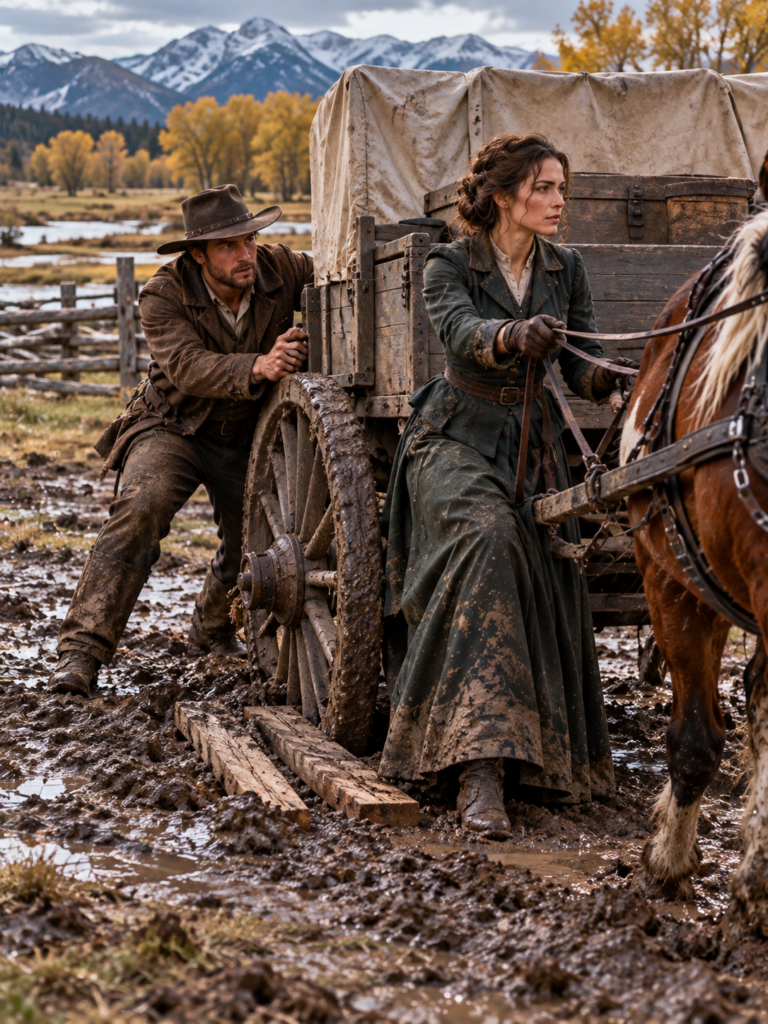
The thaw softened the roads, swelled the creeks, and turned the low pasture near the ranch into the same dark earth where Helena’s wagon had sunk the previous June.
One afternoon she drove out after seeing a patient east of town.
Douglas met her by the gate.
“Hawk’s back.”
She followed his gesture.
High over the south ridge, a red-tailed hawk circled once in the pale sky before settling near the old nest.
Helena watched.
“Same bird?”
“I believe so.”
“You cannot prove that.”
“No.”
“You generally prefer facts.”
“I make occasional room for hope.”
She looked sideways at him.
“That was sentimental.”
“I’m getting married. It may worsen.”
By May, Montana had turned green again.
They chose a Saturday.
Helena rejected every suggestion that someone escort her down the church aisle.
“You have no father here,” Mrs. Winfield said carefully, “but Reverend Cook thought perhaps—”
“No.”
Mrs. Winfield stopped.
“I know where Douglas is,” Helena said. “I do not require delivery.”
Mrs. Winfield stared at her.
Then laughed so hard she had to sit down.
The smaller church filled before the ceremony began.
Milhaven had become attached to Dr. Cross.
Children knew her firm voice.
Ranch hands trusted her hands.
Mothers trusted her judgment.
Old men who had initially refused to call her Doctor now did so with suspiciously loud emphasis in public, as though hoping no one remembered otherwise.
Douglas stood near the front in a dark coat.
He looked calm.
He was not.
Reverend Cook noticed.
“So patience has limits after all,” the minister murmured.
Douglas kept his eyes on the rear door.
“No, sir.”
“What would you call this?”
“Waiting.”
The church door opened.
Helena Cross stepped inside alone.
She wore pale sage.
Her auburn hair was pinned neatly, except for one piece already threatening rebellion near her temple.
Mrs. Winfield had forced a small bundle of wildflowers into her hands that morning.
Helena had accepted them because some battles were not worth fighting.
She walked down the aisle under her own power.
Douglas watched her come.
He thought of a muddy road.
A green dress.
A woman pressing a plank beneath a buried wheel instead of waiting for someone to rescue her.
He thought of Tuesdays.
Honey.
Bread.
A snow-covered ridge.
A west room becoming an office.
And the extraordinary fact that a woman who needed no one had chosen him anyway.
Helena reached the front.
Douglas offered his hand.
She took it.
Reverend Cook began.
The vows were simple.
Neither promised obedience.
Neither promised perfection.
Douglas promised honesty, steadiness, and respect for the work Helena had built before he entered her life.
Helena promised honesty, partnership, and the courage to remain present even when fear urged retreat.
When Reverend Cook asked whether she took Douglas as her husband, Helena looked directly at him.
“I do.”
No hesitation.
When he asked Douglas, the answer came just as clearly.
“I do.”
Afterward, the church spilled into spring sunlight.
Mrs. Winfield cried openly now and denied nothing.
Robbie Fitch, eight years old and fully recovered from the fishhook catastrophe, appeared in a stiff collar he plainly hated.
He approached Helena solemnly.
“Does this mean you live at the ranch now?”
“Part of the time.”
Robbie frowned.
“Where do sick people go?”
“To my office.”
“What if it’s night?”
“They send for me.”
He considered that.
“So nothing changes?”
Helena glanced at Douglas.
“Some things.”
Douglas looked back.
“The important things stay.”
Robbie accepted this and went in search of cake.
The first months of marriage were not magically easy.
Helena remained Helena.
Douglas remained Douglas.
Their first serious argument concerned a storm-damaged fence and Helena’s insistence on traveling to an outlying patient before the road fully dried.
Douglas thought the crossing unsafe.
Helena heard control where he intended concern.
She accused him of trying to manage her movements.
He grew angry and told her she was refusing good judgment simply because it came from him.
Silence followed.
Not romantic silence.
Unpleasant silence.
The kind that revealed marriage did not eliminate fear.
Later that evening, Douglas stood in the kitchen.
“I handled that badly.”
Helena looked up from her ledger.
“You did.”
“I should have told you what I knew about the creek crossing instead of saying you shouldn’t go.”
“Yes.”
He nodded.
“I’m sorry.”
Helena closed the ledger.
“I also handled it badly.”
He waited.
“I decided what you meant before allowing you to explain.”
Douglas pulled out a chair.
She continued.
“The road may in fact be unsafe.”
“It is.”
“Do not look pleased.”
“I wouldn’t dare.”
They found another route the following morning.
Longer.
Safer.
Douglas rode partway with her because Helena asked him to.
Then he turned back when she no longer needed him.
That became the shape of their life.
Not effortless agreement.
Adjustment.
Douglas learned that protection offered without information could feel like control.
Helena learned that accepting another person’s judgment did not erase her own.
She continued practicing medicine.
The west room filled with books, clean linen, bottles, papers, and instruments.
Douglas never moved a stack without asking.
Helena kept some money separate and contributed to shared household expenses because she wished to.
Douglas never called her earnings unnecessary.
She learned enough about ranch accounts to notice when feed costs rose sharply one winter.
He learned enough about her work to know when not to interrupt.
They divided chores according to time, skill, and circumstance rather than habit.
Douglas baked bread.
Helena kept the household medical supplies organized.
He handled most cattle work.
She helped with records when needed.
He repaired tack.
She became unexpectedly skilled at calming nervous horses during examinations.
Some evenings the ranch kitchen table held Douglas’s accounts at one end and Helena’s medical notes at the other.
Two cups stood between them.
Years later, Helena would remember that more vividly than the wedding.
The table had been built for four.
For years Douglas had set it for one.
Helena had understood that table immediately because she had lived the same way in rented rooms and boarding houses across nine towns.
One place.
One cup.
Enough.
Their marriage did not turn either of them into someone who could not live alone.
That was never the promise.
The promise was that neither had to mistake aloneness for the only form of safety.
On their first anniversary, Helena came home from town to find a jar of honey on the kitchen table.
No note.
She stared at it.
Douglas was outside repairing a gate.
She carried the jar to the porch.
“You realize you live here now.”
He looked up.
“I had noticed.”
“You can hand things to me directly.”
“I could.”
“Then why is this sitting on the table?”
Douglas drove one final nail into the hinge.
“Seemed appropriate.”
Helena held the honey in the sunlight.
Amber.
Just as it had been on the office step.
“What am I supposed to do with the jar afterward?”
“Return it.”
“To whom?”
“Me.”
“You are ten feet away.”
“I’m willing to wait.”
Helena descended the porch steps.
Douglas straightened.
She handed him the jar.
He accepted it solemnly.
“Thank you.”
“You are ridiculous.”
“Yes, ma’am.”
She kissed him anyway.
Beyond the pasture, spring runoff glimmered beneath the cottonwoods.
The road where her wagon had sunk was dry now.
Helena could still point to the exact place.
She had arrived there believing competence meant arranging one’s life so carefully that no one else could become necessary.
Douglas had been different from the beginning.
He had never asked her to become helpless so he could feel strong.
He had never mistaken assistance for authority.
On that first muddy afternoon, he had provided two boards and his shoulder.
She had held the reins.
That division had seemed practical then.
Years later, Helena understood it had also contained the whole shape of what followed.
Help without possession.
Trust without surrender.
Love without reduction.
A shared life in which both people kept their hands on what was theirs to steer.
And whenever their wagon crossed that stretch of road, Douglas still glanced at the old rut beside the pasture.
Helena always noticed.
“You’re thinking about it again.”
“Yes.”
“You stood there after I left, didn’t you?”
Douglas looked ahead.
“How long?”
“Not long.”
“That means a long time.”
He smiled.
Helena leaned back against the seat as Montana opened around them, green pasture rolling toward the distant mountains.
She had once crossed that land as a stranger carrying a medicine bag, a license, and eleven years of carefully maintained peace.
She had not been looking for rescue.
She had not needed one.
What she found instead was a man patient enough to understand the difference between being needed and being chosen.
And Douglas, who had spent years eating from one plate at a table built for four, never again mistook a quiet house for proof that he required nothing more.
By the time the wagon reached the cottonwoods, Helena reached over and took his hand.
Not because the road was dangerous.
Not because she needed steadying.
Simply because she wanted to.
Douglas closed his fingers around hers.
The wagon rolled on toward home.


