
Part 1
By the time twenty-one-year-old Zora Kovac buried the grandfather who had raised her, her two older brothers had already arranged to sell almost everything he had spent his life building.
The family house was going. The money was effectively gone. And Kovac Stove Works, the small foundry their grandfather had operated for more than sixty years, had been sold in a deal announced at $2.6 million.
Zora had worked there since she was sixteen.
She knew the weight of the iron, the smell of damp molding sand, and the exact pressure required to guide a carving tool through hard sugar maple. She had spent five years standing beside the old man, learning things he rarely bothered to explain.
But when the family gathered to hear his will, none of that appeared to matter.
What Zora received was forty acres of rocky mountain land on Bitter Creek, assessed by the county at approximately $11,000.
There was supposedly an abandoned shack somewhere among the trees.
Her brothers laughed.
What neither of them understood was that their grandfather had spent fifty years driving up that mountain almost every weekend.
He always told people he was going fishing.
And nobody had ever asked why he never brought a fish home.
The will was read on a Tuesday afternoon in April, in a county-seat conference room that smelled of old carpet and burnt coffee.
Nine chairs surrounded the table, though only five people occupied the room. Someone had left a plastic tray of shortbread cookies near a stack of legal papers.
Zora sat with her hands folded in her lap, rubbing the hardened skin on her left thumb.
Across from her sat Garrett, thirty-three, wearing an expensive jacket that no longer fit quite right. He had gained weight during the previous year, and the shadows beneath his eyes suggested that sleeping had become something he did badly.
His younger brother, Nolan, sat beside him, staring at the carpet.
Garrett had brought his own attorney.
Zora had brought nobody.
Adele Nunees, the family lawyer, held the will a few inches from her face.
She had known Emil Kovac for decades. She had drafted this particular will when Zora was ten.
“To my grandson Garrett, my grandson Nolan, and my granddaughter Zora,” Adele read, “in equal shares, the residue of my estate.”
She stopped.
Then she lowered the document.
“The problem,” she said, “is that there isn’t much of an estate left.”
Garrett’s attorney leaned forward.
“There’s a checking account.”
“With a little over four thousand dollars,” Adele replied. “That’s the entire remaining estate.”
Zora looked at her.
“What happened to everything else?”
Adele glanced toward Garrett.
“The assets were transferred into the company approximately eighteen months ago, while your grandfather was hospitalized and unable to manage his own affairs.”
The other attorney immediately spoke.
“The transfers were lawful.”
“I didn’t suggest otherwise,” Adele said.
Garrett kept his palm pressed over his phone.
Nolan continued looking down.
Adele turned another page.
“There is one additional bequest. A specific parcel of property that wasn’t included in those transfers.”
She read the provision slowly.
“To my granddaughter Zora, the forty acres on Bitter Creek and everything standing on it.”
For a moment, nobody responded.
Then Garrett laughed.
“The shack?”
“Forty acres,” Adele corrected.
“Forty acres of rock. No electricity, no proper road, no septic system.”
Garrett looked toward his attorney.
“What’s the assessment?”
“Approximately eleven thousand.”
Garrett gave a tired smile.
“That’s practically a rounding error.”
He turned toward Zora.
“Look, Zor. Once the sale is settled, we’ll make sure you’re taken care of.”
She studied him.
There had been a time when Garrett carried her on his shoulders around the foundry yard. When she was little, he had been the brother who knew how to fix her bicycle and frighten off the boys who teased her.
Now he was a stranger promising kindness after signing papers she had never been allowed to see.
“Sure,” she said.
It was the only word she managed.
Outside, a thin rain had begun falling.
Zora climbed into her old green pickup, turned the key, and listened to the failing water pump complain before the engine finally caught.
Through the windshield, she watched Garrett and Nolan walk toward Garrett’s car.
One said something.
The other laughed.
Neither looked toward her truck.
Somehow, that hurt more than the money.
Their parents had died when Zora was six.
A car accident on a wet November road had taken both of them at once, leaving three children with a grandfather who had already spent most of his adult life raising a family alone.
Emil Kovac had been sixty-four.
He had buried his wife when he was twenty-nine, raised their son without her, and then watched that son grow into a father before losing him too.
Suddenly, Emil was responsible for three grandchildren.
Garrett had been eighteen, already nearly grown. Nolan was thirteen, old enough to be angry at the world but too young to know what to do with that anger.
Zora was small enough to be carried.
And Emil carried her everywhere.
He was not an affectionate man in the ordinary sense. He rarely offered explanations or comfort. He did not say much about grief, love, or the future.
He simply made breakfast, paid the bills, kept the house warm, and went to work.
Kovac Stove Works occupied a low brick building beneath the family house.
Emil’s father had established the foundry after the war. Emil inherited it at nineteen, after his father collapsed on the sand floor.
The business made only one product: a heavy cast-iron wood stove called the Zora.
It weighed about four hundred pounds. Properly maintained, it could last longer than the people who bought it.
Emil had named the stove after his late wife.
Twenty-six winters later, when his youngest granddaughter was born, he asked that she be given the same name.
The family agreed.
So Zora grew up knowing that a cast-iron stove was older than she was, carried her name, and had been designed in memory of a grandmother she had never met.
The stove became famous across several counties.
Customers waited years for one.
There was a spiral notebook in the shipping office containing a list of names. When a customer’s turn finally arrived, the woman handling shipments would call them. Sometimes they became so emotional that they cried.
Garrett saw a business that desperately needed modernization.
Emil saw a craft that did not need improving.
And Zora saw a place where she could stand beside her grandfather without either of them having to explain what they were feeling.
She started working at the pattern bench when she was sixteen.
One afternoon after school, she found Emil cutting a block of sugar maple.
Without turning around, he extended a carving gouge behind him, handle first.
She took it.
“Push,” he said.
“Where?”
“Where you want to go.”
That was nearly the entire lesson.
For years, he taught her through silence, observation, and occasional corrections so small that she sometimes wondered whether he had touched anything at all.
By nineteen, she could carve a stove door pattern.
By twenty, her work was almost indistinguishable from Emil’s.
Then, in October, eighteen months before his death, he suffered a devastating stroke.
His speech disappeared.
Strangely, his hands remained capable.
He could still hold a gouge. He could still sharpen an edge.
But he could no longer explain what he wanted.
Only one word remained.
“Door.”
He said it constantly.
At breakfast. In his hospital bed. During visits from the nurses. While staring at the ceiling.
Sometimes he gripped Zora’s wrist, fixed his eyes on hers, and said it with such determination that she thought he might break through whatever had trapped the rest of his language.
“Door.”
“I know, Grandpa,” she would answer.
But she did not know.
Nobody did.
Garrett found the repetition unbearable.
“He says one word all day,” Zora once overheard him complaining. “It’s like listening to a smoke alarm.”
When Emil said it to Garrett, Garrett would close the bedroom door, assuming that was what the old man wanted.
Nine days after the will was read, Zora received a letter from the new owners of Kovac Stove Works.
Her position was being eliminated.
The letter thanked her for her service and explained that the pattern department was being restructured.
The pattern department consisted of one bench.
And Zora.
Reuben, a sixty-eight-year-old foundry worker who had spent thirty-one years on the sand floor, received his dismissal that same week.
He was three months away from qualifying for his pension.
That night, Zora drove to the foundry.
Her employee badge still opened the door.
Inside, the furnace was cold, the lights were dim, and the building was so quiet that she could hear her boots scraping the concrete.
She walked to her grandfather’s bench.
Someone had emptied it.
Her carefully sharpened gouges lay together in a milk crate, their metal edges knocking against one another.
She stood over them, staring at the scratches that careless handling would leave behind.
The bench was worn into a shallow depression where Emil had leaned his forearms for decades.
His old canvas apron still hung beside the doorway, stiff and brown, with a burn mark across the front.
Zora reached for it.
The lights came on.
Garrett stood behind her.
“You shouldn’t be here.”
“I worked here yesterday.”
“You know what I mean.”
She looked down at the tools.
“Apparently I don’t.”
Garrett stepped closer.
“It’s not personal.”
Zora almost laughed.
“It’s a foundry, Garrett. We make four-hundred-pound stoves with somebody’s name on them. It’s all personal.”
He studied the crate.
“Take your tools.”
She lifted it against her hip.
Then she reached again for the apron.
Garrett took it off the hook first.
“That’s Grandpa’s,” she said.
“I know.”
“Then give it to me.”
“It’s company property.”
The words sounded ridiculous even to him.
He folded the apron over his arm and carried it to his car.
Zora drove away with the crate beside her.
She had less than two thousand dollars in savings, a truck that needed repairs, and no job in a town where the foundry had been the largest employer for generations.
Eleven days later, the family house sold.
Zora moved her belongings out in four trips.
She had a bed, a dresser, some clothes, and very little else.
For two nights, she slept in her truck behind the laundromat.
On the third morning, she decided to visit the only property anyone had left her.
The mountain road began nine miles outside town.
There was no sign for Bitter Creek. Only a gap between the trees and two deep ruts climbing into the forest.
It took forty minutes to travel a mile and a half.
Her truck scraped the ground twice.
A fallen larch partly blocked the track. She climbed out and pushed it aside. It moved more easily than expected, as though someone had been keeping the road passable.
Then the trees opened.
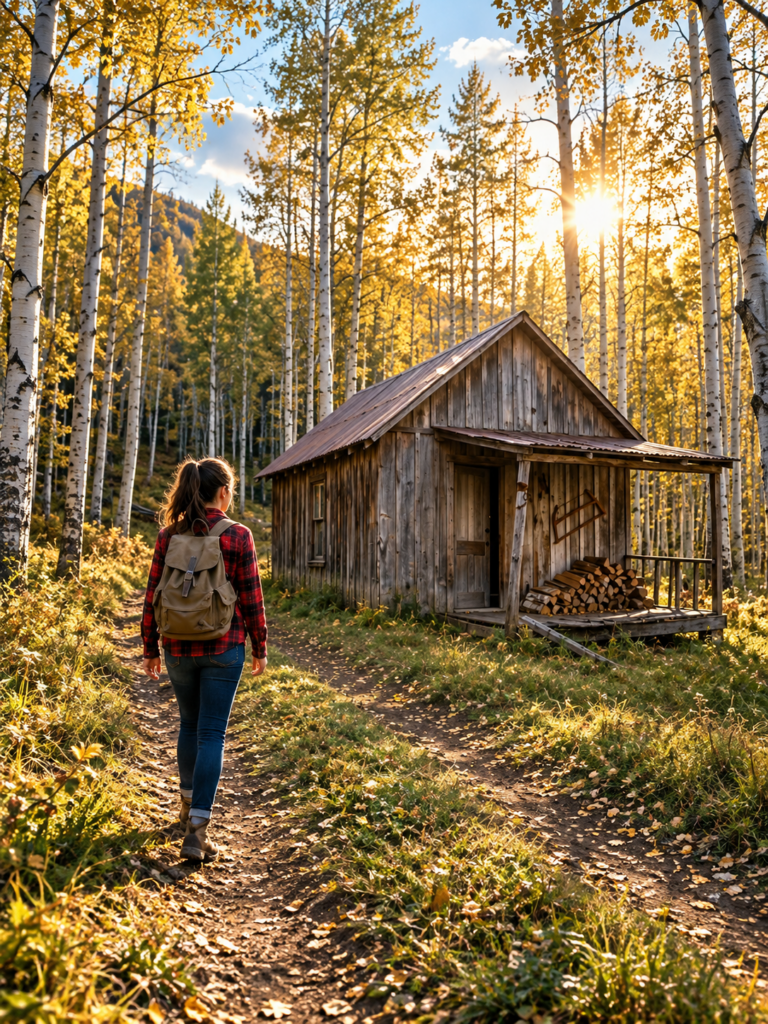
A small log cabin stood in the clearing.
Zora turned off the engine.
For a long moment, she stayed behind the wheel.
The building had squared-log walls silvered by weather, three windows along one side, and a metal roof that looked surprisingly new.
It was certainly not the ruined shack Garrett had described.
The roof could not have been more than several years old.
Someone had maintained this place.
She approached the heavy oak door.
It had no lock.
It was swollen tightly into the frame, and she needed two hard pushes with her shoulder before it opened.
The moment she stepped inside, she stopped.
Linseed oil.
Wood shavings.
Iron.
It was the exact smell that had clung to her grandfather’s shirts.
A long maple workbench occupied the south wall. Dozens of carving tools hung above it, arranged neatly by size and shape.
A hand-cranked lathe stood in one corner.
Lengths of sugar maple rested beneath a canvas cover.
A clean coffee cup sat upside down on a folded towel.
This was not an abandoned fishing cabin.
It was a fully equipped pattern shop.
Zora moved slowly along the bench, touching familiar tools.
Then she noticed a brass clock above the door.
Its second hand was moving.
She took out her phone and compared the time.
The clock was approximately ninety seconds fast.
Someone had wound it recently.
“Hello?”
Her voice sounded strange in the small room.
No answer came.
She searched the cabin.
There was no bed, no clothing, and no stored food suggesting someone lived there.
Only tools, wood, and a ladder leading into a loft.
Whoever maintained the cabin came here to work.
In one corner sat an old Zora stove.
She crouched beside it and examined the back leg, where the foundry stamped its serial numbers.
Her phone flashlight illuminated two digits.
04.
Number four.
The first three stoves Emil made had become part of company history. People still told stories about the struggle to get enough money to produce them.
But number four had disappeared.
For decades, nobody knew where it had gone.
Zora put her hand against the cold iron.
Her grandfather had kept it here.
Above her, the loft waited.
She climbed the ladder.
At the top, she stopped so suddenly that her knee struck a rung.
Wooden patterns hung from pegs beneath the rafters.
Hundreds of them.
Stove doors, frames, tops, feet, collars, and intricate shapes she recognized from the foundry.
Each had a handwritten tag.
She knew Emil’s handwriting immediately. He drew a line through every seven, an old habit she had teased him about when she was little.
Zora crawled toward a familiar door pattern.
She lifted it from its peg.
It looked nearly identical to the pattern she had used at work.
But as she turned it over, she realized something was different.
There were no repairs.
No filled cracks.
No replacement corners.
No layers of hardening compound covering decades of damage.
The lettering was sharp, and the draft angles were precisely cut.
She ran her thumb along the inner edge.
Perfect.
At the foundry, the same edge had been worn slightly crooked for years.
That was when she understood.
The patterns at Kovac Stove Works were copies.
Everything the factory used had been copied from these original wooden masters.
A foundry pattern is not simply a model. Its shape determines the cavity pressed into molding sand, and that cavity determines the shape of the iron poured into it.
Wear the pattern enough, and the casting changes.
Repair it repeatedly without an original reference, and tiny errors begin accumulating.
A stove door stops sealing correctly.
A top sits unevenly.
A seam opens.
Eventually, a product famous for lasting generations begins failing in ordinary homes.
Zora had spent five years repairing the company’s working patterns.
But Emil had preserved the original shapes here, untouched by the damage of daily production.
The very foundation of the family business was hanging beneath this cabin’s roof.
And Garrett had handed the cabin to her because he thought it was worthless.
Headlights suddenly swept across the loft wall.
An engine approached slowly through the trees.
Zora hurried down the ladder and grabbed a splitting maul beside the doorway.
She was twenty-one, alone in the mountains, and had no idea who was coming.
A pickup stopped outside.
The driver’s door opened.
“Zora?”
She recognized the voice.
“Reuben?”
“Put down whatever you’re holding, girl. I’m too old to have things thrown at me.”
Reuben appeared in the headlights, his gray mustache moving as he spoke.
She lowered the maul.
“What are you doing here?”
“Same thing I’ve been doing every Saturday for a year and a half.”
He glanced toward her pickup.
“Except somebody parked in my spot.”
Inside, Reuben lit the old number-four stove without asking where the kindling was kept.
He adjusted its stiff damper with a practiced motion.
Zora watched him.
“You knew about this place.”
“I did.”
“And you never told me?”
He sat on an overturned crate.
“After the stroke, Garrett took your grandfather’s driving license. That was the right decision. Emil couldn’t speak properly, and he wasn’t safe behind a wheel.”
Reuben rubbed his hands over the heat.
“The first Saturday after he came home, I visited him. He was standing in the hallway with his boots and coat on. Had his keys in his hand.”
“What did he want?”
“He wanted me to drive him up here.”
Reuben looked toward the ladder.
“So I did. And I drove him the next Saturday, and the Saturday after that.”
Zora sat on the floor.
“For how long?”
“Until the week he died. Ninety-some Saturdays.”
Her eyes moved toward the loft.
“He was still working?”
“Three or four hours every visit. Even when getting him up that ladder became a production.”
Reuben gave a small smile.
“I’d sit down here doing my crossword and listen to make sure he hadn’t fallen.”
“Why didn’t you tell me?”
“Because he asked me not to.”
“He couldn’t ask you anything. He had one word.”
“He had two hands and a face, Zora. I’d known him since before you were born.”
Reuben explained that he once asked whether Zora knew about the cabin.
Emil had pressed a finger to his lips.
That was his answer.
Zora stared at the flames.
“He should have told me.”
“Yes,” Reuben said. “He should have.”
She had expected him to defend her grandfather.
The agreement hurt more.
Then she told Reuben what she had discovered upstairs.
He nodded without surprise.
“Those are the masters.”
“You knew?”
“Not everything. But every once in a while, a fresh pattern appeared on the bench at work. Monday morning, there it’d be. Brand-new. The old one gone.”
“Nobody asked where it came from?”
Reuben shook his head.
“For years, we all just accepted it. Your grandfather provided what we needed, and none of us bothered to ask how.”
He leaned toward the fire.
“That’s something I’ve been thinking about lately. A man spent his entire life making things possible for the rest of us, and we let him do it alone.”
Zora looked at the ceiling.
“So what happens to the foundry now?”
Reuben took his time answering.
“The working patterns are nearly worn out. Your grandfather brought the last replacements down a couple summers ago. They’ve got maybe another six months before the tolerances start slipping.”
“Can’t they repair them?”
“Against what?”
She said nothing.
“That’s what a master pattern is for. You need something true to measure against.”
He gestured upward.
“Garrett sold the building, the furnace, the machinery, the company name, and the customer list.”
Then he looked directly at her.
“But the originals are up there. So are the records that explain how to use them.”
The stove crackled.
“And without those,” Reuben said, “that company is going to start making bad stoves. And sooner or later, somebody down there is going to realize that the one thing they need most belongs to the granddaughter they fired.”
Part 2
Reuben left close to midnight.
Before going, he told Zora about a spring forty feet behind the woodshed.
“Water runs all year,” he said. “Your grandfather drank from it for fifty years.”
Then he climbed into his pickup and disappeared down the rutted road.
Zora slept on the floor beside the old stove, wrapped in her coat.
She slept for fourteen hours.
When she woke, the fire had gone out. For several seconds, she could not remember where she was.
Then she saw the workbench.
The carving tools.
The ladder.
And the truth of what she had inherited returned all at once.
For the next three days, she did almost nothing.
She drank spring water, ate crackers, and lay staring at the ceiling.
She was grieving her grandfather, but she was also grieving the version of her family she had spent her childhood believing in.
Her brothers had taken the house.
They had taken the business.
They had taken the ordinary certainty that she had somewhere to return to.
And now she had discovered that the person who loved her most had kept an entire part of his life hidden.
On the fourth morning, she found herself standing beside the workbench.
She had not decided to begin working.
Her hand simply reached for a number-five gouge.
She secured a scrap of maple in the vise, tested the edge, and pushed.
A thin shaving curled away.
The movement was so familiar that it made her knees weak.
Her grandfather was gone.
But everything he had taught her remained in the muscles of her hands.
She continued carving.
After a while, she began crying.
She did not stop working.
Later that afternoon, Zora found the notebooks.
They occupied a low shelf beneath the bench: fifty-one green ledgers with cloth spines, their pages covered in Emil’s cramped handwriting.
She opened one.
It contained dates, furnace charges, iron weights, sand moisture readings, tapping temperatures, production results, and problems discovered after casting.
He had recorded nearly every pour for decades.
He had even recorded the weather.
At first, that detail puzzled her.
Then she understood.
Humidity affected the moisture in molding sand. Too much moisture meant steam when hot iron entered the mold. Steam could cause tiny defects that weakened castings.
Emil had watched these changes for decades.
He adjusted the mixture according to conditions that nobody else had considered important enough to record.
At the foundry, his employees believed he worked from instinct.
In reality, he had spent most of his life documenting the relationship between the weather, the sand, the iron, and the finished stove.
Fifty-one notebooks.
A lifetime of practical knowledge.
Zora sat with a ledger open across her knees.
“He wasn’t fishing,” she whispered.
He had been working.
All those weekends.
All those years.
And somehow, the people who depended on his knowledge had never known where it came from.
Reuben returned the following Saturday carrying groceries.
He found her at the bench with wood shavings covering her boots.
“You look better.”
“I look terrible.”
“Better than last week.”
He put coffee, bread, eggs, and vegetables in a cupboard she had not bothered opening.
Then he sat on his familiar crate and worked on a crossword while she carved.
He did not ask how she felt.
He did not demand a plan.
Before leaving, he took her trash.
The next Saturday, the foundry’s former melter arrived.
He had worked the furnace for twenty-six years and carried a burn scar on his forearm shaped vaguely like Ohio.
“Reuben says you’ve got a lathe that doesn’t turn,” he announced.
“It turns. It’s just stiff.”
“That’s what not turning means.”
He unloaded his toolbox and spent most of the afternoon repairing it.
Another Saturday, the woman who used to operate the overhead crane came with a chainsaw.
She cleared the fallen larch from the road and widened one difficult turn so pickup trucks could reach the cabin more easily.
By July, there were sometimes five people working on the mountain.
Nobody organized them.
Nobody held a meeting.
The foundry was closed, and the people who had spent their lives working there needed somewhere to put their hands.
So they came.
One Thursday, Zora told Reuben something she had never told her family.
“When I was eighteen, I got accepted into a metal arts program out west.”
He looked up from his crossword.
“Good program?”
“Two years. They only accepted eleven students.”
“And you were one of them?”
She nodded.
“The letter came in August. Grandpa had his stroke in October.”
Reuben waited.
“I never went. I never even told him.”
She kept sharpening the gouge in her hands.
“Sometimes I think I used his illness as an excuse because I was scared to leave.”
Reuben considered that.
“Do you want me to tell you that staying was the right decision?”
“No.”
“Good. Because I can’t decide that for you.”
He studied the wood on her bench.
“But your grandfather made more than ninety trips up this mountain after his stroke. He kept working because he believed there was something worth finishing.”
Zora lowered the tool.
“That doesn’t mean he wanted me to stay.”
“No,” Reuben said. “But it means he knew you were capable of more than you believed.”
She looked away.
The conversation remained with her long after he left.
Then, during the final week of July, she discovered what Emil had been trying to finish.
A gray shopcloth lay folded over an object at the far end of the bench.
It had been there since Zora first entered the cabin.
She had never lifted it.
That afternoon, a chisel rolled away, and she caught herself against the covered object.
Her palm recognized a shape that did not belong to any ordinary tool.
She pulled away the cloth.
Underneath sat a small wooden stove pattern.
It was beautifully made.
The body, legs, top, and flue collar had been carved from sugar maple and finished with shellac. Every surface was smooth. The draft angles were ready for molding sand.
But the stove was unusually small.
It measured perhaps eighteen inches across.
A stove that size could never heat a whole house.
It could heat one room.
A room approximately the size of the cabin.
And it was missing its door.
The opening was perfectly shaped, but no matching door pattern lay nearby.
Zora searched the loft.
Nothing.
She returned to the bench and turned the small stove pattern over.
Underneath, in pencil, were words written in Emil’s familiar hand.
For Z, when she has a place of her own.
Zora sat down.
Her first thought was that the message referred to her grandmother.
Emil had named the original stove for his wife. He had built this cabin during the year she died. Perhaps he had once intended to make her a small stove for a home they would share.
It was a sad explanation.
It was also wrong.
Beside the inscription was a date.
Five summers earlier.
Her grandmother had been dead for half a century.
Zora stared at the pencil marks.
Five summers earlier, she had been sixteen.
That was the year Emil had held out a gouge and waited for her to take it.
He had started building this small stove when she first showed an interest in his craft.
He had not made it for her grandmother.
He had made it for his granddaughter.
For the day she had a home of her own.
She carried the pattern toward the window, examined every unfinished detail, and imagined Emil sitting at the bench year after year, cutting and sanding, preparing something he expected her to need someday.
Even after his stroke, he had come back here.
Even when speech failed him, he had continued working.
But he had never finished the door.
Zora looked at the empty opening.
“Door,” she said softly.
She remembered the hospital room.
His hand around her wrist.
His eyes fixed on hers.
That same word, spoken again and again.
She covered her mouth.
When Reuben arrived that evening, he found her sitting in the clearing.
“He was making me a stove.”
Reuben looked past her toward the cabin.
Then he nodded slowly.
“So that’s what he was working on.”
“You knew?”
“I knew he was making something. I never looked at it. That bench was his business.”
“There’s no door.”
Reuben stood quietly beside her.
Then he said, “I heard him tell us that more times than I could count.”
For a long while, neither spoke.
On August ninth, a black rental sedan struggled into the clearing.
Its undercarriage scraped against the road, and a piece of trim hung loose beneath the bumper.
A man in his forties stepped out.
He wore an expensive casual jacket and boots that looked as if they had never touched real mud.
“Miss Kovac?”
Zora remained on the porch, holding a chisel.
“My name is Colin Reyes. I represent the group that purchased Kovac Stove Works.”
She said nothing.
“I’ve been trying to contact you.”
“There’s no phone service up here.”
“I noticed.”
He glanced toward the cabin’s loft window.
“I’d like to discuss something with you.”
“Discuss it.”
Reyes took a photograph from his jacket.
Zora recognized the image immediately.
It showed the inside of her loft.
The wooden patterns hanging from pegs.
The handwritten tags.
The originals.
She felt her grip tighten on the chisel.
“Where did you get that?”
“I’m not going to identify the person who provided it.”
“You’ve never been inside my cabin.”
“No.”
“Then somebody came onto my property.”
Reyes slipped the photograph away.
“Can we go inside?”
“No.”
“All right.”
He stood in the yard.
“Your grandfather’s working patterns are deteriorating.”
Zora watched him carefully.
“In July, I removed a stove from the production line,” he continued. “Then I bought an older stove from a customer in the next county. Paid nine hundred dollars for it.”
He described taking measurements.
The new door sat approximately forty thousandths of an inch farther outward than the older one.
He asked if she understood the consequences.
“It’ll crack around the hinge boss after enough heating cycles,” Zora said.
Reyes stopped.
“Exactly.”
For the first time, he looked at her as though she were someone whose opinion mattered.
He admitted that the company had no complete engineering drawings, no usable original specifications, and no reliable way to reconstruct the tolerances Emil had maintained.
Then he explained the sale.
The brothers had not received $2.6 million outright.
They had received $1.9 million at closing.
The remaining $700,000 was a performance holdback, payable over three winters only if production remained within specifications.
“And it won’t,” Reyes said.
“Probably not.”
“We’ll start seeing serious warranty claims by March. Unless something changes, the company won’t survive.”
“Why are you telling me?”
“Because I want to purchase everything in that loft. The patterns, the records, the tooling. All of it.”
He paused.
“Four hundred thousand dollars.”
Zora had approximately $1,400 in the bank.
Her truck had needed a new water pump in June, wiping out another five hundred dollars.
She could scarcely comprehend the amount.
“No,” she said.
Reyes nodded as though he had expected the answer.
“I’ll return.”
Nine days later, he did.
This time, his offer was $800,000.
And a job.
Head of the pattern department at Kovac Stove Works.
A new workshop, proper dust collection, the right to hire her own team, and control over the department she would lead.
“You could bring those workers back,” Reyes said. “Build it the way it should have been built.”
He waited.
Zora looked at the mountain, the shop, and her grandfather’s workbench.
Then she said, “Okay.”
Reyes did not celebrate.
He simply promised to bring the papers.
For the next hour, Zora felt an almost physical relief.
Eight hundred thousand dollars would change her life.
She could fix her truck, help Reuben, bring back the melter, and create a proper workshop with equipment her grandfather had refused to purchase.
She could stop worrying about how much money remained in her bank account.
She could restore what had been taken.
But when evening came, she lit the number-four stove and sat beside the little pattern on the bench.
It was still missing its door.
She looked at it through most of the night.
By dawn, she had not reached a neat explanation for what she felt.
She only knew she could not sign away the place where Emil had spent his last years working.
She drove to the bottom of the mountain road, where her phone could receive a signal, and called Reyes.
“I’ve changed my mind.”
A long pause followed.
“May I ask why?”
“No.”
It was the only truthful answer she had.
She could not yet explain it to herself.
On the final Saturday in August, Garrett and Nolan drove up the mountain together.
By then the road had been improved enough for Garrett’s car.
Zora watched them arrive from the porch.
Reuben and the melter stepped out of the workshop and stood nearby.
Garrett looked around at the trucks, the repaired road, and the busy cabin.
“I’d like to speak with you alone,” he said.
“No.”
“Zora—”
“Whatever you have to say, you can say in front of them.”
Garrett removed his sunglasses.
“The patterns belong to the company.”
“No, they don’t.”
“They were made for company use by the man who ran the company. That’s company property.”
“He made them on his land, in his own shop, with his own materials.”
Garrett’s expression hardened.
“I’ve spoken to lawyers. We have a claim.”
Zora set the chisel on the porch rail.
“Then make it.”
Garrett looked at her for a moment.
Then something changed in his face.
“You think I enjoyed running that place?”
She did not answer.
“In 2019, the foundry lost money. Same thing in 2020. Do you know how many nights I spent moving money around just so twenty-two people could get paid on Friday?”
Zora watched him.
“I begged Grandpa to buy one machine,” Garrett continued. “One router that could cut a pattern in hours instead of weeks. He wouldn’t even read the brochure.”
His voice grew strained.
“He’d disappear every weekend and leave me sitting at the kitchen table trying to figure out payroll. I did that for eleven winters.”
He looked toward the cabin.
“He didn’t tell me about this place. He didn’t show me those notebooks. He wouldn’t explain how he did anything.”
Zora could hear the genuine exhaustion beneath his anger.
And she understood something she had been unwilling to admit.
Her brother had carried burdens she had never seen.
Their grandfather had been stubborn, proud, and secretive. His silence had injured Garrett just as surely as it had injured her.
“You’re right,” she said.
Garrett stared.
“He should have told you. He should have shown you the shop and the records and let you help him.”
For a moment, Garrett seemed almost relieved.
Then Zora continued.
“But after his stroke, you used his signature to move the assets. And then you sold the foundry.”
“I saved that company.”
“You sold it.”
“I saved it first.”
His voice cracked.
The clearing became quiet.
Then Nolan spoke.
“You didn’t stay because you loved Grandpa more than we did.”
Zora turned.
Nolan stood near the car, his face flushed.
“You stayed because you were scared to leave. You got that school acceptance and never went. Then Grandpa got sick, and suddenly you had a reason to stay.”
The words hurt because they reached something she had already admitted to herself.
“Maybe,” Zora said.
Nolan looked surprised.
“Maybe you’re right. I’ve thought about it. I’ll probably keep thinking about it.”
She looked directly at him.
“But you came up here in July, didn’t you?”
Nolan’s expression changed.
“You took that photograph of the loft.”
He looked away.
“Didn’t you?”
“Yes.”
Garrett turned sharply.
“What photograph?”
Nolan swallowed.
“Reyes was asking questions. I remembered all that wooden stuff from when we were kids.”
“You came onto her property?” Garrett asked.
Nolan said nothing.
For the first time, Zora saw genuine surprise on Garrett’s face.
He had not known.
She looked at both brothers.
“I’m not going to spend the rest of my life trying to make you the bad guys.”
Neither answered.
“I’ve got fifty-one notebooks to read and a stove that still needs a door.”
She stepped down from the porch.
“I’m not going to ruin you. I’m just going to stop carrying you.”
Eleven days later, legal papers arrived.
Garrett’s attorneys sought a declaration that the patterns belonged to Kovac Stove Works, along with a claim that Zora was wrongfully keeping company property.
Adele Nunees called her.
Zora drove down to the place where her phone worked and sat in her truck with the driver’s door open.
“Can they win?” she asked.
“That’s not the question you should ask,” Adele replied.
“Then what’s the question?”
“Can you afford to fight them?”
Adele explained that a court might ultimately agree that the patterns were Zora’s property.
But a lawsuit could take two or three years.
Legal expenses could exceed $100,000.
Garrett’s attorneys could bill a corporation.
Zora would have to pay from her own savings.
“They don’t have to prove they’re right immediately,” Adele told her. “They only have to make defending yourself too expensive.”
Zora stared toward the trees.
“What am I supposed to do?”
“You settle. Or you find money. Or you find something in writing that settles ownership before a court ever has to.”
“Like what?”
“A letter. A note. Any document showing what Emil intended. Did he ever write anything about that property?”
Zora went still.
Her grandfather had written everything down.
The sand.
The iron.
The temperature.
Even the weather.
“Adele,” she said slowly. “He wrote down the weather.”
She hung up and drove back toward the cabin.
She did not know whether the answer was waiting there.
But for the first time since the lawsuit arrived, she knew where to look.
Part 3
Zora nearly destroyed the bottom of her truck driving back up the mountain.
At one bend, the undercarriage struck a rock hard enough to make her wince.
She did not stop.
Inside the cabin, she dropped to her knees in front of the shelf beneath the workbench.
One by one, she pulled out all fifty-one green ledgers.
She stacked them across the floor until the shelf was empty.
Then she saw something pushed against the back wall.
An old metal cookie tin.
Its lid showed a faded Scottish terrier, and rust had eaten through one corner.
Zora pulled it into the light.
The lid resisted.
She worked her thumbnail around the edge until it finally opened.
Inside were letters.
Dozens of them.
Every letter carried the name Adele Nunees.
The correspondence went back seven summers.
Zora unfolded the first page.
Then the next.
Gradually, she realized that her grandfather had been planning something nobody knew about.
He had wanted to sell Kovac Stove Works to its employees.
Not to investors.
Not to Garrett or Nolan.
To the twenty-two people whose labor kept the furnaces burning and the business operating.
The letters contained proposed payment schedules, financing arrangements, and calculations for transferring ownership to workers who could never have afforded to purchase the company outright.
Adele had repeatedly explained the difficulties.
Emil had repeatedly asked her to find a way.
Zora continued reading.
The final proposal was forty pages long.
It outlined how the employees could gradually purchase the business through a financing arrangement designed around what the foundry could realistically earn.
At the back was a line for Emil’s signature.
It was blank.
Zora rested her thumb against the empty space.
Her grandfather had spent years trying to accomplish something that might have changed everything.
But he had waited too long.
The stroke had taken his ability to explain and complete the arrangement.
A month later, Garrett had power of attorney.
The employee ownership plan was abandoned.
The company was reorganized instead.
Zora sat with the unsigned document in her lap.
She could imagine Garrett discovering the plan and rejecting it as impractical.
She could imagine Emil refusing to explain himself even when explanation might have saved the foundry.
Both men had been stubborn in different ways.
And somewhere between their competing ideas, twenty-two workers had lost the chance to own the place they helped build.
Then Zora noticed another page beneath the letters.
It was a county document.
There was an official stamp, a recording number, and a date.
She recognized the date.
It was the same week Emil had begun carving the little stove for her.
Five summers earlier.
Her grandfather had apparently driven into the county seat, visited the recorder’s office, and filed a statement concerning the Bitter Creek property.
It described the cabin as a pattern shop.
It identified the shop’s contents—the patterns, tooling, records, and workbench—as belonging with the property rather than being separable from it.
Those contents, Emil had written, were to pass with the land.
The document was signed.
Witnessed.
Recorded.
Zora read it again.
Then she ran outside and climbed into her truck.
She drove to the bottom of the mountain and called Adele.
“There’s something I need you to hear.”
She read the document aloud.
When she finished, the other end of the line remained quiet.
“Adele?”
“Read me the recording number.”
Zora did.
There was another pause.
“All right,” Adele said. “Now I want you to listen carefully.”
Zora gripped the phone.
“Your grandfather owned the company outright when that document was recorded. There were no outside shareholders. No partners. Nobody else controlling it.”
“Okay.”
“If the company had any claim to those master patterns, its sole owner was in a position to clarify or relinquish that claim.”
Zora looked toward the mountain.
“And he did?”
“That’s what this document appears to show. Five years ago. Well before his stroke.”
Adele’s voice sharpened with excitement.
“And because it was recorded while he still had full capacity, your brothers can’t simply argue that he didn’t know what he was doing.”
Zora closed her eyes.
“There’s something else,” Adele continued.
“The will.”
“What about it?”
“Do you remember the wording of the Bitter Creek bequest?”
Zora had heard those words only once, sitting across from her brothers at the conference table.
But she remembered them perfectly.
“The forty acres on Bitter Creek. And everything standing on it.”
“Exactly.”
Adele explained that the recorded statement connected the contents of the pattern shop to the property itself.
The same language Emil had placed in the will years earlier now had a documented meaning.
And when the estate was distributed, Garrett had signed the papers acknowledging that the land and its contents passed to Zora.
While laughing about how little they were worth.
“He signed it?” Zora whispered.
“His signature is on the paperwork.”
“He didn’t know.”
“No,” Adele replied. “He didn’t.”
Zora covered her eyes.
For months, she had believed the cabin was a lucky accident.
Now she understood that Emil had taken deliberate steps to protect what was inside it.
He had not simply hidden the patterns.
He had made a public record of where they belonged.
And the evidence had been sitting in the county recorder’s office for five years.
“Why didn’t Garrett’s lawyers find it?” she asked.
“Because they saw an eleven-thousand-dollar mountain parcel and apparently didn’t think it warranted a complete search.”
Adele gathered her papers.
“I’ll verify the original recording. Then I’ll send it to opposing counsel.”
“What happens to the lawsuit?”
“If everything is as this document states, they have a serious problem with their claim.”
Adele paused.
“Your brother is trying to argue that the company owns something its former sole owner specifically placed with another property. Your grandfather anticipated the issue before any of you knew it existed.”
Zora stared through the windshield.
She did not laugh.
The discovery felt too large for that.
Eleven days after Adele contacted the other law firm, the lawsuit was dismissed.
There was no courtroom confrontation.
No judge delivering an emotional speech.
No dramatic moment when Garrett was forced to stand before his sister and admit defeat.
Zora was in the cabin carving wood when Reuben came through the doorway holding his phone.
“Adele says it’s over.”
Zora glanced up.
“Okay.”
She returned to the pattern.
Several minutes passed.
Then she put down the gouge and walked outside.
She stood in the clearing, looking toward the trees.
That was when she finally understood the word her grandfather had repeated after his stroke.
Door.
For eighteen months, he had tried to communicate with a family that could no longer understand him.
He had known about the mountain.
The original patterns.
The fifty-one notebooks.
The county record.
The little stove waiting for its final piece.
He had known that an unfinished door remained on his workbench.
And he had known Zora was the person who could finish it.
But he could not say cabin.
He could not say Bitter Creek.
He could not say go upstairs.
He could not even say her name.
He had only one word.
Door.
So he said it.
To the nurses.
To the ceiling.
To Reuben.
To Garrett.
And to Zora while she fed him dinner and promised she understood.
He had been trying to tell her about the thing he could no longer complete.
Perhaps he had been trying to tell her about the whole mountain.
She would never know exactly what he intended.
But the word had brought her back to the same place.
The unfinished door.
The gift.
The work waiting for her hands.
Zora stood outside until the light began to fade.
Then she returned to the bench.
There was still work to do.
The old foundry deteriorated just as Reuben had predicted.
Production quality declined through the fall.
Winter was worse.
The working patterns had drifted too far from their original dimensions, and the problems were no longer small enough to ignore.
The performance targets attached to the sale were missed.
The remaining $700,000 payment never reached Garrett and Nolan.
Warranty problems accumulated.
In February, the buyer shut down the operation and walked away.
Kovac Stove Works went dark.
The customer waiting list still held names.
The furnaces were cold.
And the building where Emil’s family had worked for generations stood empty.
Garrett had received $1.9 million at closing, but there were legal expenses, debts, and other costs.
He had sold the family house.
He had lost control of the business.
And he no longer had the factory his grandfather once expected him to run.
Nobody on the mountain celebrated.
One Saturday, the melter made a remark about Garrett finally getting what he deserved.
Reuben told him to stop.
And that ended the conversation.
Zora did not want her brothers destroyed.
She only wanted to stop being destroyed by them.
In March, Nolan appeared at the cabin.
He walked the final stretch of road in his work coat, hands buried in his pockets.
Zora saw him approaching and went outside.
They stood several feet apart.
“I took the picture,” he said.
“I know.”
“I want to say it anyway.”
He looked toward the loft window.
“Reyes was in town asking questions. I remembered Grandpa had all that wooden stuff up here when we were kids.”
Zora waited.
“I thought maybe I could find something useful. Maybe I could be the one who—”
He stopped.
Nolan had never been good at finishing difficult sentences.
“I didn’t tell Garrett,” he added.
“I know that too.”
They stood together in the chilly air.
“What do you want me to say?” Zora asked.
Nolan had no answer.
She studied her brother.
Twenty-eight years old.
A man who had spent years following Garrett, trying to belong somewhere, and making decisions he lacked the courage to explain afterward.
She could still remember him at thirteen, furious and frightened after their parents died.
That boy was somewhere inside this man.
But remembering him did not erase what the man had done.
Zora looked toward Reuben’s pickup.
“There’s about four hundred pounds of sand in the back of that truck,” she said. “It needs to come inside before it gets wet.”
Nolan looked at her.
“You’re asking me to help?”
“I’m telling you what needs doing.”
He hesitated.
“Zora—”
“This isn’t forgiveness. Don’t mistake it for forgiveness.”
Nolan nodded.
Then he went to the pickup and began carrying sand.
He worked until dark.
He returned the next Saturday.
And the next.
They did not discuss the will, the photograph, or the months after Emil died.
Perhaps they never would.
But Nolan showed up.
Sometimes that was all either of them could manage.
Garrett visited once.
It was April, almost a year after the will reading.
Zora heard a car approaching and came onto the porch.
Her oldest brother stood in the yard.
He did not come closer.
For a while, they simply looked at each other.
He had no prepared speech.
No explanation.
No apology.
Finally, he approached the porch, placed something folded on the railing, and turned away.
It was Emil’s canvas apron.
Brown.
Stiff.
Burned across the front.
The apron Garrett had refused to give her on the night she lost her job.
He had kept it in his car for nearly a year.
Zora watched him drive away.
Then she carried the apron into the cabin and hung it on a nail beside the door.
She never wore it.
It belonged to Emil.
She wanted it there, but she did not need to make it hers.
As the months passed, the work on Bitter Creek began changing.
Reuben kept coming.
So did the melter.
The woman who had once operated the foundry crane began handling records and accounts, discovering that she was exceptionally good at them.
Other former employees offered their time when they could.
And Zora returned to the forty-page ownership proposal she had found in the cookie tin.
She took it to Adele.
“Can you make this smaller?” she asked.
“How much smaller?”
“Small enough that we can actually do it.”
Adele studied the old documents.
Eventually, the forty pages became six.
The new agreement established that the mountain workshop would belong to the people who worked there.
After a year of qualifying work, an employee earned an ownership share.
The structure was designed to protect those shares and prevent any one person from selling the business out from beneath everyone else.
It was not a perfect solution to every problem.
But it was workable.
Eleven months after the discovery of the tin, a small foundry stood forty feet behind Emil’s cabin.
It was a pole barn with a solid roof, a modest cupola furnace, and a sand floor.
Six people could work inside if they were careful about where they stood.
On a good month, they produced seven stoves.
Usually, they produced six.
Reuben became foreman.
He called the title unnecessary, then performed the duties anyway.
The melter handled the furnace.
The former crane operator managed the books.
Zora carved patterns and supervised the work.
She could not restore Reuben’s lost pension.
Nothing could give him back the benefit he had earned through thirty-one years of labor, only to lose it three months before qualifying.
She could not undo that injustice.
What she could do was help build a place where the people doing the work had a say in what happened to the business.
They were backordered before the first stove was poured.
The woman who had managed shipping at the old foundry had saved the spiral notebook containing the waiting list.
One Saturday in May, she brought it to the mountain.
She handed it to Zora.
“This doesn’t belong to those buyers,” she said.
Then she looked toward the workshop.
“It never really did.”
Customers began calling again.
Some had waited years for a Zora stove.
Others had heard that the original patterns were still being used.
The workshop was too small to satisfy everyone.
Zora refused to promise otherwise.
She wrote down the names.
She explained the waiting times.
And she went back to work.
In June, a sixteen-year-old girl named Marisol walked up the mountain carrying a garbage bag.
Inside was a cracked stove door.
Marisol’s mother had worked in the old foundry’s core room and had been unemployed since February.
The girl was angry about nearly everything.
“They said you’re the one who fixes these now,” she told Zora.
“Who said that?”
“Everybody.”
Zora examined the broken iron.
Then she studied the girl standing in front of her.
Sixteen years old.
Angry.
With nowhere else to take a problem that mattered to her.
Zora remembered herself at that age.
She remembered walking into the foundry after school and standing beside Emil because she had nowhere else she wanted to be.
“Come inside,” she told Marisol. “It’s cold, and I’m not doing this in the yard.”
Marisol began visiting regularly.
She watched the carving.
Asked questions.
Made mistakes.
And slowly learned how patterns guided the iron that came out of the furnace.
Zora never formally invited her to become an apprentice.
She simply made room at the bench.
There was still one project Zora had not completed.
The little stove her grandfather had made for her.
Its body was finished.
Its legs, top, and flue collar were ready.
Everything had been waiting for years.
Except the door.
She began carving it in the fall.
At first, she believed it would take a few days.
She had made stove doors since she was a teenager.
She understood their geometry, their draft angles, and the narrow tolerances required for an airtight fit.
But this one was different.
Every time she shaped the opening, she became aware of the hand that had carved the frame.
She was trying to finish something her grandfather had begun before he lost his speech.
She was trying to make her work meet his exactly.
The first door was wrong.
She discarded it.
The second was worse.
She worked for days before discovering that the fit was not correct.
Angry, she threw the pattern across the shop hard enough to chip the wall.
Reuben picked it up.
He inspected the damage.
Then he placed the ruined piece in the stove for kindling.
He said nothing.
Later, Zora sat beside him.
“I can carve everything else,” she said. “I’ve done it a hundred times.”
Reuben continued working.
“I can see the whole door in my head. But when I try to make it, something’s always wrong.”
He set down his pencil.
“Doors are hard.”
She looked at him.
“Maybe that’s why he left this one for you.”
She hated the answer.
It was too simple.
And yet it stayed with her.
Winter passed.
The snow began to retreat from the clearing.
In April, Zora returned to the bench with another piece of sugar maple.
She checked the grain.
Sharpened her gouge.
Set the wood in the vise.
Then she began.
There was no sudden revelation.
No extraordinary moment when she felt Emil guiding her hands.
She simply worked.
The blade entered the maple.
A thin shaving curled away and landed on her boot.
She adjusted the angle.
Cut again.
Hours passed.
When she finished, she lifted the small wooden door pattern and carried it to the stove body.
It fit.
Perfectly.
She checked the edges, the angles, and the places where the iron would eventually meet.
Nothing rocked.
Nothing protruded.
The opening Emil had made five summers earlier and the door Zora had made that morning belonged together.
She stood looking at them for a long time.
Then she called Reuben.
They poured the stove on a Tuesday.
Reuben prepared the molding sand himself.
He refused to let anyone else handle that part.
The melter brought the iron to temperature.
The workers moved carefully through the small shop, each following a task they knew by heart.
The casting cooled.
It was cleaned and fitted.
And eventually, the completed little Zora stove was carried into Emil’s old cabin.
It stood in the room for which it had always been intended.
Not in a showroom.
Not in the factory.
Not in the new pole barn.
In the small log building on forty acres of rocky mountain land.
The first time Zora lit it, she watched the flames catch behind the new door.
The draft pulled cleanly.
The iron warmed.
Heat spread through the room.
She sat before it with her hands resting open on her knees.
For years, she had thought her grandfather left her the least valuable thing he owned.
A cabin.
A rocky hillside.
A road that barely qualified as a road.
But Emil had left her his original patterns, his records, his tools, and the knowledge he had spent decades collecting.
He had also left her an unfinished stove, trusting that someday she would have the skill to complete it.
And through the workshop, he had given her a way to build something for the people he had never managed to make owners of his foundry.
The town still told the old story.
People sitting in the diner still explained to strangers that Emil Kovac had disappeared into the mountains every weekend for fifty years to fish.
Zora never bothered correcting them.
She had grown to like the idea of her grandfather having one secret the town could tell incorrectly forever.
On cold evenings, she worked until the light began fading behind the trees.
Sometimes Reuben stayed late.
Sometimes Nolan carried the last bags of sand into the barn.
Sometimes Marisol sat at the workbench, turning a piece of maple in her hands and deciding where to begin cutting.
The small stove remained inside the cabin.
It was the only stove their workshop had made that would never be offered for sale.
One night, after the others had gone, Zora placed another piece of wood inside it.
She closed the door she had carved.
The latch settled perfectly.
She sat down and watched the fire.
For most of her life, she had believed her grandfather wanted her to inherit the foundry.
Then, after losing everything, she had believed he had forgotten to protect her.
Now she understood that he had left her something different.
A place where she could work.
A craft she knew how to practice.
A responsibility she could choose to accept.
And a future that did not have to be owned by somebody else.
The room grew warm.
Outside, the forest was quiet.
Zora looked toward the old workbench, the apron hanging beside the entrance, and the tools arranged where her grandfather had once placed them.
Then she turned back toward the little stove.
Its door fitted the frame exactly.
Emil had started it.
She had finished it.
And at last, the place he had been preparing for her was home.


