
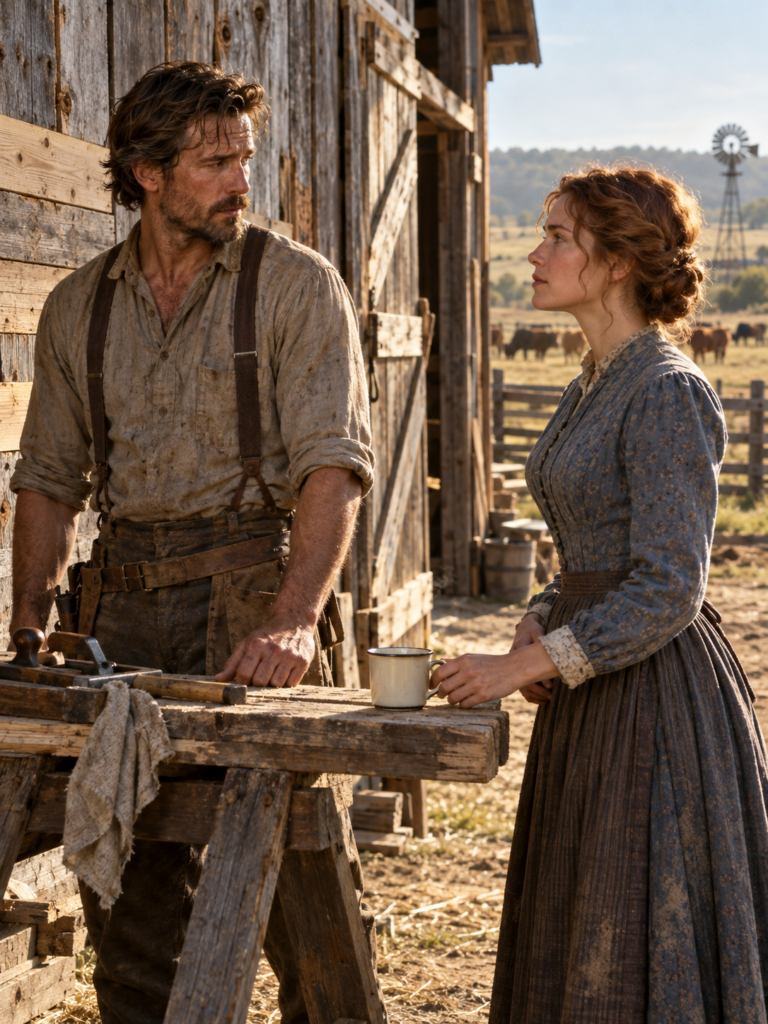
“Keep it tight,” Damon said, still braced beneath the slipping plank.
Louisa planted one heel against the base of the post and pulled until the rope burned across her palms.
“I am keeping it tight.”
“I know.”
The answer landed differently than an instruction.
Damon shifted his shoulder beneath the board, reached down, and dragged the temporary brace closer with his boot. The timber above him creaked again.
Louisa saw the angle change.
“That brace won’t reach.”
“It will.”
“It won’t.”
Damon glanced once.
She was right.
He stopped forcing it.
“Then I need the shorter timber behind the sawhorse.”
Louisa kept one hand locked on the rope, stretched with the other, caught the timber’s end, and dragged it across the dirt.
Damon wedged it beneath the wall.
The weight settled.
Only then did he step away.
Louisa loosened the rope slowly.
Her palms stung.
Damon saw her flex her fingers.
“Let me look.”
“They’re not hurt.”
“I didn’t say they were.”
She held out one hand.
The rope had reddened the skin but broken nothing.
He looked without touching.
“You’ll feel that later.”
“So will your shoulder.”
“Probably.”
She glanced at the wall.
“You knew it was unsound.”
“I knew it needed work. I didn’t know that board had loosened that far.”
“And if I hadn’t been here?”
“I’d have dropped it.”
“On yourself?”
“Preferably on the ground.”
That drew a short laugh from her.
Damon smiled, but it disappeared when he saw her staring at the damaged framing.
“I should have blocked the section before I started pulling boards,” he said.
Louisa looked at him.
“You’re telling me you made a mistake?”
“I did.”
Most men she knew preferred injury to confession.
Damon picked up the rope.
“I’ll secure the whole section before I touch another plank.”
“Good.”
He looked at her, perhaps expecting the matter to be finished.
It was not.
“And something else.”
He waited.
“If my father brings me into whatever plan he has formed for you, I want you to tell him the same thing you told me.”
“What thing?”
“That it isn’t your decision.”
Damon nodded once.
“I will.”
“And if he decides five weeks gives him five weeks to arrange matters?”
“I’m repairing his barn.”
“Only his barn?”
Damon’s gaze did not leave hers.
“That is the only arrangement I made with him.”
The answer should have relieved her completely.
Instead, absurdly, some small part of her felt disappointed.
She disliked that part immediately.
From the house, Milton called that dinner would be ready in ten minutes.
Louisa looked toward the porch.
“He is enjoying this.”
“Yes.”
“You noticed.”
“Your father is not a subtle man.”
“Oh, he thinks he is.”
Damon coiled the rope.
“He apologized with his eyes this morning.”
Louisa stared at him.
“My father has never apologized with his eyes in his life.”
“Then perhaps he had dust in them.”
This time she laughed fully.
Damon looked almost startled by the sound.
For the first time, Louisa noticed that the careful reserve in him was not coldness. It was caution—the habit of a man who measured where he placed his weight before trusting the ground beneath it.
That evening, Milton asked no questions.
He discussed the price of feed and a neighbor’s fence line and whether Damon preferred biscuits or cornbread.
Louisa waited for manipulation.
None came.
After supper, Damon stood.
“I’ll return the coffee cup.”
“It’s already in the kitchen,” Louisa said.
He glanced at her.
She realized she had carried it inside without thinking.
Milton hid his smile behind his own cup.
Louisa pointed at him.
“Don’t.”
“I haven’t said anything.”
“That has never prevented you from being guilty.”
Damon excused himself before either father or daughter could drag him farther into the argument.
Outside, he crossed toward the bunk space Milton had offered in a small room beside the equipment shed.
Milton followed him onto the porch.
“Damon.”
Damon stopped.
Milton’s expression had lost its humor.
“I may have done something foolish.”
“You did.”
Milton accepted that without protest.
“The town knows why I hired you.”
Damon turned fully around.
Milton continued.
“Or thinks it knows.”
“And Louisa?”
“She learned Saturday.”
Damon’s jaw tightened.
Milton nodded toward the darkening road.
“I wanted to put a decent man near her. I told myself that was all I was doing.”
“It wasn’t.”
“No.”
Inside the house, Louisa stood just beyond the screen door.
Neither man knew she was there.
Milton looked older suddenly.
“She has had men speak to her as if intelligence were an inconvenience they might tolerate. I thought if I found someone different—”
“You still chose for her.”
“I know.”
Damon looked toward the house.
Then he did something Louisa had not expected.
He picked up his tool bag.
Milton frowned.
“What are you doing?”
“Moving back to the boardinghouse in town.”
“You don’t need to.”
“If she wants me here tomorrow, I’ll come work. If she doesn’t, I won’t make her spend five weeks in her own home wondering whether every supper is part of somebody else’s scheme.”
Behind the screen, Louisa’s hand closed around the door latch.
If she let him walk away, she would regain the distance her father had taken from her.
If she stopped him, the choice would become unmistakably hers.
She pushed the door open.
The screen door swung outward before Damon reached the porch steps.
“Mr. Kirby.”
He stopped.
Milton looked from his daughter to the tool bag in Damon’s hand and wisely said nothing.
Louisa came onto the porch.
“You are not leaving the job.”
Damon studied her face.
“I can sleep in town.”
“You can. But not because my father embarrassed me.”
Milton shifted.
Louisa raised one finger toward him without looking away from Damon.
“He did.”
Milton became very interested in the yard.
“But the barn still needs repairing,” Louisa continued, “and you have done nothing except behave exactly as I asked you to behave.”
“That may change how town people talk.”
“They were talking before you arrived.”
“That doesn’t make it fair.”
“No. It makes it familiar.”
She folded her arms.
“I will not let gossip drive a competent carpenter off my father’s property merely so Copper Bend can believe it has authority over my decisions too.”
Damon’s grip eased on the tool bag.
Louisa looked toward the small room beside the equipment shed.
“Stay there if you wish. Eat supper with us if you wish. Work the barn because that is what you were hired to do.”
“And everything else?”
“Everything else happens only if I decide I want it to.”
Damon nodded.
“Understood.”
Louisa glanced at her father.
“And you.”
Milton sighed.
“I know.”
“No arrangements. No remarks. No accidentally seating people beside each other at church. No suddenly discovering that two errands require one wagon.”
Milton looked wounded.
“I have never done the wagon thing.”
“You were going to.”
“I had considered it.”
“Father.”
“All right.”
Louisa returned her attention to Damon.
“Seven tomorrow?”
“Seven.”
“Good.”
She went inside.
Milton waited until the door closed.
Then he looked at Damon.
“You see why I worry?”
Damon picked up his bag again.
“I see why you should stop.”
Milton smiled ruefully.
“That too.”
The following morning, Louisa carried no coffee to the barn.
Damon noticed.
He also understood.
At eight, he returned yesterday’s cup to the kitchen himself.
At noon he ate under the cottonwood rather than finding a reason to pass the post office.
At supper he spoke mostly to Milton about lumber.
Louisa noticed all of that too.
By the second week, restraint had become its own form of conversation.
She began seeing details she would have missed if Damon had spent his days attempting to charm her.
He checked every repair twice.
He rehung a gate only after asking Milton whether he wanted it moved.
He never entered the house without knocking even though he had been told he might come through the kitchen.
When Louisa discussed telegraph work, he asked what the difficult part was rather than pretending to understand it.
“People,” she told him.
They were sitting on the porch after supper, each with a book.
“Not the equipment?”
“The equipment behaves according to its construction. People send a message with twelve unnecessary words and then blame the operator for the cost.”
Damon considered that.
“Barns are easier.”
“Barns cannot argue.”
“They can fall on you.”
“People do that too, figuratively.”
He looked at her.
She turned a page.
After a moment, he laughed quietly.
That was how Louisa discovered he had a copy of Thomas Hardy.
The book was worn from use.
“Far from the Madding Crowd?” she asked.
“Second reading.”
“Why twice?”
“You know what is going to happen the second time.”
“That sounds like an argument against rereading.”
“Means you stop watching for what happens and start noticing why.”
Louisa closed her own book around one finger.
“What do you think of Bathsheba?”
Damon took the question seriously enough to make her glad she had asked.
“She spends part of the book learning that being wanted and being understood are not the same thing.”
Louisa watched him.
“And her mistakes?”
“Still hers.”
“So you don’t excuse them?”
“No.”
“You don’t condemn them?”
“No.”
“What do you do with them?”
“Let them belong to her.”
The porch went quiet.
Louisa looked across the field.
“My father would like you.”
“He already does.”
“No, I mean that answer.”
“I suspect your father likes any answer that helps his argument.”
“That is the truest thing you have said since arriving.”
Damon smiled.
She noticed again how rarely he did it without first considering whether he ought to.
“What did you mean to do before Copper Bend?” she asked.
“Work.”
“That is not an answer.”
“It has been for three years.”
He closed the book.
“My family had land in Missouri. My father’s land, mostly. My brothers wanted it. I didn’t.”
“Why?”
Damon looked over the darkening pasture.
“Because every fence already had somebody else’s decision in it. Every shed. Every row. I wanted to know whether I could make something that belonged to my own choices.”
“So you left.”
“Yes.”
“And kept leaving.”
He glanced at her.
“You noticed that.”
“You said three years.”
“I work somewhere. Finish. Move.”
“Why?”
“I haven’t decided.”
Louisa thought he had.
She also understood he did not yet want to say it.
“I know what mine looks like,” she said.
“What does?”
“The thing that belongs to my choices.”
He waited.
“The telegraph office. The key. The first incoming message in the morning. That instant when something has traveled farther than I have and reaches my hand before anyone else in town knows it exists.”
Damon’s expression softened.
“You love it.”
“Yes.”
“No apology.”
“For what?”
“Exactly.”
She looked at him for a long moment.
A week later Milton climbed partway up the ladder while Damon worked near the barn roof.
“I owe you an apology.”
Damon kept driving a nail.
“Yes.”
Milton almost laughed.
“I thought you might make this easier.”
“You’ve had two weeks to practice.”
Milton rested one arm on the ladder.
“I saw you help me in town. You didn’t look to see whether anyone important was watching. Didn’t ask what you’d get. You noticed trouble and moved.”
Damon stopped working.
“I thought that told me something.”
“It did.”
“I decided it told me enough.”
“That was the mistake.”
Milton nodded.
“I wanted Louisa to meet someone who wouldn’t spend dinner explaining her own life to her.”
“That part I understand.”
“The rest I had no right to arrange.”
“No.”
Milton looked toward the house.
“She has been lonely.”
Damon’s face changed slightly.
Milton caught it.
“That is not permission,” the older man said. “I know that now.”
Damon set the hammer across his knee.
“What did you intend to do?”
“Exactly what I did. Put you close enough for her to see you.”
“And then?”
“Hope.”
Despite himself, Damon smiled.
Milton shrugged.
“I’m her father. Hope remains within my authority.”
“That may be the only part.”
“I believe you are correct.”
He started down the ladder.
Then paused.
“The old Greer place south of the creek is empty.”
Damon frowned.
“Eighty acres. House needs work. Fence needs more. Owner wants someone willing to take it on under terms a working man could manage.”
“You offering me land now?”
“I’m telling a carpenter about an empty place.”
Milton descended another rung.
“What you build there is your affair.”
Damon watched him go.
The idea followed him for three days.
Not because of Louisa.
He insisted on that privately until the insistence became suspicious.
He walked the Greer place Sunday morning.
The house leaned slightly but the foundation looked sound. The field had gone rough. Several fence posts required replacement. There was work everywhere.
He felt something he had not felt in Missouri.
Not inheritance.
Possibility.
On Friday afternoon of the third week, he went to the telegraph office after closing.
Louisa was checking the day’s ledger.
“We’re closed,” she said.
“I know.”
She looked up.
“I wanted to tell you before your father does.”
“That sentence rarely ends well.”
“I’m taking the Greer place.”
She stilled.
“For how long?”
Damon understood the question beneath the question.
“I don’t know yet.”
Louisa’s expression closed slightly.
He stepped closer, then stopped on the other side of the counter.
“I also want to ask you something.”
“My father suggested that too?”
“No.”
That brought her eyes back to his.
“This has no bearing on the Greer place. I am taking it whether you say yes or no.”
“To what?”
Damon removed his hat.
“Let me court you.”
Louisa said nothing.
“Properly,” he continued. “Not as part of your father’s arrangement. Not because people are watching. And not because three weeks obligates either of us to turn anything into more than it is.”
“Why?”
“Because I like talking to you.”
“That is not enough reason to rearrange a life.”
“No.”
“I like talking to Dora at the post office.”
“I hope you don’t discuss Hardy with her.”
“I would rather discuss furnace ash.”
Damon’s mouth twitched.
Louisa did not let him escape with humor.
“Why?”
He answered more carefully this time.
“Because you know what belongs to you. Because you told me exactly where the boundary was the first morning, and I have thought about that conversation nearly every day since. Because you do not pretend uncertainty to make other people comfortable. Because you carried a rope toward a failing wall instead of running from it.”
Louisa’s expression changed.
“And because,” Damon added, “I would rather learn who you are than spend the next town wondering whether I should have asked.”
She looked at the telegraph key.
Her key.
Her work.
Her life had become a subject other people discussed too often.
She would not let Damon become another discussion imposed upon her.
So she made the answer as clearly as she could.
“Yes.”
Damon inhaled.
“But.”
He waited.
“My work remains mine.”
“Of course.”
“I am not leaving the telegraph office because I court you.”
“I didn’t ask.”
“You might later.”
“Then you can answer later.”
“My father does not get to decide where this goes.”
“He already apologized for thinking he did.”
Louisa raised an eyebrow.
“He apologized?”
“On a ladder.”
“That sounds like him. He prefers difficult conversations when escape is physically inconvenient.”
Damon laughed.
Louisa held out her hand across the counter.
“Then yes, Damon Kirby. You may court me.”
He took her hand once, briefly, and released it first.
When they reached the Reeves farm, Milton sat on the porch pretending not to wait.
Louisa climbed the steps.
Her father looked at her.
She looked back.
“Don’t.”
“I haven’t said anything.”
“You are about to.”
Milton’s resistance lasted perhaps three seconds.
“I told you.”
Damon sighed.
Louisa looked at him.
“How many times do you think we’ll hear that?”
“Four hundred?”
Milton grinned.
Louisa sat down.
“One,” she said. “Three hundred ninety-nine left.”
Their courtship began with her father laughing into his coffee and Damon realizing that, for the first time in years, he had just made a decision that pointed toward staying instead of leaving.
The realization frightened Damon more than he expected.
Staying had always sounded simple when other men described it. A man found work, found land, perhaps found someone beside whom the future seemed less empty, and eventually he stopped packing.
Damon knew better.
Leaving required one difficult decision.
Staying required hundreds.
He made the first of them the following Monday when Milton paid him for another week of barn work and Damon used part of the money to replace tools he had carried too long instead of saving every possible cent for the next journey.
The second came when he signed the agreement that allowed him to begin working the Greer place.
The third came when someone at the boardinghouse asked when he expected to move on.
“I don’t,” Damon said.
The words sounded strange.
Then they sounded good.
Louisa did not celebrate his permanence.
She did not assume it belonged to her.
That mattered.
She came to see the Greer place on a Sunday afternoon after he had begun clearing the yard.
The house was small, weathered, and honest about the amount of labor it required.
One shutter hung crooked.
The porch sagged near the east post.
Inside, dust lay across a table left by the previous occupant.
Louisa stood in the front room.
“You chose this?”
“I did.”
“Voluntarily?”
“Yes.”
She looked at the ceiling.
“I wanted to be certain.”
Damon leaned against the doorway.
“The roof is sound.”
“I was not looking at the roof.”
“What were you looking at?”
“The scale of your bad judgment.”
He laughed.
She walked to the window.
From there she could see the rough field and, beyond it, the creek.
“What will you grow?”
“Whatever survives my first attempt.”
“An ambitious agricultural philosophy.”
“I’m a carpenter.”
“You are planning to become a farmer.”
“I’m planning to become less incompetent each season.”
Louisa approved of that answer.
They walked the boundary together.
Damon showed her where he hoped to repair the fence first.
He never said our fence.
Never said our house.
Never asked how she would arrange the kitchen.
He had invited her to see his choice, not to surrender hers into it.
On the walk back, she said, “You know most men courting a woman would be telling her what curtains ought to hang in the front room.”
“I don’t know anything about curtains.”
“That has never prevented most men.”
“What would you hang?”
She stopped.
Damon realized the question had changed something.
Not because it presumed she would live there.
Because it did not.
Louisa looked back at the house.
“Something light enough not to steal the morning.”
He nodded.
“I’ll remember.”
“Do not buy curtains.”
“I said I’d remember.”
“That is how my father starts.”
“Your father would have measured the windows already.”
“He probably has.”
They returned to the Reeves farm laughing.
Copper Bend, naturally, noticed everything.
The same people who had once discussed Milton’s matchmaking now discussed the courtship as though it were a municipal project.
Louisa ignored most of it.
Once, a woman at the post office asked whether she would “finally” give up working once Damon established himself.
Louisa looked up from the ledger.
“Why would I?”
The woman hesitated.
“Well, if you marry.”
“That was not my question.”
The visitor left without an answer.
Dora Hatfield, who had overheard the exchange, waited until the door shut.
“I give her until supper before she tells someone.”
“Three o’clock,” Louisa said.
Dora nodded.
“Fair.”
Damon heard the story that evening.
He did not say he would permit Louisa to work.
He did not say he admired her independence.
Both statements would have placed authority in his hands that she had never given him.
Instead he said, “They really ask you that?”
“Frequently.”
“What do you tell them?”
“That telegraph keys do not stop functioning after weddings.”
Damon smiled.
“Good answer.”
The barn was finished at the end of October.
Damon replaced the final board, stepped back, and inspected the line of the wall.
Milton stood beside him.
“Well?”
“It’ll hold.”
“For how long?”
“If you stop trying to introduce your daughter to carpenters, considerably longer.”
Milton laughed.
Then his expression turned serious.
“You did good work.”
“You paid for good work.”
“I mean all of it.”
Damon understood.
He looked toward the house.
Louisa had not become his reward for virtue.
Milton had finally learned not to describe her that way.
“Still her decision,” Damon said.
Milton nodded.
“Every day.”
That winter, Damon worked the Greer place whenever weather allowed.
He repaired the porch.
He replaced fence.
He made the house weather-tight.
He also appeared for supper at the Reeves farm often enough that Milton stopped formally inviting him.
Some nights Damon and Louisa read.
Some nights they walked as far as the creek and back.
Some nights they disagreed.
Those mattered too.
Once Damon assumed she would accompany him to a neighboring farm on Sunday because he had already promised they would both come.
Louisa stopped on the porch.
“You promised for me?”
Damon heard the danger immediately.
“I did.”
“Why?”
“I thought—”
“Yes. You did.”
He looked at her.
“I shouldn’t have.”
“No.”
“I’ll tell them I spoke out of turn.”
Louisa’s irritation softened a little.
“You don’t have to make a public confession.”
“I made a public arrangement.”
“That is unfortunately logical.”
He went alone.
The next time, he asked.
She said yes.
That mattered more than the disagreement.
In December a shutter on the telegraph office’s east window began rattling badly enough to interfere with Louisa’s concentration.
Damon came by one afternoon with tools.
She was receiving a message and did not interrupt her work.
He waited until the key went quiet, then removed the loose hinge.
“You noticed that?”
“It’s been crooked since October.”
“And you waited until December?”
“You were using the window.”
She watched him fit the hinge.
“You could have asked.”
“I could have.”
“Why didn’t you?”
“I thought fixing it would take less time than discussing it.”
Louisa folded her arms.
Damon stopped working.
“Is that a problem?”
“No.”
He resumed.
She smiled when he could not see.
After a minute she asked, “Why did you keep leaving?”
The screwdriver stopped.
Damon looked at the shutter.
“You asked me that before.”
“You did not answer.”
“No.”
“Will you now?”
He set the tool down.
Outside, the Kansas afternoon had gone pale and cold.
“My mother died,” he said.
Louisa waited.
Not because the death was a secret. He had mentioned her books.
But the tone said there was more.
“Afterward my father and brothers carried on with the farm. Same work. Same rooms. Same meals. Everything stayed where it belonged.”
He rubbed his thumb along the wooden frame.
“I hated that.”
“Because it reminded you of her?”
“Because it didn’t.”
Louisa’s face softened.
“The place kept going.”
“Yes.”
“And you thought staying meant watching things become ordinary after losing someone.”
Damon looked at her sharply.
She had found the sentence before he had.
“Something like that.”
“So you left first.”
“Eventually.”
“And then kept practicing.”
He nodded.
“If I never belonged fully to a place, losing it couldn’t take much.”
Louisa looked at the repaired hinge.
“What changed?”
“You.”
The answer came too quickly for performance.
Damon immediately added, “And the Greer place. The work. Your father, though I resent admitting it.”
Louisa almost smiled.
“But mostly,” he said, “I got tired of building things carefully and then leaving them for somebody else to live with.”
He stepped away from the window.
“I’m not going to leave, Louisa.”
She believed him.
Not because he said it dramatically.
Because for months she had watched him return.
To the barn.
To the same supper table.
To the crooked gate until it hung correctly.
To a loose shutter he had noticed weeks earlier.
To conversations he could have avoided.
To his own mistakes when they needed correcting.
Louisa touched the telegraph key lightly.
“I know.”
Damon looked at her.
For a long moment neither moved.
Then the line clicked.
Louisa sat immediately.
Damon stepped back.
Her work resumed.
He finished the shutter quietly while she took down the message.
It was perhaps the most intimate afternoon they had spent together.
No declaration could have improved it.
By January, the Greer house was habitable.
Damon had repaired the stove pipe, replaced two floorboards, and built shelves in the kitchen.
The windows still had no curtains.
Louisa noticed.
“You remembered.”
“I was warned.”
“You are learning.”
“I’m an excellent student when threatened.”
She walked to the east window.
Morning light entered cleanly through bare glass.
“Something light,” she said.
“That was the instruction.”
“Not an instruction.”
“A suggestion?”
“A hypothetical preference.”
“Those seem more dangerous.”
Louisa turned.
“Damon.”
He set down the plane he had been using.
She had come to the house alone that afternoon, which was ordinary now.
“What?”
“If we marry—”
He became absolutely still.
Louisa raised a hand.
“I said if.”
“Yes.”
“I am not leaving my work.”
“I know.”
“I mean after.”
“Yes.”
“I may eventually want fewer hours. I may not. I may want to continue exactly as I do.”
“Yes.”
“I would need transportation into town some days.”
“We can arrange it.”
“We?”
“If you are asking about marriage, I assume transportation becomes a shared problem.”
She looked at him.
Good answer.
“And the house?”
“What about it?”
“If I live here, I will not live as a guest in a house that remains entirely yours in practice.”
Damon nodded slowly.
“What would you need?”
The question mattered more than an immediate promise.
“A say in what changes. Space for my things. Money I control. No assumption that every meal becomes my responsibility because I am the woman inside the house.”
Damon considered.
“I cook badly.”
“I know.”
“That may be the strongest argument you have made for shared labor.”
She laughed despite trying not to.
He crossed the room but stopped an arm’s length away.
“Louisa, if you ever come here, I want it to become ours because you chose it. Not because I built shelves and expected gratitude.”
Her laughter faded.
“And if I never come?”
“The shelves remain mine.”
“And you?”
“I remain here.”
She looked toward the field.
“That is important.”
“I know.”
She faced him again.
“Then ask me.”
Damon’s expression changed.
“Now?”
“You have been courting me since October. You repaired a barn, acquired eighty acres, learned to ask before making Sunday plans, and somehow managed to discuss kitchen labor without fainting. I believe you are prepared.”
He laughed once from sheer surprise.
Then he became serious.
“Louisa Reeves, will you marry me?”
She let the question exist for a moment.
Not because she doubted him.
Because she wanted to feel the difference between a choice made for her and one placed openly in her hands.
Months earlier her father had tried to arrange possibility.
Damon had spent every week since then refusing to claim what was not his.
That was why her answer could be simple.
“Yes.”
He did not seize her.
He stepped closer and waited.
Louisa closed the final distance herself.
Their kiss was brief, warm, and almost solemn.
Then she leaned back.
“My father is going to become unbearable.”
“He already is.”
“No. You have not seen his final form.”
They told Milton that evening.
He listened gravely.
He nodded.
He took one thoughtful drink of coffee.
Then he said, “I told you.”
Louisa pointed at Damon.
“Two.”
“Three hundred ninety-eight remaining,” Damon said.
Milton grinned.
They married in March.
The church was full because Copper Bend had followed the story from the beginning and apparently intended to see it completed.
Louisa wore a warm wheat-colored dress rather than white.
Damon stood near the front looking steadier than he felt.
When Louisa reached him, the room seemed to narrow until there was only her expression.
No father’s scheme.
No town gossip.
No barn.
No wager about what might happen.
Only two adults who had been given enough time to know what they were choosing.
They spoke their vows.
Afterward, people gathered at the Reeves farm.
On the walk from the church, Milton fell into step beside Damon.
They passed the barn.
Its walls stood square.
The gate Damon had rehung closed firmly behind the guests.
Milton slowed.
“Damon.”
“Yes?”
“Thank you for coming across that street.”
Damon looked at him.
Milton’s gray eyes were serious.
“I saw a man help me when nobody important was watching,” he said. “I decided that meant something.”
“It did.”
“I also decided it meant I knew what was best for Louisa.”
“That part took longer to repair than the barn.”
Milton laughed softly.
“Yes.”
Then he held out his hand.
“Thank you for proving me right about you without allowing me to be right about her.”
Damon shook it.
“That was mostly Louisa.”
“Most things are.”
Milton walked ahead.
Damon remained beside the gate for a moment.
He remembered a trunk sliding from a wagon.
Grain sacks.
A strange old man making an impossible statement.
Three days in a town that had meant nothing to him yet.
Then Louisa appeared on the other side of the gate.
“You coming?”
He looked at the house, at the barn, at the road leading south toward the Greer place.
“Yes.”
She waited.
He walked through.
“How many?” she asked.
“Your father?”
“Yes.”
“Two today.”
“Three hundred ninety-eight remaining.”
She took his hand.
They went inside.
Marriage did not erase Louisa’s telegraph work.
The Monday after they settled into the Greer house, she rose early, dressed, and went into Copper Bend as she always had.
Damon had already harnessed the horse.
“You do know I can harness my own horse.”
“I know.”
“Then why did you?”
“I was outside first.”
She inspected him suspiciously.
“That explanation is acceptable.”
He helped no further than she wanted.
The east window of the Greer house eventually gained curtains.
Louisa chose them.
Thin enough to let morning through.
Damon built another shelf beside the first because her books required it.
Then another because his did too.
Their home changed in small, visible ways.
Two cups stood near the stove.
Her telegraph notes occasionally rested beside his measurements.
His tools gained a corner that was not permitted to spread across the entire kitchen.
She kept her wages.
He kept records for the land.
They decided large expenses together.
When the first crop came in that summer, it was smaller than Damon hoped.
Louisa looked over the yield.
“You said you planned to become less incompetent each season.”
“I may need several.”
“Good. I married for the long-term improvement.”
The land began to answer his labor.
Not quickly.
Honestly.
Fence by fence.
Row by row.
Repair by repair.
One February evening, almost a year after Damon had first crossed Copper Bend’s street, Louisa came home to find him at the table with Far from the Madding Crowd open before him.
“Again?”
“Third time.”
“Different?”
He marked the page.
“Yes.”
“How?”
“You see people becoming who they will eventually be before they can see it themselves.”
Louisa poured coffee.
“That sounds dangerous.”
“It can be.”
“My father would build an entire philosophy around it.”
“He already has.”
She sat beside him.
Outside, the field lay brown beneath winter light.
The gate he had repaired months earlier remained straight between its posts.
Louisa wrapped both hands around her cup.
“My father was right.”
Damon turned.
She allowed him one second of triumph.
“About you.”
His expression softened.
“And wrong about his authority,” she continued.
“Yes.”
“Both can be true.”
“They usually are.”
She leaned her head against his shoulder.
Damon closed the book.
On the Reeves porch some distance away, Milton might very well have been preparing another “I told you.”
Louisa no longer minded as much.
Her father had found a good man.
But that was where his part ended.
He had not chosen her husband.
He had not persuaded her to surrender the work she loved.
He had not decided the shape of her home.
He had not turned kindness into entitlement or loneliness into obligation.
He had merely noticed one morning that Damon Kirby moved toward work that needed doing without first checking who might reward him for it.
Everything after that had required choices no father could make.
Damon had chosen Copper Bend.
He had chosen the Greer place.
He had chosen to stop leaving before anything could matter.
And Louisa had chosen him—not because he rescued her, not because she needed a man to complete a life already fully her own, and not because her father had placed him conveniently beside a failing barn.
She chose him because he listened when she spoke.
Because when he overstepped, he corrected himself.
Because he could be told no without treating it as an insult.
Because he understood that her work was not a temporary occupation waiting for marriage to replace it.
Because he built carefully.
Because he returned.
Because when he finally promised he would stay, months of ordinary behavior had already made the promise believable.
Damon looked toward the east window where the last winter light passed through the curtains Louisa had chosen.
“Your father said something to me after the wedding.”
“That narrows nothing.”
“He thanked me for crossing the street.”
Louisa smiled.
“You would have done it for anyone.”
“Yes.”
“That is why he noticed.”
Damon thought about that.
Then he looked around the kitchen—the shelves, the cups, her papers beside his, the Hardy novel open beneath his hand.
“I thought I was helping him lift a trunk.”
“You were.”
“That was all.”
“At the time.”
Louisa lifted her coffee.
Outside, Kansas winter pressed cold against the glass.
Inside, nothing dramatic happened.
No wagon overturned.
No wall threatened to fall.
No father arranged another introduction.
The telegraph key in town would begin clicking again the next morning.
Damon would check a fence line after breakfast.
Louisa would complain if he tracked mud across the floor.
He would probably repair something she had not yet noticed.
She would remind him that noticing a thing did not grant ownership of it.
He would say he understood.
And mean it.
The house held the quiet sound Milton Reeves had hoped his daughter might someday know but had never possessed the authority to choose for her: not silence, not dependence, not a woman finally placed where someone else thought she belonged, but the ordinary rhythm of two people who had each kept the right to leave and had freely, repeatedly, chosen to stay.


