
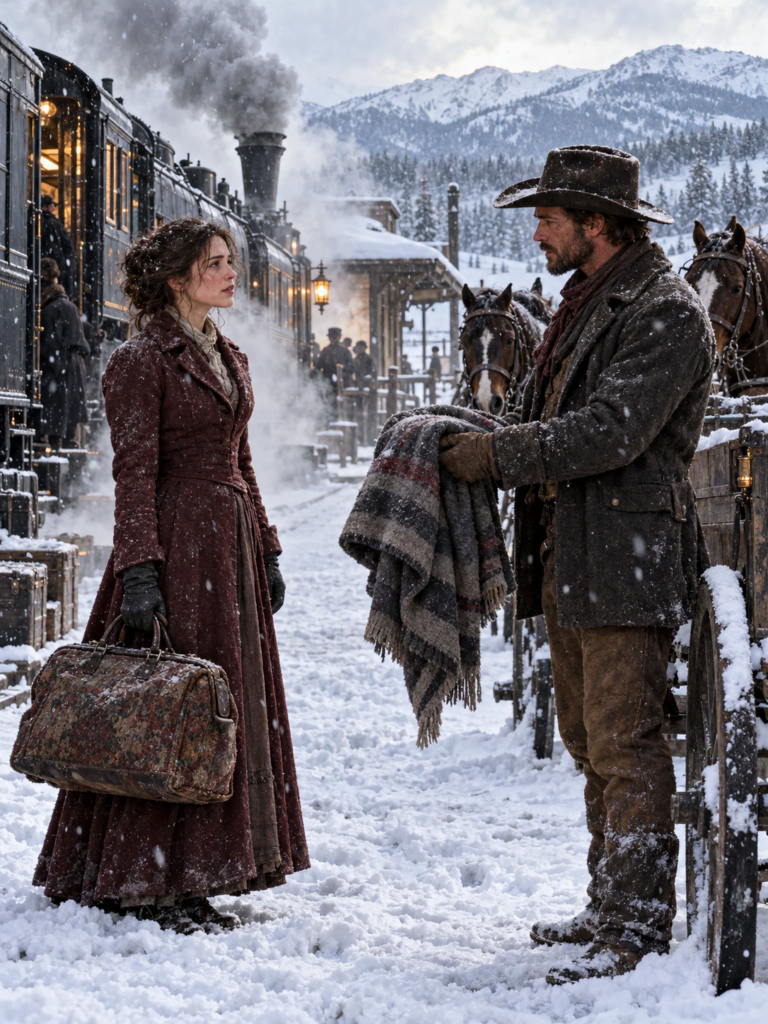
If she intended to learn his life, he decided, he could at least have the sense not to make her learn it alone.
Ethan followed Laya into the yard.
Wind scraped loose snow from the roof and sent it curling around their boots.
He reached the woodshed first and opened the door.
Laya stepped inside.
Split cottonwood and pine were stacked almost to the rafters.
“You have enough here for weeks.”
“If I’m careful.”
“If we’re careful.”
The word stopped him.
We.
Laya did not seem to notice what she had said.
She filled the basket.
Ethan reached for it.
She lifted one eyebrow.
“I can carry wood.”
“I know.”
“You tried to take it.”
“Habit.”
“That may be something we both need to watch.”
Ethan stared.
Then, slowly, he nodded.
“Fair.”
They carried separate loads inside.
By supper, the house smelled of fried potatoes, salt pork, coffee, and something Ethan had nearly forgotten could belong to a home.
Conversation.
Laya asked about the ranch books.
Ethan asked about the boardinghouse where she had worked.
Neither discussed marriage.
That omission felt deliberate.
The following morning Ethan woke before dawn and smelled coffee.
He entered the kitchen.
Laya stood beside the stove wearing yesterday’s dress with the sleeves pinned back.
“You didn’t need to make that.”
“I wanted coffee.”
That defeated every argument he possessed.
She poured two cups.
After breakfast, Ethan pulled on his coat.
Laya did the same.
He frowned.
“You’re staying inside.”
“No.”
“It’s bitter out.”
“I noticed.”
“Your coat isn’t heavy enough.”
“I noticed that too.”
Ethan disappeared upstairs.
He returned carrying a thick wool coat that had belonged to his older sister.
Laya put it on.
The sleeves covered half her hands.
“Better?”
“Yes.”
They stepped into blue morning light.
Ethan showed her the barn first.
Which horse kicked.
Where grain was stored.
How he broke ice from water troughs.
Which cow would push through a weak gate merely because she enjoyed inconvenience.
Laya listened.
Then worked.
She carried water.
Collected eggs.
Stacked kindling.
By noon Ethan found her dragging another bucket toward the chicken house.
He took it from her.
“That’s enough.”
Laya stopped.
“What?”
“You don’t have to prove you deserve to be here.”
Her expression changed.
“I am not proving anything.”
“Then why are you working yourself raw?”
She looked toward the ranch.
“Because if I stay, the work becomes mine too.”
If I stay.
Ethan lowered the bucket.
Nothing had been decided.
That night he made himself remember it.
Two days later, Christmas Eve brought a storm.
Clouds rolled over the western ridge by afternoon.
Ethan checked the sky.
“We prepare.”
Laya did not ask whether he was sure.
Together they carried extra wood indoors.
Filled water containers.
Moved hay beneath cover.
Checked shutters.
By nightfall snow drove horizontally past the windows.
After supper, Laya brought out a small parcel.
“For you.”
Ethan stared.
Inside lay a red knitted scarf.
One end was wider than the other.
“You made this?”
“On the train.”
“For me?”
“I could give it to a horse.”
“No.”
His answer came too quickly.
Laya smiled.
Ethan wrapped it around his neck.
Then remembered the box hidden in his cabinet.
He brought out a pair of lined leather gloves.
Laya stared.
“You bought these before I arrived?”
“Your letters said your hands get cold.”
Her face softened.
“You remembered.”
“I remember most of what you wrote.”
Silence settled between them.
Not empty silence.
Something else.
Then the barn door slammed outside.
Ethan stood.
Another violent crash followed.
He grabbed his coat.
“Stay here.”
Laya was already pulling on hers.
They fought through the storm together.
Inside the barn, horses stamped nervously.
One stall stood open.
Ethan’s stomach dropped.
“Molly.”
“The gray mare?”
“Yes.”
The broken barn door had given her enough room to escape.
Ethan turned toward the storm.
Laya caught his sleeve.
“You cannot see ten feet.”
“She’ll freeze.”
“So might you.”
“She depends on me.”
Laya looked outside.
Then pointed.
“Tracks.”
Together they followed faint hoofprints toward the lower fence.
They found Molly tangled in wire half buried by snow.
Ethan approached slowly.
He handed Laya the lantern.
“Keep this high.”
He worked at the wire.
The frightened mare jerked.
A sharp strand snapped loose.
Laya flinched.
Blood appeared across one glove.
Ethan’s chest seized.
“Laya.”
“Finish freeing her.”
He did.
Minutes later they had Molly safely inside the barn.
Only after securing the door did Ethan look at Laya’s hand.
The new glove was torn.
A shallow cut crossed one finger.
“You’re hurt.”
“It’s nothing.”
“You shouldn’t have followed me.”
Her face changed.
“I helped.”
“You could have been badly injured.”
“So could you.”
“That is different.”
“Why?”
The answer rose immediately.
Because losing you already frightens me.
Ethan could not say it.
Laya removed the damaged glove.
“If you wanted a woman who stayed by the stove while you carried every dangerous thing alone, Ethan, you did not need to advertise for a partner.”
Then she walked toward the house.
Ethan remained in the barn.
The storm roared outside.
Molly breathed warmly against his shoulder.
And for the first time, Ethan understood that loneliness was not always having no one beside you.
Sometimes it was refusing to let the person beside you carry any weight.
Sometimes it was refusing to let the person beside you carry any weight.
Ethan closed the barn door and followed Laya through the storm.
He found her beside the stove washing the cut on her finger.
He stopped several feet away.
“I was wrong.”
Laya looked over her shoulder.
“That was quick.”
“I had snow between here and the house to think.”
“Remarkably effective snow.”
He almost smiled.
Then became serious.
“I was scared.”
Laya turned fully.
“Of the mare?”
“Of seeing blood on your hand.”
Something softened in her face.
Ethan stepped no closer.
“I know you helped. I know we found her faster because you saw the tracks.”
“Then why did you say I shouldn’t have come?”
“Because I am used to believing every bad thing belongs to me first.”
Laya tied a strip of cloth around her finger.
“That sounds exhausting.”
“It is.”
“Then perhaps stop.”
Ethan laughed once.
It was not a refusal.
Christmas morning dawned clear.
The ranch lay buried beneath bright snow.
They sat on the porch with coffee while sunlight climbed over the fields.
Ethan looked at Laya.
“You do not owe me marriage because you came here.”
“I know.”
“If the weather clears and you want to leave, I’ll pay your fare.”
Her eyes narrowed.
“Do you want me to leave?”
“No.”
The answer came immediately.
“Then why do you keep offering?”
Ethan stared into his cup.
“Because I need to know staying is something you choose.”
Laya was quiet.
Then she said, “You never asked why I answered.”
“I assumed you wanted marriage.”
“I wanted a life that belonged partly to me.”
He looked at her.
She told him about Pennsylvania.
Her father’s death.
Years spent working in a boardinghouse where she cooked meals at tables she did not sit at and cleaned rooms she would never sleep in.
She had saved money, only to watch illness, rent, or some other necessity consume it.
“I could have found another position,” she said. “Probably.”
“Then why me?”
Laya went inside and returned with a folded clipping.
His advertisement.
The paper had softened at the creases.
“You wrote hard work.”
“Yes.”
“You wrote remote.”
“Yes.”
“You wrote honest intentions.”
He nodded.
She smiled slightly.
“You were the only man whose advertisement did not demand a cheerful woman, an attractive woman, or an obedient one.”
Ethan winced.
“I wrote respectable.”
“Which sounded almost refreshingly dull.”
He laughed.
Laya looked at the clipping.
“You admitted your life was difficult. You asked whether someone might want to share it.”
Ethan stared at her.
“And I understood the quiet before you ever explained it.”
The words settled between them.
The weeks after Christmas changed Miller Ranch through accumulation rather than miracle.
Laya learned livestock routines.
Ethan learned that Laya hated overcooked eggs, read before bed, distrusted chickens, and sang while kneading bread.
She learned that he carved small wooden animals during winter evenings and hid them because he considered the work foolish.
One evening she placed a carved horse on the mantel.
Ethan noticed.
He left it there.
Neighbors began visiting.
Mrs. Bell brought preserves.
Her husband helped repair the storm-damaged barn door.
Laya invited them to supper.
Afterward, Ethan stood beside the table staring at four dirty plates.
“What?”
Laya asked.
“Never had four people eat here before.”
“Then perhaps the table has been underused.”
Ethan looked at her.
He thought about the second chair he had bought.
About Molly.
About the red scarf now hanging from a peg beside his coat.
About how quickly the house had stopped feeling like something he merely survived inside.
Then late January brought a different kind of trouble.
Ethan rode into Sagebrush for supplies.
At the mercantile, the banker stopped him.
A payment on Ethan’s land note was due in March.
Cattle prices had fallen.
The amount Ethan expected to cover easily now threatened the eastern acreage along the creek.
The banker could extend part of the note.
Not all.
Ethan rode home with the notice inside his coat.
He told Laya nothing.
For seven days he carried the numbers alone.
Then his coat slipped from its peg while Laya was sweeping.
The paper fell out.
She did not confront him immediately.
At supper, she placed the notice beside his plate.
“What happens in March?”
Ethan went still.
“Where did you get that?”
“It fell.”
He reached for it.
Laya kept one hand on the page.
“Were you planning to tell me?”
“When I had an answer.”
“Do you?”
“No.”
“Then perhaps we find one.”
“This debt was mine before you arrived.”
Laya stared at him.
“There it is again.”
“What?”
“Mine.”
He frowned.
“My debt. My cattle. My land. My problem.”
“It is.”
“Then what exactly am I doing here?”
Ethan’s defensiveness rose.
“I am trying to protect you from something you did not create.”
“And I am telling you that you cannot ask me to share your life only when your life is easy.”
He had no answer.
Laya stood.
“You say you want a partner. Every time the weight gets heavy, you become a bachelor again.”
She went upstairs.
The silence she left behind felt worse than anything Ethan remembered from before her arrival.
The next morning he placed every account book on the table.
Laya entered the kitchen.
“All right,” he said.
She sat.
“Everything?”
“Everything.”
They spent three hours with pencils, receipts, and coffee.
When Laya finally leaned back, she asked, “How much eastern land would the bank take?”
“Twenty acres.”
“The creek land?”
“Yes.”
“Then we do not lose it.”
Ethan almost smiled.
“You say that like refusing is enough.”
Laya pointed toward the unfinished addition.
“Finish that.”
“As what?”
“A room.”
“For us?”
“For travelers.”
Ethan frowned.
Laya explained.
The ranch sat between Sagebrush and a northern cattle route. During rough weather, drovers, buyers, salesmen, and stockmen often traveled farther than daylight allowed.
They needed food.
Beds.
Stable space.
“You want strangers sleeping here?”
“You advertised for one stranger.”
“That nearly killed me.”
“And yet here I am.”
Ethan considered the numbers.
One room would not save the ranch alone.
But meals, lodging, and stable fees might close the gap.
“You have been thinking about this.”
“Since you told me town was twelve miles away.”
“Why?”
Laya smiled.
“Because I asked what chores came first.”
They worked for six weeks.
Ethan finished the addition.
Laya sewed curtains and assembled bedding.
The first paying traveler arrived during a February snow.
Then two cattle buyers.
Then a veterinarian.
Laya kept the books.
Ethan cared for horses.
Some nights they barely spoke before collapsing into sleep.
Those nights taught Ethan more about companionship than conversation had.
By March, the payment was almost covered.
Almost.
Thirty-seven dollars remained.
Ethan counted their cash twice.
“We are short.”
“I know.”
“I’ll ask for another week.”
“He already refused.”
Ethan looked up.
“When?”
“Yesterday.”
“You went to the bank?”
“Yes.”
“Without telling me?”
Laya raised one eyebrow.
Ethan stopped.
Then, despite himself, he laughed.
“Fair.”
She placed a cloth pouch on the table.
Ethan’s smile disappeared.
“What is that?”
“My savings.”
“No.”
“Ethan.”
“No.”
She opened it.
Coins spilled across the wood.
More than enough.
“You had all this?”
“I have been saving for years.”
“I am not taking it.”
“Why?”
“It is yours.”
Laya held his gaze.
“So is this place if I decide to remain.”
Everything in Ethan went still.
She pushed the pouch toward him.
“I am not giving you my savings.”
“Then what are you doing?”
“I am putting money into the home I helped build.”
The word home landed differently than wife ever had.
Ethan looked from the money to Laya.
“If we use this, it gets written down.”
“Good.”
“As yours.”
“Good.”
“If someday you leave—”
Her expression softened.
“Then we settle the account fairly.”
Ethan nodded.
Not romantic.
Not grand.
But true.
They made the payment.
The eastern creek remained theirs to use.
Spring began loosening winter’s hold.
One April evening, Ethan found Laya beside the fence watching meltwater shine in the low fields.
He carried his hat in both hands.
She looked at it.
“You are nervous.”
“No.”
“You held your hat exactly like that at the station.”
He glanced down.
She was right.
Ethan had rehearsed a speech.
None of it survived.
“I placed the advertisement because I thought I needed a wife.”
Laya’s eyebrow rose.
“That beginning could improve.”
He laughed.
“I thought what I needed was another person in the house.”
He stepped closer.
“Then you arrived.”
Laya waited.
“And somewhere between the coffee, the storm, the travelers, the bank note, and you repeatedly explaining that I am bad at partnership—”
“I never used the word bad.”
“You implied catastrophic.”
“Possibly.”
His smile faded.
“I fell in love with you.”
Laya stopped breathing for one quiet second.
Ethan reached inside his coat.
A simple silver ring rested in his palm.
“I do not want you marrying the man who wrote an advertisement.”
He looked directly into her eyes.
“I want you choosing the man you have worked beside all winter.”
Laya studied the ring.
Then him.
“Ethan.”
His stomach dropped.
“You are still forgetting something.”
“What?”
“You know me now too.”
He blinked.
She stepped closer.
“This is not only my decision about you.”
Understanding slowly replaced fear.
“It is your decision about me too.”
Ethan nodded.
“Yes.”
“Then stop explaining why I may refuse and ask me what you actually want.”
Ethan took her hand.
“Laya Dawson, will you marry me?”
She made him wait.
Three seconds.
Four.
Enough to make him understand the full terror of offering someone a choice you desperately want answered one way.
Then Laya smiled.
“Yes.”
“Yes.”
Ethan stared at her.
Laya’s smile widened.
“You may breathe now.”
He exhaled so sharply she laughed.
Then he slipped the silver ring onto her finger.
It fit.
For a moment he simply held her hand.
No claim.
No victory.
Only gratitude.
“May I kiss you?”
Laya’s laughter softened.
“Yes.”
Ethan touched her cheek first.
The kiss was careful.
Almost uncertain.
When Laya leaned closer, his free hand settled at her waist.
There were no bells.
No audience.
Only thawing earth beneath their boots, cattle moving somewhere beyond the fence, and the creek they had almost lost beginning to run again.
They married in Sagebrush two weeks later.
Mrs. Bell brought flowers.
The mercantile owner closed his store for an hour.
Three neighboring ranch families attended.
So did two travelers who had stayed at Miller Ranch that winter.
Nothing about the ceremony was grand.
That suited them.
Afterward Ethan and Laya climbed into the same wagon that had carried them from Sagebrush Station.
Snow no longer covered the road.
New grass had begun showing along the ditches.
Halfway home, Laya looked across the country.
“It seems smaller.”
Ethan glanced at her.
“The ranch?”
“The distance.”
She rested her hand over his on the seat.
Marriage changed less than Ethan expected.
And more.
Laya still kept her own savings ledger.
Ethan recorded what she had invested in the ranch.
They agreed that earnings from the guest rooms would be divided between ranch expenses, household needs, and a separate reserve both could access.
The arrangement felt unusual only until they lived it.
Then it felt practical.
The unfinished room became permanently useful.
Travelers continued coming.
A cattle buyer stayed two nights.
A schoolteacher stranded by rain stayed four.
A traveling veterinarian returned so often that Ethan began reserving the eastern stall for his horse.
Word spread.
Miller Ranch became a reliable stopping place between Sagebrush and the northern route.
Laya charged for meals.
Ethan charged for stable space.
Guests paid.
Nobody received free lodging merely because Ethan disliked discussing money.
“You are ruining my reputation for generosity,” he complained.
“I am preserving our ability to buy flour.”
“A narrow view.”
“A fed view.”
He surrendered.
The ranch stabilized.
Not suddenly.
Cattle prices still moved.
Fences still broke.
One year the creek ran low.
Another year an early frost damaged Laya’s garden.
But hardship no longer belonged automatically to Ethan.
That became the most difficult lesson he ever learned.
One summer evening, a cow went missing near the north ridge.
Ethan saddled his gelding.
Laya came from the house carrying another bridle.
He almost said, Stay here.
The words reached his teeth.
Then stopped.
Laya looked at him knowingly.
“You were about to do it again.”
“No.”
“You were.”
“I was about to ask whether you wanted to come.”
She smiled.
“Excellent recovery.”
They rode together.
Years passed through ordinary proof.
The boarding room became two rooms.
Then three.
Travelers began calling the place Miller House.
Laya planted an enormous vegetable garden and maintained an unreasonable distrust of chickens.
Ethan expanded the barn.
The kitchen table gained chairs.
First for guests.
Then neighbors.
Eventually for children the source of whose loud arguments, muddy boots, and impossible appetites Ethan sometimes blamed entirely on Laya.
She blamed him in return.
The house was almost never silent.
Yet Ethan never forgot why he had written the advertisement.
Every December, three days before Christmas, he drove Laya into Sagebrush.
For several years she pretended not to understand why.
By the fourth, she stopped pretending.
They stood together on the same railway platform.
Snow drifted across the tracks.
Laya tucked her hands into the pockets of a much better coat than the one she had worn when she arrived.
“Were you really frightened that day?”
Ethan looked at the rails.
“Yes.”
“Of me?”
“Of you taking one look at me and leaving.”
She laughed.
“We had barely spoken.”
“I had already imagined every possible disaster.”
“Did any include me asking about chores?”
“No.”
“That was your first failure of imagination.”
He smiled.
Then Laya became quiet.
“I almost did not come.”
Ethan turned.
“What?”
She had never told him this.
“The night before I left Pennsylvania, my trunk was packed. Ticket bought. I sat on the edge of my bed until nearly dawn thinking I had lost my senses.”
“Why?”
“Because I was lonely.”
Ethan waited.
“I worried I was about to cross half the country and marry a stranger simply because being alone had made any alternative seem better.”
The confession struck close enough to hurt.
“That is why I wrote the advertisement.”
“I know.”
“What changed your mind?”
Laya looked down the tracks.
“Your last letter.”
Ethan tried to remember.
They had exchanged so many pages.
“What did I write?”
She recited the words from memory.
“If you come west and discover this life is not for you, I will see you safely home. Answering me does not make you my property, and traveling this far does not create a debt between us.”
Ethan remembered.
He had nearly removed those lines.
They had sounded stiff.
Almost legal.
Laya looked at him.
“That was why I boarded the train.”
“You knew almost nothing about me.”
“I knew you were offering me a way back before I had even arrived.”
Her expression softened.
“That told me something.”
“What?”
“That you might be a man worth building a home with.”
Ethan looked across the platform.
For years he had believed Laya stayed because she possessed enough courage to endure a frontier winter.
Now he understood the deeper truth.
She had been able to come because leaving remained possible.
And perhaps staying only meant something because the door had never been locked behind her.
They returned home before dark.
Warm light shone from every window.
Someone inside was laughing.
A child ran across the porch.
Two guest horses stood in the barn.
Smoke rose from the kitchen chimney.
Ethan stopped beside the wagon.
Laya looked at him.
“What?”
He listened.
Voices.
Boots against floorboards.
A pan clattering.
A door shutting.
Firewood dropping beside the stove.
Life.
The sound no longer astonished him.
Yet sometimes it still reached directly into the place that February silence had once hollowed out.
Laya touched his arm.
“Coming inside?”
“Yes.”
They entered.
Dinner covered half the table.
One traveler sat near the stove thawing his hands.
Their youngest child was explaining something incomprehensible about a chicken.
Ethan hung his coat beside Laya’s.
The old red scarf remained on its peg.
Faded now.
Still uneven.
He had refused every offer to replace it.
After supper, while Laya checked the guest ledger, Ethan brought in another armload of wood.
He set it beside the stove.
She looked up.
“You missed one.”
“What?”
“Piece beside the door.”
Ethan stared at it.
Then at her.
“You are sitting three feet away.”
“Yes.”
“You could pick it up.”
“Certainly.”
Neither moved.
Finally Ethan laughed, retrieved the log, and added it to the stack.
Laya smiled.
“What chores come first tomorrow?”
The question was so familiar that for a second Ethan saw them again in the wagon.
Snow.
A woman in a thin coat.
A man afraid of silence.
A road neither yet understood.
“Wood,” he said.
“Always wood?”
“Always.”
She closed the ledger.
“But not only yours.”
Ethan nodded.
“No.”
That answer had taken him years to learn properly.
Work shared.
Money discussed.
Fear spoken aloud.
Choices kept open.
It was not the marriage he had imagined when he mailed his advertisement.
It was better because imagination had been too simple.
He had thought companionship meant another person filling an empty chair.
Laya taught him it meant allowing someone to move the chair.
To question where it stood.
To carry half the load.
To invest her own money and call the place hers.
To disagree.
To leave if she chose.
And to remain because she chose that too.
One winter, years after their wedding, a young woman traveling alone became stranded at Miller House when a storm closed the road.
She apologized repeatedly for the inconvenience.
Laya finally put both hands on the woman’s shoulders.
“You do not owe us an apology for weather.”
Ethan, standing near the stove, smiled.
He had heard Laya say versions of that truth to countless travelers.
Food was food.
Shelter was shelter.
Help did not create ownership.
Perhaps that belief had become the strongest beam in the house.
Their children grew up hearing it.
Guests experienced it.
Neighbors came to understand it.
Even Ethan, who had spent years believing responsibility meant carrying every weight alone, eventually learned that protection without trust could become another kind of wall.
Laya had never needed him to rescue her from work.
She needed room to build.
And in making room for her, Ethan had found something he had not known how to request in an advertisement.
Equality could not have fit into those few newspaper lines.
Neither could laughter.
Arguments.
Shared ledgers.
A red scarf.
A frightened mare.
A bank payment made with money belonging openly to both of them.
The advertisement had asked for a wife.
Life had answered with a partner.
Years later, on another December evening, Ethan and Laya returned from Sagebrush as snow began falling softly.
The road disappeared behind them beneath fresh white.
Ahead, Miller House glowed.
Laya looked toward the windows.
“You remember the first ride?”
“Every part.”
“You barely spoke.”
“I was terrified.”
“Of silence?”
“Of saying something foolish.”
“You eventually recovered.”
“Debatable.”
She laughed.
At the porch, Ethan climbed down.
He offered his hand.
Laya looked at it.
For an instant, he remembered offering that same hand when she first arrived.
Back then he had not known whether she would take it.
Now she did.
Not because she needed help from the wagon.
Because she wanted his hand.
Inside, voices rose from the kitchen.
Ethan opened the door.
Warmth spilled across the porch.
Laya stepped through first.
Then she turned.
“Ethan?”
“Yes?”
“What chores come first tomorrow?”
He smiled.
“Wood.”
She shook her head as if disappointed by his lack of imagination.
Then she held the door open for him.
Ethan stepped inside.
Once, he had believed loneliness meant an empty house.
He knew better now.
Loneliness could also mean shutting another person out of the difficult parts of your life because you were afraid to need them.
Laya had changed that.
Not by rescuing him.
Not by becoming obedient to his life.
By insisting on entering it fully.
And because Ethan had given her the freedom to leave before she ever arrived, every year she remained carried the same quiet meaning.
She was still choosing him.
He was still choosing her.
The house around them belonged to both.
And the silence that had once threatened to swallow Ethan Miller had long since become something else entirely:
the peaceful space between two people who no longer feared being alone, because neither had ever been required to surrender freedom in order to stay.


