
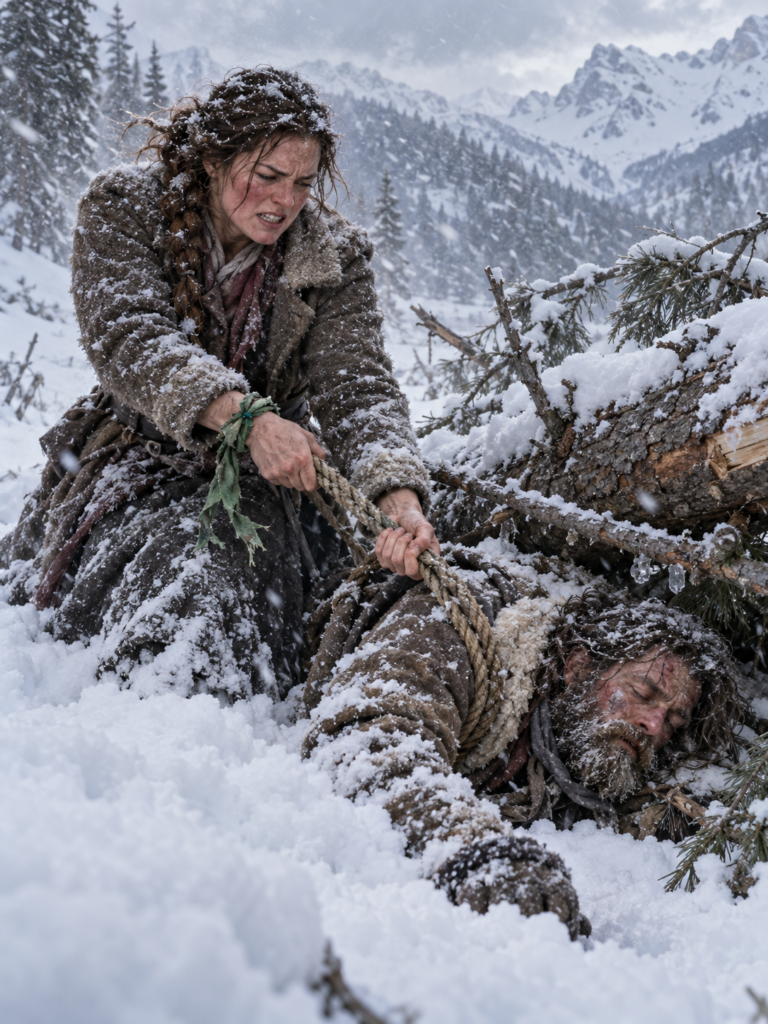
Adelaide tightened the green ribbon around two fingers and returned to Gidrick’s bedside as another gust shook the shutters.
His breathing had changed.
Shallower.
Too fast.
She checked his forehead, then his chest.
“Gidrick.”
No answer.
She poured warm broth into a cup and waited until he stirred enough to swallow.
Her uncle had taught her never to mistake remedies for miracles.
Herbs could ease pain.
Warm fluids could support a sick body.
Clean bandages could prevent a small wound from becoming worse.
But no jar in Adelaide’s trunk could promise that a man would live.
That truth frightened her more than the storm.
By sunrise she had been awake nearly a full day.
Gidrick surfaced briefly.
His hand moved over the blanket as though searching for something.
“Don’t go out.”
“I’m here.”
“Abigail—”
Adelaide stilled.
He had spoken the dead woman’s name once already.
She knew who Abigail was.
She had learned it weeks after arriving on the ridge because Silas Rourke had come to supper and called Adelaide a winter hog while Gidrick sat silent.
Adelaide had walked out before tears humiliated her further.
She found the grave beneath the cedars.
ABIGAIL COLE.
THE MOUNTAIN TOOK HER.
Gidrick found Adelaide kneeling there.
Only then did he tell her.
Abigail had been his first wife.
She had gone out in a storm after believing a calf had escaped.
Gidrick found the animal safe in the barn.
He found Abigail frozen the next morning.
“That’s why you questioned whether I could survive,” Adelaide had said.
Gidrick stared at the grave.
“When Finch described you, I pictured another woman I’d bury.”
“So you decided it would hurt less if you made me feel unwanted first.”
He had not denied it.
That mattered too.
It did not excuse him.
But it changed the shape of the wound.
Later that night Adelaide opened her trunk for the first time.
Gidrick watched jar after jar appear.
“What is all that?”
“My life before Montana.”
He learned her uncle had owned an apothecary.
That her mother had worked there.
That Adelaide had learned to weigh bark, prepare compresses, recognize herbs, clean wounds, and keep careful notes long before marriage brokers began describing her as sturdy.
“You never told me.”
“You never asked what was in the trunk.”
Something like shame entered his face.
After that, their life shifted.
Gidrick left lined gloves beside the water buckets.
Adelaide saved the crisp edge of cornbread for him.
He repaired her cot.
She reinforced the barn shelves.
Neither pretended affection had arrived.
Trust grew in quieter measurements.
Then the blizzard came.
Now Abigail’s name escaped his fever again.
Adelaide touched his shoulder.
“I am not Abigail.”
His eyes opened.
“No.”
“You cannot save me by refusing to care whether I stay.”
His face tightened even through illness.
“I know.”
“And if I remain here after spring, it will not be because you frightened me into believing I have nowhere else.”
“I know.”
“Stop saying that unless you mean it.”
“I mean it.”
Adelaide sat back.
For the first time, Gidrick lifted his gaze fully toward her.
“I was wrong at the station.”
She waited.
“Wrong about your strength.”
“That is obvious now.”
A faint, fevered smile appeared.
“Very.”
“And wrong about what?”
His smile vanished.
“Thinking fear gave me the right to decide for you.”
The storm outside began to weaken.
Inside, his body suddenly shuddered.
Adelaide leaned forward.
“Gidrick?”
Sweat broke across his forehead.
She touched his skin.
Waited.
Checked again.
The terrible heat had begun to fall.
A sound escaped her that was half laugh and half sob.
She bowed her head over his hand.
Hours later, when Gidrick opened his eyes again, morning light filled the cabin.
He saw Adelaide asleep beside him.
Her fingers were cracked.
One wrist was blistered from the stove.
The green ribbon rested beside her hand.
Beyond her stood the open trunk he had once dismissed as useless weight.
Gidrick looked at the woman he had believed incapable of surviving his mountain and understood something that made shame settle deeper than any fever.
She had not merely survived it.
She had walked into its worst storm to bring him home.
And when Adelaide woke, she found him watching her.
“I owe you my life,” he said.
She straightened.
“No.”
His brow tightened.
“No?”
“You owe me honesty.”
Adelaide pushed herself slowly to her feet.
“And when you can stand again, you can begin with the real reason Abigail’s grave frightened you enough to punish a woman who had never met her.”
Gidrick stared at Adelaide while the last of the fever haze cleared from his eyes.
“The real reason?”
“Yes.”
“You already know Abigail died in the snow.”
“I know how she died.”
Adelaide folded the blanket at the foot of the bed.
“I do not know why you spent four months acting as though her death proved every woman who came near this ridge required your permission to survive.”
Gidrick looked away.
He was still too weak to sit without effort.
Adelaide did not press him further that morning.
Truth extracted from a half-conscious man would mean little if he denied it after strength returned.
Recovery took nearly three weeks.
During the first, Gidrick required help walking from bed to stove.
He hated it.
Adelaide could tell because his jaw tightened every time she offered an arm.
But he accepted.
One afternoon he muttered, “I’m useless.”
Adelaide adjusted the chair beneath him.
“You are injured.”
“Same result.”
“No.”
She looked directly at him.
“If you decide every person who temporarily needs help is useless, then I will remind you of that sentence the next time you call someone weak.”
He grew quiet.
By the second week, he could stand without assistance.
By the third, he crossed the cabin on his own.
That afternoon Adelaide sat at the table sorting dried herbs into clean jars.
Gidrick stopped beside the open trunk.
“I owe you my life.”
“You tried that already.”
“And you refused.”
“Correct.”
“What if I insist?”
“I will charge interest.”
His mouth almost smiled.
Then he reached into his coat.
A folded document landed on the table.
Their marriage registry.
Adelaide stopped.
“What are you doing?”
“I want another beginning.”
“We are already married.”
“On paper.”
Her fingers went still.
“That arrangement was your idea too.”
“Yes.”
“I agreed because the settlement would have treated you badly otherwise.”
“And because you did not want me.”
Gidrick winced.
“Yes.”
She waited.
“The man who signed that paper at Oak Haven was afraid of gossip,” he continued. “Afraid of winter. Afraid of burying another woman.”
His voice roughened.
“He was not asking what you wanted.”
Adelaide’s throat tightened.
“What are you proposing?”
“When the roads clear, I take you wherever you choose.”
She stared.
“I have money enough to get you east. Or to Helena. Or wherever you decide.”
“And if I stay?”
Gidrick met her eyes.
“Then I court you.”
Adelaide almost laughed.
“You want to court the wife sleeping beside your stove?”
“Yes.”
“That sounds ridiculous.”
“Probably.”
“Why?”
His hands closed around the edge of the table.
“Because gratitude is not marriage.”
That answer surprised her.
Gidrick continued.
“You saved my life. I could spend twenty years repaying that and still never know whether you remained because you wanted me or because you thought I owed you.”
Adelaide softened despite herself.
“And you?”
“I want the chance to become the man you would choose without a registry trapping either of us.”
The cabin went quiet.
At length Adelaide asked, “Why me?”
Gidrick did not glance toward her body.
His eyes remained on her face.
“You work until the work is done.”
“Romantic.”
“You argue.”
“Better.”
“You walked into a storm after a man who had not earned it.”
“That was foolish.”
“Yes.”
She raised an eyebrow.
“But brave.”
“Continue.”
“You know how to make a place function.”
His gaze moved toward the shelves of herbs, the repaired curtains, the neatly stacked wood.
“And when you are angry, you tell the truth instead of making everybody guess.”
Adelaide almost smiled.
“You are only saying that because you are afraid of me.”
“I am increasingly afraid of you.”
That broke the tension.
She laughed.
Then Gidrick became serious again.
“When I thought I was dying, I was not afraid of death.”
“What frightened you?”
“Dying before I could tell you I had been wrong from the moment you stepped off that train.”
Adelaide looked at the registry.
She did not tear it.
She did not promise anything.
“Then court me.”
Gidrick blinked.
“Badly, probably.”
“Yes.”
“Very badly?”
“I expect disaster.”
His smile appeared slowly.
Spring loosened the mountain from winter.
Gidrick kept his word.
The first flowers he brought Adelaide still had dirt hanging from their roots.
She stared at them.
“You dug up the plant.”
“I thought flowers died if you cut them.”
“They also die if you tear half the mountain out by the roots.”
He looked genuinely concerned.
Adelaide laughed until she had to sit.
The second attempt involved a carved shelf for her medicines.
That was more successful.
He joined her when she gathered early plants along the lower slope.
He asked questions.
Not because he wanted to supervise.
Because he wanted to learn what she knew.
Adelaide noticed that difference immediately.
Then Silas Rourke returned.
He stamped snowmelt from his boots and grinned when he saw Adelaide.
“Well, look at that. Winter hog survived after all.”
The old pain struck before Adelaide could stop it.
Gidrick stood.
His chair scraped sharply backward.
Silas glanced at him.
“Aw, Cole, I’m only—”
“Leave.”
Silas laughed.
“Come on.”
Gidrick opened the door.
“I should have said it the first time.”
His voice remained level.
“You insulted my wife in her own home, and I sat silent because I was a coward.”
Silas’s grin vanished.
“You will not do it twice.”
The trapper looked toward Adelaide.
Then back at Gidrick.
“All right.”
He left.
Gidrick shut the door.
Adelaide stared.
“You are four months late.”
“I know.”
“Did you practice that speech?”
“Several times.”
She tried not to smile.
Failed.
A week later, Adelaide went to Abigail’s grave carrying early wildflowers.
Gidrick accompanied her.
Together they cleared winter debris from the wooden cross.
While lifting a loose stone, Adelaide noticed metal beneath it.
“Gidrick.”
He crouched.
A small tin box lay buried shallowly beside the marker.
“I did not put that there.”
Inside, wrapped in waxed cloth, was a folded letter.
Gidrick recognized Abigail’s hand immediately.
He sat back against the snow-dark earth.
Adelaide waited while he read.
Halfway through, his hand began trembling.
“What is it?”
He passed her the page.
Abigail had written it shortly before the storm that killed her.
She wrote about Gidrick’s fear.
Not only fear for her.
Fear formed long before their marriage.
His father had died beneath an avalanche.
His younger brother had vanished during a winter hunt.
Gidrick loved by guarding.
Then by warning.
Then by trying to control every danger.
Near the end Abigail had written one sentence that made Adelaide stop.
You cannot keep someone alive by refusing to love them.
Gidrick turned toward the grave.
“For years I thought her death proved I had been right.”
Adelaide folded the letter carefully.
“About what?”
“That this place eventually takes anyone I love.”
“And now?”
He looked at the cross.
Then at her.
“Now I think fear simply taught me to waste time.”
Adelaide stood beside him.
“You were still cruel at the station.”
“I know.”
“Abigail’s death explains it.”
“Yes.”
“It does not forgive it.”
“No.”
Gidrick reached toward Adelaide’s hand.
Stopped.
Waited.
She noticed.
Then placed her palm into his.
“Good,” she said.
He looked confused.
“What?”
“You are learning.”
By summer, neighbors began coming to Adelaide for help.
A child with a cough.
A ranch hand with an infected scrape.
A woman needing something for pain.
Adelaide never called herself a physician.
She knew her limits.
She cleaned wounds, prepared simple remedies, and told people when they needed a doctor from town instead of another cup of herbs.
Word spread anyway.
Mrs. Cole knows medicines.
Mrs. Cole keeps good bandages.
Mrs. Cole will tell you when you are being foolish.
That last part became especially popular.
One evening Gidrick showed Adelaide a sketch.
“What is this?”
“An addition.”
“To what?”
“The cabin.”
She studied the drawing.
Shelves.
A worktable.
A window for daylight.
Storage for dried plants.
“My own room?”
“Your workroom.”
Adelaide looked up.
“Did I ask for one?”
Gidrick went pale.
She let the silence torment him for two seconds.
Then smiled.
“I am teasing.”
He exhaled.
“Cruel woman.”
“I learned from an expert.”
He built the room by autumn.
Above the door he carved her married name.
Adelaide touched the letters.
“You forgot Miller.”
Gidrick immediately reached for his knife.
She caught his wrist.
“No.”
“You said—”
“I know.”
He waited.
Adelaide looked at the carving again.
“Leave it.”
When she kissed his cheek, Gidrick froze completely.
She stepped back.
“What?”
“Nothing.”
“You look frightened.”
“I am.”
“The Mountain Devil?”
“Terrified.”
Adelaide laughed.
Then the first snow of the new winter began falling outside.
Gidrick looked toward the white ridge.
For the first time, he did not look at it as an enemy capable of stealing whatever he loved.
He looked at Adelaide.
And understood that spring had given him one final question he could no longer avoid.
When the snow melted again, would she remain because a document said she was his wife—or would she choose, freely, to become one?
Adelaide answered that question before the snow melted.
Not with words.
Not at first.
The second winter on the ridge was hard but ordinary.
That difference mattered.
Storms came.
They filled the trail.
The cattle required extra feed.
One section of barn roofing loosened and had to be braced before another heavy snow.
But Gidrick no longer ran into danger merely because fear told him delay was weakness.
When weather worsened, he prepared.
When Adelaide warned him visibility was failing, he listened.
When he disagreed, they argued.
Sometimes Adelaide changed her mind.
Sometimes he did.
No one had to win every conversation.
In January, a neighbor arrived with a boy whose hand had been badly cut while chopping kindling.
Adelaide cleaned and wrapped the wound but told the father plainly that the boy needed the doctor in Oak Haven because the cut was too deep for her comfort.
Gidrick hitched the sleigh without being asked.
He returned after midnight.
“You did not have to go.”
“The father was exhausted.”
“You sound suspiciously kind.”
“Do not spread it around.”
By February, travelers had begun using Boone Pass less often because drifts made the upper road uncertain.
Two men stopped at the cabin asking directions.
One recognized Gidrick.
“The fellow who married the Missouri woman?”
Gidrick glanced toward Adelaide.
She was sorting dried mint at her worktable.
“Yes.”
The man grinned.
“Folks in Oak Haven say she keeps you alive now.”
Gidrick considered the statement.
“That is accurate.”
Adelaide hid a smile.
Months earlier, such talk might have embarrassed him.
Now he seemed almost proud.
That evening, while they ate stew beside the fire, Gidrick said, “You know, I still have not asked whether you want to leave in spring.”
Adelaide dipped bread into her bowl.
“I know.”
“I said I would.”
“You did.”
“So?”
She looked at him.
“You are doing very poorly at this courting business.”
He straightened.
“How?”
“A proper suitor should appear confident.”
“I am not.”
“Clearly.”
“I thought honesty mattered.”
“It does.”
“Then I am honestly terrified you will say yes.”
Adelaide set down her spoon.
“Do you want me to stay?”
“Yes.”
He answered without hesitation.
“As what?”
Gidrick’s expression changed.
“My partner.”
She waited.
“My wife, if you still choose it.”
She waited longer.
“The woman who argues when I’m wrong.”
“Frequently.”
“The person whose work matters as much as mine.”
“Better.”
“The one whose room, money, letters, choices, and body remain hers whether she loves me or not.”
Adelaide went still.
Gidrick swallowed.
“And the person I love.”
The words were quiet.
No thunder.
No sweeping declaration.
Only a man finally saying what fear had made him avoid for years.
Adelaide’s eyes filled.
“You practiced that too.”
“Yes.”
“How many times?”
“Too many.”
“Where?”
“Mostly the barn.”
She laughed through tears.
Gidrick did not move toward her.
That was what made her rise.
She crossed the cabin herself.
Stopped in front of him.
“Stand up.”
He did.
She placed both hands on his coat.
“The marriage at Oak Haven was legal.”
“Yes.”
“It was also miserable.”
“Yes.”
“I did not choose it freely.”
His face tightened.
“No.”
“I chose survival.”
“Yes.”
She looked at him.
“But I am not choosing survival now.”
Gidrick barely breathed.
“I am choosing you.”
His eyes closed once.
When they opened, they were wet.
“Are you sure?”
Adelaide smiled.
“Ask me again and I may reconsider.”
He laughed, and only then did she kiss him.
There was no minister present.
No registry.
No witness except the fire and the snow.
Yet it felt more binding than ink ever had.
The following morning, Adelaide moved her pillow from the cot beside the stove.
Gidrick watched from the doorway of his room.
She held the pillow against her chest.
“Do not make this dramatic.”
“I am not speaking.”
“You are being dramatic silently.”
“I do not know how to prevent that.”
She walked past him.
Then turned.
“Gidrick?”
“Yes?”
“If I ever want my own room again—”
“You take it.”
“If I ever want to sleep beside the stove because you snore?”
His brow furrowed.
“I do not snore.”
“You do.”
“I have never heard it.”
“That is generally how snoring works.”
He considered this disturbing information.
Adelaide laughed and pulled him into the room.
Spring returned.
Water ran down the ridge.
Pines released snow from their branches.
The cedar grove reappeared.
Adelaide continued visiting Abigail’s grave.
At first Gidrick went with her.
Later, sometimes Adelaide went alone.
She never felt jealousy toward the dead woman.
Abigail belonged to Gidrick’s life.
Love did not require erasure.
One afternoon Adelaide placed new wildflowers beside the cross and reread the letter they had found.
You cannot keep someone alive by refusing to love them.
When she returned to the cabin, Gidrick was fitting shelves inside her workroom.
“You measured badly.”
He looked offended.
“I measured twice.”
“You cut once?”
“Yes.”
“Then one of those measurements was wrong.”
He stepped back.
The shelf visibly leaned.
“Damn.”
Adelaide smiled.
“Take it down.”
“Yes, ma’am.”
The apothecary room became known across the district.
Adelaide stored bandages, dried herbs, simple tinctures, soap, and salves.
She kept careful records.
She did not promise cures.
If someone needed a trained doctor, she said so.
If someone merely needed rest, clean water, and time, she said that too.
Gidrick sometimes sat in the doorway repairing harness while she worked.
He never called it helping.
Adelaide knew better.
He built drying racks.
He collected clean jars from town.
He learned which plants not to pick.
He once returned proudly with an armful of something entirely useless.
Adelaide examined it.
“What is this?”
“Medicine.”
“No.”
His face fell.
“You have gathered weeds.”
“They looked important.”
“They were very convincing weeds.”
He stared.
Then she began laughing.
By summer, neighbors started calling Adelaide the ridge healer.
She disliked the title.
“I am not a doctor.”
Gidrick shrugged.
“They know that.”
“Then why do they keep calling me?”
“Because you listen before deciding.”
That answer pleased her more than praise of any remedy.
Silas Rourke appeared again in August.
He stood awkwardly on the porch with a cut across his forearm.
Adelaide looked at him.
Silas looked at the floor.
“Mrs. Cole.”
“Mr. Rourke.”
“I heard you know wounds.”
“I know some.”
He shifted.
“And I owe you an apology.”
Gidrick was splitting wood nearby.
He stopped but did not interfere.
Silas removed his hat.
“What I said last winter was ugly.”
Adelaide waited.
“And cowardly.”
“Yes.”
Silas swallowed.
“I was trying to make Gidrick laugh.”
“That does not improve it.”
“No.”
Adelaide opened the door.
“Come inside.”
Silas looked surprised.
“You’re helping me?”
“I am cleaning a wound. Do not confuse that with forgetting your manners.”
“Yes, ma’am.”
After he left with a clean bandage, Gidrick came inside.
“You did not have to help him.”
Adelaide looked at him.
“Remember when I told you fear did not make cruelty noble?”
“Yes.”
“Pain does not make revenge noble either.”
Gidrick leaned against the table.
“You are inconveniently consistent.”
“I know.”
That autumn, he repaired Abigail’s cross.
Not because the old wood was collapsing, but because he had finally stopped avoiding the place long enough to notice how weather had worn it.
Adelaide helped.
They replaced one cracked piece and preserved the original carved name.
When finished, Gidrick sat beside the grave.
“My father died when I was nineteen.”
Adelaide sat nearby.
“An avalanche.”
“Yes.”
“My brother went missing seven winters later.”
“You never found him?”
“No.”
Gidrick looked across the trees.
“Then Abigail.”
Adelaide understood the pattern.
Every love followed by disappearance.
Every attachment converted into warning.
“I thought if I controlled enough things, I could prevent the next grave.”
“And when you saw me at the station?”
“I saw someone I believed the mountain would take.”
“Because I was large.”
He winced.
“Because I was ignorant.”
“Both can be true.”
He nodded.
“I thought strength looked like me.”
Adelaide smiled faintly.
“Brooding?”
“Apparently.”
“Bearded?”
“That too.”
“Poor conversational skills?”
“Adelaide.”
She laughed.
Gidrick reached toward her hand.
Stopped.
Even after all this time, he still remembered.
She took his hand herself.
“I was wrong,” he said.
“You have established that.”
“No.”
His gaze moved toward her.
“I mean about strength.”
Adelaide waited.
“I thought surviving meant never needing anyone.”
She looked at Abigail’s grave.
“What do you think now?”
“That may be the loneliest kind of dying.”
They sat there until the afternoon cooled.
Years passed, though not as a blur.
They were marked by specific things.
The year Gidrick doubled the barn because Adelaide’s milk cow somehow became three cows.
The winter a roof beam cracked and they spent two weeks sleeping in the workroom while repairs were made.
The summer Adelaide traveled to Helena for better medical reference books and returned with more volumes than clothes.
The autumn Gidrick developed a habit of telling every traveler that his wife had once dragged him through a blizzard.
Adelaide finally threatened to charge admission.
Their home expanded.
Not into a grand house.
Into a useful one.
A larger kitchen.
A proper workroom.
A second bedroom for travelers too sick or snowbound to continue.
Shelving near the stove.
A long table where neighbors sometimes ate during storms.
Adelaide’s trunk remained beneath the window.
Gidrick offered to build a cabinet.
She refused.
“That trunk got us this far.”
“It nearly broke my back at the station.”
“You deserved it.”
“I did.”
The frayed green ribbon stayed in the top drawer of Adelaide’s worktable.
When frightened patients arrived, children especially, she sometimes let them hold it.
“My mother gave this to me,” she would say.
“What does it do?”
“Nothing magical.”
Then she would smile.
“It reminds me fear can travel with you without choosing the road.”
Gidrick overheard her say that once.
He stood outside the workroom afterward for a long time.
That night he asked, “Was that about me?”
“It applies.”
“I dislike wisdom that applies.”
“Most people do.”
The winter marking ten years since Adelaide came to Montana arrived early.
One evening she stirred soup over the stove while Gidrick carried in wood.
He stopped.
The smell caught him.
Adelaide looked over.
“What?”
“That soup.”
“What about it?”
“That is what you made after the blizzard.”
“Something similar.”
He set down the wood.
“For years I thought the herbs saved me.”
“They helped.”
“But they were not the thing.”
She rolled her eyes.
“Do not become sentimental.”
“I am married. Apparently it happens.”
“Tragic.”
Gidrick came nearer.
“It was you.”
Adelaide turned.
“No.”
His brow furrowed.
“No?”
“You nearly died of exposure and fever. Warmth, fluids, rest, and luck mattered. Do not rewrite the event into poetry.”
He stared.
Then laughed.
“Fine.”
“Good.”
“You, warmth, fluids, rest, and luck saved me.”
“Better.”
He slipped his arms around her from behind.
Adelaide leaned back against him.
Outside, snow covered the cedar grove.
Inside, the cabin held heat.
Near the stove sat the table Gidrick had built for Adelaide years earlier.
Her mortar rested there.
The green ribbon.
A jar containing dried mountain herbs gathered that first spring.
Along the table’s edge, Gidrick had once carved words after completing it.
THE WOMAN WHO SAVED ME.
Adelaide had complained.
“It is dramatic.”
“I was trapped under a tree.”
“You recovered.”
“I nearly froze.”
“You did.”
“Then the carving stays.”
She never removed it.
Travelers still asked about those words.
Gidrick always said, “My wife saved my life.”
From the workroom Adelaide would answer, “Tell them the whole truth.”
The whole truth was harder.
Adelaide had not saved him merely by finding him beneath a pine.
She had confronted a man whose grief had hardened into judgment and refused to pretend pain excused cruelty.
She had accepted his explanation without surrendering her boundary.
She had demanded that apology become behavior.
And Gidrick had learned.
He stopped mistaking control for care.
He stopped assuming his fear gave him authority over another person’s choices.
He learned that asking was not weakness.
That listening was work.
That love was not proved by keeping someone from every danger.
Sometimes love meant trusting the person beside you to know their own strength.
Adelaide changed too.
When she arrived in Montana, she believed she had one final chance to become useful enough that another household might tolerate her.
Years later she could barely recognize that woman.
She had built work that mattered to her.
She earned money of her own.
People crossed miles of difficult road seeking her judgment.
Her marriage became part of her life, not the permission for it.
And Gidrick never again asked her to prove she belonged on the ridge.
The mountain itself never became gentle.
It still took careless travelers.
Still punished arrogance.
Still buried roads and broke branches and turned ordinary mistakes dangerous.
But Adelaide no longer saw it as a judge measuring whether she deserved to remain.
It was simply a place.
Beautiful.
Hard.
Home.
One spring morning long after gray had appeared in Gidrick’s beard, Adelaide found him beside Abigail’s grave.
He had placed fresh flowers there.
Adelaide stood next to him.
“You all right?”
“Yes.”
He looked toward the cross.
“I used to think loving again betrayed her.”
Adelaide waited.
“Then I thought losing her meant I had failed.”
“And now?”
Gidrick considered.
“I think she lived.”
He took a slow breath.
“And I loved her.”
Another.
“And she died.”
His hand opened beside him.
Adelaide placed hers inside it.
“All three things can be true.”
“Yes.”
He looked at Adelaide.
“And loving you does not erase any of them.”
“No.”
“Thank you for knowing that.”
She squeezed his fingers.
“Thank Abigail.”
“For what?”
Adelaide glanced at the grave.
“She apparently spent years trying to teach you the same thing.”
Gidrick laughed softly.
“Poor woman.”
They walked home together.
The path led through the same cedar trees where Adelaide had once discovered the grave after fleeing Silas’s insult.
Ahead stood the cabin where Gidrick had ordered his unwanted bride to sleep beside the stove.
It no longer looked like that place.
The original walls remained.
So did the stove.
But there were more windows.
More rooms.
Adelaide’s worktable.
Gidrick’s repaired harnesses.
Shelves he had finally learned to level properly.
Two chairs near the fire.
Not one person’s cabin with space grudgingly made for another.
A shared home.
On the porch, Adelaide paused.
“Do you remember what you said at the station?”
Gidrick groaned.
“Unfortunately.”
“You told me I did not know what I could survive.”
“I was unbearable.”
“Yes.”
He looked at her.
“You did not know.”
She raised an eyebrow.
“Excuse me?”
“Neither of us did.”
He glanced toward the ridge.
“You did not know you could survive this mountain.”
Then he looked back at her.
“And I did not know I could survive being wrong this often.”
Adelaide laughed.
“That remains uncertain.”
He opened the cabin door.
She did not enter immediately.
Years ago, she had crossed that threshold because she had nowhere else to go.
That difference still mattered.
Now she had money.
A reputation.
Work.
Friends.
She could leave if she wished.
She stayed because staying had become a choice renewed in ordinary days.
Gidrick waited without hurrying her.
Adelaide touched the frayed green ribbon tied loosely around her wrist.
Then she stepped inside.
The fire burned low.
Her old trunk rested beneath the window.
Gidrick had never asked to move it.
Adelaide crossed to it and opened the lid.
The original jars had long since been replaced.
Only a few old things remained.
The brass scale.
Her mother’s mortar.
A folded dress too worn to use.
She lifted the green ribbon from her wrist and laid it inside.
Gidrick watched.
“You sure?”
“Yes.”
“You have carried that for years.”
“I know.”
“What changed?”
Adelaide closed the trunk.
“I don’t need it in my hand every time I’m frightened anymore.”
Gidrick looked at her for a long moment.
Then he nodded.
No speech.
No attempt to turn it into a symbol larger than she intended.
That was another thing he had learned.
Some moments belonged to the person living them.
Adelaide came to stand beside him.
Outside, melting snow slipped from the roof in steady drops.
The ridge beyond the window shone beneath spring light.
Gidrick reached toward her.
Paused.
Adelaide smiled.
“You may.”
His hand settled around hers.
Years before, a frightened woman had stepped off a Montana train carrying a trunk and a ribbon.
A grieving mountain man had looked at her once and thought he understood her limits.
He had been wrong.
But Adelaide’s greatest victory was not proving she could haul water, split wood, cross a blizzard, or drag a grown man through deep snow.
It was learning she never should have needed to prove her worth at all.
And Gidrick’s redemption was not surviving beneath that pine.
It was understanding that being saved did not entitle him to her love.
He asked for another chance.
She judged the man he became.
Then she chose.
Not the registry.
Not the ridge.
Not necessity.
Him.
And because that choice remained hers every day afterward, it meant more than anything either of them had signed in Oak Haven.
Gidrick Cole once believed he needed a woman strong enough to survive his mountain.
What he truly needed was a man humble enough to stop deciding what strength looked like.
Adelaide Miller once believed she needed somewhere willing to keep her.
What she built instead was a life where remaining was never the price of survival.
The heavy trunk stayed beneath the window for the rest of their years.
Whenever visitors asked why Gidrick kept such an enormous piece of luggage in the main room, he would smile toward Adelaide.
“That thing once saved my life.”
Adelaide always corrected him.
“No.”
Then she would touch the scarred lid.
“It carried the tools.”
Gidrick would wait.
And Adelaide would finish the truth.
“I chose to use them.”
That distinction was the whole story.


