
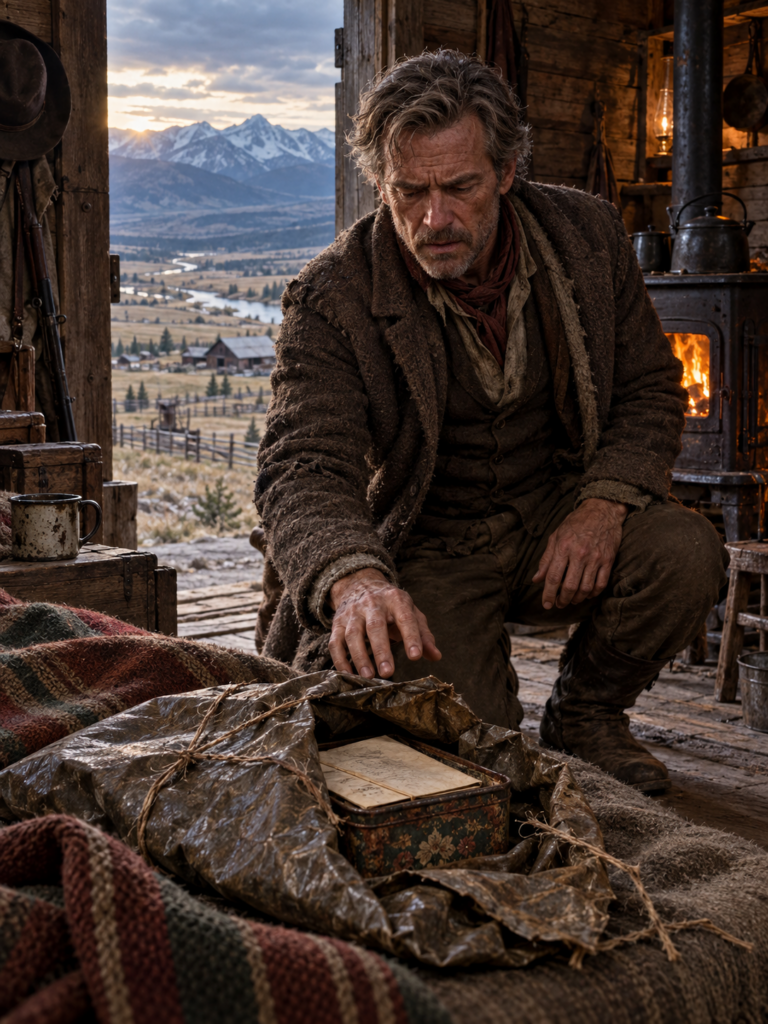
The oilcloth fell away beneath Walter’s hands, revealing a flat tin biscuit box painted with red flowers nearly erased by rust.
A folded sheet of ledger paper rested on top.
Under the box sat a small cloth sack whose weight made coins knock softly together when Walter moved it aside.
He ignored the money.
The handwriting on the folded page had already changed the room.
Ellis Broaden’s.
Walter knew those upright letters from forty years of feed orders, cattle counts, supply lists, brand records, and notes left beneath coffee cups.
He unfolded the sheet.
His own name appeared in the first line.
Walter Mercer.
Not “the boy.”
Not “hand.”
Not “Walter” scratched beside a chore.
His full name.
He lowered himself onto one of the nail-keg stools.
Beneath the ledger sheet was another document, heavier than ordinary paper.
Walter lifted it carefully.
He read the first line.
Then the second.
Then he stopped breathing normally.
The paper described Bare Fork by section, boundary, creek fork, and range marker.
Walter knew every place named.
The north fork.
The west timber line.
The meadow section.
The bench above the creek where Broaden now lay buried beneath a plain slab of stone.
At the bottom stood Broaden’s signature.
Near the center stood Walter’s name again.
This time beside language Walter had to read three times before he trusted himself to understand it.
The land, stock, buildings, improvements, and associated property of Bare Fork were conveyed to Walter Mercer upon Ellis Broaden’s death.
Walter laid the paper flat.
His hands did not shake.
That surprised him.
He had seen men shake after being thrown from horses. He had seen hands shake from fever and cold and bad news.
His stayed still.
He pressed his palm against the deed as if checking whether the table itself had gone unreal.
Outside, one of the horses stamped.
The ordinary sound made the words worse.
Or better.
He could not yet decide.
Because another thought had already arrived.
Howerin had said no will existed.
Doyle Broaden believed he owned Bare Fork.
An auction was being prepared.
A piece of paper hidden in an abandoned shack could say anything.
Walter was a ranch hand with twelve dollars in a tobacco tin.
Doyle was blood family.
Law had already spoken once.
Walter looked toward the door.
For forty years he had obeyed Broaden because the man had never asked him to do work without reason.
Repair the second-ridge shack.
The instruction had brought him here.
That could be chance.
But Broaden had spoken about handwritten papers too.
That was harder to dismiss.
Walter unfolded the ledger page again.
The opening words were plain.
Walter—
If you have come here because I told you the shack needed seeing to, then you have done what I believed you would do.
Walter stopped.
The air felt suddenly thinner.
Broaden had expected him to find this.
Not someday.
After his death.
Walter read the sentence again, then forced himself not to race through what followed.
A man could misunderstand words when he wanted them too badly.
So he carried the deed to the doorway and examined the signature in daylight.
He compared it with the letter.
Same deliberate B.
Same narrow loop in the d.
Same pressure Broaden always put beneath the final stroke.
Real, Walter thought.
Or real enough to take to somebody whose judgment did not depend upon Walter wanting it to be.
He returned to the table.
The coin sack could wait.
The roof could wait.
Even Broaden’s letter could wait until Walter had done the first necessary thing.
He folded the deed into his coat.
Then he stopped.
No.
If he rode down and lost it crossing the creek, forty years might vanish into water.
Walter found the biscuit tin, placed the deed and letter inside, closed the rusted lid, and wrapped the box in his mother’s sage-and-rust blanket.
That night he slept with the bundle against the wall beside his head.
Before sunrise, he was awake.
He fed both horses, saddled the buckskin, secured the tin box beneath his coat, and stood for one last moment outside the repaired shack.
Bare Fork spread below him in the gray morning.
Yesterday he had looked down believing none of it was his.
Today a paper claimed all of it was.
Walter tightened the cinch.
Belief could wait.
Proof could not.
He swung into the saddle, turned the buckskin toward the county recorder’s office, and started down the ridge.
The buckskin picked its way down the ridge while Walter kept one gloved hand near the inside of his coat.
Every creek crossing made him aware of the biscuit tin.
Every low branch seemed capable of knocking forty years of his life into the mud.
He reached the settlement in the middle of the afternoon and tied the horse outside the small frame building where the county recorder kept his books two days each week.
Ansel Pike sat behind the counter.
He was sixty-two, thin through the shoulders, and had spent thirty-one years recording property transfers in the county.
Walter removed his hat.
“I need you to look at something.”
Pike held out a hand.
Walter took the deed from the tin box.
The recorder read it once.
Then again.
Walter watched his face.
That was harder than waiting through a difficult calving. Livestock told a man when something had gone wrong. Human faces could decide not to.
At last Pike placed the deed on the counter.
“Where did you get this?”
“Second-ridge shack.”
“Broaden put it there?”
“I expect so.”
“You expect?”
Walter produced the letter.
Pike glanced at the handwriting and nodded before reading.
“You know his hand?” Walter asked.
“I recorded enough of it.”
“And the property description?”
Pike pulled one of the great county ledgers from a shelf.
“Let’s find out.”
For nearly twenty minutes, he compared section numbers, earlier conveyances, creek boundaries, and range markings.
Walter stood silent.
Finally Pike shut the book.
“Description is clean.”
Walter did not move.
Pike looked at him over his spectacles.
“This transfers Bare Fork to you.”
Walter absorbed the words differently hearing another man say them.
“Howerin told me there was no will.”
“This isn’t that.”
“What is it?”
“A deed.”
“Good?”
Pike looked almost offended.
“If I thought it bad, Mercer, I wouldn’t record it.”
It was the first time Walter had heard somebody call him Mercer as though the name belonged on the owning side of a counter.
He reached into the tobacco tin.
“How much?”
“One dollar forty.”
Walter counted the coins.
Pike entered the instrument into the county book, copied a certificate, pressed the seal, signed beneath it, and gave Walter the papers.
That small official movement changed Bare Fork more completely than a flood.
But Walter felt no sudden triumph.
Only responsibility.
“Suppose the nephew objects?”
“He can object.”
Walter waited.
Pike added, “That isn’t the same as prevailing.”
On the ride home, Walter thought about that distinction.
A man could object to the weather.
The weather still came.
He sent word to Howerin by the Thursday freight wagon.
The message contained no anger.
The deed had been found.
It had been recorded.
The spring auction should stop.
Eight days later the gray coat appeared again on the wagon track.
Howerin rode alone.
This time Walter met him on the porch carrying the biscuit tin.
They sat at Broaden’s plank table.
The same place where Howerin had explained that Walter was hired labor with a deadline.
Walter placed the deed, county certificate, and Broaden’s letter before him.
Howerin examined the deed first.
Then the certificate.
Then he read the letter.
Walter saw the attorney return to one paragraph before folding everything carefully.
“Well?” Walter asked.
Howerin removed his spectacles.
“The instrument is valid.”
“Then the auction stops.”
“Yes.”
“Doyle?”
“I’ll notify him.”
Walter waited.
Howerin seemed uncomfortable with the silence.
“The nephew could attempt a challenge.”
“On what ground?”
“He could claim incapacity. Improper execution. Undue influence.”
Walter almost smiled at the last one.
“I influenced Broaden?”
“I’m telling you what lawyers can allege.”
“I found it where he told me to go.”
“I know.”
“You read the letter.”
“I did.”
“Then write him what you think.”
Howerin studied Walter more carefully than he had during his first visit.
“I will.”
Walter poured coffee into two cups.
The lawyer accepted his.
After a moment, Howerin said, “I owe you an apology.”
Walter looked up.
“I told you the estate passed to Doyle because every record available to me said it did. That was legally accurate at the time. But I spoke as if the matter were finished.”
“It looked finished.”
“That doesn’t excuse treating forty years of your life as a line item.”
Walter glanced at the table.
Broaden would have disliked a speech.
So did Walter.
“Happens.”
“No,” Howerin said. “It shouldn’t.”
That answer earned more of Walter’s attention than the apology.
Howerin left before dusk.
At the porch, he paused with one foot in the stirrup.
“Broaden knew what he was doing.”
Walter thought of the second-ridge shack.
“I expect he knew for a long while.”
Doyle’s reply arrived in April.
One sheet.
No challenge.
He would honor Ellis Broaden’s deed and wished the ranch well.
Walter read it once and placed it in the biscuit tin.
Then spring came.
With it came a problem no document could solve.
Walter had spent four decades knowing exactly what to do because another man owned Bare Fork.
Now every decision was his.
How many cattle to hold through winter.
Which fence came first.
Whether to replace the west corral posts this year or next.
Who would be allowed to graze the lower meadow.
Whether he could afford a new plow.
Ownership felt less like having something than answering for it.
The first person to help him understand that was Aught Rener from below the pass.
Aught rode up leading a young ram owed to Broaden from an old trade.
He tied it at the corral.
“Figured the debt belonged here.”
Walter looked at the animal.
“Broaden’s gone.”
“Debt ain’t.”
That sounded enough like Broaden to make Walter nod.
Aught stayed for supper.
Before leaving, he mentioned the north fence had gone down in a February wind.
“I rolled your wire and stacked what posts were sound.”
Walter noticed the word.
Your.
“I’ll set them next week.”
“I’ll come.”
“No need.”
“I didn’t say there was.”
The following week Aught returned with his nineteen-year-old son.
For two days they dug post holes through ground that fought every shovel.
They set cedar posts Aught had cut on his own land and refused payment for.
Walter had lived at Bare Fork forty years.
He had not known until he owned it how many people had been quietly connected to the place.
In May, the widow Mrs. Deal arrived with a broody hen, six settings of eggs, sourdough starter, and bread.
“A man alone can’t live on bacon and cornmeal.”
“I have.”
“That doesn’t mean you should.”
Walter nearly argued.
Then he recognized another form of stubbornness and surrendered.
The preacher asked to graze two milk cows on the lower meadow during the dry weeks.
Walter said yes.
The preacher stayed and helped clean the spring box.
Josiah Beam, the blacksmith, rode up in July to ask if Walter planned to keep Broaden’s shoeing account.
Walter said he did.
Josiah immediately reset a loose shoe on the plow horse and refused payment.
“Next one,” the blacksmith said, “you pay.”
“Fair.”
By August, something stranger than ownership had happened.
People in town knew his given name.
At the store, Pearl Hatchet opened a fresh account page.
WALTER MERCER.
Walter stared at it long enough for Hatchet to misunderstand.
“Spelled wrong?”
“No.”
The storekeeper dipped his pen.
“Then what?”
“Nothing.”
But it was not nothing.
For most of his life, he had been Broaden’s hand.
Now men touched their hats and said, “Mr. Mercer.”
He did not correct them.
At night he still slept in the bunkhouse.
The main bedroom remained untouched.
Broaden’s coat no longer hung there, but Walter could see its absence.
He ate at the house table now.
That was as far as he could go.
One September afternoon, a freight wagon brought wire from the town beyond the pass.
The driver was new to Walter, a broad man with graying whiskers.
They unloaded together.
While Walter counted coils, the man said casually, “Funny thing. My wife asked about this place when she heard Broaden died.”
Walter kept working.
“She taught school down valley years ago. Ruth.”
The coil in Walter’s hands suddenly seemed heavier.
The freight agent did not notice.
“Said she used to know a man working up here. Asked if he was still around.”
Walter set the wire down.
“What did you tell her?”
“That I didn’t know.”
Walter nodded.
The man talked about freight rates afterward.
Walter heard almost none of it.
That evening, he took his mother’s blanket from the bunk.
Inside one fold lay a pressed sprig of yarrow, brittle and nearly colorless.
Ruth had given it to him decades earlier.
She had once stood beside the corral and told Walter she meant to build a house if a man would help her.
He had wanted to.
That was the truth he had never permitted himself to name.
But Broaden had been aging even then.
Winters were difficult.
Walter had said he could not leave him alone.
Ruth had touched the back of his hand with two fingers.
Then she had gone.
Married.
Built whatever life followed.
Walter stared at the dry sprig.
For one painful moment, the deed felt like a cruel joke.
Land now.
A name now.
A house now.
All after the woman who had once offered to build one with him had belonged to another life for years.
Then Walter heard Broaden’s voice in memory.
A man who kept his word through forty winters had already owned everything worth owning.
At the time, Walter had thought it meant loyalty was enough.
Now he wondered whether Broaden had meant something harder.
A man could keep faith with another person so long that he forgot he was also responsible for the life still left to him.
Walter refolded the yarrow.
But instead of returning it to the blanket, he carried it into the main house.
He opened the rusted biscuit tin.
The deed lay inside.
Broaden’s letter lay above it.
Doyle’s surrender of claim rested beneath the county certificate.
Walter placed Ruth’s yarrow among them.
Things people had left him.
Things he had failed to understand when they were first given.
His hand settled on Broaden’s letter.
He had read it several times without allowing himself to stay long on the final lines.
Tonight, for the first time, he drew the paper completely from the box and unfolded it beside the fire.
The paper crackled softly beneath Walter’s fingers.
Outside, frost had begun whitening the meadow.
Inside, firelight moved across Broaden’s handwriting.
Walter read from the beginning.
Walter—
If you have come here because I told you the shack needed seeing to, then you have done what I believed you would do.
Walter paused there, as he always did.
The sentence had first seemed like proof of a plan.
Now it sounded more personal.
Broaden had known him well enough to trust not only that Walter would remember the instruction, but that he would obey it after the man giving it was buried.
The letter continued in the old rancher’s plain manner.
There was no grand declaration.
That would not have been Broaden.
He wrote that the deed had been prepared while he remained in full command of his judgment. He had chosen the second-ridge shack because only one man regularly inspected those buildings without being reminded twice.
He wrote that Walter knew Bare Fork better than any blood relative alive.
He wrote that land ought, when possible, to pass to the person who had kept faith with it.
Then came the part Walter had spent months reading too quickly.
Broaden admitted he should have spoken plainly before death.
He had not.
Some habits of silence, he wrote, were useful in bad weather and poor company but cowardly in matters that deserved words.
Walter lowered the page.
That sentence hurt more than the inheritance had pleased him.
Because it explained Broaden.
And himself.
Two men had shared forty years while saying almost nothing they considered too important to say badly.
Broaden had lost a son before Walter arrived.
Walter had known that only years later, from somebody else.
Walter had lost both parents before he was old enough to understand death.
Neither man had called the other family.
Yet they had spent nearly every day behaving as though they were.
Broaden wrote that when the town clerk had asked whether a five-year-old orphan could be useful, his first impulse had been to refuse.
He had recently buried his own boy.
The house had become unbearable.
Then he had written one line on the back of the clerk’s letter.
He could.
Walter stopped reading.
The room blurred slightly.
He rubbed one thumb across the heel of his hand and waited until it passed.
He remembered arriving wrapped in his mother’s blanket.
Broaden standing beside the wagon.
No smile.
No welcome speech.
Just a long look at the frightened boy.
Three mornings later, black coffee.
After that, work.
Walter looked at the tin cup beside him.
For forty years, he had interpreted Broaden’s restraint as simply the old man’s nature.
Now another possibility existed.
Perhaps Broaden had been afraid to love another son loudly enough to lose him.
That did not make the silence wise.
The old man’s own letter admitted as much.
But it made the silence human.
Walter continued.
Broaden wrote that he had watched Walter refuse opportunities because he believed loyalty required staying.
One sentence made Walter’s jaw tighten.
I knew about the schoolteacher.
Walter stared at it.
Of course Broaden had known.
Nothing occurred around the Bare Fork corral without him noticing.
The letter did not pretend Walter had made the wrong choice.
It said only that Broaden had been grateful and ashamed in equal measure.
Grateful Walter stayed.
Ashamed he had accepted the sacrifice without asking whether Walter understood its cost.
Walter put the letter down.
Across the room, the small main-house bedroom stood open.
For months he had refused to sleep there because it had belonged to Broaden.
Before that, he had refused Ruth because Broaden needed him.
Before that, he had accepted the bunkhouse because he was the hand.
A boy arrived with nothing.
A worker owned nothing.
A loyal man asked nothing.
Walter suddenly saw the pattern.
It had not been forced on him entirely.
He had helped build it.
That realization brought neither blame nor comfort.
Only responsibility.
He picked up the letter again.
Broaden’s last paragraphs were simpler.
The deed was not payment for forty years.
Broaden specifically rejected that idea.
No acreage could calculate loyalty.
No herd could reimburse a life.
He was leaving Bare Fork to Walter because Walter was already the person most responsible for its survival.
And because, Broaden wrote, it was past time Walter had somewhere he could stay because he chose it, not because another man allowed it.
Walter read the final line twice.
Do not spend the rest of your life working for a dead man.
The fire settled.
A small piece of cedar collapsed inward with a sigh of sparks.
Walter sat unmoving.
Then, unexpectedly, he laughed once.
It was not much of a laugh.
But the house had probably never heard one from him when he was alone.
“Little late telling me,” he said.
The room gave no answer.
Walter folded the letter.
For the first time, he understood why Broaden had hidden the papers instead of placing them with the attorney.
The choice had been risky.
Howerin had been correct about that.
A fire could have taken the shack.
A pack rat could have damaged the paper.
Walter might have forgotten the instruction.
But Broaden had built the act around the oldest language between them.
Work.
Go inspect what needs tending.
Walter would understand that command when he might have mistrusted any emotional farewell.
It was imperfect.
It was also completely Broaden.
Walter placed the letter back inside the box.
Then he looked toward the bedroom.
The next morning, he moved.
Not away from Bare Fork.
Across the yard.
He carried his mother’s sage-and-rust blanket from the bunkhouse into the room Broaden had occupied.
He stripped the old bed.
Aired the mattress.
Swept beneath the frame.
Opened both windows despite the cold.
He removed the last of Broaden’s personal things carefully and packed them into a cedar chest rather than leaving them like relics.
At dusk, Walter laid his blanket across the foot of the bed.
He stood in the doorway.
For four months, he had behaved as though sleeping there might steal something from a dead man.
Now the thought seemed foolish.
Broaden had given him the ranch.
He had not given him instructions to preserve his absence.
Walter slept in the room that night.
The room did not object.
Neither did the dead.
Winter approached.
Walter made decisions differently after that.
When Aught suggested increasing the herd because cattle prices looked strong, Walter listened, calculated the hay, and declined.
“Could make more money,” Aught said.
“Could lose the meadow.”
Aught nodded.
“Your call.”
Walter noticed those words no longer frightened him.
Your call.
He repaired the west corral.
He bought a better plow but refused a more expensive one Hatchet tried to sell him.
He allowed the settlement’s cows onto the lower meadow again under clear conditions.
He paid Josiah Beam for every shoe after the first.
When Mrs. Deal sent bread, he returned beef.
Not because debts required exact repayment.
Because exchange felt different from charity.
One Sunday after checking the north fence, Walter rode to Broaden’s grave.
The creek ran clear below the bench.
He dismounted.
For a while, he said nothing.
Then he told the stone about the west corral.
About the new plow.
About Doyle’s letter.
About Howerin admitting he had been wrong to reduce forty years to wages and a departure date.
Finally Walter said, “Found your letter.”
Wind moved through the grass.
“You made that harder than necessary.”
A magpie landed on a fence post.
Walter looked at the grave.
“I suppose I do that too.”
That was as near to confession as either man had ever been comfortable getting.
He mounted and rode home.
By late October, Bare Fork looked much as it always had.
That was the strange thing.
Ownership had not changed the shape of the ridge.
The creek did not run differently because Walter’s name sat in a county ledger.
Cattle did not respect deeds.
Snow would fall on an owner and a hired man with equal indifference.
The change existed in smaller places.
A fresh page in Hatchet’s account book.
A key Walter no longer carried on another man’s behalf.
A bedroom he entered without apology.
Neighbors asking his permission instead of assuming Broaden’s.
And the word Mr. before Mercer.
At first, Walter had thought the title fit because the deed made it legal.
Eventually, he understood that was not why.
People had begun using his name because he had finally allowed himself to occupy it.
Ruth remained the one unfinished thing.
Not unfinished between them.
That distinction mattered.
She was married.
Her life belonged to the choices she had made after Walter refused the future she once offered.
He would not turn an old tenderness into permission to intrude on it.
But neither would he pretend she had meant nothing.
One November afternoon, the freight agent returned with sacks of salt and a crate of lamp chimneys.
Walter helped unload.
When they were finished, the man wiped his hands on his coat.
“My wife asked again whether I’d learned that hired man’s name.”
Walter looked toward the meadow.
For an instant he saw Ruth young again at the corral.
Her fingers touching the back of his hand.
A house she planned to build.
A life that continued because he had said no.
Walter felt grief.
But not regret in the old sense.
Regret imagined the past could still be renegotiated.
It could not.
“Walter Mercer,” he said.
The freight agent smiled.
“That you?”
“Yes.”
“I’ll tell her.”
Walter nodded.
Nothing more.
He did not send the yarrow.
He did not write a letter.
He did not ask whether she was happy.
Those questions belonged to Ruth and the man she had chosen.
But when the wagon disappeared down the track, Walter went inside and opened the biscuit tin.
He took out the pressed sprig.
For years he had hidden it inside his mother’s blanket, as though the memory itself needed concealment.
Now he laid it on the table beside Broaden’s letter.
Two different forms of love.
One he had stayed for.
One he had walked away from.
Both had shaped him.
Neither was entitled to own the years he still had.
Walter found a scrap of clean paper.
His writing was slower than Broaden’s but steady.
He wrote down three things Bare Fork needed before spring.
New hinges for the barn’s east doors.
Drainage cut near the lower corral.
Two rooms in the bunkhouse repaired before hiring another hand.
He considered the third item.
Hiring another hand.
Walter remembered being five.
He remembered working for room, board, and a few coins because a child with no family had nowhere else to go.
If another man worked Bare Fork, Walter decided, the arrangement would be written.
Fair wages.
Clear terms.
No life disguised as a debt.
No forty years ending with a lawyer explaining that loyalty had never appeared on paper.
He added a fourth line.
Written employment terms.
Broaden had believed handwritten papers mattered.
Walter had learned something more.
Words mattered most when they gave both men the same understanding before sacrifice became habit.
The next spring, he hired a young ranch hand from the settlement.
Not a child.
A grown man named Cyrus Rener, Aught’s eldest son, who wanted two seasons of ranch experience before deciding whether to start a place of his own.
Walter sat with him at the plank table.
Between them lay a written agreement.
Cyrus read it.
“You really want all this on paper?”
“Yes.”
“My pa never bothered.”
“I know.”
Cyrus looked at the wages.
Then the hours.
Then the provision allowing him Sundays off unless weather or livestock made that impossible.
“This is generous.”
“It’s clear.”
Cyrus glanced up.
Walter held his gaze.
“That’s better.”
They signed.
Walter gave him one copy.
He kept the other in the biscuit tin.
Not hidden in the line shack.
On the mantle.
Where everybody knew it was.
Years of silence had taught Walter the value of saying what mattered before someone had to discover it afterward.
That summer Bare Fork prospered.
Not dramatically.
Walter did not become rich.
He did not want to.
The herd increased modestly.
The meadow held.
The repaired spring box ran clear.
Mrs. Deal’s hens multiplied until Walter complained he was running a poultry operation, which made her laugh for so long he regretted giving her the material.
On first Saturdays, he still sat outside Hatchet’s store.
Only now men sometimes asked his opinion.
Walter remained careful with it.
Ownership had not convinced him that speaking more made a man wiser.
One evening near the anniversary of Broaden’s death, Walter rode to the second ridge.
The line shack stood tight against the weather.
The four replacement shakes had silvered.
The door opened cleanly.
Inside, dust lay across the table.
Walter started a small fire.
He sat where he had sat when he opened the oilcloth parcel.
For a while he listened to the stove tick as it warmed.
Then he looked around the room.
This place had once represented the edge of Broaden’s property.
Then it became the place where Walter discovered Bare Fork belonged to him.
Now it meant something else.
It was where one life ended without Walter realizing another had started.
He had arrived there believing he was finishing his dead employer’s last chore.
Instead, the chore had forced him to confront the possibility that obedience was no longer required.
Walter walked outside at sunset.
From the ridge, the ranch spread below.
Main house.
Barn.
Bunkhouse.
Corral.
Creek.
Meadow.
Black timber.
For decades he had known every visible acre better than the men whose names appeared on its papers.
He once thought that meant the land could never truly be his.
Now he understood ownership differently.
The deed mattered.
The county record mattered.
Law mattered.
But none of those things alone had made Bare Fork home.
Home was the place where his mother’s blanket rested without needing to be packed again.
The place where neighbors came without invitation and left after dark.
The place where he could preserve Broaden’s memory without continuing to obey Broaden’s ghost.
The place where a young hand received clear wages and the freedom to leave.
The place Walter could wake tomorrow and remain not because he was needed, trapped, indebted, or employed.
Because he chose to.
He took Broaden’s old tin cup from his saddlebag.
Walter had brought coffee up in a small pot.
He poured.
Forty years earlier, Broaden had put black coffee in front of a frightened boy who drank it because he did not know whether refusing was allowed.
Walter raised the cup now.
The coffee was still black.
Still bitter.
But this time he smiled.
“Could’ve used sugar,” he told the empty ridge.
He drank anyway.
Then Walter Mercer sat outside the repaired line shack until the last light left Bare Fork.
When the cold finally came down from the high country, he stood, closed the door, and turned toward home.
Not Broaden’s ranch.
Not the estate.
Not the place where he worked.
Home.
He mounted the buckskin’s successor, an easy-moving bay he had chosen himself, and rode down beneath the first stars.
The deed remained in the rusted flowered tin box on the mantle.
Broaden’s letter lay above it.
Doyle’s note rested beneath.
Ruth’s faded yarrow stayed between the pages, not hidden and not pursued.
His mother’s blanket waited across the foot of his bed.
Every object still carried the life that came before.
None commanded the life that came next.
And for the first time since arriving at Bare Fork as a five-year-old boy with his name pinned to his shirt, Walter Mercer needed no one else to tell him whether he was allowed to stay.


