
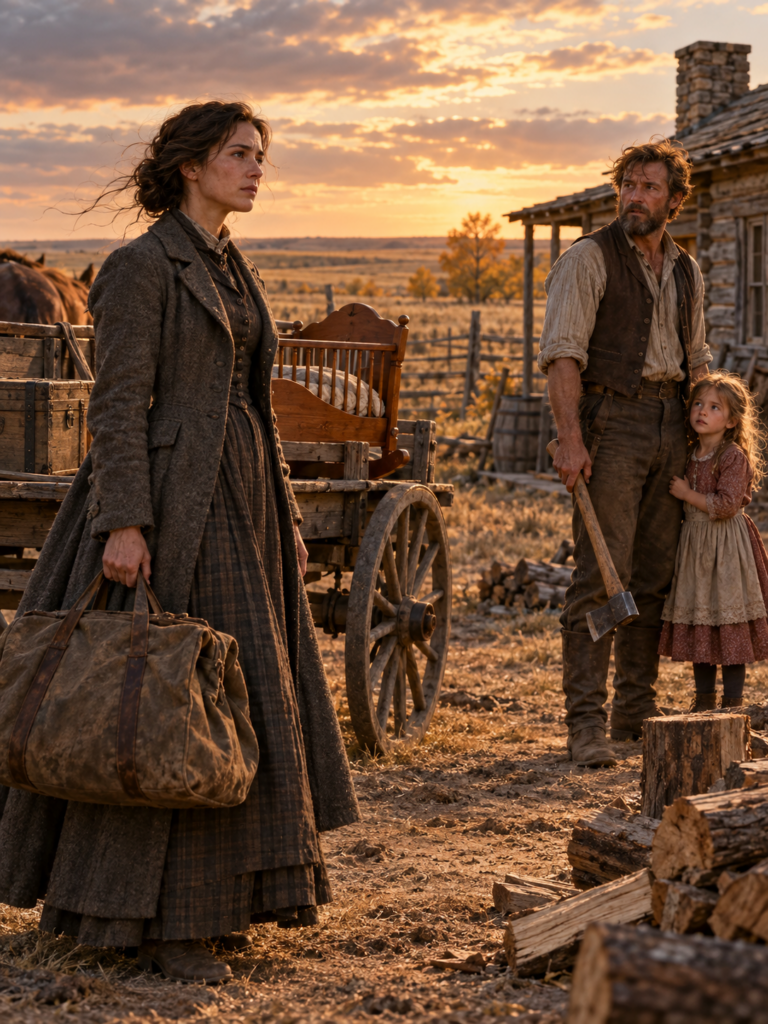
Esther held the pen above the ledger while Thomas stared at her across the table.
“The chimney,” she repeated.
Thomas finally pulled out a chair.
“Stone. Built four years ago.”
She wrote it down.
“The addition?”
“Frame construction. Two rooms. One is yours.”
“The well?”
“Dug eighteen feet. Plank cover replaced last spring.”
They continued until the page held more proof than Thomas had realized his own hands had produced.
Fence repairs.
Root cellar.
Animal shelter.
Cultivated ground.
Stored feed.
Drainage cut behind the house.
Esther did not embellish anything.
If she had not seen a thing, she marked it for inspection.
The next morning, after Thomas rode into Caldwell to speak with a land attorney, Esther buttoned Norah into her coat and walked the property.
She measured nothing she could not reasonably judge.
She simply recorded what existed.
At the south fence, Norah asked, “Is Mr. Aldrich bad?”
Esther stopped.
“Why do you ask?”
“I heard Papa tell Mr. Harding not to talk about him when I was there.”
Children, Esther thought, heard most things adults lowered their voices to hide.
“Mr. Aldrich wants land your father is trying to keep.”
“Is he going to take our house?”
Esther crouched.
“Your father is working to stop that.”
Norah’s mouth trembled.
“What if Papa can’t fix it by himself?”
The question struck harder than Esther expected.
She thought of Thomas feeding the stove twice each night.
Of the badly braided hair.
Of the telegram he had never mentioned but Gerald had quietly explained.
Of a man drowning carefully enough that his daughter had learned to watch his face for weather.
“He isn’t by himself.”
Norah studied her.
“You’ll stay?”
Esther could have answered with the terms of her employment.
Instead she said, “I’m not going anywhere.”
That evening Thomas returned after dark.
Esther knew from his silence that whatever he had learned in Caldwell was not simple.
He ate half his supper before speaking.
“The attorney says the improvements give me a good argument.”
Esther waited.
“The occupation record is strong.”
Still she waited.
Thomas set down his fork.
“He says Aldrich’s weakest point is the claim that the household cannot remain functional.”
Esther understood before he finished.
“He suggested formalizing the household.”
“Yes.”
Norah concentrated fiercely on her corn-husk doll.
Thomas’s hands remained flat on the table.
“I want to make one thing clear before I say anything else.”
Esther met his eyes.
“This is not what I hired you for. You can refuse and remain employed here on the terms we agreed.”
The carefulness of that sentence mattered more than the proposal he had not yet made.
Thomas drew a breath.
“But I am asking whether you would consider marriage.”
No romance decorated the question.
No threat hid beneath it.
Yet Esther heard what it cost him.
“And if I say no?”
“You stay until either of us ends the employment arrangement properly.”
“And the hearing?”
“I fight it another way.”
Esther glanced toward the cedar cradle, now standing near the kitchen wall because Norah had gradually carried her doll’s entire household into the main room.
Marriage might strengthen his case.
It might also bind Esther’s life to land she did not own and a family she had known only weeks.
She would not answer from gratitude.
She would not answer because she had nowhere better to go.
“I’ll think on it.”
Thomas nodded.
“That’s all I’m asking.”
Before dawn the next morning, Esther found him pulling on his coat beside the stove.
“Thomas.”
He turned.
“Yes.”
“I’ll marry you.”
His face did not brighten.
Not yet.
He knew her well enough already to wait for the rest.
“I have conditions.”
“Name them.”
“Norah remains part of every decision that concerns this household.”
“Of course.”
“I will not be managed as though marriage makes me incapable of judgment.”
“I wouldn’t try.”
“If something threatens the land, the money, or this house, you tell me. I won’t be protected by ignorance.”
Thomas’s eyes sharpened.
Then he nodded.
“All right.”
“And I came here for honest work. I will keep doing it. I’m not becoming a dependent you feed in exchange for obedience.”
“I know.”
“How?”
He looked toward Norah’s small bowl waiting on the table.
“The child always gets served first.”
Esther blinked.
“That wasn’t one of my conditions.”
“No.”
“What was it?”
“Something I noticed.”
She understood.
Thomas had been watching her too.
Not as a replacement bride.
As Esther.
She extended her hand.
“Then we understand one another.”
Thomas took it.
His palm was rough and warm.
“Yes.”
Outside, the wind scraped over the dark Kansas fields.
Inside, the cedar cradle stood beside Norah’s sleeping doll, and Esther realized she had begun an action that could not honestly be called rescue in either direction.
It was a choice.
Now they would have to discover whether it could become a life.
Thomas held Esther’s hand only long enough to seal the understanding between them.
Then he released it.
That mattered too.
The marriage took place at the end of November in Reverend Kohls’s front parlor in Caldwell because the church stove had not yet been repaired and nobody saw wisdom in freezing before God merely to satisfy architecture.
Norah stood between them.
She held Thomas’s left hand and Esther’s right.
When Reverend Kohls asked whether there was anything either wished to state before the vows, Norah announced, “Esther makes the best biscuits in Kansas.”
The reverend looked solemnly at Thomas.
“A grave responsibility.”
Thomas’s mouth moved.
Esther had learned that this was how he laughed when he did not quite trust laughter yet.
The ceremony remained simple.
Thomas promised what he could honestly promise.
Esther did the same.
Neither spoke as though marriage erased Margaret, Clara, poverty, winter, the hearing, or the fact that they had known one another only weeks.
When Reverend Kohls pronounced them husband and wife, Thomas did not pull Esther toward him.
He looked at her first.
She gave the smallest nod.
Only then did he kiss her forehead.
On the ride home Norah sat between them beneath a wool blanket.
“Do I call you Mama now?”
Esther looked at Thomas.
He did not answer for her.
She turned to Norah.
“What would you like to call me?”
Norah considered.
“Esther.”
“That’s still my name.”
“Maybe Mama Esther later.”
“If later feels right.”
Norah accepted that immediately.
Children, Esther thought, could sometimes understand freedom more easily than adults.
That night Thomas carried an extra armload of wood into the kitchen.
Esther set two lamps on the table.
Norah fell asleep with her corn-husk doll resting in the cedar cradle beside her cot.
When the house was finally quiet, Thomas sat opposite Esther.
“I didn’t think this would happen.”
“What?”
He looked around.
“Any of it.”
“You did advertise for help.”
“I thought Clara Henning would arrive. We would marry. We’d learn how to manage.”
Esther smiled faintly.
“That sounds romantic.”
“It wasn’t meant to.”
“I know.”
Thomas rubbed one thumb along a crack in the tabletop.
“I thought a workable life was enough.”
“And now?”
He looked at her.
“Now I think I’d miss talking to you.”
Esther raised an eyebrow.
“You barely talk.”
“No.”
“Then what exactly would you miss?”
“When I do talk, it goes somewhere.”
That silenced her.
Thomas was not a man who knew how to make a speech beautiful.
Perhaps that was why his plain words struck harder.
Esther reached across the table.
She placed her hand over his.
Thomas turned his palm upward and closed his fingers around hers.
Nothing else happened.
Nothing else was needed.
The hearing remained three weeks away.
Marriage had changed their legal household, but Esther refused to let either of them pretend that a marriage certificate should be their only defense.
“You built the place before I came,” she told Thomas the next morning. “We prove that.”
So they worked.
Thomas located receipts, seed records, tax notices, and two old statements from men who had helped him haul stone.
Esther reorganized the ledger.
Her years in boarding-house work had taught her more than cooking and cleaning. She had watched proprietors survive by knowing exactly what had been bought, repaired, lost, owed, and promised.
Thomas’s records had been scattered through drawers and boxes.
Esther turned them into sequence.
“You’ve got the well repair dated after the south fence.”
“It was after.”
“But this receipt says lumber in March.”
“That lumber was for the chicken shelter.”
She scratched out a note.
“Good.”
Thomas watched.
“What?”
“You like this.”
“Order?”
“Yes.”
“I like facts where they can be found.”
He leaned against the desk.
“I’ve spent five years putting tools in the same places and still lose the hammer.”
“That is because you put the hammer where you were using it instead of where it belongs.”
“That sounds like criticism.”
“It is.”
Thomas almost smiled again.
By then Esther knew he had several smiles.
One belonged to Norah.
One appeared when something genuinely surprised him.
The rarest came when Esther said something he wanted to argue with but secretly found funny.
She had begun collecting them without admitting it.
The land hearing was not the only pressure.
Winter stores had to last.
Animals needed feed.
A section of roof above the frame room began leaking during sleet.
Thomas climbed up as soon as the weather cleared enough.
Esther stood below handing him shingles.
“You should be inside.”
“You need the shingles.”
“I can climb down for them.”
“And climb up again every time?”
“Yes.”
“That is foolish.”
“It is safer.”
“For whom?”
He looked down.
“For you.”
Esther folded her arms.
“I am standing on frozen ground holding pieces of wood, Thomas.”
“You could slip.”
“So could you.”
“That’s different.”
“Why?”
He had no answer that survived being spoken aloud.
Esther handed up the next shingle.
“You may protect me from dangers I don’t see,” she said. “Do not invent helplessness where there isn’t any.”
Thomas took the board.
After a moment, he said, “Fair.”
It became another agreement.
Not the last.
Norah watched all of it.
She began knocking before entering Esther’s room.
She began asking Thomas to let her carry light pieces of kindling because “Esther says helping isn’t only for big people.”
Thomas blamed Esther for this development.
Esther accepted responsibility.
The cedar cradle changed too.
At first it had been Clara’s.
Then it became the place where Norah’s doll slept.
One afternoon Norah lined it with scraps of old flannel and asked Esther whether babies remembered people.
Esther set down her mending.
“I don’t know.”
“Do you remember your sister?”
“Every day.”
“Was she nice?”
“She was stubborn.”
Norah nodded approvingly.
“Papa is stubborn.”
“I’ve noticed.”
Thomas, entering with an armful of wood, stopped.
“I can hear you.”
“That was the intention,” Esther said.
Norah giggled.
Thomas shook his head but placed the wood by the stove with exaggerated dignity.
The household became easier in some ways and more complicated in others.
Esther discovered Thomas did not know how to share worry.
He knew how to share labor.
Those were different skills.
Three nights before the hearing, she woke after midnight and found light beneath the kitchen door.
Thomas sat at the table with papers spread around him.
“You said we had everything.”
“We do.”
“Then why are you awake?”
He did not answer immediately.
Esther sat opposite him.
“Aldrich has money.”
“That was true yesterday.”
“He has an attorney who does this for a living.”
“We have Burch.”
“He has filed before.”
“And lost before?”
“Not always.”
There it was.
Not land law.
Fear.
“If you lose,” Esther said, “what happens?”
Thomas stared at the papers.
“I can probably keep the house and western acreage.”
“Probably?”
“Depends how the claim is divided.”
“And the eastern quarter?”
“Could go.”
“What is on it?”
“Part of the best grazing. Access to a draw that holds water longer than most.”
“So it matters.”
“Yes.”
Esther waited.
Thomas finally looked at her.
“I brought you into this knowing it might fail.”
“No.”
His brow tightened.
“I walked into this after you told me it was hard.”
“I didn’t tell you this.”
“You didn’t know Aldrich had filed when I came.”
“No.”
“Then stop behaving as though you lured me here under false pretenses.”
He leaned back.
“I don’t like the idea that you chose a place that might be taken from you.”
Esther’s voice softened.
“It was not mine when I chose it.”
His expression changed.
“It is now.”
That was the first time Thomas had said it plainly.
Not my land.
Ours.
Esther felt the word before he ever used it.
She placed one hand on the inventory.
“Then we go to Caldwell together.”
“The hearing room may be crowded.”
“I’ve survived crowded rooms.”
“I meant Norah.”
“Gerald’s wife offered to keep her.”
Thomas hesitated.
“You remembered that?”
“I remember things said to me.”
“That is becoming alarming.”
“Good.”
He gathered the papers.
This time they went to bed.
At the land office three days later, Vance Aldrich arrived in a dark coat with an attorney carrying a leather case.
Aldrich was not monstrous.
That made him more believable.
He was a landholder who saw Thomas’s vulnerable quarter as an opportunity and had waited for circumstances to weaken the man occupying it.
He greeted Thomas politely.
“Whitmore.”
“Aldrich.”
His eyes moved to Esther.
“And Mrs. Whitmore.”
Esther returned his nod.
Nothing more.
Attorney Burch met them in the anteroom.
He looked over Esther’s inventory once again.
“This is good work.”
Thomas said, “She did it.”
Burch glanced at Esther.
“I assumed as much. His records were less civilized when he first brought them.”
Esther looked at Thomas.
Thomas looked at the floor.
“I was busy.”
“With what?”
“Apparently losing receipts.”
The hearing officer, Mr. Alcott, was a narrow-faced man who wasted neither expression nor time.
Aldrich’s attorney argued that the eastern quarter was effectively underused and that Thomas’s circumstances had made continued improvement improbable.
He spoke carefully of widowhood.
Of a young child.
Of labor limitations.
He never called Thomas incapable.
He only built a picture in which failure looked inevitable.
Then Burch stood.
He presented dates.
The stone chimney.
The dug well.
The root cellar.
Fencing.
Shelter.
Cultivation.
Feed stores.
Repairs completed after Margaret’s death rather than before it.
He presented witness statements from Gerald and two neighboring homesteaders.
Then he presented the household record showing Thomas’s remarriage and continued occupation.
Esther disliked how much weight the marriage seemed to carry.
But Burch did not rest on it.
He returned to the improvements.
The work.
The evidence.
Finally Alcott asked Thomas to stand.
“You intend continued residence?”
“Yes.”
“Continued cultivation?”
“Yes.”
“Continued improvement?”
“Yes.”
Then Alcott looked at Esther.
“Mrs. Whitmore, were you aware of the claim before the marriage?”
“Before the proposal, yes.”
Thomas turned slightly toward her.
Alcott continued.
“And did Mr. Whitmore represent marriage as necessary for your continued employment or shelter?”
“No.”
“Were you compelled to marry for want of another arrangement?”
“No.”
“What was your reason?”
The room became still.
Esther could have said affection.
That was true, though still new.
She could have said Norah.
Also true.
Instead she gave the answer most relevant to the question.
“Because I had seen the household as it was, understood the difficulty, and chose to become part of it.”
Alcott studied her.
“Nothing further.”
He returned to the documents.
The decision came without ceremony.
Aldrich’s claim was dismissed.
Thomas stood motionless.
Burch touched his sleeve.
“You may breathe now.”
Outside, December cold struck them full in the face.
Thomas stepped onto the boardwalk, removed his hat, and looked down the street as if he had not expected Caldwell to remain standing after the hearing.
Esther came beside him.
“It’s done.”
“Yes.”
The wind turned up the collar of her coat.
Thomas reached over and straightened it.
His hand rested briefly at her shoulder.
“I’m glad you saw the notice.”
Esther looked at him.
“I almost didn’t come.”
His hand dropped.
“What changed your mind?”
She thought of the stage.
The sixty cents.
The cradle beside her.
The woman who had described Thomas’s notice as sad.
“I needed somewhere real to go.”
Thomas nodded.
He understood.
Then he said, “Is this real enough?”
Esther glanced down the street toward the wagon that would carry them back to Norah.
“To begin with.”
Thomas smiled fully.
It was the first time she had seen him do it.
And Esther understood that saving the acreage had removed the legal threat.
It had not answered the harder question.
Now that no hearing required their marriage, they had to decide what they meant to become to one another when necessity was no longer making the decision for them.
Thomas’s smile faded first.
Not from disappointment.
From comprehension.
The hearing had given them something neither possessed the morning before.
Freedom from urgency.
For weeks every question had carried another question beneath it.
Would the homestead survive?
Would Aldrich take the eastern quarter?
Would Thomas be judged unable to maintain the property?
Would Esther’s presence matter?
Marriage had strengthened their household in the eyes of the land office.
Now the land was secure.
Their marriage had to stand without that purpose.
Thomas helped Esther into the wagon but said little until Caldwell disappeared behind them.
The winter prairie spread pale and enormous beneath a washed-out sky.
Finally he said, “You meant what you said back there.”
“About choosing this?”
“About beginning.”
“Yes.”
He kept the horse at an easy pace.
“Do you regret marrying me?”
Esther turned.
Thomas looked straight ahead.
“No.”
His shoulders lowered slightly.
“But I don’t want the land hearing to be the thing that defines why we remain married.”
“No.”
“And I don’t want you waking five years from now believing you stayed because I needed your ledger.”
That brought a laugh out of her.
“You did need my ledger.”
“I did.”
“You still do.”
“Apparently.”
She let the humor settle before speaking again.
“I married you because you asked honestly.”
Thomas glanced at her.
“You gave me room to refuse. You gave me employment before you offered marriage. You kept those two arrangements separate until circumstances changed.”
“I asked partly because marriage helped the claim.”
“Yes.”
“That doesn’t trouble you?”
“It would if that were the only reason.”
Thomas’s hands tightened slightly around the reins.
“It wasn’t.”
“I know.”
“How?”
Esther looked toward the horizon.
“Because you apologized before calling me your wife even became possible.”
He frowned.
“I never called you my wife before I asked.”
“No. But you behaved as though my agreement mattered before there was any legal reason it had to.”
Thomas was quiet.
“You ask before moving things in my room. You let Norah decide what she calls me. You don’t speak of Margaret as if remembering her is disloyal. You listened when I told you not to hide trouble from me.”
“I argued about the roof.”
“You argued badly.”
“I thought I made a reasonable case.”
“You did not.”
He almost smiled.
Esther continued.
“Those are small things.”
“No.”
She looked at him.
Thomas’s voice had gone serious.
“They aren’t.”
The rest of the ride passed quietly.
At the homestead Norah came running from the porch wrapped in Margaret’s old shawl.
“Did you win?”
Thomas climbed down.
“We kept the land.”
Norah threw both arms around his legs.
Then she turned to Esther.
“All of it?”
“All of it.”
Norah considered this.
“Good.”
She took Esther’s hand and pulled her toward the house.
“My doll fell out of the cradle.”
Apparently crisis had levels.
That night Esther returned the doll to its place.
She stood beside the cedar cradle after Norah slept.
Thomas paused in the doorway.
“You never told me your sister’s name.”
Esther’s fingers rested on the rail.
“Clara.”
His expression changed slightly.
“The woman I was supposed to marry was Clara.”
“I know.”
“You did?”
“Gerald told me.”
Thomas leaned against the doorframe.
“Does that make it harder?”
“No.”
She traced the small nick in the rocker that her brother-in-law had once sanded almost smooth.
“My Clara was older than me by three years. She could make any rented room feel like a place worth sweeping.”
Thomas waited.
“She married a carpenter. Not a wealthy man. Not much steadier than the rest of us. They were happy.”
“What happened to him?”
“Fever two years before she died.”
Thomas’s gaze dropped.
“I’m sorry.”
“So was she.”
Esther smiled faintly.
“She hated being pitied.”
“That sounds familiar.”
“She would have liked you only after arguing with you first.”
“Also sounds familiar.”
Esther looked back at the cradle.
“When she learned she was expecting, she spent money she did not have on good cedar. I told her a baby would not know pine from cedar.”
“What did she say?”
“She said she would.”
Thomas smiled.
“Stubborn.”
“Terribly.”
The smile left Esther’s face.
“She died before the child drew breath.”
Thomas did not offer comfort too quickly.
That was one of the things Esther had come to value about him.
He allowed sorrow to remain sorrow without rushing to make it useful.
After a while he said, “Why did you bring the cradle?”
“I tried to sell it.”
Thomas waited.
“I walked it as far as the secondhand dealer’s door. Then I carried it home again.”
“That seems explanation enough.”
“It felt foolish.”
“No.”
“You’ve never carried furniture across three counties.”
“No.”
“Then you cannot judge.”
He considered.
“Fair.”
Esther ran her hand over the rail.
“I thought keeping it meant I was keeping Clara.”
“And now?”
She looked at the corn-husk doll tucked beneath Norah’s scrap of flannel.
“Now I think objects survive people for reasons we don’t get to decide beforehand.”
Thomas glanced toward Norah’s sleeping form.
“The cradle has a job again.”
“Yes.”
“A different one.”
“Yes.”
That was enough.
Winter deepened.
With the hearing behind them, there were no dramatic changes.
That was exactly what made the changes important.
Thomas and Esther learned marriage in increments.
Thomas learned that Esther wanted the household money counted in front of her because uncertainty was worse than shortage.
Esther learned that Thomas always checked the western fence after wind, whether it needed checking or not, because Margaret had once found cattle through there after a storm and he had never forgotten it.
Thomas learned to braid.
Badly.
Esther insisted he keep practicing.
“If something happens to me, Norah still needs her hair done.”
He went still.
Esther regretted the phrasing immediately.
But Thomas picked up the ribbon.
“Show me again.”
So she did.
The first braid was crooked.
The second less so.
By February Norah could leave the house under Thomas’s sole preparation without looking as though she had fought a haystack.
Esther considered that genuine progress.
In return, Thomas taught her to judge the horse’s breathing after hard work and how to tell from the sky when prairie wind would turn dangerous before the temperature dropped.
He did not teach as if she were foolish.
She did not pretend she understood before she did.
Their work changed because it became shared rather than divided into his and hers.
Esther still cooked more often because she was better at it.
Thomas still handled the heavier field work because experience and strength made sense there.
But when the stove pipe needed cleaning, they did it together.
When accounts needed checking, Thomas sat beside her rather than leaving the papers as “women’s figures.”
When Norah woke from a nightmare, whoever reached her first stayed.
One February night that was Thomas.
Esther stood outside the bedroom and heard his low voice.
“Mama went away?”
Norah whispered.
Thomas answered carefully.
“Mama died.”
“Will Esther die?”
A pause.
“Everybody dies someday.”
Esther closed her eyes.
He could have told a comforting lie.
He did not.
“Soon?”
“We have no reason to think so.”
“Will she leave?”
Another pause.
“That is Esther’s choice.”
Esther opened her eyes.
Norah’s voice became smaller.
“Do you want her to?”
“No.”
“How much?”
Thomas breathed out.
“Very much not.”
Esther pressed a hand over her mouth.
Inside, Norah apparently accepted this.
“Good.”
Thomas tucked the blanket.
When he emerged, he found Esther in the hall.
Neither pretended she had heard nothing.
“You told her I could leave,” Esther said.
“Yes.”
“You could have said I wouldn’t.”
“You could.”
“Would that frighten you?”
“Yes.”
There it was.
No armor.
Esther stepped closer.
“I have no plans to.”
Thomas looked at her.
“That isn’t the same as promising forever.”
“No.”
His expression remained steady.
“But it is what I can promise tonight.”
He nodded.
“I’ll take tonight.”
That was the first time Esther kissed him by choice rather than accepting the restrained affection of their wedding day.
It was not dramatic.
Her hand rested against his cheek.
Thomas waited until she closed the distance.
Then his hand settled carefully at her waist.
The kiss changed nothing practical.
The stove still needed banking.
The horse still needed feeding at dawn.
Norah still woke before either adult wished she would.
Yet something shifted.
Their marriage stopped feeling like an arrangement they had entered carefully and began feeling like a relationship they were actively making.
Spring approached in small signs.
Mud appeared.
Then green.
Birdsong returned over fields that had spent months under hard wind.
Thomas traded for good lumber and began building a chair for the porch.
Esther found him planing the back.
“For whom?”
“You.”
She looked at the existing porch chair.
“There’s already one.”
“That one is mine.”
“I’ve sat in it.”
“I know.”
“So apparently ownership is negotiable.”
Thomas kept planing.
“You sit differently.”
Esther stared at him.
“How does a person sit differently?”
“You lean back.”
“And?”
“The old chair is straight.”
She folded her arms.
“You are building furniture around the way I sit?”
“Yes.”
“Why?”
Thomas finally looked up.
“Because you live here.”
The answer was so simple she could not argue with it.
Norah helped sand one arm.
The result was not perfectly smooth.
Thomas reached to correct it.
Esther stopped him.
“She did that.”
“It’ll catch fabric.”
“Then smooth the sharpest edge and leave the rest.”
He looked at Norah, who was watching with anxious pride.
“All right.”
The chair was placed beside Thomas’s when the first warm evenings came.
Esther sat in it after supper.
The curve fit her back.
She hated how pleased that made her.
“You measured me.”
Thomas stood at the porch edge with coffee.
“No.”
“How did you know the curve?”
“Guess.”
“You measured the old chair while I was sitting in it.”
He drank his coffee.
“That sounds like an accusation unsupported by evidence.”
She laughed.
Norah climbed beside her.
The cradle remained indoors.
By then the corn-husk doll had been joined by three river pebbles, a wooden horse Gerald had carved, and one ribbon that Norah insisted was a blanket.
The cradle no longer hurt Esther every time she saw it.
Sometimes it hurt.
That was different.
Grief had stopped owning the object completely.
One afternoon Gerald Harding visited and stood looking at the cedar cradle.
“I remember you bringing that into town.”
“So do I.”
“I thought you had a baby somewhere.”
“So did half of Caldwell.”
“More than half.”
Esther shook her head.
Gerald smiled.
“Funny where things end up.”
Esther looked through the doorway toward the porch, where Thomas was showing Norah how to hold a small hammer properly.
“Not so funny.”
Gerald followed her gaze.
“No.”
Later that month a letter arrived from the land office confirming that Aldrich had not appealed within the allowed period.
Thomas read it twice.
Then he handed it to Esther.
“What do we do with this?”
“File it.”
“Where?”
She gave him a look.
“You still do not know where I keep the land papers?”
“I know generally.”
“There is no generally in record keeping.”
Thomas sighed.
“Desk. Lower drawer. Blue cloth tie.”
She nodded approvingly.
“Progress.”
He did not hand the letter back.
Instead he remained beside her.
“Esther.”
“Yes?”
“I want to ask you something that has nothing to do with the land.”
“That sounds dangerous.”
“It might be.”
She waited.
“If Aldrich had won—if we had lost the eastern quarter—would you have stayed?”
Esther thought before answering.
“Yes.”
Thomas’s jaw shifted.
“Why?”
“You.”
He became motionless.
“And Norah.”
His eyes dropped, perhaps relieved by the addition.
Esther refused to let him hide there.
“But mostly because I had already chosen this household before the hearing.”
He looked at her again.
She continued.
“I did not marry land, Thomas.”
“No.”
“I did not marry your claim.”
“No.”
“I married a man who told a desperate woman she could refuse him and keep her job.”
Thomas swallowed.
“That sounds less impressive when you say it plainly.”
“It was more impressive because it was plain.”
He said nothing.
Esther stepped closer.
“Now I want an answer from you.”
“All right.”
“If the hearing had gone differently—if keeping this place required sending me away for some legal advantage—what would you have done?”
His answer came without delay.
“Lost the land.”
Esther stared.
Thomas’s voice remained even.
“I spent years thinking the place was the thing I had to preserve because Margaret died here and Norah was born here and I built half of it with my hands.”
He looked around the room.
“But land is ground.”
His gaze returned to her.
“You and Norah are the household.”
The words landed deeper than any declaration dressed as poetry could have.
Esther touched his coat front.
“Good answer.”
“I wasn’t trying for one.”
“I know.”
That evening they sat outside until the sky darkened.
Norah leaned against Esther beneath Margaret’s old shawl.
Thomas stood at the porch edge, then finally dragged his old chair closer to Esther’s.
“You could simply build yourself another,” she said.
“I could.”
“Will you?”
“Maybe.”
“Why haven’t you?”
He looked toward the fields.
“I like this arrangement.”
His chair touched hers at the arm.
Esther let her shoulder rest against him.
Norah was already half asleep.
The wind moved through new grass instead of dead October stubble.
Behind them the house glowed yellow through the windows.
Esther thought of the day she arrived.
Sixty cents.
One bag.
One crate.
One cradle.
She had believed she needed employment.
She had been right.
She had believed Thomas needed labor.
Also right.
Neither fact had explained what followed.
A home had not appeared because two lonely people were magically suited to each other.
It had been built through specific decisions.
Thomas asking rather than assuming.
Esther refusing to be managed.
Thomas sharing the land papers.
Esther admitting when she did not know ranch work.
Both of them letting Norah remember Margaret without forcing Esther into her place.
A cradle allowed to change meaning without requiring Esther to forget Clara.
A marriage first entered for practical reasons and then strengthened only because both adults kept choosing what it required.
One April evening, Norah brought her corn-husk doll outside.
“The baby wants to see.”
Esther looked at the doll.
“The baby?”
“She lives in the cradle.”
“I thought she was a doll.”
“She can be both.”
Thomas nodded gravely.
“Seems legally sound.”
Esther gave him a look.
Norah placed the doll on Esther’s lap.
Then she climbed into the space beside her.
“Mama Esther?”
Esther went still.
Thomas did too.
Norah seemed not to notice.
She pointed toward the field.
“Will those flowers stay?”
Esther looked at her.
“You called me Mama Esther.”
Norah frowned.
“Yes.”
“You hadn’t before.”
“I know.”
“Why now?”
Norah considered the question with the seriousness she brought to all matters worth considering.
“Because now it feels true.”
Esther’s throat tightened.
Thomas looked away toward the horizon, giving her privacy without leaving.
Esther touched Norah’s hair.
“Then Mama Esther is fine.”
Norah nodded.
“The flowers?”
“They’ll last awhile.”
“Then what?”
“They’ll go to seed.”
“And die?”
“Some.”
“Then come again?”
“Yes.”
Norah seemed satisfied.
Esther looked down at the corn-husk doll lying against her skirt.
Inside the house, the cedar cradle waited.
For months Esther had believed keeping it meant refusing to release what she had lost.
Now she understood differently.
Remembering Clara did not require preserving the cradle untouched.
Loving Norah did not replace Clara’s unborn child.
Loving Thomas did not replace Margaret.
Their lives did not need one grief erased to make room for another affection.
Thomas stepped closer.
“Coffee?”
“Yes.”
He went inside.
Norah leaned against Esther.
The porch chair held both of them badly but happily.
When Thomas returned, he carried two cups.
He handed Esther one and sat beside her.
The sun sank behind the Kansas plain.
Esther lifted her coffee.
“You know,” she said, “Gerald thought your notice was foolish.”
Thomas looked offended.
“He said honest or foolish.”
“He had not decided which.”
“And now?”
“I imagine he still considers you foolish.”
“That seems unfair.”
“But useful.”
Thomas nodded.
“I can live with useful.”
Esther smiled.
She looked back through the open door.
From the porch she could see the cradle in the lamplight.
The small cedar rails shone warmly.
Norah’s doll would return to it before bedtime.
Once, Esther had carried that cradle because it was the last object she could not bear to abandon.
Now it remained because nothing in this house had to stay trapped inside its first meaning.
The cradle had begun as hope.
Then it became grief.
Then memory.
Then a bed for a child’s ragged doll.
Eventually, perhaps, it would be something else.
No one needed to decide tonight.
Thomas stretched one arm along the back of Esther’s chair.
He did not pull her closer.
She chose to lean into him.
Norah climbed down and ran inside to fetch the wooden horse.
Thomas watched her go.
“I used to think I needed a wife because Norah needed what I couldn’t give.”
Esther looked at him.
“And now?”
“Now I think she needed more people who loved her.”
“That is different.”
“Yes.”
“And you?”
Thomas considered.
“I needed someone who would tell me when I was being foolish about roof repairs.”
“Among other things.”
“Apparently.”
Esther waited.
Thomas’s voice lowered.
“And someone whose leaving would matter to me.”
She studied his face.
He had not become less quiet.
He had become more willing to say what quietness had once protected.
That was different.
“I’m still here.”
“I know.”
“You may mention it occasionally.”
“I just did.”
“You might improve with practice.”
Thomas smiled.
“I married a demanding woman.”
“You married a woman with conditions.”
“Yes.”
“Do you regret them?”
“No.”
She rested her head against his shoulder.
Neither spoke for a while.
The sky turned violet.
A lamp burned inside.
Norah’s footsteps crossed the floorboards.
The house behind them was warm, imperfect, mortgaged in places, patched in others, and safe for tonight.
It was not secure because Esther had rescued Thomas.
It was not secure because Thomas had rescued Esther.
They had each arrived carrying needs the other could not magically erase.
What changed them was that neither demanded repayment for helping.
Thomas provided wages, shelter, honesty, and choice before asking for affection.
Esther brought work, competence, records, warmth, and courage without surrendering her right to define her place.
Their marriage survived the hearing because the hearing stopped mattering.
The land remained theirs.
But the deeper victory was simpler.
Esther could have left.
Thomas knew it.
He loved her without pretending otherwise.
Thomas could have treated marriage as authority.
Esther knew it.
He chose partnership instead.
Inside, Norah called, “Mama Esther!”
Esther rose.
Thomas stood with her.
At the doorway she stopped.
The cedar cradle was visible across the room.
Norah had placed the wooden horse inside beside the doll.
Apparently it needed sleep too.
Esther smiled.
Thomas followed her gaze.
“Should we move the cradle back to your room?”
“No.”
“Is it in the way?”
“Yes.”
He waited.
She looked at him.
“Leave it anyway.”
Thomas nodded.
No questions.
Esther stepped inside.
Norah ran toward her holding Margaret’s shawl.
“You need this.”
“Why?”
“It’s cold.”
Esther allowed the child to wrap it badly around her shoulders.
Thomas shut the door against the evening wind.
Esther touched the worn wool.
Margaret’s shawl.
Clara’s cradle.
Thomas’s land papers.
Norah’s corn-husk doll.
Her own ledger.
Nothing in the room belonged to only one story anymore.
Thomas went to bank the stove.
Norah began arranging the cradle’s inhabitants.
Esther opened the lower desk drawer and placed the final land-office letter beneath the blue cloth tie exactly where Thomas would later claim he remembered it had always belonged.
Then she turned.
Thomas was watching her.
“What?”
“Nothing.”
“That is rarely true.”
He crossed the room.
This time he held out his hand.
Not to direct her.
Not to claim her.
Simply to ask.
Esther placed her hand in his.
Norah looked up from the cradle.
“Are you staying there?”
Esther smiled.
“No.”
She moved to Thomas’s side.
“I’m coming home.”


