
Abigail kept writing until the lamplight blurred the edge of the paper.
She drafted one letter to the county commission, another requesting the original territorial survey record, and a third asking confirmation of the physical boundary markers.
Reuben remained across from her.
“You should sleep.”
“So should you.”
“I’m not the one doing the writing.”
“No. You’re the one who could lose twelve acres.”
He had no answer to that.
Nora had fallen asleep on the bench with her cheek against one arm.
Reuben lifted her carefully.
At the doorway he stopped.
“If those acres go, the dairy may not carry itself.”
Abigail looked up.
“How long?”
He understood the question.
“Without the creek? Hard to say.”
“And with it?”
“Long enough to recover.”
“Then we prove the creek is yours.”
He glanced at the papers.
“You make it sound simple.”
“I make it sound possible.”
That distinction stayed with him.
The next weeks became a campaign fought with postage, ink, survey numbers, and patience.
Abigail never acted as though the farm belonged to her.
Every letter went before Reuben before it was mailed.
Every decision remained his.
But when he did not understand a phrase, she explained it without humiliation.
When she disagreed, she said so.
And when town gossip sharpened, she refused to allow it to determine her work.
One afternoon the storekeeper’s wife asked whether Abigail found it “comfortable” living beneath a widower’s roof.
Abigail met her gaze.
“I find the room adequate, the work respectable, and Mr. Marsh’s conduct entirely proper.”
Nothing in her voice invited a second inquiry.
Reuben heard about the exchange.
The next time the same woman made a remark within his hearing, he answered more directly.
“Miss Cole works for me under terms we both agreed to. If anyone questions her character because of that, they may bring the question to me.”
The storekeeper’s wife did not.
When Reuben told Abigail what he had said, she studied him.
“You didn’t need to defend me.”
“No.”
“Then why did you?”
“Because you shouldn’t have to spend your wages buying peace from people who haven’t earned an explanation.”
She looked away before he could read her expression.
At the end of April they filed the completed claim.
May brought the answer.
The original boundary stood.
The eastern twelve acres remained with Reuben.
So did the creek.
So did the pasture.
That evening Nora climbed into Abigail’s lap without asking whether she might and announced, “You saved Papa’s land.”
Abigail shook her head.
“Your father already owned it.”
“You saved it anyway.”
Reuben met Abigail’s eyes across the room.
“She did.”
The admission embarrassed her more than praise usually did.
She lowered her gaze to Nora’s hair.
Life settled.
Town became easier after the commission decision and after Reuben made clear that commentary about Abigail would not be entertained politely forever.
By late May, Nora had begun spending quiet afternoons in Abigail’s room while Abigail mended.
Then, one day while Abigail was at the store, Nora opened the trunk.
She was not searching for secrets.
She was four.
She was searching because trunks contained things.
Beneath folded clothing and books lay a worn canvas travel bag.
It was empty.
Inside its small pocket Nora found a stiff piece of pasteboard.
She carried it to Reuben.
He was making a seed order.
“What’s this?”
He took it.
A train ticket.
He read the route.
Then the date.
October.
Five months before Abigail had stepped onto the Harlland’s Crossing platform.
His eyes moved to the hallway leading toward her room.
The trunk had arrived in October.
Abigail had not.
The ticket should have carried her onward toward Boise.
Yet she had arrived in March with a light canvas bag and no explanation.
Nora rested her chin in both hands.
“Why was her box here without her?”
Reuben turned the ticket over.
There was no answer written on the back.
But there was enough to understand that something had happened between the day Abigail sent her belongings forward and the day she finally followed.
Something costly.
“She meant to come sooner,” he said.
“Why didn’t she?”
“I don’t know.”
He looked again at the October date.
For months he had respected the part of Abigail’s journey she had chosen not to explain.
Now the ticket sat in his hand because his daughter had accidentally opened a door Abigail herself had left closed.
He could put it back.
He almost did.
Then he heard wagon wheels outside.
Abigail was returning from town.
Nora ran for the door.
Reuben stayed at the table with the ticket before him.
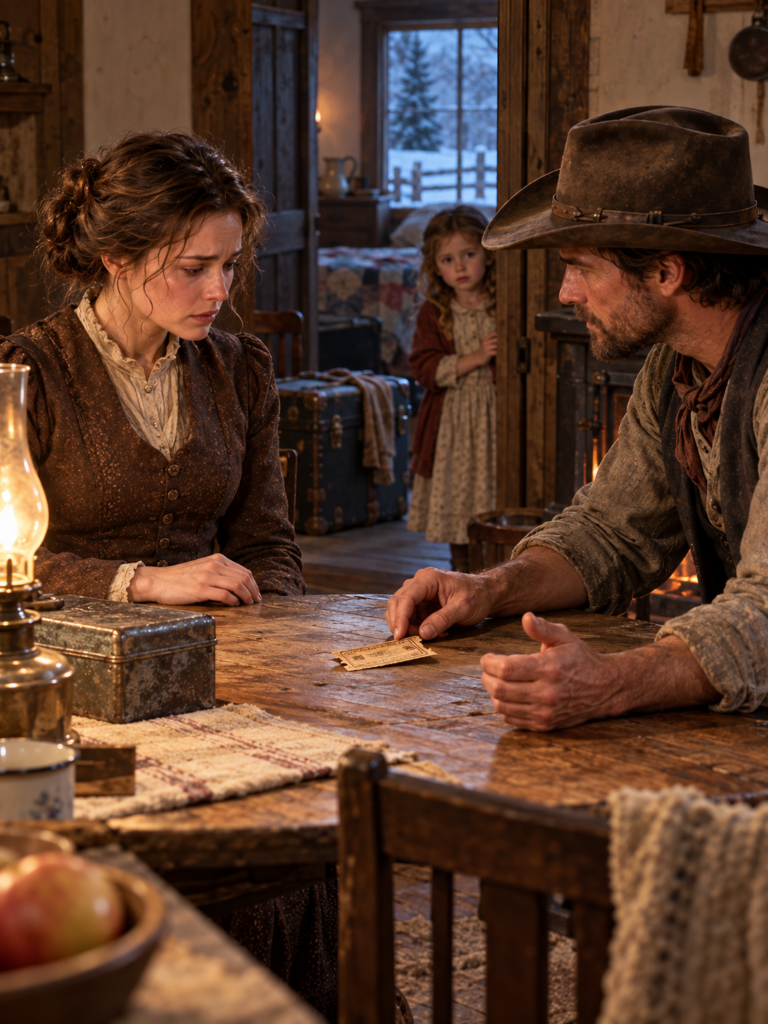
By the time Abigail entered the kitchen carrying a wrapped parcel, she saw it immediately.
She stopped.
Her eyes went to Reuben.
Then to the ticket.
Neither spoke.
Abigail slowly placed the parcel on the counter.
Reuben put both hands flat beside the small piece of pasteboard and said, “Nora found this in your trunk.”
Abigail did not reach for the ticket.
She stood beside the counter with one glove still in her hand and looked at it as though the five months between October and March had suddenly been placed on the kitchen table.
Reuben did not push it toward her.
“Nora wasn’t prying for anything in particular.”
“I know.”
“She opened the trunk.”
“I gathered that.”
“If you want me to put it back and never mention it again, I will.”
Abigail finally looked at him.
That was what made answering difficult.
No demand.
No accusation.
No suggestion that because she lived beneath his roof, he had purchased the right to know where she had been before she arrived.
She removed her other glove.
“There was a woman at a depot in Wyoming.”
Reuben remained still.
“She had two children,” Abigail continued. “One was sick enough that I worried about the cold. She had enough fare to go partway east and a sister in Boise who had written that she could take them in.”
Abigail came to the table.
“My ticket went through to Boise.”
Reuben looked down at the pasteboard.
“You gave it to her.”
“Yes.”
“And your trunk had already gone ahead.”
“Yes.”
“So you were stranded.”
“No.”
His eyes lifted.
“I was inconvenienced.”
“Five months is more than inconvenience.”
“That depends on the five months.”
There was the Abigail he knew.
Exact even about hardship.
She sat opposite him.
“I had money enough for food for a while. Not enough for another through ticket. I took work where I found it.”
“What kind?”
“Whatever was decent and paid.”
She counted quietly.
“Kitchen work at a boardinghouse. Copying invoices for a freight office. Two weeks helping a woman whose hand had been injured. Lessons for three children whose family was moving west by stages.”
Reuben’s jaw tightened.
“All winter?”
“Most of it.”
“In Wyoming?”
“Wyoming first. Then farther west as I earned enough.”
“And you never sent for the trunk.”
“Why would I? It was safer here than with me.”
He almost laughed at the practicality of that.
Almost.
Instead he said, “Why didn’t you tell me?”
Abigail folded the gloves together.
“Because I did not apply to become an object of charity.”
“You thought I would pity you?”
“I thought it was possible.”
He leaned back.
“And that would have been intolerable?”
“Yes.”
The answer was immediate.
Reuben considered it.
“You offered to work the morning you came here.”
“Yes.”
“You told me what you could do.”
“Yes.”
“You never told me what you needed.”
Abigail’s expression sharpened.
“I told you precisely what I needed. Room. Board. Wages.”
“That isn’t what I meant.”
“I know.”
The silence changed.
They had spent months learning when not to fill it.
Reuben picked up the ticket.
“Did the woman reach Boise?”
“I don’t know.”
That surprised him.
“She wrote no letter?”
“She did not know where I would be.”
“So you gave away the fare and never learned what happened.”
“She needed the journey more urgently than I did.”
“You cannot know that.”
“No.”
Abigail’s voice softened.
“But I could make that choice only with the information I had.”
Reuben looked at her for a long moment.
Then he placed the ticket down again.
“I’m angry.”
Her face cooled.
“With me?”
“No.”
The answer came hard enough that she believed it.
“I’m angry you worked through winter while that trunk sat fifty yards from people who would have talked for years about the mystery of it and never imagined the person who owned it might be sleeping in borrowed rooms along the road.”
Abigail’s gaze dropped.
“That was not their responsibility.”
“No.”
Reuben’s voice quieted.
“It wasn’t mine either.”
She looked up.
“But I wish someone had made it theirs.”
That landed where argument could not.
Nora came in from outside carrying the smooth river stone Abigail had kept on the ledger.
She had apparently retrieved it for reasons known only to herself.
She stopped when she saw them.
“Are you in trouble?”
Abigail’s mouth moved.
“No.”
Nora looked suspiciously at her father.
“Is Papa?”
“Frequently,” Abigail said.
Reuben exhaled through his nose.
Nora climbed onto the bench.
She put the stone beside the train ticket.
“You should keep both.”
“Why?”
“The rock is when you came here.”
Abigail touched it.
“And the ticket?”
“When you didn’t.”
Neither adult spoke.
Nora had once again arrived at the heart of the matter without understanding she had done so.
That evening the ticket remained beside the stone.
Reuben did not ask another question about Abigail’s journey.
He asked a different one.
“Your arrangement here was through summer.”
“Yes.”
“June comes soon.”
“I am aware.”
“Have you decided what you’ll do afterward?”
Abigail’s fingers rested on the book she had been reading.
“No.”
That answer cost her more than she showed.
By then her work had changed.
The dairy accounts were current.
The eastern boundary was safe.
Nora could recognize letters and numbers well beyond what Reuben had expected of a four-year-old.
The pantry had a system.
The garden had been planted.
The small room off the kitchen no longer looked temporary.
Abigail had hung dried lavender above its window.
Her books occupied the narrow shelf.
The smooth river stone sat on the ledger most mornings.
The house had made room for her.
That was precisely what frightened her.
She knew how to leave places that rejected her.
She had less practice leaving places that wanted her.
Three days later Reuben rode into town.
The minister stopped him near the post office.
“I hear the commission matter was settled.”
“It was.”
“Miss Cole proved useful.”
Reuben’s eyes hardened.
“She proved more than useful before there was any dispute.”
The minister paused.
“I intended no insult.”
“I know.”
That was the difficulty.
Most wounds in small communities arrived from people who believed their intentions made them harmless.
The minister cleared his throat.
“There is still the matter of appearances.”
Reuben looked at him.
“No.”
The minister blinked.
“No?”
“There is the matter of Miss Cole’s choice. There is the matter of mine. There is the matter of my daughter. Those are real. Appearances belong to whoever has spare time for them.”
He walked away.
At the dry goods store, he bought seed.
Lamp oil.
And a plank of seasoned pine.
The storekeeper looked at the plank.
“Building something?”
“Yes.”
“What?”
“A chair.”
The man looked puzzled.
Reuben already owned chairs.
That was not the point.
He carried the lumber home.
Abigail found it against the shed.
“What is that for?”
“A chair.”
“We have chairs.”
“I know.”
She waited.
Reuben rubbed a thumb over the edge of the plank.
“The chair at the kitchen table was Clara’s.”
Abigail’s expression softened.
“I have never minded using it.”
“I mind asking you to build a life around what was left behind.”
She said nothing.
He continued.
“I don’t mean replacing her.”
“I know.”
“I need you to know I know that.”
“I do.”
He nodded.
The exchange should have ended there.
Instead Abigail asked, “Why another chair now?”
Reuben looked toward the field.
“Because June is coming.”
Her breath changed.
“I have not said I’m leaving.”
“No.”
“You also have not asked me to stay.”
“No.”
“Why?”
Reuben met her eyes.
“Because until today I wasn’t sure whether I wanted you to stay because Nora needs you, because the farm works better with you, or because I do.”
Abigail’s hand tightened around the edge of her apron.
“And now?”
“Now I know those are three different questions.”
She waited.
“I have answers to all three.”
He did not give them.
Not yet.
That evening he worked on the chair after supper.
Abigail read near the lamp.
Nora moved between them, offering tools to Reuben and unnecessary advice to Abigail.
The rasp of the plane against pine became part of the room.
At last Nora went to bed.
Reuben finished one leg, set it aside, washed his hands, and sat across from Abigail.
The train ticket still rested inside her book.
She had begun using it as a marker.
He noticed.
“You kept it.”
“Yes.”
“Does it remind you of what you lost?”
Abigail considered.
“No.”
“What, then?”
“What I chose.”
Reuben nodded slowly.
Then he placed both hands on the table.
Open.
Nothing hidden in them.
“Abigail.”
It was the first time he had spoken her given name.
Her eyes lifted immediately.
They both heard the difference.
“I have been trying to ask you something without asking badly.”
“That sounds exhausting.”
“It is.”
The corner of her mouth moved.
He continued.
“The arrangement we made has not been an arrangement to me for some time.”
Abigail became very still.
“Nor to Nora.”
“That I had noticed.”
He breathed once.
“I don’t want to offer you another contract. I don’t want to hire you through another season. And I will not ask you to stay because my daughter is frightened of losing you.”
Abigail held his gaze.
“What are you asking?”
His voice lowered.
“I want you to stay because I love the life we have when you are in it.”
He did not reach for her.
Did not invoke winter.
Did not mention what she had done for his land.
“I want you to stay because when something goes wrong, I want your judgment beside mine. When something goes right, I look for you before I realize I’m doing it.”
Abigail’s eyes shone.
“And if I say no?”
“I help you arrange wherever you decide to go.”
The answer hurt.
Which was why it mattered.
She took the train ticket from her book and laid it precisely between them.
“I did not come all this way to leave in June.”
Reuben’s breath caught.
She put one fingertip on the old October date.
“But if you want something beyond an arrangement, then you must ask for it as something beyond an arrangement.”
He stared at her.
Then he understood.
He rose.
Not to tower over her.
Only because sitting suddenly seemed impossible.
“Will you marry me?”
Abigail looked toward the hallway where Nora slept.
Then at the half-built chair.
Then at the ticket that marked the road she had surrendered to someone else and still managed, eventually, to travel.
When she answered, her voice was steady.
“Yes.”
She paused.
“Provided we discuss what that means before we tell anyone.”
Reuben’s mouth curved into the rare smile she had learned was worth waiting for.
“Tomorrow morning?”
“Tomorrow morning.”
From the hallway came Nora’s sleepy voice.
“Can I know tonight?”
Reuben closed his eyes.
Abigail looked toward the hallway.
Nora stood barefoot at its edge, clutching the hem of her nightgown in one fist.
“How long have you been there?” Reuben asked.
Nora thought carefully.
“Since Papa said marry.”
Abigail covered her mouth.
Reuben looked toward the ceiling as though requesting patience from whatever authority governed four-year-olds.
Nora padded into the kitchen.
“Well?”
Abigail lowered her hand.
“Well what?”
“Are you?”
“Am I what?”
“Marrying Papa.”
“Nora.”
Reuben’s warning had no force in it.
She ignored him.
Abigail considered the child.
A few months earlier Nora had given her a river stone because friendship required no legal language.
She deserved an answer no more complicated than necessary.
“Yes.”
Nora stared.
Then she launched herself against Abigail with enough force to move the chair.
Abigail caught her.
“You’re staying.”
“Yes.”
“Forever?”
Abigail held the girl’s shoulders and looked at her seriously.
“I am choosing to build my life here. That is the promise I can honestly make.”
Nora accepted this as equivalent.
“Can I tell Mrs. Bell?”
“No.”
“The minister?”
“No.”
“Croft?”
“No.”
Nora frowned.
“Who can I tell?”
“Your pillow.”
“That is not a person.”
“Then it cannot gossip.”
Reuben laughed.
A true laugh.
Nora looked between them with great satisfaction.
“I knew.”
“Of course you did,” Abigail murmured.
The next morning they discussed terms.
Not because either doubted the marriage.
Because both understood that affection did not make practical questions disappear.
Abigail brought the dairy ledger to the table.
Reuben brought paper.
Nora brought a biscuit and announced that she would supervise.
Reuben began.
“The farm is mine by the current filing.”
“I know.”
“If we marry, I don’t want you here as an employee whose pay disappears because her title changed.”
Abigail’s gaze sharpened with approval.
“Good.”
“We keep accounts together.”
“Yes.”
“The wage ends because the household becomes ours, but money for household needs is not something you ask permission to touch.”
“Yes.”
“I would like to keep final decisions on the herd where animal care is concerned.”
“Provided I am told when those decisions change our finances.”
“Agreed.”
“I manage correspondence where I have the stronger skill.”
“Agreed.”
“You continue teaching Nora.”
Abigail paused.
“If Nora wants me to.”
Nora spoke through biscuit.
“I do.”
“Then yes.”
Reuben wrote it down despite knowing no contract was being formed.
Abigail noticed.
“You’re making a list.”
“You make lists.”
“You mock my lists.”
“I have been converted.”
“There may be hope for you.”
Nora looked at the page.
“Write cake.”
Neither adult understood.
“For the wedding.”
Reuben added CAKE.
Abigail laughed.
Then she became serious.
“There is another matter.”
Reuben waited.
“Clara.”
His pencil stopped.
Abigail went on.
“I will not become Nora’s mother by requiring that her first mother disappear.”
His eyes lowered.
“I would never ask that.”
“I know. But grief creates rules people do not realize they have made.”
That struck him.
He sat back.
After Clara died, her apron had remained behind the pantry door for months.
Her sewing basket had stayed beneath the bedroom window.
Her papers had gone under his bed because moving them had felt like betrayal.
He had continued using her chair.
Not because it was the best chair.
Because replacing it had seemed like admitting the person who once occupied it no longer would.
“I have rules like that,” he said.
“Yes.”
“You noticed.”
“Yes.”
“And never said.”
“They were yours to change.”
He looked toward the half-finished chair against the wall.
“I’m trying.”
“I know.”
That was all she required.
The wedding was set for June.
News escaped despite Abigail’s prohibition.
Nora told the storekeeper’s wife.
She told Croft.
She told the minister.
She told one of Reuben’s dairy customers before Reuben had even decided whether that man needed to know.
Her version varied only slightly.
“Miss Abigail is going to be my mother because Papa asked politely.”
When the storekeeper’s wife looked at Abigail afterward, the old raised eyebrow was gone.
“I hear congratulations are due.”
“They are.”
“I suppose I misjudged the arrangement.”
Abigail looked at her.
“Yes.”
The woman blinked.
Then, to her credit, she nodded.
“I suppose I did.”
Abigail appreciated that more than an excuse.
By then the commission decision had become common knowledge.
Some people praised Abigail as though rescuing acreage had transformed her into someone respectable.
She disliked that nearly as much as the earlier gossip.
One afternoon the minister said, “You have been quite a blessing to Mr. Marsh.”
Abigail answered, “He has been useful to me as well.”
The minister looked startled.
Reuben, standing beside her, nearly smiled.
Partnership sounded strange only to those who expected gratitude to travel in one direction.
Meanwhile Reuben finished the chair.
He built it from pine, plain and strong.
No carving.
No flourishes.
Abigail found him sanding the seat one evening.
“It looks like the others.”
“It is supposed to.”
“Then why build it?”
He ran his hand over the wood.
“Because that one belonged to Clara.”
Abigail looked toward the kitchen.
“And this?”
“Yours.”
She was quiet.
Not because the object was grand.
Because he had understood something without needing her to teach it.
He was not removing Clara’s place.
He was making another.
Abigail touched the back rail.
“Put it beside hers.”
Reuben looked up.
“You’re sure?”
“Yes.”
So he did.
The old chair and the new one sat side by side at the kitchen table.
Nora immediately decided one was Abigail’s and one was Papa’s, which ignored the actual history completely.
Neither corrected her.
Several days before the wedding, Abigail finally opened the trunk fully.
It had stood in the corner since March.
Reuben had never asked what was inside.
Now Abigail took out a folded bundle of linen.
Curtains.
Cream-colored, simple, carefully hemmed.
Nora touched them.
“Were these in the trunk all winter?”
“Yes.”
“Why didn’t you use them?”
Abigail looked toward the east kitchen window.
“I wasn’t sure where they belonged.”
Nora considered this.
“They belong here.”
Reuben entered carrying milk pails as she said it.
He stopped.
Abigail unfolded one curtain.
“I think she may be right.”
They hung them the morning of the wedding.
Sunlight came through the fabric softly, turning the kitchen warmer without changing anything else in the room.
Abigail stood back.
The curtains had been intended for whatever home she found after Ohio.
For five months they had waited inside a trunk at a station while she worked her way west.
Now they moved in the Idaho morning breeze.
Reuben came beside her.
“Too fine for my windows?”
“Our windows,” she corrected.
His gaze shifted to her.
“Yes.”
She smiled.
“Our windows.”
They were married behind the church.
The minister officiated.
Croft attended and told anyone willing to listen that he had guarded the bride’s trunk all winter, though Abigail privately believed the burlap deserved most of the credit.
The storekeeper and his wife came.
So did several dairy customers.
No one asked why Abigail had lived in Reuben’s home before marrying him.
Or if anyone wondered, they possessed the sense not to make themselves the center of the day.
Nora wore her good dress.
She held Abigail’s hand before the ceremony and Reuben’s afterward.
The vows were simple.
When the minister asked Reuben his intention, he answered without hesitation.
When Abigail was asked hers, she did the same.
No one gave her away.
She had already crossed half a country by her own decisions.
No symbolic transfer of possession was required.
Afterward there was cake.
Nora ate two pieces and announced to the minister that marriage was very successful.
He agreed.
Walking back from church, she took one of their hands in each of hers.
The road was drying after spring rain.
Grass had come up green beside the ditches.
At the station they passed the platform where Abigail’s trunk had waited.
She slowed.
Reuben noticed.
“Want to stop?”
“For a moment.”
Croft was elsewhere.
The three of them stood beneath the overhang.
Abigail looked at the place where the trunk had sat.
There was no mark remaining.
No evidence that an object had waited there through five months of snow and ice.
Nora pointed.
“Right there?”
“Yes.”
“And you were all the way away?”
“Yes.”
“Were you scared?”
Abigail considered the question.
“Sometimes.”
“Why didn’t you quit?”
“Quit what?”
“Coming here.”
Abigail looked at the tracks.
Because the teaching post had been the nearest thing she possessed to a plan.
Because she had sent her belongings ahead.
Because each small job had earned enough money for another stretch of road.
Because pride had carried her where certainty could not.
Because after giving away her ticket, admitting defeat had felt harder than continuing.
But none of those answers were entirely enough.
“I kept thinking I could get a little farther.”
Nora accepted this.
Reuben did not say that this was how most difficult lives were built.
A little farther.
He merely offered his hand.
Abigail took it because she wanted to.
They walked home.
Marriage altered fewer things than outsiders might have expected.
Abigail still rose early.
Reuben still milked before breakfast.
Nora still resisted having her hair braided.
The dairy still demanded money at inconvenient times.
Fence posts still rotted.
Cows still developed opinions about gates.
Weather remained indifferent to romance.
What changed was how decisions were made.
When two milk customers fell behind, Reuben did not simply absorb the loss in silence.
He brought the accounts to Abigail.
“What do you think?”
She reviewed them.
“Call on the first. Write the second.”
“Why?”
“The first is embarrassed. The second is avoiding you.”
“How can you tell?”
“Different kinds of lateness.”
He trusted her judgment.
When Abigail began teaching Nora more formally, she discovered the child learned numbers faster through objects than through recitation.
Reuben built counting pegs from scraps.
When Abigail proposed taking two neighboring children for paid lessons, she did not ask as though she required his permission.
“I’m considering it.”
“Would it interfere with the house?”
“Some.”
“The dairy interferes with the house.”
She looked at him.
“That is unusually sensible.”
“I have moments.”
She taught the children.
Their families paid modestly.
The money was hers.
Reuben never suggested otherwise.
The extra students required a bench.
He built it.
By autumn, Abigail’s schoolroom consisted of the kitchen table, two benches, several slates, and more ambition than space.
One evening she found Reuben measuring the wall.
“What now?”
“Shelves.”
“For what?”
“Books.”
“We own six.”
“You intend that number to remain six?”
“No.”
“Then shelves.”
She leaned against the doorframe.
This man would never make speeches easily.
He built his declarations with wood.
The shelves went up.
Nora filled the lowest one with books, stones, and objects no rational classification system would have placed together.
The smooth gray stone Abigail had been given in March remained near the ledger.
The October ticket remained tucked into her oldest book.
Not hidden.
Not displayed.
Kept.
A reminder of a journey she had chosen to surrender and then completed differently.
The following winter was difficult but ordinary.
Deep cold.
A lame cow.
A chimney draft that needed repair.
No dramatic disaster.
No miraculous prosperity.
They had enough because they planned better.
They argued about expenses.
Once Abigail ordered school supplies without mentioning them.
Reuben objected—not to the purchase, but to learning of it after the fact.
She recognized the fairness of that.
Two weeks later he bought lumber without entering it in the ledger.
She placed the receipt in front of him.
He admitted the hypocrisy.
Partnership did not mean never disagreeing.
It meant neither person’s dignity depended on winning.
Nora changed too.
She began speaking about Clara.
At first in small fragments.
“Mama sang that.”
“Mama had a blue ribbon.”
“Mama didn’t like thunder.”
Each time, Abigail listened.
One afternoon Nora asked whether Abigail wanted to see her mother’s things.
Abigail did not answer for Reuben.
She looked toward him.
His face lost color.
For years Clara’s papers and belongings had remained arranged precisely as she left them.
Reuben stood.
“I’ll get the box.”
He carried it from beneath the bed.
Placed it on the table.
And opened it himself.
Inside lay letters.
A blue ribbon.
A small sewing case.
A pressed flower.
Several account pages in Clara’s handwriting.
Nora touched the ribbon.
“I remember this.”
Reuben swallowed.
“She wore it at church.”
“Did she like blue?”
“She liked anything that made you try to grab it when you were a baby.”
Nora laughed.
Then Reuben did something Abigail had never seen him do.
He laughed while crying.
No one turned away.
Later, when the box was closed, he did not put it back beneath the bed.
He placed it on a shelf Nora could reach when she was older.
Something in the house widened that day.
Not because grief ended.
Because grief was no longer required to stand guard over every memory.
Years accumulated.
Nora learned to read well.
Then to write.
Then to keep a column of figures straighter than Reuben did.
Abigail’s little kitchen school expanded to six children during one winter.
Reuben complained that he could no longer find an empty chair in his own house.
Abigail reminded him he had built most of them.
He said this proved generosity had consequences.
She told the children to write that sentence as penmanship practice.
The farm remained forty acres.
No hidden fortune appeared.
No company returned to steal it.
The eastern pasture stayed green when water permitted.
The dairy improved because Reuben improved it, because Abigail’s accounting prevented waste, and because both learned to plan farther ahead than either had when alone.
One October afternoon, years after the winter of the abandoned trunk, Abigail found Nora sitting on the bedroom floor.
The old trunk was open.
Nora was older now, long-legged and curious.
She held the travel ticket.
“You still have this.”
“Yes.”
“You gave the real one away.”
“That was the real one.”
“You know what I mean.”
Abigail sat beside her.
Nora turned it over.
“Did you ever find out what happened to the woman?”
“No.”
“Does that bother you?”
“Sometimes.”
“Would you still give it to her?”
Abigail looked toward the window.
Reuben was crossing the yard carrying a repaired gate hinge.
He saw them through the glass and lifted one hand.
She lifted hers.
“Yes,” Abigail said.
“Even knowing how hard it made everything?”
“Yes.”
Nora frowned.
“Why?”
“Because doing the right thing does not promise you an easy road afterward.”
“That seems unfair.”
“It often is.”
Nora studied the ticket.
“But you got here.”
“I did.”
“Eventually.”
Abigail smiled.
“Eventually.”
Nora placed the ticket back inside the book.
Then she found the smooth gray stone in the little box where Abigail kept small things.
“You kept this too.”
“Of course.”
“It’s only a rock.”
“No.”
Nora looked at her.
“It is the first thing you ever gave me.”
The girl became quiet.
After a moment she returned it carefully.
That evening the three of them ate at the same kitchen table where the commission papers had once been spread.
Reuben sat in the chair he built for himself after the wedding.
Abigail sat in hers.
Nora occupied Clara’s old chair by choice.
The east-window curtains moved slightly in the autumn air.
Books filled two shelves.
The ledger lay open.
So did one of Nora’s readers.
Nothing in that room was grand enough to impress a stranger.
That was not the measure.
The trunk had waited all winter because Abigail was absent.
Years later it still stood in their room, but it no longer represented delay.
It represented arrival.
The chair Reuben built did not erase Clara’s.
It stood beside it.
The land dispute did not prove Abigail deserved a home.
She had deserved dignity before saving a single acre.
And Reuben had not earned her love by providing shelter when she needed work.
He earned her trust by never confusing shelter with ownership, wages with obedience, or gratitude with affection.
One evening, when Nora had gone outside to bring in laundry, Reuben found Abigail closing the old trunk.
“You planning another journey?”
She looked up.
“Should I?”
“No.”
His answer was immediate.
Then his expression changed.
“If you want one.”
She smiled.
“That was better.”
“I’ve had practice.”
He held out his hand.
She took it.
Outside, Nora called that the wind had stolen a sheet from the line.
Abigail stood.
“Duty calls.”
“That sounds like your department.”
“You own hands.”
“So I’ve been told.”
They went outside together.
The Idaho wind moved through the grass and across the creek, the same creek a careless number on a survey had nearly taken from them.
Nora was chasing the sheet toward the fence.
Reuben went left.
Abigail went right.
They caught it between them.
For one second all three stood laughing beneath the wide evening sky, each holding a piece of the same cloth.
Nothing about Abigail’s arrival had gone as planned.
Her trunk came first.
Her teaching position disappeared before she reached town.
Her ticket went to a stranger.
Winter delayed her.
A dairy farmer opened his door because he needed help, not because he expected love.
A small girl offered her a river stone before she offered trust.
And slowly, through accounts, lessons, boundary papers, repaired fences, shared meals, hard conversations, and choices that remained choices, a temporary arrangement became a home.
Not because Abigail had nowhere else to go.
Because when June arrived, the road was open.
She could have taken it.
Reuben would have helped her pack.
That was part of why she stayed.
The frontier had taught her that arrival meant very little if the door closed behind you.
This door did not.
She remained free enough to leave.
Reuben remained honest enough to know that love required that freedom.
And so the woman whose trunk waited five months in the cold stayed after spring—not because the journey had trapped her there, but because at last she had reached a place where staying belonged entirely to her.


