
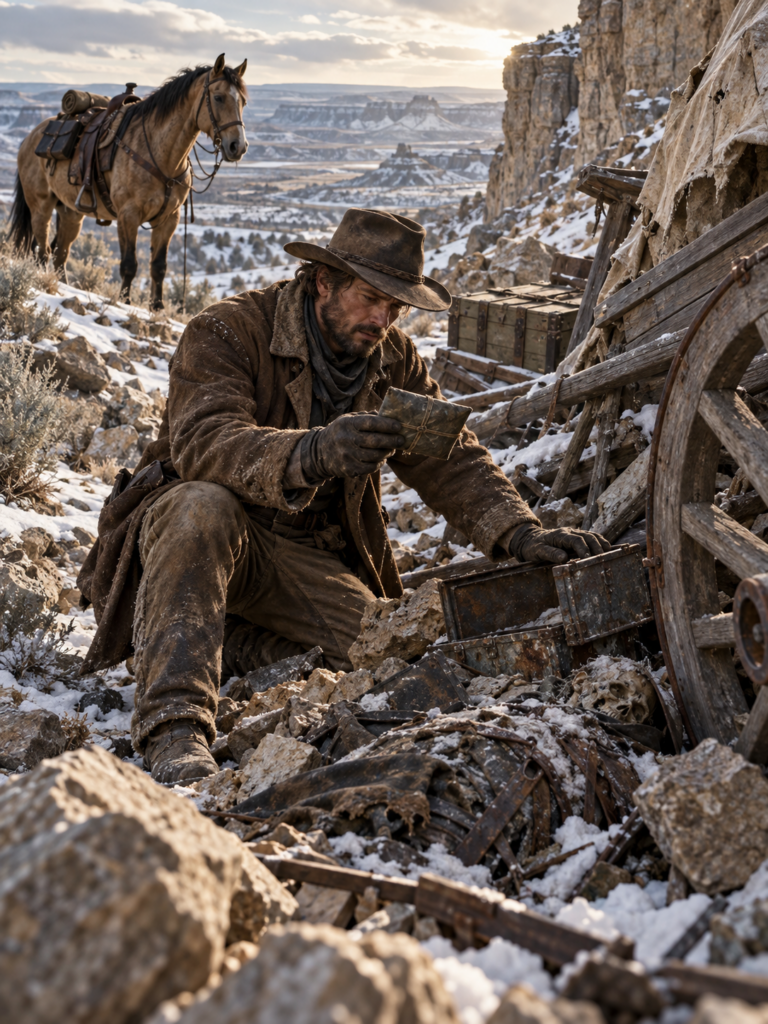
David threw himself sideways as gravel slumped into the hole he had opened beside the third wagon.
A stone the size of a stove dropped where his leg had been.
He lay still until the slide stopped whispering.
Then he pushed himself upright.
Nothing broken.
The wagon beneath him had not shifted.
That mattered more.
David backed off the mound and spent the next hour studying it before touching another stone.
Mercer’s old warning returned to him.
A man who hurried a wreck buried what he meant to save.
So David slowed down.
The next two days became a careful argument with the mountain.
Move one stone.
Watch.
Wait.
Clear canvas.
Mark the place.
Move again.
He tied strips of frayed wagon cover to exposed points so he could track what he had opened.
On the second morning he uncovered another teamster.
A man David had known only by face.
The body still wore work gloves.
A rein was looped around one wrist the way drivers did when wind made leather hard to hold.
David covered him again.
On the third morning he reached deep enough into the next wagon to count the ordnance crates.
He remembered the manifest.
He counted twice.
The number matched.
Nothing had been stolen.
Nothing diverted.
Nothing lost through incompetence.
The convoy had been where the lieutenant ordered it to be when the cliff came down.
David sat on the wagon frame and pulled a folded sheet of brown paper from his saddlebag.
Harness work had trained his hand to keep plain records.
He wrote everything.
Location.
Date.
Six wagon shapes.
Visible ordnance markings.
Bodies uncovered.
Crates counted.
Condition of the slide.
He did not write anger.
He wrote facts.
Then he folded Wy’s letter inside his own statement.
That evening he boiled coffee in Mercer’s tin cup.
The buckskin stood tied on higher ground, white-socked hind leg relaxed, breathing quietly into the cooling air.
David watched the mound darken.
He could already imagine how easy it would be for someone at Fort Howerin to call the discovery incomplete.
A civilian with a ruined name.
A dead man’s letter.
A few exposed crates.
So he stayed two more days.
He worked enough of the mound to be certain all six wagon forms were there.
He marked each one.
He recorded what he saw.
Only on the fifth morning did he saddle the buckskin.
Before leaving, he walked to Wy’s resting place.
He placed one hand against the exposed wagon board.
“I found you.”
Nothing answered.
David mounted.
The ride to Fort Howerin took four days.
He reached the gate dusty, unshaven, and carrying more evidence than any man there expected.
The sentry made him wait.
Two hours passed on a bench outside the orderly room before Captain Ordway called him inside.
Ordway had not been stationed there when the convoy vanished.
That helped.
He knew David only through the file.
The captain looked at him across the desk.
“David Tanner?”
“Yes.”
“The guide?”
David did not correct the past tense.
He placed his brown paper on the desk.
Then Wy’s letter.
Captain Ordway read them once.
Then again.
“What exactly did you find?”
“Six wagons beneath a rock slide north of Rimrock Basin.”
“All six?”
“Yes.”
“Ordnance?”
“Still there.”
“Men?”
“Some.”
Ordway’s expression changed.
David gave him the coordinates.
The approach.
The safest place to camp.
The condition of the mound.
The captain sent for a sergeant before David finished.
Within a week, twelve soldiers, two recovery wagons, a carpenter, a young lieutenant, and David Tanner were riding back toward the cliff.
David led them north.
Not as an accused man returning to the place of his failure.
As the only man in the column who knew exactly where the truth was buried.
David rode at the head of the recovery detail without looking back to see whether the soldiers trusted him.
He had spent three years learning what trust looked like when it disappeared.
He no longer needed to watch for it.
Sergeant Ives rode directly behind him.
Lean, quiet, older than the lieutenant accompanying them, Ives asked useful questions.
Not accusations.
“What will the slide do if rain comes?”
“Move.”
“How fast?”
“Fast enough to kill a careless man.”
“Where do you want the recovery wagons?”
“Half a mile south. High bank.”
Ives nodded.
No argument.
David noticed that.
Three days after leaving Fort Howerin, they reached the shattered cliff.
The young lieutenant, Peele, looked at the mound and said nothing for nearly a minute.
From the trail it resembled ordinary broken country.
That explained part of what had happened three years earlier.
The original search had taken place immediately after the storm, when the slide was new.
Fresh snow and debris would have covered every recognizable line.
The canteen and broken tongue found downstream had pulled searchers away from the cliff.
Weather had done the rest.
David dismounted.
“Before anybody moves a stone, walk it with me.”
Lieutenant Peele glanced at Ives.
The sergeant said, “You heard him.”
David led them end to end.
He showed the pale scar high on the rimrock.
The direction of the collapse.
The buried wagon shapes.
The exposed canvas.
The markings he had made.
Where Wy had been found.
Where the mound had shifted beneath him.
Ives listened.
Peele listened too.
Neither interrupted.
When David finished, Ives asked, “How do we open it?”
“Upper end first.”
“Why?”
“Pressure.”
David pointed.
“You open the lower face, everything above can settle into the hole. We clear weight from the high side and work down. One stone at a time.”
The carpenter whistled softly.
“Eleven days of that.”
David looked at him.
“The first search took eleven days.”
Nobody made a joke.
They began.
The first wagon emerged slowly.
Its canvas was destroyed.
Its frame was broken in two places.
But the army stencil remained visible along the bed.
Peele copied every number into his field book.
Sergeant Ives made a separate record.
David did not tell them what to write.
He showed them where to look.
On the second day they uncovered the first soldier.
Then another.
The carpenter built pine boxes from boards carried on the recovery wagons.
When those ran short, they used sound sections from the buried wagons themselves.
Fresh canvas lined each box.
Names were recorded wherever identification was possible.
The work remained quiet.
Men who had arrived curious became careful.
By the fourth day nobody spoke above a low voice near the recovery area.
David worked beside them.
He did not stand back simply because the letter had cleared him.
He lifted rock.
Rigged rope.
Checked unstable wagon frames.
Led the buckskin twice each day to the better grass above the wash.
At night he drank coffee from Mercer’s tin cup and wrote notes beside the fire.
Sergeant Ives occasionally joined him.
On the fifth evening Ives pointed at the cup.
“Had that long?”
“Fifteen years.”
“Looks older.”
“It is.”
Ives waited.
David normally would have left the answer there.
Instead he said, “Belonged to the man who taught me freight work.”
Ives nodded.
“Good teacher?”
“The best.”
“Then he would know what happened here?”
David looked toward the dark shape of the slide.
“He would have read it quicker than I did.”
Ives shook his head.
“You came back.”
David said nothing.
That sentence followed him into sleep.
You came back.
The official report had taught everyone to look at the convoy loss as one moment.
A mistake.
A bad decision.
A failed guide.
But David had lived with it as three years.
Three years were harder to fit into a sentence.
Three years of harness needles.
Three years of men looking away.
Three years of his father’s letter sitting beside Mercer’s cup.
Three years of being treated as though a government report had replaced his memory.
Coming back did not feel courageous.
It had felt like the only direction left.
On the seventh day they reached the center of the mound.
There they found the worst of the collapse.
Two wagon beds had been driven against each other.
Harness iron twisted around stone.
Mule bones lay beneath a fractured axle.
David stood over it for a long time.
The evidence answered a question he had carried since the search.
The convoy had not attempted to move.
The teams had still been hitched when the cliff fell.
That matched Wy’s letter.
They had been ordered to shelter and wait.
Lieutenant Peele crouched beside one trace chain.
“This didn’t break before impact.”
“No.”
“And if Tanner had led them through?”
Sergeant Ives looked at him.
“He didn’t.”
Peele flushed slightly.
“I mean if the rear column had continued with him.”
David answered.
“They would have been beyond the shoulder.”
The young officer stood.
No one said what all of them understood.
The lieutenant who had commanded three years earlier had not merely ignored David’s advice about delaying the run.
He had also ignored David during the storm.
David had wanted the wagons moved past the cliff shoulder.
The officer ordered them beneath it.
That decision buried six wagons and five men.
By the ninth day they had recovered nearly all of the ordnance.
Ninety-two crates.
The numbers matched the old manifest.
Rifle parts.
Ammunition.
Army stores.
Rust had damaged some iron.
Water had ruined some packing material.
But the central fact remained.
The army had not lost the weapons because David chose a wrong route.
The convoy had been crushed where an officer ordered it to halt.
On the tenth day, Sergeant Ives uncovered part of another tin container.
Inside were papers too damaged to read.
He handed them to David.
“Teamster records?”
“Probably.”
“You want them?”
David shook his head.
“Army evidence now.”
Ives studied him.
“You could keep anything from here and nobody would question you.”
“That would give someone something to question.”
Ives smiled without humor.
“You learned the hard way.”
“Yes.”
On the eleventh day the final wagon came free.
Six recovered.
Eleven mule remains.
Four soldiers.
Wy Prine.
Ninety-two ordnance crates.
Harness iron.
Wagon frames.
Every piece transformed the old report from certainty into embarrassment.
The carpenter closed the last pine box.
David stood beside Wy’s.
He still had the leather pouch containing eighty-one dollars.
The money had been explicitly left to whoever found him.
Captain Ordway had agreed that the note made the gift lawful.
David had not spent a coin.
He rested one hand on the box.
Three years earlier Wy had been only another teamster in the tail column.
Now the dead man had become the witness who forced the living to reopen the truth.
The recovery detail left the wash the following morning.
The dead rode on wagon beds.
Recovered ordnance traveled behind.
David rode his buckskin at the front.
When Fort Howerin came into view, people began gathering near the gate.
Word had traveled ahead.
Captain Ordway met them outside the orderly room.
He removed his hat when the pine boxes passed.
The post commander came too.
No speeches.
David appreciated that.
Formal statements began the next morning.
Captain Ordway took David’s account in full.
Then Ives’s.
Then Peele’s.
Then a corporal who had checked every visible ordnance number against the old manifest.
Wy’s letter was entered as an enclosure.
The original convoy file was opened.
David saw it once.
His name appeared on the first report beside language he had carried for three years.
Misreading of terrain.
Against the lieutenant’s judgment.
He read the words without touching the page.
Captain Ordway stood beside him.
“You want to make a statement about this line?”
“I already did.”
“You could add that it was false.”
“The evidence does that.”
Ordway looked at him.
“You’re not angry?”
David considered the question.
“I was.”
“When?”
“Three years ago.”
“And now?”
David looked at Wy’s folded letter.
“Now I want it corrected.”
That difference mattered.
Anger wanted punishment.
Truth wanted accuracy.
The revised report took several days.
When completed, it stated that the loss had resulted from a rockslide while the six rear wagons were halted beneath the cliff by command decision.
It recorded David Tanner’s prior warning.
It recorded Wy Prine’s letter.
It recorded the physical evidence.
It removed fault from David.
A copy was sent to Rimrock.
The post courier nailed it to the board outside the freight office.
David was not there to watch anyone read it.
Captain Ordway had hired him at day rate to return to the slide with a lighter wagon and assist a second detail.
He accepted.
Not because the army owed him.
Because the work was unfinished.
Through late September he helped bring out what remained.
Broken wagon iron.
Usable harness.
Crates missed during the first recovery.
Pieces of the convoy no report could summarize.
When the first October snow touched the high ground, the final wagon rolled south.
At the fork above Rimrock Basin, David stopped.
The army wagons continued toward Fort Howerin.
His road turned east.
Sergeant Ives held out a hand.
“Good work, Tanner.”
David shook it.
Lieutenant Peele did the same.
Then the detail rode on.
David remained alone with the buckskin.
He could ride back into Rimrock.
Men there now knew the truth.
His name had been cleared publicly.
Work would likely return.
Instead he turned toward a plank barn standing one mile down the road from the log house where he had grown up.
Mercer Boon’s barn.
Empty since the old freighter died.
The roof sagged in two places.
One side door hung from a single hinge.
Grass grew high around the freight scale.
David dismounted.
He opened the door.
Dust moved through a shaft of afternoon light.
The stalls remained where Mercer had built them.
The small forge remained in the corner.
The freight scale still hung from the sill.
David touched it.
It swung once.
Then settled true.
For the first time since leaving Rimrock, David knew exactly where he intended to stay.
David rode into Rimrock the following morning for one reason.
The county clerk.
He did not go first to the freight office.
He did not stand beneath the corrected army report.
He did not wait to see who might apologize.
He tied the buckskin outside the courthouse and walked inside carrying his leather money pouch.
The clerk knew him.
Everyone did now.
“Tanner.”
David nodded.
“Mercer Boon’s barn.”
The clerk pushed his spectacles higher.
“What about it?”
“Who owns it?”
The man opened a ledger.
Mercer had died without close kin.
Taxes had eventually lapsed.
The barn and its half-acre had reverted.
Seven dollars in fees would put the property into David’s name.
The clerk seemed embarrassed by the small number.
David was not.
He counted seven dollars onto the counter.
The clerk slid over a paper.
David signed.
That afternoon he returned to the barn with the deed folded inside his shirt.
Three years earlier the army had taken his name with ink.
Now seven dollars and another piece of ink gave him a place where he could decide what his name meant next.
He started with the roof.
Two sections had softened enough to leak.
David found a downed cedar above the creek, split shakes, and carried them back in bundles.
He built a ladder from pine rails and rungs cut from a broken wagon tongue.
The work took days.
No audience.
No applause.
That suited him.
After the roof came the door.
The north hinge had failed entirely.
David cut a new strap from thick harness leather he had been saving since his livery days.
The irony almost amused him.
A piece of tack nobody wanted him paid to repair now held open the first building he owned.
He mucked the stalls.
Swept the loft.
Repaired a feed bin.
Cleaned the old freight scale with kerosene until the iron showed dark beneath the rust.
Then he unpacked the saddlebag.
Mercer’s tin cup went on the shelf above the forge.
The oiled cloth went into the drawer of the plank desk beneath the window.
Inside it were three things now.
His father’s short letter.
Wy Prine’s letter.
David’s notes from the slide.
He tied the cloth twice and closed the drawer.
The first man to come to the barn on business was Henley.
David heard the horse outside before the knock.
The rancher entered carrying his hat.
Months earlier Henley had climbed the stairs above the livery to say he could no longer let David repair his harness because a wool buyer objected.
Now he stood inside Mercer’s barn looking at the new roof.
“I’ve got three hundred head on the south flats.”
“I remember.”
“Wool goes to the rail siding in April.”
David waited.
Henley rubbed his hat brim.
“I need a freighter.”
David did not rescue him from the discomfort.
“I heard the army report was corrected,” Henley said.
“Yes.”
“I read it.”
David nodded.
Henley looked around.
“You taking work?”
“Some.”
“You know the spring road better than anyone I can hire.”
“That wasn’t what people said last year.”
Henley accepted the blow.
“No.”
Silence stretched.
Then he said, “I was wrong.”
David studied him.
Henley did not decorate the apology.
That helped.
“What weight?”
The rancher exhaled.
He described the wool load.
David named a rate.
Henley agreed.
They shook hands over the freight scale.
Henley left four dollars on the desk as a deposit.
After he rode away, David looked at the coins.
He felt no triumph.
Only movement.
A week later another rancher arrived.
Bevon.
Sixty years old, cattle on the north bench, three years without so much as a greeting.
He carried a broken singletree.
“Can you mend it?”
“Yes.”
“How much?”
David told him.
Bevon paid in advance.
David repaired the wood and iron while the older man sat near the forge.
When the job was finished, Bevon looked at Mercer’s tin cup.
“Coffee?”
David poured.
Bevon drank from the cup and did not mention the years between them.
David almost preferred it that way.
Not every failure needed a speech.
Some men apologized by returning.
Others apologized by paying fairly.
Others never apologized at all.
David discovered he did not need all of them to.
The smith from Rimrock rode out one Sunday with a small keg of cut nails.
“Ordered too many.”
David looked at the keg.
“You never overorder.”
The smith shrugged.
“First time for everything.”
He stayed until sunset helping hang the second door.
A widow who ran the boarding house at the west end of town began sending a covered plate every Friday.
Pie.
Stew.
Roast one week.
Beans another.
David sent the plate back clean each Saturday.
She refused payment.
He stopped trying after the third week.
By first hard freeze, David had two signed contracts.
Henley’s spring wool haul.
And a light supply run from Fort Howerin to the foothill garrison.
Captain Ordway had written the army contract himself.
Guide’s rate and freighter’s rate together.
The same institution that had closed its doors to David now wanted him leading wagons again.
He read the contract carefully before signing.
Then he made one change.
Late-season weather decisions would rest with the guide on the ground.
Ordway accepted the clause without argument.
That mattered more to David than the money.
The lesson of the buried convoy could not be only that David Tanner had been right.
It had to change what happened the next time somebody standing on a road said the road was no longer safe.
Work increased.
David needed help.
A nineteen-year-old named Ren came through with a rail family heading east.
The boy could handle a team but knew little about broken country.
He asked if David was hiring.
“You know wagons?”
“Some.”
“You know badlands?”
“No.”
David almost said no.
Then he remembered Mercer Boon watching a quiet boy remove a splinter from a horse’s hoof.
“What do you know?”
Ren thought.
“I know enough to know I don’t know.”
David hired him.
On the first morning, he taught Ren to check a kingbolt without unhitching.
On the second, to grease a hub with a stick and tin when proper tools were unavailable.
Then weight.
Harness fit.
Brake wear.
Wash bottoms.
Clouds.
Snow line.
Where water ran after rain.
Where it hid after heat.
The lessons came naturally because David had heard them all in Mercer’s voice.
One afternoon Ren asked, “How do you know when a road stops being a road?”
David looked at him.
Mercer’s exact idea.
Not exact words, but close enough to pull fifteen years together.
David pointed toward the ridge.
“When what you expect stops matching what the ground is telling you.”
Ren frowned.
“Meaning?”
“Meaning the map doesn’t get the last word.”
The boy nodded slowly.
David continued.
“Neither does rank.”
Ren looked over.
David rarely spoke about the convoy.
This was enough.
“Ground first,” the boy said.
“Ground first.”
By November, men in Rimrock had begun calling the place Tanner’s.
Not Mercer’s old barn.
Not the vacant freight shed.
Tanner’s.
David first heard it while buying lamp oil.
A man behind him said, “Leave that harness at Tanner’s. He’ll know what to do with it.”
David paid for the oil and walked out.
He did not turn around.
The name followed him home.
That evening snow began.
Only an inch.
Enough to whiten the ridges and soften the yard.
David closed the north door against the wind.
The forge held banked coals.
The freight scale hung motionless.
The buckskin stood in the near stall, fourteen hands, one white hind sock, old wire scar visible along the ribs.
A second horse occupied the far stall, taken in trade against a spring haul.
Ren had gone home two hours earlier carrying harness pieces to clean.
David crossed to the desk.
Opened the drawer.
Untied the oiled cloth.
Wy’s letter remained folded inside his brown statement.
His father’s letter lay beside it.
David lifted that one.
He had received it after the convoy loss.
One brief sentence from a man who had never found language easy.
His father hoped David would find honest work in another county.
David had read it enough times that the creases were dark.
For three years the letter had felt like judgment.
Tonight it felt different.
Not kinder.
Different.
His father had believed the report too.
Perhaps he still did.
Perhaps word had reached the railroad settlement.
Perhaps not.
David could write.
That thought would once have felt like surrender.
Now it did not.
He set the letter down.
After the spring wool haul, he decided.
After the foothill supply run.
He would write then.
Not to defend himself.
The report already existed.
He would tell the old man about the barn.
About the contracts.
About the boy named Ren learning wagons.
If the traveling photographer came through Rimrock again, David might send a picture.
No speech.
No demand for apology.
Just proof of life continuing.
He folded the letter.
Then he unfolded Wy’s.
The pencil had faded further.
The words remained legible.
Wy had written because he believed somebody might someday find them.
That faith moved David more now than the exoneration itself.
A dying man beneath an unstable cliff had spent part of his last time protecting another man’s name.
David had accepted Wy’s eighty-one dollars because refusing it would have ignored the man’s explicit wish.
He had not spent it.
The pouch remained in the desk.
Not sacred.
Simply waiting.
One day the money would have a use worthy of the trouble of finding.
Perhaps Ren would need a team.
Perhaps someone else’s wagon would fail.
Perhaps a roof would collapse.
David did not know.
He no longer needed to know immediately.
For years he had believed his life stopped at one moment in the badlands.
The convoy vanished.
The report appeared.
The work disappeared.
Everything afterward had seemed like aftermath.
Now he understood that what came after could become a life of its own.
Henley had returned.
Bevon had returned.
The army had returned.
But none of them had given David this barn.
None had repaired the roof.
None had rehung the door.
None had hired Ren.
None had taught the boy how to read a wash.
Clearing his name restored what had been taken publicly.
Building Tanner’s created something that had never existed before.
David rose.
He took Mercer’s tin cup down from the shelf and set it on the desk beside the oilcloth.
The same two things had sat together on a flat stone beneath the cliff.
There, the cup had belonged to the man who taught him how to read the land.
Wy’s letter had belonged to the man who restored the truth about David’s reading of it.
Mercer had given David knowledge.
Wy had given him witness.
Neither man had given him a future.
That part had remained David’s work.
He looked toward the stalls.
The buckskin shifted in the straw.
Wind pressed softly against the barn.
David could hear the new north door hold.
He smiled once.
Small.
Private.
Seven dollars.
That was what the county had charged him for the barn and half-acre.
Seven dollars after three years of being treated like a man whose name had no value.
It was the best money he had ever spent.
He put Mercer’s cup back above the forge.
Retied the oiled cloth twice.
Closed the drawer.
Then he banked the coals lower.
Before putting out the lamp, David walked once through the barn.
He checked both horses.
Lifted the latch on the south door and set it again.
Ran his hand across the freight scale.
It swung slightly beneath his touch.
Then returned to center.
True.
Mercer had taught him that a good wagon guide was not merely a man who knew the road.
He was a man who recognized when the road had changed.
For three years David had failed to apply that lesson to himself.
He kept trying to return to the life he had before the convoy.
Army guide.
Freight contracts.
Reputation intact.
Men nodding to him in town.
But that road was gone.
Finding the wagons had not rebuilt it.
It had shown him another.
The report could be corrected.
The dead could be carried home.
His name could be restored.
But he did not have to become the exact man he had been before others misjudged him.
He could become the man who owned this barn.
Who chose his own contracts.
Who trained another guide.
Who wrote his own safety terms.
Who listened when a young man said the land was telling him something different from the schedule.
David extinguished the lamp.
Darkness filled the barn.
For a moment he could see nothing.
Then his hand moved automatically toward the shelf.
He touched the rolled rim of Mercer’s cup.
One thing he could always find in the dark.
David stood there with his fingers resting against it.
Outside, snow moved softly across the yard.
Inside, the horses breathed.
The repaired roof did not leak.
The north door did not shake.
The scale hung true.
And somewhere in the desk behind him, a dead teamster’s letter remained folded beside an old father’s disappointment.
Neither paper controlled the room.
Neither controlled David.
In spring, he would take Henley’s wool to the railroad.
Then he would guide the Fort Howerin supply run.
Ren would ride with him.
If weather turned, they would stop.
If a wash changed, they would change course.
If someone with rank argued against what the ground clearly showed, David would point at the road and let the road make the final argument.
Afterward, he would write his father.
Not before.
He wanted something finished first.
Not because he needed to prove himself.
Because he finally understood the difference.
Three years earlier, David Tanner had been thirty-seven and finished.
At least that was what men in Rimrock believed.
Now he was forty.
He owned a barn.
A half-acre.
A buckskin gelding.
A second horse in trade.
Two signed contracts.
A freight scale that hung true.
A boy who came before daylight because he wanted to learn.
And one battered tin cup resting above a forge beneath a roof David had repaired himself.
The badlands had kept the convoy for three years.
They had not kept David.
That was the part no army report could write for him.


