
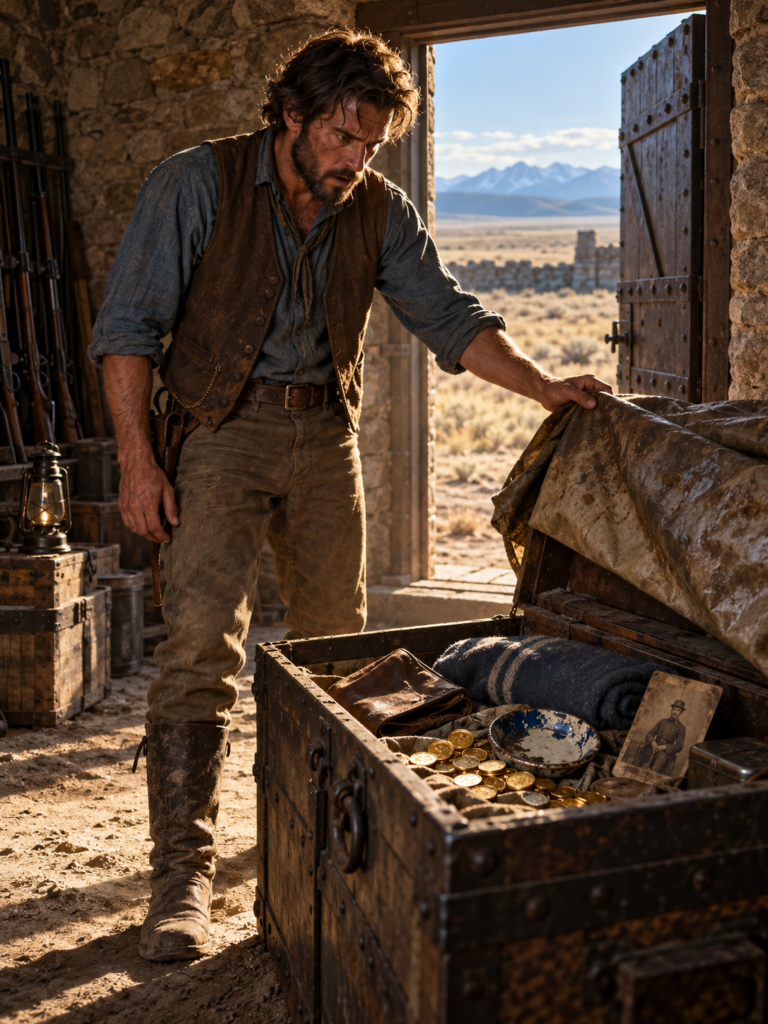
Andrew crossed the abandoned flat at a fast walk, the leather pouch buttoned inside his waistcoat beside Halden Brooks’s compass.
He did not go to the saloon.
He did not return to the auction.
And he told no one what had been inside the magazine.
Instead he walked straight to the back of the mercantile, where Powder Creek’s land business was conducted across a scarred pine counter by Harlon Doss, a sixty-two-year-old clerk with one clouded eye and handwriting precise enough to shame a bank.
Doss looked up.
“What business?”
Andrew placed the auction receipt on the counter.
“This building.”
Doss read it.
“Powder magazine.”
“Yes.”
“You bought that?”
“For two dollars.”
Doss looked at him properly for the first time.
Andrew continued.
“What happened to the ground around the old post when the army left?”
“Reverted.”
“To whom?”
“Depends on the parcel.”
“The ten acres around the magazine?”
Doss reached for a ledger.
Andrew waited.
That patience had cost him before.
Years earlier, he had saved enough to put money down on a quarter section near the Powder River.
He had worked it.
Improved it.
Believed payment and labor meant security.
Then the man holding the paper foreclosed through a technical clause Andrew had never understood.
Andrew had ridden away without a fight because he had known cattle, iron, weather, timber, and horses.
He had not known paper.
Since then, every document felt like a weapon pointed from a direction he had not learned to watch.
Doss found the entry.
“Available for filing.”
Andrew’s pulse changed.
“Price?”
“Six dollars filing fee. Ninety days for notice. No valid claim filed against it during that period, you proceed.”
Andrew did not immediately reach for his money.
“What exactly am I buying?”
Doss’s good eye narrowed slightly.
“You’re not buying. You’re filing a claim.”
“Difference?”
Doss explained.
Andrew listened to every word.
Then he made Doss explain it again.
Not because he was slow.
Because he had once lost land by being embarrassed to admit what he did not know.
That humiliation had cost him more than pride.
He would not pay it twice.
Finally Andrew took one gold coin from inside his waistcoat.
Doss glanced at it.
Then at Andrew.
“Been lucky?”
Andrew met his eye.
“I made a good purchase.”
Nothing more.
Doss counted the fee and wrote the filing papers.
Andrew read every line he could understand.
Where he could not, he asked.
Doss answered without mocking him.
When the document was finished, Andrew signed his name.
Plain.
Steady.
The same way Brooks had taught him.
Doss sanded the ink.
“That’s a lonesome piece of ground, Mr. Reed.”
Andrew folded his copy.
“I don’t mind lonesome.”
But when he stepped outside, he realized that was only partly true.
He had spent eleven years moving from ranch to ranch.
Eating at other men’s tables.
Sleeping under other men’s roofs.
Working land he could be ordered off by sundown.
The magazine could become lumber.
That had been the plan.
Instead, Andrew now saw the stone walls differently.
They were not salvage.
They were shelter.
The iron door was not scrap.
It was a door that could belong to him.
The heavy roof planks might not be something to sell.
They might be something to sleep beneath.
He crossed to the mercantile counter and began buying tools.
Nails.
A saw.
Axes.
A drawknife.
Plane.
Shovel.
Pick.
Level.
Rope.
Stove.
Flour.
Bacon.
Beans.
Coffee.
He spent carefully.
Each coin had to create something lasting.
When he finished loading the hired wagon, the liveryman, Osgood Behan, stood nearby watching.
“You rebuilding something?”
Andrew looked east toward the old army flat.
“I think so.”
“Need help?”
Andrew almost refused.
He had spent so long depending on himself that acceptance felt dangerously close to debt.
Then he remembered Wayright’s letter.
If you have anyone left to sit at your table…
Andrew looked at the wagon.
“I can feed you. Dollar a day besides.”
Osgood nodded.
“I’ll bring my team tomorrow.”
Andrew climbed onto the wagon seat.
For the first time since opening the magazine, the decision became real.
He was not taking the building apart.
He was going back to the locked stone box nobody wanted.
And he was going to make it a house.
Andrew turned the hired wagon east and drove back toward the abandoned post before he could talk himself out of it.
The whole way, he kept seeing the building not as it stood but as it might become.
A window in the north wall.
A stove near the center.
A real floor.
A bunk.
A table.
The idea frightened him more than drifting ever had.
A drifting man could lose very little.
A man who built something could watch it taken away.
He had learned that already.
When he reached the magazine, he unlocked the iron door and carried every tool inside.
Then he took Harlon Doss’s filing receipt from his waistcoat and put it beneath the leather case holding Brooks’s compass.
Paper beside brass.
One thing he understood poorly.
One thing he trusted completely.
He left both where he could see them.
The next morning Osgood arrived with a heavier wagon and his own team.
He was forty-nine, walked with a limp from an old horse fall, and did not waste words on encouragement.
He looked at the magazine.
Then at Andrew.
“You still planning to tear it down?”
“No.”
“Good.”
That was all.
They began with the roof.
Andrew pulled square-cut nails carefully rather than splitting the old boards.
Osgood stacked the tin sheets flat on grass.
Every piece that came off was inspected.
Anything sound went into a salvage pile.
Anything doubtful went elsewhere.
By evening Andrew’s hands were blistered beneath old calluses.
His shoulders ached.
He slept in the open beside the building and woke before dawn happier than he had any right to be.
On the second day, Osgood discovered that several rafters were too weathered to trust.
Andrew stared at them longer than necessary.
“That changes things.”
“Changes lumber,” Osgood said.
“Changes cost.”
“Yes.”
Andrew calculated silently.
He had enough gold.
But Wayright’s money had felt limitless when it sat hidden in a pouch.
The moment Andrew began turning it into nails, food, tools, filing fees, and construction, it became finite.
Brooks had once told him that having money and knowing what to do with money were different skills.
Andrew understood that more clearly now.
“Replace them,” he said.
Osgood nodded.
No argument.
No praise.
Just work.
Andrew kept the stone walls.
That was the first important decision.
They were thick, plumb, and cold enough inside to hold winter if he failed to heat them properly.
But they were stronger than anything Andrew could afford to build from scratch.
The powder magazine had been designed to survive accident.
Andrew decided it could survive him.
He spent three afternoons cutting a window opening into the north wall.
Each strike of the chisel rang across the empty post.
Stone dust coated his beard.
The opening began as a rough wound in the masonry and slowly became square.
Osgood framed it with salvaged pine.
When they fitted the window, Andrew stood outside and looked through it.
For the first time, the building appeared less like military storage and more like something a person might wake inside.
The change disturbed him.
He could imagine morning there.
That was dangerous.
Plans had become dangerous to Andrew years earlier.
He returned to work.
On the fourth afternoon, a mule came along the old supply road.
A woman rode it sidesaddle.
Andrew straightened from the stone pile.
Osgood shaded his eyes.
“Marjery Held.”
Andrew knew the name.
Methodist minister’s widow.
Kept the small meeting house.
Taught Powder Creek’s handful of children their letters.
She dismounted without waiting for help and untied a covered pot from behind the saddle.
“I heard somebody was trying to turn the powder magazine into a house.”
Andrew wiped his hands.
“Trying.”
She set the pot on a stump.
“Mutton and turnips.”
He stared at it.
Marjery looked at him.
“A man working alone should eat.”
“Osgood’s here.”
“Osgood eats too.”
Osgood nodded solemnly.
“Generally.”
Andrew almost smiled.
Marjery lifted the lid.
Steam rose.
Neither she nor Osgood asked what Andrew had found inside the locked building.
The absence of the question mattered.
Andrew had been prepared for curiosity.
Prepared for suspicion.
Prepared for the town to assume anyone spending gold after bidding two dollars must have uncovered something.
Instead Marjery handed him a spoon.
“Plate?”
Andrew stopped.
Inside the chest.
Blue enamel.
Chipped rim.
Wayright’s wife’s kitchen.
He could have used it.
But he was not ready.
“Tin one,” he said.
Marjery waited while he fetched it.
She returned three days later with bread.
Then again with beans cooked with salt pork.
Never once did she ask why Andrew could suddenly afford tools.
By the eighth day, another rider appeared.
A lean stone cutter named Tom Akerly.
He had heard Andrew wanted a chimney.
“I can cut your flue stone,” he said.
“What price?”
“Meat.”
Andrew frowned.
“What kind?”
“The edible kind.”
They agreed.
Andrew hunted.
Akerly cut stone.
Four days later, the chimney stood against the wall.
Andrew mixed mortar while Akerly set each piece.
At the first lighting, smoke drew cleanly upward.
Andrew watched it leave the chimney.
No smoke gathering inside.
No flaw in the draft.
Akerly nodded once.
“House’ll breathe.”
House.
The word settled differently now.
Not building.
Not magazine.
House.
In the second week, Pettigrew—the rancher who had bought the abandoned army corral at auction—arrived with two hands and a wagon carrying split rails.
Andrew immediately assumed there would be a price.
Pettigrew climbed down.
“Heard you need fencing.”
“I’ll buy some.”
“These are extra.”
Andrew looked at the rails.
Then at him.
“Why?”
Pettigrew seemed faintly offended by the question.
“Because I have them.”
Men had given Andrew things before.
Usually because they expected work, loyalty, silence, or repayment.
He waited.
Pettigrew understood.
“You cut hay off this bench next summer?”
“If the claim clears.”
“I’ll buy some.”
“That the trade?”
“That’s business. Rails are rails.”
Andrew looked at Osgood.
Osgood had already begun unloading.
Andrew let him.
The corral went against the western berm.
They reused old army posts.
By sunset, Andrew could picture his bay inside it.
Something belonging to him inside a fence belonging to him beside a house belonging to him.
Then fear returned.
Not sudden.
Not dramatic.
A deep pressure beneath the ribs.
He had thought the quarter section near the Powder River belonged to him too.
That night Andrew removed Doss’s filing papers from inside the magazine and read them by lantern light.
Every line.
Twice.
He carried them into town the next morning.
Doss looked surprised.
“Problem?”
“Maybe.”
“What?”
“I want you to tell me where I can lose this.”
Doss studied him.
Andrew pointed to the paper.
“I want every way another man can take this claim from me.”
That changed the clerk’s expression.
He pulled another ledger forward.
For almost two hours, Doss explained notices, deadlines, contest periods, occupancy requirements, filing dates, and proof.
Andrew wrote notes with the stub of pencil he had bought.
His letters were awkward.
His questions were not.
When he finished, Doss said, “Someone took land from you before.”
Andrew folded the page.
“Yes.”
“Legally?”
Andrew thought.
“On paper.”
“That wasn’t my question.”
“It’s the only answer I have.”
Doss nodded.
“Come back when the notice period is up.”
“I will.”
From then on, Andrew treated paperwork the way Brooks had taught him to treat iron.
Know its weakness.
Know its heat.
Know where it would bend.
By first snow, the magazine had changed.
The original stone walls remained.
The iron door remained.
So did the old strap hinges.
But the roof had been rebuilt.
The masonry repointed.
The chimney finished.
A second small room extended from the north side beneath a shed roof.
A proper plank floor covered the old boards.
The cook stove sat on creek flagstone.
A bunk rested under the new window.
In the main room stood a table and two chairs Osgood had made in exchange for venison.
Two chairs.
Andrew had not requested two.
He noticed that only after Osgood left them.
“You built an extra.”
Osgood shrugged.
“Tables look wrong with one.”
Andrew did not argue.
The ninety-day notice passed.
No competing claim appeared.
Harlon Doss filed the final papers.
Andrew signed.
This time his hand did not hesitate.
The ten acres were his.
He walked home from Powder Creek rather than ride.
He wanted time to understand the sensation.
He had owned a claim once before.
Yet this felt different.
Not because the law was kinder.
Because Andrew had changed.
He had asked questions.
Read documents.
Demanded explanations.
Used skill where once he had used trust alone.
Wayright’s gold had purchased the chance.
Andrew’s attention had protected it.
That mattered.
By December, people in town had begun calling the place the Reed House.
The first time Andrew heard it, he looked behind himself.
As if they meant someone else.
The men on the mercantile porch lifted their hands now when he rode past.
Harlon Doss called him Mr. Reed.
Marjery Held asked whether his chimney drew properly.
Osgood ate supper with him on Wednesdays.
Andrew drank coffee at Osgood’s kitchen on Sundays.
Nobody announced friendship.
Nobody needed to.
One February afternoon, Marjery appeared at the door with a boy beside her.
Perry Held.
Nine years old.
Her grandson.
“His mother has fever,” Marjery said. “I need him somewhere two nights.”
Andrew looked at the boy.
Then at Marjery.
“You want him here?”
“I wouldn’t have brought him if I didn’t.”
Andrew’s first response nearly escaped.
I don’t know anything about children.
Then he looked past them at the table.
Two chairs.
Wayright’s letter lay folded on the shelf.
Beside it sat the blue enamel plate.
If you have anyone left to sit at your table, set the plate for them.
Andrew stepped aside.
“Come in.”
That evening he cooked beans and bacon.
Perry talked enough for three men.
He wanted to know why the front door was iron.
Why the walls were stone.
Whether powder had ever exploded inside.
Whether Andrew had fought Indians.
Whether Andrew had killed bears.
Whether the compass on the shelf worked.
Andrew answered the questions he could.
Ignored the foolish ones.
Then supper was ready.
He reached automatically for his tin plate.
Stopped.
Looked at the blue enamel one.
For thirty years, perhaps longer, it had traveled with a man who could not bring himself to abandon it because it had belonged in his wife’s kitchen.
Andrew lifted it carefully.
Set it before Perry.
The boy looked at the chipped rim.
“This one mine?”
“For tonight.”
Perry filled it with beans without asking why.
Andrew sat opposite.
And for the first time, Wayright’s plate returned to a table in front of someone who expected to be there tomorrow.
Andrew watched the boy eat.
The stone walls held the stove’s warmth.
Wind moved over the old powder roof.
And something Andrew had believed the gold purchased finally revealed itself as something money could never have bought.
The house was no longer valuable because it belonged to him.
It was valuable because someone else could safely enter it.
After Perry went home two mornings later, the Reed House felt unusually quiet.
Andrew stood at the table holding the blue plate.
A faint smear of bacon grease remained near the chipped rim.
He washed it carefully.
Dried it.
Then returned it to the shelf beside the tintype of Ellen Wayright and her daughter Mary.
The photograph seemed different now.
Nothing in the image had changed.
The woman still wore the dark dress.
The child still stood close to her knee.
Neither smiled.
But Andrew no longer saw only the dead family of a stranger.
He saw the table they must once have shared.
The plate beneath a child’s hands.
A kitchen before grief emptied it.
He placed Halden Brooks’s compass beside the photograph.
Two dead men.
Two objects.
Two forms of inheritance neither had called an inheritance.
Brooks had left Andrew almost no money.
Only a saddle, rifle, compass, and the knowledge he had spent years teaching.
Wayright had left money but no instruction beyond a simple hope.
Buy yourself a piece of ground.
Set the plate for someone.
Neither man had promised that possessions could cure loneliness.
Andrew was beginning to understand why.
That winter, he worked.
Not dramatically.
No fortune appeared beyond what he had already found.
No hidden second chest lay beneath the floor.
The old army post offered no further mystery.
Andrew cut firewood.
Fed the bay.
Repaired the west corral after a windstorm.
Helped Osgood shoe two difficult horses.
Sharpened Marjery’s kitchen knives without charging her.
Traded venison to Akerly.
Sold Pettigrew hay rights for spring.
He kept a notebook now.
Expenses.
Trades.
Dates.
Promises.
Amounts owed.
Amounts paid.
The entries were not elegant.
But they were clear.
The man who had once lost land because paper was a weapon now treated paper as another working tool.
He asked Doss about anything he did not understand.
At first he felt foolish.
Then he noticed something.
Every time he asked, he became harder to fool.
That became its own kind of confidence.
By March, Powder Creek no longer felt like a town Andrew might leave next week.
People knew when he usually came in.
The mercantile kept his preferred coffee aside.
Osgood sent word if someone needed a horse shod.
Marjery occasionally brought school slates for Andrew to repair because he was good with wood and metal.
Akerly began stopping by whenever quarry work took him north.
One evening Pettigrew asked if Andrew would help judge a young bull he was considering buying.
Andrew gave his opinion.
Pettigrew listened.
No employer.
No wages.
No obligation.
Just respect for knowledge.
The difference was small enough that another man might have missed it.
Andrew did not.
He had spent most of his adult life useful to people who did not necessarily see him.
Now usefulness was no longer the price of being allowed to remain.
That realization came slowly.
Like thaw moving into frozen ground.
One Sunday in early spring, Osgood sat across from Andrew drinking coffee.
Neither man had spoken for several minutes.
Outside, snowmelt ticked from the roof edge.
Osgood looked at the iron door.
“You ever going to replace that?”
“No.”
“Ugly.”
“Yes.”
“Cold.”
“Not with the weather strip.”
“Looks like a jail.”
Andrew considered it.
The door was thick pine beneath iron bands.
Scarred.
Heavy.
Built to seal explosives from sparks and thieves.
“It reminds me.”
“Of what?”
“That a locked thing isn’t always valuable.”
Osgood waited.
Andrew continued.
“Sometimes what matters is what happens after it opens.”
Osgood took another drink.
“Sounds like something Marjery would say.”
Andrew regretted speaking immediately.
Osgood smiled into the cup.
Spring reached Powder Creek in pieces.
Mud first.
Then grass.
Then meadowlarks.
Andrew cut drainage around the house and repaired the old army well enough to water livestock.
He planted nothing fancy.
Beans.
Onions.
A little patch of potatoes.
His mother had once kept a kitchen garden outside the Reed place.
Andrew remembered her kneeling in dirt with her sleeves rolled above the wrist.
He had not thought about that image in years.
Memory worked strangely in a place of one’s own.
When he was drifting, the past came mostly as loss.
Inside the Reed House, pieces returned without hurting quite as much.
His mother’s blue dishes.
His sisters Margaret and Ruth.
His father at the forge before drink made his hands shake.
Brooks reading from a battered surveying book.
The quarter section Andrew had lost.
He realized he had treated leaving as proof of strength for years.
Roll the blanket.
Saddle the horse.
Do not complain.
Do not look back.
There was dignity in that when staying meant humiliation.
But there was no virtue in leaving merely because staying might make loss possible.
That was a lesson Brooks had never needed to teach him.
Andrew had to learn it at forty.
One afternoon Harlon Doss rode out from town.
Andrew had never seen the clerk on horseback and nearly laughed at the sight.
Doss dismounted stiffly.
“Don’t say anything.”
“I didn’t.”
“You thought it.”
Andrew took his reins.
“What brings you out?”
Doss removed a folded paper from his coat.
“Final territorial confirmation.”
Andrew’s chest tightened.
“I thought the filing was final.”
“It was sufficient. This is better.”
Andrew accepted the page but did not immediately unfold it.
Old instinct.
Paper equals danger.
Doss saw the hesitation.
“You should read it.”
“I will.”
“Now.”
Andrew looked at him.
Doss pointed.
“Read.”
Andrew unfolded it.
Slowly.
Every line.
The description matched.
Boundaries matched.
Dates matched.
Name matched.
Andrew Reed.
There was no hidden clause he could see.
He looked up.
Doss said, “It’s yours.”
Andrew glanced toward the stone house.
The corral.
The grass beyond it.
“Legally?”
Doss appeared offended.
“That is generally why governments send documents.”
Andrew smiled.
Doss softened.
“I checked it twice.”
“Why?”
The clerk looked toward the old magazine.
“Because you asked good questions.”
That sentence stayed with Andrew after Doss rode away.
You asked good questions.
Not luck.
Not charity.
Not Wayright’s gold alone.
Andrew had done something the younger version of himself had not known how to do.
He had refused ignorance without pretending knowledge.
That was the skill he had lacked when he lost the Powder River land.
The paper in his hand did not repair the old loss.
It changed what the loss meant.
By summer, the ten acres produced enough hay that Pettigrew bought what Andrew did not need.
The money was modest.
Andrew preferred that.
Sudden money felt unreal.
Earned money sat differently in the pocket.
He began taking smithing work in town because his father, for all his failures, had taught him iron before whiskey ruined his steadiness.
A broken hinge.
A wagon pin.
Horse shoes.
Fence hardware.
Andrew did not open a formal shop.
Not yet.
He used Osgood’s small forge twice a week and split payment.
His hands remembered more than he expected.
The work also brought townspeople into conversation with him.
People he had first seen watching silently from the mercantile porch now brought repairs and stayed to talk.
Andrew remained quiet.
But quiet had changed too.
Once, silence had been armor.
Now it could simply be silence.
There was a difference.
On late summer evenings he sat outside the Reed House while the bay grazed near the west berm.
The abandoned army ground had softened.
Grass covered old foundation lines.
Wildflowers stood near the six unmarked crosses above the creek.
Andrew repaired those markers one by one.
Not because he knew the names.
He did not.
He simply disliked seeing wood rot over people who had once belonged somewhere.
Marjery found him replacing one cross.
“You know who that is?”
“No.”
“Then why?”
Andrew set another nail.
“Someone did.”
Marjery looked at him for a moment.
Then handed him the hammer he had set down.
She asked nothing else.
In autumn, a year after the auction, Powder Creek held another sale.
Andrew went out of habit more than need.
The auctioneer was not the same man.
The crowd was larger.
Andrew now recognized most faces.
Someone offered him coffee.
Another man asked about hay.
Pettigrew wanted his opinion on a wagon.
Andrew stood near the back.
He remembered the previous year.
Eleven dollars in his hatband.
No home.
No wage.
No destination.
The old powder magazine had seemed like lumber.
He had valued it by board feet.
Iron weight.
Tin sheets.
He had been wrong.
Not because the building hid gold.
That was the easiest explanation.
Without the money, perhaps Andrew would never have filed the land claim.
Without Wayright’s letter, perhaps he would have stripped the roof and ridden away.
The discovery mattered.
But it had not built the house.
Hands had done that.
His hands.
Osgood’s.
Akerly’s.
Pettigrew’s.
Marjery’s meals had kept them fed.
Doss’s knowledge kept the paperwork clean.
A nine-year-old boy eating beans had transformed a relic into a table setting.
The two hundred forty dollars had opened possibility.
Community made it durable.
Andrew had once believed self-reliance meant needing nobody.
Brooks had never taught him that.
Life had.
And life had been wrong.
The sale ended without Andrew bidding.
He rode home before sundown.
That winter came hard.
Snow closed the east road for three days.
Two families from outside town became stranded while trying to reach Powder Creek.
Osgood brought them to Andrew because the Reed House sat nearest the old supply road and had fuel.
Four adults.
Three children.
Andrew looked around the main room.
Once, he would have seen a problem.
Now he saw floor space.
He laid blankets.
Moved the table.
Fed the stove.
The blue enamel plate went to the youngest child.
A little girl with red hair.
She noticed the chip.
“Broken.”
“Not enough to matter,” Andrew said.
She accepted that.
That night, as wind pressed snow against the old powder walls, people slept safely inside a structure once designed to contain explosives.
Andrew remained awake near the stove longer than necessary.
The irony would have amused Brooks.
A building created for danger had become shelter.
A man trained by loss to keep moving had become the person others came to when they needed somewhere to stop.
In February, after the roads reopened, Perry Held returned for supper.
He pointed at the blue plate.
“That’s mine.”
Andrew shook his head.
“Borrowed.”
“You said it was mine that night.”
“For that night.”
Perry considered this injustice.
“Whose is it?”
Andrew looked at the tintype.
“A woman named Ellen had it first.”
“Where is she?”
“Gone.”
“Then who owns it?”
Andrew looked around the room.
At the table.
At the shelves.
At Brooks’s compass.
At Wayright’s letter.
“At the moment,” he said, “the house does.”
Perry seemed satisfied.
Years earlier Andrew would have called the answer foolish.
Now it felt exact.
Some objects were too small to be fortunes and too meaningful to be possessions.
The compass did not merely belong to Andrew.
It carried Brooks forward.
The plate carried Ellen Wayright.
The letter carried Anel.
The iron padlock hung unused on a peg near the door.
Andrew could have sold it.
A smith would have paid decent money for that much good iron.
Instead he kept it.
Not as a trophy.
As evidence.
Something could remain closed for years and still open.
By late winter, Andrew had repaid every debt created during construction.
He still had a portion of Wayright’s money left.
He considered buying more land.
He could.
Instead he bought something else.
Books.
A current land manual from Cheyenne.
A volume on surveying.
An account book.
Paper.
Ink.
When Doss saw the purchases, he raised his eyebrow.
“Planning to replace me?”
“No.”
“Good. I dislike competition.”
Andrew carried the surveying book home.
That evening he placed it beside Brooks’s old compass.
The old man had once read from a battered survey text while Andrew listened at a cabin table.
Andrew opened the new book.
Some of the language was difficult.
He worked through it anyway.
Skill could be learned.
Brooks had always said so.
Even the kind written on paper.
Especially that kind.
On the clearest night of late winter, Andrew sat alone at the plank table.
The cook stove ticked as it cooled.
A lamp burned low.
The blue enamel plate rested clean on the shelf.
Beside it stood the tintype of Ellen Wayright and little Mary.
Below them lay the leather case containing Brooks’s compass.
Wayright’s letter rested beneath the folded army blanket.
The old padlock hung beside the iron door.
Andrew poured the last of his coffee.
He thought of his father Duncan at the forge.
His mother tending her garden.
Margaret and Ruth disappearing westward into lives he had stopped hearing about.
Halden Brooks beneath the spruce ridge.
The quarter section near the Powder River.
The man who had taken it through a clause Andrew had not understood.
The auctioneer calling for bids.
Nobody answering.
Two fingers rising.
Two dollars.
A key.
A lock.
A chest.
Gold.
The chipped plate.
A dead sergeant writing to someone he could never know.
Andrew had once believed the best thing Wayright left was the money.
Then he believed it was the house.
Now he understood both answers were incomplete.
Wayright had left permission.
Not legal permission.
Andrew had bought the building fairly.
Filed the land properly.
Built the house himself.
The permission was of another kind.
A stranger who had outlived his own family had written across years to another lonely man and told him, without knowing his name:
Stay.
Build something.
Set another place.
Hope this is the turn.
Andrew stood and carried his coffee cup to the wash basin.
Then he paused beside the shelf.
He took down Brooks’s brass compass.
Opened the scratched case.
The needle trembled.
Settled north.
Reliable as ever.
Andrew smiled.
For eleven years, the compass had been the closest thing he possessed to home because it always told him how to leave.
Now it meant something else.
A direction was useful even when a man intended to return.
He closed the case.
Set it beside Wayright’s letter.
Then he looked around the room.
Stone walls.
Iron door.
Plank table.
Two chairs.
A stove.
A window he had cut with his own hands.
Nothing grand.
Nothing another man would have crossed Wyoming to possess.
But the mortgage was nonexistent.
The claim was clean.
The accounts were paid.
The corral outside belonged to him.
The bay shifting beyond the wall belonged to him.
And tomorrow Osgood would come for coffee.
Wednesday he would eat supper here.
Marjery might arrive with something covered in a pot.
Perry would probably ask seventeen questions before finishing beans.
Akerly might stop by.
Pettigrew might want hay.
The house would not always be quiet.
That no longer frightened Andrew.
Wind slid over the tin roof with the soft sound of a hand smoothing a blanket.
He walked to the iron door.
The original army padlock still hung from the peg.
Andrew lifted it.
Turned the heavy square case in his palm.
Then set it back.
He had never locked the house with it again.
He did not need to.
Andrew Reed had ridden into Powder Creek at forty years old with eleven dollars hidden in his hat, a tin of matches in his shirt, a brass compass against his ribs, and no reason to believe the next town would treat him differently from the last.
He had paid two dollars for the one building nobody wanted because he thought he could tear it apart and sell the pieces.
Instead, he opened the door.
And for the first time in his life, he found something worth staying to build.


