
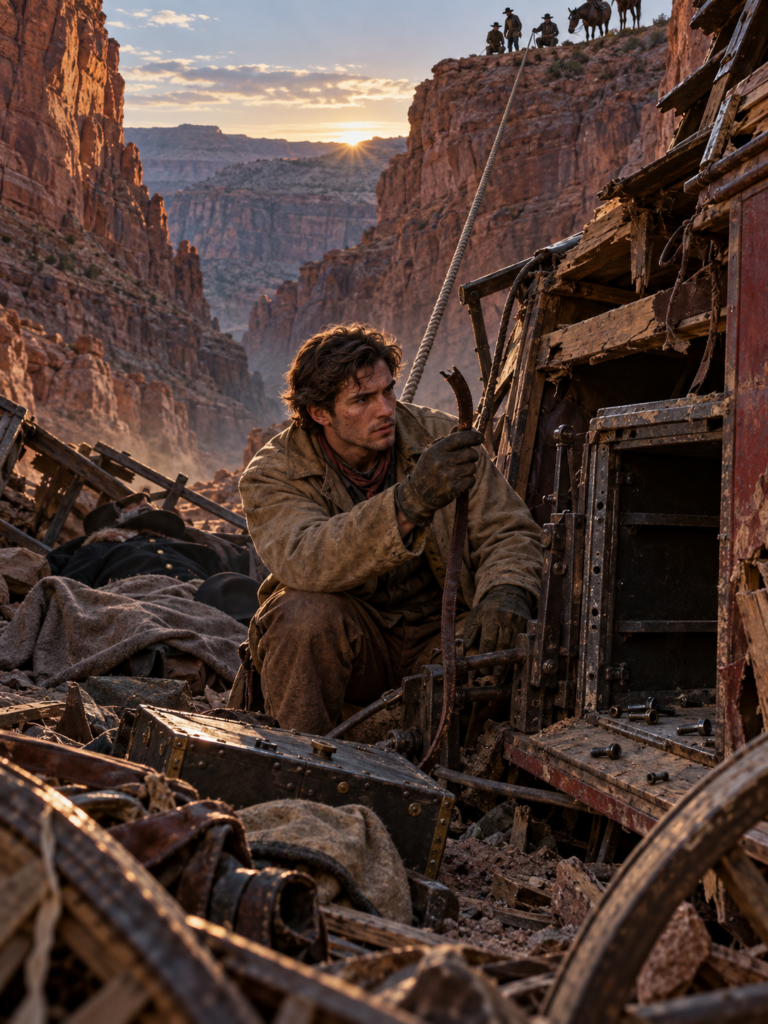
Peter stopped with his hand beneath the fractured board and carefully pulled the object into the morning light.
It was only a bolt.
Bent.
Rust-streaked.
For half a second disappointment moved through him.
Then he saw the threads.
The bolt had not belonged to the strongbox.
It had torn loose somewhere in the crash.
That mattered because the four strongbox bolts were different.
Their threads were clean.
Their heads were unmarred.
Removed before impact.
Peter placed the bent bolt exactly where he had found it.
Then he called upward.
“Bring me up.”
The rope tightened.
He tied in, checked the knot with both hands, and climbed while the men above hauled.
When his head finally cleared the rim, the circle waiting for him had changed.
Nobody joked about the youngest hand getting the unpleasant work.
Nobody slapped him on the shoulder.
Callum Roads had arrived from the Bar M range camp while Peter was below.
The foreman stood apart from the others, red-faced from the cold ride, watching.
Peter untied himself.
Callum pointed toward open ground beyond the rim.
“Walk.”
Peter followed him.
“Tell it.”
Peter began with the reins.
Callum interrupted.
“How far from the ring?”
“About six inches.”
“Clean cut?”
“Yes.”
“One stroke?”
“Looked like it.”
“Brake?”
“Set hard.”
“Strongbox?”
“Gone.”
“How were the bolts?”
“Backed out.”
“Not torn loose?”
“No.”
Callum studied him.
“You certain?”
Peter looked directly at him.
“I saw crash damage beside them. It didn’t look the same.”
That answer seemed to matter.
Callum glanced back toward the rim.
“And the horse print?”
“Still only one we saw that wasn’t ours or the team’s.”
Callum’s jaw shifted.
“A man sees what he expects if he isn’t careful.”
Peter recognized Harlon’s lesson inside different words.
Callum continued.
“You’ll tell the sheriff exactly that. Nothing you guessed. Only what you saw.”
Peter nodded.
They carried Ridley Amos toward Hock Springs the following afternoon.
The body rode wrapped in canvas on a pack mule.
Peter rode beside Callum near the front.
Sheriff Ordell Pace listened in a plank office behind the feed store.
He was a patient, heavy man with an old cavalryman’s habit of writing before speaking.
Peter described everything again.
The clean leather cut.
The brake shoe.
The loosened lag bolts.
The unfamiliar shod hoofprint.
Pace wrote each detail into a leather-cornered ledger.
When Peter finished, the sheriff closed it.
“You kept your head.”
Peter looked down.
“Harlon Boon taught me to look.”
“Then he taught you something useful.”
The sheriff stood.
“We’re going back.”
Peter expected to be dismissed.
Instead Pace handed him his hat.
“You’re coming.”
They returned to Rimrock Draw with Callum and two deputies while the ground still held the marks of what had happened.
This time Peter approached the roadside above the wreck on his hands and knees.
He ignored the obvious wheel drag.
Ignored the chaos near the edge.
Looked farther back.
Twenty yards from the road, behind chokecherry brush, he found earth trampled into a narrow oval.
A horse had stood there for some time.
Beside it, dark against a pale stone, was dried tobacco spit.
Someone had waited.
One deputy searched downhill from the rim.
He called out.
The men moved toward him.
In the sage lay an eight-inch iron wrench.
Sheriff Pace picked it up.
The jaw carried a distinctive nick.
Near the head, a tiny maker’s mark had been stamped into the iron.
An anvil.
Pace turned the wrench over once.
“I know this mark.”
Peter felt the investigation narrow.
“From where?”
The sheriff looked east.
“Willow Bend.”
Twelve miles away stood a stage station.
A freight shed.
A tool board.
And, if Ordell Pace remembered correctly, a row of wrenches bearing the same stamped anvil.
The sheriff mounted immediately.
Peter climbed onto his horse.
Behind them, Rimrock Draw fell silent again.
But now the question was no longer whether Ridley Amos had made a fatal mistake.
It was who had borrowed the tool used to make his death look like one.
Peter turned his horse east and followed the sheriff toward Willow Bend.
Peter turned his horse east and followed the sheriff toward Willow Bend, where the late sun stretched every rider’s shadow across the road.
Nobody spoke much.
They did not need to.
An hour earlier they had been searching a wreck.
Now they were following a man.
Willow Bend stage station stood beside the road beneath a line of cottonwoods. A stable, freight shed, water trough, and low plank house formed nearly the entire place.
Mrs. Aldine Fry came onto the porch before they dismounted.
She was fifty-nine, widowed, practical, and apparently unimpressed by a sheriff arriving with four dusty men.
Ordell Pace held up the wrench.
“Mrs. Fry, mind if we look at your freight tools?”
She looked at the wrench first.
Then at him.
“Someone dead?”
Pace answered plainly.
“Yes.”
She stepped off the porch.
“This way.”
The tool board hung along the interior wall of the freight shed.
Hammers.
Pliers.
Augers.
Two large wrenches.
One small.
And one empty outline between them where years of dust had preserved the shape of a missing tool.
Peter saw it immediately.
So did Mrs. Fry.
Her mouth tightened.
“That’s mine.”
Pace held the recovered wrench against the empty shape.
Perfect fit.
“When did it leave?”
Mrs. Fry did not guess.
She walked back to the porch, entered the house, and returned carrying a small account book.
“Three days ago.”
“Who?”
“A teamster named Ran Whitby.”
Callum looked at Peter.
Peter stayed silent.
Pace asked, “Reason?”
“Said a hub nut on his freight wagon was working loose.”
“Was it?”
“I didn’t crawl under his wagon to confirm it.”
“Did he return the tool?”
Mrs. Fry looked pointedly at the wrench in Pace’s hand.
“No.”
“Anything unusual about him?”
She thought.
“Empty wagon.”
“That unusual?”
“For Whitby, yes.”
“Anything else?”
Mrs. Fry closed the account book.
“He had a saddle horse tied behind.”
Pace’s expression hardened slightly.
“Shod?”
“Four feet.”
“Color?”
“Dark chestnut.”
Peter thought of the single print near the road.
Not proof by itself.
But no longer meaningless.
“What kind of shoes?” Peter asked.
Everyone looked at him.
Mrs. Fry did not seem offended by the question.
“Standard keg shoes, I’d say. Didn’t examine them.”
Peter nodded.
Pace said, “Which direction?”
“West when he borrowed the wrench. East when I saw him the next morning.”
“You saw him return?”
“From my upstairs window.”
“With the freight wagon?”
“Yes.”
“The saddle horse?”
Mrs. Fry paused.
“No.”
The silence afterward had weight.
Pace asked her to repeat everything from the beginning.
She did.
Date.
Time.
Weather.
Whitby’s words.
The missing wrench.
The empty freight wagon.
The spare horse.
His direction of travel.
The sheriff took notes.
When he finished, Peter expected them to leave immediately.
Instead Pace returned the account book to Mrs. Fry.
“I’ll need a signed statement.”
“You’ll have it.”
Then she looked at Peter.
“You the one who went down?”
Peter shifted slightly.
“Yes, ma’am.”
She regarded him for a moment.
“Good thing somebody did.”
That was all.
They rode back toward Hock Springs after dark.
At the sheriff’s office, Pace spread his notes across the desk.
Peter stood near the wall.
He was tired enough that his hands felt heavy.
Callum said, “You don’t need him anymore tonight.”
Pace looked toward Peter.
“No.”
Peter reached for his hat.
“Turner.”
He stopped.
The sheriff tapped the ledger.
“Why’d you check the reins first?”
Peter thought about it.
“Harlon used to say reins tell you what the hands were doing.”
“Your uncle?”
“Man who raised me.”
“He teach you wrecks?”
“No.”
“Tracking?”
“Some.”
“Law?”
“No.”
Pace nodded.
“Good.”
Peter frowned.
“Good?”
“A man who knows a little sometimes tells himself he knows everything.”
Pace looked back at the evidence.
“You didn’t.”
Peter left with that sentence following him.
The search for Ran Whitby lasted four days.
For Peter, those days were strange because he had no control over them.
He returned to the Bar M.
Rode fence.
Helped doctor a steer.
Reset a sagging gate.
Ate supper.
Slept badly.
Somewhere beyond the range camp, Sheriff Pace and his deputies followed roads Peter could not see.
The other hands asked questions.
Peter answered only what had already become public.
“Yes, the reins were cut.”
“Yes, a wrench was found.”
“No, he did not know where Whitby was.”
One older hand asked whether Peter thought Whitby had killed Ridley Amos.
Peter shook his head.
“I didn’t see that.”
The man laughed once.
“Everybody knows what you mean.”
“No.”
Peter looked at him.
“That’s the trouble.”
The laughter stopped.
He understood something then.
Evidence could clear a dead man.
Careless certainty could condemn a living one.
If his word mattered now, he had more reason to measure it, not less.
On the fourth evening, a rider approached through blowing dust.
Deputy Wy Bogs.
He swung down outside the cookhouse.
“They got him.”
Every man within hearing stopped.
Callum came out.
“Where?”
“Road ranch on the Medicine Bow.”
“Money?”
“Strongbox in his wagon.”
The room changed.
Peter set down the cup in his hand.
Bogs continued.
“Eighty-seven dollars already spent. New rifle. Whiskey mostly. Rest was still there.”
“Whitby talk?”
“Didn’t need much talking after Pace put the box in front of him.”
Callum looked at Peter.
“You’re going.”
Peter blinked.
“Where?”
“Road ranch.”
“Why?”
“Because Pace asked for you.”
They rode before sunrise.
The road ranch was little more than a stable, kitchen, two sleeping rooms, and a yard packed hard by wagon wheels.
Ran Whitby sat at a plank table inside with irons around his wrists.
Peter had never seen him before.
That fact mattered to him.
He had not tracked an enemy.
He had not exposed a rival.
He had simply followed what the wreck showed.
The strongbox sat on the table.
Its lock had been broken.
Payroll packets lay beside it.
Ordell Pace stood near the stove.
When Peter entered, the sheriff touched one finger to the box.
“This what should’ve been under Amos’s seat?”
Peter stepped closer.
He did not pretend certainty beyond what he possessed.
“Same size as the space.”
Pace nodded approvingly.
“Bolting pattern?”
They turned the box.
Four mounting holes.
Peter measured their spacing with his fingers, then looked at Callum.
“Looks right.”
“Looks?”
Peter met the sheriff’s eyes.
“I’d want to compare it at the wreck.”
Pace almost smiled.
“We already did.”
He took a sheet from his pocket.
“Deputy measured the compartment yesterday. It matches.”
Whitby sat silent.
His face carried neither fury nor shame.
Only exhaustion.
Peter found that more disturbing.
Pace asked him, “Want to tell Turner why you did it?”
Peter immediately said, “He doesn’t have to tell me.”
Whitby looked at him for the first time.
The sheriff raised an eyebrow.
Peter continued.
“I’m not the one deciding what happens to him.”
Pace slowly nodded.
That night the recovered wages were counted.
The theft had been larger than the amount Whitby spent, though most of the payroll remained intact.
Callum watched the money go back into a canvas sack.
Three outfits had spent days believing their employees’ wages might be gone.
Worse, for a few hours after the wreck was found, whispers had already started about Ridley Amos.
Perhaps he had been drinking.
Perhaps he had stolen the strongbox himself.
Perhaps he had run.
The dead could not answer rumors.
Peter’s observations had answered for him.
That truth struck Peter harder than the capture.
On the ride back to the Bar M, Callum spoke after several miles.
“Barn would’ve paid the men somehow.”
Peter glanced toward him.
“I know.”
“Would’ve hurt us.”
Peter nodded.
“But not like it would’ve hurt Amos’s family.”
Callum looked over.
Peter stared ahead.
“The money could be replaced.”
The foreman waited.
Peter finished.
“His name couldn’t.”
Callum said nothing for a long while.
Then: “No.”
They returned near dark.
Peter dismounted in the yard and carried his saddle toward the bunkhouse.
He stopped at the doorway.
Something was wrong.
The floor had been swept.
Not roughly.
Swept properly.
His saddle peg had been cleared.
His rope was hanging beside it in a clean hand-laid coil.
Someone had wiped mud from the bench beneath his bunk.
Peter turned.
Ike Sanderson approached carrying a tin cup.
He held it out.
“Coffee.”
Peter took it.
Ike shifted his weight.
“You called it right down there.”
Peter looked into the cup.
Steam moved across his face.
“Harlon taught me to look.”
Ike considered that.
“Well.”
He nodded toward the bunkhouse.
“Looks like he taught you good.”
That evening the men made room for Peter at the long table.
Nobody announced anything.
No speech.
No toast.
No sudden transformation into friendship.
But when Peter sat down, the place nearest the stove—unused since an older hand had gone south months earlier—remained open.
Peter looked at it.
Then at the men.
Ike was already eating.
“Sit down before somebody sensible takes it.”
Peter sat.
In the following weeks, respect arrived through work.
Callum sent Peter when a drift fence failed during the first hard snow.
Not because he was fast.
Because he would repair it once.
When a colt needed roping for the farrier, Ike passed Peter the loop.
When remount strings were assigned, Callum added a long-legged gray called Miller to the bay mare Peter already rode.
“You’re responsible for both.”
Peter touched the gray’s neck.
The animal lowered its head.
Responsibility.
Not charity.
Peter understood the difference.
Then, in the second week of November, Sheriff Ordell Pace rode into the Bar M camp carrying a folded paper inside his coat.
He asked for Peter by name.
The hands looked toward the bunkhouse.
Peter came out.
Pace nodded toward the cookhouse.
“Need a table.”
They sat across from one another.
The sheriff placed the paper between them.
Peter looked down.
A bank draft.
One hundred twenty dollars.
He looked back up.
“What is this?”
“Reward.”
“I didn’t ask for one.”
“No.”
“The sheriff’s office?”
“Three ranches. Bar M, Diamond Slash, Two Bit. Their money came back because you saw what other men would’ve ridden past.”
Peter did not touch the draft.
“I was doing what Callum sent me to do.”
Pace leaned back.
“You were sent down to bring out a body.”
Peter looked at the paper.
“That isn’t the same thing.”
“No.”
Peter’s eyes returned to him.
Pace slid the draft an inch closer.
“That’s why they’re paying you.”
Peter finally picked it up.
One hundred twenty dollars was more money than he had ever held at once.
Enough to buy a horse if he chose carefully.
Enough to begin again somewhere.
Enough to make the $41 he had once hidden in his boot seem like another man’s fortune.
He folded the draft.
“Thank you.”
Pace put on his hat.
“That isn’t the part I rode out to tell you.”
Peter waited.
The sheriff’s expression changed.
“Ridley Amos had a wife.”
Peter’s hand stopped over the folded paper.
“Cheyenne.”
Pace stood.
“She heard what people were saying before we knew better.”
Peter understood.
Drunk.
Careless.
Maybe thief.
The dead man had been accused before his body was cold.
Pace moved toward the door.
“Now she’s heard the rest.”
Peter looked toward him.
The sheriff opened the door.
“She’s writing you.”
And for reasons Peter could not yet explain, the thought of that letter unsettled him more than the reward ever could.
The letter arrived three weeks later in Callum Roads’s coat pocket.
Peter knew it before anyone said his name.
Supper had nearly ended.
Tin plates were scraped clean.
Coffee had gone bitter on the stove.
Outside, winter wind moved along the bunkhouse wall in long dry breaths.
Callum remained standing at the end of the table.
“I got something for Peter.”
Conversation stopped.
Peter looked up.
The foreman held a folded envelope.
“You want it private?”
Peter almost said yes.
Then he saw the handwriting.
Small.
Careful.
Deliberate.
Something about it reminded him of his mother copying scripture by lamplight when he was a boy.
He shook his head.
Callum broke the seal.
The letter was from Maddie Amos.
Widow of Ridley.
She wrote that men had first told her the coach had gone over Rimrock Draw and that her husband had probably fallen asleep or been drinking.
She had lived with that version for two days.
Two days imagining the man she had shared a life with ending it through carelessness.
Two days knowing people would repeat that story whenever his name came up.
Then Sheriff Pace’s telegram had arrived.
The reins had been cut.
The brake set.
The strongbox removed before the crash.
Ridley had not stolen the payroll.
He had not abandoned his post.
He had not caused the wreck through drunkenness or neglect.
Maddie wrote that Peter Turner, a young ranch hand she had never met, had gone down to where her husband lay and looked carefully enough to return something no money could replace.
His good name.
Callum’s voice roughened slightly when he reached the final lines.
Maddie said there was no payment she could send equal to that.
She would remember his name.
Then Callum stopped.
Silence filled the room.
Peter’s hands were flat on the table.
He had thought the sheriff’s reward difficult to accept.
This was worse.
Money could be folded.
Spent.
Put away.
Gratitude from a grieving stranger had nowhere simple to go.
“Can I have it?” he asked.
Callum handed him the letter.
Peter folded it along its existing creases.
That night he placed it in the small tin under his bunk.
Beside the folding knife Harlon Boon had left him.
The knife had bone scales yellowed by years of handling, a darkened brass rivet, and a blade sharpened so often its edge curved like a thin moon.
Peter opened it.
Ran his thumb carefully along the spine.
Then closed it and set it beside Maddie’s letter.
Two objects from two people who had never met.
One from the man who taught him how to look.
One from the woman whose life had changed because he had.
Peter sat on the bunk.
For the first time since Rimrock Draw, he allowed himself to think about Harlon properly.
Not simply the rules.
The man.
Harlon had been nearly sixty when Peter was sent to him.
Bad hip.
Good horse.
Few words.
He never told Peter he was wanted.
That would have required language neither of them trusted much.
Instead he gave him work.
A hackamore on the first morning.
Fence lines by the end of the week.
Knots by the end of the month.
He taught Peter to lower himself over bluffs after trapped calves.
To let rope move through leather gloves rather than fight it barehanded.
To study hoofprints.
To notice whether an animal had stood calmly or shifted under stress.
To sharpen a knife every evening whether it had been used or not.
Most importantly, he taught Peter that carefulness was not fear.
It was respect.
A rope deserved respect because somebody could be hanging from it.
A horse deserved respect because its panic could kill both of you.
Ground deserved respect because it remembered things men preferred to forget.
Peter had not understood how deeply those lessons had settled into him until Rimrock Draw.
He had simply done what Harlon would have done.
Looked.
Once.
Then again.
The world around Peter altered gradually afterward.
No one at the Bar M declared him important.
That would not have suited the place.
Instead they trusted him with more.
When a section of drift fence disappeared beneath snow, Callum sent Peter.
When cattle strayed into broken country, Peter rode lead.
When a new hand tied a rope badly, Ike jerked his chin toward Peter.
“Ask him.”
The first time that happened, Peter almost turned to see who Ike meant.
By December, he stopped turning.
The two horses in his string became four.
Not gifts.
Responsibility.
He preferred that.
The gray named Miller developed a habit of stopping before hidden ice. Peter trusted him enough to listen when the horse hesitated.
The bay mare remained quicker in open country.
He learned each animal rather than expecting either to become the other.
That too was something Harlon would have approved.
Peter rode into Hock Springs on the first Saturday of each month.
The town had nine buildings and enough mud to make them all look temporary.
He paid his account at the mercantile.
Stopped at the blacksmith.
Sometimes stood in the sheriff’s doorway.
Ordell Pace no longer looked surprised to see him.
Once, while Peter warmed his hands near the office stove, the sheriff asked, “You thinking about buying a place?”
Peter glanced over.
“With what?”
“One hundred twenty dollars gets a man closer than nothing.”
Peter smiled faintly.
“I’ve owned something on paper once.”
Pace knew enough of his history not to press.
Harlon’s small outfit had been lost to debt shortly after his death.
The memory remained sharp.
A lawyer named Merritt Ashby had arrived carrying papers with a county seal.
Promissory note.
Interest.
Hay debt.
Words large enough to remove a house, barn, cattle, and the gelding Peter had ridden for two years.
Peter had walked away with a saddle, rope, knife, clothes, and forty-one dollars tucked inside his boot.
Ownership had looked less permanent ever since.
The sheriff stirred the stove.
“You know what paper did to Whitby.”
Peter looked at him.
“Caught him.”
“No.”
Pace shut the iron door.
“Paper didn’t catch him. A wrench did. Ground did. Mrs. Fry remembering who borrowed something did. Paper only made the truth harder to lose afterward.”
Peter thought about that.
Then he nodded.
He began to understand that records were not always the enemy.
Bad paper could dispossess a man.
Good records could protect one.
The difference was whether they matched what had actually happened.
He left the sheriff’s office carrying that thought.
On the Sunday before Christmas, Peter went to the meeting house.
He stood at the back.
Did not sing.
Listened.
Mrs. Fry had come into town from Willow Bend.
She spotted him across several pews and nodded as though greeting an old acquaintance.
Peter returned it.
No one there mentioned the wrench.
They did not need to.
One missing tool had connected a shattered coach to a freight shed twelve miles away.
One remembered borrower had connected that tool to Ran Whitby.
One careful sequence of details had turned suspicion into evidence.
Peter increasingly saw that the story was not about him discovering something extraordinary.
It was about ordinary things being given their proper weight.
A cut.
A brake.
A bolt.
A hoofprint.
A wrench.
A name written beside a borrowed tool.
None meant enough alone.
Together they restored the dead.
Not his life.
Nothing could do that.
But his truth.
January came hard.
Snow flattened the range.
The Bar M cattle gathered wherever ridges broke the wind.
Peter spent more hours in the saddle than indoors.
One afternoon he returned half-frozen after repairing fence on the northern line.
Ike had left coffee warming for him.
Miller received grain before Peter removed his own gloves.
No one commented.
That was the way care worked among those men.
Quietly.
He preferred it.
Later, Peter sat on the bench nearest the stove.
The place had once belonged to an older hand who went south.
Now no one questioned Peter occupying it.
He took out Harlon’s knife.
Opened the narrow curved blade.
Stropped it gently against the flat leather of his boot.
Scrape.
Turn.
Scrape.
Turn.
The sound brought back a kitchen from years earlier.
Harlon seated by a lamp.
A cup near one elbow.
A boy watching.
“You sharpen it before you need it,” the older man had said.
Peter had asked why if it had not been used.
“Because needing something is the wrong time to discover you neglected it.”
At twenty-one, Peter understood the lesson differently.
Harlon had not only been talking about knives.
Skill had to be maintained before crisis.
Judgment too.
Patience.
Character.
You could not become careful at the moment care suddenly mattered.
You practiced it on fence wire.
Horse tack.
Knots.
Every ordinary day.
Then when a man was dead beneath a rim and everyone expected one story, habit gave you enough steadiness to notice another.
Peter closed the knife.
Across the room, two new hands argued mildly over a cinch knot.
Ike looked at Peter.
He sighed.
“Go save those fools from themselves.”
Peter stood.
One hand pointed at the knot.
“What’s wrong with it?” the younger man asked.
Peter examined it.
“Nothing yet.”
The man frowned.
“That supposed to help?”
Peter untied it.
“Watch.”
He tied it again slowly.
Once.
Then a second time.
He did not say Harlon’s name.
He did not need to.
Knowledge traveled that way too.
By late winter, Whitby’s case had moved through the territorial court.
Peter was called to give testimony.
It was the first formal room in which anyone had asked him to swear that his words were true.
He disliked the feeling.
Not because he intended to lie.
Because truth spoken beneath oath suddenly seemed more fragile, as though one careless phrase could damage it.
The attorney asked whether Peter had personally seen Ran Whitby cut the reins.
“No.”
Had he seen Whitby remove the strongbox?
“No.”
Had he witnessed the coach leave the road?
“No.”
The attorney glanced toward the jurors.
“Then much of what you’ve told us is assumption.”
Peter looked at him.
“No.”
The attorney paused.
“No?”
“I told you what I saw.”
“You concluded the wreck was deliberate.”
“I said the reins were cut, the brake was set, and the strongbox bolts had been removed.”
“And from this you formed an opinion.”
“Yes.”
“Yet you did not see Mr. Whitby at the scene.”
“No.”
“Thank you.”
The attorney turned away as though the exchange had diminished him.
Peter remained seated.
Sheriff Pace had once warned him not to claim more than he knew.
So Peter did not.
The case did not depend on him pretending to have seen everything.
Mrs. Fry testified about lending Whitby the wrench.
The deputy testified where it had been found.
Measurements connected the recovered strongbox to the mounting beneath Ridley’s seat.
Money from the missing payroll had been found with Whitby.
The shod horse had disappeared between his westbound and eastbound passages.
The truth did not need Peter to enlarge it.
It needed him not to.
That realization stayed with him long after the hearing.
When the matter ended, Peter walked outside.
Callum waited beside the hitching rail.
“How’d it go?”
Peter adjusted his gloves.
“They tried to make it sound like I didn’t know much.”
Callum’s mouth moved.
“You didn’t.”
Peter looked at him.
The foreman continued.
“You knew exactly what you knew.”
Peter considered that.
Then laughed once.
It might have been the first time Callum heard him do it.
By spring, Peter had not spent the ranchers’ reward.
The bank draft had been converted and deposited in Hock Springs under his name.
He kept adding part of each month’s wages.
Not because he had decided what to purchase.
Because for the first time he could plan without needing an immediate escape.
The Bar M did not belong to him.
He understood that clearly.
Neither did the horses.
His bunk was still a bunk.
Callum could dismiss him.
Weather could destroy work.
Markets could close an outfit.
Nothing in ranch country was as permanent as men liked pretending.
But Peter had learned something after losing Harlon’s place.
A man did not need ownership of everything around him to possess a direction.
He had work he respected.
Skills other men valued.
Savings nobody could auction for another man’s debt.
A name that meant something when Sheriff Pace asked for him.
And a letter from Maddie Amos folded beneath his bunk.
One afternoon, nearly six months after Rimrock Draw, Peter took the letter outside.
He sat on the corral rail while spring runoff flashed beyond the pasture.
He read it again.
Maddie never called him heroic.
He was grateful.
She thanked him for care.
That word meant more.
He folded the paper.
Ike crossed the yard.
“You going sentimental on us?”
Peter slipped the letter into his shirt.
“Probably.”
“Bad habit.”
“So I hear.”
Ike leaned against the rail.
For a while they watched a colt circle its mother.
Then Ike said, “You know what I thought when we found that coach?”
Peter glanced at him.
“Accident.”
“Yep.”
“Everyone did.”
“I’d already decided Amos probably slept through the turn.”
Peter said nothing.
Ike rubbed a thumb against the rail.
“Would’ve told people too.”
Peter looked at him now.
Ike’s face tightened.
“By supper it would’ve become fact.”
“Yes.”
“Man was dead. Couldn’t say different.”
“No.”
Ike stared toward the pasture.
“Funny thing.”
“What?”
“We all thought sending you down was just because you were light.”
Peter smiled faintly.
“I was.”
Ike nodded.
“Lucky for Amos you were more than that.”
He walked away before Peter could answer.
Peter stayed on the rail.
For most of his life, being young had meant other people decided what he was worth.
His father had stopped seeing him clearly after grief took hold.
Creditors saw property.
Foremen initially saw inexpensive labor.
Older hands saw the lightest man to put on a rope.
None of those judgments had been entirely false.
Peter was young.
Poor.
Replaceable.
Light enough to lower safely.
But they had not been complete.
And that, he realized, was the danger in quick judgment.
Not always that it was wrong.
That it was unfinished.
Months later, when Peter returned to Rimrock Draw with Callum to check cattle along the southern range, he stopped at the rim.
The wreck had been removed.
Snow and weather had softened the marks.
Chokecherry leaves had returned.
Peter dismounted.
Callum waited without asking why.
Peter walked to the juniper stump that had anchored the rope.
A pale groove remained around the bark.
He touched it.
That rope had carried his full weight into emptiness.
Harlon’s voice returned as clearly as if the man stood beside him.
A rope is only as good as the anchor.
Peter looked down.
The shelf where Ridley Amos had lain seemed smaller from above.
The distance did not.
He remembered his boots touching stone.
The dead man.
The reins.
The brake.
The empty strongbox cavity.
Then the climb back.
He had gone down as the youngest hand because somebody needed to.
He had come back with no money, no captured outlaw, no grand discovery anyone could hang over a mantel.
Only observations.
But those observations had led to a wrench.
The wrench to Willow Bend.
Willow Bend to Whitby.
Whitby to the missing strongbox.
And the recovered truth had traveled all the way to Cheyenne, where a widow learned that her husband had not died as a careless drunk or a thief.
Peter took Harlon’s knife from his pocket.
He opened it.
The worn blade reflected one narrow line of sun.
A man ought to carry something older than himself, Harlon had said, to remember he was not the first to walk the ground beneath him.
Peter finally understood another part of that too.
He was not the beginning of what made him useful.
Harlon was in his knots.
His mother was in the way he treated the dead.
His father’s wheel shop was somewhere in his attention to broken wood and hardware.
Loss had removed those people.
It had not removed everything they had taught him.
He closed the knife and put it away.
Callum stood beside the horses.
“Ready?”
Peter looked once more over Rimrock Draw.
“Yes.”
They mounted.
As Peter gathered the reins, the leather moved cleanly through his fingers.
He checked the cinch without thinking.
Checked the knot on the bedroll.
Looked once at Miller’s shoes.
Then again.
Callum watched him.
“You always do everything twice?”
“Most things.”
“Sounds exhausting.”
Peter adjusted his hat.
“Usually cheaper than doing them wrong once.”
Callum laughed.
They rode north.
By the following autumn, the story of the wreck remained known across that stretch of ranch country.
People told different versions.
Some improved Peter’s descent until the cliff became twice as high.
Some claimed Whitby had fought three deputies.
He had not.
Some said Peter had found the strongbox himself.
He had not.
Whenever Peter heard those versions, he corrected them.
Not angrily.
Simply.
The rope had been around eighty feet to the shelf, not a hundred and fifty.
Whitby surrendered.
The sheriff recovered the money.
Mrs. Fry identified the wrench.
Peter found only what the wreck showed him.
He insisted on those details because the entire story had begun with one dead man being assigned a false version of his own death.
Peter would not honor him by creating another.
Years later, men might remember Rimrock Draw as the place where a young ranch hand made his reputation.
Peter never thought of it that way.
Reputation was what other people carried.
He thought instead of the empty place beneath the driver’s seat.
The four clean bolts.
The cut leather.
The brake pressed hard against the wheel.
The small facts everybody could have missed because a larger explanation was already waiting.
And when he thought about the rope, he remembered something even simpler.
He had gone down because he was willing.
He had looked because he had been taught.
And when he climbed back up, he told exactly what he knew.
No more.
No less.
For Peter Turner, that was enough to change the direction of a life.
It was the best rope he ever trusted.


