
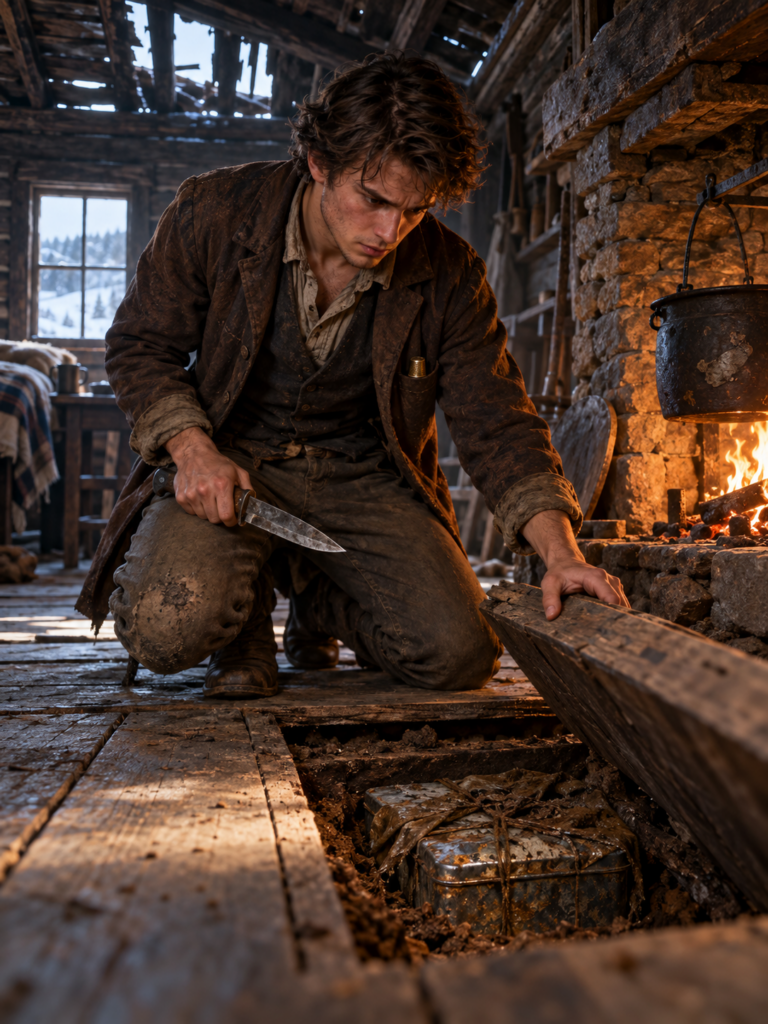
The box disappeared below the floor until William’s fingertips were the last part touching it.
Then he let go.
He replaced the earth.
Set the two planks back into their grooves.
And dragged the patched iron pot over them.
Only when the hiding place looked ordinary again did he stand.
The money had changed nothing yet.
That was how William wanted it.
He had spent three weeks hungry enough to think about food before sleep.
He needed nails.
A proper tool for splitting roof shakes.
Rope that would not tear in his hands.
Meal.
Beans.
Coffee, if he allowed himself the extravagance.
But need could become greed faster than a man admitted.
Henry Buell had been clear.
The money had been earned honestly.
The rest of his life had not.
William understood the difference.
Josiah Witt had taught him that a good blade could skin supper or cut a man. The steel was not responsible for the hand using it.
Money, William suspected, was much the same.
He crossed to his coat.
From the inner pocket he removed Ruth’s brass thimble.
Firelight moved along the dimples worn into its surface.
His mother had used it before the Fletcher farm.
Before Amos.
Before the country west of the river had taken so much from her that William remembered exhaustion almost as clearly as her face.
He placed the thimble on the stone mantel.
Then he looked at the floor.
Henry Buell’s mother remained beneath it.
“Spring,” William said quietly.
It was the first promise he had made inside the cabin.
When the weather turned, he would bring Ann Buell’s thimble out and place it beside Ruth’s.
For now, he needed to make sure he lasted until spring.
At dawn William lifted the floor again.
He opened the box and removed only two gold eagles.
Not a handful.
Not enough to make questions inevitable.
Two.
Then he buried everything again.
Three miles later, he entered Coyote Ridge.
People noticed him now.
Not because anyone knew what lay beneath his hearth.
Because the boy who had purchased Buell’s wreck had not come back begging the county to undo the sale.
He went first to Reuben Cade’s smithy.
Reuben was sixty, wide through the shoulders, and nearly deaf in one ear from a lifetime beside an anvil.
William set half an eagle on the iron.
“I need nails. A froe if you can make one. Two-pound sledge. Shoemaker’s awl. And enough bar iron for a proper hasp.”
Reuben looked at the coin.
Then at William.
“You find gold up that wash?”
William held his gaze.
“I have money for tools.”
That was all he intended to say.
Reuben grunted.
“A man’s money’s his own business.”
He weighed out the nails.
The froe would take until Wednesday.
When William gathered the bundle, a flat file lay on top.
“I didn’t ask for that.”
“No.”
“How much?”
“Nothing.”
William frowned.
Reuben turned back toward his forge.
“You bought Buell’s place. You need a file.”
At the general store, Ada Peel measured cornmeal, beans, salt, coffee, soap, muslin, matches, and hemp rope.
She deducted the second coin and counted change into William’s palm.
Then she added half a round of cheese wrapped in clean cloth.
William pushed it back.
“I didn’t pay for that.”
“I know.”
“I can.”
“I know that too.”
Their eyes held for a moment.
This kindness unsettled William more than hunger.
On the Fletcher farm, nearly everything given to him had eventually become evidence of what he owed.
He had learned to distrust gifts.
Ada slid the cheese toward him again.
“No account,” she said. “No debt. Eat it before it turns.”
William slowly picked it up.
“Thank you.”
She nodded and returned to her ledger.
Outside, he stood beneath the store awning with tools, food, rope, silver change—and for the first time since Amos died, a practical path longer than tomorrow morning.
He could spend the hidden money quickly.
He could buy comfort.
A horse.
Fine boots.
A better rifle.
He could return east dressed like a man who had won something.
Instead William looked up the wash.
He pictured the missing roof shakes.
The cracked window.
The weak sill.
The spring that never stopped running.
Henry Buell had not written that the country would feed a lucky man.
He had written careful.
William tightened his grip on the bundle.
Then he turned toward the three-mile climb home.
Behind him, nobody in Coyote Ridge knew what he had found.
Ahead of him, beneath two rough floorboards and one patched iron pot, waited enough money to test whether being cast out had taught William Fletcher how to build a life—or merely how badly he wanted to prove one.
William carried the supplies up the wash and used none of them carelessly.
That became the rule.
Not because Henry Buell’s letter had authority over him.
Because William wanted to know whether he could become the kind of man the letter hoped would find it.
The nails went first into the roof.
He and Josiah had split shakes before, and the new froe transformed work that had required exhausting improvisation into something clean and measured.
William struck the froe with the sledge.
The pine opened along the grain.
Again.
Again.
Six days later the roof was tight from one corner to the other.
The next rain came at night.
William woke expecting the familiar cold drops against his face.
None came.
He lay beneath his blanket listening to water strike the roof above him.
For several minutes he did nothing.
The pleasure was so simple it almost hurt.
A dry roof.
Nobody could take credit for giving it to him.
Nobody could remind him later what it had cost them.
He had made it.
He repaired the door next.
New hinges.
A wooden latch.
A cord threaded through the plank so it could be lifted from outside.
He paused before cutting that hole.
A locked door would have been safer.
But he did not want safety to become another form of exile.
People who belonged could knock.
People he trusted could lift the string.
He gave the plank table a fourth leg.
Replaced the window sill.
Stretched fresh oiled hide across the opening.
Carried flat stones from the wash and laid them before the door so the mud would stay outside.
He still snared food.
Still spent from Buell’s money sparingly.
Each time he opened the hidden box, he read the letter first.
That was another rule.
Not because the words could stop him.
Because he wanted to remember that the money represented work performed before the man who earned it became someone else.
William refused to pretend Henry Buell had been a good man simply because he had left an honest fortune behind.
The stage had still been robbed.
A deputy had still shot him.
Whatever damage Buell had done had not vanished beneath a kind letter.
But one part of his life had been honest.
William could honor that part without excusing the rest.
By December, Coyote Ridge had begun to notice what was happening up the wash.
The first visitor was Wesley Aiken.
William heard the horse before he saw the rider.
He stepped outside with the skinning knife still at his belt.
A lean man in a gray coat sat a tired gelding beneath the shelf.
“Fletcher?”
“Yes.”
“Wesley Aiken. Run cattle down on the flat.”
William waited.
“Lost a heifer up this wash.”
“If I see her, I’ll tell you.”
Wesley’s eyes traveled over the cabin.
The new shakes.
Fresh chinking.
Door.
Flat stones.
“You’ve made it stand.”
William glanced back at the house.
“It wasn’t ready to fall.”
“Most men would’ve helped it.”
That was apparently Wesley’s version of praise.
He touched the brim of his hat and rode away.
Three days later, William found the heifer.
Dead.
A rock slide had caught her a mile above his spring.
There was nothing to salvage except information.
William walked down to Wesley’s place.
The rancher listened.
Then he handed William a dollar.
William frowned.
“For what?”
“The walk.”
“It was three miles.”
“Then take another for not telling me you found her alive and selling her somewhere else.”
William stiffened.
“I wouldn’t.”
“I know.”
That answer mattered more than the second dollar.
Wesley leaned against the corral rail.
“You shoot?”
“Straight enough.”
“Ride?”
“Yes.”
“Broken country above the ridge eats horses if the rider’s stupid.”
“I’m not.”
Wesley almost smiled.
“Spring work. Forty dollars a month running strays. Interested?”
William answered immediately.
“Yes.”
That night he placed Wesley’s two dollars on the table.
Earned money.
His money.
Not Amos’s.
Not the county’s.
Not Buell’s hidden reserve.
He left the coins visible for three days before putting them away.
By January, the cabin held heat through the night.
William bought two blankets from Ada Peel.
He thought of Ruth’s farm quilt and nearly changed his mind.
Then he paid.
A man did not honor hardship by remaining unnecessarily cold.
When he returned to Reuben Cade for the finished hasp, the smith tossed him a bent iron pot hook.
“Scrap,” Reuben said.
William inspected it.
“That took work.”
“Not much.”
“How much?”
“You becoming difficult on purpose?”
William looked up.
Reuben’s face remained stern.
William realized, after a second, that the smith was teasing him.
It took effort not to smile.
“I can pay.”
“I know.”
That phrase again.
The people of Coyote Ridge kept using it in ways Hannah never had.
Their kindness did not require William to remain weak.
Ada could give him cheese while knowing he could buy food.
Reuben could give him a file while knowing he owned money.
Wesley could offer work without first proving William desperate.
Assistance and dependence, William was discovering, were not the same thing.
By February, Otway at the land office greeted him by name.
William paid the year’s tax on the Buell parcel.
The black cat sleeping across the ledger woke long enough to permit one scratch behind its ear.
Otway accepted the payment.
“County figured we’d never get another cent out of that ground.”
“You got five dollars.”
“County spends five faster than you walked here.”
William folded the receipt.
“Then it’s fortunate you get tax too.”
Otway looked over his spectacles.
“You planning to stay?”
William stopped.
Months earlier, the question would have frightened him.
Stay suggested attachment.
Attachment suggested something another person could take.
He slipped the receipt into his coat.
“Yes.”
The answer surprised him by feeling true.
Ada began keeping aside small things she thought he might need.
Not gifts.
Opportunities.
A paper of better tea when freight came through.
Needles strong enough for canvas.
A serviceable cup after William admitted he had been drinking from a tin whose rim cut his lip.
He paid for each.
She let him.
That, too, became a kind of respect.
Reuben taught him simple forge work on quiet winter afternoons.
“How much?” William asked after the first lesson.
Reuben struck hot metal once.
“You sweep.”
So William swept.
The next week he learned to draw a nail.
Then repair a chain link.
Trade without charity.
William understood that language easily.
In March, Wesley Aiken returned.
The job began.
William rode a borrowed bay mare into broken country where cattle disappeared between red rock folds and stands of juniper.
Some nights he slept at the cabin.
Others he wrapped himself in the canvas coat beneath open sky.
The first time Wesley paid him forty dollars, William counted the notes twice.
Not from distrust.
From disbelief.
Five dollars had once represented all that remained of his place in a family.
Now eight times that amount represented one month of useful work.
He deposited most of it with Otway for safekeeping rather than adding it to Buell’s cache.
The hidden money remained separate.
A reserve against winters he could not see.
In April, another stranger walked up the wash.
William was resetting a corral post when he noticed an elderly woman approaching with a covered jar beneath one arm and a towel-wrapped pan in both hands.
He went down to meet her.
“You Fletcher?”
“Yes, ma’am.”
“Josiah Witt teach you?”
William stared.
“How did you know him?”
“Mercy Halloran.”
She spoke the name as though that explained everything.
“I knew Josiah when both of us had fewer aches. Ada says his boy is living up here.”
William almost corrected her.
Then did not.
Mercy carried the food into the cabin without asking whether she was invited.
She placed the pan on the table.
Cornbread.
Then the jar.
“Sourdough start.”
William stared at it.
His mother had kept sourdough.
He had forgotten the smell until Mercy lifted the cloth and the faint living tang reached him.
Something tightened behind his ribs.
“Josiah was a good man,” Mercy said.
“Yes.”
“He could also be insufferable.”
William looked at her.
Mercy smiled.
“You know I’m right.”
A laugh escaped him before he could stop it.
It was small.
Rusty from disuse.
But real.
Mercy pointed at the starter.
“Feed that or I’ll hear about it.”
“From who?”
“Me.”
She turned toward the door.
William followed her outside.
“Mrs. Halloran.”
She looked back.
“Thank you.”
Her expression softened.
“Be a good man, William.”
Then she walked three miles back to town.
He kept the sourdough alive.
The first morning bread rose beside the hearth, the smell transported him without warning.
Ruth humming over dough.
Rosemary on her apron.
Her brass thimble beside the kitchen basin.
William sat heavily on the stool.
Loss did not shrink simply because life improved.
Sometimes safety gave grief enough room to return.
He let it.
Then he baked the bread.
Late in May, William rode home after a long day gathering strays.
The light across the red walls had turned copper.
He unsaddled Wesley’s bay mare inside the small pole corral he had built himself.
Rubbed her down.
Fed her hay.
Inside, the cabin held warmth.
The sourdough breathed beneath its cloth.
William started the fire.
Hung the patched pot from Reuben’s hook.
Set water for coffee.
Then he knelt beside the hearth.
Seven months had passed since he found the box.
Winter was gone.
He lifted the iron pot.
Removed the two planks.
Dug carefully.
The oilcloth bundle appeared.
William brought the tin box into the firelight.
He opened it.
Most of the money remained.
More importantly, Henry Buell’s letter remained dry.
William read it one more time.
Then he reached beneath the folded currency.
Blue calico.
A small brass thimble.
Ann Buell’s.
He carried it to the mantel.
Ruth’s thimble had stood there alone since October.
William placed Henry’s beside it.
The two were almost the same size.
One worn by a woman in Missouri whose son eventually became an outlaw.
One worn by a quiet woman on a wheat farm whose younger son had been sent away with five dollars.
In the firelight, both were the same color.
William stood looking at them.
For months, he had thought of the cabin as something he purchased.
Five dollars.
A deed.
A structure.
A spring.
Now, with the two thimbles standing side by side, he understood that the place had become something else.
A point where the lives of people who never met had somehow crossed.
Ruth.
Josiah.
Henry.
Ann.
Mercy.
Reuben.
Ada.
Wesley.
And William.
None had given him everything he needed.
Each had given something.
A thimble.
A knife.
Money.
Tools.
Work.
Bread.
Respect.
William reached toward the mantel but stopped before touching either thimble.
Outside, a horse entered the lower wash.
He heard the hoofbeats climbing toward the cabin.
Not Wesley’s measured pace.
Faster.
William turned toward the door.
The rider appeared seconds later.
It was Otway from the land office, coat dusty from the climb, clutching an official-looking folded paper.
He dismounted stiffly.
“Fletcher.”
William stepped outside.
“What happened?”
Otway handed him the paper.
“Nothing bad yet.”
“Yet?”
The clerk removed his hat and wiped his forehead.
“Someone from east of here has asked the county to review Henry Buell’s old property transfer.”
William’s hand tightened around the folded sheet.
“Who?”
Otway looked at him.
“A man named Ezra Fletcher.”
William did not open the paper immediately.
The name alone had taken him backward.
Not to the farm.
To the porch.
Five silver dollars gleaming against weathered wood.
Ezra standing one step behind Hannah with his hat in both hands.
Silent.
Always silent.
William looked down the wash.
No other rider followed.
“Where is he?”
“In town.”
“Why?”
“Read.”
William unfolded the notice.
The language was ordinary.
That helped.
No accusation.
No criminal charge.
No claim that William had stolen anything.
Ezra Fletcher had simply asked the county whether Henry Buell’s delinquent-tax parcel had been legally sold and whether any prior family interest remained unresolved.
William read the wording twice.
Then he looked at Otway.
“Does it?”
“No.”
“Then why did you ride three miles?”
“Because he’s your brother.”
William folded the paper.
“That doesn’t change the deed.”
“No.”
Otway studied him.
“You coming down?”
“Yes.”
William stepped back inside.
His gaze went first to the mantel.
Two brass thimbles.
Then to the hearth.
The hidden money remained beneath the floor.
Ezra knew nothing about it.
William intended to keep it that way unless there was a reason not to.
He put on his coat.
Buckled Josiah’s knife at his waist.
Then paused.
Months earlier, he might have carried the knife because seeing Ezra again felt dangerous.
Now he carried it because it always rode there.
That distinction mattered.
He walked beside Otway’s horse down the wash.
Neither man spoke much.
Coyote Ridge came into view by late afternoon.
Ezra waited inside the land office.
William recognized him immediately.
Of course he did.
But his older brother looked different away from the Fletcher farm.
Smaller somehow.
Not physically.
Socially.
At home, Ezra had belonged to the walls.
The barn.
The fields.
The kitchen table.
Here he was simply a tired man standing beside a ledger with dust on his boots.
Their eyes met.
“Will.”
William stopped.
Nobody had called him that since Ruth died.
“Ezra.”
Otway moved behind his desk.
The black cat remained asleep despite the tension.
William appreciated it.
Ezra removed his hat.
“I wasn’t trying to take this place.”
“Then why request a review?”
“Hannah heard you bought property.”
“That isn’t an answer.”
Ezra’s jaw tightened.
William waited.
Silence no longer frightened him.
For years, Ezra’s silence had controlled conversations because William always filled it by surrendering.
He did not now.
Finally Ezra exhaled.
“She thought the county money came with conditions.”
“What county money?”
“The five dollars Merrick gave you.”
William stared.
Then he understood.
“Hannah thought because the county paid me five dollars, anything I bought with it belonged to Amos’s estate?”
“She didn’t put it that way.”
“How did she put it?”
Ezra looked embarrassed.
“She said you couldn’t have bought land without family money.”
William almost laughed.
Not because it was funny.
Because the idea was so perfectly Hannah.
Even after sending him away with almost nothing, she could not imagine that what little he possessed might truly belong to him.
Otway opened the ledger.
“The five dollars was a statutory consideration paid directly to William. His receipt acknowledges receipt, not a loan or estate advance.”
Ezra nodded.
“I know that now.”
“You could have asked,” William said.
“I did.”
“No. You asked the county.”
Ezra looked at him.
“That’s different.”
“Yes.”
William let the word sit between them.
Ezra put his hat on the corner of Otway’s desk.
“I didn’t know if you’d speak to me.”
“You didn’t try.”
Another silence.
This one belonged to Ezra.
William did not rescue him from it.
Eventually his brother said, “I should’ve said something when you left.”
William felt the old wound move.
Not disappear.
Move.
“What?”
“I don’t know.”
“That’s convenient.”
“I know.”
William watched him.
Ezra did not defend himself.
That was new.
“I should have told Hannah you had a right to stay until you found somewhere,” Ezra said. “I should’ve given you money.”
“I wouldn’t have taken it.”
“You don’t know that.”
“Yes, I do.”
Ezra almost smiled.
Then the expression vanished.
“I should have said anything.”
William looked toward the window.
Main Street lay outside.
Ada crossing from her store.
Reuben hammering somewhere beyond view.
A wagon rolling slowly past.
A town where people knew him because he had stayed.
Not because he was Amos Fletcher’s second son.
“You’re right,” William said.
Ezra blinked.
“I am?”
“You should have.”
There was no absolution attached.
No promise that saying it now erased the porch.
Ezra understood.
He nodded.
Otway cleared his throat.
“As to the county matter, unless either of you has newly discovered evidence, I can close the review.”
“Close it,” Ezra said.
William looked at him.
“You came all this way for that?”
Ezra hesitated.
“No.”
“What else?”
“Hannah wants you back.”
William felt nothing at first.
Then too many things at once.
“Why?”
“The winter was bad. We lost wheat. One of her boys left for Denver. The other doesn’t know cattle. I’m doing most of it.”
William waited.
Ezra rubbed a hand over his face.
“She says there’s room.”
William looked down at his hands.
Three years ago, that offer would have sounded like rescue.
Seven months ago, it might have sounded like justice.
Now it sounded like work.
Work he had already done for years in exchange for a place that could be withdrawn whenever someone else needed the room.
“Does Hannah want me back,” William asked, “or does the farm need me back?”
Ezra did not answer.
That was answer enough.
William picked up the folded notice.
“I’m staying here.”
Ezra nodded slowly.
“I thought you would.”
“Then why come?”
Ezra looked toward him.
“Because I thought maybe you should get the chance to tell me yourself.”
William studied his brother.
For once, Ezra had done something imperfect but not cowardly.
He had come.
That mattered.
Not enough to rewrite the past.
Enough to alter the present by one degree.
“Come see the place before you leave,” William said.
Ezra looked surprised.
William surprised himself too.
But the invitation felt right.
Not reconciliation.
A boundary William controlled.
His home.
His choice.
They walked up the wash the following morning.
Ezra complained about the climb before the first mile ended.
William said nothing.
At the cabin, his brother stopped.
The outlaw ruin he had probably imagined no longer existed.
New roof.
Solid door.
Stone path.
Pole corral.
Spring kept clean.
Wood stacked beneath the cliff.
Ezra slowly turned.
“You did all this?”
“Yes.”
“Alone?”
“Mostly.”
William opened the door.
Ezra entered.
His gaze moved across the table, the bed, tools, shelves.
Then to the mantel.
“What are those?”
“Thimbles.”
“I can see that.”
William took Ruth’s down.
Ezra recognized it.
His expression changed.
“Ma’s.”
“Yes.”
“You took it?”
“She gave it to me.”
“I remember.”
That startled William.
“You do?”
“She used to let me play with it when I was little. You’d get mad.”
“I don’t remember that.”
“You were four.”
For one moment they were brothers without inheritance standing between them.
Then Ezra noticed the second thimble.
“Whose?”
“Henry Buell’s mother.”
William returned Ruth’s to the mantel.
Ezra looked around.
“Outlaw Henry Buell?”
“Yes.”
“How do you know it was hers?”
“He left a letter.”
That was as far as William intended to go.
Ezra waited.
Months earlier, William might have felt pressure to explain himself.
He did not.
Finally Ezra shrugged.
“This is a good place.”
“It is.”
“You got work?”
“Wesley Aiken pays me forty a month.”
Ezra’s eyebrows rose.
“For what?”
“Riding strays.”
“You always were good in rough country.”
William looked at him.
Praise from Ezra still reached some younger part of him.
He acknowledged that without surrendering to it.
“Reuben’s teaching me smithing.”
“Thinking of doing that?”
“Maybe some.”
“You staying here permanent?”
“Yes.”
Ezra nodded.
Then he noticed Josiah’s knife on the table where William had left it after sharpening.
“You still have that old thing.”
“It’s a good knife.”
Ezra picked it up.
William’s body tightened immediately.
Not fear.
Possession.
Ezra noticed and set it down.
“Sorry.”
That small act told William more than a long speech might have.
His brother had seen a boundary.
And respected it.
They ate bread and beans.
William made coffee.
He did not show Ezra the loose floorboards.
Did not tell him about the box.
Some truths did not need to be shared merely because blood stood in the room.
Henry Buell had entrusted his honest money to whoever found it.
William had found it.
The responsibility was his.
When Ezra left that afternoon, he paused outside.
“Hannah’ll be angry.”
“I imagine.”
“She might send a letter.”
William considered it.
“I’ll read it.”
“That all?”
“That’s what I can promise.”
Ezra mounted.
He looked toward the cabin.
“You really bought all this for five dollars?”
William almost said yes.
Then he thought of the miles.
Hunger.
Roof.
Winter.
Work.
People who had helped without owning him.
“No,” he said. “Five dollars bought the deed.”
Ezra glanced at the repaired house.
“What bought the rest?”
William rested one hand against the doorframe.
“Time.”
Ezra nodded and rode down the wash.
Hannah did send a letter.
William read it.
She wrote that she had acted according to the papers Amos left and according to what she believed necessary for her sons.
She did not apologize for telling William to leave.
She did not admit cruelty.
She invited him home if he wished to work for a share.
William folded the letter.
Then he placed it in the stove.
Not in anger.
Because he did not need to keep every document that had once decided something about him.
The paper curled black at the edges.
Flame consumed it.
Ruth’s thimble remained on the mantel.
That was the difference.
One thing came from someone who had loved him.
The other came from someone who wanted his labor.
William knew which deserved preserving.
Summer arrived.
Wesley began trusting him with more responsibility.
William learned where cattle hid when storms rolled in.
Which ravines flooded.
Which draws held grass longest.
Which springs turned bitter late in the season.
He purchased his own horse from wages, not from Buell’s box.
A plain bay gelding with one white sock and more sense than beauty.
Wesley offered him credit.
William declined.
“Don’t like owing?”
“I don’t mind owing if I choose it.”
Wesley considered that.
“Fair.”
That was another thing William had learned.
Independence did not mean refusing every hand.
It meant knowing the terms of the hand before taking it.
He borrowed tools from Reuben and returned them clean.
Bought food from Ada.
Accepted Mercy’s cornbread and brought her rabbit meat when he had extra.
Paid taxes.
Worked.
Built.
In autumn he spent a small amount from Henry Buell’s reserve to deepen the spring catchment and shore the bank against winter washout.
He read the letter before taking the money.
The country will feed a careful man.
William decided preserving the water qualified.
He never counted the full remaining amount.
That surprised even him.
At first he avoided counting because he feared greed.
Later he stopped caring about the number.
The money had ceased to mean escape.
He already possessed that.
It became insurance against uncertainty.
A roof after a storm.
Medicine if sickness came.
A horse if his own went lame.
Seed.
Tools.
Taxes.
Winters he could not yet see.
One clear evening in late May of the following year, William came home after riding.
He unsaddled his horse.
Rubbed him down.
Forked hay into the corral.
Inside, the sourdough Mercy had carried up the wash still lived beneath its cloth.
William fed it.
Made coffee.
Then knelt beside the hearth.
He removed the iron pot.
Lifted the two boards.
Drew out the box.
The ritual had changed.
Once it had been secretive.
Now it felt almost ceremonial.
William opened the lid.
Money.
Letter.
Blue calico.
He unfolded Henry Buell’s note.
The pencil had begun to fade.
William wondered whether one day the words would disappear.
So he took a sheet of clean paper and copied them.
Not improving the spelling.
Not changing the meaning.
Just preserving what Henry had said.
When he finished, he wrapped the original carefully.
Then he lifted Ann Buell’s thimble and set it beside Ruth’s.
Two mothers.
Two sons.
Two stories that had ended very differently.
William no longer imagined Henry Buell as simply the outlaw described in Coyote Ridge.
Neither did he turn him into a misunderstood saint.
A man could earn honest money and later commit crimes.
A man could love his mother and harm strangers.
A life could contain contradiction without one truth erasing another.
That understanding made William think differently about Amos too.
His father had worked hard.
Fed his children.
Bought William boots once.
Taught him to harness a team.
He had also allowed a household to form in which his younger son became increasingly unnecessary.
Both truths could stand.
William no longer needed to choose one version.
That freedom felt larger than forgiveness.
In town, people eventually stopped calling the property Buell’s place.
At first they called it Fletcher’s cabin.
Later simply William’s.
That change occurred so gradually he did not notice until Ada said one Saturday, “You taking that flour up to your place?”
William stopped.
His place.
“Yes.”
She tied the sack.
“Mercy says your starter’s stronger than hers now.”
“Mercy lies.”
“She does not.”
“She does about sourdough.”
Ada smiled.
William carried the flour outside.
Reuben raised a hand from the smithy.
Otway nodded through the land-office window.
The black cat slept in its customary place across the ledger.
Wesley’s wagon stood beside the livery.
No one watched William as the abandoned boy who had arrived with five dollars.
Most had forgotten that version of him.
William had not.
He hoped never to.
Not because he wanted to remain wounded.
Because remembering scarcity kept abundance honest.
That winter was severe.
Snow sealed the upper wash twice.
William used Buell’s money to buy additional meal, lamp oil, and medicine after fever moved through Coyote Ridge.
When Mercy Halloran fell ill, William rode through snow to carry supplies to her house.
She recovered.
When Reuben lost part of his smithy roof beneath wet snow, William spent three days helping rebuild it.
Reuben tried to pay.
William refused.
“You gave me the file.”
“That file cost fifteen cents.”
William drove another nail.
“Interest.”
Reuben called him irritating.
William considered that fair.
Years began collecting around the cabin.
The pole corral became a proper one.
The oiled-hide window eventually became glass.
The patched pot was replaced, although William kept the old one hanging from a peg.
Josiah’s knife remained sharp.
Ruth and Ann’s thimbles stayed together on the mantel.
The tin box remained below the hearth.
Eventually William did count the money.
Not from hunger.
From responsibility.
He made a record of what remained and wrote beside it where it had come from.
Henry Buell.
Horse money.
Sweetwater.
Earned before outlaw years.
He added his own sentence beneath that.
Used only for the keeping of the place and for necessary good.
He did not know who would read it.
Maybe nobody.
Maybe someday another person would lift the same boards.
The thought pleased him.
Not because he expected to die alone.
Because ownership, properly understood, was temporary.
Land outlived men.
Tools outlived hands.
Letters outlived voices.
Even thimbles carried the shape of fingers long gone.
One autumn afternoon, Ezra returned.
This time without a county notice.
He rode slowly into the wash with a boy of perhaps twelve beside him.
William stepped out.
Ezra dismounted.
“This is Hannah’s youngest grandson. Caleb.”
The boy stared openly at the cabin.
William nodded.
“Hungry?”
Caleb immediately said yes.
Ezra laughed.
They ate.
Afterward Caleb wandered outside to inspect the spring.
Ezra remained by the hearth.
“Hannah died last winter.”
William had heard.
“I’m sorry.”
“She talked about you near the end.”
William waited.
“She said you’d done well.”
A younger William might have needed those words.
The man standing in the cabin did not.
Still, he accepted them.
“Thank you for telling me.”
Ezra looked at the mantel.
The two thimbles remained side by side.
“You never came back.”
“No.”
“Do you regret it?”
William considered the question seriously.
He regretted that Ruth had died when he was nine.
Regretted that Josiah had died before seeing what his lessons became.
Regretted the porch.
Ezra’s silence.
Hannah’s hardness.
Amos’s failure to make room for him.
But leaving?
“No.”
Ezra nodded.
“I thought not.”
Caleb called from outside.
He had found tracks near the spring.
William went to look.
Coyote.
Fresh.
William showed the boy how to tell direction from the deeper pressure at the front of the paw.
Caleb crouched close.
“You learn that yourself?”
“No. A man named Josiah taught me.”
“Your father?”
William smiled faintly.
“No.”
“What was he?”
William looked toward the hills.
“My teacher.”
Later, watching Caleb practice reading tracks, William understood how inheritance worked when stripped of papers.
Amos’s farm had never become his.
Josiah had left him no land.
Ruth had left no money.
Henry Buell had never known he existed.
Yet each had placed something in his hands.
Some things built a man better than acreage.
That evening, after Ezra and Caleb rode away, William went inside alone.
He made coffee.
Fed the fire.
The cabin held warmth against the falling dark.
On the shelf, sourdough breathed beneath its cloth.
On the wall hung tools bought with wages.
At the door rested boots William had paid for himself.
His horse shifted outside.
William knelt.
Lifted the two floorboards.
Opened Henry Buell’s tin box.
He did not remove money.
He took only the letter.
Then he sat on the three-legged stool that had somehow survived every repair William had made.
He read.
Henry had hoped the finder was careful.
William smiled slightly.
Careful had once meant not spending.
Then it meant building slowly.
Later it meant accepting work instead of depending on hidden money.
Later still it meant understanding that kindness did not always create debt.
It meant keeping boundaries.
Reading papers.
Paying taxes.
Not turning anger into revenge.
Helping people without buying them.
Accepting help without surrendering himself.
Careful, William now understood, was not small living.
It was deliberate living.
He folded the letter.
At the mantel he touched Ruth’s thimble with one finger.
Then Ann’s.
Two mothers who never knew one another.
Two sons neither had lived to see fully grown.
One became an outlaw.
One bought the outlaw’s abandoned cabin for five dollars.
William could not repair Henry Buell’s life.
He could not repair his own childhood either.
What he could do was decide what happened next.
He returned the letter to the tin box.
Covered it with oilcloth.
Lowered it into the earth.
Set the floorboards in place.
Then, as he had done the first day, he moved the iron pot over them.
The difference was that the pot no longer hid a fortune from a desperate boy.
It guarded a reserve belonging to a man who had learned he could survive without proving his worth to anyone who had once failed to see it.
William stood.
Outside, wind moved down Coyote Ridge.
The same long breath of pine and stone he had smelled on the fourth day of walking west with five silver dollars sewn into his coat.
Back then, everything he owned could be carried on his body.
Now the cabin stood tight against weather.
The spring ran clear.
Work waited in the morning.
People in town expected him on Saturday.
A boy named Caleb knew how to read a coyote track because William had shown him.
And two brass thimbles caught the hearth light side by side.
William poured the last of the coffee.
He sat beside the fire.
For a long time, he listened to the house settle around him.
No voice told him how long he could remain.
No one needed his room.
No paper waited on a porch to decide whether he belonged.
The deed had cost five dollars.
But belonging had been built afterward—one shake, one nail, one honest day’s work, one accepted kindness, one boundary, one deliberate choice at a time.
William lifted his cup toward the mantel without quite knowing why.
Perhaps to Ruth.
Perhaps to Josiah.
Perhaps even to Henry Buell, who had known enough about the worst parts of himself to hope someone else might make something better from the one honest thing he left behind.
Then William drank.
The fire burned steadily.
The sourdough breathed above the hearth.
The two thimbles shone in the same warm light.
And beneath the floorboards, most of Henry Buell’s money remained exactly where a careful man had decided it should stay until a winter came that truly required it.


