
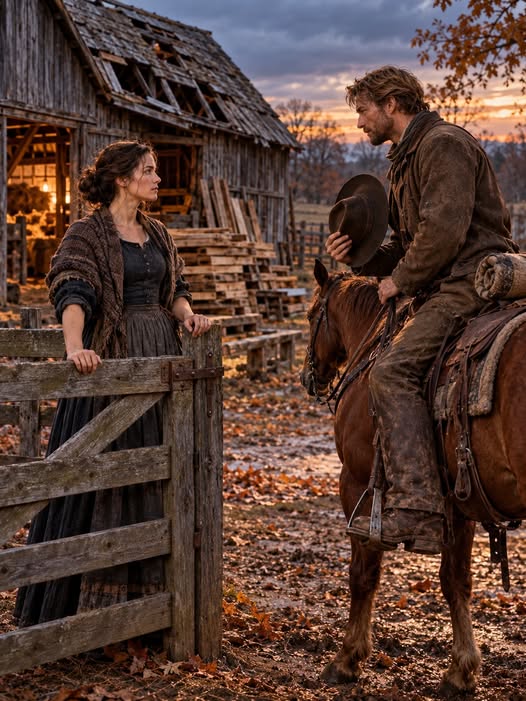
Sarah looked at him sharply.
Some men praised the dead because they wanted favor from the living.
Tom did not appear to be doing that.
He was studying the hollow.
The slope fell between two ridges and widened near a stand of cedar. A narrow creek crossed the bottom, protected from the worst wind by higher ground on both sides.
“He knew cattle,” Tom said.
Sarah’s suspicion eased by a fraction.
“He knew this farm.”
“There’s a difference.”
“Yes.”
Tom rested both hands on the top rail.
“I worked for a man once who knew cattle well enough to make money anywhere.”
“What happened?”
“He bought ground he didn’t understand and lost half a herd the first winter.”
Sarah looked toward the hollow.
“Samuel never lost more than two in a winter.”
“That tells me something.”
She glanced at him.
“What?”
“That I ought to ask before I decide I know better.”
The answer stayed with her.
So did the way he said Samuel’s name.
Not as competition.
Not as an inconvenience standing between himself and Sarah.
Simply as a man whose knowledge had shaped the farm and still deserved respect.
They moved the cattle three days later.
Twenty-eight head.
Not a large herd.
Enough to matter.
The older cows knew the route, but two yearlings broke toward the upper fence and sent Tom riding wide while Sarah held the main group near the creek crossing.
For a few minutes, the work felt like the old years.
Not because Tom resembled Samuel.
He did not.
Samuel had been quieter with cattle, almost patient to the point of stubbornness.
Tom used his voice more.
He rode faster.
He anticipated movement differently.
But the rhythm of two people working toward the same outcome returned to Sarah’s body before her mind was ready for it.
She hated the relief.
Then hated herself for hating it.
By sunset, the herd had settled in the hollow.
Tom dismounted and loosened his gelding’s girth.
Sarah stood at the fence.
“I could not have done that alone.”
The sentence cost her.
Tom looked at her.
“No.”
She waited for some gentle lie.
None came.
“You might have managed most of them,” he continued. “Then one fool yearling would have gone through that west gap and you would have spent tomorrow finding him.”
Sarah almost laughed.
“You have a comforting manner.”
“I try.”
She looked at the cattle.
“I do not like needing help.”
“Most people don’t.”
“You seem comfortable with it.”
Tom’s expression changed.
“I’m sleeping in a widow’s barn for supper and deferred wages.”
There was no self-pity in it.
Only fact.
Sarah looked at him more carefully.
“You never told me why.”
“Why what?”
“Why you are broke.”
Tom bent to check his horse’s hoof.
“That story improves nothing about the weather.”
“That is not an answer.”
He gave her a sideways look.
“You ask direct questions.”
“I have earned them.”
Tom straightened.
“Yes, ma’am. You have.”
He did not answer then.
Sarah let him keep it.
That surprised her too.
Before Samuel died, she had thought marriage meant knowing nearly everything about another person.
Widowhood had taught her something else.
Some truths belonged to their own time.
Winter came in earnest the following week.
Not snow at first.
Cold.
The kind that made every hinge complain and turned water trough edges white before dawn.
Tom began rising before Sarah.
He never entered the house unless invited.
He ate breakfast when she called him in.
Otherwise he took coffee at the barn and started work.
Sarah noticed that he never again asked about Samuel’s chair.
It remained empty.
At first that relieved her.
Then, strangely, it began to trouble her.
Not because she wanted Tom to sit there.
Because the empty chair had become a command none of them had agreed to obey.
Samuel had been dead almost a year.
His cup still sat untouched.
His coat remained on a peg behind the kitchen door.
Sarah still folded his handkerchiefs when dust reached the drawer.
Grief had entered the house and been given rooms.
She had called that faithfulness.
Some days she wondered whether it had become fear.
One evening Tom returned from checking the lower pasture with ice along his coat sleeves.
Sarah opened the door.
“You’re soaked.”
“Creek ice broke under the bank.”
“Inside.”
“I can change at the barn.”
“You can freeze at the barn too. Inside.”
He hesitated.
Then obeyed.
She pointed toward the stove.
Tom removed his coat and stood near the heat.
His shirt sleeve was wet to the elbow.
Sarah fetched a towel.
“Sit.”
He chose his usual side chair.
She dried water from the floor.
Then noticed his right hand.
Blood.
“What happened?”
“Nothing.”
“That is blood.”
“Then perhaps slightly more than nothing.”
She took his wrist.
A split ran across the heel of his palm.
Not deep.
Dirty.
“How?”
“Wire.”
“You have gloves.”
“Had.”
She looked toward the torn pair near his coat.
Sarah brought warm water.
Tom watched her clean the cut.
“You do not need to fuss.”
“I am not fussing.”
“That felt like fussing.”
“Then perhaps you have never been properly injured.”
His smile faded when she wrapped the hand.
For a moment they were too close.
Sarah became aware of his wrist in her fingers.
The heat of the stove.
The silence.
She let go.
Tom stood.
“Thank you.”
Sarah busied herself with the basin.
Then noticed something else.
He was looking toward Samuel’s chair.
Not wanting it.
Not claiming it.
Simply aware of it.
Sarah said, “You may sit there if that chair is closer to the fire.”
Tom looked at her.
“No.”
The answer came immediately.
She stiffened.
He saw it.
“That did not sound the way I meant.”
“How did you mean it?”
Tom took a breath.
“I won’t sit in Samuel’s place because you tell me cold has made it practical.”
Sarah stared at him.
“It is a chair.”
“No.”
His voice was quiet.
“Not yet.”
Something in her chest tightened.
“You think you know what it means to me?”
“No.”
“Then why decide?”
“I’m not deciding for you.”
He looked at the chair.
“I’m deciding for me.”
Sarah waited.
Tom continued.
“If you ever want that chair used because it is only furniture again, that should be your choice. Not mine because my boots are wet.”
Sarah looked down.
The grief came so suddenly she nearly resented him for touching it without touching anything at all.
“I hate that chair.”
Tom said nothing.
“I hate seeing it empty.”
Still nothing.
“I hate the thought of someone else sitting there.”
Her voice broke.
“And I hate myself for both.”
Tom did not move toward her.
That mercy nearly undid her.
Sarah pressed one hand against the table.
“I prayed the morning you came.”
He remained silent.
“I stood under Samuel’s oak because I could not stand inside the house.”
Her eyes stayed on the chair.
“I asked God for strength.”
Tom’s voice was low.
“And then?”
“I could not finish.”
She laughed once, bitterly.
“I did not know whether I wanted strength to stay alone or strength to admit I could not.”
Tom sat back down in the side chair.
Not closer.
Sarah appreciated that more than she could say.
“What did you ask Him?” she said.
“When?”
“When you were angry.”
Tom looked toward the stove.
“For a while?”
“Yes.”
His hand rested on his knee.
“I asked why my younger brother lived long enough to come home from the war and died six months later under a horse.”
Sarah had not expected that.
Tom continued.
“My father blamed me.”
“Why?”
“I bought the horse.”
The room seemed to become quieter.
“It wasn’t a bad horse. Just green. My brother wanted him. I told him he was ready.”
Tom swallowed.
“He wasn’t.”
Sarah sat opposite him.
“How old were you?”
“Twenty-four.”
“And your brother?”
“Nineteen.”
“Was it your fault?”
Tom looked at her.
“I don’t know.”
“That sounds like no.”
“It does not feel like no.”
She understood that too well.
Samuel’s fever had come fast.
There had been a day Sarah might have ridden for the doctor earlier.
A morning she had believed he only needed rest.
A thousand useless versions of the past had grown from that one decision.
Tom continued.
“My father and I never repaired it. I left Kentucky. Worked cattle wherever anyone needed hands. Saved some money. Lost most of it in a partnership with a man who thought cards were a business plan.”
Sarah almost smiled.
“He stole from you?”
“Some.”
“And the rest?”
“I trusted badly.”
“That seems expensive.”
“It was.”
He looked at his bandaged hand.
“By the time I reached Tennessee, I had the horse, my saddle, and enough money for three meals if I ate slowly.”
Sarah looked toward the barn through the dark window.
“You could have told me.”
“I could have.”
“Why didn’t you?”
“Because needing work is not the same as asking to be pitied.”
The sentence struck something inside her.
Perhaps because it sounded like something she might have said herself.
That night she moved Samuel’s coffee cup.
Not far.
From the shelf above the table to the cupboard.
She stood there holding it for several seconds before closing the door.
No one saw.
The next morning nothing outward had changed.
But Sarah knew it had.
December settled hard over the hills.
The repaired barn roof held through the first wet snow.
Tom checked it twice during the night anyway.
Sarah heard him moving outside and went to the window.
Lantern light crossed the yard.
For the first time since Samuel’s death, she did not feel entirely alone in listening to weather.
That frightened her.
Dependence frightened her more than loneliness.
So did the possibility that Tom might leave.
She disliked both discoveries.
The question of wages returned near Christmas.
Sarah brought out her accounts.
“I owe you.”
Tom sat across from her at the table.
His usual chair.
Samuel’s remained empty.
“We agreed spring.”
“We agreed fairly.”
He looked at the figures.
“You need that cash for feed.”
“I can sell two heifers.”
“No.”
Sarah raised her eyes.
“That sounded like an order.”
Tom caught himself.
“You’re right.”
“Try again.”
He nodded.
“I do not think selling good breeding heifers in winter prices to pay me early is wise.”
“That is better.”
“I can wait.”
“You should not have to.”
“I agreed to.”
Sarah studied him.
“You cannot remain here indefinitely on promises.”
“No.”
“Then we need terms.”
Tom leaned back.
“All right.”
She had expected resistance.
“What do you consider fair?”
He named a figure lower than she expected.
Sarah frowned.
“That is hired-hand pay.”
“I am hired help.”
“You repaired a roof, moved cattle, rebuilt two gates, mended the spring fence, and probably saved one calf I would have lost last week.”
“That sounds like hired work.”
“You also feed your own horse.”
“So?”
“You are undercounting.”
Tom looked amused.
“I have never been accused of bargaining myself upward badly.”
Sarah pushed the ledger toward him.
“Then learn.”
They settled on wages she could not fully pay until spring, with a small weekly cash amount, board for his horse, meals, and the right to use a dry corner of the barn as long as he worked there.
Sarah wrote every term.
Tom signed.
The formality pleased her.
It removed charity from the arrangement.
It also made clear that he was not staying because grief had turned her house into obligation.
On Christmas Eve, snow began before noon.
Not a storm.
Steady.
Soft enough to quiet the farm.
Toby Whitmore would have been the name of a child in another story, Sarah sometimes thought when neighbors mentioned grandchildren or family Christmases.
She and Samuel had never had children.
That grief had belonged to an older season.
Now the house held only two people at supper.
Sarah had made cornbread, ham, beans, and an apple pie from the last good fruit in storage.
Tom came in carrying a small bundle.
“What is that?”
“Nothing expensive.”
“That was not what I asked.”
He put it on the table.
Inside was a new leather hinge strap for Samuel’s old Bible.
The original had cracked.
Sarah stared.
“You repaired it.”
“You mentioned the cover was coming loose.”
She touched the leather.
Tom shifted uncomfortably.
“If you dislike it, I can take the strap off.”
“No.”
Her voice softened.
“No.”
She looked toward the chair.
Then at Tom.
“Sit there.”
He followed her gaze.
“Sarah.”
“I mean it.”
Tom did not move.
“It is not Samuel.”
“No.”
“It never was.”
“No.”
She took a breath.
“I think I have been asking a chair to remain married to a dead man.”
Pain crossed her face.
“And maybe asking myself to do the same.”
Tom looked at her carefully.
“If you are doing this for me—”
“I am not.”
He waited.
Sarah touched the back of Samuel’s chair.
“This house belonged to both of us. Now it belongs to me.”
Her voice shook.
“I decide what remains sacred and what becomes useful again.”
Tom still did not sit.
Sarah almost became impatient.
“Must I issue written terms?”
That drew a smile.
“No, ma’am.”
He placed one hand on the chair back.
Then paused.
“Are you certain?”
She nodded.
“Yes.”
Tom sat.
Sarah cried before supper.
Not loudly.
Not for long.
Tom did not try to stop her.
That mattered more than comfort would have.
When she finished, she wiped her face.
“Samuel would have hated that you are taller.”
Tom blinked.
“What?”
“The chair suits you better.”
He laughed so unexpectedly that Sarah laughed too.
The sound startled both of them.
Then something loosened.
Not grief disappearing.
Room being made beside it.
After Christmas, Tom began speaking more openly about leaving in spring.
Not because he wanted to.
Because the contract ended when Sarah could pay him.
“I can probably find cattle work west,” he said one afternoon.
They were repairing a mineral box near the lower pasture.
Sarah kept working.
“You have plans?”
“No.”
“That sounds like poor planning.”
“It has served me consistently.”
She drove a nail harder than necessary.
Tom noticed.
“Sarah.”
“What?”
“You look angry.”
“I am using a hammer.”
“I have seen you use a hammer.”
She set it down.
“What do you want me to say?”
“I don’t know.”
“That you should stay?”
His face became still.
“Yes.”
The honesty irritated her because it matched her own.
Sarah looked toward the cattle.
“I do not know what staying means.”
“Neither do I.”
“You work for me.”
“Yes.”
“You live in my barn.”
“Yes.”
“People talk.”
“They already do.”
“I spent twenty-three years married to one man.”
“I know.”
“I am not ready to pretend grief ended because you repaired my roof.”
Tom’s expression softened.
“I would never ask that.”
“And I will not keep you here because I am afraid to be alone.”
“Good.”
The answer surprised her.
Tom continued.
“I do not want that either.”
Sarah looked at him.
He wiped sawdust from his hands.
“If I stay, I want it because there is a life here I am choosing. And because you want me in it.”
Her throat tightened.
“And if I cannot say that by spring?”
“Then I leave.”
She hated the answer.
She respected it.
Both feelings remained.
February brought an ice storm.
One old cottonwood dropped across the south fence.
Three cows escaped before dawn.
Tom and Sarah spent six hours bringing them back.
On the final mile home, Sarah’s mare slipped.
Not badly.
Enough to throw Sarah sideways.
Tom was off his horse before she finished cursing.
“Do not touch me.”
He stopped instantly.
Sarah sat in the snow, breathing.
Nothing broken.
Pride damaged.
Hip bruised.
Tom stayed several feet away.
“Can you stand?”
“Yes.”
She tried.
Pain folded her.
Tom moved half a step.
Sarah lifted one hand.
He stopped.
She breathed again.
Then said, “Now.”
Only then did he help her.
That moment settled something in her more deeply than a declaration could have.
He had been afraid.
She had seen it.
But fear had not turned into control.
Back at the house, he carried wood, heated water, and slept in the barn as always.
Sarah lay awake.
Samuel had loved her well.
That truth did not require Tom to be less good.
It did not require Sarah to remain untouched forever by kindness.
For months she had feared that loving anyone again would revise the past.
Now she understood.
The past did not need revision.
It needed room.
Spring cattle money arrived in March.
Sarah paid Tom every dollar owed.
He counted it once.
Then folded the notes.
“There.”
She looked at the cleared account line in the ledger.
“There.”
Neither seemed pleased.
Tom moved back into the barn loft that night with the same bedroll he had carried in autumn.
Nothing had changed.
Everything had.
Two days later, a rancher from farther west stopped by.
He had heard Tom might be available.
Good wages.
Season-long contract.
Possibility of permanent foreman work.
Sarah heard the conversation from the porch.
She went inside before either man noticed.
That evening Tom came to supper.
He chose Samuel’s old chair now without ceremony.
That was perhaps the clearest proof it had become a chair again.
Sarah served beans.
“You should take the job.”
Tom looked up.
“You heard.”
“Yes.”
“It pays well.”
“Yes.”
“Better than here.”
“I know.”
He put down his fork.
“Do you want me to take it?”
Sarah hated the question.
Because it required honesty.
“No.”
Tom did not move.
She continued before courage failed.
“But I do not want you refusing it because you think I need a hired man.”
He waited.
“I can manage this place now.”
“I know.”
“I could hire seasonal help.”
“Yes.”
“I am not asking you to stay because of the barn.”
“I know.”
Sarah clasped her hands.
“I am asking because when you are gone, the house feels wrong.”
Tom looked down.
She forced herself onward.
“I think of things to tell you before I remember you are not here.”
His eyes lifted.
“I listen for your horse.”
Her voice softened.
“And I have stopped asking God to make me strong enough not to need anybody.”
Tom did not speak.
Sarah almost laughed from nerves.
“You might help.”
“I am trying not to interrupt.”
She took a breath.
“I want you here.”
Tom’s face changed.
“Working?”
“Yes.”
She swallowed.
“And not only working.”
Silence.
Then Tom asked the question she had needed him to ask.
“What do you want that to mean?”
Not what did he want.
Not what would people call it.
What did she want.
Sarah looked toward the window.
Samuel’s oak stood beyond the dark glass.
She thought of twenty-three years.
Of the grave beneath that tree.
Of the man across from her who had never once asked her to choose between memory and life.
“I want you to court me.”
Tom’s breath left slowly.
“Sarah.”
“I am not promising marriage.”
“I know.”
“I may never want another husband.”
“I know.”
“You may decide you need more than I can give.”
“I know.”
She narrowed her eyes.
“You are agreeing too easily.”
“I have been waiting since Christmas to hear any version of this sentence.”
Sarah stared.
“Christmas?”
“Possibly before.”
“You said nothing.”
“You were grieving.”
“I am still grieving.”
“Yes.”
Tom leaned forward slightly.
“That is why I said nothing.”
The courtship changed less than people expected.
Tom remained in the barn.
That was Sarah’s choice.
He worked for wages.
That was his.
They attended church together twice.
Then separately once because Sarah realized she needed to know she could enter without feeling people were watching them arrive.
Tom understood.
Neighbors talked.
Some kindly.
Some not.
Sarah discovered that after surviving widowhood, unpaid bills, failing fences, and one winter of nearly losing the farm, gossip had limited power.
By late April, Tom received another job offer.
He declined it.
Sarah asked why.
“Because I want to be here.”
“That is a poor financial reason.”
“Probably.”
“What if we do not marry?”
“Then I am still allowed to decide where I work.”
She smiled.
“Fair.”
Summer came.
The barn roof held.
Cattle gained condition.
The lower hollow greened.
Sarah sold two steers at good prices and hired a boy from a neighboring farm during haying.
She no longer structured the farm around what Samuel would have done in every circumstance.
That frightened her.
Then freed her.
One June evening she carried two cups of coffee outside.
Tom sat on the porch step.
She handed him one.
“I went to the oak today.”
He waited.
“I told Samuel about you.”
Tom nearly spilled the coffee.
Sarah smiled.
“That frightened you more than the ice storm.”
“A little.”
“What do you imagine happened?”
“I have no idea.”
“I told him you repair gates differently.”
Tom closed his eyes.
“That seems unfair.”
“I told him your biscuits are worse.”
“They are.”
“And that you ask permission too often.”
His eyes opened.
“Too often?”
“Sometimes.”
He studied her.
“What else?”
Sarah looked toward the oak.
“I told him I loved him.”
Tom’s face became quiet.
“And?”
“I told him I think I love you too.”
Neither moved.
The evening insects filled the silence.
Tom set his cup down.
“Do you?”
“Yes.”
There was no thunder.
No music.
No divine sign.
Only truth.
Tom touched her hand.
Slowly.
Giving her time to refuse.
Sarah turned her palm beneath his.
“I love you,” he said.
“I know.”
“You could have warned me sooner.”
“I wanted to be certain.”
“Records and proof?”
She smiled.
“Something like that.”
They married in October.
Almost one year after Tom Bennett had stopped at her gate.
The ceremony was small.
Ellen came from Nashville.
A handful of neighbors stood with them.
Samuel’s Bible rested on the table during the vows, its repaired leather strap holding the cover securely.
Sarah had considered whether that was too much.
Then decided memory did not contaminate joy.
Tom understood.
He always had.
Marriage did not make the farm his.
They discussed that before the wedding.
Sarah retained ownership.
Tom earned wages from the cattle operation and later bought a modest interest in the herd from his own savings.
Major decisions were shared because they shared a life.
But the land Samuel and Sarah had built remained legally hers.
Tom never objected.
The first winter after their marriage was colder than the one before.
Snow collected heavily on the barn.
One night Sarah woke to wind.
For a moment, old fear returned.
Roof.
Cattle.
Fences.
Alone.
Then she heard Tom breathing beside her.
Not Samuel.
Never Samuel.
Tom.
She lay still.
The distinction no longer hurt the way it once had.
At dawn they dressed and went outside together.
The barn stood.
The roof held.
Samuel’s cedar boards were still doing the work he had intended them to do.
Tom looked up.
“Good roof.”
Sarah glanced at him.
“Samuel bought the boards.”
“I remember.”
“You put them on.”
“You handed them up straighter than any hired man I knew.”
She smiled.
“Flatterer.”
“It worked the first time.”
They checked the cattle in the lower hollow.
All present.
On the way back, they passed the oak.
Sarah stopped.
Snow lay across Samuel’s grave.
Tom waited several steps away.
He had never needed to be told to do that.
Sarah brushed snow from the top of the marker.
Twenty-three years could not be summarized.
Neither could grief.
She touched the cold stone.
Then stood.
Tom did not ask whether she was all right.
She walked to him when she was ready.
Years later, people in the county remembered Tom as the broke Kentucky cowboy who arrived before a hard winter and married the widow whose barn he saved.
Sarah always disliked that version.
The barn had needed repair.
That part was true.
Tom had helped save the cattle.
True too.
But no man had ridden into her yard and rescued her life.
She had already been living it.
Badly some days.
Bravely others.
Often both before supper.
Tom had done something harder than rescue.
He had entered a life already shaped by another man and never demanded that the first love be erased to make room for the second.
He worked.
He asked.
He waited.
And when Sarah needed proof that staying was not dependence, he let her become capable enough to send him away.
Only then did she ask him not to go.
The old chair remained at the kitchen table for the rest of their lives.
Tom used it.
Guests used it.
Once, during a Christmas supper, Ellen’s youngest boy climbed into it and spilled gravy down one arm.
Sarah laughed until she cried.
No one understood why except Tom.
Later that evening, after the dishes were washed, Sarah found Samuel’s old coffee cup in the cupboard.
She held it for a moment.
Then set it beside the washbasin for morning use.
Tom saw.
He did not say anything.
He did not need to.
The prayer Sarah had failed to finish beneath the oak years earlier had asked for strength.
For a long time she believed the answer might have been Tom Bennett appearing at her gate.
Eventually she understood it differently.
Perhaps the answer had never been a man.
Perhaps it had been the courage to open a gate without surrendering the house behind it.
The strength to accept help without calling herself weak.
The faith to let Samuel remain loved without making grief the final shape of her life.
And when another good man stood outside that life and waited for permission to enter, the strength to choose him freely.
Tom had never been the answer to all of Sarah’s prayers.
He was simply one of the good things she had finally become strong enough to receive.


