Lily’s fingers closed around Hattie’s hand, warm now instead of fever-hot, and Hattie went completely still.
Nathan rose from the table.
“Lily.”
The child looked at him.
“She said she might stay.”
“I heard her.”
“You need help.”
Nathan’s jaw moved.
Hattie knelt so she was level with the girl.
“Your father and I have to discuss that.”
“Why?”
“Because grown people make agreements before they start arranging one another’s lives.”
Lily frowned as though adulthood sounded needlessly complicated.
Nathan looked at Hattie differently after that.
Not because she had corrected Lily.
Because she had included him without surrendering herself.
Hattie stood.
Nathan said, “I can offer the room off the kitchen.”
She waited.
“Meals. A wage when cattle money comes in. I won’t pretend cash is plentiful before spring.”
“What work?”
“House. Meals when needed. Lily while I’m outside. Some accounts, if you can keep them.”
“I can.”
“And nothing with cattle unless you choose.”
“I’m not afraid of cattle.”
His mouth almost changed.
“I heard that.”
Hattie folded her arms.
“One condition.”
Nathan’s expression sharpened.
“This arrangement is work. Not courtship. Not marriage. Not a debt because you let me stay through winter.”
Nathan answered before she finished.
“Agreed.”
Hattie studied him.
“You expected someone to marry.”
“I expected a woman willing to consider marriage after correspondence.”
“That isn’t me.”
“I know.”
“And your daughter needing care does not make me her mother.”
Nathan glanced toward Lily.
“No.”
Something in his voice made Hattie ask, “What was her name?”
He understood immediately.
“Ruth.”
Lily looked up.
“My mama.”
“Yes,” Hattie said.
She did not reach for the child again.
Lily did it herself.
Nathan saw.
Then he went to the sideboard, found paper, and sat at the table.
“What are you doing?” Hattie asked.
“Writing the terms.”
That surprised her.
“You trust paper suddenly?”
“I trust plain agreements.”
He wrote slowly.
Room off the kitchen.
Meals.
Work through spring unless either ended the arrangement once safe travel resumed.
Wages to be paid from spring cattle money.
No marriage obligation.
No assumption of permanency.
He turned the sheet toward her.
“Add anything.”
Hattie read every line.
Then she took the pencil.
Beside the last item she wrote that she could leave freely once the road was passable and that the room and personal trunk remained private.
Nathan read it.
“Fair.”
He signed.
Hattie signed beneath him.
Lily leaned across the table.
“Can I sign?”
“No,” Nathan said.
“Why?”
“Because you’re four.”
Lily considered that insult to her authority.
Hattie folded the contract.
“Where should this be kept?”
Nathan opened the sideboard drawer.
Then stopped.
Inside lay another folded letter, worn at the creases.
He closed the drawer again.
“Your trunk.”
Hattie noticed the hesitation but asked nothing.
She placed the contract beneath her Bible.
By noon Lily was back in bed.
Nathan went to feed cattle that had been waiting through the storm.
Hattie stood at the kitchen window and watched him cross the white yard.
He was not a desperate man offering safety in exchange for affection.
He was something more difficult.
A man who needed her labor and had admitted it.
That meant she could judge the arrangement by what it was.
Work.
Shelter.
A child recovering from fever.
A winter that had not finished with any of them.
Hattie turned from the window and opened the pantry.
Flour was low.
Salt pork lower.
Beans sufficient.
Dried onions.
Some cornmeal.
She began making a list.
When Nathan returned, ice crusted his coat.
He found Hattie at the table with the household supplies counted and Lily asleep nearby.
“You inventoried everything?”
“Yes.”
“Why?”
“Because you’re low on flour.”
“I know.”
“You’re also low on lamp oil.”
“I know.”
“And there’s enough food if it’s managed carefully.”
Nathan removed his gloves.
“You always answer fear with arithmetic?”
“No.”
Hattie looked toward the stove.
“Sometimes I cook.”
That time he did smile, barely.
The first weeks passed without ceremony.
Hattie learned the house.
Nathan learned that she returned tools precisely where she found them after one mistake with a hatchet.
Lily learned that Hattie made Sunday biscuits.
And Hattie learned Nathan did not enter the room off the kitchen without knocking.
Then one evening, she came from Lily’s bedside and stopped.
A new chair stood across from Nathan’s at the kitchen table.
Plain wood.
Broad arms.
A back tall enough to rest against.
Nathan was carrying shavings toward the stove.
Hattie touched the smooth arm.
“You built this.”
“The other one is miserable.”
“So I’ve been told.”
“It seemed unnecessary for you to keep proving it.”
Hattie looked at him.
He looked away first.
She sat in the new chair.
It fit.
Nathan returned to his place opposite her.
For the first time since arriving, Hattie felt the dangerous possibility that something in this house was being made not merely because she was useful—but because someone had begun expecting her to remain long enough to need it.
Hattie ran her palm once more along the new chair’s arm.
Nathan busied himself putting away the knife he had used to shave the wood.
Neither spoke about what the chair meant.
That was how most important things happened in the Holt house.
Work first.
Meaning later.
By February, Hattie could tell the weather from the sound of the front door before opening it.
She knew which barn hinge needed oil every second week.
She knew Nathan stored the small nails in the third tin from the left and considered any other arrangement evidence of moral decline.
She knew Lily disliked boiled turnips but would eat them if Hattie mashed them with potatoes.
She knew Nathan took his coffee without sugar and always left the warmest place near the stove available to Lily.
Nathan, in return, learned that Hattie required ten quiet minutes every morning before conversation became welcome.
He learned she saved buttons from every worn garment.
He learned that she could turn poor flour into respectable biscuits, but only if no one opened the oven door to look.
Lily opened it once.
Only once.
“You sounded like Papa when I moved his hatchet,” Hattie told her.
Lily was horrified.
Nathan heard from the doorway.
“I did not sound like that.”
Hattie looked at Lily.
Lily looked at Hattie.
Neither answered.
Nathan went back outside.
The arrangement should have remained simple.
It did not.
The complication was not desire alone.
It was reliability.
Hattie had known charming men.
Charm was cheap.
Nathan was different in ways more dangerous to a woman determined to remain independent.
When he said he would repair the loose latch on her room door, it was done before supper.
When Hattie said Lily needed wool stockings rather than patched cotton ones, he traded for wool in town despite complaining about the price.
When she asked whether the spring wage would actually be available, he opened the cattle ledger and showed her exactly what he expected to sell and what debts came first.
No mystery.
No injured pride.
No demand that she trust him blindly.
That honesty made him harder to dismiss.
One windy afternoon Hattie went to the sideboard for a lamp wick.
The folded letter was there again.
A woman’s hand.
Nathan’s name.
The paper had been opened so often that its edges had softened.
Hattie did not read it.
She found the wick and closed the drawer.
That evening she poured two cups of coffee.
Lily had gone to bed.
Nathan sat over the cattle ledger.
Hattie placed one cup beside him and took the chair he had built.
“I saw the letter.”
Nathan’s pencil stopped.
“I didn’t read it.”
Silence.
Then he said, “Ruth.”
Hattie waited.
“She wrote it before Lily was born.”
His hand remained on the ledger.
“She knew the birth might be difficult.”
Hattie’s chest tightened.
“She died later?”
“Not then.”
He looked toward Lily’s room.
“Couple of years afterward. Spring of ’91.”
Nathan did not explain the illness.
Hattie did not ask.
The source of a death mattered less in that moment than the life still shaped around it.
“I kept the letter,” Nathan said. “Then kept reading it.”
“You don’t owe me an explanation.”
“I know.”
The answer stopped her.
Not defensive.
Not ashamed.
Simply true.
Nathan drank some coffee.
“Ruth would have liked you.”
Hattie looked down.
“You don’t have to make room for me by moving her out of it.”
His eyes lifted.
“I’m not.”
“Good.”
“She liked capable people.”
“That sounds like a safe compliment.”
“She would also have said you’re stubborn.”
“That sounds more convincing.”
A small warmth passed through his expression.
Then he looked toward Lily’s room again.
“I didn’t send to Billings because I was finished grieving.”
Hattie said nothing.
“I sent because Lily needed more than I could do alone.”
“That’s different.”
“Yes.”
“Did you expect affection?”
“No.”
“Marriage?”
“I expected to consider it if Clara and I both thought the arrangement could work.”
“And now?”
Nathan met her gaze.
“Now Clara isn’t here.”
Hattie felt the sentence land between them.
He did not finish it.
She was grateful.
Later that week, Nathan found Hattie outside splitting kindling.
“You don’t need to do that.”
“Neither do you.”
“I’m already doing cattle.”
“And I’m already splitting wood.”
“You’re supposed to manage the house.”
Hattie planted the maul head in the chopping block.
“Does that mean I’m forbidden from work outside it?”
Nathan paused.
“No.”
“Then what does it mean?”
He considered.
“It means I assumed.”
“Yes.”
“I shouldn’t have.”
“No.”
He nodded.
Then he picked up the split pieces and carried them inside.
That was the whole argument.
It changed something anyway.
After that, the work divided according to necessity rather than habit.
Nathan carried heavy water when the pump froze.
Hattie helped feed on mornings when Lily slept late.
Nathan learned to make cornmeal without scorching it.
Badly at first.
Hattie told him so.
He improved.
Lily watched all of this with the confidence of someone who believed adults naturally reorganized themselves around her continued existence.
In March, snow began shrinking from south-facing ground.
Mud appeared.
The road to Teller’s Creek returned in pieces.
With the road came Deek Farrow.
He arrived one Wednesday carrying flour and the pleased expression of a man who had news that did not belong to him.
“Word from Billings.”
Nathan took the sack from him.
“What word?”
“Agency.”
Hattie stopped pouring coffee.
Deek settled at the table.
“Clara Beach married a shopkeeper in Billings back in December. Agency wants to know if Holt still requires a placement.”
Silence.
Lily was beneath the table with a rag doll.
Deek looked at Hattie.
Then at Nathan.
Then back at Hattie.
“I suppose that settles one confusion.”
Hattie set the coffeepot down more firmly than necessary.
Nathan’s gaze stayed on her.
Before either adult answered, Lily crawled out from beneath the table.
She walked to Hattie and took her hand.
Nothing else.
She simply stood there.
Deek suddenly became interested in finishing his coffee.
Nathan looked at his daughter’s fingers around Hattie’s.
Then he looked at Deek.
“Tell them we’ve sorted ourselves out.”
Hattie’s heart moved hard against her ribs.
Deek blinked.
“Well.”
Nathan waited.
Deek drank.
“Right.”
He left sooner than usual.
The kitchen became very quiet.
Lily let go of Hattie’s hand and returned to her doll as if she had completed her duty.
Nathan remained at the table.
Hattie stood beside the stove.
“The contract,” he said.
“Yes.”
“The road is open enough now.”
“It is.”
“You can leave.”
The words hurt more than Hattie expected.
She kept her voice level.
“I know.”
“I owe you wages.”
“Yes.”
“I can pay part now. Rest after cattle sale.”
“That was our agreement.”
Nathan placed both hands on the table.
“The terms as written are still yours if you want them through spring.”
Hattie faced him.
“And if I don’t?”
His eyes held hers.
“Then I want to discuss different terms.”
“What terms?”
Nathan inhaled.
For a moment she saw him making the choice not to hide behind practicality.
“Permanent ones.”
Hattie’s hands became still.
Nathan continued.
“I’m not asking because the agency woman married somebody else.”
“Good.”
“I’m not asking because Lily likes you.”
Lily’s doll stopped moving under the table.
Nathan glanced downward.
“She’s listening.”
“I know,” Hattie said.
The doll resumed walking.
Nathan looked at Hattie again.
“I’m asking because you came here owing me nothing and have never once acted as if shelter purchased your gratitude.”
Her throat tightened.
“I’m asking because you tell me when I’m wrong.”
“Frequently.”
“Yes.”
“Necessary service.”
“Yes.”
The corner of his mouth moved.
Then he became serious.
“I’m asking because I want you here after you no longer need to be.”
Hattie sat in the chair he had built.
“What would marriage change?”
Nathan had clearly expected emotion.
He had not expected an interview.
He thought before answering.
“You would not be hired help.”
“That’s a description, not an answer.”
He nodded.
“You’d have a say in household money.”
“I already tell you how to spend it.”
“You’d have legal standing as my wife.”
“And the house?”
“Your home as much as mine.”
“And Lily?”
Nathan looked toward the child beneath the table.
“She remains my daughter.”
Hattie’s respect for him deepened.
“You would not be required to call yourself her mother,” he added. “Or replace Ruth.”
Lily crawled out again.
“I want Hattie.”
Nathan’s voice softened.
“I know.”
Hattie looked at her.
“Wanting someone does not make them belong to you.”
Lily frowned.
Nathan said quietly, “She’s right.”
That mattered too.
Hattie turned back.
“My trunk remains mine.”
Nathan almost looked offended.
“Of course.”
“My wages earned so far are paid whether I marry you or not.”
“Yes.”
“My room remains mine until I choose otherwise.”
“Yes.”
“And if I say no?”
“You receive everything promised.”
“No punishment.”
“No.”
“No wounded silence for six months.”
Nathan considered.
“I can promise not to punish you.”
“That wasn’t the whole sentence.”
“I may be wounded.”
Hattie appreciated the answer.
“But it will be mine to manage.”
She looked down at her hands.
The road was open.
She could take her wages and return to Teller’s Creek.
From there, Billings.
Cheyenne.
Some other household.
Some other arrangement.
Nathan did not stand between her and any of them.
That was why choosing him had begun to feel possible.
She raised her eyes.
“I need time.”
Nathan nodded.
“How much?”
“Until tomorrow.”
“All right.”
That night Hattie went to her room and opened the pine trunk.
She touched the Bible.
The winter coat.
The tin of buttons.
Then the contract.
Two signatures.
Clear terms.
A beginning that had never pretended to be love.
She folded it again.
In the kitchen beyond the wall, Nathan moved quietly.
Lily laughed once at something he said.
Hattie closed the trunk.
Then she carried one item into the kitchen.
The tin of buttons.
Nathan looked up from the stove.
She placed it on the table between them.
“My mother used to say a woman with buttons could always find a use.”
Nathan looked at the tin.
“Is that an answer?”
“Not yet.”
He nodded.
Hattie sat.
“But tomorrow,” she said, “I want to see Teller’s Creek.”
“For what?”
“The preacher.”
Nathan went completely still.
From the bedroom doorway Lily whispered much too loudly, “I knew it.”
Hattie turned.
“You are supposed to be asleep.”
Lily disappeared.
Nathan looked at Hattie.
“Are you certain?”
“No.”
That surprised him.
Hattie continued.
“I’m certain I want to go to town tomorrow. I’m certain I want to speak to Reverend Aldous. I’m certain I want another night in which the road is open and nobody can say weather made the decision for me.”
Nathan’s shoulders eased.
“That seems fair.”
“Good.”
She picked up the tin of buttons.
“Then if I still choose you tomorrow, you may ask me again.”
Nathan watched her carry the tin back toward her room.
He did not follow.
He did not ask for reassurance.
And because he did not, Hattie knew she was closer to yes than she had been before.
Morning came clear enough to reveal every road Hattie might take.
That mattered.
The sky over Teller’s Creek country was pale blue, the fields broken into white snow, brown earth, and dark strips of thawing ground.
Nathan hitched the wagon.
Hattie packed no trunk.
Only her coat, gloves, and the contract.
Lily wore two scarves because she insisted the first did not make her look sufficiently prepared for town.
Nathan lifted her onto the wagon seat.
Hattie climbed up beside her.
For four miles, no one discussed marriage.
They discussed mud.
A washed rut.
Whether the general store would have molasses.
Lily announced that Reverend Aldous had eyebrows resembling two gray mice.
Nathan told her not to say so in church.
“Why?”
“Because he knows.”
Hattie laughed.
Nathan looked at her.
That was the first answer she gave him that morning.
Not yes.
But close.
Teller’s Creek looked different in daylight.
The depot stove had been the center of Hattie’s world when she arrived.
Now she passed the building and saw only a small room beside tracks of snow and mud.
The place where she had waited for a man who did not come.
The place where she had possessed four dollars, someone else’s arrangement, and no clear destination.
She could have asked Nathan to stop.
She did not.
Reverend Aldous listened carefully.
He was a spare older man with exactly the eyebrows Lily had described.
Hattie had to keep her face composed.
Nathan noticed.
That almost ruined them both.
The reverend asked to speak with them together.
Then, at Hattie’s request, separately.
Nathan did not object.
When Hattie sat alone across from the minister, he asked one question that mattered.
“Do you believe you must marry Mr. Holt because you have lived in his home?”
“No.”
“Because you helped his child?”
“No.”
“Because winter leaves you few alternatives?”
“The winter is ending.”
“Because you cannot support yourself elsewhere?”
Hattie thought of four dollars and thirty cents.
Of boarding houses.
Of other positions.
“I could find work.”
“Then why are you considering this?”
Hattie looked toward the church window.
Nathan stood outside beside the wagon with Lily.
He was repairing a loose buckle on the child’s boot.
Not watching the window.
Not trying to read her answer through glass.
“Because he has given me reasons to trust what he does when he has power over a situation.”
The minister waited.
Hattie continued.
“When I arrived, he could have turned me out. He didn’t.”
“That alone is not marriage.”
“No.”
“When I needed shelter, he offered work rather than gratitude.”
“Still not marriage.”
“No.”
“When I asked for terms, he wrote them.”
The reverend’s eyes softened.
“When I corrected him, he listened.”
“That may be rarer.”
Hattie smiled.
“He keeps promises.”
“Do you love him?”
The question frightened her more than the practical ones.
She answered carefully.
“I believe I am beginning to.”
“Beginning?”
“Yes.”
“You’re willing to marry on that?”
Hattie thought of the chair.
Ruth’s letter.
Nathan handing her the cattle ledger instead of asking for blind trust.
The room he never entered without knocking.
The way he admitted he would be hurt if she left but refused to make the hurt her burden.
“Yes.”
When she came outside, Nathan straightened.
He did not ask what she had said.
“Your turn,” Hattie told him.
He went in.
Lily climbed onto the wagon wheel.
“Did you tell Reverend Aldous yes?”
“I told him several things.”
“Was one yes?”
“Lily.”
The girl sighed.
“Grown people take too long.”
“Sometimes that prevents mistakes.”
“Papa says mistakes teach you.”
“Your father says that when he makes them.”
Lily considered.
“That is true.”
Nathan returned.
His face revealed nothing.
The reverend remained inside.
Hattie looked at Nathan.
“Well?”
“Well what?”
“What did he ask?”
“Whether I expected you to replace Ruth.”
Hattie went quiet.
“And?”
“I said no.”
“Anything else?”
“He asked whether I was trying to solve the difficulty of raising Lily by marrying the first capable woman who entered my house.”
Hattie’s mouth twitched.
“What did you say?”
“That seemed unfair.”
“Nathan.”
“I also said no.”
“And what are you doing?”
“Waiting.”
“For?”
“You told me I could ask again today.”
Hattie took a breath.
The road was open behind them.
The depot stood two streets away.
She had enough unpaid wages coming to begin somewhere else.
Nathan knew it.
That was the condition she had needed.
Choice had returned before the question.
She held out her hand.
Nathan took it.
“Hattie?”
“Ask.”
His fingers tightened slightly.
“Will you marry me?”
“Yes.”
Nothing dramatic followed.
Nathan closed his eyes for one second.
Then he opened them.
“Thank you.”
Hattie frowned.
“That sounds like I agreed to lend you a wagon.”
“I’m trying not to frighten you.”
“You’re doing poorly.”
A smile broke across his face.
Not broad.
Not practiced.
Real.
Hattie had never seen it before.
Lily screamed.
“I knew it!”
Two women leaving the dry-goods shop turned around.
Nathan immediately lost half the smile.
Hattie laughed.
They did not marry that afternoon.
That decision mattered too.
Hattie returned to the homestead with them.
She completed the winter agreement.
Nathan paid the wages owed as money became available.
The marriage was not allowed to swallow the contract that came before it.
During the following days, they discussed what Hattie wanted after the wedding.
Not what Nathan assumed.
Household accounts would be shared.
Purchases beyond ordinary daily needs would be discussed.
Hattie’s money earned before the marriage remained hers to keep.
Her room off the kitchen remained available to her for sewing, mending, private correspondence, or simply a closed door whenever she wanted one.
Nathan looked puzzled by the last part only once.
“Do you expect to need somewhere to escape me?”
“I expect every person to need one place where the door closes.”
He thought about the barn.
His tools.
The long hours he spent working alone when thought required quiet.
Then he understood.
“All right.”
Hattie also spoke about Lily.
“I will care for her.”
“I know.”
“I will love her if she continues allowing it.”
Nathan’s face changed.
“But Ruth remains her mother.”
“Yes.”
“I won’t remove her things merely to make myself comfortable.”
Nathan went very still.
“The curtains.”
Hattie knew immediately.
Yellow fabric with small white flowers hung in Lily’s room.
She had known they mattered but never asked why.
“Ruth made them?”
“Yes.”
Nathan looked toward the hallway.
“I sometimes think I kept too much unchanged.”
“That doesn’t mean everything must be changed now.”
“You wouldn’t want different curtains?”
Hattie pictured Lily beneath those yellow flowers, sleeping with one hand tucked under her cheek.
“No.”
Nathan’s gaze returned.
“I think they belong where they are.”
His eyes shone, though no tears came.
That evening he opened the sideboard drawer.
He removed Ruth’s letter.
He did not give it to Hattie.
He sat beside the stove and read it once.
Then folded it and returned it to the drawer.
Hattie continued mending Lily’s stocking.
Nothing in the house required Ruth to vanish before Hattie could belong there.
That knowledge made belonging possible.
They were married on a Thursday in March.
Snow remained in shaded hollows.
Every sunlit road had turned to mud.
Reverend Aldous’s church was small enough that Lily’s shoes sounded loud on the boards.
Hattie wore the better of her dresses.
Lily wore a dress Hattie had sewn partly from fabric she already owned.
Deek Farrow witnessed the marriage, proving that at least some of his promises survived longer than expected.
Before the vows, Reverend Aldous looked at Nathan.
Then Hattie.
Neither seemed trapped.
Neither seemed uncertain.
He proceeded.
Hattie gave her promise.
Nathan gave his.
Lily held Hattie’s hand throughout.
When Nathan took Hattie’s other hand, Lily reached for his free one.
The three of them stood connected in front of the minister.
No one called it fate.
No one said Hattie had been the woman Nathan was supposed to receive.
She had not been.
That was important.
Clara Beach had made her own choice in Billings.
Hattie had made hers in Teller’s Creek.
Nathan had made his only after both choices were clear.
Afterward, Deek declared the three of them “well matched.”
Reverend Aldous corrected him.
“Well suited.”
Hattie decided she preferred that.
On the ride home, Lily fell asleep between them.
Mud pulled at the wagon wheels.
Early grass showed along the road edges.
Nathan drove with both hands on the reins.
After two miles he said, “The curtains.”
Hattie waited.
“In Lily’s room.”
“Yes?”
“If you ever wanted to change them, I wouldn’t take it as—”
Hattie stopped him.
“Nathan.”
He looked over.
“Yellow is a fine color for a child’s room.”
Lily slept on.
Nathan looked back at the road.
“Yes.”
Nothing else needed saying.
At the homestead, Hattie kept her trunk in the room off the kitchen.
Not because the marriage was uncertain.
Because she wanted to decide when to move it.
Nathan never asked.
One week passed.
Then another.
On the third Saturday, Hattie woke early and found Nathan feeding cattle.
She opened the trunk.
Inside lay the Bible.
Her spare dress.
The original written contract.
And the tin of buttons.
She read the contract once.
The paper had done what it was supposed to do.
It had protected the difference between shelter and obligation.
It had preserved choice long enough for choice to become love.
Hattie folded it again.
She did not burn it.
She placed it inside her Bible.
When Nathan returned, she stood beside the pine trunk.
“Could you help me move this?”
He looked at her.
“Where?”
“The bedroom.”
He said nothing for a moment.
Then he nodded.
“All right.”
They lifted together.
Hattie stopped him halfway down the short passage.
“You’re carrying more than your side.”
“It’s heavy.”
“I know.”
“You want me to pretend it isn’t?”
“I want you to let me carry half.”
Nathan adjusted his grip.
“Half.”
They moved the trunk to the foot of the bed.
A rag rug lay beneath it.
Ruth had braided that rug years earlier.
Hattie knew without asking.
She left it.
Then she opened the trunk and took out the tin of buttons.
Nathan watched.
“Where do those go?”
Hattie looked around the room.
“There should be a shelf above that window.”
“There isn’t.”
“I noticed.”
Nathan understood.
The next morning, he brought lumber in from the barn.
Hattie stood beside him while he measured.
“Too deep,” she said.
“I haven’t even cut it.”
“Still too deep.”
He sighed.
She showed him the width she wanted.
By afternoon a narrow shelf stood above the window.
Hattie placed the button tin in the center.
That could have been the end.
It was not.
Marriage did not stop the ranch from requiring work.
Spring meant calves.
Mud.
Repairs.
A section of fence flattened under winter snow.
A leaking roof corner over the storage room.
A kitchen garden needing turning.
Hattie did not become only the woman indoors.
Nathan did not become a different sort of man because vows had been spoken.
He still misplaced himself inside silence when worried.
She still pressed until he explained.
Once, when money ran tight before cattle sale, Nathan tried to postpone telling her.
Hattie discovered it from the ledger.
She set the book on the table.
“We discussed this.”
“I know.”
“You were going to solve it before I had to worry.”
He went still.
Hattie regretted the sharpness as soon as she heard the echo of Thomas-like patterns from another life that wasn’t hers—but she did not withdraw the point.
Nathan looked at the figures.
“You’re right.”
“Do not protect me with ignorance.”
“I wasn’t trying to.”
“You were.”
He absorbed that.
Then he pulled out the opposite chair.
“Sit down.”
They worked through the problem together.
Feed expense could be reduced.
One purchase could wait.
A calf might be sold earlier than planned.
Nothing disastrous.
But the repair mattered.
Nathan never again withheld a ranch account because he hoped to fix it first.
Hattie noticed.
She always noticed.
Lily changed too.
At first she introduced Hattie in town as “Hattie.”
Then, once, as “my Hattie.”
Hattie did not correct her.
She also did not ask Lily to call her mother.
Months passed before the child asked.
They were shelling beans at the table.
“Can I call you Mama?”
Hattie’s hands stopped.
Nathan was outside.
The question belonged first to them.
“You already have a mama.”
“I know.”
“Her name was Ruth.”
“I know.”
“She loved you.”
“I know.”
Lily pushed one bean across the table.
“Can I have two?”
Hattie’s throat closed.
She reached across and took the child’s hand.
“If that’s what you mean when you say it.”
Lily nodded.
“All right.”
That evening Lily shouted “Mama” from the yard because she had torn her stocking on a nail.
Hattie came running before she realized what name had been used.
Nathan stood by the barn.
He heard.
He did not look broken.
He looked grateful.
Later, Hattie found him alone near the woodpile.
“You all right?”
“Yes.”
“You can say if it hurts.”
“It does.”
She waited.
“It also doesn’t.”
Hattie understood.
Some feelings were large enough to contain opposite truths.
She stood beside him.
Nathan touched her hand.
Not to claim.
To ask.
She turned her palm upward and let their fingers close.
Another winter eventually came.
This time Hattie knew the road.
She knew how the floorboards felt when the temperature dropped.
She knew how much wood the house required during a hard week.
She knew Nathan would keep his tools on the left barn wall until death or divine intervention.
He knew Hattie’s buttons multiplied without any visible source.
He knew she would notice if he moved money from one ledger column to another.
Lily knew both adults would come when she called.
One evening snow began before supper.
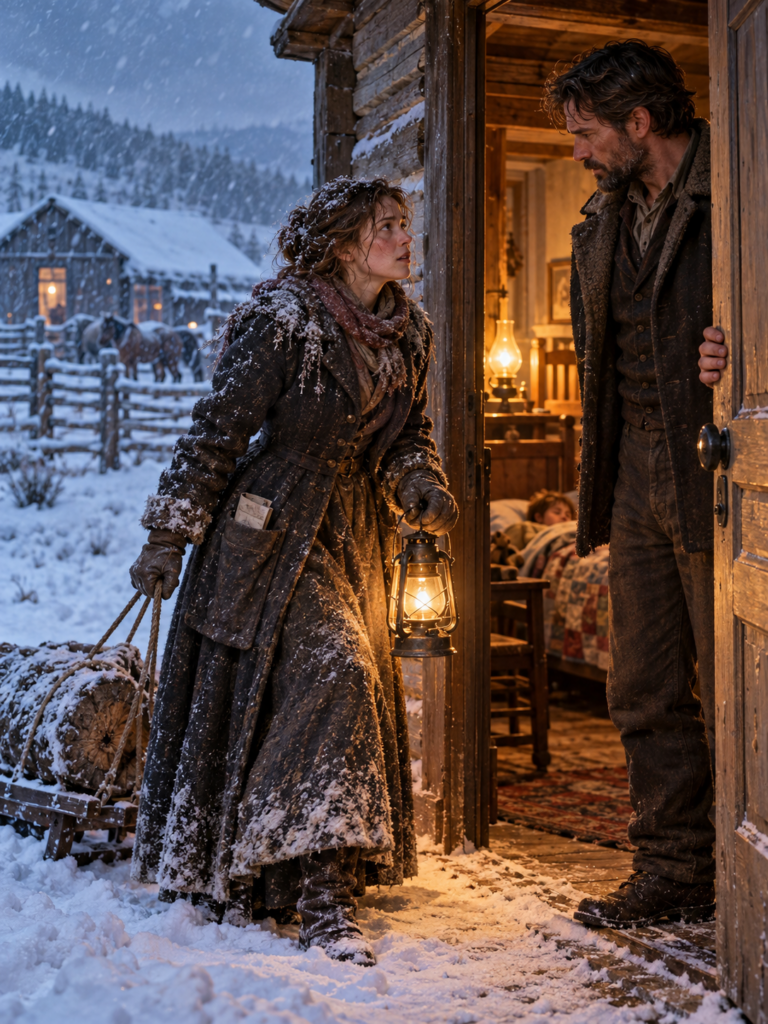
Not a blizzard like the night Hattie arrived.
Just steady Montana snow.
Hattie stood at the stove.
Nathan repaired a harness strap at the table.
Lily read aloud from the Bible, stumbling proudly through words far beyond her understanding.
The chair Nathan had built stood beneath Hattie’s folded shawl.
Her trunk remained at the foot of their bed.
Ruth’s letter remained in the sideboard.
The yellow curtains remained at Lily’s window.
And above the bedroom window sat the tin of buttons.
Years later, Nathan would find the old agency paper among Hattie’s things.
Clara Beach’s name remained on the arrangement.
Not Hattie’s.
He looked at it.
Then across the kitchen at the woman who had arrived carrying it.
By then, he knew enough to understand what she had never needed to explain in full.
She had boarded the coach because another future had closed.
She had walked four miles because a sick child needed help.
She had remained because a written agreement gave her enough safety to judge the people inside the house honestly.
And she had married because, once the road reopened, leaving was possible.
Nathan folded the agency paper.
He placed it in the sideboard beside Ruth’s letter.
Not because the two papers meant the same thing.
Because both belonged to the truth of the house.
One represented the life that had been loved and lost.
The other represented the mistake, chance, desperation, and courage that had opened another.
Then Nathan went to the barn.
He returned carrying a board.
Hattie looked up.
“What now?”
“Your shelf.”
“There’s nothing wrong with my shelf.”
“It’s too narrow.”
Hattie stared.
“You built it exactly as I told you.”
“I know.”
“Then what changed?”
He looked at the button tin.
It was full.
Beside it sat another smaller tin.
“Apparently buttons reproduce.”
Hattie laughed.
Nathan measured the wall.
She came beside him.
“Not too deep.”
“I remember.”
“You say that now.”
He marked the board.
She held one end while he cut.
Outside, snow settled over the road to Teller’s Creek.
Inside, they made room.
That was what their life became.
Not one rescue.
Not one contract.
Not one wedding.
Room.
For Ruth’s memory.
For Hattie’s independence.
For Nathan’s grief.
For Lily’s attachment.
For arguments.
For accounts.
For work.
For a second chair.
For more buttons than any sensible household required.
Hattie had first entered the house and told Nathan he could decide what to do with her in the morning.
Years later, neither of them would have described their life that way.
No one decided what to do with Hattie.
She decided what to do with herself.
Nathan’s great good fortune was that, when every road opened again, she chose a road that led back to his door.
And whenever winter cold began rising through the floorboards, there were two adults checking the stove, one child growing safely beneath yellow curtains, and a house in which the fire was no longer one person’s burden to keep alive.