
Part 1
Marin Kessler was twenty years old when she learned that a person could work every day, surrender nearly every dollar she earned, do everything she knew how to do for the people she loved, and still come home to find her place in the world had been taken away.
The proof was waiting in her aunt’s kitchen.
It was a bitter January afternoon. Cigarette smoke hung beneath the ceiling, mixing with the smell of coffee that had been sitting on the burner too long. Marin had just finished a closing shift. Her name tag was still pinned to her shirt, her feet hurt, and she had forty-one dollars folded inside her back pocket.
Thirty dollars belonged to Carla, or would as soon as Marin handed it over. The remaining eleven were supposed to help pay for her twelve-year-old brother’s inhaler refill.
She had already been calculating how to stretch the rest of the week when she noticed Toby’s blue duffel bag standing against the kitchen wall.
Carla sat at the table. Beside her was the man she’d recently started seeing, a broad-shouldered stranger Marin had met only twice. His expensive-looking truck was parked outside. He occupied the kitchen chair with the confidence of somebody who believed the house was already his.
Carla didn’t invite Marin to sit.
“This arrangement isn’t working anymore,” she said.
Marin looked from Carla to the duffel.
“What arrangement?”
“You living here. You’re twenty. You’ve been an adult for two years.”
“I pay you every week.”
“You contribute toward the groceries you eat. That’s not the same thing.”
Marin felt the familiar exhaustion settle behind her ribs. She had heard variations of that argument since her mother died. No matter how many hours she worked or how much money she handed over, Carla could always find some new way to describe her as a burden.
“I’ve got forty-one dollars,” Marin said quietly. “You can have your thirty.”
Carla’s boyfriend shifted in his chair.
“That’s not what this is about.”
“Then what is it about?”
Carla finally put down her phone.
“You need to find somewhere else to live.”
Marin waited for the rest. A deadline. A warning. Something that would make sense.
“Tonight,” Carla added.
For several seconds Marin could hear nothing but the ticking furnace.
“There’s a storm coming.”
“Then you’d better get moving.”
Marin turned toward the hallway. Toby’s little radio was playing softly behind his bedroom door. It had belonged to their mother, Laney, and since the funeral he carried it everywhere, as though the right station might someday bring her voice back.
“What about Toby?”
“He stays here.”
Marin looked back.
“Excuse me?”
“I’m still his legal guardian. He stays.”
Then Carla said the part that explained everything.
“The state still sends his support. I can’t afford to lose that.”
Four hundred dollars every month.
Marin had known about the payment. She had also known that most of it disappeared into Carla’s mortgage, groceries, and whatever financial emergency was happening that week.
She had tried not to resent it. Keeping a roof over Toby’s head mattered more than arguing over whose money paid for it.
But now she understood exactly how Carla saw the two children her sister-in-law had left behind.
One brought a check.
The other brought bills.
“He’s not staying here without me.”
Carla straightened.
“You don’t get to decide that.”
Marin looked at the man beside her aunt. He was studying his hands, refusing to meet her eyes.
She thought of her mother’s final days in the county hospital. Laney had been exhausted, her breathing shallow, but she’d used one of her last clear moments to draw Marin close.
Keep him close.
Not a grand promise about happiness or safety. Their mother had been too practical for promises nobody could guarantee.
Just those three words.
Marin turned toward the hallway.
“Toby? Put your boots on, buddy.”
Carla stood.
“Don’t you dare.”
“Toby, your coat too.”
The radio clicked off.
A moment later, her little brother appeared, holding it against his chest. His dark hair hung over his eyes. At twelve, he was undersized, his shoulders narrow, his expression guarded.
He had barely spoken since their mother’s death a year earlier.
There were days when Marin wondered whether she would ever hear him laugh again.
Carla stepped between them.
“I’m his guardian. If you take him, I’ll call the sheriff.”
Marin crouched to help Toby with his boots.
“Then call him.”
“You could get arrested.”
“Tell him you put his bag by the door in January. Tell him you’ve been taking his support money. Tell him I pay you thirty dollars every week.”
Carla’s boyfriend looked sharply toward her.
For the first time, neither adult had an answer.
Marin took her mother’s heavy wool coat from the hook, then reached onto the closet shelf for a dented cookie tin decorated with a faded winter village. Inside were the small remains of Laney’s life: photographs, a nursing aide pin, keepsakes, and old papers Marin had never been able to bring herself to examine.
She tucked the tin into Toby’s duffel.
“We don’t leave each other,” she told her brother. “Remember?”
Toby gave the smallest nod.
Then she took his hand and walked out.
Their car was fifteen years old, with a check-engine light that had been glowing for so long Marin barely noticed it anymore. It started on the third attempt.
Snowflakes drifted through the headlights as she pulled away.
“We’re going to be okay,” she told Toby.
He sat beside her with the radio on his lap.
“There’s a motel near the highway. We’ll get a room tonight, then figure things out tomorrow.”
Toby said nothing.
But after a few minutes, his hand slipped across the space between the seats and caught the sleeve of her coat.
Marin drove one-handed for a little while because she couldn’t bear to make him let go.
By the time they reached the highway, the snow had thickened into a white curtain. The wipers dragged wet streaks across the windshield.
The motel sign was dark.
Marin slowed at the entrance, then saw plywood covering the office window. Snow lay undisturbed across the parking lot.
Closed for the season.
She stopped the car.
Forty-one dollars.
Less than a quarter tank of gas.
The next town lay thirty miles away, over a mountain pass.
For a moment she rested her forehead against the steering wheel.
Then she remembered Aunt Renata, a relative in the valley beyond the pass. Renata and Laney hadn’t spoken much in recent years, but surely she wouldn’t turn away a twelve-year-old child in a storm.
“Change of plans,” Marin said, forcing steadiness into her voice. “We’re going to see family.”
The highway climbed through dense stands of pine. Soon the last streetlight disappeared behind them.
The road hadn’t been plowed. Each curve demanded more concentration than the one before. Snow collected along the edges, disguising the drop beyond the shoulder.
Three miles into the climb, the heater stopped producing warm air.
Marin turned it off.
“Put your hands inside Mom’s coat pockets,” she told Toby. “The gloves are in the left one.”
Then the fuel light came on.
She watched the needle trembling against empty and prayed the car might keep going a little farther.
It didn’t.
The engine began to hesitate. Once. Twice.
Marin eased her foot onto the accelerator, coaxing the car around one last bend.
At the crest of a rise, the engine coughed and died.
She wrestled the powerless vehicle onto the shoulder. The wipers stopped halfway across the windshield.
Silence settled over them.
Marin tried the ignition again.
The starter turned.
Nothing caught.
She tried once more, then stopped before she exhausted the battery.
“Somebody will come,” she said.
But she knew what mountain roads were like during a January storm.
People stayed home. Plow crews waited for conditions to improve. Even if someone drove past, the snow might hide their car entirely.
Her phone showed nine degrees Fahrenheit and four percent battery.
She switched it off.
They waited.
Twenty minutes passed. Then another ten.
No headlights appeared.
The cold entered through the floor, the doors, the windows. Toby’s shivering grew more violent, then gradually slowed.
Marin’s year of nursing classes had taught her enough to know that was dangerous.
She leaned toward him and touched his cheek.
“Toby? Look at me.”
His eyes moved toward hers, unfocused.
“We have to get somewhere warm.”
She pictured a porch light they’d passed farther down the road.
A little house, perhaps a couple of miles away.
Probably farther.
But they couldn’t stay in the car.
She wrapped their mother’s wool coat around Toby over his own jacket, then pulled on her thin work coat. She took the duffel, tucked the cookie tin deeper inside it, and helped him out.
The wind struck her so hard she staggered.
Snow rose past her boots as they struggled along the road, their bodies turned away from the strongest gusts.
Marin kept one arm around Toby.
“One step, buddy. That’s all. One more step.”
He stumbled.
She caught him.
They hadn’t been walking long when something moved near the trees.
At first she thought it was a wolf.
A large gray animal stood just beyond the road, its coat dusted with snow, its muzzle pale with age. One ear had a torn notch. It favored a front leg.
Marin tightened her grip on Toby.
The animal didn’t growl.
It didn’t come charging toward them.
It simply watched.
Then it turned and limped between the pines.
After several steps, it stopped and looked back.
Marin stared.
The dog came closer, circled once, and started toward the trees again.
Toby lifted his head.
“It wants us to follow.”
Marin nearly missed the words.
Her brother had spoken.
A full, clear sentence.
She wanted to turn toward him, ask him to say it again, hold him close and cry.
Instead, she looked at the dog.
The road offered them miles of snow and darkness.
The trees offered something unknown.
“All right,” she whispered. “We’ll follow.”
Under the pines, the wind eased. Snow still fell, but the trunks broke its force. The dog stayed a short distance ahead, pausing whenever Marin and Toby fell behind.
They climbed through drifts, crossed a shallow hollow, and pushed up another slope.
Marin’s feet stopped hurting. The numbness frightened her.
She kept talking because she feared that if she stopped, Toby might simply sink into the snow.
Then the trees began to thin.
A clearing opened ahead.
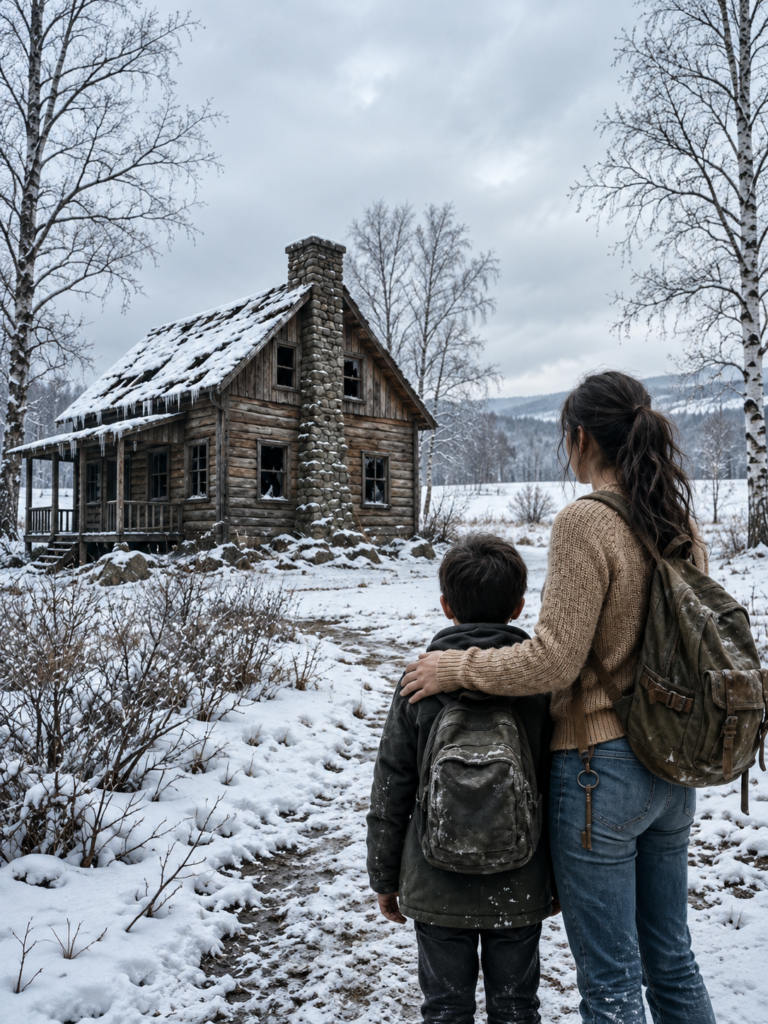
At its center stood a cabin.
It was small, built of weathered logs silvered by age, with a heavy stone chimney and a roof bowed beneath the snow.
There was no smoke, no light, no sign of anyone.
But it had walls.
A door.
A place out of the wind.
Marin almost wept.
The dog climbed onto the porch and scratched at the entrance.
Marin half carried Toby up the steps and reached for the latch.
It lifted.
The door swung inward.
She pushed Toby inside and closed it behind them.
The cabin was almost as cold as the outdoors, but the wind vanished. For several seconds they stood in darkness, listening to their own breathing.
Marin switched on her phone just long enough to examine the room.
A woodstove occupied one corner. Beside it stood a box filled with split firewood. A tin of matches rested on the warming shelf.
There was a bed, two chairs, a table, a workbench, and rows of shelves holding cans and jars.
The blankets were folded.
The floor was swept.
It looked less like an abandoned cabin than a home whose owner had stepped outside and somehow never returned.
Marin had no strength to wonder why.
She knelt before the stove.
Her mother had taught her to build a fire during a camping trip years ago. Small shavings first, then bark and kindling, then larger pieces as the flame gathered strength.
Her stiff fingers fumbled twice with the matches.
On the third attempt, the wood caught.
Soon the stove began to tick as the iron warmed.
Marin pulled off Toby’s wet boots and wrapped him in blankets near the heat. She melted snow in a pot and coaxed him to drink.
Color slowly returned to his face.
The dog shook itself, crossed the room, and climbed into a low wooden chair beside the stove.
Not beside the chair.
Into it.
The old animal curled against the worn seat with the satisfaction of someone returning to a favorite bed.
Marin watched her.
“You know this place.”
The dog’s torn ear twitched.
On the workbench beneath the window stood a coffee can filled with folded dollar bills. Small carving tools lay arranged beside it.
A name had been cut into the wood.
MERCER.
Marin ran her fingertips across the letters.
She didn’t recognize it.
She searched the shelves and found canned beans, peaches, corn, crackers, rice, and coffee. Some supplies were old, but the undamaged cans looked usable.
She opened the peaches for Toby and warmed beans for herself.
The dog watched from its chair.
Marin put a little food into a bowl for her too.
When the animal climbed down, Marin noticed the wound on its front paw: an ugly cut surrounded by swollen skin.
She heated more water, gently washed the wound, and fashioned a temporary bandage from a clean flour-sack towel.
The dog rested its muzzle against her knee.
“You found us somewhere warm,” Marin murmured. “I can at least do this much.”
“She’s a girl,” Toby said.
Marin kept working, afraid to react too eagerly to his voice.
“You think so?”
“I know.”
“Then I guess she needs a name.”
Toby considered the dog.
“Juno.”
“Juno?”
“Like the moon.”
Marin smiled.
“Juno it is.”
The dog lifted her head when she heard it.
For the first time in almost a year, Toby’s mouth curved toward a smile.
Later, with the stove burning steadily and Toby asleep beside Juno’s chair, Marin lit a kerosene lamp and explored the cabin.
A chipped mug carried the painted name Gus.
On the windowsill stood tiny wooden animals: a bear, an owl, and a running dog with one notched ear.
The carving was unmistakably Juno.
Above the bed hung a calendar from two winters earlier. Its days had been crossed off in pencil until a Tuesday near the end of November.
After that, nothing.
A worn black Bible lay beneath a pair of reading glasses. When Marin opened it, an old photograph slipped out.
A young man stood beside a smiling woman who held a baby girl.
The handwriting on the back was small and slanted.
My whole heart gone.
Marin sat on the bed, studying the photograph.
A man named Gus Mercer had lived here. He had loved someone. Lost someone. And, judging by the untouched calendar, he had never come home from whatever had happened two winters before.
Yet somebody had kept the wood dry, the food stocked, and the door unlocked.
She spent the night feeding the fire.
By morning, the storm had stopped.
The world outside was buried in clean white snow. Behind the cabin stood a woodshed filled with seasoned logs, a hand pump, an outhouse, a smokehouse, and a root cellar.
Everything showed the care of a man who had worked hard to make a lonely place livable.
The road was nowhere in sight.
They would be trapped for days.
Strangely, Marin wasn’t afraid.
For the first time since her mother’s death, nobody was demanding her wages, threatening to separate her from Toby, or telling her she occupied more space than she deserved.
She made coffee and sat at the table.
Then she brought out her mother’s cookie tin.
She hadn’t opened it since the funeral. Grief had made its contents feel untouchable.
Inside were photographs, a nurse’s aide pin, a pressed flower, and a child’s drawing of a house with too many windows.
At the bottom lay a folded sheet of lined paper.
Marin recognized neither the handwriting nor the signature at first.
The letter began with a greeting to her mother.
Dear Laney.
The writer explained that years ago, during one terrible winter, Laney had given him a warm meal outside the diner where she worked weekends.
He had been homeless.
His wife and little daughter had died in a house fire. Since then, he’d wandered from town to town, unable to imagine any future worth living for.
That night, he’d walked toward the diner intending to eat one final meal before ending his life.
Laney had carried food outside.
But instead of leaving it beside him, she had sat on the cold back step and asked his name.
She’d listened.
She’d treated him as though his answer mattered.
Because of those few minutes, he’d decided to live.
The letter described how he’d found work, saved money, bought forty acres in the mountains, and built a cabin with his own hands.
He’d tried to find Laney again, but she’d moved away.
So he had written down an invitation.
If she or her daughter ever found themselves with nowhere else to go, there was a cabin off the old pass road.
The door would be unlocked.
They could stay as long as they needed.
Marin read the words twice.
Then her eyes reached the signature.
Your friend, Gus Mercer.
She looked toward the workbench.
At the letters carved into the wood.
At Juno, sleeping peacefully in the chair that had been waiting for her.
At Toby, wrapped in blankets before the stove.
Her mother had carried this letter for more than a decade. She had never spoken of it, never used the offer, never told her children that somewhere in the mountains a stranger had left a door open for them.
And now, without knowing where they were going, they had found it.
Toby came beside her and read the final paragraph over her shoulder.
“He meant us,” he whispered.
Marin nodded, unable to speak.
“He didn’t even know about me yet,” Toby continued. “But he meant us.”
She put an arm around him.
“Yes, buddy. I think he did.”
Toby looked around the little room.
“So we aren’t stealing by being here?”
Marin pressed her cheek against his hair.
“No. We’re exactly where we’re supposed to be.”
Outside, snow weighed down the pines.
Inside, the fire warmed the room that a lonely old man had kept ready for a woman who had once saved his life.
But Marin didn’t yet know that Gus Mercer had left behind something more than an invitation.
And she didn’t know that, four days after Carla forced them out, someone would come up the mountain determined to take Toby away.
Part 2
The next three days unfolded with a strange, unfamiliar peace.
Marin had spent the year since her mother’s death living in a constant state of calculation. How many hours could she work before Toby needed her home? How far could a bag of groceries stretch? How much of her paycheck could she hand over before there was nothing left for his medicine?
At the cabin, the work was different.
She gathered wood, melted snow, heated food, and watched the fire. Each task had a clear purpose. Each completed chore made their small world warmer or safer.
Nobody told her it wasn’t enough.
Toby changed even faster than she did.
On the second morning, she found him standing at Gus Mercer’s workbench, studying the neat row of carving tools. He’d rolled up the sleeves of the old canvas coat hanging by the door and placed a small block of pine in a vise.
Marin watched quietly.
Before their mother died, Toby had loved building and repairing things. He’d once dismantled the kitchen toaster because he wanted to understand why the bread came out brown. Laney had been furious until he’d put it back together.
After the funeral, his curiosity had seemed to disappear along with his voice.
Now he worked a carving tool carefully along the pine, frowning in concentration.
“Whatcha making?” Marin asked.
“Don’t know yet.”
“Fair enough.”
She left him to it.
By afternoon, chips of pale wood covered the bench, and Toby was talking softly to Juno about grain and knots and why one piece of wood behaved differently from another.
The old dog lay near his feet, lifting her head whenever he addressed her.
Marin listened from the stove, smiling at a pot of beans.
On the third morning, Toby turned his attention to the frozen hand pump behind the cabin.
He spent hours trying to free it. He carried hot water outside in kettles, searched Gus’s supplies for oil, and brought the pump handle to the kitchen table to clean it.
Marin helped where he needed another pair of hands, but the repair was his idea.
When the pump finally rattled and sent a stream of water into the bucket, Toby ran across the snow toward the cabin.
“Marin! It works!”
She came to the door.
“What?”
“The pump! I fixed it! We don’t have to melt snow anymore!”
His cheeks were bright red. His eyes shone.
Marin laughed, a sound so unfamiliar that she almost startled herself.
“You sure did.”
“Gus had everything. The right oil, the right tools, everything.”
He looked toward the woodshed.
“I think I would’ve liked him.”
Marin studied the cabin, the carefully stacked firewood, and the old dog waiting patiently beside the steps.
“I think he would’ve liked you too.”
That evening, Toby returned to his carving.
He’d found the little wooden dog Gus had made and set it on the table. He wanted to make another one, with the same notched ear.
His first attempt barely resembled an animal.
The second had a crooked body.
He burned the third in the stove and started again.
Marin watched him working in the lamplight, his brow creased, his tongue caught between his teeth.
It occurred to her that this cabin was doing more than sheltering them.
It was giving her brother something grief had taken away: a reason to look forward to the next morning.
While Toby carved, Marin began reading Gus’s journals.
They were inexpensive notebooks stacked above the bed, their covers marked with years in careful handwriting.
Most entries described ordinary life.
Snowfall. Wood cut and stacked. Repairs to the roof. A bad hip. A successful batch of jerky. Juno’s habit of chasing animals she could never catch.
But certain lines appeared again and again.
Thought about Laney today. Hope she’s warm.
Marin turned another page.
Asked in town about that old diner. Closed years back. Nobody knew where she went.
She read late into the night, following the years of a man she’d never met.
Gus had spent much of his life alone, but he had never forgotten the young waitress who sat beside him in the cold.
He kept looking for her.
Eventually, he found her last name.
He searched again.
And then, in one notebook, an entry appeared without a date for the weather or a note about the woodpile.
Found her. Too late. She’s gone.
Marin stopped reading.
The dates were close to those of her mother’s death.
Gus had finally discovered what became of Laney, only to learn that she was already dead.
Marin stared at the page until the words blurred.
Her mother had saved a man’s life without knowing it. He had spent years trying to thank her, and in the end neither one had lived long enough for the meeting.
She could imagine Gus sitting at the same table, perhaps with Juno asleep by his chair, learning that the person he’d wanted to find was beyond his reach.
She turned the next pages carefully.
After that entry, the journals changed.
Gus began writing about a lawyer in town.
He’d learned that Laney had left two children, a daughter and a son. They had been moved after her death, and nobody seemed able to say exactly where they were.
He wanted to leave them his property.
There were problems with identifying the heirs. The lawyer needed a way to describe them in a will that could be legally administered if they were eventually found.
Gus wrote that he had settled on leaving everything to Laney Kessler’s children, identified by their relationship to her.
He seemed certain they would eventually appear.
Marin read the passages more than once.
The letter in her mother’s tin had offered shelter.
The journals suggested something far greater.
The old man hadn’t simply invited Laney’s children to use his cabin.
He had tried to give it to them.
Near the back of the final notebook, the handwriting grew shaky.
Gus wrote of a cough that wouldn’t go away, growing tired, and a man named Hollis.
Hollis knows the whole of it. He’ll keep the place up, the wood box full, and a light on.
Marin closed the notebook.
She looked toward the shelves of food and the dry logs beside the stove.
Somebody had indeed been coming here.
For two winters, someone had stocked the cabin, maintained the outbuildings, and made sure the unlocked door still opened.
Someone had been honoring the promise of a dead man.
And his name was Hollis.
On the fourth morning, the sky cleared to a brilliant blue.
By afternoon, a faint metallic scraping carried up the mountain. Somewhere below, county plows were cutting a path through the buried pass road.
Marin stood on the porch listening.
Soon she heard another engine, closer and higher-pitched.
Juno rose from her chair, limped to the door, and gave a low bark.
A snowmobile emerged from the trees and entered the clearing.
The rider was an older man, broad through the shoulders, wearing a faded Forest Service parka with its patches removed. His hair was white around the edges of his cap, and he moved stiffly as he climbed off.
He stopped when he saw smoke rising from the chimney.
Marin stepped into the doorway, Toby behind her.
“We’re not here to steal anything,” she called. “Our car broke down in the storm. We just needed somewhere warm.”
The man didn’t answer immediately.
His gaze moved across the porch and down toward Juno.
The dog gave a short, excited sound and limped into the snow.
The stranger dropped into a crouch.
“Well, there you are, girl.”
He cupped her graying face in his hands.
“I’ve been looking for you.”
Juno pressed against him, tail moving slowly.
The old man looked toward Marin.
“She bring you here?”
Marin hesitated.
“From the road. We were walking through the storm, and she kept making us follow.”
He looked at the dog again.
“Of course she did.”
He rose with a grunt.
“Name’s Hollis. I look after this place.”
Marin felt a sudden rush of relief.
“Hollis?”
“You know me?”
“Not exactly. Gus wrote about you.”
The man’s face changed.
“You knew Gus?”
“No. But I found his journals.”
Hollis looked past her into the cabin. Warm light filled the doorway.
“Well,” he said softly. “I suppose we’d better talk.”
She invited him inside.
He stamped the snow from his boots and stood near the stove, taking in the occupied room.
The table had been used. Supplies had been moved from the shelves. Toby’s carving tools lay beside a small wooden dog.
For a while, Hollis said nothing.
Then he rubbed a hand over his face.
“Gus would’ve been glad to see this.”
He sat down heavily.
“He was the best man I ever knew. And maybe the loneliest.”
Marin put the kettle on and took the folded letter from her mother’s cookie tin.
“There’s something I need to show you.”
Hollis unfolded the paper.
As he read, his weathered features slowly changed.
He reached the signature, removed his glasses, and looked at Marin.
“Laney.”
She nodded.
“She was our mother.”
Hollis’s eyes filled.
“The diner girl?”
“Yes.”
He looked toward Toby, then back at Marin.
“Gus talked about her for twelve years. I knew that man twelve years, and I don’t think a month passed that he didn’t mention her.”
Hollis stared at the letter.
“He always said she’d done more for him in ten minutes than anybody else had managed in years.”
Marin pulled out the journals.
“I read about the lawyer. About the will.”
Hollis nodded slowly.
“Then you know some of it.”
“Is it true? Did he leave this place to Mom’s children?”
“Yes.”
“To us?”
“That’s what he intended.”
Marin’s hands tightened around her coffee mug.
Hollis leaned forward.
“Gus had a wife once. A little girl too. Lost them both in a fire. For a long time afterward, he didn’t care whether he lived or died. Your mother gave him a reason to try again.”
He looked around the cabin.
“He built this place because he needed to learn how to live. Then he kept it ready because he wanted somebody else to have a place when they needed one.”
“Why didn’t he find us?” Marin asked.
“He tried. The county had moved you after your mother’s death. He couldn’t get reliable information. His lawyer tried too.”
Hollis paused.
“Then Gus got sick. Cancer. By the time he understood how little time he had, finding you had become the most important thing he couldn’t finish.”
Marin thought of the calendar, its final day crossed out in pencil.
“I kept the wood here,” Hollis continued. “Checked the supplies. Fed Juno when she let me. Figured if he believed you might turn up, somebody ought to make sure his place was ready.”
Toby looked up from his carving.
“You were waiting for us?”
Hollis gave him a gentle smile.
“That’s one way of putting it.”
For a moment Marin wanted to believe the danger was over.
They had a roof, food, and a man who knew the history of the place. Their car could eventually be recovered. The lawyer could explain the will.
Then Juno raised her head.
A low growl rolled out of her chest.
Hollis stopped speaking.
An engine sounded beyond the trees.
Headlights appeared where the clearing met the buried access road.
A county SUV with chains on its tires climbed toward the cabin and stopped beside Hollis’s snowmobile.
Marin rose.
Two people stepped from the front seats.
A sheriff’s deputy.
A woman wearing a county identification lanyard, carrying a canvas bag.
Then the back door opened.
Carla climbed out.
The fear Marin had been holding back since the kitchen returned so quickly that her legs felt weak.
Toby stood beside her.
She put a hand on his shoulder.
“Stay behind me, okay?”
Hollis came to the door.
“Let me help you talk to them,” he said quietly. “I’ve known most of the people in this county for forty years.”
The deputy approached first.
“We’re looking for Tobias Kessler. Twelve years old.”
Marin swallowed.
“He’s here. He’s my brother.”
“We received a report that he was removed from his legal guardian’s home four nights ago. We also found a vehicle registered to Marin Kessler abandoned along the pass road.”
“It broke down,” she said. “We got caught in the storm.”
The woman with the lanyard stepped forward.
“I’m with County Family Services. We need to make sure Tobias is safe.”
Her tone was patient, but Marin had learned that patient voices could still deliver terrible decisions.
“Can we come inside and talk?”
Marin stepped aside.
The deputy examined the room while the caseworker surveyed the bed, stove, food, and neatly arranged supplies.
Toby sat at the table with his half-finished carving. Juno lay close beside him.
The woman crouched to his height.
“Tobias, are you warm enough here?”
He looked down.
“Do you have enough food?”
He said nothing.
Then he slid off his chair and crossed to Marin, taking hold of her sleeve.
The caseworker noticed.
“He hasn’t talked much since our mom died,” Marin explained.
The woman nodded.
“I can see he’s comfortable with you.”
Carla spoke from near the door.
“She took him without permission. I’m his guardian.”
The caseworker turned.
“I understand you’ve made that report. I’d like to hear what happened from the beginning.”
Marin looked straight at Carla.
“Tell her about the bag.”
Carla went rigid.
“What?”
“The blue duffel bag. You had it packed before I came home from work.”
“Marin—”
“Tell her you told me to leave that night. Tell her you wanted Toby to stay because you needed his support check.”
The deputy looked toward Carla.
The caseworker stopped writing.
Carla’s face reddened.
“You don’t know what I’ve been dealing with.”
“Then tell them.”
Carla pressed her hands together.
“Your uncle left me in October. He left the debts, the mortgage, everything. I’ve been trying to hold that house together.”
Her voice broke.
“I couldn’t afford it anymore. I couldn’t afford all of us.”
Marin’s anger rose, but she kept her voice steady.
“You could’ve told me.”
“I did tell you we were struggling.”
“You told me every week when I handed you thirty dollars.”
Carla looked away.
For several seconds nobody spoke.
Then she said, “Toby’s check was the only money I could count on.”
Marin felt the old hurt return.
“He isn’t a check.”
Carla covered her face.
“I know.”
“No. You didn’t. You looked at him and saw four hundred dollars. You looked at me and saw somebody you could throw away.”
The caseworker watched both women carefully.
Marin continued.
“I work. I pay what I can. I make sure he eats. I make sure he gets his breathing treatments. And when you told me to leave, you expected me to walk out and leave him behind.”
Carla shook her head.
“I didn’t think you’d really take him.”
“I promised our mother I’d keep him close.”
Marin looked down at Toby’s hand gripping her sleeve.
“I wasn’t going to break that promise because you needed his money.”
Hollis cleared his throat.
“There’s something else these folks ought to know.”
He reached inside his parka and withdrew a long envelope, creased from being carried.
“I knew August Mercer,” he said. “The man who owned this property. I was with him at the end.”
He explained Gus’s history.
His wife and baby daughter.
The house fire.
The years of homelessness.
The young waitress who had saved his life with a meal and a conversation.
Then he handed the envelope to Marin.
“Gus asked me to hold onto this. He hoped I’d get the chance to give it to the right people.”
Marin stared at the writing on the front.
To Laney Kessler’s Children.
She carefully opened it.
Inside was a letter written in the same slanted handwriting as the one in her mother’s cookie tin.
Gus addressed two children whose names he didn’t know. He told them about their mother, about the night she’d helped him, and about his wish to repay her kindness.
He had left them his cabin, the forty acres surrounding it, the small amount of money he possessed, and anything else that remained of his estate.
There was a will with a lawyer in town.
He hoped the property would give them something he once had nearly lost forever.
A safe place to begin again.
The letter ended by asking them to care for one another and keep the door open when somebody else needed shelter.
Marin’s voice faltered as she read.
Toby moved beside her and studied the last lines.
“He’s like Mom,” he said quietly.
Marin looked at him.
“He did what she did.”
“Yes,” she whispered. “He did.”
The caseworker asked to see the letter. Hollis explained the will, the lawyer, and the two-year search for heirs who couldn’t be located.
He also explained that the county had been preparing to claim the land because of unpaid property taxes.
Marin felt her stomach tighten.
Even now, the cabin might not truly be theirs.
Hollis assured her the lawyer would need to handle the estate and taxes properly, but the documents identified the children of Laney Kessler as Gus’s intended heirs.
Nothing could be decided simply by reading the letter in the cabin.
Still, the explanation changed the conversation.
Marin was no longer merely a young woman occupying an unfamiliar property with her brother.
She was a possible legal heir whose mother had been named by the man who owned it.
The deputy and caseworker stepped onto the porch to confer.
Carla sank onto the bench by the door.
“I thought you’d leave him,” she said at last. “I thought you’d go, and he would stay, and I’d figure out how to keep everything together.”
Marin looked at her.
For the first time, Carla seemed smaller than the woman who had ordered them out.
Her thin coat was damp. Her hands were red from the cold. She looked exhausted, frightened, and ashamed.
Marin understood desperation.
But understanding it did not undo what Carla had done.
“You could’ve asked us for help,” she said. “Instead, you made us feel like we didn’t belong anywhere.”
Carla lowered her head.
“I know.”
Hollis quietly added another log to the stove.
When the caseworker returned, her expression was serious.
“I believe you, Marin,” she said. “And what happened at your aunt’s house needs to be reviewed.”
Marin took a breath.
The woman continued.
“I also believe your brother is being cared for. But there are procedures for changing legal custody. I can’t simply decide here that you are his guardian.”
Marin felt Toby tense beside her.
“A judge has to make that decision,” the caseworker explained. “Until proper arrangements are approved, I can’t leave him in an unauthorized placement.”
Her voice softened.
“Tobias, I’m going to need you to come down to town with me tonight.”
Toby tightened his hold on Marin.
“No.”
The word was sharp and clear.
Everyone turned.
The boy who had spent a year speaking only in fragments looked directly at the caseworker.
“I’m staying with my sister.”
Marin bent toward him.
“Toby—”
He shook his head.
“We don’t leave each other. That’s our rule.”
Tears blurred Marin’s vision.
She knew he was frightened. She could feel his whole body trembling beside her.
But he did not hide his voice this time.
Carla suddenly stood.
“Don’t.”
The caseworker looked at her.
“Ma’am?”
“Please don’t take him.”
Carla rubbed her face with both hands.
“I’m still his guardian, aren’t I? I still have a say?”
“Your consent is important, yes.”
“Then I want him to stay with Marin.”
Marin stared at her.
Carla’s voice shook.
“I had the legal papers. I got the check. But Marin was the one who took care of him. She was the one who got up when he couldn’t breathe, and stayed awake when he had nightmares.”
She looked at Toby.
“I told myself Marin was old enough to manage. That she’d somehow be fine without me. But all I did was make my problems theirs.”
She turned back to the caseworker.
“I’ll sign what needs signing. He belongs with his sister.”
The caseworker looked at Carla, then at Hollis.
Hollis nodded.
“I’ll help them,” he said. “Whatever they need.”
The woman considered the warm room, the boy beside his sister, and the documents Hollis had produced.
Finally, she closed her notebook.
“Here’s what I can authorize tonight.”
She explained that with Carla consenting to a temporary kinship arrangement, and Hollis available as a responsible local contact, Toby could remain with Marin for the time being.
There would be home visits, paperwork, and a hearing.
The decision was not permanent.
But nobody was taking Toby down the mountain that night.
Marin tried to thank her.
Her mouth opened, but no words came.
She covered her face and cried.
Toby wrapped both arms around her waist.
Hollis turned toward the stove, giving them some privacy.
The caseworker handed Marin her card before leaving.
“Call me if anything changes,” she said. “And keep this place warm.”
Carla paused at the doorway.
She looked at Toby for a long moment.
“Be good for your sister,” she whispered.
Then she followed the others outside.
The SUV’s headlights swept across the clearing and vanished between the pines.
Marin stood listening until the engine faded.
Toby took her hand.
“I didn’t want to talk,” he admitted. “But they were going to take me.”
Marin knelt in front of him.
“You were brave.”
He shook his head.
“It wasn’t brave. It was true.”
She pulled him close.
For four days, the cabin had kept them alive.
Tonight, a dead man’s promise had helped keep them together.
But there were still lawyers to visit, taxes to settle, and a court to convince.
A warm cabin and a letter were not the same thing as a legally secure home.
For the first time, however, Marin had people willing to help her build one.
Part 3
The road reopened the following week.
Hollis drove Marin and Toby into town, where a lawyer kept an office above the feed store.
The office smelled of old paper and furniture polish. Filing cabinets crowded the walls, and a small heater rattled beneath the window.
The lawyer was an older man with tired eyes. When Hollis explained who the children were, he stared at them for several seconds before leaving his desk.
He returned carrying a thick file.
“August Mercer,” he said, setting it down. “I’ve been holding this estate open for two years.”
He turned the pages carefully.
Gus had signed a will leaving his property to the children of Laney Kessler. He hadn’t known their names, but he’d made his intentions unmistakable.
The lawyer examined Laney’s letter, the records identifying Marin and Toby as her children, and the other information Hollis had brought.
Then he removed his glasses.
“Mr. Mercer was determined that you two would be found.”
Marin looked down at the papers.
“Does that mean we can keep the cabin?”
“There are matters to settle. The estate, the outstanding taxes, and proof of your identities all have to be handled correctly.”
He leaned forward.
“But this is what Gus intended. And I believe we can establish that you are the people he meant.”
The county had begun proceedings to take the land for unpaid taxes. The lawyer dealt with that problem as part of settling the estate.
It took months, several trips into town, and more paperwork than Marin had ever imagined.
Throughout the spring, the arrangements for Toby’s care also moved through the county’s review process. There were meetings, questions, and visits to the cabin.
Marin answered every question she could.
Hollis helped with everything else.
By the time the high mountain snow finally melted, the Mercer property legally belonged to Marin and Toby.
Forty acres of pine and meadow.
The cabin and its outbuildings.
A savings account containing a little more than nine thousand dollars.
And three hundred twelve dollars in the old coffee can on the workbench.
It wasn’t the kind of inheritance that bought mansions or expensive cars.
But it was enough to give them a beginning.
Marin used part of the money to repair the pump properly, replace a cracked window, and buy an old but reliable truck.
She paid the necessary expenses and opened her first bank account.
Standing at the bank counter with her name on the paperwork, she thought about the forty-one dollars she’d carried out of Carla’s house.
Back then, she’d believed survival meant making each dollar last until the next paycheck.
Now she had something she’d never expected.
A home nobody could simply order her to leave.
That autumn, Toby began seventh grade.
The school bus stopped at the bottom of the mountain road, and every morning Juno walked down with him.
The first day, Marin worried until the bus returned.
Then Toby came through the door talking so quickly she could barely follow him.
He’d met a boy named Diego who liked building things. His shop teacher had promised they would make birdhouses. Someone at school wanted to display his carved wooden dog.
Toby talked through dinner.
He talked while finishing his homework.
He talked about the next day’s classes until Marin reminded him that both of them needed sleep.
Sometimes she sat at the table pretending to read, just listening.
There had been a time when she would have given anything to hear three sentences from her brother.
Now he could fill an entire evening with stories about school.
Juno settled permanently into her old chair. She grew heavier, moved more slowly, and no longer wandered far from the cabin.
Hollis visited most Sundays.
He showed Toby how to split firewood safely, read approaching weather, and prepare the water system before the first hard freeze.
He helped Marin learn which repairs needed immediate attention and which could wait until spring.
When the chores were finished, they ate together at Gus’s table.
Hollis told stories about the old man—how stubborn he could be, how carefully he carved, and how he pretended not to care when Juno stole his chair.
One evening, Hollis watched Toby playing with the dog on the braided rug.
“Gus would’ve loved this,” he said.
Marin followed his gaze.
The table was crowded with dishes. Toby’s wooden animals lined the windowsill. A schoolbook rested beside the lamp.
For years the cabin had been filled with one man’s quiet loneliness.
Now it held the ordinary noise of a family.
Marin reached across the table and put her hand over Hollis’s.
“He would’ve loved you being here too.”
The old man cleared his throat and said something about the stove needing attention.
It didn’t.
In January, Marin returned to community college.
She enrolled in the nursing aide courses she’d abandoned when her mother became ill, taking two classes at a time while continuing to work.
One evening she sat at the table with a textbook open before her.
Toby glanced up from his carving.
“What’s that for?”
“School.”
“I know that. What are you studying?”
Marin smiled.
“I’m going to do what Mom did. Help take care of people.”
Toby considered her answer.
“You already do.”
He returned to his carving without noticing how long she sat looking at him.
Not everything healed so easily.
That spring, Marin learned that Carla had lost her house.
The bank had taken it. Her boyfriend had left. She’d moved into a rented room in town and was cleaning offices at night.
Marin remembered the packed duffel, the frozen highway, and her brother’s frightened face.
She couldn’t pretend those things hadn’t happened.
But she also remembered her mother’s words.
Be kind to whoever’s in front of you.
One evening, Marin sat down and wrote Carla a short letter.
She didn’t offer forgiveness she wasn’t ready to give.
She told her that Toby was doing well, that he was talking again, and that the two of them were living at the old Mercer cabin.
She added that Carla could visit if she wished.
In early summer, Carla came up the mountain.
She sat stiffly on the porch while Toby showed her a birdhouse he’d made.
Marin didn’t force a conversation or demand an apology.
Afterward, she saw Carla sitting in her car at the bottom of the road, crying where she thought nobody could see.
Carla returned twice more before autumn.
Things were still uncomfortable.
But the visits became possible.
For Marin, that was enough of a beginning.
As the months passed, people occasionally asked why she didn’t sell the property.
Forty acres could bring enough money to buy a house in town, closer to school, stores, and neighbors.
Marin understood the practical argument.
The winters were hard. The road was long. Every repair required money or labor.
But she always gave the same answer.
“Somebody left that door open for us. I want to keep it open for somebody else.”
She meant it.
Each fall she stocked the shed near the road with firewood, canned food, matches, and a folded blanket.
On storm nights she placed a lamp in the window facing the pass road.
And she left the door unlocked.
The following winter, a powerful storm swept across the mountains.
Snow buried the access road, and the wind shook the cabin walls.
Late that evening, someone pounded on the door.
Marin opened it to find a hunter standing outside, his clothing stiff with snow and his face dangerously pale.
He had lost his way in the whiteout.
He’d been stumbling through the trees when he noticed the light in the window.
Marin brought him inside.
She put dry blankets around his shoulders, warmed food on the stove, and helped him recover near the fire.
The hunter kept looking at the lamp.
“I don’t know what would’ve happened if I hadn’t seen that light.”
Marin glanced toward the window.
“A man named Gus left it burning for people who needed it,” she said. “I’m just keeping it going.”
The hunter didn’t understand the whole meaning.
She didn’t need him to.
Later, after he had fallen asleep near the stove, Hollis sat beside Juno, scratching the old dog’s ears.
“People say blood makes a family,” he murmured.
Marin looked toward Toby, asleep beneath a quilt on the bed.
Hollis continued.
“But sometimes family is the people who show up and stay. Even when they don’t have to.”
Marin thought about her mother.
About Gus Mercer, who had built a home for people he’d never met.
About Juno limping out of a blizzard.
About Hollis keeping his friend’s promise alive through two lonely winters.
She didn’t answer.
Instead, she stood and went through the familiar evening chores.
She banked the fire, filled the wood box, and made sure everyone was warm.
Then she carried the kerosene lamp to the window.
Outside, the pines disappeared into the falling snow.
She adjusted the wick until the flame burned steady and bright.
Somewhere beyond the clearing, the mountain road lay buried in darkness.
Marin placed the lamp where it could be seen from the trees.
And she left it burning.
In case somebody came.


