
Part 1
The first time the goats stopped, Rachel Harper blamed the fence.
The second time, she looked for a snake.
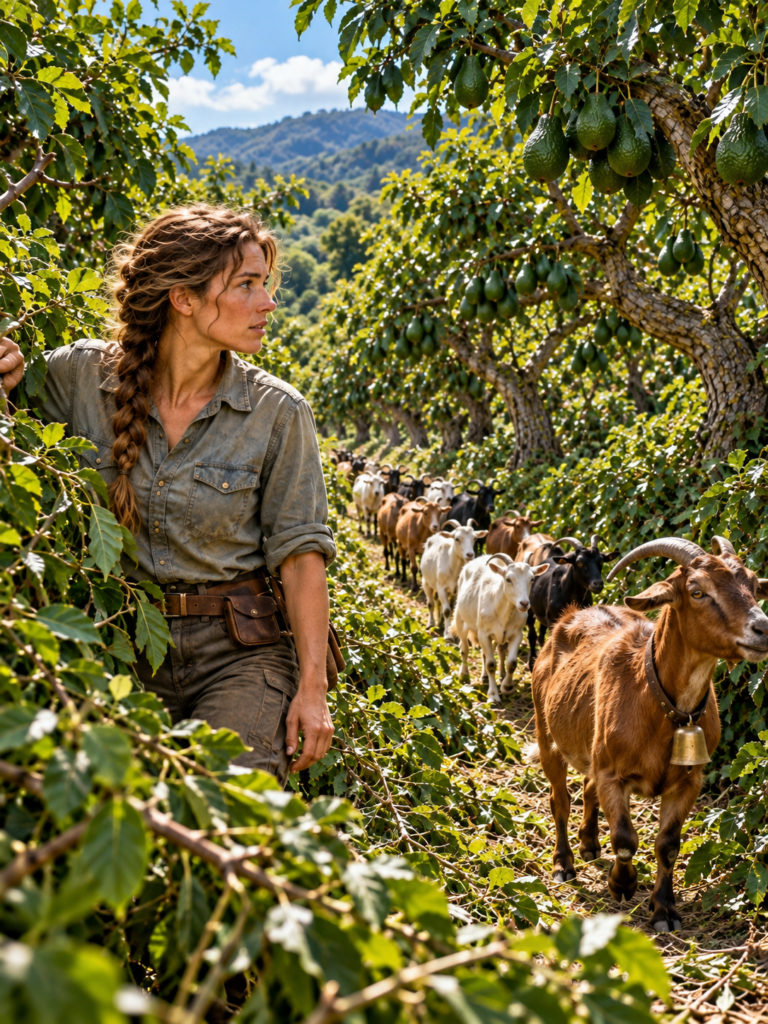
On the third morning, with the July sun just clearing the firs, twenty-four goats stood shoulder to shoulder in the blackberry thicket and refused to take another step. Juniper, the old brown doe who usually led them through anything, held her head high. Her brass bell did not move.
Ellie came up the slope behind her mother, a notebook tucked inside the waistband of her jeans. “They did it again?”
“Exactly the same spot.”
“Maybe they know something we don’t.”
Rachel stared at the wall of canes ahead of them. Six months earlier she had bought fifty acres of that wall for one dollar. By then the whole town of Alder Creek had a name for the place, and another for the woman foolish enough to take it.
The place was the Harlan mess.
Rachel was the dollar farmer.
She had laughed along once or twice. Lately, she found nothing funny about either name.
That cold January morning at Keene’s Diner, the advertisement had been squeezed between a notice for used baling twine and a church rummage sale.
FIFTY ACRES. OLD HARLAN PROPERTY. TRANSFER FOR $1 TO BUYER ACCEPTING OUTSTANDING OBLIGATIONS. INQUIRE WITH ESTATE ATTORNEY.
Rachel read it twice while her coffee cooled. Outside, pickups hissed along the wet road. Inside, Tom Keene worked the griddle and the waitress called everyone “hon” without looking up.
Rachel was thirty-five. She had worked with goats for twelve years, first on her own father’s place and later for a county-backed vegetation-management crew that moved rented herds through brushy pastures and utility corridors. Goats could make a dent in blackberries that defeated a man with a brush cutter. The work had never made her rich, but it had paid the rent and kept a dozen farms from disappearing under thorns.
The contract ended the previous fall. Funding dried up, the crew dissolved, and her supervisor shook her hand beside a loading ramp as though there were something either of them could say.
What Rachel kept was an aging stock trailer, twenty-four goats, more fencing than most people wanted to look at, and a fourteen-year-old daughter who could turn a rough pencil sketch into a map.
She and Ellie rented two rooms over the bakery. The goats grazed a muddy field belonging to Tom’s cousin on the edge of town. Rachel had enough in the bank for groceries and a few repairs, not another winter without work.
She took the clipping to the counter.
“What’s wrong with the Harlan place?”
Tom turned a pancake. “You want the short answer or the fifty-year version?”
“The honest one.”
“Blackberries. Bad access. Back taxes. There’s a ditch swallowed up in there somewhere, too. The Harlans hired a machine to clear it four years ago, and it sank up to the axle. Took another machine to pull it out.”
He glanced at the clipping.
“Rachel, a dollar’s too much.”
Most people in Alder Creek agreed. The last Harlan who had lived on the property died in the 1990s. The heirs lived in Portland and Spokane and never appeared except when a lawyer needed a signature. Over the years, the blackberry canes climbed the fences, then the old track, then the empty sheds. At the road, the brambles reached high enough to hide a standing man.
Rachel drove out the next morning.
A fog lay low in the fields. Her truck’s tires crunched on frozen gravel where the road turned uphill, and beyond the broken gate was a tangle of blackberry canes thick as rope. She walked the shoulder slowly, reading the land the way her father had taught her: first where the water moved, then where somebody had once made it move differently.
A line of stones ran across the slope, too straight to be natural. Behind it stood a row of wind-bent firs. She could make out taller shapes beyond them, but not enough to tell what they were.
At the base of the broken gatepost, something square and gray shone in the mud. Rachel crouched and pulled it free.
A small zinc tag, rust-stained and pierced by a single nail hole. There were marks beneath the dirt, but no letters she could read.
She put it in her coat pocket.
Her father would have spent an hour standing exactly where she stood, asking what the hillside looked like before the road, before the weeds, before whoever had quit taking care of it.
When Rachel was sixteen, her parents had lost their own little apple place near Silverton. Her father sold it after three bad seasons and a stack of bills that always grew faster than the crop. The new owner tore out the old trees to make room for a storage yard. Rachel watched the excavator knock down the first trunk. Her father died the following year.
She still remembered one thing he’d said while they walked the orchard rows: “A neglected place isn’t always an empty one.”
She had hated that sentence for years. It sounded like consolation from a man who couldn’t save his own farm.
That evening Ellie turned the zinc tag over beneath the kitchen light. She had dark hair perpetually escaping its braid, and a habit of looking at things sideways, as if a better angle might make them confess.
“It’s from something,” she said.
“That’s the theory.”
“Maybe a trail marker.”
“Maybe.”
“Are you really thinking of buying that place?”
Rachel set the estate attorney’s figures on the table. The purchase price was one dollar, but the neglected property carried forty-two thousand dollars in unpaid taxes and assessments. The county had agreed to a schedule of six seven-thousand-dollar payments through December 2010 if the new owner kept up current charges. The county also wanted the brush cleared back from the roadside by September 30. If she missed the deadline, a contractor would do it and send the bill.
The closing and title work would take nearly all her savings. A small agricultural bank had tentatively offered a thirty-five-thousand-dollar credit line against her livestock, equipment, and signed work agreements.
Ellie traced the numbers with a fingertip.
“That’s not a one-dollar farm.”
“No,” Rachel said. “It’s a farm with a one-dollar door.”
“What if we can’t make the payments?”
Rachel looked at the tag by the sugar bowl. “Then I lose more than a dollar.”
She signed the papers in February.
By that Friday, everybody knew.
At Keene’s Diner, Grant Mercer announced that he’d gladly sell Rachel another fifty acres of blackberry canes for fifty cents if she wanted a bargain. A few men laughed because Mercer owned one of the largest commercial orchards in the county, and when he laughed first, people tended to follow.
He had been trying to acquire the Harlan tract for years. It bordered a spring-fed drainage channel he wanted to use, if the regulators allowed it, as part of a planned orchard expansion. He had expected the property to fall into foreclosure, where its complications might make it cheap.
Instead, a woman with a livestock trailer and a long shot of a plan had stepped in ahead of him.
“You’ll spend your whole summer feeding goats and never see bare ground,” he told Rachel when she came in to pay the rent on her grazing field.
She slid an envelope across the counter to Tom. “They don’t need to see the ground. They need to eat what’s on it.”
Mercer raised his mug in a mock toast. Rachel walked out before he could answer.
At school, two boys started calling Ellie Princess Bramble. Ellie didn’t tell her mother. She didn’t have to. Rachel knew by the way the girl’s shoulders tightened whenever her phone lit up.
By March, Rachel had bought portable electric netting, a solar energizer, and a water tank. The checking account showed eight hundred and thirteen dollars. Her gloves already had holes in the thumbs.
She started along the road because the September deadline was a real one. Every morning before dawn she cut a narrow lane through the blackberries, pushed in fence posts, and set a tight paddock around the herd. Give goats twenty acres to roam, and they would pick their favorite leaves, then lounge in the shade. Keep them in a small enclosure for a few days, supply hay, minerals, and clean water, and they would strip the tender growth from the canes. The dead stems still needed cutting later, but the next pass would be easier.
Juniper always went first. Her brass bell rang beneath the branches, and the others followed the sound.
Ellie came after school, measured progress in feet, and recorded each new section on graph paper.
“How much today?” Rachel asked one evening as they rolled up the netting.
“Thirty-seven feet along the fence. Not counting the bend.”
“Count the bend.”
“I did. It’s ugly.”
“We’ll take ugly.”
On Saturdays they worked together. Rachel hauled water in blue jugs when the truck could not reach the tank. Ellie checked the charger voltage and marked where the goats had nipped new shoots. Neither of them said much about the size of the place that remained untouched.
In late April, a man passing in a pickup slowed down to stare at two hundred yards of bare gray canes beside the road. For the first time, Rachel allowed herself to believe the job might be possible.
Then came the storm.
A windstorm broke over the valley on June 12, snapping alder branches and driving rain into the soil. By morning the netting had blown flat, the charger was off, and eighteen goats had found their way into a neighbor’s newly planted vegetable field.
Rachel spent the better part of the day leading them out one by one, boots sinking in the churned mud. Lettuce lay smashed under hoofprints. The neighbor was furious, and fairly so.
The damage cost seven hundred dollars. Rachel paid it from the credit line, along with the first seven-thousand-dollar installment on the Harlan land.
Three days later Grant Mercer parked his polished truck where Rachel was tightening new braces on the fence.
“Let me take this problem off your hands,” he said. “I’ll assume what you owe and give you five thousand in cash for the trouble.”
Rachel kept twisting the wire until it sang.
“That generous?”
“More generous than September will be.”
She looked toward the brambles. Behind the leafless canes, patches of earth were appearing like small windows. It was not much, but she could see the hillside’s shape for the first time.
“No, thank you.”
Mercer rubbed his thumb along the silver buckle of his belt. “The summer’s long, Rachel.”
“So is the fence.”
He drove off without saying goodbye.
That night she sat at the little kitchen table until the coffee in her mug went cold. The zinc tag lay next to the bills. Ellie was asleep, and the room smelled faintly of flour drifting up from the bakery ovens below.
Rachel took a pencil and added the numbers again. They were no kinder the second time.
She could still turn back. Five thousand dollars was more than she’d had since losing the contract. It would settle the immediate trouble. It might keep Ellie in a real house for a while.
But the stones in that straight line on the hill bothered her. So did the taller trees beyond them. So did the ditch Tom had mentioned, and the machine that had sunk without anyone seeming curious enough to learn why.
In July she moved the goats away from the road and followed a narrow track that had emerged under the canes. The track led toward the stone embankment.
Juniper walked it as she walked every other path—nose down, bell tapping softly, impatient for the next mouthful.
Then she stopped.
All twenty-three goats behind her stopped, too.
Rachel inspected the fence, the brush, and the ground. Nothing moved. No rattlesnake sounded in the leaves. No deer had died nearby. The animals simply stared into the green wall as though an invisible gate had shut.
The next morning they did it again.
On the third, Rachel went back to her truck for a brush hook and a coil of rope.
Ellie followed with her notebook.
“Are we crossing?” she asked.
“We’re going to find out what they won’t.”
Part 2
At first the brush hook struck only canes. Then it caught on wire.
Rachel pulled back a green curtain of blackberry vines and found an old barbed-wire fence hanging low across the path. Beyond it lay a drainage ditch, nearly five feet wide, its dark water hidden by nettles and grass. A rotten plank stretched from one bank to the other. The goats had smelled the water and felt the wire long before either Rachel or Ellie had seen them.
“Well,” Ellie said, “that explains the strike.”
Rachel crouched at the bank. The ditch had steep sides and a soft bottom. A heavy mower driven into it would sink quickly. For four years, people in Alder Creek had used that accident as proof that the Harlan place was worthless. None of them seemed to have asked what the ditch had once been for.
She cut away more vines. Beneath the mud, flat stones lined the near bank. An old wooden gate frame emerged, its hinges broken but still fixed to the posts.
“Someone built this,” she said.
“Obviously.”
“No. I mean someone built it to go somewhere.”
They left the goats on the safe side, found firmer ground farther upstream, and crossed over. Five paces into the brush, Rachel’s hook struck something solid and hollow-sounding. She cleared a patch around it.
A tree trunk, thick and deeply furrowed, rose through the canes. Several small green apples hung high overhead.
She took ten steps east and cut another opening. Another trunk. Ten more steps, another.
Ellie stopped writing and looked through the trees. “Mom.”
They were in rows.
One straight line opened into another, and then a third. The trees had spent decades reaching over the brush, their crowns alive in the sunlight while the blackberries locked up the ground below. Several limbs had fallen, but the trunks were broad and sound. A low stone wall marked the outside edge. Above the orchard, a small spring ran into the old ditch.
Ellie counted aloud as they worked their way through.
Twelve trees in this row. Twelve in the next. Twenty rows, once she could trace them all, though some spaces had to be reconstructed from stumps and old planting mounds.
Two hundred and forty trees.
Rachel had expected a lost fence line or maybe the foundations of a shed. She had not expected an orchard.
On one trunk she found a rusted nail at chest height, surrounded by a pale patch of bark. She took the zinc tag from her pocket. Its single hole slipped neatly over the nail.
For a moment she could hear the machine taking down her father’s trees—the metal teeth, the cracking limbs, the way he had stood beside her and watched without speaking. She put a hand against the rough bark in front of her. The tree was still living. All these trees were still living.
The blackberries had swallowed the orchard, but they had also kept machinery out. They had disguised the trunks, hidden the old bridge, and made the land more trouble than anyone wanted to cross.
Rachel sat on a hummock of grass. She had not intended to cry. Ellie sat beside her, notebook closed in her lap, and waited without asking questions.
After a while Ellie said, “Are these good apples?”
“I have no idea.”
“Do we tell anybody?”
“Not yet.”
Rachel called one man: Walter Moss, a retired orchard adviser who lived twenty miles away and had spent his working life grafting old apple varieties for nurseries and neighbors. Walter was seventy-eight and drove a pickup with a cracked dashboard and a folding cane behind the seat. He arrived carrying a hand lens, a fruit knife, and a lunch packed by the woman next door.
He walked slowly around the nearest trees. He rubbed a leaf between his fingers, studied the branching, cut a small unripe apple and examined its pips.
“Some of these are old cider types,” he said. “Some are eating apples. Could be several varieties. I’d be very careful about naming any of them until they’re ripe.”
“How old?”
“Some could be a century. You can tell they’ve been managed and grafted. Not wild trees.”
Ellie showed him the plan she’d begun that morning. He turned the notebook sideways, traced the rows with a blunt finger, and gave her a look of quiet surprise.
“Did you do this?”
“Yes, sir.”
“Keep doing it. Number each tree. Note anything unusual, and don’t mix the fruit when harvest comes. It’s how you’ll know what you’ve got.”
He looked toward the goats browsing on the far side of the ditch.
“And don’t let those fellows near the trunks until they’re guarded. They’ll strip the bark clean off. An old tree can survive blackberries for fifty years and still be finished by an afternoon of goats.”
Rachel’s relief turned into another problem. Two hundred and forty trunk guards would cost money she didn’t have.
She sold twelve spring kids at the livestock sale and brought home rolls of wire mesh. She and Ellie worked in the shade, cutting and bending cages large enough to keep hungry mouths away from the bark. Tom Keene found a stack of used posts behind an old barn and left them by her gate without saying who had donated them. Once the guards were in place and the failing bridge had been reinforced with solid planks, Rachel brought small groups of goats across to browse the undergrowth under close supervision. She kept them away from fruiting branches and moved the netting before they could gnaw at a guard.
The orchard floor slowly returned to daylight.
In August the agricultural bank sent a field appraiser after Rachel asked for enough credit to pay for harvest bins and packing. He parked by the road, glanced at the scrub stretching toward the ridge, and asked whether a vehicle could get in.
“Not yet,” Rachel said. “But there’s a productive orchard on the other side.”
He examined the narrow track and his polished shoes. He was not willing to cross the repaired plank bridge on a day when the boards were damp. His report described difficult access, unmanaged vegetation, and uncertain commercial value.
The bank declined to extend the line.
Rachel held the letter while sitting on an overturned feed bucket. She could not quite decide whether she wanted to laugh or tear it in half. An orchard existed if she stood among its trees. On the bank’s paper, it might as well have been a rumor.
A few days later Walter asked her to meet him beside the ditch. He sat on the stone bank and gazed up at the oldest apple trees for such a long time that Rachel finally asked whether he was tired.
“I’ve been here before,” he said.
She turned toward him.
“In 1948. I was eighteen. Mrs. Harlan used to sell apples in baskets by the road. If your family had money, she’d charge a little. If it didn’t, she’d put two more in the bag and tell you not to argue.”
Walter smiled to himself. “My mother sent me here because she knew I’d come home with fruit even when we were short on cash.”
He pointed to a tree with a low fork in its trunk.
“I kissed Alice under that one. She was staying with an aunt in town. We were married fifty years. Lost her three winters ago.”
Rachel unfastened the thermos she’d brought and poured coffee into its lid. Walter took it in both hands.
“My dad lost his orchard,” she said. “They tore it out.”
“I’m sorry.”
“For years I thought he was a fool for loving it so much.”
Walter watched the hillside. “No use asking a farm to be sensible all the time. It won’t oblige.”
His memories traveled faster than Rachel had intended. He told Tom Keene about Mrs. Harlan’s apple baskets while having pie at the diner. Tom remembered being a small boy in a line beside the road, his mother counting coins in her purse while a woman handed him a red apple with no bruises.
Other people began remembering. An elderly school bus driver recalled an orchard gate. A former neighbor brought over an old photograph of children carrying sacks of windfalls. The laughter stopped, not all at once but as conversation at the diner changed from what Rachel had wasted to what might have been there all along.
When Grant Mercer returned in late August, he came with an envelope instead of a joke.
“Eighty thousand,” he told Rachel beside the roadside fence. “As is. I handle the obligations. You can be clear of this before Christmas.”
The amount made her dizzy. She thought of the bakery stairs, Ellie’s patched winter coat, the unpaid balance on the trailer. She also looked past him to the new path and the crowns of trees above the canes.
“I’m keeping the place.”
“I could do more with it.”
“Maybe,” she said. “But not the same things.”
Mercer slipped the envelope back into his truck. He didn’t raise his voice. “I’m not going to keep asking forever.”
By September, Rachel was clearing the last roadside stretch. She drove posts into stubborn ground, hauled cut canes away in the trailer, and worked through rain that left the netting heavy and the hill slick. The county inspector came on September 29, walked the shoulder, and signed off on the required clearance.
The deadline was met by a day.
Rachel took Ellie to the diner for burgers that night. They were halfway through their meal when Tom turned up the little television above the counter. A major investment bank had failed. Every channel seemed to show the same photographs of frightened people standing outside buildings in New York.
A man at the end of the counter said, “That’s a long way from here.”
Tom looked at the prices crossed out on the order sheet beside the register. “Nothing stays a long way forever.”
Within two weeks Rachel had a letter from her bank. Because its lending position had changed, the bank would no longer advance money on the line. The amount she had already borrowed would have to be repaid under the revised schedule. Her next seven-thousand-dollar county installment was still due December 15.
There was no money for harvest bins. No money for packing. No way to turn apples into payments without some way to pick, store, and sell them.
Then Walter fell.
He slipped in his yard, fractured his hip, and went into the hospital in Salem. He was the only person Rachel trusted to help identify and sort the old varieties, and the apples were starting to color.
On the same afternoon, a new letter arrived from Mercer. Alder Creek’s autumn harvest supper was on Sunday. He would be there with a final offer and a contract if she wanted to be practical.
Ellie found Rachel after dark beneath the tree with the nail. The goats lay in pale shapes beyond the fencing. A few apples had fallen in the grass and gave off a sharp, sweet smell.
“Are we losing it?” Ellie asked.
Rachel had rehearsed hopeful answers for months. She couldn’t find one that felt fair to her daughter.
“I don’t know,” she said.
Ellie lowered herself onto the grass.
“Then we do the next thing.”
“What next thing?”
“Walter’s still Walter,” Ellie said. “Just in a hospital.”
The following morning they drove to Salem.
Walter looked frail against the white pillows, but his voice was clear enough. Rachel had barely finished explaining when he held out his hand for Ellie’s notebook.
“Bring me fruit,” he said. “Five apples from each tree you think is different. Mark the row and number. And bring my old books. I can still see and think.”
For two evenings Rachel and Ellie picked samples by headlamp, carrying them across the bridge in egg cartons and small wooden crates. Every apple received a number. Ellie cross-checked each label against the map, then checked it again. Walter’s neighbor brought the books to the hospital, where nurses let him set up a makeshift sorting table beside his bed.
Meanwhile Mercer prepared his offer.
And Rachel prepared to hear a price she might not be able to refuse.
Part 3
The harvest supper filled Alder Creek’s grange hall with the smell of roast chicken, apple cake, and wet wool coats. Folding tables ran beneath strings of paper leaves made by children at the elementary school. Someone had put a raffle basket beside the door. Someone else was trying to coax an elderly coffee urn into working.
Rachel had been to the supper every year she could remember. This time, walking through the doorway felt like entering a room where a verdict had already been reached.
Grant Mercer stood beside the windows with a brown folder on the table in front of him. He had dressed for the occasion in a pressed shirt and polished boots. He greeted Rachel politely and slid the folder toward her as though they were discussing the sale of a used truck.
“Two hundred and seventy-five thousand dollars.”
Ellie stood at her mother’s shoulder.
Rachel opened the folder. The figure was there, unmistakable. After paying the county, the bank, and the other costs, she could buy a little house. She could put money aside for Ellie to attend college. She could stop waking in the night trying to calculate how much a sick goat, a blown tire, or one more bank letter would cost her.
Mercer was patient. That made the offer harder, not easier.
“I’ve been telling you there was a way out,” he said.
Rachel turned the pages slowly. The contract allowed a quick closing. It also gave the buyer broad control over the land, subject to any required permits. On page nine she found the section that mattered: the buyer could remove the existing orchard, regrade the property, and pursue new drainage and water works. The old trees were listed as vegetation to be cleared.
She imagined the trunk with the rusted nail tipping sideways. The stone ditch crushed under machinery. Walter’s hand against the bark where he’d once kissed Alice.
She looked up. “You know what’s back there.”
“I know there are old trees. They aren’t a business plan.”
“Then why do you want to cut them down?”
“I want usable acreage and access for my expansion. I’m not paying that amount to preserve a museum.”
He said it evenly. There was no hidden menace in his voice, only the certainty of a man accustomed to deciding what land was worth.
Rachel closed the folder.
She had watched her father’s orchard fall. This time no one was making her watch. She would have to give permission.
“No.”
Mercer held her gaze.
“You won’t get an offer like this again.”
“Maybe not.”
He stood, tucked the folder beneath his arm, and walked away. Rachel felt people watching, but no one cheered. Some of them thought she’d just made an unforgivable mistake. She wasn’t altogether sure they were wrong.
At the door Tom Keene caught up with her.
“When are you picking?”
She blinked. “Next Saturday, if I can get the fruit down.”
“Where are you putting it?”
“I’m working that out.”
Tom looked at Ellie and then back at Rachel. “Come by the diner Monday. Bring your list of what you need.”
On Monday he drove Rachel to a packing house outside McMinnville. He knew the owner from years of buying produce for the diner, and he had already called ahead. The packer listened while Rachel described the orchard and looked through Ellie’s notes. He agreed to receive and sort the crop, place saleable fruit into small boxes, and hold some under refrigeration. They would settle the packing fees in March, after sales came in. Tom signed a personal guarantee for those fees.
Rachel stared at the page with his signature.
“You don’t have to do that.”
Tom capped the pen. “I was one of the people making jokes. I’m tired of hearing myself talk.”
That was all he said.
Saturday dawned in a low mist. Rachel and Ellie reached the ditch shortly after seven with two ladders, a stack of borrowed crates, and the hope that some neighbors might spare an hour.
For half an hour no one came.
Then Tom’s truck appeared with more ladders in the bed. Behind it rolled a smaller pickup carrying an older couple from the church. A retired mechanic arrived, followed by Ellie’s science teacher and a family with two teenage sons. One of the boys was Ben Carver, who had started the Princess Bramble nickname at school.
He stopped in front of Ellie, hands buried in his pockets.
“I was a jerk,” he said. “I’m sorry.”
Ellie looked at him long enough to make him shift his weight.
“Tree eighty-six,” she said, handing him a crate. “Don’t take the green ones.”
He nodded so quickly that Tom had to hide a smile.
They picked until the light went yellow behind the firs. The following Saturday, more people came. Someone brought sandwiches. Someone else lent an orchard ladder. A woman who had moved to town only that summer baked two trays of biscuits and left them near the gate. Rachel kept a sharp eye on safety, refusing to let children climb the tallest trees and lowering fruit from the upper branches herself.
The orchard gave up more than anybody expected. Over three Saturdays they gathered roughly thirty-three thousand pounds of apples—about fifteen tons. There were bruised apples for pressing, sound cooking apples, sweet eaters that colored unevenly, and small fragrant fruit that Walter said might belong to varieties nobody had grown commercially in decades.
The packhouse began moving boxes to independent grocers, farm shops, and a cider maker. Not every apple fetched a premium. Not every buyer paid quickly. Some fruit spoiled. Every invoice carried a cost.
But it was a harvest. It existed on paper now as clearly as it did in the crates.
Ellie had an idea while watching Tom write customers’ names on the back of a diner receipt.
“People keep asking what they can buy,” she said. “Why not let them order before the boxes are ready?”
She printed order sheets at the public library and arranged pickup days at the diner, the bakery, and the orchard gate. Each mixed heritage-apple box held fifteen pounds and cost forty dollars, paid in advance. Tom pinned a sheet beside his register. Ellie’s teacher took one to the school. The woman with the biscuits passed copies around her workplace in Salem.
By late November, two hundred and ten boxes had been reserved.
Eight thousand four hundred dollars.
Rachel stared at the total in Ellie’s notebook, then opened the county payment notice again. The December installment was seven thousand. Some of the remaining money would go straight toward the bank and the next round of expenses, but for the first time the figures left room to move.
On December 15, Rachel paid the county on time.
She sat in her truck afterward with the receipt in her hand. Rain blurred the windshield. There was still a great deal of debt. Four more county installments still lay ahead. She had not become wealthy. She had bought herself another season.
It felt astonishing.
On the final picking day, Walter arrived in a wheelchair, pushed through the gate by his neighbor. His face was pale, his hat pulled low, but a thick catalog lay across his knees. He had spent three weeks comparing fruit samples with his old books and notes, sorting Ellie’s labels into careful piles.
The orchard had been many things over the years, he told them. Family food. A roadside stand. A place for apples meant for baking and cider. But there was one fruit he had returned to over and over.
He opened an agricultural catalog printed in 1925 and showed Rachel an illustration of a small, red-gold apple with a faint russet halo near its stem.
“See the flattened shape? The speckled skin? The way the flesh turns rosy near the core? I thought I remembered it, but I didn’t trust my memory.”
He lifted a fruit from a cloth bag, sliced it carefully, and let Rachel taste it. The apple was crisp and surprisingly aromatic, sharp first and then sweet, with a flavor that lingered after she’d swallowed.
“It’s called Alder Heart in this book,” Walter said. “Local growers thought it was gone by the sixties. I can’t tell you these are the only trees left anywhere, but I can tell you I haven’t seen this apple in half a century.”
At that moment Ellie came jogging up the track with a large paper envelope in her hand.
“Portland,” she said, breathless. “The Harlan family.”
She had written to the heirs in July, asking whether anybody had photographs or plans of the farm. For months she’d heard nothing. Now one of the granddaughters had searched an attic, found an old roll of papers, and mailed it to the girl who had written such a careful letter.
Inside was a planting plan dated 1907.
The ink had faded brown. A narrow border showed the irrigation ditch, the stone embankment, the fence and a gate. Tiny marks represented rows of trees, each numbered in a hand so precise that Ellie made a small, astonished sound when she laid the page beside her own drawing.
The lines matched.
Not perfectly—two trees had been lost and several had spread wider with age—but the structure was unmistakable. Rachel could trace the orchard she had uncovered against the orchard someone had planted a century earlier.
Across parts of rows seven and eight, eighteen trees bore the same abbreviation: A.H.
Walter tapped the catalog.
Ellie took the cleaned zinc tag from her pocket. She had spent the previous evening rubbing away the last of the dirt with a soft cloth. Now, in the cold daylight, the letters showed clearly.
ALDER HEART — 1907.
For a moment no one said anything.
It wasn’t gold buried in the ground. It wasn’t a document that erased the debts or turned Rachel into a rich woman overnight. It was eighteen living trees of a named apple that local memory had almost lost, with a century-old map to explain where they’d come from and an old grower’s notes to help identify what they still carried.
It was enough to build on.
Walter reached for Ellie’s notebook and wrote a few words on the first page in his small, sloping script: For the girl who drew the map.
“Don’t lose the names,” he told her. “A tree without its name is easier to forget.”
Rachel stood with the tag in her palm and thought about her father. He had said a neglected place wasn’t always an empty one. As a girl she’d heard a man making excuses for what he’d lost. Now she understood he had been asking her to look more carefully.
The following winter, Rachel and Ellie cut scion wood from the eighteen Alder Heart trees and stored it properly until spring. They couldn’t grow the same apple by simply planting its seeds; each seed would make a new, unpredictable tree. To keep the old variety, they needed to graft its living wood onto suitable rootstock.
Walter taught them the method at a worktable in his neighbor’s greenhouse. He guided Rachel’s hands through the first sloping cuts and showed Ellie how firmly the graft had to be wrapped. A local nursery let them buy a hundred rootstocks on credit. Some grafts failed. They redid what they could and marked every successful plant with a number.
Meanwhile the ordinary business of the orchard went on. Rachel repaired irrigation channels without diverting the creek, pruned dangerous limbs under Walter’s advice, built stronger perimeter fences, and kept the goats in controlled grazing sections away from young trees. Ellie tracked yield, dates, expenses and sales as faithfully as she had once tracked feet of cleared blackberry.
There were lean weeks. An early frost spoiled some fruit. The truck required a transmission repair at precisely the wrong time. The 2009 crop was smaller than the first, but their customers knew the names of the apples now. Several shops ordered again. A cider maker asked for a blend from the older rows. A county horticulturist visited and helped them compare the historical descriptions of Alder Heart with the surviving fruit.
When the first hundred young grafted trees were ready for sale in 2010, Rachel and Ellie sent them to nearby growers and a small nursery. The saplings did not sell for an extravagant amount. They did sell. So did boxes of fruit, bundles of scion wood, and a little cider fruit by the pound.
Every payment went into a ledger. Every bill came out of it. Rachel paid down the bank and met the county deadlines, one after another, without another dramatic rescue.
In December 2010 she made the last seven-thousand-dollar installment.
The county clerk stamped the receipt and pushed it across the counter. Rachel looked at the ordinary rectangle of paper, waiting for it to feel different from the others.
Then she noticed the line showing the remaining arrears balance.
Zero.
The land was hers without the old debt hanging over it.
She carried the receipt home and set it beside the zinc tag. Ellie, home from a college visit, made a pot of tea and said they ought to frame it. Rachel said that would be ridiculous. The next morning they bought a cheap frame at the hardware store.
Walter lived long enough to see the first Alder Heart grafts leaf out in the nursery. He died the following winter at home, with his neighbor nearby and Alice’s photograph beside his bed. He left his books to the county garden club and his working notebook to Ellie.
For weeks she couldn’t open it.
Then one evening she did, and found his notes on the first spring he had known Alice, written between descriptions of old apple trees. The pages smelled of pencil dust and the leather cover he’d carried for years.
By October 2018, the Harlan tract looked different from the road. Young apple trees rose behind stout cages, and the old orchard stood above a mown path rather than a wall of thorns. Rachel managed more than sixty goats and hired out smaller browsing crews in spring. A wooden sign announced HARPER HERITAGE ORCHARD & NURSERY. It was not a big operation. In some years it was barely a comfortable one. It was hers.
Rachel was forty-five. There was gray in her braid and a permanent white scar across one knuckle from a wire cutter that had slipped years before.
Ellie had studied horticulture and returned to run the nursery. She still kept a notebook, though her maps now lived on a computer as well. Walter’s worn book stayed in her work apron.
One afternoon a young shepherd named Noah Price came to ask whether Rachel knew anyone who might rent him ground. He had twenty sheep, a borrowed trailer, and no family land. Every pasture he’d looked at cost more than he could pay.
Rachel showed him a twelve-acre field by the creek, outside the protected orchard. The fencing needed repair and he would have to keep his animals clear of the watercourse, but the grass was good.
“How much?” Noah asked.
“One dollar a year. Put the rest toward fixing the fences.”
He stared at her. “You can’t mean that.”
“I do. We’ll write it properly. The grazing rules matter.”
“Why a dollar?”
Rachel looked upslope, where the oldest trees stood in their straight rows.
“Because someone once let me through a door for one.”
At the nursery entrance, a young Alder Heart apple tree grew beside the path. From its protective wooden post hung the little zinc tag, now clean enough to catch the light. Beneath it Ellie had fixed a board engraved with the words Rachel remembered from her father:
A NEGLECTED PLACE ISN’T ALWAYS AN EMPTY ONE.
Visitors often stopped there before following the path toward the orchard. Most looked at the pretty young tree first. A few noticed the old tag and the date.
And some, if they asked, heard the story of a woman who bought what everyone else had dismissed, a girl who bothered to draw a map, and twenty-four goats who knew when the ground ahead wasn’t safe.
The goats had never known there was an orchard waiting beyond the ditch.
They had only refused to cross.
Rachel had been the one who decided to look.


