
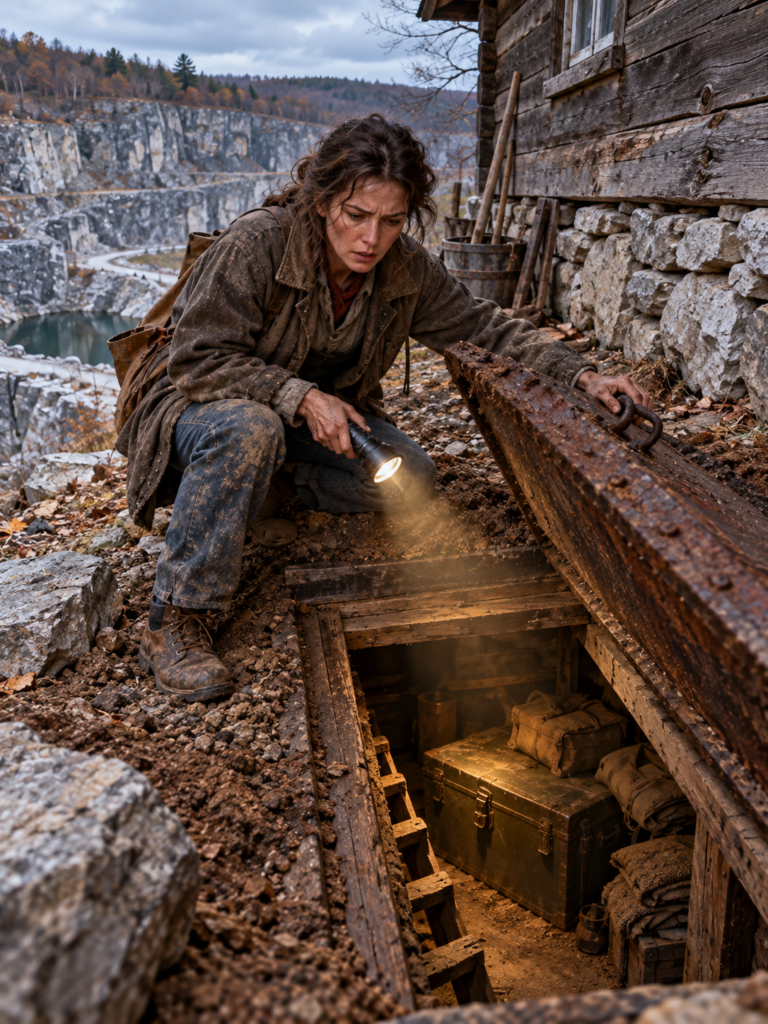
Audrey wrapped her fingers around the brass padlock and tested it.
The lock was firmly secured.
Its surface had turned a dull green with age, but the steel clasps holding the trunk closed were still intact.
She aimed the flashlight over the lid.
No name.
No visible ownership mark.
Nothing identifying whoever had brought the trunk underground.
Audrey glanced toward the canvas bags.
The simplest explanation was that the chamber had belonged to the quarry’s former operators.
But she had no evidence of that.
Her grandfather had acquired the abandoned property years after mining ceased. The chamber might have been sealed before he ever possessed the deed.
And the paper inside the bags raised more questions than it answered.
She returned to the torn canvas and examined several certificates.
Different denominations.
Different issuing authorities.
Dates from the 1930s.
They appeared to be old financial instruments, but she knew enough from her years with David to distrust the apparent value of anything written on paper.
A certificate could be authentic and worthless.
A debt could have been paid, canceled, or become impossible to redeem.
She needed someone qualified to examine them.
But first, she needed to understand what she had found.
Audrey climbed the ladder, fetched a clean cloth and her duffel bag, and carried a selection of the documents into the cabin.
She locked the door.
Until now, the abandoned quarry had felt like the one place nobody cared enough to visit.
Suddenly, its isolation felt dangerous in a different way.
She laid the certificates on the table and sorted them by date and denomination.
Hours passed.
The stove burned down.
Her fingertips turned gray from dust.
By early morning, she had recorded more than four million dollars in printed face values from the contents of one bag.
One bag.
At least twelve others remained underground.
She stared at the total.
The number was extraordinary.
But it was not money in her bank account.
It was a question written across decades-old paper.
And she knew precisely how dangerous assumptions about hidden assets could become during a divorce.
David had taught her that.
The following morning, Audrey drove to the public library in Oak Haven.
She searched the history of bearer bonds, their redemption requirements, and the complications surrounding old financial instruments.
The more she read, the more cautiously she viewed her discovery.
Ownership, authenticity, payment history, taxes, and the terms of each issuing authority could affect their value.
There was no simple guarantee that a bank would exchange the papers for cash.
Audrey sat back.
Even if the documents proved valuable, liquidating them could expose her newfound assets to scrutiny.
And she did not trust David to stay away if he learned there was money hidden beneath the property he had mocked.
She returned to the quarry that afternoon.
The rain had turned the access road into slick mud.
Inside the cabin, the stove was cold.
She stood beside the table, looking at the certificates she had left beneath a folded cloth.
The bag might contain a fortune.
Or an expensive legal problem.
Perhaps both.
Then she remembered the trunk.
Unlike the canvas bags, it had been secured with a substantial lock.
Why?
Audrey took a hacksaw from her tools and descended into the underground room again.
She knelt beside the olive-green trunk.
Pressed the blade against the brass.
And began cutting.
The sound scraped painfully through the small chamber.
Her arm burned.
She changed angles and continued.
At last the weakened metal gave way.
The lock fell onto the concrete.
Audrey removed it and forced open the stiff side clasps.
She placed both hands beneath the heavy lid.
Lifted.
The hinges protested.
Her flashlight beam moved across the interior.
Audrey stopped.
There were no papers inside.
The bottom of the trunk held neat rows of dull yellow metal bars.
She reached for one.
Its weight startled her.
With both hands, she lifted it into the flashlight beam.
An assay marking indicated one kilogram of exceptionally pure gold.
She could not yet know whether the marking was authentic.
But the density, color, and weight made her hands tremble.
She counted the visible bars.
Then the layers beneath them.
Approximately fifty kilograms.
Audrey slowly lowered the bar onto the concrete.
The bearer bonds might take months or years to investigate.
The gold could be evaluated much more directly.
But whoever had hidden it had left no explanation.
And whoever legally owned it might not be the person standing above it now.
She looked from the gold to the ladder.
Then she made a decision.
She would take one bar for professional examination.
And before telling anyone about the rest, she would find out exactly what rights came with the quarry deed her grandfather had left her.
She wrapped the bar in cloth, placed it inside her bag, and climbed toward the daylight.
Audrey emerged from the underground chamber with the wrapped gold bar pressing heavily against the bottom of her duffel bag.
She lowered the iron hatch behind her and replaced enough of the loose soil to make the opening less obvious.
Then she carried the bag into the cabin.
For several minutes, she stood beside the stove, considering the change that had occurred.
Yesterday she had been worrying about whether her remaining money would cover winter supplies.
Today she was holding an object that might be worth more than everything she had lost in the divorce.
But two questions remained.
Was it genuine?
And did she have the legal right to sell it?
Audrey did not intend to make the same mistake David had made repeatedly.
He had treated documents as weapons and other people’s rights as inconveniences.
She wanted independence, not another disaster disguised as an opportunity.
The following morning, she drove away from Oak Haven.
Her destination was a precious-metals dealer in Pittsburgh, far enough from the quarry that she would not immediately become the subject of local gossip.
The journey took her through cold hills, industrial outskirts, and streets lined with warehouses.
She found the shop in a worn commercial district.
A heavyset man with a thick beard sat behind a protected counter.
He looked at her muddy boots.
Then at the canvas bag she placed in front of him.
“Buying or selling?”
“Possibly selling. First I need an assessment.”
Audrey unwrapped the bar.
The dealer’s expression changed.
He lifted it carefully and examined the rough casting.
Then he studied its stamped markings.
“Where did you get this?”
“It came from property I inherited.”
He looked at her again.
“That’s an unusual inheritance.”
“So I’ve discovered.”
He checked its weight and performed preliminary tests.
He could not establish its full history from those tests, but he confirmed that the metal appeared consistent with high-purity gold.
The bar was worth serious money.
The dealer gave her a preliminary offer, subject to the identification and documentation required for a transaction.
Audrey listened without interrupting.
For a moment, the old desperation returned.
The temptation to accept anything.
To take the money and prove that David had not destroyed her.
Instead, she asked for the assessment in writing.
The dealer appeared surprised.
“You’re not selling?”
“Not today.”
“Someone else might offer you less.”
“Then I’ll know what less looks like.”
She wrapped the bar again.
Outside, she sat behind the wheel of the Civic and looked down at her hands.
They were cracked, rough, and stained from weeks of labor.
She had walked into that shop with a strange lump of metal.
Now she had independent reason to believe it was gold.
That was the first real answer.
The second would be harder.
Audrey spent the following days investigating the history of the quarry and the consequences of discovering old valuables on inherited property.
She knew the deed established her interest in the land.
She also understood that land ownership alone might not settle every question about objects left there before her grandfather acquired it.
She needed professional advice.
Her first instinct was to avoid attorneys.
David’s lawyers had turned her financial ruin into a series of calm conversations about documents, percentages, and assets.
But hiding from legal questions would not make them disappear.
She began looking for someone familiar with property disputes, business ownership, and unusual assets.
Eventually, she found Hollis, a former corporate attorney operating from a modest office near Cleveland.
His professional history was complicated, and Audrey understood that he could not perform legal services requiring an active license.
Still, he knew how corporate records worked and could explain some of the business issues she would eventually face.
She met him in a diner.
He sat opposite her, tearing a paper napkin into narrow strips while she described the property.
She did not reveal the full contents of the underground chamber.
But she explained that she had discovered old financial instruments and precious metal on land she had inherited.
Hollis stopped tearing the napkin.
“You’re going to need qualified legal counsel for ownership and redemption questions.”
“I know.”
“And you should establish provenance before trying to move anything substantial.”
“I know that, too.”
He studied her.
“Then what do you need from me?”
“Help understanding what it would take to run a legitimate business if those assets eventually become available.”
Hollis leaned back.
“That’s a different question.”
They discussed business structures, banking relationships, recordkeeping, and the practical difference between owning something valuable and having usable capital.
Audrey had spent years watching David talk about companies as though they were machines designed to make money invisible.
She had once assumed he understood business better than she did.
Now she was beginning to recognize how much of his confidence had depended on her remaining uninformed.
She asked questions until Hollis stopped treating her like a confused former housewife.
At the end of the conversation, he asked what she intended to call her business.
Audrey looked through the diner window.
Across the street, a truck rolled past carrying construction materials.
“Limestone Holdings,” she said.
The name came naturally.
The quarry had once represented everything David believed was worthless about her future.
She wanted to build something on that ground.
Over the following weeks, Audrey continued sorting the discovery.
She documented where the materials had been found.
She photographed the chamber.
She carefully separated what she knew from what she merely suspected.
The gold appeared to be genuine.
The bonds appeared to be old, potentially significant securities.
But there was still no clear explanation of who had placed them underground or why.
The most plausible explanation was that someone associated with the quarry’s earlier history had used the chamber for storage.
The reinforced walls, carefully sealed hatch, and protected trunk were consistent with deliberate long-term concealment.
None of it established the identity of the person responsible.
Audrey resisted the urge to invent answers.
She had lived for years beside a man who could make almost any story sound convincing when money was involved.
She would not do that to herself.
At the same time, the practical work of rebuilding her life continued.
She repaired the cabin.
She improved the roof.
She arranged more reliable power.
She replaced damaged flooring.
And with the limited funds she could legitimately access, she began planning a business.
Oak Haven Salvage and Towing had been declining for years.
Its owner, Miller, was behind on taxes, burdened by equipment problems, and weary of keeping the place running.
Audrey studied the business before approaching him.
The yard had acreage, an established commercial use, and a collection of machinery in varying condition.
It also had liabilities.
She did not overlook them.
When she entered Miller’s office, he was watching television beside a cup of stale coffee.
“Parts are out back,” he said.
“I’m not here for parts.”
He looked up.
“What do you want?”
“To discuss buying the business.”
Miller laughed.
Audrey waited.
When he stopped, she placed a folder on the desk.
It contained the questions she had prepared about the property, outstanding obligations, and equipment.
She did not pretend to have unlimited money.
Instead, she proposed terms that would allow the business to change hands if its liabilities could be dealt with.
Miller read the first page.
Then the second.
His expression changed.
“You’ve done your homework.”
“I’ve learned that’s cheaper than surprises.”
The negotiations were difficult.
Audrey had to establish a workable arrangement with the existing obligations, obtain appropriate financing and advice, and decide which equipment could be repaired rather than replaced.
But eventually, Limestone Holdings became the operating owner of Oak Haven Salvage.
It was not an instant fortune.
It was a business with invoices, repairs, customers, payroll decisions, and enough unpleasant surprises to remind her why people avoided buying failing companies.
Audrey loved it.
Every truck repaired represented a problem she could solve.
Every legitimate payment deposited into the business account represented revenue she could account for.
Every month the company survived gave her more confidence.
She continued investigating the underground assets separately.
She did not know how much of their apparent value could actually be realized, and she refused to build her monthly expenses around money that remained uncertain.
Still, the possibility changed how she thought.
She was no longer planning only for survival.
She was planning for ownership.
By the sixth month after arriving at the quarry, the change was visible.
The exterior of the cabin still looked old and weather-beaten.
But inside, the floor was solid.
The roof was dry.
The stove worked.
A proper desk stood near the window, and a computer connected her to the businesses and professional advisers she had begun working with.
Security cameras watched the road and the quarry entrance.
The access gate had been reinforced.
Audrey could sit in a warm room and know that she had made it functional with her own decisions.
She had also grown physically stronger.
Her hands no longer resembled the hands David used to compliment over dinner.
They carried scars from repairs, hauling wood, and working on machinery.
She no longer wished they looked different.
One snowy afternoon, she was checking business records when a security monitor flashed.
A black luxury SUV was approaching the gate.
Audrey leaned toward the screen.
The vehicle stopped.
The driver’s door opened.
A man stepped out in an expensive overcoat.
She recognized him before he reached the call box.
David.
Her former husband.
The man who had laughed at the quarry deed.
He looked thinner.
Less composed.
And unmistakably angry.
Audrey remained seated.
Her phone vibrated.
David’s name appeared.
She let it ring.
Then the call box beside the gate sounded through the cabin.
She activated the intercom.
For a moment, neither spoke.
Finally David said, “Audrey. Open the gate.”
She watched him through the monitor.
“Why are you here?”
“We need to talk.”
“About what?”
“Where did you get the money?”
Audrey felt her pulse quicken.
David stepped closer to the camera.
“My lawyers found Limestone Holdings. The salvage yard. The property purchases. I know you’ve been moving money.”
She did not answer.
His voice rose.
“You had assets you didn’t disclose. That’s what this is, isn’t it?”
Audrey stared at the man who had spent two years secretly moving their joint savings.
Now he was standing outside the one property he had considered beneath his notice.
Accusing her of the same deception he had practiced.
David gripped the steel gate.
“Open it.”
Audrey looked down at the records on her computer.
She had been so focused on rebuilding that she had almost forgotten how quickly David could turn another person’s success into an accusation.
But something had changed.
He could no longer command her by threatening to take away their home.
He could not control the money she earned.
And he had no right to enter the quarry merely because he disliked what he saw.
She pressed the intercom button.
“David, if you believe you have a legal claim, have your attorney make it through the proper channels.”
He struck the call box with his palm.
“I’m not leaving until you tell me what you’re hiding.”
Audrey looked toward the road camera.
Then toward the documents she had prepared during months of work.
The moment had come to decide whether she would spend the rest of her life defending herself against the man who had already taken enough.
She opened a secure folder containing the records of David’s old financial arrangements.
For the first time, she was ready to investigate his remaining empire as carefully as she had investigated her own discovery.
And what she found would explain why he had come back.
Audrey opened the folder containing the financial records she had preserved from her marriage.
The original spreadsheet was still there.
Project Restructure.
David had chosen the name because it sounded ordinary.
A business phrase.
Something that could sit on a computer without attracting attention.
But Audrey remembered the first time she had opened it.
The unfamiliar company names.
The transfers from their joint accounts.
The slow removal of money from a marriage she had believed was financially secure.
She had been devastated then.
Now she looked at the same information with different eyes.
The entries had always been more than evidence of betrayal.
They were a map of the businesses David had used to control and move money.
She compared them with the information she could find about his current corporate holdings.
One of his offshore associates was under regulatory scrutiny.
Several real estate developments had encountered serious financial trouble.
His access to liquid funds appeared increasingly restricted.
The company names on the old spreadsheet connected to a network that was now struggling under its debts.
Audrey studied the dates.
David had come to the quarry not because he regretted the divorce.
He had come because he had learned she owned something he might be able to use.
And because his own financial position was deteriorating.
Outside, the intercom sounded again.
“Audrey!”
She looked toward the monitor.
David stood at the gate with his coat collar raised against the snow.
“You’re going to regret ignoring me!”
Audrey activated the speaker.
“You’re on private property. Leave.”
“Not until we settle this.”
“There is nothing for us to settle here.”
“I know you’re hiding something!”
She kept her voice even.
“If you have a legal claim, pursue it legally. You are not coming inside.”
David stared toward the camera.
For years, he had relied on raising his voice until she began explaining herself.
She was no longer willing to participate.
“Get off my property,” she repeated.
Then she ended the call.
She did not go outside to confront him.
She saved the security footage, secured the cabin, and watched from a safe distance.
David remained by the gate for several minutes.
He shook the bars.
Looked toward the road.
Made another call.
Finally, with no response from Audrey, he returned to the SUV.
The vehicle reversed carefully down the muddy track and disappeared between the trees.
Audrey continued watching until it was gone.
Only then did she release the breath she had been holding.
She knew his departure did not necessarily mean the confrontation was finished.
But he had not entered the property.
And she had refused to give him the emotional surrender he wanted.
That mattered.
She returned to her desk.
There was another decision to make.
The discovery beneath the cabin had offered her the possibility of financial power.
But power without proper control could become another kind of trap.
The bearer bonds had not yet been fully resolved.
She had spent months trying to understand their origin, validity, and ownership.
The more she learned, the more obvious it became that their printed face values could not simply be treated as cash.
Audrey began compiling the documentation necessary for qualified specialists to evaluate them.
Hollis helped coordinate introductions, though she relied on properly licensed professionals for the legal work.
An experienced securities specialist examined representative certificates.
The results were mixed.
Some instruments required further historical verification.
Others raised questions about whether payment obligations remained enforceable.
A few appeared promising enough to justify continuing the process.
Audrey accepted those distinctions.
She refused to risk everything by pretending a complicated asset was simpler than it was.
Meanwhile, the gold presented a separate set of questions.
The bars were real.
Professional testing had confirmed their purity.
But authenticity did not automatically establish ownership.
Audrey reviewed the known history of the quarry and her grandfather’s deed with qualified advisers.
The available evidence did not identify who had placed the gold underground.
The chamber had apparently been concealed for decades.
No clear record connected its contents to her grandfather.
The ownership question therefore required more care than she had originally imagined.
For weeks, Audrey had thought of the chamber as a miracle waiting beneath the ground.
Now she understood something more important.
The miracle had been finding an opportunity.
What she did with it still had to survive scrutiny.
She organized every record she had.
Photographs.
Dates.
Locations.
Assessments.
Correspondence.
She would not confuse concealment with protection.
She knew too well how much harm hidden money could cause.
The investigation did not produce a complete history of the chamber.
The original person who had sealed it remained unidentified.
But the evidence was preserved, the legal questions were being addressed, and Audrey continued pursuing only the transactions her advisers could properly support.
She could live with a mystery that had not yet yielded every answer.
What she could not live with was becoming another version of David.
That choice proved more important than she expected.
Because David’s financial problems were growing worse.
His real estate companies had taken on debts they could no longer comfortably service.
Creditors were pressing for payment.
Several ventures had entered restructuring proceedings.
And the confident businessman who had once dictated every detail of their divorce now found himself answering questions from people who were not impressed by his expensive clothes.
Audrey followed these developments carefully.
At first, she told herself it was self-defense.
She wanted to know whether David’s problems might bring him back to the quarry.
But as she read the records, another possibility emerged.
She understood his corporate structure better than many outsiders would.
She knew how he had moved assets.
She knew which entities had once mattered most to him.
And she recognized the significance of debts now being offered for sale.
She contacted her financial advisers.
“What would it take,” she asked, “to purchase some of those claims?”
The response was cautious.
Purchasing distressed debt was not the same as acquiring someone’s personal property.
A creditor received only the rights attached to the particular claim.
Bankruptcy priorities, secured interests, collateral, and court supervision could sharply limit what a buyer could do.
Audrey listened.
Then she asked the advisers to examine the available opportunities.
She did not want a theatrical victory that collapsed under legal scrutiny.
She wanted a transaction that was enforceable.
Months earlier, David had used complicated ownership arrangements to make her feel powerless.
Now she was learning that the same financial world could be navigated through documented transactions and professional judgment.
Some claims were not worth purchasing.
Others were too uncertain.
But certain debts connected to David’s distressed real estate interests were available through established restructuring processes.
Limestone Holdings, now supported by operating revenue and capital that had been properly cleared for use, evaluated them.
Audrey had built the salvage business carefully enough that it had become a genuine asset rather than an empty company name.
The yard repaired equipment.
Processed scrap.
Handled towing work.
Paid its bills.
Its income was not imaginary.
And the distinction mattered.
Eventually, through advisers and appropriate commercial transactions, Limestone Holdings acquired a significant position among David’s creditors.
Audrey read the final documentation twice.
For years, David had controlled the money.
Now she had acquired a lawful financial claim against part of his failing business structure.
It did not make her the owner of David.
It did not automatically give her everything he possessed.
But it meant that he could no longer assume she was irrelevant to the future of his companies.
She had become one of the people whose interests had to be considered.
The irony was not lost on her.
Project Restructure had come back into her life.
This time, she understood the documents she was signing.
When the next formal meeting concerning David’s troubled businesses was scheduled in Chicago, Audrey decided to attend.
She could have remained anonymous behind company representatives.
That would have been easier.
But part of her wanted to face the man who had once smiled while arranging her financial destruction.
Not to shout.
Not to beg.
To see whether he could recognize the person she had become.
On the morning of the meeting, Audrey dressed in a charcoal-gray suit.
The fabric was well made, but simple.
She did not wear expensive jewelry.
She left her hands bare.
The calluses were still there.
The scars remained visible along her knuckles.
Those hands had pulled timber, repaired machinery, carried firewood, and opened the iron hatch.
She had no reason to hide them.
The meeting room was bright with fluorescent light.
A long table occupied the center.
Attorneys and financial representatives had already arranged their folders.
David sat near one end.
He looked older than he had at the quarry.
His face was thinner.
His eyes were tired.
He had a legal pad in front of him, but he was not writing.
Audrey entered with the representatives of Limestone Holdings.
David looked up.
At first, his expression suggested that he thought she had entered the wrong room.
Then he recognized her.
“What are you doing here?”
Audrey took the chair opposite him.
“Good morning, David.”
He turned toward his attorneys.
“Why is she here?”
One of the meeting representatives explained that Limestone Holdings had acquired claims involved in the restructuring.
David frowned.
He looked at the company folder.
Then at Audrey.
“Limestone Holdings?”
“Yes.”
“That’s yours?”
“I have a controlling interest.”
David stared.
His face changed slowly as the implication settled.
“You bought my debt?”
“Certain claims against your companies.”
“With what money?”
Audrey kept her expression neutral.
“Money my company was entitled to use.”
He leaned forward.
“You couldn’t afford groceries six months ago.”
“I remember.”
“You were living in that shack.”
“I still live there.”
David looked toward his lawyers again, as though someone should intervene and explain why this was happening.
No one did.
The purpose of the meeting was to address financial obligations.
Not to comfort him.
Audrey opened her folder.
The documents contained proposed restructuring terms prepared with professional advice.
They addressed collateral, repayment, and the position of Limestone Holdings as a creditor.
David stared at them.
For a long moment, he did not speak.
Then he lowered his voice.
“You set this up.”
Audrey looked at him.
“No. You created these debts.”
“You’ve been waiting for me to fail.”
“I’ve been rebuilding my life.”
“And now you’re here to ruin mine.”
She felt an old sensation stir.
The instinct to explain herself.
To soften the truth.
To reassure him that she had not intended to hurt him.
It was the instinct David had exploited for years.
She let it pass.
“Your businesses are in trouble because of decisions made before I acquired these claims.”
David’s jaw tightened.
“You think you’re smarter than me now?”
Audrey considered the question.
Once, she would have felt compelled to answer.
Now she understood that it was not a question about intelligence.
It was a demand that she accept her old position beneath him.
“I’m informed about the transaction,” she said. “That’s what matters today.”
David looked down.
His fingers tightened around his pen.
Then he glanced toward the documents again.
The man who had once hidden money behind layers of companies now had to discuss those companies openly with creditors.
He could no longer rely on confidence alone.
The meeting continued.
There were questions about assets, liabilities, repayment priorities, and what could realistically be recovered.
David’s lawyers challenged several terms.
Audrey’s advisers responded.
Nothing happened instantly.
No one magically transferred all David’s possessions to her.
No document erased every legal safeguard.
Instead, the obligations were examined through the formal process.
Audrey participated only where her company had actual rights.
But that was enough to change the balance between them.
David had to negotiate.
And Audrey did not have to yield simply because he was angry.
At one point, after the discussion paused, David leaned closer.
“Where did you find the money, Audrey?”
She held his gaze.
The limestone chamber flashed through her mind.
The rusted hatch.
The canvas bags.
The dull yellow bars inside the trunk.
But she also remembered every morning spent repairing the cabin, every exhausting day at the salvage yard, and every evening she had devoted to understanding the business she was building.
“The quarry was worth more than you thought,” she answered.
David’s expression hardened.
“What does that mean?”
“It means you were wrong about it.”
He stared at her.
She did not elaborate.
The underground discovery was being handled through the appropriate professional channels.
She would provide information where legally required.
But she no longer owed David a private explanation of every detail of her life.
He leaned back.
For the first time, he seemed to realize that no amount of anger would make her return to the role she had occupied during their marriage.
When the meeting ended, Audrey gathered her papers.
David remained seated.
She stood.
For a moment, she considered saying something cutting.
She had imagined this encounter during countless cold nights in the cabin.
She had imagined telling him what he had done.
Showing him the proof of his betrayal.
Making him feel as small as she had felt.
But standing there, she discovered that revenge had lost some of its appeal.
She did not need him to admit that she was capable.
She did not need him to regret leaving.
She did not even need to know whether his remaining business problems would destroy his lifestyle.
Her life no longer depended on his judgment.
She closed her folder.
“Goodbye, David.”
He looked up.
There was something desperate in his face.
“Audrey.”
She paused.
“Did you ever think we’d end up like this?”
She considered the question.
“No.”
That was the truth.
Then she left.
Outside, Chicago was gray and cold.
Traffic moved along the street.
People hurried past carrying briefcases, coffee cups, and shopping bags.
Nobody knew that the woman stepping out of the building had once sat crying on the floor of a cabin without clean water.
Nobody knew about the iron hatch beside the foundation.
Or the years of financial deception she had uncovered.
Or the strange old chamber filled with assets whose origins remained partly unresolved.
To everyone passing, she was simply another woman leaving a business meeting.
Audrey found that she liked it that way.
She drove back toward the quarry.
The journey took hours.
The farther she traveled from the city, the more the landscape opened into wooded hills and quiet roads.
By the time she reached the access gate, darkness had settled.
She entered through the reinforced entrance and drove up toward the cabin.
The old wooden building stood against the gray limestone walls.
From outside, it still looked like a place someone might abandon.
Its siding was weathered.
The roof retained the modest profile of the original structure.
The quarry pool below remained dark and still.
But the windows glowed with warm light.
Audrey parked the Civic.
She had considered replacing the car many times.
Its heater barely worked.
The seats were worn.
The engine complained on cold mornings.
Yet she had kept it because it reminded her of the woman who had first driven to the quarry.
That woman had been terrified.
Humiliated.
Nearly penniless.
But she had still arrived.
Still opened the cabin door.
Still started the stove.
Still chosen to survive.
Audrey carried her bag inside.
The warmth met her immediately.
She hung her coat.
Set the documents on the desk.
Then walked to the stove.
The fire was low, but alive.
She added another log.
The flames rose gradually, illuminating the iron surface.
Beneath that stove, in a secured cavity constructed during the renovation, remained part of the extraordinary discovery she had made underground.
The remaining historical securities were preserved separately while their status continued to be investigated.
Audrey had learned to treat the objects with caution rather than excitement.
They were evidence of a past she did not fully understand.
They might also represent legitimate wealth, depending on the unresolved facts.
But they were no longer the only foundation of her future.
She looked around the cabin.
At the repaired walls.
At the solid flooring.
At the desk where she managed her company.
At the shelves holding books she had bought because she wanted to learn, not because someone had told her she was supposed to know.
These things had not appeared when the hatch opened.
She had built them.
The difference mattered.
Audrey made herself a cup of coffee.
Then she opened the cabinet containing the original quarry deed.
The paper was old and creased.
For ten years, David had treated it as a joke.
During the divorce, he had considered it worthless enough to leave uncontested.
Audrey remembered holding it in her hands after the settlement.
She had felt as though her grandfather had left her a cruel reminder of failure.
A ruined piece of land.
A structure barely fit for shelter.
A hole in the earth.
Now she looked at the deed differently.
Her grandfather had not necessarily known about the chamber.
There was no evidence that he had.
Perhaps he had purchased the property simply because it was cheap.
Perhaps he had imagined it might someday serve a purpose.
Audrey did not invent a hidden intention to make the story more satisfying.
The truth was simpler.
He had left her land.
What she did with it had been her choice.
She folded the deed and returned it to the cabinet.
Then she stepped onto the porch.
Cold air moved across the quarry.
The limestone cliffs fell into darkness, their pale surfaces barely visible under the winter sky.
The pool below reflected a thin strip of moonlight.
Farther away, wind moved through the trees.
Audrey stood listening.
Six months earlier, the silence had frightened her.
She had wondered whether she could endure another night there.
She had wondered whether she would ever feel safe.
Whether she would ever have enough money.
Whether the woman David had abandoned was capable of becoming anyone else.
Now she understood that the answer had begun long before the discovery of gold.
It had begun when she stood up from the cabin floor after crying.
When she repaired the water pump.
When she patched the roof.
When she decided to dig a root cellar instead of accepting that winter would defeat her.
The hatch had changed her financial possibilities.
It had given her a mystery worth investigating.
It had provided a glimpse of wealth hidden beneath what everyone believed was worthless.
But the most important discovery had been made above ground.
She was capable of building a life without the man who had convinced her she could not.
David’s problems were now his own.
Her business was hers to manage.
The remaining questions about the underground chamber would be answered where evidence allowed, rather than by wishful thinking.
And the quarry, once a symbol of her humiliation, had become a place she chose to call home.
Audrey took one final look across the limestone walls.
Then she went inside.
She closed the door against the wind.
The stove warmed the room.
Her papers waited on the desk.
There would be work tomorrow.
Invoices to review.
Repairs to approve.
Questions about the old securities still to resolve.
And perhaps, someday, a clearer answer to who had hidden so much beneath the abandoned cabin.
But tonight, she needed nothing more.
For years, David had measured her worth by what he believed he could take from her.
He had taken the house.
He had taken the savings.
He had taken the marriage.
And when he left her with a ruined quarry, he had assumed there was nothing valuable left.
He was wrong about the land.
He was even more wrong about the woman standing on it.
Audrey turned off the desk lamp and watched the fire settle into a steady glow.
The quarry was quiet.
The cabin was warm.
And for the first time in years, she did not feel that someone else’s decisions could determine whether her life would continue.
She had found wealth beneath the ground.
But the life she built above it was what finally made her free.


