
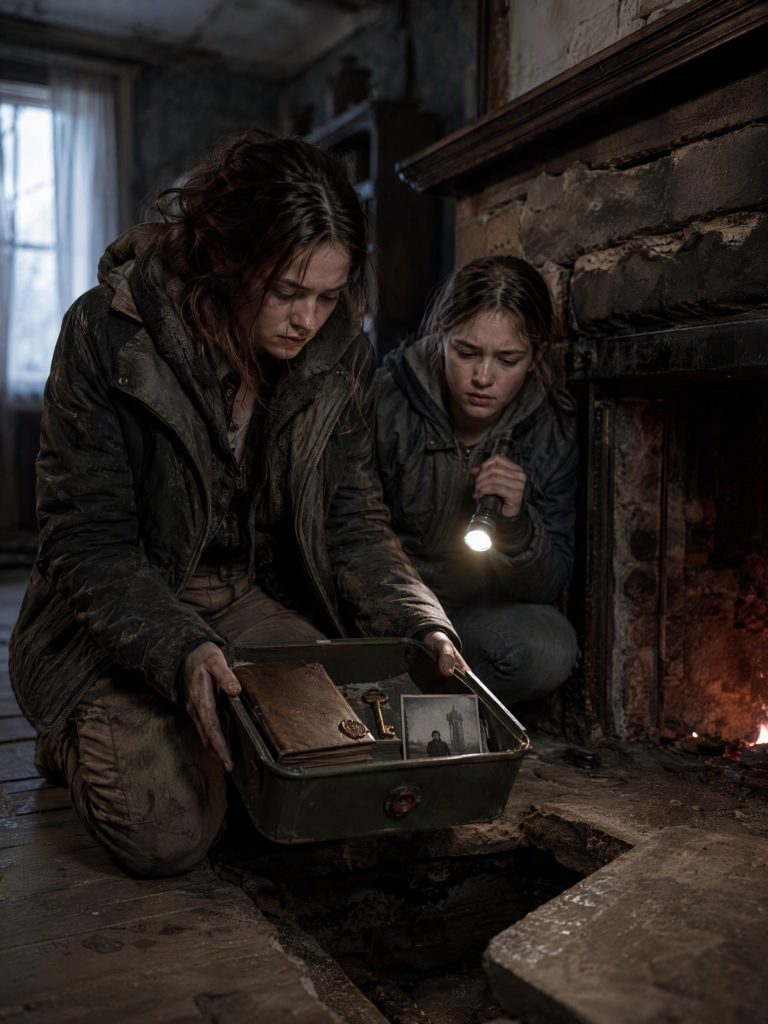
Chloe turned the page, holding the flashlight against the journal’s cracked spine.
Calvin’s handwriting was cramped but deliberate.
An October entry said Dean had returned to the farm asking questions about the silo.
Calvin believed he was looking for something valuable.
More disturbing was the warning that followed: Calvin had threatened to bury Dean beneath the structure if he touched it again.
Jess read the passage over Chloe’s shoulder.
“Did Uncle Calvin hurt Dad?”
Chloe looked back at the words.
The threat was written plainly.
But nothing in the journal established that Calvin had acted on it.
Their father had abandoned them years ago. That much was real.
Whether this argument had anything to do with his disappearance from their lives was another question.
“All we know is they fought,” Chloe said.
She read farther.
The journal moved between ordinary farm repairs and increasingly anxious notes about property taxes.
Calvin believed local officials were assessing his land unfairly.
He suspected people wanted the farm for reasons they would not explain.
Chloe remembered the bank statements in his office.
The large deposits.
The cash withdrawals.
The coded records beginning around 1998.
At first she had thought Calvin might have lost the money or spent it during his years of isolation.
Now the journal suggested he had deliberately converted and concealed his savings.
One passage referred to a reserve.
Another mentioned a limestone ridge beneath the property.
Then Chloe found an entry connecting the reserve to the silo.
The base was secure.
The brass lock was holding.
She stopped reading.
Jess stared at the key in her sister’s hand.
“You think that’s what this opens?”
“I think Calvin wanted somebody to find it.”
“Maybe he just didn’t want Dad to find it.”
Chloe considered that possibility.
The photograph had been stored inside the same sealed box as the key and journal.
Calvin had clearly preserved evidence of Dean’s visit.
But preserving a photograph did not establish why he had kept it.
Perhaps it was a warning.
Perhaps a reminder of a betrayal.
Perhaps something else entirely.
Whatever the reason, the silo had become the strongest connection between the objects.
Chloe returned to the office and carried back the ledgers.
She spread the papers beside the fireplace, careful to keep them away from the embers.
The 2005 statements showed unusually large balances for a farm that had supposedly stopped operating profitably.
By 2010, much of that money had been withdrawn in cash.
In the later notes, Calvin repeatedly referred to storage and transfers.
There were numbers and abbreviations, but no ordinary description of what was stored.
The estate might have been nearly worthless by the time Mitchell contacted them.
Or Calvin might have hidden assets that the lawyer had not located.
Chloe could not yet know which was true.
Then she found another troubling connection.
Calvin had written that the people pursuing the land knew about something beneath its limestone ridge.
The tax problem and the hidden reserve appeared in the same sequence of entries.
Was Calvin protecting money?
Was the property itself valuable?
Or had years of isolation led him to connect unrelated events?
Jess sat back against the mattress.
“Even if there’s something out there, what are we supposed to do with it?”
Chloe glanced at the fireplace.
The little fire was fading.
Neither sister had enough warm clothing for another severe night.
The farmhouse had no electricity.
The water valve was seized.
Their car barely had enough gas to reach town.
And the county seizure was approaching.
Whatever Calvin had hidden, it would be meaningless to them if they couldn’t survive long enough to use it.
Chloe closed the ledger.
She placed the photograph inside its pages and tucked the brass key into her pocket.
“We check the silo,” she said.
Jess looked toward the dark window.
“Now?”
“If there’s something that can keep us warm tonight, we need to know.”
They wrapped themselves in old wool blankets and stepped outside.
The wind cut across the yard.
Dead weeds tangled around their shoes as they walked toward the concrete silo.
Up close, its base was surrounded by packed soil, gravel, and fallen leaves.
Jess noticed that weeds grew unevenly near one section of the foundation.
Chloe knelt and scraped away the loose debris.
Several inches below the surface, her fingers touched metal.
She cleared the edges.
A square steel plate lay almost flush against the concrete.
At its center was a rusted industrial padlock protected by a sliding metal cover.
Chloe drew out the brass key.
The keyhole appeared to match.
She brushed grit from the lock, inserted the key, and felt it stop halfway.
She pressed carefully.
The key slid deeper.
Jess held the flashlight steady as Chloe gripped the heavy brass head and began to turn it.
The brass key resisted beneath Chloe’s fingers.
She adjusted her grip, pressed inward, and twisted again.
A metallic crack echoed against the concrete silo.
The padlock opened.
Jess stepped backward.
For several seconds neither sister moved.
They had spent the day searching a ruined house for food, warmth, and anything they could possibly sell.
Now they were standing over a buried steel hatch that their estranged father had apparently known about, holding a key Calvin had hidden beneath the fireplace.
Chloe set the lock aside and tested the hatch.
The hinges resisted.
She pulled harder.
Jess joined her, bracing one foot against the packed earth.
Together they dragged the heavy cover upward until it fell back against the ground.
Below it was a square concrete shaft.
Cold, dry air rose from the darkness.
Chloe directed the flashlight downward.
An iron ladder descended approximately fifteen feet to a concrete floor.
Beyond it, a narrow passage disappeared into darkness.
Jess gripped Chloe’s sleeve.
“We can’t go down there.”
Chloe examined the walls.
She could see heavy construction, rusted ladder rungs, and no obvious standing water.
But she could not see the entire passage or know whether the air was safe.
It was an abandoned underground space, and Jess was right to be afraid.
Chloe hesitated.
Then she looked at the dark farmhouse.
Calvin’s property was approaching seizure.
Mitchell had already offered them a way to walk away without claiming anything.
If whatever Calvin had hidden was still below them, leaving it undiscovered could mean losing it.
Chloe decided to inspect the passage.
She told Jess to remain above until she reached the bottom.
Then she placed one foot on the ladder.
Each rung felt painfully cold.
She lowered herself carefully, keeping the flashlight aimed toward the concrete floor.
When she reached the bottom, she tested her footing.
The ground was dry.
The air felt warmer than the wind outside.
She looked along the passage and called up to Jess.
Her sister descended reluctantly.
They stood together, listening.
There were no voices.
No movement.
Only the faint sound of wind passing the open hatch far above.
The passage was reinforced with timber and corrugated steel.
Chloe followed it slowly.
After roughly fifty feet, the narrow corridor opened into a rectangular chamber.
Her flashlight moved across the far wall.
Then across a row of shelves.
Then another.
Heavy canvas bags were stacked from floor to ceiling.
Some had begun splitting along their seams.
Chloe approached the nearest one and pressed its side.
Something dense shifted inside.
She loosened the frayed opening.
Several small, heavy metal bars spilled onto the concrete.
Jess flinched at the noise.
Chloe picked one up.
The bar was tarnished and cold.
Its markings indicated silver bullion.
She examined the other bags.
They appeared to contain the same kind of metal.
For several seconds, she could not speak.
The house above them had been left to rot.
The taxes were unpaid.
The electricity was disconnected.
Their attorney had described the estate as almost worthless.
Yet beneath the silo were shelves filled with silver.
Jess lifted a bar in both hands.
“How much is here?”
Chloe shook her head.
She could not estimate the value from what her flashlight revealed.
But even a small portion of the stockpile could be worth more than the fourteen dollars they had possessed two days earlier.
Calvin had not simply misplaced his savings.
He had deliberately hidden them.
The coded transfers in his ledgers now had a plausible explanation.
The enormous cash withdrawals appeared to correspond with the period when he stopped trusting financial institutions.
And the heavy brass key had protected what remained.
Chloe moved her flashlight past the shelves.
At the far end of the chamber stood a wooden desk.
Several black binders were stacked neatly on top.
She opened the first.
Inside were copies of property deeds, county tax assessments, correspondence, newspaper clippings, and annotated maps.
Some documents were decades old.
Others were far more recent.
Unlike the chaotic paperwork upstairs, these materials had been arranged to support a particular argument.
Calvin believed a group of officials and private investors had been acquiring farms through inflated tax assessments and foreclosure pressure.
He had tracked properties that went into debt.
He had recorded subsequent transfers.
He had compared tax valuations before and after ownership changed.
Again and again, one organization appeared.
Oak Haven Land Trust.
Chloe followed the references through the binder.
She found papers linking the trust to the family of Mitchell, the probate attorney who had contacted them.
She stopped.
Jess noticed.
“What?”
Chloe showed her the name.
Mitchell had told them the farm was a financial burden.
He had suggested they sign away their interest.
And now his family’s business appeared in Calvin’s research concerning the acquisition of distressed farms.
That connection did not, by itself, prove Mitchell had committed a crime.
But it changed how Chloe understood his offer.
She turned more pages.
Calvin had collected material concerning a limestone formation beneath the farm and neighboring properties.
A geological report described a substantial natural gas deposit associated with the land.
The maps suggested that the same formation extended beneath several farms Oak Haven had acquired.
Chloe examined the documents carefully.
If the reports were accurate, the land had value beyond its old dairy buildings and abandoned fields.
Calvin appeared to have understood that value.
He had also believed people connected to local government were trying to acquire it cheaply.
Jess looked around the room.
“So he hid the silver because he thought they’d take the farm?”
“That’s what his records suggest.”
“And Dad?”
Chloe remembered the photograph.
Calvin’s journal described Dean trying to reach the silo and asking about the reserve.
The old man had threatened him.
Whatever Dean had wanted, he had not obtained the key Calvin left beneath the fireplace.
At least, the silver was still here.
Chloe could not establish everything that had happened between the men.
But their father’s connection to the hidden storage area was no longer in doubt.
He had been at the farm.
He had known about the silo.
And Calvin had considered his interest in it unwelcome.
Jess sat on the edge of the desk.
For nine years, neither sister had known where Dean went after abandoning them.
Now the first physical evidence of his involvement in their family’s property was a photograph connected to a concealed fortune.
It did not explain why he left.
It made his absence more painful.
Chloe returned to the binders.
The tax records were the more urgent issue.
Mitchell had warned that the county could seize the property.
Even if the silver belonged to Calvin’s estate, the sisters still needed to understand the outstanding debt and establish their legal rights before making decisions about the assets.
They also needed food, heat, and a place safe enough to sleep.
Chloe chose to take a small quantity of silver from the chamber.
They packed fifty ten-ounce bars into canvas sacks and carried them back toward the ladder.
The weight made the work slow.
They made repeated trips up the cold iron rungs.
When the bags were finally inside the Honda, Chloe secured the hatch, replaced the padlock, and concealed the cover as best she could.
The car’s rear suspension sagged under the weight.
Jess stared at the trunk.
“We can’t drive around with all that.”
“We’re not going far until we know what it’s worth.”
Chloe remembered a precious metals dealer advertised across the county line.
She wanted to avoid the immediate area around Mitchell’s office until she understood the documents.
They drove toward the neighboring county with the fuel gauge close to empty.
At a small bullion shop, Chloe brought six bars inside.
The proprietor examined the metal and tested it.
He offered eighteen dollars per ounce.
Each ten-ounce bar would bring $180.
For six bars, the total was $1,080.
Chloe knew she was accepting less than the quoted market price.
She also knew they needed money immediately.
She agreed to the sale, giving the dealer a misleading explanation that the bars had been found among a deceased grandfather’s belongings.
When she returned to the Honda, she placed the envelope of cash in Jess’s lap.
Jess opened it carefully.
More than a thousand dollars.
After three months of homelessness, the money scarcely seemed real.
Chloe started the engine.
First they purchased gasoline.
Then insulated coats, boots, thermal sleeping bags, heating equipment, and basic tools.
They stopped at a roadside diner.
When the waitress brought two cheeseburgers and hot fries, Jess stared at her plate.
Chloe was already eating when she noticed a tear slipping down her sister’s cheek.
Jess wiped it away quickly.
Neither mentioned it.
For the first time in days, they had a proper meal.
For the first time in months, they could purchase necessities without counting every coin.
But Chloe understood that finding the silver had not solved the estate’s problems.
The tax claim remained.
Calvin’s documents needed scrutiny.
The hidden assets would have to be accounted for.
And Mitchell still expected them to sign away their interest.
They returned to the farm that night.
Chloe arranged the papers in the living room under a battery lantern.
Jess fell asleep nearby.
The newly purchased equipment made the space warmer, though Chloe knew the old, poorly ventilated house still required proper repairs before it would be safe to live in comfortably.
She stayed awake studying the binders.
Calvin had traced the pattern of land transfers across approximately fifteen years.
The records showed farms entering financial trouble after tax reassessments.
They showed certain properties being acquired by organizations connected to Oak Haven.
They also showed later assessments that were significantly lower.
His notes identified officials he believed had participated in the scheme.
Some allegations were supported by copies of correspondence and financial records.
Others remained Calvin’s interpretations of patterns he had noticed.
Chloe separated the evidence from his conclusions.
One section concerned a neighboring farm acquired by Oak Haven the previous year.
Its tax assessment had changed dramatically after the transfer.
The comparison made her look again at the unpaid taxes on Harrow Reach.
The property had been assessed as though it possessed extraordinary value while being described to her as almost worthless.
Those two positions could not easily be reconciled.
Then she found a map showing the limestone ridge passing beneath Calvin’s farm and three neighboring properties.
The accompanying geological materials referred to natural gas reserves.
Suddenly, the tax assessments, land acquisitions, and Mitchell’s interest in a quitclaim made sense as parts of the same possible scheme.
The land itself was the prize.
The silver was Calvin’s attempt to preserve assets outside the financial channels he feared.
The binders were his attempt to preserve evidence.
The farmhouse was decaying because he had devoted his resources to guarding those things rather than maintaining the visible property.
He had hidden enough money to protect himself.
But he had died before resolving the tax problem.
Now the estate had passed to two young women Mitchell apparently believed would be unwilling or unable to fight.
At dawn, Chloe heard an engine outside.
She approached the boarded window.
A black SUV was moving along the driveway.
It stopped near the porch.
Mitchell climbed out, wearing an expensive charcoal overcoat.
Another man stepped from the passenger side.
Chloe watched them approach.
The lawyer opened a briefcase and removed a manila envelope.
The same sort of documents he had offered when she first learned of the inheritance.
Jess appeared beside her.
“Is that him?”
Chloe nodded.
She looked at the binders stacked on the table.
Then at the photograph of their father.
Then at the brass key lying beside Calvin’s journal.
Mitchell had come expecting an answer.
This time, Chloe intended to ask questions first.
She told Jess to stay inside and keep the door locked.
Then she stepped onto the sagging porch.
Mitchell looked up and smiled.
“Chloe. I was beginning to worry. I still haven’t received the signed paperwork.”
Chloe stood at the top of the steps.
“We’ve been busy.”
He opened the folder.
“The county is preparing to proceed. If you sign today, you can walk away from this property without carrying its debt.”
Chloe looked at the documents.
Then she asked why the farm’s tax assessment was so high when a nearby property acquired by Oak Haven Land Trust had received a dramatically lower reassessment.
Mitchell’s smile faded.
For the first time since his phone call, he appeared to understand that she knew something about Calvin’s records.
And Chloe knew exactly which question she would ask next.
Chloe watched Mitchell’s expression change.
The attorney lowered the manila folder slightly.
For a moment, the polished confidence he had brought onto the property gave way to visible caution.
“I’m not sure what you’re suggesting,” he said.
Chloe remained at the top of the porch steps.
“I’m asking about the assessments.”
Mitchell glanced toward the heavyset man waiting near the SUV.
“The county determines property valuations. My job is to help settle your great-uncle’s estate.”
“Then you won’t mind explaining why your family is connected to Oak Haven Land Trust.”
Mitchell stopped moving.
Chloe had spent much of the previous night reviewing Calvin’s records.
She knew what the documents appeared to show.
She also knew that having copies of tax assessments and correspondence was not the same as obtaining a legal finding of wrongdoing.
But she had enough to ask the attorney why he had encouraged two financially desperate heirs to give up an estate associated with valuable mineral deposits.
Mitchell closed the folder.
“Those are complicated matters,” he said.
“Then let’s keep this simple. Did you know about the natural gas beneath the limestone ridge when you told me the property wasn’t worth keeping?”
The silence that followed was longer than Chloe expected.
Mitchell’s gaze shifted briefly toward the barn and concrete silo.
Then he looked back at her.
“You shouldn’t make assumptions based on old papers.”
“I haven’t,” she said. “I’ve been comparing them.”
She described the changes in the neighboring property assessments.
The repeated appearance of Oak Haven in deeds and land-transfer records.
The geological information showing a natural gas formation beneath Calvin’s farm and several adjoining properties.
She did not tell him every document she possessed.
But she made it clear that the estate contained more information than he had expected her to find.
Mitchell’s manner hardened.
“The tax debt doesn’t disappear because you’ve found an old survey.”
“I know.”
“And the county still has the authority to proceed.”
“I know that too.”
He appeared irritated by her refusal to argue.
Then Chloe took one of Calvin’s silver bars from her coat pocket.
She tossed it gently toward the snow at the bottom of the steps.
It landed near Mitchell’s shoes.
The attorney looked down.
For the first time, the change in his expression was unmistakable.
He recognized the significance of what he was seeing.
Calvin had withdrawn substantial amounts of money years earlier.
The estate had appeared to possess no useful liquid assets.
Yet Chloe was holding bullion that had evidently survived him.
If she had found Calvin’s hidden silver, she might also have found the records he had collected.
“Where did you get that?” Mitchell asked.
“From the estate you advised us to abandon.”
Mitchell stared at her.
Chloe kept her voice steady.
“We’re not signing away the farm.”
The heavyset man moved a step closer.
Mitchell raised one hand, stopping him.
“You have no idea how difficult this will become.”
“Maybe not,” Chloe answered. “But I’m going to have Calvin’s records examined, and I’m going to challenge what happened here.”
She told him that the tax debt shown in the estate papers was approximately $84,000.
She intended to use the discovered assets to address the immediate seizure threat and seek a proper accounting of the property’s assessments.
She also intended to deliver Calvin’s documentation to state authorities.
Mitchell warned her that the documents might not prevent the county from proceeding.
He was right about that much.
Finding suspicious records did not automatically invalidate taxes or stop a seizure.
But Chloe no longer had to make the decision he wanted while believing she possessed nothing.
She could obtain professional advice.
She could preserve the evidence.
She could investigate the debt.
And she could refuse to sign a voluntary transfer.
“Please leave,” she said.
Mitchell looked again at the silver bar.
Then toward the farmhouse.
Finally, he returned the unsigned papers to his briefcase.
Without another word, he walked back to the SUV.
The other man followed.
The vehicle reversed down the driveway and disappeared behind the trees.
Chloe remained on the porch until the engine noise faded.
Then her knees began shaking.
She lowered herself onto the cold boards.
For the previous several minutes, she had been forcing herself to appear calm.
Now that Mitchell was gone, she could feel how frightened she had been.
Her hands trembled uncontrollably.
The front door opened.
Jess stepped outside and sat beside her.
“Are we okay?”
Chloe looked across the yard.
The barn was still leaning.
The silo was still stained and neglected.
The farmhouse still required enormous repairs.
And the county tax problem had not gone away.
“I think we have a chance,” she answered.
Jess put an arm around her shoulders.
They sat there until Chloe could stand again.
Then the sisters returned inside and began making a plan.
They could not treat the silver as spending money without accounting for its ownership and the estate’s obligations.
They needed records showing what had been discovered, what had already been sold, and what remained secured beneath the silo.
They also needed to preserve Calvin’s documents in their original condition.
Chloe organized the binders and photographed their contents where possible.
She listed the six bullion bars already sold to meet their immediate needs.
She recorded the remaining silver they had moved from the underground chamber.
She kept the brass key and journal together.
Most importantly, she decided that Mitchell would no longer be the only legal professional advising them about the estate.
The amount at stake was too large, and the possible conflict of interest too serious.
Over the following days, Chloe and Jess began dealing with the tax threat.
The silver gave them access to funds that had not appeared in the estate’s initial description.
They arranged a larger bullion transaction outside the county.
The source account describes the sisters selling approximately $100,000 worth of silver, enough to cover the stated tax arrears while leaving money available for immediate necessities and repairs.
Chloe then went to the county clerk’s office with the funds required to settle the outstanding bill.
Mitchell was not present.
The payment was processed.
The immediate threat of seizure for that debt was removed.
It was the first time since the phone call that Chloe could look at the farmhouse without thinking only about the deadline hanging over it.
The estate still required proper administration.
The silver needed to be accounted for.
The mineral information required verification.
But the land was no longer about to be lost simply because the sisters could not pay the tax bill.
Chloe did not stop there.
She traveled to Albany with copies of Calvin’s most important records.
The documents included tax assessments, property transfers, company information, correspondence, maps, and the geological report.
She presented them to the state attorney general’s office for review.
She explained how Mitchell had contacted her.
How he had characterized the estate.
How his family appeared connected to one of the land-acquiring organizations.
And how Calvin’s records suggested a broader pattern affecting several farms.
The source account describes an extensive investigative response and warrants being pursued against Mitchell’s firm.
For Chloe, the immediate significance was that Calvin’s suspicions were no longer confined to notebooks in an abandoned farmhouse.
They had reached people with the authority to examine them.
She could not know how every allegation would ultimately be resolved.
The existence of a binder did not establish the guilt of every person Calvin named.
Nor did a geological report prove the exact commercial value of the gas beneath the farm.
But the records could now be assessed independently.
That distinction mattered.
Calvin had spent years making connections between apparently separate events.
Chloe had found the material because he preserved it.
Now those claims could be tested rather than remaining one man’s private accusations.
When she returned to the farm, Jess was waiting in the kitchen.
The room was still cold, but several windows had been uncovered.
They had begun removing the worst of Calvin’s accumulated rubbish.
The first repairs were already underway.
Workers inspected the roof and damaged plumbing.
A proper heating system was planned to replace the unsafe improvised arrangement they had endured during their first nights.
Chloe watched Jess carry a box of discarded papers toward the door.
“Anything important?” she asked.
Jess stopped.
“Old catalogs. Broken envelopes. Nothing about the farm.”
Chloe nodded.
They had begun sorting Calvin’s belongings carefully.
Not everything needed to be preserved.
But after discovering the ledgers, journal, and hidden room, neither sister was willing to throw away unidentified papers without examining them.
Over the next week, the house slowly changed.
Leaks were repaired.
The water system was restored.
A reliable furnace brought steady heat through the rooms.
The smell of wet rot and old neglect began to disappear beneath the scent of fresh lumber.
The stacks of newspapers were removed from the hallway.
Broken furniture left the living room.
The mattress was moved away from the fireplace.
For the first time, the sisters could walk from one room to another without squeezing between piles of junk.
Yet the renovation did not erase Calvin from the house.
Chloe kept his accounting ledgers.
She preserved the photograph of Dean beside the silo.
She stored the journal with the other estate records.
And she kept the brass key.
Those objects explained how the sisters had discovered the chamber and why they had questioned Mitchell’s advice.
There were still parts of the family’s history they could not resolve.
Dean remained absent.
The photograph established that he had been on Calvin’s property.
The journal indicated that he had sought access to the silo.
But it did not explain why he had abandoned his daughters, or where he had gone afterward.
Chloe could reasonably suspect that he had been motivated by the possibility of hidden wealth.
Calvin’s account supported that interpretation.
Still, she could not claim to know everything he had intended.
She looked at the photograph one evening.
Her father was younger in it.
His face was marked by dirt.
His hands gripped the shovel.
For years, Chloe had imagined that finding evidence of him would provide some kind of answer to his departure.
Instead, it gave her another piece of a life he had chosen not to explain.
Jess came into the room.
“Are you going to keep that?”
Chloe studied the image.
“Yes.”
“Why?”
“Because it’s part of what happened.”
Jess sat beside her.
“Doesn’t mean we have to forgive him.”
“No,” Chloe said. “It doesn’t.”
She slipped the photograph back into its protective folder.
For once, she did not feel compelled to turn a fragment of evidence into a complete explanation.
Her father had made choices.
Calvin had made choices.
Now she and Jess would make their own.
The secret beneath the silo had changed their finances.
But the more important change was that they no longer had to build their lives around other people’s decisions.
The sisters began discussing what to do with the property.
They did not immediately restart the dairy operation.
The barns were deteriorated.
The equipment was obsolete.
Neither sister had the knowledge, money, or experience required to operate a commercial dairy farm.
They could repair the residence first.
They could finish their education.
They could obtain professional guidance on the estate’s remaining assets and the possible mineral interests.
And they could decide later what kind of future the land might support.
That plan was less dramatic than turning an abandoned farm into a thriving business overnight.
It was also more realistic.
Chloe had spent three months thinking no farther ahead than the next meal or the next place to park.
Now she could consider the following year.
She could think about classes.
About repairing the farmhouse.
About giving Jess a stable room of her own.
About making decisions that were not forced by immediate hunger.
One evening, Jess stood in the upstairs bedroom that had finally been cleared.
The old wallpaper was faded, and the floor needed refinishing.
But the window opened onto the fields behind the house.
Snow covered the broken fences and abandoned machinery.
Beyond them, the trees stood dark against the winter sky.
“It’s quiet,” Jess said.
Chloe leaned against the doorframe.
“Too quiet?”
Jess shook her head.
“I think I like it.”
They had spent so many nights in parking lots that ordinary silence felt unfamiliar.
There was no engine idling beside them.
No stranger crossing the asphalt.
No fear of someone knocking on the car window and telling them to move.
They had a place to sleep.
A place to leave their belongings.
A place where a closed door meant privacy rather than confinement.
That night, Chloe returned downstairs and opened Calvin’s journal again.
She read the entries about his distrust of the county.
His references to the silo.
His anger toward Dean.
His growing obsession with protecting the assets he believed others intended to take.
For years, Calvin had lived surrounded by possessions, papers, and evidence.
He had converted his savings into silver and hidden the bars beneath reinforced concrete.
He had protected his reserve but allowed the visible farm to decline.
He had kept records that could eventually expose wrongdoing, yet he had never completed the process himself.
His legacy was therefore complicated.
He had preserved resources that transformed the lives of two young relatives.
He had also left them a dangerous property, an urgent tax problem, and evidence of a dispute they would have to navigate themselves.
Chloe did not need to turn him into a hero to appreciate what he had left.
He had been frightened, stubborn, suspicious, and meticulous.
He had spent much of his later life defending something he believed others wanted to take.
Whatever his flaws, the evidence and assets he preserved had given the sisters a chance.
Chloe closed the journal.
Then she placed it in the small cabinet where they kept the most important estate documents.
Beside it went the brass key.
The photograph remained inside its folder.
The three objects that had first appeared together in the ammunition tin now had distinct meanings.
The photograph connected their father to the farm’s hidden history.
The journal explained Calvin’s fears and provided clues about his efforts.
The key had opened the physical space where he stored his wealth and records.
No single object had told the entire story.
Together, they had led the sisters from the fireplace to the silo, from the silo to the binders, and from the binders to the questions that changed the estate’s future.
As winter deepened, the farmhouse became warmer.
The roof no longer leaked.
The plumbing worked.
The kitchen was clean enough to prepare meals without clearing debris from every surface.
Chloe and Jess purchased ordinary necessities.
They bought groceries without calculating whether the expense would leave them stranded.
They replaced clothes worn thin from months of sleeping in the car.
The Honda remained in the driveway, old and unreliable but no longer their only shelter.
Chloe still remembered waking behind its steering wheel with frost inside the windshield.
She remembered the fourteen dollars.
The quarter tank of gas.
The phone call that had sounded almost too cruel to be a joke.
An inheritance that appeared to be nothing more than another debt.
She remembered asking the attorney whether the house had a roof and a door that locked.
She had not asked whether the farm contained silver.
She had not asked about natural gas.
She had not imagined that their absent father had once stood beside the silo.
All she wanted was somewhere Jess could sleep safely.
One morning, Chloe stood at the kitchen window holding a mug of coffee.
Outside, fresh snow covered the yard.
The old tractors were still waiting to be hauled away.
The barn still required serious attention.
There were legal and financial matters ahead that she did not yet know how to resolve.
The property was far from perfect.
Jess entered the kitchen carrying toast.
She wore clean, warm clothes, and her hair was still damp from a shower.
She stood beside Chloe and looked through the glass.
The fields lay quiet beneath the snow.
The concrete silo rose beyond the barn.
A week earlier, Chloe had seen only decay when she looked at it.
Now she saw the place where they had discovered what Calvin left behind.
Not simply money.
Evidence.
History.
And the means to protect a future they had nearly given up expecting.
Jess watched the snow settle across the land.
“It’s actually kind of beautiful,” she said.
Chloe looked around the warm kitchen.
Then back toward the driveway where the Honda sat beneath a thin white covering.
For three months, that car had been the only place they could call their own.
Now it was only a car.
She took another sip of coffee.
“Yeah,” she said quietly. “It really is.”
And for the first time in ninety days, neither sister had to wonder where she would sleep that night.

