Anna kept her hand on the account book as the wagon jolted over the frozen ruts.
“Mr. Mercer, how many men are you feeding?”
Daniel glanced at the figures beneath her fingers.
“Six hired hands. Seven with me.”
“Eight with Eli. Nine with me.”
“That’s right.”
She studied the recorded flour, beans, salt pork, and meal.
“These stores won’t last comfortably through a severe winter.”
Daniel slowed the horses.
“No. That’s why I’m collecting more provisions.”
“And if the roads close early?”
“We’ll make what we have go farther.”
Anna looked at him.
“You should have told me that before offering employment.”
“I wasn’t trying to conceal it. We have another wagonload ordered. This book only shows what’s on hand.”
“Then I need to see the full inventory when we arrive.”
Daniel nodded.
“Fair enough.”
Eli shifted against her shoulder.
“Will we be hungry again, Mama?”
Anna opened her mouth.
The familiar answer waited.
Of course not.
Everything will be fine.
But she had told her son too many reassuring things that circumstances had made impossible.
“We’re going to work hard to make sure we have enough,” she said.
Eli seemed satisfied.
Daniel, however, noticed the effort it had taken her to answer truthfully.
The wagon continued east.
After a while he said, “My mother kept accounts much the same way you do.”
Anna looked at him.
“Was she a cook?”
“Among other things. She helped keep our family fed through some poor cattle years.”
“She sounds capable.”
“She was.”
His expression became distant.
“She also had a habit of claiming she wasn’t hungry.”
Anna turned her face toward the prairie.
She understood immediately.
“You heard me say that to Eli.”
“I did.”
“And now you think you know my circumstances.”
“I know what an empty plate can mean. I don’t presume to know everything else.”
Anna’s cheeks burned.
“I can provide for my son when there’s employment.”
“I believe you.”
“I don’t need to be pitied.”
“Then we understand each other.”
She looked at him sharply.
But he was watching the road.
He had offered no argument, no sermon, and no demand for gratitude.
It unsettled her more than pity would have.
By late afternoon, the ranch buildings appeared beneath the immense Wyoming sky.
The main house stood low and sturdy against the wind. A barn, corrals, and several smaller structures occupied the surrounding ground.
Smoke rose from the chimney.
Eli sat upright.
“Is that where we’ll live?”
“If your mother accepts the work,” Daniel answered.
Anna gave her son a small smile.
“We’ll see the room first.”
Daniel led them inside.
The kitchen was larger than she expected, with a substantial stove, a worktable scarred by years of use, shelves for provisions, and enough cookware to feed the ranch hands.
It needed cleaning.
More importantly, it needed organization.
Anna could already see where supplies were being wasted.
Daniel opened the door to a small adjoining room.
A bed stood against one wall. There was a stove, a washstand, and a narrow window looking toward the barn.
Eli hurried to the bed.
“Is this ours?”
Anna placed a hand on his shoulder.
“For as long as we work here.”
Daniel set their trunk near the wall.
“The door closes. Nobody has reason to come through your room.”
Anna checked the latch.
It worked.
She turned toward him.
“I’d like the written terms before I begin tomorrow.”
“You’ll have them.”
“And I want responsibility for the kitchen stores if I’m to answer for feeding the men.”
Daniel considered that.
“Within the budget we agree upon, yes.”
Anna nodded.
It was the first piece of real control she had been offered since losing her homestead.
But when she returned to the kitchen and examined the sacks beside the pantry, another worry took shape.
The flour supply was already lower than the ledger suggested.
She lifted the nearest sack and checked its contents.
“Mr. Mercer?”
Daniel appeared in the doorway.
“Yes?”
“These figures were recorded before some of the provisions were used.”
He came closer and examined the sack.
“Seems they were.”
Anna straightened.
“Then we’d better count everything tonight.”
“We’ve just arrived. You should rest.”
“I will. After I know what I’m responsible for.”
Daniel studied her pale face and the exhaustion she was trying to hide.
Then he made a choice.
“We’ll count it together after supper. Tomorrow we’ll plan the stores properly. Tonight, you and Eli eat first.”
Anna looked toward her son, who was already watching the stove hopefully.
“I can prepare something.”
“There’s stew left from this morning.”
“Enough?”
“For all three of us.”
Daniel took down three bowls.
Anna reached automatically for two.
He noticed.
“Three, Mrs. Whitaker.”
She hesitated.
For an instant, the dining room seemed to rise between them again.
Then she took the third bowl.
But as Daniel opened the pantry and lifted down the crock of stew, Anna saw how little remained inside.
She stepped forward, reached for the ladle, and stopped his hand before he could begin serving.
“If we’re going to get through this winter,” she said, “we must stop pretending there’s more food than there is.”
Daniel looked at the nearly empty crock.
Then at the woman who had spent months pretending she needed none.
And he handed her the ladle.
Anna took the ladle and divided the stew among three bowls.
She measured the portions carefully, but when Daniel saw that hers was noticeably smaller, he said nothing until she had set all three on the table.
“There’s bread as well,” he said.
Anna looked at the remaining loaf.
“We ought to save some for morning.”
“We will.”
He cut three pieces of equal thickness.
Then he sat down and began eating.
Anna stared at her bowl.
It was not a large meal.
Yet it was the first supper in weeks that she had not prepared by calculating how much she could safely refuse.
Eli ate eagerly.
“This is better than sleeping in that old house,” he announced.
Anna’s hand froze.
Daniel looked up.
“Old house?”
“The one with the broken roof. Mama made a fire.”
“Eli,” Anna said gently.
“What? You did.”
Daniel waited until the boy returned to his food.
Then he asked, “How long were you traveling?”
“Several weeks.”
“From Sundance?”
“Yes.”
He glanced toward the window.
“That’s a hard distance with a youngster.”
“We managed.”
“I can see that.”
She expected more questions.
None came.
Later, after Eli fell asleep in the little room, Anna returned to the kitchen.
Daniel had spread his account book across the table.
They counted every sack, jar, and crock.
Anna noted what remained and compared it with his expected deliveries.
By the time they finished, the lamps were burning low.
“The men have been taking supplies as needed,” Daniel admitted.
“Without recording them?”
“For the most part.”
“Then that’s the first thing we’ll change.”
He looked at her.
“You’ve been here one evening.”
“And already I’ve found three places where we’re losing track of food.”
Daniel leaned back.
“You’re right.”
Anna blinked.
Her husband had been a good man, but even Samuel had sometimes resisted her suggestions about the farm’s finances.
Daniel simply moved the book toward her.
“Show me.”
She did.
Over the following weeks, Anna transformed the kitchen.
She began rising early enough to prepare a substantial breakfast for the ranch hands.
She organized the pantry, recorded deliveries, and planned meals around what could be preserved through winter.
She baked bread when flour allowed, stretched beans and vegetables into filling suppers, and made sure the men received food suited to their strenuous work.
Soon, complaints about the cooking disappeared.
One hand declared that the biscuits alone were worth remaining employed through winter.
Another asked whether Anna intended to stay permanently.
She answered with a reserved smile.
“I intend to keep working as long as the arrangement suits us.”
Daniel heard her.
He did not challenge the answer.
But he began hoping it might someday change.
Eli settled into ranch life with the boundless curiosity of a child discovering a new world.
He followed the hired men at a safe distance, asked endless questions about the horses, and watched Daniel repair harness beside the barn.
One afternoon Daniel offered him a short piece of worn leather.
“Would you like to learn how to mend this?”
Eli nodded eagerly.
Daniel showed him how the stitching worked, then allowed him to try.
The boy’s first attempt was crooked.
His second was little better.
Daniel examined it seriously.
“Not bad for a beginning.”
Eli beamed.
Anna watched from the doorway.
For the first time since Samuel’s death, her son was learning from a man who did not expect him to behave like an adult.
She was grateful.
And that gratitude frightened her.
She had promised herself she would never again build their entire future on another person’s security.
So she worked harder.
She scrubbed the kitchen after everyone slept.
She mended torn work clothes.
She refused help with heavy pots.
She insisted she was not tired when her back ached.
Daniel noticed.
One evening, he found her standing beside the stove long after supper.
“Mrs. Whitaker, you’ve been working since before dawn.”
“So have you.”
“I sat down twice.”
“So did I.”
“Once was to tie your boot.”
She almost smiled.
He continued.
“You’re allowed to rest.”
“The work isn’t finished.”
“Work never is on a ranch.”
Anna turned toward him.
“If I stop being useful, I lose my place here.”
Daniel’s expression changed.
“Is that what you believe?”
She looked away.
“It has happened before.”
He understood enough not to dismiss her fear.
“You’re employed to do a reasonable day’s work,” he said. “Not to wear yourself down proving you deserve to eat.”
Anna folded the dishcloth.
“That’s a generous distinction.”
“It’s a necessary one.”
She did not answer.
But she went to bed earlier that night.
Winter arrived with a violence that made the old cattlemen uneasy.
Snow came down from the direction of the Bighorn Mountains in the second week of January.
For three days it fell steadily.
Then the weather cleared just enough for the cold to become more dangerous.
Water froze in the troughs.
The wind cut across exposed pasture.
Cattle crowded into sheltered draws, and the ranch hands worked from dawn until darkness carrying feed, clearing routes, and keeping the animals from becoming stranded.
The snow returned.
Daniel and his men struggled to move livestock away from exposed ground.
Each day brought new losses.
Anna watched the exhaustion gathering in Daniel’s face.
At supper, he sometimes ate in near silence, then rose to check the weather once more.
One evening she found him studying a page of figures.
“How bad is it?”
He looked up.
“We may lose a third of the herd.”
Anna sat down.
She knew what such a loss meant.
Samuel had borrowed money after a winter much like this one.
That loan had eventually cost her and Eli their home.
“What happens to the ranch if you do?”
“We’ll have to work with less next year.”
“Will you be able to keep your men?”
“I don’t know.”
She looked toward the kitchen.
“And the food?”
“We have enough for the immediate need. After that, we must be careful.”
Anna nodded.
She said nothing about the terror that had awakened inside her.
That night, she returned to the pantry and began adjusting portions.
At first, the changes were small.
A little less meat in the stew.
A thinner slice of bread.
More beans where she could manage them.
The men still received enough to sustain their work.
Eli continued eating regular meals.
But Anna began reducing her own portion.
She told herself she was protecting everyone.
She knew how to endure hunger.
She had done it for so long that going without felt almost familiar.
By the fourth week of severe weather, the ranch’s supplies were stretched painfully thin.
Anna spent longer beside the stove, pretending to taste the soup as it cooked.
She stopped sitting down for every meal.
When Eli asked why, she smiled.
“I’ve already eaten.”
The old lie returned so easily that she barely noticed herself speaking it.
Daniel noticed.
He had been watching her grow paler for days.
One evening, after the men had gone and Eli was asleep, he entered the kitchen.
Anna stood stirring a pot of thin soup.
“Anna.”
She turned.
He had never used her first name quite that way before.
“Yes?”
“When did you last eat a proper supper?”
She stiffened.
“I ate earlier.”
“What did you have?”
“There’s no need—”
“Anna.”
His voice remained gentle.
But the concern in it was unmistakable.
She put down the spoon.
“We’re short on provisions, Daniel.”
“I know.”
“The men need their strength.”
“So do you.”
“Eli needs to eat.”
“He does.”
“Then you understand.”
Daniel stepped closer to the table, leaving the space between them open.
“I understand why you do it. I don’t agree that you ought to keep doing it.”
Anna looked toward the stove.
“My boy has already gone hungry enough.”
“And so have you.”
She blinked rapidly.
Daniel continued.
“My mother used to say she wasn’t hungry. I believed her when I was little.”
Anna turned back.
“Did she?”
“Every winter when money ran short.”
He looked down at his hands.
“I grew up before I understood what she gave up.”
The kitchen was silent.
Then Anna whispered, “Sometimes there’s only enough for one.”
“Then we work out how to share it. We don’t let one person disappear while everyone else is fed.”
She pressed her lips together.
The tears came before she could stop them.
Daniel did not reach for her.
He waited.
“I’m frightened,” she admitted.
“I know.”
“Every time food runs low, I remember Samuel’s last winter. I remember the banker taking our land. I remember telling Eli he could have my supper because I wasn’t hungry.”
Her voice broke.
“I don’t know how to stop being afraid that tomorrow there won’t be enough.”
Daniel’s face softened.
“I can’t promise the weather will spare us. But you’re not carrying the whole ranch on your own.”
She lowered her head.
For a moment, neither spoke.
Then Daniel picked up a bowl.
“There’s enough soup for you tonight.”
Anna almost protested.
He waited without moving the bowl toward her.
Finally, she nodded.
He filled it and placed it on the table.
She sat down.
And for once, she ate while someone else watched the stove.
The following evening, Daniel prepared too much soup.
At least, that was his explanation.
Anna examined the pot suspiciously.
“How did you manage to make extra when we’re counting every measure of beans?”
Daniel looked almost sheepish.
“I may have misjudged.”
“You? Misjudge a ration?”
“It happens.”
“Not often.”
He offered her a bowl.
“You’ve caught me.”
A small smile escaped her.
“You’re a poor liar, Daniel Mercer.”
“Then you’d better eat it before I attempt another one.”
She laughed.
It was the first unguarded laugh he had heard from her.
And he realized how dearly he wanted to hear it again.
Throughout those weeks, Eli watched both adults with increasing attention.
He liked Daniel.
He liked the horses, the stove-warmed kitchen, and the little room where he slept without hearing wind through broken walls.
But most of all, he liked seeing his mother sit at the table.
Still, he noticed when she skipped meals.
He always noticed.
One evening, while Daniel repaired harness, Eli sat beside him.
“Mr. Mercer?”
“Yes?”
“Do you think Mama likes living here?”
Daniel paused.
“I hope so.”
“She smiles more.”
“That’s good.”
“But she still doesn’t eat enough.”
Daniel set down his needle.
Eli stared at the leather in his hands.
“She thinks I don’t notice.”
Daniel waited.
“My papa made me promise something before he died.”
“What was that?”
“He told me to look after Mama. He said she wouldn’t ask for help, even when she needed it.”
Daniel felt his chest tighten.
“And you’ve tried to keep that promise?”
Eli nodded.
“Every day.”
The boy’s voice grew small.
“When she says she’s not hungry, I know she’s lying.”
Daniel looked at him.
“How long have you known?”
“A long time.”
Eli blinked back tears.
“But I didn’t know what to do.”
Daniel placed a hand gently on the workbench.
“You’ve done more than any child should have to do, Eli.”
The boy looked up.
“Is it all right if I tell you when I’m worried?”
“Always.”
Eli took a shaky breath.
“Because I don’t want her to get sick.”
“Neither do I.”
Daniel understood then that the boy had been carrying a burden no eight-year-old should have been given.
And he resolved to help him lay it down.
The storm finally weakened in early February.
When the ranch hands could safely reach the farther pastures, they began counting the losses.
The result was devastating.
Nearly forty head of cattle were gone.
Daniel stood beside the corrals after the count was finished, staring at the figures in his notebook.
Anna approached.
“How bad?”
He handed her the page.
She read it.
Then she looked toward the frozen fields.
“We’ll have to be careful this spring.”
“We will.”
“Can we manage?”
Daniel exhaled.
“I think so. But it won’t be easy.”
She nodded.
Together they reviewed the accounts.
The surviving cattle would have to be managed closely.
Expenses would need cutting.
The ranch could not afford mistakes.
But Anna had helped keep the kitchen costs under control, and Daniel had preserved enough livestock to continue operating.
It was a narrow path.
Still, it was a path forward.
Then, two weeks after the thaw began, a rider appeared on the road.
He arrived with two armed men and papers bearing the authority of officials from Sundance.
Anna saw his face before he reached the porch.
Her blood turned cold.
Harlan Pruitt.
The man who had handled the collection of Samuel’s debt.
Daniel stepped outside.
“Can I help you?”
Pruitt looked past him toward Anna.
“Mrs. Whitaker.”
She stood very still.
“What are you doing here?”
“There’s an outstanding obligation connected to your late husband’s borrowing.”
Anna’s hands went cold.
“The land was surrendered against that debt.”
“Not all obligations were settled.”
He held up the papers.
“We’re here to collect against any wages due to you.”
Then his gaze shifted toward Daniel’s cattle.
“And to examine assets tied to your employment.”
Daniel’s expression hardened.
“My livestock has nothing to do with her husband’s loan.”
Pruitt smiled thinly.
“That is a matter for the proper authorities.”
Daniel stepped forward.
“Then those authorities can explain exactly what you claim. No stock leaves this ranch merely because you say so.”
The two armed men remained behind Pruitt.
Anna felt the old fear rising.
The bank.
The papers.
The threat of losing another home.
Pruitt warned that he would return with formal authority.
Then he rode away.
That evening, Anna sat beside the kitchen stove, staring at her hands.
Daniel tried to reassure her.
“We’ll examine the papers. I’ve contacts who can find someone knowledgeable about these matters.”
But she heard only one thing.
Her debt had followed her.
And now it might destroy the ranch that had saved her son.
After Daniel went to the barn, Anna opened their trunk.
She folded Eli’s shirts.
She wrapped their few belongings in cloth.
Then she placed Samuel’s old pocketknife inside the trunk, where it had traveled with them from Sundance.
Eli appeared in the doorway.
“Mama?”
Anna looked up.
“Yes, sweetheart?”
“Why are you packing?”
Her hands stopped.
“We may need to travel again.”
“To Casper?”
“Perhaps.”
“Because of that man?”
Anna could not answer.
Eli looked at the trunk.
Then at his mother.
And for the first time, he did not believe she was making the right decision.
He turned and ran toward the barn.
Daniel looked up from the harness he was repairing when the boy stumbled inside.
“Mr. Mercer!”
“Eli?”
The child was crying.
“Mama’s packing. She thinks she’ll ruin your ranch if we stay.”
Daniel set down his tools.
Eli grabbed his sleeve.
“Please don’t let her go alone. She always says she’s fine when she isn’t.”
Daniel crouched before him.
“Eli, listen to me. Your mother has to make her own decisions. But she shouldn’t have to make them without knowing what can be done.”
The boy wiped his eyes.
“Can you help?”
“I intend to try.”
He stood and walked toward the house with Eli beside him.
Anna was closing the trunk when Daniel reached her doorway.
He stopped outside.
“Anna.”
She looked up.
“I can’t stay and let that debt take your cattle.”
“You don’t know that it can.”
“I’ve already lost one home because of those papers.”
“I know.”
“I won’t be responsible for you losing yours.”
Daniel looked at the packed trunk.
Then he said something she had not expected.
“Before you go anywhere, will you let me show you something?”
She hesitated.
“What?”
“The papers you’ve kept. And the accounts we’ve kept here. I want us to take both to someone who can tell us what Pruitt is actually entitled to collect.”
Anna’s eyes filled.
“You’d do that?”
“Yes.”
“Even after losing forty cattle?”
“Especially now. We can’t afford to surrender anything to a claim that hasn’t been properly examined.”
He paused.
“And there’s something else.”
She waited.
Daniel’s voice became quieter.
“I don’t want you to leave because you’re afraid of what staying might cost me. If you choose to leave, I’ll respect that. But I want you to know that you’re welcome here, and I want to help you fight this fairly.”
Anna looked at Eli.
The boy stood between them, frightened but hopeful.
She had been preparing to disappear again because it seemed the only way to protect someone she cared about.
Now Daniel was offering something she had almost forgotten existed.
The chance to stand beside another person rather than face the danger alone.
She slowly released the trunk’s handle.
“What would you need from me?”
“Every paper you still have from the bank.”
Anna opened the trunk again.
Beneath the folded clothing lay the worn envelope she had carried from Sundance.
She lifted it out.
Then she placed it in Daniel’s waiting hand.
“All right,” she whispered. “Let’s find out what they actually have a right to take.”
Daniel accepted the envelope, but before opening it, he looked toward Eli.
“Would you fetch the lamp for us?”
The boy hurried into the kitchen.
Anna remained beside the trunk, her heart beating so hard she could feel it in her throat.
For months, she had kept those papers wrapped carefully among her belongings.
Every time she touched them, she remembered Samuel’s signature.
The banker.
The day she surrendered the land.
The humiliation of learning that a family could work for years and still lose everything.
Now the papers lay between her and another man whose livelihood might be threatened because of them.
Daniel carried the envelope to the kitchen table.
Anna followed.
Eli returned with the lamp and placed it beside them.
Then he climbed onto a chair.
Daniel spread the documents carefully across the wood.
There was the original loan agreement.
The record of the homestead being surrendered.
Several notices from the bank.
And the most recent demand, written in language Anna had never fully understood.
Daniel read through them slowly.
He was accustomed to managing ranch accounts and contracts, but he was not a lawyer.
He refused to pretend otherwise.
“What does it say?” Anna asked.
“It says the bank accepted the land toward the debt. But Pruitt is claiming there’s still a personal obligation.”
“Is there?”
“I don’t know.”
Anna looked down.
“That’s what they told me when they took the farm. I thought surrendering it would settle matters.”
“Did you sign another agreement afterward?”
“No.”
“Any paper saying you would personally guarantee the remaining debt?”
“I signed the papers transferring the land. Nothing else that I remember.”
Daniel nodded.
“Then we need someone to examine exactly what you signed and what the bank accepted.”
Anna drew a shaky breath.
“I don’t have money for a lawyer.”
“We can decide how to handle that.”
“Daniel—”
“Anna, I’m not asking you to let me take over your affairs.”
He spoke carefully.
“I’m asking whether you’d like us to get proper advice before you give up another home.”
She looked at the documents.
Then at Eli.
Her son was staring at them with the solemn attention of a child who understood that grown-up papers could cause terrible harm.
“Yes,” she said. “I would.”
Daniel nodded.
“Then we start there.”
The next few days passed slowly.
Daniel contacted a lawyer in Cheyenne through the available mail and business connections.
The papers were reviewed, and the lawyer’s reply questioned whether the bank had any enforceable claim beyond the property already surrendered.
The supposed right to seize Daniel’s cattle was especially doubtful.
There was no agreement making his ranch security for Samuel Whitaker’s loan.
Nor had anyone produced a separate document establishing Anna’s personal responsibility for the remaining amount.
The advice did not promise that the dispute would disappear merely because Pruitt had been challenged.
But it gave Anna something she had not possessed when the bank first took her land.
A reasoned answer.
A course of action.
And the knowledge that the man’s threats were not the same thing as the law.
Daniel showed her the correspondence.
She read it twice.
Then a third time.
“Are you certain we can oppose him?”
“We have grounds to do so. If he wants the matter decided, he can bring his evidence before the proper court.”
Anna looked toward the window.
The prairie was beginning to thaw.
Patches of earth showed through the snow.
For the first time since Pruitt appeared, she felt the possibility of spring.
But the fear had not entirely left her.
“What if he comes back with more men?”
“Then we ask to see their authority and deal with it properly.”
“And if they take my wages?”
“We challenge any attempt that isn’t lawful.”
She stared at him.
“You say all that as though it doesn’t frighten you.”
Daniel gave a small, tired smile.
“It does.”
She blinked.
“Really?”
“I’ve lost close to forty cattle. I’ve got men depending on me and a ranch to keep solvent. I don’t welcome trouble.”
“Then why are you doing this?”
He studied her for a moment.
“Because you’re entitled to be treated fairly, Anna. That doesn’t change because a man arrives carrying papers.”
She looked away before he could see her tears.
Three days later, Pruitt returned.
He came with the same two armed men.
Anna heard the horses before they reached the house.
Eli was helping her prepare bread.
At the sound, he went still.
“Mama?”
Anna wiped the flour from her hands.
“Stay in the kitchen, sweetheart.”
“Are they going to take us away?”
She knelt beside him.
“No one is taking you anywhere merely because that man says so.”
Eli looked at her.
For once, there was no practiced lie in her voice.
She meant every word.
Daniel came from the barn as Pruitt rode into the yard.
The rancher stood near the porch steps, his expression composed.
Anna joined him.
Pruitt dismounted.
“Mrs. Whitaker. Mr. Mercer.”
Daniel nodded.
“Mr. Pruitt.”
The man produced his papers.
“I’ve come to settle this matter.”
“Then we’d best begin with what you’re actually authorized to collect,” Daniel said.
Pruitt’s eyes narrowed.
“I’ve already explained the bank’s position.”
“And we’ve had that position reviewed.”
Daniel held up the lawyer’s letter.
“The documents you showed us don’t establish a right to seize my livestock. Nor do the papers we’ve examined show a separate guarantee signed by Mrs. Whitaker that would support the claim you’ve been making.”
Pruitt looked at Anna.
“Your husband’s debt remains unsettled.”
Anna felt the familiar urge to lower her eyes.
Instead, she stepped forward.
“The bank accepted our property,” she said. “I want a proper accounting of what was owed, what the land satisfied, and the authority for any amount you still claim.”
Pruitt’s expression changed.
She continued.
“I won’t pay money simply because I’m frightened. And I won’t surrender wages I’ve earned without being shown a lawful reason.”
Daniel said nothing.
This was Anna’s dispute.
She had the right to speak for herself.
Pruitt shifted his weight.
“The court can decide.”
“Then let the court decide,” Anna answered.
Her voice was steady now.
“But until that happens, you will not frighten my son into believing we have to run every time you ride up.”
The two men accompanying Pruitt exchanged glances.
One of them finally spoke.
“We have no order naming Mercer cattle for seizure.”
Daniel turned toward him.
“Then I trust they’ll remain where they are.”
The man gave a brief nod.
Pruitt looked furious.
But anger did not supply the missing authority.
After another tense exchange, he gathered his papers.
“This isn’t finished.”
Anna met his eyes.
“Then present your claim properly.”
Pruitt remounted.
He rode away with the two men following.
No cattle were taken.
No wages were seized.
And Pruitt did not return to the ranch.
The challenge to the bank’s demand remained a matter of documents and legal procedure, but Anna no longer faced it as a powerless woman frightened into surrender.
She had seen the claim questioned.
She had spoken for herself.
And she had learned that she could demand proof before giving up what she had earned.
When the horses disappeared, she realized her hands were shaking.
Daniel noticed.
“Would you like to sit down?”
Anna released a breath that seemed to have been trapped inside her for months.
“Yes.”
They went into the kitchen.
Eli stood beside the stove, waiting.
“Did he go?”
“He did,” Anna answered.
“Are we leaving?”
She looked at Daniel.
Then back at her son.
“No, sweetheart.”
Eli searched her face.
“Not today?”
Anna knelt and took both his hands.
“We’re not leaving because of that man. We still have work here, and we have every right to do it.”
The child threw his arms around her.
Anna held him close.
For the first time in many months, she allowed herself to cry while her son could see.
Not because she wanted to frighten him.
Because she finally understood that protecting him did not require pretending she never felt afraid.
Eli drew back.
“Mama?”
“Yes?”
“Can I tell you something?”
“Anything.”
He looked toward Daniel.
Then back at her.
“I knew you were hungry in that dining room.”
Anna went still.
The room seemed to grow quiet around her.
“What?”
“I knew.”
His small face tightened.
“I knew when you gave me the bread on the road, too. And when you said you’d already eaten supper.”
Anna covered her mouth.
Eli continued.
“Papa told me to look after you.”
Tears filled her eyes.
“He did?”
The boy nodded.
“Before he died. He said you wouldn’t ask for help even when you needed it.”
Anna lowered herself onto the nearest chair.
She remembered Samuel’s final days.
The fever.
His weak voice.
The way he had held Eli’s hand.
But she had never known the words he had spoken to their son when she was not beside the bed.
Eli climbed onto her lap.
“I tried, Mama.”
Anna held him fiercely.
“Oh, sweetheart.”
“I watched you. But I didn’t know how to make you eat.”
Her heart broke at the words.
For all her efforts to protect him from hunger, she had not protected him from the fear of watching her go without.
She had given him every possible meal.
But he had spent months worrying about the woman who would not eat beside him.
“You kept your promise,” she whispered. “You were brave and loving. But you were never supposed to carry all that worry.”
Eli buried his face against her shoulder.
“I just didn’t want to lose you too.”
Anna closed her eyes.
Daniel turned slightly away, giving them a moment that belonged to mother and son.
When Eli finally lifted his head, Anna kissed his forehead.
“Your father loved us both. He would want you to play and laugh and grow up, not spend every day trying to be the grown man of the house.”
“Who will look after you?”
Anna took his hands.
“I will look after myself, too. And sometimes I’ll let other people help.”
Eli considered that carefully.
“Mr. Mercer?”
She looked toward Daniel.
He stood beside the table, his eyes bright.
“Yes,” Anna said softly. “Mr. Mercer is one of them.”
That evening, Daniel prepared supper with her.
The ranch had survived the winter, though the losses would be felt for another year.
There would be fewer cattle to sell.
Repairs would need to wait.
The men would have to work carefully to rebuild.
But they still had land, surviving stock, provisions, and the strength to begin again.
Anna had helped preserve the ranch’s food stores through its hardest months.
Daniel knew how much her judgment had mattered.
And Anna knew she could continue working, saving her wages, and protecting Eli’s future without starving herself to prove her worth.
As they prepared the evening meal, Daniel noticed that she had set out three plates.
He smiled.
“Someone’s planning to eat supper.”
Anna looked at him.
“Someone has been telling me for months that I’m allowed to.”
“Wise advice.”
“From a man who can’t make soup without inventing leftovers?”
He laughed.
“I admit my methods have been questionable.”
She smiled.
Then the smile faded into something more serious.
“Daniel, can I ask you something?”
“Of course.”
“Why did you really approach me that afternoon?”
He set down the bread knife.
“The dining room?”
She nodded.
“You said you needed a cook.”
“I did.”
“But there were other people you could have asked.”
He looked at the table.
For a while, he seemed uncertain how to answer.
Then he said, “I saw the way you fed Eli.”
Anna waited.
“My mother used to do the same for me.”
He pulled out a chair.
“When I was a boy, we had some desperately hard years. I remember sitting at our table, eating while my mother drank coffee and told me she’d had enough.”
Anna’s eyes softened.
“Did she ever tell you the truth?”
“Not then.”
He smiled sadly.
“I was nearly grown before I understood.”
He paused.
“When I saw you that day, I remembered her. I remembered how much she had given us without expecting anyone to notice.”
Anna lowered her eyes.
“That was pity.”
“At first, it was recognition. I was concerned for you. But I also needed a capable cook, and I’d seen how carefully you managed what little you had.”
He looked directly at her.
“I couldn’t know whether you’d be good at the job. I could offer you an honest chance to show me.”
Anna considered the distinction.
“And afterward?”
“Afterward, I discovered you were better at managing supplies than I was, that Eli asked more questions than any boy I’d ever known, and that the kitchen felt like somewhere I wanted to be when you were in it.”
She looked up sharply.
Daniel’s face reddened.
He gave a quiet laugh.
“I didn’t mean to say quite so much at once.”
Anna smiled.
“I’m glad you did.”
He sat beside her.
“I’ve grown fond of you, Anna. More than fond.”
She looked toward the doorway.
Eli was outside helping one of the ranch hands with a small chore.
“Daniel…”
“I don’t expect you to answer anything tonight. And I won’t have you thinking your work or your room depends on how you feel about me.”
Her eyes filled.
“You understand why that matters.”
“I do.”
She looked down at her hands.
“I loved Samuel.”
“I know.”
“I still miss him.”
“I would expect you to.”
“He was a good man. He wanted us to make a life on that land.”
Daniel waited.
“I sometimes think that if I allow myself to be happy again, I’ll be leaving him behind.”
He shook his head gently.
“You’ve brought him with you all this way. In the things you taught Eli. In the way you worked. In the stories you tell. I don’t think finding happiness would change any of that.”
Anna breathed slowly.
“I don’t know if I’m ready to love anyone again.”
“Then there’s no need to rush.”
She looked at him.
“And if I never am?”
He answered without hesitation.
“You’d still have my respect and fair employment for as long as the arrangement suits us.”
She reached across the table.
Her fingers rested lightly against his hand.
“Thank you.”
He turned his palm upward.
She allowed him to hold her hand.
It was the first time they had touched without lifting a trunk, passing a pot, or working together.
And neither hurried to let go.
Spring came gradually.
The last snow withdrew from the lower pastures.
The surviving cattle grew stronger as fresh grass returned.
Daniel worked to repair what the winter had damaged.
Anna continued overseeing the kitchen and accounts.
Eli spent his afternoons learning small practical skills under the watchful eyes of Daniel and the ranch hands.
The ranch was not suddenly prosperous.
Forty lost animals could not be replaced by a declaration of hope.
But the property remained a working ranch, and careful management gave it a chance to recover.
Anna saved part of her wages.
It was a modest sum, but it belonged to her.
She kept her own record of every amount earned.
Daniel never questioned her right to do so.
One afternoon, as they reviewed provisions for the coming season, Anna brought out her little account book.
“I’ve been thinking about our arrangements.”
Daniel looked up.
“Anything you’d like changed?”
“Yes.”
She smiled at his immediate seriousness.
“Nothing dreadful.”
“Glad to hear it.”
“I want to continue being paid for my work. And if we’re ever to discuss a life together beyond employment, I want us to be clear about what happens to my savings and Eli’s future.”
Daniel nodded.
“That’s fair.”
“I don’t want him to become dependent on anyone’s mood or generosity.”
“Neither do I.”
She looked at him for a long moment.
“Then perhaps we’ve something more to discuss.”
They took their time.
They spoke of marriage not as repayment for food and shelter, but as a future both adults might freely choose.
They discussed the ranch’s debts and losses.
They discussed how Anna’s wages and savings should be protected.
They discussed Eli’s place in the household and the importance of keeping Samuel’s memory alive.
They made plans to obtain proper advice concerning any legal arrangements affecting their property and finances.
And they continued working.
That, more than anything, persuaded Anna.
Daniel did not become less considerate once he understood that she cared for him.
He still listened when she disagreed.
He still offered to help with heavy tasks without becoming offended if she preferred to do them herself.
He still made sure Eli had time to play rather than laboring beyond his years.
And whenever supplies grew tight, he sat beside her to work through the figures instead of allowing her to solve every shortage by taking food from her own plate.
One evening, Eli entered the kitchen holding a piece of leather he had stitched himself.
“Look, Mama!”
Anna examined the crooked seam.
“That’s fine work.”
“Mr. Mercer taught me.”
Daniel, standing near the stove, shook his head.
“He did most of it himself.”
Eli smiled proudly.
Then he looked at his mother.
“Mama, are we going to live here forever?”
Anna paused.
There had been a time when the question would have filled her with dread.
Now she looked toward Daniel.
He did not answer for her.
He waited.
“I don’t know about forever,” she told Eli. “But I’ve decided I’d like to build our future here.”
The boy grinned.
“Good.”
Then he hurried outside to show his work to the men.
Daniel watched him go.
“He’s happy.”
“He is.”
Anna stood beside him.
“So am I.”
He turned.
For several seconds, neither spoke.
Then Anna took his hand.
“I’ve been afraid of saying it.”
“Then you needn’t say anything you aren’t ready for.”
She shook her head.
“No. That’s why I want to.”
Daniel waited.
Anna looked directly into his eyes.
“I love you.”
He closed his eyes briefly.
When he opened them, his expression held such open tenderness that she felt her own eyes fill.
“I love you too, Anna.”
She stepped closer.
He touched her cheek gently.
And when she kissed him, it was not because he had fed her son or given her employment.
It was because months of shared hardship had shown her the kind of man he was.
A man who would stand beside her without insisting she stand behind him.
A man who understood that strength was not the same as never needing help.
A man who had seen her empty plate and recognized the suffering she could not yet admit.
Some time later, they chose to marry.
Their ceremony was modest, attended by the ranch hands and a few friends.
Eli stood beside his mother in his best clean shirt, holding himself as straight as he could.
Before the ceremony, Daniel knelt beside him.
“There’s something I want you to know.”
Eli looked serious.
“What?”
“Your father loved you very much. Your mother has told me what kind of man he was.”
Eli nodded.
“I remember some things.”
“Good. I hope you always will.”
The boy looked at him.
“Can I still talk about him?”
“Whenever you want.”
Eli hesitated.
“And can I love you too?”
Daniel swallowed.
“Yes, Eli. I’d be glad if you did.”
The child hugged him.
Daniel held him gently.
When he looked up, Anna was standing in the doorway with tears in her eyes.
Their marriage did not erase the winter.
It did not restore Samuel’s lost homestead.
It did not bring back the forty cattle that had died.
But it began a new chapter built on work, trust, and mutual choice.
In the seasons that followed, the ranch slowly recovered.
Anna remained closely involved in managing provisions and household accounts, and Daniel continued treating her judgment as essential to the ranch’s decisions.
Eli grew stronger.
He learned more about animals, leatherwork, and the rhythms of a working ranch.
He also learned something far more important.
He no longer needed to watch every bite his mother ate.
At first, the change seemed almost too small to notice.
Anna would sit down at supper.
She would take a proper serving.
Sometimes she would ask for another piece of bread.
And Eli, who had spent so long pretending not to notice her hunger, would smile quietly to himself.
One evening, several years after they first met, Daniel returned from checking the cattle.
The kitchen was warm.
Anna sat beside the window, reviewing the next week’s provisions.
Eli, older now, was outside finishing a chore before supper.
Daniel removed his coat.
“Something smells good.”
“Beans and salt pork.”
He smiled.
“Reminds me of the first day I saw you.”
Anna looked up.
“Does it?”
“That little dining room. You and Eli by the window.”
She closed her account book.
“I remember.”
“You told him you weren’t hungry.”
Her smile faded into gentle sadness.
“I did.”
Daniel pulled out a chair.
“I wanted to do something. But I didn’t know whether you’d accept anything from me.”
“You were right to be careful.”
“I nearly didn’t come over.”
Anna studied him.
“What changed your mind?”
He considered the question.
“I remembered how much I wished someone had noticed my mother.”
Anna reached across the table.
He took her hand.
“I noticed,” he said softly. “But you’ve taught me that noticing isn’t enough. A person ought to be willing to listen, too.”
She smiled.
“And you did.”
From outside came Eli’s whistle.
Clear, confident, cheerful.
Daniel looked toward the sound.
“He’s getting good at that.”
“He has a patient teacher.”
Daniel squeezed her hand.
“And a remarkable mother.”
Anna laughed.
Then she rose to put supper on the table.
But this time, she did not fill Eli’s plate and leave hers empty.
She served herself a portion equal to the others.
She sat down while the food was still warm.
And when Eli entered the kitchen, he found his mother eating, smiling, and discussing the next day’s work with Daniel.
The boy took his seat.
For years, he had carried his father’s last request like a weight on his small shoulders.
Look after your mother.
He had kept that promise by watching, worrying, and trying to protect her from a hunger too large for a child to solve.
Now he understood that looking after someone did not always mean guarding them from every hardship.
Sometimes it meant trusting them to accept love and care from others.
Daniel bowed his head.
Anna and Eli followed.
They gave thanks for the meal, for the surviving ranch, and for the chance to continue building a life together.
When the prayer ended, Daniel reached for the bread.
He passed it first to Anna.
She took a slice.
Then another.
Eli noticed.
His face brightened.
Anna caught him smiling.
“What is it, sweetheart?”
“Nothing, Mama.”
“Are you sure?”
He nodded.
“I’m just happy.”
She reached across the table and squeezed his hand.
“So am I.”
Outside, the Wyoming wind moved across the prairie.
The ranch had survived storms, debt, hunger, and fear.
There would be more difficult seasons.
Cattle could still be lost.
Harvests could fail.
No marriage could promise a life without sorrow.
But there was something different about the household now.
Its people faced hardship together.
Anna could work, earn, plan, and make decisions without believing her worth depended on going without.
Daniel could care for her without controlling her.
And Eli could be a child without carrying responsibility for his mother’s survival.
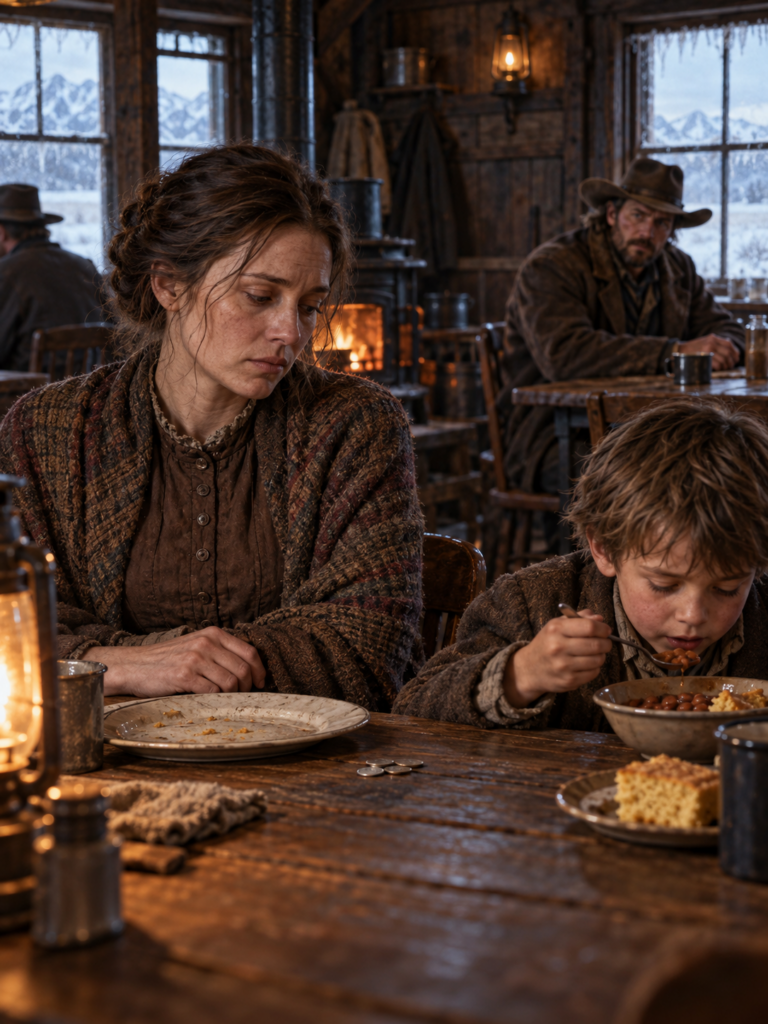
Years earlier, Anna had sat in a roadside dining room with a single plate of food and told her son she wasn’t hungry.
She had believed that loving him meant giving him everything, even when it left her nothing.
Daniel had seen the empty plate.
He had offered honest work.
And the difficult months that followed had taught them both that love was not proved by suffering alone.
It was also proved by shared responsibility.
By respecting another person’s freedom.
By showing up when circumstances became difficult.
By making room at the table.
And by understanding that a mother who has spent her life feeding everyone else deserves to eat, too.
That evening, when supper was nearly finished, Eli reached for the last piece of cornbread.
Then he paused.
“Mama, would you like half?”
Anna smiled.
For once, she did not tell him she wasn’t hungry.
“Yes, sweetheart,” she answered. “I believe I would.”
Eli broke the bread in two.
He gave his mother one piece and kept the other.
And across the table, Daniel watched them with the quiet satisfaction of a man who knew that the most important thing he had helped save was not a herd of cattle or a piece of Wyoming land.
It was the freedom of a mother and son to stop being hungry, frightened, and alone.
Anna took a bite of the bread.
Eli took his.
And for the first time in a very long while, neither had to pretend there was enough.
There truly was.