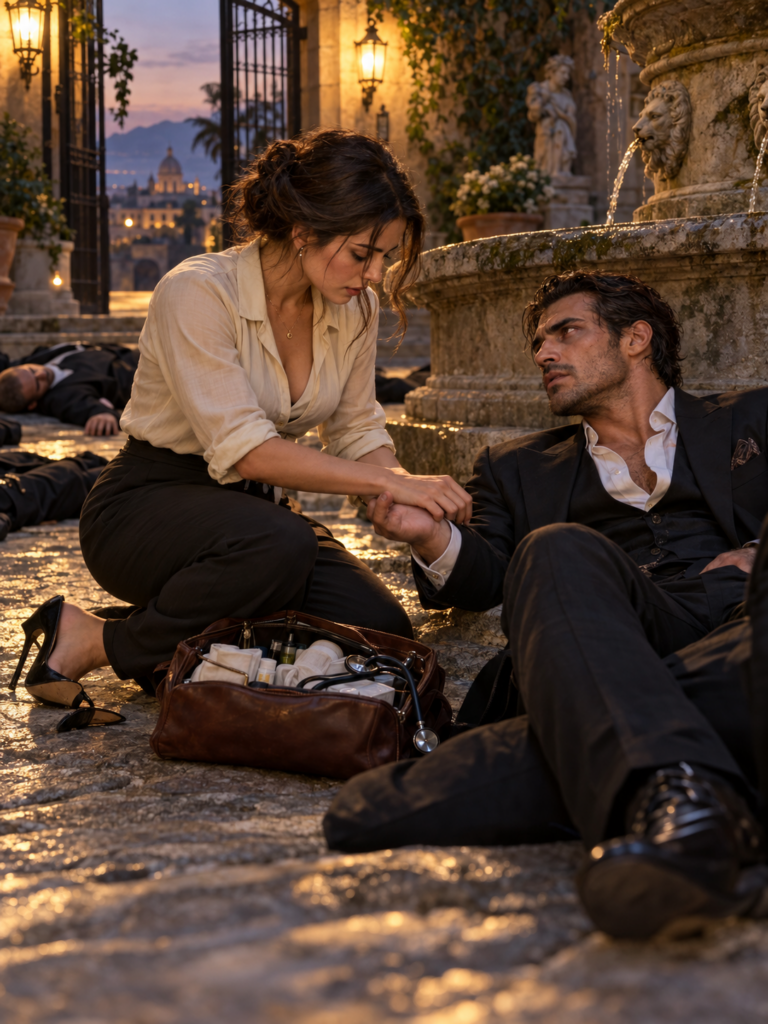
Her fingers closed around the cold iron just as the guard stepped aside.
For one astonishing second, the passage to the street stood open.
Sofia could see the alley beyond. The uneven cobblestones. The corner where she had broken her heel.
A few steps, and she could be back among ordinary people.
Then Dante spoke.
“Sofia.”
She stopped, but did not turn.
“There’s no one stopping you from opening that gate.”
“Except the men who were standing in front of it thirty seconds ago.”
He accepted the correction without argument.
“You’re right.”
She turned.
His face had lost more color from standing. He was using the fountain for support, though he seemed determined not to admit it.
“Then let me leave.”
“I can’t promise that sending you back into Palermo tonight is safe.”
“You’re talking about my safety as though it’s something you own.”
The words landed harder than she expected.
Dante studied her. Then he motioned for the guard to remain where he was.
“Someone close to me betrayed me tonight,” he said. “I don’t know how much information they have. I don’t know whether they know you intervened. That’s the truth.”
“And your solution is to make an innocent woman disappear?”
“Temporarily.”
“You keep saying that.”
His expression tightened.
“Because I’m hoping it will be.”
She almost laughed.
Not because anything was funny.
Because she had spent the last hour fighting to keep this man alive, and now she was bargaining with him for permission to resume her own life.
The arrival of another vehicle interrupted them.
A small, neatly dressed woman stepped out.
She introduced herself as Concetta and explained, in a gentle Sicilian voice, that she managed Dante’s household.
She asked whether Sofia needed water.
The kindness was so ordinary that it nearly undid her.
“No, thank you,” Sofia said. “What I need is a way home.”
Concetta looked toward Dante.
There it was again.
Everyone looking to him.
Everyone waiting for his permission.
Sofia faced him directly.
“I have a training program at a medical cooperative. People expect me tomorrow. My mother expects to hear from me. If I disappear, questions will follow.”
“Then you can contact them.”
“Privately?”
He hesitated.
“Within certain limits.”
“Those limits will be decided by you.”
“At first.”
Sofia lowered her eyes briefly.
She recognized a dangerous kind of logic.
Every restriction came with an explanation.
Every explanation sounded reasonable until all the restrictions were placed together.
And at the end of them stood a woman who could no longer decide where she slept.
She looked up.
“Here’s what happens next. You receive proper medical treatment. Your two men receive treatment. And tomorrow you tell me exactly what you’re asking of me, how long it lasts, and what happens if I refuse.”
Dante looked at her.
“You don’t frighten easily.”
“I’m frightened right now.”
Something altered in his expression.
“But I’m not going to let that make me stupid,” she continued.
For several moments, the courtyard was silent.
Then Dante gave a small nod.
“All right.”
It was not freedom.
It was not agreement.
But it was the first concession he had made.
Concetta guided her toward the waiting car.
Sofia climbed inside because the alternative remained uncertain and because exhaustion had finally begun to overtake anger.
Dante entered beside her.
He kept his distance.
For forty minutes, they traveled through Palermo and up into the hills.
The city lights diminished behind them.
At the end of a winding private road, enormous iron gates opened onto a property surrounded by citrus groves.
The residence beyond was built from pale Sicilian stone, with tall windows and balconies overlooking the dark hills.
Sofia had seen expensive homes before.
She had never seen one that looked so much like a fortress pretending to be a family residence.
Concetta brought her upstairs to a bedroom overlooking orange trees.
Everything was beautiful.
Everything was immaculate.
And Sofia knew she had not chosen to be there.
Before Concetta left, Sofia asked one final question.
“Is the door locked?”
“No, signorina.”
“And the front gate?”
Concetta’s silence was answer enough.
Sofia put her medical bag on the desk.
She took out her phone.
No immediate message came from her supervisor.
Her mother had sent a photograph of the family dog.
The ordinariness hurt.
Somewhere downstairs, footsteps moved through the house.
She crossed to the window and watched security lights illuminate the trees.
Then she opened her notebook and wrote down everything she remembered about the courtyard, the man’s symptoms, the timing of the wine, and the men who had arrived.
She was not going to let Dante Ricci become the only person controlling the story.
At the bottom of the page, she wrote one question.
Why had the poison left Dante conscious when both men beside him were unconscious?
Then she closed the notebook.
A soft knock came at the door.
Concetta’s voice followed.
“Signorina Caruso? Signor Ricci asks if you will see him in the morning.”
Sofia looked at the unlocked door.
“Tell him I have questions.”
She set the notebook beside her bag and walked toward the door, already deciding which question she would ask first.
Sofia opened the bedroom door before Concetta could leave.
“One more thing,” she said. “Please tell him I want to speak to my supervisor tomorrow. Without anyone telling me what to say.”
Concetta studied her for a moment.
“I will tell him.”
“Thank you.”
The older woman nodded, and Sofia watched her disappear down the corridor.
She closed the door.
For the first time since entering the courtyard, she allowed herself to sit down and feel the full weight of what had happened.
In Boston, she knew who she was.
She had a hospital identification badge, a profession, an apartment, friends, bills, an occasionally demanding mother, and a very small collection of windowsill plants that seemed determined to die despite her medical qualifications.
Here, she was something she had never imagined becoming.
A powerful man’s security problem.
And she intended to change that.
At nine the next morning, she entered Dante’s office.
He was standing near a window, dressed in a charcoal suit, apparently determined to look as though he hadn’t nearly died twelve hours earlier.
Sofia examined him before speaking.
“Are you still dizzy?”
“Good morning to you, too.”
“Answer the question.”
“A little.”
“And the physician?”
“Has examined me.”
“Follow-up monitoring?”
“Arranged.”
She nodded and pulled out a chair.
Dante watched her sit.
“You seem comfortable.”
“I’m exhausted. There’s a difference.”
He moved behind the desk.
“There’s something you should understand about this family.”
“I know you have enemies.”
“More than enemies. Obligations. History. People whose loyalties depend on circumstances I cannot always control.”
“And someone among them poisoned you.”
“Yes.”
“Then why am I the one under surveillance?”
He had no immediate answer.
Sofia leaned forward.
“Tell me what happens to me when you find the person responsible.”
“You go home.”
“When?”
“My estimate is two weeks.”
She felt her stomach tighten.
“My flight is scheduled for the fourteenth.”
“I know.”
The casual certainty bothered her.
“How?”
“I had your background checked.”
She stared.
“Of course you did.”
“Sofia—”
“Did you find out what toothpaste I use, too?”
To her surprise, the corner of his mouth moved.
“No.”
“Then your investigation was incomplete.”
The amusement disappeared when she added, “I understand why you investigate threats. I don’t accept being treated as one without evidence.”
He lowered himself into the chair opposite her.
It was a small adjustment.
But she noticed.
For the first time, they sat at the same level.
“What would you consider reasonable?” he asked.
“An honest explanation. Contact with the people who expect me. And an actual plan for my departure.”
“I can arrange the first two.”
“The third?”
“I’m working on it.”
“Then I’ll keep asking.”
His gaze remained on hers.
“Every day?”
“Every single day.”
And unexpectedly, he laughed.
It was brief.
Almost startled.
But genuine.
For a moment, the feared Sicilian boss looked like an ordinary man who had been caught unprepared by someone who refused to flatter him.
That moment should not have mattered.
To Sofia’s considerable annoyance, it did.
Over the following days, she learned the rhythms of the estate.
Concetta ran the household with practical authority.
Marco, Dante’s longtime second, supervised security with quiet precision.
Dante himself spent hours behind closed doors, trying to determine how someone had penetrated the circle of people he trusted.
Sofia was allowed through most of the house and grounds.
The western wing remained forbidden.
She spent her mornings walking the gardens and her afternoons in the library.
There she discovered shelves of history, philosophy, literature, and a much-loved collection of English novels.
One afternoon, she found Dante standing in the doorway.
“Your library is impressive,” she said.
“It belonged largely to my parents.”
She held up a battered copy of Pride and Prejudice.
“This one has definitely been loved.”
He looked at the book.
“My mother read it repeatedly.”
The expression that crossed his face was so unguarded that Sofia lowered the novel.
“She must have liked it very much.”
“She did.”
He entered, took another book from the shelves, and sat across from her.
They read together.
Neither tried to make conversation.
Sofia found herself appreciating the silence.
It wasn’t the suspicious silence of the office.
It was simply two people occupying a room without demanding anything of each other.
On the third day, Concetta told her about Dante’s family.
His father had died seven years earlier.
His mother had died long before that.
And his younger sister, Julia, had been killed four years ago.
“She was twenty-five,” Concetta said.
Sofia paused.
“What happened?”
The older woman stopped trimming rosemary in the kitchen garden.
“Someone wanted to hurt her brother.”
She said nothing more.
That evening, Sofia found herself looking differently at the portrait of a young woman in the main hallway.
Dark eyes.
A serious expression.
A face bearing traces of Dante’s.
For the first time, she understood that the enormous house was not merely a demonstration of wealth.
It was full of people who were no longer alive.
Later that night, Dante asked her about her nursing experience.
He had learned about her work in Baltimore and her time at a field hospital in Iraq.
She asked exactly how much of her personal history his people had uncovered.
When he mentioned her former relationship, she stopped eating.
“My professional background is one thing. My private life is another.”
He was quiet.
“You’re right. I shouldn’t have brought that up.”
She studied him.
It was a small apology, but not an empty one.
“And since we’re sharing information,” she said, “I looked you up, too.”
His eyebrows lifted.
She told him what she knew.
Dante Ricci.
Forty-one.
Leader of a powerful Palermo criminal family.
A man associated with a world she had spent her adult life trying to keep other people’s injuries from entering.
“You should be afraid of me,” he said quietly.
“I am.”
His expression changed.
“But I’m also trying to understand you.”
“Why?”
“Because knowing someone’s reputation isn’t the same as knowing their character.”
He looked at her for a long moment.
It was the first conversation they had in which neither of them seemed entirely interested in winning.
On the fifth morning, Sofia discovered the rose garden.
It lay behind an old door in the southern wall.
She pushed it open and stopped.
Roses grew everywhere.
Across the stone walls.
Around a rusted pergola.
Over narrow paths almost swallowed by leaves.
There were crimson roses, cream roses, pale pink flowers and deep red blossoms with centers nearly black.
She was standing among them when Dante appeared.
His expression changed as soon as he saw her.
“I didn’t know this was private,” she said.
“It’s not.”
But his voice had gone quiet.
She looked around.
“Who planted them?”
“My mother.”
He came to stand beside her.
“She added something every year. She believed a garden told the truth about the person who made it.”
Sofia touched a fallen petal.
“Then she left you quite a story.”
For several seconds, he said nothing.
Then he told her that after his mother’s death, his father had kept the garden maintained. After his own death, nobody had the heart to change it.
“And Julia?” Sofia asked carefully.
“She loved it here.”
He stared at the flowers.
“After she died, I came here when I couldn’t tolerate the rest of the house.”
Sofia didn’t try to comfort him with an easy sentence.
Instead, she stayed beside him.
Eventually, he looked at her.
“You can come here whenever you want.”
The invitation surprised her.
“Thank you.”
He nodded.
Then he left her among the roses.
A week after the poisoning, a shot was fired near the eastern perimeter.
Sofia was reading when she heard the sudden movement of guards through the house.
Concetta appeared.
“Please stay upstairs.”
“Is Dante injured?”
“No. His security team moved him out of danger.”
Sofia obeyed.
Not because she had stopped questioning her confinement, but because she understood the difference between asserting independence and deliberately entering an active threat.
Two hours later, Dante knocked on her bedroom door.
She told him to enter.
He was uninjured.
But his face was hard with exhaustion.
“Are you all right?” she asked.
“Yes.”
“Sit down.”
He glanced at her.
“I’m fine.”
“Your face says you’ve spent two hours convincing everyone else you’re fine. I’m not everyone else.”
He sat on the edge of the bed, leaving a respectful space between them.
She asked him what had happened.
“A shot from the eastern side. Marco got me clear.”
“You trust Marco.”
“With my life.”
The answer came without hesitation.
Then he asked about her training program.
She described the clinic, the lectures, the patients and the colleagues she missed.
When she finished, he asked, “What do you miss most?”
“Having something useful to do.”
“You saved my life.”
“That was one night. I have a career, Dante. I’m not a visitor whose only purpose is to sit in a beautiful house.”
He looked away.
“I know.”
“Do you?”
His eyes returned to hers.
“Yes. And I haven’t treated you accordingly.”
The admission surprised her.
She hadn’t expected to feel tenderness toward him in that moment.
But she did.
And she distrusted the feeling.
Because she knew gratitude could become attachment under strange circumstances.
She had seen it happen to vulnerable patients.
She was determined not to confuse a man’s occasional gentleness with freedom.
On the ninth day, that determination was tested.
She received a worried message from her mother.
Her supervisor wanted an update.
Her work at the cooperative was being disrupted.
And every communication she made was constrained by the story Dante’s people wanted the outside world to hear.
Sofia went looking for him.
The door to the forbidden western wing stood open.
She stepped inside.
A large operational room stretched before her.
Security screens showed the estate and parts of Palermo.
Documents and surveillance photographs covered a long table.
Marco stood beside several other men.
Dante was studying the photographs.
And near the center of the table was a picture of Sofia.
Taken in Palermo.
Before the courtyard.
Before the poisoning.
Before she had ever knowingly met Dante Ricci.
She picked it up.
The room went silent.
“You knew who I was?”
Dante dismissed most of the men.
Marco remained by the door.
“The image came from surveillance in an area we were monitoring.”
“Then why is it here?”
Dante said nothing.
She studied his face.
“Did you see this before the night I saved you?”
A pause.
“Yes.”
The answer made her blood run cold.
“Why didn’t you tell me?”
“Because at first I didn’t consider it relevant.”
“And now?”
“Now we’re trying to understand who knew what before the attempt.”
She held the photograph.
“You have kept me here for nine days because you say you can’t trust what you don’t understand. Yet you knew something about me before we met and decided it wasn’t important enough to share.”
“You’re right to be angry.”
“Angry?”
Her voice remained calm.
Which somehow made the accusation worse.
“My mother thinks I’m safely attending a medical program. My colleagues believe I’ve left for a family emergency. And the man controlling my movements had already seen a picture of me before I knelt beside him.”
Dante came around the table.
She didn’t move back.
“I didn’t arrange our meeting,” he said.
“Then why should I trust that?”
“Because I’m telling you the truth.”
“That isn’t enough anymore.”
He stopped.
For the first time since meeting him, Sofia saw him genuinely struggle with the limits of his power.
He could order people to leave rooms.
He could summon vehicles, physicians and security.
But he couldn’t command another person to believe him.
“What do you need from me?” he asked.
“Stop treating my questions like obstacles. Let me work. Let me speak for myself. And stop making decisions about my life without me.”
He listened.
Then he told her about Concetta’s husband, Enzo, whose persistent hip pain had resisted several consultations.
Sofia agreed to assess him.
She found a seventy-three-year-old man who had spent years compensating for an old knee injury.
After carefully examining his walking pattern and reviewing his history, she identified an issue worth raising with his treating clinicians.
She showed him gentle movements, explained why follow-up mattered, and helped him understand the habits that were making his pain worse.
Enzo listened.
For the first time since the courtyard, Sofia felt fully like herself.
When she left the cottage, Dante stood beneath an orange tree.
“Checking whether I escaped?” she asked.
“Partly.”
“At least you’re learning honesty.”
He accepted the remark.
They walked toward the house.
Sofia asked about the poison again.
“Whoever did it wanted something from you. The symptoms suggest they may have intended to incapacitate rather than kill immediately. The shot near the wall complicates that, but I don’t think the two events should be treated as unrelated.”
Dante slowed.
“Go on.”
“Someone needs information from you. Otherwise, why take the risk of poisoning three men instead of simply attacking you?”
He looked at her with a new expression.
Not appreciation.
Recognition.
Then he told her about an agreement made three years earlier between four regional criminal principals.
It involved distribution networks and the enormous sums associated with illegal trade.
The terms were never written down.
Two principals were now dead.
A third, a Neapolitan named Corsetti, wanted to change the arrangement.
“But he doesn’t know every condition,” Sofia said.
“No.”
“So he needs you alive long enough to tell him.”
Dante nodded.
“And afterward?”
His silence was terrible.
Sofia looked down at the gravel.
For the first time, she understood that the man beside her was not merely defending his power.
He was fighting someone who could not afford to let him survive once he had served his purpose.
“Am I in danger?” she asked.
“Not directly, as far as we know. Corsetti doesn’t know you’re here.”
“As far as you know.”
“Yes.”
She respected the distinction.
Then she looked toward the house.
“I have five days until my flight, Dante. I expect to be on it.”
“I know.”
But his voice carried something she was becoming reluctant to name.
That night, long after midnight, music woke her.
She followed it downstairs to a room she had never entered.
Dante sat at an old piano in the moonlight.
His eyes were closed.
His hands moved across the keys with a tenderness Sofia had never seen him show another living thing.
She stayed in the doorway until he finished.
When he looked up, he seemed startled.
“I’m sorry,” she said. “I heard you playing.”
“Come in.”
She took a chair near the piano.
“Who taught you?”
“My mother.”
He looked at the keys.
“My father didn’t see much value in music.”
“And you disagreed.”
“Privately.”
He played again.
Sofia listened.
The music made the enormous house seem smaller.
Less like a fortress.
More like a place where people had loved one another and failed to protect them.
When he finally stopped, he asked about Boston.
She told him about her apartment near the hospital, the gray skies, and the tiny herb garden on her windowsill.
He listened with the same intensity he brought to everything.
“You’ll return to that life,” he said.
“Yes.”
“Do you want to?”
She looked at him.
For a long time, neither spoke.
“I want the right to go home,” she answered.
Dante lowered his gaze.
“That’s fair.”
She stayed until morning.
And for the first time, Sofia wondered whether leaving the house might eventually hurt more than remaining in it.
On the twelfth day, Marco arrived during breakfast.
He carried photographs.
Ferrante, one of Corsetti’s trusted men, had appeared at Palermo’s port.
More importantly, he had been observed meeting with Vitale.
One of Dante’s own lieutenants.
A man who had served him for eight years.
A man who had been present the night of the poisoning.
Dante examined the photographs.
His expression became utterly still.
Sofia watched him.
“Who is Vitale to you?”
Dante took a moment before answering.
“He helped me after my father’s death.”
A pause.
“He was also the man who found Julia.”
The words transformed the photograph.
This was not simply a professional betrayal.
Vitale had stood beside Dante during one of the worst moments of his life.
Now he appeared to be helping the man trying to destroy him.
Dante turned to Marco.
“Where is he?”
“At his apartment. He doesn’t know we’re watching.”
“Keep it that way. I want to know the extent of the arrangement before anyone moves.”
Marco nodded.
When they were alone, Sofia said, “You’re going to confront him.”
“Yes.”
“And Corsetti?”
“That problem will be addressed, too.”
She studied the exhaustion beneath his composure.
“What happens if you’re wrong?”
Dante looked at the surveillance photograph.
“Then I lose more than I can afford.”
That evening, he left the estate.
Sofia stood at the library window as the vehicles disappeared down the road.
She had spent almost two weeks demanding the right to walk away from this man.
Now, watching him drive toward the people who had betrayed him, she discovered something she had not prepared herself to feel.
She was afraid he would never come back.
Near midnight, headlights finally swept across the orange trees.
Sofia set down her book and hurried into the hallway.
Footsteps sounded on the stairs.
Then Dante appeared.
Alive.
Uninjured.
But carrying an exhaustion deeper than anything she had seen before.
She stepped toward him.
“Tell me it’s finished.”
He stopped beneath the portrait of his sister.
And for several seconds, he could not answer.
Dante looked at Sofia standing beneath Julia’s portrait.
Then he loosened his collar.
“Vitale is in custody,” he said. “Ferrante is returning to Naples. Corsetti has accepted that the old agreement stands.”
Sofia studied him.
“Did he accept willingly?”
Dante’s expression told her the answer wasn’t simple.
“The immediate threat has been contained.”
She heard the distinction.
The threat was contained.
Not the world that had created it.
Not the obligations that made Dante necessary to some people and dangerous to others.
Not the history that had already claimed his sister.
“Come downstairs,” she said.
He frowned.
“Why?”
“Because you look like you haven’t eaten since breakfast.”
“Sofia—”
“You’re not negotiating this.”
For a moment, he stared.
Then he followed her into the kitchen.
She found eggs, rosemary from the garden and bread left wrapped beneath a cloth.
While she cooked, Dante sat at the wooden table, watching her with an expression she had begun to recognize.
He was accustomed to people anticipating his needs.
He wasn’t accustomed to someone noticing his exhaustion and refusing to be intimidated by it.
When she placed the plate before him, he looked at the food.
“My grandmother made eggs like this,” Sofia said.
He picked up his fork.
They ate quietly.
Eventually, he told her what he could about Vitale.
The trusted lieutenant had allowed his loyalty to become divided.
Corsetti’s pressure had created an opening.
Ferrante’s arrival in Palermo had confirmed the connection.
The poisoning and the later threat near the eastern wall belonged to the same larger effort to force Dante into surrendering the terms of the agreement.
Sofia listened.
The pieces fitted together, though not every detail was available to her.
She understood why Dante had been afraid.
She still disagreed with what he had done to her.
When he finished, she set down her glass.
“There’s something we need to discuss.”
He looked up.
“Your departure.”
“Yes. And more than that.”
She folded her hands.
“You knew almost immediately that I was a civilian. You checked my history. You understood my work, my obligations, and the people who would notice if I disappeared.”
“Yes.”
“And you kept me here anyway.”
“Yes.”
“Why?”
He looked toward the dark window.
“Because someone had breached my inner circle. I thought controlling every unknown variable would reduce the danger.”
“You made me one of those variables.”
“I did.”
“And the photograph?”
“It came from earlier surveillance around an area of concern. I saw you in it before the courtyard, but I had no reason to identify you as personally involved. Afterward, I had it placed among the material we were reviewing.”
“You should have told me.”
“Yes.”
She studied his face.
He wasn’t trying to persuade her that his intentions made his actions harmless.
For the first time, he seemed willing to let the harm exist without defending it.
“I was wrong to take away your choice,” he said. “I told myself it was necessary. That doesn’t make it right.”
Sofia looked down.
She had imagined this conversation many times.
In every version, she had prepared arguments.
She hadn’t prepared for him to agree.
“I don’t regret helping you,” she said.
His expression softened.
“But I regret that helping you cost me my freedom.”
He nodded.
“I know.”
“And I won’t build anything real with someone who believes fear gives him the right to decide for me.”
Dante met her eyes.
“Then I have to learn differently.”
There was no grand promise.
No dramatic declaration.
Only a man admitting that the habits which had kept him alive had also wounded someone who had asked nothing of him.
And Sofia knew that a confession was only the beginning.
Over the next two days, the house changed.
The movements of security staff became less urgent.
Concetta resumed complaining about the quality of vegetables delivered from the market.
Enzo proudly demonstrated that he was walking with less discomfort.
And Dante arranged for Sofia’s departure.
Her flight was confirmed.
Her documents were returned without condition.
Her communications were no longer monitored.
For the first time since the courtyard, she could walk through the front gate because she chose to.
That freedom changed everything.
It did not erase what had happened.
But it allowed her to consider what she wanted without the pressure of being trapped.
On her last evening, Dante invited her into Palermo.
He took her to a quiet courtyard restaurant beneath lemon trees, where the owner greeted him as an old friend.
Sofia wore a simple dark blue dress.
They ate slowly.
Dante told her how his father had first brought him there when he was young, already expecting him to inherit the family’s responsibilities.
He spoke about the London career he might have chosen.
The economics he had studied.
The weight of returning home.
Sofia listened.
“Do you ever wish you’d stayed away?” she asked.
“Sometimes.”
“Why didn’t you?”
“Because I thought leaving meant abandoning everyone who depended on me.”
She considered that.
“Maybe there are ways to protect people that don’t require controlling them.”
He smiled faintly.
“You’re going to spend the rest of your life telling me things I don’t want to hear.”
Sofia felt the remark settle between them.
The rest of your life.
Neither acknowledged the implication.
After dinner, they walked near the harbor.
Palermo glowed behind them.
The water carried broken reflections of streetlights.
Dante stopped beside her.
“Sofia.”
She knew what he wanted to say.
She knew because she wanted to hear it.
And that frightened her.
“Not tonight,” she whispered.
He nodded.
“All right.”
He didn’t touch her.
Didn’t argue.
Didn’t turn his disappointment into another obligation she was expected to manage.
They simply stood together beside the sea.
And Sofia realized how much his restraint mattered.
The next morning, in the rose garden, he told her something about his past.
Before she arrived, there had been a woman named Mara.
A woman he had cared for deeply.
A woman who had walked away because the life he offered required too much sacrifice.
“She wasn’t wrong,” Dante said.
Sofia sat beside him on the old iron bench.
“Did you blame her?”
“For a long time.”
“And now?”
“Now I understand that loving someone doesn’t mean they can survive the world you’ve built.”
Sofia watched the sunlight move over the roses.
She thought about Boston.
Her career.
Her mother.
Her small apartment with its stubborn plants.
And the man sitting beside her.
She had been happy in his house.
Not because captivity had been good for her.
Not because his wealth impressed her.
But because, within circumstances she had never chosen, she had encountered people and moments that mattered.
Concetta.
Enzo.
The library.
The garden.
The music.
And Dante, whose worst qualities and best qualities were now both impossible for her to ignore.
That evening, she went to his office.
He stood when she entered.
“I’m going home,” she said.
His face changed, but he nodded.
“I know.”
“I’m going back to my hospital. My apartment. My mother. Everything I built before you.”
“Of course.”
She stepped closer.
“And after a month, I want you to call me.”
His eyes lifted.
“A month?”
“I need distance. I need to know what I feel when I am free and my days belong to me again.”
He listened.
“If you still want to speak to me then,” she continued, “call.”
“And you’ll answer?”
“Yes.”
He crossed the space between them and stopped.
“May I?”
She knew he meant to touch her.
She nodded.
His hand rose gently to her cheek.
One brief touch.
No demand attached.
“Go home, Sofia,” he said.
She closed her eyes for a moment.
Then she stepped away.
The next morning, she left Sicily.
At the airport, surrounded by ordinary travelers and departure announcements, she felt a strange, almost overwhelming relief.
Her life was hers again.
She boarded her flight carrying her notebooks, her broken shoe, a borrowed novel from Dante’s library, and one dried rose wrapped carefully in tissue.
In Boston, she returned to work.
She rediscovered the satisfaction of a busy emergency department.
She visited her mother.
She watered her rosemary.
She walked through autumn streets where nobody knew the name Dante Ricci.
And she discovered something important.
Her life had not become smaller because she had left him.
It had become clearer.
She could function without him.
She could be happy without him.
She had options.
And only once she was certain of those things did she begin to understand what she wanted.
On the twenty-eighth evening, her phone rang.
An international number appeared on the screen.
She answered.
“You’re early.”
Dante’s voice came across the Atlantic.
“I’ve been informed I’m not particularly skilled at waiting.”
She laughed.
“How is Palermo?”
“Quieter.”
“Enzo?”
“He’s convinced your exercises have made him twenty years younger.”
“And Concetta?”
“Has started making more food than anyone in the house can reasonably eat.”
Sofia smiled.
There was a pause.
Then Dante said, “I’ve thought about what you told me.”
“Which part?”
“All of it.”
His voice had become serious.
“I can’t promise you a life without danger. I can’t pretend my responsibilities have disappeared.”
“I wouldn’t believe you if you did.”
“But I can promise that your decisions will remain yours.”
She sat beside the window.
“And your work?”
“Your work belongs to you. Wherever you choose to do it.”
She looked at the rosemary growing in its chipped ceramic pot.
“What are you asking me, Dante?”
“To let me see you again. When you decide you’re ready.”
For a moment, she closed her eyes.
This was what she had needed.
Not a man promising to rearrange the world through sheer force.
A man learning to ask.
They began speaking regularly.
The conversations were not always romantic.
Sometimes they discussed the books she read.
Sometimes he asked about her hospital shifts.
Sometimes she challenged his assumptions about his family and the responsibilities he believed could never change.
He didn’t always agree.
But he listened.
Eventually, Sofia returned to Palermo.
This time, she arrived with her own plans.
She arranged to continue medical work with the local cooperative.
She made clear that her professional responsibilities would not be directed by Dante or his organization.
She wanted a life in Sicily that existed beyond his walls.
He accepted that.
And over the following months, acceptance became something more important.
Practice.
He asked before making arrangements involving her.
He told her when a security situation affected her safety.
He stopped assuming that withholding information was kindness.
They disagreed.
Sometimes fiercely.
But she no longer had to negotiate for the basic right to decide what happened to her.
In winter, they walked through the bare rose garden.
The paths were wet from rain.
The rose canes stood dark and skeletal beneath the pale sky.
Dante told her about the changes he was trying to make within the family.
The structure he had inherited was built on violence, coercion and obligations that could not disappear overnight.
He did not pretend otherwise.
But he was attempting to reduce the harm his organization caused and move his responsibilities away from the worst practices of previous generations.
Sofia listened.
“That won’t make everything you’ve done right,” she said.
“I know.”
“And it won’t make the consequences disappear.”
“No.”
“Then why do it?”
“Because someone has to decide the next generation inherits less damage than the last.”
She looked at him.
It was the kind of answer she could respect without mistaking it for innocence.
In February, Sofia returned to Boston to settle her affairs.
Her mother listened as she explained her decision.
“He’s dangerous,” Rosaria said.
“Yes.”
“And you know that?”
“Better than I did before.”
Her mother studied her.
“Do you still know who you are when you’re with him?”
Sofia considered the question.
She thought about her work, her freedom, the choices she had made, and how differently Dante now responded when she disagreed with him.
“Yes,” she said. “And I can leave if that ever stops being true.”
Her mother nodded slowly.
“Then remember that.”
Sofia returned to Palermo in March.
Spring arrived across the hills in waves of color.
The orange trees blossomed.
The roses began opening.
Her life became divided between meaningful work and the complicated warmth of the Ricci household.
She was not Dante’s employee.
She was not his possession.
And she refused to become merely a decorative figure beside a powerful man.
She had patients, colleagues, decisions and a profession she had earned long before meeting him.
Dante learned to respect the hours she spent away from him.
He learned that concern did not entitle him to control.
And Sofia learned that loving a complicated man did not require denying the complications.
Then, in April, a new pressure arrived.
Another figure from the criminal world, Fioravanti, began attempting to use Dante’s relationship with Sofia as leverage.
The danger was not imaginary.
A compromised member of the estate’s security rotation had allowed information to pass where it shouldn’t.
The breach threatened the fragile freedom Sofia had worked to establish.
When Dante proposed additional protection, she listened.
Then she told him what she would and would not accept.
“I’ll take reasonable precautions,” she said. “But I’m not disappearing into this house again.”
“I understand.”
“You may need to remind yourself.”
His expression tightened.
“Probably.”
She appreciated the honesty.
When the risk became more immediate, Sofia chose to spend time in Milan with Zia Paola, a formidable older relative whose experience with the Ricci family had taught her that loyalty and obedience were not the same thing.
For twelve days, Sofia had space.
She thought about the life she wanted.
About the risks she could accept.
About the compromises she could not.
Zia Paola did not flatter her.
She made clear that loving Dante would require awareness, judgment and a willingness to protect her own identity.
Sofia agreed.
Meanwhile, Dante’s security team identified the compromised employee and closed the information breach.
Fioravanti received a definitive rejection of his attempt to gain leverage.
The immediate threat ended, though Sofia understood that danger would never vanish completely from Dante’s world.
On the twelfth day, a message arrived.
It gave the estate’s address.
And said the roses had opened.
Sofia read it twice.
Then she booked her return flight.
When she arrived the following afternoon, Concetta greeted her with an embrace that was far warmer than either woman would later admit.
Enzo insisted on demonstrating how well he could walk.
Marco carried her bag.
And Sofia went directly to the garden.
The roses were magnificent.
Every arch seemed heavy with blossoms.
The old pergola was nearly hidden beneath crimson and cream flowers.
At the far end of the path, Dante stood beside the iron bench.
He turned when he heard the gate.
For a moment, neither spoke.
Sofia crossed the garden.
She examined his face out of habit.
Good color.
Steady posture.
No visible injury.
“You look well,” she said.
“I’ve been told I should take better care of myself.”
“Wise advice.”
He smiled.
Then he opened his arms.
She stepped into them.
For a while, they stood beneath the roses without speaking.
At last, Sofia drew back.
“Tell me about Fioravanti.”
“The threat has been dealt with.”
“Tell me what I need to know.”
His expression changed.
Not with irritation.
With recognition.
He explained what had happened to the compromised security arrangement, what risks remained, and why he believed the immediate danger had passed.
He did not pretend his criminal world had become harmless.
And she did not pretend she could make it harmless by loving him.
When he finished, she nodded.
“Thank you.”
He studied her.
“There’s something I want to ask.”
Sofia smiled faintly.
“Then ask.”
He looked around the garden.
“My mother planted the first roses here when she came into this family. She built something of her own in a place already full of other people’s expectations.”
Sofia listened.
“For years, I thought protecting this house meant keeping everything exactly as it had been.”
He looked back at her.
“You’ve shown me how much harm that belief can cause.”
She took his hand.
“Not every change is a betrayal of the past.”
“I know that now.”
A breeze moved through the blossoms.
Dante stepped closer.
“I want you in my life, Sofia. Here, if this is where you want to be. With your work, your independence, your own decisions. Not because you saved me. Not because you owe me anything.”
His voice grew quieter.
“Because I love you.”
She felt the words settle through her.
Not as a debt.
Not as a command.
As something freely offered.
“I love you, too,” she said.
His breath caught.
“But I need you to understand something.”
“Tell me.”
“I won’t stop being a nurse. I won’t stop asking questions. And I won’t agree with you just because other people are afraid to disagree.”
He smiled.
“I’ve noticed.”
“And if you ever start treating my freedom as something you can give or take away, we’ll have a serious problem.”
“Understood.”
She lifted his hand.
“Then yes, Dante. I want to stay.”
He leaned toward her.
This time, she met him halfway.
Their kiss was quiet and unhurried.
No witnesses were required.
No declaration of ownership.
No promise that life would suddenly become easy.
They had lived through too much to believe in that kind of ending.
When they separated, Dante brushed a loose strand of hair from her face.
“Do you remember the courtyard?” he asked.
Sofia laughed softly.
“I remember a very stubborn patient.”
“And a woman who refused to take orders.”
“She was right not to.”
“She was.”
He glanced toward the flowers.
“I thought that night I needed to keep you close because you knew too much.”
“And now?”
“Now I know that if you stay, it has to be because you want to.”
Sofia rested her hand over his heart.
The same place where she had once searched desperately for signs that he would survive.
His heartbeat was steady beneath her palm.
She thought of the broken heel that had sent her into the alley.
Of the iron gate she had tried to open.
Of Boston, where she had returned to remember the person she was before him.
And of this garden, where she had finally chosen what came next.
She hadn’t arrived in Sicily searching for a powerful man.
She had arrived because she wanted her life to become larger.
Now it had.
Not because Dante Ricci had claimed her.
Because she had insisted on remaining herself.
And because the man who once believed protecting her meant controlling her had finally learned that the only love worth keeping was the love someone could freely walk away from.
Sofia took his hand.
Together, they walked out of the rose garden.
This time, the gate remained open behind them.