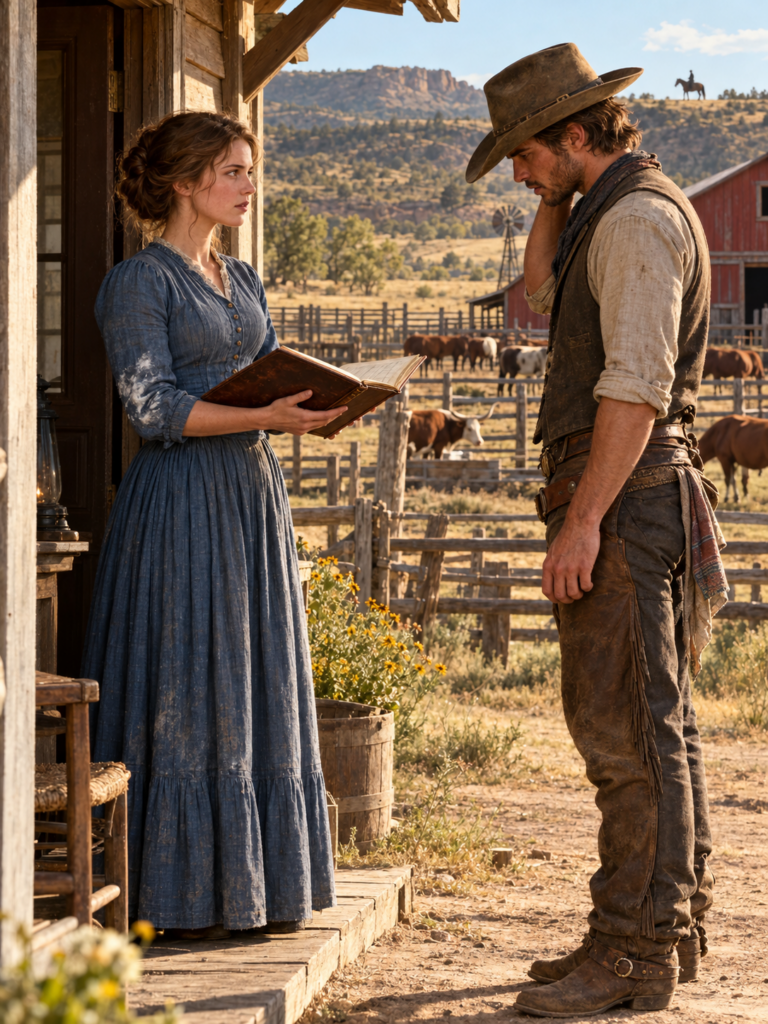
May’s hand closed over the edge of the ledger before Will could turn another page.
“Garrett Holland owns the adjoining property,” she said.
Will stopped.
“And he wants yours?”
“He’s made two offers.”
“You refused both?”
“Yes.”
“Why?”
May looked at him with a mixture of surprise and irritation.
“Because I don’t wish to sell my home.”
Will nodded.
“Fair enough.”
She removed her hand.
He turned the page.
There, in Daniel Callaway’s handwriting, was a brief notation about an old boundary survey and Holland’s renewed interest in the eastern pasture.
Will read it twice.
“Your husband was concerned about the survey?”
“He mentioned a discrepancy before he died. He intended to ask someone in Abilene to examine the old measurements.”
“Did he?”
“Not that I know.”
Will considered the entry.
“So Holland knows there’s a question about the land.”
“He claims there is.”
“And he’s been offering to buy it.”
“Yes.”
May’s voice sharpened.
“Mr. Harding, I asked you here because I need help managing cattle and protecting this operation. Not because I want you deciding what should be done with my property.”
Will closed the ledger.
“You’re right.”
She blinked.
“I am?”
“You are. I shouldn’t have pressed as though it was my decision.”
Her expression softened slightly.
“But if I take the work, I’ll need to understand the boundary before putting fencing money into the wrong ground.”
May considered that.
Then she nodded.
“That makes sense.”
Will pushed the book toward her.
“May I ask one more question?”
“Yes.”
“Why haven’t you sold part of the herd?”
“I’ve considered it.”
She opened another page.
“If I sell enough cattle at today’s prices to cover the note, I won’t have enough left to sustain the operation properly through winter.”
“And borrowing elsewhere?”
“I have no family who can lend that sum. The bank is my only practical option at present.”
Will sat back.
She had not invented a crisis to obtain a husband.
She had calculated every ordinary solution and found each one insufficient.
It made his decision harder.
He could sign papers.
He could work from sunup until dark.
But he could not promise that marriage would make their troubles disappear.
“You understand,” he said, “that a signature won’t fix the fences.”
“I know.”
“And forty dollars a month is more than some outfits pay their hands.”
“I know that, too.”
“You may not be able to afford it immediately.”
“Then we’d have to agree on when the payments begin.”
He watched her.
“You really have thought this through.”
May lowered her eyes.
“I’ve had eight months.”
Silence settled between them.
Will could hear the ticking of a clock near the stove.
Finally, he asked, “Did Daniel love this ranch?”
Her expression changed.
“Yes.”
“Did you?”
“Before I married him, it was just land. Afterward, we built a life here.”
She swallowed.
“And after he died, keeping it became the only thing I knew how to do.”
Will looked around the kitchen.
The shelves were neat.
The table had been scrubbed.
A second chair stood opposite hers, though it seemed not to have been used in some time.
He recognized the signs of someone maintaining a home against the fear of losing it.
“I’ve spent my whole life working on places that belonged to other people,” he said.
May listened.
“I know what it feels like to finish a hard day’s work and realize none of it gives you a reason to stay.”
“Then perhaps you understand why I won’t sell.”
“I think I do.”
She folded her hands.
“What about the marriage?”
Will looked at her steadily.
“I need the night to think.”
May nodded.
“That was always the offer.”
He rose.
She followed him to the door.
Outside, the August sky was darkening.
Will paused on the porch.
“If I agree, I won’t pretend your ranch is suddenly mine to command.”
“Good.”
“And I won’t promise affection I haven’t had time to feel.”
“I wouldn’t believe you if you did.”
He smiled.
For the first time, she smiled back.
Then a distant horse called from the eastern pasture.
Both turned toward the sound.
A dark rider was again visible near the far fence.
May’s smile vanished.
“Is that Holland?” Will asked.
“I believe so.”
“Does he often watch the ranch?”
“More often since Daniel died.”
Will looked at the man on the ridge.
Then at the woman standing beside him.
She had offered him a home, a wage, and a marriage that might remain practical forever.
But someone else was waiting for her circumstances to grow worse.
And Will understood that his answer tomorrow might determine much more than whether he had finally found work.
He stepped down from the porch.
“I’ll give you my decision at breakfast,” he said.
May nodded.
Then she reached for the door.
But before she closed it, Will turned back.
“Whatever I decide, don’t let Holland frighten you into selling before the boundary’s properly checked.”
“I won’t.”
She held his gaze.
Then, as the distant rider disappeared over the ridge, May shut the farmhouse door.
The farmhouse door closed, leaving Will Harding alone on the porch with a decision he had never imagined making.
A few hours earlier, he had been an unemployed cowboy asking for honest work.
Now a widow had offered him a place on her ranch, forty dollars a month, and a marriage.
Not because she loved him.
Not because he loved her.
Because she was running out of time.
Will crossed the yard toward the barn.
Inside, the animals were quiet.
He checked his horse, loosened the tack, and spread his blanket in an empty stall.
Then he lay awake considering May Callaway’s proposition.
He had worked for ranchers who cared more for their horses than their hired hands.
He had slept in bunkhouses, barns, and once beneath a wagon during a cold rain.
He knew the comfort of having steady work.
But he had never experienced belonging.
May was offering something beyond wages.
The possibility of remaining.
Yet he knew that accepting simply because he was tired of drifting would be unfair to her.
Before dawn, he rose and walked the fence line near the barn.
The eastern posts needed resetting.
A portion of the roof had begun to soften.
The place demanded work, but it was worth saving.
By six o’clock, he was standing in May’s kitchen.
She had coffee ready.
The ledger lay open beside her cup.
“Well?” she asked.
Will removed his hat.
“Yes.”
For a moment, she stared at him.
“Yes to the work?”
“And the marriage, if we can agree on everything properly.”
She sat down.
Then she took a long breath.
“Very well.”
It was not the reaction of a woman receiving a romantic proposal.
It was the relief of someone who had found a way to keep fighting.
They spent the morning reviewing the arrangements.
Will would handle cattle, fencing, repairs, and other ranch work.
May would continue overseeing accounts, purchases, and the property itself.
His wages would begin when the refinancing was completed, with the timing and any changes recorded clearly.
They would maintain separate rooms and treat any future change in their personal relationship as a matter requiring both their agreement.
Will insisted that May’s ownership and financial position be protected as far as the law allowed, and that they consult the lawyer handling the estate before signing anything affecting it.
By afternoon, they went to town.
The marriage was conducted by a minister before two witnesses.
May wore her best dress.
Will wore a clean shirt.
There were no flowers beyond a small arrangement already standing near the church window.
No music.
No declarations of eternal devotion.
They spoke their vows solemnly.
And when the minister pronounced them husband and wife, Will looked at May with unexpected tenderness.
“Are you all right?” he whispered.
She nodded.
“Ask me again when the bank agrees.”
That nearly made him laugh.
***
The refinancing meeting took place after the necessary estate documents and arrangements had been reviewed.
Harlon Briggs, the bank officer, examined the papers with the careful manner of a man concerned chiefly with whether the bank would be repaid.
He asked Will about the cattle.
About the projected winter expenses.
About the condition of the eastern pasture.
Will answered plainly.
When a question concerned ownership or May’s plans, he turned to her.
“She knows the figures better than I do,” he said.
Briggs looked mildly surprised.
May did not.
She had begun to understand that Will’s respect was not merely something he expressed when they were alone.
The revised terms were accepted.
The debt remained real.
The ranch still faced a difficult season.
But May had gained breathing room.
Walking back to the wagon, she said, “You did well.”
“So did you.”
“He seemed more interested in your answers.”
“That was his mistake.”
May glanced at him.
Will continued.
“The cattle are your business as much as mine. I wouldn’t be much of a partner if I forgot that.”
She looked ahead.
For a moment, she seemed close to smiling.
***
The weeks that followed were filled with work.
Will repaired the damaged barn roof.
He inspected the fencing, checked cattle condition, and studied the way May managed pasture rotation.
He asked questions without pretending to know everything.
May answered patiently.
She had spent years learning that land.
She knew where water collected after rain, which pastures recovered slowly, and which cattle needed special attention.
Will listened.
And with each passing day, their partnership became less theoretical.
One afternoon, he drove a new nail into the barn roof.
The hammer struck with a sharp, ringing sound.
Will paused.
For years, he had repaired other men’s buildings.
He had always finished the work knowing he would leave.
This time, the echo seemed different.
He looked across the yard toward the house.
May stood on the porch, examining a paper from the bank.
She raised her head.
“Everything all right?”
“Yes,” he called.
And he meant it.
But beyond the eastern fence, Garrett Holland remained a concern.
The neighboring rancher had wanted the Callaway property for years.
He had made two offers while Daniel was alive.
After Daniel’s death, he had renewed his interest.
And now he seemed displeased that May had found a husband willing to help her keep the land.
Holland approached Will one morning while he was setting fence posts.
“So you’re the new husband.”
“Will Harding.”
“Holland.”
“I know.”
Holland studied the fence.
“You’re putting a great deal of work into property that may have boundary troubles.”
Will straightened.
“What kind of troubles?”
“Old survey. Seventy-four. Some irregularities.”
“I’ve heard.”
“Then perhaps you should be cautious about improving the east pasture.”
Will rested his hands on the fence tool.
“That’s sensible advice if the survey is wrong.”
Holland looked pleased.
“Exactly.”
“But I prefer to know whether it’s wrong before I act as though it is.”
Holland’s expression tightened.
“Suit yourself.”
He rode away.
Will waited until the man was gone.
Then he returned to the house.
He opened Daniel’s old ledger to the notation about the disputed survey.
He read the name written beside it.
Pratt.
A surveyor in Abilene.
That evening, Will brought the ledger to May.
“I think we ought to contact this man.”
She examined the entry.
“John Pratt?”
“Daniel meant to ask him about the boundary.”
May nodded slowly.
“I remember.”
“Holland’s already raising the matter.”
“Then we should have it examined.”
Will took a sheet of paper.
“Shall I write?”
“Yes. I’ll tell you what Daniel knew.”
They prepared the letter together.
And when Will addressed it, May placed her hand briefly over his.
“Thank you for telling me.”
He looked up.
“It’s your land. You ought to know.”
That answer stayed with her.
***
By October, their routines had become familiar.
Will rose early.
May prepared the day’s accounts before joining him in whichever tasks required her attention.
They ate supper together when work allowed.
Sometimes they talked for hours.
Sometimes neither had much to say.
But the silence was no longer awkward.
One evening, May brought a plate to the barn while Will repaired a harness.
“You missed supper.”
“Didn’t mean to.”
“I thought you might say that.”
She placed the plate beside him.
He examined the damaged leather.
“Daniel meant to replace this.”
“He meant to replace a great many things.”
There was no bitterness in her voice.
Only an affectionate recognition of the husband she had lost.
“He was a good man,” she added.
Will nodded.
“I believe you.”
“He wasn’t always careful with money.”
“That happens.”
“And I spent months being angry with him for leaving me with debt.”
Will stopped stitching.
“May.”
She looked down.
“Sometimes I still am.”
“You can love someone and be angry about what they left you to face.”
She studied him.
“You don’t think that’s disloyal?”
“No.”
She sat beside him.
For a long moment, neither spoke.
Then she picked up her plate and began eating.
It was the first time they had shared supper in the barn.
It would not be the last.
***
John Pratt arrived in November.
He spent two days examining the old survey references and taking measurements along the eastern boundary.
Will helped where instructed.
May accompanied them whenever the work concerned a decision about her land.
Pratt explained the results.
The earlier survey had placed the boundary approximately ninety feet west of its correct position because of an error in accounting for compass variation.
The disputed forty acres lay within the Callaway property according to the corrected measurements.
May stood looking across the pasture.
“So Holland’s claim isn’t supported?”
“Not by these measurements,” Pratt answered. “The corrected survey should be submitted to the proper office, with the supporting records.”
They arranged the filing.
The question was not magically settled by a single conversation.
But May finally possessed evidence strong enough to defend the boundary she had feared losing.
Will watched her fold the survey copy.
“Feel better?”
“A little.”
“Only a little?”
“I’m learning not to celebrate until the paperwork is properly handled.”
He smiled.
“Wise woman.”
Two days after the corrected survey was filed, the eastern fence was damaged during the night.
Three sections had been cut.
Posts had been pulled from the ground.
And much of the herd had moved through the openings.
Will discovered the damage before dawn.
He rode back toward the house, then stopped beside the barn.
For a moment, he considered managing the situation alone.
May had barely slept the previous evening.
He wanted to spare her the worry.
But he knew better now than to mistake protection for secrecy.
He went inside.
“May.”
She opened her eyes.
“What is it?”
“The east fence is down. Several sections. The cattle are out.”
She sat upright.
“How many?”
“I can’t say yet.”
“Where are they?”
“Heading east.”
She was on her feet before he could say anything more.
Within minutes, she had dressed and joined him at the barn.
Will was already saddling his horse.
“You don’t have to ride if you’d rather organize things here,” he offered.
“They’re my cattle, Will.”
“I know.”
“Then hand me that bridle.”
He did.
They rode out together beneath the fading stars.
The air was turning sharply colder.
A northern wind had begun sweeping over the plains.
They found cattle scattered across the open ground near Holland’s side of the boundary.
Will noticed tracks left by several horses.
The movement of the herd did not look accidental.
Men had been driving the animals east.
May followed the nearest group.
“Keep them from crossing farther,” she called.
Will nodded.
They worked carefully, turning cattle back toward the damaged fence without scattering them further.
As daylight grew, Will noticed two riders watching from the eastern side.
He approached them without drawing a weapon.
One called, “You’re a long way from your own fence.”
Will stopped his horse.
“The corrected survey says otherwise.”
The men exchanged glances.
“We don’t know anything about that.”
“Then you can ask Holland. The filing’s been made.”
Neither answered.
Will looked toward the scattered cattle.
“I’m taking our herd back. I don’t intend to have trouble, and I expect the same.”
After a tense pause, the riders turned away.
Will waited until they had gone.
Then he returned to May.
Together, they moved the cattle toward the damaged sections, using the surviving stretches of fencing and the terrain to keep the herd contained.
By morning, the animals were back within the ranch’s working boundary.
The fence still needed proper repair.
But they had prevented a worse loss.
May dismounted beside the broken posts.
Her hands were cold.
Her face was exhausted.
Yet her eyes held determination.
“We’ll fix it.”
Will looked toward the darkening northern sky.
“And we’d best do it before the weather worsens.”
She followed his gaze.
The wind was increasing.
Winter had arrived on the Texas plains.
And the ranch they had fought to protect was about to face a danger neither a marriage certificate nor a corrected survey could solve.
May reached for the first fallen fence post.
“Then we start now,” she said.
Will bent to help her lift it.
Will caught the heavier end of the fallen post while May cleared the broken wire from beneath it.
The wind was already cold enough to sting their faces.
“Set it against that brace,” she said.
Will shifted his grip.
“Here?”
“A little farther.”
Together they raised the post and secured it temporarily.
It would not be a permanent repair.
But it was enough to keep the cattle contained until they could return with proper tools and materials.
May examined the damaged fence.
Three sections.
Too deliberate to mistake for ordinary wear.
Will watched her expression.
“You think Holland ordered it?”
“I think someone wanted the cattle moved east.”
“That isn’t proof.”
“No.”
She looked toward the neighboring land.
“And I won’t accuse him without it.”
Will nodded.
It was one of the things he admired about May.
She was determined.
But determination did not make her careless.
She wanted to protect what belonged to her without becoming the kind of person who would use suspicion as evidence.
They rode home as the weather worsened.
The first snow began falling before they reached the barn.
By evening, the temperature had dropped sharply.
And the great winter that swept across much of the western cattle country in 1886 and 1887 began testing every weakness in the Callaway operation.
***
The early storms were followed by deeper cold.
Water sources froze.
Wind drove snow across the pasture.
Cattle that had entered winter in poor condition began suffering first.
May and Will worked from before sunrise until well after dark.
They broke ice where animals needed water.
They moved feed to sheltered places.
They strengthened weak sections of fencing.
And they spent long hours checking the herd for animals in danger.
The work was exhausting.
There were nights when Will came inside barely able to remove his coat.
There were mornings when May rose before him because she had been awake listening to the wind.
Neither pretended that hard work could overcome every loss.
During the first severe stretch, seven cattle died.
May recorded each loss in her ledger.
Will stood beside her as she made the entries.
She stopped after the seventh.
“We can’t afford many more.”
“I know.”
She pressed the pencil against the page.
“Daniel borrowed money because he believed the herd would bring us a better future.”
Will waited.
“And now I’m watching that same herd disappear.”
He rested one hand against the back of her chair.
“Some losses were beyond his control. These are beyond ours, too.”
“I know.”
“But we’ll do everything we reasonably can.”
May looked up.
“And if it isn’t enough?”
Will did not offer a false promise.
“Then we’ll make another plan.”
She studied him.
Then she nodded.
It was the answer she needed.
Not reassurance that nothing bad could happen.
The certainty that they would face the truth together.
***
As the winter deepened, their house became a working refuge for animals that could be brought safely inside.
Several weakened calves needed close attention.
Three spent the coldest nights in a protected corner near the kitchen stove, wrapped and kept warm while May and Will took turns watching them.
The kitchen smelled of coffee, wood smoke, damp wool, and livestock.
May had once kept that room spotless.
Now she looked at the calves and decided that cleanliness could wait.
One evening, Will came in carrying fresh bedding.
May glanced toward the corner.
“One of them finally drank properly.”
“Which one?”
“The smallest.”
He smiled.
“Good.”
She looked at him.
“You’re pleased.”
“Shouldn’t I be?”
“Last month you said there was no sense bringing cattle into a kitchen.”
“I’ve reconsidered.”
“Remarkable.”
Will laughed.
The sound surprised them both.
Then May began laughing, too.
For a little while, winter seemed less powerful.
They were still frightened.
Still tired.
Still watching the ranch’s finances with growing concern.
But they had also discovered something that did not appear in the four terms of their original arrangement.
They could make one another happy even on days when almost everything else went wrong.
***
On the coldest night of the season, Will returned from checking the northern pasture with his hands nearly numb.
May saw the condition of his fingers as soon as he entered.
“Sit down.”
“I’m fine.”
“Will.”
He stopped.
She pointed to the chair.
“Sit.”
He obeyed.
She helped him remove his gloves and examined the pale, painful fingers.
The cold had injured his skin.
She warmed his hands carefully and gradually, using what protection and knowledge they had, while watching for signs that the damage might be serious.
Will tried to make light of it.
“I’ve had colder days.”
“Then you’ve been fortunate.”
He looked at her.
She was concentrating on his hands with the same expression she wore when examining a difficult ledger.
Focused.
Serious.
Unwilling to let fear make her careless.
“May.”
“What?”
“Thank you.”
She glanced up.
“For what?”
“For taking care of me.”
Her expression softened.
“Those hands have been keeping this place standing.”
“So have yours.”
She looked down.
For a moment, her fingers rested gently over his.
“Then perhaps we ought to take better care of both pairs.”
Will smiled.
Outside, the wind battered the shutters.
Inside, three calves slept beside the stove.
And Will Harding, who had spent most of his life searching for somewhere he belonged, finally understood that he had found it.
Not because he possessed land.
Not because a woman had signed a marriage certificate with him.
But because they had made a life together that neither could have built in quite the same way alone.
***
The worst weather eventually passed.
When conditions improved, May and Will counted their losses.
The ranch had suffered badly.
Twenty-two cattle were gone by the end of the hardest part of winter.
The remaining herd needed careful attention.
There would be no quick expansion.
No easy recovery.
But the operation had survived.
The corrected boundary was recognized in the records.
The bank note remained under its revised terms.
And although the winter had damaged their finances, the accounts showed a path forward.
They would have to rebuild slowly.
May accepted that.
She had learned the danger of making plans against prices and prosperity that had not yet arrived.
Will agreed.
“We’ll build the herd at a pace we can support,” he said.
“And keep the debt moving down.”
“Yes.”
She smiled.
“Listen to you. Sounding like an accountant.”
“Terrible thing to happen to a cowboy.”
“You’ll recover.”
“Not sure I want to.”
***
In February, Garrett Holland rode to the eastern fence.
Will was replacing damaged posts.
The boundary markers placed during Pratt’s survey stood beyond him.
Holland stopped his horse.
“Heard you lost cattle.”
“We did.”
“Lost thirty myself.”
Will continued working.
“Hard winter.”
Holland watched him set another post.
“That survey is still going to stand, then?”
“Far as the corrected filing shows.”
Holland looked toward the marked boundary.
Then he nodded.
“I don’t intend to dispute the east pasture further.”
Will straightened.
“Good.”
The two men regarded one another.
Then Will spoke.
“There’s something else.”
Holland waited.
“That fence was deliberately cut in November. I saw tracks leading cattle toward your side.”
Holland’s face remained guarded.
Will continued.
“I don’t know who gave the order. But I want it understood that we’ll protect our herd and our boundary through proper means.”
Holland was silent.
Then he said, “There needn’t be more trouble.”
“I’d prefer there wasn’t.”
Holland looked toward the farmhouse.
“May’s kept the place together better than I expected.”
Will rested a hand on the fence post.
“She worked hard for it.”
Holland nodded once.
Then he turned his horse and rode east.
Will watched him go.
No apology had been made.
No confession offered.
But the pressure against the boundary had eased.
And for the first time since Will arrived, the eastern fence seemed to mark a place that could simply be maintained rather than defended.
He picked up his hammer.
There was still work to do.
He intended to finish it.
***
By March, the worst of winter was behind them.
The first warmer days brought mud, dripping eaves, and cautious signs of new growth.
May sat at the kitchen table one evening with the ledger open.
Will entered after checking the barn.
He washed his hands and sat across from her.
“The accounts?” he asked.
“Nearly finished.”
“Good news?”
“Some.”
He smiled.
“I’ll take some.”
May looked at the figures.
Then she closed the book halfway.
“Will, do you remember the four terms we agreed upon?”
He nodded.
“Work. Wages. A share in the operation. Marriage.”
“And separate rooms.”
“I remember.”
She studied him.
“Things have changed.”
“They have.”
He leaned forward.
“I’ve been wanting to discuss that.”
May rested her hands on the ledger.
“So have I.”
Will took a breath.
“I came here looking for a job.”
“I remember.”
“I had no home of my own. No particular reason to stay anywhere.”
“And now?”
He looked around the kitchen.
The coffee pot rested on the stove.
Their coats hung together near the door.
The calves had returned to the barn.
The ledger lay between them, filled with records of shared labor and difficult choices.
“Now this is where I want to be.”
May’s expression softened.
Will continued.
“I know we’re already married. But I want to ask whether you’re willing to make this marriage something more than the arrangement we started with.”
She remained very still.
“Not because of the bank,” he said. “Not because of the ranch. Not because either of us needs the other to survive.”
He met her eyes.
“Because I love you, May.”
She looked at him for a long moment.
Then she smiled.
The smile she had almost given him on the day they returned from their wedding.
The smile she had withheld while the bank’s answer was uncertain.
Now it came freely.
“Oh, Will.”
He swallowed.
“I know that wasn’t in the terms.”
“No,” she said. “It wasn’t.”
“Then I’ll understand if—”
“Will.”
He stopped.
She rose from her chair.
Crossed the small distance between them.
And placed both hands against his face.
“I think our marriage became real somewhere around the time we started keeping calves in the kitchen.”
Will stared at her.
Then he laughed softly.
“You think so?”
“I know so.”
She kissed him.
It was not a kiss offered out of obligation.
Not a payment for work.
Not a desperate bargain made to save land.
It was a choice.
Made by a woman who had lived through loss, debt, uncertainty, and winter, and who now knew exactly what she wanted.
Will drew her gently closer.
For the first time since they had spoken their wedding vows, neither was thinking about the bank or the terms of employment.
They were simply a husband and wife who had fallen in love.
***
Spring brought better grazing.
The surviving cattle began recovering condition.
New calves arrived.
By May, the herd had grown from fifty-three to fifty-eight head.
The ranch was not wealthy.
But its finances were sounder.
May’s ledgers showed a modest operating profit and steady progress on the debt.
Will continued improving the property.
The eastern fence was rebuilt with stronger posts and properly stretched wire.
He took care of the barns, horses, and cattle with the same attention he had once given other men’s ranches.
But the difference remained.
He no longer worked merely for a wage.
He worked for a future he had freely chosen to share.
One morning, May found a letter on the kitchen table.
It was addressed to Will’s father.
Will had not written home in three years.
She did not open it.
When he returned from the barn, she pointed toward the envelope.
“Are you sending that today?”
He nodded.
“I thought it was time.”
“What did you tell him?”
Will smiled.
“That I found a place worth staying.”
May looked at him.
“And did you tell him about me?”
“Most of the letter was about you.”
She laughed.
“Poor man.”
“He’ll manage.”
Will kissed her cheek and carried the letter outside.
May watched him go.
There had been a time when she could scarcely imagine trusting another person’s future to her ranch.
Now she trusted Will not because he always agreed with her, but because he respected her judgment, told her the truth, and remained beside her when the work became hard.
That was a different kind of security from anything a bank could offer.
***
Later that month, Will came in from the pasture and found May waiting at the table.
The ledger was open.
She pointed toward a column.
He sat down.
“Something wrong?”
“Not wrong. Interesting.”
He followed her finger.
Several monthly entries recorded the forty dollars he had been entitled to receive under their original arrangement.
Beside each amount, May had written that it had been returned to the ranch operation.
Will looked up.
“You found those.”
“I keep the accounts, Will.”
“I know.”
“You’ve been putting your wages back into the ranch.”
“It needed the money.”
“So did you.”
“I had what I needed.”
May folded her hands.
“You shouldn’t have done that without discussing it with me.”
He considered her words.
Then nodded.
“You’re right.”
She looked surprised.
“That’s all?”
“I should have told you. We agreed to keep the accounts clear.”
May’s expression softened.
“I don’t want your contribution disappearing simply because you think the ranch needs it.”
“Then we’ll record it properly.”
“Yes.”
He smiled.
“More paperwork?”
“Always.”
She closed the ledger.
Then she looked at him with an expression that made him sit very still.
“You could have left, Will.”
“I know.”
“After the bank meeting. After Holland began troubling us. After that dreadful winter.”
“Yes.”
“You could have taken your wages and ridden away.”
He reached across the table.
“But I didn’t want to.”
“Why?”
Will looked around the kitchen.
He thought of the first evening in the barn.
The sound of a hammer striking a nail.
The woman who had stood in her doorway holding a ledger and offering him the strangest proposition of his life.
He remembered the long hours of work.
The bitter winter.
The cold night when May warmed his injured hands.
The spring morning when the calves finally ran across the pasture again.
And the simple joy of coming home knowing someone would be glad to see him.
“Because I love you,” he answered.
May smiled.
“And because this is our home?”
“And because this is our home.”
She leaned across the table and kissed him.
Outside, sunlight lay across the eastern pasture.
The repaired fence stood firm.
The cattle grazed on fresh spring grass.
The debt was being repaid.
And the future, while still uncertain, no longer frightened them in quite the same way.
***
One evening, long after supper, May and Will walked toward the barn.
The Texas sky had turned the soft gold of late spring.
Will stopped beside the building where he had slept on his first night at the ranch.
May looked at him.
“What are you thinking?”
He smiled.
“About the day I arrived.”
“I remember it.”
“You opened the door holding that ledger.”
“You looked as if you hadn’t eaten a proper meal in three days.”
“I hadn’t.”
“And I told you I needed a husband.”
“You did.”
She laughed.
“Terrible way to greet a stranger.”
“Worked rather well.”
May rested her hand against his arm.
“Were you frightened?”
“Of marrying you?”
“Of the whole arrangement.”
Will considered the question.
“I was frightened of promising something I didn’t understand.”
“And now?”
“Now I understand a little more.”
She waited.
He looked toward the house.
“I always thought having a home meant owning something nobody could take from me.”
May listened.
“But I’ve learned it means having somebody who will stand beside you when the work gets hard, and letting them stand there because they choose to.”
She smiled.
“You’ve become quite thoughtful for a wandering cowboy.”
“Not wandering anymore.”
“No.”
He took her hand.
They stood beside the red barn for a while, watching the last light settle over the property.
The ranch was still three hundred acres of Texas land.
The fences would need mending again.
Cattle would always require care.
There would be more accounts to balance, more decisions to make, and more seasons that tested them.
But neither had to face those things alone.
May had asked a stranger to become her husband because she feared losing everything.
Will had accepted because he saw a chance to stop drifting.
Neither had known that the work itself would teach them how to love.
The first nail he drove into the barn roof had sounded different from all the others he had driven.
He understood why now.
For the first time, he had been building something he intended to stay and care for.
And May, who had once measured every hope against the figures in a ledger, had learned that a good future could be made from more than favorable numbers.
It could be made from respect.
Honest work.
Hard conversations.
Shared decisions.
And the simple courage to choose one another when neither was obliged to remain.
Will squeezed her hand.
“Ready to go inside?”
May looked toward the farmhouse.
The kitchen window glowed softly in the dusk.
Her ledger waited on the table.
Coffee would be ready in the morning.
And beside her chair stood the man who had come looking for a job and stayed to build a life.
“Yes,” she said.
“Let’s go home.”
Together, they crossed the yard.
And this time, neither was merely passing through.