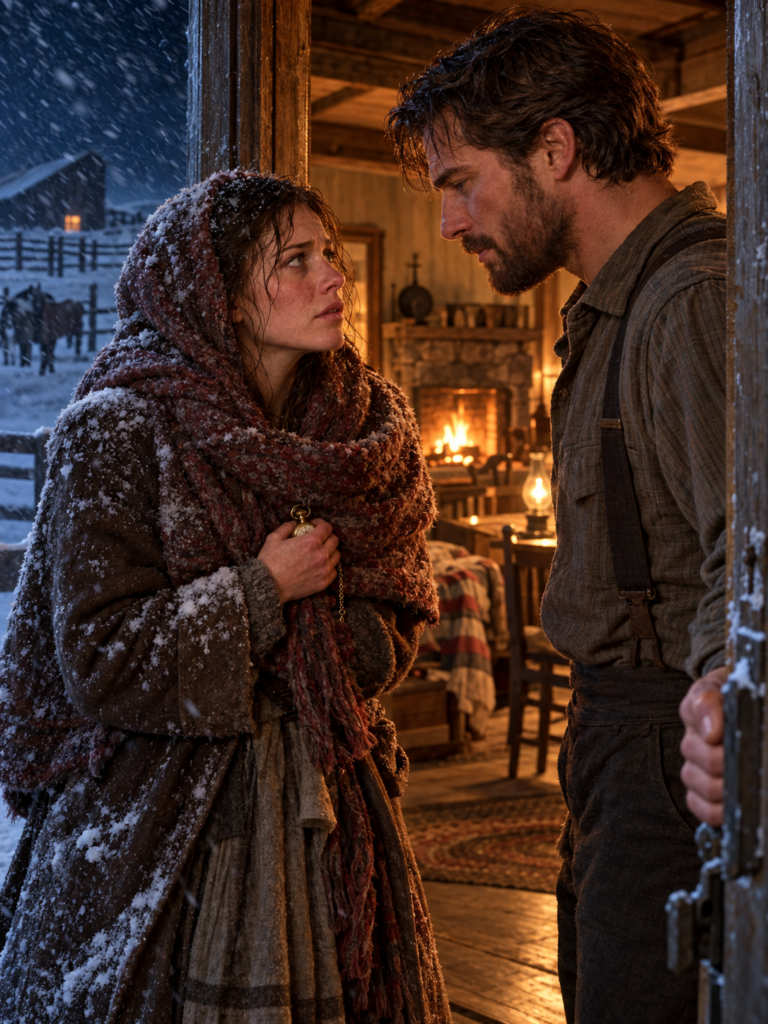
Ivy’s fingers closed around Emmett’s sleeve just as another violent gust struck the house.
The window beside the stove shuddered, and the lamp flame bent sharply inside its glass.
For an instant, Ivy tightened her grip.
Emmett remained still.
“What is it?” he asked.
She looked at her hand, then at his face.
“I don’t often ask anyone for help.”
“I’ve noticed.”
“And when I do, I don’t want it mistaken for an invitation to take charge of my life.”
He glanced at her fingers resting against his arm.
“I wouldn’t mistake it.”
She slowly released him.
“Good.”
Emmett pulled the curtain away from the rattling window, checked the latch, and secured it.
Then he returned to the stove.
“Your land’s yours, Ivy. A damaged roof doesn’t change that.”
She stared at him.
He had named the fear beneath all her other fears.
Not simply that her house might collapse.
That dependence might follow.
That someone would see her vulnerability and decide she was no longer capable of directing her own affairs.
She sank into the chair.
“My father left that place to me.”
Emmett nodded.
“I know.”
“I’ve worked it through three winters. Last year I carried water through drifts higher than the lower fence. I’ve gone without proper rest, sold what I could spare, and kept the stock alive when neighbors lost nearly everything.”
“You’ve done remarkable work.”
“I didn’t do it to impress anyone.”
“I didn’t suppose you had.”
Her throat tightened.
“I did it because I was determined nobody would ever tell me again that a woman couldn’t stand on her own.”
Emmett sat opposite her.
“Who told you that?”
Ivy looked toward the fire.
She had never spoken openly about the broken engagement since coming west.
Now the storm seemed to have stripped away her usual talent for silence.
“A man I once intended to marry.”
Emmett said nothing.
“When my father became ill, I took over the accounts and most of the work. The man decided I wasn’t the sort of wife he wanted.”
“What sort did he want?”
“One who needed him.”
A muscle tightened in Emmett’s jaw.
Ivy noticed.
“He thought a capable woman made a husband unnecessary.”
Emmett considered that.
“Sounds like he confused being wanted with being obeyed.”
Ivy looked up sharply.
No one had ever put it so plainly.
“He made every kindness sound like a debt,” she said. “Eventually I began to believe accepting anything meant surrendering something.”
Emmett glanced at the steaming cup between her hands.
“That coffee doesn’t come with conditions.”
“Even with all the sugar?”
“Especially with the sugar.”
She laughed softly.
The wind continued its relentless assault.
For a while, neither spoke.
Then Ivy asked, “Why do you live alone?”
Emmett leaned back.
“Built the place myself. Got accustomed to the quiet.”
“That can’t be the whole answer.”
“No.”
He smiled faintly.
“I’ve a brother in Ohio. We write sometimes. Other than that, I’ve never cared much for noisy company.”
“Yet you’ve spent the evening listening to me talk.”
“You’re not noisy.”
“I’ve been complaining since I arrived.”
“There’s a difference.”
Ivy looked at him for a long moment.
“What difference?”
“You’re saying things worth hearing.”
Her cheeks warmed.
It had nothing to do with the fire.
Outside, the wind began to rise again.
Emmett stood to add wood to the stove.
Ivy watched him work, noticing his unhurried movements, his patient attention to the fire, and how naturally he made room for another person.
Then she looked at the bedroom doorway.
“You truly mean to sleep in that chair?”
“Unless the chair objects.”
“You’ll be stiff by morning.”
“I’ve been stiff before.”
“Emmett.”
He turned.
“Yes?”
She hesitated.
The truth felt strangely dangerous.
“For three years, I’ve told myself I would rather freeze alone than admit I needed anybody.”
He waited.
“Tonight I crossed half a mile of open prairie in a storm that nearly took me off my feet.”
“You shouldn’t have stayed in that house.”
“I know.”
Her voice dropped.
“But when I finally decided to leave, I didn’t spend a moment wondering where to go.”
Something changed in his expression.
Ivy stood and crossed the small space between them.
She stopped close enough to feel the warmth of the stove behind him.
“I knew exactly whose door I trusted.”
Emmett’s voice was quiet.
“I’m glad it was mine.”
Another gust rattled the walls.
But Ivy did not flinch this time.
She looked directly into his eyes.
“I feel safer with you.”
For several seconds, Emmett did not answer.
Then he slowly offered his hand.
Not to claim hers.
Only to let her decide whether to take it.
Ivy reached toward him, her fingers trembling as they crossed the final inch between their hands.
Ivy’s fingers settled into Emmett’s open palm.
His hand was warm, roughened by work, and perfectly still.
He did not pull her closer.
He merely closed his fingers gently around hers and waited.
For a woman who had spent years treating dependence as a danger, that simple restraint meant more than she could explain.
“You’re shaking again,” he said.
“I know.”
“Cold?”
“Not entirely.”
Emmett looked toward the stove.
“Then perhaps we ought to sit while the room warms.”
She gave him a small smile.
“You’re determined to be sensible about everything.”
“Not everything.”
“Name one exception.”
He considered her.
“I’ve spent two years wondering what you might say if I ever found the courage to hold a proper conversation with you.”
Ivy blinked.
“Two years?”
“More or less.”
“And all this time you settled for good morning?”
“Seemed safer.”
She looked at their joined hands.
“For whom?”
Emmett gave a rueful smile.
“That’s a fair question.”
Their hands separated naturally when he reached for another log.
The moment passed without awkwardness, but something fundamental had changed.
Ivy was no longer merely a neighbor sheltering from a storm.
And Emmett was no longer simply the reserved rancher across the field.
They had begun telling each other truths.
***
The storm did not end until the hours before dawn.
Emmett insisted Ivy take the bedroom.
She protested once more, though less fiercely than before.
“You’re a stubborn man.”
“I’ve been told.”
“By whom?”
“Mostly myself.”
That earned another laugh.
She carried her father’s pocket watch into the little room and set it beside the bed.
Emmett remained outside, keeping the stove fed and listening for trouble in the wind.
Once, he heard her moving restlessly.
“Everything all right?” he called.
“Just listening.”
“House is holding.”
“I know.”
After a pause, her voice came again.
“Emmett?”
“Yes?”
“Thank you.”
“Good night, Ivy.”
She slept at last.
Not deeply.
Not without waking when the wind struck.
But each time she opened her eyes, she heard the stove crackling and knew there was someone nearby.
For the first time in years, she allowed herself the comfort of that knowledge.
***
Morning came in a strange stillness.
The blizzard had passed, leaving the prairie buried beneath drifts that smoothed fence lines and disguised every shallow depression.
Emmett inspected the weather before suggesting they go outside.
Ivy was already dressed in her dried clothing.
“My house?”
“We’ll see it soon enough.”
“I don’t intend to spend the day sitting here.”
“I wouldn’t dream of asking you to.”
He gave her a searching look.
“Eat first. Then we’ll go together.”
She accepted the breakfast.
That was the first small change.
Not that she suddenly needed him.
But that she no longer saw every sensible suggestion as a challenge.
When daylight had strengthened enough to reveal the way, they crossed the half-mile field.
The snow made progress slow.
Emmett walked ahead through the deeper drifts, while Ivy followed the route she knew from years of traveling between the properties.
They paused whenever necessary.
He did not hurry her.
She did not pretend the walk was easy.
Before they reached the yard, Ivy saw what remained of her roof.
The northern corner had been stripped away.
A section of the kitchen wall leaned inward.
Snow had gathered inside the house.
She stopped.
Emmett looked at the damage without speaking.
Ivy stood motionless for several seconds.
Then she said, “Well.”
He glanced at her.
“Well?”
“At least now I know which part of the roof was weakest.”
He almost smiled.
Then she began walking again.
***
Inside, the damage was worse.
Snow lay across the kitchen floor.
The stove was cold, surrounded by scattered debris.
Water and ice had found their way into places Ivy had worked hard to keep dry.
She stood beside the doorway, trying to measure what could be repaired.
Emmett examined the sagging wall from a safe distance.
“We shouldn’t put weight against that until it’s braced.”
“I know.”
“We’ll need timber.”
“I have some stored behind the shed.”
“That may be a start.”
Ivy turned toward the kitchen shelf.
Her face suddenly changed.
“The watch.”
Emmett looked back.
“Your father’s watch?”
She searched the clutter near the stove.
It was not the watch she had carried into his house the previous night; that one was safely in her coat pocket.
She realized her confusion when she reached for it.
For one frightened instant she had forgotten where she had placed it after changing clothes.
Then she drew it out.
The familiar metal case lay cold against her palm.
“Here it is,” she whispered.
Emmett watched without comment.
She opened the cover.
The hands had stopped during the night.
For a moment, the sight hurt more than the damaged house.
“My father used to wind it every evening,” she said.
“Would you like me to look at it?”
“Not yet.”
She closed the cover carefully.
“I’ll see to it myself when we’ve dealt with this.”
He nodded.
There was no reason to turn every difficulty into an opportunity to prove his usefulness.
Ivy noticed that too.
***
Within two days, Emmett brought the first load of lumber from his own supply.
Ivy met him beside the wagon carrying a small notebook.
He looked at it.
“What’s that?”
“An account.”
“Of what?”
“Everything you’re bringing.”
Emmett set down the reins.
“Ivy—”
“I’ll pay you for the boards. And nails. And anything else you supply.”
He studied her face.
Her expression was firm, but he could see the anxiety beneath it.
This was not an argument about money alone.
It was an attempt to preserve the independence she had fought so hard to establish.
“All right,” he said.
She blinked.
“All right?”
“Write them down.”
He lifted the first board.
“And I’ll expect you to keep the accounts fairly.”
“Of course.”
“Then you’ll have to include the meals you make while I’m working here.”
Ivy stared.
“Those aren’t the same thing.”
“Why not?”
“Because I’ll be cooking anyway.”
“And I’d be doing something with these boards anyway.”
She narrowed her eyes.
“You’re deliberately being difficult.”
“Only a little.”
She looked at him.
Then, against her better judgment, smiled.
“Fine. We’ll settle it fairly.”
He handed her the next board.
“That’s all I ask.”
***
The repairs required patience.
Emmett could help with the heavier work, but he still had his own stock and land to tend.
Ivy knew the house intimately.
She knew where her father had placed the original framing, which sections had been repaired over the years, and which supplies could be saved.
They planned around daylight, weather, available timber, and the obligations neither could neglect.
When Emmett’s lumber ran short, they traveled together to town for more.
Silas Cobb, the aging proprietor who supplied building materials, looked at the pair standing before his counter.
“Rebuilding the Morrow place?”
“My kitchen,” Ivy corrected.
Silas nodded toward Emmett.
“And whose wagon?”
“His.”
“And whose labor?”
“Ours,” Ivy replied.
Silas smiled.
“Then I’d say the two of you have come to a practical arrangement.”
“Entirely practical,” Emmett said.
The old man glanced at their faces.
“Of course.”
He wrote out the order without further teasing.
But Ivy caught the amusement in his eyes.
Later, when Mrs. Fenwick brought a small parcel of supplies Ivy had ordered before the storm, she found them working together along the damaged wall.
The older woman surveyed the repairs.
Then she surveyed Emmett.
“Well, I never thought I’d see the day.”
Ivy looked up.
“What day?”
“The day Emmett Larkin discovered the road between these two farms.”
Emmett kept working.
“It’s half a mile.”
“Then it has taken you an unusually long time to travel it.”
Ivy’s cheeks warmed.
Mrs. Fenwick set down the parcel.
“I suppose I’ll leave you two to your building.”
After she had gone, Ivy glanced toward Emmett.
“She’ll have the whole town talking.”
“Probably.”
“Doesn’t that trouble you?”
“Not much.”
“Why?”
He gave her a steady look.
“Because we’re repairing a house, Ivy. There’s nothing shameful in that.”
She returned to her work.
Yet his answer stayed with her.
***
Their first serious disagreement came over the kitchen wall.
Ivy wanted the damaged section rebuilt as closely as possible to her father’s original construction.
Emmett believed an additional brace would make the wall better able to withstand strong winds.
“My father built that wall,” Ivy said.
“I know.”
“It stood for twenty years.”
“And it deserves proper repair.”
“Then why change it?”
“Because the storm showed us where it needs strengthening.”
She crossed her arms.
“It was good enough for him.”
Emmett set down his tool.
“I haven’t said otherwise.”
“You think you know better.”
“I think the wall needs a different brace. That’s all.”
For a moment, silence settled between them.
Ivy felt her old defensiveness rising.
She knew this sensation.
A man disagreeing with her.
A man with practical skill.
A man who could easily make her feel foolish for having a different opinion.
Her former fiancé had done precisely that.
Emmett did not.
He waited.
Then he said, “Would you like me to show you what I mean?”
Ivy looked at the exposed framing.
Finally, she nodded.
“Show me.”
He explained how he intended to support the weakened section.
She examined the timber, questioned the placement, and considered the force of the wind against the northern wall.
At last, she said, “Your brace is sensible.”
Emmett nodded.
“But I want the door frame kept where Father put it.”
“It’s your house.”
“You don’t mind?”
“Not unless the door starts arguing with the wall.”
She laughed.
He smiled.
And Ivy realized something important.
They had disagreed without either of them being diminished.
Emmett had not needed her to surrender.
She had not needed to win merely to remain herself.
They had simply solved a problem together.
***
As the repairs continued, their companionship became part of the rhythm of their days.
Ivy noticed Emmett favoring his right shoulder after lifting heavy timber.
She said nothing at first.
Then one evening she found a tear along the lining of his work coat.
She repaired it carefully and left it folded near his door.
The next morning, he appeared carrying the coat.
“You fixed this?”
“Yes.”
“You didn’t have to.”
“I know.”
He looked at her.
“Then why?”
She shrugged.
“You needed a repair. I knew how to make it.”
Emmett’s mouth curved.
“Seems I ought to start keeping a notebook.”
She smiled.
“Don’t you dare.”
Later, when a cold spell interrupted their outdoor work, Ivy prepared a hot meal and carried it to his house.
He opened the door with obvious surprise.
“What’s this?”
“Dinner.”
“Something wrong with your kitchen?”
“Not anymore.”
He stepped aside.
She entered without hesitation.
A small action.
Yet both understood what it meant.
The first time she had crossed his threshold, she had come desperate and afraid.
Now she came because she wanted his company.
***
One evening, after the dishes had been cleared, Emmett admitted something he had concealed for two years.
“I used to watch you working across the field.”
Ivy raised an eyebrow.
“Used to?”
“Still do sometimes.”
“Emmett Larkin.”
He smiled.
“I admired how you handled that place. Even when the winters were hard.”
“Then why didn’t you ever say so?”
He considered his answer.
“Because I thought you’d resent the attention.”
“Perhaps I would have.”
“That’s what I told myself.”
“And the real reason?”
He looked down at his hands.
“I wasn’t certain what I’d do if I told you I admired you and you decided you’d rather I kept my distance.”
Ivy stared.
“You were afraid I’d refuse you?”
“Very much.”
She almost laughed.
“Two years, Emmett?”
“Two years.”
“And you settled for passing remarks over the fence?”
“They were very thoughtful remarks.”
She smiled.
“Mostly about weather.”
“Important subject out here.”
For a while they laughed together.
Then Ivy grew quiet.
She had assumed his distance meant disinterest.
Instead, it had been a clumsy mixture of respect and fear.
The revelation changed the meaning of two years of small encounters.
***
But affection did not entirely silence Ivy’s old wounds.
One afternoon, Emmett arrived with several roofing boards he had purchased at a favorable price.
He had not discussed the purchase with her.
Ivy saw the load and stiffened.
“What are those?”
“Boards for the roof. Silas had a good price.”
“I didn’t order them.”
“No. I thought—”
“Exactly.”
Emmett stopped.
Her voice was sharper than she intended.
“That’s exactly how it starts. Someone decides what I need, then expects me to be grateful.”
His expression changed.
For a moment, he looked hurt.
Then he placed the boards carefully against the wagon.
“I should have asked before buying them for your house.”
Ivy looked away.
She knew she had spoken more harshly than the situation deserved.
“My former fiancé used to do things like that,” she said.
Emmett remained silent.
“He would make decisions for me, then remind me how much he’d done. And if I disagreed, I was ungrateful.”
Emmett nodded slowly.
“I’m sorry he treated you that way.”
She looked back.
“And I’m sorry I accused you of doing the same.”
“I wanted to help. But I should have left the choice with you.”
Ivy exhaled.
“Thank you.”
“The boards can go back if you don’t want them.”
She studied the timber.
Then, with the beginnings of a smile, said, “What was the price?”
He told her.
She raised her eyebrows.
“That was a good price.”
“I thought so.”
She reached for her notebook.
“Then we’ll buy them. Properly.”
Emmett laughed.
And the argument ended not because Ivy abandoned her independence, but because both had respected it.
***
Later that week, Ivy sat alone reviewing her accounts.
The notebook contained careful entries for boards, nails, hauled materials, and other expenses.
Yet it did not contain everything that had passed between them.
The meals she had carried to Emmett.
The repaired coat.
The evenings spent talking beside the stove.
The quiet companionship.
The laughter.
The growing affection that no account book could fairly measure.
She turned another page.
Then closed the notebook.
For the first time in years, she understood that not every gift carried a hidden demand.
Some things could be freely given.
And freely received.
That evening, she walked the half mile to Emmett’s porch.
He was seated outside, watching the last light fade.
“Evening, Ivy.”
“Evening.”
He noticed her empty hands.
“No notebook?”
“No.”
She sat beside him.
“I’ve been thinking.”
“About the roof?”
“About us.”
He turned toward her.
Ivy looked across the field between their houses.
“I spent years believing I had to choose between being independent and letting someone care for me.”
Emmett waited.
“Now I’m beginning to think that was never the choice.”
“What was?”
She looked directly at him.
“Whether I could trust someone to care without trying to take over.”
Emmett’s expression softened.
“And?”
“I think I’ve found someone I can.”
They sat quietly.
Then Ivy said, “I don’t want to spend another two years speaking to you only across a fence.”
Emmett smiled.
“Neither do I.”
Her hand rested on the porch between them.
He reached toward it.
This time, she met him halfway.
***
The next week, Ivy returned to Emmett’s porch with no lumber to discuss, no accounts to settle, and no repair requiring his attention.
He stood when she approached.
“Everything all right?”
“Yes.”
“Your house?”
“Sound enough to face another storm.”
“Glad to hear it.”
She took a breath.
“Emmett, I want to stop building our lives as though we must always be half a mile apart.”
He looked at her steadily.
“Ivy, are you saying what I think you’re saying?”
“I’m saying I’d like a future with you. One in which neither of us has to pretend we need nothing from the other.”
Emmett stepped closer.
“Then there’s something I’ve wanted to ask for a long time.”
She smiled, though her heart was beating hard.
“Go on.”
He took both her hands.
“Ivy Morrow, will you marry me?”
Ivy looked down at Emmett’s hands holding hers.
The question hung between them in the cold evening air.
Beyond the porch, the prairie stretched toward the darkening horizon, and the roofs of their two farms stood visible across the half-mile field.
She had spent three years believing marriage would mean surrendering the life she had built.
Now a man was asking her to share a future without asking her to abandon herself.
Still, she did not answer immediately.
“Emmett,” she said softly, “do you know what you’re asking?”
He smiled.
“I believe I do.”
“I’m not an easy woman.”
“I’ve noticed.”
“I have my own ways of doing things.”
“Very particular ways.”
“And I won’t give up my father’s land.”
His expression grew serious.
“I wouldn’t ask you to.”
She studied his face.
“My farm stays mine?”
“Yes.”
“And yours stays yours?”
“Unless we agree otherwise.”
“And decisions about the land will be made together when they concern us both?”
“That’s what I want.”
She let out a breath she had not realized she was holding.
Emmett continued.
“I’m not asking you to marry me because you need a roof. You’ve already rebuilt yours.”
He glanced toward her farmhouse.
“I’m not asking because you need someone to run your place. You’ve proved you can.”
“Then why?”
He looked at her with a tenderness that made her chest ache.
“Because every good thing in my day is better when I can tell you about it. Because when something goes wrong, you’re the first person I want beside me. And because I would rather share the work and the quiet with you than spend the rest of my life watching you from across a field.”
Ivy’s eyes filled.
“You have a way with words for a man who claims not to talk much.”
“I’ve had two years to think them over.”
She laughed.
He squeezed her hands gently.
“But if you don’t want this, Ivy, nothing between us has to become a debt. I’ll still be your neighbor.”
That was what finally settled her heart.
He meant it.
He would accept her refusal.
He would not punish her for choosing differently.
And because he had given her that freedom, she understood how deeply she wanted to choose him.
“Yes,” she whispered.
Emmett blinked.
“Yes?”
She stepped closer.
“Yes, Emmett Larkin. I’ll marry you.”
He let out a long breath and smiled with a joy she had never seen on his face.
“Well,” he said.
Ivy laughed.
“Well?”
“I suppose I ought to say something more impressive.”
“You already have.”
She lifted her face toward him.
He paused, giving her the chance to turn away.
She did not.
Their first kiss was gentle and brief.
No storm forced it.
No danger demanded it.
It was simply a choice made by two people who had finally stopped mistaking distance for safety.
***
The days following their engagement were quieter than Ivy expected.
She had imagined that deciding to marry might change everything immediately.
Instead, the ordinary work remained.
Livestock needed tending.
Fences required inspection.
Feed supplies had to be counted.
Emmett’s wagon needed attention, and Ivy had accounts to balance before spring planting.
What changed was the way they approached those tasks.
They began making plans aloud.
Not merely for the next repair or the next meal, but for seasons they intended to share.
One afternoon, Ivy spread her papers across the kitchen table.
Emmett sat opposite her.
“I’ve been reviewing what each place produces,” she said.
“That sounds dangerous.”
“Only to a man who dislikes figures.”
“I don’t dislike figures.”
“You dislike having your estimates corrected.”
“That’s different.”
She smiled and turned the page.
Her father’s property had always been more than a house to her.
It represented his years of work, her own labor, and the independence she had fought to preserve after his death.
She would not discard that history merely because she loved someone.
Emmett understood.
They agreed to continue working both farms while keeping their ownership arrangements clear.
The livestock, buildings, supplies, and land would be managed through decisions they made openly.
Neither would assume that marriage granted the right to disregard the other’s judgment.
It was not an extravagant arrangement.
But it was one they could both live with.
And that mattered more to Ivy than any romantic promise made without practical meaning.
***
Mrs. Fenwick learned of their engagement before they had told more than a handful of neighbors.
Ivy entered the store one morning to purchase sewing thread and found the older woman smiling with unmistakable satisfaction.
“Well, Miss Morrow.”
Ivy stopped.
“Good morning.”
“I hear congratulations are in order.”
Ivy narrowed her eyes.
“Who told you?”
“Does it matter?”
“It might.”
Mrs. Fenwick leaned across the counter.
“Silas said Emmett came in asking about lumber for tables. I asked whether he intended to entertain the entire territory. He looked embarrassed, which told me more than any explanation could.”
Ivy shook her head.
“That man cannot keep a secret.”
“Silas? Certainly not. But don’t blame him. Half the town has been waiting for this since you started rebuilding.”
Ivy tried to look stern.
Mrs. Fenwick’s expression softened.
“I’m pleased for you, dear.”
“Thank you.”
“And I’m especially pleased that you haven’t sold your father’s place.”
Ivy looked surprised.
“You aren’t?”
“Why should you? It’s yours. A husband worth having ought to understand that.”
Ivy smiled.
“He does.”
Mrs. Fenwick nodded.
“Then I suppose you chose well.”
***
Silas Cobb took a more practical interest.
When Emmett collected materials for the small wedding gathering, Silas inspected the list.
“How many people?”
“Not many.”
“That isn’t a number.”
Emmett gave him an estimate.
Silas scratched his chin.
“Then you’ll need more boards if you expect everyone to sit.”
“I’ve already counted.”
“And I’ve been selling lumber since before you learned to swing a hammer.”
Emmett sighed.
Silas smiled.
“This lot’s my wedding gift.”
Emmett looked up.
“Silas, that’s too much.”
“Then consider it payment for all the entertainment you and Miss Morrow have provided this town.”
“We haven’t provided entertainment.”
The old man raised an eyebrow.
“You argued over board prices like an old married couple before you’d even begun courting.”
Emmett shook his head.
Silas pushed the order toward him.
“Take the lumber.”
At last, Emmett accepted.
He knew better than to continue arguing.
***
Their wedding took place in the spring of 1887, near the boundary where their lands met.
The location was Ivy’s suggestion.
She had spent years treating that boundary as proof of what belonged to her.
Now she wanted it to represent something different.
Not the disappearance of the line.
But the willingness of two people to cross it freely.
The ceremony was modest.
A few neighbors gathered beneath the open sky.
Mrs. Fenwick brought food enough to feed far more guests than had been invited.
Silas supplied tables.
And Emmett arrived wearing his best coat, freshly brushed and repaired.
Ivy recognized the stitching near the lining.
Her own work.
She smiled when she saw it.
He noticed.
“Something wrong with my coat?”
“Not a thing.”
“You’re looking at it.”
“Just checking my repairs.”
He leaned closer.
“They’ve held better than the original stitching.”
“Of course they have.”
She laughed.
Then the ceremony began.
Ivy wore a simple dress suited to the occasion.
In her pocket lay her father’s old watch, carefully wound that morning.
It still ran a little slow.
She had never considered replacing it.
When the time came to speak her vows, she looked steadily at Emmett.
She promised faithfulness, honesty, companionship, and the willingness to share both prosperity and hardship.
She did not promise never to disagree.
Emmett would have found such a vow impossible to believe.
He promised to honor her, to stand beside her in difficulty, and to treat the life they built as something belonging to them both.
His voice remained steady until the final words.
Then emotion briefly caught in his throat.
Ivy squeezed his hand.
He finished.
And when they were pronounced husband and wife, he smiled at her with an expression that held none of his former reserve.
They kissed beneath the pale spring sky.
Around them, their neighbors applauded.
Mrs. Fenwick wiped her eyes.
Silas pretended to be examining the tables.
And Ivy, standing on land she had once believed she must defend entirely alone, felt no loss of freedom.
Only the extraordinary happiness of having someone she could trust to share it.
***
The months after the wedding brought the familiar demands of frontier life.
Marriage did not soften the Dakota weather.
It did not keep fences from breaking or animals from falling ill.
It did not prevent exhaustion after long days or disagreements over spending.
But it changed how Ivy and Emmett carried those difficulties.
They worked both properties together.
Ivy continued maintaining accounts, inspecting her livestock, and directing the work on her land.
Emmett contributed his experience and labor while managing the responsibilities of his own farm.
When one needed help, the other offered it.
When a task required discussion, they discussed it.
And when either made a mistake, they learned that admitting it was less costly than protecting pride.
One spring morning, Ivy discovered that Emmett had moved several tools from the place she preferred keeping them.
She found him near the barn.
“Emmett.”
He recognized the tone immediately.
“Yes?”
“Where are the smaller tools?”
“Put them in the other shed.”
“Why?”
“Thought they’d stay drier.”
“Did you ask me?”
He looked toward the shed.
Then back at her.
“No.”
She crossed her arms.
He sighed.
“I ought to have asked.”
“Yes.”
“Would you like them moved back?”
She considered.
“Actually, the other shed may be better.”
He raised an eyebrow.
“Then we’re agreed?”
“We are agreed that you had a sensible idea and neglected to consult me.”
Emmett laughed.
“I see marriage hasn’t made you any less particular.”
“Did you want it to?”
“No, ma’am.”
He put his arms around her.
“Not for a moment.”
***
Their affection grew most naturally through work.
Ivy learned to recognize when Emmett’s shoulder was troubling him before he admitted it.
He learned that she became quiet when she was worried about expenses.
She discovered that he preferred to think through difficult problems while walking outside.
He discovered that she sometimes needed to talk through hers before she could see an answer clearly.
Neither approach was always convenient.
Both required patience.
But the small adjustments accumulated.
He began asking whether she wanted advice before offering it.
She learned to accept help without immediately reaching for her notebook.
They were not trying to make one person less independent.
They were learning how two independent people could be stronger together.
And that was a far more difficult and worthwhile task than merely sharing a surname.
***
That summer, they began building a new house on a low rise near the boundary between their farms.
The original houses remained standing.
Ivy refused to abandon the home her father had built, and Emmett had no desire to see years of his own work wasted.
The new house would provide a shared center for the life they intended to make.
They chose the location together.
It offered a view across both holdings and enough shelter from the worst of the wind to make it practical.
Emmett planned the framing.
Ivy reviewed the placement of the rooms, storage, and kitchen.
They disagreed over the size of the pantry.
“You don’t need that much space,” Emmett said.
Ivy looked at him.
“How many winters have you spent running short of something you thought you had plenty of?”
He considered.
“More than one.”
“Then we need the pantry.”
They built the larger pantry.
Emmett later admitted it was one of the better decisions made during construction.
The roof received special attention.
Ivy stood beside him as they examined the framing.
“Twice as careful this time?” she asked.
“At least.”
She smiled.
“Remember the roof that brought us together?”
“Hard to forget.”
“Then let’s make certain this one doesn’t require another desperate journey across the prairie.”
Emmett looked at her.
“I wouldn’t complain if you came knocking again.”
“You’d better not.”
They laughed.
The new house rose gradually through months of work, with materials purchased as they could afford them and assistance from neighbors when a task required more hands.
It was not grand.
The walls were plain.
The furniture was practical.
The porch overlooked the fields.
But every part of it reflected decisions they had made together.
And when the final boards were secured, Ivy stood in the doorway and felt a satisfaction unlike anything she had known before.
She had helped build a home without having to surrender the one she already possessed.
***
Her father’s pocket watch found a place on the mantel.
Emmett had offered to have it examined, but Ivy preferred to keep it much as it had always been.
The hands still lost a little time.
The case still bore the scratches of years of use.
And every evening, whoever passed the mantel last wound it.
Sometimes Ivy.
Sometimes Emmett.
The habit became one of those small household rituals that no one planned but both came to cherish.
One evening, Emmett held the watch while Ivy prepared supper.
“Your father truly believed everyone else was rushing?”
“He did.”
“Perhaps he was right.”
She turned toward him.
“What makes you say that?”
Emmett looked at the ticking watch.
“Seems to me we spent two years hurrying past the chance to know each other, all while pretending we were taking our time.”
Ivy smiled.
“We were cautious.”
“We were frightened.”
“Both, I suppose.”
He closed the watch.
“Wish I’d knocked on your door sooner.”
She considered that.
“Perhaps I wouldn’t have let you in.”
“Likely not.”
“Or perhaps I would have invited you for coffee and then spent the entire visit explaining why I didn’t need your assistance.”
“That sounds more likely.”
They laughed.
Then Ivy crossed the room and kissed his cheek.
“I’m glad you waited until I could recognize the difference.”
“Between what?”
“Being rescued and being loved.”
Emmett looked at her.
“And what is the difference?”
She answered without hesitation.
“Rescue helps you survive a moment. Love respects who you are after the danger passes.”
He drew her close.
“Then I hope I’ve done the second part properly.”
“You have.”
***
The first anniversary of the blizzard arrived with a familiar gray line gathering along the northern horizon.
Ivy noticed it while standing on the porch of their new house.
The air was sharp.
Clouds moved across the open country.
She remembered the night a year earlier when the sky had turned white and the wind had stripped the roof from her kitchen.
She remembered the struggle across the frozen field.
The numbness in her fingers.
The fear that her independence, her home, and perhaps her life were slipping beyond her control.
Most vividly, she remembered Emmett opening his door.
Not with triumph.
Not with questions about why she had finally needed him.
But with simple concern.
Come inside.
Those had been the words that allowed everything else to begin.
Emmett stepped onto the porch beside her.
“Storm coming.”
Ivy nodded.
“Looks that way.”
He followed her gaze toward her old farmhouse, still standing beyond the rise.
The repaired roof had held through the months since its rebuilding.
Her land remained hers.
His remained his.
And the new house stood between them as proof of a choice neither had been forced to make.
“You worried?” he asked.
Ivy considered the question.
“About the weather? Naturally.”
“About the house?”
“We built it well.”
“That we did.”
He rested an arm along the porch rail.
She moved closer.
For a while, they watched the clouds gathering.
Then Emmett glanced at her.
“Do you remember what you said that night?”
“Which part?”
“The part when you were sitting beside the stove and thought I couldn’t hear you above the wind.”
Ivy smiled.
“I remember.”
“You said you felt safer with me.”
“I did.”
He looked toward the prairie.
“I’ve thought about those words more times than I can count.”
“Why?”
“Because I’d spent two years hoping you might someday trust me enough to say something like that.”
Ivy turned toward him.
“Did you know I was frightened when I said it?”
“I suspected.”
“Not only of the storm.”
“I know that now.”
She placed her hand in his.
“That was the first night I realized I could trust someone without losing myself.”
Emmett squeezed her fingers.
“And you taught me that admiring someone from a distance isn’t the same as having the courage to love them.”
They stood together as the wind strengthened.
Inside, the stove was warm.
Their supper was waiting to be prepared.
The watch on the mantel ticked a little behind the true hour.
Ivy looked once more toward the horizon.
“Another storm,” she said.
“Afraid so.”
She smiled.
“Let it come.”
Emmett raised an eyebrow.
“You’re certain?”
She leaned against him.
“I’ve got exactly the place I want to weather it.”
He kissed the top of her head.
And together they went inside.
***
In the years that followed, neighbors sometimes repeated the story of Ivy Morrow and Emmett Larkin.
They spoke of the fierce winter storm.
The ruined roof.
The woman who crossed half a mile of snow rather than abandon the land her father had left her.
And the quiet rancher who opened his door without asking for anything in return.
But the storm itself was never the whole story.
Its fury had lasted only a night.
What followed required months of labor and many decisions neither could have made honestly while the wind was still howling.
Ivy had to learn that accepting help did not make her incapable.
Emmett had to learn that respecting independence did not always mean keeping his distance.
They both had to risk an answer they could not control.
The damaged farmhouse had needed timber, nails, and patient work.
Their growing trust required something less visible.
Honesty.
Time.
A willingness to disagree.
And the courage to remain gentle when old fears returned.
Ivy never stopped being the woman who could manage her own land.
Emmett never demanded that she become someone else.
They simply discovered that strength did not diminish when it was shared.
Years after their wedding, Ivy still kept a notebook.
But the pages were no longer devoted to proving that every act of kindness had been repaid.
They recorded planting plans, livestock matters, purchases, and the ordinary responsibilities of two farms managed together.
Her father’s old watch continued ticking on the mantel.
Its time remained imperfect.
Neither of them minded.
For Ivy understood something she had once believed impossible.
She could own her land.
Keep her judgment.
Speak her mind.
Choose her work.
And still rest her head against the shoulder of a man who loved her.
That winter night had not made her weak.
It had shown her that even the strongest person sometimes needs an open door.
And Emmett had learned that opening a door was only the beginning.
Keeping someone’s trust meant respecting the freedom that allowed her to walk through it—or walk away.
When the prairie storms returned, they no longer watched the weather from two separate houses, wondering whether the other was safe.
They stood together.
Not because either had surrendered.
Not because either was incapable of living alone.
But because both knew the difference between needing someone to save them and freely choosing someone to share their life.
And each time the wind rose over Dakota Territory, Ivy remembered the night she arrived at his door with frozen hands and nothing left to prove.
She had whispered that she felt safer with him.
The years that followed proved why.
For the safest home she ever knew was not the strongest roof, the thickest wall, or the largest stretch of land.
It was a life in which her independence could stand beside another person’s love, without either one asking the other to disappear.