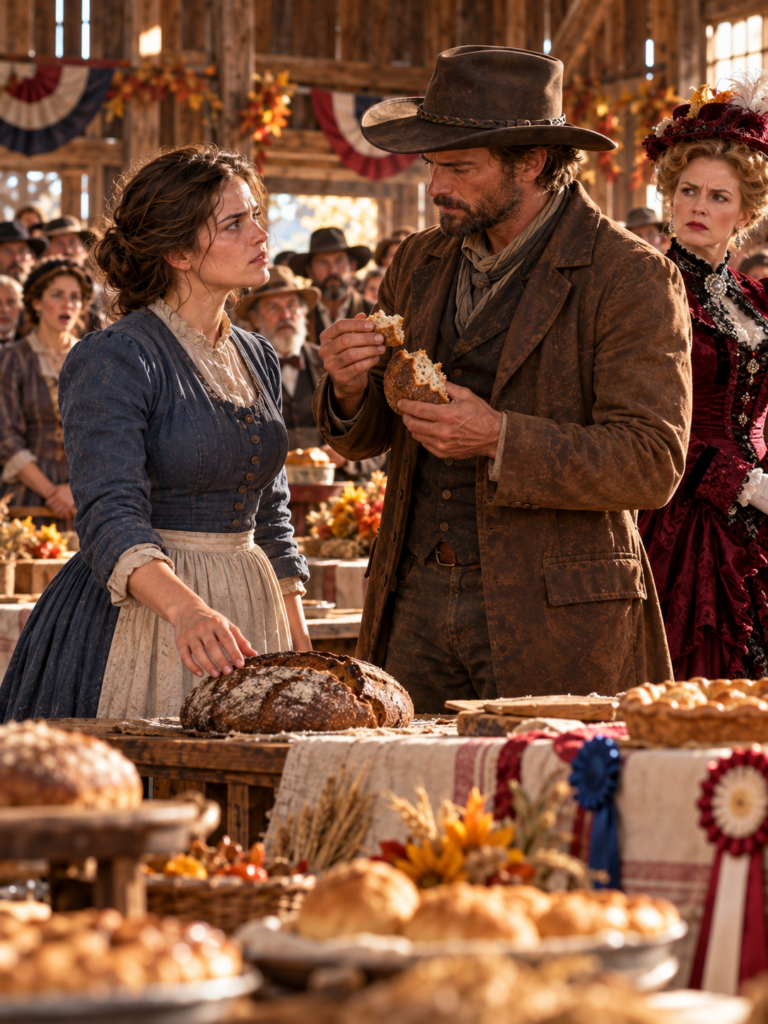
Marin kept her hand raised as Silas settled his horse and turned toward her.
Behind them, the town hall door stood open. She could hear the women still talking inside.
“Did you buy that bread because you wanted it,” she asked, “or because you felt sorry for the woman who made it?”
Silas looked genuinely surprised.
“Because I wanted it.”
“You paid more than the price.”
“I thought it worth more.”
She searched his face for the careful kindness she had come to distrust.
She found none.
He seemed almost uncomfortable with the attention, as though purchasing bread ought not require an explanation.
“You didn’t know who made it,” she said.
“Not until I asked.”
“And Beatrice’s opinion didn’t trouble you?”
“I was buying supper, Miss Whitlock. Not her opinion.”
Against her intentions, Marin almost smiled.
Silas touched the brim of his hat.
“Good afternoon.”
Then he rode away with the loaf.
Marin stood watching until he reached the corner.
The encounter should have ended there.
A fair was a fair. A sale was a sale. And a traveling cattle buyer had no particular reason to return to a lonely woman’s homestead.
She went back inside, helped put away the chairs, and walked home as the afternoon light faded.
Her chickens were waiting to be fed.
The barn latch still needed attention.
The beans she had soaked that morning needed cooking.
Nothing about the homestead had changed because a stranger bought a loaf.
Yet when she fed her starter that evening, she found herself remembering his words.
He had wanted the bread.
Not out of charity.
Not to make a display of kindness.
Because it was something he valued.
During the following weeks, Brier Hollow behaved as it always did.
Conversations stopped when Marin entered the dry goods store.
Frank Abson at the mill asked whether the fair had gone well, though his expression suggested he had already heard.
Beatrice continued presiding over the baking circle as though the incident had never occurred.
Marin worked.
She repaired weatherboarding around the chicken coop, sorted potatoes in the root cellar, and reset leaning fence posts.
Autumn advanced toward winter.
She told herself not to think about Silas.
Mostly, she succeeded.
Then, about a month after the fair, hoofbeats sounded on the road while she was splitting firewood.
The horse stopped at her gate.
Marin finished the stroke of her axe, set it aside, and straightened.
Silas Ror stood outside the fence.
He had his hat in one hand.
There were no cattle with him.
No other riders.
No business that she could see.
“Afternoon, Miss Whitlock.”
“Mr. Ror.”
His gaze went toward the stacked wood.
“You’ve been busy.”
“Wood doesn’t split itself.”
“No, ma’am.”
She waited.
He looked as though he had rehearsed a reason for coming and then misplaced it somewhere along the road.
“I was passing through,” he said.
Marin knew the nearest cattle route lay a considerable distance away.
She also knew that asking a man to explain himself before offering coffee was poor hospitality.
“I’ve got a pot on the stove.”
He accepted.
Inside, he removed his muddy boots without being asked and sat at her kitchen table.
His eyes moved across the room, noticing the mended harness, the preserved pears, the worn book, and the cracked starter crock on the shelf.
He commented on none of it.
They drank coffee.
Finally Silas spoke.
“I finished that loaf.”
“I expected you might.”
“Lasted well. Better than the white bread I generally buy.”
“My mother taught me to make it for working days.”
He glanced toward the crock.
“That’s where it begins?”
“Yes. Her starter. I’ve kept it going since she died.”
“What happens if you neglect it?”
“It weakens. Leave it too long and it may not recover.”
Silas considered that.
“Then there’s work in keeping it alive even when you’re not baking.”
“There is.”
For a moment she felt he understood more than bread.
But he offered no declaration.
When he rose to leave, she followed him to the gate.
“You rode a long way for coffee,” she remarked.
He met her eyes.
“Wanted to see how you were getting on.”
“I’m getting on well enough.”
“I can see that.”
He mounted.
Then he rode back toward the distant road.
Marin remained beside the gate, caught between pleasure and irritation.
He had come.
He had noticed.
He had left.
And she had no idea whether he intended to return.
She was turning back toward the house when she heard his horse stop beyond the bend.
Silas called back through the cold air.
“Miss Whitlock, that east fence of yours needs another look before the ground freezes.”
Marin turned toward the distant corner post.
She knew he was right.
She also knew a man who rode so far merely to notice her fences might eventually have to explain himself.
She picked up her axe and walked toward the unfinished woodpile, unsure whether she wanted his next visit more than she feared it.
Marin drove the axe into the chopping block and left it standing there.
Silas’s horse had disappeared beyond the bend.
She looked toward the eastern fence, where one corner post leaned slightly against the strain of the wire.
He had been right about the repair.
That irritated her almost as much as his unexpected visit.
She was accustomed to managing her own affairs. If something required mending, she planned the work according to the time and money available.
She had no need for a passing cattle buyer to inspect her property.
Yet he had not criticized her. He had simply noticed.
Six weeks later he returned.
This time Marin was struggling to hold a loose gate board steady while setting a fastener.
Silas came through the gate after she acknowledged him and offered to hold the board.
She allowed it.
Together they brought the wood into place.
When he mentioned that one side of the gate would eventually need replacing, she told him she had already planned the expense for spring.
He accepted the answer.
There was no argument about what she could afford.
No suggestion that he ought to take charge.
Afterward he helped her shift several feed sacks, and they ate bread and cheese in her kitchen.
He noticed that this loaf was lighter than the rye she had brought to the fair.
“Different proportions,” she explained.
“I favored the darker one.”
“Most people prefer this.”
Silas considered the slice in his hand.
“Then most people are welcome to it.”
Marin laughed.
It surprised both of them.
He did not stay long after that.
But when he rode away, she found herself listening to the hoofbeats until they vanished.
Three weeks later he arrived carrying a cloth-wrapped parcel.
It was a handmade stoneware crock, glazed brown and shaped for keeping sourdough.
Marin turned it slowly in her hands.
The workmanship was good, though not perfectly even.
Unlike her mother’s old vessel, it had no crack.
“For your starter,” Silas explained.
She looked up.
“You remembered?”
“I noticed the old crock leaking a little at the seam.”
He had visited only twice.
Yet he had remembered a small problem she had lived with for years.
Marin looked toward the kitchen window.
“I can repay you.”
“No need.”
“I’d rather not have a debt left between us.”
Silas considered her.
“Then give me a loaf when there’s one to spare.”
She accepted that.
That evening she carefully transferred the starter into its new home, fed it, and returned it to the shelf.
She kept the old cracked crock rather than throwing it away.
Her mother had used it for years.
A new vessel did not make the old one worthless.
By December, Brier Hollow had noticed Silas’s visits.
At the mill, Frank Abson began asking unusually careful questions about whether she had company.
Other women watched her cross the street.
Then Beatrice Crowell confronted her in the post office.
“I understand Mr. Ror has been visiting.”
Marin folded her seed catalog.
“He has.”
“A traveling man isn’t generally suited to settled expectations.”
Marin met her eyes.
“I haven’t asked you to set mine.”
Beatrice’s mouth tightened.
“I was only concerned.”
“Then your concern is noted.”
Marin left before the conversation could become another public examination of her life.
Outside, the cold air stung her cheeks.
She was tired of being discussed as though she were too foolish to understand her own circumstances.
What troubled her most was that Beatrice had touched upon a genuine uncertainty.
Silas had shown consideration.
He had worked beside her without belittling her.
He had returned when he said he might.
But he belonged to the road.
And Marin belonged to a homestead that demanded daily attention.
She could not build a life around guessing when he would come again.
Two weeks before Christmas, Silas arrived and asked whether she would walk with him toward the creek.
She took her coat.
They crossed the dry winter grass together until they reached the south-facing slope above the water.
The ground was sheltered from the worst northern wind.
Two cottonwoods stood near the creek.
Even in winter the place seemed promising.
Silas stopped.
“Look at the slope.”
Marin examined it.
“Good drainage. Enough sun for a garden. You’d need to be careful where you put the foundation.”
He nodded.
“That’s what I thought.”
“Whose ground is it?”
“Halverson’s parcel.”
She turned toward him.
“Are you thinking of buying it?”
“Been considering a piece of land.”
She waited.
Silas looked across the water.
“I’ve spent a good many years riding from one place to another. Lately I’ve been wondering whether I ought to stop.”
“Why now?”
He looked at her.
The answer hovered between them.
Then he said he had more reason to consider staying than he once had.
Marin wanted him to say more.
But he did not.
They walked home as the afternoon darkened.
She served coffee.
They discussed the coming spring, her water pump, and the seed catalog.
Neither returned to the question of the slope.
When Silas finally left, he promised to come through after New Year’s.
Marin closed the door and stood beside it.
He had shown her land on which a home might be built.
He had spoken of staying.
Yet he had not actually asked her to share anything with him.
And she refused to build her future upon words he had not said.
In January, Edwin Mercer arrived at her door carrying dried flowers.
Edwin was fifty-one, a respected merchant and a widower.
He had always treated Marin with courtesy.
He asked to come inside.
She offered coffee.
Unlike Silas, Edwin knew precisely why he had come.
He admired her steadiness and the way she had managed her homestead alone.
He believed they might build a good life together.
He did not demand an immediate answer.
Marin thanked him sincerely.
Edwin was kind, financially established, and part of the community in which she had spent her life.
He offered companionship without mystery.
She promised to consider his words.
At the New Year’s social, he brought her cider and asked her to dance.
They danced twice.
Marin found him agreeable company.
He listened when she spoke.
He did not treat the practical matters of her farm as unimportant.
Yet she caught herself looking toward the hall entrance.
Silas never appeared.
She told herself that meant nothing.
A traveling cattle buyer had no obligation to attend Brier Hollow’s social gatherings.
Still, when Edwin walked her home, she found herself painfully aware of the difference between a man who offered a future clearly and one who could only suggest that he might be considering one.
Three weeks later Silas returned.
He asked about the social.
Marin recognized something uneasy in his expression.
She would not soothe him with assurances he had never earned.
“It was a pleasant evening,” she said. “Edwin was good company.”
Silas nodded.
He asked what she intended to do.
“I haven’t decided.”
He accepted that, though it plainly troubled him.
Again they drank coffee.
Again they discussed ordinary work.
Again he departed without saying the words Marin needed to hear.
February brought snow.
One afternoon Silas stopped at the house with snow collecting on his coat and his horse waiting outside.
Marin brought him inside to warm himself.
This time she refused to let the important conversation disappear beneath talk of chores.
“Silas, what are you trying to decide?”
He looked at the cup between his hands.
“I’ve lived on the move since I was nineteen.”
“That much I know.”
“I’ve never stayed anywhere long enough to be certain I could make a home.”
“And you think I can decide that for you?”
“No.”
“Then what are you asking of me?”
He answered slowly.
He cared for her.
He had returned because he wanted to see her, not because Brier Hollow lay conveniently along his route.
He had thought about the slope above the creek and what a settled life might require.
But he remained uncertain whether he was prepared to leave the road.
Marin listened.
She was grateful he had finally spoken plainly.
Yet gratitude did not make his uncertainty less costly.
“Edwin has offered me something definite,” she told him.
“I know.”
“He’s a good man.”
“I know that too.”
“And I’m not going to keep him waiting merely because you might someday make up your mind.”
Silas lowered his eyes.
“You shouldn’t.”
He left after the snow stopped.
Marin watched him ride away.
For the first time she understood that his hesitancy was not indifference.
But understanding his fear did not oblige her to arrange her life around it.
Edwin visited several days later with firewood.
He stacked it beside the shed and came in for coffee.
Then he gently asked whether she had considered his proposal.
Marin told him she needed more time.
“How much?” he asked.
“I wish I knew.”
He studied her.
“Is there someone else?”
She did not lie.
“There is someone I care about, but I don’t know what future there is in it.”
Edwin was quiet.
Then he said he could not wait indefinitely.
She agreed that he should not.
After he left, Marin felt the sorrow of having two reasonable possibilities before her and no painless way to choose.
March brought softer ground and longer days.
One morning Edwin returned with Frank Abson from the mill.
He had asked Frank to accompany him as a respected witness to the seriousness of his intentions.
This time Edwin made a formal proposal of marriage.
Marin stood in the doorway of the house she had maintained alone for three years.
She could picture the life he offered.
A respectable household.
Steady company.
A husband whom the town approved.
She could also picture herself sitting across from him years later, wondering whether she had accepted his proposal because she loved him or because she feared being alone.
“Edwin,” she said, “you have treated me better than many people in this town.”
He waited.
“I respect you. I believe you would be a good husband. But I cannot give you the answer you deserve.”
Pain crossed his face.
“Then your answer is no?”
“Yes.”
He took a slow breath.
“I’d rather have the truth.”
“That’s what I can give you.”
He touched his hat, thanked her for her honesty, and left with Frank.
Marin watched the wagon disappear.
She had refused a secure future.
Not because she despised security.
Not because Edwin lacked kindness.
Because accepting him without the love he hoped for would have been unfair to both of them.
She returned to her kitchen.
The new stoneware crock stood on the shelf.
Her starter was rising slowly beneath its cloth.
She had made her choice regarding Edwin.
But she had made no promise to Silas.
If the cattle buyer never returned, she would continue her life as she had before.
She was capable of doing that.
The knowledge comforted her.
A few days later, while buying flour in Brier Hollow, she saw Silas’s horse tied outside the livery.
She did not wait for him.
She purchased her flour and started home.
Before she reached the outer road, hoofbeats came up behind her.
Silas slowed his horse beside her.
“Marin.”
She stopped.
He dismounted.
For once, his expression carried none of its usual uncertainty.
“I heard Edwin visited.”
“He did.”
“Did you accept him?”
“No.”
Silas looked at her.
She adjusted the sack of flour beneath her arm.
“I didn’t refuse Edwin to stand here waiting for you. If you’ve something to say, this would be a good time.”
He drew a breath.
“I’ve decided to stop traveling.”
Marin waited.
“I want to buy Halverson’s land above the creek. I want to build a house there.”
“And?”
He stepped a little closer, stopping well short of touching her.
“And I want to ask whether you’d consider building that life with me.”
Marin held his gaze.
For months she had imagined him speaking clearly.
Now that he had, she discovered she still needed an answer to the most important question.
“Silas Ror, are you asking me because you’ve tired of the road, or because you want me beside you?”
He did not look away.
“Because I love you, Marin. And I want a home with you.”
Her grip tightened around the flour sack.
He held out his hand.
But he did not take hers.
He waited for her to decide.
Marin looked at Silas’s outstretched hand.
The road behind them was empty.
His horse stood patiently near the verge, the reins hanging loose from one hand.
For months Silas had arrived, helped with some ordinary piece of work, shared coffee, and disappeared again.
Now he was standing before her offering something that could not be accomplished with an afternoon’s labor.
A home.
A marriage.
A future that would require him to remain.
She did not take his hand immediately.
“You’re certain about the land?”
“I’ve been examining what Halverson is willing to sell.”
“And the house?”
“I’ve thought about where it should stand. I haven’t made plans without you.”
She studied his face.
“What happens to my homestead?”
“It stays yours.”
“I have grain fields to manage.”
“I know.”
“And I won’t give them up just to sit in a house you’ve built.”
“I haven’t asked you to.”
She breathed slowly.
“What are you asking, then?”
Silas lowered his hand.
He seemed to understand that this was the moment when quiet feeling had to become practical honesty.
He wanted to purchase the creek slope and establish a modest cattle holding.
He hoped they could join their work without erasing what she had already built.
Her original homestead could continue producing grain.
His land could accommodate livestock.
They could plan a house, garden, and working arrangements together.
And if she chose to marry him, it would be because she wanted the life as much as he did.
Marin looked toward the fields beyond town.
“You’ve lived on the road since you were nineteen.”
“Yes.”
“People don’t change their habits merely because they’ve found a pleasant place to rest.”
“I know.”
“Then why should I believe you’ll stay?”
Silas was quiet.
He could have offered a grand promise.
Instead he told her he had spent the winter considering the ordinary demands of a settled life.
Not the romance of a house beside a creek.
The actual work.
Livestock needing daily attention.
Fences to maintain.
Accounts to keep.
A roof to repair.
A wife whose plans deserved as much respect as his own.
He had been moving for so many years that movement had become easier than commitment.
When he felt uncertain, he rode away.
But lately, every road seemed to lead back to Brier Hollow.
He had begun to recognize the difference between wanting to return somewhere and being willing to remain.
“I can’t prove what I’ll do twenty years from now,” he said. “I can tell you what I’m choosing now, and then live by it.”
Marin considered that.
She had kept a homestead alive through three difficult years.
She knew that promises meant very little without repeated work.
But she also knew that no person could offer certainty about an entire lifetime.
What mattered was whether the person standing before her understood the work involved.
“You’ll have to learn to disagree with me,” she said.
“I believe I’ve had some practice.”
“Without riding forty miles to avoid the conversation.”
For the first time, Silas smiled openly.
“That may be the harder part.”
She laughed, and the tension between them eased.
Then she placed her flour sack carefully on the grass and took his hand.
“Yes,” she said.
Silas looked at her.
“Yes to the house?”
“To building a life together. And to marrying you, if we’re both still saying yes when the day comes.”
He closed his fingers around hers.
There was no audience.
No church bell.
No witness except a patient horse and the pale March sky.
Yet Marin felt no need for any of those things.
She had turned down Edwin because her heart could not honestly follow his offer.
She was accepting Silas because she wanted the man and the life he was willing to build with her.
The distinction mattered.
They walked a little way along the road before Silas mounted again.
He did not insist on carrying her home.
She had walked that road many times and knew it perfectly well.
He rode beside her at a slow pace, talking about Halverson’s parcel and the work that spring would require.
By the time they reached her gate, they were disagreeing about the position of a future garden.
Marin thought that was a promising beginning.
A few days later, Silas completed the purchase of Halverson’s land above the creek.
There was nothing grand about the parcel.
It had a favorable southern exposure, access to the water, and enough ground for the small cattle operation Silas intended.
Two cottonwoods stood near the lower edge.
The slope was good for a garden.
Marin walked it with him again, this time carrying a notebook.
She considered drainage, the prevailing wind, and where a kitchen would receive useful morning light.
Silas had imagined the house farther down the slope.
Marin pointed out what heavy rain might do to the lower ground.
He listened.
Then they marked a better location.
The first decision about their future home had been made together.
There would be many more.
Frank Abson’s son Tom, an experienced young carpenter, agreed to help with the framing.
A neighbor and other local men assisted as the work progressed.
In late April, the wall frames went up.
The building site was full of sawdust, misplaced tools, shouted measurements, and disagreements about timber.
Marin carried meals down from her homestead when she could.
But she also helped plan the kitchen shelves, storage space, and working yard.
She knew what she needed from a farmhouse.
A room could be handsome and still function badly.
Silas was learning that a woman who had managed a place alone for years knew more than how to bake bread.
She understood the cost of wasted movement, poorly placed doors, damp grain, and insufficient storage.
One afternoon Tom and Silas disagreed over the angle of a roof member.
Silas examined the measurements again.
Then he acknowledged that Tom was right.
Marin heard him say so without irritation.
She stored the moment away.
A man willing to admit an error before other workers was a man with whom she might settle much larger disagreements.
The wedding was set for the second Saturday in May.
As the date approached, Brier Hollow began adjusting its opinions.
The same people who had treated Marin’s solitary homestead as a peculiar arrangement now spoke approvingly of the capable woman marrying a man who had purchased land.
Carol Deane began greeting her more openly.
Members of the baking circle offered congratulations.
Marin accepted their courtesies.
But she noticed how readily the town altered its judgment when a man’s intentions became visible.
She had not suddenly become worthy because Silas intended to marry her.
She had been worthy when she carried the dark rye loaf into the harvest hall.
The difference was that more people were willing to admit it now.
Beatrice Crowell remained less easily persuaded.
Marin encountered her at the post office in April.
Beatrice congratulated her with careful politeness, then remarked that Silas was an unusual choice for a husband.
“He is,” Marin replied.
“And you seem satisfied?”
“I am.”
Beatrice studied her.
It was the same assessing look Marin remembered from the judging table.
But Marin no longer waited to discover what verdict would follow.
She collected her mail and wished Beatrice a pleasant day.
Outside, the morning smelled of wet earth and spring growth.
She walked home with her head raised.
On the second Saturday in May, Marin dressed in a blue-gray wool gown she had sewn herself.
It was neither fashionable nor extravagant.
The seams were sound, the fit comfortable, and she intended to wear it again.
She pinned her hair in its familiar practical style.
Looking into the small mirror, she saw a woman who had survived years of difficult work without surrendering the things she valued.
She thought of her mother.
Of the old homestead.
Of the rye loaf dismissed at the harvest fair.
Then she went to marry Silas.
The ceremony was modest.
Friends and neighbors attended.
Frank Abson was there, along with people who had helped build the house.
The promises were spoken without elaborate speeches.
Silas looked at Marin with the steadiness she had come to recognize.
He promised marriage not as a way of claiming her homestead or directing her life, but as a commitment to share the work and responsibilities ahead.
Marin made her own promises with equal seriousness.
She knew the man beside her was imperfect.
So was she.
What made the moment meaningful was that neither had pretended otherwise.
Afterward the guests shared a meal.
There was bread.
Of course there was bread.
Marin baked dark rye from her mother’s starter, and nobody needed to be persuaded to take a slice.
Silas ate it with obvious satisfaction.
Someone asked whether it was the same recipe that had caused such discussion at the harvest fair.
“Near enough,” Marin replied.
“Still my favorite,” Silas said.
She caught his eye across the table.
It was not a grand declaration.
It meant more to her than one.
Marriage did not instantly finish the house.
For a time the building seemed to require as much correction as construction.
Floorboards warped.
Tools were misplaced.
A section of work had to be done again.
Money ran short of their most hopeful estimates.
The garden took longer to establish than Marin wanted.
Silas occasionally underestimated how much daily attention the household demanded.
Marin sometimes tried to do too much herself because asking for help remained unfamiliar.
They learned.
He began checking her plans before making changes that affected the household.
She learned that allowing someone to share a task did not make her incapable of performing it alone.
They made mistakes.
They apologized.
They went back to work.
And slowly the house above the creek became the place they had imagined.
The old starter crock, cracked and sealed with beeswax, was kept as a reminder of Marin’s mother.
The living starter remained in the newer stoneware vessel Silas had brought.
It sat on a kitchen shelf with enough space around it for the cloth to rise as the dough became active.
From the window Marin could see the garden and, farther down, the creek.
On good mornings the room filled with sunlight.
On difficult ones it was still a working kitchen, where flour spilled, pots needed scrubbing, and someone occasionally forgot to bring in enough wood.
They had not built perfection.
They had built a home.
As the seasons passed, their farming and cattle work developed.
Marin continued managing grain on her original homestead.
Silas established livestock on the purchased parcel.
The two holdings supported one another through shared effort and careful planning.
Their cattle numbers grew modestly.
The garden began producing enough that Marin could preserve vegetables for winter and share some with neighbors.
She brought tomatoes to Willa Sutter, who admired their quality.
“The south-facing ground suits them,” Marin explained.
Willa smiled.
“Seems to suit more than tomatoes.”
Marin understood.
She smiled back.
The first year of marriage also taught Silas that having a permanent home did not mean surrendering every part of his former life.
He still traveled when business required.
He still knew cattle, buyers, routes, and markets.
But the road was no longer the place to which he automatically fled when something at home became difficult.
He returned.
And when he returned, he attended to what needed doing.
Marin no longer counted the days between visits and wondered whether she had imagined his intentions.
They had established a life with routines that held even when one of them was away.
That steadiness changed her more deeply than she expected.
She began to recognize that companionship was not the opposite of independence.
A person could share a household and still keep her judgment, her work, and her voice.
She did not need to become less capable in order to become loved.
Nor did Silas need to abandon every trace of his old nature to be a good husband.
He remained quiet.
Sometimes blunt.
Often absorbed in practical questions.
But he learned to explain what troubled him instead of leaving the difficulty unspoken.
And Marin learned that not every silence meant rejection.
At the end of one long day, after a disagreement over the use of a section of pasture, they sat together on the steps while the creek moved below.
Silas admitted he had made his decision too quickly.
Marin acknowledged that she had assumed his reluctance to discuss it meant he had already dismissed her opinion.
They reconsidered the matter.
Neither won.
The land benefited.
So did the marriage.
Brier Hollow, meanwhile, continued being Brier Hollow.
Its people worried over crops, discussed one another’s affairs, celebrated fairs, and made judgments that sometimes changed with the season.
Marin no longer spent much time measuring herself against those judgments.
She had enough real work to occupy her thoughts.
One autumn she stopped at Edwin Mercer’s store with a jar of preserved tomatoes.
He accepted it pleasantly.
Their earlier conversation had once seemed destined to leave permanent awkwardness between them.
Time had softened the discomfort.
Edwin asked after the new house.
Marin told him about the garden and the floorboards that had needed replacing.
He laughed.
Then he mentioned he had begun corresponding with a woman in another county.
Marin was pleased for him.
Their lives had taken different directions.
Neither had needed to become unhappy for the other’s choice to be right.
By the second autumn in the new house, the holding supported a modest herd of forty cattle.
The grain fields remained productive.
Silas tended the animals with the practiced eye of a man who knew their condition and requirements.
Marin managed her work and the kitchen garden with the same attention she had always given the homestead.
They helped one another without assuming that every task belonged naturally to the man or the woman.
When Silas was needed elsewhere, Marin could handle the ordinary responsibilities of the holding.
When she was occupied with grain or preserving, he did his share in the kitchen and garden.
The life they built was not effortless.
It was dependable.
In time, their family grew.
Their son Daniel arrived, and later their daughter Lena.
The children did not replace the work, ambitions, or companionship that had existed before them.
They became part of the household Marin and Silas had already chosen together.
There were new expenses, interrupted nights, and adjustments to old routines.
Silas learned to carry a tired child while discussing cattle with the same seriousness he had always brought to business.
Marin learned to work more slowly on days when the children needed her.
The house grew noisier.
The kitchen table acquired smaller chairs.
But the stoneware crock remained on its shelf.
Marin continued feeding the starter.
One day Daniel asked why she cared so much about the old mixture.
She explained that her mother had kept it before he was born, and that it could remain useful for many years when properly tended.
He watched her stir it.
“Will you teach me?”
“When you’re ready.”
Lena, younger and determined not to be overlooked, reached toward the wooden spoon.
Marin laughed and lifted her onto a chair where she could watch safely.
Silas stood in the doorway.
He remembered the first time he had visited this woman’s old kitchen and asked about the same starter.
Much had happened since then.
He had purchased land.
Helped build a house.
Learned the shape of a life he once feared he could not manage.
And the woman who had once stood alone at the edge of a crowded hall had become his wife and partner, without losing the independence that had first commanded his respect.
Three years after the harvest fair where Beatrice refused to taste her bread, Marin entered the same hall again.
This time she carried another dark rye loaf.
Silas walked beside her with Lena in his arms.
Daniel kept close to his father, looking eagerly toward the livestock pens and the fair stalls.
The hall was crowded.
The baking tables were again covered with pale loaves, braided breads, rolls, and cakes.
Marin placed her rye among them.
It looked much as it had before.
Dark.
Plain.
Substantial.
She made no effort to disguise it with decorative flour.
Lydia Marsh examined the entries.
Other women spoke together.
Beatrice stood nearby, her familiar silver brooch catching the light.
Marin remembered the earlier fair clearly.
The lowered voices.
The judges who walked past.
The moment she had reached for the rejected loaf.
And the stranger who tasted it.
Now she did not stand waiting for approval.
She had bread to share and a family that wanted to enjoy the fair.
Silas noticed the memory crossing her face.
“You all right?”
She nodded.
“I was thinking about the first time you came here.”
He glanced toward the bread.
“I remember.”
“You had no idea what you were getting yourself into.”
“I knew the bread was good.”
She laughed.
“And the woman?”
Silas looked at her.
“Took me longer to admit what I knew about her.”
“Five months longer.”
He accepted the correction.
Daniel tugged at his father’s sleeve.
“Can we go see the horses?”
“In a moment.”
Marin looked toward the judging table.
This time several people were examining the rye with genuine interest.
A woman cut a slice.
Another tasted it.
A conversation began about the flavor.
Marin watched without moving closer.
She had once believed that being recognized by the town might finally make her feel she belonged.
Now she understood that belonging had been built elsewhere.
It was in the house above the creek.
In the shared work.
In the decisions Silas had learned to make with her instead of for her.
In the children watching the world with curious eyes.
In the starter she had carried from her mother’s kitchen into a new home.
And in the simple knowledge that she did not need anyone’s permission to be proud of what she could make.
Later, as the afternoon light turned golden, the family left the fair together.
Frank Abson greeted them outside the mill.
Carol Deane waved.
The town continued around them, neither perfect nor transformed beyond recognition.
But Marin no longer walked its streets feeling that every glance contained a judgment she must answer.
Daniel leaned sleepily against Silas.
Lena rested in her father’s arms.
Marin walked beside them, carrying a parcel of supplies for home.
Silas glanced down at her.
“Thinking about bread again?”
“I often do.”
“Anything in particular?”
She looked toward the road leading to the creek.
“Just how strange it is that one loaf could bring us here.”
Silas considered that.
Then he shook his head.
“The loaf didn’t build the house.”
“No.”
“Didn’t mend the fences.”
“No.”
“Didn’t see us through the winters.”
She smiled.
“We did that.”
He took her free hand.
Together they followed the road home.
By evening the kitchen window caught the last light above the creek.
The house stood solid on the slope where Silas had once asked whether something might be built.
The original homestead remained part of their livelihood.
The cattle were settled.
The garden awaited another day’s work.
And inside, on its familiar shelf, the sourdough starter rested beneath a clean cloth.
Marin would feed it again in the morning.
As her mother had taught her.
As she had done through lonely years and happy ones.
The bread that once brought her humiliation had led to a man who recognized its worth.
But the life that followed had been made by two people who chose, day after day, to care for what they had begun.
And that was something no judge at a harvest fair could ever have awarded them.