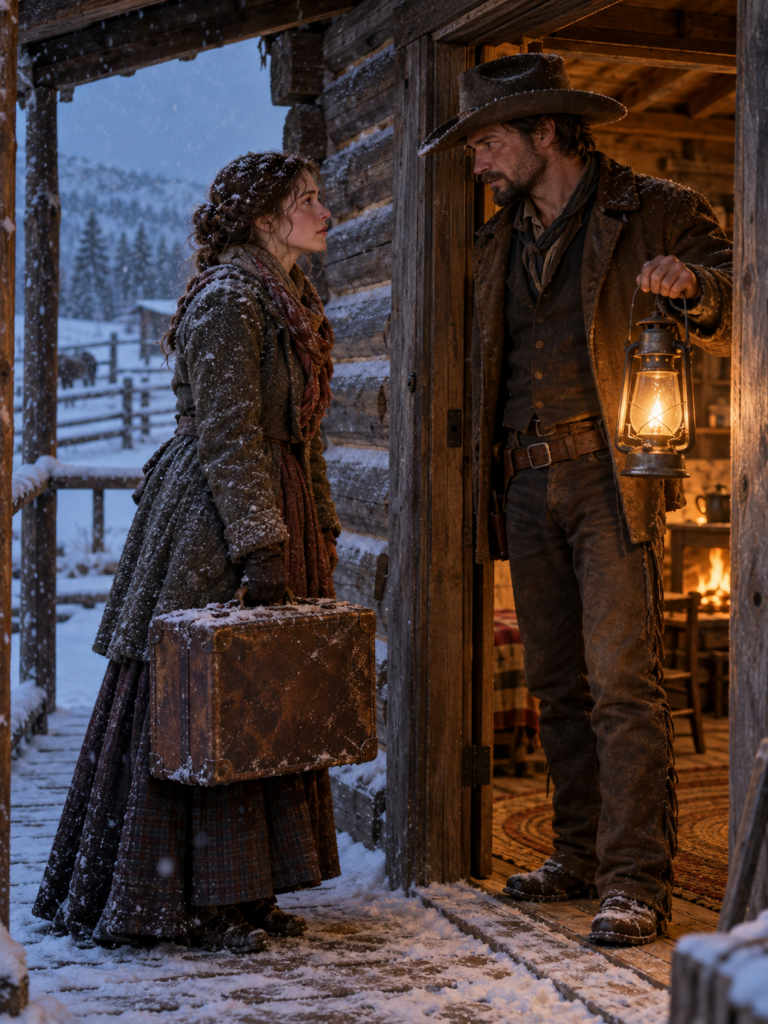
His fingers closed lightly around the fabric, stopping Evelyn before her damaged boot touched the frozen patch.
“Careful,” Daniel said.
She looked down.
Ice covered the porch step beneath a powdering of snow.
He released her immediately.
“That sole won’t last long.”
“I know.”
“Margaret carries boot leather. You might ask what a repair would cost.”
Evelyn gave him a tired smile.
“After I’ve earned something.”
Daniel considered answering, then merely moved aside.
He had understood that she wanted work, not another debt.
By noon, Evelyn was at Doyle’s store examining three coats and a torn dress.
Margaret watched her set prices in a small notebook.
“You’re not charging enough to frighten people away,” the storekeeper observed.
“I’m charging what the work is worth.”
“Good.”
Before evening, Evelyn had secured two customers.
By the third day, she had five.
Mrs. Larson, a rancher’s wife with a cheerful disregard for her own poor stitching, invited Evelyn to repair several work shirts.
“Could you teach me to mend these properly?”
“Gladly.”
Evelyn showed her how to strengthen a worn seam without pulling the cloth out of shape.
Mrs. Larson talked.
Evelyn listened.
And slowly, word traveled that Cedar Hollow’s unfortunate mail-order bride could sew better than anyone expected.
But not everyone was pleased.
Mrs. Tilman, collecting a repaired dress, looked Evelyn over with an expression of reluctant approval.
“Beautiful work. Though I ought to warn you that staying with Daniel Mercer won’t improve your standing.”
Evelyn folded the dress.
“Has he been unkind to someone?”
“Two men died under his command.”
“That’s not what I asked.”
Mrs. Tilman stiffened.
“His reputation is well known.”
“So is Arthur Pike’s,” Evelyn replied. “And everyone welcomed him until he disappeared.”
She collected her payment and left.
Her hands trembled afterward.
Not because she regretted speaking.
Because she understood how easily another person’s opinion could become a prison.
That evening, Daniel found her sitting by the stove, finishing a coat lining.
He had given her the table for her sewing and made no complaint about the fabric occupying half of it.
“How was town?”
“Profitable.”
“That’s good.”
“Mrs. Tilman thinks you’re dangerous.”
Daniel returned to repairing a leather harness.
“She’s entitled to her opinion.”
“Is it true that you ordered men into a flooded river?”
His hands stopped.
For several seconds, only the stove made a sound.
“The crossing was at Bingham River,” he said. “October 1879.”
Evelyn waited.
“The cattle company had a delivery deadline. The river was running too high.”
“Did you know that beforehand?”
“Yes.”
“Then why did they cross?”
Daniel set the leather down.
“I recommended waiting.”
“To whom?”
“The company superintendent.”
“Did he agree?”
“No.”
Evelyn felt something tighten in her chest.
“What happened?”
“He ordered us to proceed.”
“Against your judgment?”
“Yes.”
“Was there a record?”
Daniel looked at her.
“I wrote my recommendation that morning.”
“And he answered?”
“In writing.”
Evelyn stared at him.
“Then there are documents proving you didn’t give that order.”
“Yes.”
“Does Cedar Hollow know?”
“No.”
“Why?”
Daniel’s face became painfully still.
“Because Jesse Ror died. So did Tom Freely. Their families buried them while I came home alive.”
Evelyn lowered her needle.
“That doesn’t mean you caused their deaths.”
“I was their trail boss.”
“But someone else ordered the crossing.”
Daniel looked into the fire.
“Jesse’s brother, Caleb, believes I could have stopped it. He’s spent nine years believing that.”
“And you’ve allowed the town to believe you were reckless?”
Daniel did not answer.
She remembered her father keeping a useless promise from his former business partner as though the paper might someday restore everything lost.
She understood how guilt could become a habit.
Still, she could not understand why Daniel would surrender his own name.
“His grief is real,” she said gently. “But grief doesn’t change who gave the order.”
Daniel remained silent.
Evelyn returned to her stitching.
She would not force him to speak further.
Not tonight.
The seventh day arrived.
She had enough customers to keep working but not enough saved to rent a proper room.
That evening, she placed her account notebook on the table.
“I’ve earned more than I expected,” she said.
Daniel glanced at the figures.
“That’s good.”
“But I haven’t enough for a room.”
He considered the fire.
“You have work waiting another two weeks.”
“Yes.”
“Then you’d better stay until it’s finished.”
Evelyn looked up.
“Are you offering?”
“I’m saying the table’s available.”
She smiled.
“That sounds remarkably like an offer.”
His mouth moved slightly.
“It may be.”
She accepted.
Over the following days, she repaired coats, replaced torn linings, and earned new customers.
Daniel began leaving good thread beside her sewing case.
When she mentioned needing canvas, a folded piece appeared the following morning.
He repaired the pasture gate she struggled with on her way to town.
And when she returned after dark, she sometimes saw his lantern approaching from the ridge.
He always claimed he’d been checking the weather.
Even on clear evenings.
Evelyn discovered herself listening for his horse.
Then one afternoon Margaret Doyle gave her troubling news.
“Caleb Ror has been asking about you.”
Evelyn looked up.
“Jesse’s brother?”
“Yes.”
“What does he want?”
Margaret’s face tightened.
“He has spent years making it difficult for Daniel to keep livestock contracts. Now he knows you’re staying at the cabin.”
Evelyn’s hand closed around her sewing case.
“Why should that concern him?”
“Because you’ve begun building something Daniel cares about.”
At that moment, the store door opened.
A tall, lean man entered and removed his hat.
He looked straight at Evelyn.
“Miss Hart?”
She rose.
“Yes.”
“My name is Caleb Ror.”
He smiled politely.
“I believe we ought to have a conversation.”
Caleb Ror closed the door behind him and approached Evelyn with an expression of carefully measured concern.
Margaret remained behind the counter.
“Miss Hart,” Caleb said, “I’ve heard you’re making a respectable name for yourself.”
“I’m working at it.”
“That’s admirable.”
His eyes rested on her sewing case.
“A woman with your abilities ought to have a proper establishment.”
Evelyn waited.
“Mrs. Carver has a room available above her house on Elm Street. Comfortable enough, and much nearer your customers.”
“Thank you for mentioning it.”
“I could make an introduction.”
“That won’t be necessary.”
Caleb’s smile remained.
“I only thought a young woman who’s already suffered one unfortunate association might wish to avoid another.”
Evelyn met his gaze.
“Mr. Mercer has treated me with consideration.”
“Some people would disagree with your judgment.”
“Those people are entitled to make their own.”
Caleb looked toward Margaret.
The storekeeper offered him no assistance.
At last he replaced his hat.
“I hope your business prospers, Miss Hart.”
When he departed, Evelyn waited until his footsteps faded.
Margaret began folding cloth.
“He didn’t come to discuss rooms.”
“I gathered that.”
“He wanted to learn whether Daniel matters enough to you that your business could be used against him.”
Evelyn looked toward the doorway.
“And what if he does?”
Margaret’s expression grew serious.
“Then Caleb has found another way to punish a man he believes responsible for his brother’s death.”
That evening, Evelyn told Daniel about the visit.
He listened without interruption.
“Caleb will keep pressing,” he said.
“Why haven’t you defended yourself?”
“I told you.”
“You told me why you feel responsible. You haven’t told me why you allow him to ruin your livelihood.”
Daniel rose and put another log on the fire.
“Jesse was twenty-four. He planned to buy land in Oregon. Caleb told me that after the funeral.”
Evelyn’s anger softened.
Daniel continued.
“He had a future waiting for him. And I was the man leading the outfit when that future ended.”
“That is a terrible thing to live with.”
“It is.”
“But losing your own future won’t bring his back.”
Daniel looked at her sharply.
She held his gaze.
“I don’t say you should stop grieving. I say you’ve mistaken enduring punishment for doing something honorable.”
He went outside.
When he returned, his coat carried the cold.
They spoke little that evening.
But the next morning, he poured her coffee just as he always had.
Their disagreement remained unresolved.
Their consideration for one another did not.
***
By late December, Evelyn had several steady customers.
One was Constance Whitmore, the banker’s wife, whose expensive traveling dress had been badly torn in a carriage door.
Evelyn examined its unusual construction and determined that the repair required taking apart much of the bodice.
Constance hesitated.
“Will it show?”
“Not if I’m allowed to do the work properly.”
“Then do it properly.”
When the dress was finished, Constance wore it to a town supper.
Within days, Evelyn received more orders.
Her notebook filled with names.
She found herself earning more consistently than she had expected when she stepped off the train.
Yet Cedar Hollow’s opinion of her association with Daniel remained divided.
Some customers admired her workmanship and ignored the gossip.
Others paid reluctantly.
Three canceled their orders within one week.
Each cancellation arrived after Caleb began making inquiries among families connected with his livestock business.
Evelyn returned their deposits without complaint.
Then she came home and spread the notices across Daniel’s table.
“Three,” she said.
Daniel examined them.
“Caleb?”
“He hasn’t signed a single one.”
“He doesn’t need to.”
Evelyn sat down.
“I won’t let him determine where I live.”
“I haven’t asked you to.”
“Then I need to make my position clear.”
She opened her notebook.
For weeks, she had repaired Daniel’s work clothes, maintained linens, mended canvas, and performed other household tasks.
He had never demanded the work.
She had offered it because she disliked seeing good materials neglected and because her skill was useful.
But their arrangement remained informal.
People were free to invent whatever meaning suited them.
“I want us to write down the work I do here,” she said.
Daniel looked surprised.
“What kind of agreement?”
“Employment. Proper wages for the ranch mending and household work. My private sewing customers remain mine.”
He considered her figures.
“Some of these services are worth more than you’ve written.”
“Then correct them.”
They worked through the details together.
Evelyn insisted that her own customers, materials, and earnings remain under her control.
Daniel insisted on paying fairly for ranch work already completed.
When the agreement was finished, both signed it.
Evelyn retained a copy and arranged for the document to be filed as evidence of their working relationship.
It did not end every rumor.
But it established terms neither of them needed to conceal.
And more importantly, it gave her labor a recognized value.
The following week, another threat reached them.
An old local ordinance concerning unmarried people sharing premises had been brought to the attention of Cedar Hollow’s council.
Caleb’s influence could be felt behind the renewed interest.
Evelyn was angry.
Daniel was weary.
They sat together at the table, examining what could be done.
“We’ll need witnesses to the work arrangement,” Evelyn said.
“Margaret knows about it.”
“So does Mrs. Larson. And your ranch accounts ought to show what I do.”
Daniel began making notes.
Evelyn watched the change in him.
Instead of retreating into silence, he was planning.
Instead of accepting another injury to his livelihood, he was considering how to answer it.
It was the first time she had seen him actively resist Caleb’s long campaign.
And it made her care for him more than she wanted to admit.
***
January brought hard weather and long evenings.
Their small cabin developed its own rhythm.
Daniel tended the horses and ranch fences.
Evelyn traveled to town for fittings and deliveries, then returned to her sewing table.
They ate supper together.
They shared coffee in the morning.
A second cup occupied the shelf beside Daniel’s old one.
Her coat now hung from the second hook.
The third remained empty.
One afternoon, Evelyn found Daniel repairing the latch on the lower pasture gate.
She had mentioned its inconvenience only once.
“Does everything I complain about get repaired?” she asked.
“Not everything.”
“How do you choose?”
He tightened the fitting.
“Depends whether the complaint is reasonable.”
She laughed.
“And mine usually are?”
He looked up.
“Usually.”
It was the first time she had heard him tease her so openly.
She carried that small pleasure into town.
But beneath their growing closeness lay the old sorrow neither could ignore.
Evelyn began asking questions about the Bingham River disaster.
Margaret remembered the inquiry.
So did Gus Riley, a former territorial surveyor.
Old newspaper accounts described the deaths of Jesse Ror and Tom Freely but offered little detail about the orders preceding the crossing.
Evelyn realized the distinction mattered.
The public knew men had drowned while Daniel served as trail boss.
It did not know he had recommended waiting.
And it did not know his superior had overruled him.
She decided to obtain the original inquiry papers.
Without announcing her intention, she wrote to the territorial records office in Cheyenne and paid the fee for copies.
Then she continued working.
She did not want another person’s life to become her only occupation.
By February, she had enough sewing orders to justify teaching classes.
Mrs. Larson helped gather interested women.
Evelyn began showing them proper stitching, fabric cutting, and methods for repairing heavily worn garments.
The lessons brought additional income.
They also brought something Evelyn had lacked since leaving Ohio.
Respect earned through her own ability.
She was becoming independent of Daniel’s roof.
And precisely because of that, she began to understand that her attachment to him had little to do with necessity.
***
The inquiry documents arrived in early March.
Evelyn opened the envelope at the cabin table while Daniel was outside.
The papers included the official account of the Bingham River crossing on October 9, 1879.
One page carried Daniel’s handwritten report.
It recorded the river gauge as seven inches above the accepted safe crossing level.
He had recommended a delay of at least twenty-four hours.
The following page contained the company’s response.
Superintendent H. W. Briley acknowledged the warning but ordered the herd forward to meet the contractual delivery deadline.
Evelyn read both pages again.
The evidence did not erase the deaths.
It did not prove that every decision made that day had been perfect.
But it established something the town had been denying Daniel for nine years.
He had warned against the crossing.
Someone above him had ordered it anyway.
Daniel entered and saw the documents.
He recognized them at once.
“You sent to Cheyenne.”
“Yes.”
He pulled out a chair.
“Why?”
“Because I wanted to know precisely what happened.”
“You could have asked me.”
“I did. I wanted the record as well.”
He looked down at the pages.
For several moments, neither spoke.
Then Evelyn touched the superintendent’s written order.
“You didn’t choose the schedule over those men.”
Daniel’s expression hardened.
“I was still responsible for them.”
“Yes. But that isn’t the accusation Caleb has made.”
“He lost his brother.”
“And the loss is terrible. But Jesse’s death doesn’t make an untrue accusation true.”
Daniel rose.
He walked toward the window.
“I won’t turn his grief into a public quarrel.”
Evelyn felt her patience strain.
“Daniel, his grief has already become a public quarrel. He’s taken contracts from you. He’s attacked my work. He’s made this town believe something the evidence contradicts.”
Daniel turned.
“You don’t understand what it was like standing beside that river.”
“No. I wasn’t there.”
“Then don’t tell me what I should feel.”
The words hurt.
Evelyn stood.
“I’m not telling you what to feel. I’m asking whether you’ll let what actually happened be known.”
He shook his head.
She looked at the two papers.
Her father’s lost business came back to her.
The letter promising money that never returned.
The years spent trying to overcome another man’s dishonesty.
She had come too far to live under a story someone else controlled.
“And what about me?” she asked.
Daniel stopped.
“Caleb is threatening my livelihood now. Am I supposed to accept that too because you feel guilty?”
His face changed.
“Evelyn—”
“No. I won’t spend my life paying for another man’s false version of events.”
He said nothing.
She gathered the documents.
“I care for you, Daniel. More than I’ve told you. But I cannot make this decision for you.”
The room became very quiet.
Then she opened her sewing case and put the papers inside.
Daniel moved toward the stove.
Neither knew how to mend what had just torn between them.
***
Over the following days, Evelyn worked steadily.
Her savings increased.
She counted them carefully, knowing that sixty dollars would give her the means to rent a room independently.
The day her savings passed that amount, she laid the money on the cabin table.
Sixty-two dollars.
Daniel looked at the coins.
“Your room money?”
“Yes.”
“Then you’ve done what you came here to do.”
Evelyn studied him.
“Not entirely.”
He waited.
She looked at the two coffee cups.
The coat hooks.
The table where she had rebuilt her trade.
“I can afford to leave now.”
“I know.”
“But I’ve remained because I wanted to.”
Daniel went still.
She continued carefully.
“I wanted to understand whether I was staying for shelter or because I wanted to share my days with you.”
He drew a breath.
“And?”
“Because I want to share them with you.”
Daniel looked at her for a long moment.
Then he opened a drawer.
He took out a receipt and laid it beside her money.
It was for three months’ lodging above Mrs. Carver’s house on Elm Street.
Already paid.
Evelyn stared at it.
“You arranged a room?”
“Yes.”
“Without asking?”
“I made it available. You needn’t take it.”
Her throat tightened.
“Why?”
Daniel sat across from her.
“Because I want to know that you’re free to choose.”
“I just told you I am.”
“I believe you. But I need to know that no part of what we might become rests upon the fact that I gave you shelter when you had nowhere else.”
Evelyn understood.
And the understanding hurt.
He was offering her the independence she had fought to obtain.
At the same time, he was asking her to step away from the home she had begun to love.
Daniel looked down.
“When you have your own room and your own living, I want to ask whether you might consider a future with me.”
Evelyn sat very still.
Then she folded the receipt.
“I will take the room.”
He nodded, but his expression revealed the cost.
“And Daniel?”
“Yes?”
“When you ask, be certain you’re asking because you want a future. Not because you’re trying to make amends for the past.”
He looked at her.
“I will.”
The following morning, Evelyn packed her two cases.
Her wedding dress remained carefully folded inside one.
The same dress she had made for Arthur Pike.
The same dress she had carried through the snow.
She collected her sewing tools, her accounts, and the inquiry documents.
Then she approached the door.
Daniel stood beside it.
He did not ask her to stay.
Evelyn reached up and lifted her coat from the second hook.
The empty wood showed against the wall.
She put on the coat, picked up her cases, and walked onto the porch.
Behind her, Daniel remained in the doorway.
For several seconds, she felt the pull to turn around.
Instead, she walked down the ridge path toward Cedar Hollow.
She would return only if both of them could meet on ground neither had been forced to occupy.
And as she reached the bend below the cabin, Daniel called her name.
“Evelyn.”
She stopped on the ridge path and turned.
Daniel stood on the porch with one hand against the doorframe.
The morning was cold but clear.
For a moment, she thought he might ask her to return.
Instead, he said, “You left your smaller sewing ruler.”
He lifted the familiar wooden instrument.
Evelyn almost laughed.
Of all the things he might have called after her, he had chosen the most practical.
“I’ll collect it another time.”
He nodded.
Then his expression changed.
“Evelyn, there’s something else.”
She waited.
“I’m proud of what you’ve built.”
The words crossed the distance between them more gently than any plea to stay.
Her eyes stung.
“Thank you, Daniel.”
He stepped back.
She continued down the path.
And when she reached Cedar Hollow, she did not feel defeated.
She felt the ache of leaving someone she loved.
But beneath it was the knowledge that she had finally become capable of choosing her own life.
***
Mrs. Carver’s room was small.
A narrow bed stood against one wall.
A table occupied the space beneath an east-facing window.
There was a washstand, a chair, and a nail for her coat.
Evelyn unpacked slowly.
From the window, she could see the direction of Daniel’s ridge.
She placed her sewing case on the table.
Then she took out her business notebook.
Her customers were waiting.
She had work to finish.
And for the first time since leaving Ohio, she could begin each day without depending upon a man’s promise.
The room was hers to occupy.
The money she earned was hers to manage.
The decisions she made belonged to her.
It should have been enough to make her happy.
In many ways, it was.
She enjoyed the privacy.
She enjoyed being able to arrange the table entirely for her work.
She enjoyed walking to Margaret’s store without first worrying about the weather over the ridge.
But there were mornings when she poured coffee and instinctively reached for a second cup.
There were evenings when she finished a seam and looked toward an empty chair, expecting to find Daniel reading quietly beside the stove.
She missed him.
Not because she needed his protection.
Not because she could not survive alone.
She missed the man himself.
His dry humor.
His patience.
The care with which he listened.
Even the way he sometimes refused to admit he had done something kind.
Recognizing the difference settled something within her.
She did not need Daniel Mercer to make her life complete.
She wanted him to share the life she had already begun building.
***
The weeks passed.
Her sewing business prospered.
Mrs. Larson continued attending lessons and brought several other women.
Constance Whitmore sent more customers.
Margaret allowed Evelyn to use the store’s back room for additional work when space became scarce.
By April, Evelyn’s notebook contained more than twenty names.
She was no longer known chiefly as Arthur Pike’s abandoned bride.
She was the seamstress whose repairs lasted.
The woman who could rebuild an expensive bodice without spoiling its shape.
The teacher whose students went home knowing useful skills.
And the businesswoman who kept fair accounts.
One afternoon, while collecting supplies, she encountered Caleb Ror near the post office.
He looked surprised to see her alone.
“I hear you’ve moved into town.”
“Yes.”
“A sensible decision.”
“It was my decision.”
He smiled thinly.
“Well, I imagine Mr. Mercer understands.”
Evelyn held his gaze.
“Mr. Mercer had more respect for my independence than most people in Cedar Hollow.”
Caleb’s expression changed.
“Then perhaps you’ve misunderstood my concern.”
“I don’t think I have.”
She walked past him.
She had begun to see that Caleb’s power rested partly upon other people wanting his approval.
Evelyn did not.
And although his influence remained considerable, it no longer frightened her quite so much.
***
One quiet morning, she returned to the Bingham River documents.
The papers had become a question she could not entirely put aside.
She knew Daniel did not want her to conduct a public campaign on his behalf.
She also knew the truth had been sitting in territorial records for nine years while false accusations shaped his life.
She considered both things carefully.
Then she arranged for certified copies to be kept with the relevant records associated with her former employment at Mercer Ranch.
She did not publish accusations against Caleb.
She did not summon the town to hear Daniel’s defense.
She simply made the documents accessible through a formal record, where they could be examined if the dispute arose.
Daniel would still have to decide whether to use them.
That choice remained his.
But the evidence would no longer depend upon a single envelope sitting in an isolated cabin.
When Evelyn stepped outside afterward, the spring sun warmed the boardwalk.
She thought of her father holding a letter that had promised repayment.
She wished he had been willing to confront the truth of his ruined partnership sooner.
Then she returned to her work.
There was no use surrendering another afternoon to regrets.
***
Daniel, meanwhile, had been making changes of his own.
He began appearing in Cedar Hollow more often.
He spoke with suppliers instead of avoiding them.
He renewed contact with men who had once been willing to do business with him.
When a timber agreement needed negotiation, he went in person.
He did not pretend the past had ceased to matter.
But he had begun to understand that living honorably did not require allowing others to write every part of his history.
Margaret told Evelyn about these changes.
“He’s been coming to town quite regularly.”
Evelyn looked up from a coat.
“For supplies?”
“Sometimes.”
“And otherwise?”
“Business.”
Evelyn smiled faintly.
“Real business?”
“Real enough.”
Margaret folded a length of brown wool.
“You gave him something to think about.”
“I didn’t give him his courage.”
“No,” Margaret agreed. “But perhaps you reminded him he still had some.”
Evelyn said nothing.
She hoped Daniel was learning to act for his own future.
That mattered more than whether he returned to her.
***
In early May, a notice appeared concerning a territorial review of disputed livestock contracts.
Caleb Ror’s business interests were involved.
The old Bingham River disaster was again being raised as a reason to question Daniel’s reliability.
Evelyn read the notice twice.
Then she went to the records office to make certain the documents she had preserved were available.
They were.
She left them there.
Daniel knew where to find them if he chose.
For several days she heard little from the ridge.
Then Margaret mentioned that Daniel had asked questions about the old inquiry papers.
Evelyn felt an unexpected rush of relief.
Not because he was finally doing what she had told him.
But because he had begun taking responsibility for a decision only he could make.
On the morning of the hearing, Evelyn dressed carefully and went to the office where the interested parties had gathered.
Caleb was already seated.
His expression was composed.
Several men representing ranch and livestock interests sat nearby.
Daniel arrived carrying a small notebook.
He wore a good dark shirt that Evelyn recognized.
She had repaired one of its cuffs in January.
He looked across the room.
Their eyes met briefly.
Then he sat down.
Evelyn did not approach him.
She would not speak in his place.
Whatever happened next had to come from him.
***
Caleb’s presentation was calm and carefully arranged.
He did not shout.
He did not make accusations he could not phrase as questions.
He reminded the commission that two men had drowned while Daniel served as trail boss.
He described doubts about Daniel’s judgment.
He suggested that working with Mercer carried unnecessary risk for other livestock owners.
Evelyn recognized the method.
Caleb had spent years turning one terrible event into a reason to distrust Daniel in every other matter.
The commission’s representative asked whether anyone wished to respond.
For several seconds, the room remained silent.
Then Daniel stood.
“I do.”
Evelyn felt her breath catch.
Daniel placed his notebook on the table.
From it, he removed two certified documents.
“The first is my report from the Bingham River crossing on October ninth, 1879.”
He laid it before the commission.
“It records the river level that morning. Seven inches above the accepted safe crossing mark.”
He paused.
“I recommended delaying the crossing.”
Caleb’s expression tightened.
Daniel placed the second document beside the first.
“This is the written response from Superintendent Briley of the Continental Livestock and Cattle Company.”
The room grew quiet.
“He acknowledged my recommendation. Then he directed that the herd proceed because of the delivery deadline.”
Someone shifted in his chair.
Daniel continued.
“Jesse Ror and Tom Freely died during that crossing. They were good men. I was responsible for the outfit. I have never forgotten them.”
His voice remained steady.
“But it is not true that I recklessly ordered the crossing against my own judgment. I warned against it. I was overruled.”
He looked toward Caleb.
“I should have made these records available sooner.”
Caleb said nothing.
“I believed that defending myself meant diminishing what happened to Jesse and Tom. I understand now that allowing an inaccurate account to stand has not honored them.”
Evelyn watched him.
This was the man she had known in the cabin.
Careful.
Honest.
Willing to accept responsibility.
But no longer willing to confuse responsibility with guilt for decisions he had opposed.
Daniel finished his statement and sat down.
The documents were examined.
Questions followed.
For once, the discussion concerned what had actually happened rather than what Cedar Hollow had repeated for nine years.
The commission recognized the distinction between Daniel’s responsibilities as trail boss and the superintendent’s documented order.
The old accusation could no longer be presented as though the inquiry contained no evidence in Daniel’s favor.
Caleb’s attempt to use the tragedy as a decisive argument against Daniel’s business standing lost much of its force.
It did not bring Jesse back.
It did not restore Tom.
It did not erase nine years of loss.
But the truth had finally been spoken where it mattered.
And Daniel had spoken it himself.
***
After the hearing, Evelyn stood outside in the May sunshine.
People passed along the boardwalk.
Some nodded toward Daniel.
Others remained uncertain how to address a man they had avoided for years.
Daniel came down the office steps carrying his notebook.
He stopped before Evelyn.
“You were right about something.”
“Only one thing?”
A smile crossed his face.
“At least one.”
She waited.
“I thought speaking honestly about the crossing would mean using those men’s deaths to defend myself.”
“And now?”
“Now I think leaving the truth untold did nobody any kindness.”
Evelyn nodded.
“You can mourn them without accepting what isn’t yours to carry.”
Daniel looked toward the street.
“I think I finally understand that.”
They stood together for a moment.
Then he said, “I’ve missed you.”
Evelyn felt the words settle warmly inside her.
“I’ve missed you too.”
He glanced toward her sewing case.
“How is business?”
“Thirty-one customers.”
His eyebrows rose.
“Thirty-one?”
“And two teaching afternoons each week.”
“That’s quite an enterprise.”
“I’m considering expanding.”
He smiled.
“Of course you are.”
She looked at him.
“How is Copper?”
“Older. Hungrier. Still believes every apple belongs to him.”
Evelyn laughed.
The sound came easily.
Then Daniel became serious.
“May I visit you sometime?”
“Certainly.”
“As a customer?”
“Do you need anything mended?”
He considered.
“Probably.”
She raised an eyebrow.
“Daniel.”
He looked at her.
“I’d rather come as someone who hopes to court you properly.”
Evelyn’s heart beat harder.
She had imagined those words.
But she had not imagined how much sweeter they would sound when neither of them needed to say them.
“You may,” she answered.
He took her hand.
They stood together without hurrying.
There were still decisions to make.
Her sewing business would continue.
Her room remained hers.
Daniel had a ranch to rebuild and contracts to renegotiate.
Nothing required Evelyn to surrender the life she had established.
And nothing required Daniel to pretend his past had never happened.
They could consider a future without erasing either truth.
***
Two days later, Evelyn met Caleb outside the post office.
He stopped when he saw her.
For once, his manner lacked its usual careful polish.
“I didn’t know about the superintendent’s letter,” he said.
Evelyn waited.
“I knew the inquiry cleared Mercer. I never read the original testimony.”
He looked down the street.
“I told people he was reckless.”
“Yes.”
Caleb swallowed.
“Jesse trusted him.”
Evelyn’s expression softened.
“I know.”
“He was saving to buy land. He had everything planned.”
“Daniel remembers that.”
Caleb looked at her sharply.
“He told you?”
“Yes.”
For several moments, Caleb said nothing.
Then he spoke quietly.
“I don’t know what to do with all these years.”
Evelyn understood that he was asking something she could not give.
She could not forgive him on Daniel’s behalf.
She could not restore his brother.
She could not turn grief into something simple.
“Your brother deserves to be remembered for his life,” she said. “Not only for the argument about his death.”
Caleb looked away.
After a while, he said he intended to move much of his business south, toward Laramie.
Evelyn wished him well.
She did not ask for a reconciliation.
Some wounds required time.
Some never closed entirely.
But the false story Caleb had spent years spreading no longer held the town with the same force.
And Daniel was no longer arranging his life around it.
***
As spring advanced, Evelyn continued her work.
Daniel visited when his ranch responsibilities allowed.
Sometimes he brought a damaged coat.
Sometimes a length of canvas.
Often he brought nothing except news of the horses and the wish to spend an hour with her.
They walked through Cedar Hollow without disguising their companionship.
Margaret observed all this with satisfaction she rarely expressed aloud.
Mrs. Larson invited them to supper.
Constance Whitmore continued sending customers to Evelyn.
The town did not suddenly become generous or wise.
But the people who had learned to respect Evelyn’s workmanship and Daniel’s honesty began treating them accordingly.
One afternoon, Daniel arrived while Evelyn was fitting a sleeve.
He waited until her customer departed.
Then he set a small wooden ruler on the table.
Evelyn recognized it immediately.
“My ruler.”
“You left it at the cabin.”
“That was months ago.”
“I know.”
“Have you been keeping it deliberately?”
Daniel looked almost embarrassed.
“I thought you might come back for it.”
Evelyn laughed softly.
“And when I didn’t?”
“I decided I ought to bring it to you.”
She took the ruler.
“Thank you.”
Daniel glanced toward her worktable.
“I’ve been thinking about the cabin.”
Evelyn waited.
“There’s more room in it than I believed when you first arrived.”
“Daniel, there’s barely room for two chairs.”
“Then perhaps we should discuss changing that.”
She looked up.
He smiled.
“I don’t mean tomorrow. And I don’t mean that you should close your business or surrender your room.”
“What do you mean?”
“I mean that I’d like to build a life with you, if that’s what you want. We’d have to decide how it would work.”
Evelyn studied him.
This was not the frightened, silent rancher who had stood apart from the town.
Nor was he asking her to become the remedy for his loneliness.
He was offering to make practical room in his future for another person.
A person with work, opinions, customers, and ambitions of her own.
“Then we’d better discuss it carefully,” she said.
“I was hoping you’d say that.”
They began with the ordinary matters.
Where she would work.
How often she would need to be in town.
Which ranch responsibilities Daniel could handle without her help.
Whether the cabin could accommodate a proper sewing space.
How to ensure that her business earnings remained under her control.
There were disagreements.
There were compromises.
There were moments when Daniel discovered that saying he wanted partnership was considerably easier than working out its details.
And there were moments when Evelyn realized that independence did not mean refusing every offer of help.
It meant being able to accept assistance without surrendering authority over her own life.
They learned these things together.
***
One evening, Daniel invited Evelyn to supper at the cabin.
She rode out after finishing her afternoon sewing.
Copper greeted her with expectant interest.
She had brought an apple.
The old bay gelding accepted it as though he had been awaiting her return for months.
Daniel stood on the porch.
“He’s missed you.”
“Only because I bring food.”
“Not only because of that.”
Evelyn looked up.
His expression held a tenderness she no longer feared.
Inside, the cabin remained familiar.
The stove.
The table.
The worn chair.
The row of three hooks beside the door.
Only one coat hung there.
Daniel’s.
Evelyn removed her own coat.
She hesitated for a moment.
Then she placed it on the second hook.
Daniel watched her.
“Staying for supper?” he asked.
“Yes.”
“Anything beyond that?”
She turned toward him.
“I’ve made arrangements for my work tomorrow. And Mrs. Carver knows where I’ll be.”
He nodded.
“Then there’s no hurry.”
They ate together.
Afterward, Evelyn looked around the room.
The same cabin had sheltered her when forty-seven cents stood between her and destitution.
But she was not the same woman who had crossed its threshold that winter night.
She had thirty-one customers.
She had her own room in town.
She had savings.
She had skills that could support her anywhere.
And she had learned the difference between being grateful to a man and freely loving him.
Daniel rose to pour coffee.
Evelyn reached for the second cup.
He filled it without asking.
She watched him carry it to her side of the table.
“Daniel?”
“Yes?”
“When I first came here, I believed I had been foolish to trust a stranger’s promise.”
He sat down.
“Arthur Pike?”
“Yes.”
She glanced toward the fire.
“I thought I’d made the worst mistake of my life coming west.”
Daniel listened.
“But if I hadn’t come, I wouldn’t have found my work here. I wouldn’t have met Margaret or Mrs. Larson. I wouldn’t have learned how much I could do on my own.”
She looked directly at him.
“And I wouldn’t have met you.”
He reached across the table.
She placed her hand in his.
“I love you, Daniel.”
His expression changed.
For a moment, the weight of nine years seemed to loosen from his shoulders.
“I love you too, Evelyn.”
He spoke plainly.
No grand promise.
No claim upon her.
Just the truth.
She leaned toward him, and he kissed her gently.
When they drew apart, Evelyn smiled.
“I should warn you that I mean to keep sewing.”
“I should hope so.”
“And teaching.”
“Of course.”
“And I intend to have a proper room for the work if I spend much time here.”
Daniel glanced toward the adjoining space.
“I’ve already been measuring.”
She laughed.
“Without consulting me?”
“I thought you might wish to correct my figures.”
“I certainly will.”
He smiled.
And she understood that this was what their future might be.
Not a rescue prolonged forever.
Not a bargain disguised as marriage.
But two people making room for one another while remaining themselves.
***
Later, Evelyn stood beside the cabin door.
She touched the wooden hooks.
The first held Daniel’s coat.
The second held hers.
The third remained empty.
Once, she had thought that empty hook represented everything missing from his life.
Now she saw it differently.
It was room for whatever came next.
A guest.
Another coat.
A future neither of them needed to predict completely.
Daniel came to stand beside her.
“What are you thinking?”
“That when I arrived, there was only one coat here.”
“Yes.”
“And now there are two.”
He looked at the hooks.
“Seems we ought to make room for more.”
Evelyn turned toward him.
“Only if we decide together.”
Daniel smiled.
“Together.”
Outside, Wyoming’s night settled over the ridge.
The horse shifted quietly in the stable.
The stove warmed the little room.
And on the table, two coffee cups stood beside the sewing ruler Daniel had kept safe until he could return it.
Evelyn Hart had traveled west to marry a stranger and found herself abandoned.
Daniel Mercer had spent nine years believing that surviving a tragedy meant he no longer deserved an ordinary, happy life.
Neither had been rescued from every sorrow.
Neither had forgotten the past.
But Evelyn had reclaimed her independence.
Daniel had reclaimed his voice.
And together they had discovered that love mattered most when staying was a choice rather than a necessity.
The woman who once walked through a snowstorm with forty-seven cents could now leave whenever she pleased.
The man who once shut himself away from Cedar Hollow could now face the town without surrendering his honesty.
And on that quiet Wyoming evening, they chose the same place to be.
Not because either one had nowhere else to go.
Because they wanted to be there together.