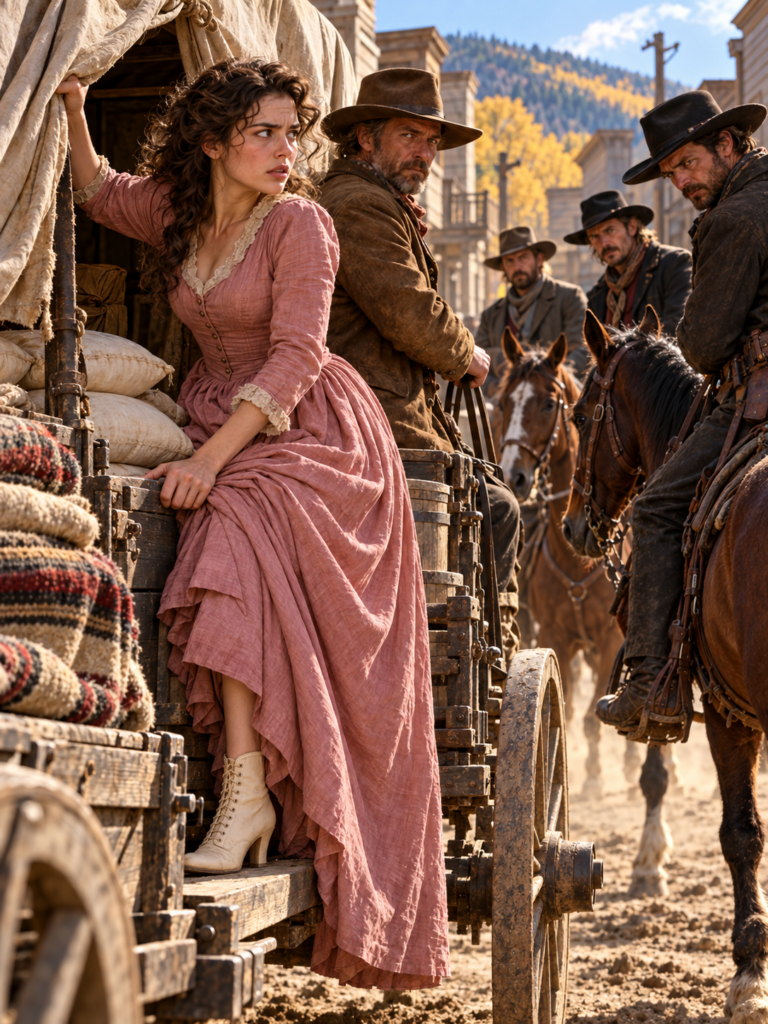
The wagon tipped toward the ditch, throwing Rosemary against the front rail as the folded paper flew from her fingers.
Elias hauled back on the reins.
“Hold on!”
She caught the rail with both hands. The horse scrambled for footing, its harness creaking as the near wheel dropped into the rut.
For one sickening instant, Rosemary saw nothing beyond the wheel but the steep, muddy edge of the drainage ditch.
Then Elias shifted his weight, spoke firmly to the horse, and guided the wagon onto level ground.
The wheels settled.
Rosemary breathed again.
The paper lay beside his boot.
She reached for it before he could.
“Careful,” she said, pressing it flat. “I can’t replace this.”
Elias looked back along the lane.
No riders were visible.
Not yet.
“Can it wait until we’re beyond town?”
She hesitated.
“If you don’t know what Pike wants, you won’t know what you’ve taken on.”
“That much is already plain.”
He urged the horse forward, slowly at first.
Rosemary sat beside him, the paper protected between her palms.
“My mother made dresses in Red Willow. She was good at it, but last winter there wasn’t enough work. Mr. Pike extended her credit.”
“And now he claims you owe him.”
“More than she borrowed. Much more.”
The old mill road opened ahead. Beyond it, pale foothills rose beneath a sharp October sky.
Rosemary unfolded the document.
“My mother left me a small property at the south edge of town. It belonged to my grandfather.”
“What kind of property?”
“Land beside the creek.”
Elias’s expression changed.
Pike owned the neighboring parcels.
Everyone familiar with the country knew he had been enlarging his grazing operation.
“You have water crossing your land,” Elias said.
“Yes.”
“And Pike wants control of it.”
“He says the property must be surrendered to satisfy Mother’s debt. Unless I marry him.”
Elias drove without answering.
A marriage dressed up as mercy. Debt pressed upon a grieving daughter. A creek that could prove worth more than the land itself.
The facts were beginning to fit together.
Rosemary watched his face.
“Do you believe me?”
“I believe you’ve given me reason to examine Pike’s claims.”
“That’s not the same thing.”
“No. But I don’t intend to call a man guilty solely because I dislike him.”
She considered that.
Then she nodded.
“Fair enough.”
He glanced at the paper.
“What’s that?”
“A letter. Pike wrote it to a creditor in Cheyenne. I found it among Mother’s papers.”
“May I see it?”
She handed it over.
He stopped long enough to read the few lines she indicated.
There were instructions about figures, about terms to be represented one way and collected another.
Enough to trouble him deeply.
But not enough, standing alone, to settle the whole matter.
“Does anyone else know you have this?”
“One person.”
“Who?”
“Sarah Wren. She worked with Mother.”
Elias returned the document.
“Did she help you leave?”
Rosemary looked toward town.
“She helped me understand that the wedding wasn’t going to save anything.”
The horse snorted, impatient to move.
Elias took up the reins.
“We’ll go to my ranch. You can stay until we find a safer arrangement.”
Rosemary stiffened.
“I haven’t agreed to live under another man’s terms.”
He faced her.
“Then tell me yours.”
Her surprise was immediate.
“I want a room with a door. I want my papers kept where I choose. And when there’s a way back to town, I want to decide whether I go.”
“Agreed.”
“And I’ll work while I’m there.”
“You needn’t pay for shelter.”
“I know. I still intend to be useful.”
He gave a small nod.
“Then we’ll discuss the work when we arrive.”
For several miles, they rode without speaking.
Rosemary tucked the documents into her bag and settled it firmly against her knees.
The mountains rose ahead, their autumn aspens bright against dark timber.
By late afternoon the air had sharpened.
Elias studied the northern sky.
Clouds were gathering beyond the ridge.
He knew those clouds. Knew what they could mean on the higher road in October.
“How far to your ranch?” Rosemary asked.
“Twelve miles from town by the usual road. Considerably farther by this one.”
“Can we reach it before dark?”
“Not if that weather comes down.”
Rosemary looked at the distant clouds, then at the wagon’s blankets.
“Do you have shelter nearer?”
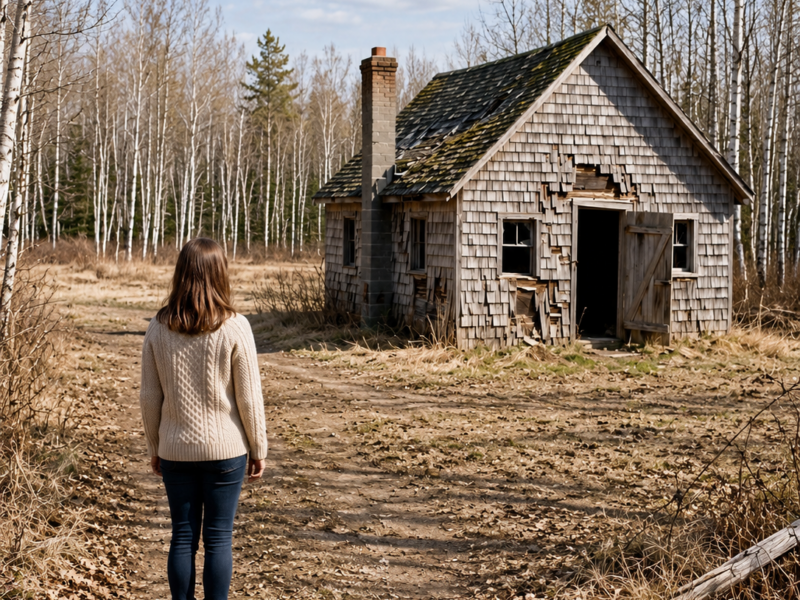
“An old grazing cabin.”
“Then we should make for it.”
Elias nodded and turned the horse toward the mountain track.
Behind them, Red Willow disappeared beneath the hills.
Ahead, the first cold wind bent the roadside grass.
Rosemary drew her mother’s Bible from her bag and held it against the papers.
For the first time since climbing into the wagon, she wasn’t thinking only about escape.
She was thinking about the land beside the creek.
The property her mother had struggled to keep.
The property Pike intended to take.
Then Elias spoke.
“Rosemary, if that letter means what I think it means, Pike may have more to fear from those papers than you know.”
She turned toward him.
“Then why hasn’t anyone stopped him?”
Elias watched the clouds swallow the highest ridge.
“That’s what we need to find out.”
He urged the horse uphill toward the distant cabin as the first wet flakes of snow struck the wagon canvas.
The first snowflakes melted against the wagon canvas, but the next came thicker, clinging to the folds and collecting along the wooden rails.
Elias leaned forward, searching the darkening track.
“Cabin’s a little farther.”
Rosemary tucked her bag beneath a blanket to protect the papers.
“Can the horse make it?”
“Provided I don’t ask him to run.”
“Then don’t.”
There was no panic in her answer. Only a sensible instruction from a woman who understood that frightened people sometimes ruined the very animals upon which their safety depended.
Elias adjusted the reins.
“Did you grow up around horses?”
“My grandfather kept two. I spent summers helping him.”
“Good. I’ll need you to watch the wheel on your side if the ruts deepen.”
She leaned forward, ready.
By the time the line cabin appeared among the pines, daylight was fading and snow had begun collecting in the wagon tracks.
Elias brought the horse beneath the lean-to. Rosemary helped unfasten the harness, her fingers stiff but competent.
When the animal was sheltered and supplied with hay from the cabin’s remaining stores, they carried what they needed indoors.
The cabin was small.
One room. A stone fireplace. A narrow bunk. A rough table with a single chair.
But the roof was sound, and beneath the hearth lay dry kindling.
Elias lit the fire.
Rosemary examined their provisions.
“We have flour, pork, and coffee,” she said.
“Enough for tonight.”
“I’ll cook if you’ll fetch water.”
He looked up.
“There’s a covered water barrel by the lean-to. I filled it the last time I came through.”
“Then I’ll see whether it’s fit to use.”
He almost objected to her going back outside in those thin shoes. Instead, he offered his spare boots.
“They’ll be too large,” he said, “but they’ll keep your feet out of the snow.”
She accepted them.
That was how their first evening together began.
Not with romance.
Not with promises.
With water, firewood, an exhausted horse, and two strangers learning whether they could trust each other’s judgment.
Rosemary cooked the pork while Elias checked the roof and stacked more wood inside.
He gave her the bunk and made his own place on the floor beside the hearth.
When she protested, he merely said he was accustomed to sleeping in worse places.
“You’re doing a great deal for someone whose name you learned this morning,” she said.
“You’re doing a great deal of cooking for someone who nearly drove you into a ditch.”
She looked at him.
Then she laughed.
It was quick and surprised, and afterward the little cabin seemed less forbidding.
They ate from tin plates while snow moved against the window.
Elias waited until she set down her fork.
“Your mother died in March?”
Rosemary nodded.
“She was ill for some time. I handled the shop as best I could.”
“And Pike?”
“He came regularly. Always with kind words. He said Mother had been like family to him.”
Her mouth tightened.
“After she died, he brought the account books. I couldn’t understand how she could owe so much. Every time I questioned a figure, he reminded me how much he had helped her.”
“Did he offer marriage then?”
“Not at first. He waited until I’d been told often enough that I might lose the land.”
She stared into the fire.
“Two weeks ago, I found the letter.”
“The one you showed me?”
“Yes. And another paper Mother kept with it. A copy of the original terms she believed she’d agreed to.”
She opened her bag and handed him the second document.
He studied both.
The figures differed. So did the description of how interest was to be calculated.
Elias was no lawyer.
He refused to pretend otherwise.
But he had spent years listening to his brother explain contracts, loans, and the trouble dishonest men caused when nobody insisted on seeing the original agreements.
His brother, Daniel Ward, had practiced law before coming west.
Four years earlier, Daniel had died and left Elias the ranch.
Since then, Elias had largely kept his distance from town.
Now he wished his brother were sitting beside that fire.
“These papers matter,” he said. “But we’ll need the original notes and someone qualified to examine them.”
“Can Pike make me marry him?”
“No lawful agreement I know of gives a creditor a right to a woman’s hand. But he may still cause trouble over the estate and the land.”
She breathed slowly.
“I don’t know which frightens me more.”
“You don’t have to settle either question tonight.”
He returned the papers.
Rosemary laid them beside her mother’s Bible, watching him as she did.
“Most men in Red Willow told me to be grateful.”
“For Pike’s offer?”
“For a wealthy gentleman being willing to take me as his wife.”
Elias looked toward the fire.
“That’s a poor measure of gratitude.”
“Then what would you call it?”
“An offer you have every right to refuse.”
She sat very still.
Nobody had said those words so plainly to her before.
The snow eased by morning.
The trail remained rough, but they could travel.
They reached the Ward Ranch around noon.
Rosemary stepped down from the wagon and studied the house.
It was a sturdy wooden building with a broad porch and a garden already covered against the coming frost.
There was no grandeur about it.
But the roof was straight, the fencing sound, and the barn doors well fitted.
Somebody cared about this place.
“You live here alone?” she asked.
“Since my brother died.”
“Who planted the garden?”
“Daniel. I look after it now.”
She looked at the beds again.
“Then he taught you something worth keeping.”
Elias said nothing.
But when he showed her the house, he opened Daniel’s old room.
It contained a bed, a chair, a chest, and a window looking toward the barn.
The room was spotless.
Too spotless, perhaps.
Nothing had been changed in years.
“You may use this,” Elias said. “The door has a latch. I’ll leave you undisturbed.”
Rosemary set down her bag.
“Thank you.”
He started to leave.
“Elias?”
He turned.
“Do you want the room kept exactly as it is?”
The question caught him.
For four years he had preserved Daniel’s room as though moving a chair might erase some portion of his brother’s life.
Yet Rosemary was standing there, alive and in need of somewhere to begin again.
“You can arrange it as you please,” he answered.
She nodded.
“Then I’ll mend those curtains. They’re pulling loose.”
He looked at them.
He hadn’t noticed.
That evening, they discussed what work she wished to undertake.
Elias explained the ranch’s routines and warned her which animals required caution.
She listened, asked precise questions, and made several suggestions of her own.
When he mentioned an injured mare in the east stall, her attention sharpened.
“I’d like to see her.”
“Tomorrow.”
The following morning, Rosemary examined the animal’s swollen foreleg while Elias held the halter.
She moved calmly, allowing the mare to settle before touching the sore place.
“My grandfather taught me never to hurry a frightened horse,” she said.
Elias watched the mare relax beneath her hand.
“Your grandfather taught you well.”
The mare’s recovery was gradual.
For weeks Rosemary helped with gentle care while Elias managed the heavier work and kept the animal from being put back into service too soon.
By December the swelling was gone and the mare was moving freely.
Rosemary had gained something important in the process.
Not simply occupation.
A place in the day’s decisions.
The mountain pass closed in early November, as Elias had expected.
Travel to Red Willow became impractical.
Winter settled over the ranch.
Cattle required feed and regular attention. Water troughs froze. Fences needed watching. Firewood had to be hauled and split.
Some days were exhausting.
Others offered a quiet satisfaction Rosemary had never known while managing her mother’s shop beneath Pike’s threats.
She repaired harness stitching where she could. She mended curtains, organized stored supplies, and helped Elias keep accounts of what they used.
He taught her which stretches of fence suffered most from drifting snow.
She showed him a quicker way to patch a torn work shirt.
They disagreed about where to store certain tools.
Once, she moved a set of leather punches without telling him, and he spent half an hour looking for them.
The resulting argument was brief but instructive.
“Ask before you rearrange my workbench,” he said.
“Then ask before you move the sewing basket from the table.”
He paused.
“Fair.”
“Fair,” she answered.
By supper, both had apologized.
Afterward, they began leaving practical notes for each other on the kitchen table.
The mare is bearing weight evenly.
The east fence needs two new rails.
There’s coffee left on the stove.
I fixed your coat cuff.
At first, the notes concerned work.
Then they grew more personal.
There’s fresh bread. Don’t skip dinner because you’re repairing a gate.
Your boots are by the hearth. Snow got through the seam again.
I noticed the garden plans in Daniel’s old book. Would you mind if I tried his planting arrangement come spring?
Elias answered that last one with unusual care.
He would have liked that.
Rosemary folded the note and put it in her Bible.
For the first time in years, Elias began listening for another person’s footsteps in his own house.
For the first time since her mother died, Rosemary could sit down to supper without feeling she must justify her right to the chair.
But the papers from Red Willow were never forgotten.
Rosemary wrote a careful account of the debt and the discrepancies she had discovered.
She prepared copies of the two documents and addressed a letter to Sarah Wren, asking her to preserve anything else that might corroborate them.
A neighbor traveling toward the lower valley carried the correspondence when the weather allowed.
Sarah’s reply took weeks.
When it came, Rosemary read it twice before speaking.
Sarah had seen the account Pike presented to her mother.
She believed the charges had been changed.
More important, she had retained a copy of a letter concerning the loan, written before Rosemary had discovered her own papers.
Sarah would keep it safe and seek trustworthy advice about sending the evidence to the appropriate territorial authorities.
Elias listened as Rosemary read.
“This may be enough to force an examination,” he said.
“But not enough to know whether I can keep the property.”
“Not yet.”
She folded the letter.
“I want that land, Elias.”
“I know.”
“It isn’t only the money. My grandfather worked there. Mother kept it when almost everything else had to go.”
“Then we won’t speak of selling it until you’ve had a fair chance to defend it.”
She looked up.
“We?”
Elias took a moment.
“If you want my help.”
She smiled faintly.
“I do.”
The ranch grew quieter after Christmas.
Not colder, though the weather sharpened.
Quieter in the way of two people who had learned each other’s habits well enough to recognize when something mattered.
Rosemary discovered Elias sometimes stood at the garden fence after dark.
One evening she joined him.
“Thinking about Daniel?”
He nodded.
“He designed that house for a family. Thought I’d settle down one day, too.”
“And you didn’t?”
“I kept finding work that needed doing.”
“There’s always work.”
“That’s true.”
She rested her gloved hands on the fence.
“Do you miss him?”
“Every day.”
He looked toward the unlit fields.
“After he died, I thought keeping everything the way he left it was a kind of loyalty. Then you repaired his curtains.”
“I wondered whether you might be angry.”
“I wasn’t.”
“What were you?”
He turned to her.
“Relieved, I think.”
She didn’t answer.
Their shoulders stood close beneath the winter stars.
For a moment Elias nearly reached for her hand.
Then he remembered that she had come to his home because she needed refuge, not courtship.
He kept his hand on the fence.
Rosemary noticed.
And in a strange way, his restraint drew her closer than an impatient embrace could have done.
By February, she no longer thought of herself as a woman merely waiting for the pass to open.
She had plans for the garden.
Plans for the mare.
Plans for the land in Red Willow, should she recover it.
She even had plans for the pantry shelves.
But she had not yet told Elias which future she wanted most.
That answer was beginning to matter more than either of them cared to admit.
Then, one pale February morning, six riders appeared beyond the ranch gate.
Elias heard them while carrying hay toward the barn.
He set down his fork and walked into the yard.
The man at the front was Ambrose Pike.
He surveyed the house, the barn, and the snow-covered pasture before fixing his attention on Elias.
“Ward. I’ve come for Rosemary Bell.”
The house door opened.
Rosemary stepped onto the porch.
And Elias realized the winter’s most difficult choice had finally reached his front yard.
Rosemary stood in the doorway, one hand on the frame.
She had imagined seeing Ambrose Pike again countless times.
In those imaginings, she was either running or struggling to speak.
Now she stood on the Ward Ranch porch with a steady breath, a warm house behind her, and four months of her own decisions beneath her feet.
Pike removed his gloves.
“Rosemary. You’ve made this matter needlessly difficult.”
“Good morning, Mr. Pike.”
His eyes narrowed.
“Come down here.”
“No.”
The word surprised even Elias.
Pike looked toward him.
“I suggest you tell your guest to behave sensibly.”
“She can speak for herself,” Elias answered.
Pike turned back to Rosemary.
“Your mother’s debts remain unpaid. The property is still pledged against them, and you cannot simply hide here forever.”
“I’m not hiding.”
“Then come with me and settle this.”
She descended one step.
Elias moved toward the porch, stopping far enough aside that she could still approach the yard if she wished.
Pike noticed.
So did Rosemary.
She walked down the remaining steps.
“What exactly do you intend to settle?” she asked.
“The agreement.”
“There is no marriage agreement. I withdrew my consent before any vows were spoken.”
“Your mother’s obligations did not vanish because you lost your nerve.”
Her face tightened.
“You told me marriage was the only way to protect her land.”
“It was a generous settlement.”
“It was a demand made while you controlled the accounts.”
Pike’s expression hardened.
Six mounted men had come with him, including the men who had questioned Elias’s wagon in October.
Their horses shifted in the packed snow.
Elias looked from rider to rider.
He saw no reason to reach for a weapon.
But he did not leave Rosemary alone with the man who had frightened her out of her own town.
Pike addressed Elias.
“This is a business matter. You have no interest in the Bell estate.”
“That’s true,” Elias said.
Pike seemed encouraged.
“Then perhaps you’ll finally understand—”
“But Rosemary has an interest in it. And she has the right to state her case without being carried off by your men.”
One of the riders looked uncomfortable.
Pike ignored him.
“Rosemary, if you come back willingly, I may still be prepared to offer reasonable terms.”
She reached inside her coat.
For a moment Elias wondered what she intended.
Then he saw the familiar folded paper.
The same letter she’d clutched when he found her in the wagon.
The one they had nearly lost in the ditch outside Red Willow.
She opened it carefully.
“Before I consider any terms, I want you to explain this.”
Pike’s face changed when he saw it.
“Where did you get that?”
“Mother kept it.”
“Those are private business papers.”
“They concern the terms of her debt.”
“You’re reading matters you don’t understand.”
“Then help me understand them.”
She held the page steady.
“Why did your instructions to the creditor describe one rate for the papers my mother was shown and another for the amounts to be collected?”
Pike did not immediately answer.
Rosemary continued.
“The copy Mother kept describes the lower charges. Your account shows the higher ones. I want an explanation.”
“You are making serious accusations.”
“I’m asking a serious question.”
The riders had fallen silent.
Pike glanced at Elias.
“Have you put these notions in her head?”
“No,” Elias said. “She brought those papers to me.”
Rosemary folded the letter.
“And Sarah Wren has another.”
Pike went still.
“Sarah Wren?”
“She worked with Mother. She remembers the original terms, and she kept a copy of correspondence about the loan.”
Pike’s eyes moved from Rosemary to the road.
“That proves nothing.”
“Perhaps not by itself. But Sarah has sent the papers and her account to the territorial authorities for examination.”
She gave him no chance to interrupt.
“I haven’t asked anyone to excuse a debt Mother lawfully owed. If the estate owes money, let the proper amount be established. What I will not do is surrender my inheritance or marry you because you refuse to show how you arrived at your figures.”
Pike’s face flushed.
For months Rosemary had feared the simple act of questioning him.
Now, surrounded by his hired men, he seemed unable to decide whether anger or disbelief would serve him better.
“You’ll regret embarrassing me,” he said.
Elias took a step forward.
“That’s enough.”
But Rosemary lifted one hand.
“Let him answer.”
She faced Pike.
“If I’m wrong, you’ll have every opportunity to produce your records. If I’m right, Mother was never offered the honest terms you claimed.”
A voice carried from the ranch road.
“Seems reasonable to me.”
Three neighbors had approached from the valley: Tom Henderson and the Hargrove brothers.
They had seen Pike’s party crossing the snow and ridden over to learn what business brought so many men to the Ward place.
Tom reined in beside the gate.
“Morning, Elias.”
“Morning, Tom.”
Tom surveyed the gathering.
“Everything all right?”
“Miss Bell is discussing an account,” Elias said.
Tom looked at Rosemary.
“Need us to stay?”
She met his eyes.
“For a few minutes, if you wouldn’t mind.”
“Don’t mind at all.”
The change in Pike was subtle but unmistakable.
He had arrived expecting an isolated rancher and a frightened young woman.
Now he had witnesses who had heard her objections and seen that she was not being held against her will.
Pike returned his gloves to his hands.
“This is not finished.”
Rosemary answered before Elias could.
“No, Mr. Pike. It will be finished when the accounts have been examined and the land’s rightful obligations determined.”
He stared at her.
Then he wheeled his horse.
The others followed.
No shots were fired.
Nobody was dragged away.
The confrontation ended because, for the first time, Pike could not force the question to be settled solely on his terms.
Rosemary stood in the snow until the riders disappeared.
Then her hands began shaking.
Elias approached.
“Are you all right?”
She laughed once, unsteadily.
“I think so.”
“Would you like to go inside?”
“In a minute.”
He remained beside her.
She looked at the road.
“I thought I’d feel braver.”
“You spoke clearly.”
“I was terrified.”
“Both can be true.”
She turned toward him.
“Thank you for letting me answer.”
“It was your answer to give.”
Tom called that he’d stop by again if anything changed.
The neighbors departed.
Elias fetched the hay fork he’d abandoned in the yard.
He had nearly reached the barn when Rosemary called him back.
“Elias.”
He turned.
She stood at the foot of the porch, holding the letter.
“When I climbed into your wagon, I thought the only way to get free was to pretend I belonged to somebody else.”
He waited.
“I don’t want to spend the rest of my life afraid that another man gets to decide where I belong.”
“Then don’t.”
Her eyes filled unexpectedly.
“You make it sound simple.”
“No. I know it isn’t.”
He set the fork down.
“But I believe you can make that decision.”
She folded the letter and tucked it safely into her coat.
For a moment she wanted to cross the yard and put her arms around him.
Instead she went indoors.
There were things she needed to understand about herself before she could ask another person to share her future.
That evening, after supper, Rosemary sat with her mother’s Bible open beside her.
Elias washed the last plate and set it to dry.
The house was quiet.
Outside, wind moved lightly along the porch.
“Elias,” she said.
He turned.
“The pass should open in April.”
“Most years.”
“And when it does?”
“I’ll take you to Red Willow if you want. Or farther, if you choose.”
She closed the Bible.
“Suppose the land is mine again.”
“Then you’ll have a decision to make.”
“Would you expect me to sell it?”
“No.”
“Would you expect me to stop managing it if I stayed here?”
“No.”
She watched him.
“You’re making this difficult.”
“How?”
“You’re not telling me what you want.”
He looked at the table.
For months he had avoided saying the words because he feared they might make her feel obliged to remain.
He had told himself silence was kindness.
But silence could also make another person carry uncertainty alone.
At last he sat opposite her.
“I want you to stay.”
Her breath caught.
“Because the ranch runs better with two?”
“It does.”
“Because the house is warmer?”
“That too.”
She waited.
He looked up.
“Because every morning I find myself listening for you in the kitchen. Because you argue with me over where tools belong. Because you made Daniel’s old room yours without making me feel I’d lost him a second time.”
His voice grew quieter.
“And because when I think of you leaving in spring, I can’t imagine coming home to this house and finding you gone.”
Rosemary looked down at their hands resting on opposite sides of the table.
“Why didn’t you say anything before?”
“You came here needing safety. I didn’t want you to mistake gratitude for affection.”
She smiled through her tears.
“And now?”
“Now I know you have property to return to, friends who will stand beside you, and a future that doesn’t depend upon me. I can tell you what I want without pretending it’s something you owe.”
She reached across the table.
He took her hand.
“I want to stay,” she said.
Elias drew a slow breath.
“Are you certain?”
“I’ve been certain for some time. I was waiting for you to understand that I haven’t been repairing this house because I intend to leave it.”
He looked toward the kitchen window.
The curtains she had mended stirred faintly in the draft.
For the first time, he realized that every little change he had noticed had been a quiet expression of hope.
“Rosemary—”
She squeezed his hand.
“That doesn’t mean I’ll give up Mother’s land.”
“I wouldn’t ask you to.”
“And I expect a voice in what happens here.”
“You already have one.”
“Then I’d like to continue having it.”
He smiled.
“That can be arranged.”
For a long time they sat together, their hands joined beside her mother’s Bible.
There was no proposal that evening.
No dramatic promise.
There was something more necessary.
An understanding that neither had to surrender the life they’d built separately in order to begin one together.
In March, word came from Red Willow.
The territorial inquiry had compelled a closer examination of the accounts Pike had used to press his claims.
Sarah Wren’s preserved correspondence and Rosemary’s documents supported the charge that the figures presented to her mother differed from those used to demand repayment.
The matter still required the settlement of genuine obligations, but the inflated charges could no longer be treated as unquestioned.
Pike’s position began to collapse.
Creditors pressed him.
People who had previously been unwilling to challenge his accounts began demanding explanations of their own.
He left the territory before the spring was over.
Rosemary did not celebrate his departure.
She wanted the land settled correctly, not merely an enemy driven away.
Sarah continued assisting her with the correspondence until the disputed claims against the creek property were cleared and the title was confirmed in Rosemary’s name.
When the final notice arrived in April, Rosemary read it three times.
Then she carried it to the barn.
Elias was examining a harness.
“It’s mine,” she said.
He looked at the paper.
“The creek land?”
She nodded.
“Mine. Mother’s. Grandfather’s. No inflated debt hanging over it.”
Elias put aside the harness.
“That’s good news.”
She laughed.
“It’s the best news I’ve had in nearly a year.”
He took her hands.
“What will you do with it?”
“I’ll keep it.”
“Good.”
“And I want to go there.”
“When?”
“As soon as the road’s fit.”
The mountain pass opened in the third week of April.
They traveled to Red Willow by wagon, following the road that had once carried them away from it.
Rosemary sat beside Elias on the driver’s seat.
She wore sturdy traveling boots this time.
The cream wedding shoes lay safely wrapped in her bag, no longer an object she was afraid someone might recognize.
At the edge of town she saw the feed store, the mercantile, and the street where Pike’s riders had questioned them.
She looked back toward the covered wagon bed.
“Do you remember what I said that morning?”
Elias glanced at her.
“Which part?”
She smiled.
“That you should pretend to be my husband.”
“I remember.”
“You didn’t know me.”
“No.”
“And you helped me anyway.”
“You asked.”
“Most people would have asked what I could give them in return.”
Elias kept his eyes on the road.
“You didn’t have anything I wanted.”
She raised an eyebrow.
“Nothing?”
He considered.
“Well, your opinion of my driving left something to be desired.”
She laughed.
He smiled, and the wagon continued toward the south edge of town.
The creek property was modest.
A few acres, rough in places, with a narrow stream winding through low ground beneath young cottonwoods.
There was no grand house.
No hidden wealth.
Only land her family had held through years of work and worry.
Rosemary walked slowly toward the water.
Elias stayed by the wagon, giving her time.
She knelt beside the creek and touched the earth.
Her grandfather had once stood here teaching her how to watch the current after spring thaw.
Her mother had kept this property when she might have sold it to pay for easier years.
For months Rosemary had believed their efforts might be lost because she had been too frightened or too inexperienced to fight.
Now the land was still here.
And so was she.
She rose and looked toward Elias.
He was waiting beside the horse.
Not summoning her.
Not reminding her that they had other places to be.
Simply waiting.
She walked back to him.
“I want to keep this land as part of our future,” she said.
He nodded.
“We’ll make a plan.”
“Our future?”
He met her eyes.
“If that’s what you want.”
“It is.”
She took his hand.
“But I want to make one more decision before we go home.”
He waited.
“I want to marry you, Elias Ward.”
The words left him utterly still.
Rosemary smiled.
“Not because you saved me. Not because I need a roof. Not because anyone has told me it’s the proper thing to do.”
She moved closer.
“Because I love you. And because I want you beside me when I make the ordinary decisions as well as the difficult ones.”
Elias looked at her for a long moment.
Then he answered with the quiet certainty she had come to know.
“I love you too.”
He lifted her hand and kissed it.
“And I’d be honored to marry you.”
She drew him closer and kissed him.
There beside the creek, without an audience and without anyone’s permission, they made the promise that mattered before any ceremony could give it public form.
Their wedding took place in May at the small church in Red Willow.
Sarah Wren made Rosemary’s dress.
Cream-colored, simple, and carefully fitted, it was a dress Rosemary could wear again rather than preserve behind a locked door.
Sarah had also helped restore the little pair of wedding shoes Rosemary had worn on the morning of her escape.
When she brought them to Rosemary, both women stood silently for a moment.
“I wasn’t certain you’d ever want to see these again,” Sarah said.
Rosemary turned one shoe in her hands.
“I thought about throwing them away.”
“Why didn’t you?”
“Because they were never his.”
Sarah smiled.
“No. They weren’t.”
Rosemary put them on.
The church was filled with neighbors, ranch families, and people who had known her mother.
Tom Henderson sat with the Hargrove brothers.
Sarah sat in the front pew, holding a handkerchief she insisted she wouldn’t need.
Elias stood waiting at the front.
He wore a clean dark suit that fitted him less comfortably than his work clothes.
When Rosemary came through the doorway, he forgot about the collar at his neck and the people watching him.
He saw only the woman who had once appeared beneath the canvas of his wagon, fighting to keep fear from breaking her voice.
Now she approached him freely.
They spoke their vows without elaborate speeches.
They promised faithfulness.
They promised honesty.
And they promised to face the responsibilities of their shared life together.
When the minister pronounced them husband and wife, Elias took Rosemary’s hand.
Neither pretended anything.
Outside, spring sunlight warmed the churchyard.
Sarah came to embrace the bride.
“Your mother would have been proud of you.”
Rosemary held her tightly.
“I hope so.”
“She’d have liked him, too.”
Rosemary glanced toward Elias, who was speaking with Tom about repairs to the north pasture fence.
“She would have asked why he took so long to speak his mind.”
Sarah laughed.
“Your mother always did prefer a plain answer.”
“So do I.”
Across the yard, Elias turned.
He saw his wife laughing with Sarah, cream shoes bright beneath her dress, and remembered how those same shoes had nearly betrayed her to Pike’s riders.
The thought moved him more deeply than he could explain.
They had begun as evidence of a ceremony she dreaded.
Now she wore them at a wedding she had chosen.
On the journey home, Rosemary sat beside him in the wagon again.
The canvas shifted softly behind them.
The air smelled of thawed earth and new leaves.
They stopped briefly at the old mill road.
Elias looked toward the rutted track.
“We nearly overturned here.”
“I remember.”
“You lost your paper.”
“And you got the wagon out of the ditch.”
“You caught the rail before I could reach you.”
She smiled.
“I was determined not to fall out.”
He laughed.
Then he grew quiet.
“If we’d stayed on the main road, I wonder what would have happened.”
Rosemary considered the question.
“Perhaps Pike’s men would have followed us farther. Perhaps we’d have reached the ranch sooner.”
“And perhaps?”
She took his hand.
“Perhaps it wouldn’t have mattered which road we took, as long as we kept making the right choices afterward.”
Elias turned toward her.
“That’s a comforting thought.”
“It isn’t meant to be comforting.”
“What is it, then?”
“A reminder.”
“Of what?”
“That saving me that morning wasn’t the end of the story.”
He nodded.
“No. It wasn’t.”
When they returned to the ranch, spring work was waiting.
The garden needed turning.
Fences needed checking.
The mare, now sound, stood impatiently in her stall.
Rosemary changed her clothes and went directly to see her.
Elias followed with a fresh measure of oats.
There was no sudden transformation of their lives.
The same work remained.
The same weather threatened.
Cattle still needed feeding.
Harness still wore thin.
The accounts still required attention.
But their decisions were now made together.
Rosemary retained the creek property and arranged for its upkeep through trusted help in Red Willow. Elias continued managing the ranch, with Rosemary taking an active part in its plans, supplies, and household accounts.
They argued occasionally.
They apologized when necessary.
And they kept leaving notes on the kitchen table.
Some were practical.
The south pasture gate needs a new hinge.
Sarah is expecting us in town next week.
The mare’s left foreleg is sound.
Others were not.
There’s coffee waiting. I saved you a cup.
Come look at the first green shoots in Daniel’s garden.
I’m glad you came home.
One evening late in May, Elias found a note beside his plate.
Meet me on the porch after supper.
He looked toward Rosemary.
She was arranging flowers in a small pitcher by the window.
“Something wrong with the porch?” he asked.
“Not a thing.”
“Then what’s this about?”
“You’ll see.”
After supper, he followed her outside.
The evening sun lay across the pasture.
The first young leaves stirred on the cottonwoods.
Rosemary stood beside the porch railing she’d repaired during the winter.
She had placed two chairs together where the light was best.
“Sit,” she said.
He obeyed.
She sat beside him and slipped her hand into his.
For a while they watched the animals settling beyond the fence.
Then she spoke.
“Do you remember what you said when you first showed me this house?”
“I said it was your home until you could travel again.”
“Yes.”
She looked through the open doorway toward the warm kitchen and the table where their notes waited.
“I didn’t know then that I’d come to want a life here.”
“Neither did I.”
“Your brother built that house expecting people to fill it.”
Elias nodded.
“For four years I thought keeping it unchanged was the best way to honor him.”
“And now?”
He watched the last light move across the garden.
“Now I think he’d be pleased somebody was using it properly.”
Rosemary rested her head against his shoulder.
Elias put his arm around her.
In Red Willow, the woman in his wagon had asked him to pretend they belonged together.
But over the long Wyoming winter, they had done something far more difficult than pretend.
They had learned to trust one another.
They had learned to speak plainly.
They had learned that love was not a debt to be repaid or a shelter granted in exchange for obedience.
It was a choice made freely, then honored through ordinary days.
The cream wedding shoes rested upstairs, carefully cleaned and put away.
The papers that had defended Rosemary’s inheritance were stored among her own belongings.
Daniel’s garden was coming back to life.
And the old wagon stood beside the barn, its canvas folded neatly against the rail.
Rosemary glanced toward it.
“Funny thing,” she said.
“What?”
“I climbed into that wagon because I thought it was the only place nobody would look for me.”
“And?”
She looked at Elias.
“It turned out to be the first place in months where somebody listened.”
He took her hand and kissed it.
“I’d listen again.”
“I know.”
The sun sank beyond the Wyoming hills.
Inside, the kitchen waited for them.
Outside, the pasture stretched green beneath the evening sky.
And Rosemary Ward, who had once been frightened of a wedding, sat beside the husband she had chosen, on land where her voice was heard.
She had not traded one man’s control for another’s protection.
She had reclaimed what belonged to her and found a partner who wanted to build a future beside her.
As darkness settled, Elias rose and held out his hand.
“Shall we go in?”
Rosemary took it.
“Yes,” she said. “Let’s go home.”
Together, they stepped through the doorway.