
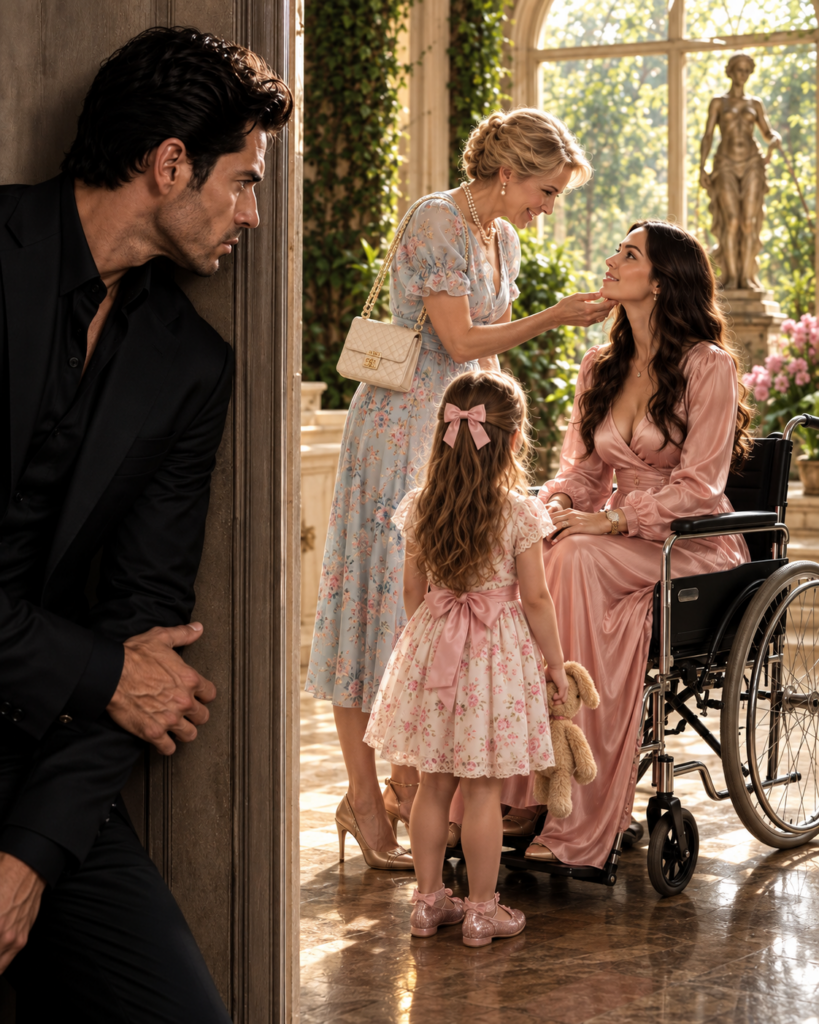
For several seconds, I forgot to breathe.
The man standing in the doorway was older than the photographs Sarah kept in the cedar box beneath our bed. His face was narrower. There was silver at his temples. He wore glasses now, thin black frames that changed him just enough that another person might have doubted what they were seeing.
I didn’t.
I had spent eleven years married to his sister.
I knew Daniel Mercer’s face.
More than that, I knew the small crescent-shaped scar beneath his left ear, the one Sarah had once pointed out in a family photograph while telling me how Daniel had fallen through the glass door of a greenhouse when he was twelve.
The scar was still there.
Daniel crouched as Lily approached.
My hands tightened around the steering wheel.
But Lily didn’t look frightened.
That was the first thing I noticed.
She didn’t hesitate or shrink away. She walked toward him with the cautious familiarity of a child visiting someone she had met before but did not entirely understand.
Daniel smiled.
“Hey, Lilypad.”
Lily looked back at Evelyn.
Her grandmother nodded.
Then Lily held up a folded piece of paper.
“I made another one.”
Daniel accepted it carefully.
Even from half a block away, I could see his expression change.
He unfolded the page.
A child’s drawing.
Three stick figures beneath what appeared to be a bright yellow sun.
Daniel said something I couldn’t hear.
Lily answered.
Then he reached into the building and brought out a small wooden box.
He opened it.
Lily peered inside.
Whatever I had expected to witness behind that steel door, it wasn’t this.
No menace.
No obvious danger.
Just my daughter, my mother-in-law, and a dead man looking at something together.
That somehow made everything stranger.
Evelyn glanced toward the street.
I lowered myself instinctively behind the wheel.
When I looked again, all three had gone inside.
The steel door closed.
I reached for my phone.
Sarah’s name was at the top of my recent calls.
My thumb hovered above it.
I wanted to call her.
I wanted to hear her laugh and tell me there was an explanation. I wanted her to say I had mistaken Daniel for somebody else.
But Lily’s words came back to me.
Grandma says if I tell you, Mommy will get hurt and it’ll be my fault.
There was a difference between protecting someone from danger and protecting them from pain.
A seven-year-old might not understand that difference.
Evelyn certainly did.
I put the phone down.
Then I called Martin Hale.
He answered on the fourth ring.
“Either you miss me,” he said, “or something has gone very wrong.”
Martin had spent six years overseeing security for my company before retiring to Vermont. Before that, he had worked in federal law enforcement, though he had never been particularly interested in discussing which agency or what exactly he had done there.
“I need you to look into someone.”
A pause.
“You haven’t called me in three years.”
“I know.”
“And the last time you did, you wanted restaurant recommendations in Montreal.”
“You gave excellent recommendations.”
“Flattery means this is serious.”
I watched the steel door.
“Daniel Mercer.”
Another pause.
“Sarah’s brother?”
“You remember him?”
“I remember Sarah talking about losing him.”
“He’s alive.”
Martin said nothing.
“I’m looking at the building he just walked into.”
“Are you sure?”
“Yes.”
“Then don’t do anything.”
I almost laughed.
“Martin—”
“I mean it. Don’t march inside. Don’t make calls you can’t take back. If Daniel Mercer has been presumed dead for eight years and is standing fifty yards from you, then whatever explanation exists has survived because several people have chosen silence.”
“My daughter is inside.”
His tone changed.
“Is she in immediate danger?”
I watched through the windshield.
“No.”
“Do you have any reason to believe she’s unsafe?”
I thought about Lily’s expression that morning.
“I have reason to believe she’s been told to keep secrets from me.”
“That matters. But it isn’t the same question.”
“No. She doesn’t look unsafe.”
“Good. Then give me the address.”
I read him the number painted beside the door.
“Go home,” he said.
“Absolutely not.”
“Then stay in the car.”
“For how long?”
“As long as it takes.”
I disliked being told what to do under the best of circumstances.
This was not the best of circumstances.
But Martin had always been useful precisely because he did not tell me what I wanted to hear.
So I waited.
Twenty-three minutes later, the steel door opened.
Lily came out first.
She was carrying the wooden box.
Evelyn followed.
Daniel remained in the doorway.
Lily turned around.
“Bye, Uncle Danny!”
I heard it clearly.
My stomach dropped.
Daniel smiled and lifted one hand.
“Next Tuesday?”
Lily glanced at Evelyn before nodding.
“Maybe.”
Then she climbed into the SUV.
Evelyn spoke quietly to Daniel for several seconds.
He looked tired.
Not sick exactly.
Just worn in a way that seemed deeper than age.
Finally Evelyn touched his arm.
He nodded.
She walked away.
Daniel watched the SUV disappear before going inside.
I stayed where I was.
My phone rang.
Martin.
“Well?”
“They’re leaving.”
“And your daughter?”
“Fine.”
“Go home.”
“Martin.”
“I’m working on it.”
I watched Evelyn’s SUV turn at the end of the block.
“How long?”
“As long as necessary to get facts rather than theories.”
“That sounds intentionally irritating.”
“It is.”
He hung up.
I gave Evelyn a three-minute lead before following.
On the drive home, I kept trying to arrange what I knew into something coherent.
Daniel was alive.
Evelyn knew.
Lily knew him as Uncle Danny.
Sarah supposedly believed he had died eight years ago.
Unless she didn’t.
That possibility hurt more than I wanted to admit.
There were explanations for keeping secrets.
There were even good explanations sometimes.
But eleven years of marriage had been built on the assumption that Sarah and I told each other the things that mattered.
Not every thought.
Not every small embarrassment.
But the foundations.
Family.
History.
Grief.
The dead returning from the dead seemed firmly inside that category.
I reached home before Evelyn because I took the faster route.
I parked the Range Rover behind the detached garage and entered through the mudroom.
Our housekeeper, Rosa, looked surprised to see me.
“Mr. Bennett? I thought you were going to Chicago.”
“Flight issue.”
“Oh. Mrs. Bennett doesn’t know?”
“Not yet.”
She smiled.
“She’ll be happy.”
The confidence in Rosa’s voice made me feel worse.
Sarah was at her architecture firm in Manhattan. She had left before Lily told me anything.
I went upstairs and changed out of the suit I had worn for Chicago.
When I returned to the kitchen ten minutes later, I heard the front door.
Lily’s voice floated down the hallway.
“Can I have the blue scissors?”
“After lunch,” Evelyn said.
“But Grandma—”
“Lunch first.”
Perfectly ordinary.
I stood beside the counter as they entered.
Evelyn stopped.
For perhaps half a second, genuine surprise crossed her face.
Then it vanished.
“You’re home.”
“Trip was canceled.”
“Why?”
“Aircraft problem.”
Lily stared at me.
Her eyes widened.
The wooden box was tucked against her chest.
I smiled.
“Hey, kiddo.”
“Daddy?”
“Apparently Chicago has to survive without me.”
I expected relief.
Instead Lily looked at Evelyn.
There it was again.
That silent consultation between them.
Evelyn recovered first.
“That’s nice,” she said. “You’ll have dinner with Sarah.”
“I suppose I will.”
I looked at the box.
“What have you got there?”
Lily hugged it tighter.
“Nothing.”
Children are terrible liars when they still trust you.
The realization cut through me.
I crouched until we were eye level.
“It looks like something.”
She bit her lip.
Evelyn intervened gently.
“It’s a craft project.”
I looked at her.
She met my eyes.
Neither of us blinked.
Then Lily said, “Grandma, can I go upstairs?”
“Of course.”
Lily hurried away.
I waited until I heard her bedroom door close.
“What kind of craft project?”
Evelyn opened the refrigerator.
“Does it matter?”
“It might.”
She took out a pitcher of water.
The composure irritated me more than defensiveness would have.
“Where were you?”
“Out.”
“With my daughter.”
“With my granddaughter.”
“My daughter,” I repeated.
Evelyn set down the pitcher.
“You’re behaving strangely.”
I studied her.
She was sixty-eight, elegant without trying, her gray-blond hair cut neatly at her jaw. Sarah had inherited her eyes but not her temperament. Sarah was open where Evelyn was guarded, quick to laugh where Evelyn sometimes seemed to ration emotion as if she feared running out.
“Does Sarah know where you went?”
That did it.
A tiny movement in Evelyn’s face.
Nothing more.
But enough.
“She’s at work,” she said.
“That wasn’t my question.”
Evelyn poured herself water.
“I don’t report my errands to my daughter.”
“No. But you apparently ask my seven-year-old to hide them from me.”
The glass stopped halfway to her mouth.
Silence.
Then Evelyn lowered it.
“What did Lily say?”
The question was quiet.
Too quiet.
I could have told her everything.
Instead I said, “Enough.”
Evelyn closed her eyes.
Not fear.
Weariness.
When she opened them again, she looked older.
“I was afraid this would happen.”
“Then perhaps you should explain why.”
“Not here.”
“Why not?”
Her gaze shifted toward the ceiling.
Lily.
I understood.
Whatever anger I felt, my daughter would not be placed in the middle of it.
“Tonight,” Evelyn said.
“Before tonight.”
“Jonathan.”
“Before tonight.”
She studied me.
Then she nodded.
“One hour. The guest cottage.”
I walked away before I said something I would regret.
Upstairs, Lily was sitting cross-legged on the carpet beside her bed.
The wooden box rested in front of her.
She hurriedly put the lid on when I entered.
I knocked against the open door anyway.
“Permission to enter the kingdom?”
Normally she would announce a tax of three gummy bears.
Today she only nodded.
I sat on the floor.
For a moment neither of us spoke.
Then I noticed the spelling workbook on her desk.
“You know,” I said, “I canceled a very important trip and nobody has even challenged me to spell anything.”
That earned the smallest smile.
“Necessary.”
“N-E-C-E…”
She giggled.
“Wrong.”
“I wasn’t finished.”
“You were going to be wrong.”
“Outrageous accusation.”
Her shoulders relaxed.
I let a few seconds pass.
“Lily, I want you to know something.”
She picked at the corner of the wooden box.
“You are never responsible for grown-up feelings.”
She looked at me.
“If Mommy gets sad?”
“Even then.”
“But Grandma said—”
“I know what Grandma said.”
“Is she in trouble?”
The immediate worry in her face stopped me.
“No.”
“You’re mad.”
“I’m confused.”
“That’s almost mad.”
I smiled despite myself.
“Fair point.”
She considered that.
Then she opened the wooden box.
Inside were photographs.
Dozens of them.
Lily pulled out one.
It showed a boy of perhaps ten standing beside a younger girl in matching raincoats.
I recognized Sarah immediately.
Daniel stood beside her, grinning at the camera.
“Uncle Danny says Mommy used to hate puddles.”
I stared at the photograph.
“When did you meet him?”
“After Grandma came here.”
“How many times have you seen him?”
She counted silently.
“Maybe five.”
“And what do you do there?”
“He tells stories.”
“Stories?”
“About Mommy when she was little.”
I swallowed.
“What else?”
“Sometimes we draw. And he has a piano but one key doesn’t work.”
Nothing she described sounded frightening.
“So why did Grandma make you lie down in the car?”
Lily’s face tightened.
“She said if anyone from the family saw me, they might tell Mommy before Grandma was ready.”
“That frightened you.”
“I don’t like hiding.”
There it was.
Not fear of Daniel.
Fear of secrecy itself.
I moved closer.
“You did the right thing telling me.”
“Will Mommy be hurt?”
“She may have some big feelings.”
Children understand that phrase better than adults sometimes.
“But she’ll have me and you,” Lily said.
“Yes.”
“And Grandma?”
I hesitated.
“Yes.”
She looked satisfied.
Then she handed me another photograph.
Sarah at perhaps seventeen, asleep on a couch with her head on Daniel’s shoulder.
On the back, written in blue ink, were five words.
Somebody always stays until morning.
I read them twice.
“What does that mean?”
“Uncle Danny says Mommy used to get scared before school plays.”
I looked up.
“Daniel told you that?”
Lily nodded.
“He stayed outside her room because she didn’t want Grandma to know.”
I sat there with that photograph in my hand and suddenly understood something.
Daniel had not merely been Sarah’s older brother.
He had been her safe place.
And Sarah had spent eight years grieving him.
At three that afternoon, I walked across the lawn to the guest cottage.
Evelyn was waiting at the small dining table.
There were two cups of tea.
I didn’t touch mine.
“You saw him,” she said.
It wasn’t a question.
“Yes.”
She nodded.
“I wondered when you came home before us.”
“Start at the beginning.”
Evelyn folded her hands.
“Daniel did not die eight years ago.”
“That much I’ve gathered.”
“The accident happened.”
I said nothing.
“He was driving back from Providence. Another car lost control in heavy rain. Daniel’s vehicle went through a barrier.”
“But he survived.”
“Yes.”
“And Sarah was told he died.”
“Yes.”
I stared at her.
“How does an entire family attend a funeral for someone who isn’t dead?”
Evelyn looked toward the window.
“There was a body recovered from the other vehicle. There was confusion initially. Daniel’s wallet was found in his car. The circumstances were… complicated.”
I shook my head.
“That doesn’t explain eight years.”
“No.”
“Then explain them.”
She took a slow breath.
“Daniel disappeared deliberately.”
“Why?”
“He believed he had ruined Sarah’s life.”
That wasn’t the answer I expected.
“What?”
“Not financially. Not criminally. Nothing like that.”
Her gaze returned to me.
“Your wife has never told you why she stopped speaking to her father for almost three years, has she?”
I thought back.
Sarah rarely discussed her father except warmly. Richard Mercer had died six years before our marriage. She had told me they had been distant when she was younger and repaired things later.
“No.”
“Daniel found out Richard was having an affair.”
I waited.
“He was twenty-six. Sarah was twenty-two. Daniel confronted him privately and demanded that he tell me. Richard refused. So Daniel told me himself.”
Evelyn’s voice held no anger now.
Only old exhaustion.
“Our family fell apart for a while.”
“Sarah blamed Daniel?”
“At first.”
“Why?”
“Because grief is rarely logical when the people involved are still standing in front of you.”
She gave a small, sad smile.
“Sarah adored her father. Daniel believed truth mattered regardless of consequence. Sarah believed Daniel had detonated the family instead of giving her father time to fix it.”
“What happened?”
“Eventually she understood. Richard apologized. We rebuilt what we could.”
“And Daniel?”
“Daniel never rebuilt himself.”
I frowned.
Evelyn looked down at her hands.
“He had always carried responsibility too heavily. Every disappointment became evidence that he had failed someone. After the accident, while he was recovering, he told us he wanted to disappear.”
“You agreed?”
“No.”
The answer came sharply.
Then her voice softened.
“I argued with him for months.”
“Sarah thought he was dead during those months?”
“For the first few days, yes. Then Daniel learned she had been told he hadn’t survived.”
“And he let her keep believing it.”
Evelyn’s eyes filled.
“I made the worst decision of my life.”
That silenced me.
She did not defend herself.
She did not say it had been necessary.
She simply sat across from me and accepted the ugliness of what she had done.
“Daniel was not well emotionally,” she continued. “He believed Sarah would be better without him. He said every time he tried to protect the family, he damaged it instead. He wanted to go somewhere no one expected anything from him.”
“So you let your daughter bury her brother.”
“I told myself it would be temporary.”
“How temporary?”
“A few weeks.”
I almost laughed.
“Eight years, Evelyn.”
“I know.”
“What happened?”
“Every day made the truth harder to tell.”
That, at least, I understood.
Not forgave.
But understood.
The first lie creates a problem.
The hundredth creates a life.
“Where has Daniel been?”
“Mostly Maine. For several years he worked restoring old houses. Then Vermont. He came back to Connecticut last winter.”
“Why?”
Evelyn looked at me.
“Because I asked him to.”
“Why now?”
“My husband died.”
Her voice trembled for the first time.
“Thomas wasn’t Daniel’s father, but he knew everything. After Thomas died, I realized I was the only person left carrying the secret.”
“You weren’t.”
She understood immediately.
“Daniel.”
“And now Lily.”
Evelyn closed her eyes.
“Yes.”
“That was unacceptable.”
“I know.”
“Do you?”
“Yes, Jonathan.”
Her voice remained soft.
“That is why I haven’t asked you to forgive me.”
I leaned back.
“Does Sarah know Daniel is alive?”
“No.”
I searched her face.
“You’re certain?”
“She believes her brother died eight years ago.”
“And you’ve been bringing Lily to him because…”
“Because Daniel asked about her.”
“That’s not enough.”
“No.”
Evelyn looked toward the house.
“When I moved here, I found Sarah’s old photograph albums in storage. Lily saw one. She asked about Daniel. Sarah told her Uncle Danny had died.”
“I remember.”
“Later Lily asked me what he was like.”
“So you introduced them?”
“Not immediately.”
“But eventually.”
“Yes.”
“Without asking either of her parents.”
“Yes.”
Her willingness to admit it stripped some of the heat from my anger.
Not because the choice was acceptable.
Because she wasn’t pretending it was.
“Why did Daniel agree?”
“He didn’t at first.”
I waited.
“Then Lily drew him a picture.”
I remembered the paper she had given him.
“Evelyn, she’s seven.”
“I know.”
“She shouldn’t be carrying an adult secret.”
“I know.”
“Then why tell her Mommy would get hurt if she talked?”
Evelyn looked stricken.
“I never meant it the way she understood it.”
“What did you say?”
“I said that finding out suddenly could hurt her mother deeply, and that Grandma needed time to figure out how to tell her.”
“That is far too much responsibility to put on a child.”
“Yes.”
The immediate agreement stopped me again.
“I thought I was explaining why discretion mattered. Instead I frightened her.”
For the first time since that morning, I saw Evelyn not as the architect of a conspiracy but as a grieving woman who had spent so many years managing impossible information that secrecy had become instinct.
That did not make her decisions right.
It made them human.
“What happens now?” she asked.
“Sarah learns the truth.”
Evelyn went pale.
“Today?”
“Yes.”
“Jonathan, please.”
“No.”
“She has a presentation tomorrow.”
I stared at her.
“You cannot possibly think her presentation matters.”
“I think Sarah matters. I think how she learns matters.”
That was different.
I sat quietly.
Evelyn continued.
“If you tell her Daniel is alive before she understands why he stayed away, the first thing she will feel is betrayal.”
“She’s going to feel betrayed no matter how carefully we package it.”
“I know.”
“She deserves that feeling.”
Evelyn nodded.
“Yes.”
The answer surprised me.
“She deserves the truth,” Evelyn said, “including the right to be angry with me.”
We sat there for a long time.
Finally I asked, “Does Daniel want to see her?”
Evelyn looked away.
“I don’t know.”
“That’s convenient.”
“It isn’t.”
“Then what is it?”
“He came back because Thomas’s death changed something in him. But wanting to stop hiding and being ready to face the person you hurt are different things.”
I thought of Sarah.
Her brother had been alive for eight years.
He had missed our wedding anniversary dinners, Lily’s birth, birthdays, Christmas mornings.
He had missed Sarah designing her first public library.
He had missed the night she sat on our bathroom floor crying because she wished Daniel could see the newspaper article about it.
And all along he had been somewhere in Maine repairing houses.
“Where is the building?” I asked.
“A workshop.”
“For what?”
“Furniture restoration. Daniel owns it with a friend.”
I stood.
“I want to speak to him.”
Evelyn rose too.
“Jonathan—”
“Without Lily.”
She hesitated.
Then nodded.
“I’ll call him.”
“No.”
“Why?”
“Because if he knows I’m coming, he might leave.”
Her expression told me the possibility was real.
“I’ll go myself.”
Twenty minutes later, I drove back to the industrial district.
The steel door was unlocked.
Inside, the windowless exterior gave way to an unexpectedly beautiful space.
Warm overhead lamps illuminated long worktables covered in planes, chisels, clamps, and jars of brushes. Half-restored chairs lined one wall. A mahogany dining table stood beneath hanging lights, its damaged surface gradually returning to life under careful hands.
Daniel was sanding the edge of a cabinet.
He looked up when I entered.
He knew immediately who I was.
His hand stopped.
“Jonathan.”
I closed the door behind me.
“So we’ve met?”
“No.”
“You know what I look like.”
“Evelyn showed me photographs.”
“Of course she did.”
He put down the sandpaper.
For a moment, neither of us knew where to begin.
Daniel solved it.
“Is Lily all right?”
“Yes.”
Relief crossed his face.
“She told me.”
His shoulders lowered.
“I wondered when she would.”
“You expected her to?”
“I hoped she would.”
That was not what I expected.
“You hoped my daughter would expose this?”
“I told Evelyn bringing Lily here was a mistake.”
“But you still saw her.”
“Yes.”
“Why?”
Daniel looked around the workshop.
“Because I’m not as disciplined as I pretend to be.”
He pulled out a wooden chair.
I remained standing.
“You let your sister believe you were dead.”
“Yes.”
“No explanation?”
“None that makes it acceptable.”
I was beginning to resent this family’s habit of refusing to defend itself.
Anger needs resistance.
Without it, it often turns into something harder.
“Sarah still talks to you sometimes.”
Daniel’s face changed.
“What?”
“When something important happens.”
I wished immediately that I had not said it that way.
But it was true.
“She goes to the cemetery.”
He looked at the floor.
“I know.”
“You know?”
“Mom told me.”
“She told you that?”
“Not often.”
I stared at him.
“You knew your sister was standing beside an empty grave talking to you.”
Daniel flinched.
“Yes.”
“Why didn’t you come back?”
His answer took a long time.
“Because eventually I became ashamed of how long I’d waited.”
There it was.
Not mystery.
Not conspiracy.
Cowardice of the most ordinary, recognizable kind.
The kind that grows from regret.
“I kept thinking there would be a better moment,” he said. “First after rehabilitation. Then after Sarah’s birthday. Then Christmas. Then when I had a stable place to live.”
His mouth tightened.
“Every deadline became another excuse.”
“You could have called.”
“I wrote letters.”
“That she never received.”
“No.”
“Why?”
“I never mailed them.”
I shook my head.
Daniel walked to a desk in the back corner.
He opened a drawer.
Inside were envelopes.
Stacks of them.
Some yellowed at the edges.
Each addressed to Sarah.
He handed me the first.
The postmark area was blank.
On the front, written in handwriting I recognized from old birthday cards Sarah had saved, were the words:
Sarah Mercer.
No address.
Just her name.
“Eight years?” I asked.
“Seventy-three letters.”
I looked at him.
“You counted?”
“I wrote them. Of course I counted.”
He sat.
“I know how pathetic that sounds.”
“It sounds sad.”
He looked up.
Perhaps that was worse.
“I came back after Thomas died because Mom told me she couldn’t carry this anymore. I rented this place. I started working. I thought if I stayed close enough, eventually I’d find the courage.”
“And Lily?”
“She arrived one Tuesday holding a drawing of a dog wearing a crown.”
I almost smiled.
“That sounds like her.”
“She said Mom told her I liked dogs.”
“You let her call you Uncle Danny.”
“Only after she asked whether I was.”
“And what did you tell her?”
“The truth.”
“All of it?”
“No.”
“Good.”
Daniel rubbed his palms together.
“I told her families sometimes lose track of each other when grown-ups make complicated mistakes. I told her none of those mistakes belonged to her.”
That was more appropriate than what Evelyn had said.
“Why didn’t you tell Sarah after meeting Lily?”
“Because Lily made it harder.”
I frowned.
“I realized how much I had missed.”
His gaze moved toward the small wooden box on the workbench.
A second one.
Nearly identical to Lily’s.
“And I realized coming back wasn’t about making myself feel better. Sarah gets to decide whether she wants me back.”
“She can’t decide if she doesn’t know you’re alive.”
“I know.”
I finally sat.
For the first time, I saw resemblance between him and Sarah that photographs hadn’t captured.
Not the eyes.
The pauses.
Sarah did the same thing when trying to say something painful. She would become very still, as if the right words might appear if she stopped moving.
“I was going to tell her this week,” Daniel said.
“Were you?”
“Yes.”
“How?”
He opened another drawer.
A cream envelope lay alone inside.
He handed it to me.
This one had an address.
Our address.
And a stamp.
Sarah’s name was written across the front.
“When?”
“Tomorrow.”
I stared at it.
“You were going to mail seventy-four?”
“No.”
He looked at the stacks of letters.
“This one says only that I’m alive. That I’m sorry. And that she doesn’t owe me a meeting, forgiveness, or even a reply.”
I turned the envelope over.
Sealed.
“You’re asking her to absorb eight years in a letter.”
“I’m giving her control over whether she sees me.”
I couldn’t immediately decide whether that was compassionate or another form of hiding.
Perhaps it was both.
My phone buzzed.
Sarah.
A message.
Chicago landed safely? Call me when you’re free. Love you.
I stared at the screen.
Daniel glanced away.
“You haven’t told her you stayed.”
“No.”
“So now you’re keeping something from her too.”
I looked sharply at him.
“I’ve been doing it for six hours.”
“I know.”
“Don’t compare us.”
“I’m not.”
He met my eyes.
“I’m warning you how quickly you can start believing that waiting for the right moment is kindness.”
That landed harder than anything else he could have said.
I read Sarah’s message again.
Then I called her.
She answered immediately.
“Hey. How’s Chicago?”
“I’m not in Chicago.”
Silence.
“What?”
“The flight was canceled.”
“You didn’t tell me.”
“I should have.”
“Is everything okay?”
I looked at Daniel.
He looked terrified.
Not for himself.
For her.
“Sarah, can you come home early?”
Another pause.
“What happened?”
“Lily’s fine.”
“Why would you say that unless something happened?”
“Nothing happened to Lily.”
My voice softened.
“But there’s something we need to talk about.”
“Jonathan.”
“I’m here. She’s safe. Everyone is safe.”
She exhaled.
“I can leave in twenty minutes.”
“I’ll be home.”
I hung up.
Daniel stared at the envelope between my fingers.
“Today?”
“Yes.”
He stood.
“No.”
“Daniel—”
“I’m not ready.”
“For eight years, everyone has organized their choices around whether you were ready.”
He lowered his eyes.
I regretted the sharpness immediately, but not the truth.
“I’m not bringing her here,” I said. “I’m not forcing you into a room together. But I will not lie to my wife tonight.”
Daniel sat again.
“What are you going to tell her?”
“That I saw you.”
His jaw tightened.
“And then?”
“The rest should come from the people who lived it.”
At five twenty, Sarah’s car pulled into our driveway.
I was waiting in the library.
Evelyn was in the guest cottage.
Lily was upstairs doing homework with Rosa nearby.
For once, the house felt too quiet.
Sarah entered still wearing her work clothes, a rolled set of architectural drawings under one arm.
She dropped her purse on the chair.
“What happened?”
I stood.
“Sit with me.”
Her face immediately changed.
“No.”
“What?”
“People only say that when they’re about to tell you something terrible.”
“Nothing terrible happened today.”
“Then tell me standing up.”
So I did.
“I saw Daniel.”
Sarah stared at me.
I had imagined many responses.
Disbelief.
Anger.
Tears.
She simply looked confused.
“What Daniel?”
“Your brother.”
Her expression remained blank for several seconds.
Then she laughed once.
Not because anything was funny.
Because the words had failed to fit inside reality.
“My brother is dead.”
“No.”
She stopped breathing for a moment.
I moved toward her.
She stepped back.
“No.”
“Sarah.”
“No.”
“Your mother knew.”
Her eyes closed.
When they opened, something inside them had changed.
“You saw him?”
“Yes.”
“Today?”
“Yes.”
“Where?”
“At his workshop.”
She put one hand against the back of a chair.
“How long?”
I knew what she meant.
“Eight years.”
Her face went completely still.
“My mother knew for eight years?”
“Yes.”
“And you?”
“Since this morning.”
“Lily?”
I hesitated.
That was answer enough.
Sarah sat.
Not because I asked her to.
Because her knees seemed suddenly unable to negotiate standing.
“How long has Lily known?”
“A few months.”
Her voice was barely audible.
“My daughter met my brother before I knew he was alive.”
I sat across from her.
“Yes.”
She looked at me.
“Why?”
I could have answered.
Instead I said, “Your mother needs to explain her part. Daniel needs to explain his.”
“Daniel.”
She repeated his name like it belonged to another language.
Then tears finally came.
Quietly.
Not dramatic.
Sarah pressed the heels of her hands against her eyes.
“He’s alive?”
“Yes.”
“Actually alive?”
“Yes.”
A sound escaped her that I had never heard before.
Half laugh.
Half sob.
I moved beside her.
This time she let me.
I wrapped my arms around her.
For several minutes she cried against my shoulder.
Then she whispered, “I talked to him last Sunday.”
I knew what she meant.
At the cemetery.
“I know.”
“I told him Lily lost her front tooth.”
My throat tightened.
“I know.”
“I told him I wished he could see her.”
I held her tighter.
For all the betrayals wrapped inside the truth, one fact remained untouched.
Her brother was alive.
Grief had not been reversed.
Life did not work that way.
But something Sarah had believed permanently impossible had become possible again.
After a while, she pulled away.
“Where is Mom?”
“The cottage.”
Sarah stood.
“I need to see her.”
“I’ll come.”
“No.”
I looked at her.
“I need to talk to my mother as her daughter.”
I nodded.
She reached the doorway and stopped.
“Jonathan?”
“Yes?”
“Thank you for telling me today.”
The words hurt because I understood what she was really saying.
Thank you for not waiting.
I watched her walk across the lawn.
She stayed with Evelyn for nearly two hours.
I did not follow.
I helped Lily with her spelling words.
I ruined grilled cheese sandwiches.
We fed the burnt edges to the dog.
At seven thirty, Lily asked, “Does Mommy know?”
“Yes.”
Her eyes widened.
“Is she sad?”
“She has lots of feelings.”
“Is Grandma in trouble?”
“Families aren’t courts, sweetheart.”
She considered this.
“What does that mean?”
“It means sometimes people make mistakes, and then we have to decide what happens next.”
“Do we vote?”
I smiled.
“No.”
“We should.”
“I’ll consider changing family policy.”
At eight twelve, the cottage door opened.
Sarah walked back alone.
Her face was puffy from crying.
I met her at the kitchen door.
“How are you?”
“I don’t know yet.”
A good answer.
An honest one.
She looked toward the stairs.
“Where’s Lily?”
“Getting ready for bed.”
“I want to see her.”
We went upstairs together.
Lily was already beneath her blanket when Sarah entered.
For a moment, mother and daughter simply looked at each other.
Then Lily said, “I’m sorry.”
Sarah crossed the room immediately.
“No.”
She sat on the edge of the bed and took Lily’s hands.
“No, sweetheart. You have nothing to apologize for.”
“But I knew.”
“You were asked to keep something that was too big for you.”
“Grandma didn’t mean to scare me.”
“I know.”
“Are you mad at her?”
Sarah took a breath.
“I’m hurt.”
“Is that different?”
“Yes.”
“How?”
Sarah glanced at me.
Then she looked back at Lily.
“Being mad sometimes wants an answer right away. Being hurt sometimes needs time.”
Lily thought about that.
“Are you happy Uncle Danny isn’t dead?”
The simplicity of the question broke through everything.
Sarah smiled through tears.
“Yes.”
“So you’re happy and hurt?”
“Yes.”
“At the same time?”
“Very much at the same time.”
Lily seemed relieved by that.
Children often understand contradictions more easily once adults admit them.
She reached under the blanket and pulled out the wooden box.
“I have pictures.”
Sarah froze.
Lily opened it.
One photograph after another.
Sarah at five.
Daniel at eight.
Family vacations.
School plays.
Christmas mornings.
A childhood preserved in paper.
Sarah picked up the photograph of herself sleeping against Daniel’s shoulder.
Her fingers trembled.
On the back:
Somebody always stays until morning.
She closed her eyes.
“I forgot about this.”
Lily leaned against her.
“Uncle Danny remembered.”
Sarah cried again.
But differently.
Softer.
When Lily was asleep, Sarah and I went downstairs.
We sat in the kitchen where the day had started.
It felt like another lifetime.
“Mom told me everything,” she said.
“Do you believe her?”
“I believe she believes everything she did was protecting somebody.”
“That isn’t what I asked.”
Sarah gave me a tired smile.
“No. Not all of it.”
She wrapped both hands around a cup of tea.
“She apologized.”
“Did that help?”
“More than I expected.”
I waited.
“She said something I can’t stop thinking about.”
“What?”
“That she spent eight years being afraid I would hate her if I learned the truth, and that every year she waited made the thing she feared more likely.”
Sarah stared into her tea.
“I told her she was right.”
“And do you hate her?”
“No.”
The answer came immediately.
“I’m furious with her. I don’t trust her judgment right now. I don’t know how long that lasts.”
She looked toward the dark window.
“But she’s my mother.”
I reached across the table.
Sarah took my hand.
“What about Daniel?” I asked.
She didn’t answer for a long time.
Finally she said, “Did you speak to him?”
“Yes.”
“Does he want to see me?”
“I think he wants you to have the choice.”
Her eyes sharpened.
“That sounds like him.”
“What does?”
“Making himself smaller and calling it generosity.”
I almost smiled.
“He gave me this.”
I placed the sealed envelope on the table.
Sarah stared at her name.
She didn’t touch it.
“What is it?”
“A letter he planned to mail tomorrow.”
“Tomorrow?”
“Yes.”
“So if Lily hadn’t told you this morning…”
“You would have received it anyway.”
She laughed softly.
“That’s almost funny.”
“Almost.”
She finally picked up the envelope.
For several minutes she simply held it.
Then she opened it.
I looked away.
Not because she asked.
Because some words belong first to the person for whom they were written.
Sarah read silently.
Once.
Then again.
When she finished, she folded the page carefully.
“What did he say?” I asked.
She looked at me.
“Not enough.”
I wasn’t sure what that meant.
Then she stood.
“Where are you going?”
“To get my coat.”
My heart jumped.
“Sarah.”
“I’m not going to yell at him.”
“I wasn’t suggesting—”
“Yes, you were.”
Fair.
She wiped her eyes.
“I spent eight years talking to an empty grave because I thought my brother couldn’t answer.”
She picked up the letter.
“Tonight, he can.”
Twenty-five minutes later, we were parked outside Daniel’s workshop.
The lights were still on.
Sarah stared at the steel door.
“You want me to come?”
“No.”
Then, after a moment:
“Yes.”
So we walked together.
Inside, Daniel was standing beside the unfinished mahogany table.
He saw Sarah.
Everything in him stopped.
Sarah stopped too.
Eight years stood between them.
Eight birthdays.
Eight Christmases.
A wedding anniversary.
A child growing from infant to seven.
A father’s death.
A stepfather’s death.
Hundreds of ordinary mornings neither had shared.
Daniel removed his glasses.
Sarah’s mouth trembled.
For one terrible second, I thought she might turn around.
Instead she said the most ordinary thing imaginable.
“You got old.”
Daniel stared.
Then something like a laugh escaped him.
“So did you.”
Sarah began crying.
Daniel did too.
Neither moved closer.
Not yet.
Sarah held up the letter.
“Seventy-four?”
His eyes widened.
“Jonathan told you?”
“He told me there were others.”
Daniel looked toward me.
I said nothing.
Sarah swallowed.
“I want to read them.”
“All of them?”
“Yes.”
He hesitated.
“Some are embarrassing.”
“I buried you.”
He lowered his head.
“That was unfair.”
“Yes.”
She said it gently.
That made it heavier.
Daniel nodded.
“I know.”
“No, Danny. I don’t think you do.”
He closed his eyes at the childhood name.
Sarah stepped closer.
“I’m glad you’re alive.”
Daniel looked at her.
“I need you to hear that before anything else.”
He nodded.
“I’m glad you are alive.”
A tear ran down his face.
“But I’m not ready to tell you everything is okay.”
“I don’t expect you to.”
“I might be angry tomorrow.”
“You should be.”
“I might not want to see you next week.”
“I understand.”
“And I might want to see you every day.”
Daniel’s mouth trembled.
“I’d understand that too.”
Sarah looked toward the drawer containing the letters.
“Give me the first one.”
Daniel opened it.
He removed the oldest envelope.
Sarah took it.
She didn’t open it immediately.
She looked at her brother instead.
“Did you really think I was better without you?”
Daniel answered quietly.
“At the time, yes.”
“Do you still?”
“No.”
“Good.”
She opened the letter.
And as Sarah began reading words her brother had written eight years earlier, I realized the mystery had changed.
The question was no longer why Daniel had disappeared.
We knew that now.
The harder question was what a family did after truth finally arrived—when nobody could undo the lost years, nobody could erase the hurt, and yet everyone involved was still standing close enough to choose what came next.
Then Sarah reached the final paragraph.
Her eyes stopped moving.
She read it again.
Slowly.
She looked at Daniel.
“What is this?”
His face went still.
Sarah turned the page toward me.
At the bottom, beneath a date from eight years earlier, Daniel had written:
There is one thing I never told Sarah about Dad. Mom doesn’t know either. I thought keeping it from them was kindness, but now I’m not sure kindness and silence are the same thing.
Sarah lowered the letter.
“What didn’t you tell us?”
Daniel looked from his sister to me.
Then toward the locked cabinet at the back of the workshop.
And I understood that Daniel’s disappearance had not been the only secret our family had inherited.
Daniel had chosen to remain visible.
Sarah had chosen forgiveness without pretending the hurt had never happened.
And Lily had reminded all of us that children should never have to protect adults from honest conversations.
As for me, I had learned that the life you build can become so complicated that you forget what you built it for.
The acquisition in Chicago eventually made the business pages.
There were photographs.
Numbers.
Quotes about strategy and expansion.
People congratulated me for months.
But none of that was what I remembered most clearly about that year.
I remembered a panda mug.
Untouched eggs.
A small hand gripping my sleeve.
And a whispered request I had almost been too busy to hear.
Dad, don’t go.
I didn’t.
And because I stayed, the rest of us finally learned how to come home


