
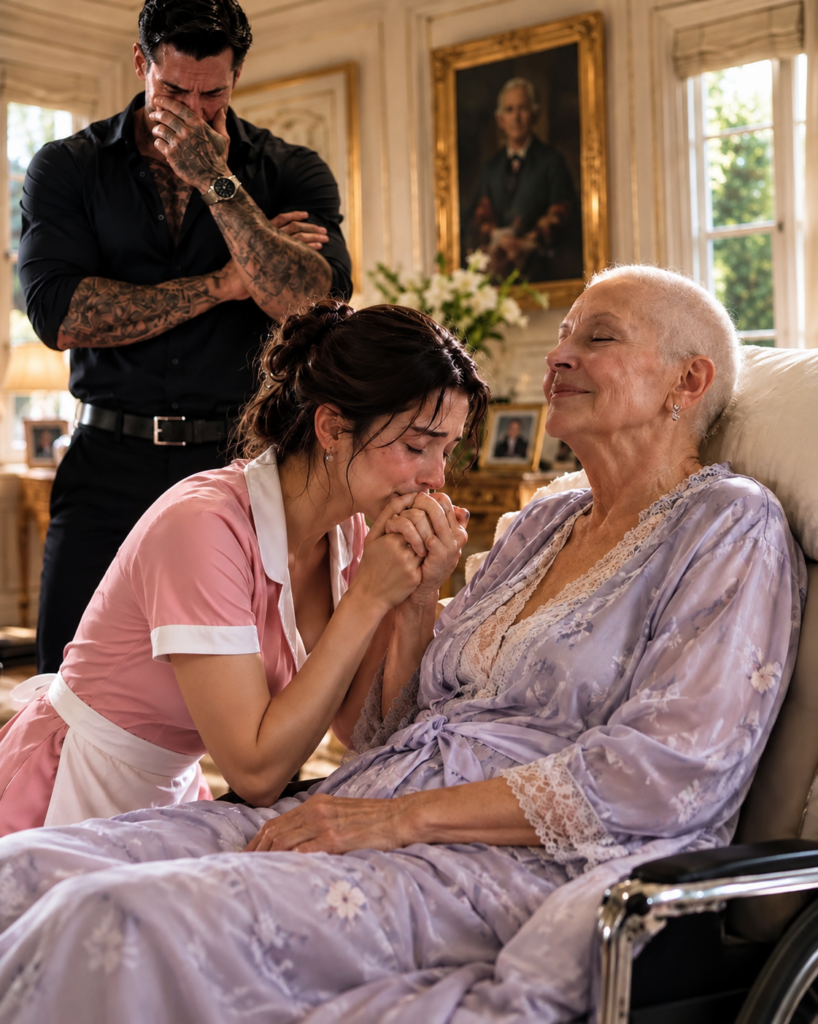
“My daughter.”
For several seconds, I thought I had misunderstood my mother.
The office seemed unusually quiet. Even the old brass clock on the mantel, something I had stopped hearing years ago, suddenly sounded loud.
Tick.
Tick.
Tick.
Mother sat in her wheelchair near the window. The morning light caught the pale scarf tied loosely around her head. Clara stood beside her with one hand pressed against the back of a chair, as if she needed something solid beneath her fingers.
I looked from one woman to the other.
“What did you say?”
Mother did not look away.
“I had a daughter before I had you.”
There are revelations that arrive like thunder.
This one did not.
It entered quietly and rearranged the room.
I sat down again.
“You had a daughter.”
“Yes.”
“With Dad?”
“No.”
That answer was somehow harder.
My mother folded her hands in her lap.
“I was nineteen.”
I had spent my entire life believing I understood the architecture of the Hale family. My father, Arthur Hale. My mother, Eleanor. Me.
There were portraits in hallways, names carved into foundation stones, genealogies printed inside leather-bound family Bibles.
We were, supposedly, a family with no blank spaces.
I looked at Clara.
She was staring at the carpet.
A thought formed slowly.
Then all at once.
“No.”
Mother closed her eyes briefly.
“Bennett—”
“No.”
Clara finally looked at me.
Her face had gone white.
“My mother’s name was Ruth,” she said.
The clock continued ticking.
I had negotiated company mergers involving hundreds of people without losing my composure.
I had sat across tables from men who thought silence was weakness and watched them discover otherwise.
But there, in my own office, I could not think of a single intelligent thing to say.
Mother reached toward Clara.
Clara crossed the small distance between them and took her hand.
“Ruth was my daughter,” Mother said.
Her voice trembled once.
“And Clara is Ruth’s daughter.”
I stared at Clara.
“My niece.”
She nodded.
The word felt impossible.
This quiet young woman who polished silver in my dining room and rearranged flowers in the entrance hall was my sister’s child.
My sister.
Even that word seemed to belong to someone else’s life.
I stood and walked toward the window.
Outside, the grounds looked exactly as they always did.
The gardeners were trimming the hedges near the eastern path.
A delivery van had stopped by the kitchen entrance.
A pair of sparrows landed on the stone fountain.
Everything ordinary continued happening.
“How long have you known?” I asked.
Mother answered.
“About Clara? Four years.”
I turned.
“Four years?”
“Bennett.”
“How long has she been working here?”
“Eleven months.”
I looked at Clara.
“And you knew who I was the entire time.”
“Yes.”
That hurt more than I expected.
Perhaps because every conversation I remembered immediately felt different.
Good morning, Mr. Hale.
Would you like the study windows opened, Mr. Hale?
Your mother is resting, Mr. Hale.
All those polite distances.
All those hidden words.
Uncle.
Family.
Mother shifted in her chair.
“Don’t blame Clara.”
“I didn’t say I blamed her.”
“You’re doing that thing with your jaw.”
“What thing?”
“The thing you’ve done since you were twelve when you’re angry and pretending not to be.”
Under any other circumstances, I might have laughed.
I didn’t.
I turned to Clara.
“Why?”
She swallowed.
“Why what?”
“Why come here as a housekeeper?”
Mother started to speak, but Clara gently squeezed her hand.
“It’s all right.”
Then Clara faced me.
“Because I didn’t want anything from you.”
“I never said you did.”
“You didn’t have to.”
There was no accusation in her voice.
That somehow made it worse.
She took a breath.
“My mother spent most of her life wondering whether she should find Mrs. Hale. She knew her birth mother’s name by the time she was twenty-seven, but knowing someone’s name and walking into their life are different things.”
Mother looked down.
“Ruth wrote to me when she was thirty-one.”
I did the calculation automatically.
Four years older than me.
I had an older sister.
For thirty-six years, somewhere in the world, I had an older sister.
“Why was she adopted?”
Mother’s fingers tightened around Clara’s.
“My parents.”
She looked toward the window, but I suspected she was seeing something much farther away.
“My father was a judge. My mother was very involved in every respectable committee a respectable woman could possibly join. We lived in a town where everyone knew everyone else, and appearances mattered far more than they should have.”
She gave a small, tired smile.
“I was nineteen and convinced I knew everything about life. Then I became pregnant.”
“What happened to the father?”
“He was twenty. Frightened. His family moved away before Ruth was born.”
Mother spoke without bitterness.
That surprised me.
“I thought I would keep her. I truly did. I had plans. Silly plans, probably. I imagined getting a little apartment and finding work and raising her myself.”
Her voice softened.
“But nineteen-year-old girls in my world did not have as many choices as they should have. My parents arranged everything. They said the adoption was the responsible decision.”
I pulled out the chair across from her.
This time I sat because I needed to.
“Did you agree?”
“I signed the papers.”
“That isn’t what I asked.”
Mother looked at me.
“No.”
One word.
Quiet.
Certain.
Beside her, Clara wiped at one eye.
Mother continued.
“They told people I had gone away to help an aunt who was ill. I spent the last months of my pregnancy in another city. Ruth was born on a rainy morning in March.”
For the first time, Mother smiled.
“She had the loudest cry I had ever heard.”
Clara laughed softly.
“My mother could be loud.”
“Oh, she could.”
They exchanged a glance full of history.
I realized they possessed memories together.
Not inherited stories.
Actual memories.
Birthdays I had never attended.
Conversations I had never heard.
Photographs in which I did not exist.
The feeling that came over me was not jealousy exactly.
It was grief for years I had not known were missing.
“What happened after the adoption?”
“I came home.”
Mother touched the edge of her scarf.
“And everyone behaved as if nothing had happened.”
That sentence stayed with me.
Everyone behaved as if nothing had happened.
A year later she met my father.
Three years after that, they married.
Then I came along.
I remembered Christmas mornings, summer houses, school photographs, my father teaching me to tie a Windsor knot.
I wondered whether there had been another life beneath those memories all along.
“Did Dad know?”
Mother’s expression changed.
“Yes.”
I leaned back.
“He knew.”
“I told him before we married.”
That surprised me more than almost anything else.
My father had been a private man. Formal. Controlled.
But he had loved my mother.
That I had never questioned.
“What did he say?”
Mother smiled faintly.
“He asked whether I wanted to find her.”
I said nothing.
“He told me that if I did, he would help.”
“Then why didn’t you?”
“Because I was afraid.”
There was no elaborate justification.
Just that.
“I had already lost her once. I was afraid of discovering she hated me. I was afraid of disrupting her life. Then you were born, and I convinced myself that perhaps looking for Ruth would somehow be unfair to you.”
“To me?”
“I know it sounds foolish now.”
“It does.”
Clara looked at me sharply.
Mother raised one hand.
“He’s allowed to be angry.”
I rubbed my forehead.
“I’m not angry that she existed.”
“I know.”
“I’m angry that apparently everyone knew except me.”
Clara spoke carefully.
“My mother didn’t know about you until much later.”
That stopped me.
Mother nodded.
“The adoption records were closed. When Ruth eventually found me, she discovered I had married and had a son.”
“And what did she think?”
Clara smiled sadly.
“She was happy.”
“Happy?”
“She had always wondered whether you existed.”
I stared at her.
“She wondered about me?”
“All the time.”
Something about that broke through my anger.
Clara lowered herself into the chair beside Mother.
“When she was growing up, she used to imagine she had siblings somewhere. She said sometimes she’d walk through a crowded place and look at people who resembled her.”
Her smile appeared briefly.
“She wondered if one of them might be family.”
I looked at Mother.
“When did you finally meet Ruth?”
“Seventeen years ago.”
I searched my memory.
Seventeen years ago, I had been twenty-nine and expanding Hale Holdings into Europe.
I could tell you exactly which hotel in Frankfurt I had stayed in during the acquisition of a logistics firm that year.
I could not tell you what my mother had been doing.
Mother seemed to know what I was thinking.
“You were very busy.”
“That’s not an excuse.”
“No,” she said softly. “It isn’t.”
Clara looked down.
Mother continued.
“Ruth and I exchanged letters for almost a year before we met. Then one afternoon she came here.”
“Here?”
Mother nodded.
I looked around the office.
“To this house?”
“She sat in the garden.”
A strange image appeared in my mind.
A woman I had never known sitting beneath the chestnut tree.
My sister.
Mother smiled.
“She refused to come inside.”
“Why?”
“She said the house looked intimidating.”
I almost smiled.
“That sounds sensible.”
Clara did laugh then.
“My mother hated grand houses.”
Mother pointed at me.
“She said exactly that.”
For a moment, the three of us shared something that almost resembled ease.
Then I remembered the obvious question.
“Where is Ruth now?”
Neither woman answered immediately.
I already knew.
I could see it in Clara’s face.
“She died,” I said.
Clara nodded.
“Three years ago.”
My eyes closed.
I had discovered my sister and lost her in the same conversation.
“How?”
“An illness,” Clara said. “It was caught late.”
“I’m sorry.”
The words sounded inadequate.
Clara nevertheless nodded.
“Thank you.”
I looked at her and realized something else.
“You were what? Twenty-one?”
“Twenty-two.”
“And after your mother died, you contacted my mother?”
“No. Grandma contacted me.”
Grandma.
The word landed softly.
Mother’s eyes filled with tears.
“I promised Ruth I would.”
Clara squeezed her hand.
I stood again.
This time not because I was angry.
Because sitting still had become impossible.
“Why didn’t you tell me then?”
Mother looked at me for a long moment.
“Because Clara asked me not to.”
I turned toward her.
She lifted her chin.
“I wasn’t ready.”
“For what?”
“For becoming a Hale.”
I almost told her that no one had asked her to become anything.
Then I understood.
Our surname had weight.
Newspapers wrote about us.
Business magazines speculated about us.
People who had never met me believed they understood my family because they knew the square footage of my houses and the estimated value of my companies.
Clara continued.
“My mother spent years building a relationship with your mother privately. She didn’t want money. She didn’t want publicity. She didn’t want to change her name.”
“Neither do I,” Clara said. “I wanted to know my grandmother.”
“And me?”
She hesitated.
“I didn’t know.”
The answer was honest.
It was not flattering.
I appreciated it anyway.
“When Grandma became sick, I started visiting more often.”
“And then you took a job here.”
“Yes.”
“Why not just visit?”
Clara looked toward Mother.
Mother answered.
“Because I was stubborn.”
“That doesn’t narrow it down.”
She gave me the smallest smile.
“I didn’t want you reorganizing your entire life around me.”
“So you arranged for my niece to become a housekeeper in my own home.”
“When you say it like that, it sounds slightly ridiculous.”
“Slightly?”
Clara covered her mouth, but I saw her trying not to laugh.
Mother looked offended.
“It seemed practical at the time.”
For the first time that morning, I laughed.
Only once.
A short, disbelieving sound.
Then I sat down.
Mother’s expression softened.
“Clara wanted a job. She refused my money. Mrs. Lane needed another person on the household staff. Clara wanted to stay close without everyone asking questions.”
“And you both decided I should remain ignorant.”
Neither of them answered.
That hurt.
Mother saw it.
“I should have told you.”
“Yes.”
“I kept waiting for the right moment.”
“There is no right moment for something like this.”
“I know that now.”
I looked at Clara.
“Were you ever going to tell me?”
“Yes.”
“When?”
She looked embarrassed.
“I hadn’t worked that part out.”
I shook my head.
Apparently avoidance was hereditary.
Mother coughed.
Clara immediately reached for the glass of water on the side table.
The movement was automatic.
She held it while Mother drank.
I watched them.
That was the moment my anger became complicated.
They had lied to me.
But the lie had not been built from greed.
It had been built from fear.
Fear of rejection.
Fear of changing relationships.
Fear of saying something too late and discovering it should have been said earlier.
I knew something about fear disguised as practicality.
I had spent most of my adult life doing exactly that.
When Mother returned upstairs to rest, Clara remained in my office.
She stood near the door.
“Would you like me to leave?”
I looked at her.
“The house?”
“My job.”
“Do you want to?”
She considered the question.
“No.”
“Then don’t.”
Her shoulders relaxed slightly.
“But things are different now.”
“Yes.”
“I don’t know what you expect from me.”
“I don’t know what I expect either.”
That was difficult to admit.
I looked at the woman who had been a stranger twelve hours earlier and was now my closest living relative besides my mother.
“Do I call you Clara?”
She blinked.
“Yes.”
“What did you think I was going to call you?”
“I don’t know.”
“Neither do I.”
She smiled.
And unexpectedly, so did I.
That afternoon I canceled three meetings.
My assistant, Daniel Cho, called me within four minutes.
“Are you ill?”
“No.”
“Has something happened?”
“Yes.”
A pause.
“Business something?”
“No.”
Another pause.
Daniel had worked with me for twelve years. He knew when to ask questions and when not to.
“Do you need anything covered?”
“All of it.”
I could almost hear his eyebrows rise.
“All of Wednesday?”
“And tomorrow morning.”
“Bennett, should I contact a doctor?”
“Very funny.”
“I’m serious. You haven’t taken a full weekday off since 2019.”
That fact irritated me.
Mostly because it was true.
“Handle Zurich.”
“I already do.”
“Then why do I attend the calls?”
“I have been asking you that for six years.”
I hung up before he could become unbearable.
I found Mother in the conservatory.
She was sitting beneath a blanket while Clara repotted a violet.
I pulled up a chair.
Mother stared at me.
“What are you doing?”
“Sitting.”
“I can see that.”
“I canceled my meetings.”
Her eyes narrowed suspiciously.
“All of them?”
“Yes.”
“Are you dying?”
I looked toward Clara.
“Apparently everyone finds this alarming.”
Clara smiled at the plant.
Mother was quiet for a moment.
Then she said, “Tea?”
So we drank tea.
For nearly an hour, no one discussed family secrets.
Mother complained about a television chef.
Clara told us about accidentally ordering forty kilograms of potatoes for the household because she misunderstood Mrs. Lane’s handwriting.
I learned that my mother preferred lemon biscuits to the almond ones I had been ordering for years.
That small discovery bothered me more than it should have.
“How did I not know that?”
Mother looked amused.
“You never asked.”
Later, Clara left to help downstairs.
Mother and I remained.
I studied her.
Without her hair, she looked smaller.
Not weaker exactly.
More exposed.
“Did you love her?”
Mother knew who I meant.
“Yes.”
“Ruth.”
“With everything I had.”
“Did she forgive you?”
Mother looked toward the garden.
“Eventually.”
“For giving her up?”
“For staying away afterward.”
The distinction mattered.
“She understood I was nineteen,” Mother said. “What hurt her was that I remained silent once I became an adult with choices.”
I absorbed that.
“Did she resent me?”
Mother turned immediately.
“No.”
“Not even a little?”
“No.”
“How do you know?”
“Because she asked about you constantly.”
I looked away.
Mother touched my hand.
“She wanted to meet you.”
“Then why didn’t she?”
“Because I kept postponing it.”
I stared at her.
“You?”
She nodded.
“Your father had died. You were taking over the company. Every month there seemed to be another crisis.”
“So?”
“I told myself I was protecting you.”
“From having a sister?”
“From another complication.”
I stood.
Mother sighed.
“I know.”
“Do you?”
“Yes.”
Her voice was quiet.
“I was wrong.”
That prevented the argument I was preparing.
There is something disarming about a parent who no longer pretends to have been right.
I went to the window.
“What was she like?”
Behind me, Mother inhaled slowly.
“She was funny.”
I turned.
“Funny?”
“Very.”
“You don’t sound surprised.”
“You’re not particularly funny.”
“I can be funny.”
“No, darling.”
She smiled.
“You can be unintentionally entertaining.”
I ignored that.
“What else?”
“She taught primary school for twelve years. She loved old movies. She hated pears. She rescued plants people threw away.”
“That explains Clara.”
“What?”
“The conservatory looks like a forest.”
Mother laughed.
Then her expression softened.
“She had your father’s patience.”
“She wasn’t his daughter.”
“No. But Arthur adored her.”
I froze.
“Dad met her?”
Mother looked suddenly uncomfortable.
“Yes.”
“How many times?”
“Quite a few.”
I stared at her.
“What does quite a few mean?”
“He and Ruth became friends.”
Somehow that was the detail I could not process.
My father.
My sister.
Friends.
Without me.
Mother saw the change in my face.
“Bennett.”
“I need some air.”
I walked outside before she could stop me.
I spent nearly half an hour circling the garden.
It would have been easier if there had been someone obvious to blame.
But my father had been dead nine years.
My mother was sick.
Clara had been protecting a promise.
And Ruth was gone.
My anger had nowhere useful to go.
Near the greenhouse, I found Clara sitting on a low stone wall.
She had changed from her housekeeping uniform into jeans and a gray sweater.
For the first time, I realized I had never seen her dressed as herself.
She looked younger.
“Mind if I sit?”
She shook her head.
I sat beside her.
We watched the gardeners in silence.
Finally I said, “What was your mother like?”
Clara smiled.
“You asked Grandma that already, didn’t you?”
“How do you know?”
“Because everyone asks the oldest person first.”
“Is that a rule?”
“It should be.”
I waited.
Clara pulled her sleeves over her hands.
“She sang badly.”
I laughed.
“Grandma probably didn’t mention that.”
“She also talked to strangers everywhere. Grocery lines. Bus stops. Waiting rooms.”
“I definitely didn’t inherit that.”
“No.”
“And you?”
“What about me?”
“Did you inherit it?”
She thought.
“Sometimes.”
We sat quietly.
“She was a good mother,” Clara said.
“I’m glad.”
“She wasn’t perfect.”
“No one is.”
“She worried too much. She kept receipts for absolutely everything. She could hold a grudge against a broken appliance for years.”
I smiled.
Then Clara looked at me.
“She wanted to meet you.”
Mother’s words again.
“You knew?”
“Of course.”
“Why didn’t you contact me after she died?”
Clara looked toward the greenhouse.
“Because grief makes every decision feel permanent.”
I said nothing.
“I was afraid you’d think I had come for money,” she continued.
“I might have.”
“I know.”
That answer stung.
She looked at me apologetically.
“Your name was in newspapers. My whole life, Hale meant buildings and companies and foundations. You were someone on magazine covers.”
“I hate those photographs.”
“You always look annoyed.”
“I usually am.”
She smiled.
Then her expression turned serious.
“My mother didn’t want your money. Neither did I. The only thing she wanted was for Grandma to stop being ashamed.”
I looked toward the conservatory windows.
“Was she?”
“For years.”
That evening, after Mother had gone to sleep, I walked through the house differently.
It is strange how quickly knowledge changes familiar rooms.
The portrait of my mother at twenty-five now contained a secret.
The photograph of my parents on their wedding day contained a secret.
Even my childhood pictures seemed changed by the knowledge that somewhere another child of my mother had been growing up without us.
I went into the library.
Clara was there.
She stood on a ladder placing a book on the upper shelf.
“You don’t have to work tonight.”
She looked down.
“I know.”
“Then why are you?”
“Because routines are useful when your entire family situation changes before lunch.”
I understood that.
She climbed down.
“Grandma asked me to give you something.”
She walked to the reading table.
A wooden box sat there.
I had seen it before.
It usually lived in Mother’s dressing room.
Clara opened it.
Inside were dozens of envelopes tied with faded ribbon.
“Ruth’s letters,” she said.
I reached for one.
The handwriting was neat and rounded.
Eleanor.
No Mrs. Hale.
No Mother.
Just Eleanor.
I looked at Clara.
“Have you read them?”
“Some. Mom left her copies too.”
I sat.
Clara moved toward the door.
“You can stay.”
She hesitated.
Then she sat across from me.
The first letter was dated seventeen years earlier.
Dear Eleanor,
I have rewritten this six times, so I suppose at some point I have to accept there is no perfect way to begin.
I read only a few lines before stopping.
Not because the words were dramatic.
Because they were ordinary.
Ruth wrote about the weather.
Her job.
Her daughter.
A burnt casserole.
Then, near the end:
I don’t know what I expect from you. I think mostly I want to know whether you sometimes wondered about me too.
My vision blurred.
I folded the letter carefully.
Mother’s reply was there.
I opened it.
Dear Ruth,
Every day.
That was the first sentence.
I spent two hours reading.
Clara occasionally explained a name or place.
Ruth had married a man named Stephen Reed, Clara’s father, who had died in an accident when Clara was nine.
She had raised Clara mostly alone after that.
She had taught children.
She had traveled rarely.
She collected secondhand books.
She once sent my mother a six-page complaint about a neighbor’s cat destroying her tomatoes.
I laughed more than once.
Then I found my father’s handwriting.
The envelope was addressed to Ruth.
I stared at it.
“You knew about these?”
Clara nodded.
“Some.”
I opened it.
Dear Ruth,
Your mother says you believe I find the situation uncomfortable.
She is mistaken.
I find golf uncomfortable.
You are family.
I read that sentence three times.
You are family.
The letter continued.
My father wrote that he hoped Ruth would visit again.
He told her about a restaurant near the river.
He made a joke about Mother’s habit of overwatering orchids.
It was not a formal letter.
It was affectionate.
My father had known her.
More than that.
He had cared about her.
I found another.
Then another.
There were years of them.
Near midnight Clara went upstairs.
I remained.
At the bottom of the box lay a sealed envelope.
Unlike the others, it had my name on it.
Bennett Hale.
The handwriting was Ruth’s.
I stopped breathing for a moment.
Clara had returned to the doorway.
I held it up.
“What is this?”
Her face changed.
“I wondered whether it was still there.”
“You knew?”
“Yes.”
“Why hasn’t anyone given it to me?”
“Because Mom asked Grandma not to.”
I looked down at my name.
“Why?”
“She wrote it when she became sick.”
The room seemed colder.
“What does it say?”
“I don’t know.”
“You never read it?”
“No.”
“When was I supposed to get it?”
Clara stepped inside.
“When Grandma believed you were ready.”
A strange laugh escaped me.
“Ready for what?”
“I don’t know.”
I turned the envelope over.
It was still sealed.
“I think,” Clara said carefully, “Mom was afraid that if you learned about her only after she was gone, you might see her as another family problem someone had left you to solve.”
That sounded uncomfortably plausible.
“What changed?”
Clara looked toward the staircase.
“Grandma did.”
I thought of my mother that morning.
You gave me money.
Clara gave me her time.
I opened the envelope.
The letter inside was only three pages.
Dear Bennett,
If you are reading this, then Eleanor has finally told you I existed.
I almost smiled.
Ruth continued:
Please don’t be angry with Clara. And if you must be angry with your mother, try not to stay angry too long.
She spent many years believing silence was the same as protecting people.
I think our family may have a talent for that.
I leaned back.
Even dead, apparently, my sister understood us.
I kept reading.
She told me she had followed my career from a distance.
She had seen interviews.
Articles.
Photographs.
She said she had once heard me speak at a university fundraiser online and thought I looked exactly like Mother when I frowned.
Then came the line that made me stop.
We met once.
I stared at the page.
“What?”
Clara leaned forward.
“What is it?”
I read the sentence again.
We met once, Bennett. You probably don’t remember.
My heartbeat changed.
I continued.
It was seventeen years ago, shortly after I first met Eleanor. Arthur invited me to lunch in the city. You happened to arrive early for a meeting with him.
He introduced me as an old family friend.
I remembered.
Not clearly.
A restaurant near my father’s office.
A woman sitting with him.
Dark hair.
Green coat.
She had laughed because I took a business call before removing my overcoat.
I had been twenty-nine.
Busy.
Important.
In a hurry.
I remembered shaking her hand.
I remembered her saying, “Your mother talks about you constantly.”
I had smiled politely.
Then I left.
My sister.
I had stood three feet from my sister.
For perhaps six minutes.
And I had not known.
The letter continued.
I wanted to tell you that day.
Arthur wanted me to as well.
But I lost my nerve.
I told myself there would be another lunch.
Another birthday.
Another year.
There is always another year until there isn’t.
I put the page down.
Clara’s eyes were wet.
“What else?”
I picked it up.
Ruth’s final paragraph was shorter.
I don’t want anything from you, Bennett.
I never did.
But Clara may someday need something harder for you to give than money.
She may need you to let her belong without deciding what belonging should look like.
If that day comes, please try.
For me.
Your sister,
Ruth
For a long time, neither Clara nor I spoke.
Finally she whispered, “I didn’t know she wrote that.”
I folded the letter carefully.
“She knew me fairly well for someone who met me once.”
Clara smiled through her tears.
“She paid attention.”
I looked toward the dark windows.
Something was still bothering me.
In Ruth’s letter she had said my father wanted to tell me.
That did not match what Mother had said earlier.
I returned to the wooden box.
Near the bottom were several envelopes tied separately with blue thread.
All were from my father.
The final one had never been mailed.
Arthur Hale’s handwriting had become shaky by then.
It was dated ten years earlier.
Less than twelve months before his death.
I opened it.
Eleanor,
We have waited long enough.
Bennett should know Ruth.
Not because he has a right to every part of your past, but because Ruth is no longer merely the past.
She is part of our family now.
I read on.
There were references to conversations I knew nothing about.
My father had apparently urged Mother several times to tell me.
Then one sentence stopped me.
If you cannot tell him yet, I will.
I looked across the table at Clara.
“He was going to tell me.”
She looked surprised.
I continued.
I also need to tell him what Ruth and I decided about the cottage.
My eyes narrowed.
“What cottage?”
Clara’s face changed.
For the first time all evening, she looked genuinely confused.
“What?”
I turned the letter toward her.
“Dad mentions a cottage.”
She read the line.
“I don’t know.”
“You’ve never heard of it?”
“No.”
The following morning, I brought the letter to Mother.
She was having breakfast in bed.
The moment she saw the blue thread around the bundle, she stopped eating.
“You found Arthur’s letters.”
“Yes.”
She looked at me for a long time.
“He wanted to tell me.”
“Yes.”
“You let me believe he was part of the reason you didn’t.”
Her eyes filled with regret.
“I didn’t mean to.”
“You said he knew.”
“He did.”
“You didn’t say he wanted the truth told.”
“No.”
I waited.
Mother set down her spoon.
“I suppose some part of me was relieved to let you assume your father shared my hesitation.”
At least she did not lie again.
I placed the letter on the blanket.
“What cottage?”
Her face went still.
That was answer enough.
“There’s more.”
Mother looked toward the window.
“Yes.”
Clara, standing near the dresser, frowned.
“Grandma?”
Mother sighed.
“The cottage belonged to Ruth.”
“My mother rented her house.”
“Not the house you grew up in.”
Clara looked confused.
Mother continued.
“There is a little place near Bellweather Bay.”
I knew the area.
A quiet coastal town two hours away.
“Arthur bought it years ago.”
“For Ruth?” I asked.
Mother shook her head.
“With Ruth.”
That distinction mattered.
“How?”
Mother leaned back against the pillows.
“Ruth received a small inheritance from her adoptive grandmother. She wanted somewhere near the sea. Arthur knew an old cottage was being sold by a friend.”
“Dad owned property with my sister.”
“Technically, yes.”
“And no one thought I might need to know this?”
Mother gave me a tired look.
“When you say everything together, it sounds worse.”
“It is worse.”
Clara almost smiled despite herself.
Mother reached for the letter.
“Arthur never gave Ruth money she didn’t want. They argued about it constantly.”
That sounded like my father.
“He finally suggested they buy the cottage together. Ruth paid half. He paid half. She spent summers there with Clara.”
Clara’s mouth opened.
“The blue cottage?”
Mother nodded.
Clara sat down.
I looked between them.
“You know it?”
“My mother took me there every summer when I was little.”
Clara stared at Mother.
“She told me it belonged to a family friend.”
“It did.”
“Grandpa Arthur?”
Mother smiled.
“Yes.”
Clara covered her mouth.
I felt something strange in my chest at the word Grandpa.
My father had been a grandfather.
He had known it.
He had apparently accepted the role more easily than I had accepted being an uncle.
“What happened to the cottage?”
Mother looked at me.
“Arthur transferred his half to Ruth before he died.”
“So Clara owns it?”
“Not exactly.”
Clara frowned.
“What do you mean?”
Mother’s gaze moved between us.
“Ruth changed the ownership after Arthur died.”
“To whom?”
Mother folded the blanket beneath her fingers.
“To the three of you.”
Silence.
“Three?” I asked.
“Ruth. Clara.”
Mother paused.
“And you.”
I stared at her.
“I own a cottage I’ve never heard of?”
“Part of one.”
“How?”
“Ruth added your name to the trust.”
“Why?”
Mother looked toward the old wooden box on the table.
“She left a letter explaining that.”
Clara and I exchanged a glance.
“Where?”
Mother hesitated.
“Bellweather Bay.”
Of course.
I nearly laughed.
Mother gave me a tired smile.
“Ruth believed some things should be discovered in the place where they mattered.”
Clara shook her head slowly.
“That sounds like Mom.”
I looked at Mother.
“What exactly are we supposed to discover?”
She closed her eyes.
“I don’t know.”
That answer, for once, I believed completely.
Two days later, Clara and I drove to Bellweather Bay.
For someone who owned three cars designed for long-distance comfort, I had apparently chosen the wrong one.
Clara objected to my music.
I objected to hers.
She ate pretzels loudly.
I answered two business calls until she threatened to throw my phone into the glove compartment.
“You wouldn’t.”
“I clean for a living. I know where every replacement phone in your house is.”
I ended the call.
The road narrowed near the coast.
The sea appeared between pine trees.
Clara became quiet.
“I haven’t been here since Mom died.”
“We don’t have to do this today.”
She looked at me.
“You canceled meetings again?”
“Yes.”
“Daniel is going to think you’ve been replaced by an impostor.”
“He already does.”
The cottage stood at the end of a narrow lane.
Blue shutters.
White walls.
A small garden gone slightly wild.
Nothing about it belonged to the world I had grown up in.
No security gate.
No stone lions.
No polished driveway.
Just a house overlooking the sea.
Clara stood outside for almost a minute before unlocking the door.
Inside smelled faintly of cedar and dust.
A faded yellow blanket lay over the sofa.
Books crowded the shelves.
Photographs covered the mantel.
Clara at seven.
Clara at eleven.
Ruth laughing beside the sea.
Then I saw my father.
Arthur Hale stood beside Ruth on the cottage steps holding a paintbrush.
Both were covered in blue paint.
My father was laughing.
I had rarely seen photographs of him laughing.
I picked it up.
Clara came beside me.
“I remember that summer.”
“You met him?”
“A few times.”
“You knew who he was?”
“No. Mom called him Arthur.”
Of course she did.
There were more photographs.
My mother.
Ruth.
My father.
Clara.
An entire branch of my family existed inside this tiny house.
And for the first time, I understood something that money had never taught me.
You could own a mansion and still be absent from the rooms where your family truly lived.
Clara opened a cupboard beneath the bookcase.
“There.”
A metal box sat inside.
On top was an envelope.
Two names were written across it.
Clara Reed.
Bennett Hale.
We sat together at the old kitchen table.
Neither of us reached for it immediately.
“What do you think it says?” Clara asked.
“No idea.”
“That must be difficult for you.”
“What?”
“Not knowing something.”
I looked at her.
She smiled.
I opened the envelope.
Inside was a letter from Ruth.
And beneath it, a small brass key.
I read the first line.
Dear Clara and Bennett,
If you are reading this together, then at least one thing I hoped for has already happened.
Clara leaned closer.
I continued.
This cottage was never meant to be an inheritance.
It was meant to be a choice.
I stopped.
“What choice?”
Clara whispered.
I unfolded the second page.
And as I read what my sister had planned years before either of us knew we would be sitting at that table together, I finally understood that the secret my family had kept was not finished revealing itself.
Not even close.
The letter began with an apology.
That surprised me.
Ruth had done almost nothing that required forgiveness.
Yet there it was in her careful handwriting.
Dear Clara and Bennett,
First, forgive me for putting both your names on something neither of you asked for.
Clara smiled.
“That is very Mom.”
I looked at her.
“She apologized often?”
“For things that weren’t really her fault.”
Another family trait, apparently.
I continued reading.
Arthur and I bought this cottage because we both needed somewhere we were not required to be who other people believed we were.
Here, he was not Arthur Hale.
I was not Eleanor Hale’s lost daughter.
We were simply two people trying to work out what family might mean after too many years had already passed.
I looked toward the photograph on the mantel.
My father covered in paint.
A man I barely recognized.
Ruth continued.
When Arthur became ill, he wanted to give me his half.
I refused.
We argued.
He won, mostly because he was more stubborn than I was.
“That also sounds familiar,” Clara murmured.
I ignored her.
But I did smile.
After he died, I placed the cottage in a small family trust.
Clara owns one half.
Bennett owns the other.
Neither share may be sold without the agreement of the other.
I lowered the letter.
“She trapped us into shared property.”
Clara laughed.
“Yes.”
“I’m beginning to think your mother was dangerous.”
“You would have liked her.”
The simplicity of that sentence hurt.
I looked back at the page.
The cottage should not become a museum.
Use it.
Sell it together if you both truly want to.
Keep it if it gives you something useful.
But before you decide, open the little storage room behind the kitchen.
The brass key is for that door.
Clara and I turned simultaneously toward the kitchen hallway.
“There’s a room back there?” I asked.
She frowned.
“I thought it was a closet.”
The door was narrow enough that I had probably walked past it without noticing.
The brass key turned stiffly.
Inside was no great family treasure.
No collection of valuables.
No hidden fortune.
Just shelves.
Boxes.
Photograph albums.
Old letters.
A child’s red raincoat.
A stack of schoolbooks.
A battered wooden chair.
Clara stepped inside.
“Oh.”
Her voice changed.
She lifted the red raincoat from a box.
“This was mine.”
She pressed it against herself and laughed softly.
“I refused to wear anything else for about six months.”
On another shelf were several framed drawings.
Clara at age eight.
A crooked lighthouse.
A blue whale.
A family standing on a beach.
Three figures.
One was labeled MOM.
One CLARA.
The third was ARTHUR.
I looked at her.
“You drew Grandpa Arthur.”
She stared at the picture.
“I didn’t know that’s what he was.”
My father had been tall even in a child’s drawing.
I smiled.
“He would have complained about the ears.”
“They’re accurate.”
“You gave him enormous ears.”
“He had enormous ears.”
I laughed.
For the first time since learning the truth, my laughter contained no bitterness.
We spent the afternoon going through boxes.
Little by little, the missing years became less abstract.
Ruth’s life had not been some tragic blank space outside ours.
She had friends.
Work.
Arguments.
Favorite restaurants.
Christmas traditions.
A daughter who once tried to keep a crab as a pet in the bathtub.
“She was five,” Clara said defensively.
“You were five.”
“Yes.”
“That makes it worse.”
“The crab survived.”
At the bottom of one carton I found an old cassette tape.
Clara stared at it.
“What is that?”
I looked at her.
“You’re young enough to offend me.”
She grinned.
“There’s a player in the living room.”
The machine took several attempts to work.
Then a woman’s voice crackled through the speakers.
“If Arthur has pressed the wrong button again, this recording will contain forty minutes of him complaining.”
A man spoke in the background.
“I can hear you.”
My father.
Clara’s hand flew to her mouth.
Ruth laughed.
And suddenly there they were.
Not photographs.
Not handwriting.
Voices.
My sister.
My father.
Alive inside a dusty machine.
Ruth was recording a birthday message for Clara.
My father interrupted repeatedly.
They argued about candles on a cake.
He insisted eleven candles were correct.
Ruth reminded him Clara was turning twelve.
“I was right,” my father said.
“You are never right when numbers are involved,” Ruth replied.
“I run an international company.”
“And apparently cannot count to twelve.”
Clara laughed.
Then she cried.
Not heavily.
Quiet tears rolled down her cheeks while she smiled.
I sat beside her.
Neither of us turned off the recording.
Near the end, Ruth said something that stayed with me.
“Families are strange things, Clara. Sometimes people arrive late and still somehow belong.”
My father answered softly in the background.
“That’s true.”
The tape clicked off.
For a while, the cottage held only the sound of the sea.
Clara wiped her face.
“I had forgotten her voice sounded like that.”
I understood.
I was trying to memorize a voice I had never known.
We remained at Bellweather Bay overnight.
There were two small bedrooms.
I slept badly.
Not because the mattress was uncomfortable, though it was.
Because everywhere I looked, I found evidence of a life my father had lived without me.
At two in the morning, I went downstairs.
Clara sat at the kitchen table drinking tea.
“You too?”
She nodded.
I sat across from her.
“Were you close to him?”
“Arthur?”
“My father.”
She thought about it.
“I was a child.”
“That wasn’t my question.”
She wrapped both hands around the mug.
“He was kind to me.”
I waited.
“He came some summers. Not for long. Sometimes just a day.”
“What did you do?”
“Normal things.”
“Such as?”
“He tried to teach me chess.”
“Did you learn?”
“No.”
“That would have bothered him.”
“It did.”
I smiled.
“He took me for ice cream once. He let me order three scoops.”
“That definitely wasn’t like him.”
“He said grandparents were exempt from sensible portions.”
The word returned.
Grandparents.
I looked down at the table.
“I didn’t know him like that.”
Clara frowned.
“He was your father.”
“Yes.”
“But you mean…”
“He wasn’t relaxed with me.”
I struggled to explain.
“My father taught me things. Discipline. Business. Responsibility.”
“Those aren’t bad things.”
“No.”
But they were not ice cream.
Not blue paint.
Not joking into cassette recorders.
I had spent years believing my father was exactly the man I remembered.
Now I discovered he had contained rooms I had never entered.
It was unsettling.
Then strangely comforting.
Perhaps people were allowed to be larger than our experience of them.
Clara looked at me.
“Maybe you saw the version of him he thought you needed.”
“That sounds exhausting.”
“It probably was.”
I thought about my own life.
The employees who saw Bennett Hale, chairman.
The newspapers that saw Bennett Hale, businessman.
The staff who saw Mr. Hale.
My mother who saw her son.
And now Clara.
Who was still deciding what she saw.
“I don’t know how to do this,” I admitted.
“What?”
“Be your uncle.”
Clara smiled.
“I don’t know how to be your niece.”
“That seems inconvenient.”
“We can improvise.”
I nodded.
For Bennett Hale, improvisation was almost revolutionary.
The next morning we met a woman named Miriam Lawson.
She lived three houses down and had known Ruth for fifteen years.
She marched into the cottage carrying scones before either of us had finished breakfast.
“You’re Bennett.”
It was not a question.
“Yes.”
She examined me.
“You have Eleanor’s eyes.”
People usually told me I looked like my father.
I liked Miriam immediately.
She hugged Clara, complained she was too thin, then placed the scones on the counter.
“I wondered when someone would come back.”
“You knew about the trust?” I asked.
Miriam looked offended.
“I knew practically everything.”
“Were you one of Ruth’s friends?”
“Best friend, if you asked me. She might have claimed otherwise to annoy me.”
She sat.
Clara poured tea.
Miriam looked at me for several moments.
“Ruth worried about you.”
“She barely knew me.”
“That has never stopped a sister.”
I did not know what to say to that.
Miriam continued.
“She worried you’d eventually discover everything after the people who could explain it were gone.”
“She was nearly right.”
“Yes.”
“Why didn’t she contact me?”
Miriam buttered a scone.
“Why didn’t you contact her?”
“I didn’t know she existed.”
“Exactly.”
I waited.
She sighed.
“Ruth spent her childhood wondering why Eleanor gave her away. Then she spent adulthood discovering that life is usually more complicated than the questions children ask about it.”
Clara sat beside her.
“She was afraid.”
“Of Bennett?”
“Of rejection,” Miriam said. “There’s a difference.”
I appreciated that distinction.
“She saw your interviews,” Miriam told me. “You looked very certain of yourself.”
“I usually was.”
“You still do.”
“I’m less certain now.”
“Good.”
Clara laughed.
Miriam smiled at me.
“Ruth would have liked that answer.”
Before leaving, Miriam handed me a small envelope.
“Your father left this with me.”
I stared at it.
“For me?”
“No.”
She gave it to Clara.
“For her.”
Clara looked startled.
“Why didn’t you send it?”
“Arthur told me to give it to you after you returned here as an adult without your mother.”
Clara frowned.
“That’s oddly specific.”
“He enjoyed making simple things complicated.”
“He was a Hale,” I said.
Miriam pointed at me.
“Exactly.”
After she left, Clara opened the envelope.
Inside was a single sheet.
Dear Clara,
You are twelve while I write this.
If Ruth follows my instructions, you will not see it for many years.
Clara laughed.
“She absolutely followed them.”
My father wrote that he hoped she would return to the cottage someday by choice rather than obligation.
Then:
There may come a time when people tell you what being part of this family should mean.
Do not listen too carefully.
A name is useful on legal documents and almost nowhere else.
Choose the life that fits you.
Clara stopped reading.
I watched something shift in her face.
“What?”
She handed me the letter.
Near the bottom, my father had added:
And if Bennett tries to organize your future for you, remind him that when he was fifteen he attempted to schedule his summer holiday in fifteen-minute increments.
I stared at the page.
Clara began laughing.
“That never leaves this room.”
She laughed harder.
“I’m serious.”
“I’m framing it.”
“You wouldn’t.”
“Three copies.”
By the time we returned to the mansion, something between us had changed.
Not dramatically.
We did not suddenly behave like relatives in a sentimental advertisement.
Clara still called me Bennett hesitantly.
I still occasionally almost called her Miss Reed.
But the careful distance had narrowed.
Mother noticed immediately.
She was in the drawing room with Mrs. Lane when we arrived.
Mrs. Margaret Lane had managed the household for twenty-three years and possessed the unique ability to make everyone feel they were interfering with her schedule.
She looked at Clara.
“You’re late.”
Clara checked the clock.
“I’m not working today.”
Mrs. Lane considered that.
“Then you’re still late.”
“For what?”
“Tea.”
Mother smiled.
I sat beside her.
“How was Bellweather?”
“Complicated.”
“Good.”
“That’s an unusual response.”
“Simple things are overrated.”
I looked at her.
“You knew Dad left Clara a letter.”
“Yes.”
“You knew about the fifteen-minute holiday schedule.”
Mother’s expression brightened.
“He told her that?”
Clara burst out laughing again.
I regretted everything.
The following weeks were unlike any period of my adult life.
Not because my mother improved.
She didn’t.
Her treatments became harder.
Some mornings she could walk slowly to the conservatory.
Other days she barely left bed.
But something inside the house changed.
Or perhaps inside me.
I stopped treating time with Mother as something to fit between obligations.
Daniel took over more meetings.
At first I checked everything he did.
Then he called me one evening.
“Bennett.”
“Yes?”
“If you send me one more email asking whether I have reviewed a document I sent to you after reviewing it, I’m resigning.”
“You’re not resigning.”
“Then stop supervising my supervision.”
I leaned back in my chair.
“Do you need me at tomorrow’s meeting?”
“No.”
The old answer would have been, I’ll attend anyway.
Instead I said, “Fine.”
Daniel was silent.
“Are you there?”
“Yes.”
“Why aren’t you speaking?”
“I’m experiencing personal growth. It’s unpleasant.”
He laughed.
That next morning I made breakfast for Mother.
Technically, Mrs. Lane made breakfast.
I carried it upstairs.
Mother looked suspicious.
“What do you want?”
“Nothing.”
“That’s alarming.”
I put the tray down.
She lifted the lid.
“Lemon biscuits.”
“I finally learned.”
Her smile nearly undid me.
Clara eventually stopped wearing her housekeeping uniform.
The decision came from Mrs. Lane.
One afternoon she summoned all three of us into the kitchen.
“I require clarity.”
Mother raised an eyebrow.
Mrs. Lane pointed at Clara.
“Is she staff or family?”
Clara looked at me.
I looked at Mother.
Mother looked at Clara.
Mrs. Lane sighed dramatically.
“This is precisely the problem.”
Clara spoke.
“Can I be both?”
“No.”
“Why?”
“Because when I assign you to clean the dining room, Mrs. Hale tells me I am making her granddaughter work.”
Mother looked innocent.
“I said no such thing.”
“You said, and I quote, ‘Surely Bennett can clean his own dining room.’”
I frowned.
“You volunteered me?”
“You own the dining room.”
Mrs. Lane continued.
“And when I remove Clara from the schedule, she complains that she needs wages.”
Clara nodded.
“I do.”
I looked at her.
“You know—”
She held up a finger.
“Careful.”
I remembered Ruth’s letter.
Let her belong without deciding what belonging should look like.
I closed my mouth.
Mrs. Lane noticed.
“Remarkable.”
“What?”
“You learned.”
Eventually they worked it out.
Clara continued part-time with Mrs. Lane while enrolling in evening courses.
That was another surprise.
One Sunday afternoon, I found university brochures on the kitchen table.
“Thinking of going back?”
Clara looked embarrassed.
“Maybe.”
“What would you study?”
“Nursing.”
I waited.
She watched me carefully.
“You’re trying not to say anything.”
“I am.”
“It looks painful.”
“It is.”
She smiled.
“I started nursing school before Mom became ill. Then I left.”
“To care for her?”
“Yes.”
“And now?”
“I think I want to finish.”
I nodded.
“That sounds good.”
She stared at me.
“That’s all?”
“What else am I supposed to say?”
“I expected a spreadsheet.”
“I can make one.”
“No.”
“A comparison of programs?”
“No.”
“Tuition projections?”
“Absolutely not.”
I smiled.
“Then that’s all.”
She looked at me for a moment.
“Thank you.”
That simple thank-you meant more than if she had accepted a check.
Later, I did offer to pay her tuition.
She refused.
I expected that.
What surprised me was that I did not argue.
Instead we made another arrangement.
A loan.
No interest.
Written terms.
Clara insisted on repayment.
I insisted the repayment period be generous.
We negotiated for forty minutes.
Mother sat between us watching with enormous amusement.
“My two children,” she said.
Clara and I both stopped.
Mother corrected herself.
“My child and grandchild.”
But the first version remained in the room.
One evening in October, Mother asked me to sit with her.
Clara had gone to class.
Rain tapped softly against the bedroom windows.
Mother looked tired.
More tired than usual.
“I spoke to Dr. Patel.”
I knew immediately.
“What did he say?”
“He didn’t say anything I didn’t already know.”
I sat beside her.
“Are the treatments not working?”
She touched my hand.
“They’re buying time.”
“That’s the point.”
“Some time.”
My throat tightened.
“We can change hospitals.”
“No.”
“There are trials.”
“Bennett.”
“London has—”
“Bennett.”
I stopped.
Her voice was gentle.
“I’m tired.”
There are words that powerful people do not know how to answer.
Tired was one of them.
I could buy expertise.
I could arrange aircraft.
I could obtain second opinions from almost anywhere.
But I could not bargain with my mother’s exhaustion.
“What do you want?”
She smiled.
That question mattered.
“I want to stop the aggressive treatment.”
My first instinct was refusal.
Not out loud.
But every part of me tightened against the idea.
Mother saw it.
“I’m not giving up.”
“It sounds like giving up.”
“No.”
She squeezed my hand.
“It is choosing how I want to spend what remains.”
I looked away.
“How much remains?”
“Dr. Patel doesn’t know.”
“Weeks?”
“Perhaps months.”
The rain continued.
I stared at our hands.
Her fingers looked thin against mine.
“I’m not ready.”
“I know.”
“That should matter.”
“It does.”
“But not enough.”
Mother’s eyes filled.
“No.”
That was the hardest answer she ever gave me.
We sat without speaking.
Eventually she said, “Do you remember when you were seven and refused to go to school because you thought I might disappear while you were gone?”
I did.
Barely.
“You sat on the stairs in your pajamas.”
“I remember.”
“I promised you I wasn’t going anywhere.”
“You lied.”
“I was twenty-eight. Mothers lie about impossible things sometimes.”
I smiled despite myself.
Then she said, “I cannot make that promise now.”
My eyes burned.
“But I can promise something else.”
“What?”
“I’m here today.”
I looked at her.
Today.
Not next quarter.
Not next year.
Not after one more meeting.
Today.
I nodded.
“All right.”
Telling Clara was harder.
She sat beside Mother’s bed and listened without interrupting.
When Mother finished, Clara wiped her eyes.
“Are you sure?”
“Yes.”
“Then okay.”
I looked at her.
“That’s it?”
Clara looked at me.
“What should I say?”
“I don’t know.”
“She made a decision.”
“You’re not angry?”
“I’m sad.”
The distinction humbled me.
Mother reached for both our hands.
“Look at us.”
“What?”
“No one is arguing.”
I laughed.
Clara did too.
“You sound disappointed,” I said.
“A little.”
The months that followed became smaller.
And better.
That seemed impossible, but it was true.
We stopped measuring life by medical appointments.
Mother sat in the garden whenever weather allowed.
Mrs. Lane started serving Sunday lunches in the conservatory.
Daniel came once and was so intimidated by Mother that I enjoyed myself immensely.
“So,” she asked him, “you’re the man who actually runs Bennett’s company?”
Daniel looked at me.
I said nothing.
“Yes, Mrs. Hale.”
“I suspected as much.”
Clara nearly choked on her tea.
Even Mrs. Lane smiled.
Mother began organizing boxes.
Not because she expected to die the next day.
Because she said she had spent too much of her life leaving difficult things for later.
She gave Clara jewelry that had belonged to her grandmother.
Clara accepted one small ring and refused the rest.
She gave Mrs. Lane a painting.
Mrs. Lane cried privately and denied it publicly.
She gave Daniel my father’s old fountain pen.
I objected.
“You never use it,” Mother said.
“It’s mine.”
“You have forty-three pens.”
“I don’t have forty-three pens.”
Clara checked the desk drawer.
“You might.”
I lost that argument.
Then Mother gave me a recipe book.
I stared at it.
“You’re joking.”
“No.”
“I don’t cook.”
“Exactly.”
Inside the cover she had written:
For Bennett.
Some things cannot be delegated.
I laughed so hard I had to sit down.
Near Christmas, Clara brought her nursing-school acceptance letter into Mother’s room.
She tried to act casual.
It lasted three seconds.
“I got in.”
Mother shouted.
Actually shouted.
Mrs. Lane came running.
I arrived from the study convinced something had happened.
Instead I found Mother crying, Clara laughing, and Mrs. Lane demanding everyone explain themselves.
I looked at the letter.
“You got in.”
Clara nodded.
Something inside me swelled with pride so quickly it embarrassed me.
I hugged her.
It was our first real hug.
For half a second, she froze.
Then she hugged me back.
Mother watched us.
The expression on her face stayed with me forever.
Peace.
Not happiness exactly.
Something deeper.
As though a door she had spent half her life trying to open had finally moved.
That Christmas we went to Bellweather Bay.
Mother insisted.
The trip exhausted her, so Daniel arranged—without asking me—for a larger vehicle with a reclining seat.
I complained.
He ignored me.
We spent three days at the cottage.
Mother slept often.
Clara studied.
I cooked once.
It was disastrous.
“You burned soup,” Clara said.
“I didn’t know soup could burn.”
“Neither did I.”
Mother ate toast instead.
On Christmas morning, the three of us walked slowly to the beach.
Mother held my arm on one side and Clara’s on the other.
The sea was gray.
The wind was cold.
We did not stay long.
But on the way back, Mother stopped.
“This is enough.”
I looked at her.
“What?”
“This.”
She gestured toward us.
“For years I kept thinking I had to repair everything.”
Clara squeezed her hand.
Mother looked at me.
“I couldn’t give Ruth back the childhood we lost.”
“No.”
“I couldn’t give you back the sister you should have known.”
“No.”
Her eyes filled.
“I’m sorry.”
I had imagined that apology in many forms since learning the truth.
In some versions I was angry.
In others I demanded explanations.
But standing there with the cold sea behind us, none of those imagined speeches mattered.
“I know.”
Mother waited.
I took a breath.
“And I forgive you.”
Her face folded.
Not dramatically.
Just a small collapse of tension she had carried for decades.
She pressed her forehead against my shoulder.
Clara put an arm around both of us.
We stood that way beside the winter sea.
Three people connected by all the years we had missed.
And by the ones we still had.
Mother lived until early spring.
Her final weeks were peaceful.
The house became quieter.
Friends visited.
Dr. Patel came by even on days he was not scheduled.
Mrs. Lane kept fresh flowers in the bedroom.
Clara read aloud when Mother could not sleep.
I spent less time in my office.
On one of our last afternoons together, Mother woke and found me sitting beside her.
“No meetings?”
“No.”
“Very irresponsible.”
“I’m learning.”
She smiled.
“Clara?”
“Class.”
“Good.”
She closed her eyes.
After a moment she said, “I used to worry money would ruin you.”
“Encouraging.”
“It didn’t.”
I looked at her.
“You thought it might?”
“Your father did too.”
“That’s reassuring.”
She smiled.
“Money makes it easy to confuse providing with loving.”
I thought about doctors.
Cars.
Staff.
Invoices.
Everything I had once listed privately as evidence that I was taking care of her.
“I did that.”
“Yes.”
She opened her eyes.
“But you learned.”
I swallowed.
“Late.”
“Late is still here.”
Those were among the final clear words she said to me.
Mother died quietly several days later.
Clara and I were both in the house.
There was no dramatic final speech.
No perfect farewell.
Life rarely arranges itself that neatly.
There was simply a morning when she was there.
And an afternoon when she wasn’t.
Grief did not arrive like thunder either.
It appeared in ordinary things.
A second teacup.
A scarf hanging behind a door.
Lemon biscuits no one had ordered.
For several weeks I kept expecting to hear her wheelchair moving along the corridor.
Clara returned to classes three days after the funeral.
I almost told her she should take more time.
Then I stopped myself.
“What?” she asked.
“Nothing.”
“You were about to organize my grief.”
“I was not.”
“You absolutely were.”
I smiled.
“Go to class.”
She kissed my cheek.
“See you tonight, Uncle Bennett.”
I stood completely still.
She reached the door.
“Did you just—”
“No.”
“You did.”
She disappeared down the hall.
I laughed.
Months passed.
The house changed.
Not radically.
Mrs. Lane would never permit radical changes.
But Clara moved into one of the family rooms upstairs.
Her old staff room went to a new housekeeper.
She still helped Mrs. Lane occasionally, mostly because she enjoyed irritating her.
Daniel became chief executive of Hale Holdings.
I remained chairman.
For the first time in my adult life, I allowed someone else to make decisions without secretly checking all of them afterward.
Mostly.
Daniel claimed I was improving.
I claimed he was becoming arrogant.
We were both correct.
Bellweather Cottage remained in the trust.
Clara and I discussed selling it once.
The conversation lasted seven minutes.
Neither of us wanted to.
Instead, we repaired the roof.
Clara painted the shutters.
I suggested hiring someone.
She handed me a brush.
“You own half.”
Apparently property ownership came with manual labor.
One summer afternoon, nearly a year after that Wednesday when I first saw Clara shaving my mother’s hair, we sat outside the cottage.
Clara had finished her first semester.
She placed an envelope on the table.
“What’s that?”
“My first loan payment.”
I pushed it back.
“No.”
Her eyes narrowed.
“We had an agreement.”
“You’re a student.”
“We had an agreement.”
“You need the money more than I do.”
“That isn’t the point.”
I recognized that tone.
Ruth must have used it with my father.
I took the envelope.
“Fine.”
Clara smiled.
“Thank you.”
“But I’m putting it into an account.”
“No.”
“You don’t even know what account.”
“Yes, I do. Some secret investment account you’ll give me later.”
I considered lying.
She pointed at me.
“Don’t.”
I sighed.
“What am I supposed to do with it?”
“Anything.”
I looked toward the cottage.
An idea came slowly.
“What if we start something?”
Clara became suspicious.
“How expensive?”
“Not everything I do is expensive.”
She stared.
“Most things.”
Fair.
I explained.
A small scholarship.
Nothing bearing the Hale name.
Something for people who had interrupted education to care for relatives.
Clara grew quiet.
“Mom would have liked that.”
“That’s why I thought of it.”
“With the loan payments?”
“If you want.”
“And you match them?”
I smiled.
“That seems fair.”
“No ridiculous billionaire matching.”
“Define ridiculous.”
“Bennett.”
We negotiated.
Again.
Eventually we agreed on a modest fund.
Clara chose the name.
The Ruth Reed Continuing Care Scholarship.
The first recipient was a thirty-eight-year-old father returning to school after caring for his mother.
The second was a young woman completing a physical therapy degree.
We never turned it into a publicity campaign.
No gala.
No giant plaque.
Clara insisted.
I discovered I liked it better that way.
That autumn, Miriam came to the cottage for dinner.
So did Daniel.
Mrs. Lane refused our invitation three times before arriving with dessert.
Clara cooked.
I was assigned salad.
Apparently no one trusted me near heat.
We sat around Ruth’s old kitchen table.
At one point, I looked around the room.
Daniel was arguing with Miriam about football.
Mrs. Lane was correcting Clara’s table setting.
Clara was ignoring her.
The window stood open to the sea.
For years, I had believed family was something fixed.
A structure.
A name.
A duty.
Something inherited intact.
I knew better now.
Families could begin late.
They could survive missing years.
They could hold mistakes without being defined by them.
They could forgive slowly.
Sometimes awkwardly.
Sometimes without ever forgetting.
Clara caught me watching everyone.
“What?”
“Nothing.”
“You’re doing that weird sentimental face.”
“I don’t have a sentimental face.”
“You do now.”
I looked toward the photograph on the mantel.
My father and Ruth, covered in blue paint.
Beside it stood another photograph.
Mother on the beach between Clara and me.
Three people smiling into the winter wind.
“I was thinking about your mother.”
Clara’s expression softened.
“What about her?”
“She was right.”
“That narrows it down significantly.”
I smiled.
“About belonging.”
Clara waited.
“I thought belonging meant bringing someone into my life.”
“And?”
“I think sometimes it means making room for the life they already have.”
She looked at me for a moment.
Then nodded.
“I think Mom would have liked you.”
That sentence no longer hurt in quite the same way.
“I wish I’d known her.”
“So do I.”
There was sadness in that.
There always would be.
But sadness was no longer the only thing there.
Clara reached across the table.
“You know pieces of her now.”
I looked at the books.
The photographs.
The cottage.
At Clara.
“Yes.”
Outside, the evening light spread across the water.
For most of my life, I had believed security meant eliminating uncertainty.
If something frightened you, buy the best advice.
If something broke, replace it.
If something threatened what you loved, build higher walls around it.
My mother had spent decades building walls out of silence.
I had built mine out of schedules and responsibility.
Both of us had called it protection.
Ruth, somehow, had understood the flaw before either of us.
There is always another year until there isn’t.
I still worked.
I still cared about the company.
I still liked things organized.
Clara still mocked me for arranging the refrigerator by height.
Some people do not transform into entirely different human beings because life teaches them a lesson.
Real change is smaller.
I answered fewer calls during dinner.
I asked questions before offering solutions.
I learned which tea Clara drank during exams.
I learned Mrs. Lane had a grandson studying architecture.
I learned Daniel’s wife painted landscapes.
I learned to make one edible soup.
And every Wednesday, whenever possible, I left the office early.
Not because Wednesday possessed any magic.
Because one Wednesday had taught me how much could be happening inside my own home while I was elsewhere believing I had everything under control.
Years later, that habit remained.
One Wednesday afternoon I arrived at Bellweather Cottage to find Clara sitting on the steps in nursing scrubs.
She had finished her final clinical placement.
There was paint on her sleeve.
Blue.
I pointed at it.
“What happened?”
“The shutter.”
“You painted in your uniform?”
“I forgot to change.”
“That seems irresponsible.”
She smiled.
“Runs in the family.”
I sat beside her.
The sea stretched in front of us.
She handed me an envelope.
Another loan payment.
I laughed.
“You’re relentless.”
“I’m nearly finished.”
“You know I don’t care about the money.”
“I know.”
That was precisely why she continued paying.
I accepted it.
Then she leaned against my shoulder.
Neither of us spoke for a while.
Inside the cottage were Ruth’s letters.
My father’s ridiculous cassette tape.
Mother’s lemon-biscuit recipe.
Three generations of imperfect decisions.
Outside sat two people who had once lived in the same family without knowing they belonged to each other.
I thought of the morning in my office when Mother had taken Clara’s hand.
I remembered how certain I had been that providing the finest medical care meant I had done everything required of a son.
I had been wrong.
Money had bought excellent doctors.
It had bought comfort.
Privacy.
Time, to some extent.
Those things mattered.
I would never pretend otherwise.
But money had not sat beside my mother when she was frightened of losing her hair.
Money had not learned how she took her tea.
Money had not known the story of Ruth.
People had done those things.
Clara.
My father.
Mother herself, once she finally found courage.
And eventually, me.
I had spent half my life building an empire because I believed power meant being able to acquire whatever mattered.
My mother’s final gift was teaching me that the most important things in my life would never belong to me that way.
Time could only be used.
Trust could only be earned.
Forgiveness could only be offered.
Family could only be chosen again and again, in hundreds of ordinary moments.
Clara nudged my shoulder.
“You’re thinking too much.”
“Probably.”
“Tea?”
“Yes.”
She stood.
Then she looked back.
“Lemon biscuits?”
I smiled.
“Always.”
She disappeared inside.
I remained on the steps for another minute, listening to the sea.
For once, there was nowhere else I needed to be.
So I stayed.

