
Part 1
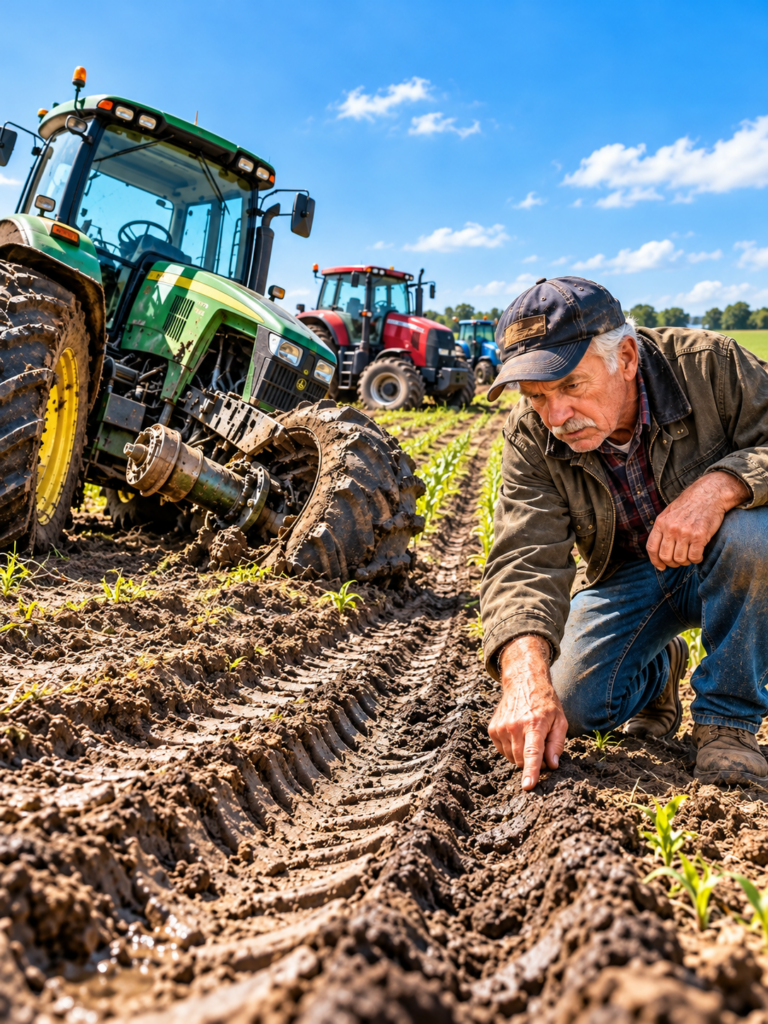
The third tractor died at 9:17 on a Tuesday morning.
Tom Brant remembered the exact time because the clock on the dashboard froze when the engine quit, leaving those numbers staring back at him through a thin film of dust.
First came a violent shudder beneath the seat. Then a metallic crack that sounded like somebody had slammed a sledgehammer against the belly of the machine.
The steering wheel jerked in his hands.
The tractor lurched sideways.
And then everything went quiet.
Tom sat motionless inside the cab.
Beyond the windshield stretched forty acres of rich Iowa farmland, dark as coffee grounds beneath the pale April sky. A row of cottonwood trees marked the creek along the eastern boundary. Farther away stood the weathered fence his father had built before Tom was old enough to hold a hammer.
It was good land.
The best land the family owned.
And somewhere beneath it, something was destroying every machine Tom drove across it.
He looked down at his trembling hands.
“Lord Almighty,” he whispered. “Not again.”
Ten days earlier, he would have laughed at the idea that a field could frighten him.
At fifty-eight, Tom had spent more years behind a tractor wheel than anywhere else. He knew the sound of a failing bearing, the smell of overheated hydraulic fluid, and the difference between a harmless rattle and a repair that could ruin a season.
He also knew exactly how much money remained in the farm account.
Not enough.
Not nearly enough.
Three tractors had now broken down on the same forty-acre field.
The first belonged to him.
The second belonged to his closest neighbor.
The third belonged to a dealership that had already warned him he would be personally responsible for any damage beyond ordinary wear.
Tom reached for his phone.
His wife answered on the second ring.
“Did you finish the south section?” Jenny asked.
He closed his eyes.
“No.”
There was a pause.
“Tom?”
“The rental broke.”
For several seconds, all he heard was the faint ticking of their kitchen clock.
Then Jenny said, very softly, “Please tell me you’re joking.”
He stared at the motionless hood.
“I wish I was.”
The Brant family farm sat six miles outside a small town in central Iowa, where neighbors still waved from pickup trucks and the local diner filled before sunrise during planting season.
The farmhouse was white, although years of wind had dulled the paint. The porch sagged a little near the eastern steps. A rusted weather vane stood above the barn, its rooster permanently facing north after a storm bent the mechanism seventeen years earlier.
Tom had grown up there.
His father, Harold Brant, had grown up there.
And his grandfather had worked the same ground with horses before tractors became common.
Nobody in the family had ever been wealthy.
But for three generations, the land had provided enough.
Until recently.
The previous fall had been difficult. Corn prices were disappointing, fertilizer costs were high, and an unusually expensive combine repair had swallowed most of their savings.
By March, Tom had taken an operating loan to cover seed, fuel, fertilizer, and the ordinary expenses required to put another crop into the ground.
The banker had been friendly.
Tom didn’t find that comforting.
Friendly bankers still expected payment.
Jenny handled the books at the kitchen table every evening, working beneath a yellow lamp that had belonged to Tom’s mother.
She was fifty-six, with graying brown hair, reading glasses that were forever slipping down her nose, and the practical patience of a woman who had spent thirty-four years married to a farmer.
She knew when Tom was hiding a problem.
Usually, he got quieter.
He’d been nearly silent for a week.
It started with his own tractor.
A twenty-year-old machine that had carried him through droughts, floods, planting seasons, and harvests when he had been too exhausted to remember driving home.
The first failure came on a clear Tuesday morning.
Tom was pulling a planter across the Creek Forty, the name his father had given the field decades earlier.
The tractor’s front end suddenly dropped.
Not far.
Perhaps several inches.
But enough to send a violent jolt through the frame.
Something cracked beneath him.
He managed to stop before the machine settled completely.
The front axle support had split.
When Ray Kowalski, the mechanic, arrived, he examined the damage with a flashlight.
“That’s one ugly break,” Ray muttered.
“Twenty years old,” Tom replied. “Guess it was bound to happen.”
Ray studied the fractured metal.
“Maybe.”
Tom didn’t notice the hesitation.
He was already calculating the cost.
The repair required parts that weren’t sitting on any shelf in town. By the time the machine was hauled away and the work arranged, Tom had lost precious planting hours.
So he called Gary Pruitt.
Gary farmed the neighboring property and had known Tom since they were boys. Their fathers had worked together. The two men had shared equipment, weather reports, bad harvests, and more than a few arguments about whose fence was leaning onto whose land.
When Tom explained the problem, Gary didn’t hesitate.
“Take my spare tractor.”
“You’ll need it.”
“Not until Thursday.”
“I’ll pay for the fuel.”
“Tom, just come get the thing.”
That was Gary.
He could complain for an hour about the price of diesel, then hand a neighbor his last full tank.
The borrowed tractor made it halfway across the Creek Forty.
Then its right rear tire struck something.
A sharp explosion echoed across the field.
The machine dropped hard.
Tom stopped it and climbed down.
The tire’s sidewall was torn open. The wheel rim had bent badly.
He stood staring at the damage, unable to understand what he’d seen.
There was no exposed rock.
No discarded metal.
Nothing but dark soil and the tracks of his tires.
Gary arrived twenty minutes later.
He looked at the wheel, then across the field.
“That’s a strange one,” he said.
“I’ll replace it.”
“Never mind that right now.”
“I ruined your tractor.”
“You didn’t ruin the tractor. You ruined a tire.”
Gary smiled, but his eyes remained on the twisted rim.
After that, Tom rented a newer machine from a dealership.
He told himself two failures were a coincidence.
Farm equipment broke. Tires failed. Things happened.
But when the third tractor collapsed at nearly the same place, the last of his confidence disappeared.
And now he was sitting in the dead rental, listening to the wind strike the windshield.
Ray Kowalski arrived shortly before noon.
He drove a faded red service truck that had once belonged to his father. The truck carried enough tools to repair almost anything, although Ray frequently insisted he couldn’t find a decent wrench when he needed one.
He was sixty-three, broad-shouldered, and slow-moving because of an old knee injury.
His hands were permanently stained with grease.
People who didn’t know him sometimes mistook his quietness for uncertainty.
People who did know him rarely made that mistake.
He climbed out of the truck, glanced at the crippled rental, and walked straight past it.
“Ray?” Tom called.
The mechanic kept walking.
He stopped beside the tractor tracks and crouched.
For nearly a minute, he said nothing.
Then he looked toward the fence.
“Tom, where did the first tractor break?”
“Over there.”
“Show me.”
Tom led him toward the place where his old machine had stopped.
Ray examined the ground.
Then they walked to the place where Gary’s tire had burst.
Finally, Ray returned to the rental.
He took off his cap and scratched his forehead.
“Same general area,” Tom said.
Ray didn’t answer.
Instead, he looked across the dark field toward the creek.
“Did you drive these machines in exactly the same tracks?”
“No. Different passes.”
“Different directions?”
“Mostly north and south. Why?”
Ray looked down at the deep impressions left by the rental’s tires.
“Because three different machines don’t usually break three different ways for no reason.”
Tom rubbed the back of his neck.
“You’re saying there’s something wrong with the field?”
“I’m saying there’s something here we haven’t understood.”
He crouched again.
Then he asked a question Tom would remember for the rest of his life.
“Did your father ever tell you not to drive heavy equipment along this fence line?”
Tom frowned.
“Dad had rules about everything.”
“Think about it.”
Tom stared toward the old fence post near the road.
Somewhere in his memory, he heard his father’s voice.
Stay off that low strip when the ground’s wet.
The memory came and went.
“Maybe,” Tom admitted.
Ray stood.
“Then before you lose another tractor, we’d better find out what that old man knew.”
Part 2
That evening, the kitchen table looked more like a bank office than a place where people ate supper.
Invoices lay beside seed catalogs.
A repair estimate sat underneath Jenny’s calculator.
Gary’s tire replacement was written on a yellow note.
The rental dealership had sent an email warning that the damaged driveline would require inspection before a final bill could be issued.
Jenny added the figures twice.
Then a third time.
“More than nineteen thousand dollars,” she said.
Tom sat opposite her, staring into a cup of coffee he’d forgotten to drink.
“I know.”
“That’s before we fix whatever happened to the rental.”
“I know.”
“And before we finish planting.”
He raised his eyes.
“Jenny.”
She put the calculator down.
“I’m not trying to make you feel worse. I’m trying to understand how we pay for this.”
Outside, the wind rattled the porch screen.
Tom looked toward the window.
When his father was alive, the old man often sat in the chair beside it after supper, studying the sky and predicting the next day’s weather.
Harold Brant had died four years earlier.
He’d been seventy-nine.
His final winter had been difficult, and by the following spring he was too weak to climb into a tractor.
But he still asked about the fields.
Every day.
Even when he could barely hold his coffee cup.
How’s the Creek Forty draining?
You check that outlet by the cottonwoods?
Don’t let the heavy machines sit on that low ground.
Tom had heard the warnings so many times that he’d stopped listening.
His father had been cautious about everything toward the end.
Too cautious, Tom had thought.
Now he wasn’t sure.
Jenny followed his gaze.
“You’re thinking about your dad.”
Tom nodded.
“He used to talk about a wet strip near the creek.”
“That’s right.”
“You remember?”
“Of course I remember. He complained about it every spring.”
Tom leaned forward.
“Did he ever say why?”
Jenny thought for a moment.
“He mentioned an old drainage line. I remember that much.”
Tom frowned.
“Drainage line?”
“Clay tile, maybe. Something your grandfather put in.”
Tom stared at her.
His father had managed the farm records for decades. He kept handwritten notes, maps, receipts, and equipment instructions in an old green filing cabinet behind the workshop.
After Harold died, Tom had moved the cabinet into a back corner.
He had never sorted through it.
There had always been something more urgent.
A field to plant.
A fence to repair.
A bill to pay.
Now three tractors were broken, and the planting window was closing.
Jenny reached across the table.
“Tom, your father wasn’t perfect.”
He looked at her.
“But he knew that land.”
Tom nodded slowly.
“Yeah,” he said. “He did.”
The next morning, Ray arrived shortly after sunrise.
He brought wooden stakes, orange marking tape, a steel probing rod, and a battered thermos.
The sky was gray.
A cold wind moved through the corn stubble.
Tom watched Ray place a flag at the location of the first breakdown.
Then another at the second.
Then a third beside the rental.
Ray walked to the edge of the field.
“Come here.”
Tom joined him.
“Look at those flags.”
Tom studied the three orange markers.
At first, he saw nothing remarkable.
Then he noticed their arrangement.
They didn’t follow the north-south planting rows.
They formed a diagonal line across the field, beginning near the old fence post and running toward the creek.
Ray pointed.
“See it?”
Tom swallowed.
“Yeah.”
“Thirty feet wide, give or take. Every failure happened inside that strip.”
“Could still be coincidence.”
Ray nodded.
“Could be.”
He walked back toward the nearest flag.
“But let’s see what the dirt says.”
Ray knelt beside the tire impressions left by the rental.
The tracks were deeper than those a few yards away.
More importantly, they changed suddenly.
The ground appeared firm, then dipped sharply beneath the wheel marks.
“Something gave way here,” Ray said.
“Wouldn’t I have noticed a hole?”
“Not necessarily.”
Ray pushed the steel rod into the ground.
It slipped downward easily.
Far too easily.
Tom watched the rod disappear.
Ray pulled it out and moved several feet.
The same thing happened.
Then he walked away from the diagonal strip and tried again.
This time the rod stopped against firm soil.
Ray looked at Tom.
“That’s not right.”
Tom took the rod and tested the ground himself.
Inside the strip, it sank with little effort.
Outside the strip, the soil resisted.
He straightened, suddenly uneasy.
“Could be an old foundation.”
“Maybe.”
“Buried rock?”
“A rock wouldn’t let that rod slide down like that.”
Ray knelt and dug a shallow hole with a small spade.
The soil beneath the surface was dark and damp.
Tom took a handful.
It was loose.
Almost spongy.
“This section always stays wetter,” he murmured.
Ray glanced up.
“How long?”
“As long as I remember.”
“And you never wondered why?”
Tom looked toward the creek.
“The corn always grew well here. Greener than the rest of the field some years.”
“Greener doesn’t always mean better underneath.”
Tom didn’t respond.
Ray planted one more stake.
“Nothing heavy goes across this strip.”
“We’ve got rain coming Friday.”
“Then you plant somewhere else.”
“The Creek Forty has to go in.”
Ray stood, facing him.
“Tom, I’ve repaired equipment for forty years. I can tell you when something broke from wear, and I can tell you when something took a hit.”
He pointed toward the flags.
“Those three machines took a hit.”
“From what?”
“That’s what we’re going to find.”
Later that morning, Tom opened the green filing cabinet.
The workshop smelled of motor oil, old wood, and mouse dust.
Sunlight entered through a dirty window above the workbench.
He pulled at the top drawer.
It stuck.
He tugged harder.
The drawer opened with a metallic screech.
Inside lay decades of documents.
Old seed invoices.
Tax records.
Equipment manuals for machines that had been sold twenty years earlier.
A photograph of his grandfather standing beside a team of horses.
Tom picked up the photograph.
His grandfather wore overalls and a broad-brimmed hat. Behind him stood the farmhouse before the front porch was enclosed.
Tom remembered the picture hanging in his father’s office.
He set it aside.
For the next hour, he searched the drawers.
His fingers grew dusty.
His knees ached from crouching.
Twice, he nearly gave up.
Then he discovered a manila folder near the back of the lowest drawer.
Across the front, in Harold Brant’s unmistakable handwriting, were three words.
Creek Forty Tile.
Tom stopped moving.
He opened the folder.
Inside was a folded map drawn on yellowed graph paper.
The outline of the forty-acre field was carefully marked.
So was the creek.
And crossing the field diagonally, from the northeast fence line toward the water, was a narrow line drawn in red pencil.
Tom felt the hair rise along his arms.
The line ran exactly where Ray had placed the flags.
He unfolded the rest of the paper.
Beside the line, his father had written:
Old clay main laid by Dad.
Outlet end silting up.
And below that, in darker pencil:
Soft spot near fence post. Do not drive heavy over until repaired.
Tom read the words again.
Then he saw the final note.
Repair planned. Never finished.
He lowered himself onto an overturned bucket.
For a long time, he sat in silence.
His father had known.
Years before the first tractor broke.
Years before Tom bought the heavier planter.
Harold Brant had known there was a weakness somewhere beneath the Creek Forty.
And he’d left a warning.
Tom’s throat tightened.
He remembered an afternoon during his father’s final year, when Harold had asked him to bring the field maps into the house.
Tom had been busy repairing the combine.
“Later, Dad,” he’d said.
The old man had nodded.
“All right, son. Later.”
But later had never come.
Tom looked down at the map.
“I’m sorry, Dad,” he whispered.
Outside, a truck door slammed.
Ray had returned.
Tom stood slowly, carrying the folder.
He walked outside and handed the map to the mechanic.
Ray unfolded it against the hood of his service truck.
His expression changed.
He looked toward the field.
Then back at the paper.
“Well,” he said quietly.
Tom waited.
Ray traced the red line with one thick finger.
“Your father was trying to tell us something.”
Part 3
By noon, the old map had become the most important piece of paper on the Brant farm.
Ray held it against a sheet of plywood beside the field while Tom used his phone to photograph every note.
The faded red line matched the pattern of the breakdowns almost perfectly.
The first tractor had failed near the northern end.
Gary’s machine had stopped several yards farther down.
The rental had broken nearer the creek.
Three separate locations.
One buried drainage line.
Tom looked from the map to the orange flags.
“That tile’s been there since my grandfather’s time.”
Ray nodded.
“Probably the fifties.”
“Why would it suddenly cause trouble now?”
Ray folded his arms.
“Tell me about your new planter.”
Tom frowned.
“What about it?”
“The twenty-four-row you bought last winter.”
“Used one. Needed something faster.”
“Heavier than your old rig?”
“Quite a bit.”
“And you added ballast to the tractors?”
“Had to.”
Ray looked down at the ground.
“There you go.”
Tom shook his head.
“That doesn’t explain everything.”
“No. But it explains why the problem might have shown itself this year.”
Ray pointed toward the creek.
“Old drainage line. Wet spring. More weight. If there’s a weak place underground, you might finally have put enough pressure on it.”
Tom stared across the field.
The idea bothered him.
Not because it sounded foolish.
Because it made sense.
He thought of the heavy rains in March, the standing water along the road, and the way the creek had overflowed its banks for two days.
He thought of his father’s warning.
Do not drive heavy over until repaired.
And he thought of the machines he’d driven across that exact place.
Three of them.
That afternoon, Tom and Ray walked the length of the old drainage line.
They moved carefully, keeping several feet away from the deepest tire impressions.
The wind had shifted south.
The air smelled of damp earth.
Halfway down the strip, Ray stopped.
“Look here.”
There was a shallow depression in the ground.
No wider than a dinner table.
Tom had crossed it hundreds of times over the years without noticing.
Now he knelt beside it.
The soil was darker than the surrounding ground.
A tiny crack ran through the surface.
Ray pushed his probing rod beside the crack.
Again, it dropped with almost no resistance.
Tom felt a cold sensation in his stomach.
“How deep?”
Ray marked the rod with his thumb.
“Deeper than I like.”
“Could the tile itself be broken?”
“That’s one possibility.”
“What else?”
Ray looked at the depression.
“Something underneath may have washed out.”
Tom studied the ground.
He had seen erosion before. Every farmer had.
Rain could cut gullies into hillsides. Floodwater could wash gravel from roads. A creek could eat away at its bank.
But the idea that soil might disappear beneath an apparently solid field was harder to imagine.
“You’re saying there could be a hole under there?”
“I’m saying we shouldn’t stand on it to find out.”
Tom rose carefully.
For the first time, the familiar field seemed foreign.
He had spent thirty years believing he understood every inch of it.
Now he wasn’t sure he understood what lay beneath his boots.
That night, rain began tapping against the farmhouse windows.
At first, it was gentle.
Then it grew steady.
Tom lay awake beside Jenny, listening to water run through the gutters.
He watched the red numbers on the bedside clock change.
11:42.
12:16.
1:03.
Finally, Jenny turned toward him.
“You’re not sleeping.”
“Neither are you.”
She reached for his hand beneath the blankets.
“How bad do you think it is?”
Tom stared at the ceiling.
“I don’t know.”
“Ray will figure it out.”
“Maybe.”
She was quiet for a moment.
Then she asked the question he’d been avoiding.
“What happens if we can’t afford to fix it?”
He swallowed.
“We plant around it.”
“And if we lose too much yield?”
He didn’t answer.
Jenny moved closer.
“We’ve been through bad years before.”
“Not like this.”
He sat up.
“The bank’s already watching us. We owe for seed and fertilizer. The machinery repairs are piling up. If we lose part of the crop before it’s even planted…”
He stopped.
Jenny sat up beside him.
“Tom.”
He rubbed his face.
“I keep thinking about Dad.”
“Because of the map?”
“Because he knew there was trouble, and I never listened.”
Jenny waited.
“He told me to check those old records. More than once.”
“You had a farm to run.”
“That’s no excuse.”
“No,” she said gently. “But it is the truth.”
Tom looked at her.
Jenny took his hand again.
“Your father made mistakes too.”
He gave a tired laugh.
“He didn’t make many.”
“He made plenty. You just remember the good things.”
Tom smiled faintly.
She continued.
“He left that map because he wanted somebody to find it. And now you have.”
Tom lowered his eyes.
“What if finding it is too late?”
Jenny squeezed his hand.
“Then we’ll deal with what’s in front of us.”
Outside, the rain continued.
At dawn, Ray was already waiting beside the field.
Tom parked his pickup near the road.
The sky had cleared, but low clouds still drifted above the cottonwoods.
The field glistened.
Ray stood near the middle flag, looking down.
“Come see this.”
Tom approached carefully.
A shallow puddle had formed beside the depression.
At first, it appeared ordinary.
Then Tom noticed the movement.
The water wasn’t spreading into the soil.
It was turning.
Slowly.
In a small circle.
A few grains of dirt moved toward the center.
Then disappeared.
Tom crouched several feet away.
“What’s doing that?”
Ray’s face was grave.
“Water’s finding a way down.”
“Into the tile?”
“Maybe. Or into a space where the tile used to hold soil.”
Tom watched the tiny whirlpool.
Something about it frightened him more than the broken tractors.
The water was disappearing into the earth.
And wherever it was going, it was carrying fine soil with it.
Ray stood.
“That’s enough investigating for us.”
“What do you mean?”
“We need a drainage contractor.”
Tom thought of the bank account.
“Ray—”
“I know what you’re thinking.”
“Specialists aren’t cheap.”
“Neither are tractors.”
Ray looked toward the farmhouse.
“And neither is a man’s life.”
Tom said nothing.
The mechanic spoke more quietly.
“If that ground is hollow underneath, one of those machines could have gone farther down.”
Tom imagined the cab dropping suddenly into the earth.
Steel twisting.
Glass breaking.
His stomach tightened.
Ray reached for his phone.
“I know a woman who works on drainage systems. Dana Whitfield. She’s good.”
“How soon can she come?”
“I’ll ask.”
Dana arrived before noon.
She was a compact, strong-looking woman in her forties with sun-browned skin and a no-nonsense manner.
Her pickup carried camera equipment, survey stakes, drainage tools, and enough muddy gear to make it obvious she’d spent her career in fields like this.
She listened without interrupting while Ray explained the failures.
Then she examined the map.
“Your grandfather installed this?”
“My dad wrote that his father laid it,” Tom said.
Dana nodded.
“Old clay drainage tile. Could be a good installation. Could be a bad one. Either way, seventy years is a long time underground.”
She studied the three flags.
“Let’s start at the outlet.”
They walked toward the creek, following the old map.
The outlet was partially hidden beneath roots, weeds, and a shelf of silt.
Dana knelt beside the bank.
“There’s your first problem.”
Tom looked.
The pipe opening was almost blocked.
Mud had accumulated around it, and thin roots had worked their way into the joints.
Dana cleared enough debris to inspect the opening.
Then she prepared a small camera.
A monitor flickered to life.
Tom leaned closer.
The picture showed the inside of the old pipe.
For the first stretch, the clay sections looked worn but recognizable.
There were mineral stains.
Small roots.
Uneven joints.
Then, about forty feet inside, the picture changed.
The camera showed a cracked section.
One tile had shifted.
Another appeared partially crushed.
Beyond it lay a dark obstruction.
Dana adjusted the camera.
Then she sat back on her heels.
“Well, there it is.”
Tom’s chest tightened.
“What?”
“A collapse.”
Ray leaned over the screen.
“How bad?”
Dana enlarged the image.
“Bad enough that soil has been washing into the line.”
Tom looked toward the field.
“How much soil?”
Dana didn’t answer immediately.
That frightened him.
She studied the monitor again.
“Enough that we need to excavate carefully and see what’s missing.”
The digging began from the safer edge of the field.
Dana brought in a compact excavator and an experienced operator.
Before starting, she marked the suspected void and made sure nobody approached the unstable ground.
Tom watched from behind the safety line while the machine removed soil a little at a time.
The work was slow.
Each bucket exposed another layer of dark earth.
Then the operator stopped.
Dana walked forward, inspected the opening from firm ground, and motioned for the bucket to move more soil.
A cavity appeared beneath the surface.
Tom stared.
It was larger than he’d imagined.
Much larger.
The opening extended along the old drainage line.
Beneath a thin, root-bound layer of topsoil was an empty space where solid earth should have been.
The cavity stretched roughly twelve feet.
At its deepest point, the missing soil left a drop approaching three feet.
Tom gripped the top rail of the temporary barrier.
For a moment, he couldn’t speak.
All three tractors had crossed that ground.
And the surface had been holding over an empty space.
Dana stood beside him.
“Years of leaking water likely carried soil into the broken tile. A little at a time. Eventually, the material underneath was gone.”
Tom stared at the cavity.
“But the top looked normal.”
“Roots can hold a crust together longer than you’d expect.”
Ray pointed toward the first breakdown location.
“Your old tractor hit one edge. The front wheel dropped, and the axle support took the shock.”
He indicated the second.
“Gary’s tire caught another edge.”
Then the third.
“And the rental’s wheel dropped and climbed out hard enough to damage the driveline.”
Tom looked at the hollow.
“Three different failures.”
Ray nodded.
“One cause.”
Tom imagined the heavy rental driving across the center of the cavity.
He imagined the soil giving way completely.
He whispered, “I could have died.”
Neither Ray nor Dana contradicted him.
The wind moved through the cottonwoods.
Somewhere beyond the creek, a red-winged blackbird called.
Tom stood in the field his grandfather had cleared, looking into a hole that had been growing beneath his family’s livelihood for years.
And he finally understood what his father had been trying to tell him.
Part 4
Finding the problem brought relief.
For about fifteen minutes.
Then Dana gave Tom the repair estimate.
Fourteen thousand dollars.
That would cover replacing the damaged clay pipe with modern drainage material, rebuilding the outlet, stabilizing the excavation, and carefully backfilling the cavity so the ground could carry equipment again after proper inspection.
Tom read the figure twice.
Then he handed the paper to Jenny.
They were sitting at the kitchen table, the old map spread between them.
Ray occupied his usual chair near the door.
Nobody spoke for a while.
Finally, Jenny asked, “How long?”
Dana had explained that the repair itself could take two days if the weather cooperated.
But the repaired ground would need to be evaluated before heavy equipment crossed it.
Tom rubbed his forehead.
“That puts us behind.”
Jenny studied the calendar.
The first week of May was approaching.
The forecast showed another system moving in.
If the planting window closed, they could lose more than time.
They could lose yield.
And if yields dropped too far, the operating loan would become a problem they couldn’t solve with another repair.
Tom stared at the numbers.
“We can’t spend fourteen thousand dollars we don’t have.”
Jenny looked at him.
“We also can’t keep driving across a hole.”
“I know that.”
“Then we have to make a decision.”
He pushed his chair back.
“Maybe we plant around it.”
Ray lifted his head.
“How close?”
“We stay clear of the bad section.”
“How clear?”
Tom hesitated.
Ray leaned forward.
“You don’t know where the ground becomes safe until the investigation is finished. You want to bet another machine on a guess?”
Tom’s face tightened.
“I’m trying to save my farm.”
“I know you are.”
“Then give me something better.”
Ray was quiet.
Tom immediately regretted the sharpness in his voice.
The mechanic had done nothing but help.
After a moment, Ray took off his cap.
“All right,” he said. “Here’s something better.”
He pointed toward the map.
“Fence the entire questionable strip. Don’t let anything heavy near it. Plant your other fields first. Have Dana fix the drainage while you’re working somewhere else.”
Tom frowned.
“The Creek Forty would go in last.”
“Yes.”
“A week late, maybe.”
“Maybe.”
“We’d lose yield.”
“Some.”
Ray looked him in the eye.
“But you’d still have a farm.”
Tom stared at the map.
There was no miracle in the plan.
No easy solution.
It meant more debt, more work, and a season that would begin with a financial wound.
But it was the first plan anyone had offered that didn’t depend on pretending the problem would disappear.
Jenny folded her hands.
“I think we should do it.”
Tom looked at his wife.
She appeared exhausted.
There were dark shadows beneath her eyes, and several gray strands had escaped the clip holding back her hair.
He thought about the nights she’d spent balancing accounts while he worked in the fields.
The meals she’d carried to the tractor.
The years she’d gone without replacing her car because something on the farm needed repairing.
The farm was not only his inheritance.
It was her life’s work too.
He took a breath.
“All right.”
Jenny closed her eyes briefly.
Tom looked toward Ray.
“We do it your way.”
Ray nodded.
“Then let’s get to work.”
The first call was to Gary Pruitt.
Tom stood on the back porch, holding his phone while the evening sun dropped behind the barn.
Gary answered with his usual greeting.
“What broke now?”
Tom almost laughed.
“Nothing today.”
“Well, that’s progress.”
Tom explained the drainage collapse.
Gary listened silently.
When Tom finished, there was a long pause.
“Good Lord,” Gary said.
“Yeah.”
“You could’ve gone through that thing.”
“That’s what Ray said.”
Another pause.
Then Tom cleared his throat.
“Gary, I need to ask you something.”
“Go ahead.”
“I could use your tractor again. On the other fields. Nothing near the Creek Forty.”
Gary didn’t answer immediately.
Tom looked out toward the pasture.
“I know what happened to the tire. I know you’ve already helped more than you should have. If you’d rather not—”
“Tom.”
“Yeah?”
“Come get it in the morning.”
Tom closed his eyes.
“I’ll replace that tire.”
“Wouldn’t be much of a neighbor if I made you beg for a tractor.”
“I wasn’t begging.”
“Sure sounded close.”
They both laughed.
Then Gary’s voice softened.
“Your dad helped mine during the flood of ’93. Brought over a pump and stayed until midnight. Never asked for a dime.”
Tom looked down.
“I remember.”
“Some things don’t get forgotten.”
After the call ended, Tom remained on the porch for several minutes.
The barn stood in the fading light.
Beyond it stretched the fields his family had worked for generations.
For the first time in days, he felt something besides fear.
He felt grateful.
The next morning, Tom called the bank.
He hated making that call.
For fifteen minutes, he sat in his truck outside the equipment shed, staring at the contact number.
Then he dialed.
The loan officer, Daniel Mercer, answered politely.
Tom explained everything.
The broken tractors.
The buried drainage tile.
The cavity.
The repair estimate.
He sent photographs, Ray’s notes, Dana’s inspection findings, and the old field map.
Mercer studied the documents while Tom waited.
Finally, the banker spoke.
“Mr. Brant, this is a serious expense.”
“I know.”
“And you’re already carrying a substantial operating balance.”
“I know that too.”
Mercer paused.
“But you have something now that you didn’t have last week.”
“What’s that?”
“A documented problem and a reasonable correction plan.”
Tom said nothing.
The banker continued.
“We may be able to modify the operating line enough to cover part of the repair. There will be conditions, and I’ll need updated cash-flow numbers.”
Tom gripped the phone.
“You’re saying there’s a chance?”
“I’m saying I can take a supported request through our process. That’s better than explaining three unexplained equipment failures.”
It wasn’t a promise.
But it was enough to keep working.
Jenny found the next piece of the solution behind the equipment shed.
An old baler had been sitting beneath a weathered tarp for six years.
Tom had kept it because it had belonged to his father.
The machine no longer ran properly.
Replacing the missing parts would cost more than it was worth.
But every time Jenny suggested selling it, Tom changed the subject.
That afternoon, she stood beside the baler, looking at the rusted frame.
Tom approached carrying a wrench.
“What are you doing?”
“Looking at something we don’t use.”
He followed her gaze.
“No.”
She turned toward him.
“Tom.”
“That was Dad’s.”
“I know.”
“He bought that baler before we were married.”
“I know that too.”
Tom looked at the machine.
His father had taught him how to tie bales using it. They’d worked summer evenings together, stacking hay while the sun went down and the mosquitoes gathered over the fields.
He could still remember Harold’s voice.
Keep your hands clear of that knotter, son.
Jenny touched his arm.
“Your father loved this farm.”
Tom nodded.
“More than anything.”
“Do you think he’d rather see that machine rust behind the shed, or see the land repaired?”
Tom looked at her.
The answer came painfully easily.
He lowered his eyes.
“He’d sell it.”
Jenny squeezed his arm.
“Then maybe that’s what we should do.”
Tom stood beside the baler until the light began to fade.
The following morning, he placed an advertisement with a local equipment buyer.
By afternoon, a man had come to inspect it.
The offer wasn’t generous.
But it was fair for a machine that hadn’t run in years.
Tom accepted.
As the baler was loaded onto a trailer, he felt a strange ache in his chest.
It was only steel.
Old steel.
But it carried decades of memories.
Ray, who had stopped by to check on the repair schedule, stood beside him.
“Hard to see it go?”
Tom nodded.
“Yeah.”
Ray watched the trailer pull away.
“Your dad was a practical man.”
“He was.”
“He’d probably tell you that old baler was finally earning its keep.”
Tom laughed softly.
Then he wiped at his eyes with the back of his sleeve.
“Yeah,” he said. “He probably would.”
The repair started Thursday morning.
Dana’s crew worked carefully.
They removed the collapsed clay sections, restored the outlet, installed new drainage material, and rebuilt the excavated area according to the repair plan.
The work took two full days.
Tom spent most of that time planting the other fields with Gary’s tractor.
He left before sunrise.
He returned after dark.
Jenny brought him supper in a metal lunch container, sometimes finding him at the far end of a field as the last light faded.
Every hour mattered.
On Friday evening, she climbed into the cab carrying sandwiches and coffee.
Tom shut off the engine.
For a few moments, they sat together in silence.
The tractor windows reflected the orange sunset.
Jenny handed him a sandwich.
“You’ve nearly finished this section.”
“Another couple hours.”
“You need sleep.”
“I need corn in the ground.”
She studied him.
“You’re not twenty-five anymore.”
Tom smiled tiredly.
“I noticed.”
He unwrapped the sandwich.
For a while, they ate without speaking.
Then Jenny said, “Dana called.”
Tom turned toward her.
“And?”
“The pipe is repaired. The outlet’s flowing properly.”
He exhaled.
“But she doesn’t want heavy equipment on the backfilled section until she finishes her checks.”
Tom nodded.
“Good.”
Jenny looked surprised.
“Good?”
He stared through the windshield.
“Ten days ago, I’d have driven across it the minute somebody said the hole was filled.”
“And now?”
“Now I’d rather wait.”
Jenny smiled.
His father’s old warning had finally become something more than words on paper.
It had become a lesson Tom understood.
But the farm still wasn’t safe.
Not financially.
Not yet.
The bank’s final decision remained pending.
The planting window was narrowing.
And the Creek Forty, the family’s best field, was still unfinished.
Part 5
Six mornings after Dana began the repair, Tom stood beside the Creek Forty with his hands buried in his jacket pockets.
The sun had just cleared the tree line.
A thin mist hovered above the creek.
The field looked almost ordinary again.
Fresh soil marked the repaired drainage line.
Orange tape still warned drivers away from the area until the final safety checks were complete.
Dana had returned to inspect the backfilled ground, assess its stability, and confirm that the repaired line was draining correctly.
Ray accompanied her.
Tom watched them work without speaking.
Dana took measurements.
Ray examined the surrounding soil.
They checked the outlet.
They reviewed the areas where the three machines had failed.
Only after Dana was satisfied that the intended equipment route was safe did she authorize limited access under the conditions she’d specified.
Tom looked toward the far fence.
“You’re certain?”
Dana faced him.
“As certain as the inspection allows. Follow the route we marked. Don’t take heavy equipment onto the repaired section until the remaining restrictions are lifted.”
Tom nodded.
Ray placed a hand on his shoulder.
“You’re not proving anything by rushing.”
Tom looked at the old mechanic.
For the first time, he didn’t argue.
“I know.”
The first careful pass was made under Dana’s supervision using a lighter machine.
Tom drove slowly.
The wheels rolled over firm ground.
Nothing shifted.
Nothing cracked.
No strange vibration traveled through the steering wheel.
When he reached the far end of the marked route, he stopped and looked back.
The tracks were straight.
Shallow.
Ordinary.
For most of his life, he had never given a second thought to ordinary tractor tracks.
Now they seemed like the most beautiful sight he’d seen all spring.
Ray stood near the fence.
He raised one hand.
Tom raised his in return.
And then he rested his forehead briefly against the steering wheel.
Not because everything was solved.
The financial damage remained.
The crop was late.
There would be more work than usual, and the year would still be difficult.
But the mystery was over.
The danger had been found.
And he was still alive to plant another season.
The bank approved a modest adjustment to the operating loan under revised conditions.
The money wasn’t free.
Tom knew that.
He and Jenny would spend the next several months watching every expense.
They postponed replacing the farmhouse porch.
Jenny delayed buying a newer car.
Tom repaired several pieces of equipment himself rather than paying for work he could safely handle in the shop.
But they had a plan.
More importantly, they had a reason to believe the plan would work.
The other 360 acres had been planted on time.
The Creek Forty went in six days later than Tom had originally intended, with the repaired area handled according to Dana’s guidance.
Some yield loss was likely.
Tom accepted it.
After what he’d seen beneath that field, a few bushels of corn no longer seemed worth risking someone’s life.
One evening in June, Gary Pruitt stopped by the farm.
Tom was standing beside the machine shed, washing dirt from his boots.
Gary climbed out of his pickup.
“Field looks good.”
“Better than I expected.”
“You get the final bill from the dealership?”
Tom nodded.
“Yeah.”
“Bad?”
“Bad enough.”
Gary winced.
Tom wiped his hands on a rag.
“But we worked out a payment arrangement.”
Gary leaned against the truck.
“That drainage line really caused all three failures?”
“Every one of them.”
Gary shook his head.
“Wouldn’t have believed it.”
“Neither would I.”
They stood looking across the fields.
The young corn was beginning to cover the dark soil.
A breeze moved through the leaves.
After a while, Gary said, “Your dad used to talk about that low strip.”
Tom turned.
“He talked to you about it?”
“Years ago. Told my father he needed to get that old tile replaced.”
Tom looked toward the creek.
“Why didn’t he?”
Gary shrugged.
“Probably money. Same reason most of us put things off.”
Tom nodded.
It was an answer he understood too well.
Gary glanced toward the farmhouse.
“Your old man was proud of this place.”
“I know.”
“Proud of you too.”
Tom looked at him.
Gary continued.
“He wasn’t much for saying it, but he was.”
For a moment, Tom couldn’t speak.
Then he cleared his throat.
“Thanks, Gary.”
His neighbor nodded.
“Anyway, I came to borrow your post-hole digger.”
Tom laughed.
“Of course you did.”
By July, the corn on the Creek Forty was growing well.
The repaired strip looked different.
Not dramatic.
Just a faint change in the ground and a row of younger plants where the excavation had disturbed the soil.
But every time Tom passed that section, he remembered the cavity beneath it.
He remembered the crushed clay pipe.
The old map.
The notes written by his father’s hand.
And the three broken tractors that had finally forced him to pay attention.
One Saturday afternoon, he carried the map into town.
A small framing shop mounted it behind glass.
When he brought it home, Jenny helped him hang it on the workshop wall above the green filing cabinet.
The yellowed graph paper looked humble inside the frame.
There were no fine drawings.
No elegant lettering.
Only a field outline, a diagonal red line, and the hurried notes of a farmer who had noticed a problem and hoped to fix it someday.
Tom stood before it for a long time.
Jenny came to stand beside him.
“Looks good there,” she said.
Tom nodded.
“He’d probably think I was foolish for framing it.”
Jenny smiled.
“He’d ask what you paid.”
Tom laughed.
“Then he’d tell me he could’ve made the frame himself.”
They stood quietly together.
At last, Tom said, “I used to think Dad worried too much.”
Jenny looked at the map.
“Maybe some of the things he worried about were worth worrying about.”
Tom nodded.
“Yeah.”
He reached out and straightened the frame, although it was already level.
“Yeah, they were.”
Later that summer, Tom began putting together a new set of farm records.
Not just receipts and tax documents.
Detailed field maps.
Drainage lines.
Repair locations.
Soft spots.
Equipment problems.
Anything he thought might matter to someone working the land after him.
Jenny scanned the pages into a computer and backed them up.
Tom wrote notes by hand as well.
He didn’t entirely trust computers.
“Paper doesn’t need a password,” he told her.
“No,” Jenny replied, “but mice like paper.”
So they kept both.
One evening, their grown daughter, Emily, came home for supper with her husband and young son.
After the meal, Tom took his grandson out to the workshop.
The boy was eleven and fascinated by farm equipment.
He studied the framed map.
“Grandpa, what’s that?”
Tom pulled over a stool.
“That’s a map your great-grandpa drew.”
The boy leaned closer.
“What’s the red line?”
“An old drainage pipe.”
“Why did he draw it?”
Tom considered the question.
Then he crouched beside his grandson.
“Because he knew there was something under that field we needed to remember.”
The boy looked puzzled.
“Was it dangerous?”
“It became dangerous.”
“What happened?”
Tom looked at the map.
“Three tractors broke. All in the same field.”
The boy’s eyes widened.
“Three?”
“Three.”
“Did you fix them?”
“Eventually.”
“How did you know what was wrong?”
Tom smiled faintly.
“A friend noticed something strange. And your great-grandpa left us a clue.”
He pointed toward the old notes.
“See that writing?”
The boy nodded.
“That’s his handwriting.”
His grandson studied the faded words.
Then he asked, “Did he save your farm?”
Tom felt something tighten in his throat.
He thought about Harold Brant sitting beside the kitchen window.
About the warnings he’d repeated.
About the folder he’d carefully labeled and tucked away.
He thought about Ray’s patience, Gary’s generosity, Dana’s expertise, and Jenny’s steady determination when he had nearly surrendered to fear.
Finally, he answered.
“He helped us save it.”
The boy looked at the map again.
“Then it’s a good thing he wrote it down.”
Tom rested a hand on his grandson’s shoulder.
“Yes,” he said softly. “It surely is.”
When harvest arrived, the Brant farm didn’t produce a record crop.
The Creek Forty yielded less than Tom had hoped.
Equipment repairs had taken a painful bite out of the year’s income.
There were still bills on the kitchen table and payments to make.
But the farm survived.
By the end of the season, Tom and Jenny could see a workable path through the remaining debt.
The next spring, Tom walked the Creek Forty before bringing any equipment into it.
He checked the drainage outlet.
He examined the repaired area.
He studied the map.
Then he stood near the old fence post and looked toward the creek.
A light wind moved across the field.
For a moment, he could almost imagine his father standing beside him in his old brown coat, studying the soil with those sharp, cautious eyes.
Tom slipped his hands into his pockets.
“Well, Dad,” he said quietly, “I finally listened.”
He stood there for a while.
Then he turned and walked back toward the tractor.
There was work to do.
And for the first time in a long time, that work no longer frightened him.
Because he had learned something that no dealership manual, bank statement, or repair invoice could have taught him.
A farm wasn’t only made of land, buildings, and machinery.
It was also made of memory.
Of things learned the hard way.
Of warnings passed from one generation to the next.
And sometimes the greatest inheritance a father could leave his son wasn’t money, equipment, or even forty acres of fertile soil.
Sometimes it was a faded map in an old filing cabinet.
A few lines written in pencil.
And the wisdom to know that the ground beneath your feet might hold a truth you cannot see.
Tom had nearly lost three tractors, his livelihood, and possibly his life before he understood that.
But in the end, the old mechanic had noticed what everyone else had missed.
The machines hadn’t simply broken in the same field.
They had broken along the same invisible line.
And that line led back to the warning Harold Brant had left behind.
A warning his son had finally learned to respect.
The following winter, Tom added one final note beneath the framed map.
He wrote it in his own handwriting, on a small piece of cream-colored paper.
Before you blame the machine, understand the ground.
And beneath that:
Dad was right.
The note remained there for years.
Long after the broken tractors were repaired.
Long after the loan was paid.
Long after the corn had grown tall enough to hide every trace of that troubled spring.
And whenever someone asked Tom why he kept an old drainage map framed on his workshop wall, he gave the same answer.
“Because my father knew something I didn’t.”
Then he’d smile, look toward the fields, and add:
“And because a good farmer never gets too old to learn.”
Cho đến nay, cuộc hội thoại này có hữu ích với bạn không?


