
Part 1
The summer of 1886 had burned the Montana Territory down to the color of old straw. By late August the creek below Copper Mesa ran thin enough that a person could see the stones on the bottom, and the wind that came off the benches carried dust instead of rain. Tempers in town were shorter than the shade. Men who had hayed through June and July stood in the street and talked about what they would sell if September stayed dry.
Mara Voss came into that town on foot.
She carried a canvas bag that had once been Thomas’s, a folding knife with a worn horn handle, a tin cup blackened at the rim, and a Bible with her husband’s name written inside the cover in his own careful hand. Thomas Voss, Fort Benton road, July. A fever had taken him twelve days east of the fort. She had buried him under a cottonwood with a shovel borrowed from a freighter who would not meet her eyes while she worked. Then she had kept walking west, because turning around would not put breath back into a man already under the ground.
One boot had split at the toe. The half-dollar in her pocket was all she had left that was not worn through. She had come looking for water and a place to sit that was not the side of a road.
What she found was a horse trying to break himself apart.
Nearly fifty people had gathered behind Bains Feed and Grain, standing on crates and wagon tongues to see over a high board pen. The planks were new enough that the resin still smelled in the heat. Inside, a stallion was black from nose to tail except for a thumb-sized white mark beneath his left eye. Sweat ran in dark lines down his neck. A broken lead rope dragged from his halter and snapped against his legs every time he spun. Blood had dried along one shoulder where the rope had burned through the hide. His eyes showed white all the way around.
He hit the rails hard enough that one plank split down the middle. The crowd laughed the way people laugh when they are glad the danger is on the other side of a fence.
“Vicious,” a woman said near Mara’s shoulder. “That’s what they call him. Blackbird. He put a man through a stall wall down at the Reed place.”
Mara did not answer. She set her bag on the ground and watched.
Fury moved toward a thing. This horse was not moving toward anything. He was circling, ears flicking at every sound, flanks drawn tight against his ribs. Under the sweat she could see old straight scars along his side, the kind a quirt left when a man was angry and a horse had nowhere to go. Somebody had taught him that ropes meant pain, and he had learned the lesson well enough that he was still paying for it.
A man in a gray coat stepped onto a feed crate. He was broad through the shoulders, sun-darkened, and tired in the way of someone who had spent years holding himself together with work. His name, Mara learned from the talk around her, was Gideon Reed.
“I bought Blackbird seven months ago,” he said. His voice carried without him raising it. “Four capable men have tried him. Two were badly hurt. If no one takes him today, I will make another decision before sundown.”
Nobody asked what decision. They understood. A horse that could not be used was a horse that cost hay, and hay was already scarce.
A rancher near the gate offered five dollars. Another offered two. Somebody laughed and said he would take the hide if Gideon would do the rest.
Mara looked at the stallion again. Beneath the panic was exhaustion, and beneath the exhaustion was attention. He was listening for the next thing that would hurt him. When the crowd shifted, his head turned with it. When a boy dropped a stick, he flinched as if the stick had already landed.
“I’ll take him,” she said.
Every face turned. The heat seemed to thicken.
A lean man near the gate folded his arms. He wore a clean vest, a silver watch chain, and a calm expression that did not feel peaceful. Later she would learn his name was Silas Crow, and that he had kept Gideon Reed’s books for nine years.
“Ma’am,” he said. The word was polite. The look was not. “That horse put a man through a stall wall. You own a ranch?”
“No.”
“A barn?”
“No.”
“Then what exactly do you have?”
Mara lifted the half-dollar. The silver caught the sun and threw it back into the dust.
“This.”
For one second the yard was silent. Then it broke open.
“Half a dollar.”
“She’ll be dead before supper.”
“Does the coin include a coffin?”
Mara kept her eyes on Gideon. He was not laughing. He studied her the way a man studies weather he cannot yet name.
“You know horses, Mrs.—”
“Voss,” she said. “Mara Voss. My father gentled cavalry remounts in Missouri. I worked inside round pens before I could read.”
Silas gave a quiet snort. “This is not a farm gelding.”
“No,” Mara said. “This is a horse that has never been given enough room to discover what he is.”
Something tightened behind Silas’s eyes. It was small. Most of the crowd missed it. Gideon did not.
He looked toward the pen. Blackbird had stopped moving. His head was turned toward Mara, ears pricked, one hind foot still cocked as if he meant to strike and had forgotten why.
“Half a dollar,” Gideon said.
“Everything I have.”
He held out his hand. His palm was callused and dry. “Done.”
Silas stepped forward. “This is foolish.”
Gideon did not look at him. “Open the gate.”
The latch lifted. The crowd drew back as if the air itself might bite. Mara set her bag outside the rails, took the folding knife from her pocket and left that too, and walked in with empty hands.
Blackbird spun toward her. Every muscle gathered. The broken rope slapped his chest. Mara turned slightly sideways so her shoulder faced him instead of her eyes. She did not reach. She did not stare. Trust was too large a word for a first meeting. She simply stopped adding pressure to a place that was already full of it.
The stallion took two hard steps toward her. The ground shook under her split boot. Mara stayed where she was.
“I won’t put a rope on you,” she said, quiet enough that only he and the nearest rail could hear it. “Not today. You’ve had enough men prove they can tighten something around you. I am not here to tighten anything.”
Minutes passed. The crowd grew restless and then uneasy, because nothing was happening that they had paid their afternoon to see. Blackbird circled once. He snorted against her sleeve, jumped back as if the cloth had burned him, then came again. Sweat dripped from his jaw onto the dirt between them.
At last he lowered his nose beside her shoulder and released one long breath. It was not peace. It was the first small release from panic, the kind a body gives when it has been holding itself ready too long.
Mara turned toward the rail. “He needs clean water. No men inside this pen. Move the other horses away from this wall.”
Silas almost laughed. “She pays fifty cents and starts giving orders.”
Gideon watched the horse, then Mara. The stallion’s head was still near her shoulder. The white mark under his eye caught the light.
“You heard her,” Gideon said.
That night Mara slept above Mrs. Bell’s bakery in exchange for scrubbing pans before dawn. The room smelled of yeast and old flour. She lay on a cot with her Bible under her hand and listened to the town settle. She had no money, no plan, and a horse nobody could touch.
For the first time since Thomas died, she knew exactly where she would be in the morning.
She thought of the cottonwood and the borrowed shovel and the way Thomas’s fever had made him talk about the land they were going to claim as if he could already see the fence lines. She had not cried at the grave. She cried now, once, into the sleeve of her dress, and then she stopped, because morning was coming and a frightened horse did not care about a widow’s tears.
Part 2
For the next twelve mornings Mara gave Blackbird the one thing every man before her had taken away.
Choice.
On the first morning she sat outside the pen with her back against a post and her hands in her lap. The stallion watched her from the far corner. When she did not come in, he paced. When she still did not come in, he drank. She left before he finished.
On the second morning she stepped just inside the gate and sat on an overturned bucket. She brought nothing. She asked for nothing. Blackbird blew at her and kept his distance. A fly landed on her wrist. She let it stay until it left on its own.
On the third morning she moved the water trough two steps closer to the gate and walked out before he drank. From the alley behind the feed store she heard him come to it. The sound of his muzzle in the water was ordinary. It was the most ordinary sound she had heard since the cottonwood.
She never chased him into a corner. She never blocked the line to the gate. She never made his fear prove itself by cornering it.
A young stable hand named Eli Boone started bringing the water. He was seventeen, sunburned across the nose, and full of questions he tried to hold until he could not.
“How long before you ride him?”
“I don’t know.”
“A week?”
Mara watched Blackbird nose the trough and then lift his head to check the rails. “If you walk toward a frightened thing while thinking only about the day you plan to use it, your body tells the truth before your mouth does.”
Eli frowned. “You think he reads minds?”
“No. He reads shoulders. Hands. Breath. The part of a man that speaks before his mouth does.”
Eli tried to relax. His shoulders rose toward his ears. Mara almost smiled.
“That is not relaxing.”
“How do I stop trying?”
“That is the work.”
After several quiet minutes Blackbird lowered his head and ate the hay she had left in the middle of the pen, not in a corner. Eli whispered, “He did it.”
“No,” Mara said. “We stopped preventing it.”
Copper Mesa watched from a safe distance. Men who had laughed at the half-dollar found reasons to walk past Bains on their way to somewhere else. Women paused with baskets and did not admit they had paused. Gideon watched from closer. He began appearing at dawn with a tin cup of coffee, leaning against the corner post and saying little. At first Mara thought he was measuring progress the way a buyer measures a colt. Then she realized he was learning how to stand still.
On the fifth morning he said, “Silas thinks you’re wasting hay.”
“Silas can think what he likes.”
“He keeps my books. He’s kept them nine years.”
“Then he knows what hay costs.” Mara nodded at the stallion, who was standing square for the first time since she had seen him, weight even on all four feet. “He also knows what a dead horse costs. This one is still eating.”
Gideon drank his coffee and did not argue.
On the ninth morning Blackbird let her lift the broken rope from the dirt. He watched her hands the whole time. She carried the rope outside the pen and cut it into pieces with the folding knife. The fibers were stiff with old blood and sweat.
Silas watched from the barn door. “That was good rope.”
“It had become a bad memory.”
“Rope is rope.”
“Not to the horse.”
Silas stepped closer. His boots were clean even in the yard dust. “Everything on this ranch has a use. So does space. You leave a horse room and he learns he can take more of it. Then one morning he takes a man.”
Gideon came around the corner of the barn. He did not raise his voice.
“Silas.”
One word was enough. Silas left, pleasant as ever, the watch chain bright against his vest. Blackbird did not approach again that morning. The air had tightened, and the horse had felt it before the people had finished speaking.
On the tenth day Gideon brought two cups.
“My wife made it stronger,” he said, and then corrected himself with the plainness of a man who had practiced the sentence. “Louisa made it stronger. She died four winters ago. Lung fever. Our boy died the same week.”
Mara did not offer the small useless word people used when they wanted grief to end quickly. She held the cup in both hands. The coffee was bitter and hot.
“What was his name?”
“Samuel.” Gideon looked at the pen, not at her. “He was six.”
“Thomas was thirty-five.”
They sat without speaking. A meadowlark called from the fence beyond the alley. Blackbird moved closer to the quiet between them, one step, then another, until his shadow touched the rail near Mara’s boot. He did not ask to be touched. He only stood where the voices were low.
Gideon looked at him. “Silas says you’re making the horse dependent on you.”
“Silas mistakes dependence for anything he cannot control.”
“He’s been with me nine years.”
“That does not make him wrong.”
“No,” Gideon said. “It does not make him right, either.”
A corner of his mouth moved. Not a smile yet. It remembered how.
On the twelfth morning Blackbird crossed the pen on his own. The sun was just up. Mrs. Bell’s bread was in the oven two streets over, and the smell of it reached the alley. Mara stood with her hands at her sides. The stallion stopped beside her, lowered his head, and pressed the white mark beneath his eye against her palm.
She closed her fingers against his face. The hide was warm. Something frozen inside her shifted, not all the way, but enough that she felt the place where it had been.
Behind the rail, Eli wiped his sleeve across his eyes.
“Dust,” Mara said.
“Terrible amount.”
Gideon had seen everything. He did not speak until evening, when he found her scrubbing pans behind the bakery.
“I want to hire you,” he said. “Work with the other horses. Teach Eli. Board and a wage. The stallion stays where he is until you say otherwise.”
Mara dried her hands on her apron. “Silas won’t like it.”
“Silas doesn’t have to like it.”
She thought of the half-dollar and the split boot and the road that had seemed endless. “All right.”
Within weeks she proved the ranch’s bad horses had reasons.
A roan mare bit because a cracked buckle had rubbed her raw under the girth. Mara cut the buckle away, washed the sore with salt water, and waited. The mare stopped swinging her head the day the skin closed.
A gelding refused the creek because a rusted wagon tongue lay beneath the water, invisible until a hoof struck it. Eli and two hands hauled it out. The gelding crossed at a walk the next morning.
A young bay shook at chains because he had once been trapped in a freight rack when a trace broke on a grade. Mara took the chains off the wall of his stall and hung rope instead. He still watched the place where the iron had been. He stopped shaking.
One by one the monsters became injuries, memories, and mistakes.
And every reason Mara uncovered made Silas look less like the man who understood horses and more like the man who understood how to be obeyed.
He remained polite. That was what made him dangerous.
He held doors. He asked after her health. He told Gideon, in a voice meant to be overheard, that a widow’s softness was a fine thing in a kitchen and a poor thing in a pen. When Mara found a nail driven up through a board in the bay’s stall, point first, Silas said some hand must have dropped it. When the roan’s new buckle went missing and the old cracked one reappeared on the peg, he said memory was a tricky thing on a busy ranch.
Gideon began spending evenings on Mrs. Bell’s porch with Mara. They spoke about Missouri, about Louisa’s garden that had gone to weeds behind the ranch house, about Thomas and the two years they had saved for the journey west. They did not speak about Silas unless the day forced it.
One evening after work Gideon asked why she had continued west after Thomas died.
Mara watched the last light leave the road. A freight wagon passed, the driver nodding, the mules tired.
“Thomas and I spent two years saving for that journey. Every choice we made pointed west. After the fever, turning back felt like letting the fever choose the rest of my life.”
“So you kept moving.”
“I did not know how to do anything else.”
Gideon nodded. His hands rested on his knees, the coffee cup empty between them. “I know that kind of motion. I spent four years moving through ranch work because motion required less from me than living.”
Mara understood without forcing him to say the rest. Louisa’s chair still sat at the kitchen table. Samuel’s small boots were still on the porch, because Gideon had not been able to decide whether putting them away was kindness or surrender. He had told her that on the ninth evening, and then looked ashamed of having told it.
She had said, “Leave them until you want them gone. The porch can hold them.”
He had looked at her a long time after that.
By the end of September, Blackbird followed Mara loose through the pen. No rope. No bridle. She laid her arms across his back, waited for him to settle, then lifted herself onto him bareback. His spine was warm under her dress. He took one step, then another. He crossed the pen at a walk while the ranch forgot to breathe.
When she slid down, Gideon smiled fully for the first time since she had known him.
Silas saw her see it.
In that moment the problem stopped being a horse. It became a woman who had arrived with nothing and was slowly giving Gideon Reed his life back.
Part 3
The ranch held its autumn sale on the first Saturday of October. Buyers came from Helena and Great Falls in wagons that raised dust a mile out. The yard filled with cattle, spare harness, loud talk, and men who spoke more loudly whenever money was near. Mrs. Bell sent pies. Eli wore a clean shirt that was already dusty at the cuffs.
Silas let a question spread through the crowd the way a man lets a match fall into dry grass. Could the famous half-dollar stallion behave outside one quiet pen? Had anybody seen him under a saddle where it counted? Was Reed about to sell gentle horses off a place that still kept a killer in the back?
Gideon refused to make Blackbird an exhibition.
“He’s not a trick,” he told Mara behind the barn. “I won’t put him in front of them to prove a point.”
Mara looked toward the pasture. Blackbird had carried her there for eight mornings, no saddle, no crowd, only the grass and the low creek and the sound of her voice. He was ready for an ordinary ride. What he was not ready for was a crowd waiting to be proven right.
“If I ride,” she said, “one circuit. No tricks. No shouting. Then we put him away.”
Gideon studied her face. “You don’t have to.”
“If I don’t, Silas will keep the story he already wrote.”
He pushed the crowd back from the yard with Eli and two hands. Eli brought the saddle and pad from the tack room. Mara checked the girth, the blanket, the way the pad sat. The leather smelled of neat’s-foot oil. Nothing looked wrong. A cow broke loose near the lower gate, and for half a minute the yard fractured into movement, men shouting, a dog barking, dust rising.
Silas stepped out of the tack room carrying a coil of rope. He brushed past the saddle where Eli had set it on the rail. Nobody noticed. There was too much noise, and he had every reason to be carrying rope on a sale day.
Mara mounted. Blackbird stood. She felt the familiar shift of his weight under her, the way he listened. He took ten perfect steps. The crowd went quiet in spite of itself.
At the far end of the yard his back tightened. Not gradually. All at once.
His breath snapped short. He crow-hopped once, then exploded. He launched upward, twisted, and came down with his spine arched so hard Mara felt the saddle tree drive into her. She stayed through the first buck. The second tore one hand from the rein. On the third the saddle rolled. She hit the ground hard enough to lose sound. The sky went white. Dust filled her mouth.
Blackbird struck at his own belly, twisting toward the saddle as if something beneath it were biting him. The pad had slipped. He kicked at it and screamed, a sound Mara had not heard from him since the first day.
Someone yelled for a rifle.
Gideon drew his revolver.
Mara forced air into her lungs. “No.”
The word came out broken. Gideon heard it anyway. He lowered the gun an inch, not all the way.
Blackbird kicked free of the rolling saddle and bolted toward an open lane between the wagons. A little girl in a yellow bonnet stood frozen in his path, a cloth bag in her hands, her father three steps too far away. The crowd screamed.
“Blackbird.”
The stallion’s head snapped toward Mara’s voice. Pain fought memory. She saw it in the set of his ears, the way his stride broke. Then he swerved. He missed the child by less than a foot and crashed through the side rail instead, wood splintering, his shoulder taking the blow. He went down, scrambled up, and stood shaking, the white of his eye showing, blood on his knee.
Mara got to one knee. Her left wrist would not close. “Look at the saddle.”
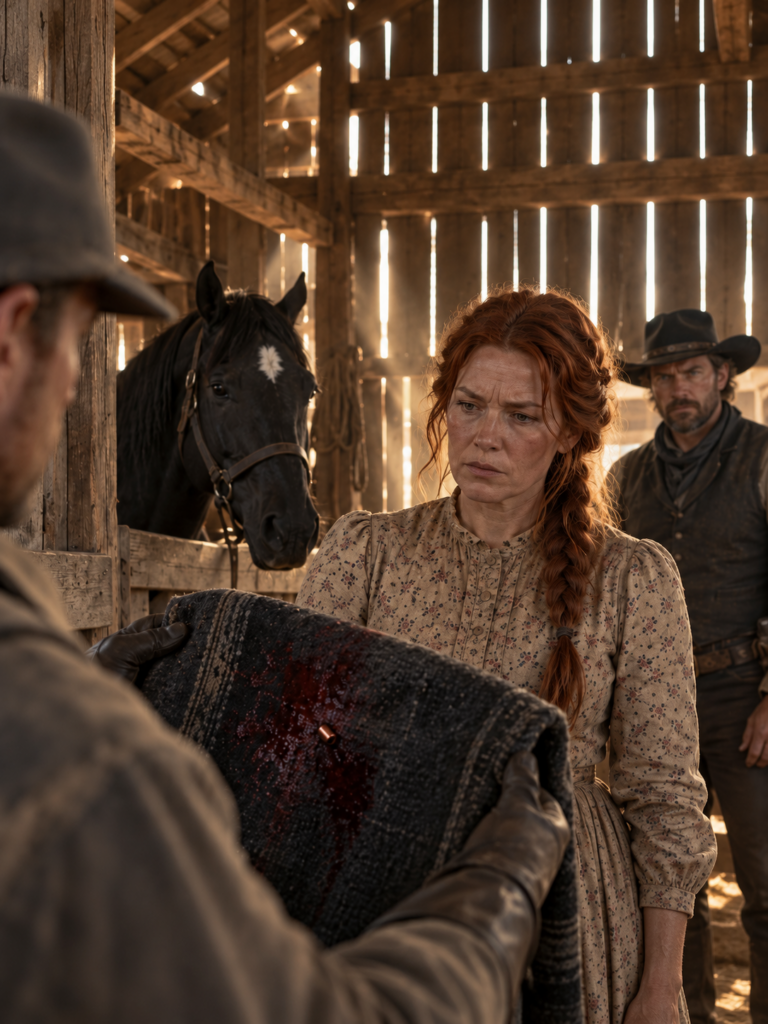
Eli lifted the pad from the dust. Blood spread across the wool in a dark coin. He turned it over. A short copper tack had been hidden inside the pad, angled upward so a rider’s weight would drive it into the horse’s back. The wool had been slit, the tack pushed through, the fibers combed over the cut.
The yard went silent.
Mara looked at Silas. He still held the rope. His face showed exactly the correct amount of shock.
Dr. Amos Vail came through the crowd with his bag. He examined the puncture on Blackbird’s back, then the pad. “The wool was slit. The tack inserted, then combed over. This was deliberate.”
Silas folded his arms. “It proves sabotage. It does not prove who did it.”
“No,” Mara said. Her voice was hoarse. “It proves someone knew exactly when I would mount. The pad was clean when Eli brought it out. It was not clean when I put my weight on it.”
Silas looked at Gideon. The pleasant mask held. “I have protected this ranch for nine years. I was here after Louisa. I kept the books, the men, and you standing. Now a widow arrives with a coin and a wounded animal, and every rule that kept this place alive is called cruelty.”
The crowd listened. This was no longer about the tack. Maybe it never had been.
Gideon looked tired for one instant. Nine years against six weeks. History against a woman who had spent her last coin and then asked him to stand still. Then his face settled.
“You earned the right to answer a plain question,” he said. “Did you put that tack in the pad?”
“No.”
“Then give Sheriff Tobin your room key and stay where he can find you.”
For the first time, Silas’s pleasant mask cracked. Not into rage. Into something colder, the look of a man who had expected loyalty to arrive on schedule and found it late.
The sheriff found an invoice in Silas’s desk for fine copper upholstery tacks, bought in Great Falls in September. A ranch hand remembered Silas asking whether Mara would ride Blackbird at the sale. Another had heard him say, quiet, near the corrals, that a public failure would settle the foolishness.
It was enough for suspicion. It was not enough for conviction. Silas remained under watch, sleeping in his own bunk, eating at the cookhouse, polite again by supper. He told anyone who would listen that a widow’s word had been weighed against nine years, and the scale had tipped because Gideon Reed was lonely.
Mara sat on an overturned bucket beside Blackbird’s pen while Eli washed the puncture with warm water. The stallion flinched, then stood. She kept her good hand on his neck.
“I put you in front of them,” she said. “I knew better.”
He breathed against her sleeve. The white mark was damp with sweat. She thought of Thomas telling her, on the road, that courage was not the absence of fear. She had not believed him then. She was not sure she believed him now. What she knew was that the horse had swerved. With a tack in his back and a crowd screaming for a rifle, he had swerved for a child because a woman on the ground had said his name.
That had to count for something. She intended to make it count.
Part 4
Near midnight Mara woke in Gideon’s spare room to the smell of smoke.
She had refused the room at first. Mrs. Bell’s cot was enough. Gideon had said the ranch was closer to the horse, and her wrist needed wrapping, and he was not asking her to owe him anything. She had slept in her dress with the Bible on the chair. The smell woke her before the shouting did.
The east stable was burning.
She ran into the yard in her stockings. Flames had climbed the tack room wall into the hayloft. The light was orange and wrong against the stars. Horses screamed inside, a sound that went through her teeth. The main doors were not merely latched. They had been chained shut, the links new, the padlock shut tight.
“Where is Silas?” Gideon asked.
Nobody answered. The night watchman was not at his post.
A narrow folding door on the north wall had not caught yet. Smoke leaked around its edges. Mara ran toward it. Gideon caught her wrist, the good one, and held it.
“No. The chain will take too long. We break the wall.”
“The loft will fall first.”
“Mara.”
She looked at him. Soot already marked his jaw. He was not trying to control her. He was trying to keep one more person from entering a place he might not get them back from. She could see Samuel in that fear, and Louisa, and the four years he had spent moving so he would not have to stand still inside it.
She covered his hand with hers. “I will open the north run. When they come, give them room. Do not catch them. Do not shout.”
The old language. He knew it now.
Gideon released her.
Eli pulled rails from the folding door. “I’m coming.”
“No. The gray mare will only pass me.”
“I’m coming anyway.”
Mara saw his fear and the choice beneath it. He was seventeen. His hands shook. He had already decided.
“Stay behind me. If I say out, you go out.”
They wrapped wet grain sacks around their shoulders and kicked the door open. Smoke rolled over them, thick and sweet with burning hay. Inside, orange light moved where walls should have been. Mara crouched beneath the smoke. The heat pressed on her eyes.
“Open the north stalls. Turn them toward the door. Get clear.”
Eli freed the gray mare. She came out fast, eyes rolling, and vanished into the yard. Mara opened two more. A bay ran. A sorrel froze until Eli struck the boards behind him, not the horse, the wood, and the sound sent him forward.
They moved deeper. Blackbird waited in the center box, terrified but not throwing himself against the walls. His ears were pinned. His chest heaved. The bolt had warped in the heat. Mara drove her folding knife beneath the latch plate until the wood split. The door opened.
Blackbird came out. He did not run.
“Go,” she said.
Three horses remained on the south side, closer to the tack room. Mara turned toward them. Blackbird turned with her.
“No. Go.”
He stayed.
Eli appeared through the smoke, coughing. “General Pike will not move.”
The old chestnut stood with his head against the wall, the way old horses do when the world has become too loud to sort. Beyond him the tack room roof collapsed in a rush of sparks. Mara opened the stall. General did not react. The roof groaned. Thirty yards away, the north door framed clean night.
“Room,” Mara said, and pointed Blackbird toward General. “Bring him.”
The stallion stepped into the stall and pressed his chest against the old horse’s shoulder. General lifted his head. Blackbird pushed again, steady, not a strike. One step. Then another. Eli moved behind them, arms wide, not touching. Mara led them into the aisle as burning timber fell behind them and threw coals across the floor.
“Go.”
Eli passed through the door. General followed, slow, blinking at the yard. Blackbird reached the threshold. Then a roof beam cracked above Mara.
Gideon shouted from outside.
The beam struck her shoulder and drove her to the floor. Pain went white down her left arm. The arm would not move. Smoke filled her mouth. She could see the door and could not reach it. Blackbird was already outside. Good, she thought. At least he was free.
Then the stallion came back.
He stepped through the smoke, ears flat, and put his head beneath her right arm. He pushed. The beam shifted an inch. Mara dragged one knee free. He pushed again, shoulder against the timber, until she crawled from beneath it. Splinters tore her dress. She grabbed his mane with her good hand. There was no clean mount. She jumped once and failed. Blackbird lowered himself just enough, the way he had learned in the pen when she laid her arms across his back.
Mara pulled across him. “Door.”
They burst into the yard as the center roof folded behind them. Heat rolled out and then up. Gideon pulled her down into his arms. She coughed until her ribs hurt.
“All out,” she said. “All fourteen.”
Blackbird stood beside them, shaking, and placed his nose against her shoulder. The white mark left a smear of soot on her dress. Gideon’s hand stayed on her back. He was shaking too. Neither of them mentioned it.
Sheriff Tobin arrived before dawn with two deputies and a face that had already decided the night was not an accident. He found kerosene soaked into the tack room floor where the fire had started and failed to finish its work. He found the watchman unconscious behind the grain shed, a lump on his skull and a rag in his mouth. He found Silas’s bunk empty, the blanket folded, the pillow undented.
Under the bed was a satchel.
Inside it were the missing copper tacks, a stable key, two kerosene bottles, the ranch payroll in a canvas wallet, and Gideon’s bill of sale for Blackbird. Across the bill, in Silas’s neat hand, was a figure: what the stallion could bring from a rendering buyer if declared permanently dangerous. The amount was not large. That made it worse.
Silas had risked fourteen horses and three human lives to restore an order in which Gideon needed him, Mara looked foolish, and force appeared right again.
Gideon stood in the wet ash at sunrise. The east wall was gone. The loft was a skeleton. Hay smoke hung in the pasture. He held the bill of sale and did not look at the number.
“I trusted him with everything.”
“You trusted what he had been,” Mara said. Her arm was bound against her ribs. Dr. Vail had said the shoulder was bruised, not broken, and had looked at her as if he did not quite believe she had walked out. “What if he was always this?”
“He was not.” Gideon’s voice was rough. “That is why betrayal hurts.”
He looked toward Blackbird, who stood in the open corral Eli had thrown together from spare rails, head low, one hind leg resting.
“He came back for you.”
“He came back because he had room to leave.” Mara watched the stallion breathe. “All those weeks, every man had tried to keep him by closing something around him. A rope. A gate. A leg. A hand. I opened space. When the door stood open, he chose.”
Gideon was quiet a long time. Ash drifted onto his sleeve. “I spent nine years closing things so nothing else could leave.”
“I know.”
“Louisa didn’t leave. Samuel didn’t leave. The fever took them. I still locked every door I could find.”
Mara did not tell him he had been wrong to grieve that way. Grief made its own stalls. She only said, “The horses are out. The door can stay open now.”
Sheriff Tobin caught Silas two days later at a Missouri River ferry, trying to buy passage under another name. He carried Gideon’s watch, the stolen payroll, and burns across both hands from the kerosene that had caught faster than he planned. He was brought back in irons. The town gathered outside the sheriff’s office without being asked.
Six weeks earlier those people had laughed when Mara spent her last coin. Now they moved aside when she passed. Some of them looked at the ground. The father of the girl in the yellow bonnet stood at the edge of the crowd and did not speak yet.
Silas looked through the bars. The pleasant face was gone. What remained was smaller.
“You ruined this place,” he said.
Mara glanced toward the road that led to Reed Ranch, where Blackbird waited in an open corral with the rails set wide.
“No,” she said. “I opened a gate.”
Part 5
The trial was held in the county seat before the snow closed the road. The evidence left little room for invention. The invoice. The satchel. The watchman’s testimony. The burns. The hand who had heard Silas say a public failure would settle the foolishness. Dr. Vail’s account of the tack. Eli’s account of the chained doors.
Silas spoke once, in a steady voice, about loyalty and order and the danger of letting sentiment run a ranch. He said he had meant to frighten, not to kill. He said the fire was meant to be small. He said Gideon had forgotten who kept him standing.
The jury was out less than an hour.
Silas Crow was convicted of arson, theft, cruelty to livestock, and destruction of ranch property. When the verdict was read, Gideon placed his hand over Mara’s on the bench between them. She turned her palm upward. That was all. It was enough.
Outside the courthouse the father of the girl in the yellow bonnet removed his hat. His daughter stood beside him with a cloth bag of apples, the same bag she had carried on sale day.
“I called that horse a killer,” he said. “I said it where my daughter could hear. I was wrong.”
Mara looked at the child. “He was in pain.”
“I know that now.”
The girl held out the bag. “One is for him.”
Mara took it. The apples were small and cold. “He will like that.”
By the following month seven ranchers had asked Mara to examine horses everyone else had given up on. She rode to their places in a wagon Gideon lent her, with Eli driving and Blackbird tied loose behind, not because he had to be tied but because the road had other traffic. She found a wire cut in a hoof, a wolf scar that made a mare hate dogs, a bit that had been too severe for a soft mouth. She did not promise cures. She promised time.
Gideon rebuilt the east stable before winter. He did not rebuild it the way it had been. The new aisle was wider. Every stall opened into an outside run. Every door could be released from both sides, so nothing frightened would ever again be trapped by one man’s key. He did the work himself on the days the crew was short, and Mara found him more than once standing in the unfinished aisle at dusk, looking at the open runs as if he were checking a lock he had decided not to use.
At the far end he built her a large round working yard with no sharp corners.
“You made it large,” she said.
“You keep saying room matters.”
“It does.”
“I listened.”
Blackbird walked through the open gate, circled once, and returned to Mara. She gave him the apple. He took it carefully, lips soft, and did not ask for the rest of the bag.
By spring, horses were arriving from three counties. Mara promised no miracles. She promised observation, time, and honest work. A savage mare became gentle after a rotten tooth was pulled. A remount stopped throwing riders when she replaced a saddle tree that pinched his spine. A terrified wagon horse worked again after she found the old scar on his gaskin and stopped asking him to back into dark sheds. Over five years more than two hundred horses passed through the Copper Mesa yard. Some stayed a week. Some stayed a season. A few could not be helped, and she said so, and sent them home with a letter about what not to do.
The work paid for the rebuilt stable, then a second barn, then eighty acres adjoining Reed Ranch. Gideon put Mara’s name beside his on the deed without a speech. He left the paper on the kitchen table under the salt cellar, where she would find it when she set out the plates.
That winter he asked her to marry him at the same table. Snow ticked against the window. Louisa’s chair had been moved to the wall months before, not hidden, only no longer waiting. Samuel’s boots were in a trunk. Gideon had put them there himself.
“I do not want to give you another place you can be trapped,” he said. His hands were flat on the wood. “The work remains yours. Nothing is taken back. But I want you beside me.” His voice shook once. “Would you choose to stay?”
Mara thought of Thomas, the cottonwood grave, and the road that had seemed endless. She thought of the half-dollar and the split boot and the nights she had mistaken motion for survival because stopping meant feeling everything she had lost. Then she thought of Blackbird standing in an open gate with every chance to run.
“I already did,” she said.
They married in April. Eli cried openly and pretended it was the wind. Mrs. Bell fed half the territory out of the yard, pies and bread and a ham that had been promised to nobody and given to everybody. The girl in the yellow bonnet, taller now, brought Blackbird a red apple and stood very straight while he ate it.
After the ceremony Mara entered his stall in her cream dress and placed both hands against his face. The white mark was warm under her palm.
“We were supposed to be ruined,” she told him.
Blackbird breathed against her hands. Outside, someone laughed. Gideon waited at the stall door and did not come in until she turned.
Blackbird lived thirteen more years. He never became a horse for everyone. Mara refused to make that the measure of success. He carried her. Later he carried Gideon, who learned to sit quiet and let the stallion choose the pace. He guided frightened young horses across water, through wagon noise, and past the blackened foundation of the old stable, which Gideon left as it was for a year and then plowed under. When another animal panicked, Blackbird did not pull against the rope. He waited for it to go slack. Then he moved.
Children in Copper Mesa grew up knowing the simple version. A poor widow bought a killer horse for one silver coin. The horse saved fourteen animals from a fire. The widow married the rancher.
When they were older, some of them came to Mara for the harder version.
They asked why Blackbird had been dangerous. She showed them the scars along his ribs, faded to white, and the small knot of scar tissue on his back where the tack had gone in.
They asked why Silas had hated her.
“Some people do not fear change,” she said. “They fear becoming unnecessary.”
One autumn afternoon a boy asked, “Did you save Blackbird?”
Mara was fifty by then. Silver threaded her hair. Her left shoulder still ached when the weather turned. Blackbird stood beyond the fence, old and quiet, the white mark gray at the edges.
“I gave him room. Is that the same as saving him?”
“No.”
The boy waited.
“He saved himself. That is why the room mattered.”
“Then what did he do for you?”
Mara remembered the road after Thomas died. Every morning another mile. Every night another place she did not belong. She had mistaken motion for survival because stopping meant feeling the cottonwood, the borrowed shovel, the name in the Bible.
Then a black horse had screamed behind a fence, and her feet had turned toward him.
“He gave me a reason to stop walking,” she said.
Blackbird died the following spring with Mara beside him and Gideon’s hand on her shoulder. There was no struggle. The grass was new. He laid his head near her knee, breathed once against her palm, and did not breathe again. They buried him on the rise above the stable, facing the open north pasture. No rope. No gate. Nothing closed around him.
Years later travelers still asked where the famous half-dollar horse had been kept. Mara would point to the wide yard, the open-run stalls, the two barns, and the acres their work had bought. Then she would point toward the rise.
People liked to say she had spent her last coin on a worthless horse.
They had the story backward.
Mara spent her last coin on a horse everyone had tried to hold by force. Blackbird gave her room enough to live again.


