
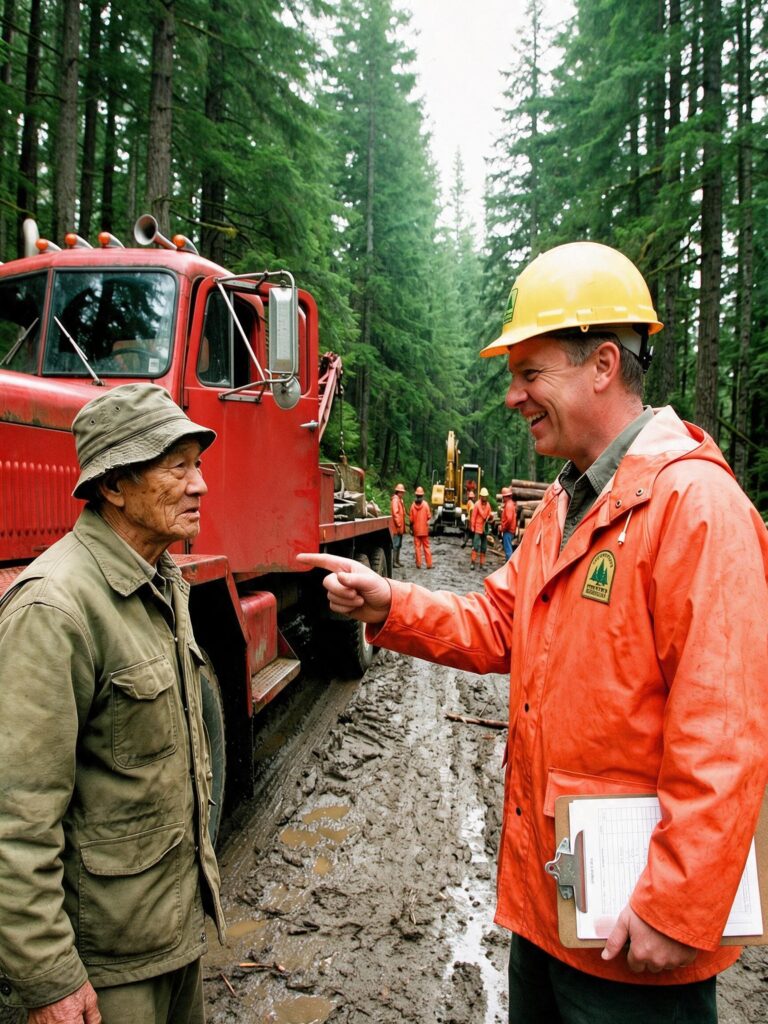
the loggers said nothing on earth could pull that yarder off the cliff and then an eighty-one-year-old man fired up the wrecker he had kept since 1951
Part 1
On the morning of October 9th, 2004, on a logging road in the Cascade Mountains of Skagit County, Washington, a Madill 71 yarder worth three hundred thousand dollars broke free from its anchor stumps and slid two hundred feet down a ravine that no sane person would call anything but a cliff with trees on it.
The rain had been at the mountain for three weeks. Not a storm, exactly. The steady Pacific Northwest soak that turns volcanic ash and clay into something that looks like ground and behaves like grease. The yarder had been sitting on its anchors since dawn, cable out, the crew below setting chokers in a stand of second growth that still had old firs standing in the draw where the machines were not supposed to go. The operator felt the shift before he heard it. A soft give in the stump line. A tilt in the deck under his boots. He killed the throttle, hit the step, and jumped clear onto the road grade with his hands out, the way a man jumps when he has already decided the machine is no longer his.
He stood at the ravine’s edge, shaking, and watched three hundred thousand dollars of his company’s most critical equipment crash through sword fern and vine maple and come to rest wedged between two old-growth Douglas firs at the bottom. The trees were each six feet through at the butt. Two hundred years of mountain in the grain. They stopped the yarder from sliding farther into the drainage, and they also pinned it at a sixty-degree angle on a slope where any direct pull would either split the frame or snap the cable. The soil around the tracks was a slurry of ash, clay, and rain. The firs were not going anywhere. Their roots were woven through forty feet of mountain. The yarder was.
Randy Callahan, the crew boss, stood on the road for twenty minutes with the rain ticking on his hard hat and the radio quiet in his hand. He was forty-six. He had been logging since he was old enough to carry a saw without being told to put it down. He knew the sound a contract makes when it starts to die. Morrison Timber had the harvest. The yarder was the harvest. Without it, the side shut down, the fallers went home, and the bond the company had posted against the sale went from paper to a problem.
He made three phone calls.
The first was to Cascade Heavy Recovery out of Burlington. Their operator drove two hours in a service truck, walked to the edge, looked at the ravine for a long time, and said, “Randy, I can’t anchor on that face. The whole slope is saturated. I put my equipment down there and I’m going to need someone to come pull me out. I’m sorry.” He meant it. He had pulled logging iron out of ditches and river bars for fifteen years. This was not a ditch.
The second call was to a specialty recovery contractor in Bellingham who charged four hundred dollars an hour and had a reputation for never saying no. He said no. He stood in the same rain, hands in his pockets, and told Randy the slope was sixty degrees on wet volcanic ash, there was no way to establish a stable working platform, and even if he could anchor, the pull angle was wrong for every machine he owned. “Write it off,” he said. “I’m not putting a man on that.”
The third call was to the company’s insurance adjuster. He drove out the next morning, looked at the ravine for about thirty seconds, and started filling out a total-loss form on the hood of his car, using a clipboard so the rain would not spoil the paper. He was not unkind about it. He had seen equipment die before. A yarder at the bottom of a draw, pinned between firs older than the company, was a photograph he did not need to study.
Randy stood on the logging road above the ravine and watched his timber contract dissolve in the rain. The crew had gathered in a loose line along the grade. Nobody was talking much. The operator who had jumped sat on a stump with his gloves in his hands and did not look at the ravine. A younger man named Tyler, twelve years in the woods and opinions about all of them, kept glancing at the adjuster’s clipboard as if the form might change if someone argued with it hard enough.
That was when the old flatbed came around the bend.
It was a 1989 Toyota, white once, now the color of weathered concrete, pulling a trailer that had no business being on a mountain road and was on it anyway. The man driving was eighty-one years old. Thin in the way men get thin after a lifetime of work instead of after a lifetime of sitting. Gray hair under a cap that had lost its shape. He stopped where the grade widened, set the brake, and climbed down with the careful economy of a body that remembered every mile it had carried.
His name, on the license in his wallet and on the mailbox in Concrete, was Elmo Voss.
The name he had been born with, in 1923, in a Japanese-American farming community outside Bellingham, was Hiroshi Yamada.
Randy walked over because there was nothing else to walk toward. The adjuster looked up from the form. Tyler folded his arms. The rain kept on. Down in the draw, the yarder sat at its impossible angle between the two firs, cable slack, a machine that had been worth a contract at breakfast and was worth a claim by noon.
Elmo Voss looked past all of them at the slope, the way a man looks at a face he has known a long time, and said, “Heard you lost a yarder.”
Part 2
To understand what he did next, a person has to understand the name, and the years under it, and the machine he had refused to sell.
Executive Order 9066 had sent the Yamada family to the Minidoka internment camp in Idaho in 1942. Hiroshi was nineteen. He had been about to take over a share of the berry ground his father leased outside Bellingham. Instead he stood in a line with a tag on his coat and watched the farm, the truck, and the name on the mailbox become things other people administered. They were in Idaho for three years. The cold there was a different cold from the Cascades. Dry. A cold that got into the barracks and stayed. His mother mended the same three shirts until the cloth would not hold a needle. His father did not talk much about the farm after the first winter. He talked about soil, when he talked. About how ground did not know the name of the man who worked it.
They came back in 1945. The lease was gone. The truck was gone. A kind man in Idaho, a mechanic who had hired Hiroshi to sweep the shop and then to turn wrenches when he saw the boy could listen, had told him that a name could be a door if the old name had been nailed shut. The man’s name was Elmo Voss. He had no son. He offered the name the way a man offers a coat, without a speech. Hiroshi took it. He did not take it because he was ashamed of Yamada. He took it because no company in western Washington would hire a Japanese-American kid for anything but the jobs that already took anyone who could work, and even those jobs went easier if the foreman did not have to explain the name at the office.
The logging camps accepted anyone who could set a choker and not get killed doing it. Elmo could work. He started in 1945 as a choker setter, wrapping cable around logs so the yarder could pull them up the mountain. He learned the woods the way a man learns a language he is not allowed to fail. Chaser. Rigging slinger. Hook tender. High climber, which was a young man’s job and a fool’s job and, for a few seasons, his. By 1965 he was running a small outfit of his own. Three men. A piece of ground he had bought with twenty years of savings, paid for in cash because a bank had already told him, politely, that his kind of paper was complicated.
He logged carefully. Old-growth country teaches that, or it kills you. He never took more than the terrain could recover from. He never pushed equipment past what the ground would hold. He never cut corners on rigging, because he had seen what a corner cost, and it was never the company that paid it first.
In 1951 he bought a Pacific wrecker from a closing outfit in Darrington. Pacific Truck and Manufacturing, out of Renton, built trucks for this country specifically. Heavier than highway rigs. Lower gearing. Frames that expected a grade to try to kill them and were engineered to argue back. This particular machine had been a rigging truck for a small logger who went broke when the big timber companies bought the ground out from under the little ones. Elmo paid eight hundred dollars for it. He drove it home to Concrete and parked it where he could see it from the kitchen.
He used it for thirty-eight working years and kept it for fifteen more. He retired in 1989, when the last of the old-growth ground he had worked was sold to a timber investment company that clear-cut it with equipment he had never seen and techniques that made old-timers look away. He did not make a speech about it. He brought the Pacific home to the barn in Concrete, a small town in the upper Skagit Valley that most people drive through without stopping, and he started the engine once a month. Fresh cables. Grease in the blocks. The hand-lettered door, white paint on faded red: YAMADA LOGGING RECOVERY. He had put the born name back on the machine when he no longer needed a door. The mountain had never asked him which one he was using.
His grandson Daniel asked him once, home from college, why he kept the old wrecker running when the scrap man had offered real money.
“Because the mountain doesn’t change,” Elmo said. They were in the barn. The straight-six ticked as it cooled. “The equipment changes. The companies change. The men change. The mountain stays the same. Someday someone is going to need a machine that understands it.”
In October of 2004, someone did.
He heard about the yarder from a man at the feed store in Concrete who had been on the side doing chainsaw work and had come down the mountain talking. Slope. Saturated soil. Two recovery outfits already gone. Elmo drove home, hitched the Pacific to the flatbed, and took the river road up into the drainage he had worked in 1958 and again in 1971. He did not call ahead. He had learned a long time ago that a phone call gave a man a chance to say no before he had seen the iron.
When Randy Callahan watched the 1951 Pacific come off the trailer, he walked over with the expression of a man who had run out of real options and was about to humor a crazy person. The wrecker was red, a deep faded red that had weathered fifty-three Pacific Northwest winters. The cab was boxy and particular, the old Pacific shape that loggers in Washington and Oregon still recognized if they were old enough, or if they had ridden with someone who was. The boom was a tall vertical tower built for old-growth rigging, pulleys and blocks that modern recovery operators had stopped using forty years ago because the stumps they needed were gone.
Randy looked at the truck. Looked at the old man. Looked at the door.
“Elmo Voss.”
“That’s right.”
“You logged up here.”
“From 1945 to 1989. Worked this drainage twice. Fifty-eight and seventy-one.” Elmo set a hand on the fender, not affectionate, exact. “That wrecker’s a 1951 Pacific. Renton. She’s worked every kind of Cascade ground there is.”
Randy gestured at the ravine. Rain ran off the brim of his hat. “Three recovery companies said it can’t be done. Two of them are the best in the business.”
“They’re the best at highway recovery and standard logging accidents,” Elmo said. “This isn’t standard.”
“What’s different about it?”
“The yarder’s wedged between two old-growth firs. You can’t pull it straight out. The angle’s wrong and the trees are in the way. You have to move it along the slope first. Lateral. About forty feet, until it clears the firs and the incline works for you instead of against you. Then you pull uphill on the geometry. Then you take it out the skid road your crew already cut.”
Randy stared at him. “Lateral pull on a sixty-degree slope.”
“That’s right.”
“Wet volcanic ash.”
“Done it before. 1971. Lost a nine-arch yarder on this same drainage. Different company. Same problem. Took me nine hours then. Should be faster now. I know the ground better.”
The insurance adjuster had stopped writing. His pen hovered over the total-loss line.
“If you’re wrong,” Randy said, “and that Pacific goes over the edge—”
“Then I’ve lost a wrecker worth about four thousand dollars in scrap,” Elmo said. “Which is considerably less than the three hundred thousand you’ve already written off.”
There was a long silence on the logging road. The rain ticked. Somewhere below, water moved under the ferns.
Tyler walked over. He had the look young men get when they are about to say a thing they will have to live with.
“Randy, this is insane. That man’s eighty-one. That truck’s from 1951. If something goes wrong—”
“Tyler,” Randy said quietly, “every professional option we had said no. This man logged this drainage for thirty-four years. If he says he can do it, we listen.”
Tyler looked at Elmo. “No offense. That wrecker looks like it belongs in a museum.”
“What makes you think that, son?” Elmo said. His voice was calm. Not kind, exactly. Accurate. “I set chokers on this mountain before your father was born. I’ve pulled iron out of ravines that made this one look like a ditch. And I’ve been maintaining this machine for fifty-three years because I knew the day would come when someone needed it.”
Tyler did not say anything else. He stepped back into the line of the crew. The adjuster closed the clipboard, not signed, and put it under his arm where the rain could not reach the form.
Part 3
Elmo spent two hours walking the site before he touched the Pacific.
He walked the ravine’s edge in the rain, reading the slope the way he had read slopes for sixty years. He carried a steel probe and pushed it into the ground every few yards, feeling for the difference between mud and the thing under mud. He looked at the root flares of the trees near the yarder. He studied the lean of the two old firs that had stopped the slide, the way their butts had taken the hit and not split. He did not write anything down. He calculated in his head, with the geometry of a man who had spent a lifetime in country where a wrong angle was not a mistake on paper. It was a widow.
Randy walked with him for the first twenty minutes and then stopped, because Elmo was not narrating and the younger man felt, correctly, that narration was not the work. Tyler stayed on the road. The adjuster drank coffee from a thermos and watched an eighty-one-year-old man poke a mountainside with a rod.
When Elmo came back, his boots were caked to the ankle and his cap was dark with rain. He told Randy exactly what he was going to do.
“I’m going to set the Pacific on the ridge to the east. There’s basalt under the soil there. Solid anchor. Not where it looks solid. Where it is. I’ll run the main line down to the yarder through three intermediate blocks on old-growth stumps. Those stumps are from the 1971 cut. They’ve had thirty-three years to root-bond to the mountain. They’ll hold. First pull is lateral. I move the yarder west along the slope about forty feet, until it clears the firs. Second pull is diagonal uphill on the path that opens. Third pull is direct, up the skid road you already built.”
The adjuster had his notebook out now. The total-loss form stayed in the car.
“How long?” Randy said.
“Six hours if nothing goes wrong. Eight if something does.”
“What could go wrong?”
Elmo looked at him with eighty-one years of mountain honesty. “On a Cascade slope in October after three weeks of rain, anything. But probably nothing. This mountain and I have an understanding.”
He took forty-five minutes to find the exact spot on the east ridge. Not the flat place that looked like an anchor. The place where the probe hit rock eight inches down and rang, faint, the way steel rings on basalt. He chalked it. He had the crew help him walk the Pacific off the trailer and onto the set, and he did not let anyone hurry the tires. Low gear. A foot at a time. When the wrecker sat where he wanted it, he shut it down and went to the rigging.
The blocks were old. 1955 iron, maintained with the kind of care working men give to tools they trust their lives to. He shackled the first to a stump from the ’71 cut, a butt four feet across, gray and hard, the roots still holding the slope the way a hand holds a rope. The second block redirected the angle. The third set the lateral so the first pull would walk the yarder along the hill instead of trying to lift it through the firs. It looked like nothing the Bellingham contractor owned. It looked like 1955 because it was. Randy’s older faller, a man in his fifties who had learned from a hook tender now dead, watched the blocks go on and did not offer advice. He knew the shape of the work even if he had not been taught the whole of it.
“They don’t teach that anymore,” he said, quiet, to Tyler. “Doesn’t work on a tree farm. You need stumps with roots that go down forty feet. Tree farms don’t leave you those.”
Tyler did not answer. He was watching the cable.
When Elmo was satisfied, he climbed into the Pacific’s cab. The door shut with a sound the mountain had heard before. He turned the key. The engine started on the first try. A deep straight-six rumble, the same sound it had made in 1951, too large for the rain to cover. He sat a moment with his hands on the levers. Not praying. Listening. Then he engaged the winch.
The drum turned at a pace modern operators would have called absurd. One revolution every four seconds. Low gearing, the Pacific’s answer to a grade that wanted to run away. The cable took up slack inch by inch. The rigging hummed. The old stumps creaked as load moved through the blocks and into roots that had been holding this drainage since before any of the men on the road were born.
Randy’s crew stood at the edge. Tyler had stopped talking. His arms were crossed. His face had gone unreadable, which in a young man is often the beginning of attention.
At seven minutes, the yarder moved.
Not much. Six inches along the slope. The direction was the one Elmo had named before he ever started the engine.
“It’s moving,” someone said.
Elmo did not answer. He was watching the cable angle, the pressure gauge, feeling the load through the seat the way a man feels a grade through the wheel. He worked the lateral pull for ninety minutes. Six inches. Reset. Six inches. The yarder walked west in increments so small they were barely visible from the road, and each one was placed. At two hours it cleared the first fir. The butt of the tree showed a bright scar where the yarder had rested against it, and then the scar was empty. At three hours it cleared the second.
Randy Callahan, who had started the day expecting to sign a total loss, stood at the ravine’s edge with his hands in his pockets and rain on his shoulders, watching an eighty-one-year-old man in a fifty-three-year-old wrecker do what three professional companies had declared impossible.
“Been logging twenty-two years,” he said to nobody in particular. “I’ve never seen rigging work like that.”
“Old-growth rigging,” the older faller said. “He’s not fighting the hill. He’s borrowing it.”
Part 4
At four hours, the diagonal pull began.
The yarder was clear of the firs, sitting on ground where the incline could work for the cable instead of against it. Elmo shut the winch down and climbed out. He reset the blocks. It took thirty minutes. Nobody rushed him. Nobody spoke above the rain. He moved one stump anchor six feet west because the probe had told him the first choice would load a root that was already doing too much. He checked every shackle with his hands, not his eyes. Then he climbed back into the cab, and the straight-six took the load again.
The second pull was faster. The yarder came uphill along the path he had walked that morning, the path of least resistance that had not looked like a path until a man who knew the drainage pointed at it. The slope that had seemed impossibly steep from the road was channeling the machine now, a little at a time, tracks biting where the ash was thinner and skating where it was not, the cable keeping it honest. Once, at four hours and twenty minutes, the uphill track slipped and the whole frame yawed ten degrees toward the drainage. A sound went through the crew, not a word. Elmo eased the drum. Held. Let the geometry settle. Pulled again, slower. The yaw came back. Tyler let out a breath he had not known he was holding.
“He’s talking to it,” the older faller said.
“He’s talking to the winch,” Tyler said, but he said it without the earlier edge.
“Same thing, on this hill.”
At five hours and forty minutes the yarder reached the skid road the crew had cut two days before, when the machine was still a tool and not a claim. The tracks found the grade. The angle under the frame went from sixty degrees toward something a man could walk. Elmo did not speed up. The last pull was the one that killed people, he had told Daniel once, because it looked finished. He brought it the rest of the way an inch at a time, the Pacific’s low gear turning, the blocks creaking, the rain unchanged.
At six hours and three minutes, the Madill sat on flat ground at the edge of the landing.
The crew made the noise men make when something they have already buried stands back up. Not quite a cheer. Not quite a yell. Something between the two, specific to the moment when a law everybody agreed on turns out to have had an exception living in a barn in Concrete. Somebody slapped the yarder’s track. Somebody laughed once, short, and then looked embarrassed about it. The operator who had jumped that morning walked over and put his hand on the cab and did not say anything at all.
Elmo shut down the winch. He sat in the Pacific’s cab for a moment with the engine idling, the deep rumble filling the small space, rain on the roof. Then he climbed down. Careful. Both hands. The movements of an eighty-one-year-old man whose body had absorbed sixty years of mountain work and remembered every bit of it. His knees took the last step like a negotiation.
Randy walked over. For a long moment neither man spoke. The yarder ticked as it cooled. Steam, or just the rain hitting warm iron, lifted off the winch drum.
“How much do I owe you?” Randy said.
“Nothing.”
“Elmo. You just saved three hundred thousand dollars and a timber contract. That’s not nothing.”
Elmo looked at the landing, then at the ridge where the Pacific sat, faded red against wet cedar. “My father taught me something when we came back from the camps in 1945. He said the land doesn’t know what they did to us. The land just is. If you work it honestly, it works honestly with you. I’ve spent sixty years on this mountain working honestly. Today was the mountain working honestly back.”
Randy was quiet. He had not known about the camps. Most of the men on the road had not. The name on the door was Yamada, and the man who had climbed down from the cab was Elmo Voss, and the distance between those facts was a history the woods had not required them to learn until an old wrecker did a job their contractors would not touch.
“Your rigging,” Randy said. “I’ve never seen anything like it.”
“Old-growth rigging. They stopped teaching it in the seventies, when the old growth ran out. Doesn’t pencil on a plantation. I’ve been in this drainage since 1958. I know what the stumps can hold. I know how to use the slope’s geometry instead of fighting it.” He nodded toward the ravine, empty now except for the two firs and the scar in the brush. “Your recovery companies were fighting the mountain. I was working with it.”
“Can I ask you something?”
“Go ahead.”
“You retired in ’89. Why keep that wrecker running all these years?”
Elmo looked at the Pacific. At the mountain behind it, cloud down on the ridges, the drainage running tea-colored under the ferns. “Because this mountain is still here. And as long as it’s here, someone might need a machine that understands it.”
Tyler had come up without either of them noticing. He stood a little off to the side, hard hat in his hands, rain in his hair. He looked younger than he had that morning.
“I was wrong,” he said. It cost him something to say it, and he said it anyway. “About the museum.”
Elmo studied him a moment. “You weren’t wrong that she’s old. You were wrong about what old means on a hill like this.” He almost smiled. It was mostly in the eyes. “Next time a stump looks useless, ask what the roots are doing. That’s the whole trick. The rest is cable.”
Part 5
The Madill was repaired and returned to service before the end of the month. Morrison Timber’s contract held. Randy Callahan finished the harvest on schedule, and when the last load went down the grade he stood on the landing a minute longer than he needed to, looking at the two firs in the draw. He did not cut them. They were not in the sale. Even if they had been, he thought he might have found a reason.
Word moved through Pacific Northwest logging country the way stories move in the timber industry. Slowly. Through crews and contractors and equipment dealers. Told at fuel stops and auctions and the kind of roadside diners that still serve loggers at five in the morning, coffee strong enough to stand a spoon in, eggs on a flat top that had been hot since four. The old man who knew the mountain. The rigging nobody taught anymore. The 1951 Pacific that should not have worked and did. Some of the tellings got the slope wrong. Some of them forgot the name on the door. The ones that lasted kept both.
Over the next three years, until Elmo was eighty-four and finally decided his mountain days were done, he got called out four more times. Always old-growth drainage country. Always a situation where modern iron could not anchor, could not maneuver, could not work with the terrain instead of against it. A shovel on a sidehill above the Sauk. A yarder hung up in a tributary of the Skagit after a January rain. A cold deck that had started to walk. He hitched the Pacific, drove up, walked the ground before he touched a lever, and brought the iron home. He never sent a bill. If a man pressed money on him he told him to put it toward cable, or toward the next kid who wanted to learn rigging and could not find anyone to teach it. He always said the same thing when they asked why. The mountain had worked honestly with him. He was working honestly back.
Daniel came up for the last of those calls and rode in the Toyota because Elmo’s eyes were still good and his knees were not. He watched his grandfather probe for basalt and talk to a stump as if it might answer. On the drive down, Elmo told him the other name. Not as a secret, exactly. As a fact the boy was old enough to carry. Hiroshi Yamada. Minidoka. A mechanic in Idaho who had offered a door. The berry ground that had not been there when they came home. Daniel drove the rest of the way with both hands on the wheel and did not interrupt.
Elmo Voss, born Hiroshi Yamada, died in 2009 at the age of eighty-six, in the house in Concrete, with the barn door open so he could hear if the wind got into the eaves. Daniel was there. The Pacific was in the barn, cables fresh, because the monthly start had never stopped being a monthly start. After the funeral, which was small and mostly men who had worked in the rain, Daniel donated the wrecker to the Washington State Historical Society in Tacoma. He could have sold it. A collector had called. He thought about the door, and the hand-lettered name, and the eight hundred dollars paid in Darrington in 1951, and he signed the papers.
It sits there now. Fully maintained. Faded red. The placard tells the story of the man who survived the camps, logged the Cascades for forty-four years under a borrowed name, and kept a 1951 wrecker running because he knew the mountain would need it. At the bottom, Randy Callahan’s words, given to the curator over a cup of coffee he did not finish:
“Three professional companies said it was impossible. An eighty-one-year-old man who’d been talking to that mountain since 1945 knew it wasn’t. I learned that day that there’s a kind of knowledge that can’t be bought or trained or certified. It can only be lived. Elmo Voss had lived it for sixty years. The rest of us were just watching.”
The loggers said nothing could pull it out. The old man knew better. Fifty-three years of Pacific Northwest iron, and a lifetime of refusing to fight ground that would work with him if he asked it correctly, proved that the mountain remembers the men who treated it honestly, even when the companies have changed, and the equipment has changed, and the name on the mailbox is not the name he was born with. The land did not know what they did to him. The land just was. He worked it honestly. On a wet October morning in a drainage he had already saved once, it worked honestly back.


