
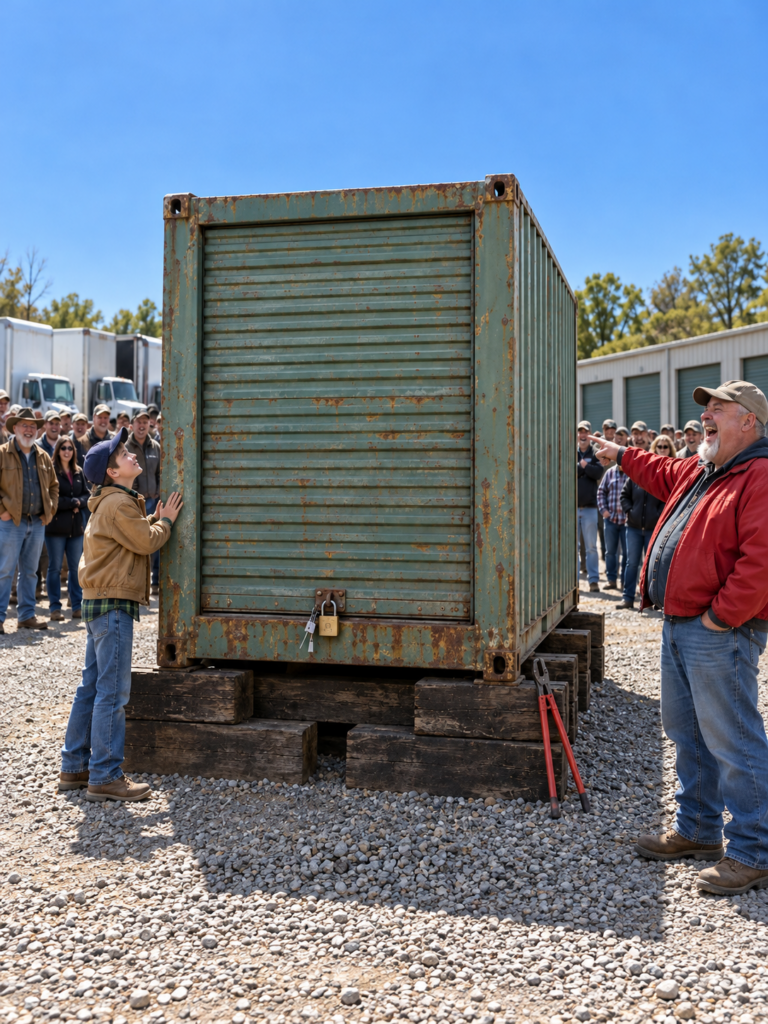
the auction laughed when the twelve-year-old paid forty dollars for the sealed green storage unit and refused to cut the lock—until the carousel horses that had been packed dry in 1969 stood in the light again and the man who mocked him stood quiet in the line
Part 1
The gravel yard of Kessler Brothers Moving and Storage sat empty of trucks for the first time in seventy years. The last Kessler brother had retired to Arizona, and everything left was going under the gavel on a bright Saturday at the end of September. Forklifts. Office desks. And nine green steel storage units nobody had come back for. Under the state’s lien rules they went sealed, exactly as they stood. No peeking. No cutting a lock until the money was paid and the gavel came down.
Owen Pruitt stood at the back of the crowd beside his grandfather. He was twelve years old, still in his tan canvas chore jacket and the faded navy ball cap he wore mowing lawns on Sycamore Street. In the left pocket of the jacket, folded into a square, were forty-three dollars he had earned that summer and meant to spend on a used bicycle. He had not come to buy anything. He had come because Walt Pruitt could not bear to stay home.
Walt had driven a crane truck for Kessler Brothers for forty years. He had set those green units down in driveways all over the county and hauled them to college towns and army bases and retirement villages in Florida. Now he stood with his hands in the pockets of his gray work shirt and brown suspenders, watching the units sell one by one. A reseller from the next county paid two hundred ten for one full of kitchen chairs. A young couple paid ninety for a boat motor and a rowing machine. Every time a lock was cut, Dwayne Kettering was at the front making a joke of whatever came out. Dwayne owned Kettering’s Resale Barn out on the state highway. He bought storage units every week in three counties. He was a big, loud man in his fifties with a ruddy face and a gray goatee, and he wore the same bright red jacket to every sale so people would know he was there. Nearly everybody laughed at his jokes, whether they meant to or not.
The last unit sat apart from the others, back by the chain-link fence, up on a crib of old railroad timbers where someone had set it level a very long time ago. It was sixteen feet long and taller than any man in the yard. Its green paint had faded to the color of pond water. Rust ran in long orange streaks down its roll-up door. The door was held shut by a heavy brass padlock, and threaded through the hasp was a twist of wire carrying two small gray wire seals, the kind Kessler Brothers had used in the old days to prove a unit had never been opened. Stapled beside the hasp, inside a plastic sleeve gone yellow and brittle, was an inventory card.
Dwayne got to it before anyone else and read it out loud in his biggest voice. “Fourteen pieces, carved, stand upright, fragile, keep dry. Signed A. Vail, 1969. Fourteen pieces of carved junk, folks. Probably duck decoys and a coat rack.”
People chuckled. Ray Voss, the auctioneer, tipped back his white straw hat and started the bidding at two hundred. Nobody moved. One-fifty. Nothing. One hundred. “Come on now,” Ray said. “The box alone is worth a hundred to somebody with a bit of land.”
“The whole is worth three hundred to anybody who has to move it,” Dwayne called out. “Nobody’s paying you to take a headache off Kessler’s hands, Ray.”
That got the biggest laugh of the morning. Ray sighed and dropped to fifty. Owen had been standing beside his grandfather the whole time. He had heard the name on the card. Vail. He looked up at Walt. Walt was staring at the green storage unit as if he had seen a face he knew in a crowd.
“Grandpa,” Owen whispered. “Vail. Is that the carousel man from your stories?”
Walt did not answer. He did not have to.
“Fifty,” Ray Voss called. “Fifty, anybody? All right, forty-five? Forty?”
Owen’s hand went up before he had quite decided to raise it. For a second nobody noticed. Then Ray squinted over the heads of the crowd, found a small hand in the air, and followed it down to a boy in a navy cap.
“I have forty from the young man in the back,” Ray said, a little surprised. “Do I hear forty-five?”
He did not. He heard Dwayne Kettering laugh. It started low and then it got loud, the way Dwayne’s laugh always did, and it pulled the rest of the crowd along with it.
“Forty,” Dwayne said. “Ray, the boy’s bidding his lunch money. Somebody call his mother.”
People turned around to look. Owen felt his face go hot. His grandfather’s hand settled on his shoulder, warm and heavy, and stayed there.
“Forty, going once,” Ray said. “Going twice.” He glanced at Walt, who gave him the smallest nod. “Sold to the young man in the back for forty dollars.”
The gavel came down on the folding table with a crack. Owen walked up through the crowd and laid his bills on the clerk’s table, one at a time, and people laughed at that too, at the way he smoothed each one flat. Then he went straight to the storage unit and put both hands on the door, the way you would put your hands on the side of a horse to let it know you were there.
That was when Dwayne came over with the bolt cutters. He held them high over his head so every person in the yard could see them, and the laughter rolled across the gravel like a wave breaking.
“Forty dollars!” he shouted. “The kid paid forty dollars for a padlocked box full of some dead man’s lawn chairs, and now he won’t even look inside it.”
He swung the cutters down and held them out, handles first. “Go on, son. Cut the lock. Show us all what your forty dollars bought.”
The yard went quiet, waiting. Owen looked at the cutters, then he looked at the brass padlock gone brown with half a century of weather.
“No, sir,” he said.
Dwayne leaned down. “What’s that?”
“No, sir. I’m not opening it here.”
For a moment Dwayne looked genuinely puzzled. Then he threw back his head and laughed so hard he had to put a hand on his knee. “He’s scared of the raccoons,” he told the crowd. “Son, whatever’s in there died in the Nixon administration. It’s not going to bite you.”
“I’m still not opening it,” Owen said. His voice shook a little, but he did not take his hands off the door.
“Then what are you going to do with it? Pray over it?” More laughter. “You’ve got forty-eight hours to get it out of this yard, you know. That’s the rule. You got a truck, son? You got a crane in your back pocket?”
“He’s got me,” said Walt Pruitt. He had come up through the crowd without anybody noticing, the way quiet men do. He was seventy-six years old, lean and straight with a white crew cut. Half the people in that yard had known him all their lives. “Put the cutters away, Dwayne. The boy bought it fair. He’ll open it when he’s ready.”
Dwayne shrugged, still grinning. “Suit yourself, Walt. But when you get it home and it’s full of mouse nests, you bring it by my barn. I’ll give the kid five bucks for the steel.”
The crowd laughed one last time and drifted off toward the forklifts. Owen stayed exactly where he was, with his palms on the cold green door, until the yard was nearly empty.
Part 2
Getting the unit home took the whole of Sunday. Walt called Bud Lindgren, who had driven for Kessler Brothers alongside him for twenty years and whose son now ran a towing business out on the county road. Bud came on Sunday morning in his son’s big rollback truck, the kind with a tilting flatbed and a heavy winch at the front. He took one look at the storage unit on its timbers and whistled.
“That’s one of the old ones,” he said. “They don’t make the steel that thick anymore. What’s in it?”
“Don’t know,” said Walt.
“The boy won’t open it,” Bud said. It was not a question. News traveled fast in Crane Lake. Bud looked at Owen, who was standing well back beside his grandfather’s pickup the way he had been told to, and something in the boy’s face made him stop smiling. He nodded once and went to work.
They tilted the bed, ran the winch cable to the unit’s steel skids, and Bud eased it up inch by inch while the cable hummed and the timbers creaked. A few people had come by to watch, and one of them was Dwayne Kettering, sitting in his truck with the window down and a cup of gas-station coffee.
“Hope that tow costs less than the box,” he called, and drove off laughing.
Walt had cleared a space in his machine shed, a tall old building behind the farmhouse where Owen and his mother had lived with him since Owen’s father left. They set the storage unit down on fresh timbers in the middle of the concrete floor, level as a table. When the truck finally pulled away, the unit sat there under the shed lights, green and silent and still sealed, with its brass padlock and its two small gray wire seals exactly as they had been for more than half a century.
Owen’s mother came home from her shift at six. Dana Pruitt was thirty-eight, and she had worked nights and weekends in the county hospital laundry for four years. When she walked into the shed in her navy scrubs and saw what was standing there, she put both hands over her mouth.
“Owen,” she said, “what did you do?”
He told her all of it. The auction, the card, the name, the forty dollars. When he got to the part about Dwayne Kettering and the bolt cutters, her eyes went hard and bright, but she did not interrupt.
“That was your bicycle money,” she said finally.
“Yes, ma’am.”
“And you don’t know what’s in it?”
“No, ma’am, not for sure.”
“Then why on earth won’t you open it?”
Owen looked at his grandfather. Walt pulled a folding chair over from the workbench, sat down heavily, and rubbed his face with both hands.
“Because I think I know what’s in it, Dana,” he said, “and so does he.”
That night at the kitchen table, Walt told the story he had told Owen a dozen times when Owen was small, but this time he told the part he had always left out. When Walt was a boy, there had been an amusement park on the north shore of Crane Lake. Lakeside Pleasure Park, it was called. It had a dance pavilion, a wooden roller coaster, a pier where the steamboats docked, and in the middle of it all, under a round roof strung with a thousand light bulbs, a carousel. Not a small one. A grand one, built before the First World War, with horses carved by hand in a shop in Philadelphia, finished in real gold leaf, with glass jewels on their bridles and tails of real horse hair.
“Every child in this county rode those horses,” Walt said. “I did, your great-grandmother did, and the man who ran that carousel was named Ambrose Vail. The park closed in the autumn of 1969. The land went to a developer. The roller coaster was torn down for lumber, and the carousel’s frame and motor went for scrap. And the horses,” Walt said, “simply disappeared. Some people said they went to a collector in California. Some said they were burned. Nobody ever knew. I was nineteen that autumn. I just started at Kessler’s. One night in October, old Mr. Kessler sent me and Bud out to the park with a storage unit on the truck. We set it down behind the carousel house after dark. Mr. Vail was there with three other men, and they wouldn’t let us near the building. We sat in the cab for two hours while they carried things out wrapped in moving quilts. Tall things, heavy. When they were done, Mr. Vail locked the door himself and paid Mr. Kessler cash for a year of storage, and he said to me, I remember it exactly, ‘Keep her dry, son. That’s all I ask.’”
Owen’s mother had gone very still.
“He paid cash every October after that,” Walt said. “Came into the office himself year after year, even when he needed a cane. He died last winter. He was ninety-six and there was no family left. So the rent stopped and the unit went to the lien sale and nobody at that auction knew what the card meant except me.” He looked across the table at his grandson. “And him.”
“I remembered the name from your stories,” Owen said quietly, “and the card said fourteen pieces, carved, stand upright. Horses stand upright, Mom.”
“Then open it,” Dana said. “If it’s what you think, open it and find out.”
Owen shook his head. He had been thinking about this since the gavel came down. “If it’s the horses,” he said, “they’ve been shut up in the dark for more than fifty years. Mr. Vail packed them dry. If I go cutting the lock and throwing the door up and letting the sun and the damp in all at once, I could ruin them. The paint could crack. I read about it at the library.” He took a breath. “And if it’s the horses, I don’t want to be the one who says so. Everybody in that yard thinks I’m a dumb kid who wasted his bicycle money. If I open it myself and say it’s the Lakeside Carousel, Mr. Kettering will just say I’m making it up.”
“So what do you want?” his mother asked.
“I want somebody who really knows to open it. Somebody nobody can argue with. And I want Mr. Kettering standing right there when they do.”
Walt Pruitt laughed then, for the first time since the auction, a short, surprised bark of a laugh. “Dana,” he said, “the boy’s right. We leave it sealed.”
Part 3
The week that followed was the longest of Owen’s life. By Monday morning the story had gone all the way around Crane Lake. Dwayne had told it at the feed store, at the diner, and at his own resale barn, and he had improved it each time. By Tuesday, in Dwayne’s version, the boy had cried when he saw the bolt cutters. By Wednesday the storage unit was full of rats. At school, Dwayne’s nephew Tyler, who sat two rows behind Owen in seventh grade, started calling him storage boy. And by lunch half the cafeteria was doing it. Somebody taped a drawing of a cardboard box to Owen’s locker with the words Owen’s Mansion written underneath. Owen took it down, folded it, and put it in his backpack without a word.
After school he rode the bus into town and walked to the Crane Lake County Historical Society, two rooms above the old bank on Main Street, run by a retired school teacher named Adeline Frick. She was eighty-one, with bright white hair and a cardigan full of pencils, and she had heard about the boy and the storage unit like everybody else.
“You’re Walt Pruitt’s grandson,” she said, “the one who wouldn’t cut the lock.”
“Yes, ma’am,” said Owen. “I need to see anything you have about the Lakeside Carousel.”
Adeline Frick looked at him over her glasses for a long moment. Then she went to a gray filing cabinet and brought out a folder as thick as a family Bible. They sat at her long oak table until nearly six. There were postcards of the carousel and its roundhouse with the light bulbs blazing, and newspaper photographs of children in their Sunday clothes on the painted horses. And there was one photograph, taken in 1952, of a young Ambrose Vail in a white shirt and bow tie, standing proudly beside the carousel’s lead horse. It was a big, armored horse, rearing, with a carved eagle across its breast and a flowing mane covered in gold. Owen stared at that photograph for a long time.
“Mrs. Frick,” he said at last, “do you know anybody who really knows about carousel horses? Somebody official?”
She did. A friend of hers at a museum in Columbus knew a conservator named Helen Marchetti, who had spent thirty years restoring carousel figures for museums and parks all over the country. Adeline made the phone call herself that evening with Owen standing beside her. Helen Marchetti listened to the whole story without interrupting. Then there was a long silence on the line.
“Put the boy on,” she said.
Owen took the phone.
“Owen, listen to me carefully. Do not open that unit. Do not let anyone else open it. Keep the shed closed and if it rains, keep the doors shut. Can you do that?”
“Yes, ma’am. I haven’t opened it. I’m not going to.”
“Good. If this is what I think it might be, you’ve already done the most important thing. I’ll come on Saturday and I’ll bring an appraiser from an auction house in Cincinnati, a man named Gordon Pell. If there’s anything in there worth the trip, he’ll need to see it with his own eyes and put a number on it before it goes anywhere.”
Owen hung up and turned to Adeline Frick. “Saturday,” he said. “Would you come? And would you help me with some invitations?”
He wrote them that night at the kitchen table in his best handwriting on plain white cards his mother bought at the drugstore. One went to Ray Voss, one went to Bud Lindgren, one went to Mrs. Ortega next door, one to Mr. Haskins, his science teacher, and one to Adeline Frick. And the last one he wrote three times before he got it right.
“Mr. Kettering,” it said, “you are invited to the opening of the storage unit I bought at the Kessler auction Saturday at ten o’clock in my grandfather’s machine shed. There will be a real expert there. I hope you will come. Sincerely, Owen Pruitt.”
He delivered it himself on Tuesday. Walt drove him out to Kettering’s Resale Barn and waited in the truck while Owen walked inside past rows of dusty dressers and lamps and crates of old records. Dwayne was at the counter with three customers and he read the card out loud to all of them.
“A real expert.” He slapped the counter. “Well, I wouldn’t miss it, son. I’ll bring my own raccoon trap.”
The customers laughed. Owen said, “Thank you, sir,” and walked back out to the truck.
On Thursday evening Dwayne’s red truck pulled into the Pruitt driveway. Walt met him on the porch and Owen watched through the screen door.
“Walt,” Dwayne said, friendly as anything, “look, I feel bad about all the ribbing. The kid’s a good kid. Let me take that box off your hands so he doesn’t get embarrassed in front of everybody on Saturday. I’ll give him three hundred for it, sight unseen. That’s seven times what he paid.”
Walt looked at him for a while. “That’s a generous offer for a box full of mouse nests, Dwayne.”
Dwayne’s smile flickered. “Just trying to be neighborly.”
“Owen,” Walt called over his shoulder, “Mr. Kettering wants to buy your storage unit for three hundred dollars.”
Owen came out and stood beside his grandfather. “No, thank you, sir,” he said. “I’ll see you Saturday.”
Dwayne drove away without another word and Walt watched his taillights all the way down to the county road.
“He read that card too,” Walt said quietly. “He’s been thinking about it all week.”
Part 4
Saturday came up clear and cold with frost on the fields and a hard bright sun. By half past nine the machine shed had been swept twice. Owen and his grandfather had borrowed twenty folding chairs from the Methodist Church and set them in two rows facing the storage unit, and Dana had made two big pots of coffee and a plate of cinnamon rolls. The unit stood in the middle of the floor exactly as it had stood all week, green and scarred and sealed, its brass padlock untouched.
The witnesses came one by one. Adeline Frick with her thick folder. Ray Voss and his straw hat. Bud Lindgren and his wife. Mrs. Ortega from next door. Mr. Haskins, who said he had brought his camera for science. By ten o’clock there were nearly twenty people in the chairs and more standing along the walls. At ten-ten a white van came up the gravel drive. Helen Marchetti climbed out, a small woman in her sixties with short silver hair and reading glasses on a chain, followed by a tall man in a tweed blazer with a clipboard. Gordon Pell shook Walt’s hand and then Owen’s, very seriously, as if Owen were the owner of something, which of course he was.
Dwayne Kettering arrived last in his red jacket, holding a coffee cup, grinning at everybody. “Didn’t start without me, I hope,” he said loudly. “Wouldn’t want to miss the raccoons.”
A couple of people chuckled. Most of them did not. Owen sat in the front row between his mother and his grandfather, with his hands pressed flat on his knees to keep them still. For a whole week he had been sure. Now, with twenty people behind him and Dwayne Kettering grinning at the back, he was not sure of anything at all.
Helen Marchetti did not seem to notice him. She walked slowly all the way around the storage unit, looking at the seams, the skids, the brass padlock. She photographed the gray wire seals from three sides and held a small humidity meter against the door vent. Then she turned to the room.
“This unit has been sealed since October of 1969,” she said. “Those seals are intact. Nobody has been inside it. I want everyone to understand that before we begin.” She looked at Owen. “It’s your unit. Would you like to open the door?”
Owen stood up. His knees were shaking. Helen’s assistant, a young man from the museum, cut the brass padlock with a pair of long bolt cutters and the snap of it was the loudest sound in the room. Then Owen and his grandfather took hold of the door handle together and pulled. The roll-up door groaned and rattled and rose a foot, two feet, six feet, and the smell that came out was not mice or rot or damp. It was cedar, cedar and old wool and something sweet like varnish. Inside, in two neat rows, stood fourteen tall shapes wrapped in quilted moving blankets and tied with rope. Over the front of them all, someone had draped a heavy canvas tarp.
“Go ahead,” Helen said softly. “Pull the tarp back gently.”
Owen reached up, took hold of the corner of the canvas, and pulled. The tarp slid down. The front blanket had slipped a little and out of the gap, looking straight at Owen, was a carved wooden horse’s head. Its eye was glass, amber and black, and it caught the shed lights and seemed to shine. Its mane was carved in deep waves and every wave was covered in gold leaf that had not dimmed in more than a hundred years. A red glass jewel sat in the bridle just below its ear.
Nobody in the room said a word. Helen Marchetti put on white cotton gloves. With her assistant and Owen’s grandfather she lifted the first blanket away, then the next and the next, and the shed filled up with horses. A black standard with a flowing silver mane. A dappled gray with roses carved along its saddle. A little palomino jumper meant for small children. A lion with a carved cherub riding on its back. A carved chariot with swans for sides. And at the very back, taller than all of them, rearing with its front hooves in the air, an armored horse with a carved eagle spreading its wings across its breast.
Adeline Frick opened her folder with trembling hands, found the photograph from 1952, and held it up beside the eagle horse. It was the same horse. There was no question about it. Helen spent nearly an hour with the figures, studying tool marks and joints and layers of paint and a carver’s number cut into the belly of the lead horse. Then she took off her gloves, stood beside Owen, and spoke to the whole room.
“These are the fourteen figures of the Lakeside Pleasure Park Carousel,” she said, “carved in Philadelphia around 1912 by one of the finest carousel shops that ever existed. Almost none of that shop’s work survives as a matched set. These have their original park paint under a single later coat, their original gold leaf, their original glass jewels. Whoever packed them knew exactly what he was doing. Cedar shavings, wool blankets, every figure blocked upright on its own stand. They are the best preserved carousel figures I have seen in thirty years.” She turned and looked at Owen. “And I will tell you something else. If this door had been thrown up in an open yard in the September sun, with damp air rushing in after fifty-seven years sealed, I would be looking at cracked paint and lifted gold right now. Keeping it shut until today saved these figures. That was the right call, young man, and it was not an easy one.”
Owen felt his mother’s hand find his and hold on. Gordon Pell had been writing steadily on his clipboard. Now he stood up.
“For insurance purposes,” he said, “and this is a conservative figure that a public auction would very likely exceed, I am appraising the fourteen figures of the Lakeside Carousel as a matched set with documented history at four hundred sixty-three thousand dollars.”
The silence in that shed was so complete that Owen could hear the coffee pot ticking on the workbench. One by one, every head turned toward the back of the room. Dwayne Kettering stood there holding his coffee cup. His face had gone white as paper. He opened his mouth and closed it and said nothing at all.
“Well,” he managed at last in a voice nobody in Crane Lake had ever heard him use, “I was thinking about bidding on that one myself.”
It was Ray Voss who finally spoke. He took off his straw hat and turned it slowly in his hands. “Dwayne,” he said, “I believe you told that whole yard it was full of lawn chairs.”
And for the first time anyone could remember, the laughter in a room in Crane Lake was not on Dwayne Kettering’s side. He set his cup down on the end of the workbench very carefully and walked out to his red truck without looking at anyone.
Part 5
Offers came within the week. A museum in Pennsylvania. Two private collectors. An auction house in New York. Owen listened to all of them at the kitchen table with his mother and his grandfather, and then he made his own decision. He sold two figures, the little palomino and the dappled gray, to the museum in Columbus, where they would be shown with Ambrose Vail’s name beside them. That paid every bill his mother owed, put a new roof on his grandfather’s shed, and started a college fund. The other twelve he lent to the town on one condition, that they go back on a carousel by the lake where children could ride them again.
It took two years. The new carousel house opened on the north shore of Crane Lake on a warm Saturday in June with a thousand light bulbs burning and the eagle horse rearing in the lead. There’s a small brass plate by the ticket booth now. It says the figures were kept safe for more than fifty years by Ambrose Vail and brought home by Owen Pruitt who paid forty dollars for them and would not open the door until the truth could stand in the room.
Owen rode the eagle horse first. His grandfather rode the lion. And near the back of the line that day, in a bright red jacket holding his ticket like everybody else, stood Dwayne Kettering, very quietly waiting his turn. The music started. The horses began to rise and fall. Owen held the brass pole and felt the wind off the lake against his face, and for a moment he could almost hear the old park the way his grandfather had described it, the lights and the laughter and the sound of the organ. The line moved. Dwayne stepped up when his turn came and climbed onto one of the outer horses without looking at anyone. The carousel turned. The lights burned. And the horses that had waited in the dark for more than half a century carried children again, exactly as Ambrose Vail had asked them to be kept—dry, upright, and safe until the right hands opened the door.


