
Part 1
By the time the auctioneer reached the last few lots, most of the men standing outside Whitford Farm Equipment had stopped expecting anything worth buying.
It was a cold Saturday morning in October 1990. The kind of morning when the wind found its way through a buttoned work coat and the damp gravel seemed to hold the chill. Pickup trucks lined the edges of the dealership lot, their tires muddy from the country roads. Farmers stood in small groups with their hands buried in their pockets, studying equipment they had known for years.
Whitford Farm Equipment had served the surrounding farming community for more than half a century. Men had come through its doors to buy their first tractor, replace a broken cultivator, order bearings before spring planting, or simply ask whether a troublesome machine was worth repairing.
Now the dealership was closing for good.
Everything that could be sold was being sold. Tractors sat in rows beside cultivators and planters. Shop tools had been pulled from their familiar places and arranged for inspection. Shelves that had once held carefully labeled replacement parts stood half-empty beneath the gray October sky.
For some of the farmers, the auction was an opportunity.
For others, it felt like watching a familiar piece of the community disappear.
Sixteen-year-old Ethan Miller understood a little of both feelings, though he had come with considerably less money than most of the men around him.
He had spent much of the summer working at a small farm equipment repair shop. He was young enough that people sometimes looked at him twice before trusting him with a wrench, but old enough to know the difference between a machine that was worn out and one that simply needed someone patient enough to understand it.
He liked the work.
There was something satisfying about finding the exact reason a machine refused to do what it was built to do. A bent linkage. A worn gear. A missing pin so small that a careless person might sweep it off a workbench without noticing.
Ethan had learned that an expensive piece of machinery could be brought to a standstill by an ordinary part.
And he had learned something else.
Sometimes the things people threw away deserved a closer look.
That morning, while most of the buyers gathered around the tractors and larger equipment, Ethan wandered toward the back of the dealership.
He wasn’t looking for anything particular. He had simply developed the habit of examining whatever other people had passed over.
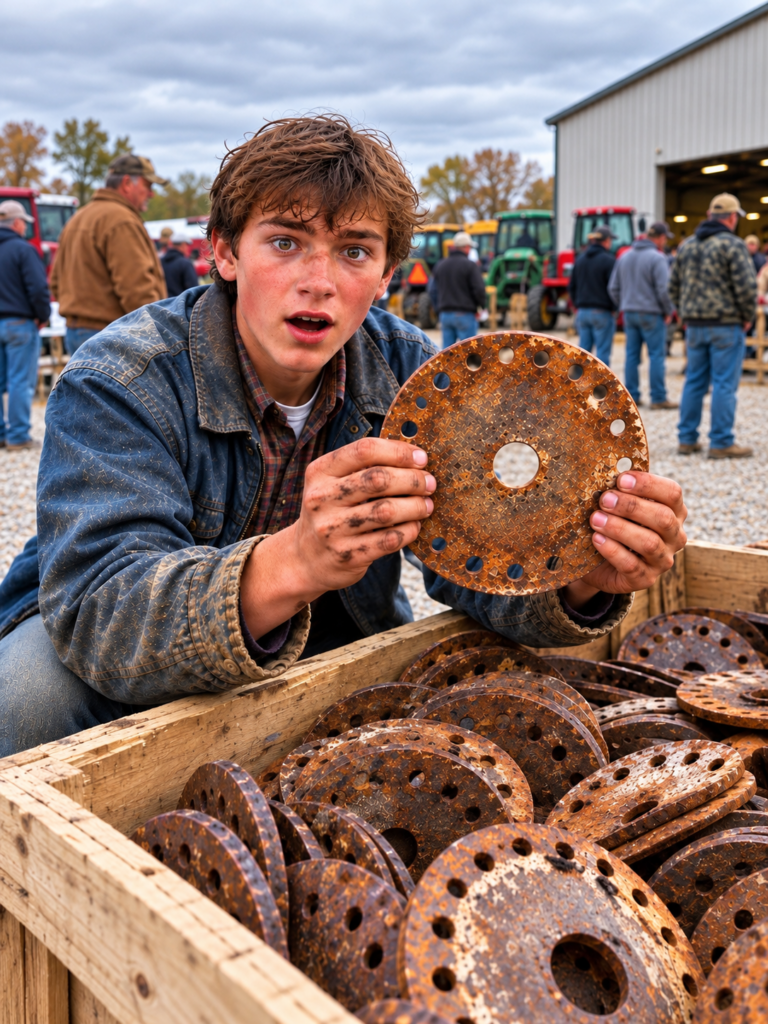
Behind the main building, near a fence where grass had pushed up through the gravel, several wooden crates sat in a neglected row.
Dust lay thick across their lids. Their boards had darkened with age, and a few of the corners showed the rough damage of years spent being moved from one storage place to another.
There were no bright auction tags drawing attention to them.
No crowd.
No excited conversation about horsepower, repairs, or resale value.
They looked like leftovers.
Ethan stopped.
He lifted the lid of the nearest crate, and the smell of old grease rose from inside.
Beneath the dust were stacks of round cast-iron pieces. Some were dark with old lubricant. Others carried the reddish-brown film of surface rust. Each had openings arranged around its face, though the patterns were difficult to make out beneath the grime.
He picked one up.
It was heavier than it looked.
He turned it over, rubbing his thumb across the metal. Something was stamped or cast into its surface, nearly hidden beneath years of dirt.
A number.
He tilted the piece toward the light.
The marking became clearer.
Ethan set it aside and lifted another.
Different number.
Then a third.
Different again.
He stood there for several moments with the three pieces arranged near the open crate.
They looked almost identical from a distance. To someone walking past, they were just round pieces of rusting iron.
But someone had once gone to the trouble of putting a different identification number on each one.
That meant something.
A man carrying an auction clipboard passed behind him.
He slowed when he noticed Ethan examining the contents.
“Wouldn’t spend much time digging through those,” the man said.
Ethan looked up.
“Why not?”
“Old planter plates. Nobody wants them. We’re putting the whole lot up as scrap.”
Ethan glanced into the crate again.
“All of them?”
“Every last one.”
“How many are there?”
The man gave the crates a casual look.
“About nine hundred. Give or take.”
Nine hundred.
Ethan looked along the row of wooden boxes, trying to imagine how many hours it would take to sort that much iron.
“What are you asking for them?”
The man appeared surprised that the boy was interested enough to ask.
“One hundred eighty dollars for the whole pile.”
Ethan felt the number settle in his stomach.
One hundred eighty dollars.
He knew exactly how much money he had in his coat pocket.
It represented long days, dirty hands, afternoons spent working when he might have been doing something easier. He had saved carefully, keeping back what little he could from his wages.
The money was supposed to be useful.
And there was nothing obviously useful about buying nine hundred pieces of iron that a farm equipment dealership had been unable to sell.
He looked again at the nearest plate.
The number was still there.
It bothered him that nobody seemed interested in why.
“One hundred eighty for everything?” he asked.
The man nodded.
“You haul it away.”
Ethan hesitated.
He thought about the money he would have left.
Almost nothing.
He thought about what Raymond Bell, the older mechanic who employed him, might say. Raymond had spent enough years around machinery to recognize a foolish purchase before the buyer finished explaining it.
Then Ethan thought about the numbers.
They were not random scratches.
They belonged to a system.
He didn’t understand the system yet, but he wanted to.
He took the money from his coat pocket and counted it.
“All right,” he said. “I’ll take them.”
The man with the clipboard accepted the payment with a look that suggested he had expected an older buyer, or perhaps no buyer at all.
Nearby, a scrap dealer who had overheard the exchange gave a short laugh.
“You’re paying for them one at a time,” the man said, looking at the crates, “when everybody else is paying for iron by the pound.”
A few men glanced over.
Ethan felt his face warm.
He could have explained that he wasn’t buying the iron for its weight. He could have pointed to the markings and argued that the plates might have uses the scrap dealer didn’t understand.
But he wasn’t certain enough to make that argument.
Not yet.
So he said nothing.
He put the plate back into its crate, closed the lid, and started figuring out how to move nine hundred pieces of metal.
By the time Raymond Bell found him, Ethan was standing beside the crates with grease on his fingers and the uneasy feeling that he might have spent his savings on a mountain of trouble.
Raymond had come to the auction for his own reasons. He knew Whitford’s inventory, knew the kind of equipment the dealership had sold over the decades, and understood that an old parts shelf sometimes held things newer businesses no longer bothered to carry.
When he heard what Ethan had purchased, he made his way around the building.
He stopped beside the crates.
For a while, he didn’t speak.
He lifted a lid, reached inside, and took out a plate.
His practiced fingers turned it over. He studied the openings, brushed dirt from the casting mark, and looked into the other boxes.
Ethan waited.
He was prepared for a lecture.
Raymond was not a man who wasted much breath, and when he thought someone had made a bad decision, he generally said so plainly.
Instead, the mechanic put the plate down.
“You know what you’ve bought?”
Ethan shook his head.
“Not exactly.”
Raymond looked at him.
“Not exactly, or not at all?”
Ethan considered that.
“I know they’re planter plates. I just don’t know what all the numbers mean.”
Raymond glanced at the crates again.
“Well,” he said, “we’d better find out.”
The words relieved Ethan more than he wanted to admit.
Raymond hadn’t told him the purchase was brilliant. He hadn’t promised the crates were valuable. He hadn’t even said the boy had done the right thing.
But he hadn’t laughed, either.
That mattered.
They brought Raymond’s trailer around and began loading the crates.
The boxes were awkward and heavy. Some had to be shifted carefully to keep the loose plates from sliding against one another. By the time they finished the first load, Ethan’s palms were stained with rust and his sleeves smelled of old machinery.
It took two trips to move everything to the repair shop.
On the second trip, the afternoon light had begun to change. The crowd near the dealership was thinning, and the auction grounds looked less like a place where farmers were making bargains and more like a business being slowly taken apart.
Ethan stood beside the trailer before leaving.
He looked back at the building.
For fifty years, people had come there expecting to find what their machines needed.
Now the doors were closing, and a boy of sixteen was hauling away parts nobody had cared enough to identify.
He wondered whether he would regret it.
Raymond secured the last crate.
“Ready?”
Ethan nodded.
There wasn’t much else to do.
He had already spent the money.
That evening, his mother asked him the question he had been avoiding.
“What exactly did you buy today?”
Ethan stood with his hands freshly washed, though dark stains remained around his fingernails.
“Some old planter parts.”
His mother watched him.
“How many?”
He shifted his weight.
“Quite a few.”
“Ethan.”
“About nine hundred.”
She stared at him.
“Nine hundred?”
“They’re not very big.”
That explanation did little to improve matters.
His mother folded her arms.
“And how much did nine hundred old planter parts cost?”
Ethan looked down for a moment.
“One hundred eighty dollars.”
The silence that followed was worse than if she had immediately scolded him.
She knew how hard he had worked for that money.
So did he.
His grandmother, sitting nearby, had been listening. She looked toward the crates, then back at Ethan.
Unlike his mother, she did not appear especially interested in whether the purchase had been sensible.
She seemed more interested in what he intended to do now.
“Well,” she said, “if you’ve already spent the money, you might as well find out what you’ve bought.”
Ethan looked at her.
There was no praise in her voice, and no criticism.
Just a practical statement.
The money was gone.
The parts were his.
What happened next depended on him.
The following afternoon, Ethan started cleaning the plates.
He chose one from the nearest crate and placed it on a work surface at the repair shop.
A wire brush scraped over the cast iron, knocking loose small flakes of rust and hardened grease. The work was slow. Dirt had settled into the openings and around the raised casting marks, obscuring details he needed to see.
He brushed one side, turned the plate over, and worked on the other.
Beneath the grime, the metal began to reveal its original shape.
There were letters.
A number.
A particular arrangement of openings.
He put the cleaned plate beside another.
They weren’t the same.
One had smaller openings spaced around its face. Another had larger ones. Some plates had noticeably different diameters, while others looked similar until he compared the patterns carefully.
He cleaned another.
Then another.
The first afternoon passed with far less progress than he had expected.
When he stepped away from the workbench, the pile of untouched plates still seemed enormous.
He rubbed the stiffness from his fingers.
Nine hundred, he thought.
He had bought nine hundred things he did not know how to identify.
And every one of them needed attention.
Over the next several days, Raymond watched the boy work.
He didn’t interfere much.
Occasionally he picked up a cleaned plate, checked its markings, and put it back in the appropriate group. Sometimes he asked Ethan why two nearly identical pieces had been separated.
“Different casting numbers,” Ethan would answer.
“Anything else?”
“Openings aren’t quite the same.”
Raymond nodded.
“Good. Keep looking.”
After several days, the mechanic finally sat down with him and explained what those differences meant.
A planter, Raymond told him, was not simply a machine that dropped seed into the soil.
It had to release the seed in a controlled way.
The right plate helped determine how seeds moved through the planting mechanism. A different crop could require a different opening pattern. Seed size mattered. So did the manufacturer and model of the machine.
A plate intended for corn might not be suitable for beans.
A plate from one brand might be useless in a machine made by another.
And two planters that looked almost identical could require completely different parts.
Ethan listened, holding a plate in both hands.
Raymond reached for an old manual and opened it on the workbench.
“See this?”
He pointed to the illustration of a planter mechanism.
“This part has to match the machine. Close isn’t good enough.”
Ethan studied the drawing.
“So if a farmer loses one…”
“Or breaks it,” Raymond said.
“He needs the same kind.”
“That’s right.”
“What happens if nobody makes it anymore?”
Raymond leaned back.
“Then he’s got a problem.”
Ethan looked at the plate in his hands.
He had worked around enough old machines to understand how farmers kept equipment running long after manufacturers stopped supporting it.
A machine didn’t become useless simply because it was old.
A tractor with a solid engine could continue working. A planter with a sound frame and functioning gears could serve another planting season, and perhaps many more.
But if a particular part was missing, none of that mattered.
The farmer might be left with a machine that could do everything except the one thing he needed it to do.
And buying a replacement planter could cost far more than replacing a single piece of metal.
Raymond looked toward the crates.
“That’s why the numbers matter.”
Ethan felt something change in the way he saw the room.
The plates were no longer an enormous pile of nearly identical objects.
They were parts belonging to machines with different histories, different purposes, and different requirements.
Some might be common.
Some might be impossible to sell.
But somewhere, he thought, a farmer could be looking for the exact number stamped into one of those old pieces.
That farmer wouldn’t care how rusty the plate had looked at the auction.
He wouldn’t care that the scrap dealer had laughed.
He would care whether it fit.
Ethan set the plate carefully on the bench.
For the first time since handing over his savings, he understood the possibility hidden inside his mistake.
He hadn’t necessarily bought nine hundred valuable things.
He had bought nine hundred things that might solve somebody’s problem.
Now he needed to find out which ones.
Part 2
Ethan found an old wooden box in Raymond’s shop and began turning it into something that had never existed for the crates at Whitford Farm Equipment.
A catalog.
It was not an impressive-looking system.
The box held ordinary index cards, the kind anyone might use for recipes, addresses, or household records. Ethan ruled lines on each card and began filling the spaces with information.
Manufacturer.
Planter model.
Casting number.
Opening pattern.
Seed type.
Condition.
Storage location.
At first, he thought the work would be straightforward. Clean the plate, read the number, write down the information, and put it away.
He discovered almost immediately that identifying old equipment parts was rarely that simple.
Some casting numbers had become difficult to read. Others appeared on plates that were nearly identical but not interchangeable. Manufacturer initials sometimes told him where a plate had come from, but not which machines could use it.
The older equipment manuals became essential.
Raymond had collected them over years of repairing farm machinery. They occupied shelves in the shop, their faded covers marked with the names of manufacturers and machines that had long since disappeared from new dealership inventories.
Some pages were yellowed. Some had softened along their edges from decades of handling. Others carried pencil marks made by mechanics who had needed the same information years earlier.
Ethan began spending his evenings with those books.
He would select a cleaned plate, read the markings, and search through diagrams and parts lists until he found a likely match.
When a manual provided the answer, he recorded it.
When it didn’t, he kept looking.
Sometimes he found that a plate he had assumed belonged to one planter was actually intended for a different model. Sometimes the hole pattern was the only clue he could use to separate several similar parts.
The deeper he went, the less comfortable he became with guessing.
One wrong identification could turn an apparently useful plate into a costly disappointment for somebody who trusted him.
Raymond noticed.
One evening, he stopped beside the table where Ethan had arranged several index cards.
“How many have you got figured out?”
Ethan glanced toward the remaining crates.
“Not enough.”
“How many do you know for certain?”
Ethan counted through the cards he had finished.
He gave Raymond the number.
The mechanic looked at the carefully separated stacks.
“And the rest?”
“Still working on them.”
Raymond studied him for a moment.
“That’s the right answer.”
Ethan looked up.
Raymond tapped the top of an unfinished card.
“There’s no shame in not knowing what something is. Trouble starts when you pretend you do.”
The remark stayed with Ethan.
He had already risked almost everything he had saved on the possibility that the plates were worth something. The temptation to make that possibility feel certain was always there.
It would have been easy to look at an unfamiliar casting number and declare it rare.
It would have been comforting, too.
But comforting guesses were not the same as knowledge.
When the manuals failed him, Ethan called other repair shops.
The conversations weren’t always easy.
He was sixteen years old, asking experienced mechanics about obsolete planter parts. Some had time to help. Others were busy and gave only short answers. A few remembered old machines clearly but couldn’t recall the exact casting numbers after so many years.
Ethan learned to ask specific questions.
He wrote down what people told him, then compared it with the information already in his cards.
Occasionally, he wrote letters to equipment manufacturers, explaining the markings he had found and requesting any available information about old planter models.
Then he waited for replies.
There was no immediate answer to every question. Sometimes an unidentified plate remained on the workbench for days while he searched for another manual or checked a conflicting detail.
The slow work taught him patience.
And it taught him that nine hundred pieces of inventory were not the same as nine hundred pieces of inventory he could confidently sell.
He needed to know what he had.
More importantly, he needed to know who might need it.
One afternoon, Ethan found a plate that looked unlike the others.
Its openings were arranged in an unusual pattern, different enough that he noticed it before he had completely cleaned the surface.
He turned it in his hands, studying the shape.
It looked specialized.
Old.
Hard to find.
For a few minutes, he allowed himself to imagine that he had discovered something unusually valuable.
He took it to Raymond.
“Look at this one.”
Raymond accepted it.
“What about it?”
“I haven’t seen another pattern like that in the crates.”
The mechanic checked the casting number.
Ethan waited, watching his expression.
“Could be pretty rare, couldn’t it?”
Raymond shook his head.
“No. That one’s not rare.”
Ethan frowned.
“How do you know?”
“I’ve seen plenty of them.”
“But look at the openings.”
“I am looking.”
“They’re different from the others.”
Raymond handed it back.
“Different doesn’t mean scarce.”
Ethan examined the plate again.
It seemed unfair that something so unusual-looking could still be common.
Raymond must have recognized the disappointment because his expression softened.
“You’re looking at the wrong thing,” he said.
“What should I be looking at?”
“Whether anybody needs it.”
Ethan remained quiet.
Raymond continued in the steady voice he used when explaining machinery.
“You can have a part that looks strange and old, but if there are a thousand of them sitting around and nobody’s looking for one, that doesn’t make it worth much.”
He touched the plate in Ethan’s hand.
“Then you can have something plain as a washer, and if it’s the only piece that’ll get a man’s machine running, it’s worth something to him.”
Ethan understood the distinction.
He had spent weeks studying how to identify his inventory.
Now Raymond was teaching him how to understand its value.
Not by age.
Not by appearance.
Not by the amount of rust.
By usefulness.
Ethan took the unusual plate back to the bench and recorded its information without marking it as rare.
From then on, he began thinking about demand whenever he sorted a new group.
Which planters were still being used?
Which manufacturers had stopped producing replacement plates?
Which parts were easy to find, and which ones had become troublesome for farmers trying to keep older equipment operating?
He had no way to answer every question.
But each answer made his catalog a little more useful.
And without realizing it, he was preparing for the day someone would need exactly what he had been working so hard to identify.
That day arrived a few weeks after the auction.
A farmer named Harold Voss came into Raymond Bell’s repair shop carrying the housing from an old International planter.
It was the kind of problem Raymond saw regularly: equipment that still had years of use left in it, provided the owner could find the right part.
Harold explained that his planter was serviceable.
The frame was sound. The mechanism could still operate. There was no reason to replace the entire machine.
Except for one missing piece.
The seed plate he needed was no longer being manufactured.
He had already contacted several dealerships.
Nobody had one.
He had spent months looking, and every unsuccessful inquiry brought him closer to an expensive decision he did not want to make.
Replacing the planter would mean spending money he had not planned to spend.
Raymond listened without interrupting.
Then he asked about the casting number.
Harold gave him the information.
The mechanic looked toward the rear of the shop.
“Ethan,” he called.
Ethan was working nearby.
He came over, wiping his hands.
“What’s up?”
Raymond gestured toward the farmer.
“Harold needs a plate for an old International planter. See what you’ve got.”
Ethan felt a flicker of nerves.
Until that moment, the collection had been mostly a private project shared with Raymond.
He had cleaned plates, studied diagrams, made mistakes, corrected cards, and imagined that somebody might someday need one of them.
Now a real farmer was standing in front of him with a real problem.
Ethan asked for the number again.
Harold repeated it.
The boy went to his index box.
He flipped through the cards, scanning the casting numbers.
One card.
Another.
Then he stopped.
His finger rested beneath a number written carefully across the top.
He checked it twice.
Manufacturer.
Model.
Pattern.
It matched.
Ethan looked toward Raymond.
“I think I’ve got it.”
Harold straightened.
“You do?”
“I’ve got that number listed.”
“Where?”
Ethan checked the storage location written at the bottom of the card.
“Third crate. Second shelf. Toward the back.”
He moved quickly but resisted the urge to rush.
At the shelves, he pulled the crate forward enough to examine the plates stored inside. Their surfaces were cleaner now than when he had first found them, and the numbers could be read without scraping away layers of grease.
He separated two plates and found the one he wanted.
The casting number matched the card.
He checked it again under the shop light.
Then he carried it to the waiting farmer.
Harold took the piece and turned it over in his hands.
For several seconds, he said nothing.
Ethan watched his eyes move across the metal.
The farmer checked the openings.
Then the markings.
Then the shape.
His expression changed.
“That’s it.”
Ethan released a breath he hadn’t realized he was holding.
Harold looked up.
“Where in the world did you find this?”
“At an auction.”
“An auction?”
“Whitford Farm Equipment. When they closed.”
Harold stared at the plate.
“I’ve been looking for one of these for months.”
Ethan glanced at Raymond, but the mechanic let him handle the conversation.
He had spent his money on the inventory. He had cleaned the plate. He had identified and cataloged it.
Now he needed to learn how to sell it.
“Fifteen dollars,” Ethan said.
Harold looked at him.
“For this?”
Ethan nodded.
“Fifteen.”
Harold checked the number one more time, as though he was afraid the answer might vanish if he looked away.
Then he bought the plate.
There was nothing dramatic about the transaction.
No applause.
No crowd gathered around the workbench.
Just a farmer who had been searching for a specific piece of machinery and a teenager who happened to know where to find it.
But as Harold left with the plate, Ethan felt a satisfaction unlike anything he had experienced during the weeks of cleaning and sorting.
He had not merely sold an old part.
He had helped a farmer keep using equipment that otherwise might have been taken out of service.
The object had been considered scrap because nobody at the auction could see an immediate use for it.
Harold had seen something entirely different.
To him, that fifteen-dollar piece of iron was the difference between a usable planter and a costly replacement problem.
Raymond watched Ethan return to the workbench.
“Well?”
Ethan looked at the empty place where the plate had been.
“It worked.”
Raymond nodded.
“Looks like it.”
Ethan picked up the index card and marked the part as sold.
For a moment, he studied the neat writing.
The number had been on the metal all along.
Someone only needed to connect it to the right machine and the right person.
Harold went home with the part he had spent months trying to find.
And he told people about it.
At first, the story spread in the ordinary way news traveled through a farming community.
One man mentioned it while picking up supplies at the feed store.
Another repeated it during a conversation at a repair shop.
A farmer looking for a hard-to-find component heard that Raymond Bell had a young fellow working there who kept old planter plates arranged by number.
Then somebody called.
He wasn’t interested in buying a random collection of used parts.
He wanted to know whether Ethan had a specific casting number.
Ethan checked his box.
The inquiry was different from anything he had experienced before.
The caller wasn’t asking whether an old plate looked good or whether it might be useful someday.
He knew exactly what he needed.
The question was whether Ethan could supply it.
Soon another farmer asked about a plate for an old McCormick planter.
Someone else needed a piece for equipment the manufacturer had stopped supporting years earlier.
Some inquiries ended in sales.
Others ended with Ethan explaining that he didn’t have the right part.
He was careful about that.
He knew what it meant when a farmer was counting on a machine to work. Selling the wrong plate simply because it looked close enough would do more harm than good.
So he kept checking his records.
He kept comparing numbers.
And the callers began learning that he took the questions seriously.
Before long, the conversation at the shop had changed.
People were no longer asking whether he had a pile of old planter parts.
They were asking whether he had number 197B.
Or another particular casting.
Or the plate specified in a worn manual that had been sitting on a farmer’s shelf for twenty years.
Ethan began to recognize certain numbers as soon as he heard them.
He could remember which crate contained some of the more unusual plates.
But he continued using the cards.
Memory was useful.
A reliable catalog was better.
The wooden box that had looked like a simple way to organize a reckless purchase was becoming the most important tool in the entire collection.
Without it, he had nine hundred pieces of old iron.
With it, he could connect a farmer’s problem to the exact piece that might solve it.
And every call taught him something new about the machinery still working in the fields around him.
The farmers weren’t necessarily looking for new machines.
They were looking for ways to keep dependable old ones running.
Ethan had not expected his strange purchase to become part of those decisions.
But it was happening.
One casting number at a time.
Part 3
By the time winter settled over the farming community, Ethan’s collection no longer resembled the dirty crates he had discovered behind Whitford Farm Equipment.
The plates were still old.
Many still showed stains from years of use, and some carried surface marks that no amount of cleaning could erase.
But they were no longer an unidentified heap.
Ethan had reorganized the inventory around the questions farmers actually asked.
Manufacturer first.
Then planter model.
Casting number.
Seed type.
Condition.
He marked the storage locations carefully and separated plates that were difficult to replace from those that appeared frequently in old equipment inventories.
The distinction mattered.
In the beginning, he had been tempted to think that every unfamiliar plate might be valuable.
The more he learned, the less he believed that.
Most of the nine hundred plates were relatively common.
They weren’t worthless. A farmer who needed one could still make good use of it. But common parts rarely justified high prices, especially when similar pieces could be found elsewhere.
Some sold for five dollars.
Others brought ten.
Ethan didn’t mind.
Every sale helped recover money from the purchase that had nearly emptied his savings.
And every successful match made the remaining collection more useful.
But there were other plates.
Numbers that appeared less frequently in the manuals.
Parts for older planters that no longer had dependable sources of replacement components.
Pieces that might sit untouched for months because few people needed them, then become urgently important when the right farmer called.
Those were different.
Some sold for twenty dollars.
Others brought forty.
And one plate eventually sold for sixty dollars.
The farmer who bought that one had already spent weeks searching for the correct replacement.
Ethan remembered the way Raymond had explained value to him.
An unusual-looking part wasn’t necessarily rare.
And a rare part wasn’t automatically valuable simply because it was difficult to find.
What mattered was whether somebody needed it.
The sixty-dollar plate had been sitting among the others when Ethan first bought the collection.
At the auction, nobody had even bothered to ask what its casting number meant.
But to the farmer searching for that exact part, it represented a practical solution to a problem that had consumed time and threatened to cost much more.
The metal hadn’t changed.
The need had made its importance clear.
Ethan began thinking of each sale that way.
A five-dollar plate and a sixty-dollar plate could both be valuable in the right circumstances.
One might replace an inexpensive, readily available component.
The other might make the difference between keeping a useful planter in service and having to spend thousands of dollars on another machine.
The farmer knew the difference.
And increasingly, so did Ethan.
Still, the work was far from easy money.
Every plate that left the shop had required some amount of labor before it could be sold.
There had been the cleaning.
The hours spent comparing numbers.
The manuals spread across the workbench.
The phone calls.
The letters.
The time spent making certain that the part a customer requested was actually the part being supplied.
Even the storage system needed constant attention.
When one plate sold, Ethan updated its card.
When he discovered that another plate fit an additional model, he corrected the information.
If he learned that a number was more common than he had first believed, he changed his notes rather than continuing to treat it as scarce.
He wanted the system to become more accurate, not merely larger.
And he kept doing that work after school.
On evenings when other boys might have put aside the concerns of the day, Ethan returned to the repair shop and opened the wooden index box.
On weekends, he worked through the remaining plates.
He learned to recognize the feel of old cast iron in his hands and the small differences in opening patterns that could separate one part from another.
Sometimes his fingers hurt from brushing rust.
Sometimes he spent an entire evening trying to identify a piece that turned out to be common and inexpensive.
There were nights when the work seemed endless.
Nine hundred plates had sounded like a large number at the auction.
It sounded even larger when each one needed to be examined, cleaned, identified, and stored in a way that would make it possible to find again.
But Ethan had already learned that the most important discoveries were often made during the work nobody else wanted to do.
And little by little, the system improved.
Raymond noticed the difference.
In the beginning, Ethan had needed help understanding what a seed plate did.
Now he could explain why two plates with similar shapes were not interchangeable.
He could read a casting number and often recognize the manufacturer.
He understood that identifying a component was only half the job. The other half was knowing which machine needed it.
Raymond had not become less important to the boy.
If anything, Ethan valued the older mechanic’s experience more than before.
But their conversations had changed.
Instead of asking Raymond to identify every unfamiliar part, Ethan came to him with specific questions.
Sometimes he brought two plates and explained why he believed they belonged to different planter models.
Other times he asked Raymond to check a conclusion against what he remembered from years of repairs.
The mechanic listened.
When Ethan was right, Raymond said so.
When he was wrong, the older man made him find out why.
That was how the catalog grew more dependable.
And in time, something else began to grow.
The reputation of the boy who kept it.
By the following spring, farmers from several counties were coming to Bell’s repair shop looking for particular parts.
Some arrived carrying the damaged component they wanted to replace.
Others brought a casting number copied from an old manual.
A few knew only the planter model and the kind of plate they were missing.
Ethan couldn’t help every person who came through the door.
He never claimed that he could.
But he could often tell them whether he had a match without forcing them to sort through stacks of unfamiliar iron.
That alone made the trip worthwhile.
The farmers appreciated the fact that someone had taken the time to organize parts most businesses no longer wanted to handle.
They had older equipment for practical reasons.
A machine that had worked dependably for decades did not suddenly become a bad machine because a manufacturer had stopped making every component for it.
Replacing equipment was expensive.
Keeping it running required knowledge, patience, and access to the right parts.
Ethan’s collection offered one small answer to that larger problem.
By spring, he was no longer surprised when somebody arrived asking for a specific casting number.
But he was still surprised by how far the news traveled.
One farmer heard about the collection from someone nearly a hundred miles away.
Another learned Ethan’s name through an equipment newsletter.
Calls began coming from places Ethan had never expected to hear from when he first opened those crates.
He would pick up the telephone and listen as a farmer described an old planter, an obsolete part, and the difficulty of finding anyone who could help.
Sometimes Ethan recognized the number immediately.
Other times he returned to the manuals.
And sometimes, after checking carefully, he had to say that the part wasn’t in his inventory.
Even those unsuccessful calls mattered.
They told him what farmers were looking for.
They revealed which old machines were still being used.
They helped him understand demand more clearly than any appearance of age or rarity ever could.
He began noticing patterns.
A plate that seemed ordinary on his workbench could be unusually difficult to locate in another county.
A part he had assumed was scarce might turn out to be sitting in several repair shops.
The value of the collection was not fixed.
It depended on the machinery people owned, the parts they needed, and whether the correct replacements could still be found.
That was a more complicated way of thinking than Ethan had possessed at sixteen when he reached into his coat pocket and surrendered nearly all his savings.
But it was also a more useful one.
He was learning that a business could be built around information as much as around inventory.
The iron was necessary, of course.
Without the physical plates, he would have nothing to supply.
But without the knowledge stored in his index cards, those same plates might still be sitting in dirty boxes waiting for somebody to recognize them.
The catalog gave the metal a purpose.
And the farmers gave that purpose meaning.
One afternoon, the scrap dealer who had laughed at Ethan’s purchase stopped Raymond Bell during a visit to a local supply store.
The man remembered the auction.
He remembered the crates.
And he had heard enough since then to understand that the boy’s purchase hadn’t been nearly as foolish as it looked.
Another dealership, he told Raymond, was clearing out an old warehouse.
Among the unwanted materials were more obsolete planter plates.
The scrap dealer knew what usually happened to such things.
They were weighed.
Loaded.
And sold for their value as metal.
He also knew that there might be somebody who wanted a chance to inspect them before that happened.
“Tell that kid,” he said. “He’ll probably want them.”
Raymond passed the message along.
When Ethan heard about the warehouse, he was interested immediately.
The idea of finding another group of old plates stirred the same curiosity he had felt behind Whitford Farm Equipment.
But this time, something was different.
He didn’t reach for his money first.
He reached for his catalog.
When he went to inspect the second lot, he came prepared.
He checked the casting numbers.
He compared them with the plates already in his collection.
He identified the manufacturers where he could and worked out which planter models the pieces belonged to.
Some were common.
Some duplicated what he already owned.
Others deserved a closer look because they were harder to replace.
Ethan didn’t treat the entire lot as valuable simply because it was old.
He didn’t assume that a warehouse full of obsolete parts must contain hidden treasures.
He understood too much now to make that mistake.
He knew that acquiring inventory without identifying it could leave him with more work and little benefit.
And he knew that having nine hundred parts nobody needed would not accomplish nearly as much as having one part a farmer had searched months to find.
The first auction had taught him to look beyond appearances.
The months afterward had taught him how.
As he worked through the second collection, he thought back to that October morning.
He remembered the neglected crates beside the fence.
The grease.
The rust.
The auction worker’s indifference.
And the scrap dealer’s laughter.
At the time, Ethan had believed there was something worth understanding inside those boxes.
But he had no evidence that it would turn into a useful business.
He had made a decision based on curiosity, instinct, and the simple observation that the plates carried different identification numbers.
He had been lucky enough to have Raymond help him begin.
Everything after that had required work.
He had needed to learn why the markings mattered.
He had needed to separate useful information from guesses.
He had needed to understand the difference between rarity and demand.
And he had needed to turn a scattered collection into a system other people could depend on.
The second warehouse gave him an opportunity to use those lessons.
He was no longer the boy who bought a pile of rusty iron because the numbers looked interesting.
He was still curious.
Still willing to examine what others overlooked.
But now he knew how to ask the questions that mattered before spending his money.
Could he identify it?
Did it fit machines farmers were still using?
Was the part readily available elsewhere?
Did he already have enough of that casting number?
Was there a real reason to believe somebody would need it?
Those questions mattered more than how old the metal looked.
And they were questions he had learned by working his way through the consequences of his first decision.
Nearly a year after the Whitford auction, Ethan was at Bell’s shop when another farmer came through the door.
The man wasn’t carrying a broken planter housing.
He didn’t have a crate of damaged parts.
He held a small piece of paper.
A casting number had been written on it in pencil.
He approached Ethan and handed it over.
“Think you might have one of these?”
Ethan looked at the number.
It was familiar.
He read it once, then raised his eyes toward the shelves.
Months earlier, he would have gone straight to the wooden index box.
He would have searched the cards, checked the manufacturer, confirmed the model, and located the correct crate.
The system had taught him where everything belonged.
But now he knew that number.
He knew the plate.
And he knew exactly where he had put it.
“Let me check,” he said.
He walked toward the shelves.
Third row.
Near the end.
He reached behind two other plates and brought one forward.
The iron was cool in his hands.
He turned it just enough to see the casting mark.
Then he carried it back to the farmer.
The man took it carefully.
For a moment, he studied the face of the plate.
His thumb moved across the openings.
Then he checked the number.
He looked up.
“That’s the one.”
Ethan nodded.
There was no need for celebration.
A farmer had needed a particular part.
Ethan had known where to find it.
That was what the work had been leading toward all along.
The man continued examining the plate while Ethan stood on the other side of the counter.
For Ethan, the moment brought back a memory so clear that he could almost smell the old grease in the crates behind Whitford Farm Equipment.
He saw himself again on that cold October morning.
Sixteen years old.
A coat pocket holding nearly all the money he had managed to save.
A row of dusty wooden boxes that nobody wanted.
He remembered lifting the first cast-iron plate and discovering the number hidden beneath the dirt.
Then another.
Then another.
He remembered wondering why each piece carried its own markings when the men around him seemed to consider the entire collection nothing more than scrap.
He hadn’t understood what the numbers meant.
He had only known they must mean something.
The farmer standing in front of him was proof that they did.
Not in some mysterious way.
Not because the metal held a hidden fortune.
But because those markings connected ordinary objects to specific machines and specific needs.
When Harold Voss had come searching for a discontinued International planter plate, the catalog had supplied the answer.
When other farmers began calling with casting numbers, the cards had allowed Ethan to check his inventory instead of guessing.
When the second warehouse became available, that same knowledge had prevented him from buying blindly again.
And now, nearly a year after the first auction, he could locate a part almost without thinking.
The number on the paper had led him directly to the shelf.
That was not luck anymore.
It was knowledge earned one plate at a time.
Ethan thought of Raymond Bell.
The older mechanic had never promised that the original purchase would make money.
He had simply asked whether Ethan knew what he had bought.
And when the answer had been no, Raymond had helped him learn.
He thought of his mother, who had stared at him when he admitted how much he had spent.
She had understood the risk better than he had wanted to admit.
He thought of his grandmother, whose practical advice had given him a way forward after the money was gone.
If you’ve spent it, learn what you bought.
He had done exactly that.
Not in one afternoon.
Not through a sudden discovery that every plate was rare.
But through months of cleaning, studying, sorting, asking questions, and correcting his mistakes.
He had learned that a single metal part could keep an expensive machine working.
He had learned that farmers often needed someone who understood obsolete equipment more than they needed someone eager to sell them something new.
And he had learned that usefulness could survive long after the people who originally sold an object had stopped recognizing its value.
The strange thing was that none of those lessons had required the plates to become anything different from what they had always been.
They were still cast iron.
Still old planter components.
Still the same pieces that had sat in dusty crates at the edge of an auction lot.
The difference was what Ethan knew about them.
At Whitford Farm Equipment, everyone had seen a pile of unwanted parts.
The scrap dealer had seen metal that could be sold by weight.
The auction worker had seen inventory that needed to be cleared before the doors closed.
Ethan had noticed the numbers.
And instead of deciding that their meaning was unimportant simply because the parts looked worthless, he had taken the time to find out what they were for.
That curiosity had cost him one hundred eighty dollars.
It had taken months of his time.
It had tested his patience and taught him how much he didn’t know.
But it had also given him something no auctioneer could have listed among the contents of those crates.
An understanding of how to recognize a problem that an overlooked object could solve.
He hadn’t become successful by pretending that every discarded thing was valuable.
He had learned to distinguish between something that merely looked interesting and something another person genuinely needed.
That was the lesson he carried away from the auction, even though he hadn’t understood it until much later.
The farmer left Bell’s shop with the part he had come looking for.
Ethan returned to the shelves.
There were still plates to organize, cards to update, and casting numbers to identify.
There would be more calls from farmers with aging machinery.
More questions he couldn’t answer immediately.
More hours spent searching through old manuals.
And probably more parts that looked promising until careful research proved they were common.
But that no longer troubled him the way it once had.
He understood what the work was for.
The following time he opened the wooden index box, he did not see it as a record of a foolish purchase he was trying to justify.
He saw a record of everything he had learned.
Every card represented a connection between a particular piece of equipment and the part that allowed it to do its job.
Some of those connections were worth five dollars.
Some were worth much more to the people who needed them.
And some had not yet found the farmer who was looking.
On that cold morning in October 1990, sixteen-year-old Ethan Miller had stood alone beside a row of dusty crates while the rest of the auction crowd searched for better bargains.
He had spent almost everything he owned on nine hundred pieces of iron that nobody wanted.
The men around him had already decided what the collection was worth.
One hundred eighty dollars in scrap.
Ethan hadn’t known enough to disagree.
But he had known enough to look twice.
And in the months that followed, he discovered that the real value of those old plates had never been measured by their weight, their age, or the rust covering their surfaces.
It lay in the machines they could keep working.
The money they could save.
And the farmers who would come through Bell’s shop hoping that somewhere, among hundreds of forgotten parts, someone had preserved the exact piece they needed.
The auction had sold Ethan nine hundred pieces of unwanted iron.
Through patience, research, and an old mechanic’s guidance, he learned to recognize them as something far more useful.
Nine hundred possible answers.
And it all began because one sixteen-year-old boy saw a number beneath the rust—and cared enough to find out what it meant.


