Part 1
“Sixteen rows on Bennett ground?”
Wade Mercer stared across the field, then let out a short laugh that carried farther than he probably intended.
“You’ll spend more time cleaning up what you knock down than you’ll spend harvesting.”
Behind him, two men standing beside their pickup trucks exchanged amused looks.
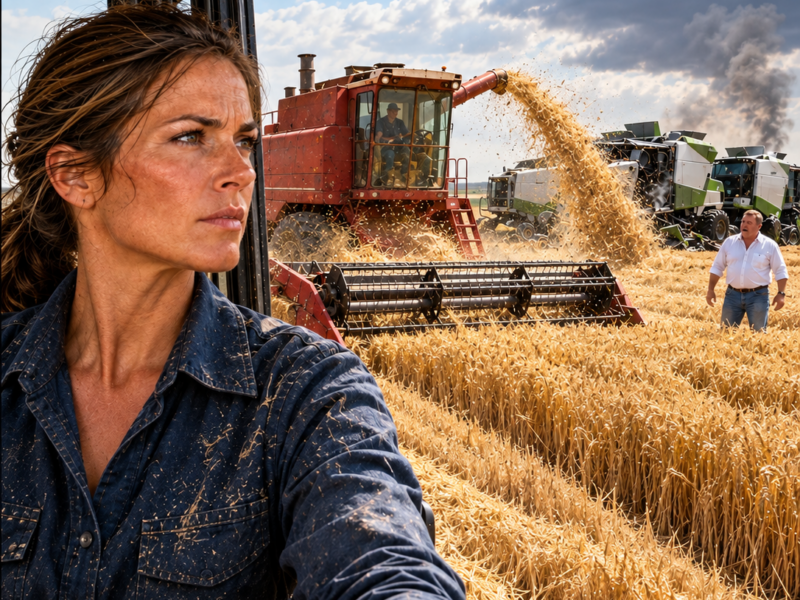
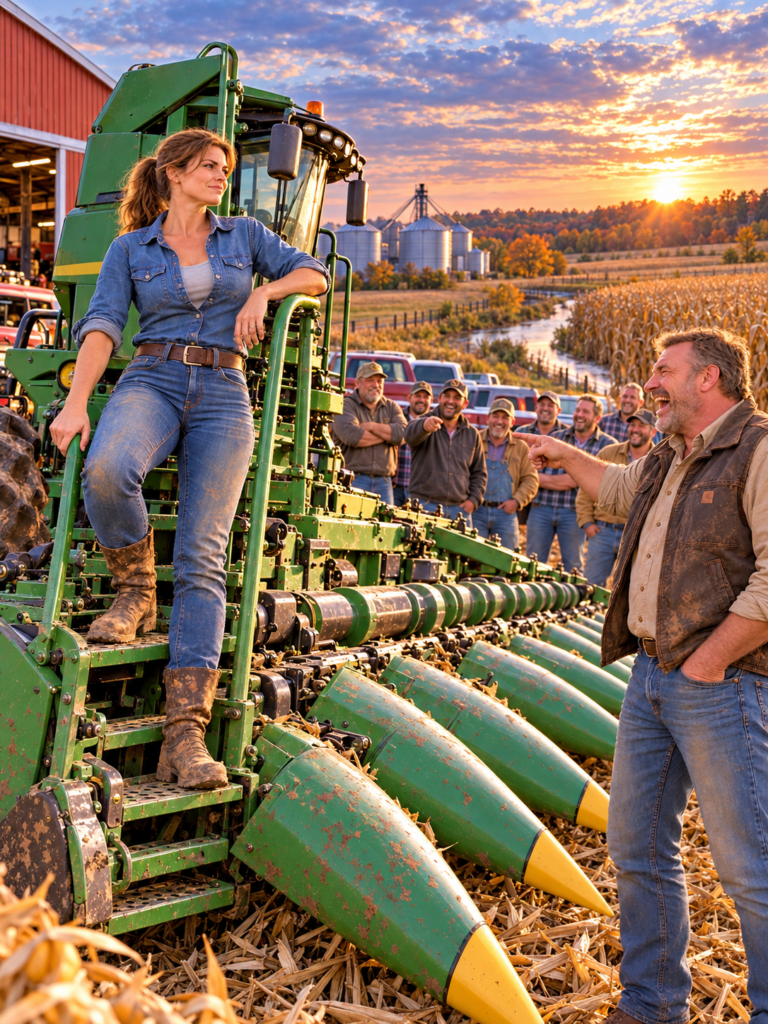
Clare Bennett stood near the massive green corn head resting at the edge of her family’s Iowa farm. The morning air carried the dry, papery smell of mature corn, and a faint breeze whispered through the stalks beyond the fence.
She had expected questions about the machine.
She had expected doubts.
She had not expected the entire conversation to turn into a public judgment of whether she belonged on her own family’s land.
“I’ve run the numbers,” she said.
One of the men chuckled.
Wade turned toward the others, raising his eyebrows.
“She ran the numbers.”
More laughter followed.
Then someone asked whether Robert Bennett knew what his daughter was doing.
Wade’s expression grew serious.
“This isn’t about the farm, Clare. You know that, don’t you?”
She looked at him.
“What is it about, then?”
He folded his arms.
“You’re trying to take your father’s place. But running equipment doesn’t make you a farmer.”
For a moment, nothing moved except the corn.
Clare felt the weight of the men’s attention. They were waiting for anger, embarrassment, or some hurried defense of her decision.
Instead, she looked toward the long green machine.
“Then watch me.”
It was the last thing she said before turning away.
Wade Mercer had been operating custom harvest crews across three Iowa counties for nearly twenty years. He knew machinery, soil conditions, weather windows, and the expensive consequences of bad decisions. Farmers hired him because he could bring equipment and experienced operators into difficult situations when their own resources were not enough.
And to be fair, some of what he said that morning was correct.
Bennett Farm was hardly ideal ground for a sixteen-row folding corn head.
Several fields had irregular boundaries. Narrow waterways curved around low areas where drainage had always been troublesome. The north block ended against an old fence line that made turning large machinery awkward. Some headlands were short enough to punish an inattentive operator.
A machine built to swallow sixteen rows at once could become an expensive nuisance if someone tried to force it through every acre.
What Wade did not understand was that Clare already knew every one of those problems.
She knew the angle of the drainage channels. She knew which corners required extra care and which long, straight fields could support wider equipment. She knew where the ground stayed soft after rain, where trucks could turn safely, and where the grain carts lost valuable minutes traveling between the combine and the unloading points.
She had been studying those details for eight years.
And for most of that time, hardly anyone had noticed.
Nobody had ever officially introduced Clare Bennett as the person running the family operation.
At county meetings, people greeted her father first.
At the co-op elevator, they asked Robert about yields, planting decisions, and whether the coming winter looked like another difficult one.
When a harvest went well, someone would slap Robert on the shoulder and tell him he still knew how to make the land produce.
Clare might be standing three feet away, holding the yield reports that had guided half the decisions.
Nobody thought much about that.
She had grown accustomed to hearing men congratulate her father for things she had done.
There were mornings when she had been awake before five, checking field moisture and maintenance schedules while the kitchen windows were still black. There were afternoons spent recalibrating equipment or comparing fuel consumption against harvest output, trying to determine why a particular field cost more to work than it should.
Robert had taught her the difference between understanding a machine and merely knowing how to start it.
He had shown her how to recognize trouble before an alarm sounded, how to read the condition of a crop from the way it entered the header, and how to listen to an engine without trusting sound alone.
But he had also been the face of Bennett Farm for so long that nobody could imagine someone else making the important decisions.
Not even when that person was his daughter.
Whenever Clare corrected a problem, someone inevitably asked whether Robert had approved the solution.
She used to explain.
Eventually, she stopped.
The farm needed work done whether the county recognized her or not.
And Clare had always been better at finishing work than arguing about who deserved credit.
Three weeks before harvest, that quiet arrangement collapsed.
Robert suffered a minor stroke while walking between the machine shed and the farmhouse.
One moment he had been going about an ordinary morning. The next, Clare was facing the terrifying possibility that the man who had spent his life keeping Bennett Farm alive might never walk those fields the same way again.
He survived.
The doctors were reassuring about his immediate recovery, but they were firm about the restrictions.
No heavy physical labor.
No long days.
No operating farm machinery until he had recovered sufficiently and received medical clearance.
Clare listened to every instruction, nodded when appropriate, and kept her expression steady.
Then she went home and looked at the calendar.
The corn was almost ready.
A dry summer had weakened the stalks more than usual, leaving them vulnerable to strong wind. Weather reports showed a developing system northwest of their part of Iowa, with heavy rain and damaging gusts expected to arrive around the most critical portion of harvest.
The timing could hardly have been worse.
If they waited too long, the wind might flatten sections of the crop. If they rushed recklessly, damaged kernels and harvest losses could cost nearly as much.
Robert had always been the primary combine operator during the busiest part of the season.
Now he was lying in a hospital bed.
And the weather would not postpone itself out of respect for him.
Clare spread the farm maps across the kitchen table.
She worked first with the equipment they already owned.
Their older eight-row corn head was reliable and familiar. She knew its strengths, its maintenance history, and the ground it could cover under normal conditions.
But normal conditions had disappeared.
She calculated the remaining acreage, estimated average field speed, accounted for headland turns, unloading interruptions, and the acres already harvested earlier in the week.
Then she calculated everything again.
The answer remained the same.
There were not enough working hours inside the weather window.
She considered hiring Wade Mercer.
His crews had the capacity. He could bring experienced operators, larger machines, grain carts, and transportation. He had helped farms recover from equipment failures before.
But arranging an emergency harvest at the last minute would cost Bennett Farm most of the profit they expected to make that year.
Clare understood why his rates were high. Machinery was expensive. Labor was expensive. Pulling a crew away from other commitments carried a cost.
Still, signing that agreement would mean working an entire season only to watch the earnings disappear into someone else’s invoices.
A single year like that could be survived.
Too many such years could destroy a farm without a bank ever needing to foreclose.
For two nights, Clare studied alternatives.
The solution came through a contact at a larger farming operation three counties east.
A lightly used John Deere C16F sixteen-row folding corn head was available during the week Bennett Farm needed it.
The machine was far wider than anything the Bennetts had previously used.
It was also capable of changing the arithmetic.
Clare examined its operating requirements, then returned to her maps.
She divided the fields according to their actual characteristics instead of treating the farm as one uniform piece of ground.
Some fields were immediately unsuitable.
She marked the awkward sections near the drainage tile, the tight corners, the short headlands, and places where a wide header would create more problems than advantages.
Then she looked at the center blocks.
Long, straight rows.
Generous turning space.
The most productive ground on the farm.
Those fields offered a different possibility.
With sixteen rows moving at a controlled speed, the combine could harvest significantly more corn during the available hours. But the header was only one part of the operation. The grain cart had to keep pace. Trucks needed to arrive and depart without leaving the combine waiting. Every unnecessary interruption would eat into the advantage.
She modeled the sequence, adjusted the estimates, and checked her assumptions.
The plan was not perfect.
It did not need to be.
It needed to work better than the alternatives.
Clare made the call.
Two days later, the C16F arrived on a flatbed trailer.
By the following morning, three pickup trucks were parked beside the county road.
Wade Mercer was among the spectators.
And before the machine had cut a single stalk, he had already decided that Clare was making a mistake.
Standing by the fence, he pointed out the places where he expected her to struggle.
The drainage curve.
The north block.
The short turning areas.
Clare listened without interrupting because none of those observations surprised her.
What she objected to was his assumption that she had ignored them.
Then Wade brought up her father.
He suggested she wanted the big machine because she was trying to prove she could replace Robert.
That accusation landed harder than his criticism of the equipment.
Clare knew how much her father had done for the farm. She knew how many seasons he had carried its worries privately so she could learn without bearing all the responsibility at once.
She did not want him erased from the story of Bennett Farm.
But neither did she want her work dismissed because the county was more comfortable believing he had made every important decision.
She gave Wade her brief answer and walked away.
That evening, she drove to the hospital.
Robert was sitting upright when she arrived, looking tired in a way that still unsettled her. For most of her life, she had associated him with motion—walking the fields, climbing into tractors, opening shed doors, examining machinery.
Seeing him confined to a hospital room made the world feel unnaturally still.
She pulled a chair beside his bed.
“Wade came by today.”
Robert looked at her.
“What did he want?”
“To explain everything wrong with the sixteen-row head.”
“That sounds like Wade.”
“He thinks I’m trying to replace you.”
Robert said nothing.
Clare looked down at her hands.
“Maybe I made the wrong call.”
“About the header?”
“About all of it.”
He waited.
“The ground is awkward. The weather’s getting worse. Half the county thinks I’ve lost my mind.”
Robert studied her for a moment.
Then he asked, “Do you think the numbers are wrong?”
“No.”
“Have you checked them?”
“More times than I want to admit.”
“Then why are you asking me?”
She gave a tired smile.
“Because you’re my father.”
He reached toward the blanket covering his legs, smoothing a fold that did not need smoothing.
“Tomorrow,” he said, “don’t harvest for those people.”
Clare frowned.
“What?”
“Don’t harvest for them.”
“You mean Wade?”
“I mean anybody standing beside that road waiting to decide what kind of farmer you are.”
She considered his words but wasn’t certain she understood.
Robert leaned back against the pillows.
“You’ve got corn standing out there. Harvest that.”
It was such a simple instruction that it almost irritated her.
She had come hoping for certainty.
Instead, he had given her something she would have to understand for herself.
She stayed a little longer, talking about ordinary things, then drove home through the darkening Iowa countryside.
The C16F waited near the equipment shed, folded and silent beneath the security lights.
Clare stood looking at it before going inside.
She had spent days making sure the machine could help save the harvest.
Tomorrow would tell her whether the person operating it could live up to the plan.
At 5:20 the next morning, the combine engine came alive.
The sound rolled through the darkness and echoed against the equipment buildings.
Clare completed her checks beneath the pale glow of the work lights. She watched the gauges, confirmed the settings, and examined the header connections.
As dawn spread across the eastern sky, the sixteen-row corn head unfolded.
The outer sections extended until the green machine occupied a width that made Bennett Farm’s familiar equipment look small.
Clare climbed into the cab.
Across the road, the pickup trucks had returned.
She recognized Wade’s immediately.
Of course he was there.
She settled into the seat, adjusted her controls, and lined up with the standing corn.
The first sixteen rows disappeared beneath the header.
For several minutes, everything seemed to work.
Then the field reminded her that calculations were only as useful as the decisions made while operating the machine.
Near the drainage tile, a curve she knew perfectly well approached faster than she wanted.
On the second pass, she drifted too far outside the intended line.
With the old eight-row head, the mistake would have been irritating but minor.
With sixteen rows, correcting the error required an additional pass.
She saw the wasted motion immediately.
She also saw the trucks parked beside the road.
One man stepped closer to the fence.
Clare’s jaw tightened.
She kept going.
Not long afterward, the combine’s engine load began fluctuating.
The left gathering chain was feeding stalks unevenly. The change was subtle at first, but unmistakable to someone accustomed to listening for irregularities.
She stopped.
Climbed down.
Examined the header.
Residue had accumulated where it could interfere with the chain’s movement. She cleared the obstruction and adjusted the tension, working with the focused, practiced movements of someone who understood the machinery in front of her.
Eleven minutes passed before she climbed back into the cab.
Eleven minutes she could almost feel the men on the road counting.
When she started again, the machine seemed better.
But something remained wrong.
The load monitor still climbed higher than she wanted whenever she pushed the ground speed. The feeding action settled briefly, then began to sound strained.
Three passes later, Clare understood.
She was driving too fast.
Not wildly fast. Not at a speed that would make the machine immediately dangerous or uncontrollable.
Just faster than the crop conditions and feeding system wanted.
Faster than the optimal rate she had calculated.
Because people were watching.
Clare eased off the controls.
The realization made her feel foolish in a way Wade’s laughter never had.
She had spent days building a plan around efficiency, only to abandon part of that plan because she wanted the men beside the road to see how quickly she could work.
She heard Robert’s voice again.
Don’t harvest for them.
She checked the monitor.
Reduced the speed.
Allowed the machine to settle into the feed rate the corn actually required.
Within minutes, the difference was obvious.
The gathering chains worked with a smoother rhythm.
The engine load stabilized.
The grain loss monitor dropped into a more acceptable range.
Instead of surging forward and correcting mistakes, the combine moved through the rows with a deliberate consistency.
Clare stopped looking toward the county road.
She watched the crop.
She watched the numbers.
She listened to the machine.
Then something happened that she had not quite expected.
The work became easier.
Not because operating the C16F was simple, but because she had stopped asking the machine to prove anything.
Sixteen rows entered the header.
Sixteen rows vanished.
Behind her lay evenly cut stubble and a widening stretch of harvested ground.
The grain cart operator began adjusting his movements to keep up with her.
By late morning, the pickup trucks were still there, but the men beside them had grown quiet.
Wade leaned against his hood, arms crossed.
He was no longer making jokes.
From his position beside the road, he could see the progress she was making.
He knew the field.
He knew the approximate acreage.
And he knew how quickly standing corn should disappear under ordinary conditions.
Clare could not hear what he was thinking.
She did not need to.
For the first time since he had arrived at Bennett Farm, Wade Mercer was studying her operation instead of her reputation.
And in the cab of the combine, Clare Bennett was finally working the way she had planned.
The hardest part of the day was still ahead.
But the numbers were beginning to prove themselves.
Part 2
By early afternoon, the sunlight had turned the standing corn the color of old gold.
Clare had already completed the more demanding sections assigned to the C16F, and the operation was moving with a steadiness that would have seemed impossible during the first troubled hour.
Now she approached the field that mattered most.
Two hundred acres.
Long, straight rows stretched across the center of Bennett Farm, with enough room at either end for the wide machine to turn without fighting the boundaries.
This was the ground she had been thinking about when she first found the C16F.
This was where the sixteen-row header needed to justify the risk.
She stopped briefly at the edge of the block and looked across the field.
There was no room for careless excitement.
A machine could perform beautifully for hours and still ruin a harvest if the operator became impatient.
She checked the settings once more, lined up with the first rows, and lowered the header.
The corn entered smoothly.
The combine moved forward.
And the field began to disappear.
Dean Holloway managed the grain cart rotation with the calm efficiency of a man who had spent enough harvest seasons watching machines work to know where every delay could begin.
He understood when the combine would need unloading, where to position the cart, and how to keep traffic moving without creating unnecessary interruptions.
Clare trusted that judgment.
She had prepared the schedule, but Dean’s experience helped make the operation work in real time.
The afternoon settled into a demanding rhythm.
The C16F cut.
The grain cart moved.
Trucks loaded and departed.
Each successful cycle gave Clare another reason to trust the plan instead of her anxiety.
She knew the machine was capable of impressive output. But watching the numbers accumulate while the grain loss remained controlled was different from studying a spreadsheet at the kitchen table.
She could feel the difference in the cab.
The combine wasn’t fighting the ground anymore.
It was working with it.
Outside, the distant tree lines grew softer beneath the autumn light.
The sun moved westward.
The acreage counter continued climbing.
At 4:30, Wade Mercer returned.
He had apparently expected to find Clare struggling to maintain the pace, perhaps slowed by a mechanical problem or forced to retreat to narrower equipment.
Instead, the wide green header was still moving through the field.
The cut area behind it was enormous.
Wade parked near the road and watched.
He could see that the rows were being harvested cleanly. He could see the grain cart keeping pace. He could see that the work had become an organized operation rather than the oversized spectacle he had predicted.
And because he understood farming, he could not dismiss what he was seeing as luck.
Clare never looked toward his truck.
She had no reason to.
By late afternoon, the field was nearly finished.
At 6:12, she lined up on the final sixteen rows.
The sunlight had dropped toward the western trees, casting long shadows across the stubble.
She lowered the header one more time.
The combine moved forward, the gathering chains pulling in the last standing corn with the same measured rhythm she had maintained all afternoon.
When she reached the far headland and lifted the machine clear, there was nothing left standing in the block.
Two hundred acres had been harvested before sunset.
Clare sat in the cab for a moment.
Her shoulders ached. Her hands were tired. She could feel the accumulated fatigue of the day in the muscles of her back.
But the sight beyond the windshield held her attention.
Two hundred acres of completed harvest.
Not a reckless sprint.
Not a lucky accident.
A plan that had worked.
Dean walked part of the field afterward, examining the ground for evidence of excessive grain loss.
When he returned, he looked toward Clare with an expression that carried more meaning than any enthusiastic speech could have.
“You got it done,” he said.
Clare glanced toward the harvested rows.
“We did.”
Dean gave a small nod.
Then he looked back across the field, as though confirming for himself just how much work had been completed in a single afternoon.
For the first time in days, Clare allowed herself to feel something close to relief.
She had made the right decision about the header.
At least, that was what she believed.
That evening, the annual Bennett Harvest reunion filled the old barn with voices.
The gathering was a long-standing tradition. Farmers from neighboring properties came with their families, and some guests made the drive from an hour away because Robert Bennett’s harvest celebrations had become part of the region’s autumn routine.
Ordinarily, Robert would have been at the center of everything, greeting people, talking about yields, and making sure nobody left without food or conversation.
This year, he arrived in a wheelchair.
He looked stronger than he had in the hospital, though his movements were still slower than Clare remembered.
She had been so busy working that she hardly knew what to expect when she entered the barn.
The conversations changed as soon as people noticed her.
Dean stood first.
Then the farmer beside him.
Then another.
Within seconds, nearly everyone in the barn was on their feet.
Applause filled the room.
Clare stopped just inside the doorway.
She had spent eight years doing work that many of these people had attributed to her father.
Now they were looking directly at her.
For once, nobody was asking who had approved her decisions.
Nobody was asking whether she understood the machine.
They had seen the results.
She found Robert across the room.
Her father watched her with a quiet expression she could not immediately name.
Pride was part of it.
But there was something more complicated as well, something that suggested he understood how long she had carried responsibility without being recognized for it.
Clare smiled at him.
The applause continued.
Near the back wall stood Wade Mercer.
He did not clap.
But he did not leave.
He held a drink loosely in one hand, watching the scene without joining it.
For a brief moment, Clare saw him looking toward Robert.
His expression was difficult to read.
She wondered whether he was reconsidering what he had said beside the road, or whether he was simply trying to understand how the daughter he had dismissed could have accomplished what he had just witnessed.
Before she could think much more about it, her phone rang.
The caller was from the regional processor.
Clare stepped outside into the cooler evening air.
The sound of celebration became muffled behind the barn doors.
She listened while the caller explained that three Bennett grain loads had failed quality testing.
Cracked kernels.
Mechanical damage above the acceptable threshold.
The readings were serious enough to place the farm’s premium contract status under review.
If additional loads showed the same damage, Bennett Farm could face substantial price penalties across the harvest.
Clare stared into the darkness beyond the barn.
Only minutes earlier, the county had been applauding her.
Now she was calculating how much money they might lose.
She asked for the test details.
She wrote down the figures.
She confirmed which loads had been flagged.
Then she thanked the caller and ended the conversation.
For a long time, she remained outside.
The celebration continued behind her.
She could hear laughter, the scrape of chairs, and fragments of conversations about the remarkable harvest.
Nobody inside knew that the accomplishment they were celebrating might have created a financial disaster.
Two hundred acres harvested before sunset meant very little if the crop arrived damaged and the premium price disappeared.
Clare looked toward the dark outline of the barn.
She could go back inside.
She could smile.
She could accept the congratulations.
But the numbers had changed.
And once again, she was the person who had to deal with them.
By morning, the story had spread.
In a small farming county, good news moved quickly.
Bad news often moved faster.
The two hundred acres that had disappeared before sunset became, in some conversations, two hundred acres of ruined corn.
Clare heard a version of it before she had even finished reviewing the quality reports.
Someone had apparently decided that the large header was too aggressive.
Someone else believed she had driven too fast.
Wade Mercer made an observation that soon traveled through the county.
Acres per hour meant nothing if the elevator did not want the grain.
Clare resented how much the statement bothered her.
Because taken by itself, it was true.
Harvest speed did not matter if it came at the expense of crop quality.
And for several hours, she feared she had done exactly what Wade had warned against.
She replayed the first hour in her mind.
The corrective pass near the drainage tile.
The struggling gathering chain.
Her impatience with the spectators.
Had she damaged more corn than the monitors indicated?
Had the wide header fed the combine unevenly enough to crack kernels?
Had she misunderstood something essential about the machine?
The questions followed her as she spread the test reports across the table.
Then she stopped asking what she might have done wrong and began examining where the damage actually appeared.
The results were inconsistent.
Not every Bennett load had failed.
Some samples met the required standards.
Others showed clear mechanical damage.
If the combine itself had been damaging the crop uniformly, she would have expected the problem to appear more consistently.
Instead, the failed samples shared something else.
They had passed through the farm’s older grain cart.
Clare gathered the grain-handling records and compared them with the unloading sequence.
The pattern became clearer.
The corn coming directly from the combine was testing clean.
The damaged samples were associated with the cart that had been working on Bennett Farm for nearly fifteen years.
She drove to the equipment area and examined it.
The unloading system had performed thousands of ordinary tasks over the years.
It had seemed dependable because it had continued to function.
But functioning was not the same as functioning well.
When Clare opened the system for inspection, she found badly worn auger flighting, with part of the metal deformed enough to interfere with the grain moving through it.
At the lower volumes the farm had handled in previous harvests, the defect had not produced an obvious quality problem.
Yesterday, the C16F had dramatically increased the flow of corn through the operation.
The old auger had been forced to handle throughput it was no longer in good condition to manage.
Kernels were being crushed during unloading.
Clare stood beside the grain cart, looking at the worn metal.
The big header had not ruined the grain.
But the problem was still hers.
She had calculated the increased harvesting capacity.
She had planned the truck movements.
She had measured the time savings.
And she had failed to examine whether every component downstream could handle the volume safely.
A faster combine did not make an efficient harvest system when the grain-handling equipment destroyed part of the crop.
She had improved one part of the operation while overlooking the weakness of another.
There was no comfort in that realization.
But there was something useful.
She knew what had gone wrong.
And because she knew, she could fix it.
The weather reports offered little encouragement.
The storm was now less than ten hours away.
More than four hundred acres of Bennett corn were still standing.
The operation could not continue using the damaged cart.
The quality issue needed to be addressed with the processor.
And the remaining fields included sections where the C16F would be more trouble than help.
Clare was still considering the options when Wade arrived.
He drove into the farmyard with an offer.
Two combines.
Experienced operators.
Available grain carts and truck connections.
His crew could take over the remaining harvest.
Wade laid out the terms carefully.
The price was high, but it reflected the urgency and the resources he would have to commit. He was not trying to disguise the cost.
He simply knew that Clare was running out of choices.
“You’ve made your point,” he told her.
She looked at the agreement.
“What point?”
“You proved you could run that machine. Nobody can take yesterday away from you.”
He paused.
“But you’ve got over four hundred acres left, a grain problem, and weather coming. There’s a time to prove something, and there’s a time to let the professionals finish the job.”
Clare stared at him.
He did not seem to understand that he had once again reduced everything she had accomplished to an attempt to impress other people.
Still, his proposal was practical.
If she signed, she could transfer much of the immediate operational burden to a crew experienced in handling difficult harvests.
It would cost Bennett Farm dearly.
But the crop might be saved.
Wade placed the paperwork where she could examine it.
Clare picked up a pen.
For a moment, she nearly signed.
Then she looked toward the machine shed.
She thought about the clean samples from the combine.
The worn auger.
The long center fields.
The difficult headlands.
All the pieces of a system she had been trying to make work through one increasingly complicated emergency.
She put down the pen.
“I need to talk to my father.”
Wade looked disappointed, but he gathered the paperwork without arguing.
Clare drove to the hospital.
Robert listened while she explained everything.
The successful afternoon.
The processor call.
The damaged kernels.
The grain cart.
The approaching storm.
Wade’s proposal.
She did not soften the parts that reflected badly on her.
She told him how she had overlooked the old equipment, and how easily yesterday’s success might have become the most expensive mistake of her life.
When she finished, her father remained quiet.
Clare rubbed her forehead.
“I think I’ve been doing something wrong for a long time.”
Robert waited.
“I keep thinking about what everyone expects from you. The way you’ve always run the farm. The way they look at me like I’m supposed to be a smaller version of you.”
She swallowed.
“Maybe I’ve been trying to replace you.”
Robert looked at her steadily.
“Then that’s the mistake.”
Clare raised her eyes.
“You were never supposed to replace me.”
For a moment, she said nothing.
Robert continued.
“It’s your farm to run, Clare. You have to make the decisions it needs now. Not the ones I would have made twenty years ago.”
She looked toward the hospital window.
“I thought the big header was the answer.”
“Was it?”
“For some of the fields.”
“Then use it there.”
“The grain cart can’t handle the throughput.”
“Then you need a different cart.”
“The corners are still too tight.”
Robert gave the faintest smile.
“Sounds like you know that, too.”
Clare sat very still.
The solution began arranging itself in her mind, not as one heroic decision but as several smaller, more practical ones.
She had been treating the situation as though she had to choose between running the entire harvest herself and surrendering it completely to Wade’s crew.
Those were not the only options.
She could use the C16F where it belonged.
Bring in smaller equipment for the difficult sections.
Replace the grain cart.
Reorganize the trucks.
And direct the whole operation according to what each part could do best.
Robert watched her expression change.
“What did I tell you the other night?”
Clare nodded slowly.
“Don’t harvest for them.”
“That’s right.”
She stood.
For the first time since the processor’s call, she knew what she needed to do.
Back at Bennett Farm, Clare rejected Wade’s takeover agreement.
Then she called him.
“I don’t need you to take over the farm,” she said.
There was a pause.
“Clare—”
“I need two combines.”
“You just told me you didn’t want my crew.”
“I don’t want your crew doing the whole harvest. I want your smaller headers working the tight fields. The corners. The short headlands. The sections near the drainage tile.”
Wade said nothing.
She continued.
“The C16F will handle the long blocks. Your machines can work where the big head doesn’t belong. We can finish faster without fighting the ground.”
“You’ve thought this through?”
“Yes.”
Another pause.
Then Wade asked about the grain cart.
“I’m replacing it.”
She called Dean Holloway next.
He agreed to let the operation use his grain cart in place of the damaged Bennett unit.
Two neighboring farms provided additional trucking support.
Clare contacted the processor, explained what the inspection had revealed, and asked that new loads be tested independently using clean samples.
The processor did not immediately restore the premium status.
The concern was real, and the new grain still had to meet the standards.
But Clare had identified the problem and established a practical way to prevent more damage.
She could work with that.
By early afternoon, she had rebuilt the harvest plan.
The machinery was assigned according to the terrain.
The grain cart rotation accounted for the new throughput.
Truck arrivals and departures were coordinated to reduce unnecessary waiting.
For the first time since the crisis began, the operation no longer depended on one person or one machine performing beyond its proper limits.
When the equipment returned to the fields, the difference was immediate.
The C16F worked the long center blocks.
Wade’s smaller headers moved efficiently through the irregular sections.
Dean’s cart handled the grain without the damaging bottleneck of the old auger.
The trucks kept moving.
Clare monitored the operation and made adjustments as conditions changed.
Twice, she revised assignments to keep equipment from waiting on another part of the process.
Both times, the men followed the updated plan.
Even Wade.
The afternoon moved toward evening.
The sky grew heavier.
The wind began working through the standing corn in sustained waves.
At dusk, seventy acres remained.
Clare felt the pressure of every passing minute.
She knew exactly how much ground was left and how little room the weather had given them.
Then Wade’s voice came over the radio.
“You could pick up another mile an hour. Might get us clear ahead of the worst of it.”
Clare looked at the engine load.
The grain loss readings.
The crop moisture.
She remembered the first morning, when the fear of being judged had tempted her into pushing too hard.
This time, she understood the cost.
“No,” she replied.
There was a brief silence.
“We hold this speed. I don’t want to save an hour and lose the grain.”
Wade did not argue.
The machines kept working.
Seventy acres became thirty.
Thirty became twenty.
Twenty became ten.
By the time Clare approached the final standing rows, the wind had grown strong enough to make the corn move in uneasy waves.
At the edge of the field, Robert sat in his wheelchair.
He had been brought out to watch the last of the harvest.
There was no crowd around him.
No gathering of curious farmers.
No applause waiting at the end of the row.
Only her father watching a machine move through the field that had shaped so much of their lives.
Clare aligned the header.
Sixteen rows remained.
She lowered the machine and drove forward.
The corn entered cleanly.
The engine held steady.
The last of Bennett Farm’s standing crop passed beneath the header.
At the far headland, she lifted the machine and looked back.
The harvest was complete.
The first heavy drops of rain struck the windshield before she had finished turning.
Clare sat motionless for a second, listening to the impacts against the glass.
They had done it.
The crop was off the fields.
The damaged grain-handling equipment had been replaced.
The remaining loads were moving through a system that worked.
And they had beaten the storm.
When she climbed down, Wade was nearby.
For once, he seemed to have nothing to say about her judgment.
Then his radio crackled.
One of his operators had suffered a major mechanical breakdown several miles away.
The message was brief, urgent, and unmistakable.
Three neighboring farms still had corn standing.
The weather was closing in.
Roughly three hundred and fifty acres remained across the affected properties, and Wade’s crew was now short a working combine.
He lowered the radio.
Then he looked toward Clare.
Hours earlier, he had arrived to save Bennett Farm.
Now the situation had reversed.
For the first time, the man who had called her unqualified was standing beside her completed harvest, needing the very machine he had once mocked.
Part 3
Wade Mercer stood beside the combine, listening as the radio crackled again.
The operator on the other end repeated the situation.
A major mechanical failure.
No quick repair available.
Three farms with standing corn and a storm already pushing into the county.
Even with the remaining equipment, Wade could not cover the ground the way he had planned.
He turned toward Clare.
“We could use that sixteen-row head.”
She looked at him.
The sentence was so different from what he had said beside the fence two days earlier that, for a moment, she wondered whether he understood its significance.
He had called the C16F a mistake.
He had told the county she was not a real farmer.
He had insisted she needed professionals to finish her harvest.
Now he was asking for her machine.
But Wade’s face held none of the satisfaction or stubbornness she might have expected.
He looked worried.
Not about his reputation.
About the farms still waiting for help.
Clare glanced toward the barn.
Bennett Farm was finished.
Her own corn was safely off the fields, and the processor had agreed to evaluate new grain samples. The premium contract was not yet secure, but the immediate danger to her standing crop had passed.
She had every reason to stop.
Her body was exhausted. She had spent two days carrying the weight of decisions that could have determined the farm’s financial future.
And the people Wade wanted her to help included farmers who had parked along the county road to watch her fail.
Some of them had laughed when she said she had studied the numbers.
Some had repeated Wade’s comments.
None of them had offered help when the first hour went badly.
Clare looked back toward the harvested field.
Then she took out her phone and checked the weather radar.
The storm was coming hard.
The heaviest rain had not yet reached the farms farther down the road, but the window was narrowing.
She knew what standing corn looked like after strong wind flattened weakened stalks.
She knew what it could cost to recover that crop.
More importantly, she knew that three farms were now facing the same problem Bennett Farm had faced only hours earlier.
Too much work.
Too little time.
And not enough equipment in the right places.
Wade watched her.
“Clare, I know you’ve had a long day.”
She put away her phone.
“Quit talking, Wade.”
He blinked.
She turned toward the combine.
“We’re wasting daylight.”
Minutes later, the convoy began moving down the county road.
Clare drove the combine carrying the folded C16F. Wade’s remaining working machine followed as part of the operation, along with two grain carts and the trucks needed to keep the harvested corn moving.
The countryside had taken on the strange gray color that sometimes came before a severe storm.
Cornfields stretched beside the road, their dry leaves shifting in the wind.
Dark clouds gathered on the western horizon.
Clare knew the machines could not afford to work carelessly.
But she also knew there was still time to make a difference.
At the first neighboring farm, she stopped before beginning the harvest.
Wade approached her cab.
She climbed down with the field map and examined the ground.
The central area was long and relatively straight.
The field edges were less forgiving.
The C16F could make an enormous difference here, but only if they avoided wasting its advantages on sections better suited to smaller equipment.
Clare pointed toward the center blocks.
“I’ll take those.”
Then she indicated the boundaries.
“Your machine works around the edges and corners. We keep the grain carts moving between us, and the trucks need to rotate without blocking either combine.”
Wade studied the arrangement.
A day earlier, he might have explained how he preferred to organize the job.
Now he looked across the field, considered the equipment available, and nodded.
“All right.”
That was all.
Nobody made a speech.
Nobody argued about who was supposed to be in charge.
The machines moved into position.
The first rows disappeared.
Clare settled into the familiar rhythm of the header feeding corn into the combine.
There was no room left for wounded pride.
Only the work.
The first block went quickly.
The second required more careful coordination as the wind increased.
Clare monitored the operating conditions and kept the machines assigned to ground they could handle efficiently.
Every time the carts returned, they needed to be ready for the next load.
Every time a truck departed, another needed to take its place without creating a delay.
The system depended on people paying attention to one another.
At one point, a farmer from one of the neighboring properties suggested changing the truck rotation.
He explained his concern and looked around for a response.
The other men turned toward Clare.
It happened so naturally that nobody seemed to notice.
Not Wade.
Not the grain cart operators.
Not the farmer who had raised the question.
They simply looked toward her because she was coordinating the work.
Clare considered the suggestion.
She checked the timing and the location of the next unloading point, then explained how she wanted the trucks to move.
The men accepted the decision and returned to their equipment.
A few minutes later, the operation continued exactly as she had directed.
Inside the combine, Clare thought about that moment.
The applause at the Bennett reunion had been extraordinary.
For eight years, she had wondered what it would feel like to be recognized for the work she did.
Now she understood that recognition and trust were different things.
Applause could come from surprise.
Trust came when people depended on her judgment while the outcome was still uncertain.
And out here, with a storm bearing down on standing corn, nobody was treating her as Robert Bennett’s daughter trying to prove herself.
They were treating her as the person responsible for the harvest plan.
The wind strengthened.
Along the outer rows of the final field, some stalks were already beginning to lean.
Lightning flashed against the western horizon, momentarily illuminating the cloud bank.
Wade’s voice came through the radio.
“You think we’ve got one more pass cycle?”
Clare studied the field ahead.
She checked the remaining distance, the equipment positions, and the conditions around them.
The question was not whether she could drive faster.
She had learned the danger of making that the most important measure.
The question was whether they could complete the work while maintaining control and protecting the crop.
She looked across the rows.
Then she answered.
“Yes. One more.”
The machines moved together.
The C16F worked through the remaining long rows while Wade’s smaller header finished its assigned section.
For several minutes, the sounds of machinery and wind seemed to fill the entire countryside.
Clare kept her attention on the crop entering the header.
The grain continued feeding evenly.
The combine maintained its pace.
At the end of the pass, she lifted the header.
Across the field, Wade’s machine emerged from the last of its assigned rows.
The trucks were completing their final loading cycle.
Then the rain arrived in earnest.
It struck the ground in heavy sheets, turning the distant buildings into blurred shapes.
The final truck pulled its tarp tight over a full load as water hammered against the metal.
Clare watched the field disappear behind the curtain of rain.
They had reached the end of the available window.
There had been no time to celebrate.
No time to congratulate themselves.
But several neighboring farms had been pulled ahead of a storm that might otherwise have left a substantial part of their harvest exposed.
Wade walked toward her through the rain, his jacket darkening with water.
For a moment, the two stood beside the green machine that had started the argument.
He looked at the C16F.
Then at Clare.
She waited, expecting perhaps an acknowledgment of how much his opinion had changed.
Instead, he asked, “Everybody accounted for?”
She glanced toward the equipment and the last departing truck.
“Looks that way.”
He nodded.
The two of them turned toward the vehicles.
There was no apology.
Not yet.
But something between them had changed in a way that no apology alone could have accomplished.
He had trusted her with his equipment, his operators, and the harvests of farmers who depended on him.
And she had done the work.
Two days later, the regional processor called Bennett Farm again.
Clare answered while reviewing the remaining harvest records.
The new loads had passed quality testing.
Kernel damage was within the required standards.
The investigation supported the explanation Clare had provided: the earlier cracked corn had been damaged by the worn grain-handling equipment, not by the C16F or the way the combine harvested the crop.
Bennett Farm’s premium contract status was restored.
Clare closed her eyes briefly.
For several days, she had been carrying the possibility that one overlooked maintenance problem could erase the financial benefit of an otherwise successful harvest.
Now the worst of that risk had passed.
She thanked the processor and ended the call.
Then she sat at the kitchen table with the reports spread around her.
There had been a time when she would have wanted to take the news immediately to the co-op, where the same people who had doubted her would have to acknowledge she had been right.
But the experience had changed what she wanted from their acknowledgment.
The field loss numbers mattered.
The quality reports mattered.
The contract mattered.
And the maintenance records she had neglected mattered most of all.
She took out her notebook and began writing down what needed to change before the next harvest.
Later that week, several farmers whose crops she had helped rescue came to Bennett Farm.
They did not arrive with formal apologies.
Men who had spent their entire lives working alongside one another did not always find it easy to discuss embarrassment directly.
Instead, they talked about equipment.
About the weather.
About the number of acres saved.
And eventually, about what would happen the next time a major storm caught several farms in the same position.
Dean Holloway spoke first.
He pointed out that farmers lost valuable time every harvest season because they waited until something broke before coordinating with their neighbors.
A combine failed.
A grain cart stopped working.
A truck did not arrive.
By the time everyone began calling for help, the emergency had already become worse.
Dean believed the county could do better.
He proposed a cooperative emergency harvest network.
Farmers could identify available equipment, establish ways to communicate, and coordinate assistance before a machinery failure or sudden weather event became a disaster.
It was a practical idea.
But organizing it would require someone who understood more than how to operate one machine.
Someone who could evaluate different fields, assign equipment efficiently, and make decisions when conditions changed.
The conversation slowed.
Then Wade Mercer spoke.
“Clare ought to run it.”
For a moment, nobody said anything.
Clare looked toward him.
This was the same man who had stood beside the county road and told her she was not a farmer.
The same man who had laughed when she said she had run the numbers.
The same man who had offered to take over her harvest because he believed she had reached the limits of her ability.
Now he wanted her making decisions about where his machines should go during an emergency.
Wade met her eyes.
He did not try to explain away his earlier comments.
He did not pretend he had always believed in her.
He simply waited for her answer.
Clare looked around the room.
Dean had more years of farming experience than almost anyone she knew.
Wade commanded more harvesting equipment than any other operator across three counties.
The other farmers brought experience of their own, gained through years of difficult seasons and costly lessons.
She did not need to become more important than those men.
She needed to help them work together.
Clare opened her notebook.
“All right,” she said. “First, we need to know what equipment everybody can actually make available.”
Dean smiled.
Wade reached for the list of farms.
The meeting continued.
And without anyone announcing it, the county began doing something different.
The following harvest season, Bennett Farm looked much the same from the road.
The farmhouse stood where it always had.
The equipment shed still occupied its familiar place beside the yard.
The long center fields stretched toward the horizon, and the same drainage waterways curved around the difficult sections.
But inside the operation, almost everything worked differently.
Clare had spent the months after the storm examining the weaknesses she had discovered.
She did not immediately go looking for larger machinery.
The C16F had already taught her that size alone was not the answer.
Instead, she studied grain handling.
She examined the points where equipment created unnecessary delays.
She reviewed truck scheduling and the maintenance work that had been deferred for so long that aging components had become hidden liabilities.
The old grain cart failure became a lesson she refused to forget.
She built a more deliberate maintenance schedule and made sure the entire harvest process was evaluated, not just the combine and header.
The C16F remained part of Bennett Farm.
On the long, straight blocks, it continued to deliver the advantages she had calculated during that desperate first season.
But she did not force it into the fields where its width worked against it.
For difficult corners and irregular boundaries, she used equipment suited to the ground.
The operation became more flexible.
Harvest losses dropped.
Downtime decreased.
The processor renewed its premium relationship with Bennett Farm without requiring the same struggle over grain quality.
Clare also took responsibility for coordinating the county’s cooperative emergency harvest schedule.
When equipment failed or the weather created a dangerous window, farmers now had a more organized way to share resources.
Wade continued running his custom harvest crews.
Dean continued offering the kind of practical experience that could not be learned from maps alone.
But when several farms needed to coordinate equipment under pressure, they called Clare.
Not because she was the loudest person in the room.
Not because she owned the largest machine.
And not simply because she had once harvested two hundred acres in a single afternoon.
They called because she had demonstrated something more valuable.
When her own harvest had begun falling apart, she had stopped defending the decision everybody was watching and identified the problem that was actually damaging the crop.
She had accepted responsibility for it.
Then she had rebuilt the operation around what the land, the machinery, and the people truly needed.
That was what made the other farmers trust her.
Months later, Robert Bennett walked into the equipment shed on his own.
His recovery had been gradual.
He still moved more slowly than he once had, and his daughter had learned not to measure his progress against the man who used to work from dawn until after dark.
But he was walking steadily.
And in his hands, he carried an old notebook.
Clare recognized it immediately.
Robert had kept harvest records in that notebook for nearly thirty years.
Season after season, he had filled the pages with handwritten observations, decisions, yields, problems, and lessons.
There were notes about wet springs and unusually dry summers.
Records of machinery that had performed well and equipment that needed attention.
Small details that might seem unimportant to someone outside farming, but which could influence decisions years later.
It was a record of the farm’s history.
And in many ways, of Robert’s life.
He placed it on the workbench beside her.
Clare ran a hand across the worn cover.
“What’s this for?”
Robert looked at the notebook.
Then at his daughter.
“You ought to have it.”
She opened it carefully.
The handwriting on the early pages was strong and deliberate, written by a younger man who had not yet experienced many of the difficult seasons that followed.
The later entries carried the weight of experience.
There were corrections.
Revised plans.
Decisions that had worked.
And others that plainly had not.
Clare turned a few pages.
“You want me to keep using it?”
Robert shook his head.
He pointed toward the empty notebook resting nearby on the workbench.
Clare looked at it.
For a moment, she did not move.
She understood what her father was offering.
Not permission to become him.
Not responsibility for preserving every decision he had ever made.
Something much more important.
The freedom to lead Bennett Farm according to her own judgment.
She closed his old notebook and placed it carefully on the bench.
Then she opened the new one.
The first page was blank.
She picked up a pen.
Outside, sunlight fell across the farmyard.
The C16F stood folded and clean near the equipment shed, its broad green frame resting quietly after another season of work.
Clare thought about the morning Wade Mercer had laughed at her.
The trucks beside the road.
The first difficult pass.
The gathering chain that had nearly convinced everyone she was out of her depth.
She remembered the moment she had realized she was pushing too fast because she wanted to prove the men wrong.
And the simple advice her father had given her.
Don’t harvest for them.
She thought about the two hundred acres cleared before sunset, and the applause that had followed.
Then the processor’s phone call.
The worn auger.
The emergency harvest agreement she had almost signed.
The last sixteen rows disappearing as the rain began.
And the neighboring farmers looking toward her for direction when their own harvests were in danger.
Every one of those moments had taught her something.
But none had made her a farmer.
She had already been one.
For eight years, she had worked the land, studied the machinery, carried responsibilities, and made decisions that kept Bennett Farm operating.
The county simply had not known how to see her.
Now it did.
Robert watched quietly as she lowered the pen to the paper.
At the top of the first page, she wrote:
Bennett Farm — Year 1
She looked at the words for a moment.
Then she turned toward her father.
Robert gave a small nod.
There was nothing more he needed to say.
The old notebook remained beside the new one, thirty years of experience close enough to reach but no longer determining every decision that would follow.
Outside, the afternoon light settled over the farm.
The sixteen-row header stood silent.
The fields were ready for another season.
And Clare Bennett, who had spent so many years waiting for other people to recognize what she already knew, no longer needed their approval to begin.
Two hundred acres before sunset had finally made the county notice her.
What she had done after sunset had taught them to trust her.
But the most important change had happened somewhere in between.
She had learned that being a farmer was never about proving she could take her father’s place.
It was about knowing how to take care of the land when the decisions were hers to make.
And from that day forward, they were.