
Part 1
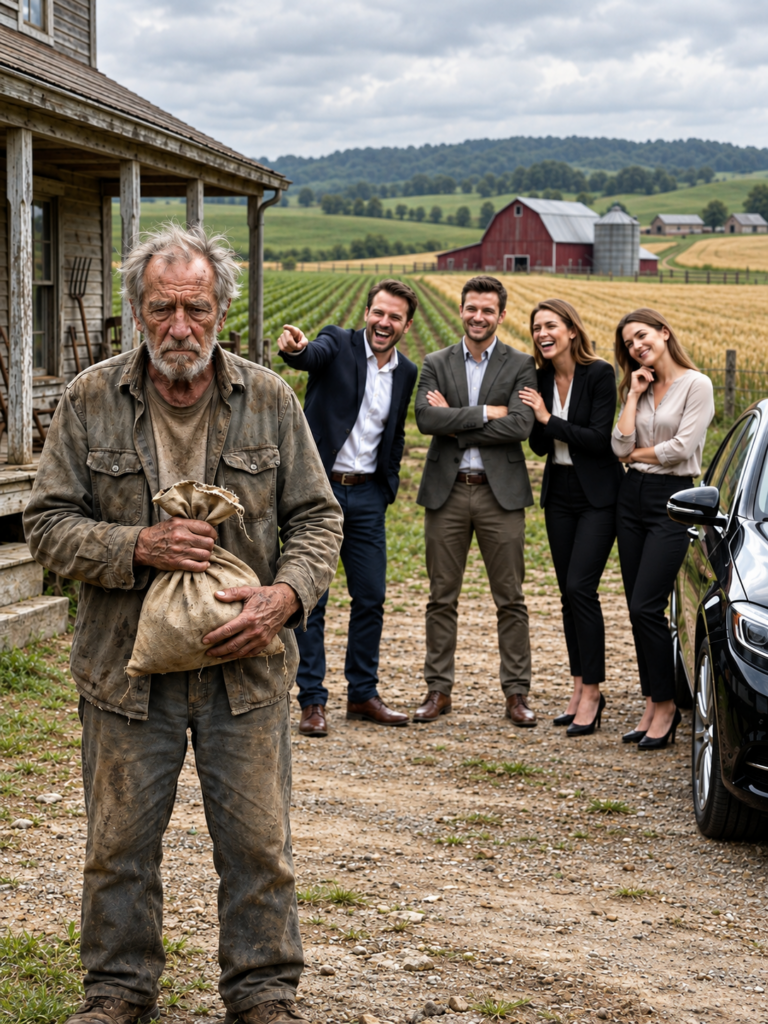
Raymond Dalton was worth more money than most people in his Iowa county would earn in several lifetimes.
He owned six hundred acres of productive farmland, three grain elevators, and an investment portfolio large enough to keep his family comfortable for generations.
But on the first evening of September, the seventy-two-year-old farmer sat alone in a deteriorating single-wide trailer, preparing to tell his four children he had lost everything.
The trailer stood on the northern edge of his property, surrounded by fields he still owned but was pretending had been taken by creditors. Its wood-paneled walls smelled faintly of mildew. The linoleum curled near the bathroom doorway, and the old furnace had to be coaxed into working.
On the narrow kitchen counter sat a photograph of his late wife, Eileen, propped against a mason jar.
Raymond looked at her face for a long time.
“I don’t know if you’d forgive me for this,” he murmured.
Then he picked up the telephone.
By the end of that evening, all four of his children would believe their father was bankrupt.
And over the following nine months, Raymond would discover something he had spent his entire life avoiding.
He knew how to build a fortune.
He had never learned how to build a family without his wife.
The first call went to Marcus, his eldest son.
Marcus answered on the third ring. Raymond could hear voices and office equipment in the background. His son operated a successful insurance brokerage in Des Moines, and even when he wasn’t at work, he sounded as though he were negotiating something.
“Dad? What’s going on?”
Raymond gripped the receiver.
“Marcus, I need to tell you something. I’ve made some bad decisions with the farm.”
He explained that falling grain prices, failed investments, and debts he had concealed had finally caught up with him. The banks had taken control of the operation. The farmhouse was no longer available to him. He was living in the old trailer.
Everything was gone.
Marcus didn’t answer immediately.
Then his voice hardened.
“How could you let this happen?”
Raymond shut his eyes.
“I made mistakes.”
“I told you years ago that you needed to diversify. You kept everything tied up in agriculture.”
“I remember.”
“Is there anything left? Equity in the acreage? Anything you can sell?”
“No, son.”
Marcus breathed out sharply.
“I need to process this. I’ll call you back.”
The conversation ended.
Raymond sat motionless with the telephone in his hand.
His son had asked about the land, the debt, and the possibility of salvaging the business.
He had not asked where Raymond was getting his food.
The second call went to Diane, his daughter in Minneapolis.
She answered while moving between meetings.
When Raymond told her the news, she sounded genuinely distressed.
“Oh, Dad. I’m so sorry.”
For one brief moment, he felt relief.
Then she asked, “Do you have a plan?”
“I’m working on it.”
“Okay. Well, let me know if there’s anything I can do. Things are completely crazy here, but I want to help if I can.”
He thanked her.
Four minutes later, the call was over.
Kevin, his third child, answered from his auto body shop in Ames. Raymond could hear an air compressor running behind him.
Kevin listened without interrupting.
When Raymond finished explaining the supposed bankruptcy, Kevin spoke in a strained voice.
“What about the money you owe me?”
Raymond stared at the wall.
“There’s nothing left, Kevin.”
“But I was counting on that money. The shop—”
Kevin stopped speaking.
For a moment, Raymond could hear only the machinery in the background.
Then the call disconnected.
Raymond remained seated.
Three children.
Three conversations.
Not one had asked whether he was all right.
He dialed the fourth number.
Nora answered on the second ring.
“Hi, Dad.”
Her voice was warm and familiar, carrying something of Eileen’s kindness.
Raymond almost abandoned the entire plan.
Instead, he repeated the story.
The bad investments. The debt. The foreclosure. The trailer.
Nora listened.
When he finished, she asked two questions.
“Dad, are you safe?”
“Yes.”
“Are you eating?”
Raymond swallowed.
“I’m managing.”
“I’m coming Saturday,” she said.
“Nora, there’s no need to—”
“I’m coming Saturday. Don’t argue with me.”
She hung up before he could object.
Raymond lowered the telephone.
Outside, the September evening had turned the soybean fields gold. Somewhere beyond the fence, Harold Jensen’s cattle were settling for the night.
Raymond opened a small leather notebook he had bought at the hardware store.
He wrote four names.
Beside each name, he recorded the first thing that child had asked him.
Marcus: How could you let this happen?
Diane: Do you have a plan?
Kevin: What about the money?
Nora: Are you safe?
He studied the entries.
Then he closed the notebook and placed it beside his wife’s photograph.
For the first time since Eileen’s death, he was afraid of learning the truth.
Forty-eight years earlier, Raymond Dalton had owned almost nothing.
In 1978, his father died, leaving him eighty acres of Iowa bottomland and a mortgage already three payments behind.
Raymond was twenty-four.
That June, he married Eileen Weber in a ceremony so modest that the reception took place in his mother’s kitchen. They ate sheet cake from the grocery store off paper plates, then drove to the old farmhouse that would become their home.
The roof leaked. The windows rattled in winter. The kitchen floor sloped enough to make marbles roll toward the back wall.
Raymond didn’t know how he would pay the mortgage.
Eileen didn’t ask.
She unpacked their dishes, found a bucket for the leak, and told him they had better get started.
And they did.
While Raymond worked the fields, Eileen kept the accounts. She knew which bills could wait, which suppliers would offer better terms, and when they could risk buying another parcel of land.
She caulked windows while he patched the roof.
When harvest season kept him outside until midnight, she carried supper out to the machinery shed.
They expanded from eighty acres to one hundred sixty, then three hundred, then more than four hundred.
Eventually, their holdings reached six hundred acres.
Raymond purchased his first grain elevator when Marcus was six years old. He bought the second in 1991 and the third in 1997.
The farm became one of the most respected agricultural operations in the county.
But Eileen always reminded him that a household was not a business.
Four children grew up beneath the farmhouse roof.
Marcus was the oldest, ambitious and restless, forever looking toward cities and opportunities beyond the cornfields.
Diane came next, intelligent, sharp-tongued, and determined never to let anyone tell her what she couldn’t accomplish.
Kevin was quieter. He preferred engines to arguments, wrenches to books, and the comfort of working with his hands.
Then came Nora, the unexpected youngest child, born when Eileen was thirty-six.
Eileen called her their best surprise.
Marcus left home at eighteen, attended college, and built his insurance business in Des Moines.
Diane moved to Minneapolis and established a demanding career in marketing.
Kevin remained closer, opening an auto body shop in Ames with his wife, Tammy.
Nora became a teacher in Cedar Falls and married a mechanic named Ben Bishop.
The children grew into adults with homes, careers, families, and problems of their own.
And Eileen remained the person who held them together.
She remembered birthdays. She arranged Thanksgiving dinners. She called when someone sounded troubled and visited when a telephone conversation wasn’t enough.
When Marcus struggled financially during the recession of 2008, she drove to Des Moines with a cooler of food and stayed until he talked honestly about what was happening.
When Diane’s marriage collapsed, Eileen flew to Minneapolis and spent two weeks helping her daughter put her life back together.
When Kevin needed twelve thousand dollars to keep his shop operating, Eileen persuaded Raymond to write the check without making their son feel humiliated for needing it.
Raymond provided the money.
Eileen provided the comfort.
Neither of them recognized how dangerous that division had become.
Raymond believed his responsibility was to keep the farm profitable, the bills paid, and his children financially secure.
He loved all four of them deeply.
But he seldom told them.
Then Eileen became sick.
The diagnosis came on a Tuesday afternoon in an examination room that smelled of antiseptic.
Stage-four pancreatic cancer.
Raymond remembered the doctor’s voice but very little of what was said afterward.
Eileen reached for his hand beneath the table.
“What do we do next?” she asked.
For nine months, she endured chemotherapy, radiation, exhaustion, and pain.
Through it all, she kept two things close to her bed: an old recipe box and a leather journal.
The children visited, but not equally.
Marcus came twice, staying less than two days each time.
Diane appeared at Christmas but spent much of her visit dealing with work.
Kevin stopped when he could, although he rarely stayed long. Seeing his mother ill frightened him more than he could admit.
Nora came every weekend.
She brought Lily and Sam, her two young children, and read aloud to Eileen from the worn novels kept above the fireplace.
When Eileen was too tired to listen, Nora sat beside her and held her hand.
Raymond remembered one afternoon when Nora brushed her mother’s hair.
Eileen closed her eyes and said, “You always know what to do with your hands, sweetheart.”
Nora smiled.
“Learned from you.”
Eileen died in July, with the corn growing tall outside her bedroom window.
Raymond was holding her hand.
He continued holding it long after she stopped breathing.
At the funeral, nearly two hundred people crowded into the Lutheran church.
They spoke about Eileen’s generosity, her faith, and the countless ordinary kindnesses she had given without expecting anything in return.
Raymond listened as though the words were coming from a great distance.
Afterward, he noticed things he wished he hadn’t.
Marcus was speaking with a commercial real estate developer in the church parking lot.
As Raymond approached, he heard the phrase grain elevator valuations.
Diane sat in the fellowship hall with her telephone beside an untouched plate of food, repeatedly checking the screen.
Kevin pulled Raymond aside and asked whether Eileen’s life insurance claim had been filed.
Only Nora seemed to notice that her father had stopped speaking.
She found him standing alone in the kitchen near the sink, with the water running.
Without saying a word, she shut off the faucet.
Then she took his hand and stood beside him.
Raymond had spent his life believing that money was how a father protected his children.
That afternoon, with Nora holding his hand, he discovered how little money could do for a man who had lost his wife.
The months following Eileen’s death made the distance worse.
Marcus called to suggest selling the grain elevators while their market value was strong.
Diane missed Thanksgiving because of a business conference.
Raymond cooked a small turkey breast and ate alone across from Eileen’s empty chair.
Kevin asked for twelve thousand dollars to repair the paint booth at his shop.
Raymond gave it to him.
By spring, Kevin had received thirty-one thousand dollars in three separate checks.
Marcus’s conversations continued to revolve around property and investments.
Diane called occasionally.
Nora telephoned every Sunday at six.
She asked about Raymond’s meals, his garden, whether he was sleeping, and whether he had attended church.
When he claimed he was doing fine, she answered, “I don’t believe you, Dad. But I love you anyway.”
Raymond began recording the calls in his notebook.
Not because he planned to punish anyone.
At least, that was what he told himself.
He wanted evidence that the loneliness he felt wasn’t simply grief distorting his judgment.
Then, one April evening, while packing Eileen’s clothing for donation to the church, he discovered her journal.
It fell from a shelf in their bedroom.
He opened it while sitting on the edge of the bed.
Most pages contained observations about farm life, the weather, the children, and the everyday things Eileen had considered worth remembering.
But one entry stopped him.
She had written that children should visit their father because they wanted to see him, not because there was something to sign.
Then came the sentence Raymond could not forget.
He thinks providing is the same as loving. It isn’t. And the children have learned his language.
Eileen believed their children had learned to approach Raymond through transactions because he had rarely offered them another way to reach him.
Raymond read the entry again.
Then again.
He wanted to argue with her.
Hadn’t he given his children everything? Paid for their education? Helped with their homes? Supported them through financial difficulties?
But the longer he sat there, the harder it became to remember the last time he had called one of them for no reason other than wanting to hear their voice.
The next morning, he went to see Frank Myers, the family’s longtime attorney.
“I want to know which of my children would come see me if I had nothing left to give them,” Raymond said.
Frank listened as Raymond described his plan.
Farm income would be directed through a trust account. Equipment would be moved into barns belonging to Harold Jensen, Raymond’s oldest neighbor and friend.
Raymond would leave the farmhouse and live in the old trailer on the north forty.
Then he would tell his children the business had collapsed.
Frank took off his glasses.
“Ray, this is a terrible idea.”
“Probably.”
“You understand that when they discover the truth, they’re going to be furious.”
“If none of them come when they think I’m broke, I don’t know that their anger will matter.”
Frank studied his friend.
“Have you considered simply telling them you’re lonely?”
Raymond looked toward the window.
“I wouldn’t know how to begin.”
Frank did not approve of the plan.
But eventually, he helped arrange the financial structure Raymond requested.
Harold was equally skeptical.
When Raymond explained what he intended to do, the cattle rancher folded his arms.
“Eileen would have something to say about this.”
“She usually did.”
“She’d call you stubborn.”
“She’d be right.”
Harold glanced toward the silver Cadillac in the driveway.
“What are you doing with that?”
“Sell it to you for a dollar.”
“I don’t want your Cadillac.”
“Then leave it in your barn.”
Harold shook his head but accepted the keys.
And on September first, Raymond moved into the trailer.
Nora arrived the following Saturday with her children and several bags of groceries.
Raymond heard the familiar rattle of her station wagon before he saw it.
She was already unloading the car when he reached the door.
“Dad.”
She wrapped her arms around him.
Then she stepped back and studied his face.
“You’ve lost weight.”
“I’m fine.”
“You’re living in a trailer with a broken furnace. You’re not fine.”
She carried the groceries inside.
Milk. Bread. Eggs. Apples. Canned soup. Coffee. A cooked chicken.
She opened the cabinets and saw how little food Raymond had deliberately left there.
For a moment, her face changed.
Then she began filling the shelves.
Lily and Sam played outside, chasing grasshoppers along the field.
Nora made sandwiches and sat opposite Raymond at the narrow table.
“Tell me what happened.”
He repeated the story Frank had helped him prepare.
The bad investments. The debts. The bank.
Nora listened carefully.
When he finished, she reached across the table.
“What do you need, Dad?”
Not what did you lose?
Not what is left?
What do you need?
Raymond had no answer.
Over the following weeks, the others responded differently.
Marcus visited once, arriving in a polished sedan and examining the trailer as though it were a distressed commercial property.
He wanted to review the finances. He discussed restructuring the debt and possibly recovering equity from the land.
He even offered to take Raymond into town for lunch.
Raymond declined.
But Marcus spent most of the visit talking about the decisions his father should have made years earlier.
Before leaving, he promised to call about other property options.
Diane telephoned and suggested that Raymond consider moving into an assisted-living community in Des Moines.
It was not an unreasonable suggestion.
She seemed concerned about his future.
But she did not offer to visit.
Kevin arrived one Saturday morning and sat across from his father, nervously picking at a scratch in the table.
“Do you have anything left?” he asked.
“Nothing.”
“Any savings bonds? Accounts Mom kept separate? Her life insurance?”
Raymond shook his head.
Kevin’s shoulders sagged.
Then the truth came out.
The auto body shop owed the bank eighty-four thousand dollars. Tammy had taken another job because they couldn’t make payroll. Their son Tyler needed braces, and there wasn’t enough money.
Kevin had been counting on the inheritance he expected someday.
“I don’t know what to do,” he whispered.
Raymond recognized the fear in his son’s face.
Kevin wasn’t simply greedy.
He was desperate.
For one terrible moment, Raymond wanted to end the deception.
He could rescue Kevin. He had the resources to do it.
Instead, he remembered Eileen’s words about transactions.
“I wish I could help,” Raymond said.
Kevin nodded, got up, and left.
Raymond watched his truck disappear.
Then he opened the notebook.
This time, he didn’t just record what Kevin had asked.
He wrote about the fear in his son’s eyes.
And for the first time, he felt ashamed of what he was doing.
Nora continued coming every Saturday.
She repaired a cabinet hinge, adjusted a faulty window latch, and brought groceries from Cedar Falls.
One November weekend, she arrived with a casserole and a set of dark blue curtains she had sewn herself.
Raymond watched her hang them over the trailer’s largest window.
“You don’t have to do this,” he said.
“I know.”
“Why bother making curtains for a place like this?”
“Because it’s where you’re living.”
She smoothed the fabric.
“Mom used to say a house feels warm because somebody cares enough to make it that way.”
Later that evening, after feeding the children and putting them to bed, Nora made coffee.
She sat across from Raymond and looked at him for a long moment.
“Come live with us, Dad.”
Raymond stared at her.
“Ben and I talked. We can fix up the back bedroom. Lily and Sam would love having you there.”
“I can’t leave the land.”
“Then I’ll keep coming.”
“You’re spending money you can’t afford.”
“Don’t tell me what I can afford.”
“Nora—”
“Every Saturday, Dad. That’s not a negotiation.”
After she left, Raymond wrote about the visit.
He recorded the curtains, the food, the repairs, and the invitation to live with her family.
Then he compared the notebook’s four sections.
Marcus had a handful of entries.
So did Diane.
Kevin’s pages were full of financial worry and shame.
Nora’s section was becoming longer than all the others combined.
Raymond looked at the blue curtains moving gently beside the window.
He had wanted to discover which child loved him.
Instead, he was beginning to see the terrible price his youngest daughter was paying to prove something she had never known she was being tested on.
Part 2
By December, Raymond’s experiment had become something he could no longer control.
The farm was still profitable. Harvest money moved into accounts managed through Frank Myers’s office, and Harold oversaw the daily agricultural operation while Raymond remained hidden in plain sight.
The corn had been harvested. The grain elevators were operating. Contracts were being honored, and equipment was maintained.
Raymond could have returned to his farmhouse at any time.
He could have slept in his own bed, used his own kitchen, and stopped pretending that his entire life’s work had disappeared.
Instead, he remained in the trailer.
Each morning, he woke to the sound of wind rattling the aluminum walls.
The cold was getting worse.
Frost formed inside the windows, and the furnace struggled to keep up with the falling temperatures.
Some nights, Raymond wore two flannel shirts beneath a vest and still couldn’t get warm.
Nora noticed immediately.
She began bringing heavier meals. Stew with potatoes and onions. Soup that could simmer all afternoon. Bread she could slice and freeze.
She brought a space heater from Ben’s garage.
Her children taped their drawings to the refrigerator. Sam decided the trailer was Grandpa’s camping house, and Lily asked why someone who had spent his life farming didn’t have a television.
Raymond had no sensible answer.
Before long, the little trailer contained signs of Nora everywhere.
Blue curtains hung at the window. A crocheted blanket rested over the couch. Children’s pictures covered the refrigerator, and a small jar held dried wildflowers Nora had collected along the road.
The place no longer looked entirely abandoned.
It looked as though someone cared about the man living inside.
One afternoon in mid-December, Harold arrived carrying a package of bacon and an expression Raymond knew well.
He made coffee while Harold removed his boots.
They sat opposite each other at the small table.
“How much longer?” Harold asked.
Raymond understood immediately.
“As long as it takes.”
“As long as what takes?”
Raymond said nothing.
Harold leaned back.
“You’ve got your answer. Marcus came down looking at property. Diane’s barely called. Kevin wanted money. Nora’s been here every Saturday carrying groceries and fixing things.”
“I need to know if it lasts.”
Harold stared at him.
“Lasts?”
“If Nora keeps coming when the weather gets bad. When it becomes harder.”
“She’s got two children and a husband and a job. She’s driving all the way here because she loves you.”
Raymond looked toward the window.
“I need to be certain.”
Harold slowly set down his coffee.
“Ray, are you testing your children, or are you punishing them?”
The question struck more deeply than Raymond expected.
He wanted to tell Harold he was wrong.
But he couldn’t.
After Harold left, Raymond remained at the table, listening to the furnace click and rattle.
He looked at the notebook.
Originally, it had been a record of what his children did.
Somewhere along the way, it had become a record of how long he could make them prove themselves.
And he no longer knew where the difference lay.
Christmas Eve arrived under gray Iowa skies.
Nora drove down with Ben and the children.
They carried a ham, a pecan pie, and a small Christmas tree with battery-powered lights.
Lily insisted on putting the tree near the window.
Sam helped arrange the decorations, although he spent most of the time moving the same ornament from one branch to another.
Ben crawled beneath the trailer to inspect the insulation around the pipes.
When Raymond protested, Ben simply said, “Might as well check it before something freezes.”
They ate dinner crowded around the little table.
Lily sang a Christmas carol she had learned at school. Sam fell asleep in his father’s lap before dessert.
Raymond watched Nora washing dishes at the sink.
She moved through the narrow kitchen with the same practical confidence Eileen had possessed.
There was no performance in her kindness.
She noticed what needed doing and did it.
When the dishes were finished, Nora handed him a wrapped package.
“From all of us.”
Raymond carefully pulled away the paper.
Inside was a framed photograph of Eileen standing beside Nora in the farmhouse garden.
The picture had been taken during late summer. Eileen’s arm rested around her daughter’s shoulders, and she was laughing at something outside the frame.
Raymond had never seen it.
“Where did you get this?”
“Mom’s phone. I found it when I was looking through her pictures.”
Raymond touched the edge of the frame.
For a moment, he could almost hear his wife’s laugh.
He wanted to say something beautiful.
Something that would tell Nora what the gift meant to him.
But his voice failed.
So he stood and hugged his daughter.
She held him without asking for an explanation.
Marcus did not call that Christmas.
Diane sent a card that arrived several days later.
Kevin called Christmas morning. They exchanged greetings during a short, awkward conversation in which neither man knew what to say.
Later, Nora learned from Tammy that Kevin had been drinking heavily.
Raymond heard about it but did nothing.
He told himself Kevin had to learn to stand on his own.
The excuse felt less convincing every time he repeated it.
January brought bitter cold.
Snow drifted against the trailer’s steps. The windows developed thick patterns of ice, and Raymond sometimes woke before dawn with his hands stiff and his knees aching.
He was seventy-two, and although he had spent his life working outdoors, the winter was wearing him down.
Late in the month, he developed a cough.
At first, he ignored it.
He had worked through colds before. He had repaired machinery in freezing rain and harvested crops while running a fever.
But the cough worsened.
His chest began to hurt, and even crossing the short distance from the bed to the kitchen left him short of breath.
On Sunday evening, Nora telephoned at six.
“Dad, what’s wrong with your voice?”
“Nothing. Just a cold.”
“How long have you been coughing?”
“A few days.”
“Have you seen anyone?”
“No need.”
“Dad.”
He recognized the warning in her voice.
“It’s nothing to worry about.”
“I’m coming tomorrow.”
She arrived at eight the next morning.
One look at her father was enough.
She put her hand against his forehead, collected his coat, and drove him to the clinic.
The diagnosis was pneumonia.
The physician recommended hospital admission.
Raymond refused.
Nora argued with him in the parking lot while their breath formed clouds in the cold air.
Eventually, they reached a compromise.
He would return to the trailer only if she stayed to supervise his medication and recovery.
Nora called Ben.
“I’m going to be here for a few days. Can you handle the kids?”
Ben didn’t hesitate.
She called her school and arranged for someone to cover her classroom.
For four days, she slept on the trailer’s uncomfortable couch.
Every six hours, she checked Raymond’s medicine.
She heated broth, made sure he drank water, and sat awake during the worst nights listening to his breathing.
Ben came down with insulation materials and spent an afternoon sealing the cold gaps beneath the trailer.
Afterward, he sat with Raymond talking about engines while Nora graded spelling tests at the table.
Raymond looked at the young couple and felt a deep, unfamiliar discomfort.
They were giving him time they couldn’t easily spare.
Nora was missing work.
Ben was spending money on materials for a trailer Raymond didn’t need to be living in.
Both believed they were helping an elderly man who had lost his fortune.
And Raymond, who could have paid every bill without noticing the expense, was allowing them to make those sacrifices.
On the third evening, his fever finally broke.
Nora sat beside the lamp with a book.
Raymond watched her for several minutes.
“Thank you,” he said.
She looked up.
“For what?”
“For staying.”
Nora closed the book.
“You’re my dad.”
He turned toward the wall so she wouldn’t see his eyes.
The next morning, Marcus called.
Raymond answered while Nora was in the shower.
“Dad, I’ve heard something you should know about.”
Marcus explained that Summit Development was purchasing agricultural parcels in the county and offering above-market prices.
“If you still have any ownership in the north forty, we might be able to work something out.”
Raymond coughed into his hand.
“I don’t have anything to sell.”
“Are you sure? Even a partial interest might be worth something.”
“Marcus, I’m sick.”
There was a pause.
“What do you mean?”
“I have pneumonia.”
“Oh.”
Raymond waited.
“Are you being treated?”
“Nora’s here.”
“Good. That’s good.”
Another pause.
“Well, think about what I said. Those offers won’t last forever.”
The call ended.
Raymond stared at the receiver.
His eldest son had discovered an opportunity to sell farmland before discovering his own father was seriously ill.
Marcus had not intended to be cruel.
He had asked whether Raymond was receiving treatment.
But he had not offered to visit.
Raymond opened his notebook and recorded the conversation.
Then he put the pen down and felt sick in a way the pneumonia couldn’t explain.
That night, he returned to Eileen’s journal.
He had been reading it slowly since her death, reluctant to reach the final page and lose the last new words she could ever give him.
An entry written years earlier caught his attention.
Eileen had described how Raymond rebuilt a barn after a fire in 1994. How he held Nora through a childhood illness and once drove through a blizzard to rescue Kevin from a college party.
She had never doubted his love.
But she had also written about the things he neglected.
He hadn’t attended Kevin’s baseball games.
He hadn’t regularly called Diane when she was away at college.
He had never told Marcus how proud he was that his eldest son had built something of his own.
Raymond remembered each omission.
He remembered choosing work over games, postponing telephone calls, and believing his children already understood what he felt.
His love had been real.
But he had buried it so deeply beneath responsibility that his children had never learned to recognize it.
He closed the journal.
Eileen had not written those words to accuse him.
She had been trying to teach him something while there was still time.
And now, years later, he had created an elaborate test to measure the love of children he had never taught how to express it.
Spring arrived slowly.
The snow melted into mud, and the fields began turning green.
Raymond recovered from pneumonia, though his back and joints ached more than they had before the winter.
Nora continued visiting.
She still brought groceries. She still checked the cabinets and windows, still asked whether he was eating and whether he was lonely.
Kevin’s life, meanwhile, was collapsing.
His auto body shop closed in February.
The bank debt had become impossible to manage.
He found part-time work at an auto parts store in Ames, earning fourteen dollars an hour.
Tammy worked two jobs.
Their son Tyler began missing school.
Kevin grew withdrawn and angry, ashamed that he could no longer provide for his family.
Tammy called Nora because she didn’t know who else to ask.
Nora drove to Ames on a Sunday in March.
She found her brother sitting in his garage, staring at a car he couldn’t afford to repair.
“I brought some groceries,” she said.
“I don’t need charity.”
“They’re for Tammy and Tyler, too.”
“Go home, Nora.”
She didn’t argue.
She carried the food inside and spent an hour talking with Tammy.
The following day, Tammy sent her a short message.
He ate the soup. Thank you.
When Raymond heard what had happened, his guilt grew worse.
He had watched Kevin’s business fail while knowing he possessed enough money to prevent it.
Was he teaching Kevin something?
Or had his desire to expose his children’s selfishness blinded him to his own?
He couldn’t answer.
Marcus continued dealing with business matters.
Diane remained absorbed in her career, occasionally calling and promising she would visit when things became less demanding.
They never did.
And Nora kept arriving every Saturday.
The days lengthened. The corn was planted. The grain elevators continued operating under Harold’s supervision.
Raymond’s bank accounts remained healthy.
His family did not.
One evening in late May, he sat beside Nora on the trailer steps.
The sun was dropping over the fields. The air smelled of freshly turned earth, and the corn had begun rising in tidy green rows.
Lily and Sam were sleeping inside.
Nora looked toward the farmhouse in the distance.
“What did Mom used to say about this place?”
Raymond considered the question.
“She said the land would outlast all of us, so we’d better make sure we deserved it.”
Nora smiled faintly.
“That sounds like her.”
They sat together.
After a while, she asked, “Do you miss her?”
Raymond looked toward the horizon.
“Every day.”
He paused.
“Every hour.”
Nora rested her arms on her knees.
“She’d want you back in the house, Dad.”
Raymond didn’t respond.
“She wouldn’t want you spending another winter in here.”
“Maybe.”
“Not maybe. She’d want you warm. She’d want you comfortable. She’d want you surrounded by the things you built together.”
Raymond looked across the fields at the farmhouse.
It was still his.
So was every acre he could see.
Everything he had spent nine months pretending to lose was waiting for him.
But Kevin’s business was gone.
Diane had spent months keeping her distance.
Marcus had become a stranger who communicated in financial proposals.
And Nora had given more than Raymond would ever be able to repay with money.
He had wanted to discover who would stand beside him when he had nothing.
He already knew.
Continuing the deception could only cause more harm.
“I think it’s time,” he said.
Nora turned.
“Time for what?”
“To stop this.”
She watched him carefully.
“Stop what, Dad?”
Raymond couldn’t bring himself to explain it on the steps.
“I need all four of you here next Saturday.”
“Why?”
“Because there’s something you need to know.”
Nora waited.
When he offered nothing more, she nodded.
“I’ll make the calls.”
That night, Raymond opened his notebook.
He reviewed nine months of entries.
Marcus’s section held four visits or conversations primarily concerned with property and money.
Diane’s contained three brief contacts.
Kevin’s was filled with a handful of painful encounters and the growing evidence of his shame.
Nora’s section filled thirty-seven pages.
Thirty-seven pages of groceries, meals, repairs, visits, medicines, conversations, and care.
Raymond closed the notebook and telephoned Frank Myers.
“It’s time,” he said.
The following Monday, Nora contacted her siblings.
Marcus immediately asked whether the gathering concerned the farm.
Nora told him she didn’t know.
Diane wanted to postpone the meeting because of a conference call.
Nora insisted on Saturday at ten.
Kevin agreed reluctantly.
When Saturday morning arrived, the Iowa sky was bright and clear.
Harold had spent several days preparing the farmhouse.
The windows were open. The counters were clean. Coffee brewed in the kitchen where Eileen had once cooked breakfast for six people every morning.
On the dining room table lay the farm’s financial statements, grain elevator contracts, and investment records.
The truth, documented in black and white.
Raymond stood beside them in clean clothes, his boots polished, his hands trembling slightly.
Nora arrived first with Ben and the children.
She stopped on the porch when she saw the farmhouse door standing open.
“We’re meeting here?”
“Yes.”
She looked at her father, then toward the kitchen.
But she said nothing.
Marcus arrived shortly before ten.
Diane followed in a rental car.
Kevin came last, his old truck rattling up the gravel driveway.
Harold took Ben and the children outside while the four siblings gathered in their mother’s kitchen.
Marcus stood near the counter.
Diane sat with her hands folded.
Kevin remained close to the door, looking down at the floor.
Nora took a seat at the table.
Raymond stood at its head.
He placed the worn leather notebook beside the financial documents.
Then he looked at the four people Eileen had loved more than anything else in the world.
For nine months, he had prepared himself for this moment.
He had imagined anger. Accusations. Embarrassment.
He had never imagined how frightened he would feel.
Raymond put one hand on the table to steady himself.
“The farm didn’t go bankrupt,” he said.
Marcus looked up.
Diane stopped moving.
Kevin slowly raised his head.
Nora stared at her father.
Raymond drew a breath.
“The farm is still mine. The elevators are operating. The investments are safe.”
He touched the notebook.
“I lied to all of you.”
Part 3
For several seconds, nobody spoke.
The kitchen looked exactly as it had when they were children. Eileen’s curtains hung at the windows. Her dishes remained in the cabinets, and the old hook beside the back door still waited for the apron she would never wear again.
But the people standing in that familiar room had become strangers to one another.
Marcus spoke first.
“You lied?”
“Yes.”
“About the bankruptcy?”
“All of it.”
Marcus glanced toward the financial statements.
“The foreclosure? The debts?”
“There was no foreclosure. The farm never stopped making money.”
Diane pressed her hands together.
Kevin stared at the table.
Nora remained seated, studying Raymond’s face as though she were trying to recognize the man sitting behind it.
“Why?” Marcus asked.
Raymond lowered himself into a chair.
“After your mother died, I started noticing things. The calls. The visits. What everyone wanted.”
He swallowed.
“I couldn’t tell whether my children cared about me or whether they only cared about what I could give them.”
Marcus stepped away from the counter.
“So you decided to test us?”
Raymond nodded.
“I moved into the trailer. Frank handled the accounts. Harold managed the farm. I told you I was broke because I wanted to see who would still come.”
Marcus gave a short, disbelieving laugh.
“You manipulated us.”
Raymond did not argue.
“I did.”
“You watched us for nine months?”
“Yes.”
“And wrote everything down?”
Raymond looked at the notebook.
“Yes.”
Marcus’s face reddened.
“That’s unbelievable.”
Raymond opened the notebook.
He had imagined this moment so many times that he thought he would know exactly what to say.
But now that his children were standing before him, the entries seemed different.
These were not strangers whose behavior he had been studying.
They were his sons and daughters.
Still, he began.
“Marcus, you came to the trailer once. You asked about the acreage, the loans, and whether there was anything left to sell. You called about the mineral rights and the development company. When you learned I had pneumonia, you were calling about land.”
Marcus stared at him.
“You didn’t offer to come,” Raymond finished quietly.
He turned a few pages.
“Diane. You called three times in nine months. You suggested senior housing. You sent cards, but you never visited.”
Diane looked down at her hands.
“Kevin.”
Raymond hesitated.
“You came looking for accounts, insurance money, anything your mother might have left. When I told you there was nothing, you went away.”
Kevin’s face tightened.
“You didn’t come back when I was sick.”
Raymond closed the notebook.
Then he looked at Nora.
“Your sister came every Saturday. For nine months.”
His voice grew unsteady.
“She brought groceries. Fixed things around the trailer. Sewed curtains. Cooked your mother’s recipes. When I got pneumonia, she slept on that couch for four nights and made sure I took my medicine.”
He looked toward the kitchen window.
“Ben insulated the trailer. Lily and Sam filled the refrigerator with pictures. Nora offered me a room in her house.”
He paused.
“She never asked what was left of the farm. Never asked about the accounts or the will.”
Raymond looked at his youngest daughter.
“She asked whether I was eating. Whether I was warm. Whether I was lonely.”
Nora’s eyes glistened.
Raymond set the notebook on the table.
“That’s what happened.”
Marcus stepped forward.
“No, Dad. That’s not all that happened.”
Raymond looked at him.
“You had money the entire time.”
“Yes.”
“Kevin lost his business.”
Kevin shifted near the door.
Marcus pointed toward the documents.
“You had two million dollars sitting in a trust account, and you watched your own son lose everything.”
Raymond lowered his head.
“I know.”
“You could have helped him.”
“I could have.”
“But you wanted to finish your little experiment.”
Raymond didn’t answer.
Because Marcus was right.
Kevin finally spoke.
“I was ashamed.”
His voice was so quiet that Diane leaned forward to hear him.
Kevin rubbed his face.
“Every time I came to see you, I needed something. Money for the shop. Money for the mortgage. Money for Tyler.”
He stared at the floor.
“I didn’t know how to come to your house and just sit down.”
Raymond watched him.
“I thought if I showed up without a reason, you’d wonder what was wrong with me.”
“Kevin—”
“The shop closed in February. Tammy’s working two jobs. I’m stocking shelves at a parts store for fourteen dollars an hour.”
Kevin’s voice broke.
“I couldn’t come sit in your trailer and pretend everything was fine when my whole life was falling apart.”
Raymond reached toward him, then stopped.
For years, he had treated his son’s financial problems as problems that could be solved with checks.
He had never asked Kevin what it felt like to carry them.
And when Kevin’s fear became impossible to hide, Raymond had used it as evidence against him.
“I’m sorry,” Raymond whispered.
Kevin turned away.
Diane spoke next.
“I kept telling myself I’d visit when work slowed down.”
She looked toward the empty chair where her mother used to sit.
“But work never slows down. There’s always another project, another meeting, another reason to wait.”
She wiped beneath her eyes.
“I could have come, Dad.”
Raymond looked at her.
“I know you have responsibilities.”
“That’s not the point.”
Diane shook her head.
“I chose not to come. I can’t pretend otherwise.”
Marcus folded his arms.
“None of this makes what you did right.”
“You’re correct,” Raymond said.
Marcus seemed surprised by the answer.
Raymond looked at his eldest son.
“I should have talked to you. I should have told you how lonely I was.”
“Then why didn’t you?”
Raymond struggled for words.
“Because I didn’t know how.”
The admission embarrassed him more than any financial failure ever could have.
“Your mother always knew what was happening with everyone. She told me when to call, when someone needed help, when somebody was hurting.”
He glanced at Eileen’s photograph on the counter.
“After she died, I didn’t know how to reach any of you.”
Nora stood.
She walked toward the window, looking out at her children playing in the yard.
Then she turned.
“Did you test me, too, Dad?”
Raymond felt his stomach tighten.
“Nora—”
“Every Saturday, when I came with groceries, did you write down what I brought?”
He couldn’t lie to her again.
“Yes.”
“Did you count how many times I visited?”
“Yes.”
“Did you wonder if I was pretending?”
“No.”
“Then why does my name fill thirty-seven pages?”
Raymond looked at the notebook.
“Because I needed to remember what love looked like.”
Nora’s expression changed.
She seemed torn between wanting to comfort him and wanting him to understand what he had done.
“I didn’t pass a test, Dad.”
Raymond remained quiet.
“I came because you’re my father. Because I thought you were alone and broke and cold.”
Her eyes filled.
“I didn’t need a prize for that.”
“I know.”
“Do you?”
Raymond looked at her for a long moment.
“I’m learning.”
Nora wiped her eyes.
Then she turned toward her siblings.
“We all failed.”
Marcus looked at her sharply.
“Speak for yourself.”
“I am.”
She gestured toward the room.
“Mom held this family together. She remembered everything. She made the calls, planned the dinners, noticed when someone was hurting.”
Her voice steadied.
“And we all let her do it.”
She looked at Raymond.
“You did, too, Dad.”
He nodded slowly.
“You never went to Kevin’s baseball games. You barely called Diane when she was at college. You never told Marcus you were proud of him.”
Marcus looked away.
“Mom told me before she died that she worried about you,” Nora continued.
“She knew you loved us. But she also knew you didn’t know how to show it.”
Raymond remembered Eileen’s journal.
He remembered reading those same accusations in her handwriting, months after he could no longer answer them.
His wife had tried to tell him the truth for years.
He had been too busy to listen.
Raymond placed both hands flat on the table.
“Your mother was right.”
Nobody interrupted.
“I built the farm. I paid for your education. I helped when you needed money. And I thought that meant I was doing my job.”
He looked at Kevin.
“I’m sorry for the baseball games I missed.”
Then Diane.
“I’m sorry for the calls I never made.”
Finally, Marcus.
“And I’m sorry I never told you how proud I was of what you built. I was proud, Marcus. I still am.”
Marcus’s expression changed, but he didn’t speak.
Raymond looked around the table.
“I’m sorry for the lies. For the test. For letting your mother do all the loving while I did the work.”
He lowered his voice.
“I can’t give back the time we’ve lost.”
Nora returned to the table and sat beside him.
She placed a hand on his arm.
She did not tell him everything was forgiven.
Kevin pulled out a chair and sat down.
Then Diane joined them.
Marcus remained standing near the counter.
For a long moment, he looked at the notebook.
Finally, he took the last empty chair.
The five of them sat together in Eileen’s kitchen.
The farm was still there.
The money was still there.
But for the first time in years, none of them seemed interested in discussing it.
Raymond looked at his children.
“I’ve got some decisions to make about the property and the will,” he said.
“Not today.”
He glanced around the table.
“Today, I just wanted you here.”
They stayed for lunch.
Nobody had planned it.
Harold came inside with Ben and the children, looked at the family gathered around the kitchen table, and began making sandwiches.
Lily climbed into her grandfather’s lap.
Sam played with a toy truck on the floor.
The conversations were awkward, but they happened.
Kevin asked Harold about the cattle.
Diane asked Nora how things were going at school.
Marcus said little, though he remained long after he ordinarily would have left.
At one point, he picked up Raymond’s notebook and turned to his own entries.
He read them slowly.
When he finished, he pushed the notebook back across the table.
“You should have just talked to us,” he said.
Raymond nodded.
“I know.”
There was no dramatic embrace.
No sudden restoration of everything they had lost.
But when Marcus left that afternoon, his voice was softer.
And when Kevin climbed into his truck, he looked toward the porch and raised a hand.
Raymond raised his in return.
It was a small beginning.
That evening, Nora and Raymond sat together on the farmhouse porch while Ben took the children into the yard.
Raymond brought out Eileen’s old recipe box.
“Your mother wanted you to have this.”
Nora took it carefully.
Inside were decades of handwritten recipes.
Pot roast. Chicken and rice. Pecan pie. Cinnamon rolls.
Some cards were spotted with grease. Others had been rewritten when the paper became too worn.
Nora turned through them with a faint smile.
Then she discovered an envelope tucked behind the dessert section.
Her name was written on the front in Eileen’s handwriting.
She looked at Raymond.
“I didn’t know that was there,” he said.
Nora opened the envelope and read the letter silently.
When she finished, she pressed it against her chest.
Raymond waited.
“What did she say?”
Nora shook her head.
“That’s between Mom and me.”
He nodded.
Then Nora looked at him.
“But she said she wasn’t worried about me.”
She glanced toward the farmhouse.
“She was worried about you.”
Raymond leaned back in his chair.
“She had reason to be.”
They remained together until the evening cooled.
And when Lily appeared at the door asking whether they were sleeping in the farmhouse that night, Nora answered before Raymond could.
“Yes, sweetheart. We’re staying.”
The following morning, Raymond moved back into his home.
Harold helped carry the belongings from the trailer.
Eileen’s photograph.
Her journal.
Raymond’s notebook.
And the dark blue curtains Nora had sewn.
Raymond refused to leave the curtains behind.
They reminded him of the difference between having a house and having someone who cared whether it was warm.
A week later, Frank Myers returned to the farmhouse with a briefcase full of legal documents.
He and Raymond spent the afternoon reviewing the estate arrangements.
This time, Raymond was not interested in discovering which child deserved the largest reward.
He had already seen what happened when he treated family relationships like an accounting exercise.
The six hundred acres and three grain elevators would eventually belong to a family trust, with Nora serving as its primary steward.
She would oversee the land and its operations for the benefit of the grandchildren, including Marcus’s two children, Kevin’s son Tyler, Nora’s Lily and Sam, and future grandchildren.
Marcus, Diane, and Kevin would receive equal shares of the investment portfolio.
There would be no clauses punishing anyone for failing Raymond’s experiment.
Raymond had considered them.
Harold had talked him out of it.
“You’ve already tested those kids once,” his friend said. “Don’t make the rest of their lives another test.”
Raymond finally understood.
He couldn’t repair his family by controlling their behavior from beyond the grave.
He could leave them security.
The rest would require something harder.
Showing up while he was still alive.
Frank prepared the documents.
Raymond added one handwritten request.
Sunday dinner at the farmhouse.
First Sunday of every month.
Come because you want to.
The table is big enough.
When the paperwork was complete, he called each child to explain.
Marcus thanked him.
Diane said she understood.
Kevin remained quiet for a long time.
Then he whispered, “I don’t deserve it.”
Raymond gripped the telephone.
“It’s not about deserving, Kevin.”
His son didn’t respond.
“It’s about belonging. You’re my son. You belong to this family, and you always will.”
The first Sunday dinner took place in July.
Nora arrived the previous afternoon with Ben, Lily, and Sam.
She spent the evening cooking in Eileen’s kitchen.
The farmhouse filled with the familiar smells of pot roast, mashed potatoes, and green beans from Harold’s garden.
Nora brought out her mother’s good dishes, the white plates with blue rims that had been a wedding gift decades earlier.
Kevin arrived early.
He stood in the doorway wearing a clean collared shirt.
“Need any help?”
Nora handed him a bag of potatoes and a peeler.
“These aren’t going to peel themselves.”
Kevin sat at the counter and began working.
Diane arrived from Minneapolis carrying a pie and a bottle of wine.
She confessed that the pie came from a bakery because her attempt at making one had ended badly.
Nora laughed.
“At least you tried.”
Diane looked around the kitchen.
For the first time in years, she wasn’t checking her watch.
Marcus arrived last.
His wife, Veronica, sat beside him, and their two college-age children rode in the back seat.
Raymond met his eldest son on the porch.
Marcus hesitated.
Then Raymond offered his hand.
Marcus took it.
Their handshake lasted longer than either expected.
Neither man knew how to say everything that remained between them.
So neither tried.
They went inside together.
Dinner was crowded, noisy, and imperfect.
There weren’t enough chairs, so Ben brought in a folding table and covered it with a bedsheet.
Lily spilled her milk.
Sam dropped a bread roll, which Harold’s dog immediately stole.
Tyler sat looking at his telephone until Kevin quietly asked him to put it away.
Marcus and Ben discussed engines, a subject Marcus knew less about than he pretended.
Diane asked Lily about school and listened carefully to the answer.
Kevin helped Sam cut his food into smaller pieces.
Harold ate quietly at the far end of the table.
Nora stood for a moment in the kitchen doorway, a dish towel resting over her shoulder.
Raymond caught her eye.
She smiled.
And Raymond understood that she wasn’t smiling because she had inherited responsibility for the farm.
She was smiling because her family was eating together.
He sat at the head of the table in Eileen’s old chair.
That morning, he had moved it there himself.
For forty-seven years, Eileen had been the center of the family.
Raymond had spent his life sitting nearby, believing that earning money and keeping the farm operating were enough.
Now it was his turn to do more.
After dinner, Kevin and Marcus washed the dishes side by side.
Marcus washed.
Kevin dried.
They didn’t say much.
But they stood together until the sink was empty.
Diane helped Nora put away the leftovers.
“I’m coming next month,” she said.
Nora nodded.
“And the month after that.”
“I know.”
Diane looked at her.
“I mean it.”
Nora smiled.
“I know you do.”
Later, Kevin found Raymond sitting on the porch.
He took a seat on the step below him, the way he had when he was a boy.
“I’ve been thinking about leaving the parts store,” Kevin said.
Raymond turned.
“What would you do?”
“I talked to Harold. He said he could use some help with the cattle. And maybe I could learn to work the elevators, if you’d let me.”
“You want to come back to farming?”
Kevin looked out at the fields.
“I want to come back to something.”
Raymond placed his hand on his son’s shoulder.
For once, he didn’t offer him a check.
He simply left his hand there.
Kevin reached up and covered it with his own.
The house gradually emptied.
Diane left first.
Marcus and his family stayed longer, with Veronica promising Nora she would bring a casserole next time.
Kevin was the last to leave.
At the door, he shook Raymond’s hand.
“Thank you for today.”
Raymond smiled.
“It’s just dinner.”
Kevin shook his head.
“It’s not just dinner. You know that.”
Raymond watched his son’s truck disappear down the gravel road.
Then he went back inside.
Nora and Ben were putting the children to bed upstairs in the bedroom Nora had occupied when she was young.
The farmhouse smelled of food and coffee.
There were dirty plates waiting to be put away and a few crumbs beneath the table.
It was everything Eileen would have loved.
Raymond stepped onto the porch one final time.
The night was warm.
Beyond the yard, the grain elevators stood against the fading blue sky.
The fields stretched toward the horizon, six hundred acres of land that had once meant almost everything to him.
He reached beneath his shirt and touched the wedding ring he wore on a chain around his neck.
He had carried Eileen’s ring there since the funeral.
The little gold band was worn smooth from decades of work.
He rubbed it between his fingers.
“You would have been furious with me,” he whispered.
He thought about the trailer, the lies, the notebook, and the months he had wasted waiting for his children to prove something.
“But you would have come to dinner.”
A faint smile touched his face.
“You always did.”
From inside the house, he heard Nora laughing at something Ben had said.
Then came Sam’s sleepy voice asking for water.
The screen door opened.
Lily stepped onto the porch in her bare feet.
“Grandpa?”
Raymond turned.
His granddaughter stood in the doorway, seven years old, with Eileen’s eyes and Nora’s stubborn expression.
“Are you coming inside?”
Raymond looked once more toward the fields.
For most of his life, he had measured success in acres, investments, and buildings that would outlast him.
He had thought the most important thing he could leave behind was a fortune.
But none of those things had brought him back into the farmhouse that evening.
Not the land.
Not the grain elevators.
Not the millions sitting in the bank.
It had been a daughter who brought groceries every Saturday, even when she believed he had nothing left.
It had been a family willing, however imperfectly, to begin again.
And it had been the lessons of a woman who had spent forty-seven years showing him that love was something people did, not something they owned.
Raymond released the wedding ring.
“I’m coming, sweetheart.”
He stepped toward the door.
Lily reached for his hand.
And together they walked inside, into the light and warmth of the farmhouse, where someone was waiting for him.


