
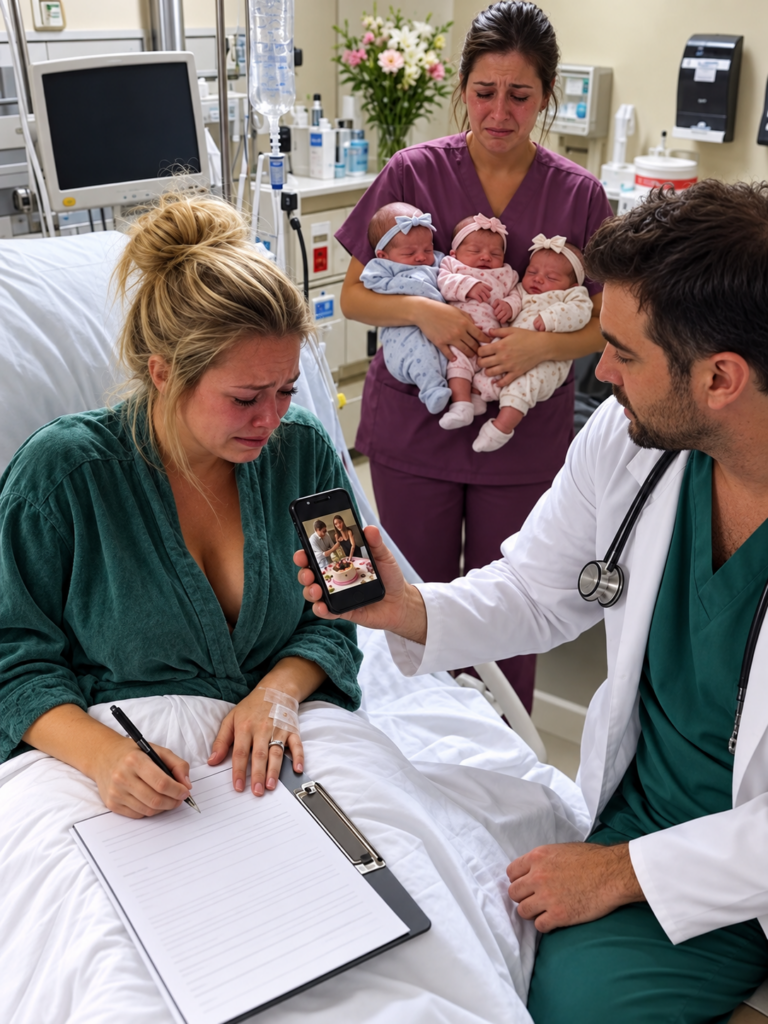
Part 1
The photograph trembled between my fingers.
Across from me, Nathan Whitmore stared at it as though someone had placed a loaded gun on the bench between us.
“What fourth file?” he asked.
I watched his face closely. Six weeks earlier, I would have answered him immediately. I would have explained what I knew, reassured him that I didn’t suspect him of anything worse, and probably apologized for upsetting him.
That was the woman I had been before three daughters entered the world while their father was cutting a birthday cake with another woman.
Now I folded the photograph and slipped it into my purse.
“I was hoping you could tell me.”
Nathan rubbed his palms against his trousers. He had lost weight since the delivery. The polished confidence he once wore into every room seemed to have deserted him.
“Rachel, I swear I don’t know what that means.”
“Then somebody wants us to find out.”
He looked toward the parking lot. My older brother, Owen, waited beside his truck, pretending to check his phone. He had promised not to interfere unless I needed him.
Nathan followed my glance.
“Does Owen know about this?”
“Not yet.”
“Maybe we should talk somewhere private.”
“We are talking somewhere private enough.”
His shoulders dropped.
I could see the moment he recognized that he no longer had the authority to decide where our conversations happened.
For eleven years, Nathan had controlled the atmosphere of our marriage without ever appearing to give orders. He decided when a disagreement had gone on long enough. He decided whether my fears were reasonable. He decided what counted as an emergency.
I had made the mistake of calling that steadiness.
Six weeks earlier, I had learned the difference between steadiness and indifference.
It had started on a Thursday afternoon, when I was thirty-two weeks pregnant and struggling to breathe through a contraction that seemed to wrap around my back.
The nursery wasn’t finished. Three bassinets waited against a pale yellow wall, still holding folded instruction sheets. A basket of tiny socks rested on the changing table. Beside it stood a mug of cold peppermint tea.
Nathan had left that morning for what he described as an important client luncheon.
I had asked him to stay.
“Dr. Romero said she wants me monitored,” I reminded him as he adjusted his tie.
“And you’re being monitored.”
“At the hospital, Nathan. She said I might need to go in today.”
He sighed.
“Rachel, I can’t keep canceling my entire life because every little symptom frightens you.”
I stood in the bedroom doorway, one hand beneath the weight of my stomach.
“It isn’t every little symptom. There are three babies.”
His expression softened just enough to make me doubt my anger.
“I know, sweetheart. And I’m working to give them a good life.”
He kissed my forehead, picked up his car keys, and left.
At 1:17 p.m., my water broke.
By 1:43, I was in an ambulance.
By 2:06, the doctors were discussing an emergency cesarean section.
And Nathan wasn’t answering his telephone.
I remembered the ceiling tiles moving above me as they pushed my bed down the corridor. I remembered a nurse named Evelyn Pierce pressing a warm hand against my shoulder.
“Rachel, I need you to keep breathing with me.”
“Has anyone reached my husband?”
Her eyes flicked toward the physician walking beside us.
“We’re still trying.”
I knew what that meant.
They had called him repeatedly. They had probably called his office, too.
I was the woman who had spent seven months arranging appointments around his schedule, sending him ultrasound photographs, reminding him which baby was measuring small.
Now I was about to become a mother while listening to strangers discuss the possibility of losing one of my children.
Dr. Elena Romero leaned close.
“Rachel, we need to move quickly. Baby C is showing signs of distress.”
Baby C.
The smallest of the three.
The little girl I had privately called Wren because she moved so lightly.
I grabbed the doctor’s wrist.
“Please save them.”
“We’re going to do everything we can.”
After that, the memories came in broken pieces.
A bright operating room.
Someone placing a mask over my face.
A pressure beneath my ribs.
A baby’s faint cry.
Then another.
Then silence where the third should have been.
I remembered trying to lift my head.
“Where is she?”
Nobody answered immediately.
That silence would live inside me for the rest of my life.
When I woke properly, my daughters had names.
Ava.
June.
Wren.
I had written them on a folded page months earlier, long before Nathan bothered asking whether I had thought about names.
Ava was stable.
June needed respiratory support.
Wren was fighting for every breath.
Nathan was still absent.
Nurse Pierce sat beside me when I finally asked how long I had been there.
“Nearly fourteen hours since surgery.”
I looked at the empty chair.
“Did he call?”
She hesitated.
“Not yet.”
I turned my face toward the window.
I didn’t cry.
I had done enough crying during the pregnancy, mostly in bathrooms where Nathan wouldn’t see me and ask whether I was being dramatic again.
The following morning, my mother arrived from Pennsylvania with a suitcase, a cardigan buttoned incorrectly, and the determined expression she used whenever somebody she loved was in trouble.
She took one look at me and began crying.
I had expected her to scold Nathan. Instead, she held my hand.
“Tell me what you need.”
I stared toward the neonatal intensive care unit.
“I need the girls to live.”
“Then we’ll start there.”
My mother, Margaret Ellis, was seventy-one and recovering from knee surgery. She should not have been rushing across state lines to help a daughter who had a perfectly healthy husband.
But she stayed.
So did Owen.
And when Nathan finally appeared at the hospital four days later, I was already gone.
Not because I had vanished recklessly.
Because my mother had contacted a family friend, Dr. Samuel Keller, who coordinated specialized neonatal transfers. After the babies were medically cleared for transfer, they went to a children’s facility closer to my family, where Wren could receive continued treatment.
My own discharge had been arranged with follow-up care, a visiting nurse, and a room in my mother’s house.
I had signed the paperwork myself.
For the first time in years, I had made a decision without asking whether Nathan would approve.
At the garden, he was still studying me.
“I know what I did,” he said quietly. “I know you might never forgive me.”
I almost laughed.
“You know what you did after you stopped answering your phone. You don’t know what happened while you were gone.”
He swallowed.
“Then tell me.”
“Wren stopped breathing twice. June couldn’t maintain her temperature. Ava had trouble feeding. I had a transfusion. And every time somebody walked into my room, I looked behind them because some ridiculous part of me thought you would come through the door.”
He looked down.
“That was unforgivable.”
“I didn’t ask you to judge yourself. I asked about a file.”
His face tightened.
“I don’t know anything about a fourth file.”
I rose carefully from the bench. My incision still pulled when I stood too quickly.
Nathan instinctively reached toward me.
I stepped away.
He let his hand fall.
There was a time when that gesture alone would have broken my heart.
Now it only reminded me how much strength it had taken to survive without him.
“I have to go,” I said.
“Rachel.”
I stopped.
“Can I ask something?”
I nodded.
“Were you planning to leave before the delivery?”
I considered lying.
I could have told him that every part of our separation was a reaction to his absence. That might have made me appear less calculating, more wounded, easier to forgive.
But he had asked for truth.
“I was preparing in case I needed to.”
He closed his eyes.
“How long?”
“Since the day I learned about Vanessa.”
Vanessa Hart.
Nathan’s former girlfriend, now a senior consultant at the marketing company where he worked.
The woman who had convinced him to turn off his phone during what he claimed was an ordinary business luncheon.
The woman who had sent me a message three weeks before the delivery suggesting that my husband was staying with me out of obligation.
Nathan stared at the ground.
“I wish you’d confronted me.”
“I did. I asked where you were on Thursday nights. I asked why you suddenly changed your phone password. I asked whether your relationship with Vanessa had crossed a line.”
“I never admitted—”
“No. You told me I was insecure.”
He flinched.
“I thought you were accusing me without proof.”
“And you thought that made it acceptable to lie.”
There was nothing he could say.
I turned toward Owen’s truck.
Behind me, Nathan spoke one final time.
“Rachel, whatever that photograph means, I want to help.”
I looked back.
“Then don’t ask me to trust you. Give me a reason.”
That night, after the girls were asleep, Owen spread the photograph across my mother’s kitchen table.
Our house smelled of chicken soup and baby detergent. The dishwasher hummed in the next room. Upstairs, my mother was resting while a nighttime nurse monitored Wren.
It was the kind of ordinary household noise that had become precious to me.
Owen studied the picture beneath the overhead light.
“Nathan and Vanessa,” he said.
“Yes.”
The photograph showed them leaning together over a white birthday cake in a private restaurant dining room. Vanessa’s hand rested over Nathan’s on the knife handle.
A gold watch gleamed on his wrist.
I recognized it immediately.
I had given it to him for our tenth anniversary.
Owen flipped the photograph over.
“Ask about the fourth file,” he read.
“That’s all.”
“Was there anything else in the envelope?”
“No return address. Plain paper. Postmarked Baltimore.”
He looked up.
“Nathan’s company has an office in Baltimore.”
“I know.”
Owen leaned back.
My brother had spent twenty years working as a municipal records administrator. He wasn’t a detective, but he knew how ordinary paperwork could expose extraordinary dishonesty.
“Does Nathan have any reason to believe someone at work is angry with him?”
“Probably. He’s a department director. People are always complaining about budgets and promotions.”
“What kind of files does he handle?”
“Client proposals. Contracts. Campaign reports.”
Owen tapped the back of the photograph.
“Maybe the message isn’t about the marriage.”
That possibility unsettled me.
For weeks, I had believed Vanessa’s purpose was simple: she wanted Nathan.
But what if the affair, or whatever they had been doing, was only part of something larger?
The next morning, I called Claire Bennett.
Claire had been my closest friend since college. She was also the only person outside my family who had known how frightened I was during the pregnancy.
She answered before the second ring.
“Rachel? Are the girls okay?”
“They’re fine. I need to ask you something.”
“Anything.”
“Do you remember when I told you about the email Vanessa sent me?”
A pause.
“Of course.”
“Did I forward it to you?”
“Yes. You wanted me to help you decide whether to confront Nathan.”
“Do you still have it?”
“I think so.”
“Can you send it back? The complete original, with the headers if possible.”
“What’s going on?”
I looked toward the bassinet beside my bed, where June was sleeping with both fists raised.
“I think someone has been trying to tell me something.”
Claire promised to look.
Two hours later, the email arrived.
I read Vanessa’s original message again, forcing myself to move beyond the lines that had hurt me.
There was one sentence I had barely noticed.
Nathan has more to lose than you realize, Rachel. Ask him what he keeps in the private office cabinet.
At the time, I had assumed Vanessa meant old love letters.
Nathan kept everything sentimental: theater tickets, anniversary cards, faded photographs from college.
But now, with a mysterious reference to a fourth file, I wasn’t so sure.
I called Nathan.
He answered immediately.
“Rachel?”
“I need to ask about your office.”
“Okay.”
“Do you have a locked cabinet?”
Silence.
“Yes.”
“What’s inside?”
“Work records. Some personal things.”
“Anything connected to Vanessa?”
Another silence.
“Rachel—”
“Don’t decide what I can handle. Just answer.”
He exhaled.
“Vanessa and I worked on a confidential acquisition last year. Some of the documents are in that cabinet.”
“What acquisition?”
“My company was buying a smaller marketing firm. I managed the financial presentation.”
“Did Vanessa work on it with you?”
“Yes.”
“Was there a fourth file?”
Nathan didn’t answer.
“Nathan?”
“I don’t know. There were four folders during the preliminary review, but I haven’t thought about them in months.”
My fingers tightened around the telephone.
“What was in the fourth folder?”
“I genuinely don’t remember. The records were reorganized.”
“Look.”
“I will.”
“Today.”
He hesitated.
“Rachel, those documents belong to my employer.”
“Then speak to someone authorized to review them. I don’t want you stealing anything.”
“I understand.”
I almost ended the call.
Then something occurred to me.
“Did Vanessa have access to your locked cabinet?”
“She had access to some of the project files.”
“Did she have a key?”
He was quiet long enough to answer the question without speaking.
I closed my eyes.
“You gave her a key.”
“We were working together.”
“Of course you were.”
“Rachel—”
“Find out what happened to the fourth file.”
I hung up.
Three days later, Nathan called with a voice I had never heard from him before.
It was the voice of a man who had discovered that the situation he thought he controlled had been controlling him.
“Rachel,” he said, “the fourth file is missing.”
And then he told me something worse.
His signature appeared on the document authorizing its destruction.
Part 2
Nathan asked to meet with Owen and me the following afternoon.
I refused to bring the girls into anything connected with his office, so we met at a diner near the county courthouse.
It was an old place with red vinyl booths, chipped coffee mugs, and a waitress who had known my brother since high school.
Nathan arrived carrying a thin notebook.
Owen looked at it.
“What’s that?”
“Everything I can remember about the acquisition.”
“Not confidential documents, I hope,” Owen said.
“No. Dates, names, and my own recollections.”
Nathan sat across from me.
He looked as though he hadn’t slept.
“The company we acquired was called Harbor & Pine Media,” he began. “Small firm. Good local contracts. They’d been struggling financially after their founder died.”
“What does this have to do with Vanessa?” I asked.
“She handled outside relationships. I prepared the board presentation.”
He opened the notebook.
“There were four review files. Finance, operations, client obligations, and compliance.”
Owen leaned forward.
“Which one disappeared?”
“Compliance.”
The word carried a different weight than I expected.
“What was in it?” I asked.
“Potential liabilities. Pending complaints. Contract irregularities. Things that could affect the purchase price.”
“Did you read it?”
“I read an executive summary. Vanessa handled the detailed review.”
Owen frowned.
“You signed off on a corporate acquisition without reviewing the underlying compliance findings?”
Nathan looked embarrassed.
“I relied on the team.”
“That’s not what I asked.”
Nathan stared down at the tabletop.
“No. I didn’t review the complete file.”
I thought of all the times he had called me overprepared.
The birth plans I’d made. The folders of pediatric information. The questions I’d written down for doctors.
He had laughed at my insistence on reading every form.
Yet here he was, admitting he had approved a multimillion-dollar transaction without examining an entire category of risk.
The waitress brought coffee.
Nobody touched it.
Nathan continued.
“The destruction authorization is dated six days after the acquisition closed. It has my electronic signature.”
“Did you approve it?” Owen asked.
“I don’t remember doing it.”
“Did you ever share your credentials?”
“No.”
Owen regarded him with obvious skepticism.
“Never?”
Nathan rubbed his forehead.
“Vanessa used my office computer sometimes. But I didn’t give her my password.”
I studied him.
“Are you certain?”
He met my eyes.
“I can’t be certain about anything that happened last year.”
It was the first useful admission I’d heard from him.
Not because it excused him.
Because he had finally stopped treating certainty as something he could manufacture by speaking confidently.
“Have you told your company’s legal department?” I asked.
“Yes. This morning.”
“What did they say?”
“They’ve opened an internal review. They told me not to discuss company records without counsel.”
“Then why are you discussing them now?”
He closed the notebook.
“Because I think someone sent that photograph to warn us.”
Owen glanced at me.
“Or to draw Rachel into your professional problems.”
Nathan looked miserable.
“I know that’s possible.”
I folded my hands in my lap.
“What happened at the birthday luncheon?”
His expression changed.
“I thought you knew.”
“I know you were with Vanessa. I know you switched off your phone. I know you ignored calls from the hospital. I want to know exactly what happened.”
Nathan looked toward the window.
“It wasn’t a business luncheon. Vanessa had arranged a private celebration for her promotion. She told me she wanted one last chance to talk about us.”
“Us,” I repeated.
“We dated years ago. When she joined the company, we started spending time together again.”
“How much time?”
“Dinners. Coffee. Messages.”
“Did you have an affair?”
His eyes filled.
“Yes.”
For a moment, the diner’s ordinary sounds seemed to retreat.
I had suspected it. I had read the message Vanessa sent me. I had seen photographs.
But hearing my husband say it changed something physical inside me.
I felt a sharp, dull ache beneath my breastbone.
“How long?”
“About four months.”
Owen looked away.
Nathan’s voice dropped.
“It ended before the delivery.”
“Did Vanessa know that?”
“I told her it couldn’t continue. She said we needed to talk, and I agreed to the luncheon.”
I stared at him.
“So while I was admitted to the hospital, you went to explain to your mistress why you couldn’t keep cheating on your pregnant wife.”
He lowered his head.
“Yes.”
“Did you know I’d been taken to the hospital?”
“I knew you were having contractions. I didn’t know they were operating.”
“You knew I was high-risk.”
“Yes.”
“You knew Wren wasn’t growing properly.”
“Yes.”
“And when the hospital called?”
Nathan pressed his hands together.
“I saw the first call. Vanessa said you would keep interrupting until I went home. I convinced myself the nurses were calling about paperwork.”
“You turned off your phone because that was easier.”
He nodded.
“I did.”
I took a long breath.
The truth was ugly, but at least it no longer required my imagination to complete it.
Owen pushed his untouched coffee away.
“Rachel, do you want to go?”
“Not yet.”
I looked at Nathan.
“Did Vanessa take the photograph?”
“Yes. She asked the restaurant manager to take it.”
“Why?”
“She said she wanted a memory of the day we decided to be honest with each other.”
I gave a quiet, humorless laugh.
“Honest.”
Nathan flinched.
“After the delivery, I told her it was over.”
“And she accepted that?”
“No.”
His phone had received messages for weeks. Some were pleading, others accusatory. He had finally blocked her, he explained, after she suggested I might be hiding something about the children.
I felt an immediate flash of anger.
“She said what?”
“Nothing specific. Just that I shouldn’t trust everything you told me.”
I leaned forward.
“Listen carefully. If she contacts you about my daughters again, you preserve the message and tell your attorney. You do not answer her, and you do not bring her accusations into our parenting conversations.”
“I understand.”
“Good.”
That evening, I sat beside Wren’s bassinet while she slept.
She had gained nearly two pounds since birth. Her cheeks had begun to fill out. The thin line where the breathing support once rested was fading.
I touched her hand.
“Your father made a terrible choice,” I whispered. “But you had nothing to do with it.”
Ava stirred in the neighboring bassinet.
June made a small sleepy noise.
I looked at all three girls and felt an overwhelming desire to close the world outside our door.
I had been raised to believe a good wife protected her marriage from public embarrassment. My mother had never taught me to tolerate betrayal, but somewhere along the way I had confused privacy with silence.
I had hidden my loneliness from friends.
I had softened Nathan’s words when describing them to my family.
I had protected his reputation even when he was no longer protecting me.
Now a strange corporate file threatened to pull me into a scandal I barely understood.
I wanted none of it.
The next morning, Claire called.
“Rachel, I need to tell you something.”
Her voice sounded wrong.
“What happened?”
“I should have told you months ago.”
I sat down on the edge of my bed.
“Tell me what?”
“Vanessa contacted me.”
“When?”
“Before the babies were born.”
My stomach tightened.
“She knew we were friends. She sent me a message saying Nathan was planning to leave you and that you needed help accepting it.”
“Why didn’t you tell me?”
“I thought she was trying to manipulate you through me. I told her to leave you alone.”
I closed my eyes.
“And?”
“She sent me a photograph. Nathan standing outside a hotel.”
The room seemed suddenly too warm.
“Was he with her?”
“Yes.”
Claire began crying.
“I didn’t send it because you were having those scary appointments, and I thought another confrontation might make things worse.”
I stared at the wall.
Another person had decided what truth I was strong enough to hear.
“Claire,” I said, “you should have told me.”
“I know.”
“Protecting me doesn’t mean making my decisions for me.”
There was a long silence.
Then she whispered, “You’re right.”
I wasn’t ready to forgive her.
But I wasn’t ready to lose her either.
“Send me the messages,” I said.
When they arrived, I discovered something unexpected.
Vanessa had attached two photographs.
One showed Nathan outside a hotel with her.
The other showed a man leaving Harbor & Pine Media’s old office carrying a cardboard file box.
The second photograph had never been mentioned in Claire’s message.
I called her back.
“Who’s the man with the box?”
“I don’t know. Vanessa said he was somebody who could make Nathan’s life complicated.”
“Did she give a name?”
“No.”
“Why would she send that photograph?”
“I assumed she was threatening him somehow.”
I forwarded both images to Owen.
Within an hour, he recognized the man.
His name was Martin Cole.
He had once worked for the county purchasing office, where Owen handled public records. Martin had left government service several years earlier and gone into private consulting.
“Do you know him well?” I asked.
“Enough to know he was careful. Almost painfully careful.”
“What does he do now?”
“Compliance reviews. Contract auditing. That sort of thing.”
I looked again at the image of the cardboard box.
“Could he have reviewed Harbor & Pine?”
“Possibly.”
Owen paused.
“Rachel, I think you should speak to an attorney of your own before contacting anyone connected to Nathan’s company.”
He was right.
Two days later, I met with a family-law attorney named Susan Merrill.
Her office occupied the second floor of a converted brick house. Framed watercolors hung in the hallway, and a bowl of individually wrapped peppermints sat on the reception desk.
Susan was in her late fifties, with short silver hair and the kind of composed expression that made silence feel useful rather than uncomfortable.
I told her about Nathan’s affair, the delivery, our temporary parenting arrangement, and the anonymous photographs.
She listened without interruption.
When I finished, she closed her notebook.
“First, let’s separate your marriage from his employment situation.”
I nodded.
“You don’t have to investigate a corporate transaction because your husband may have been involved in one. Your priority is recovery and the children.”
“I know.”
“But if the photographs are being used to intimidate you, document everything. Keep the envelopes, preserve the messages, and don’t confront possible witnesses on your own.”
“What about Nathan?”
“His access to the girls and your marriage are different questions. We can establish a parenting schedule based on medical guidance and the children’s needs while you decide what you want personally.”
I looked down.
“What if I don’t know what I want?”
“Then we don’t pretend you do.”
Something about that sentence made my eyes fill.
For years, I had been asked to predict my needs before anyone would take them seriously.
Susan handed me a tissue.
“Rachel, you survived a medical emergency. You’re caring for three premature babies. You have time to make a thoughtful decision.”
I nodded.
For the first time since the delivery, I allowed myself to consider that an answer might not be required immediately.
A week later, the internal investigation at Nathan’s company became public.
A local business publication reported that Whitmore & Blake Communications had opened a review of its acquisition of Harbor & Pine Media following concerns about undisclosed liabilities.
Nathan was placed on administrative leave.
He called me that evening.
“I wanted you to hear it from me.”
“I already saw the article.”
“There’s more.”
I closed my eyes.
“What?”
“The company’s outside counsel found evidence that Martin Cole prepared the compliance report. But his final version never reached the board.”
“Did Vanessa receive it?”
“Yes.”
“Did you?”
Nathan hesitated.
“I received an email saying the review was complete. The attachment was a summary, not the full report.”
“Who sent it?”
“Vanessa.”
I felt a strange chill.
“What happened to Martin?”
“He resigned from the consulting firm shortly after the acquisition.”
“Have they contacted him?”
“They’re trying.”
I thought of the anonymous photographs.
“Maybe somebody else has already found him.”
Nathan was quiet.
Then he said, “Rachel, there’s something I haven’t told you.”
I gripped the telephone.
“Go on.”
“Two months before the babies were born, Vanessa asked me to move money from a departmental account into a consulting expense category. She said it covered outstanding acquisition costs.”
“How much?”
“Eighty-seven thousand dollars.”
I sat very still.
“Did you approve it?”
“Yes.”
“Did you verify the invoice?”
“No.”
I looked toward the nursery.
The girls were sleeping. My mother was folding laundry in the next room.
All the ordinary things I had fought to preserve suddenly felt separated from a much larger danger by a very thin wall.
“Who received the money?”
“A company called Northbridge Advisory.”
“Who owns it?”
“We don’t know yet.”
I didn’t believe him entirely.
Not because he was necessarily lying about that particular detail.
Because I had learned how often ignorance could be convenient.
“Then let the investigators find out,” I said.
I ended the call.
The next surprise arrived on a Sunday afternoon.
My mother was making pot roast when someone knocked on the front door.
Owen opened it.
A woman stood on the porch wearing a gray coat and holding a sealed envelope.
She looked exhausted.
“I’m looking for Rachel Whitmore.”
Owen remained in the doorway.
“Who are you?”
“My name is Denise Cole. Martin Cole was my husband.”
Was.
The word made my stomach drop.
Owen moved aside just enough for me to see her.
“Is Martin all right?” I asked.
Her eyes filled.
“He died in February.”
I put my hand against the wall.
“I’m sorry.”
Denise nodded.
“He was sick for months. Heart trouble. He kept saying he needed to finish something before it was too late.”
She lifted the envelope.
“He left this for me to deliver if anybody ever started asking about the Harbor & Pine acquisition.”
Owen glanced toward the kitchen.
“Would you like to come inside?”
Denise looked past us toward the sound of my daughters upstairs.
“No. I won’t stay.”
She handed the envelope to me.
“Martin never knew you. But he knew what they did to your husband.”
I stared at her.
“My husband?”
Denise’s expression tightened.
“He also knew what your husband allowed them to do.”
Before I could ask another question, she turned toward the porch steps.
“Please read the letter before you decide who to believe.”
Owen accompanied her to the car.
I carried the envelope to the kitchen table.
Inside were three sheets of paper.
The first was a letter from Martin.
The second was a copy of an internal compliance memorandum.
The third was a photocopy of a bank transfer authorization.
Martin’s letter was short.
He described discovering irregularities in several of Harbor & Pine’s contracts. Some clients had been billed for services they never received. A charitable foundation had been charged for outreach campaigns that appeared never to have happened.
He said he had submitted a complete report to Vanessa and copied Nathan’s office.
Days later, Vanessa told him the concerns had been resolved.
When Martin requested written confirmation, his consulting contract was terminated.
Then came the sentence that made me read the page twice.
I believe the missing fourth file was suppressed because it documented payments to Northbridge Advisory, a company controlled by a person connected to the acquisition team.
Below that, Martin had written a name.
Vanessa Hart.
Owen returned to find me staring at the page.
“What is it?”
I handed him the letter.
He read in silence.
Then he looked at the bank authorization.
“Nathan approved the payment.”
“Yes.”
“But this isn’t just about him signing carelessly. If Martin’s right, Vanessa was receiving money through an undisclosed company.”
I looked at the date.
The transfer had taken place less than three weeks before I went into labor.
And beside Nathan’s electronic approval appeared a second authorization.
One from the company’s chief financial officer.
Richard Blake.
Nathan’s boss.
His mentor.
The man who had given a speech at our wedding about integrity and family.
Owen read the name aloud.
“Richard Blake.”
He put the paper down.
“Now we know why somebody might want that report to disappear.”
But Martin had included something else.
At the bottom of his letter, he wrote that the full report had been preserved with his attorney and could be provided through proper legal channels.
Owen exhaled.
“He was careful.”
I nodded.
That should have been the end of our involvement.
I had enough evidence to give my attorney. Nathan’s company could investigate its own corruption.
But the final paragraph of Martin’s letter changed everything.
I am particularly troubled by the personal pressure used to secure Mr. Whitmore’s cooperation. I believe certain individuals deliberately exploited his relationship with Ms. Hart to prevent him from questioning the financial approvals.
I thought of Vanessa’s birthday luncheon.
Her insistence that Nathan turn off his telephone.
The carefully staged photograph.
The anonymous messages.
For the first time, I wondered whether Vanessa had wanted a lover, a scapegoat, or both.
That night, I couldn’t sleep.
I sat in the rocker between the bassinets while the girls breathed softly.
Nathan had betrayed me.
Nothing about corporate misconduct could change that.
But I was beginning to understand that people could be guilty of one terrible thing and still be manipulated into another.
It didn’t make them innocent.
It made the truth more complicated.
The following day, I gave Susan copies of everything.
She agreed to send the relevant material to the company’s independent investigators through appropriate channels, keeping my family-law matter separate.
I asked her not to disclose where the girls and I were living unless legally necessary.
She nodded.
“That’s reasonable.”
Then she asked a question I hadn’t expected.
“Do you think the person sending the photographs is trying to protect you?”
“I don’t know.”
“Or trying to make sure you become involved?”
I looked at the envelope on her desk.
For weeks, someone had been deciding which pieces of information reached me and when.
First the cake photograph.
Then the fourth file.
Then Martin’s widow.
A pattern was emerging.
And I didn’t like the possibility that even my discovery of the truth had been guided by someone with an agenda.
Two days later, Nathan’s attorney contacted Susan.
He had been advised that the company intended to dismiss him for gross misconduct and seek repayment of the eighty-seven thousand dollars.
Nathan maintained that he hadn’t personally received the funds.
Richard Blake had provided a written statement blaming him for approving the payments.
Vanessa had left the company.
No one knew where she was staying.
I learned all of this while feeding Ava.
My daughter looked up at me with milk-drunk eyes, her tiny hand resting against my sweater.
I remember thinking how absurd it was that three newborn girls might inherit the financial wreckage of a man who had spent years telling their mother not to worry so much.
That afternoon, Nathan called.
“Rachel, Richard is blaming everything on me.”
“Your lawyers need to handle it.”
“I know. But I need you to understand something.”
“What?”
“Vanessa told me the fourth file contained nothing important. Richard backed her up. I signed the transfer because he instructed me to.”
“Did he force you?”
“No.”
“Did he prevent you from reading?”
Nathan said nothing.
“Then you still made the decision.”
He breathed unevenly.
“I know.”
I shifted Ava against my shoulder.
“That’s the part you keep wanting someone else to carry for you.”
“I don’t want to lose everything.”
His voice broke on the last word.
For a moment, I felt the old reflex to comfort him.
Then I looked at Ava.
“I was afraid of losing everything too,” I said. “But you didn’t answer.”
He began crying.
I let him.
It was not punishment.
It was simply the first time I understood that I didn’t have to rescue him from a feeling he had earned.
That evening, a fourth envelope arrived.
This one contained no photograph.
Only a printed copy of a text exchange.
The messages were between Vanessa and Richard Blake, dated the morning of my surgery.
Richard: Make sure Nathan attends. We need the revised approvals completed before Monday.
Vanessa: He’s worried about Rachel.
Richard: Then keep him occupied. He listens to you.
Vanessa: And if the hospital calls?
Richard: You know what you need to do.
I stared at the page.
Owen stood beside me.
Neither of us spoke for a long time.
The message didn’t prove they knew I would require emergency surgery.
It didn’t prove they had intended to endanger my babies.
But it suggested that Nathan’s absence had been useful to them.
The luncheon had not been merely romantic.
It had been part of a plan to keep him distracted.
I put down the page.
My hands were shaking.
Then I noticed the final line printed beneath the exchange.
There was never only one copy of the fourth file.
Part 3
Three weeks later, I sat in a conference room overlooking downtown Baltimore, waiting for a woman who had once been my husband’s mistress.
I hadn’t planned to confront Vanessa Hart.
In fact, Susan had strongly advised me to avoid doing so privately.
But the independent investigators had asked whether I would consent to a formal interview about the photographs and messages sent to me.
I agreed on one condition.
My attorney would be present.
Nathan would not.
The conference room belonged to an outside law firm hired to investigate the acquisition. It had glass walls, a long oak table, and a view of traffic moving along wet streets.
Susan sat beside me.
Across the table were two investigators, a company attorney, and a court reporter documenting the interviews by agreement.
I had brought copies of the envelopes, the text messages, and Martin Cole’s letter.
I had also brought something nobody else expected.
A notebook.
Not Nathan’s.
Mine.
I had begun keeping it after Wren came home from the neonatal facility.
Every visit.
Every telephone call.
Every agreement.
Every broken promise.
I had once kept journals to record the girls’ tiny achievements. Now I was also recording the adult decisions that might affect their future.
One of the investigators, a woman named Allison Price, looked at me kindly.
“Mrs. Whitmore, we understand you’ve been through a difficult period.”
“Please call me Rachel.”
She nodded.
“We won’t discuss your medical history beyond what is relevant to the documents.”
“Thank you.”
The interview began with questions about Vanessa’s messages.
I explained when they arrived, how I preserved them, and which photographs had been sent anonymously.
Then Allison placed a document on the table.
“Are you familiar with this email address?”
I looked at the page.
It was an old account belonging to Claire.
“Yes. That’s my friend.”
“Did she communicate directly with Ms. Hart?”
“Yes.”
“Did you authorize that communication?”
“No.”
Allison nodded and made a note.
I couldn’t tell whether the question mattered.
Then she produced a second document.
A scanned copy of the acquisition’s original compliance index.
Four numbered files were listed.
The fourth was marked:
Legal and Ethical Risk Assessment — Complete Supporting Evidence.
Beside it were two initials.
M.C.
Martin Cole.
And V.H.
Vanessa Hart.
Below the index was a handwritten notation.
Duplicate retained with external counsel.
I leaned closer.
“That must be what Martin meant.”
Allison nodded.
“The duplicate was preserved. His attorney has produced it in response to a lawful request.”
“What did it contain?”
“Evidence of improper billing and consulting payments, including the Northbridge transfers. It also documented concerns about who authorized them.”
I looked at Susan.
She gave me a small, steadying nod.
Allison continued.
“Mr. Whitmore approved several transactions without sufficient review. But we have not found evidence that he received the proceeds.”
“Then Richard and Vanessa were responsible?”
“Our findings are still being finalized. We can say that the available records raise serious concerns regarding their conduct.”
I watched rain slide down the window.
I had imagined this moment in different ways.
I had thought there would be a dramatic confession, a sudden arrest, or a document that erased every uncertainty.
Instead, there were careful sentences and investigators unwilling to promise more than their evidence supported.
It was less cinematic than I expected.
It was also more trustworthy.
The door opened.
Vanessa entered with an attorney.
For a moment, I barely recognized her.
She was smaller than she appeared in photographs, with dark hair pulled into a severe knot and a pale coat draped over one arm.
Her expression changed when she saw me.
“Rachel.”
I didn’t answer.
Her attorney leaned toward the investigators.
“We were not informed Mrs. Whitmore would be present.”
Allison remained calm.
“Ms. Whitmore has agreed to provide evidence concerning communications directed to her. We can arrange separate interviews if necessary.”
Vanessa looked at me again.
Something passed across her face.
Not shame exactly.
Annoyance.
She had always seemed to view me as an inconvenient detail in a story about herself and Nathan.
Now we were sitting across the same table, and I wasn’t going anywhere.
Her attorney requested a private conversation.
They left the room.
Susan leaned toward me.
“You don’t need to say anything directly to her.”
“I know.”
Five minutes later, Vanessa returned.
She sat without looking at me.
Allison began.
“Ms. Hart, can you explain the purpose of the private luncheon you arranged with Mr. Whitmore on the day his wife was hospitalized?”
Vanessa folded her hands.
“It was a personal event.”
“Did it also involve discussions about acquisition records?”
“Yes.”
“Did Richard Blake ask you to make sure Mr. Whitmore attended?”
“My attorney has advised me not to answer that question at this stage.”
I looked at the table.
Allison continued through a series of questions about the compliance report, the consulting payments, and the missing file.
Vanessa declined to answer several.
Then Allison showed her the text exchange.
Vanessa stared at it.
Her expression changed.
“Where did you get that?”
“We’re asking you to verify whether the messages are authentic.”
Vanessa looked at her attorney.
He whispered something.
She swallowed.
“They appear to be.”
Allison pointed to Richard’s message.
Then keep him occupied. He listens to you.
“What did Mr. Blake mean?”
Vanessa pressed her lips together.
“I had influence with Nathan.”
“What kind of influence?”
“We were involved personally.”
“And Mr. Blake knew?”
“Yes.”
I felt my stomach twist.
Vanessa stared at the table.
“He knew Nathan would agree to things if I supported them.”
“Did you deliberately persuade Mr. Whitmore to turn off his phone?”
She looked toward me.
For the first time, I saw genuine discomfort.
“Yes.”
The room became very quiet.
Allison waited.
Vanessa spoke more slowly.
“Nathan kept checking it. Rachel had been calling. I told him he deserved one afternoon without being interrupted.”
I remembered the operating room.
The bright lights.
The silence after Wren’s birth.
My fingers closed around the edge of the notebook.
“Did you know Rachel was in danger?” Allison asked.
“I knew she was pregnant with triplets. I knew there had been complications. But I didn’t know she was having emergency surgery.”
“Did you know the hospital was calling?”
“I saw the screen once.”
“What did you do?”
Vanessa lowered her eyes.
“I turned the phone facedown.”
My breath caught.
Not because I had believed she was innocent.
Because I had spent six weeks wondering whether one of those calls might have changed everything.
She continued.
“I thought Nathan would call back after lunch.”
I heard myself speak.
“Did you?”
Every face turned toward me.
Susan touched my wrist lightly.
Vanessa looked at me.
“What?”
“Did you really think he would call back?”
Her eyes flashed.
“I didn’t know what was happening.”
“You knew I was in the hospital.”
“Yes.”
“You knew he was married.”
“Yes.”
“You knew I was carrying three babies.”
Her face hardened.
“Rachel, Nathan made his own decisions.”
“I know.”
That seemed to surprise her.
I leaned forward slightly.
“I have never needed you to explain that Nathan chose to betray me. I’ve known it since the day he didn’t answer. I’m asking why you helped him make that choice.”
Vanessa stared at me.
For a moment, she looked as if she might say something cruel.
Then her expression crumpled into exhaustion.
“Because I wanted him to choose me.”
The words were barely audible.
I sat back.
There it was.
Not a grand conspiracy against my children.
Not a sophisticated plan to cause medical harm.
A selfish woman wanted to win a private competition that I hadn’t agreed to enter.
And a corrupt executive had used that desire to keep an unreliable colleague compliant.
Allison resumed the interview.
Vanessa acknowledged that Richard had instructed her to minimize concerns about the fourth file. She claimed he had assured her the discrepancies would be corrected after the acquisition.
She denied understanding the full extent of the improper payments when they began.
The investigators challenged that claim with records showing that Northbridge Advisory was registered through an entity she controlled.
Her attorney intervened.
The interview stopped.
There were no handcuffs.
No dramatic walk into disgrace.
Only a woman gathering her coat while the consequences of her decisions moved slowly and relentlessly toward her.
Before leaving, Vanessa looked at me.
“Rachel, I didn’t want anyone to get hurt.”
I watched her for a moment.
“Wanting something and refusing to see who it hurts are not as different as you think.”
She opened her mouth.
Then closed it.
I didn’t wait for an apology.
Outside the conference room, Susan and I stood by the elevator.
My knees felt weak.
“Are you all right?” she asked.
“I think so.”
“You did well.”
“I don’t feel victorious.”
“You don’t have to.”
I looked at the closed doors.
“Did she send the photographs?”
“The investigators are still determining that.”
“Then why would somebody send them to me?”
Susan considered the question.
“Perhaps someone believed you’d be more likely to act than Nathan.”
The idea unsettled me.
Nathan had been too loyal to Richard, too susceptible to Vanessa, and too confident in his own judgment to ask the right questions.
I had been the inconvenient wife who kept documents and remembered dates.
The woman Nathan accused of preparing for disasters that would never happen.
I wondered whether that habit had made me useful to someone at his company.
Two days later, we learned who had sent the photographs.
It was Patricia Lowe, the former administrative assistant to Richard Blake.
She had worked at Whitmore & Blake for twenty-three years.
When questioned by the investigators, she admitted mailing the envelopes.
She had found copies of the fourth file in an archived executive folder after Richard instructed her to clear out old acquisition materials.
She’d also discovered that Nathan’s approvals were being used to shift responsibility away from senior management.
At first, she’d planned to send everything to him.
Then she saw the photographs of his luncheon with Vanessa and remembered the emergency calls his office had received that day.
Patricia had been one of the people trying to reach him.
She had watched him ignore his family while Richard praised him for his dedication.
According to her statement, she no longer trusted him to act.
So she sent the first photograph to me.
She hoped I would force him to look at the missing records.
It was a poor way to communicate important information, and she later admitted she should have gone directly to independent counsel or the company’s reporting channel.
But she had preserved enough evidence for investigators to follow.
I read her statement twice.
Then I asked Susan whether Patricia could face retaliation.
“She may have protections depending on the circumstances,” Susan said. “The investigators and her attorney will have to address that.”
“Can I thank her?”
“Not until the review is complete. It’s better not to complicate her position.”
I nodded.
For once, I didn’t insist on doing something immediately just because my feelings were urgent.
There were processes larger than me.
And there were three daughters who needed their mother more than an old corporate battle needed another participant.
The next several months changed our family in ways I couldn’t have predicted.
The company’s outside review found that Richard Blake had directed improper consulting payments and concealed material findings during the Harbor & Pine acquisition.
Vanessa had participated in routing payments to a company connected to her and had helped suppress the compliance report.
The company referred relevant findings to authorities and began civil proceedings seeking recovery of funds. The outcome of those proceedings would take longer than our family story.
Richard resigned from his leadership position.
Vanessa’s employment ended.
Nathan was not restored to his old job.
He had approved transactions without adequate review and had allowed a personal relationship to compromise his judgment.
His employer reached a separation agreement with him, and he was required to cooperate with the continuing investigation.
The distinction mattered to me.
Nathan was not the architect of the scheme.
He was not its innocent victim either.
He had chosen convenience over responsibility in his office just as he had done at home.
When he called to tell me the outcome, his voice was quiet.
“I lost my job.”
I sat at the kitchen table, where Ava was chewing the corner of a soft fabric book.
“I’m sorry this is hard.”
“I suppose I deserve it.”
“Some of it,” I said.
He let out a tired breath.
“I thought I’d be relieved when they found out what Richard and Vanessa did.”
“Are you?”
“Not really. I keep thinking that I should have noticed.”
I watched Ava drop the book and look offended that gravity existed.
“You were very good at not noticing things, Nathan.”
He didn’t argue.
That was new.
As the girls grew stronger, our parenting arrangement changed.
At first, Nathan saw them through video calls.
Then, after the pediatric team approved ordinary family visits with appropriate precautions, he began meeting them in person at my mother’s house.
Owen remained nearby during the earliest visits, not because Nathan had been violent, but because I wasn’t ready to be alone with him.
He accepted that.
During one visit, Wren began crying while June needed a diaper change and Ava was hungry.
Nathan looked overwhelmed.
“Which one do I help first?”
I almost told him.
Then I stopped.
“Look at them. Figure out what each one needs.”
He hesitated, then picked up Wren.
Her crying softened against his chest.
He began talking to her in a low voice.
“Hello, little bird. I know. It’s a lot, isn’t it?”
I watched from the kitchen doorway.
There had been a time when the sight of Nathan holding our daughter would have felt like proof that our marriage could be repaired.
Now I understood it was proof of something smaller and more important.
He could learn to be a father.
Whether he could become a trustworthy husband was another question.
He attended infant-care classes.
He learned the medication schedules.
He came to pediatric appointments when invited and listened instead of interrupting.
When June developed an ear infection, he drove forty minutes to bring the prescription from the pharmacy after our local one had closed.
He didn’t ask for praise.
He didn’t remind me of what he’d done.
For the first time in our marriage, he began doing necessary things without treating them as favors.
But I also knew that several months of improved behavior couldn’t erase years of loneliness.
One November afternoon, Nathan came to help assemble three high chairs.
The girls were nearly five months old chronologically, though their adjusted age remained younger because of their premature birth.
They were growing.
Ava had become fascinated with her feet.
June smiled at ceiling fans.
Wren had developed a habit of staring at people with solemn, watchful eyes.
Nathan sat on the living-room floor surrounded by screws and cardboard.
I brought him coffee.
“Thank you,” he said.
He set down the instruction sheet.
“Rachel, there’s something I want to ask.”
I felt myself become guarded.
“Go ahead.”
“Have you thought about coming home?”
I looked around my mother’s living room.
The familiar curtains.
The faded floral rug.
The photographs of my grandparents.
Upstairs, three bassinets stood in the room where I had slept as a teenager.
“I’m already home,” I said.
He nodded slowly.
“I meant our house.”
“I know what you meant.”
He studied his hands.
“I’ve been going to counseling.”
“I know.”
“I’ve started to understand some things about myself. About why I avoided conflict, why I needed people to admire me, why I treated responsibility as something that took away my freedom.”
I sat in the armchair opposite him.
“That’s important.”
“I want us to try again.”
I was silent for a long time.
Outside, wind moved through the bare branches of my mother’s maple tree.
I remembered our first apartment.
Nathan bringing home grocery-store flowers because he couldn’t afford roses.
The morning he held me after our first miscarriage.
The night we found out I was pregnant with triplets and laughed until we were both crying.
There had been love.
Real love.
That was part of what made its loss so painful.
But I also remembered the years when I had begun checking his mood before mentioning my own needs.
The appointments he dismissed.
The evenings I ate alone.
The operating room.
The empty chair.
“I don’t want to come back,” I said.
Nathan closed his eyes.
“I thought you might say that.”
“I’m not saying you’ll never be part of our lives. You already are. And I want the girls to have a healthy relationship with you.”
He nodded.
“But I don’t want to be married to you anymore.”
His eyes filled.
For several seconds, he couldn’t speak.
Then he asked, “Is there anything I could do to change your mind?”
I thought carefully.
“No. Not now.”
He covered his face with his hands.
I let him cry.
Then I went upstairs because June had woken from her nap.
That was the day I realized I was no longer waiting for Nathan to become the man I had needed.
I wanted him to become a good father.
I wanted him to live honestly.
I even wanted him to find peace someday.
But I didn’t need my future to depend on any of those things.
By spring, Susan had helped us finalize a separation agreement and a parenting plan.
There were disagreements.
Financial disclosures took time. We had to address the marital home, retirement savings, child support, health coverage, and the cost of care for three infants.
Nathan sometimes became defensive.
I sometimes became angry.
We worked through those disputes with our attorneys and, when appropriate, mediation.
There was no miraculous transformation that made every conversation easy.
But there was progress.
Eventually, I returned to part-time work in educational publishing. My employer had kept a position available, and my mother encouraged me to use a portion of my savings for reliable childcare rather than trying to do everything myself.
I resisted at first.
Then I remembered how often I’d tried to prove I could manage without help.
Accepting support was not defeat.
It was the beginning of a healthier life.
I rented a small house fifteen minutes from my mother’s place.
It wasn’t grand.
The kitchen cabinets were old, and the backyard fence needed repairing.
But the rooms were bright.
There were three bedrooms, a sunroom, and a wide front porch.
Owen helped paint the nursery.
Claire came over one Saturday carrying sandwiches and a box of children’s books.
We had spoken carefully since she admitted concealing Vanessa’s messages.
Our friendship was still healing.
That afternoon, while we arranged books on a low shelf, she stopped.
“Rachel, I know I’ve apologized before.”
I looked at her.
“I know.”
“I thought keeping that photograph from you was kindness.”
“I understand why you thought that.”
“But it wasn’t.”
“No.”
She nodded.
“I won’t do that again.”
I put a book on the shelf.
“Then we can keep rebuilding.”
She began crying.
I hugged her.
Forgiveness, I had learned, didn’t always mean returning to the exact relationship that existed before.
Sometimes it meant building something more honest in its place.
The girls turned one in June.
We held a small birthday party in the backyard.
There were paper flowers, three tiny cakes, and a table covered with photographs from their first year.
My mother baked lemon cupcakes.
Owen grilled hamburgers.
Claire brought balloons.
Nathan arrived carrying three wrapped presents and a bag of extra diapers.
He had asked in advance whether he could attend.
I had said yes.
He spent most of the afternoon sitting on a blanket with the girls.
Ava tried to pull his glasses off.
June laughed whenever he made a ridiculous face.
Wren leaned against his chest, holding a wooden bird he’d bought her.
For a moment, I watched them from the porch.
My mother came to stand beside me.
“Does it hurt?” she asked.
“Sometimes.”
She followed my gaze.
“He’s trying.”
“I know.”
“Are you sure about the divorce?”
I looked at her.
She wasn’t pressuring me. She had simply seen enough years to know that the heart occasionally surprised its owner.
“Yes,” I said.
She nodded.
“Then that’s enough.”
We stood together listening to the children laugh.
Across the yard, Nathan looked up.
Our eyes met.
He gave me a small smile.
I returned it.
There was no romance in the gesture.
No promise.
Only recognition.
We had created three children together.
We had also caused each other pain, though not equally and not in the same ways.
We would spend years learning how to raise our daughters without making them carry the weight of our marriage.
That responsibility belonged to us.
Not them.
Later that evening, after the guests had gone, Nathan helped fold the tables.
He paused beside the porch steps.
“Rachel?”
“Yes?”
“I got a new job.”
I looked up.
“That’s good.”
“Smaller company. Less money. More oversight.”
I smiled slightly.
“Sounds like it might be good for you.”
He laughed once.
“Probably.”
Then he became serious.
“I wanted to tell you something else.”
I waited.
“I read the old messages I sent you during the pregnancy. The ones where you asked me to come to appointments.”
I looked toward the house.
“I remember them.”
“I didn’t realize how dismissive I sounded.”
I turned back to him.
“You knew I was upset.”
“Yes. But I kept telling myself I was being reasonable.”
He paused.
“I was afraid of becoming a father. Three babies felt impossible, and instead of admitting that, I made you carry all the fear.”
I didn’t speak.
“I thought providing money meant I was doing my part. And when you needed more, I acted like you were asking too much.”
His eyes shone.
“I’m sorry.”
For once, the apology didn’t sound like an attempt to bring me home.
It sounded like a man finally naming what he’d done.
“Thank you for saying that,” I told him.
He nodded.
Then he picked up the folded table and carried it toward Owen’s truck.
I watched him go.
And I felt something unfamiliar.
Not longing.
Not bitterness.
Relief.
The last connection to the fourth file arrived several weeks later.
Susan forwarded me a letter from Patricia Lowe, who had been cleared to contact me after her role in the investigation was resolved.
The letter was handwritten on plain white stationery.
Patricia explained that she had spent months deciding whether to speak up.
She had watched Richard manipulate employees. She had watched Vanessa flatter people when she needed something and abandon them when she didn’t.
She had watched Nathan accept praise without asking hard questions.
But what stayed with her most was the day I gave birth.
She wrote that Nathan’s office telephone had rung repeatedly that afternoon.
When she learned the hospital was trying to reach him, she had contacted the restaurant.
The hostess confirmed he was there.
Patricia asked that someone tell him his wife was in labor.
Later, when Nathan returned to the office, he told colleagues the day had been complicated but that everything was under control.
Patricia had believed him.
Only after she learned how ill the babies had been did she understand the full cost of his absence.
The final paragraph was the one I kept.
I sent you those photographs because I was ashamed of how many times I had stayed quiet while powerful people decided which truths mattered. I should have reported the records properly much sooner. I’m sorry I involved you in such a frightening way. But I want you to know that when I finally chose to speak, I was thinking about the three little girls whose mother had been left to face the hardest day of her life alone.
I folded the letter and placed it in a box beneath my bed.
Not because I wanted to preserve the scandal.
Because I wanted to remember that courage could arrive late and still matter.
By autumn, the divorce was final.
Nathan and I met outside the courthouse after signing the last documents.
The day was cool and clear.
People hurried past us carrying briefcases and coffee cups. A woman stood near the steps arguing into her phone. Somewhere in the distance, a church bell rang.
Nathan looked at the papers in his hand.
“I used to think losing you would be the worst thing that could happen to me.”
I waited.
“Then I realized the worst thing was knowing how much you had needed me and remembering that I chose not to answer.”
I studied his face.
He looked older.
Not defeated.
Just stripped of the certainty that had once made him careless.
“I hope you keep remembering,” I said gently. “Not so you can punish yourself forever. So you don’t make the girls feel that way.”
He nodded.
“I won’t.”
I believed he wanted to keep that promise.
Whether he would was something only time could prove.
He walked down the steps toward his car.
I watched him for a moment.
Then I turned toward mine.
My mother was waiting at home with the girls.
Ava was learning to stand while holding furniture.
June had discovered how to clap.
Wren was taking determined little steps along the sofa, stopping whenever she heard music.
I had missed none of those moments.
That was enough to make the future feel generous.
When I reached the house, the porch light was already on.
Inside, the kitchen smelled of warm bread.
My mother stood beside the counter, wiping her hands on a towel.
“How did it go?”
I set down my purse.
“It’s finished.”
She looked at me for a long moment.
Then she opened her arms.
I stepped into them.
For years, I had imagined that the end of my marriage would mean the destruction of everything I’d hoped to build.
Instead, I had come home to a kitchen full of ordinary love.
Three little girls were waiting in the living room.
The house was noisy.
There were toys beneath the table, tiny shoes by the door, and a stack of laundry I hadn’t managed to fold.
It wasn’t the life I once imagined.
But it was mine.
That evening, after the girls were asleep, I walked into their room.
Ava lay curled around a stuffed rabbit.
June had kicked off her blanket.
Wren slept on her back, one hand resting beside her cheek.
I stood between their cribs, listening to the steady rhythm of their breathing.
Their first birthday photographs hung on the wall above a little bookshelf.
In one picture, Nathan was laughing as Wren grabbed his nose.
In another, Owen was holding June upside down, making her giggle.
In the third, my mother and I stood behind Ava, both of us smiling so widely that our eyes had nearly disappeared.
No one looking at those pictures would know about the missing file.
The secret payments.
The anonymous envelopes.
The birthday luncheon.
The emergency surgery.
The empty chair.
And I hoped that, when the girls were old enough to understand our family, those events would be only one part of what we told them.
They would know their father had made serious mistakes.
They would know he had responsibilities that didn’t disappear because the marriage ended.
They would know their mother had been frightened and hurt.
But most of all, I wanted them to know that love wasn’t something they had to earn by being quiet.
That asking for help wasn’t weakness.
That a promise mattered only when someone acted on it.
I bent to straighten June’s blanket.
She stirred and opened her eyes.
For a moment, she looked at me without recognition.
Then her face softened.
“Mama,” she murmured.
It was still a new word.
One she occasionally used for me, for my mother, and once for a bright yellow duck.
But that night, in the quiet nursery, it felt as though the world had given me something I hadn’t dared to ask for.
I kissed her forehead.
“I’m here, sweetheart.”
She closed her eyes again.
I moved toward the doorway and switched off the light.
For a brief moment, I remembered the operating room, where I’d begged strangers to reach my husband.
How I had waited for a man who was supposed to protect us.
How I had believed his absence meant I was facing the future alone.
I knew better now.
My daughters had entered the world surrounded by people who fought for them.
Nurses.
Doctors.
My mother.
My brother.
Friends who stayed.
And a woman who, despite her fear, had found the strength to make decisions for all four of us.
I closed the nursery door halfway, leaving a strip of warm light across the floor.
The house settled around me.
Downstairs, my mother was humming while she washed the last of the birthday plates we’d finally unpacked from a storage box.
Outside, the porch light glowed against the autumn darkness.
Nathan had once believed he could leave our lives whenever they became inconvenient and return to find everything unchanged.
He had come back too late for the marriage we once had.
But the girls were safe.
They were loved.
And the chair beside my bed, once empty when I needed someone most, no longer frightened me.
I had learned I didn’t need to spend my life waiting for anyone to fill it.
I turned toward the stairs, toward the ordinary evening waiting below, and went home to the life I had chosen.


