
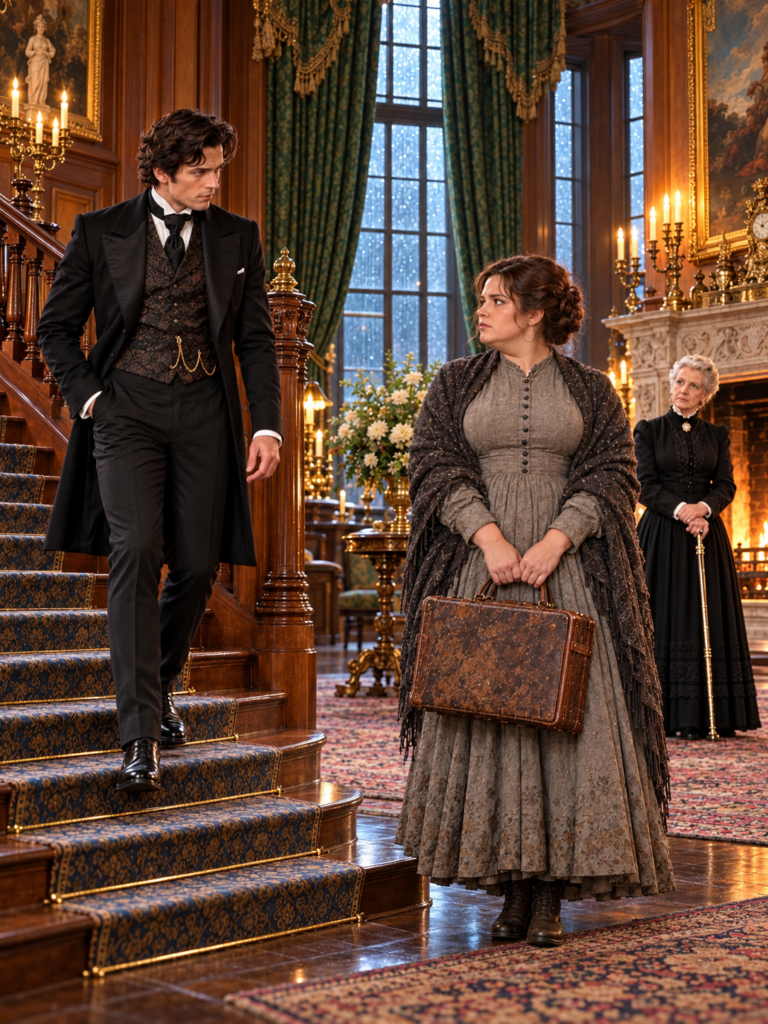
Part 1
The first time Arthur Penhaligon saw the woman his grandmother intended him to marry, she was standing in the rain, arguing with his head groom over a lame horse.
It was not the introduction he had expected.
Indeed, Arthur had expected very little beyond another tiresome performance arranged by a well-meaning relative who considered his unmarried state a public emergency.
At thirty-two, the Duke of Ravensmere possessed three estates, considerable investments, a title older than several European kingdoms, and a reputation for disappointing the mothers of eligible daughters.
He had rejected seven prospective brides in two years.
The seventh had left his London house in tears.
Arthur maintained that this was unfortunate but hardly criminal.
His grandmother disagreed.
“One more young woman reduced to weeping,” the Dowager Duchess Matilda Penhaligon had declared that morning, “and I shall begin charging you for the handkerchiefs.”
Arthur had been standing beside the library fireplace, examining a letter from his estate steward.
“I did not ask Miss Holloway to weep.”
“You told her she possessed the conversational imagination of a boiled potato.”
“I said she was admirably consistent.”
“You asked whether she believed the moon was made of cheese.”
“And she replied that if I believed it, she could hardly disagree.”
Matilda regarded her grandson over the silver rim of her spectacles.
“Perhaps the girl was simply nervous.”
“Then I pity the gentleman who must spend forty years ensuring she never becomes uncomfortable enough to speak honestly.”
The dowager set down her teacup.
“Arthur, you have turned finding a wife into a test no sensible woman would wish to pass.”
“Then perhaps I should remain unmarried.”
“You have been saying that for fourteen years.”
“And I have grown increasingly convinced.”
Matilda studied him with an expression that made him suspect she was contemplating something unpleasant.
She was eighty-one, small and white-haired, with a spine that had begun to surrender to age but a disposition that had not surrendered to anything.
“I have invited someone to Ravensmere,” she said.
Arthur closed his eyes.
“No.”
“You have not heard who.”
“I have heard enough.”
“Her name is Miss Eleanor Ashford.”
“Grandmother—”
“She has no fortune, no useful connections, and very little patience with arrogant men.”
Arthur opened his eyes.
“An extraordinary recommendation.”
“She also has a mind of her own.”
“Then I wish her every happiness elsewhere.”
“She arrives today.”
Arthur stared at her.
Matilda smiled.
It was a smile he had feared since childhood.
“You arranged this without consulting me?”
“Naturally. Consulting you would have defeated the purpose.”
“And what precisely is the purpose?”
“To determine whether your objection is to marriage or merely to women who agree with everything you say.”
Arthur turned toward the window.
Outside, heavy clouds rolled over the distant hills of Hampshire. Rain swept across the lawns, flattening the flowers and darkening the gravel drive.
He had no intention of participating.
Then, shortly after four, a servant announced that the expected guest had arrived.
Arthur remained in his study.
Five minutes later, shouting rose from the courtyard.
Not loud shouting.
Something worse.
A woman’s voice, precise and unmistakably irritated.
“If you force him another ten yards, sir, you may destroy the hoof entirely.”
The groom replied, “I’ve handled horses for thirty years.”
“Then you have had thirty years to learn that an animal cannot explain where it hurts.”
Arthur put down his pen.
He walked to the window.
A young woman in a rain-darkened traveling cloak stood beside a carriage horse whose left foreleg trembled beneath him.
Her bonnet hung crookedly. Mud covered the hem of her dress. One gloved hand rested against the horse’s neck while the other pointed toward its hoof.
The head groom looked scandalized.
Arthur went outside.
“What seems to be the difficulty?”
The groom straightened immediately.
“Your Grace. The lady insists—”
“The horse has a stone lodged beneath the shoe,” she interrupted. “Your groom insists the animal is merely stubborn.”
Arthur looked at her.
She was perhaps twenty-seven, with dark brown hair escaping its pins and eyes of an unusually clear green.
She looked exhausted.
She also looked entirely unimpressed by his appearance.
“Have you examined the hoof?” Arthur asked.
“I attempted to. Your groom told me it was not a lady’s concern.”
Arthur turned to the groom.
“Have you?”
The man hesitated.
“No, Your Grace.”
“Then perhaps we should establish the facts before discussing the lady’s concerns.”
The young woman glanced at Arthur, surprised despite herself.
The groom lifted the hoof.
A sharp stone had indeed become trapped beneath the shoe.
Arthur watched it being removed.
“See that he is rested,” he instructed. “And examine the other horses.”
Then he turned back to the stranger.
“Miss Ashford, I presume?”
“Unfortunately.”
Arthur raised an eyebrow.
“Unfortunately?”
“Only because I suspect you are the duke.”
“I am.”
“Then I fear we have both been deceived.”
Something like amusement stirred beneath Arthur’s irritation.
“By whom?”
“Your grandmother.”
Arthur looked toward the enormous house.
“For once, Miss Ashford, we appear to agree.”
Eleanor Ashford had not come to Ravensmere in search of a husband.
She had come because she was nearly destitute.
Three weeks earlier, the elderly aunt she had nursed for six years had died, leaving behind an unpaid physician’s account, a few pieces of worn furniture, and a household whose remaining valuables belonged to creditors.
Eleanor’s cousins arrived two days after the funeral.
They had expressed sincere regret.
They had also informed her that the house must be surrendered before Michaelmas.
Six years of unpaid nursing had apparently purchased neither gratitude nor security.
Eleanor sold her mother’s jewelry to settle the physician’s bill.
She kept her father’s battered agricultural notebooks, a small prayer book, two dresses, and eleven shillings.
Then a letter arrived from the Dowager Duchess of Ravensmere.
Matilda claimed to remember Eleanor’s late father, a modest landowner who had once helped her family resolve a dispute over water rights.
She offered Eleanor a temporary position reviewing old correspondence and estate records.
The wages were modest.
The accommodation was provided.
Eleanor accepted.
Only when she reached Ravensmere did she discover that Matilda had neglected to explain the entire arrangement.
The revelation came during supper.
Arthur sat at one end of a long mahogany table. Matilda occupied the other. Eleanor, now wearing her cleaner dress, sat between them.
Candelabra illuminated silver dishes, crystal glasses, and more courses than Eleanor had eaten in the previous week.
Matilda observed her guest helping herself to a small portion of chicken.
“Take more, my dear.”
“Thank you, Your Grace. This is sufficient.”
“Nonsense. You are thin.”
“I have always been rather thin.”
“Then you have always needed feeding.”
Arthur concealed a smile behind his wineglass.
Eleanor noticed.
“Does something amuse you, Your Grace?”
“Merely the discovery that my grandmother has found someone else to command.”
Matilda ignored him.
“Eleanor, have you ever considered marriage?”
Arthur nearly choked.
Eleanor lowered her fork.
“I beg your pardon?”
“Marriage.”
“I am familiar with the institution.”
“Have you considered it?”
“Not recently.”
“Why?”
Eleanor looked from Matilda to Arthur.
Then she placed her napkin carefully beside her plate.
“Because, Your Grace, gentlemen generally prefer women who possess either money or the willingness to pretend that gentlemen are always right.”
Arthur laughed.
A genuine laugh.
It escaped before he could prevent it.
Matilda’s eyes brightened.
“And you possess neither?”
“Regrettably.”
“Excellent.”
Arthur stopped laughing.
“Grandmother.”
Matilda folded her hands.
“I believe honesty is overdue. I invited Miss Ashford because I thought she might suit you.”
A long silence followed.
Eleanor’s cheeks colored.
Arthur stared at his grandmother.
Then Eleanor spoke.
“Suit him in what capacity?”
“As a wife.”
Eleanor turned very slowly toward Arthur.
He looked equally horrified.
She rose.
“Your Grace, I believe there has been a serious misunderstanding.”
Matilda remained perfectly composed.
“Sit down, dear.”
“I cannot imagine—”
“Sit.”
Eleanor hesitated.
Then, to Arthur’s astonishment, she remained standing.
“With respect, Your Grace, I was offered employment. I was not informed that my poverty would be treated as an invitation to arrange my marriage.”
Arthur felt the words strike something uncomfortable inside him.
Matilda’s expression changed.
For the first time that evening, she looked uncertain.
“Eleanor, I meant no insult.”
“I believe you. Nevertheless, I am insulted.”
Arthur stood.
“Miss Ashford is right.”
Both women looked at him.
He continued quietly.
“Whatever my grandmother intended, you are under no obligation to indulge it. Your employment remains yours, provided you wish to accept it.”
Eleanor studied him.
“And if I refuse the employment?”
“Then you will be offered a carriage to wherever you choose.”
“Without conditions?”
“Without conditions.”
For several seconds, Eleanor said nothing.
Then she sat down.
“Very well. I shall stay long enough to earn my wages.”
Matilda looked down at her plate.
Arthur resumed his seat.
The matchmaking had apparently ended before it began.
Yet when Eleanor asked for the salt, Arthur passed it without waiting for a servant.
And Matilda, though silent, observed the gesture with considerable interest.
Over the following days, Eleanor learned that Ravensmere was not merely a magnificent country house.
It was a complicated kingdom.
More than four thousand acres stretched around the manor, including tenant farms, orchards, managed woodland, and low-lying fields beside the River Calder.
The estate supported nearly eighty households.
Its grand appearance concealed considerable difficulties.
A poor harvest the previous autumn had left several tenant families behind on their rents. Drainage channels constructed decades earlier had fallen into disrepair. Repairs to workers’ cottages had been delayed.
Eleanor learned these things not through gossip but through the records Matilda had asked her to examine.
She worked in a small morning room overlooking the gardens.
On the fourth day, she found something peculiar.
Two ledgers recorded the same expenditure.
Both concerned repairs to the western drainage channels.
One listed payments to laborers and suppliers.
The other carried the same amounts under miscellaneous estate improvements.
At first she assumed a clerical error.
Then she noticed the dates.
The payments had been approved in March.
The work had supposedly been completed in April.
Yet during her journey to Ravensmere, Eleanor had passed fields where standing water still covered the young crops.
She examined the figures again.
Someone had paid for drainage work that did not appear to exist.
That afternoon, she carried the ledgers to Arthur’s library.
He was studying correspondence beside the window.
“Your Grace?”
He looked up.
“Miss Ashford.”
“I believe there is a problem with your estate accounts.”
His expression tightened.
“Have you spoken to Mr. Bellamy?”
“Your steward?”
“Yes.”
“He informed me that I must have misunderstood the figures.”
“Perhaps you did.”
Eleanor placed the books on his desk.
“Then perhaps you can explain them.”
Arthur looked at the ledgers.
He had expected an opinion.
He had not expected calculations.
For several minutes, he examined the entries while Eleanor stood patiently opposite him.
At last he frowned.
“These payments are duplicated.”
“Yes.”
“That does not necessarily indicate wrongdoing.”
“No.”
“It may be a bookkeeping oversight.”
“It may.”
Arthur looked up.
“You are agreeing with me?”
“I agree when you are correct.”
“How reassuring.”
Eleanor pointed toward a column.
“However, an oversight does not explain why the same laborers were paid for work supposedly performed in two different locations on the same dates.”
Arthur’s amusement disappeared.
He examined the names.
Then he reached for a map.
“Where did you say you saw standing water?”
“Along the northern approach, near the old willow bridge.”
He spread the map across the desk.
Eleanor moved beside him.
Together they traced the western channels.
Arthur explained that the upper fields drained toward the Calder, while the lower meadows depended on a network of shallow ditches.
Eleanor studied the contours.
“These ditches are too narrow.”
“They were designed forty years ago.”
“For forty years ago’s rainfall and cultivation.”
Arthur folded his arms.
“What would you propose?”
“Deepening the central channel, restoring the old culvert, and redirecting the water away from the cottages.”
“That would be expensive.”
“So would losing another harvest.”
He regarded her thoughtfully.
“Your father taught you this?”
“My father believed land was not improved by simply owning it.”
“A dangerous opinion in a ducal household.”
“He also believed gentlemen who inherited estates should learn how those estates worked.”
Arthur stared at her.
Eleanor stared back.
Then he smiled.
“Miss Ashford, I am beginning to understand why my grandmother invited you.”
“To insult you?”
“Possibly.”
“Then she has made an excellent investment.”
For the first time in years, Arthur found himself looking forward to the next conversation.
He did not recognize the danger until much later.
That evening, after Eleanor had retired, Arthur summoned Mr. Bellamy.
The steward arrived carrying a portfolio and an expression of careful respect.
Arthur questioned him about the duplicated payments.
Bellamy explained that repairs had been delayed by unexpected flooding.
The expenditure had been charged in anticipation of completion.
“Then why do the records indicate otherwise?”
“A copying error, Your Grace.”
“And the laborers?”
“Different men with similar names.”
Arthur did not believe him.
But suspicion was not evidence.
He dismissed the steward and returned to the accounts.
On the final page, beneath a list of authorized payments, appeared a signature.
Not Bellamy’s.
The signature belonged to Arthur’s cousin, Lord Julian Penhaligon.
Julian had assisted with estate business during Arthur’s long absence in London the previous spring.
Arthur stared at the name.
His cousin had expensive tastes, gambling acquaintances, and an unfortunate talent for requiring loans.
A cold uneasiness settled over him.
Then he remembered Eleanor’s expression when she had pointed out the discrepancy.
Not triumph.
Not accusation.
Only the calm certainty of someone who understood that the truth mattered more than the person inconvenienced by it.
He closed the ledger.
For the first time, he wondered whether the woman his grandmother had brought to Ravensmere might be far more dangerous to his carefully ordered life than any marriage-minded debutante.
Part 2
The next morning, Eleanor found Arthur waiting in the courtyard beside two saddled horses.
She stopped on the steps.
“Good morning, Your Grace.”
“Miss Ashford. I thought you might wish to see the western fields.”
She looked toward the horses.
“On horseback?”
“Unless you would prefer to walk seven miles.”
“I haven’t ridden for some years.”
“Do you remember how?”
“Certainly.”
“Then we shall proceed cautiously.”
Eleanor descended the steps.
“And does your horse know you intend to be cautious?”
Arthur looked at the bay gelding beside him.
“Argus is a gentleman.”
“Then he has already distinguished himself from several men of my acquaintance.”
Arthur laughed.
They rode out beneath a pale September sky.
The countryside opened around them in long green slopes and harvested fields. Stone walls divided the tenancies. Smoke rose from cottage chimneys. Farther west, the Calder wound through low meadows bordered by alder and willow.
Arthur knew the land by ownership.
Eleanor knew it by observation.
She noticed the yellowing grass near the drainage channel, the heavy clay beneath the horses’ hooves, and the way water collected around the roots of young trees.
At a tenant farm near Briar Hollow, they stopped to speak with Thomas Reed, whose family had worked the land for three generations.
Reed removed his cap when Arthur approached.
“Your Grace.”
“How are your fields?”
The farmer hesitated.
“We’ve had better years.”
Arthur dismounted.
“I’ve seen the figures. Tell me what happened.”
Reed glanced toward Eleanor.
She stepped back, allowing the men to speak.
“The lower field never dried,” Reed said. “We planted late and lost half the barley. The steward said the drains had been repaired, but nothing changed.”
Arthur looked toward the waterlogged meadow.
“Did anyone come to inspect the work?”
“Mr. Bellamy sent men in April. They measured the ditch. Took a few notes. Then left.”
“Did they dig?”
“No, Your Grace.”
Arthur’s jaw tightened.
“Why was I not informed?”
Reed lowered his eyes.
“Begging your pardon, sir, but I wrote twice.”
Arthur went still.
“To whom?”
“Your estate office.”
Eleanor watched the duke’s expression change.
He had not known.
That much was obvious.
But ignorance, she understood, did not lessen the consequences for the people who depended upon him.
Arthur asked to see Reed’s letters.
The farmer led them into his cottage.
Inside, a fire burned beneath a blackened kettle. A little girl sat at the table practicing her letters.
When Arthur entered, she stood so quickly that her slate fell.
He bent to retrieve it.
“Have I interrupted your studies?”
The child nodded nervously.
“What are you learning?”
“Spelling, Your Grace.”
“An admirable occupation. I was dreadful at it.”
The girl looked doubtful.
“I still am,” Arthur added gravely.
She smiled.
Eleanor watched him return the slate.
The kindness was unremarkable in itself.
That was what made it remarkable.
He did not perform it for admiration.
He simply seemed unable to regard the child as anything less than a person.
Outside, Eleanor waited until they were alone.
“You did not receive those letters?”
“No.”
“Then someone prevented you from receiving them.”
“Yes.”
She studied him.
“Does that trouble you?”
Arthur turned toward the flooded field.
“More than I can explain.”
They rode back slowly.
At the edge of the estate, Arthur stopped beside an abandoned stone bridge.
“My father used to bring me here,” he said.
Eleanor waited.
“He told me that the land would one day belong to me. I remember thinking that sounded rather grand.”
“And now?”
“Now I think he should have explained that eighty families might depend upon whether I paid attention.”
Eleanor looked at the river.
“My father said land never truly belonged to anyone. People merely borrowed it from their children.”
Arthur considered the words.
“I think I would have liked your father.”
“He would have asked you how much barley you could grow on an acre.”
“And if I answered incorrectly?”
“He would have made you find out.”
Arthur smiled faintly.
They remained beside the river longer than either intended.
During the following week, Eleanor became an unexpected presence in Arthur’s daily life.
They examined accounts, questioned tenants, and compared old surveys with current conditions.
At meals, they argued over estate expenses.
In the library, they disputed agricultural methods.
In the drawing room, where Matilda pretended to read, they exchanged observations that left the dowager alternately delighted and exasperated.
Their conversations had none of the polished elegance Arthur remembered from London.
Eleanor did not compliment his judgment merely because it belonged to him.
She challenged his conclusions.
And when he proved her wrong, she acknowledged it without resentment.
Arthur found that more intoxicating than flattery.
Yet Eleanor remained careful.
She never forgot that Ravensmere belonged to him.
Nor did she forget that her own room, food, and wages existed entirely at the discretion of his household.
The distinction mattered.
It mattered especially one evening when guests arrived from London.
Lady Wexford had known Arthur since childhood.
She was wealthy, socially influential, and possessed an extraordinary ability to disguise cruelty as concern.
Her daughter, Lady Caroline, had once been considered a likely duchess.
Arthur had rejected that suggestion the previous winter.
Lady Wexford had not forgiven him.
At dinner, her attention settled upon Eleanor.
“Miss Ashford, I understand you are assisting with estate records.”
“Yes, my lady.”
“How industrious. I had not realized the household was in need of additional clerks.”
Matilda placed her glass on the table.
“Miss Ashford’s work has been invaluable.”
“Of course.” Lady Wexford smiled. “Though I suppose one must find suitable employment when one has no prospects.”
Arthur’s expression hardened.
Eleanor answered before he could speak.
“Employment is particularly useful when one prefers to purchase one’s own necessities.”
“How practical.”
“I have always found practicality preferable to disappointment.”
Lady Caroline glanced down at her plate.
Lady Wexford continued.
“And where does your family reside, Miss Ashford?”
“My parents are dead.”
“How unfortunate.”
“Yes.”
“And your remaining relations?”
“We are not close.”
“I see.”
Lady Wexford paused delicately.
“One wonders how a young lady manages without the guidance of her family.”
Eleanor set down her fork.
“One learns, my lady.”
Arthur heard the quiet finality in her voice.
He also saw the effort it cost her to remain composed.
“Miss Ashford has been helping me investigate serious irregularities in the estate accounts,” he said.
Lady Wexford turned toward him.
“Surely that is work for your steward.”
“It was.”
The duke’s tone ended the discussion.
Later, Eleanor escaped to the greenhouse.
Rain tapped softly against the glass.
She stood among potted citrus trees and late-flowering geraniums, trying to master the anger that had followed her from dinner.
She hated how easily the evening had reminded her of everything she lacked.
Family.
Money.
Protection.
A place where she could exist without explaining herself.
The greenhouse door opened.
Arthur entered carrying a dark wool shawl.
“My grandmother thought you might be cold.”
Eleanor glanced at it.
“That was kind of her.”
He placed it on a chair.
For a moment, neither spoke.
Then Arthur said, “Lady Wexford was unforgivably rude.”
“She was entirely predictable.”
“That does not excuse her.”
“No.”
“Why did you not tell me to dismiss her?”
Eleanor looked at him with surprise.
“Because this is your house.”
“That does not mean you must endure insults.”
“It means I must consider what happens after I object.”
Arthur fell silent.
Eleanor turned toward the rain.
“You can afford to quarrel with Lady Wexford. Tomorrow, you will still be the Duke of Ravensmere. Your house will remain yours. Your breakfast will arrive at the usual hour.”
“And yours?”
“I have spent six years learning how quickly one’s circumstances can change.”
He stepped closer, though not so close that she felt cornered.
“Miss Ashford—”
“Eleanor.”
The name escaped before she had decided to offer it.
Arthur stopped.
She looked embarrassed.
“You may call me Eleanor.”
Something softened in his face.
“Then you must call me Arthur.”
“That would be rather improper.”
“Most useful things are considered improper by someone.”
She smiled despite herself.
Arthur took a breath.
“My parents married because their families insisted.”
Eleanor glanced at him.
He had never spoken of them beyond the usual formal references.
“My mother brought a large estate into the marriage. My father brought debts and an ancient title. Their families considered the arrangement an extraordinary success.”
“And was it?”
“They despised each other.”
His voice was steady, but Eleanor heard what lay beneath it.
“They used every disagreement as a weapon. My father controlled the money. My mother controlled the household. If one showed affection toward a servant, the other dismissed that servant. If one admired something, the other found a way to destroy it.”
Eleanor listened without interruption.
“When I was twelve, my mother told me that love was merely a useful word employed before people discovered how much they disliked one another.”
Arthur looked down.
“I believed her for a long time.”
“And now?”
“I am no longer certain.”
Outside, the rain strengthened.
Eleanor touched a leaf on the nearest plant.
“My aunt believed gratitude was a debt that could never be paid.”
Arthur looked at her.
“She was ill. I cared for her. Every time I asked whether I might earn a little money elsewhere, she reminded me that she had given me a home.”
“Did she leave you nothing?”
“She left me six years of experience in keeping someone alive.”
The bitterness in Eleanor’s smile wounded him.
“And an extraordinary ability to recognize when affection is being used as an obligation.”
Arthur understood.
It was not marriage itself that frightened her.
It was dependence without protection.
He could offer her everything he possessed.
But unless she believed she could refuse him, those gifts might feel like another form of captivity.
“I owe you an apology,” he said.
Eleanor turned.
“For what?”
“For allowing my grandmother’s intentions to place you in an impossible position.”
“You corrected the misunderstanding.”
“Not entirely. You are still working in my house while everyone speculates about whether I intend to marry you.”
Eleanor looked away.
Arthur continued.
“I will arrange for your wages to be paid in full, regardless of when you leave. And I shall provide a written reference.”
“Why?”
“Because you have earned both.”
She studied him.
“And if I choose to go tomorrow?”
“I will not prevent you.”
The words were simple.
Eleanor discovered that she had been waiting to hear them.
Something shifted between them.
Not a promise.
Not yet.
But perhaps the beginning of trust.
The next morning brought news that changed the nature of their investigation.
Mr. Bellamy had disappeared.
His rooms were empty.
Several account books had vanished.
And a letter arrived from London addressed to Arthur in an unfamiliar hand.
It came from a solicitor representing creditors of Lord Julian Penhaligon.
Julian had borrowed heavily against future income from lands he did not own.
Among the documents pledged as security were several agreements relating to Ravensmere’s western farms.
Arthur read the letter twice.
Then he summoned Eleanor.
She found him standing beside the library fireplace, one hand gripping the mantel.
“What has happened?”
He handed her the letter.
She read it carefully.
“Your cousin has pledged income from your tenants?”
“Apparently.”
“Can he legally do that?”
“Not without authority.”
“Did he possess authority?”
“Limited authority to approve repairs while I was away.”
Eleanor looked at the letter again.
“Then he may have used that authority to establish false claims.”
Arthur nodded.
“The drainage payments.”
“Yes.”
She lowered the paper.
“How much money is involved?”
He told her.
Eleanor stared.
“That would repair the entire western channel.”
“Twice.”
She looked toward the window.
“What will happen to the tenants?”
“Nothing, if I can establish the fraud.”
“And if you cannot?”
Arthur did not answer immediately.
“The creditors may attempt to enforce the agreements. Even if they fail, defending the matter could take months.”
Eleanor felt sick.
The people whose crops were already failing might be dragged into a dispute they had never created.
“Then you must go to London.”
“I know.”
“When?”
“Tomorrow.”
She nodded.
Arthur watched her expression.
“You have already decided something.”
Eleanor remained silent.
“What is it?”
“I shall finish arranging the records. Then I think it best that I leave.”
The words landed harder than he expected.
“Why?”
“Because your household is already the subject of speculation. A duke defending a financial scandal does not need rumors about a penniless woman living beneath his roof.”
“I do not care about rumors.”
“Your tenants may have reason to care.”
“I can protect them.”
“Then protect them.”
Her voice trembled.
“Do not confuse protecting me with protecting your estate.”
Arthur stepped toward her.
“Eleanor—”
“No. Please.”
She gathered the documents.
“I know you are trying to be kind. But kindness is not enough when one person holds all the power.”
He stopped.
There was no accusation in her face.
Only fear.
And something more painful.
Affection she was trying desperately to conceal.
“I do not want you to leave,” he said.
Eleanor closed her eyes.
“That is precisely what makes leaving difficult.”
She departed before he could answer.
That evening, Arthur found Matilda alone in the drawing room.
His grandmother was working at a piece of embroidery she had not meaningfully advanced in six months.
“She intends to leave,” he said.
Matilda did not look up.
“I know.”
“You knew?”
“She told me.”
“And you said nothing?”
“Would you have preferred that I ordered her to stay?”
Arthur gave her a sharp look.
Matilda set aside the embroidery.
“You are beginning to understand, then.”
“Understand what?”
“Why she is different from the other women.”
Arthur paced toward the fireplace.
“She thinks marriage to me would cost her freedom.”
“And has anyone demonstrated otherwise?”
“I have.”
“Have you?”
He stopped.
Matilda’s voice softened.
“You have offered her kindness. You have offered her employment. You have allowed her to disagree with you. But you have not yet given her a life in which disagreement cannot cost her everything.”
Arthur stared at the flames.
His grandmother continued.
“Your father believed possession was the same as love. You have spent your life fearing that you might become him.”
“I am not my father.”
“Then stop allowing his mistakes to decide your future.”
Arthur said nothing.
After a moment, Matilda reached into the pocket of her dress.
She withdrew a folded letter.
“I intended to give you this when you were ready.”
Arthur looked at it.
“What is it?”
“A letter your mother wrote shortly before she died.”
He went still.
Matilda had rarely spoken of his mother with anything approaching tenderness.
“Why have I never seen it?”
“Because she asked that you receive it when you were old enough to understand that a person’s worst choices need not be their only legacy.”
Arthur unfolded the letter.
The handwriting was familiar.
Elegant.
Slightly hurried.
He read.
His mother had written of regret.
Of the years spent wounding a husband who had wounded her.
Of confusing pride with dignity.
And of fearing that their son would grow into a man who believed affection inevitably ended in humiliation.
Near the bottom, one sentence arrested him.
I hope Arthur one day learns that a home is not made peaceful by the absence of disagreement, but by the certainty that disagreement will not destroy it.
Arthur read those words again.
And again.
When he finally raised his eyes, Matilda was watching him.
“Did she ever tell me that?”
“No.”
“Why not?”
“Because she did not learn it until very late.”
Arthur folded the letter carefully.
Then he looked toward the door through which Eleanor had departed.
For years, he had believed that refusing marriage would spare him his parents’ tragedy.
Now he understood that fear had made his decisions for him long after his parents were gone.
But understanding his own heart did not give him the right to command Eleanor’s.
He would have to become someone she could choose freely.
And before that, he would have to prove himself worthy of the responsibility already placed in his hands.
The following morning, Arthur departed for London.
Eleanor watched his carriage disappear beyond the gates.
She told herself that its departure brought relief.
Then she returned to the morning room and found the last missing clue.
A folded receipt lay inside the back cover of an old survey book.
It bore the signature of a drainage contractor and listed a payment considerably smaller than the amount entered in the estate accounts.
Attached was a note from Mr. Bellamy.
The note instructed the contractor to suspend work until further notice.
The date was three months earlier than Bellamy had claimed.
But it was the final line, written in another hand, that made Eleanor stop breathing.
The duke need not be troubled. J.P.
Julian Penhaligon.
Eleanor hurried to the cabinet containing the remaining correspondence.
She compared the handwriting.
Then she discovered something still more disturbing.
The fraudulent payments had not merely concealed stolen money.
They had been used to justify proposed rent increases across the western farms.
If those increases went forward, several families would be unable to remain on their land.
And the document authorizing them bore a seal copied from the duke’s private correspondence.
Eleanor stared at the papers.
The scandal was no longer only about stolen funds.
Someone had deliberately made the tenants pay for the theft.
Part 3
Arthur returned from London three days later.
He arrived after dark, his carriage wheels grinding over rain-soaked gravel.
He had spent the journey reviewing letters from solicitors, banking houses, and two furious creditors.
Julian had disappeared.
Bellamy remained missing.
And the disputed agreements had already begun attracting attention among men eager to profit from a troubled estate.
Arthur had established that the creditors’ claims could be challenged, but doing so would require proving the documents were unauthorized.
He entered the house tired, angry, and uncertain.
Hastings met him in the entrance hall.
“Welcome home, Your Grace.”
“Where is Miss Ashford?”
The butler hesitated.
“In the morning room, sir.”
Arthur stopped.
“She has not left?”
“No, Your Grace. She postponed her departure.”
“Why?”
“I believe she has discovered something.”
Arthur did not remove his coat.
He went directly to the morning room.
Eleanor sat at the table surrounded by documents.
A candle burned low beside her.
She looked up when he entered.
For a moment, neither spoke.
Arthur felt an absurd desire simply to look at her.
Her hair was untidy. Ink stained one finger. She appeared to have forgotten supper.
She was the most welcome sight he had ever encountered.
“You came back,” she said.
“It is my house.”
“I know.”
“And you stayed.”
“I found something.”
Arthur smiled faintly.
“I had hoped you might say you missed me.”
Eleanor looked down at the papers.
“That would be an inconvenient admission.”
“I have had a very inconvenient week.”
She almost smiled.
Then her expression grew serious.
“You need to see this.”
For the next hour, she explained what she had uncovered.
The false repair records.
The inflated contracts.
The forged authorization.
The proposed rent increases.
Arthur listened without interruption.
When she finished, he stood in silence.
“Julian signed these,” he said.
“Yes.”
“And Bellamy helped him.”
“That appears likely.”
“Have you established which contractor actually received payment?”
Eleanor passed him the receipt.
“He kept a record.”
Arthur studied it.
“The amount is less than a quarter of what the estate paid.”
“According to the ledger.”
Arthur lowered the paper.
“How did you find all this?”
“Your grandmother suggested I examine the old survey books. She remembered a similar drainage dispute years ago.”
Arthur looked toward the corridor.
“Of course she did.”
Eleanor’s expression softened.
“She has been very kind.”
“She is also frequently impossible.”
“Those qualities are not mutually exclusive.”
Arthur smiled.
Then he noticed the traveling case beside the door.
His smile faded.
“You are still leaving.”
“Tomorrow morning.”
He looked at the case for several seconds.
“Have you decided where you will go?”
“Bath. An acquaintance of my father may be able to recommend me for a position.”
“As a companion?”
“Perhaps.”
Arthur slowly set down the papers.
“And that is what you want?”
Eleanor hesitated.
“It is something I can obtain.”
“That is not what I asked.”
She looked away.
Arthur waited.
Finally she said, “I want work that matters. I want to be useful without being indebted. I want a home that no one can take away because I have displeased them.”
He nodded.
“Then you should have those things.”
Eleanor studied him.
“That is easily said.”
“Yes.”
He moved toward the desk.
“And far more difficult to accomplish.”
Arthur reached into his coat and withdrew a packet of papers.
“I had my solicitor prepare these in London.”
Eleanor looked suspicious.
“What are they?”
“A formal employment agreement, if you wish to remain at Ravensmere.”
She did not touch the packet.
Arthur continued.
“It provides you with a salary appropriate to an estate adviser, rather than a temporary clerk. Your duties would include reviewing agricultural improvements and financial records. The agreement guarantees your wages and accommodation for a fixed term, with provisions for termination and notice.”
Eleanor stared at him.
“You are offering me a position?”
“Yes.”
“Why?”
“Because you have demonstrated qualifications I would be foolish to ignore.”
She looked down at the packet.
“And if I refuse?”
“Then I shall write you a recommendation that may make half the landowners of Hampshire desperate to employ you.”
Eleanor gave a small, incredulous laugh.
Arthur did not smile.
“There is something else.”
He placed a second document beside the first.
“This is the beginning of a separate trust arrangement for the benefit of the western tenants. The funds will be administered under independent oversight. Repairs, emergency grain purchases, and necessary cottage improvements will not depend solely upon the judgment of one duke or one dishonest steward.”
Eleanor examined the document.
“Why would you do this?”
“Because I failed them.”
“You were deceived.”
“I was absent.”
“That does not make you responsible for every dishonest act.”
“No. But it makes me responsible for correcting what I can.”
Eleanor looked at him for a long moment.
Then she said quietly, “Your father would not have done this.”
Arthur’s expression changed.
“No.”
“Neither would mine have expected you to.”
He glanced at her.
“What would he have expected?”
“That you learn from the mistake.”
Arthur smiled sadly.
“I believe I am.”
For the first time since arriving at Ravensmere, Eleanor found herself struggling to speak.
The papers before her offered something she had not expected.
Not rescue.
Not charity.
A position she had earned.
Terms she could consider.
A future that would not disappear merely because a powerful man changed his mind.
Arthur stepped back.
“You need not answer tonight.”
“Arthur—”
“And whatever you decide about the work, I must tell you something.”
His voice became quieter.
“I love you.”
Eleanor’s hands tightened around the edge of the table.
The room seemed suddenly very still.
Arthur did not move closer.
“I did not intend to,” he continued. “Indeed, I spent a considerable portion of my adult life arranging matters so that I never would.”
She looked up.
“But somewhere between our first argument in the courtyard and the day you told me that my estate accounts were a disgrace, I began to care more about your opinion than anyone else’s.”
Eleanor tried to smile.
“That seems unwise.”
“It may be.”
“Arthur—”
“I am not asking you to marry me because my grandmother chose you. Nor because you are useful to the estate, though you are. I am asking nothing of you tonight.”
He paused.
“I merely want you to know that if you leave tomorrow, my feelings will remain. And if you stay, I will not mistake that decision for a promise.”
Eleanor looked at him with tears gathering in her eyes.
“How can you say something like that and expect me to sleep?”
“I have not slept properly in three days. Perhaps we may both be miserable.”
A laugh escaped her.
Then she covered her face.
Arthur remained where he stood.
After a moment, Eleanor lowered her hands.
“I love you too,” she whispered.
The confession seemed to astonish her.
Arthur closed his eyes briefly.
When he opened them, she was watching him with a mixture of fear and hope.
“But I am frightened.”
“So am I.”
“You have no reason to be.”
“I have every reason. You know how dreadful I can be.”
She laughed through her tears.
“Yes.”
“And how frequently I am wrong.”
“Very frequently.”
“And how much I dislike admitting it.”
“That is perhaps your greatest defect.”
Arthur smiled.
“Then I am fortunate you have discovered it early.”
Eleanor stood.
For a moment, they faced one another across the table.
Then she walked toward him.
He did not reach for her until she held out her hand.
When their fingers met, Eleanor felt something she had not experienced in years.
Not certainty that nothing could hurt her.
But certainty that she was permitted to choose.
“I do not want to leave,” she said.
Arthur’s breath caught.
“Then stay.”
“Not because I have nowhere else to go.”
“No.”
“And not because I owe you gratitude.”
“Never.”
She tightened her hold on his hand.
“Because I want to discover what this might become.”
Arthur raised her hand to his lips.
“Then we shall discover it.”
Their happiness, however, did not excuse them from the demands of the following morning.
The inquiry into Julian’s dealings was already advancing.
Arthur’s solicitors arrived from London with evidence that Bellamy had received payments through an intermediary. Two contractors agreed to provide testimony. A clerk employed by Julian’s principal creditor produced correspondence showing that Julian had represented the disputed rents as income he could lawfully assign.
The papers proved something Eleanor had suspected.
Julian had been planning the deception for months.
He expected Arthur’s reluctance to concern himself with routine estate affairs to protect him.
The scheme had succeeded precisely because Arthur had trusted others to perform duties he found tiresome.
The realization humiliated him.
But he did not attempt to hide it.
At a meeting held in the village schoolroom, Arthur stood before the tenant farmers and their families.
The room smelled of damp wool and fresh-cut wood.
Thomas Reed sat in the front row.
Several other men regarded the duke with visible suspicion.
Arthur removed his gloves.
“I owe you an explanation,” he began.
No one spoke.
“Payments were recorded for work that was not performed. Documents were issued proposing rent increases without my knowledge or consent. Members of my household administration participated in that deception.”
A murmur passed through the room.
Arthur continued.
“The fraudulent agreements are being challenged through my solicitors. No tenant will be charged the proposed increases. Any sums improperly collected will be returned.”
Reed raised his hand.
“Your Grace, does that mean the drains will be repaired?”
“Yes.”
“When?”
“Work begins next Monday.”
Another farmer stood.
“And if the same people steal the money again?”
Arthur looked at him.
“A fair question.”
He took a breath.
“Payments will be examined by independent accountants, and the work inspected before the contractors receive their final sums.”
He glanced toward Eleanor, who sat beside Matilda near the back.
“Miss Ashford has agreed to serve as an adviser on the project.”
Every head turned.
Eleanor felt her cheeks warm.
One of the older farmers frowned.
“A lady, Your Grace?”
Arthur met his gaze.
“A lady who discovered the fraud while several gentlemen, myself included, failed to notice it.”
A few people chuckled.
Arthur continued.
“I recommend listening when she speaks.”
From the back of the room, Matilda smiled.
Eleanor lowered her eyes, though the smile on her own face was impossible to conceal.
The repairs began the following week.
Men arrived with spades, picks, carts, and measuring rods.
The central channel was deepened. The old culvert was cleared. Damaged banks were strengthened.
Eleanor spent long hours studying measurements and reviewing invoices.
Arthur joined her whenever his duties allowed.
Their work brought them into disagreement almost daily.
He sometimes favored expensive solutions.
She demanded proof that they were necessary.
She occasionally underestimated how long labor would require.
He reminded her that weather could undo the neatest schedule.
But their disagreements ended differently from the quarrels Arthur remembered from childhood.
Neither sought to wound.
Neither used silence as punishment.
And when one of them was wrong, the other did not treat the admission as surrender.
One evening, after a particularly exhausting day, Arthur found Eleanor standing by the newly cleared channel.
Autumn had turned the surrounding trees gold.
Water moved steadily beneath the stone culvert.
“It works,” Arthur said.
Eleanor watched the current.
“It appears to.”
“You sound disappointed.”
“I shall reserve my celebration until the next heavy rainfall.”
“An admirable precaution.”
He stood beside her.
After a while, Eleanor said, “Do you ever wonder what your parents would think of us?”
Arthur considered the question.
“My father would find you intolerably argumentative.”
“And your mother?”
He looked at the water.
“I think she might have envied you.”
Eleanor turned toward him.
“For what?”
“For knowing that love need not require surrender.”
Arthur reached into his coat.
Eleanor recognized the movement.
Her heart began to pound.
“Arthur.”
“Before you object, I have prepared an argument.”
“That is not encouraging.”
He smiled.
Then he withdrew a small velvet box.
Inside lay a simple gold ring.
No enormous diamond.
No elaborate arrangement of precious stones.
Only a narrow band set with one small sapphire.
“It belonged to my grandmother’s mother,” Arthur said. “She was a woman of remarkably strong opinions.”
“I begin to see a family pattern.”
“She married a gentleman who adored her. They disagreed frequently and remained devoted to one another for forty-eight years.”
Eleanor looked at the ring.
Arthur’s voice softened.
“I cannot promise that our life will be free of difficulty. I cannot promise that society will always welcome you. I cannot even promise that I shall never be foolish.”
“That last promise would be impossible.”
“Quite.”
He took her hand.
“But I can promise that your voice will never be treated as less important than mine because you are my wife. That your work will remain yours to choose. And that when we disagree, I will remember that we are standing on the same side.”
Eleanor felt tears gathering.
Arthur held her gaze.
“Eleanor Ashford, would you consider becoming my duchess?”
She was silent long enough that a flicker of concern crossed his face.
Then she said, “I should like to amend one point.”
He blinked.
“One point?”
“Yes.”
“Of course.”
“I do not wish to become your duchess.”
Arthur’s face went still.
Eleanor stepped closer.
“I wish to become your wife. The title may follow, but I want you to understand the difference.”
For a moment, Arthur only stared at her.
Then a slow smile spread across his face.
“I believe that is the finest distinction anyone has ever made to me.”
“Then you agree?”
“Entirely.”
“In that case, yes.”
Arthur drew a sharp breath.
“Yes?”
“Yes, Arthur. I will marry you.”
He laughed.
Not the restrained amusement of a gentleman accustomed to controlling every expression.
A delighted, helpless laugh.
Then he slipped the ring onto her finger.
It fitted.
Eleanor looked down at it, astonished by how quietly an entire future could begin.
Arthur drew her into his arms.
She rested her cheek against his chest.
Beyond them, water moved freely through the channel they had restored.
For once, neither had anything to argue about.
When they returned to Ravensmere, Matilda was waiting in the drawing room.
She looked from Arthur to Eleanor.
Then to the ring.
“Well,” she said.
Arthur sighed.
“Must you always know everything?”
“Not everything. Only the important things.”
Eleanor sat beside her.
“Arthur has asked me to marry him.”
Matilda folded her hands.
“And?”
“I accepted.”
The dowager closed her eyes.
For a moment, Eleanor thought she might cry.
Instead, Matilda reached for her hand.
“My dear girl, you have no notion how long I have hoped for this.”
Arthur raised an eyebrow.
“Since you invited her?”
“Longer.”
He stared.
“Grandmother.”
Matilda smiled.
“Your father once told me of a gentleman who managed his small estate with uncommon intelligence and never hesitated to contradict his neighbors. His daughter, I was told, was exactly like him.”
Eleanor looked surprised.
“My father?”
“Yes. I remembered him when I heard of your aunt’s death.”
Matilda’s expression softened.
“I wished to help you. I also suspected that a woman raised to think for herself might be the one person capable of reaching my stubborn grandson.”
Arthur shook his head.
“You arranged the entire affair.”
“I arranged an introduction. You two did the difficult part.”
Eleanor squeezed her hand.
“And what if we had disliked each other?”
“Then you would still have had employment, and Arthur would still have needed a wife.”
“Grandmother!”
Matilda laughed.
A rich, delighted sound.
Then she rose with the assistance of her cane.
“Now, if you intend to marry, there are matters to settle. I shall not have the servants learning everything from gossip.”
Arthur exchanged a glance with Eleanor.
She smiled.
“I believe we have just been given our first instruction as an engaged couple.”
Arthur leaned toward her.
“Shall we disobey?”
“Not this one.”
Their wedding took place six weeks later in the small parish church beyond Ravensmere’s eastern woods.
It was not the grand spectacle society had expected from one of England’s wealthiest dukes.
There were no imported flowers, no enormous procession of carriages, and no gathering of half the aristocracy.
Matilda attended in violet silk.
Thomas Reed and his wife sat beside several other tenant families.
Hastings stood at the rear with the household servants.
Eleanor wore a gown of ivory satin altered by the manor’s seamstress.
Around her neck hung a delicate chain that had belonged to her mother.
When Arthur saw her enter the church, he forgot every prepared thought.
She walked toward him without fear.
And he understood that he had never wanted a perfect bride.
He had wanted a woman who could stand beside him without becoming smaller.
Their vows were simple.
Their hands trembled.
And when the ceremony ended, Arthur bent to kiss his wife with such obvious happiness that Matilda was heard telling the rector she had never seen anything so satisfying.
Winter came early that year.
Snow settled across Ravensmere’s fields.
The river rose twice after heavy rain, but the restored drainage channels carried the water safely away.
The western harvest had been poor, yet emergency grain purchases and temporary rent relief allowed the tenant families to remain.
The fraudulent contracts were successfully contested, and the estate recovered part of the stolen money through legal proceedings. Bellamy eventually surrendered himself to the authorities. Julian, facing overwhelming evidence, agreed to restitution through his remaining assets before departing England under a cloud of disgrace.
Arthur did not celebrate his cousin’s downfall.
He celebrated the fact that no farmer would lose his home to satisfy Julian’s creditors.
As for Eleanor, marriage brought considerable changes.
Her wardrobe improved.
Her name appeared in newspapers.
Society invitations arrived by the dozen.
But certain things remained exactly as they had been.
She continued reading agricultural treatises beside the library fire.
She continued reviewing estate accounts.
And she continued disagreeing with Arthur whenever she believed him mistaken.
At their first formal dinner as husband and wife, Lady Wexford remarked that the new duchess possessed an unusually practical interest in matters better left to gentlemen.
Arthur set down his glass.
“My wife possesses an unusually practical mind,” he replied. “I have found it indispensable.”
Eleanor turned toward him.
“And my husband possesses an unusually stubborn one.”
Several guests laughed nervously.
Arthur smiled.
“Fortunately, I married a woman willing to correct it.”
Matilda raised her wineglass.
“At last,” she murmured.
Much later, after the guests had departed, Eleanor found Arthur standing beside the library window.
Snow drifted beyond the glass.
He held the letter his mother had written so many years earlier.
Eleanor approached quietly.
“Are you thinking of her?”
“Yes.”
“Does it make you sad?”
“Sometimes.”
She slipped her hand into his.
Arthur looked at her.
“But tonight I think she would have been pleased.”
“Why?”
“Because I finally understand something she learned too late.”
Eleanor waited.
Arthur looked around the library.
The fire burned low. Books lay scattered across the table. Eleanor’s notes rested beside his correspondence.
Nothing was arranged perfectly.
Nothing resembled the cold, immaculate rooms of his childhood.
Yet the house felt more peaceful than it ever had.
“Love does not mean we shall never disagree,” he said.
Eleanor smiled.
“That would be an unreasonable expectation.”
“Quite.”
He drew her closer.
“It means that even when we do, neither of us has to fear the other will stop caring.”
Eleanor rested her forehead against his.
“And when you are particularly impossible?”
“You will remind me.”
“Repeatedly.”
“I have no doubt.”
He kissed her.
Outside, the winter wind moved across the fields, through the bare trees, and over the land that had belonged to the Penhaligons for generations.
Inside, the Duke of Ravensmere held the woman he had never expected to find.
He had refused beautiful women, wealthy women, obedient women, and women whose families promised every advantage.
He had believed that marriage required a man to surrender his peace.
But his grandmother had recognized what he could not.
He had never needed a woman who would agree with him.
He had needed someone who would tell him the truth.
Someone who could remain herself while choosing to stand beside him.
And Eleanor, who had arrived at Ravensmere with one worn suitcase and almost nothing to her name, had discovered something equally precious.
She had not found a man willing to own her future.
She had found a man willing to share it.
As the last embers glowed in the fireplace, Arthur asked whether she thought the spring planting should begin earlier that year.
Eleanor immediately disagreed.
He listened.
Then he laughed.
And in the great old house that had once taught him to fear marriage, the sound of their happy argument carried warmly through the halls.
For the first time, Ravensmere was not merely an inheritance.
It was a home.


