
Part 1
The first time Lily Goodwin saw her future husband, he was sitting beside a window with blood on his cuff and a loaded pistol on the desk.
He did not trouble himself to hide either.
Outside, the last light of a bitter November afternoon was disappearing behind the bare hills of northern England. Rain struck the tall windows of Thornwick Hall, and somewhere deep in the old house a clock sounded five solemn notes.
Charles Kensington, the eighth Duke of Thornwick, looked up from the papers in his lap.
“So,” he said, studying her with dark, unsmiling eyes, “you are the young woman who has agreed to marry a stranger for his money.”
Lily stood just inside the library doorway, her traveling dress still damp from the long journey.
“And you,” she replied, “must be the gentleman who believes his money excuses his manners.”
The Duke’s fingers stopped moving.
For one astonishing moment, Lily thought he might laugh.
Instead, he closed the document before him.
“Come in, Miss Goodwin. We may as well discover how thoroughly we intend to disappoint each other.”
She crossed the room without looking again at the pistol.
But she noticed everything else.
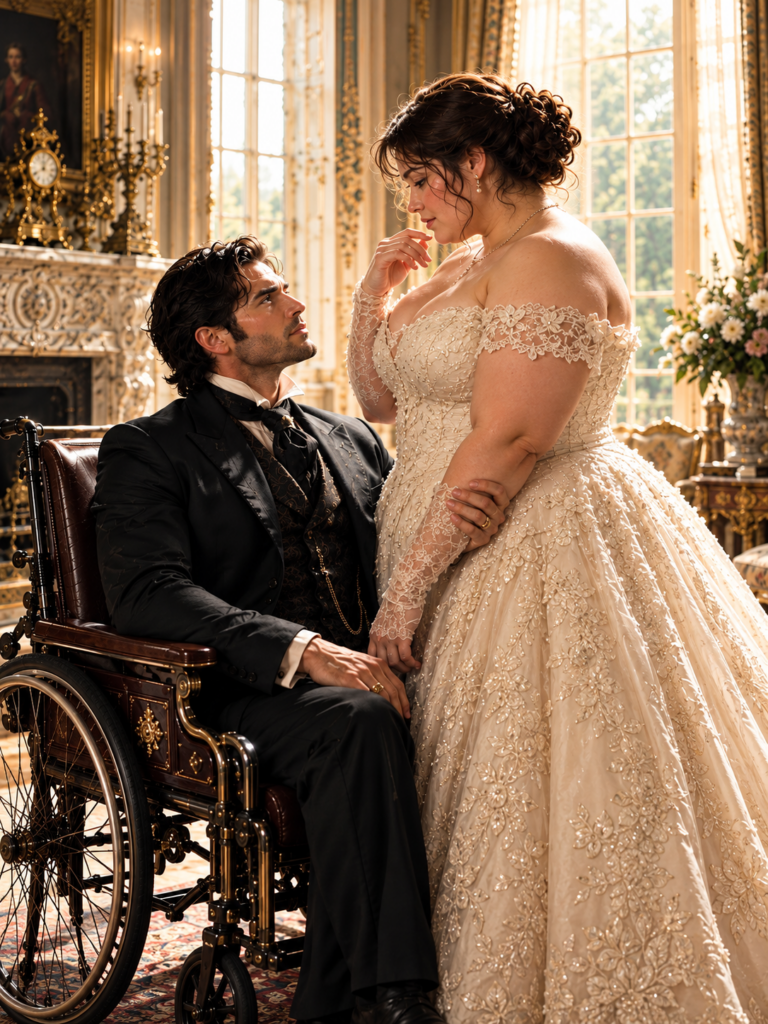
The mahogany wheelchair with its large brass-rimmed wheels. The scar running beneath Charles’s collar. The extraordinary strength of his hands. The silver-framed photograph turned facedown beside an unfinished glass of brandy.
And the blood.
A dark line had soaked into the white linen beneath his right cuff.
He followed her glance.
“You needn’t concern yourself,” he said.
“I hadn’t offered to.”
“Excellent. We understand one another already.”
That was how their engagement began.
Not with affection.
Not with tenderness.
But with two strangers who had learned, for very different reasons, that pride was sometimes the last possession a person could afford to lose.
Six weeks earlier, Lily had buried her father.
James Goodwin had owned a textile mill outside Manchester, a modest enterprise that had supported his family and nearly a hundred working households for more than twenty years.
By the time he died, the mill was mortgaged, its accounts were in disorder, and nearly every creditor was demanding payment.
One creditor was demanding something worse.
Lord Augustus Kensington, cousin to the Duke of Thornwick, had quietly acquired the mill’s outstanding debts.
He also possessed evidence suggesting Lily’s younger brother, Samuel, had signed an altered financial record involving money improperly transferred from a Kensington family investment.
Samuel was nineteen, gentle, and painfully inexperienced in business. He had signed the document at their father’s request without understanding its significance.
It did not matter.
An accusation of fraud could destroy him.
When Lily visited her father’s solicitor, Richard Randolph, she expected bankruptcy.
Instead, Randolph presented an offer.
The Duke of Thornwick would settle the mill’s debts, protect Samuel from prosecution, establish an income for Lily’s widowed aunt, and guarantee employment for the mill workers for ten years.
In return, Lily would marry him.
She remembered staring at the papers.
“Why?”
Randolph removed his spectacles.
“Because His Grace has enemies, Miss Goodwin. And because a duchess may prove more useful to him than an entire regiment of lawyers.”
Eighteen months earlier, Charles Kensington had been injured in a carriage accident that killed his younger brother, John.
Since then, he had used a wheelchair.
Society had decided this meant he was no longer capable of governing his estates.
His cousin Augustus was encouraging that belief.
Through petitions to family trustees and inquiries into the administration of the Kensington trusts, Augustus hoped to strip Charles of control over his fortune.
A capable wife, Randolph explained, might strengthen the Duke’s position.
She could manage household affairs, entertain influential visitors, examine accounts, and demonstrate that the supposedly helpless aristocrat remained fully engaged in his responsibilities.
Lily understood the bargain immediately.
She needed his protection.
He needed her usefulness.
Neither required love.
Yet one clause in the marriage settlement had disturbed her more than all the others.
The Duchess shall retain private quarters and shall never be required to accept physical intimacy without her freely given consent.
The wording was plain.
Almost painfully careful.
She had read it several times before signing.
Now, standing in the Duke’s library, she wondered what experiences had taught him to expect rejection so completely that he had written it into a legal agreement.
Charles motioned toward a chair.
“There are certain arrangements you should understand before the ceremony.”
“Then I suggest you begin.”
“The east wing will be yours. No one will enter your rooms without permission. You will have access to the library, gardens, conservatory, and household accounts.”
“And the rest of the house?”
“The north wing is closed.”
“Because?”
“Because I have ordered it closed.”
Lily folded her hands.
“Is that intended as an explanation?”
“No.”
“I see.”
“I doubt that very much.”
He watched her carefully, as though waiting for the anger he had deliberately invited.
But Lily had spent too many years dealing with stubborn mill owners and suspicious creditors to be frightened by a bad-tempered duke.
“Will you expect obedience in every matter?” she asked.
“Only in matters involving your safety.”
“Who determines what threatens my safety?”
“I do.”
“Then we have already found our first disagreement.”
This time Charles did smile.
It was brief, almost unwilling, and it changed his face so completely that Lily forgot what she had intended to say next.
Then the smile disappeared.
“Be careful with my cousin, Miss Goodwin.”
She stiffened.
“Lord Augustus?”
“He has acquired the unfortunate habit of considering other people’s difficulties his opportunities.”
“He holds my father’s debts.”
“He did.”
“What do you mean?”
“I purchased them yesterday. They now belong to me.”
Lily stared at him.
He had acted before the marriage.
Before obtaining anything in return.
“Why would you do that?”
“Because the mill cannot afford another week of uncertainty.”
For the first time, something moved beneath her professional gratitude.
Not affection.
Not yet.
But surprise.
Charles returned to his papers.
“Our marriage will take place on Thursday. Mrs. Fitzpatrick will explain the household arrangements. Good evening, Miss Goodwin.”
It was plainly a dismissal.
Lily rose.
At the doorway, she stopped.
“Your Grace?”
He looked up.
“You should have that wound attended to.”
His face hardened.
“I said it was nothing.”
“Yes,” Lily answered. “But I have noticed that people often say that when they most desperately wish to be believed.”
Then she left.
Behind her, the Duke remained motionless for a long while.
Finally, he glanced down at the blood beneath his cuff.
And, against his better judgment, smiled again.
Thornwick Hall was a vast, beautiful, deeply unhappy house.
Lily discovered this during her first three days.
Its servants moved quietly. Doors were closed softly. Meals were served with military precision, and no one laughed within hearing of the library.
The housekeeper, Mabel Fitzpatrick, ruled the establishment with a firm hand and a surprising affection for its difficult master.
“His Grace was not always so grim,” she told Lily while supervising preparations for the wedding.
“What changed him?”
“Grief. Pain. And people who cannot tell the difference between offering help and taking away a man’s choices.”
Lily considered this.
“Does he permit anyone to help him?”
“Captain Clark. Occasionally. Me, when he is too ill to argue. Otherwise, very seldom.”
Captain William Clark was the tall, reserved man responsible for Thornwick’s security.
He had served beside Charles during earlier travels abroad and appeared to possess the unusual privilege of contradicting him without being dismissed.
On the morning of the wedding, William stood beside the Duke’s chair outside the chapel.
“You look dreadful,” he remarked.
Charles adjusted his gloves.
“I am getting married, not attending my execution.”
“There are gentlemen who consider the distinction uncertain.”
“Your encouragement overwhelms me.”
William’s stern mouth twitched.
Inside, Lily waited beneath the chapel’s ancient stone archway.
She wore a simple ivory gown altered from her mother’s wedding dress.
No diamonds.
No grand procession.
Only a narrow wreath of winter greenery in her hair and a small cameo brooch at her throat.
Charles saw the brooch first.
“Your mother’s?” he asked when she reached him.
“Yes.”
“Then I am honored she has come with you.”
Lily looked at him.
The remark was so gentle, so different from the man she had met in the library, that she almost missed the opening words of the ceremony.
They exchanged vows before a small gathering.
Charles remained seated, his expression controlled.
Lily’s voice trembled only once.
When the clergyman pronounced them husband and wife, Charles took her hand.
“You may kiss me,” Lily whispered, surprising herself.
His eyes lifted sharply.
“Are you certain?”
“Would I have suggested it otherwise?”
He leaned forward.
The kiss was brief and formal.
Yet his hand lingered around hers long after the congregation began to move.
The first trouble came over a matter of coal.
Two weeks after the wedding, Lily discovered that Thornwick spent a small fortune heating unused rooms while four tenant cottages stood with broken windows and leaking roofs.
She brought the household accounts to breakfast.
Charles looked up from his newspaper.
“Have you been examining my estate books?”
“Yes.”
“Without asking?”
“You gave me access.”
“An unfortunate lapse in judgment, apparently.”
Lily set the ledger beside his plate.
“These figures show that three empty guest chambers consume more fuel than the northern cottages receive in an entire winter.”
Charles glanced at the columns.
“And?”
“And there are children sleeping beneath leaking roofs while your unused rooms remain comfortably warm.”
He studied the page.
Then he rang for the steward.
“Have the cottages repaired immediately. Send the accounts to my wife for approval.”
The steward blinked.
“Your Grace?”
“You heard me.”
When they were alone, Lily stared at Charles.
“You agreed?”
“Should I have disagreed?”
“I had prepared several arguments.”
“Then I apologize for depriving you of an enjoyable morning.”
He lifted his coffee.
“Next time, bring the problem before it becomes expensive.”
It was the first lesson Lily learned about her husband.
He disliked interference.
But he respected judgment.
And beneath the sharp edges of his pride lived a man who cared more about doing what was right than being seen to have been right all along.
After that, she began working beside him.
They reviewed mill accounts.
They inspected cottages.
They discussed a proposed bridge across the estate stream and argued over whether a tenant school should be enlarged.
Sometimes Charles was infuriating.
Sometimes Lily was deliberately provocative.
More often, they discovered that their disagreements produced better decisions than either would have made alone.
And slowly, Thornwick began changing.
There was more conversation at dinner.
More movement in the corridors.
The servants learned that the new duchess disliked unnecessary ceremony.
One evening, Lily moved an enormous floral arrangement that obstructed Charles’s view across the dining table.
“Mrs. Fitzpatrick placed that arrangement very carefully,” Charles observed.
“Then she placed it very carefully in the wrong position.”
“It has stood there for years.”
“So has the grandfather clock in the hall. I do not intend to let it block the doorway.”
A startled laugh escaped him.
Every servant in the room froze.
Then Mabel Fitzpatrick looked down at her plate and smiled.
The first time Lily saw Charles in serious pain, they were returning from the mill.
The carriage struck a rut.
His jaw tightened.
One hand gripped the seat.
Lily noticed the way he concealed the movement beneath his coat.
She drew a woolen blanket across his knees.
His expression changed immediately.
“I do not require—”
“I am freezing,” she interrupted. “If you refuse the blanket, I shall be forced to watch you suffer from cold as well as an appalling disposition.”
His eyes narrowed.
“That argument is thoroughly dishonest.”
“Then you will understand its usefulness.”
He left the blanket where it was.
A few minutes later, Lily saw him relax against the carriage cushions.
She turned toward the window to give him privacy.
Neither mentioned it afterward.
Yet that evening, when she came downstairs, she found a fire already burning in the small sitting room she preferred.
Beside it lay a folded woolen shawl.
No note accompanied it.
She needed none.
The north wing remained locked.
Sometimes Lily heard movement beyond its heavy oak doors.
Once, she saw Charles returning from that direction after midnight, his face pale and his coat disordered.
Another time she found a narrow mark of blood on the stone floor.
When she asked Mabel about the rooms, the housekeeper turned unusually grave.
“They belonged to Lord John.”
Charles’s dead brother.
“Why are they sealed?”
“His Grace has never been ready to empty them.”
“Does he visit them?”
“Not in daylight.”
That was all Mabel would say.
One evening Lily entered the library and found Charles staring at the silver-framed photograph.
This time it was standing upright.
Two young men stood together beside a carriage, laughing into the summer sunlight.
Charles noticed her looking.
“John,” he said.
“He resembles you.”
“He was considerably more pleasant.”
Lily came closer.
“He looks happy.”
“He usually was.”
Charles turned the photograph in his hands.
“He drove the carriage that night because I asked him to. I had a headache. He offered to take the reins.”
His voice became almost expressionless.
“The horse bolted near the old bridge. The carriage struck the parapet. John was thrown into the river.”
Lily remained silent.
“I survived.”
There was such hatred in those two words that she felt it like a physical blow.
She placed her hand gently over his.
Charles withdrew at once.
“Do not.”
“I only meant—”
“I know what you meant.”
He turned the photograph facedown.
“I have had eighteen months of people offering sympathy for a tragedy they did not witness. I need no more.”
Lily swallowed her hurt.
“Then you shall have none from me.”
She stood.
“But one day, Charles, you may discover there are other reasons a person might wish to hold your hand.”
She left before he could answer.
The accident in the long gallery happened four days later.
Charles was traveling toward a meeting with his estate trustees when the right wheel of his chair seized.
The chair lurched sharply.
William Clark caught the back before it overturned.
Dr. Benedict Wallace, the physician who had treated Charles since the carriage crash, pronounced the incident an unfortunate mechanical failure.
But Lily saw something the men overlooked.
A narrow metal fastener beneath the wheel had been filed nearly through.
Not worn.
Cut.
She recognized the marks from machinery at her father’s mill.
When she showed William, his expression grew dark.
“Are you certain?”
“Absolutely.”
He examined the metal himself.
“Then someone intended the chair to fail.”
“Someone with access to the house.”
“And knowledge of where His Grace would be.”
William looked toward the gallery windows.
“Do not speak of this outside these walls, Duchess.”
“Why?”
“Because until we know whom we can trust, silence may be our only advantage.”
That night, Lily returned to her rooms and found her desk drawer open.
A letter she had written to Samuel was missing.
In its place lay a white camellia.
Its petals were fresh.
A small card accompanied it.
Family should always look after family.
There was no signature.
There did not need to be.
Lord Augustus Kensington was famous for wearing a white camellia in his buttonhole.
Lily locked the door.
For the first time since her arrival at Thornwick, she understood that marrying Charles had placed her in danger.
Not because he was cruel.
Not because he was disabled.
But because someone desperately wanted him powerless.
And the person had just demonstrated that no room in the house was beyond his reach.
Part 2
Lord Augustus arrived at Thornwick three days later with a smile that could have persuaded strangers to trust him with their children.
He was handsome, elegantly dressed, and possessed the effortless warmth that made people feel they had been personally selected for his attention.
He greeted Lily in the conservatory.
“My dear cousin’s wife,” he said, bowing over her hand. “At last. Charles has kept you hidden away.”
“I have been occupied.”
“With the estate, I hear. Most admirable.”
His gaze moved over her face.
“Though surely it must be difficult, being married to a gentleman whose circumstances prevent so many ordinary pleasures.”
Lily withdrew her hand.
“What pleasures do you imagine my husband lacks?”
Augustus gave a sympathetic smile.
“Dancing. Riding. Escorting his wife into society. The simpler requirements of married life.”
“How fortunate,” Lily said, “that he possesses considerably greater accomplishments than you have mentioned.”
For an instant the warmth in Augustus’s eyes vanished.
Then it returned.
“I see Charles has chosen a loyal defender.”
“He has chosen a wife.”
“Quite so.”
Augustus wandered toward the fern-lined windows.
“Your brother is well, I trust? Samuel, is it not?”
Lily went still.
“He is.”
“A promising young man. It would be unfortunate if his future were interrupted by those tiresome questions concerning your father’s accounts.”
The threat was so delicately delivered that another woman might have mistaken it for concern.
Lily did not.
“The matter is settled.”
“Most matters are settled,” Augustus replied, “until someone discovers an overlooked document.”
He smiled.
“Do give my regards to your husband.”
After he left, Lily remained beside the window for a long time.
Then she went upstairs and checked her writing desk.
Another page was missing from her correspondence book.
Charles had begun suffering from increasingly severe spells of exhaustion.
His hands sometimes trembled after taking the medicine Dr. Wallace supplied.
On several mornings he struggled to remain alert through meetings.
Wallace insisted that such weakness was inevitable.
“The spinal injury is extensive,” he told Lily. “The Duke must avoid unnecessary movement. His exercises are doing him more harm than good.”
“Exercises?”
The physician hesitated.
“Merely certain foolish attempts to recover what cannot be recovered.”
“Has he been attempting to stand?”
“That is not a matter for discussion.”
Lily looked directly at him.
“Everything affecting my husband’s well-being is a matter worthy of discussion.”
Wallace’s pleasant expression hardened.
“Your Grace, sentiment must not replace medical knowledge.”
“Nor should medical knowledge be used to silence reasonable questions.”
She wrote to Richard Randolph that evening.
Through him, she arranged for an independent examination by Dr. Elias Sterling, a physician known for treating complicated injuries without promising miraculous cures.
Sterling arrived under the pretext of discussing medical arrangements for Thornwick’s workers.
His assessment lasted nearly two hours.
Afterward, he met Lily privately.
“I cannot promise that the Duke will ever walk independently,” he said. “His injuries are serious.”
Lily nodded.
“But?”
“But his present treatment concerns me profoundly.”
Sterling placed a small bottle on the table.
“The sedative prescribed by Dr. Wallace is being administered at excessive strength. It would account for much of his confusion and fatigue.”
“Could it also worsen his weakness?”
“Certainly. It may inhibit his ability to participate in appropriate rehabilitation.”
Lily felt cold.
“Then the man entrusted with caring for him has been making him less capable.”
“I cannot establish intent,” Sterling cautioned. “But I strongly recommend that the present prescription be suspended under supervision while we review his condition.”
When Charles discovered the consultation, he was furious.
“You summoned another physician without consulting me?”
“Yes.”
“You invited a stranger to examine my body and question my treatment?”
“I asked for an independent opinion.”
“You had no right.”
Lily stood opposite him in the library.
“You are right.”
He stopped.
The admission appeared to disarm him.
“I should have spoken to you first,” she continued. “I was frightened by what I had seen, and I made a decision that belonged to you.”
Charles looked away.
“But I will not apologize for recognizing that something is wrong.”
His voice lowered.
“Everyone believes they know what is best for me.”
“I do not.”
“Then why interfere?”
“Because I am beginning to care what happens to you.”
The words escaped before she could restrain them.
Silence filled the library.
Charles stared at her.
For one terrible instant she thought he would say something tender.
Instead, he looked toward his chair.
“You need not pretend this marriage has become something it is not.”
Lily felt the sting.
“And what, exactly, do you believe it is?”
“A bargain.”
She held his gaze.
“Perhaps that is the only thing you are willing to let it become.”
She left him alone.
They did not speak beyond necessary courtesies for two days.
On the third evening, Lily found Charles in the conservatory, watching rain travel down the glass roof.
He looked tired.
Not from medicine alone.
From the exhausting effort of remaining distant from someone he had begun to need.
“I dismissed Lady Adeline,” he said without turning.
Lily paused.
She knew the name.
Adeline Randolph had been Charles’s fiancée before the accident.
Society believed she had abandoned him afterward.
“I beg your pardon?”
“I ended our engagement. Everyone assumes she left because she could not bear my condition.”
“Why did you let them believe that?”
“Because correcting the story would have required explaining the truth.”
He looked toward the rain.
“Her mother questioned whether I would ever be able to give Adeline children. Whether I could fulfill the ordinary expectations of marriage.”
“And Adeline?”
“She said she wished to remain.”
“Then why did you release her?”
Charles gave a bitter smile.
“Because I thought she was being kind.”
Lily moved closer.
“You decided her feelings were pity.”
“Yes.”
“Without allowing her to tell you otherwise.”
He looked at her.
For the first time, the powerful Duke seemed uncertain of his own judgment.
“I could not bear to wait until she discovered she had made a mistake.”
“And so you made the choice for her.”
Charles said nothing.
Lily sat beside him.
“You did something very similar when you wrote our marriage agreement.”
“That agreement was intended to protect you.”
“It did protect me. But it also told me what you expected me to feel.”
“Which was?”
“Revulsion. Obligation. Perhaps gratitude. Never desire.”
His hands tightened on the arms of his chair.
“I have spent eighteen months being told what I can no longer do.”
“Then perhaps you might consider that there are things you still can do, which you have stopped allowing yourself to want.”
He turned toward her.
“Such as?”
Lily extended her hand, palm upward.
“Trust someone.”
Charles looked at her hand for a long while.
Then, slowly, he took it.
Neither spoke.
The rain continued across the glass.
And for the first time since their wedding, Charles did not seem afraid of being touched.
The winter assembly brought half the county to Thornwick.
The trustees would attend, along with prominent neighboring families, magistrates, and several gentlemen whose influence Augustus hoped to secure.
For Lily, the event was more than entertainment.
It was an opportunity to demonstrate Charles’s competence and undermine the suggestion that his household was collapsing without proper leadership.
She supervised everything.
The kitchens.
The guest rooms.
The seating arrangements.
The estate reports awaiting the trustees.
When a visiting countess complained that her chamber faced north, Lily personally escorted her to another room.
When a servant fell ill, she reorganized the dinner service without fuss.
When the chief steward discovered an error in the accounts, she corrected it before anyone else noticed.
Charles watched from the drawing-room doorway.
William stood beside him.
“She is rather formidable,” the captain remarked.
Charles’s gaze followed Lily as she instructed two footmen to move a particularly enormous vase.
“Yes,” he replied.
Then, so quietly William almost missed it, he added, “She is.”
Lady Adeline arrived on the second day.
To Lily’s surprise, the former fiancée was gracious and perceptive.
Over tea, Adeline smiled sadly.
“Charles is a man who believes rejection is inevitable. He would rather close a door himself than risk hearing someone else shut it.”
“I have noticed.”
“I loved him once,” Adeline said. “But we were younger then, and I was less willing to challenge his pride.”
Lily studied her.
“Do you still love him?”
“With affection. Not with longing.”
Adeline glanced across the room, where Charles was discussing railway shares with a trustee.
“He looks at you differently.”
Lily lowered her eyes.
“And how is that?”
“As though he has found something he wants desperately and cannot quite believe he is permitted to keep.”
That evening Augustus requested a dance.
Lily disliked the idea of accepting, but she was conscious of the guests watching.
She took his arm.
The orchestra began a waltz.
“You have managed Thornwick very well,” Augustus murmured.
“Thank you.”
“Charles must be grateful.”
“He has expressed his satisfaction.”
“And yet you must miss being escorted onto a ballroom floor by your own husband.”
Lily kept her expression composed.
“He escorts me into a great many rooms.”
“Not this one.”
“No,” she answered. “But I would rather spend an evening beside a gentleman who respects me than dance a hundred times with one who does not.”
Augustus’s grip tightened slightly.
“You are very certain of your judgment.”
“More certain with every conversation we have.”
His smile cooled.
“You should be careful, Duchess. The Kensington family has never been particularly forgiving of women who mistake affection for influence.”
“Then perhaps it is time the family learned something new.”
When the music ended, Lily withdrew her hand.
Across the room, Charles was watching.
His face was unreadable.
But later, when she approached him beside the fire, he asked a question she had not expected.
“Did you enjoy dancing with Augustus?”
“No.”
“Not at all?”
“He spent most of the time insulting you.”
Charles looked away.
“Then I apologize for depriving you of a more agreeable partner.”
Lily stared at him.
“Must everything return to what you cannot do?”
His expression hardened.
“I merely stated a fact.”
“Then allow me to state another. I would have preferred dancing with you.”
He looked at her sharply.
Before he could answer, a servant arrived to announce another guest.
The moment passed.
But it did not disappear.
Two nights later, Charles arranged for the small morning room to be cleared.
Lily arrived to find the furniture pushed aside and a gramophone standing beside the windows.
He waited in his wheelchair.
“What is this?”
“A practical demonstration.”
“Of what?”
“Your husband’s determination not to remain entirely useless at a ball.”
She frowned.
“Charles—”
“Come here.”
His tone softened.
“Please.”
She approached.
He offered his hand.
“A waltz has three beats. Your left hand rests here.”
He guided her hand to his shoulder.
His other hand settled at her waist.
“Now follow the movement of my chair.”
He turned the wheels with practiced strength.
Lily stepped with him.
At first, the arrangement was awkward.
She stumbled against a wheel.
He corrected her position.
She lost count.
He laughed.
“Duchess, I have seen horses manage a smoother turn.”
“Horses do not have husbands criticizing their feet.”
“An excellent excuse. Completely inadequate, but excellent.”
They tried again.
This time, they moved together.
The wheels turned in a gentle arc.
Her skirt brushed his knees.
His hand remained warm against her waist.
The gramophone played softly.
Lily forgot the steps.
She forgot the assembly.
She forgot that this marriage had begun in a solicitor’s office, with debts and signatures and everything carefully measured.
She knew only that Charles was looking at her as though she were the first beautiful thing he had seen in years.
When the music ended, neither moved.
“Is that acceptable?” he asked quietly.
Lily swallowed.
“It is more than acceptable.”
His thumb shifted slightly against her waist.
“Then perhaps we shall attempt it again.”
“Perhaps.”
Their faces drew closer.
Then someone knocked.
The gramophone needle reached the end of the record with a harsh scratching sound.
Charles released her.
Lily stepped away, her cheeks burning.
Neither mentioned what almost happened.
But both thought of little else that night.
The forged letter appeared at breakfast the following morning.
It had been placed among the correspondence delivered to the drawing room.
The handwriting resembled Lily’s.
The contents suggested that she intended to abandon Charles and flee with Augustus, taking several valuable documents from the estate.
A visiting gentleman discovered it.
Within minutes, the room buzzed with scandal.
Charles demanded the letter.
He read it once.
Then he looked directly at the guests.
“This document is false.”
Augustus raised his brows.
“Charles, surely one ought to establish—”
“I have established it.”
“An investigation might—”
“My wife has my complete confidence.”
The room fell silent.
Charles folded the letter.
“Any person who repeats this accusation without proof will be asked to leave Thornwick permanently.”
The matter ended publicly.
But in the library afterward, Charles looked at Lily with an expression she had learned to fear.
Not anger.
Uncertainty.
“Tell me,” he said, “that nothing in that letter is true.”
Lily felt as though the floor had shifted beneath her.
“You told them you believed me.”
“I do.”
“Then why are you asking?”
“Because Augustus has been speaking to you privately. Because he knows things about your family. Because I have watched people turn away before, Lily, and I—”
He stopped.
She understood.
He was terrified.
But understanding did not erase the pain.
“You trusted your duchess while everyone could hear,” she said quietly. “I had hoped you might also trust your wife when we were alone.”
She left him sitting beside the fire.
For once, he did not try to stop her.
The following afternoon, Lily saw Augustus unlock the north-wing door.
She watched him disappear inside.
Something about his movements troubled her.
He had entered too confidently.
As though he knew exactly where to look.
When he emerged, he was carrying a small leather notebook.
Lily withdrew before he could see her.
Later, finding the door imperfectly latched, she entered.
The north wing smelled of dust and old leather.
John Kensington’s rooms remained almost untouched.
His riding boots stood beneath a bench.
A wool coat hung beside the fireplace.
On a writing desk lay a half-finished sketch of Thornwick’s southern fields.
For a moment Lily felt the terrible intimacy of stepping into a life interrupted.
Then she noticed the open drawers.
Someone had searched them.
She examined the desk and discovered a small brass key wedged behind a loose panel.
It fitted a traveling chest beneath the window.
Inside were ledgers, bank correspondence, and records of investments in several railway companies.
At first the entries seemed ordinary.
Then Lily recognized something from her father’s accounts.
A payment made to a railway concern with no apparent business activity.
The same amount appeared in one of the Kensington ledgers.
And beside it was a notation in John’s handwriting.
Funds diverted by A.K. Confirmation required.
Lily turned the page.
Several transfers had been authorized using signatures that looked suspiciously alike.
The money had moved through accounts associated with Augustus.
At the bottom of the chest lay an unfinished letter.
Its date was the day of the carriage accident.
Charles,
I have delayed telling you because I hoped I might be mistaken. I am not. Augustus has used the family trusts to finance fraudulent railway interests, and I believe he means to place responsibility upon you.
I have obtained copies of the transfers. I intend to confront him tonight. Should anything happen before I can explain, examine the accounts marked with the blue ribbon. Do not trust Wallace merely because Augustus recommended him.
Your brother,
John.
Lily read it twice.
Then she heard footsteps.
Augustus.
He was returning.
She closed the chest quickly.
There was nowhere to hide.
The door began to open.
Then Lady Adeline’s voice sounded in the corridor.
“Lord Augustus! I have been searching everywhere for you.”
His footsteps stopped.
“My dear lady.”
“Surely you remember the musicale at Lady Pembroke’s last summer? I have been trying to recall the name of the violinist.”
Lily heard Augustus attempt to excuse himself.
Adeline persisted.
She spoke brightly, insistently, with the determination of a woman who understood exactly how useful an inconvenient conversation could become.
Lily slipped through a servants’ doorway at the far end of the chamber.
She emerged into an empty passage, clutching John’s letter beneath her shawl.
Her hands were shaking.
John had discovered Augustus’s crimes.
John had intended to confront him.
And John had died that very night.
That evening, Clara Robinson, Lily’s maid, confessed everything.
Augustus had purchased the gambling debts of Clara’s younger brother.
He threatened imprisonment unless she copied Lily’s letters and reported her movements.
She had stolen correspondence.
She had helped provide examples of Lily’s handwriting.
But she insisted she had not known Augustus intended to forge the letter.
Lily listened in silence.
Then she asked one question.
“Where does Lord Augustus go when he wishes not to be seen?”
Clara hesitated.
“The old ballroom, Your Grace. Sometimes late at night.”
Lily took John’s letter and left.
The old ballroom stood at the end of a deserted passage.
Its chandeliers were draped in linen.
Dust covered the windows.
The enormous mirrors reflected nothing but shadows and candlelight.
Lily opened the door.
She expected Augustus.
Instead, she found Charles on the floor.
His wheelchair lay overturned beside him.
A leather brace was strapped around one leg.
A cane rested several feet beyond his reach.
His face was white with pain.
For a moment neither spoke.
Then Charles closed his eyes.
“Go away.”
Lily did not move.
“Are you hurt?”
“Nothing that has not happened before.”
She looked at the worn marks in the dust.
The handprints near the chair.
The small scratches on the floor where a cane had repeatedly fallen.
“You have been coming here for weeks.”
He said nothing.
“Trying to stand.”
His jaw tightened.
“Trying,” he repeated bitterly. “An excellent word for accomplishing absolutely nothing.”
Lily knelt a short distance away.
“Would you like my help?”
“No.”
“Very well.”
She remained where she was.
After a long silence, his breathing changed.
“Lily.”
“Yes?”
“Please.”
She moved beside him.
He instructed her where to position the chair.
She held it steady as he lifted himself, using the strength of his arms and the support of the seat.
The effort left him trembling.
When he was safely seated, he turned away.
“I suppose you find the spectacle humiliating.”
“No.”
“Then what?”
“Painful to watch, because you are in pain.”
His expression twisted.
“I wanted to dance with you.”
Lily stared at him.
“At the final ball,” he continued. “I thought perhaps if I could manage one minute standing, one turn around the floor…”
He looked down at his hands.
“John used to say there was no music I could resist. I suppose I wished to discover whether that man still existed.”
Lily felt tears threaten.
“You danced with me already.”
“Not as I wanted.”
“Charles—”
“I know what you deserve.”
His voice sharpened.
“A husband who can escort you without assistance. Who can give you the life you were supposed to have. Who does not need a servant to carry him upstairs when the lift breaks down.”
Lily moved closer.
“Who told you that was the life I wanted?”
He looked at her, anger concealing fear.
“Do not mistake gratitude for desire.”
“Do not tell me what I feel.”
“You married me to save your family.”
“Yes.”
“And now you remain because you are kind.”
“No.”
“Then why?”
Lily reached for his hand.
“Because when you laugh, I forget every sorrow I carried into this house. Because you listen when I disagree with you. Because you care about the people who depend upon you, even when you pretend to care about nothing.”
She leaned closer.
“Because somewhere between our first argument and our last, I fell in love with you.”
Charles went completely still.
The words seemed to strike him harder than any blow.
“You cannot mean that.”
“I do.”
He stared at her.
Then, slowly, he lifted a hand to her cheek.
“Lily…”
She covered his hand with hers.
He drew her toward him.
Their first true kiss was hesitant only for a heartbeat.
Then it became an answer to every conversation they had avoided.
When Lily drew back, breathless, her gaze fell briefly toward the cane on the floor.
Charles noticed.
His face closed.
“You think I cannot be a husband to you?”
“No.”
“Do you think I cannot love you as a man should?”
“Charles.”
“Tell me.”
She held his face between her hands.
“I was looking at the cane because I was frightened you might hurt yourself trying to prove something neither of us needs proved.”
His expression changed.
She moved closer.
“I do not want you to stand to earn my love.”
The words broke through something he had guarded for eighteen months.
“Then what do you want?”
“You.”
He stared at her.
“Exactly as you are.”
For a long moment he could not speak.
Then he kissed her again, gently this time, with a tenderness that held no trace of fear.
Later, as rain struck the ballroom windows, Lily told him about John’s letter.
She showed him the records.
His face changed as he read.
Not with surprise alone.
With recognition.
“I suspected Augustus had stolen money,” he whispered. “John told me he was investigating irregularities. But I never knew…”
His fingers tightened around the paper.
“He was killed because of it.”
Lily did not answer.
Charles looked toward the deserted ballroom.
“All this time, I thought he died because I asked him to drive.”
He folded the letter carefully.
“And the man responsible has been sitting at my table.”
The following morning, they began preparing to expose Augustus.
William secured the records.
Randolph was summoned.
Dr. Sterling agreed to provide a formal medical report.
Lily personally examined several years of estate accounts, tracing the missing money through false railway investments and altered receipts.
Charles worked beside her.
They argued.
They compared entries.
They began to understand just how carefully Augustus had built his scheme.
It had started before the accident.
The fraudulent investments required control over the Kensington trusts.
Charles refused to approve them.
John discovered the false accounts.
The carriage crash removed John and left Charles injured.
Then Wallace’s medical reports depicted Charles as increasingly incapable.
The next step was a trustees’ petition placing the fortune under Augustus’s control.
And Lily’s marriage had complicated everything.
By strengthening Charles’s position, she had become an obstacle.
The evidence was compelling.
But Augustus still had allies.
And they did not yet possess the direct proof connecting him to the crash.
They needed time.
Time was the one thing Augustus had no intention of giving them.
The telegram arrived shortly after dinner.
Samuel Goodwin arrested. Immediate attendance required. Randolph.
It bore the correct private code from the solicitor’s office.
Lily read it twice.
Charles watched her face.
“What is it?”
She handed him the message.
He went pale.
“William will arrange an escort.”
“I must go.”
“I know.”
He reached for her hand.
“Take Hugh Bennett with you. He knows the roads. Do not leave the carriage unless he says it is safe.”
Lily nodded.
She wanted to tell Charles that she loved him again.
That she was afraid.
That she wished the world would grant them one ordinary week without danger.
Instead, she kissed his forehead.
“I shall return.”
He held her hand.
“You had better, Duchess. I have not finished arguing with you.”
She smiled.
Then she left.
Two miles beyond Thornwick’s gates, a fallen tree blocked the road.
The driver turned toward a narrow woodland track.
Hugh Bennett leaned out of the carriage window.
“Something is wrong, Your Grace.”
Before Lily could answer, three men appeared among the trees.
The horses reared.
A shout rang out.
Hugh jumped from the carriage and struck the nearest attacker with the butt of his pistol.
Then another man hit him from behind.
Lily forced open the opposite door.
She ran into the trees.
Snow broke beneath her boots.
Branches tore at her cloak.
She heard men pursuing.
Then a hand seized her shoulder.
She fought.
Her mother’s cameo broke from its chain.
It fell into the snow beside the road.
A cloth pressed over her mouth.
The forest tilted.
And darkness swallowed everything.
When Charles received the news, he did not shout.
He became terribly still.
William stood before him, blood on his coat.
“Hugh is alive,” the captain reported. “Badly injured, but alive. The driver escaped and brought word.”
“Where is Lily?”
“We are searching.”
Charles looked toward the door.
Then he reached for the telephone that connected Thornwick to the railway station.
“Bring me the estate maps,” he ordered.
William hesitated.
“Your Grace—”
“Every property deed Augustus has acquired in the last twenty years. Every abandoned house. Every road leading south.”
The captain bowed his head.
“Yes, Charles.”
For the first time since the crash, Charles did not attempt to prove that he could face disaster alone.
He began directing the people who trusted him.
And within an hour, he found the one place Augustus would have chosen.
Stormcroft House.
The old dower property where Charles had spent the first months of his recovery.
A house with level entrances.
A concealed servants’ passage.
And a private telegraph line Augustus did not know Charles had kept in working order.
Charles placed his finger on the map.
“There.”
William reached for his coat.
“We ride?”
Charles looked at the chair beneath him.
Then at the men waiting for his orders.
“We go together.”
Part 3
Lily awakened in a bedroom with barred windows and a locked door.
A fire burned in the grate.
Her wrists were free.
Her head ached.
She recognized the scent of old roses and damp plaster before she recognized the room itself.
Stormcroft House.
She had seen the property marked on an estate map only days earlier.
The door opened.
Augustus entered carrying a leather portfolio.
“Good evening, Duchess.”
Lily sat upright.
“Where is my brother?”
“Perfectly well, I imagine.”
“The telegram was false.”
“Regrettably necessary.”
He pulled a chair toward the bed.
“I had hoped we might settle matters without such unpleasant arrangements.”
“By abducting me?”
“By encouraging cooperation.”
He opened the portfolio.
Inside lay a statement alleging Charles was violent, unstable, dangerously irrational, and incapable of administering his property.
The document claimed Lily had personally witnessed incidents of reckless judgment and uncontrolled behavior.
Her signature line remained blank.
“You will sign this,” Augustus said.
“No.”
His smile remained.
“You have not yet heard the alternatives.”
“I have heard enough.”
“Dr. Wallace is prepared to certify that you have been suffering from nervous exhaustion. Should you refuse, he will administer a treatment which may leave you confused enough to make your testimony unreliable.”
Lily felt her blood turn cold.
“And my husband?”
“The trustees will assume control of his estate. Charles will remain comfortably housed, naturally. His condition will require supervision.”
“You mean imprisonment.”
“I mean protection.”
She looked at him with open contempt.
“You arranged the carriage accident.”
Augustus’s expression did not change.
“Careful.”
“John discovered your theft.”
“John was an interfering fool.”
“He was your cousin.”
“He threatened to ruin everything.”
The words came sharply.
For the first time, Augustus appeared genuinely angry.
Lily watched him.
“You killed him.”
Augustus rose and crossed toward the window.
“I arranged for Charles’s carriage to fail on the bridge. I had no reason to expect John would be driving.”
Lily’s hands clenched beneath the blanket.
“You intended to kill Charles.”
“I intended to remove an obstacle.”
“And when Charles survived?”
Augustus turned.
“His condition offered another solution.”
He returned to the table.
“Sign the document, Lily. Your brother will remain safe. Your husband will receive the care he requires. And you may return to your family with a generous allowance.”
Lily lowered her eyes toward the paper.
She knew she could not overpower him.
She had no weapon.
No means of leaving the room.
But she remembered something Charles had told her during their weeks working together.
The person who controls the information controls the negotiation.
She studied the document.
“I shall need time to consider.”
Augustus smiled.
“At last, a sensible response.”
“May I have writing materials?”
“To draft an amendment?”
“Yes.”
He considered.
Then he placed a pencil beside her.
“Do not test my patience.”
When he left, Lily moved at once.
In the corner stood a small telegraph apparatus, partly concealed beneath a linen cloth.
She remembered Charles mentioning that Stormcroft once possessed a private connection to Thornwick.
The instrument appeared old.
But its wire was intact.
She lifted the key.
Her father had taught Samuel the telegraph alphabet during a visit to the railway offices. Lily had learned only a few signals herself.
She remembered three letters.
S.
O.
S.
Her fingers shook as she tapped them.
Three short signals.
Three long.
Three short.
Then she tried to send the name.
STORMCROFT.
The door handle turned.
She dropped the key.
Returned to the bed.
And barely managed to arrange the papers before Augustus entered.
He looked at her suspiciously.
“Have you decided?”
“Not yet.”
His gaze moved toward the corner.
For one terrible instant, she thought he had noticed the disturbed cloth.
But footsteps sounded outside.
Dr. Wallace called his name.
Augustus turned away.
“I shall return shortly.”
The door closed again.
Lily stared at the telegraph.
She had no way of knowing whether the signal had reached anyone.
At Thornwick, the telegraph clerk had almost dismissed the irregular tapping as interference.
Then the signal repeated.
Three short.
Three long.
Three short.
William Clark entered the office just as the clerk began recording the next letters.
“S… T… O…”
The captain seized the paper.
“Stormcroft.”
The clerk stared at him.
“Sir?”
“Send acknowledgment. Immediately.”
Within minutes, William was back in the library.
Charles was examining an old plan of the dower house.
“She is there,” William said.
Charles looked up.
“How do you know?”
“The private line. Someone is signaling from Stormcroft.”
Charles closed his eyes for the briefest moment.
Then he opened them.
“Lily.”
William nodded.
“She’s alive.”
Charles gripped the arms of his chair.
The relief almost broke him.
But there was no time to surrender to it.
“Send men to the north entrance. Another party to the orchard gate. The rear servants’ passage opens beneath the east staircase.”
William studied the plan.
“You remember?”
“I lived there for four months, William. There is not a door in that house I do not remember.”
“And Augustus?”
“He knows the main approaches. He will be watching the drive.”
Charles rolled toward the door.
“Then we shall not oblige him by using it.”
Near midnight, a carriage stopped beyond the tree line at Stormcroft.
William led four trusted men through the orchard.
Two constables summoned from the neighboring town followed at a distance.
Charles remained beside the carriage while William inspected the approach.
Not because he lacked courage.
But because his knowledge of the house, the passages, and the positions of its rooms mattered more than his presence in the first struggle.
He laid the old plan across his knees.
“The servants’ entrance lies beneath the eastern terrace,” he whispered. “Its lock can be opened from inside the coal passage.”
William nodded.
“Stay here until we send word.”
Charles looked at him.
“No promises.”
“Charles.”
“Bring her back.”
The captain’s expression softened.
“I intend to.”
Inside the house, Lily heard shouting.
Then a heavy crash.
Footsteps thundered beneath her room.
She hurried toward the door.
A gunshot sounded.
She recoiled.
Someone shouted an order.
Then the lock turned.
Hugh Bennett’s younger brother, Thomas, stood outside with a constable.
“Your Grace! Come quickly.”
Lily hurried into the corridor.
Dr. Wallace appeared at the far end.
He seized her arm.
“You are not leaving.”
She struck him with the brass candlestick she had carried from the bedroom.
Wallace staggered backward.
The constable caught him.
Lily ran.
Down the staircase.
Through the deserted dining room.
Past the old portraits and the narrow doorway to the servants’ hall.
Then she heard a voice calling her name.
“Lily!”
Charles.
She turned.
He waited at the entrance to the level courtyard, his wheelchair beside a lamp-lit carriage.
For one extraordinary moment, neither moved.
Then she crossed the courtyard toward him.
He reached out.
She fell into his arms.
He held her with a strength born of terror and relief.
“I thought—” he began.
His voice failed.
Lily pressed her face against his shoulder.
“I know.”
“I thought I had lost you.”
“You found me.”
He drew back just enough to look at her.
“Are you hurt?”
“Not seriously.”
“Did he—”
“No.”
Charles closed his eyes.
She kissed his cheek.
“I knew you would come.”
A shout interrupted them.
Augustus had escaped through the rear gardens.
William and two men were pursuing him toward the frozen lake.
Charles turned sharply.
“The eastern edge,” he said.
William looked back.
“What?”
“There is an underground spring beneath the eastern edge. The ice will not hold.”
But Augustus was already running across the frozen surface.
Moonlight glimmered on the snow.
The lake groaned beneath his feet.
William stopped near the shore.
“Come back!” he shouted.
Augustus kept running.
Charles moved his chair toward the bank.
“Augustus!”
The man turned.
For one moment his face was visible beneath the moonlight.
Pale.
Wild-eyed.
Furious.
Charles pointed toward the shore.
“The ice is thin. Come back.”
Augustus laughed bitterly.
“You would enjoy that, would you not? Saving me before your servants?”
“I am trying to keep you alive.”
“Then you are a greater fool than I imagined.”
A sharp crack split the silence.
Augustus stumbled.
The ice opened beneath him.
Black water swallowed his legs.
He screamed.
William seized a rope from one of the men.
He threw it toward the hole.
“Take it!”
Augustus clawed at the broken edge.
The ice crumbled beneath his hands.
Charles called again.
“Augustus! Take the rope!”
For a heartbeat, Augustus looked directly at him.
The cousin he had mocked.
The man he had tried to murder.
The man whose disability he had used as justification to steal a fortune.
The rope lay within his reach.
But instead of grasping it, he tried to pull himself onto the ice.
It broke again.
He disappeared.
The lake became still.
No one spoke.
William stared at the dark opening.
Then he lowered his head.
Charles remained beside the shore, breathing hard.
Lily came to stand behind him.
He reached back for her hand.
She took it.
They watched the black water together.
Neither felt triumph.
Only the terrible weight of what greed had destroyed.
Augustus’s death did not end the investigation.
It made the documents more important.
William recovered a leather portfolio from Stormcroft containing payments to Dr. Wallace, instructions to the hired men who had attacked Lily’s carriage, and correspondence regarding the forged trustees’ petition.
Among the papers was an account of the carriage repairs performed shortly before John’s death.
A mechanic had been paid to weaken the fittings.
The payment came from Augustus’s private funds.
His written orders provided the proof John had died before he could obtain.
Dr. Wallace was arrested.
Under questioning, he admitted receiving money to exaggerate Charles’s incapacity and maintain him on medication that impaired his concentration and strength.
Clara Robinson gave a full account of the threats made against her brother.
The coachmen and servants were questioned.
The false financial transfers were traced.
Richard Randolph discovered that the threatened accusation against Samuel depended upon an altered record that had been deliberately manipulated to give Augustus leverage over Lily’s family.
Samuel was cleared.
The mill remained protected.
And the trustees were forced to reconsider everything they believed about the Duke of Thornwick.
Their final meeting took place in the great hall.
Charles entered in his wheelchair.
Lily traveled beside him.
No one attempted to move her behind his chair.
On the table lay the estate books, John’s letter, Sterling’s medical assessment, and the evidence recovered from Stormcroft.
Lord Pembroke, senior among the trustees, rose.
“Your Grace, the documents establish that Lord Augustus acted fraudulently and that the claims against your competence were founded upon deliberate misrepresentation.”
Charles inclined his head.
“And?”
Pembroke hesitated.
“The trustees have agreed to withdraw the petition.”
“Entirely?”
“Yes.”
“And the authority of my estate remains mine?”
“Without restriction.”
Charles nodded once.
“Good.”
Pembroke shifted uncomfortably.
“There remains the matter of our conduct.”
The room fell silent.
The elderly lord looked toward Charles.
“We accepted reports concerning your physical condition as evidence of your inability to govern. We allowed ourselves to be guided by appearances rather than by the estate’s performance.”
His voice became quieter.
“I owe you an apology.”
Charles studied him.
Then he placed one hand upon the ledger.
“My lord, I accept your apology. But I would ask one thing of you.”
“Anything within reason.”
“The next time a gentleman loses the use of his legs, do not conclude that he has lost the use of his mind.”
No one spoke.
Then Pembroke bowed.
“You have my word.”
Lily looked toward her husband.
His expression was composed.
But beneath the table, she found his hand and held it.
He squeezed back.
The weeks that followed were quieter.
They were not entirely easy.
Charles continued his rehabilitation under Dr. Sterling’s care.
Without Wallace’s excessive medication, his concentration improved, and he gradually regained some strength.
But Sterling refused to make promises.
“There is meaningful muscular response,” he explained one afternoon. “You may eventually stand for brief periods with proper support. Independent walking, however, remains uncertain.”
Charles listened.
Lily sat beside him.
“And if I never walk again?” Charles asked.
“Then we shall design your treatment around the life you wish to live, rather than the movements you cannot reliably perform.”
For a moment Charles looked almost startled.
Then he gave a small smile.
“That sounds remarkably reasonable.”
Sterling nodded.
“It usually is.”
After the physician left, Lily expected Charles to withdraw into silence.
Instead, he moved toward the window.
“Do you know,” he said, “that the main entrance to this house contains fifteen steps?”
“I have counted them.”
“Generations of Kensingtons considered those steps a magnificent symbol of hospitality.”
“They are very handsome.”
“They are utterly useless to me.”
Lily came beside him.
“Then perhaps it is time they ceased being the only entrance considered respectable.”
Charles looked up.
She smiled.
“You told me once that Thornwick’s household might benefit from learning something new.”
“I believe you told me.”
“Then we agree it was an excellent observation.”
Within the month, plans were prepared for a broad, gently sloping entrance beside the main steps.
Not hidden in a courtyard.
Not concealed from visitors.
But visible from the carriage drive, designed to be used by anyone who needed it.
Charles insisted upon inspecting every drawing.
Lily insisted he refrain from arguing with the masons before breakfast.
Neither achieved complete success.
Samuel came to Thornwick in early spring.
He had grown thinner during the ordeal, but the familiar gentleness remained in his face.
Lily embraced him in the entrance hall and wept with relief.
Charles waited nearby.
When Samuel approached him, the young man bowed awkwardly.
“Your Grace, I hardly know how to thank you.”
“You might begin by not bowing at me as though I were an unfamiliar bishop.”
Samuel flushed.
“Yes, Your Grace.”
“And you may stop calling me that when we are alone.”
“Of course, Your—Charles.”
“Better.”
Over dinner, Charles discovered Samuel’s interest in drawing birds.
Thornwick’s lake attracted several migratory species, and the estate steward had been struggling to keep accurate records.
“If you are willing,” Charles said, “I could use someone capable of preparing proper illustrations.”
Samuel looked astonished.
“You mean employment?”
“Paid employment. I have discovered that artists become troublesome when one expects them to work entirely for gratitude.”
Lily smiled across the table.
Samuel accepted.
And for the first time since their father’s death, she saw her younger brother speak of the future without fear.
One evening Charles asked Lily to meet him in the library.
The room looked very different from the place where they had first met.
The pistol was gone.
The curtains were open.
Fresh flowers stood beside the fireplace.
And John’s photograph rested upright on the desk.
Charles held a stack of documents.
“I have been discussing certain arrangements with Randolph.”
Lily sat opposite him.
“Should I be alarmed?”
“Only if you consider financial independence alarming.”
He placed the papers before her.
The mill had been transferred into a trust administered for Lily’s benefit.
Samuel’s position was secured.
Her aunt’s income was guaranteed.
The financial claims that once threatened her family were permanently settled.
A separate settlement ensured that Lily would possess independent funds whatever happened to the marriage.
She read slowly.
Then she looked up.
“Why have you done this?”
Charles leaned back.
“Because the original bargain has served its purpose.”
Her chest tightened.
“What do you mean?”
“You married me because your family had no other refuge. I accepted because I needed an ally.”
He looked at her steadily.
“Neither of those necessities remains.”
Lily stared at the papers.
Charles’s expression softened.
“If you wish to leave Thornwick, you may. Your family will remain protected. Your income will remain yours. No one will accuse you of abandoning your duty.”
She felt an unexpected sharpness in her throat.
“You are offering me freedom.”
“Yes.”
“From you?”
“From any obligation to remain with me.”
She stood.
Crossed the space between them.
And knelt beside his chair so they faced one another.
“Then I would like you to ask me something.”
He frowned slightly.
“What?”
“Not as the Duke of Thornwick. Not as the gentleman who saved my family.”
She took both his hands.
“Ask me as Charles.”
His breath caught.
For a moment, he seemed the same frightened man she had found in the abandoned ballroom.
Then he whispered, “Lily, will you remain my wife because you love me, and for no other reason?”
“Yes.”
The answer came without hesitation.
“Yes, Charles. I will.”
He closed his eyes.
She touched his cheek.
“Did you truly believe I might leave?”
“I believed you should have the choice.”
“And now I have made it.”
He opened his eyes.
There were tears in them.
“I have very little to offer that you do not already possess.”
Lily smiled.
“You have an appalling temper.”
“Undeniably.”
“A disgraceful habit of giving orders before breakfast.”
“An old family tradition.”
“And a tendency to believe every terrible thing ever said about you.”
His smile faded.
She leaned closer.
“But you also have a generous heart. A brilliant mind. A loyalty I have rarely encountered.”
Her voice softened.
“And you have my love.”
Charles touched her face.
“I wish I could give you everything.”
“You already have.”
Then he kissed her.
No audience.
No contract.
No witnesses beyond the quiet fire and the photograph of the brother he had finally begun to remember without unbearable guilt.
Spring arrived slowly at Thornwick.
The frozen lake thawed.
Green spread across the hills.
The repaired cottages stood warm and dry, and the mill returned to steadier production.
Clara remained at Thornwick under Mabel’s supervision, working to regain the trust she had lost.
William Clark, who had always maintained that marriage was a dangerous distraction, began walking regularly with Mabel’s lively niece Phoebe.
When Lily teased him about it, he denied everything.
Phoebe did not.
“He smiled twice yesterday,” she announced at breakfast. “I consider that a promising beginning.”
Charles nearly spilled his coffee.
The household laughed.
And this time, no one fell silent afterward.
The great ballroom reopened in May.
It had stood closed for years, a vast chamber filled with the shadows of happier days.
Now the chandeliers blazed.
Music rose toward the painted ceiling.
Guests arrived from across the county.
The Duke of Thornwick greeted them at the main entrance, using the newly completed level approach beside the grand steps.
Some guests glanced at his chair.
Most quickly learned there was nothing remarkable about it.
He was their host.
Their neighbor.
Their duke.
And he had no intention of apologizing for how he moved through his own house.
Lily wore a pale blue gown.
At her throat rested her mother’s cameo, recovered from the snow near the site of her abduction and repaired by a careful jeweler.
Charles noticed it as she approached.
“Your mother has come with you again.”
“She would have liked this evening.”
“I hope so.”
“She would have liked you.”
He lifted an eyebrow.
“Then she must have possessed extraordinary patience.”
“More than you can imagine.”
The orchestra began a waltz.
Charles looked toward the dancers.
Then he turned to Lily.
“Would you honor me?”
She placed her hand in his.
“Always.”
He moved onto the floor beside her.
For the first measures, they danced as they had practiced in the small morning room.
He guided his chair in slow turns.
She moved beside him.
Their hands remained joined.
Then, when the music softened, Charles looked up.
“I believe I should like to try something.”
Lily understood.
“Are you certain?”
“Yes.”
William approached unobtrusively with Charles’s cane.
Charles secured his brace and rose carefully, with the support he needed.
The room seemed to hold its breath.
Lily stood before him.
He placed one hand at her waist.
Together, they managed a single, small turn.
It was neither elegant nor effortless.
His strength lasted only a few moments.
Then he sat again.
For an instant, Lily saw the old fear return to his eyes.
As though he expected disappointment.
Instead, she stepped closer and placed both hands around his.
“That,” she whispered, “was a very beautiful dance.”
Charles looked up.
“Rather brief.”
“I should hate to encourage your vanity.”
He laughed.
Then she smiled.
“Shall we continue?”
He glanced toward his wheels.
Then back at her.
“Yes,” he said.
And they did.
They moved across the ballroom in a slow, graceful circle, the music surrounding them, the other guests dancing nearby.
At the edge of the floor, Mabel pressed a handkerchief to her eyes.
William stood beside Phoebe, smiling without attempting to hide it.
Samuel danced with a young woman from one of the tenant families.
Lady Adeline lifted her glass toward Charles.
And in the center of the room, beneath the light of the chandeliers, a husband and wife danced without shame.
Much later, when the guests had departed, Charles remained beside the ballroom windows.
Beyond them, the gardens lay silver beneath the moon.
Lily came behind him and rested her hands on his shoulders.
He leaned back into her touch.
“I used to hate this room,” he said.
“Because you could not dance?”
“Because I believed everything good in my life had ended before I entered it again.”
Lily bent and kissed his hair.
“And now?”
He looked around.
At the polished floor.
The extinguished candles.
The open doors.
Then he looked up at her.
“Now I think I spent a very long time mistaking loss for the end of every possibility.”
She moved beside him.
“You lost much, Charles.”
“Yes.”
“And nothing can make John’s death less terrible.”
“No.”
“But you are still here.”
He took her hand.
“I am.”
She smiled.
“And you are still thoroughly impossible.”
“An affliction for which Dr. Sterling offers no treatment.”
“Then I suppose I must endure it.”
He drew her hand to his lips.
“Lily?”
“Yes?”
“Thank you for never asking me to become the man I was before.”
She shook her head gently.
“I did not fall in love with the man you were before.”
“Then whom did you fall in love with?”
She leaned down until their foreheads touched.
“The man who is here.”
For a long moment, Charles said nothing.
Then he kissed her.
Not to prove himself capable.
Not to silence an old fear.
Simply because she was his wife, and he loved her, and no part of that love required him to become someone else.
Outside, the moonlight shone upon the new entrance to Thornwick Hall.
The doors stood open.
And Charles Kensington, eighth Duke of Thornwick, understood at last that dignity had never depended upon standing, strength had never required solitude, and love had never demanded that he hide the parts of himself that had changed.
The house he once considered a monument to everything he had lost had become a home.
And beside him stood the woman who had entered it as a stranger, uncovered its darkest secret, and chosen to remain when she was free to leave.
Charles looked toward the ballroom one final time.
“Another dance tomorrow, Duchess?”
Lily smiled.
“Only if you promise not to criticize my steps.”
“I should never make a promise I cannot keep.”
Her laughter followed them into the corridor.
And for the first time in many years, Thornwick Hall was not merely a place where the Kensington family lived.
It was a place where they were happy.


