
Part 1
The first thing Maud Lowry noticed was that the three elderly ladies had brought no winter coats.
The second was that the gentleman responsible for delivering them had not bothered to climb down from his carriage.
It was a bitter afternoon in October 1823, and the rain had been falling over the Yorkshire moors since dawn. It ran in dirty streams through the ruts of Cold Harbor Farm, dripped from the sagging thatch, and gathered beneath the kitchen door where Maud had stuffed an old flour sack against the draft.
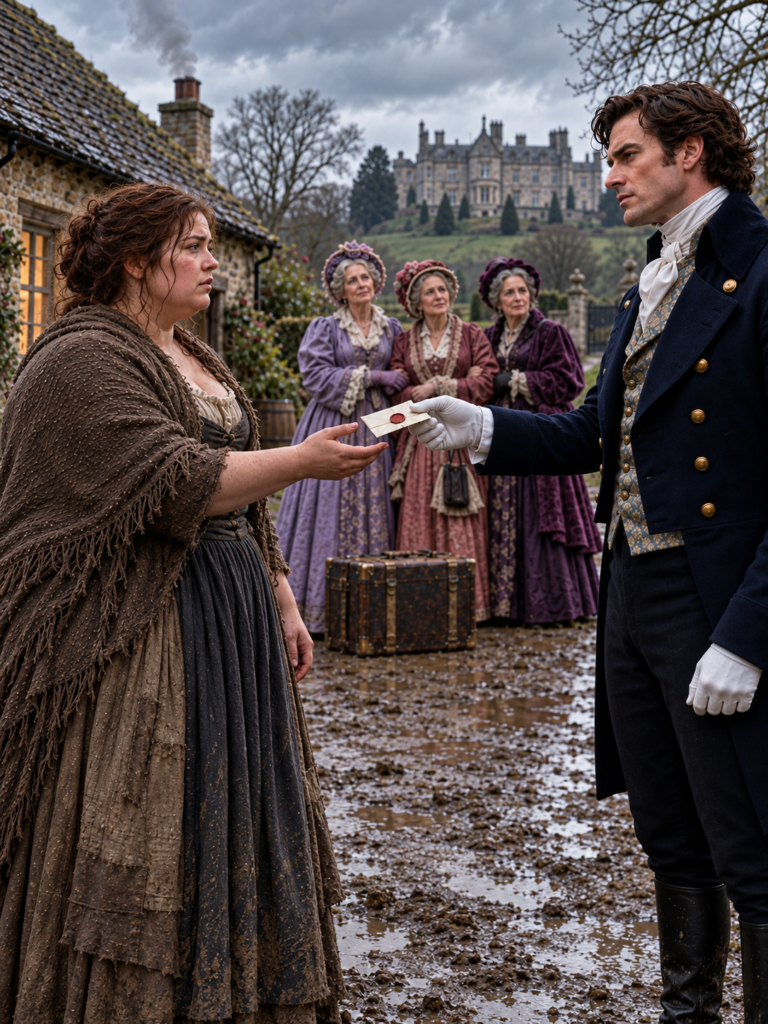
She stood in the doorway with her husband’s woolen shawl around her shoulders, watching a black carriage stop beside the gate.
Behind it came a farm cart.
Three women sat upon the cart’s narrow bench, pressed together beneath a canvas sheet that offered little protection from the rain.
The eldest was tall, with silver hair escaping from a dark bonnet. Another, smaller and sharp-featured, held a leather writing case tightly against her chest. The third had round cheeks, bright blue eyes, and a feather trembling miserably from the brim of her hat.
A servant lowered a battered trunk into the mud.
Then the carriage window opened.
“Mrs. Lowry?”
Maud recognized the Duke of Brewwell immediately, although she had never before spoken to him.
He was younger than she had expected, perhaps thirty-two, with a handsome, severe face and the polished appearance of a man who had never needed to consider the cost of a fire.
“Your Grace.”
He extended an envelope through the carriage window.
“My steward has arranged everything. You will receive four shillings weekly for each lady until Lady Day. Their requirements are modest. I trust you will make them comfortable.”
Maud stared at the envelope.
“These ladies are to stay here?”
“That is the arrangement.”
“For the winter?”
“Until further notice.”
The Duke glanced toward the farmhouse. His expression revealed neither contempt nor concern, only the impatience of someone completing an unpleasant obligation.
“My steward informs me you require additional income.”
Maud felt the words settle somewhere beneath her ribs.
Her husband had been dead for six weeks.
Edward Lowry had left her thirty acres of exhausted soil, two aging cows, a leaking roof, and debts that seemed to multiply whenever she opened the account book.
The rent was due in March.
She had no money to pay it.
But she had not asked the Duke for charity, and she certainly had not agreed to become the keeper of three strangers.
“Your Grace, I have only one proper bed.”
“That should be sufficient for tonight. Mr. Sneath will explain the remainder.”
He withdrew his hand.
The envelope dropped onto the wet doorstep.
Before Maud could answer, the carriage began turning.
She watched its wheels churn through the mud, then disappear beyond the hawthorn hedge.
The three women remained beside their trunk.
For a moment, nobody spoke.
Then the eldest took a careful step forward.
“Mrs. Lowry, I presume.”
“Yes, ma’am.”
“I am Miss Dorcas Ferris. These are my sisters, Honoria and Winifred.”
Dorcas inclined her head with the dignity of someone greeting a duchess rather than a penniless farmer’s widow.
“I apologize for our arrival. We were given to understand that you had agreed.”
Maud looked at the wet trunk.
Then at the three shivering figures.
“You’d better come inside.”
Dorcas smiled faintly.
“Thank you. We shall endeavor not to inconvenience—”
Her voice stopped.
Her eyes lost their focus.
And she collapsed.
Maud caught her just before her head struck the stone threshold.
The elderly woman weighed almost nothing.
“Help me!” Maud cried.
Honoria dropped her writing case. Winifred stumbled forward, calling her sister’s name.
Together they carried Dorcas into the kitchen.
There was a little warmth in the hearth, though more smoke than fire. Maud laid the woman upon the narrow bed behind the curtain and pressed her fingers against a wrist that felt frighteningly cold.
“When did she last eat?”
Honoria hesitated.
“Yesterday morning.”
“Yesterday?”
“We were told there would be luncheon before our departure.”
Winifred knelt beside the bed.
“The trays never came.”
Maud said nothing.
She went to the cupboard.
There remained half a loaf of coarse bread, a little milk, two onions, and a handful of dried beans.
She warmed the milk and broke the bread into it.
Then she sat beside Dorcas, supporting her shoulders while feeding her a spoonful at a time.
Outside, the carriage wheels had long since faded.
Only the rain remained.
By evening, the three women were seated around the kitchen table, wrapped in blankets and drinking weak tea.
Maud had given them her bed.
She herself would sleep in the chair beside the fire.
“You needn’t do that,” Honoria said.
“There’s nowhere else.”
“We could take turns.”
“And have three sick guests by morning? No, thank you.”
Winifred smiled for the first time.
“You sound rather like our old housekeeper.”
“Was she a disagreeable woman?”
“Exceedingly.”
“Then I expect we’d have got along.”
A small laugh passed around the table.
It was the first laughter Maud had heard beneath that roof since Edward’s funeral.
She was surprised by how much it hurt.
Later, when the sisters had retired, Maud opened the Duke’s envelope.
Inside was a brief note written in an elegant hand.
Mrs. Lowry shall receive twelve shillings each week for the accommodation of the three Misses Ferris, until Lady Day, provided they remain at Cold Harbor Farm and cause no disturbance to the household or estate.
Beneath the signature was another instruction.
All correspondence concerning their maintenance is to pass through Mr. Sneath.
Maud read those final words twice.
She did not like them.
Still, twelve shillings a week was more money than her farm had earned in the previous month.
It might be enough to save the house.
She folded the note and placed it inside the biscuit tin where she kept the rent money.
Then her eyes fell upon Edward’s coat.
It hung on the peg beside the door, exactly where he had left it on the evening before his final illness.
She had not been able to touch it.
Now, shivering, she took it down and slipped her arms into its sleeves.
The familiar smell of hay and tobacco brought him back so sharply that she gripped the edge of the table.
“Edward,” she whispered, “what have I done?”
The house offered no answer.
Behind the curtain, someone coughed softly.
Maud wiped her face.
She had three hungry women under her roof.
Whatever else happened, they would not be sent back into the rain.
By breakfast, Maud had learned that her guests were not merely distant relations of the Duke.
They were his father’s three younger sisters.
For nearly forty years, they had lived at Brewwell Hall.
Dorcas, sixty-four, had managed the household during the long illnesses of the late Duchess.
Honoria, sixty-one, had kept the estate’s domestic accounts after the previous housekeeper lost her sight.
Winifred, fifty-eight, had cared for nieces, nephews, cousins, elderly visitors, and every unhappy child who found the grand rooms of Brewwell Hall unbearable.
None had married.
None possessed an independent fortune.
And all three had been removed from their family home because the present Duke had recently married.
“The Duchess is a charming young lady,” Winifred said, stirring her porridge. “I believe she has splendid taste in furniture.”
Honoria made a peculiar noise.
Dorcas gave her a warning glance.
“What?” Winifred asked.
“Nothing,” Honoria replied.
“You’re thinking about the morning room.”
“I am thinking about the thirty-eight pounds spent on curtains for a room nobody uses.”
“Honoria.”
“And the Persian carpet.”
“Honoria.”
“And the six silver candlesticks purchased while the north servants’ quarters remained without proper coal.”
Dorcas set down her spoon.
“Our nephew has married. His household is now his wife’s concern. We must not make trouble.”
Maud, who had been listening from the hearth, turned.
“Did the Duchess ask you to leave?”
None of the sisters answered.
Finally, Winifred said, “We never spoke to her about it.”
“Then who told you to go?”
“The steward brought the instructions,” Honoria replied.
“And the Duke confirmed them?”
Dorcas looked down at her hands.
“He said the arrangement was necessary.”
Something in the stillness of the room troubled Maud more than any complaint could have done.
She understood then that these women had not merely lost their rooms.
They had lost their place in the world.
For decades, they had been useful without being noticed.
Now that their usefulness was no longer fashionable, they had been packed into a cart.
Maud knew something of that feeling.
A widow without money was quickly transformed from a respectable married woman into a problem requiring management.
She pushed another piece of bread toward Dorcas.
“You’ll not need to apologize for eating it,” she said.
Dorcas looked up.
“I beg your pardon?”
“Nothing in this house is so fine that you must ask permission to touch it.”
Winifred’s eyes filled unexpectedly.
Honoria concentrated on her porridge.
And Dorcas gave Maud a long, searching look.
“Mrs. Lowry,” she said quietly, “I believe we may understand one another.”
The first fortnight was disastrous.
Rain came through the roof.
A kitchen window broke in a storm.
One of the cows went lame.
The chimney smoked so badly that everyone developed sore eyes, and the old kitchen range threatened to choke them whenever the wind blew from the west.
Maud worked from dawn until darkness, feeding the animals, hauling water, mending fences, and calculating debts she could not pay.
The ladies tried to help.
At first, their efforts were more enthusiastic than successful.
Winifred broke a wooden spoon while stirring porridge.
Honoria attempted to carry two buckets from the pump and spilled most of the water into her boots.
Dorcas declared the kitchen knives disgraceful and spent an entire afternoon sharpening them against a stone.
Then one evening, Maud returned from the cowshed to find the kitchen transformed.
The fire burned cleanly.
A pot of soup bubbled on the range.
And the table had been covered with a faded white cloth rescued from the bottom of the sisters’ trunk.
Dorcas stood over the stove, sleeves rolled to her elbows.
Honoria sat beside the window with paper, ink, and a ruler.
Winifred was polishing the last of Maud’s mismatched plates.
“What have you done?”
Dorcas tasted the soup.
“Found a way to keep the smoke from the pot. The flue must be swept properly, but this will serve for tonight.”
“And the food?”
“A little barley. Two carrots. Your bacon bones. Nothing worth mentioning.”
Maud tasted a spoonful.
It was the richest soup she could remember eating.
She stared at Dorcas.
“How?”
Dorcas gave a faint smile.
“When I was seventeen, my father employed a French cook named Monsieur Bellamy. He was an extraordinary man.”
“Did he teach you?”
“He did. Until my father discovered it.”
“And then?”
“He dismissed him.”
“Because he’d taught you to cook?”
Dorcas’s smile faded.
“Because I had hoped to marry him.”
Silence settled around the hearth.
Winifred reached for her sister’s hand.
Dorcas looked into the soup.
“I had no fortune. He had no title. My father considered the matter settled.”
“Did you ever see him again?” Maud asked.
“Once. He sent me a little book of recipes when he opened his own establishment in Bath. I still have it.”
She turned back to the pot.
“But I have never forgotten how to make a proper stock.”
Honoria tapped her pencil against the table.
“And that is precisely why I’ve been making calculations.”
Maud approached reluctantly.
“What calculations?”
“The cost of ingredients. The amount of fuel used. The number of people who might pay for a good dinner on Sunday.”
Maud stared at her.
“Pay?”
“Certainly.”
“To eat here?”
“Why not?”
“Because this is a farmhouse, Miss Honoria, not an inn.”
“An inn requires licensing and considerable expense. A private dinner offered by arrangement is another matter, provided we remain within the law.”
Maud looked from one sister to another.
“We don’t even have enough chairs.”
“Then we shall borrow them,” Winifred said.
“We have no proper oven.”
“Then we shall repair it,” Dorcas replied.
“We have no customers.”
Honoria lifted her pencil.
“That is the easiest problem of all.”
Maud almost laughed.
“You cannot expect working men to hand over money for soup when their families need every penny.”
“Then we must give them something worth more than the penny,” Honoria said.
She turned her paper around.
Written across the top were four words.
COLD HARBOR SUNDAY DINNERS.
Beneath them was a careful reckoning of food costs, portions, fuel, and possible earnings.
Maud studied the page.
For the first time since Edward’s death, she saw a future measured in something other than debts.
But a question remained.
“Why would people come all this way?”
Winifred rose from her chair.
She crossed the kitchen and opened the door.
The rain had stopped.
Across the fields, the lights of cottages glimmered in the falling dusk.
“Because,” she said softly, “there are a great many people who have nowhere they particularly wish to be on a Sunday afternoon.”
Their first customer was Abel Stroud.
He was a farm laborer with six children, a permanently bent shoulder, and hands so scarred from work that Maud wondered how he managed to hold his knife.
He came to repair her gate in exchange for a meal.
Dorcas served him thick barley broth, brown bread, and a portion of stewed beef that had been stretched so carefully it seemed almost miraculous.
Abel ate without speaking.
Then he asked for another bowl.
When he finished, he reached into his pocket and placed a penny on the table.
Maud pushed it back.
“You’ve earned your dinner.”
Abel shook his head.
“Then this is for next Sunday.”
He looked toward Dorcas.
“My wife would like to come, if there’s room.”
By the following week, five people arrived.
The week after, twelve.
Before November ended, Maud had repaired the oven with clay and lime, Abel had made a longer table from old planks, and Winifred had borrowed chairs from half the neighboring cottages.
The first Sunday on which twenty people gathered beneath her roof, Maud stood by the door in astonishment.
Farmhands sat beside their wives.
A retired schoolmaster shared a bench with a shepherd.
A young mother nursed her infant near the hearth while Dorcas prepared roast onions and dripping.
Nobody asked anyone else’s station.
Nobody waited for a footman to announce dinner.
And when Winifred began to sing an old country ballad, even the schoolmaster joined the chorus.
For three hours, the shabby farmhouse seemed larger than Brewwell Hall itself.
Maud was carrying plates toward the washing tub when Honoria caught her arm.
“Come here.”
On the table lay the little blue earthenware jug in which they collected the dinner money.
Honoria emptied it.
Copper coins rolled across the cloth.
She counted them with practiced fingers.
Then she laid a folded paper beside Maud’s hand.
“What is this?”
“Our expenses and receipts for the month.”
Maud read slowly.
After food and fuel, they had earned enough to purchase two roof tiles, a pane of glass, and half the lime required to repair the chimney.
It was not wealth.
It was scarcely security.
But it was something the Duke could neither bestow nor withdraw.
It was money they had earned themselves.
Maud looked toward the hearth.
Dorcas was laughing at something Abel had said.
Winifred held the young mother’s baby and sang beneath her breath.
And Honoria, watching Maud’s expression, allowed herself a rare smile.
“We may yet make a business of this, Mrs. Lowry.”
Maud folded the account sheet carefully.
Outside, the first snowflakes of winter were falling.
For the first time, she did not fear them quite so much.
What she did not know was that a second account book, kept under lock and key at Brewwell Hall, already contained an entry ordering Cold Harbor Farm to cease its Sunday dinners.
And the man who had written that entry was preparing to make certain the order was obeyed.
Part 2
Mr. Sneath had been steward of Brewwell Hall for twenty-three years, and during those years he had developed a firm conviction that the most useful thing about a Duke was his signature.
A Duke signed.
A steward understood what the signature ought to mean.
That arrangement had served Sneath admirably through two generations of the family.
The late Duke had been elderly, distracted by illness, and inclined to leave unpleasant matters to his servants.
His son was neither elderly nor foolish, but he had inherited an estate with rising debts and a household in which no one wished to mention the cost of extravagance.
Sneath had therefore made himself indispensable.
He controlled repairs.
He managed tenants.
He advised on rents.
He received the servants’ complaints and decided which deserved to reach His Grace.
And when the new Duchess casually admired the three bright rooms overlooking the south garden, Sneath had recognized an opportunity.
The Duke’s aunts occupied those rooms.
They possessed no legal right to them.
Their continued residence caused inconvenience.
And the household accounts would look considerably healthier if their allowances could be reduced.
Thus the old ladies had been sent to Cold Harbor.
Sneath had expected them to endure the winter quietly, become dependent upon the charity of the widow, and eventually accept rooms above the laundry at Brewwell Hall.
The arrangement would reduce expenses while allowing the Duke to believe he had treated his relatives generously.
Instead, word reached the steward that the sisters had become the most celebrated hostesses in the parish.
One December morning, Sneath stood beside the Duke’s library desk while His Grace examined a list of household expenditures.
“Public dinners?” the Duke repeated.
“I fear so, Your Grace.”
“At Cold Harbor?”
“Every Sunday. Laborers, village women, itinerant tradesmen. Some members of the county have attended.”
The Duke frowned.
“My aunts are serving meals to farmhands?”
“Personally, I am told.”
“Good heavens.”
Sneath lowered his eyes.
“An unfortunate spectacle for the family.”
The Duke remained silent.
His marriage to Lady Cordelia Ashcombe had brought a handsome dowry and the expectation that Brewwell Hall would once again become a fashionable county residence.
He had spent months renovating the rooms.
Now his own aunts were apparently running a dining establishment.
“Are they in want?” he asked.
“The widow is an unreliable person, Your Grace. Her farm has debts. It may be that she has persuaded the ladies to exploit their connections.”
The Duke’s mouth tightened.
“Then the business must stop.”
“Naturally, Your Grace.”
“Speak with Mrs. Lowry. Make it clear that the arrangement was for accommodation, not commerce.”
“And the allowance?”
The Duke hesitated.
Sneath waited.
Finally, the Duke said, “Hold the next payment until the matter is clarified.”
It was a foolish decision.
But foolish decisions often sounded sensible when spoken in quiet rooms by men who did not have to live with their consequences.
The trouble came with the frost.
For three nights the temperature fell so sharply that the pump froze, the cattle huddled against the stable wall, and Maud woke to discover ice forming along the inside of the windowpanes.
On the fourth night, the chimney cracked.
The sound was like a pistol shot.
Maud sprang from her chair.
A great seam had opened across the masonry above the hearth.
Smoke poured into the kitchen.
She rushed to the fire, dragged the burning wood apart with the poker, and smothered the flames with sand from the bucket beside the door.
Then she pulled the curtain back.
“Up! All of you!”
Dorcas struggled from the bed.
Honoria coughed violently.
Winifred, half awake, tried to find her slippers.
Maud wrapped them in blankets and hurried them into the back room.
By the time the smoke cleared, the kitchen was blackened and cold.
The chimney could no longer be used safely.
Without it, there could be no cooking.
Without cooking, there would be no Sunday dinners.
And without the dinners, the rent money would soon disappear.
Maud stood beneath the cracked brickwork until dawn.
When Mr. Sneath appeared at the gate the following morning, she almost welcomed him.
Perhaps the Duke had heard about the damage.
Perhaps he had sent someone to help.
Instead, the steward remained astride his horse.
“Mrs. Lowry.”
“Mr. Sneath. The chimney has split. I’ll need a mason.”
“That is a matter between yourself and the estate.”
“The property belongs to His Grace.”
“And is maintained by the tenant.”
“I cannot pay for such work.”
Sneath removed a folded paper from his coat.
“Then perhaps you should reconsider your current arrangement.”
Maud took the paper.
Her eyes moved over the words.
Maintenance payments are hereby suspended pending satisfactory cessation of the unauthorized dining enterprise.
Below that was another instruction.
The ladies may return to Brewwell Hall on Monday, where alternative accommodation has been provided.
Maud looked up.
“You mean rooms above the laundry.”
“Perfectly respectable quarters.”
“They’ve spent their lives in the main house.”
“Times change, Mrs. Lowry.”
“And if they refuse?”
Sneath’s smile was thin.
“Then I fear they must learn the consequences of refusing His Grace’s generosity.”
He turned his horse.
Maud called after him.
“Do you think he knows they were sent away without proper clothing? That Miss Dorcas fainted from hunger on my doorstep?”
The steward stopped.
For the first time, his expression hardened.
“Be careful, Mrs. Lowry. You are a tenant of this estate.”
“I know precisely what I am.”
“Then you know who may decide whether you remain here after Lady Day.”
He rode away.
Maud stood holding the paper until the rain softened its edges.
The sisters announced their decision that evening.
“We shall return on Monday,” Dorcas said.
Maud was kneeling beside the cold hearth, examining the crack in the bricks.
“No.”
“We cannot permit you to lose your home.”
“I said no.”
Honoria folded her hands.
“You cannot continue without the allowance. I have examined the accounts.”
“Then examine them again.”
“I have examined them three times.”
Maud stood.
For a moment, she was so angry that she could scarcely speak.
Not with the ladies.
Not even entirely with the Duke.
She was angry because she recognized the trap.
The powerful could remove a person’s choices and then praise her for accepting what remained.
Edward’s illness had done something similar.
First it had taken their savings.
Then their strength.
Then their plans.
Finally it had taken him.
Since his death, Maud had lived as though every morning were another installment of the same surrender.
She looked at Dorcas.
“Do you want to go back?”
Dorcas said nothing.
“Miss Honoria?”
“No,” Honoria whispered.
“Miss Winifred?”
Winifred shook her head.
“Then you shall stay.”
“At what cost?” Dorcas asked.
Maud looked around the room.
At the patched curtains.
The broken chimney.
The worn table where so many people had eaten.
Then she glanced at Edward’s coat.
“I don’t know,” she admitted. “But I am tired of letting other people decide what my home is worth.”
The following morning, Maud walked three miles to the village carrying Edward’s coat folded over her arm.
Mr. Tebbitt, the village shopkeeper, had never been particularly kind to her.
He had mocked the arrival of the three ladies at the church gate, calling them the Duke’s discarded ornaments.
Maud had not forgotten.
But he possessed flour, salt pork, dried peas, and the power to extend credit.
She placed the coat upon his counter.
“I need provisions.”
Mr. Tebbitt looked at her.
“How much?”
“Enough to keep the dinners going until Candlemas.”
“That’s a long time.”
“I can pay something each Sunday.”
“And if the customers stop coming?”
Maud straightened.
“Then you may have the coat.”
He unfolded it.
The wool was good, though worn at the elbows.
“Your husband’s?”
“Yes.”
Mr. Tebbitt studied her face.
Then he pushed the coat toward her.
“Put it on.”
“Mr. Tebbitt—”
“Put it on, woman. It’s freezing outside.”
She hesitated.
He took down his credit book.
“How much flour?”
Maud stared.
“You’re willing to trust me?”
“I have eaten Miss Dorcas’s stew.”
“That hardly makes me reliable.”
“No. But the fact that half the village would rather dine at your kitchen table than at the squire’s does.”
He dipped his pen.
“Besides, I’ve made a poor account of myself where those ladies are concerned.”
He wrote her name.
Then he rang the bell for his assistant.
“Send word to Abel Stroud. Tell him I need him here.”
“What for?”
Mr. Tebbitt glanced toward the snowy road.
“Your chimney, Mrs. Lowry. Unless you mean to cook your Sunday dinner outdoors.”
The work took three days.
Abel brought four laborers from the home farm.
They removed the fractured brickwork, reinforced the chimney breast, replaced the damaged stones, and rebuilt the flue.
Maud kept their mortar from freezing by warming small batches inside the washhouse.
Dorcas supplied hot broth.
Honoria recorded every hour of labor.
Winifred sang to the men when their hands grew stiff and their tempers short.
Nobody asked the Duke’s permission.
Nobody sent a bill.
On Christmas Eve, Abel lit a small fire in the repaired hearth.
The flames caught.
Smoke rose through the chimney.
It went upward in one clean, steady stream.
The kitchen filled with warmth.
Maud watched it without moving.
Then, quite unexpectedly, she began to cry.
Dorcas took her hand.
“Whatever is the matter, my dear?”
Maud laughed through her tears.
“Nothing.”
But that was not true.
For the first time in months, she believed there might be an answer to her troubles besides leaving.
At Brewwell Hall, Christmas was a different affair.
The great house glittered with chandeliers, ribbons, and polished silver.
The Duke entertained neighboring families and spoke confidently of improvements to the estate.
His wife sat beside him in gowns selected by a London dressmaker.
Cordelia, Duchess of Brewwell, was twenty-six years old, intelligent, carefully educated, and profoundly unhappy.
She had expected marriage to bring companionship.
Instead, her husband spent his mornings with the steward, his afternoons with lawyers or tenants, and his evenings discussing matters she was expected to admire without understanding.
The house was full of servants but strangely empty of conversation.
Every room belonged to a tradition she had not created.
Every decision appeared to have been made before she arrived.
One afternoon, Lady Ashcombe, an elderly neighbor, called upon her.
“Have you visited Cold Harbor?” she asked.
Cordelia looked up from her embroidery.
“I don’t believe so.”
“Then you must. The dinners are extraordinary.”
“Dinners?”
“At Mrs. Lowry’s farm. The Duke’s aunts have quite taken the county by storm.”
Cordelia lowered her needle.
“The Duke’s aunts?”
Lady Ashcombe stared.
“My dear, surely you know.”
“Know what?”
The older woman’s expression changed.
“Oh.”
For a moment, the only sound was the ticking of the mantel clock.
Then Lady Ashcombe explained.
The three Ferris sisters.
Their departure from Brewwell Hall.
The farm.
The Sunday dinners.
The unpaid allowance.
The threat of eviction.
Cordelia listened without interrupting.
When Lady Ashcombe finished, the Duchess sat very still.
“I admired their rooms,” she said at last.
“I beg your pardon?”
“The south rooms. When I first came here, I told my husband they were beautiful. I said I could imagine using one as a dressing room.”
“Yes?”
“The following week they were empty.”
Lady Ashcombe’s eyes softened.
“Cordelia.”
“I thought the rooms were being renovated.”
She looked down at the embroidery in her hands.
“I never knew anyone had lived there.”
Twelfth Night arrived beneath a sky the color of pewter.
Snow began falling at noon.
By sunset, it had buried the hedges and reduced the roads to narrow white channels.
At Brewwell Hall, forty guests were expected for a ball.
The Duke had ordered music.
Cordelia had arranged the flowers.
The dining table glittered beneath enough silver to furnish a small church.
At seven o’clock, nobody had arrived.
At eight, a footman brought news that the road through the cutting had become impassable.
Several carriages were trapped below the hill.
The Duke summoned servants to clear the snow.
But the wind had risen, and the work could not be finished before morning.
Meanwhile, the stranded guests began searching for shelter.
Someone noticed a light burning far across the fields.
Cold Harbor Farm.
The only house within reach.
Maud first saw the lanterns from the kitchen window.
They moved strangely through the snow, a wavering procession of yellow sparks against the darkness.
She opened the door.
A gust of freezing wind struck her face.
Then a woman’s voice called from beyond the gate.
“Please! Is anyone there?”
Maud lifted her own lantern.
“Come toward the light!”
The first arrivals were a gentleman and his wife, their evening clothes soaked beneath heavy traveling cloaks.
Behind them came three young women, two servants, and an elderly baronet supported by his footman.
More followed.
Their carriage wheels had become trapped in deep snow near the cutting, and the horses could go no farther.
Maud brought them inside.
Then she went back.
And back again.
By the time the last stragglers reached Cold Harbor, nearly forty guests crowded the kitchen and adjoining rooms.
The farmhouse had never held so many people.
Ladies in satin slippers stood beside muddy farm boots.
Gentlemen in embroidered waistcoats warmed their hands over the hearth.
Someone’s powdered wig had gone missing.
A young officer sat upon an upturned milk pail, apologizing profusely for dripping snow upon the floor.
Maud looked at Dorcas.
“We haven’t enough food.”
Dorcas studied the room.
“We haven’t enough plates either.”
Winifred glanced toward the rescued guests.
“Then we had better begin with tea.”
Honoria was already counting the available chairs.
The four women exchanged a look.
Then Dorcas tied on her apron.
“Maud, fetch the large stockpot.”
“What shall we put in it?”
“Everything.”
For the next two hours, Cold Harbor Farm became the busiest kitchen in Yorkshire.
Dorcas worked at the range with a concentration that made conversation seem almost indecent.
She simmered dried beans with bacon, onions, barley, and the remains of a joint of beef.
Maud kneaded and baked rough loaves as quickly as the oven would take them.
Honoria organized the guests into groups, assigning the warmest places to the elderly and the wettest travelers.
Winifred tended the frightened children and persuaded the gentlemen to carry water and firewood.
At last, the soup was ready.
It was served in every bowl, mug, and deep saucer the house possessed.
No one complained.
The guests ate seated on benches, stools, overturned crates, and the floor beside the hearth.
A fashionable widow from York announced that she had never enjoyed a meal more.
A colonel who had spent twenty years in the army asked Dorcas for her recipe.
And a dignified elderly gentleman in a velvet coat, Sir Edmund Vale, quietly requested a third helping.
When the children grew sleepy, Winifred began to sing.
It was an old Christmas carol, one she remembered from childhood.
At first, her voice trembled.
Then it strengthened.
The room grew silent.
A few guests joined her.
Others listened with their eyes lowered.
Sir Edmund removed his spectacles and wiped them slowly with his handkerchief.
“My mother used to sing that,” he murmured.
Winifred smiled at him.
“Then perhaps she knew the second verse.”
He did.
They sang it together.
Outside, snow buried the lane.
Inside, the room glowed with firelight.
And on the hill above them, the great windows of Brewwell Hall shone upon an empty ballroom.
The story spread with remarkable speed.
Within a fortnight, everyone in the county knew that the Duke’s guests had been rescued and fed by the elderly aunts he had sent away.
They knew about the Duchess waiting alone beside an untouched banquet.
They knew that the aunts cooked and served their own meals.
And they knew that Mr. Sneath had attempted to stop the allowance keeping them at the farm.
Invitations to Brewwell Hall began receiving polite refusals.
The Duke’s acquaintances became less willing to discuss his improvements.
At the next county gathering, Sir Edmund Vale greeted him with perfect civility but declined an invitation to dine.
“I have formed another Sunday engagement,” he explained.
The Duke stared.
“With whom?”
“Your aunts.”
It was the first time anyone had spoken the matter so plainly.
In February, Cordelia visited the estate office while her husband was away.
She had decided to write to the sisters.
She wished to apologize.
But first she wanted to understand what had actually happened.
Sneath stood when she entered.
“Your Grace.”
“I would like to see the instructions concerning the Misses Ferris.”
“They are routine household matters.”
“Then they should be easy to find.”
Sneath hesitated.
She noticed.
“I am not asking whether you approve, Mr. Sneath. I am asking for the papers.”
He fetched a ledger.
Cordelia examined it.
The sisters’ maintenance appeared as a regular expense.
But the entries were peculiar.
For several weeks after the supposed suspension, money had still been withdrawn from the household account.
She pointed to the figures.
“These sums were paid?”
“Authorized, Your Grace.”
“To whom?”
“Through the estate office.”
“And delivered to Cold Harbor?”
Sneath shifted his weight.
“There were complications.”
Cordelia turned another page.
Beside a December entry was a notation in small, neat handwriting.
Retained pending compliance.
She looked up.
“You continued collecting the allowance after the payments were stopped.”
Sneath’s face reddened.
“The money was held in reserve.”
“Under whose authority?”
“The Duke’s, naturally.”
“Then His Grace should be able to tell me.”
She closed the ledger.
Sneath put out a hand.
“Your Grace, that book must remain here.”
Cordelia looked at him coldly.
“I am aware of where it belongs.”
She carried it to the library herself.
There, beneath the winter light, she read the entries again.
The sums were small beside the enormous expenses of Brewwell Hall.
But she understood something that would have escaped her a few months earlier.
A small sum meant little to the person signing the order.
To someone whose roof leaked and whose cupboard was empty, it could mean the difference between shelter and ruin.
That evening, she placed the ledger before her husband.
“I want you to read this.”
The Duke barely glanced at it.
“Estate accounts?”
“Your aunts’ accounts.”
His expression tightened.
“Cordelia, I have had enough of this business.”
“Have you?”
He looked up sharply.
She met his gaze.
“Because I have only just begun.”
Their argument lasted nearly an hour.
The Duke insisted that Sneath had been instructed to supervise the arrangement.
Cordelia asked whether supervision included withholding funds while entering them as paid.
He claimed the ladies had embarrassed the family.
She asked whether feeding hungry people was more embarrassing than turning elderly relatives out of their home.
He told her she did not understand estate management.
She replied that she understood enough arithmetic to read a ledger.
Finally, he rose from his chair.
“Do you imagine I wished them harm?”
Cordelia’s anger faltered.
“No,” she said. “I think you wished not to think of them at all.”
The Duke stared at her.
She continued more quietly.
“You found three women inconvenient. You placed them somewhere you would not see them. You entrusted their comfort to a man who could reduce them to a number on a page.”
“You make me sound monstrous.”
“I don’t think you are monstrous.”
She looked toward the cold fireplace.
“I think you have been careless with people who loved you.”
He said nothing.
Cordelia closed the ledger.
“I shall visit Cold Harbor myself.”
“That is unnecessary.”
“Perhaps.”
She lifted her chin.
“But it is what I intend to do.”
A week later, Honoria made a discovery of her own.
She had been reviewing the farm accounts when Maud brought in the old envelope containing the Duke’s original instructions.
“Can you make sense of this?” Maud asked. “I wondered whether we might claim the payments now that the dinners are established.”
Honoria examined the letter.
Her eyes narrowed.
“Where did this come from?”
“The Duke handed it to me.”
“Personally?”
“At the gate.”
Honoria read it again.
Then she rose so abruptly that her chair scraped across the floor.
“Maud, fetch my writing case.”
“Why?”
“Because I believe Mr. Sneath has made a serious mistake.”
She opened the case and took out a sheaf of older papers.
Among them was a copy of a settlement made after the late Duke’s death.
It guaranteed each unmarried sister a modest annual maintenance allowance.
The sums were not gifts.
They were obligations attached to the estate.
And they were not restricted to Lady Day.
Honoria spread the papers across the table.
“Here. Do you see?”
Maud studied the handwriting.
“The allowance continues during their lifetimes.”
“Precisely.”
“Then why did the Duke’s note say until Lady Day?”
Honoria went pale.
“Because someone intended to review it and perhaps persuade us to relinquish our claims.”
“Can they do that?”
“Not lawfully, if the settlement remains valid.”
She looked toward the hearth, where Dorcas was preparing supper.
“For months, we have behaved as though we were grateful recipients of charity.”
Maud saw her hands begin to tremble.
“But we were entitled to support all along,” Honoria whispered. “My father provided for us.”
It was not a fortune.
It would not return their youth.
But the discovery changed everything.
The Duke had not merely been unkind.
His steward might have concealed obligations that could be enforced.
And the three sisters, whom the household had treated as useless old women, possessed the very evidence needed to defend themselves.
Honoria carefully folded the settlement.
“We shall not confront him yet.”
“Why not?”
“Because the Duke must first be made to understand what his signature has done.”
She looked toward the window.
“And I suspect his wife may soon be able to assist us.”
Part 3
The Duchess arrived at Cold Harbor on the third Sunday in March.
She came without a carriage.
That fact alone caused considerable astonishment.
The road was thick with spring mud, and her plain gray cloak was splashed almost to the knees. She wore sturdy boots rather than fashionable slippers, and a small leather satchel hung from her arm.
Maud saw her through the kitchen window.
At first she thought the young woman had lost her way.
Then the visitor pushed back her hood.
The whole room seemed to recognize her at once.
Conversation faltered.
Spoons stopped.
Abel Stroud rose from his place beside the hearth.
The Duchess stood in the doorway, pale and uncertain.
“Mrs. Lowry?”
Maud stepped forward.
“Your Grace.”
Cordelia glanced toward the long table.
Dorcas sat at its head, with Honoria and Winifred beside her.
For a moment, the young Duchess looked almost frightened.
“I hope you will forgive my arriving without an invitation.”
Maud waited.
Cordelia drew a breath.
“I have come to ask whether I might join you for Easter dinner.”
Someone near the window moved awkwardly.
A chair scraped.
“I understand there is a charge,” Cordelia continued. “I have brought a penny.”
Her gloved hand opened.
There lay a small copper coin.
It trembled against her palm.
Maud looked at the coin.
Then at the woman holding it.
She had expected pride.
Perhaps excuses.
Perhaps a message from the Duke demanding that the family be spared further embarrassment.
Instead, she saw a lonely young woman standing in a crowded kitchen, asking for the one thing she apparently could not find in her own magnificent house.
A place.
Before Maud could answer, Winifred rose.
She crossed the room, took the Duchess’s cold hands, and drew her toward the fire.
“My dear child, you’re frozen.”
Cordelia’s composure broke.
“I am sorry,” she whispered.
Winifred patted her hands.
“Yes, well. We shall discuss that after you’ve had some soup.”
Cordelia remained for nearly three hours.
At first she barely spoke.
Dorcas placed a bowl before her.
Honoria asked whether she took bread.
Winifred offered her the chair nearest the warmth.
The other guests gradually resumed their conversations, though with considerably more attention than they pretended.
It was Abel who first made her laugh.
He was describing an escaped pig that had entered the churchyard and caused the curate to lose his place during a funeral sermon.
“The creature stood directly beneath the pulpit,” Abel declared, “and when Mr. Fletcher began speaking of the resurrection, it gave such a squeal that half the congregation thought Judgment Day had arrived.”
Cordelia laughed suddenly.
The sound surprised her so much that she covered her mouth.
Winifred smiled.
“There. That’s better.”
After dinner, while the other guests lingered over tea, Cordelia asked to speak privately with the sisters.
Maud took them into the back room.
There, seated upon mismatched chairs beneath a window repaired with inexpensive glass, the Duchess told them what she knew.
She explained her admiration of the south rooms.
The sudden disappearance of their occupants.
Her belief that some private family sadness had made the rooms vacant.
And her discovery, months later, that the three women had been sent away because the Duke wanted to please her.
“I never asked him to do it,” she said.
Dorcas watched her carefully.
“I believe you.”
Cordelia’s eyes filled.
“I should have asked more questions.”
“Yes,” Honoria said.
Winifred gave her sister a reproving glance.
But Cordelia nodded.
“You’re right.”
She opened her satchel.
Inside lay the estate ledger.
“I have brought this because I believe you are owed money.”
Honoria leaned forward.
Cordelia showed her the entries.
Together they examined the dates.
The withdrawals.
The payments marked as withheld.
Honoria’s expression grew increasingly severe.
At last she opened her writing case and produced the settlement.
“Your Grace, there is something else.”
Cordelia read the document slowly.
When she reached the provision for lifelong maintenance, she looked up.
“The Duke knows of this?”
“I cannot say,” Honoria replied.
“Mr. Sneath?”
“He ought to.”
Cordelia examined the handwriting and the seals.
“My husband’s father signed this.”
“He did,” Dorcas said.
“And the original?”
“Filed among the family settlements, if it has not been mislaid.”
Cordelia set the paper down.
For several moments, she was silent.
Then she said, “We must show him.”
Maud folded her arms.
“And what if he refuses to listen?”
“Then he will have to explain his refusal before someone qualified to interpret the settlement.”
It was not the answer Maud expected from a Duchess.
She studied Cordelia with new interest.
“You would oppose your husband?”
Cordelia looked toward the kitchen door, beyond which voices and laughter could still be heard.
“I would rather give him the chance to become a better man.”
The Duke arrived before the afternoon was over.
He had followed his wife’s route after discovering that she had walked down from the hall.
His boots were muddy.
Rain darkened the shoulders of his coat.
And when Maud opened the door, he appeared almost embarrassed to find himself standing on the same threshold where he had deposited his aunts five months earlier.
“Mrs. Lowry.”
“Your Grace.”
“Is my wife here?”
“She is.”
He glanced over Maud’s shoulder.
From the crowded kitchen came the sound of Winifred singing.
The Duke seemed to recognize the voice.
Something moved across his face.
For one brief instant, he looked considerably younger.
Then he removed his hat.
“May I enter?”
Maud stepped aside.
The room fell silent as he crossed the threshold.
His aunts sat at the long table.
Cordelia was beside them.
Abel Stroud stood near the hearth.
Mr. Tebbitt, who had been enjoying a second helping of pudding, placed his spoon down with deliberate care.
The Duke looked around.
At the clean white cloth.
The bowls.
The mended window.
The new chimney.
The faces of people who neither bowed nor hurried to please him.
This was not the miserable lodging he had imagined.
It was a home.
And there was no place prepared for him.
“Your Grace,” Maud said, “your wife has been telling us about the household accounts.”
The Duke turned.
Cordelia rose.
“I have shown them the ledger.”
He frowned.
“That was a private estate document.”
“And these are private estate obligations,” she replied. “Obligations to your own family.”
Honoria laid the settlement upon the table.
The Duke read it.
Then he read it again.
“This is my father’s signature.”
“Yes, nephew.”
He turned the page.
“The allowances were to continue for life.”
“Yes.”
He stared at the paper.
“Sneath told me the payments were discretionary.”
“Your steward has been mistaken,” Honoria replied.
Or dishonest, Maud thought.
But she held her tongue.
The Duke sat down without being invited.
For several minutes, he examined the account entries.
At last he looked toward Maud.
“Mrs. Lowry, were you paid the weekly sum after December?”
“No.”
“Nothing?”
“Not a farthing.”
His face darkened.
Cordelia pointed toward the ledger.
“The sums continued to be withdrawn.”
He looked down.
The significance of the entries became plain.
Money intended for his aunts had been retained inside the estate office while the widow caring for them struggled to buy food on credit.
He closed his eyes briefly.
Then he addressed Honoria.
“Did you know about the settlement?”
“I remembered that our father had made provision. I did not understand how carefully until Mrs. Lowry showed me your letter.”
“And you believed I had set it aside?”
“We believed what your steward told us.”
The Duke’s jaw tightened.
“I must speak with Sneath.”
“Yes,” Maud said. “You must.”
He looked up.
Her voice was quiet, but it carried across the room.
“And you must speak with us first.”
The Duke had been raised to command servants, manage tenants, and preside over a family whose very name opened doors.
He had not been raised to explain himself before a room full of laborers.
Yet there he sat.
Maud stood across the table.
She had changed little since October.
Her dress was plain.
Her hands were rough.
There was flour upon one sleeve and a burn mark near her wrist.
But she no longer lowered her eyes when he addressed her.
“Your Grace, I have kept your aunts through the winter. I have fed them, housed them, and done my best to keep them warm.”
“I understand.”
“No,” she replied. “I don’t believe you do.”
A murmur passed through the room.
The Duke remained silent.
“One of them fainted on my doorstep because she had been sent away without food. The chimney cracked in the frost. Your steward stopped the payments and threatened my tenancy when I refused to send them back.”
The Duke’s expression grew rigid.
“He threatened to evict you?”
“At Lady Day.”
The Duke looked toward Abel.
The laborer stepped forward.
“We rebuilt the chimney, Your Grace. Four of us from the home farm. Mrs. Lowry kept the mortar warm while we worked.”
Mr. Tebbitt cleared his throat.
“I supplied provisions on credit.”
“And the ladies,” Maud continued, “worked harder than anyone under this roof. Miss Dorcas cooked. Miss Honoria managed the books. Miss Winifred welcomed every person who came through that door.”
She glanced toward the sisters.
“They didn’t need to be put somewhere out of sight. They needed a reason to get up in the morning.”
The Duke lowered his gaze.
For the first time, he seemed uncertain what to do with his hands.
Finally, he said, “What do I owe you?”
Maud did not hesitate.
“The missing payments. The cost of the chimney. Mr. Tebbitt’s outstanding account. The wages of the men who repaired it.”
“Of course.”
“And an acknowledgment that your aunts may choose where they live.”
He looked toward Dorcas.
“Aunt, surely you would prefer—”
“No,” Honoria interrupted.
Her voice was so sharp that even Winifred started.
“We would prefer to be asked.”
The Duke stared at her.
Honoria rose.
She was a small woman, scarcely reaching her nephew’s shoulder, but her bearing had changed.
“We spent our lives at Brewwell Hall. We cared for your father and mother. We kept its accounts, raised its children, received its guests, and buried its dead.”
Her voice trembled.
“We were not troublesome relatives waiting to be hidden. We were part of the family.”
The Duke looked stricken.
“Aunt Honoria—”
“You need not explain what you intended. We know what happened.”
A tear escaped her eye.
She brushed it away angrily.
“And you have no idea how much worse it is to be forgotten than to be disliked.”
No one moved.
Then Dorcas spoke.
“We loved your father, Charles.”
The Duke looked at her.
“And we loved you.”
He swallowed.
“I know.”
“No,” Dorcas said gently. “I don’t think you did.”
The Duke remained seated for a long time.
Outside, the clouds parted enough to send a pale strip of sunlight across the farmhouse floor.
When he finally rose, his expression had changed.
He turned toward his aunts.
“I have behaved disgracefully.”
Nobody answered.
“I thought the arrangements were sensible. The hall was being altered, and I allowed myself to believe that you would be more comfortable somewhere quiet.”
He looked at Maud.
“I did not come to see whether that was true.”
Then he looked toward Cordelia.
“And I blamed others for the embarrassment when I discovered what you had made of this place.”
His wife said nothing.
The Duke took a breath.
“I ask your forgiveness.”
It was awkwardly said.
There was no eloquence in it.
But he did not attempt to excuse himself.
Dorcas considered him.
“Forgiveness is not difficult, Charles. Trust takes somewhat longer.”
He nodded.
“Then I shall endeavor to earn it.”
He turned toward Honoria.
“I shall have the settlement examined and every arrear paid. You shall receive your allowances directly, rather than through the steward.”
“That would be sensible,” Honoria replied.
“And you may return to Brewwell Hall whenever you wish. Your former rooms will be restored.”
The sisters exchanged a glance.
Winifred looked at Dorcas.
Dorcas looked at Honoria.
Then Honoria folded her hands and spoke the words that would be repeated across the county for years afterward.
“Thank you, nephew. But we have a home.”
The Duke stared.
“You mean to remain here?”
“We do.”
“All three of you?”
“Unless Mrs. Lowry grows tired of us.”
Maud laughed softly.
“Not likely.”
The Duke looked around the crowded kitchen.
His eyes rested upon the mended chimney, the long table, and the faces of the people gathered there.
Then, slowly, he nodded.
“I see.”
Winifred rose.
She came toward him, placed a hand against his cheek, and smiled.
“You may visit us, Charles.”
His composure nearly failed.
“May I?”
“Of course.”
“And perhaps,” she added, “you would bring your wife.”
Cordelia lowered her eyes.
Winifred’s smile widened.
“At Easter. We always have a very good dinner.”
Honoria cleared her throat.
“One penny per plate.”
The room broke into laughter.
Even the Duke managed a smile.
“One penny,” he said. “I shall remember.”
Mr. Sneath was summoned to the hall the following morning.
The interview took place behind closed doors.
The Duke questioned him about the missing payments, the settlement, and the instructions issued in his name.
At first, the steward insisted that everything had been done for the dignity of the family.
Then he claimed the funds had merely been retained.
Finally, confronted with the ledger and the original agreement, he admitted that he had hoped to persuade the sisters to accept a reduced maintenance arrangement before Lady Day.
He had not considered their preferences important.
He had considered the savings useful.
The Duke required him to account for every shilling.
A solicitor was instructed to examine the records, confirm the sisters’ entitlements, and arrange restitution.
Sneath was dismissed from his post.
But the Duke did not escape the consequences by blaming his steward.
At Cordelia’s insistence, he personally visited Cold Harbor with the money owed.
Honoria counted every coin.
Mr. Tebbitt received payment for his provisions.
Abel and the men who repaired the chimney received their wages.
The outstanding rent was settled according to the tenancy agreement.
And a new arrangement was established.
The three sisters could remain at Cold Harbor for as long as they wished, with their maintenance paid directly and regularly.
Maud’s tenancy would no longer depend upon their presence.
She would keep the farm through her own agreement with the estate.
When the solicitor asked whether she understood the terms, Maud took the papers and read them carefully.
Then she signed.
She had learned the importance of written promises.
Spring came reluctantly.
The snow withdrew from the fields, leaving the roads brown and soft.
Primroses appeared beneath the hedges.
Lambs cried from the neighboring pastures.
At Cold Harbor, Abel built a second long table beneath the kitchen window.
The repairs continued.
The roof was made sound.
The back room was whitewashed.
The kitchen shelves were replaced.
And the Sunday dinners became so well attended that Honoria introduced a simple reservation book, though she still insisted that anyone genuinely hungry would be fed.
Dorcas began teaching two village girls how to cook.
Neither came from a wealthy family.
One was the daughter of a laborer.
The other was the granddaughter of the shopkeeper.
Dorcas treated both with the seriousness of apprentices in a great French kitchen.
She showed them how to make broth from bones, how to knead bread without wasting flour, and how to judge a sauce by scent and texture.
One afternoon, Maud discovered Dorcas showing the girls her old recipe book.
The cover had softened with age.
Inside, on the first page, was a dedication written in French.
To Mademoiselle Dorcas, who understands that a good meal is never merely food.
Beneath it stood the name Bellamy.
Maud touched the page.
“You kept it all these years.”
Dorcas smiled.
“Some things are worth keeping.”
“Do you regret not marrying him?”
Dorcas closed the book gently.
“Sometimes.”
She looked toward the two girls laughing beside the table.
“But I regret even more that I allowed other people to convince me my life was finished because that choice had been taken from me.”
Maud understood.
For months after Edward died, she had believed the best part of her life was over.
Now she rose each morning to a house filled with work, purpose, and people who needed her.
It did not diminish her love for Edward.
It gave that love somewhere to live.
Easter Sunday dawned clear and cold.
Sunlight spilled over the fields.
The new chimney sent a thin ribbon of smoke into the blue sky.
Inside, Cold Harbor Farm smelled of roast lamb, rosemary, fresh bread, and baked apples.
Dorcas directed the cooking like a general commanding a well-disciplined regiment.
Honoria inspected the account book.
Winifred arranged spring flowers in three mismatched jugs.
Maud carried plates between the kitchen and the newly whitewashed back room.
By noon, the guests had begun to arrive.
Abel came with his wife and their youngest children.
Mr. Tebbitt appeared in his Sunday coat.
The curate brought an elderly aunt.
Sir Edmund Vale arrived carrying a small parcel for Winifred and insisted upon sitting beside her.
Then, just as Dorcas announced that the lamb was ready, a carriage stopped at the gate.
The Duke stepped down first.
He wore a dark blue coat and carried no walking stick.
He turned to help Cordelia from the carriage.
She wore a simple blue dress beneath her cloak.
No jewels except her wedding ring.
When they reached the door, Maud was there to greet them.
“Your Graces.”
The Duke removed his hat.
“Mrs. Lowry.”
He looked past her toward the crowded room.
“I hope we are not late.”
“Not at all.”
Cordelia smiled nervously.
“We have brought our pennies.”
She opened her hand.
Two copper coins lay upon her glove.
Maud stepped aside.
“Then you’d better come in before Miss Dorcas gives your dinner away.”
The Duke laughed.
It was a small sound, but genuine.
For perhaps the first time in his adult life, he entered a room without expecting it to arrange itself around him.
Nobody hurried to pull out a chair.
Nobody interrupted their conversation.
He took his place at the end of the table beside Abel Stroud, who moved his elbow to make room.
Cordelia settled between Winifred and the curate.
Within minutes, she was helping pass the bread.
When one of Abel’s children dropped a spoon, she bent to retrieve it before a servant could move.
There were no servants.
The child thanked her.
She smiled.
Across the room, the Duke watched.
His wife looked younger than she had in months.
Not because she wore fashionable clothes or occupied a place of honor.
Because she appeared to belong.
Dinner lasted well into the afternoon.
Dorcas served lamb with rosemary, onions cooked slowly in their own sweetness, carrots glazed with a little butter, and bread so fresh that steam rose when Maud broke it.
The company ate heartily.
Stories passed from one end of the table to the other.
The curate argued cheerfully with Mr. Tebbitt about the proper date for planting beans.
Sir Edmund persuaded Winifred to sing an old Easter hymn.
And the Duke, after an awkward beginning, found himself discussing the condition of the home farm’s drainage with Abel Stroud.
It was a conversation he had never imagined having over Sunday dinner.
He discovered that Abel knew more about the neglected lower fields than anyone in the estate office.
He listened.
He asked questions.
And when Abel suggested a modest improvement to the ditches, the Duke promised to inspect the ground himself.
Honoria observed the exchange with satisfaction.
Near the end of the meal, Cordelia leaned toward Maud.
“May I ask you something?”
“Of course.”
“Would it be acceptable if I came again? Not merely for a formal visit.”
Maud looked at her.
Cordelia hesitated.
“I know very little about managing a household properly. The hall runs as it always has, and I am expected to approve everything without understanding how it is done.”
She glanced toward Honoria.
“I should like to learn.”
Maud smiled.
“You had better be certain, Your Grace. Miss Honoria does not spare anyone who makes a mistake in a ledger.”
“I have already discovered that.”
“Then I think you’ll manage very well.”
Cordelia laughed.
It was not the restrained laughter of a Duchess entertaining guests.
It was the laughter of a young woman discovering that she could be useful.
The final course had been served when Dorcas brought the Duke his plate.
She had kept aside the best slice of lamb.
He looked at it.
“Aunt Dorcas, you needn’t—”
“Hush, Charles. Eat your dinner.”
She laid a hand upon his shoulder.
The gesture was small.
Ordinary.
The kind of gesture she might have given him when he was a child frightened by thunder.
The Duke looked up.
His eyes had grown suspiciously bright.
“Thank you,” he said.
Dorcas gave his shoulder a gentle squeeze.
Then she moved away to fetch more bread.
He watched her go.
For the first time, he seemed to understand that rank had never been what made her valuable.
She had always possessed something he could neither inherit nor purchase.
The ability to make another person feel cared for.
When the guests began leaving, Maud went to the mantelpiece.
The old biscuit tin stood there, a little dented, its lid scratched from years of use.
She opened it.
Inside lay the Duke’s original letter.
The broken red seal still clung to the paper.
Twelve shillings each week until Lady Day.
For months, she had kept it because it was the only assurance that she might survive the winter.
Now she had a proper tenancy agreement.
Her debts were being reduced.
The Sunday dinners paid their way.
And the three women sleeping beneath her roof had chosen to remain.
She held the letter a moment.
Then she turned toward the fire.
Dorcas, seated by the window, noticed what she was doing.
Their eyes met.
Maud lifted the paper slightly.
Dorcas smiled.
It was all the permission Maud needed.
She fed the letter into the flames.
The edge darkened.
The writing curled.
The red seal softened and sank into the embers.
In moments, the Duke’s instructions had become ash.
Maud closed the tin.
Behind her, Winifred began another song.
Honoria was scolding Abel for trying to leave without accepting a parcel of bread for his children.
Cordelia stood beside the window laughing with Sir Edmund.
And the Duke was helping carry chairs into the back room.
Maud looked toward Edward’s coat.
It hung upon its old peg beside the door.
She had worn it through the worst of the winter.
She had cried into its collar.
She had offered it for flour.
But she no longer wore it every day.
She had a coat of her own now, purchased from the earnings of the Sunday dinners.
She walked to the peg and straightened Edward’s coat.
“Well,” she whispered, “we kept the place.”
For a moment, she imagined his hand resting against her shoulder.
Then she heard Dorcas calling.
“Maud, my dear, we need you!”
She turned.
The sunlight fell across the long table.
There were breadcrumbs upon the cloth, empty dishes beside the blue jug, and flowers spilling from their chipped vases.
Three elderly sisters sat among friends who had once been strangers.
A Duchess was learning how to belong without demanding attention.
A Duke had discovered that being obeyed was not the same thing as being respected.
And a widow who had been certain she would lose everything had found a reason to open her door every Sunday.
Maud returned to the table.
There was room beside Dorcas.
Winifred drew back the chair.
Honoria passed her a cup of tea.
Outside, the last of the winter wind moved across the moors.
But inside Cold Harbor Farm, the fire burned steadily, the windows stood clear, and nobody had to ask whether there was a place for them.
There was always a place.
And that, Maud thought as she sat among the people who had become her family, was a kind of wealth no Duke could ever take away.


