
Part 1
The first thing I noticed was that my mother had used the photograph I took.
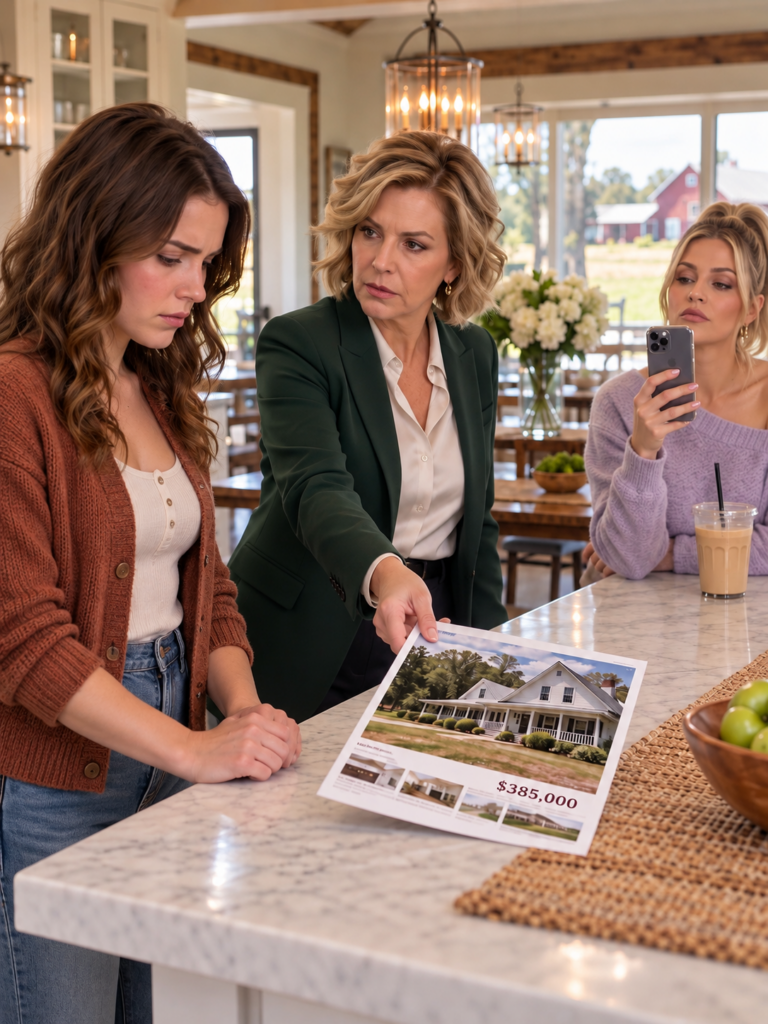
It was a picture of the farmhouse in late September, when the maple trees along the gravel drive had turned red and the morning sun made the old white siding look almost new. I had taken it for my grandmother, who wanted to send it to an old friend living in Vermont.
Now that same photograph was printed across the top of a glossy real estate brochure.
Beneath it, in elegant blue lettering, were the words:
Historic Country Charm — $429,000.
My mother had even written a little description.
Lovingly maintained family property, offering warmth, character, and generations of cherished memories.
I stood at the kitchen counter, reading that sentence twice.
Then I looked at her.
“Lovingly maintained?”
My mother, Diane Whitcomb, took a slow sip of coffee.
She was sixty-one, with carefully colored chestnut hair and a face that always seemed to know exactly what expression would serve her best. That morning, she wore a cream-colored sweater and gold earrings. She looked like a woman preparing to show a house to wealthy buyers, not a woman preparing to throw her daughter out of it.
“It’s standard listing language, Claire. Don’t start picking everything apart.”
My stepfather, Warren, sat at the breakfast table with a folded newspaper in front of him. He hadn’t turned a page since I entered the room.
My sister, Madison, leaned against the refrigerator, holding her phone at chest height.
I could see the little red recording indicator.
“Are you filming me?” I asked.
Madison shrugged.
“It’s a family moment.”
“Put the phone down.”
“Why? Afraid you’ll say something embarrassing?”
She smiled at the screen.
At twenty-eight, Madison had perfected the art of making cruelty look casual. She could insult someone while checking her lipstick and somehow convince the room that the person she wounded was being overly sensitive.
My mother tapped the brochure.
“Let’s stay focused. Warren and I have decided to sell. We’ve already spoken with a builder about a smaller home near the lake. This place is too much work, and we’re ready for a different chapter.”
I looked around the kitchen.
The oak cabinets needed polishing. The old refrigerator hummed louder than it should. A narrow strip of sunlight fell across the floorboards I had scrubbed countless times.
Outside the window, my grandmother’s vegetable garden lay beneath a layer of early spring frost.
“Does that different chapter include me?” I asked.
My mother sighed.
“Claire, you’re thirty-six. Surely you didn’t expect to live here forever.”
That sentence landed with such familiar precision that for a moment I couldn’t answer.
I had heard versions of it since childhood.
At sixteen, when I asked why Madison received new clothes while I wore secondhand ones, my mother said I was old enough to understand money.
At nineteen, when I needed help with community college tuition, she said adulthood meant standing on my own feet.
At twenty-seven, when my grandmother fell and fractured her hip, my mother said I was the only one with the patience to help her.
At thirty-three, when Grandma could no longer dress herself without assistance, my mother said family came before personal ambition.
And now, at thirty-six, apparently, family meant finding somewhere else to live.
“I thought we were going to discuss the house after the anniversary of Grandma’s death,” I said.
“We are discussing it.”
“No. You’re announcing a decision.”
“Because a decision has been made.”
Madison tilted her phone toward my face.
“So, are you going to cry, or are you going to start packing?”
I stared at her.
She had never lived in the farmhouse for longer than a few months at a time. She came home when relationships ended, when rent became inconvenient, or when she wanted to photograph the porch for her lifestyle account.
But when Grandma needed someone to change her bedding at two in the morning, Madison was busy.
When Grandma’s hands trembled too badly to button her cardigan, Madison was busy.
When the ambulance came during that final November, Madison had been at a spa weekend with friends.
She sent flowers to the funeral.
Pink lilies.
Grandma hated lilies.
My mother slid a second piece of paper toward me.
It was a moving checklist.
“You’ll need to clear your bedroom, the downstairs sewing room, and whatever belongings you’ve stored in the garage. I don’t want potential buyers walking into clutter.”
I looked at the list.
Someone had already checked the box beside Donation pickup.
“You scheduled people to take Grandma’s things?”
“Only what isn’t useful.”
“You didn’t ask me.”
“Because I knew you’d make it emotional.”
I picked up the paper.
In the section marked Items to Remove, my grandmother’s rocking chair was listed beside a broken lawn mower.
The chair she had sat in every evening for forty years.
The chair where she taught me to sew a button, peel an apple in one long strip, and recognize thunderstorms by the smell of the air.
Something inside me went very quiet.
“Don’t touch that chair,” I said.
My mother rolled her eyes.
“Claire.”
“I mean it.”
Madison laughed softly.
“Oh, here we go.”
Warren finally set down his newspaper.
“Maybe we should give her a little more time, Diane.”
My mother turned toward him.
“We’ve already talked about this.”
He lowered his eyes.
That was Warren’s contribution to most family arguments: one sentence of concern, followed by immediate surrender.
I folded the moving checklist into quarters.
“Who owns the house?” I asked.
My mother blinked.
“What?”
“Whose name is on the deed?”
“Your grandmother left her affairs to me.”
“That isn’t what I asked.”
Her expression hardened.
“I’m the person responsible for handling the estate. I’ve been dealing with property and probate matters for thirty years, Claire. I don’t need you interrogating me at breakfast.”
I looked at Warren.
He concentrated on his coffee.
Madison was still filming.
My mother pushed the brochure closer.
“Sixty days. That’s generous, considering you’ve lived here without paying rent.”
I felt the sting of that familiar accusation.
I had paid for the roof repairs after the ice storm.
I had replaced the water heater.
For six years, I bought most of the groceries, handled the utility bills, and took unpaid leave whenever Grandma needed another medical appointment.
My mother occasionally bought decorative pillows for the living room and described herself to neighbors as the woman holding the entire family together.
But I knew better than to recite my contributions.
My mother had a remarkable gift for turning evidence into an accusation.
If I mentioned money, I was keeping score.
If I mentioned sacrifice, I was demanding praise.
If I mentioned fairness, I was jealous of Madison.
So I put the folded checklist on the counter.
“Fine,” I said.
Madison lowered her phone slightly.
“Fine?”
“I heard you.”
My mother’s shoulders relaxed.
“Good. I knew you’d be sensible once you got past the initial disappointment.”
I turned toward the stairs.
“Where are you going?” she asked.
“To get something.”
“Claire, we haven’t finished discussing the open house.”
I kept walking.
Behind me, Madison said, loud enough to make sure I heard, “That went better than I expected.”
My mother laughed.
It wasn’t a cruel, theatrical laugh.
It was worse.
It was the easy laugh of someone who believed the matter had already been settled.
My bedroom was at the back of the second floor, overlooking the field where Grandma once grew pumpkins.
The room hadn’t changed much since I was fourteen.
A narrow brass bed.
A pine dresser.
A quilt with uneven blue stitching.
And beneath the window, an old wicker sewing basket that nobody but Grandma and I ever bothered to open.
I knelt beside it.
For a moment, I simply rested my hand on the lid.
Grandma’s name was Ruth Holloway.
She had been a public school secretary for thirty-two years, married a mechanic who died too young, and raised two daughters on a salary that never seemed large enough.
One daughter was my mother.
The other was my aunt Beth, who had died from complications of pneumonia when I was seven.
Grandma rarely spoke about losing Beth. But sometimes I would find her sitting in the kitchen after midnight, holding a photograph of two little girls in matching Easter dresses.
She loved them both.
That was one thing I never questioned.
What I eventually understood was that love didn’t make her blind.
Three weeks before her death, Grandma asked me to bring her the sewing basket.
She was ninety-one by then, impossibly small beneath the hospital blanket, with thin silver hair and hands covered in purple bruises from blood tests.
I brought the basket to her bedside.
She opened the false bottom herself.
Underneath her neatly wound thread spools lay a thick envelope wrapped in a piece of faded green fabric.
She placed it in my hands.
“Don’t let your mother see this.”
I remember looking toward the door.
“Grandma, what is it?”
“Something I should have told you sooner.”
“Then tell me now.”
She shook her head.
“Not while she’s still pretending.”
I didn’t understand.
Grandma pressed my fingers around the envelope.
“When you need it, you’ll know. Promise me you won’t throw it away.”
“I promise.”
“And Claire?”
“Yes?”
“Don’t confuse keeping the peace with keeping your place.”
At the time, I thought she was talking about my mother criticizing the way I cared for her.
I had no idea she meant something much larger.
Now, almost three years later, I lifted the basket’s false bottom.
The green fabric was still there.
So was the envelope.
My name had been written across the front in Grandma’s narrow, unmistakable handwriting.
For Claire. When the house is no longer safe.
I sat on the floor.
Downstairs, I could hear Madison talking.
Something about the footage being perfect.
Something about my mother finally getting her fresh start.
I slipped the envelope into my handbag.
Then I stood and looked around my bedroom.
For years, I had thought the saddest part of losing Grandma was the silence she left behind.
I was beginning to understand that the silence had hidden something.
And I intended to find out what.
I drove west toward the county seat, following a two-lane road through the hills of western Pennsylvania.
The sky was heavy and gray. Old snow remained in narrow white patches beneath the trees.
My hands shook against the steering wheel.
Not because I was afraid of leaving.
I had imagined leaving many times.
I imagined a little apartment above a bookstore, or a rented cottage with enough light for my houseplants. I imagined waking without hearing my mother criticize the way I closed cabinets or the groceries I purchased.
But each time I considered it, I remembered Grandma.
First, she needed me.
Then she was gone, and I couldn’t bear to abandon the rooms where she had spent her life.
Grief had turned the farmhouse into both shelter and prison.
At a traffic light outside Bellhaven, I opened the envelope.
Inside was a folded letter and a business card.
I read the letter first.
My darling Claire,
If you have opened this, I suspect your mother has finally tried to force you out of the house.
I wish I could tell you that I was wrong about her. I have spent too many years hoping she would become kinder when life stopped giving her reasons to be angry.
But I have learned that some people don’t need a reason to take something. They only need to believe they deserve it more than anyone else.
There are papers you have never seen. There are things I did quietly because I knew you would try to protect everyone’s feelings, including those of people who never protected yours.
Please go to the attorney whose card I’ve enclosed. Listen before you make promises to anyone.
And whatever your mother tells you, remember this: You did not owe me your youth in exchange for my love.
I loved you before you ever lifted a finger to help me.
Grandma Ruth.
I read the final two lines four times.
Then I pulled into a grocery store parking lot and cried so hard I couldn’t see the windshield.
Not because I understood the secret.
I didn’t.
I cried because Grandma had known.
She had known how often I felt trapped between resentment and guilt.
She had known that every compliment my mother gave me came attached to another obligation.
And somehow, from the fragile edge of her own life, she had been thinking about mine.
Eventually, I unfolded the business card.
Caleb Mercer, Attorney at Law.
Estate Planning and Property Litigation.
18 North Market Street, Bellhaven, Pennsylvania.
Under the printed address, Grandma had written three words.
He knows everything.
I wiped my eyes, started the car, and drove toward Market Street.
I had never met Caleb Mercer.
But when his receptionist heard my name, she immediately stood.
“Claire Holloway?”
I nodded.
Her eyes softened.
“Oh, honey.”
She picked up the phone.
“Mr. Mercer? She’s here.”
A moment later, an elderly man appeared in the hallway.
He wore a gray suit with a slightly crooked tie and carried a leather folder beneath one arm.
When he saw the envelope in my hands, he stopped walking.
For several seconds, he studied my face.
Then he said something that made my stomach tighten.
“I was beginning to worry she’d found it first.”
He led me into his office and closed the door.
On his desk lay a photograph of my grandmother standing beside an enormous oak tree.
Mr. Mercer placed his folder beside it.
“Before we discuss the house,” he said, “I need to ask you one question.”
I sat down.
“All right.”
“Has your mother already put the property on the market?”
I opened my handbag and handed him the brochure.
He examined it carefully.
Then he removed his glasses.
The warmth disappeared from his face.
“Claire,” he said, “do you know what a trustee is?”
I shook my head.
He opened the leather folder.
“Then we need to talk about what your grandmother did twelve years ago.”
Mr. Mercer turned the folder around.
At the top of the first page were the words The Ruth E. Holloway Living Trust.
Below them were signatures, dates, notary seals, and paragraphs of legal language I couldn’t begin to understand.
“Your grandmother established this trust when she was seventy-nine,” he explained. “At the time, she was in excellent health. She wanted to decide what would happen to her home while she was still perfectly capable of making those decisions.”
I stared at the date.
Twelve years earlier.
Grandma had still been driving herself to church, planting tomatoes, and taking bus trips with the senior center.
“She never told me.”
“She didn’t want you put in the position of defending her decisions while she was alive.”
He took another document from the folder.
“The farmhouse was transferred into the trust. Your grandmother served as the original trustee, with full authority to manage it during her lifetime. Upon her death, I was named successor trustee to administer her instructions.”
“Why you?”
“Because she knew your mother would challenge them.”
My throat tightened.
“What instructions?”
He studied me for a moment.
“Your grandmother left the farmhouse and the adjoining eleven acres to you, Claire. Your mother is not the beneficiary.”
The room seemed to tilt.
I looked down at the document again.
My name was there.
Claire Elizabeth Holloway.
I traced the letters with one finger.
“No,” I whispered.
Mr. Mercer waited.
“There must be some mistake. Mom said Grandma left everything for her to manage.”
“Your mother was named personal representative in an earlier will. That document was replaced as part of the estate plan. The trust property was never hers to sell.”
“But she knows about real estate. She’s worked in the business for years.”
“She knows enough to understand that a listing agreement doesn’t create ownership.”
I looked up sharply.
“You mean she knew?”
Mr. Mercer didn’t immediately answer.
Instead, he reached for another folder.
It contained three letters.
The first was dated four months after Grandma’s death.
The second, eleven months later.
The third, less than a year ago.
Each had been addressed to my mother.
Mr. Mercer showed me the delivery confirmations.
“Diane was informed that she wasn’t authorized to sell, mortgage, or transfer the property. She requested copies of the trust and questioned the arrangement through her own lawyer. We provided the information she was legally entitled to receive.”
“What did she say?”
“Initially, she claimed Ruth had been manipulated. Later, she questioned your grandmother’s mental capacity. Neither claim was supported by the evidence.”
He pushed the final letter toward me.
My mother had written it herself.
I recognized her handwriting immediately.
I will not accept being pushed aside in favor of a daughter who has never amounted to anything.
My eyes fixed on that sentence.
Who has never amounted to anything.
Not my daughter.
Not Claire.
Just someone who had failed to become the person my mother believed deserved a house.
Mr. Mercer cleared his throat.
“There’s more.”
I looked at him.
He hesitated.
“Your grandmother anticipated that your mother might persuade you to surrender the property once you learned about it. She was particularly concerned that you’d sign something to prevent a family confrontation.”
He showed me another page.
It was a letter Grandma had left for him.
In it, she described years of watching my mother treat me as unpaid help while praising Madison for the smallest accomplishments.
She listed the dates I took Grandma to the hospital.
She mentioned the Thanksgiving dinner I missed because she was recovering from surgery and nobody else volunteered to stay.
She described the time my mother used money Grandma had given me for a nursing certification program to pay Madison’s overdue car loan.
I had almost forgotten that.
Almost.
At the time, Mom told me it was an emergency and promised she’d replace the money.
She never did.
Mr. Mercer watched my face.
“Your grandmother kept records.”
“What kind of records?”
“Canceled checks. Household expense ledgers. Notes about repairs. Copies of transfers. She was a meticulous woman.”
That made me smile through the tears gathering in my eyes.
Grandma never threw away a receipt.
She once kept the warranty for a toaster that had stopped working during the Clinton administration.
“She wanted you to understand that this inheritance wasn’t payment for taking care of her,” he continued. “She wanted it to be a place where you could build a life without anyone deciding whether you’d earned the right to stay.”
I covered my mouth.
For the first time that morning, I couldn’t control the sound that escaped me.
It was half a sob and half an exhausted laugh.
Mr. Mercer let me have the moment.
Then he reached into the bottom of the folder and removed a photograph.
Grandma stood in front of the farmhouse with her hand resting on a young oak sapling.
Beside her was a woman I didn’t recognize.
“Who’s that?” I asked.
“Your grandmother’s sister, Margaret.”
“I didn’t know she had a sister.”
“She died many years ago. Ruth inherited part of the land from her. Your grandmother worried that the history of the property would be forgotten.”
He turned the photograph over.
On the back, Grandma had written:
For the girl who always stayed when everyone else left.
I pressed the photograph to my chest.
Mr. Mercer waited until I could speak again.
“Does that mean I can make Mom leave?”
“You have the right to possession, subject to the legal process. But we need to proceed carefully. Your mother has been occupying the property with your permission or your grandmother’s, depending on when that permission arose. We cannot simply change the locks or remove her belongings.”
I nodded.
“Then what do we do?”
“First, we stop the sale. Second, we formally notify her that permission to occupy the property is being terminated. If she refuses to leave, we’ll ask the court for possession.”
He paused.
“And there’s something else. Your grandmother directed me to provide a full accounting before distributing the property, so the administration has remained open. We have some unresolved questions about household funds and expenses.”
My heart sank.
“Is the house in trouble?”
“Not at the moment. But your mother has made inquiries about borrowing against it. We discovered that recently.”
I stared at him.
“She tried to mortgage Grandma’s house?”
“She asked a local lender whether the property could support a substantial loan. The lender requested proof of authority and didn’t proceed.”
“How substantial?”
He checked a note.
“One hundred and forty thousand dollars.”
I couldn’t speak.
That was more money than I had ever earned in two years.
“What did she want it for?”
“I don’t know.”
He closed the folder.
“But I intend to find out.”
I sat for a long time, staring at the photograph of Grandma.
That morning, my mother had given me sixty days to get out.
Now I was sitting in an attorney’s office, learning that for almost three years, she had been trying to take something Grandma had deliberately protected.
And all that time, she let me believe I was merely a guest.
Mr. Mercer slid a blank legal pad toward me.
“I need you to tell me everything that happened at breakfast. Every word you remember. And I need you to preserve any messages, photographs, or financial records involving the property.”
I picked up his pen.
For most of my life, I had been careful about what I said.
Careful not to provoke.
Careful not to make things worse.
Careful not to embarrass my mother.
This time, I began writing.
I wrote about the brochure.
The sixty-day deadline.
Madison’s phone.
The moving checklist.
The rocking chair.
And finally, the sentence that had hurt me more than I wanted to admit.
You’ve lived here without paying rent.
Mr. Mercer read the page when I finished.
Then he looked at me.
“You understand something, Claire?”
“What?”
“You don’t have to convince your mother that you’re worthy of your grandmother’s love.”
He tapped the trust document.
“Ruth made her decision. What we have to do now is protect it.”
I looked down at my name.
For the first time in years, I had a decision to make that didn’t begin with asking my mother’s permission.
“Then stop the listing,” I said.
He nodded.
“I’ll begin today.”
I left his office shortly after two.
When I reached the parking lot, my phone showed seventeen missed calls.
Nine from my mother.
Six from Madison.
Two from Warren.
There was also a message from Madison.
Mom says you better come home. Some lawyer just called her office and she’s absolutely furious.
Then another.
Seriously, Claire, whatever you’re doing, stop. You’re ruining everything.
I stared at the screen.
A minute later, my mother called again.
This time, I answered.
“Where are you?” she demanded.
“In Bellhaven.”
“Did you go to Mercer?”
“Yes.”
There was a sharp intake of breath.
Then silence.
“You had no right,” she said.
I looked across the parking lot at a woman helping an elderly man into a car.
I thought of all the appointments, the grocery trips, the sleepless nights.
All the years I had been told I was doing the bare minimum.
“Mom,” I said, “whose house did you just put up for sale?”
She didn’t answer.
And in that silence, I finally understood that she had known the truth all along.
Part 2
By the time I returned to the farmhouse, my mother’s car was parked diagonally across the driveway.
That was unusual.
Diane believed cars should always be parked neatly. She once made me move mine six inches because she didn’t like how it looked from the front porch.
Seeing her tires pressed into the wet grass told me more about her mood than any text message could.
I walked through the front door.
My mother was waiting in the kitchen.
Madison sat on a stool at the counter, her phone face down beside her.
Warren stood by the sink.
Nobody spoke until I set my handbag on the table.
Then Mom said, “What exactly have you done?”
“I went to see Grandma’s attorney.”
“I know where you went.”
“Then why did you ask?”
Her face tightened.
“Don’t get clever with me.”
I took off my coat and hung it beside the door.
It was a small action, but I saw her notice.
I was behaving as though I still belonged there.
Perhaps that frightened her more than shouting would have.
“Caleb Mercer has been interfering in this family’s affairs for years,” she said. “Your grandmother was vulnerable, and he took advantage of her.”
“He showed me the documents.”
“Documents can be challenged.”
“He showed me your letters, too.”
That stopped her.
Madison looked up.
“What letters?”
My mother ignored her.
“Claire, this isn’t something you understand.”
“Then explain it.”
“I’ve spent decades working in real estate. I know how these things happen. Elderly people make irrational decisions. They become attached to the person who’s around them most.”
“Grandma was seventy-nine when she created the trust.”
My mother’s eyes narrowed.
“She was still getting older.”
“She was organizing church fundraisers and doing her own taxes.”
“That doesn’t mean she understood every document she signed.”
“She had her own lawyer.”
“Mercer.”
“Yes.”
Mom threw up her hands.
“Exactly.”
Madison looked between us.
“Can somebody tell me what’s happening?”
I turned toward her.
“Grandma left me the farmhouse.”
For once in her life, Madison had no immediate response.
She blinked twice.
Then she laughed.
“That isn’t funny.”
“I’m not joking.”
She turned to Mom.
“Tell her.”
My mother pressed her lips together.
“It’s complicated.”
Madison’s expression changed.
“Wait. What do you mean, complicated?”
My mother looked at me with open resentment.
“You see what you’ve done? You’ve upset your sister.”
The words were so familiar that I almost smiled.
I had spent a lifetime being blamed for Madison’s reactions.
When I earned a scholarship and Madison didn’t, I was told not to mention it.
When my engagement ended, Madison posted photographs from her own romantic vacation and accused me of being jealous when I stayed quiet.
When Grandma gave me her wedding ring to keep safe, Mom made me hide it because Madison felt excluded.
Now the entire farmhouse belonged to me, and somehow the problem was that Madison might be upset.
“I didn’t write the trust,” I said.
“You certainly benefited from it.”
“Yes,” I answered. “I did.”
The room went still.
My mother wasn’t accustomed to hearing me acknowledge something good without apologizing for it.
Madison stood.
“So what, Claire? You’re going to throw us onto the street?”
“I’m trying to understand why Mom listed property she knew she couldn’t legally sell.”
“Because she’s our mother.”
“That doesn’t give her ownership.”
Madison stared at me.
“Wow.”
I waited.
She shook her head slowly.
“Grandma would be ashamed of you.”
For a second, the words struck exactly where she intended.
Then I remembered Grandma’s letter.
You did not owe me your youth in exchange for my love.
“No,” I said. “I don’t think she would.”
My mother stepped toward me.
“Don’t you dare use my mother’s memory against me.”
I looked at her.
“Then stop using it against me.”
Warren cleared his throat.
“Maybe everybody should calm down.”
Mom turned sharply.
“Stay out of it, Warren.”
He looked at the floor.
I picked up my handbag.
“Mr. Mercer will be sending formal paperwork. I suggest you speak with your own attorney.”
My mother gave a short, bitter laugh.
“You think a piece of paper is going to make you powerful?”
“No.”
I walked toward the stairs.
“I think it’s going to make you tell the truth.”
The following morning, the listing disappeared from the regional real estate website.
By noon, my mother was receiving calls from the brokerage where she worked.
By four, a certified letter arrived at the farmhouse explaining that she had no authority to market the property and demanding that she cease representing herself as its seller.
Mr. Mercer had also contacted the broker supervising her transactions.
I learned all this because my mother spent the afternoon pacing the kitchen, taking calls, and speaking in that falsely pleasant voice she reserved for people who could damage her reputation.
“Yes, of course, I’m cooperating.”
“No, it was a misunderstanding.”
“My daughter is experiencing some emotional difficulties.”
That last sentence made me stop at the foot of the stairs.
I listened.
My mother lowered her voice.
“She’s always been rather unstable around matters involving her grandmother.”
I nearly walked into the kitchen.
Nearly.
Instead, I went back upstairs and called Mr. Mercer.
He listened without interrupting.
Then he said, “Keep documenting what happens. Don’t argue about your mental health with her. Let the records speak for themselves.”
I sat on my bed.
“She’s telling people I’m unstable.”
“I understand.”
“She’ll make everyone believe it.”
“Not everyone.”
He said it so simply that I almost cried.
Three days later, my aunt’s best friend came to visit.
Her name was Eleanor Pike, though everyone called her Ellie.
She was seventy-four, with bright white hair and an old-fashioned handbag large enough to hold emergency supplies for a small family.
Ellie had known Grandma since high school.
She had brought casseroles during her final illness, attended every birthday, and quietly helped me wash sheets when Mom claimed she couldn’t bear the sight of Grandma’s suffering.
When I opened the door, Ellie looked past me toward the kitchen.
“Is your mother here?”
“No. She went into town.”
“Good.”
She stepped inside.
“Put the kettle on.”
I smiled despite myself.
Ellie had always believed tea was the proper beginning to any difficult conversation.
We sat at Grandma’s kitchen table.
For several minutes, Ellie talked about ordinary things.
The late frost.
The price of eggs.
A neighbor’s stubborn dog.
Then she opened her handbag and removed a small photograph album.
“Ruth asked me to keep this,” she said.
I stared at it.
The cover was worn brown leather, with a tiny brass clasp.
“What’s inside?”
“Something she wanted you to see when the time was right.”
I opened it.
The first pages showed Grandma as a young woman.
Her wedding.
Her first house.
My mother as a toddler.
Aunt Beth with two missing front teeth.
Then came pictures of me.
At five, standing in the garden.
At nine, holding a birthday cake.
At fifteen, asleep on the sofa with a book in my lap.
At twenty-four, painting the porch railing.
At thirty-one, helping Grandma plant tomatoes while she sat in a chair beside the raised bed.
The final photograph stopped me.
It showed Grandma sitting at the kitchen table, smiling beside a stack of papers.
On the back, in Ellie’s handwriting, were the words:
The day Ruth finally stopped worrying about the house.
I looked up.
“What does that mean?”
Ellie folded her hands.
“Your grandmother was frightened of your mother.”
I couldn’t imagine Grandma being frightened of anyone.
She had survived widowhood, breast cancer, and raising two children while working full-time. She could stare down a rude store manager without raising her voice.
“Frightened of what?”
“Not that Diane would hurt her physically. Ruth feared what your mother would do with the house after she died.”
Ellie sighed.
“Your mother used to tell Ruth that the property ought to be sold to give Madison a proper start in life.”
“A proper start?”
“She said Madison needed help buying a home. And she made it sound as though you already had everything because you lived here.”
I looked toward the window.
The tomato beds were bare.
“How long had Mom been saying that?”
“Years.”
Ellie reached across the table.
“There’s something you may not know. Ruth offered your mother money once. Enough for a down payment on a modest house.”
I frowned.
“Grandma never mentioned that.”
“Diane refused it.”
“Why?”
“She wanted the farmhouse itself. Said selling it would be more useful than some small gift.”
Ellie took a breath.
“Your grandmother asked her what would happen to you.”
I looked at her.
“And?”
“Diane said you could find a place of your own like everybody else.”
I stared at the table.
Ellie squeezed my hand.
“Ruth asked why Madison deserved help getting established, while you deserved nothing after spending years caring for her.”
“What did Mom say?”
Ellie’s expression darkened.
“She said Madison had potential.”
I closed the album.
For years, my mother had called me practical.
Dependable.
Low-maintenance.
Easy to count on.
I had believed those words were compliments.
Now I understood they were the labels attached to a person whose future everyone else considered negotiable.
Ellie waited quietly while I absorbed it.
Then she said, “Your grandmother didn’t want Diane left homeless. She wasn’t cruel. But she knew there was a difference between helping a child and letting that child consume everything.”
I nodded.
“Mr. Mercer said something similar.”
Ellie smiled faintly.
“Caleb and Ruth argued about that for months. She kept looking for some arrangement that would make everybody happy.”
“What changed her mind?”
Ellie looked toward the empty rocking chair beside the window.
“You did.”
I frowned.
“What?”
“Do you remember the winter your grandmother had pneumonia?”
“Yes.”
“You took six weeks off work. You slept downstairs because she couldn’t manage the stairs.”
I remembered.
I had been working as a medical billing specialist then, with a supervisor who kindly allowed me to use vacation days and temporarily reduce my hours.
I nearly lost my health insurance.
“Your mother visited one afternoon,” Ellie continued. “She asked Ruth whether she’d considered selling the house and moving into assisted living.”
“That sounds reasonable.”
“It would have been, if she’d been worried about Ruth’s care.”
Ellie paused.
“But Ruth asked whether you’d be able to move with her. Diane laughed and said, ‘Claire needs to stop hiding behind old people and finally do something with herself.’”
I felt heat rise into my face.
Ellie’s voice softened.
“Your grandmother told me that was the day she understood your mother didn’t see your sacrifices. She saw them as evidence that you had no life worth protecting.”
I looked at the photograph of Grandma holding the paperwork.
For years, I believed she kept me close because she needed me.
What if she had also been trying to give me the freedom to leave?
The next week brought the first public humiliation.
It happened at the Bellhaven Community Church spring luncheon.
I had attended that church since childhood. Grandma used to bake apple pies for its annual fundraiser and knew almost everyone who came through the doors.
I went because Ellie asked me.
I didn’t know my mother would be there.
The fellowship hall smelled of coffee, baked ham, and lemon cleaning solution.
Long folding tables were covered in pale green paper cloths. Women passed casserole dishes while children hurried between the chairs.
I had just poured a glass of iced tea when I heard my mother’s voice.
“Of course, I never expected this kind of behavior from my own daughter.”
I stopped.
She was standing near the dessert table, surrounded by three women I had known for years.
Madison stood beside her.
My mother held a tissue in one hand.
“I don’t even recognize her anymore,” she continued. “Ever since Ruth passed, Claire’s been obsessed with the house. Now she’s found some legal technicality and decided to use it against us.”
One woman shook her head.
“That’s terrible, Diane.”
I felt the room grow very still around me.
Madison noticed me first.
Her eyes widened slightly.
Then she smiled.
“Well,” she said, “why don’t we ask Claire herself?”
My mother turned.
For one moment, she looked startled.
Then her face settled into wounded dignity.
“Claire. I didn’t realize you were coming.”
I placed my glass on the nearest table.
“I can see that.”
The women looked uncomfortable.
My mother pressed the tissue beneath one eye.
“We were just discussing how painful all of this has been.”
“For whom?” I asked.
She flinched as though I’d slapped her.
“See? This is exactly what I’m talking about.”
Madison folded her arms.
“Mom’s been crying every night.”
I looked at her.
“Did you tell them about the house being in Grandma’s trust?”
My mother sighed.
“Claire, nobody wants to hear legal arguments at church.”
“Did you tell them you tried to sell it?”
A woman beside her looked confused.
“Diane, didn’t you say you owned the property?”
My mother opened her mouth.
Before she could answer, Ellie appeared at my side.
“No,” Ellie said. “She doesn’t.”
The small group fell silent.
Ellie wasn’t loud.
She had never needed to be.
“I was with Ruth when she made her estate plans,” she continued. “She knew exactly what she was doing.”
My mother’s face went pale.
“Eleanor, this is private family business.”
“Then you shouldn’t have brought it into the fellowship hall.”
Someone behind me coughed.
I looked at Ellie.
She stood perfectly straight, both hands resting on her handbag.
“You’ve told these women that Claire is stealing from you,” Ellie said. “That’s not true, Diane. And you know it.”
My mother stared at her.
For once, she couldn’t dismiss the person contradicting her as a foolish daughter.
Ellie had been her own mother’s closest friend.
She had known the family for half a century.
My mother gathered her purse.
“I don’t have to stand here and be attacked.”
She walked away.
Madison followed, but not before looking at me with a hatred so sharp it frightened me.
I stayed near the dessert table, wishing the floor would open beneath my shoes.
Ellie touched my shoulder.
“You all right?”
I shook my head.
“Not really.”
She gave a sad smile.
“Truth can be uncomfortable without being wrong.”
That evening, Madison posted a video.
She didn’t mention me by name.
She didn’t have to.
She described a selfish family member who had manipulated an elderly relative, stolen an inheritance, and forced a hardworking mother to face the possibility of homelessness.
By the next morning, hundreds of people had watched it.
Some were strangers.
Others were neighbors, cousins, and former classmates.
My phone filled with messages.
How could you do this to your mother?
Your grandmother would never have wanted this.
Money changes people.
The worst message came from a former coworker I had once considered a friend.
I always thought you were a decent person. Guess I was wrong.
I sat on my bedroom floor with the phone in my hand.
And for one terrible moment, I wondered whether standing up for myself was going to cost me every relationship I had left.
Two days later, I called Mr. Mercer and told him I was thinking about letting Mom stay.
He didn’t sound surprised.
“Under what conditions?”
“I don’t know. Maybe she could stay for a year. Maybe we could work something out.”
“Has she apologized?”
“No.”
“Has she withdrawn the accusations?”
“No.”
“Has she agreed to stop trying to sell or borrow against the property?”
I hesitated.
“She says she just wants what’s fair.”
Mr. Mercer was silent for a moment.
Then he said, “Claire, your grandmother left you something she believed would protect your future. If you decide to share it, that’s your choice. But make sure it’s a choice, not something you do because people are punishing you for having boundaries.”
I pressed my hand against my forehead.
“I don’t want to be the reason my family falls apart.”
His voice softened.
“What if the family was already falling apart, and you were simply the person holding the pieces together?”
I couldn’t answer.
After the call, I went downstairs.
Grandma’s rocking chair was gone.
I stared at the empty space beside the window.
The worn oval in the floor where its runners had moved for decades was still visible.
My heart began pounding.
I hurried into the kitchen.
Warren was there, rinsing a plate.
“Where’s the chair?”
He looked up.
“What chair?”
“Grandma’s rocking chair.”
His expression changed.
“Oh.”
“Where is it?”
“Diane had someone pick up some furniture.”
I felt sick.
“Who?”
“A consignment dealer, I think.”
“When?”
“This morning.”
I gripped the edge of the counter.
I had told my mother not to touch that chair.
I had told her plainly.
And she’d done it anyway.
Warren dried his hands.
“Claire, your mother is under a lot of stress.”
I looked at him.
That sentence had excused so much damage over the years.
My mother’s stress.
My mother’s disappointment.
My mother’s sacrifices.
There was always a reason her behavior had to be forgiven.
“What about me?” I asked.
Warren looked away.
I repeated the question.
“What about my stress?”
He said nothing.
I walked upstairs, retrieved the moving checklist, and photographed the section where Mom had marked the chair for removal.
Then I called the consignment shops in town.
The third one had it.
A woman named Susan answered.
“Yes, we received an old maple rocking chair this morning.”
“Has it been sold?”
“Not yet.”
“Please don’t sell it. It belonged to my grandmother, and the person who brought it in didn’t have permission from the owner to dispose of it.”
Susan hesitated.
“Are you the owner?”
“I’m the beneficiary of the property trust, and I’m working with the trustee and an attorney. I can have him call you.”
“All right,” she said. “I’ll set it aside until we sort this out.”
I hung up and sat on the edge of my bed.
My hands were shaking.
But beneath the anger was something unfamiliar.
I had solved a problem without asking my mother to be reasonable.
That evening, I confronted her.
She was sitting at the kitchen table, reviewing paperwork.
“Where’s Grandma’s chair?”
She didn’t look up.
“I donated it.”
“No. You sent it to a consignment store.”
She lifted her eyes.
“So?”
“I told you not to touch it.”
“I’m allowed to remove furniture from a house I’ve lived in for years.”
“Not furniture that belongs to the trust.”
She laughed.
“Oh, for heaven’s sake. Is everything going to become a legal dispute now? A chair? A teacup? A dusty old lamp?”
“It mattered to me.”
“Everything matters to you when it gives you an opportunity to feel persecuted.”
I stared at her.
She returned to her paperwork.
And suddenly, I saw the pattern with startling clarity.
My mother didn’t need the rocking chair.
She didn’t even like it.
She had complained about the way it squeaked.
She had removed it because I asked her not to.
Because somewhere in her mind, my refusal to obey had become something that needed correcting.
I stepped closer.
“I’m going to get it back.”
“Do what you like.”
“And I’m not changing my mind about the house.”
Her pen stopped moving.
For a long moment, she said nothing.
Then she looked up at me.
“You think Ruth loved you more than she loved me?”
The question caught me off guard.
Her face had changed.
The arrogance was gone.
For just a moment, I saw something raw and wounded.
“Mom, this isn’t about who Grandma loved more.”
“Of course it is.”
She stood.
“She spent her entire life criticizing me. Nothing I did was ever good enough. Beth was always the sweet one. You were always the patient one. And I was the difficult daughter.”
I didn’t know what to say.
My mother had never spoken about herself that way.
For a fleeting moment, I felt compassion.
Perhaps she had spent decades carrying resentment I never understood.
Perhaps Grandma had made mistakes too.
Families rarely reached a breaking point because one person had been cruel every minute of their life.
But then my mother stepped closer.
“And now you’ve taken the final thing she had left to give me.”
I looked at her.
“Mom, Grandma didn’t give you the house.”
“She should have.”
There it was.
Not grief.
Not confusion.
Entitlement.
I took a breath.
“I know you’re hurt. But that doesn’t make the house yours.”
She stared at me.
Then she said, very quietly, “You’ll regret choosing an old woman’s paperwork over your own mother.”
I walked away before I could answer.
That night, I locked my bedroom door.
It was the first time I had ever done that while living in the farmhouse.
The formal notice terminating my mother’s permission to occupy the property arrived the following week.
Mr. Mercer arranged for it to be properly served.
It gave my mother a clear deadline and explained the next steps if she refused to leave.
She hired an attorney.
Within days, her attorney sent a letter claiming that Grandma had lacked capacity when she signed the trust.
He also suggested I had exerted undue influence.
I read those words twice.
Undue influence.
I had been twenty-four when Grandma signed the documents.
I was working full-time, attending night classes, and living in a small apartment thirty miles away.
I hadn’t known the trust existed.
But my mother was willing to accuse me of manipulating a vulnerable elderly woman if it meant getting another chance at the property.
Mr. Mercer didn’t panic.
He assembled medical evaluations, correspondence, witness statements, and records from the attorney who had prepared the original documents.
He explained that a court dispute could still be costly and unpleasant even when evidence strongly favored us.
I tried to remain calm.
Then a second letter arrived.
This one was from a bank.
My mother had recently applied for a personal loan, listing anticipated proceeds from the sale of the farmhouse as a source of repayment.
The bank had declined to rely on that claim without proof of ownership.
But what frightened me was the amount.
One hundred and forty thousand dollars.
Exactly the figure Mr. Mercer mentioned.
Why did she need that much money?
I asked Warren while my mother was out.
He was repairing a loose hinge on the back door.
At first, he pretended not to understand.
Then he set down the screwdriver.
“Madison got into some trouble.”
My stomach tightened.
“What kind of trouble?”
He rubbed his forehead.
“Business trouble.”
Madison had started an online home-decor company two years earlier.
She posted photographs of expensive interiors and sold furniture and decorative accessories through a website.
Mom called her an entrepreneur.
I privately suspected most of her business involved ordering things wholesale and taking pictures in well-lit rooms.
“What happened?” I asked.
Warren sighed.
“She borrowed money to expand. Then one of her suppliers failed to deliver, and customers started asking for refunds.”
“How much money?”
“I don’t know everything.”
“Warren.”
He looked exhausted.
“More than a hundred thousand, Claire.”
I stared at him.
“Mom’s trying to sell Grandma’s house to cover Madison’s debts?”
He didn’t answer.
He didn’t have to.
My mind raced backward through the past few months.
Madison’s sudden return to the farmhouse.
Her expensive car disappearing from the driveway.
The angry phone calls she took behind closed doors.
My mother’s insistence that the real estate market was peaking and the house had to be sold immediately.
The smaller lake house had been a convenient explanation.
The real emergency was Madison.
Again.
Always Madison.
I leaned against the kitchen counter.
“Why didn’t anyone tell me?”
Warren gave me a helpless look.
“Your mother didn’t think you’d understand.”
I almost laughed.
I understood perfectly.
When Madison needed a car, she got one.
When Madison needed tuition, she got it.
When Madison needed help starting a business, my mother found money.
And when Madison’s business failed, my mother decided to sell a house that didn’t belong to her.
The only thing she hadn’t planned for was Grandma saying no from beyond the grave.
I picked up my phone.
“Does Madison know?”
Warren hesitated.
“I think so.”
I walked upstairs.
Madison’s bedroom door was open.
She sat on her bed with a laptop in front of her.
When she saw me, she closed it.
“What?”
“Did Mom promise to sell the farmhouse to pay your debts?”
Her face went pale.
“Who told you that?”
“Answer me.”
She stood.
“You don’t understand how businesses work.”
“Then explain.”
“I had contracts. I had investors. Things happened that weren’t my fault.”
“How much do you owe?”
She looked away.
“That’s private.”
“Apparently it’s private enough to keep from me, but not private enough to stop you from taking my home.”
Her eyes flashed.
“Your home? God, Claire, listen to yourself.”
“Grandma left it to me.”
“Because you spent years making her feel guilty.”
I stared at her.
She stepped closer.
“You played the martyr perfectly. The devoted granddaughter. The poor hardworking Claire who never asks for anything.”
“I didn’t know about the trust.”
“Sure.”
“I didn’t.”
She laughed.
“Do you know what Mom told me? She said Grandma was leaving us enough to finally start over. She said selling this old place would fix everything.”
I swallowed.
“And you believed her.”
“Why wouldn’t I?”
“Because Grandma was a person, Madison. Not a savings account.”
For a moment, she looked almost ashamed.
Then her expression hardened again.
“You always thought you were better than me.”
“No. I wanted you to treat me like your sister.”
She looked down.
For a heartbeat, I thought she might apologize.
Instead, she whispered, “If I lose everything, that’s on you.”
I left before she could see me cry.
The worst day came three weeks later.
My mother’s lawyer filed a petition challenging the trust, and a hearing was scheduled.
That alone was frightening enough.
Then Madison sent me a message.
You need to see what Mom found.
Attached was a photograph of an old handwritten note.
The paper was yellowed.
The writing looked like Grandma’s.
I enlarged the image.
I intend for Diane to have the house someday. She has always been my daughter, and I want her to know she will not be forgotten.
There was no date.
No signature visible in the photograph.
But the handwriting was unmistakably familiar.
My stomach dropped.
For several minutes, I sat motionless on my bed.
What if Grandma had changed her mind?
What if there had been another document?
What if the inheritance had not been as simple as Mr. Mercer believed?
I forwarded the image to him.
He called me almost immediately.
“Where did this come from?”
“Madison sent it.”
“Do you know where the original is?”
“No.”
His voice became careful.
“Don’t respond to her yet. We need to examine the entire document.”
“Could it be real?”
“It’s possible your grandmother wrote those words. But a handwritten statement isn’t automatically an amendment to a trust. Context matters.”
I pressed my fingers against my temples.
“What if she wanted Mom to have the house?”
“Then we need to determine when she wrote it, what she meant, and whether she made any valid legal changes afterward.”
I stared at the screen.
For the first time since visiting his office, I felt genuine fear that the ground beneath me might disappear.
But what hurt most wasn’t the possibility of losing the house.
It was the thought that Grandma might have told me one thing while secretly intending another.
The following morning, my mother called a family meeting.
She invited two cousins, Warren’s brother, Madison, and Ellie.
I refused at first.
Then Mr. Mercer advised me that I could attend if I wished, but should not agree to anything or sign documents without legal advice.
I went because I needed to see the original note.
We gathered in the living room.
My mother sat in Grandma’s old armchair.
Madison stood beside her.
On the coffee table lay a yellowed sheet of paper.
My mother picked it up.
“I think it’s time everyone heard the truth about what Ruth wanted.”
She looked directly at me.
“Claire has been insisting that my mother deliberately excluded me from the farmhouse. But I’ve found a letter that says otherwise.”
She handed it to Cousin Patricia.
Patricia read it, frowned, and passed it to Ellie.
I watched Ellie’s expression change.
Not to surprise.
To recognition.
My mother mistook her silence for support.
“Ruth wrote that herself,” she announced. “And I intend to make sure her wishes are respected.”
Ellie turned the paper over.
Then she said, “Diane, where did you find this?”
“In Mother’s old desk.”
“When?”
“Last week.”
Ellie looked at me.
Then back at my mother.
“Do you remember when Ruth wrote this?”
My mother frowned.
“How would I?”
“Because I was there.”
The room went silent.
Ellie placed the paper on the table.
“She wrote it after your first divorce, Diane. You’d moved back home with Madison, and Ruth was trying to reassure you that you and your little girl wouldn’t be abandoned.”
My mother stared at her.
“That doesn’t change what she wrote.”
“No,” Ellie said. “But it changes what you’re pretending it means.”
She pointed to the bottom edge of the paper.
“There’s another page.”
My mother didn’t move.
Ellie looked at her.
“Where is it?”
I felt my heart begin to pound.
“What other page?” I asked.
Ellie’s voice was quiet.
“Ruth showed me this letter when she wrote it. It was a draft of a note she planned to give Diane. She didn’t want to sell the farmhouse, and Diane was threatening to move out with Madison if Ruth wouldn’t promise her the property.”
My mother stood abruptly.
“This is ridiculous.”
Ellie continued.
“The second page explained that Ruth intended to help Diane find a home of her own, but the farmhouse would remain hers while she was alive, and she would make her final estate decisions later.”
Everyone looked at my mother.
Her face had gone rigid.
Then Madison spoke.
“Mom?”
My mother grabbed the paper from the table.
“I’m not listening to this.”
But Ellie wasn’t finished.
“Ruth kept a copy of the complete letter,” she said. “I know because she gave it to me after she decided not to send it.”
She opened her handbag.
And removed two carefully folded pages.
My mother stared at them.
For the first time in my life, I watched her lose control of a story she had spent years carefully arranging.
Ellie handed the letter to me.
I read it slowly.
The first paragraph matched the photograph Madison had sent.
The second began:
But I cannot promise you the farm, Diane. A mother’s love is not measured by surrendering everything she owns. I have already helped you many times, and I will help you establish a home if I can, but I will not make decisions under threats.
I looked up.
Mom’s eyes met mine.
And in that moment, I understood something even more devastating than the attempted sale.
My mother hadn’t simply misunderstood Grandma.
She had taken a sentence written in love, separated it from the boundary that followed, and used it to make the rest of us doubt a dead woman’s intentions.
Ellie looked around the room.
“Ruth didn’t leave Diane nothing,” she said. “She helped her for years. But she wanted the right to choose what happened to her home.”
My mother grabbed her purse.
“This meeting is over.”
I looked at the incomplete letter still in her hand.
“No,” I said.
She stopped.
“For years, you told me I was selfish whenever I asked for anything.”
My voice trembled.
“You told me Madison needed more because she had a brighter future. You told me caring for Grandma was just my duty. And now you’re standing in Grandma’s living room, using half a letter to take away the one thing she wanted me to have.”
My mother stared at me.
I took a breath.
“I’m not doing this anymore.”
Her voice was low and cold.
“You’re making a terrible mistake.”
“Maybe.”
I placed the complete letter in my handbag.
“But it’ll be my decision.”
Then I walked out.
And this time, I didn’t go upstairs.
I got into my car, drove to Ellie’s house, and stayed there for the night.
Part 3
The morning of the hearing, I woke before sunrise.
Ellie’s guest room smelled faintly of lavender and furniture polish. A small clock ticked on the bedside table, and through the curtains I could see the dark outlines of bare trees.
For several minutes, I lay still, listening to the house.
It felt strange to wake somewhere without immediately wondering what mood my mother would be in.
I dressed in navy trousers, a white blouse, and the gray cardigan Grandma had knitted for me during my final year of college.
One of its sleeves was slightly longer than the other.
I wore it anyway.
Downstairs, Ellie had made scrambled eggs and toast.
“You need something in your stomach,” she said.
I tried to eat.
After two bites, I set down my fork.
“What if the judge believes her?”
Ellie poured another cup of coffee.
“Then Caleb will explain the evidence. You don’t need to win an argument with your mother over breakfast.”
I looked down at my hands.
“I’m scared.”
“I know.”
“What if everyone thinks I’m a terrible daughter?”
Ellie pulled out the chair beside me.
“Claire, I knew your grandmother for fifty-eight years. She made mistakes. She could be stubborn, judgmental, and impossible when she thought she was right.”
I laughed weakly.
“That sounds like her.”
“But she understood something before the end.”
“What?”
Ellie covered my hand with hers.
“You cannot spend your whole life proving your goodness to people who benefit from believing you’re selfish.”
I looked toward the window.
The sky was beginning to lighten.
Then Ellie said, “Now finish your toast.”
The courthouse stood in the center of Bellhaven, an old limestone building with wide steps and a clock that hadn’t worked properly in years.
Mr. Mercer met me in the hallway.
He had brought two thick binders.
One contained the trust documents, medical evaluations, correspondence, and evidence of Grandma’s independent decision-making.
The other contained the complete handwritten letter, Ellie’s statement, and the records supporting the history of the property.
My mother arrived with her attorney shortly afterward.
Madison walked beside her.
Warren followed several steps behind.
My mother wore a black suit and pearl earrings.
When she saw me, she looked away.
That hurt more than I expected.
A small part of me had still hoped she might approach and say she was sorry.
Not necessarily for everything.
Just something.
Instead, she leaned toward her attorney and whispered.
The hearing was less dramatic than I had imagined.
Nobody shouted.
Nobody pointed across the room.
The judge listened while the attorneys explained their positions.
My mother’s attorney argued that Grandma had become increasingly dependent on me and that the trust arrangement unfairly favored one family member.
Mr. Mercer responded with the timeline.
Grandma created the trust before she required daily assistance.
She met with independent counsel.
She underwent a medical evaluation confirming her ability to make informed decisions.
And she had repeatedly affirmed her wishes in later meetings.
Ellie testified about the complete letter and the circumstances under which it had been written.
When my mother’s attorney questioned whether Ellie might be biased toward me, she adjusted her glasses.
“I loved Ruth,” she said. “And I believe her daughter has a right to be disappointed. But disappointment doesn’t turn half a letter into the whole truth.”
I looked down to hide my tears.
The judge examined the submitted documents.
Then she asked my mother’s attorney whether there was any evidence of a later valid amendment revoking the trust’s property provisions.
There wasn’t.
My mother’s claim rested largely on suspicion, family grievances, and an incomplete handwritten note.
That wasn’t enough.
By the end of the hearing, the judge had rejected the challenge presented that day and left the trust’s property provisions intact, subject to the normal completion of administration.
Mr. Mercer explained the result quietly afterward.
The trust would continue toward distribution according to Grandma’s instructions. We could proceed with the remaining paperwork, including the deed conveying the farmhouse to me.
My mother had not been granted authority to sell it.
I should have felt triumphant.
Instead, I felt exhausted.
Years of resentment didn’t disappear because a judge agreed with a legal document.
We gathered our things.
As I stepped into the hallway, I heard my mother call my name.
“Claire.”
I turned.
She stood near the courtroom door, holding her handbag with both hands.
For a moment, neither of us spoke.
Then she said, “I hope you’re satisfied.”
I looked at her.
I thought about the nights Grandma cried because she couldn’t remember where she’d put her glasses.
The time I carried her down the stairs because the ambulance crew hadn’t arrived.
The countless meals I prepared.
The holidays I spent at home.
The dreams I’d postponed.
And I thought about my mother calling those years free rent.
“No,” I said.
She looked surprised.
“I’m not satisfied.”
Her lips parted.
“I wanted a mother who could be happy that Grandma loved me. I wanted a sister who wouldn’t make every good thing in my life feel like something stolen from hers. I wanted to believe that when Grandma died, we’d grieve together.”
My voice cracked.
“That’s what I wanted.”
For a moment, my mother’s expression shifted.
I thought I saw regret.
Then she looked past me.
“Well,” she said, “we don’t always get what we want.”
I nodded.
“No. We don’t.”
And I walked away.
My mother didn’t leave the farmhouse immediately.
Her attorney negotiated a written move-out arrangement rather than forcing another prolonged court dispute.
Mr. Mercer made sure the terms were clear.
There would be a specific departure date, arrangements for collecting personal belongings, and an inventory of furniture and other possessions that belonged to Grandma’s estate or the trust.
My mother agreed to leave within forty-five days.
Madison moved out first.
She loaded her clothes, lamps, beauty products, and boxes of decorative accessories into a rented moving van.
I watched from the porch.
She didn’t speak to me until the final box was loaded.
Then she stopped near the steps.
“Mom says you’re keeping the house because you want to punish us.”
I leaned against the porch railing.
“Is that what you believe?”
She looked toward the driveway.
“I don’t know anymore.”
It was the first time I’d heard uncertainty in her voice.
She pulled the sleeves of her sweatshirt over her hands.
“My business is gone.”
“I’m sorry.”
She looked sharply at me.
“Are you?”
“Yes. I know you worked hard on parts of it.”
She swallowed.
“Everyone thinks I’m a fraud.”
“Did you take orders you couldn’t fulfill?”
She lowered her eyes.
“Yes.”
“Did you keep taking orders after you knew there was a problem?”
She didn’t answer.
I waited.
Finally, she nodded.
“Then you need to take responsibility for that.”
She wiped her cheek quickly.
“I thought Mom could fix it.”
“I know.”
Madison looked at the house.
“I thought there would always be something to fall back on.”
I studied my younger sister.
For most of her life, she’d been taught that someone would rescue her before consequences could reach her.
It had made her confident.
It had also made her terribly unprepared.
“You can still figure things out,” I said.
She looked at me.
“But not by taking what belongs to somebody else.”
She nodded faintly.
Then she picked up her purse and walked to the van.
I didn’t know whether that conversation would change her.
I still don’t.
But it was the first time we had spoken without pretending the truth was something cruel.
My mother left on a Friday afternoon.
There was no dramatic final confrontation.
Warren carried the last boxes to their rented townhouse across town.
My mother checked the kitchen drawers twice, walked through the downstairs rooms, and finally stood by the front door.
I waited near the staircase.
She looked tired.
Not defeated, exactly.
Just older than she had looked that morning when she put the listing beside my breakfast plate.
“I raised you in this house,” she said.
“You lived here with me for the last several years,” I answered.
She pressed her lips together.
“You always have to correct me.”
I almost apologized.
The instinct was so strong that I felt the word forming.
Then I stopped.
My mother looked into the living room.
“I did love you, Claire.”
My chest tightened.
I had waited years to hear those words without a criticism attached.
“I believe you,” I said.
She looked back at me.
“But I needed you to treat me like you did.”
Her eyes filled.
For a moment, I thought she might reach for me.
Instead, she adjusted the strap of her handbag.
“I don’t know what you expect me to say.”
I swallowed.
“I guess I don’t either.”
She walked down the porch steps.
Warren stood beside the car.
Before getting in, he turned toward me.
“You took good care of Ruth,” he said.
His voice was barely above a whisper.
I nodded.
“Thank you.”
Then he opened the passenger door for my mother.
The car backed down the gravel drive and disappeared beyond the maple trees.
I stood on the porch until the dust settled.
No one was shouting.
No one was filming.
No one was telling me what I owed them.
The farmhouse was quiet.
And for the first time in my adult life, the quiet didn’t feel like loneliness.
It felt like space.
Two months later, Mr. Mercer called to tell me the last documents had been recorded.
The farmhouse and eleven acres were now officially titled in my name.
I drove to his office to collect copies.
He placed the deed on his desk.
I stared at the legal description, the parcel numbers, and my name.
Such ordinary words.
Such extraordinary weight.
“I wish Grandma could see this,” I said.
Mr. Mercer smiled.
“I think she saw it long before either of us did.”
He opened a drawer.
“There’s one final thing Ruth left for you.”
My stomach tightened.
Another envelope.
This one was smaller, with a faded blue ribbon tied around it.
I looked at him.
“Another secret?”
He smiled.
“Not a legal one.”
I untied the ribbon.
Inside was a photograph of Grandma sitting on the front porch.
I was beside her, about ten years old, holding a glass of lemonade.
On the back, she had written:
Claire, summer of 2000. She says she’s going to have her own little house someday, with yellow flowers by the front door.
I smiled through tears.
I had forgotten that conversation.
But Grandma hadn’t.
Beneath the photograph was a letter.
My darling girl,
If you’re reading this, I hope the house is finally quiet enough for you to hear yourself think.
I know you believe you have to earn every kindness you receive. I know because I watched you try.
You never had to earn mine.
I loved you when you were a little girl tracking mud across my clean kitchen floor. I loved you when you were seventeen and too stubborn to ask for help. I loved you when you were grown and tired and still came to sit beside me after everyone else had gone home.
But I never wanted your whole life to become a repayment for my affection.
This house isn’t a reward for what you sacrificed.
It’s an invitation to stop sacrificing everything.
Fill it with people who are glad to see you. Paint the walls any color you like. Plant something that blooms in the spring. Travel somewhere beautiful and don’t feel guilty about leaving.
And if you ever decide to sell this house yourself, I hope you’ll do it because you’re running toward something wonderful, not because somebody made you feel you had no right to stay.
Love always,
Grandma Ruth.
I sat in Mr. Mercer’s office with the letter in my hands.
And something inside me finally loosened.
All those years, I thought Grandma needed me so much that leaving her would mean abandoning her.
But even at the end, she had been worried about something different.
She was afraid I would never believe I deserved a life of my own.
By summer, the farmhouse looked different.
Not completely.
I didn’t want to erase Grandma from the rooms.
Her blue mixing bowls still sat in the kitchen cabinet.
Her quilt remained on the guest bed.
The clock in the hallway still ran five minutes slow.
But I painted my bedroom a soft pale yellow.
I replaced the heavy curtains with white linen.
I turned the downstairs sewing room into a small office where I could work without listening for footsteps in the hallway.
And I brought Grandma’s rocking chair home.
Susan, the consignment shop owner, refused to charge me a storage fee after learning what had happened.
She even helped me load it into my car.
That evening, I carried it onto the porch.
One of its runners had a small crack, so I had it repaired before using it.
When I finally sat down, it made the same familiar creak I remembered from childhood.
I closed my eyes.
For a moment, I could almost hear Grandma saying, “Don’t rock so hard, sweetheart. You’ll wear a hole in the floor.”
I laughed aloud.
The sound startled me.
Then I laughed again.
My mother’s professional consequences were quieter than Madison had predicted.
She was removed from the disputed listing, and her supervising brokerage reviewed the matter. A complaint about the unauthorized marketing was referred to the state real estate commission.
The investigation did not produce the instant public disgrace Madison once claimed I wanted. It took months, involved records and interviews, and ultimately resulted in disciplinary consequences for my mother’s professional conduct.
I didn’t celebrate.
I had simply given the relevant evidence to Mr. Mercer and let the process take its course.
Her financial problems were hers to solve.
Madison eventually took a job at a home furnishings store while working through repayment arrangements connected to her failed business.
I heard that from Warren.
He called me occasionally.
Our conversations were brief but increasingly honest.
My mother sent me a birthday card in August.
There was no apology.
Just a handwritten sentence.
I hope you’re taking good care of the house.
I read it twice.
Then I put it in a drawer.
I didn’t throw it away.
But I didn’t call her either.
For now, distance felt healthier than another attempt to make peace before anyone was ready to tell the truth.
In September, almost six months after the breakfast confrontation, I planted yellow chrysanthemums beside the front steps.
Ellie came over with gardening gloves and a basket of sandwiches.
We spent the afternoon pulling weeds, trimming the lavender, and arguing over whether Grandma would approve of the new flower beds.
“She’d say you’ve planted them too close together,” Ellie told me.
“She’d be right.”
“She’d make you move every single one.”
“I know.”
Ellie laughed.
By sunset, my knees ached and dirt had worked its way beneath my fingernails.
We sat on the porch drinking iced tea.
Across the yard, the leaves were beginning to change.
The old maple tree glowed orange in the evening light.
Ellie looked at the flower beds.
“Ruth would love this.”
I smiled.
“I hope so.”
“She’d love that you’re making it yours.”
I looked toward the farmhouse.
For years, I had thought belonging meant being useful.
Being needed.
Being the person who stayed when everyone else had more interesting places to go.
But sitting there beside Ellie, watching the first yellow flowers lift their faces toward the evening sun, I understood something Grandma had tried to teach me all along.
A home wasn’t supposed to be a place where you had to justify your existence.
It was supposed to be somewhere you could finally put down your burdens.
The porch light clicked on.
It was the same old brass fixture Grandpa installed decades earlier.
I had replaced the wiring that summer, but kept the shade because Grandma always loved the warm color it cast across the wooden steps.
Ellie stood and gathered her handbag.
“I’d better get home before dark.”
I walked her to the car.
She hugged me tightly.
“Are you happy here, Claire?”
I thought about the question.
There were still hard days.
Sometimes I missed Grandma so fiercely that I couldn’t walk past her bedroom without crying.
Sometimes I wondered whether my mother and I would ever find a way to speak without hurting each other.
Sometimes I worried about money, about repairs, about all the ordinary responsibilities that came with owning an old house.
But there were good mornings too.
Mornings when I drank coffee on the porch without being criticized.
Afternoons when I left the house simply because I wanted to go somewhere.
Evenings when I invited friends over and heard laughter coming from rooms that had once held nothing but tension.
I looked at Ellie.
“Yes,” I said. “I think I’m learning how to be.”
She smiled.
“That’s a good enough beginning.”
After she drove away, I went back to the porch.
Grandma’s rocking chair waited beneath the light.
I sat down and watched the last color fade from the fields.
Nearly six months earlier, my mother had placed a real estate brochure beside my breakfast plate and told me I had sixty days to disappear from the only home I’d ever truly loved.
My sister had tried to turn my humiliation into entertainment.
And I had driven away believing I was about to lose everything.
Instead, I’d discovered that a quiet woman who saved every receipt, remembered every birthday, and never forgot to water her flowers had spent years making sure I would have a choice.
The yellow chrysanthemums shifted in the evening breeze.
Inside, the kitchen clock struck eight.
I held Grandma’s final letter in my lap and looked toward the darkening drive.
For the first time, I wasn’t watching to see who might come home and need something from me.
I was simply home.
And this time, nobody could tell me I hadn’t earned the right to be there.


