
Part 1
“God, I’m not asking You to make me rich.”
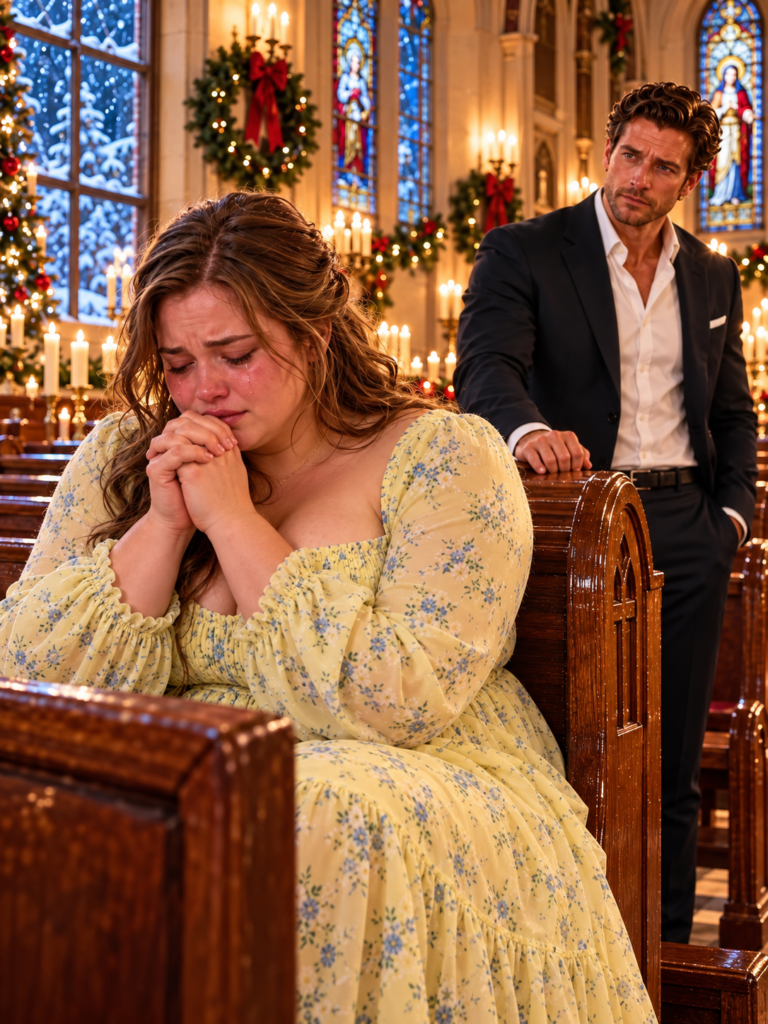
The young woman’s voice was barely louder than the wind brushing against the church windows.
“I’m not asking for a beautiful house. Or an easy life. I just…”
Her voice fractured.
She pressed her hands together so tightly that her fingers hurt.
“I just want someone who won’t leave when everything gets hard.”
At the back of the nearly empty church, a man in an expensive charcoal coat stopped walking.
He had entered only minutes earlier, hoping to find a moment of peace before returning to a mansion where nobody would be waiting for him.
Instead, he had heard something he was never meant to hear.
A woman’s desperate prayer.
“Someone who won’t look at all the broken pieces of my life and decide I’m too much trouble.”
She lowered her head.
“Please, God. Just someone who’ll stay.”
The man closed his eyes.
He was thirty-six years old. He owned a technology company worth more than he had once dared to imagine. His decisions affected hundreds of employees, and his name appeared regularly in business magazines.
But in that moment, Daniel Hayes realized something uncomfortable.
The woman praying a few pews ahead of him was asking for something he had spent years convincing himself he didn’t need.
Someone to stay.
And neither of them knew that the next few minutes would become the beginning of an entirely different life.
Christmas Eve had always been Emily Carter’s favorite night of the year.
When she was younger, she had loved the glowing windows, the scent of cinnamon, and the strange gentleness that seemed to settle over the city after sunset.
At twenty-eight, she still loved those things.
But she had learned that Christmas could be beautiful and merciless at the same time.
That morning, she had stood inside the small bakery where she worked, listening to an announcement that made the room seem to tilt beneath her feet.
The bakery was closing after the holidays.
For good.
The owner was a decent man who had struggled for months to keep the business operating. Emily could see the exhaustion in his face as he explained that there simply wasn’t enough money left.
Nobody argued.
There was nothing to argue about.
But Emily had to grip the edge of the counter to steady herself.
She was already behind on her rent.
Her savings had dwindled to almost nothing.
Her landlord had given her only a few more days to pay what she owed.
Now the one reliable source of income she had was disappearing.
“I’m sorry, Emily,” the owner said quietly when the other employees drifted away.
She forced a smile.
“I know. You’ve done everything you could.”
He looked at her for a moment.
“You’ve been one of the best people I’ve ever had working here.”
“Thank you.”
She meant it.
But compliments wouldn’t pay the rent.
As she untied her apron, she imagined her daughter waiting at home, excited for Christmas, completely unaware of the numbers her mother was calculating.
Rent.
Electricity.
Groceries.
The cost of getting to work.
The little things that became enormous when there was never enough money to cover all of them.
Emily folded her apron and placed it carefully on the counter.
She didn’t cry.
Not yet.
She had learned that tears were a luxury best saved for moments when Lily couldn’t see them.
Three years earlier, Emily had married a man who promised her that they would face everything together.
He had sounded so certain when he made those promises.
For a while, she had believed him.
Then she became pregnant.
The pregnancy was difficult, and when she lost her job, their financial troubles began to consume nearly every conversation.
At first, her husband said they would manage.
Then he started calculating what everything cost.
The groceries.
The appointments.
The things their baby would need.
Slowly, the word we disappeared from his vocabulary.
Their problems became her mistakes.
Their expenses became her fault.
Even after Lily was born, Emily kept hoping he would remember the man he had once been.
Instead, their arguments became more frequent.
One winter morning, he packed his belongings while Emily stood in the apartment holding their daughter.
He blamed her for everything that had gone wrong.
She remembered asking him to look at Lily.
Just once.
He didn’t.
When the door closed behind him, Emily remained standing in the same place for a long time.
She had waited for him to return that evening.
Then the following morning.
Then the next day.
Eventually, she stopped waiting.
He never came back.
But the damage he left behind stayed with her.
It lived in the way she hesitated before trusting someone. In her instinct to apologize for needing anything. In the exhaustion she concealed behind a smile whenever Lily asked questions that had no easy answers.
“Why do some kids have daddies waiting at school?” Lily had asked one afternoon.
Emily had knelt in front of her daughter and brushed a stray lock of hair from her forehead.
“Families can look different, sweetheart.”
“But why doesn’t mine have one?”
Emily had held her closer.
“Because sometimes people make choices we can’t control.”
“Did I do something wrong?”
The question had almost undone her.
“Oh, baby. No.”
She had kissed Lily’s forehead.
“Never think that. You are the best thing that’s ever happened to me.”
And because she couldn’t bear to let her daughter see how much the question hurt, she had smiled.
“We’re a good little family, aren’t we?”
Lily had nodded.
Emily had nodded too.
She believed it.
She and Lily were a family.
But being enough for her daughter didn’t mean she never wished someone would share the weight.
By late afternoon on Christmas Eve, Emily had walked through several neighborhoods searching for work.
A grocery store had no vacancies.
A café manager had politely explained that he needed employees who could accept last-minute shifts.
Another business had already hired someone.
At every stop, Emily asked whether there might be an opening after the holidays.
She explained her bakery experience, her reliability, her willingness to learn.
But when she mentioned that she was raising a child alone and needed to plan around Lily’s care, the conversations became less encouraging.
By the time she stopped looking, snow had begun collecting on the shoulders of her coat.
Her shoes were damp.
Her fingers burned from the cold.
Inside her purse, a few coins were all that remained of the money she had brought with her.
Enough for bread and milk.
Not much else.
She stood outside a shop window, watching a family choose brightly wrapped gifts.
A little girl pressed both hands against the glass and pointed excitedly at something inside.
Her father laughed.
Her mother adjusted the child’s scarf.
Emily looked away.
She wasn’t jealous of their presents.
She was jealous of how effortless their togetherness seemed.
How nobody had to ask whether the others would still be there tomorrow.
Lily was staying for a little while with a trusted neighbor, a woman who understood that Emily sometimes needed an extra hour to work or search for opportunities.
Emily had promised to return soon.
But she couldn’t go home yet.
Not with the fear rising inside her.
Not when she knew Lily would look into her face and ask whether everything was okay.
Across the street stood a church, its stained-glass windows glowing with warm color against the falling snow.
Emily hadn’t planned to go inside.
She simply found herself walking toward it.
Daniel Hayes rarely entered a room without knowing why he was there.
His entire professional life had been built around preparation.
He founded his technology company through years of long nights, impossible deadlines, calculated risks, and decisions other people had been afraid to make.
Now the business occupied a towering glass building downtown.
His employees respected him.
Investors listened when he spoke.
Competitors studied his decisions.
Daniel had become the kind of man people described as having everything.
His house was enormous.
His suits were tailored.
He could purchase nearly anything he wanted without checking a price tag.
And yet there were evenings when he returned home, set down his keys, and felt the silence waiting for him before he even switched on a light.
His mother had died when he was young.
She had been the gentle center of his childhood, the person who made him feel loved when he accomplished nothing at all.
His father was different.
To him, success meant results.
Achievement.
Status.
Money.
When Daniel was a boy, he had often watched for his father’s car from the living room window.
Sometimes headlights appeared at the end of the street.
Sometimes they passed without turning into the driveway.
Either way, Daniel learned not to expect too much.
As he grew older, he decided that becoming successful would protect him from ever feeling powerless again.
He worked harder.
Earned more.
Demanded more of himself.
His life became an endless sequence of objectives.
Two years earlier, his fiancée had finally told him she couldn’t continue.
“I don’t want to compete with your company for your attention, Daniel.”
He remembered looking at her, genuinely confused.
He had given her everything he thought a partner should want.
Security.
Comfort.
A beautiful home.
A future without financial worries.
But she had looked at him with unmistakable sadness.
“You’re always somewhere else, even when you’re standing right in front of me.”
He had promised to make changes.
Then his phone rang with a problem at work.
And without thinking, he had answered it.
She left.
For months, he told himself that their relationship had failed because she didn’t understand the demands of his career.
Eventually, he stopped discussing it.
Work became easier than examining the truth.
On that Christmas Eve, he had left his office later than he intended, even though much of the building had emptied hours earlier.
Driving home to his quiet mansion held little appeal.
So he stopped at the church where he sometimes came to remember his mother.
She had once told him that the worth of a life wasn’t measured by how many people admired you.
It was measured by how many people felt less alone because you were there.
He hadn’t thought about those words for a long time.
Until he heard Emily Carter praying.
Daniel remained behind the pews as Emily tried to collect herself.
He knew he should leave.
Her prayer wasn’t intended for him.
It felt wrong to stand there listening to a stranger expose wounds she had carefully hidden from the rest of the world.
But something in her words had reached him.
She hadn’t asked for wealth.
She hadn’t asked for someone powerful enough to solve every problem.
She had asked for a person who wouldn’t disappear.
Daniel glanced down at his watch.
An expensive, beautifully engineered object.
For years, he had worn it as proof that his time mattered.
Now he wondered how much of that time he had actually given to anyone.
Ahead of him, Emily rose from the pew.
She wiped her cheeks with the backs of her hands, took a slow breath, and straightened her worn coat.
There was something painfully familiar about the way she composed herself.
She seemed determined to look fine before stepping back into the world.
Daniel watched her move toward the doors.
He didn’t know her name.
He didn’t know what had happened to her.
But he could see the snow falling harder beyond the windows.
He followed at a distance, intending only to make sure she reached the street safely.
Emily stepped outside.
The cold caught her breath.
She pulled her coat closer and hurried down the stone steps.
Then her foot found a slick patch of ice.
She slipped.
Before she could fall, a hand caught her arm.
“Careful.”
Emily gasped and turned.
A tall man stood beside her, his dark coat dusted with snow.
His grip was steady but brief.
As soon as she regained her balance, he released her.
“Are you all right?”
“Yes.” She looked down at the icy step. “Yes, thank you. I didn’t see that.”
“It’s difficult to see under the snow.”
She tried to smile.
“I guess I should’ve been paying more attention.”
Daniel noticed how quickly she blamed herself for something so ordinary.
“It’s a dangerous step,” he said. “Not a personal failure.”
The unexpected remark drew a small laugh from her.
It lasted only a second.
But it changed her face.
For the first time that evening, Daniel saw the woman beneath the exhaustion.
She was beautiful, though not in the polished, carefully arranged way he was accustomed to seeing at corporate events.
Her cheeks were reddened by the cold. Her eyes were still wet. She looked as though she had been carrying too much for too long.
And yet she was trying to smile at a stranger.
“The weather’s getting worse,” he said. “Would you like me to call a taxi?”
Her expression changed.
Not dramatically.
Just a slight withdrawal.
A small tightening around her eyes.
“Oh, no. That’s okay.”
“I don’t mind.”
“I appreciate it, really. But the bus is fine.”
Daniel could have explained that money wasn’t an issue.
He could have offered to pay.
He could have insisted that no one should have to stand in the cold on Christmas Eve.
But something told him that insisting would only make her feel cornered.
So he stepped back.
“There’s a shelter across the street,” he said. “At least you’ll be out of the wind while you wait.”
Emily looked toward the lights of the bus stop.
Then back at him.
“Thank you.”
“You’re welcome.”
They crossed the street at a respectful distance from one another.
Inside the shelter, Emily adjusted the strap of her purse, and Daniel noticed a photograph tucked into its transparent pocket.
A little girl with bright eyes and a missing front tooth grinned directly at the camera.
Emily caught his glance.
“That’s my daughter.”
The pride in her voice was immediate.
Daniel looked at the picture again.
“She looks happy.”
“She is. Most of the time.” Emily smiled. “She thinks Christmas lights should stay up all year.”
“That’s a reasonable position.”
Emily laughed again, more naturally this time.
“She’s waiting for me. I promised I’d be back soon.”
“Then I hope your bus comes quickly.”
“So do I.”
He hesitated.
“What’s her name?”
“Lily.”
“That’s a lovely name.”
“Thank you.”
For a moment, the quiet between them felt surprisingly comfortable.
Then Emily glanced at him.
“Do you have children?”
Daniel shook his head.
“No.”
She didn’t ask why.
He appreciated that.
Instead, she adjusted the photograph, making sure it sat securely inside the little pocket.
“She makes every difficult day worth getting through,” Emily said.
There was no self-pity in her voice.
Only love.
Daniel thought about the boy he had once been, watching a dark street through a window and wondering when his father would come home.
He looked at the photograph again.
“I’m glad she has you.”
Emily’s smile softened.
“Sometimes I just hope I’m doing enough.”
Daniel considered the worry behind those words.
“You seem like someone who’s trying very hard.”
She looked down.
“Trying is about all I can do right now.”
The bus appeared through the snowfall.
Emily stepped toward the curb.
“Thank you again. For catching me.”
“I’m glad I was there.”
She climbed aboard.
Before the doors closed, she glanced back through the glass.
Daniel was still standing beneath the shelter lights.
He gave a small nod.
Then the bus pulled away.
He watched until its red taillights disappeared into the snowy street.
He could have returned to his car and forgotten the encounter.
By morning, his calendar would be full again.
There would be emails, meetings, financial projections, and people demanding answers.
But as he walked away from the bus stop, he kept hearing the same quiet sentence.
I just want someone who’ll stay.
And for the first time in years, Daniel wondered whether the most meaningful thing he could do with his success had nothing to do with earning more.
The following morning, Daniel went to the bakery Emily had mentioned during their conversation while waiting for the bus.
The owner was there, occupied with the work of closing down a business that had once represented years of hope.
Daniel introduced himself and explained that he wanted to ask about one of the employees.
“Emily Carter?”
The owner studied him.
“Is something wrong?”
“No,” Daniel said quickly. “Nothing like that.”
He paused, choosing his words.
“I met her yesterday. She mentioned working here.”
“Then you met one of the best employees I’ve ever had.”
Daniel listened.
The owner spoke of Emily’s reliability, her willingness to cover for coworkers when she could, and the careful attention she gave to people who entered the bakery with barely enough money to buy something.
“She comes in tired sometimes,” the owner admitted. “I know things haven’t been easy for her. But she never treats customers as though they’re a burden.”
Then he mentioned something Daniel hadn’t expected.
“Whenever we had bread left over, she’d make sure families who needed it could take some home.”
“Did she?”
The owner nodded.
“Never made a show of it. Sometimes she’d notice someone counting coins and find a way to help without embarrassing them.”
Daniel looked around the bakery.
The display cases.
The shelves.
The empty spaces where familiar routines were being dismantled.
Emily was about to lose her job.
And even while struggling to provide for herself and her daughter, she had been trying to make other people’s lives a little easier.
Daniel could have written her a check large enough to cover months of rent.
He could have offered money that would have felt insignificant to him and overwhelming to her.
The thought crossed his mind.
But it didn’t sit comfortably.
He remembered how she had drawn back when he offered a taxi.
She didn’t want a stranger to take control of her circumstances.
She wanted to keep her dignity.
And she had worked too hard to deserve anything less.
During the conversation, Daniel learned that a local community center was preparing to open a café.
It needed an experienced supervisor.
Someone who understood customers, food service, scheduling, and the importance of running a place where people felt welcome.
Daniel asked a few questions.
Then a few more.
By the time he left the bakery, an idea had begun taking shape.
Not a plan to purchase Emily’s gratitude.
Not a way to enter her life by making her dependent on him.
A possibility.
Later, he contacted the community center’s director.
He offered to fund the equipment needed for the new café.
Then he mentioned a potential applicant who had the experience and character the position required.
He was careful about one thing.
“I don’t want anyone hired because I recommended her,” he said.
The director understood.
“We’ll interview her like everyone else.”
“Good. That’s exactly what I want.”
When the conversation ended, Daniel stood by the window of his office, looking out over the city.
He didn’t know whether Emily would be interested in the position.
He didn’t know whether she would get it.
And he didn’t intend to interfere with the decision.
For once, he had used his influence to make an opportunity possible without trying to control its outcome.
He glanced toward the snow-covered streets below.
Somewhere out there, a young mother was probably still wondering how she would pay her rent.
Daniel hoped she would soon have one less thing to worry about.
But he could not yet imagine how much that woman and her little girl would eventually teach him about the one thing his money had never been able to buy.
A place to belong.
Part 2
Three days after Christmas Eve, Emily Carter received a phone call she almost didn’t answer.
She was sitting at her small kitchen table, reviewing a handwritten list of places where she might apply for work.
Lily was nearby, quietly occupied with the paper decorations they had made together.
Emily’s phone vibrated against the table.
An unfamiliar number.
For a second, she hesitated.
Then she answered.
“Hello?”
“May I speak with Emily Carter?”
“This is Emily.”
The woman on the other end introduced herself as a representative of a local community center.
They were opening a new café and looking for a supervisor.
Emily straightened in her chair.
“We understand you have several years of bakery experience,” the woman continued. “Would you be interested in coming in for an interview?”
Emily pressed her free hand against the table.
“Yes. Absolutely.”
She tried to keep her voice steady.
They discussed the position, the responsibilities, and the interview arrangements.
Emily listened carefully, writing everything down on the back of her employment list.
When the call ended, she remained motionless.
Then she looked at Lily.
“Mommy?”
Emily smiled.
“I might have found a job interview, sweetheart.”
Lily brightened.
“Is that good?”
Emily laughed softly.
“That’s very good.”
“Then why are you crying?”
Only then did Emily realize there were tears on her cheeks.
She wiped them away.
“Because sometimes people cry when they’re happy, too.”
But happiness wasn’t the only thing she felt.
There was hope.
And beneath it, the old fear of being disappointed.
One interview didn’t mean a job.
A promising opportunity didn’t mean the landlord would suddenly stop expecting payment.
She knew better than to build an entire future around something that hadn’t happened yet.
Still, as she looked at her little girl, Emily allowed herself something she had been withholding for weeks.
The possibility that things might get better.
On the morning of the interview, Emily chose the cleanest dress she owned.
It wasn’t expensive.
It wasn’t fashionable in the way clothes in glossy magazines were fashionable.
But it was neatly pressed, and it made her feel professional.
She gathered her résumé, checked it twice, and placed it carefully in a folder.
Before leaving, she knelt in front of Lily.
“Wish me luck?”
Lily wrapped both arms around her neck.
“Good luck, Mommy.”
Emily hugged her a little longer than usual.
Then she went to the community center.
The building was nothing like the glass tower she passed sometimes on her way downtown.
It was practical and welcoming, with a steady flow of people entering and leaving.
The new café was still being prepared.
Emily could see the outlines of what it might become.
Counters waiting for equipment.
Tables being arranged.
An unfinished space that needed more than someone capable of operating a register.
It needed someone who knew how to make it work.
During the interview, the director asked about Emily’s experience.
She explained her responsibilities at the bakery.
Handling busy mornings.
Keeping work areas organized.
Managing supplies.
Helping customers.
Coordinating with coworkers when the day became overwhelming.
At first, her answers were careful.
She worried about saying too much.
Then one of the interviewers asked a question that changed everything.
“What would you want this café to feel like for the people who come here?”
Emily stopped thinking about giving the perfect answer.
She thought about the people she had served at the bakery.
The elderly customers who bought one pastry and lingered because they wanted conversation.
The tired parents trying to manage restless children.
The people who studied prices for too long before deciding what they could afford.
She leaned forward.
“I’d want people to feel comfortable coming in, even if they don’t have much money.”
The director nodded for her to continue.
“I know we’re supposed to run a café, and I understand the business side of that. We need to manage costs. We need to work efficiently. We need customers to have a good experience.”
She paused.
“But I also think we can be somewhere that families actually want to come.”
“What would that look like?”
“Affordable meals. A place parents can bring their children without feeling like they’re bothering everyone. Somewhere people can sit for a little while and feel welcome.”
She glanced around the unfinished room.
“A lot of parents are doing their best with very little support. I think having one place where things feel easier can mean more than people realize.”
The interviewers exchanged a look.
Emily noticed.
For one terrible second, she wondered whether she had sounded too emotional.
Then the director smiled.
“That’s very close to what we’re hoping to create.”
Emily felt some of the tension leave her shoulders.
They continued talking.
This time, she answered with growing confidence.
She knew how to work hard.
She knew how to recognize when a customer needed patience instead of irritation.
She knew that running a café required attention to details people only noticed when something went wrong.
And she knew how important a welcoming place could be to someone who had spent a long day feeling unwelcome everywhere else.
For the first time in weeks, Emily wasn’t speaking as a desperate woman pleading for employment.
She was speaking as an experienced worker who understood the job she wanted to do.
When the interview ended, she thanked everyone and left the room.
She had no idea what they would decide.
But she knew she had given them the truth.
That afternoon, she received the offer.
Emily read the details slowly.
Then she read them again.
The community center wanted her to supervise the new café.
They believed her experience and her vision were exactly what the project needed.
She would have responsibilities.
A schedule.
A dependable income.
A chance to build something rather than watch another part of her life disappear.
She stepped outside the building, holding her folder tightly against her chest.
Cold air brushed her face.
People passed on the sidewalk, moving through the ordinary business of their day.
Emily tried to take a breath.
Instead, she began to cry.
Not the exhausted, helpless tears she had shed in the church.
These were different.
She thought about the landlord’s deadline.
The electricity bill.
The nearly empty refrigerator.
The terrible calculations she had been making every night.
The job wouldn’t solve everything immediately.
There was still money to earn and overdue rent to address.
But now she had a path forward.
She could work.
She could provide.
She could begin repairing the fragile foundation beneath her daughter’s life.
Emily tilted her face toward the pale winter sky.
“Thank You,” she whispered.
She didn’t need to say more.
When she returned home and told Lily the news, her daughter threw both hands into the air.
“You got it!”
Emily laughed.
“I got it.”
“Does that mean you’re happy?”
Emily gathered her into her arms.
“Yes, baby.”
She kissed Lily’s cheek.
“I think we’re going to be okay.”
For the first time in a long while, she believed those words as she said them.
Emily approached her new position with the determination of someone who understood exactly how valuable the opportunity was.
She arrived prepared.
She paid attention.
She learned how the community center operated and what its visitors needed.
She understood that the café wasn’t meant to imitate a luxury restaurant.
Its purpose was simpler.
Provide good food, affordable options, and a place where people felt comfortable.
Emily enjoyed the challenge.
She helped organize the daily routines, thought carefully about how to serve families efficiently, and gave the small details the attention they deserved.
A clean table.
A friendly greeting.
A child who needed a little reassurance.
A parent who wanted to sit down without worrying about being judged.
She remembered her own difficult afternoons.
The ones when taking Lily somewhere warm had felt like a luxury.
Now she had a chance to help create that warmth for others.
And then, not long after she began working, she saw a familiar face.
Daniel Hayes stood near the café entrance, speaking with someone from the community center.
Emily stopped.
The man from the church.
The stranger who had caught her before she fell.
The man who had offered a taxi and accepted her refusal without making her explain.
He was dressed more casually than he had been that Christmas Eve, but she recognized him immediately.
For a moment, she simply stared.
Daniel turned.
Their eyes met.
Surprise crossed his face, followed by a warm smile.
“Emily.”
She approached slowly.
“You remember me?”
“Of course.”
He glanced toward the café.
“I heard the new supervisor had started.”
Emily looked from him to the director nearby.
Then back again.
“Wait. You know about this place?”
Daniel nodded.
“I’m involved with the project.”
“Involved how?”
He didn’t try to avoid the question.
“I helped fund the equipment.”
Emily blinked.
The information settled between them.
Her mind moved quickly.
The church.
The bus stop.
The unexpected interview.
The job.
She looked at him more closely.
“Did you have something to do with me getting hired?”
Daniel could see that the question mattered.
He could also see how easily the wrong answer might destroy the trust that had begun forming between them.
“I visited the bakery after we met,” he said.
Emily’s expression changed.
“You went to my old job?”
“Yes.”
“Why?”
He considered giving her a polished explanation.
Something impersonal.
Something that would make the situation easier.
But she deserved a real answer.
“Because you seemed worried, and I thought there might be a way to help without interfering in your life.”
Emily looked down.
“Daniel…”
He continued before she could misunderstand.
“The owner spoke very highly of you. When I heard the community center was looking for someone with your experience, I suggested they consider you.”
She studied his face.
“Did you tell them to hire me?”
“No.”
“Are you sure?”
“Completely.”
He met her eyes.
“I helped provide equipment. The hiring decision belonged to the center. You interviewed. They chose you.”
Emily remained quiet.
Daniel understood why.
A woman who had been made to feel like a burden didn’t need another man implying that everything good in her life existed because he allowed it.
He kept his voice gentle.
“Emily, I didn’t give you this job. You earned it.”
She swallowed.
“But you made sure they knew about me.”
“I made sure they had the opportunity to meet you.”
“Why would you do that for someone you barely knew?”
Daniel looked at the café around them.
He remembered what the bakery owner had said about her quietly helping struggling families.
“Because someone told me what kind of employee you are,” he answered. “And because a person who’s good at something deserves a chance to keep doing it.”
Emily’s eyes shone.
She looked away before the tears could fall.
Daniel didn’t move closer.
He didn’t reach for her.
He simply gave her the space to decide what the information meant.
After a long moment, she nodded.
“Thank you for opening the door.”
Daniel smiled slightly.
“You’re the one who walked through it.”
She looked at him again.
This time, her smile came without effort.
Daniel began visiting the café occasionally.
Never so often that his presence interfered with Emily’s work.
Never with the expectation that she would abandon her responsibilities to entertain him.
Sometimes he came to speak with the director.
Sometimes he stopped for coffee and asked how the project was progressing.
And sometimes, Emily suspected, he simply wanted to see how things were going.
She began noticing details.
He listened when she explained a challenge.
He remembered something she had mentioned on a previous visit.
If she was busy, he waited.
If she needed to return to work, he didn’t seem offended.
It surprised her how much those small considerations mattered.
Her former husband had often treated her needs as inconveniences.
Daniel treated her time as something valuable.
One afternoon, he stood near the counter while she organized supplies.
“How’s the café?” he asked.
“Busy.”
“Good busy or the kind that makes you regret taking the job?”
Emily laughed.
“Ask me again after the next rush.”
He smiled.
She gestured toward the room.
“No, really. It’s going well. We’re learning what people need. Some things take adjusting, but that’s normal.”
“What would you change?”
She considered the question, then began explaining a few practical improvements she had been thinking about.
Daniel listened with the same concentration he gave important business decisions.
When she finished, he nodded.
“You’ve thought that through.”
“It’s my job.”
“I know.”
Something about his response made her pause.
He wasn’t surprised that she was competent.
He wasn’t praising her as though she were a child who had completed a small task.
He was simply acknowledging that she knew what she was doing.
Emily found herself looking forward to their conversations.
Not because he was wealthy.
Not because his company occupied a glass tower downtown.
But because he seemed interested in the things that mattered to her.
How the café was doing.
Whether families were comfortable.
What Lily had been laughing about lately.
He never asked for an explanation of her marriage.
He never treated her financial hardship as entertainment.
He never made her feel that she had to reveal painful memories to justify the kindness he had shown.
Little by little, Emily began lowering the walls she had spent years building.
Daniel, meanwhile, discovered that his visits were becoming the most satisfying part of his week.
At his office, people brought him problems to solve.
At the café, Emily spoke to him as a person.
She disagreed when she thought he was wrong.
She laughed when he said something awkward.
She never seemed particularly impressed by his status.
And somehow, he found that deeply reassuring.
The first time Daniel saw Lily at the café, he understood immediately why Emily spoke about her daughter with such affection.
The little girl had her mother’s expressive eyes and an almost limitless supply of questions.
She was visiting after school, and Emily had made sure she could sit safely nearby while the day’s work continued.
Daniel approached the table.
“Hello, Lily.”
Lily looked up.
“Are you Mommy’s friend?”
Daniel glanced at Emily.
“I hope so.”
Emily smiled.
“He’s the man who helped Mommy when she slipped outside the church.”
Lily looked at him with sudden interest.
“Did she fall?”
“Almost.”
“Did you catch her?”
“Just in time.”
Lily considered this.
“Mommy says we have to be careful on ice.”
“She gives good advice.”
“Did she say thank you?”
Daniel struggled not to laugh.
“Yes. She did.”
Lily nodded, satisfied.
“Good.”
Emily covered her face briefly with one hand.
“Lily.”
“What?”
Daniel laughed then.
A genuine laugh, so unfamiliar to him that he almost startled himself.
He had spent years surrounded by adults who measured their words around him.
Lily didn’t care who he was.
She wanted to know whether her mother had remembered her manners.
Over the following visits, Daniel began noticing other things.
How Lily brightened whenever Emily came near.
How Emily could recognize the difference between her daughter’s ordinary complaints and genuine worry.
How naturally the two of them fit together.
He also saw Emily comforting a frightened child at the café one afternoon.
She crouched beside the child, spoke quietly, and waited until the little one’s breathing steadied.
She didn’t rush.
She didn’t look irritated.
She simply stayed.
Daniel watched from a distance.
That was when he began to understand something his mother had tried to teach him.
Care wasn’t always dramatic.
Sometimes it was the willingness to be fully present during an ordinary, uncomfortable moment.
For years, Daniel had believed that providing financially was the highest form of security he could offer another person.
Emily was showing him that emotional safety required something different.
Attention.
Patience.
Consistency.
And time.
He had plenty of money.
Time was the one thing he had always guarded most fiercely.
Now he found himself wanting to give it away.
One snowy afternoon during the holiday season, the community café hosted a small Christmas gathering for local families.
There were decorations in the windows, simple refreshments, and the warm, cheerful disorder that comes whenever children are invited to help prepare for a celebration.
Lily had taken her responsibilities very seriously.
She was helping Emily arrange paper snowflakes along the windows.
“Mommy, this one goes higher.”
Emily stretched her arm.
“Here?”
“Higher.”
“Lily, if it goes any higher, I’ll need a ladder.”
Lily giggled.
When Daniel arrived, he found Emily standing near the window with a paper snowflake in one hand.
She looked over her shoulder.
“You came.”
There was something in her voice that made him stop.
Not surprise exactly.
Relief.
As though she had hoped he would be there but hadn’t wanted to admit it.
“I said I’d try,” he answered.
Emily smiled.
“I’m glad.”
Daniel looked around.
The café was filled with families talking, children laughing, and people sharing food.
Nothing in the room was extravagant.
The decorations were handmade.
The refreshments were simple.
Several paper snowflakes hung at slightly crooked angles.
And yet he couldn’t remember the last time a room had felt so inviting.
He helped with a few small tasks and spoke with the families.
Then Lily approached him.
She held something behind her back.
“Daniel?”
He turned.
“Yes?”
“I made you something.”
He bent slightly so they were closer to eye level.
“For me?”
She nodded.
Then she revealed a handmade card covered with crooked stars.
Some were yellow.
Some were blue.
One had been colored so enthusiastically that the paper had nearly torn.
Daniel accepted it carefully.
“Thank you, Lily.”
“Open it.”
He did.
Inside was a message written in a child’s uneven handwriting.
I hope you come back because you make Mommy smile.
Daniel stared at the words.
The sounds of the gathering seemed to recede.
He read the sentence again.
And then once more.
His chest tightened with an emotion he couldn’t immediately name.
He was accustomed to receiving expensive gifts.
Leather cases.
Luxury watches.
Objects chosen by people who knew his preferences but not necessarily his heart.
He had received awards for business achievements and invitations to events where everyone seemed eager to speak with him.
But nobody had ever given him anything quite like this.
A little girl, with no understanding of his wealth or professional reputation, wanted him to return for one simple reason.
He made her mother happy.
Daniel looked at Lily.
“Did you make all these stars yourself?”
“Yes.”
“They’re beautiful.”
She beamed.
“Mommy helped me with some letters.”
“I think you both did a wonderful job.”
He looked back at the message.
Then he folded the card carefully, making sure not to damage the paper.
Emily had approached and seen his expression.
“Oh, Lily,” she said softly. “Honey, you can’t just tell people things like that.”
Lily looked confused.
“Why?”
Emily glanced at Daniel.
“I’m sorry. She’s very honest.”
Daniel shook his head.
“Don’t apologize.”
He slid the card into the inside pocket of his coat.
Then he looked directly at Lily.
“Thank you for telling me.”
“Will you come back?”
Daniel could have offered the easy answer.
A bright, casual promise.
Something meant to please a child in the moment.
But he remembered the woman he had heard praying alone in the church.
He knew that promises were not harmless things in this family.
So he answered carefully.
“I’d like to.”
Lily smiled.
“Good.”
Then she hurried away to finish arranging the decorations.
Emily watched her daughter go.
When she turned back, Daniel was still holding one hand over the pocket where he had placed the card.
“She’s going to remember that, you know,” Emily said.
“I hope she does.”
“She gets attached to people.”
Daniel nodded.
“I understand.”
Emily studied him.
There was a question she wanted to ask.
What exactly did he understand?
That Lily had already begun to trust him?
That Emily herself was becoming accustomed to his presence?
Or that losing someone after learning to count on them hurt far more than never letting them in?
Before she could find the words, Daniel spoke.
“I spent a long time building a life that looked successful from the outside,” he said quietly.
Emily listened.
“I thought if I worked hard enough, there wouldn’t be anything important missing.”
He looked around the café.
“At some point, I became very good at building things and very bad at letting people into my life.”
Emily’s expression softened.
“You must have worked very hard to build your company.”
“I did.”
“And you’re proud of it.”
“Yes.”
“Then you shouldn’t pretend it doesn’t matter.”
Daniel looked at her.
She continued.
“It’s something you created. You don’t have to be ashamed of that.”
“I’m not ashamed of the company.”
“Then what?”
He took a moment before answering.
“I think I’m beginning to regret how much of everything else I sacrificed for it.”
Emily didn’t interrupt.
Daniel glanced toward Lily, who was proudly showing another child how to unfold a paper snowflake.
“I used to think that if people needed me, it meant they wanted something from me.”
“And now?”
He looked at Emily.
“Now I’m starting to think I didn’t understand what it meant to be needed.”
Their eyes held.
Emily felt warmth rise into her face.
She looked away first.
Because for the first time, the possibility of loving Daniel Hayes seemed more frightening than the possibility of never seeing him again.
She had survived one man leaving.
She wasn’t sure she could survive watching another man become important to her daughter and then disappear.
But when she looked back, Daniel was still there.
And in the pocket of his expensive coat, he carried a crooked, handmade Christmas card as though it were the most valuable thing he owned.
Part 3
By the time the Christmas gathering ended, snow was falling steadily outside the café windows.
The families had begun leaving, carrying children, coats, and small handmade decorations.
Emily was finishing the last of her work when Daniel approached.
“Would you mind if I walked you and Lily home?”
She looked toward her daughter, who was struggling to put on her gloves.
“You don’t have to do that.”
“I know.”
“It’s cold outside.”
“I noticed.”
Emily laughed.
Daniel smiled.
“I’d like to, Emily. But only if you’re comfortable with it.”
She hesitated.
The sensible part of her wanted to decline.
She had spent years learning how to handle everything herself. Accepting company, especially from a man she was beginning to care about, felt strangely dangerous.
But Lily had already spotted him.
“Daniel! Are you coming with us?”
He looked at Emily.
“That’s up to your mom.”
Lily turned hopeful eyes toward her.
Emily sighed affectionately.
“All right. You can walk with us.”
Lily cheered.
Daniel pretended that the decision hadn’t made him happier than anything that had happened at his office that week.
The sidewalks glittered beneath the streetlights.
Snow collected on parked cars and softened the edges of buildings.
Emily walked beside Daniel while Lily moved between them, fascinated by the small clouds her breath made in the cold air.
For a while, their conversation was easy.
Lily talked about the paper snowflakes.
Emily told Daniel how pleased the families had been with the gathering.
Daniel listened, occasionally asking questions.
Then, without warning, Lily reached for his hand.
Her little fingers slipped into his much larger ones.
Daniel looked down.
The girl continued walking as though nothing extraordinary had happened.
To her, it was simple.
She liked him.
He was there.
So she held his hand.
But Daniel felt something shift inside him.
He remembered another cold evening, many years earlier, when he had waited for his father to come home.
He remembered watching passing cars and wondering why grown-ups could be so important everywhere else and so absent in the places where they were loved.
Now a child was trusting him with something as ordinary as walking down a sidewalk.
He held Lily’s hand gently.
Emily noticed.
The sight filled her with tenderness so sudden that it frightened her.
Lily had never known what it felt like to have a father consistently waiting for her, listening to her stories, or attending the little events that meant so much to children.
Emily had tried to be everything.
She had done her best.
But she couldn’t deny that seeing Lily comfortable beside Daniel touched a place in her heart she had protected for a long time.
Then the fear arrived.
What if he leaves?
She knew how easily someone could become part of a child’s life.
How naturally affection could grow.
And she knew how devastating the absence could be afterward.
Daniel glanced at her.
“You’ve gotten quiet.”
Emily attempted a smile.
“Just thinking.”
“About something difficult?”
She looked at Lily, who was distracted by the snowflakes collecting on her sleeve.
“Yes.”
Daniel didn’t press.
They walked another few steps.
Then Emily spoke.
“Lily likes you.”
“I like her, too.”
“She’s a very loving little girl.”
“I’ve noticed.”
Emily stopped beneath a streetlight.
Daniel stopped with her.
“I need you to understand something.”
He gave her his full attention.
“Lily’s been through enough,” Emily said. “She doesn’t remember everything that happened with her father, but she knows he’s not here.”
Daniel said nothing.
“I can’t let someone become important to her if they’re only going to disappear when things get complicated.”
Her voice trembled despite her efforts to steady it.
“And I can’t go through that again, either.”
Daniel looked at the woman standing before him.
He could have told her what she wanted to hear.
That he would never leave.
That he would never make a mistake.
That he would protect her from every disappointment.
Promises came easily to men who were accustomed to getting what they wanted.
But Emily didn’t need another beautiful promise.
She needed something she could trust.
“I’m not going to ask you to believe in me because I say the right things tonight,” he answered.
Emily looked up.
“I’ve spent most of my life thinking that having control meant I could prevent anything from going wrong.”
He glanced toward Lily.
“I’m learning that people aren’t business decisions. You can’t guarantee every outcome.”
“No,” Emily whispered. “You can’t.”
“But you can choose how you behave.”
Daniel met her eyes.
“You can choose to be there when it’s inconvenient. You can listen when the conversation is difficult. You can keep showing up, even on the days when everything isn’t easy.”
Emily felt tears threatening again.
Daniel continued quietly.
“I won’t promise you a perfect future. I don’t think either of us would believe that.”
A faint smile touched her lips.
“Probably not.”
“But I can tell you that I want to know you. Both of you. And I understand that trust takes time.”
He paused.
“I don’t expect you to give me that trust tonight.”
Emily looked down at their daughter, still holding his hand.
Then she looked back at Daniel.
For the first time, she noticed something important.
He wasn’t asking her to forget her past.
He wasn’t demanding that she stop being afraid.
He was giving her permission to take her time.
“Thank you,” she whispered.
Daniel nodded.
They resumed walking.
And when Lily reached for her mother’s hand as well, the three of them continued down the snowy sidewalk together.
The months that followed were not filled with dramatic declarations.
There was no sudden transformation in which every old problem disappeared.
Emily still had responsibilities.
Daniel still ran a demanding company.
Lily still needed school mornings, meals, bedtime stories, and the steady routines that made her world feel secure.
But something changed in the ordinary hours.
Daniel began leaving his office earlier.
At first, his employees noticed with surprise when he stopped working before midnight.
Then the surprise faded.
The company continued operating.
Decisions were still made.
Responsibilities were still met.
Daniel slowly discovered that being an effective leader didn’t require surrendering every hour of his life.
He began making room for dinners and conversations that had no connection to business.
He learned to put his phone aside when Emily was speaking.
Sometimes he failed.
Once, during a meal, he caught himself repeatedly checking a work message.
Emily noticed.
“Daniel.”
He looked up.
“Hmm?”
“Are you here?”
He glanced at the phone.
Then at her.
The question was gentle, but he understood it.
“Not completely,” he admitted.
Emily didn’t scold him.
She simply said, “I’d rather have an hour when you’re really here than an entire evening where you’re thinking about somewhere else.”
Daniel turned his phone over.
“Then you have my hour.”
She smiled.
Over time, that hour became many.
Emily learned things about him that business magazines never mentioned.
How much he missed his mother.
How lonely his childhood had sometimes been.
How frightened he had once been of failing to impress his father.
How little comfort his enormous house offered when he returned to it alone.
One evening, Daniel admitted that for years he had mistaken being admired for being loved.
Emily listened.
Then she took his hand.
“You know you don’t have to accomplish something for someone to care about you, right?”
He looked at their joined hands.
“I’m beginning to understand that.”
She smiled.
“Good.”
Their relationship developed through moments like those.
Not through expensive gifts or grand displays, but through conversations that required honesty.
Daniel didn’t always know what Emily needed.
Emily didn’t always find it easy to tell him.
Sometimes an offer of help brought back memories of being made to feel incapable.
Sometimes Daniel’s instinct was to solve a problem immediately when Emily needed him simply to listen.
They had to learn each other.
One afternoon, after a particularly difficult day at the café, Emily told him she was overwhelmed.
Daniel immediately started suggesting ways to make her work easier.
Emily listened for a moment before gently interrupting.
“I appreciate that you’re trying to help.”
“But?”
“But I already know what I’m going to do tomorrow.”
Daniel stopped.
She smiled tiredly.
“Right now, I just want to tell you about my day.”
He leaned back.
“Okay.”
“Okay?”
“Tell me everything.”
And he listened.
It was a small exchange.
But for Emily, it mattered.
She was learning that accepting emotional support didn’t mean surrendering control over her own life.
Daniel could stand beside her without taking over.
She could love him without becoming dependent on his money.
And she could let someone care for her without owing them pieces of herself in return.
Lily adapted to Daniel’s presence with the natural confidence of a child who measures love through actions.
He attended her school performances.
He listened attentively when she explained which parts she had practiced.
He remembered the bedtime stories she liked best.
When she asked him to read one again, he didn’t complain that he had heard it before.
Sometimes Emily watched from a doorway as Lily corrected his reading.
“That’s not how Mommy says it.”
Daniel would look at the page.
“How does Mommy say it?”
Lily demonstrated with tremendous seriousness.
Daniel repeated the sentence properly.
“Better?”
“Much better.”
Emily would turn away to hide her smile.
These were the moments she had once been afraid to imagine.
Not because they were extraordinary.
Because they were ordinary.
She had learned how devastating it was to lose someone who belonged in the everyday spaces of her life.
Now Daniel was slowly becoming part of those spaces.
And he continued showing up.
Not perfectly.
Not without occasionally struggling to balance his responsibilities.
But consistently enough that Emily no longer found herself watching every goodbye with dread.
At the café, she grew more confident in her role.
She took pride in the welcoming environment she was helping create and the families who returned because they felt comfortable there.
The job Daniel had helped her discover became something she owned through her own work.
He never suggested otherwise.
When Emily achieved something, he celebrated her ability instead of congratulating himself for giving her an opportunity.
And when she thanked him for helping make the project possible, he reminded her that she was the one responsible for making it succeed.
For both of them, the relationship became a place to grow rather than somewhere to hide from their lives.
Spring arrived quietly.
The snow disappeared from the sidewalks.
Trees began showing the first signs of green.
The city that had seemed so cold and unforgiving on Christmas Eve gradually filled with light.
One evening, Emily asked Daniel if he would go somewhere with her.
“Of course,” he said. “Where?”
She hesitated.
“There’s a church I’d like to visit.”
Daniel looked at her.
He knew which one she meant.
He didn’t ask why.
And when Emily explained that she wanted Lily to come too, he agreed without hesitation.
They arrived as the evening light was fading.
The same stained-glass windows glowed softly above the pews.
The church was peaceful.
Emily stood inside the entrance for a moment.
She remembered the last time she had come here.
Her wet shoes.
Her freezing hands.
The coins in her purse.
The fear of losing her home.
The terrible uncertainty of not knowing how she would feed her child if the bakery closed and she couldn’t find another job.
Most of all, she remembered kneeling alone and asking God for someone who would stay.
She hadn’t known Daniel Hayes was standing behind her.
She hadn’t known that a stranger would catch her when she slipped on the icy steps.
She hadn’t known that the man offering her a taxi was a wealthy CEO who felt as lonely as she did.
And she certainly hadn’t known that his greatest gift would not be his money.
It would be his willingness to make room for her and Lily in his life.
“Mommy?”
Lily’s voice brought her back.
Emily looked down.
“Yes, sweetheart?”
“Are we going to sit?”
Emily smiled.
“Yes.”
They moved into a pew together.
Daniel sat beside her, with Lily close enough to rest against her mother.
For several minutes, nobody spoke.
Then Emily bowed her head.
She thought about the woman she had been that Christmas Eve.
She wished she could reach back through those difficult months and tell her something.
That losing a job didn’t mean she had lost her worth.
That being abandoned didn’t make her unlovable.
That needing support didn’t make her weak.
And that she would one day meet a man who respected her enough to let her choose how close he came.
Tears slipped down her cheeks.
Daniel noticed.
He leaned closer.
“Emily?”
She turned toward him.
“Are you okay?”
She nodded.
“Yes.”
Her voice trembled.
“I’m more than okay.”
Daniel looked at her carefully.
She took a breath.
“I came here once because I was terrified,” she said softly. “I didn’t know what was going to happen to us.”
Daniel remembered the trembling voice he had heard from the shadows.
“I know,” he answered.
Emily looked toward the front of the church.
“I thought I was asking God to send someone who could fix everything.”
She shook her head gently.
“But that wasn’t really what I needed.”
Daniel waited.
“I needed to know that I didn’t have to face every hard thing alone.”
She turned to him.
“And I needed to learn that letting someone love me didn’t mean giving up who I was.”
Daniel reached for her hand.
Slowly.
Gently.
Leaving her free to decide whether to take it.
Emily placed her fingers between his.
This time, she didn’t hesitate.
Lily leaned against them, content in the quiet warmth of the pew.
For a while, the three of them remained together beneath the stained-glass windows.
Daniel thought about his mother.
He wondered what she would have said if she could have seen him now.
He imagined her smiling at the sight of the little girl who had given him a handmade card and the woman who had taught him that love could not be measured in numbers.
He had spent years believing that success meant becoming powerful enough to need nobody.
Now he understood that he had been measuring the wrong thing.
His greatest achievement wasn’t the technology company.
It wasn’t the glass tower downtown or the expensive mansion waiting at the end of the day.
Those things had their place.
He was proud of what he had built.
But they weren’t what made him feel at home.
Home was the woman beside him who trusted him enough to be vulnerable.
Home was the little girl who reached for his hand without worrying whether he deserved the privilege.
Home was the growing certainty that his presence mattered more than his possessions.
Emily closed her eyes.
“Thank You,” she whispered.
Outside, the last light of spring evening softened the city streets.
Inside, Daniel held her hand.
She no longer needed him to make impossible promises.
She knew that life could become difficult again.
There would be disagreements.
Unexpected problems.
Days when neither of them had the right answers.
But now she understood that a lasting relationship was built through the choice to face those days together.
When Lily finally whispered that she was ready to go home, Emily opened her eyes.
Daniel stood and offered her his hand.
She accepted it.
Then Lily reached for his other hand.
And together, they walked toward the church doors.
Months earlier, Emily had entered that building alone, convinced that her life might always be an endless struggle to keep the people she loved from leaving.
Now she stepped into the gentle spring evening beside a man who had never asked her to be perfect, never demanded repayment for his kindness, and never treated her daughter as an inconvenience.
A man who had learned that love wasn’t about rescuing someone so they would owe you their happiness.
It was about respecting their strength and choosing to stand beside them.
Emily looked up at Daniel.
He smiled.
She smiled back.
And as Lily happily guided them along the sidewalk, Emily realized that the answer to her Christmas Eve prayer hadn’t arrived in the form she had expected.
It hadn’t come with a grand declaration.
Or an expensive gift.
Or a promise that nothing would ever hurt again.
It had begun with a stranger who listened.
A hand that caught her before she fell.
An opportunity that allowed her to stand on her own feet.
A handmade card covered in crooked stars.
And hundreds of ordinary choices that slowly transformed uncertainty into trust.
Because sometimes the greatest gift someone can give isn’t the promise that life will always be easy.
It’s the decision to keep showing up when it isn’t.
And for Emily Carter, Daniel Hayes, and a little girl named Lily, that was where their happiest chapter truly began.


