
Part 1
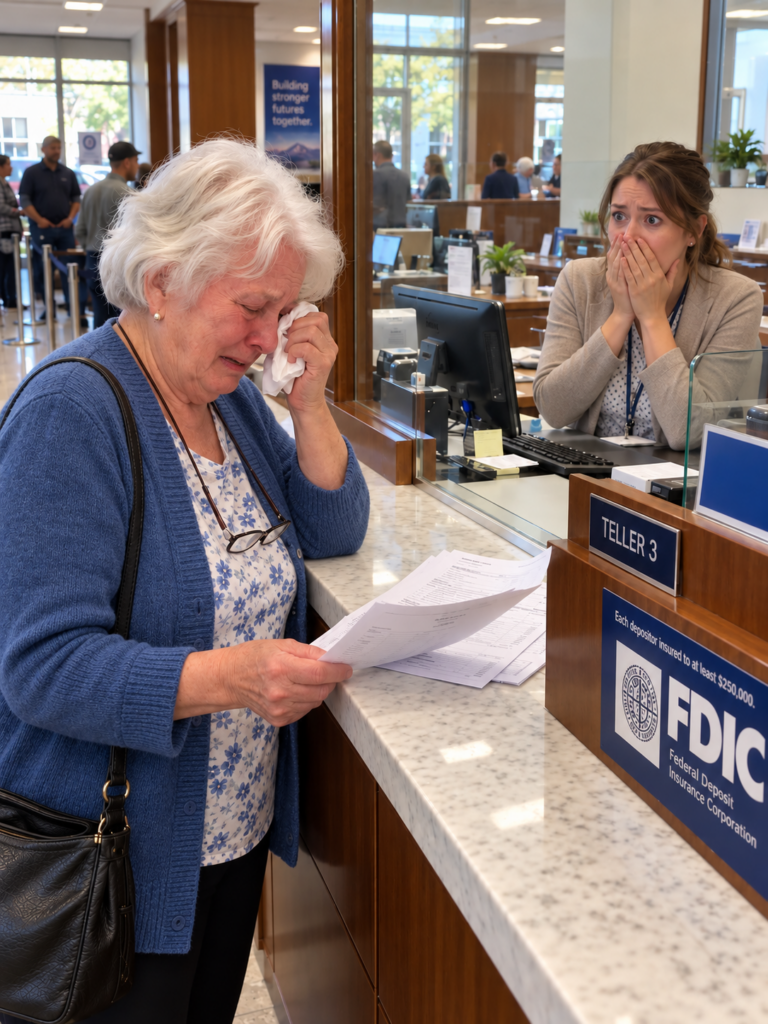
The young teller’s name was Melissa. I knew because I had been staring at the little brass nameplate on her counter for nearly three minutes, trying not to imagine what she was seeing on her computer.
She couldn’t have been more than twenty-five. Her dark hair was pulled into a neat bun, and she wore a pale blue sweater with a silver necklace shaped like a tiny heart.
When I first handed her the card, she had smiled the way young people sometimes smile at elderly customers, with a little extra patience.
Now she wasn’t smiling.
“Mrs. Whitmore,” she said carefully, “would you mind waiting just a moment?”
“Is the account closed?”
“No, ma’am.”
“Then what’s wrong?”
She glanced toward a glass office at the far end of the banking floor.
“I’d rather have my manager explain.”
My fingers tightened around the strap of my handbag.
It was an old brown leather bag that I’d carried for almost twelve years. The stitching along one side had come loose, and I’d repaired it with a needle meant for upholstery.
That morning, I’d spent ten minutes deciding whether to bring it.
I thought the bank employees might judge me for looking poor.
Now I wished that were the worst thing I had to worry about.
A woman in a charcoal suit approached the counter. She looked to be in her early fifties, with silver beginning to show at her temples.
“Mrs. Whitmore? I’m Elaine Foster, the branch manager.”
She offered her hand.
I shook it, though mine was cold and trembling.
“Is there a problem with my husband’s money?”
Something changed in her expression.
“Perhaps we’d be more comfortable talking in my office.”
I almost laughed.
Comfortable.
There was nothing comfortable about being sixty-five years old and wondering whether the last three thousand dollars you believed you had in the world had disappeared.
But I followed her.
The office smelled faintly of coffee and furniture polish. Through the glass wall, I could see customers walking in and out, depositing checks, discussing mortgages, living their ordinary lives.
Elaine pulled out a chair.
“Would you like some water?”
“No, thank you. I’d just like to know how much is left.”
She sat across from me and opened a folder.
“First, I need to confirm a few details.”
She asked for my identification, my birth date, and my current address.
Then she asked a question that made me sit straighter.
“Have you ever accessed this account since it was opened?”
“No.”
“Not even to check the balance?”
“No.”
“May I ask why?”
I looked down at the card lying on her desk.
It was blue, with a faded white stripe near the bottom. I remembered exactly how it had felt in my hand five years earlier.
“My husband gave it to me when we divorced,” I said. “He told me there was three thousand dollars in the account.”
“And you never spent it?”
“I didn’t want his charity.”
Elaine’s eyes softened, but she didn’t interrupt.
“I worked,” I continued. “I managed. Or I thought I did. But I’ve been sick, and I need medication. So I came to withdraw the money.”
For a moment, Elaine said nothing.
Then she turned her computer monitor slightly away and placed both hands on the desk.
“Mrs. Whitmore, there is considerably more than three thousand dollars in this account.”
My heart gave a strange little jump.
“How much more?”
“Before I answer, I want to explain that the account was established as part of a legal arrangement. Your former husband authorized certain deposits, and there are documents connected to them.”
I stared at her.
“What kind of documents?”
She opened a drawer and removed a thick cream-colored envelope.
My name was written on the front.
Margaret Anne Whitmore.
Not Maggie, as my children called me.
Not Margaret Hale, the name I’d started using again after the divorce.
Margaret Anne Whitmore.
The woman I’d been for thirty-seven years.
Elaine slid it toward me.
“This was delivered by an attorney with instructions that it be given to you when you first accessed the account.”
I didn’t touch it.
“How long has it been here?”
“The bank received the sealed correspondence recently. The account itself has existed for five years.”
“From my husband?”
“Yes.”
“Richard Whitmore?”
“Yes, ma’am.”
I felt anger rising through my confusion.
Richard had spent five years pretending I no longer existed. He hadn’t come when I moved out. He hadn’t called on my birthday. He hadn’t even sent a Christmas card.
And now he’d left a letter at a bank?
“What does he want?”
“I can’t speak for him.”
“Then tell me how much money is in the account.”
Elaine looked at the screen.
“The available balance is two hundred and sixty-four thousand, three hundred and eighteen dollars.”
I heard the numbers.
I understood each word individually.
But together, they made no sense.
“Two hundred…” I began.
“Sixty-four thousand, three hundred and eighteen dollars.”
I gripped the arms of my chair.
“That can’t be right.”
“I’ve verified the balance.”
“There were only three thousand dollars.”
“That was the initial deposit.”
I stared at her.
She opened another document.
“Additional transfers began later. They continued regularly, and several supplemental deposits were made. The account has also earned interest.”
I could hear a telephone ringing somewhere outside the office.
A man laughed near the entrance.
A printer started humming.
The ordinary sounds seemed impossibly loud.
I thought about the winter I’d slept wearing two sweaters because the heating bill was overdue.
I thought about the week I ate peanut butter crackers for dinner four nights in a row.
I thought about how I’d stood in a pharmacy aisle holding two prescription bottles, deciding which one I could afford to refill.
All that time, this money had existed.
Somewhere.
Waiting.
I looked at the envelope.
“Please,” I whispered. “Tell me what’s going on.”
Elaine folded her hands.
“I think you should read the letter.”
I opened it carefully.
Inside were several legal pages and a smaller envelope containing a handwritten note.
I recognized Richard’s handwriting immediately.
He always made his capital R too large.
Even after five years, I knew that R better than my own.
Before I unfolded the paper, I remembered the last time I’d seen his face.
And suddenly I was back in that courthouse hallway.
Richard and I had married in 1983, in a little Methodist church outside Dayton, Ohio.
I was twenty-eight.
He was thirty.
My mother had sewn my wedding dress, working late into the night at her kitchen table because we couldn’t afford one from a bridal shop.
Richard wore a gray suit borrowed from his older brother.
He kept tugging at the sleeves because they were too short.
When the minister asked if he would love me in sickness and in health, Richard looked directly into my eyes.
“I will,” he said.
For years, I believed he meant it.
We started our marriage in a rented apartment above a hardware store. The kitchen was so narrow that two people couldn’t open the refrigerator and stand by the stove at the same time.
We didn’t have much.
But Richard was ambitious.
He worked in warehouse operations, and I worked at a dental office.
Some evenings, we’d sit at the little table by the window and talk about the future.
“One day,” he’d say, “we’re going to have a house with a real backyard.”
“And a dishwasher,” I’d add.
He’d laugh.
“An enormous dishwasher.”
We had three children.
Our oldest, Laura, was born two years after the wedding.
Daniel came three years later.
Then Sophie arrived, surprising us when we thought our family was complete.
By then, Richard had started his own transportation and distribution company.
For the first several years, the business barely survived.
There were weeks when he couldn’t pay himself.
I remember taking extra shifts at the dental office so we could cover the mortgage.
I remember addressing invoices at our dining-room table while Sophie slept in a basket beside my chair.
I remember cleaning the office on Sunday afternoons because we couldn’t afford a janitorial service.
Richard worked hard.
I won’t pretend otherwise.
But I worked hard, too.
For nineteen years, I kept my job while raising our children and helping with whatever the business needed.
When Richard started earning real money, I was proud of him.
Proud of us.
We bought a two-story house on a quiet street in Columbus. It had a maple tree in the front yard and a back porch where Richard built a swing for the children.
For years, I thought that house would be where we grew old.
Then, one September evening, Richard came home and told me he wanted a divorce.
There had been no affair that I knew of.
No screaming argument.
No dramatic confrontation.
He simply sat across from me at the kitchen table and said, “Maggie, I don’t want this life anymore.”
I thought he’d been talking about work.
He’d been under pressure at the company for months.
“Then sell the business,” I said. “We can travel. We can spend time with the grandchildren.”
He shook his head.
“That’s not what I mean.”
The refrigerator hummed behind him.
I remember that sound because it was the only thing I could hear after he said the next sentence.
“I don’t want to be married anymore.”
I stared at him.
“To anyone?”
“To you.”
He didn’t say it cruelly.
Somehow that made it worse.
I asked whether there was someone else.
He said no.
I asked whether I’d done something.
He said no.
I asked whether we could try counseling.
He rubbed his forehead and looked away.
“I’ve been unhappy for a long time.”
A long time.
Those words rearranged decades of memories.
Every vacation photograph.
Every anniversary dinner.
Every ordinary morning when I’d packed his lunch or folded his shirts.
How many of those moments had he spent wishing he were somewhere else?
Our divorce took nearly a year.
Richard’s company was valuable, but much of its value was tied up in business interests, debts, and assets I didn’t fully understand.
I had an attorney at first.
A kind man named Peter Lawson who kept telling me that I needed more financial records.
But legal fees were mounting.
Richard’s lawyer argued over nearly everything.
And I was tired.
So tired that when the settlement finally came, I signed it without fighting for everything Peter believed I might be entitled to.
I received a portion of the proceeds from the sale of our home and a modest cash settlement.
It wasn’t nothing.
But after legal expenses, moving costs, and the debts I had taken on during the divorce, far less remained than I’d expected.
I decided to move to Baltimore.
My sister had once lived there, and I had fond memories of visiting the city when I was younger.
I wanted to be somewhere Richard couldn’t accidentally appear at the grocery store.
Somewhere every street corner didn’t hold a memory.
The day the divorce became final, he handed me the bank card outside the courthouse.
“There’s three thousand dollars on it,” he said. “It should help you get settled.”
I looked at the card.
Thirty-seven years.
Three children.
A home.
A business I’d helped him build.
And he was standing there offering me three thousand dollars as though I were a departing employee receiving a farewell bonus.
“Keep it,” I told him.
“Maggie, please.”
“I don’t need your pity.”
“It’s not pity.”
“Then what is it?”
He looked down.
For the first time that day, he seemed unable to find an answer.
“Just take it.”
So I did.
Not because I wanted the money.
Because I wanted the conversation to end.
I put the card in my handbag and walked away.
He didn’t follow.
For five years, I never saw him again.
I rented a studio apartment above a small insurance office in Baltimore.
The ceiling had a brown water stain, and the bathroom window wouldn’t close properly.
At first, I told myself it was temporary.
I found cleaning work.
Then I took occasional evening shifts helping direct cars at a crowded pharmacy parking lot.
When money ran short, I collected returnable bottles and cans where I could and did whatever odd jobs neighbors offered.
I kept telling my children I was fine.
Laura had two boys and a mortgage.
Daniel was helping his wife through a difficult pregnancy.
Sophie was working long hours at a medical billing company.
They offered to help.
I always refused.
I didn’t want my children worrying about me.
I didn’t want Richard knowing how far I’d fallen.
And I certainly didn’t want him believing I couldn’t survive without him.
But pride doesn’t put food on the table.
And eventually, my body began demanding payment for all the things I’d refused to admit.
Three weeks before my visit to the bank, I fainted on the sidewalk outside my apartment.
My neighbor, Mrs. Bell, found me beside the steps.
She was seventy-two and walked with a cane, but she somehow managed to keep my head supported until the ambulance arrived.
At the clinic, the doctor studied my bloodwork.
“Mrs. Hale, you’re severely anemic. Your blood pressure is low, and you’re not getting the nutrition you need.”
I stared at my hands.
“I’ve been tired lately.”
“Have you been eating regular meals?”
“Of course.”
He looked at me for a long moment.
“Margaret.”
That was when I started crying.
Not loudly.
Just tears rolling down my face while I sat on the examination table.
He handed me a tissue.
“We need to start treatment. But I also need you to make some changes. You cannot keep pushing your body this hard.”
That evening, I opened the shoebox where I’d kept Richard’s card.
I held it under the kitchen light.
For the first time in five years, I wondered whether refusing the money had been strength or simply another way of letting Richard control my life.
The next morning, I walked to the bank.
And now, sitting in Elaine Foster’s office, I unfolded the letter Richard had written.
The first line made my breath catch.
Maggie,
You were right about something on the day of our divorce.
Three thousand dollars was an insult.
My fingers tightened around the page.
I read the next sentence.
But I need you to understand why I gave you that card, and why I could never bring myself to tell you the truth.
I looked up at Elaine.
“Is there a telephone I could use?”
“Of course.”
“I need to call my daughter.”
I looked down at the pages again.
For five years, I’d believed Richard had walked away without a second thought.
Now I was beginning to understand that something had happened after our divorce.
Something involving money, secrets, and a decision he’d made without telling me.
And for once, I wasn’t going to put the papers back in a box and pretend I didn’t need answers.
Part 2
Sophie answered on the third ring.
“Mom? Are you okay?”
I closed my eyes.
That had become her usual greeting lately.
Not hello.
Not how’s your day.
Are you okay?
“I’m at the bank.”
There was a pause.
“What bank?”
“The one near my apartment.”
“Why?”
“I came to use the card your father gave me.”
Silence.
Then Sophie said, “Mom, I thought you got rid of that thing years ago.”
“So did I.”
“What happened?”
I stared at Richard’s letter.
“I’m not entirely sure.”
“Are you hurt?”
“No.”
“Do you need me to come?”
Sophie lived in Annapolis, nearly an hour away depending on traffic.
Ordinarily, I would have said no.
I would have told her I could manage.
But my hands were shaking, and I had just learned that there was enough money in an account bearing my name to change the remainder of my life.
“Yes,” I said.
It was such a small word.
But it felt like opening a door that had been locked for years.
“Yes, sweetheart. I think I do.”
While Sophie drove, Elaine brought me tea.
She also called the attorney identified in the documents, with my permission, and arranged for me to speak to her that afternoon.
Her name was Caroline Reeves.
The account, Caroline explained over the telephone, had been opened legally in my name after the divorce.
Richard had established a funding arrangement through his attorney and authorized transfers from his personal assets.
The debit card gave me access, but Richard had no withdrawal rights over the funds once deposited.
“Everything currently in the account belongs to you, Mrs. Hale,” Caroline said.
“All of it?”
“Yes.”
“Can he take it back?”
“No.”
“Does accepting it mean I owe him something?”
“Absolutely not.”
I swallowed.
“What about taxes?”
“Those details are addressed in the documents. I strongly recommend having an independent financial adviser review them before making major decisions.”
I appreciated that answer.
It sounded like something a real professional would say.
Not a promise that everything was magically perfect.
Not another person telling me what I wanted to hear.
I looked at the pages.
“Why didn’t he just send me checks?”
There was a pause.
“That is a question Mr. Whitmore is better positioned to answer.”
“Then I’d like to ask him.”
Caroline’s voice softened.
“I’m afraid his health makes that complicated.”
I sat straighter.
“What do you mean?”
“Mr. Whitmore has been receiving treatment for a serious illness.”
The office seemed to grow colder.
“What illness?”
“I don’t believe I should disclose his medical details without permission.”
“Is he dying?”
Another pause.
“Mrs. Hale, I think you should finish reading his letter.”
I thanked her and ended the call.
Then I looked at the handwritten pages again.
Richard’s words continued beneath the opening paragraph.
I know you believe I stopped caring about you. The truth is that I made a decision I thought would free both of us, and then I discovered that freedom does not erase responsibility.
I had spent years telling myself I was trapped by our marriage. I blamed the routine, the house, the expectations, and sometimes even you.
After I left, I began to understand how much of my life had been made possible by the work you did without asking for recognition.
When the company struggled, you kept us afloat. When the children needed something, you were there. When I needed to travel, you arranged everything at home so I could go.
I called the company mine because the paperwork said it was.
But I know what it cost you to help me build it.
I stopped reading.
My eyes burned.
For decades, I’d wanted Richard to acknowledge that.
Not necessarily in public.
Not in some speech at an anniversary party.
Just once, privately, to say that he understood how much I’d given.
Instead, he’d spent years talking about his achievements as though they belonged to him alone.
At dinner parties, people would ask how he had built such a successful company.
He’d explain the long hours.
The risky decisions.
The difficult clients.
He wasn’t lying.
But there was always someone missing from the story.
Me.
I remembered a company anniversary dinner twelve years earlier.
Richard had stood in front of nearly sixty employees and thanked his managers, his investors, and his oldest business partner.
When he finished, everyone applauded.
I was sitting at a table near the back.
His assistant had saved me a seat because Richard had forgotten to include me on the guest list.
Afterward, I teased him about it.
“You forgot your unpaid secretary.”
He kissed my cheek.
“You know I couldn’t do any of this without you.”
I smiled.
I believed him.
But he had never said those words where anyone else could hear.
I unfolded the next page.
The divorce settlement was legal, but I knew it wasn’t fair.
You were exhausted, and you wanted the fighting to stop. I let you accept less than your attorney advised because it was easier for me.
That is something I have regretted every day.
I put the letter down.
An old anger moved through me.
I remembered sitting in Peter Lawson’s office, watching him underline figures in a stack of financial records.
“Maggie, you should not sign this yet,” he had said.
“I can’t keep doing this.”
“I understand. But there are assets we still need to evaluate.”
“Richard says the company has debt.”
“That may be true, but we need independent confirmation.”
I had shaken my head.
“I want it over.”
Peter had leaned back.
“You’re entitled to make that decision. But don’t let exhaustion make it for you.”
I had signed anyway.
For years, I blamed myself.
Now I knew Richard had understood exactly what was happening.
He had watched me give up.
And he had allowed it.
My tears dried.
I felt something sharper than grief.
I continued reading.
About eighteen months after the divorce, I began arranging regular transfers into the account. Later, I added larger deposits whenever I could.
I wanted you to have financial security without having to ask me for it.
I thought the card would be enough. I assumed that one day you would check the balance.
When you didn’t, I convinced myself you must have had other resources.
I was wrong.
I have since learned that you’ve been living far more modestly than I imagined.
I am ashamed that I didn’t find a better way to make sure you were safe.
There was a short gap before the next paragraph.
The handwriting changed slightly there.
The letters became smaller, less steady.
I also need to tell you something I’ve kept from almost everyone.
I heard a car door close outside the bank.
Then footsteps approached.
Sophie appeared in the doorway.
She looked frightened.
Her blond hair was pulled back in a hurried ponytail, and she still wore her work badge around her neck.
“Mom?”
I stood.
She crossed the room and hugged me.
Not the quick, polite embrace we usually exchanged.
She wrapped both arms around me and held on.
“What happened?”
I couldn’t answer immediately.
Instead, I handed her the account statement.
She read the balance.
Then she looked at me.
“Is this real?”
I nodded.
“Two hundred and sixty-four thousand dollars?”
“Apparently.”
“How?”
“Your father.”
She sat down.
For a moment, she looked exactly like she had at fourteen, when someone told her that her bicycle had been stolen.
Confused.
Angry.
Trying not to cry.
“Dad gave you this?”
“He put it in an account.”
“Why didn’t he tell you?”
“That’s what I’m trying to understand.”
Sophie stared at the paper.
“Mom, you were borrowing money from Mrs. Bell to buy groceries last month.”
I looked away.
She had found out about that despite my best efforts.
Mrs. Bell had lent me forty dollars when my paycheck was delayed.
I’d paid her back.
But Sophie had heard about it from Laura.
“You should have told us,” she said.
“I didn’t want to worry you.”
“Mom, you were sick.”
“I’m getting treatment.”
“You fainted on the sidewalk.”
“I know.”
She covered her face with both hands.
“Do you have any idea how scared I was when the neighbor called?”
I had no answer.
Then Sophie said something that hurt worse than I expected.
“You keep saying you didn’t want Dad’s money. But you wouldn’t take ours, either. Were you angry with all of us?”
“No.”
“Then why wouldn’t you let anyone help?”
I stared at my old handbag.
The broken strap.
The careful stitches.
“I spent thirty-seven years being someone’s wife,” I said quietly. “Then one day I wasn’t. I needed to know there was still something I could do on my own.”
Sophie was silent.
“I thought if I accepted help, it would mean I had failed.”
“Mom.”
Her voice cracked.
“We never thought you failed.”
I began crying again.
This time, I didn’t apologize.
Sophie pulled her chair beside mine.
We sat together until my breathing settled.
Then she picked up Richard’s letter.
“Do you want me to read the rest with you?”
I nodded.
She began where I had stopped.
Three years ago, I was diagnosed with a serious heart condition.
Sophie stopped.
Her face went pale.
“What?”
I looked at her.
“You didn’t know?”
She shook her head.
“Dad said he’d been tired. He told me he was seeing doctors. But he never said it was serious.”
She continued reading.
At first, I was angry. I had convinced myself that leaving our marriage would give me a new beginning. Instead, I found myself sitting alone in a hospital room, realizing that I had walked away from the person who knew me best.
I am not writing this to ask you to return.
You deserve better than an invitation based on my fear of being alone.
I am writing because I owe you the truth.
I never stopped respecting what you did for our family. I simply stopped showing it.
And by the time I understood the difference, I had already hurt you.
Sophie stopped again.
I could see tears gathering in her eyes.
“Did he ever tell you he was unhappy?” I asked.
She hesitated.
“Before the divorce?”
“Yes.”
“He told me you were growing apart.”
I nodded.
“Anything else?”
“He said he needed to find himself.”
Despite everything, I laughed.
A short, bitter sound.
“Did he ever find himself?”
Sophie looked down.
“I don’t know.”
I took the letter back.
There was one final paragraph.
When Sophie told me you had fainted, I realized I could no longer wait for you to use the card.
I contacted Caroline and asked her to make sure the bank had everything ready whenever you came in. I considered calling you myself, but after five years of silence, I was afraid you would hang up before I could explain.
The money is yours, Maggie. Not because I am generous, and not because I expect forgiveness.
Because you helped earn it.
If you never want to see me again, I will understand.
But please, for once, take care of yourself before you take care of everyone else.
Richard.
I read the last sentence three times.
Then I folded the paper.
Sophie watched me.
“Do you want to call him?”
I didn’t answer immediately.
A part of me wanted to hear his voice.
Another part wanted to tear the letter into pieces.
For five years, I had built my survival around one simple belief.
Richard had discarded me because I was no longer worth loving.
Now he was telling me the story had been more complicated.
But complication didn’t erase what he’d done.
He could have told me about the account.
He could have contacted my attorney.
He could have made sure I wasn’t living in an apartment with heat leaking through the windows.
He could have done a hundred things.
Instead, he had chosen secrecy.
Again.
“I don’t know,” I said.
Elaine returned to the office and gently explained my options.
I could withdraw a portion of the funds immediately. I could transfer the money to another institution. I could leave it where it was until I had received independent advice.
I thought about what the doctor had said.
Medication.
Food.
Rest.
I thought about the rent due next week.
“Can I take ten thousand dollars today?” I asked.
“Yes, ma’am.”
“And leave the rest until I’ve spoken with someone?”
“Of course.”
I signed the paperwork.
My hand trembled when I wrote my name.
But I signed.
Sophie drove me to the clinic afterward.
We stopped at a pharmacy on the way home.
For the first time in years, I didn’t ask whether a cheaper medication was available because I couldn’t afford the prescribed one.
I simply paid.
At the grocery store, Sophie watched me hesitate in front of the meat counter.
“Mom, get the salmon.”
“It’s expensive.”
“You have money.”
“I know.”
She smiled gently.
“Then get the salmon.”
I bought two pieces.
And fresh asparagus.
And strawberries.
And a loaf of bread from the bakery.
When the cashier told me the total, I handed over my card without mentally subtracting the amount from next week’s grocery budget.
I had forgotten what that felt like.
At home, Sophie helped me unpack the groceries.
Then she examined the window above my kitchen sink.
“Mom, this thing is practically open.”
“I’ve been meaning to have it fixed.”
“For how long?”
I gave her a look.
She laughed.
It was the first time either of us had laughed without sadness that day.
Before she left, she asked whether I wanted her to tell Laura and Daniel.
“Not yet.”
“Okay.”
“I need to understand it myself first.”
She hugged me.
Then she stopped in the doorway.
“Mom?”
“Yes?”
“I’m proud of you.”
I almost smiled.
“For what? Finally using a debit card?”
“No.”
She looked at me steadily.
“For letting somebody help.”
After she left, I cooked dinner.
I sat at my little kitchen table and ate slowly.
The salmon was wonderful.
But halfway through the meal, I began crying again.
Because I remembered something Richard had said when we were young.
We were sitting in our first apartment, sharing a cheap takeout dinner.
He had reached across the table and taken my hand.
“One day,” he’d said, “you’ll never have to worry about money.”
Back then, I had thought he was promising to make us rich.
Now I wondered whether he’d ever understood that what I wanted most was simply to feel safe.
The next morning, I called Peter Lawson.
He had retired from regular practice but still worked occasionally with a younger attorney.
When he heard my name, he remembered me immediately.
“Margaret Hale,” he said warmly. “How are you?”
“Better than I was yesterday.”
I told him about the account.
He listened without interrupting.
Then he asked me to bring the documents to his office.
Two days later, I sat across from him in a small conference room.
His hair had gone almost completely white.
He wore reading glasses on a chain.
He reviewed the statements carefully.
Then he looked at me.
“Well.”
“Is that a good well or a bad well?”
“A surprising well.”
He smiled.
“The documents appear to establish that the funds are yours. But I want my colleague to review everything, including the transfer history and any tax implications.”
“Could Richard have done this because he was afraid I’d challenge the divorce settlement?”
Peter considered that.
“Possibly. But according to these documents, there are no conditions requiring you to waive legal rights.”
I sat back.
“Then why?”
Peter removed his glasses.
“Margaret, I can’t tell you what was in your husband’s mind.”
He paused.
“But I can tell you something I remember very clearly.”
“What?”
“The day you signed the settlement, Richard looked miserable.”
I stared at him.
“He didn’t look miserable to me.”
“He waited outside my office after you left.”
“What did he want?”
“He asked whether you’d agreed because you understood the terms, or because you couldn’t bear another argument.”
My throat tightened.
“What did you tell him?”
“I told him both could be true.”
I looked toward the window.
Peter continued.
“He asked whether he could change the settlement after it was signed.”
“And?”
“I told him he needed to speak with his own attorney about the proper legal options.”
I was silent.
“Why didn’t you tell me?”
“At the time, Margaret, it wasn’t a formal proposal. I had nothing concrete to bring to you.”
I nodded.
That made sense.
Still, knowing Richard had felt some hesitation changed the memory.
Not enough to repair it.
But enough to make it less simple.
Peter leaned forward.
“There’s another thing you should understand.”
I looked at him.
“Receiving this money does not require you to forgive him.”
I blinked.
He continued.
“You can be grateful for the financial security and still be angry about the years you suffered.”
I stared at the documents on his desk.
“I think that’s what confuses me.”
“What does?”
“I spent five years hating that card. Now it’s the reason I can pay for my treatment.”
Peter nodded.
“Two things can be true.”
I left his office with a list of practical steps.
Open a separate account in my current name.
Meet with a financial planner.
Review the tax documents.
Arrange a medical appointment with a specialist.
Consider moving somewhere safer and warmer.
For the first time since my divorce, I had plans that extended beyond the next paycheck.
But that evening, Sophie called with news I hadn’t expected.
“Mom, Dad’s in the hospital.”
My heart stopped for a moment.
“What happened?”
“He had another cardiac episode.”
“Is he all right?”
“I don’t know. Daniel called me. Laura’s trying to reach the hospital.”
I sat down slowly.
“Where is he?”
“Columbus.”
I looked toward the shoebox on my shelf.
For five years, I had refused to touch the card inside it.
Now I had used the money.
Read the letter.
Started imagining a different future.
And Richard might not live long enough to hear what I had to say.
Sophie spoke again.
“Mom, there’s something else.”
“What?”
“Dad asked for you.”
I closed my eyes.
Then she added, “He said there’s something he needs to tell you in person.”
Part 3
I didn’t sleep much that night.
Every time I closed my eyes, I saw Richard sitting at our old kitchen table.
Not the man he’d become at sixty.
The younger Richard, with dark hair and restless hands, making promises about houses and dishwashers and a future we would build together.
I kept asking myself whether I should go.
He had walked away from me.
He had let me spend years believing I wasn’t worth a proper goodbye.
Why should I rush to his bedside because he was frightened?
But then I remembered the letter.
And the money.
And the fact that, whether I liked it or not, Richard was the father of my children.
By morning, I knew what I wanted.
Not reconciliation.
Not revenge.
Answers.
I called Sophie.
“I’ll go.”
She offered to drive.
I accepted.
We left early the following morning, stopping for coffee before heading west.
The highway stretched ahead of us under a pale October sky.
For the first hour, we barely spoke.
Then Sophie said, “Are you scared?”
I looked out the window.
“Yes.”
“Of seeing him?”
“Of finding out I still care.”
She didn’t answer immediately.
Then she reached over and squeezed my hand.
“Of course you still care, Mom. You spent almost forty years together.”
I nodded.
“But caring doesn’t mean I want him back.”
“I know.”
“Promise me you understand that.”
“I do.”
When we arrived at the hospital in Columbus, Daniel was waiting near the entrance.
He was thirty-eight now, tall and broad-shouldered, with Richard’s eyes and my tendency to worry.
He hugged me carefully.
“Mom, you okay?”
I almost laughed.
Apparently my children had agreed on a greeting.
“I’m fine.”
Daniel raised an eyebrow.
“Really?”
I sighed.
“I’m nervous.”
“That’s more believable.”
We walked toward the elevators.
Laura was upstairs.
She had flown in from Wisconsin the night before.
When she saw me, she stood so quickly that her coffee spilled onto her sleeve.
“Mom.”
She hugged me.
Then stepped back.
“Sophie told us about the account.”
I glanced at Sophie.
She looked apologetic.
“I thought they should know.”
I nodded.
“It’s all right.”
Laura stared at me.
“Two hundred and sixty-four thousand dollars?”
“Yes.”
“After everything you’ve been through?”
“Yes.”
Her expression tightened.
“That man.”
Daniel shifted uncomfortably.
“Laura.”
“No, I’m serious. He knew Mom was struggling. He could have helped her years ago.”
“He did put money in the account,” Sophie said.
“And forgot to mention it?”
“He gave her the card.”
“With no explanation!”
I listened to my children arguing.
It reminded me painfully of the divorce.
Everyone choosing sides.
Everyone trying to decide who was right.
“Enough,” I said.
They fell silent.
I looked at each of them.
“I’m not here to argue about your father.”
Laura pressed her lips together.
“I’m sorry.”
“I know you’re angry. I am, too. But I need to speak with him without feeling that I have to represent all of you.”
Daniel nodded.
“Of course.”
A nurse came to the waiting area.
“Mrs. Hale?”
I stood.
“Mr. Whitmore is awake. He asked whether you had arrived.”
I followed her down the hall.
The room was quiet.
A monitor beeped softly beside the bed.
Richard lay propped against two pillows.
His hair was thinner.
His face looked narrow and tired.
He wore a hospital gown beneath a blue blanket, and there was an IV taped to his hand.
For a moment, I barely recognized him.
Then he turned his head.
“Maggie.”
Just one word.
But hearing his voice after five years made something twist painfully inside me.
“Hello, Richard.”
He tried to sit straighter.
“You’re here.”
“Apparently.”
A faint smile touched his mouth.
“You haven’t changed.”
I looked at his pale face.
“You have.”
He glanced away.
“Fair enough.”
The nurse checked his monitor and left us alone.
I pulled a chair beside the bed.
For a moment, neither of us spoke.
Then Richard looked at my handbag.
“The same old bag.”
I glanced down.
“Still works.”
He nodded.
“You always hated throwing things away.”
“Not everything.”
His smile disappeared.
He looked at me carefully.
“Did you get the letter?”
“Yes.”
“And the account?”
“Yes.”
He closed his eyes.
“Thank God.”
Anger rose inside me.
“Don’t say that.”
He opened his eyes.
“What?”
“Don’t act relieved as though you’ve fixed everything.”
He stared at me.
I leaned forward.
“Do you know what the last five years were like?”
His face tightened.
“Maggie—”
“No. You asked me here. You’re going to listen.”
He went still.
I told him.
About the studio apartment.
About the cleaning jobs.
About the nights I was too tired to cook.
About pretending I’d already eaten when Sophie called.
About standing in the pharmacy and choosing which prescription I could afford.
About the fainting spell.
And the shame.
I told him that some mornings, I’d sat on the edge of my bed wondering how a woman who had worked for most of her life could end up frightened of opening her mailbox.
Richard didn’t interrupt.
When I finished, his eyes were wet.
“I didn’t know,” he whispered.
“That’s the problem.”
He looked at me.
“You could have known.”
He nodded slowly.
“I know.”
“You had my address.”
“Yes.”
“You had my phone number.”
“Yes.”
“You knew our children.”
“Yes.”
“You could have told me about the money.”
His eyes closed.
“I thought you wouldn’t take it.”
“So you decided for me.”
He said nothing.
I looked at the frail man in the bed.
For years, I had imagined confronting Richard.
In those imaginary conversations, he always made excuses.
He told me I was dramatic.
He blamed me for the marriage.
He reminded me that I’d signed the divorce papers.
But the real Richard just looked old and ashamed.
Somehow, that was harder.
“Why did you leave?” I asked.
He stared at the ceiling.
“I told you.”
“No. You told me you weren’t happy. That’s not the same thing.”
A long silence followed.
Then he spoke.
“I was afraid of getting old.”
I blinked.
“What?”
“I’d spent my whole life building the company. Raising the kids. Paying bills. Meeting expectations.”
He swallowed.
“And then one day I looked around and realized I was sixty. I thought everything important had already happened.”
I stared at him.
“So you divorced me?”
He looked down.
“I thought if I changed my life, I’d feel young again.”
I wanted to laugh.
Or scream.
Instead, I whispered, “You destroyed my life because you were afraid of a birthday.”
He flinched.
“I know how that sounds.”
“Do you?”
He rubbed his face with his free hand.
“I told myself we were both unhappy.”
“I wasn’t.”
“I know that now.”
“You never asked me.”
He looked directly at me.
“No.”
That single word felt heavier than any apology.
I sat back.
Outside the window, the sky had turned gray.
Richard took a slow breath.
“I thought I wanted freedom,” he said. “But I didn’t know what to do with it.”
I watched him.
“I sold my share of the company eighteen months after the divorce. I traveled. I bought a small condo. I tried things I’d always said I wanted to do.”
“And?”
“I was lonely.”
I looked away.
“I don’t say that to make you feel sorry for me.”
“Good.”
He nodded.
“Then I got sick.”
I turned back.
He stared at the blanket.
“The doctors found the heart problem three years ago. At first, they thought medication would control it. But it got worse.”
“Why didn’t you tell the children?”
“I didn’t want them worrying.”
I gave him a long look.
“What?”
“Do you hear yourself?”
He frowned.
“You didn’t want them worrying. So you kept something important from them.”
He looked away.
I continued.
“And because you were trying to protect everyone, nobody knew what was really happening.”
Richard let out a tired breath.
“Sounds familiar.”
“Yes.”
For a moment, we both smiled.
Then the silence returned.
I took his letter from my handbag.
“I want to ask you about something.”
He nodded.
I unfolded the page.
“You said you knew the divorce settlement was unfair.”
His face tightened.
“Yes.”
“Then why didn’t you change it?”
He looked toward the window.
“At first, I thought you’d reconsider and ask for more.”
“Richard, I had already told you I couldn’t keep paying lawyers.”
“I know.”
“You had every advantage.”
He nodded.
“I did.”
“So why did you let it happen?”
His eyes filled.
“Because I was selfish.”
I said nothing.
He continued.
“I’d convinced myself I deserved everything I’d built. I told myself you had the house proceeds, the settlement money, your work experience. I found ways to make it seem fair.”
He looked at me.
“But once you were gone, I started remembering.”
“What?”
“All the things I hadn’t counted.”
He told me about a box of old company records he’d found while clearing out a storage room.
Inside were invoices written in my handwriting.
Schedules I’d organized.
Photographs from company dinners.
A notebook containing emergency contacts and payroll reminders I’d maintained during the company’s early years.
“I sat there looking at those papers,” he said, “and I realized how much of that business had your fingerprints on it.”
I looked at him.
“I had forgotten how many times you’d rescued me.”
I shook my head.
“I never wanted you to feel indebted to me.”
“I know.”
“I wanted us to be partners.”
He nodded.
“You were. I just stopped treating you like one.”
I looked down at the letter.
“Why the secret account?”
He took a breath.
“Because I was afraid you’d reject the money if I offered it directly.”
“I probably would have.”
“I know.”
“But you still should have told me.”
“Yes.”
I waited.
Then he said something I hadn’t expected.
“I also wanted to avoid having to face you.”
I looked up.
He continued quietly.
“If I sent money without speaking to you, I could tell myself I was making things right.”
My throat tightened.
“But I didn’t have to hear how badly I’d hurt you.”
There it was.
The truth I’d been waiting for.
Not a grand explanation.
Not a noble sacrifice.
Fear.
Shame.
And a man who had chosen the easier way even when he knew it wasn’t the better one.
I sat quietly for several minutes.
Then I asked, “How did the account reach that amount?”
Richard explained.
He’d started with the original three thousand dollars.
Later, after the sale of his business interest, he arranged recurring deposits.
He added larger amounts from the proceeds of investments and savings he’d accumulated after the divorce.
He had asked Caroline Reeves to document everything so there would be no confusion about ownership.
“The final substantial deposit was last spring,” he said.
“Why?”
He looked down.
“Because my doctors told me I needed to prepare for the possibility that I might not have much time.”
I felt my stomach tighten.
“How much time?”
He shook his head.
“They don’t know.”
I looked at the monitor.
At the thin wire leading beneath his hospital gown.
At the hand resting on the blanket.
For the first time, I allowed myself to see him as he was.
Not the husband who’d abandoned me.
Not the man who’d hurt me.
Just a frightened sixty-five-year-old man facing something neither of us could control.
He reached toward me.
Then stopped.
His hand hovered between us.
I looked at it.
For decades, that hand had held mine in movie theaters.
Lifted sleeping children from the car.
Fixed broken cabinet doors.
Carried groceries.
Signed divorce papers.
I didn’t take it.
But I didn’t move away, either.
“Maggie,” he whispered, “I’m sorry.”
I closed my eyes.
I’d imagined those words so many times.
I thought hearing them would make everything easier.
Instead, they made me remember how much I had loved him.
“I know,” I said.
He swallowed.
“Can you forgive me?”
I looked at him for a long moment.
“I don’t know.”
He nodded.
“That’s fair.”
“I might someday.”
He looked up.
“But I need you to understand something.”
“Anything.”
“The money doesn’t buy forgiveness.”
“I know.”
“And it doesn’t give you the right to come back into my life as though nothing happened.”
“I understand.”
I leaned forward.
“I am grateful for the money. I am grateful you finally acknowledged what I contributed. But those five years still happened.”
His eyes filled again.
“I know.”
“I was lonely, Richard.”
His face crumpled.
“Not just poor. Lonely.”
He covered his eyes.
And for the first time since our marriage ended, I watched him cry.
Not quietly.
Not politely.
He cried like a man who had spent years holding something inside and finally no longer had the strength.
I sat beside him.
After a while, he lowered his hand.
“Will you tell the children about the account?”
“They already know.”
He gave a tired smile.
“Of course they do.”
“They’re angry.”
“They should be.”
“They’re worried about you, too.”
He nodded.
“I’ve made a mess of things.”
I looked at him.
“Yes.”
Then I added, “But you’re still their father.”
He stared at me.
“They deserve the truth about your health. No more protecting them by keeping them in the dark.”
He nodded slowly.
“You’re right.”
I stood.
Richard watched me.
“Are you leaving?”
“Yes.”
He looked disappointed.
I picked up my handbag.
“I have an appointment with a financial planner next week. And a doctor. And I’m looking for a new apartment.”
He managed a smile.
“Somewhere nice?”
“Somewhere with windows that close.”
He laughed softly.
I walked toward the door.
Then stopped.
“Richard?”
“Yes?”
“Thank you for finally telling me the truth.”
His eyes glistened.
“Thank you for coming.”
I nodded.
Then I left.
In the hallway, Sophie was waiting.
She stood when she saw me.
“How was it?”
I took a breath.
“Hard.”
She hugged me.
“Do you want to go back in?”
“No.”
“Are you sure?”
I looked through the window of Richard’s room.
He was lying back against the pillows, staring at the ceiling.
For years, I’d believed that if he ever regretted leaving me, it would make me feel victorious.
But seeing his regret didn’t feel like winning.
It felt like mourning something that had already been lost.
“I’m sure,” I said.
We went downstairs.
Outside, the air smelled of rain.
Sophie unlocked the car.
“Mom?”
“Yes?”
“Do you think you’ll ever forgive him?”
I looked back at the hospital.
“Maybe.”
She waited.
“But I don’t think forgiveness means forgetting.”
“No.”
“And it doesn’t mean going back.”
She smiled gently.
“No, it doesn’t.”
During the drive home, I felt something I hadn’t experienced in years.
Not happiness, exactly.
Peace.
I no longer needed to imagine what Richard thought of me.
I knew.
He had been selfish.
He had been ashamed.
He had made mistakes he couldn’t undo.
He had also tried, in an imperfect and cowardly way, to correct one part of what he’d done.
None of those truths canceled the others.
And I didn’t have to spend the rest of my life deciding whether he was entirely good or entirely bad.
He was simply Richard.
The man I had loved.
The man who had hurt me.
And the man I was finally ready to stop organizing my life around.
Over the next several months, things changed.
Slowly at first.
I met with a financial adviser recommended by Peter Lawson.
We reviewed my income, the bank account, medical expenses, and what I could safely afford.
I didn’t rush into buying a house.
I didn’t start handing money to my children.
I didn’t purchase expensive clothes or take an extravagant vacation.
Instead, I paid my medical bills.
I began eating properly.
I reduced my cleaning hours while my strength returned.
And I moved into a small one-bedroom apartment in a quiet building near a park.
The bedroom had two windows.
The kitchen was bright.
The heating worked.
There was even a little balcony large enough for a chair and a pot of flowers.
The first night I slept there, I woke around three in the morning.
For a moment, I didn’t know where I was.
Then I remembered.
I lay in bed listening.
No rattling window.
No dripping ceiling.
No footsteps from the office below.
Just quiet.
I got up, made a cup of tea, and stood by the balcony door.
The city lights glimmered beyond the trees.
I thought about the woman I’d been five years earlier.
Sixty years old.
Standing outside a courthouse with a bank card in her hand.
Trying not to cry because she believed crying would mean defeat.
I wished I could go back and tell her something.
Not that Richard would eventually regret leaving.
Not that money would appear.
Not that everything would turn out perfectly.
I wanted to tell her that survival didn’t have to mean suffering alone.
That needing help wasn’t weakness.
That dignity had nothing to do with how much hardship she could endure without complaining.
And that the end of a marriage wasn’t the end of her value.
A few weeks after I moved, Richard called.
He was home from the hospital.
His condition had stabilized, though he still needed ongoing treatment.
We spoke for fifteen minutes.
He asked about the apartment.
I told him about the balcony.
He asked whether I was eating properly.
I told him yes.
Then he said, “Maggie, I know I don’t have the right to ask, but would you ever consider having coffee with me?”
I looked out at the park.
Children were playing near the swings.
A woman walked past with a small white dog.
“I don’t know, Richard.”
“All right.”
“Maybe someday.”
He was quiet.
Then he said, “I’d like that.”
We ended the call.
And I felt no need to analyze every word afterward.
That alone was progress.
Laura visited the following weekend.
She brought my grandsons.
They helped me arrange furniture and hang photographs.
Daniel came the next month and fixed a loose cabinet handle I hadn’t even noticed.
Sophie stopped by on Sundays whenever she could.
For years, I’d been the mother who insisted she didn’t need anything.
Now, sometimes, I asked.
“Could you pick up some milk?”
“Would you mind driving me to the doctor?”
“Can you stay for dinner?”
And something wonderful happened.
My children didn’t resent me.
They were relieved.
One Sunday afternoon, Sophie and I sat on the balcony drinking lemonade.
She looked at the flowers I’d planted.
“You’re different, Mom.”
I smiled.
“Older?”
She laughed.
“No.”
“Richer?”
“That too.”
I shook my head.
“Then what?”
She thought for a moment.
“You seem like you don’t have to prove anything anymore.”
I looked toward the park.
She was right.
For five years, I’d been trying to prove I could survive without Richard.
I had mistaken stubbornness for independence.
And silence for strength.
I thought of all the nights I’d gone hungry because I refused to ask for help.
All the mornings I’d smiled through exhaustion.
All the phone calls when I’d lied to the people who loved me.
I couldn’t recover those years.
But I could stop repeating them.
“Maybe I finally understand something,” I said.
“What?”
“Being independent doesn’t mean you have to be alone.”
Sophie reached across the little table and squeezed my hand.
We stayed outside until the afternoon light softened.
Later, after she left, I opened the drawer beside my bed.
Inside was the blue bank card Richard had given me outside the courthouse.
I had replaced it with a newer card, but I’d kept the old one.
For a long time, that small piece of plastic had represented everything I believed my marriage was worth to him.
Three thousand dollars.
A final insult.
A dismissal.
Now I understood that the truth was more complicated.
The card hadn’t been enough.
Neither had the money behind it.
What I’d needed most was honesty, respect, and the freedom to make choices for myself.
I placed the card beneath Richard’s letter.
Then I closed the drawer.
I didn’t need to look at either of them every day.
The next morning, I woke early.
Sunlight poured across my bedroom floor.
I made coffee, ate breakfast, and took my medication.
Then I put on a comfortable blue dress and went downstairs.
Mrs. Bell had moved into an apartment only a few blocks away after her own building was sold, and we’d made plans to have lunch.
I stopped at a florist on the way and bought a small bunch of yellow daisies.
Five years ago, I would have walked past the flowers without considering them.
Now I could afford a little beauty simply because I wanted it.
As I stepped outside, my phone rang.
Richard’s name appeared on the screen.
I looked at it for a moment.
Then I answered.
“Hello, Richard.”
“Maggie. I hope I’m not interrupting.”
“Not at all. I’m on my way to lunch.”
“That sounds nice.”
“It is.”
He hesitated.
“I just wanted to see how you were doing.”
I looked down at the flowers in my hand.
“I’m doing well.”
There was a quiet pause.
Then he said, “I’m glad.”
I believed him.
And for once, I didn’t need anything more.
We said goodbye.
I slipped the phone into my handbag and continued down the sidewalk.
The morning air was cool.
The trees had begun to turn gold.
People passed me carrying shopping bags, pushing strollers, hurrying to appointments.
Ordinary people living ordinary lives.
I walked among them, holding my flowers.
I was sixty-five years old.
I had been married for thirty-seven years and divorced for five.
I had lost a home, a future, and a version of myself I once thought would last forever.
I had also discovered that my life didn’t have to end where my marriage had.
Richard’s money had given me security.
His letter had given me answers.
But neither had given me back my dignity.
That was something I had slowly reclaimed for myself.
When I reached the café, Mrs. Bell was waiting by the window.
She waved excitedly.
I waved back.
Then I opened the door and stepped inside.
For the first time in a long time, I wasn’t walking toward someone who needed me to be strong.
I was simply walking toward a friend.
Toward a warm meal.
Toward an afternoon I could enjoy without fear.
And that, I realized, was the life I’d wanted all along.


