
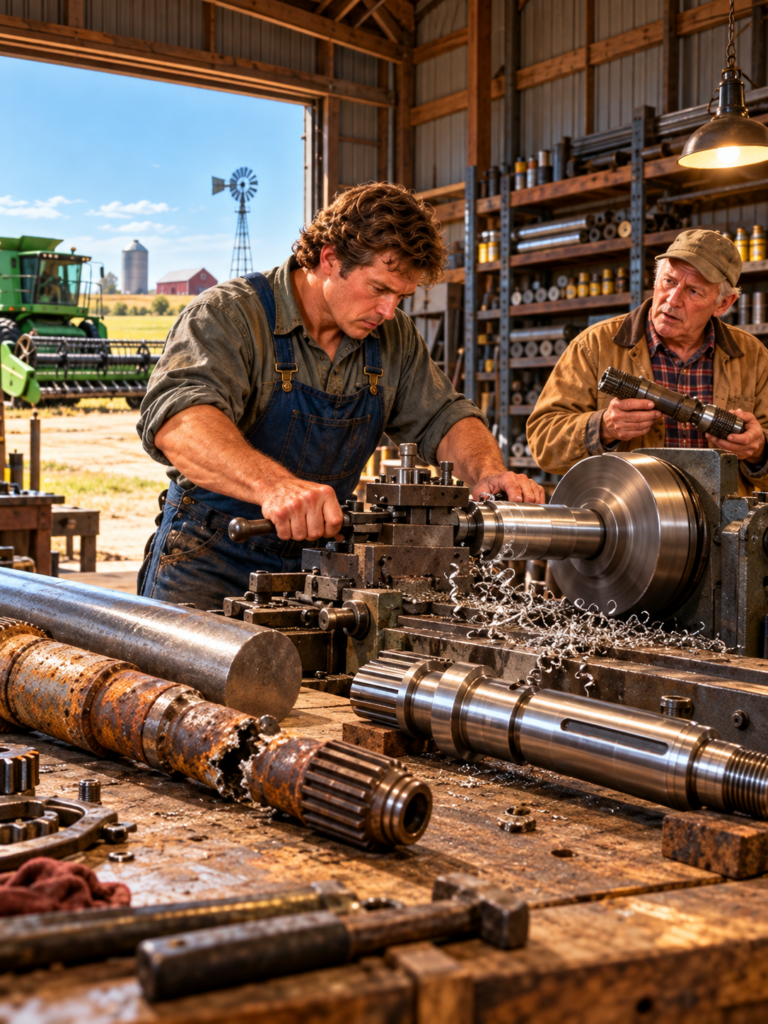
Part 1
In the spring of 1971, Dwayne Reinhold drove forty-three miles from his farm outside Weston, Nebraska, to a machinery dispersal sale at the Kowaltzik implement lot on Route 6.
He was forty-one years old, old enough to recognize a bargain and experienced enough to know that a bargain could become an expensive mistake if a man failed to look closely.
By late afternoon, he had four secondhand metal lathes loaded onto the bed of his 1958 Ford flatbed truck.
Three had cost him fifteen dollars apiece. The fourth, a battered Lodge and Shipley with badly damaged ways, had gone for nine dollars after Dwayne convinced the auctioneer that nobody else wanted the trouble of hauling it away.
The purchase would be remembered as sixty dollars’ worth of old machinery.
To anyone watching, it looked like a truckload of iron that had already given its best years to somebody else.
Dwayne saw something different.
He worked slowly as he secured the last machine. Heavy chains scraped against the truck bed. The afternoon sun caught the rust on the cast-iron housings, and the Ford’s rear springs sagged under the weight.
Gordon Pedabone, the parts-counter supervisor at Kowaltzik, stood near the gate watching him.
Gordon had spent enough years in the implement business to recognize almost every machine that passed through the lot. He knew which tractors farmers were trading, which replacement parts had become difficult to find, and which equipment manufacturers were leaving their older models behind.
He also knew that the machinery in Dwayne’s truck was no longer fashionable.
“That’s quite a collection you’ve got there,” Gordon said.
Dwayne tightened a chain and tested it with one hand.
“Should do what I need.”
Gordon looked at the machines again.
“Hope you know what you’re getting yourself into.”
There was no cruelty in his voice. If anything, he sounded concerned. In Gordon’s estimation, Dwayne was spending money and valuable time on tools that modern industry had already begun to discard.
Dwayne straightened and wiped his hands against his work pants.
“I believe I do.”
That was all he said.
He climbed into the Ford, started the engine, and pulled carefully onto Route 6.
The load was heavier than he had expected. For much of the forty-three-mile trip home, he kept the truck in second gear, listening to the engine work and feeling the rear suspension complain beneath him.
He passed the cafe in Weston without stopping.
There would be time for coffee another day. For now, he wanted the truck unloaded before darkness settled across the farm.
What nobody at the auction understood was that Dwayne had not bought four machines because he needed more machinery.
He had bought them because he could see a problem coming.
And the problem was bigger than his farm.
Dwayne had been born in 1930, during the hard years when falling crop prices drove families off their land throughout Nebraska.
His father, Lambert Reinhold, had owned 160 acres east of Weston, where he raised dryland corn and milo.
Lambert had watched neighbors pack their possessions, sell their equipment, and leave farms that had been in their families for generations. He had seen what happened when a family owed more than its ground could earn.
He stayed.
Remaining on the farm had required a kind of discipline that eventually shaped nearly everything his son believed about work.
Lambert repaired what broke.
Sometimes he repaired things that another farmer would have thrown away. Sometimes he rebuilt them more than once.
He had learned that a machine did not become useless simply because one component had worn out. A tractor with a damaged shaft might still have a good engine. A pump with a cracked collar might have decades of work left in it. A broken bearing housing could often be repaired if a man had the tools and understood the metal.
In 1938, Lambert bought a used nine-inch South Bend lathe from a retiring machinist in Alma.
He paid twenty-two dollars.
At the back of his shop, he poured a heavy bench from Portland cement and river gravel. He installed the lathe on it and arranged a belt-driven power system using a half-horsepower electric motor salvaged from a burned pump house.
Nothing about the installation was particularly elegant.
The overhead shaft was improvised. The belt needed occasional adjustment. The motor looked as though it had survived more than one disaster.
But the lathe turned.
And that was what mattered.
Dwayne grew up around the smell of cutting oil, warm steel, and dusty grain equipment.
By twelve, he had begun watching his father work at the machine.
Lambert was not a man who gave long explanations. He preferred demonstration.
He would position a piece of steel in the chuck, bring the cutting tool into place, and turn the handles slowly enough for Dwayne to see what was happening.
Then he would step aside.
“Your turn.”
Dwayne learned to listen.
A cutting tool made one sound when it moved cleanly through metal and another when it began to chatter. The carriage handle offered resistance when the cut was too heavy. Certain kinds of steel behaved differently from others, and the condition of a surface could tell a careful machinist almost as much as a measuring instrument.
Lambert taught him how to repair worn shafts by turning them down and fitting sleeves. He showed him how to bore damaged collars and install bushings, and how to restore stripped threads when enough sound metal remained.
One afternoon, after Dwayne had examined a badly worn component and wondered whether it was worth saving, Lambert explained the principle behind nearly everything he did.
“Metal doesn’t disappear just because a part wears out,” he told him. “It becomes something different. You figure out what it’s become, and sometimes you can make it useful again.”
Dwayne remembered that lesson.
He carried it through high school and into the vocational school in Hastings, where he spent two years studying machining and general mechanics.
By the time he completed his training in 1950, he could operate a manual lathe with a precision that impressed his instructors.
The county extension office, however, had little use for his certificate.
Its programs were organized around farming and livestock. There was no obvious category for a young man who understood the fine tolerances of machine-tool work.
Dwayne returned to Weston.
He farmed with his father during the day and worked on neighbors’ machinery in the evenings.
At first, there were only occasional jobs.
A farmer needed a shaft shortened. Another brought in a worn spindle. Someone else had a collar that could not be replaced without ordering an entire assembly.
Dwayne charged two dollars and twenty-five cents an hour.
His wife, Selma, bought him a green composition notebook at the drugstore in Alma, and he began recording every repair, every payment, and every expense.
The notebook filled.
Then another.
By 1960, he was using his third ledger.
By 1965, his repair work had grown enough that he had acquired a drill press and a surface grinder. The machinery no longer fit comfortably in the corner of the barn.
With help from his brother-in-law, Neils, Dwayne built a separate concrete-block shop on the east side of the house.
They worked on it during two summers, laying the blocks themselves.
The completed building measured sixteen by thirty-two feet.
It wasn’t much to look at from the road. It had plain walls, a practical entrance, and none of the appearance of a commercial machine shop.
But inside, Dwayne had room to work.
Lambert lived long enough to see his son establish that shop.
Then, in the winter of 1967, he contracted pneumonia and died.
His death left Dwayne the farm, the South Bend lathe, and a savings account at the Harland County Bank in Alma containing $14,312.
It was a remarkable amount for a man who had farmed modest acreage through difficult decades, but Lambert had accumulated it through years of careful spending and an unwillingness to borrow money for things he could manage without.
Dwayne understood the inheritance as more than property.
His father had left him a working farm, a set of habits, and the means to continue without being forced into debt.
He moved Lambert’s South Bend into the concrete-block shop, keeping it on the same homemade bench.
He repaired the worn machine ways and installed a replacement belt. Beyond that, he changed very little.
When the motor started and the belt began moving again, it sounded much as it had when Dwayne was a boy.
He found comfort in that.
But by 1971, the country around Weston was changing.
Farms were growing larger.
Four-row planters were giving way to eight-row machines. Bigger tractors replaced smaller ones. Dealers devoted their inventory and service departments increasingly to equipment that required larger investments and promised better returns.
The change made financial sense for the dealerships.
It also created an overlooked problem.
Thousands of acres in Harland County were still being worked with older machinery.
A farmer running a tractor built in the early 1950s could not simply buy a new tractor every time a shaft wore out or a bearing failed.
He needed the old machine to keep working.
Yet the parts he depended on were becoming harder to obtain.
The Kowaltzik dealership could still source some components for older equipment, but many were no longer kept in stock. An unusual replacement might take six weeks to arrive.
For someone repairing a tractor in January, that delay might be inconvenient.
For someone whose planter failed during the spring planting window, it could threaten the entire year’s crop.
The same was true in autumn.
Corn did not wait for a dealer to locate a shaft. A combine sitting idle during a wet October could cost a farmer far more than the price of the broken component.
Even vocational schools were turning toward newer methods of machining.
The school in Hastings had changed its program in 1968, emphasizing computer-controlled equipment and reducing the time devoted to traditional manual lathes.
Dwayne understood the reasoning.
Factories needed faster production and modern tools. Students wanted jobs in industries moving toward those technologies.
But the men farming around Weston were not running factories.
They were keeping older equipment alive because it was what they owned.
And Dwayne noticed something that others had failed to consider.
As manufacturers advanced, their older machinery was becoming less valuable on the resale market.
At the same time, the ability to repair older farm equipment was becoming more valuable to the people who still depended on it.
Those two trends were moving in opposite directions.
That was why he had driven forty-three miles to the Kowaltzik sale.
He had examined the four lathes before bidding.
The first, a 1941 LeBlond, was a heavy production machine with a long bed and enough capacity for substantial agricultural shafts.
Its exterior was grimy, and rust had formed on exposed surfaces. But when Dwayne checked the spindle with a dial indicator, he found that it still ran true.
He knew what a sound spindle meant.
The second was a 1948 South Bend Heavy 10, related to the machine his father had owned. It came with valuable attachments still stored in their original wooden case.
The third, a 1955 Monarch 10E, was a precision toolroom lathe.
It had a quick-change gearbox and capabilities that would make it useful for jobs requiring accurate threads and close tolerances.
The fourth was the troublesome Lodge and Shipley.
Its ways were badly scored. Someone had apparently allowed metal chips beneath the carriage and continued running the machine until deep damage marked the sliding surfaces.
Most potential buyers saw a worn-out lathe.
Dwayne saw a good spindle attached to a bed that needed careful hand scraping.
His father had taught him the difference.
Damaged ways could be restored by a man with the patience and knowledge to do the work. A ruined spindle was a far more serious problem.
Dwayne had learned hand scraping from Lambert, who had learned it from the machinist who sold him the original South Bend.
The technique came from an older generation of machine-tool craftsmen. It required precision, a practiced eye, and the willingness to repeat a small operation hundreds of times.
Dwayne still owned the old machining textbook his father had given him when he was fourteen.
Its cover was held together with strips of brown tape.
He knew how to use the methods inside.
That was why he wasn’t frightened by the fourth lathe.
After bringing the machines home, Dwayne began restoring them in the evenings.
His farming duties continued. His regular repair customers still came. Selma still had a household to run, and there was no reason to assume the new machinery would ever pay for itself.
For eight months, the work proceeded quietly.
Dwayne cleaned the LeBlond with solvent, scrapers, and bronze wool. He adjusted the sliding components, aligned the tailstock, and checked the headstock until the machine would cut smoothly without vibration.
He rebuilt the South Bend Heavy 10, replacing worn bearings that had produced a knocking sound at high speeds.
The Monarch required surprisingly little mechanical repair.
Its previous owner had maintained it well. Dwayne cleaned the gearbox, replaced a felt wiper, and checked the machine’s accuracy.
The Lodge and Shipley demanded the most patience.
For fourteen evenings, Dwayne worked beneath a trouble lamp hanging from a ceiling hook.
He borrowed precision straightedges from Anel Feld, an instructor at the Hastings vocational school who had known him for years.
The process involved coating a reference surface with Prussian blue, checking where the damaged ways made contact, and carefully scraping away the high spots.
Each pass removed only a small amount of metal.
Then he checked again.
Some evenings, the progress was almost impossible to see.
He would finish work, clean the tools, and look at the machine knowing that the following night would require more of the same.
But the contact pattern slowly improved.
By the fourteenth evening, he had restored contact across approximately eighty-three percent of the bearing surfaces.
He aligned the tailstock and gave the machine a permanent place along the east wall.
By March 1972, five lathes stood inside Reinhold’s shop.
Lambert’s old South Bend remained on its homemade bench. The LeBlond and South Bend Heavy 10 stood along the north wall. The Monarch and the Lodge and Shipley occupied the east side.
The building was crowded.
Dwayne had to think carefully about where he stored his tools and how he moved long pieces of material between machines.
But every lathe had a purpose.
Including the damaged machine nobody else had wanted.
Between the purchase price and the repairs, he had invested surprisingly little cash, relying on his own labor to restore equipment that would have cost far more in working condition.
He had not yet earned anything from the four additional lathes.
Gordon Pedabone would probably have considered that proof of his concerns.
Dwayne considered the machines ready.
He also had something else that mattered just as much.
Along the south wall stood a rack he had welded together from angle iron.
It held metal remnants that he had been gathering since 1968.
Whenever he found usable pieces of steel at a scrap yard or service center, he considered buying them. He looked for common shaft diameters, dependable alloys, and lengths likely to suit the kinds of farm machinery he encountered.
He sorted the pieces by size and material.
Each carried a masking-tape label recording what it was and what he had paid.
A casual visitor might have seen nothing more than an assortment of leftover metal.
Dwayne saw shafts, collars, bushings, and fittings that had not yet been made.
In April 1972, that preparation finally proved its value.
Bertram Ruska arrived from his farm south of Alma carrying a broken shaft from the header drive of a 1963 International combine.
Bertram farmed 840 acres of corn and soybeans.
The shaft had failed during the previous autumn’s harvest.
His dealer had quoted sixty-two dollars for a replacement and warned that delivery would require six weeks.
Bertram had waited.
When the part finally arrived, it belonged to a different model year. The keyway was in the wrong location.
He had to order another.
The correct shaft did not arrive until February, long after the harvest season had ended.
Meanwhile, wet October weather had prevented him from reaching approximately forty acres of standing corn.
The loss still bothered him.
Now, several months later, he wanted an answer to a question that had been following him all winter.
Could Dwayne have made the shaft?
And if he could, how long would it have taken?
Dwayne placed the broken piece on his workbench.
He examined the fracture, checked the dimensions, and measured the locations of the keyway and threads.
Then he walked to the material rack.
A piece of 1045 steel round stock, two inches in diameter and thirty-six inches long, was already there.
He had bought it the previous autumn from a steel service center in Hastings.
It was close to the size he needed.
Dwayne brought it to the LeBlond, secured it in the chuck, and began turning.
Bertram watched for a while, then occupied himself as Dwayne worked.
The long steel blank gradually became a precisely measured replacement shaft. Dwayne machined the ends, cut the required features, moved it to the mill for the keyway, and finished the threads.
Four hours and twenty minutes after beginning, he placed the completed shaft on the bench.
Bertram picked it up.
The dimensions matched.
He looked toward the lathe, then back at Dwayne.
“You did that today?”
Dwayne nodded.
Bertram turned the shaft in his hands.
“Dealer took all winter to get me the right one.”
Dwayne made no comment.
Bertram studied the finished metal for another moment.
“If I’d known you could do this, I’d have been here in October.”
Dwayne wiped the oil from his hands.
“I was here in October.”
Bertram looked at him.
Then he gave a small, rueful smile.
“Suppose I didn’t know where to come.”
Dwayne charged his usual modest hourly rate.
Bertram paid him and carried the shaft home.
Neither man realized that this ordinary exchange was about to change how farmers across Harland County thought about the little concrete-block shop east of Weston.
Within two weeks, people were telling the story at the co-op, the cafe, and the sale barn.
A farmer had waited months for a combine shaft that Dwayne Reinhold could make in a single afternoon.
The story grew slightly with each telling.
Some people remembered the wrong price. Others exaggerated how quickly the work had been completed.
But the important part remained.
Reinhold could manufacture parts that the dealers struggled to supply.
What the story never mentioned was the piece of steel waiting on the rack before Bertram arrived.
That was the advantage Dwayne had spent years preparing.
He didn’t have to telephone a supplier.
He didn’t have to wait for a shipment.
He didn’t have to purchase the material at an emergency price.
The metal was already there.
The machinery was already there.
And so was the man who knew what to do with both.
For the first time, people outside the Reinhold family were beginning to see why those four unwanted lathes might have been worth bringing home.
But one successful repair did not make a business.
What came next would take years of ordinary work, hundreds of small decisions, and a reputation built so gradually that nobody could identify the exact day it became indispensable.
Part 2
The first year after Bertram Ruska’s visit did not transform Reinhold’s shop into a thriving business overnight.
Dwayne still spent long days farming.
He still repaired machinery for the same neighbors who had known him for years.
The difference was that new customers began appearing at the shop door, often carrying something wrapped in a feed sack or laid across the bed of a pickup.
They had heard about the combine shaft.
Some came because a dealership had quoted a replacement they could not afford. Others came because the part they needed had been discontinued. A few simply wanted to know whether the man outside Weston could really make things that no longer existed on a parts shelf.
Dwayne treated them much as he had treated Bertram.
He examined what they brought, asked how the part had failed, measured what remained, and decided whether a repair was possible.
Sometimes it was.
Sometimes the damaged piece required a complete replacement.
And sometimes he had to tell a customer that the problem was beyond what his shop could reasonably accomplish.
That willingness to be practical mattered.
Farmers were accustomed to dealing with difficult equipment and uncertain conditions. They trusted a man more readily when he told them what he could do than when he promised everything.
The green ledger for 1972 recorded forty-three jobs on the five lathes.
The following year, the number rose to sixty-eight.
It was still a modest business, but the pattern was unmistakable.
By 1975, annual billings had passed two thousand dollars.
Dwayne hired a part-time helper named Tobin Scogan, a young machinist trained at the vocational school in Hastings.
Tobin came three days a week.
He handled production work on the South Bend Heavy 10, while Dwayne generally took the larger and more difficult jobs on the LeBlond.
Every Friday, Dwayne paid him in cash from an envelope kept in the top drawer of the shop desk.
Tobin earned three dollars and twenty-five cents an hour.
There was no elaborate system of supervision. Dwayne explained what a job required, showed Tobin anything unfamiliar, and checked the finished work.
The arrangement suited them both.
Dwayne gained the capacity to complete more repairs, and Tobin acquired something his vocational training could not provide: daily experience with equipment that seldom arrived in perfect condition.
In a school machine shop, students often worked from clean drawings and correctly sized materials.
At Reinhold’s, the drawings were frequently missing.
A farmer might bring in a cracked shaft with one end worn beyond measurement, or a damaged collar that had already been repaired twice.
The machinist had to understand not only the part but also the equipment around it.
He had to work backward from the damage and forward toward a reliable repair.
Dwayne had spent his life learning that process.
Now Tobin was learning it from him.
By 1977, the shop billed $4,040 annually, and Tobin had become a full-time employee earning four dollars an hour.
Dwayne had also acquired a horizontal milling machine at an estate sale in Franklin County.
It cost sixty-five dollars.
He rebuilt it during the winter of 1976.
The mill expanded the kinds of jobs the shop could accept, particularly when a repair required a machined slot, a keyway, or a gear.
But most of the work remained unremarkable to anyone who did not understand farming.
A worn crankshaft journal on a 1949 John Deere B.
A collar with stripped threads from an older New Holland baler.
Shafts for hay equipment that had to keep operating through the narrow weeks when the crop was ready.
These were not objects people admired in a display case.
They were parts that disappeared inside machines, where they performed their work without being noticed.
And when they failed, the consequences reached far beyond the machine itself.
Cornelius Angel, a farmer using an older hay mower, had learned this through repeated breakdowns.
The mower’s PTO shafts were prone to failure. A dealer might take longer to supply a replacement than the entire haying period allowed.
So Cornelius asked Dwayne to make six spare shafts.
Dwayne understood immediately.
The job was not merely about replacing a broken component.
It was about preventing future breakdowns from becoming emergencies.
Cornelius would keep the shafts ready.
When one failed, he could replace it and return to the field.
Dwayne had approached his own material rack with precisely the same reasoning.
Another job involved a threaded collar for a 1961 New Holland baler.
The threads had worn badly enough that the collar would no longer hold securely.
Dwayne bored the damaged area, cut new threads, and fitted a steel insert.
Cornelius examined the repaired component and decided it might be stronger than the original.
Dwayne didn’t argue.
He simply recorded the work in his ledger.
Other repairs demanded greater precision.
A stationary irrigation pump serving three farms east of Weston needed a replacement crankshaft.
Dwayne measured the pump housing before beginning.
He selected a suitable piece of alloy steel, machined the shaft on the LeBlond, and fitted it to the housing with the close tolerance required.
The work took two days.
Had the pump remained out of service, three separate farms would have felt the consequences.
That was becoming the defining feature of the business.
The value of a repair could not always be measured by the amount written on the invoice.
A fifteen-dollar part might protect thousands of dollars’ worth of crop.
A small bushing might restore a machine that several people depended on.
The people who benefited began telling other farmers.
There was no advertising campaign.
No painted billboard beside Route 6.
No salesman traveling the county.
Just conversations in familiar places.
At the co-op, someone mentioned that Reinhold had repaired an old Oliver tractor.
At the sale barn, another man described a part that the dealership in Red Cloud could no longer obtain.
At the cafe, someone spoke of a shaft made from metal Dwayne already had in the shop.
The information accumulated.
One job in particular changed the thinking of Curtis Voss, the manager of a grain elevator.
A bushing on the elevator’s machinery had failed, leaving the equipment out of service.
Two suppliers had indicated that a replacement could take six weeks.
Curtis worked through the possible sources.
Eventually, he arrived at Reinhold’s shop.
He had little reason to expect a miracle.
Dwayne examined the bushing, measured it, and went to the material rack.
There was a piece of bronze rod in the appropriate size range.
He placed it in the Monarch and began machining.
Forty minutes later, the new bushing was finished.
The charge was three dollars and eighty cents.
Curtis held the small bronze component in his hand.
He had spent longer trying to locate a supplier than Dwayne had spent making it.
“That’s all?” he asked.
Dwayne looked at the part.
“Should fit.”
Curtis slipped it into his shirt pocket and returned to the elevator.
The machinery was back in operation without a six-week delay.
The following week, Curtis mentioned the experience at the Weston co-op.
He didn’t describe it as extraordinary.
He simply told other farmers something they might find useful.
If they needed a part machined quickly, Reinhold’s shop was worth trying.
That practical recommendation carried more influence than an advertisement ever could.
And somewhere along the way, Gordon Pedabone heard it.
Gordon remembered the auction.
He remembered the four old lathes on Dwayne’s truck and the concern he had expressed while watching him chain them down.
He had assumed that the machines represented excess capacity in a county moving toward newer equipment.
Now the same county was revealing how many older machines remained in daily use.
More importantly, those machines required repairs the dealers were increasingly unable to provide on short notice.
Gordon did not announce that he had been wrong.
He simply began behaving differently.
When someone approached the Kowaltzik parts counter with an unusual request for an obsolete component, Gordon sometimes suggested Reinhold’s shop before opening the parts catalog.
“Try Dwayne out east of Weston,” he would say. “Might be able to make it.”
He continued doing that whenever the situation warranted it.
Dwayne never knew exactly how many customers came because of Gordon’s referrals.
Gordon never asked him to account for them.
Their relationship had changed without either man feeling the need to discuss it.
By the end of the decade, Reinhold’s shop had become part of the county’s informal repair network.
A farmer might try the dealer for a standard part, a neighboring farmer for a used component, and Dwayne for something that had to be manufactured.
Eventually, some began contacting him first.
In 1980, the shop expanded its working capacity again.
Tobin helped bring in a second employee, a young woman named Fern Joerger.
Fern had grown up on a farm twelve miles north of Weston.
Like Tobin, she had studied machining at the Hastings vocational school.
She understood farm equipment, but she also had a natural feel for precision work.
Dwayne recognized her ability quickly.
On the Monarch, she could hold extremely close tolerances, producing parts with the kind of finish and accuracy that required patience as much as training.
He once observed that on a bad day, she could hold a tolerance better than he could.
Fern earned four dollars and fifty cents an hour.
She brought her own micrometers in a small wooden case she had made during her school years.
Her father had cut the black walnut from a tree that had fallen in their pasture.
The case was smooth, carefully fitted, and practical, much like the work Fern preferred.
She handled precision jobs on the Monarch and production work on the Lodge and Shipley.
Dwayne gave her permission to use the shop on Saturday mornings for personal projects.
Fern took advantage of the arrangement.
She made small replacement components for neighbors and unusual parts that required careful measurement.
One project involved a bronze worm gear for an old hand-cranked grain cleaner.
A farm museum had sent her a drawing and requested a reproduction.
Fern studied the specifications, selected the material, and machined the replacement.
The museum paid her forty dollars.
More importantly to Fern, it sent a letter praising the quality of her work.
She placed the letter inside the walnut case beside her measuring instruments.
Dwayne noticed, but he didn’t make a ceremony of it.
He understood what that letter meant.
Fern was beginning to build a professional reputation independent of the shop that employed her.
It was the same process he had experienced years earlier, when neighbors first began bringing broken parts to his father’s barn.
The business was no longer just a place where Dwayne performed repairs.
It was becoming a place where skilled people learned from one another.
By the end of 1980, the financial records reflected how far the operation had progressed.
That year, the shop completed 197 jobs and billed $11,240.
From 1972 through 1980, total billings reached approximately $31,480.
The machines remained mostly the same equipment Dwayne had assembled through auctions, repairs, and patient rebuilding.
The horizontal mill had joined the lathes, and he had added further grinding capacity after purchasing another used machine at a dispersal sale in Furnas County in 1978.
None of it had required the kind of borrowing that could place the farm at risk.
The shop operated without debt.
And the material rack kept growing.
By the winter of 1980, it held 311 pieces of steel, bronze, brass, and aluminum in forty-seven different sizes.
Dwayne estimated that replacing the entire inventory at current prices would cost about eight hundred dollars.
He had acquired it over twelve years of searching for leftovers, remnants, and auction bargains at a fraction of that amount.
Each piece occupied a place on the rack.
Each was labeled.
Each could potentially become a part needed by someone in Harland County.
One evening, while reviewing the business records, Selma asked whether he believed the work would continue.
Dwayne considered the question.
He was not a man who predicted the future casually.
But this time, he thought the answer was plain.
“There’s more old iron in this county than there are places to fix it,” he told her.
Selma considered that.
“Sounds about right.”
Then she returned to what she had been doing.
The exchange was brief, but it captured the understanding beneath everything Dwayne had built.
He wasn’t depending on a temporary shortage.
He was serving a need that would remain as long as farmers continued using machinery they could not afford to replace.
And the older that machinery became, the more important his shop might be.
Three years later, Harland County was about to discover exactly how important.
The winter of 1982 into 1983 was long and bitterly cold.
Spring arrived late.
Frozen ground and delayed thawing kept farmers out of their fields until May, compressing the planting season into roughly three weeks.
Once the soil became workable, everyone was in a hurry.
Tractors ran long hours.
Planters moved across fields with little time for unnecessary stops.
Equipment that had spent months sitting through winter was suddenly expected to perform continuously.
Old weaknesses began appearing.
Dry bearings seized.
Worn shafts failed.
Cracked components finally broke under the pressure of sustained operation.
The dealers received more calls than they could easily satisfy.
For farmers running older equipment, some of the answers remained familiar.
The parts would have to be ordered.
Delivery would take time.
But that spring, time was the one thing nobody in Harland County had to spare.
On the morning of May 9, 1983, a planter drive gear broke in a field belonging to Vidar Nygard.
One tooth sheared away at its root.
The planter stopped.
Vidar removed the damaged gear and carried it to his truck.
After contacting the dealer, he learned that a replacement would cost forty-eight dollars and take ten to fourteen business days to arrive.
Ten business days could consume most of the remaining planting window.
He put the gear in a feed sack and drove toward Weston.
When he turned into the Reinhold driveway, three other farmers were already waiting in the yard.
Inside the concrete-block shop, every machine seemed to be working.
And for the first time since Dwayne bought those four unwanted lathes, Harland County was about to confront a truth that had been building quietly for more than a decade.
Part 3
Dwayne was working at the LeBlond when Vidar Nygard arrived.
Tobin occupied the South Bend Heavy 10. Fern was machining a precision component on the Monarch. The Lodge and Shipley was being used for another run of PTO shaft ends ordered by Cornelius Angel, who had learned to prepare for the haying season before his equipment broke.
The air smelled of cutting oil and warm steel.
The machines made their familiar sounds, interrupted occasionally by the sharper noise of a tool engaging metal.
Dwayne noticed Vidar through the doorway.
He stopped his machine and walked outside.
“What have you got?”
Vidar lifted the feed sack onto a clear section of the workbench and pulled out a cast-iron gear.
“Planter drive. Broke this morning.”
Dwayne picked it up.
It was a spur gear with twenty-two teeth, a two-inch bore, and a face width of an inch and a half. A narrow keyway ran along the center opening.
One tooth had sheared cleanly away.
Dwayne turned the gear over and studied the damaged area.
He could see the failure clearly enough.
What he needed to determine was whether making a replacement would be practical.
“Dealer says two weeks,” Vidar told him.
Dwayne looked up.
“Two weeks?”
“Ten to fourteen business days. That’s what they quoted.”
Dwayne glanced at the gear again.
He understood what that meant with planting already delayed.
There was no point in telling Vidar how serious the situation was. The man knew the condition of his own fields.
Dwayne measured the damaged component and considered the alternatives.
He couldn’t manufacture a cast-iron gear by simply turning it on a lathe. The teeth required a different machining operation, and casting a replacement wasn’t practical for the shop.
But he had a horizontal mill.
And he had steel.
“I can make you one,” he said. “Wouldn’t be cast iron. I’d use steel.”
Vidar watched him carefully.
“You think it’ll work?”
“Drive shouldn’t be carrying a load that requires cast iron. Steel ought to be suitable, provided everything fits the way it should.”
Vidar considered the answer.
“How soon?”
Dwayne looked toward the machines.
There were other jobs underway. He couldn’t abandon them without affecting farmers who were depending on promised repairs.
“Thursday morning.”
Vidar nodded slowly.
It was Tuesday.
Thursday was a great deal better than two weeks.
He picked up the empty sack and began walking toward his truck.
Then he stopped.
He turned and came back.
“Forgot to ask. What’ll it cost?”
“Thirty-five dollars. Gear and keyway.”
Vidar thought about the forty-eight dollars the dealer had quoted.
“All right.”
He returned to his truck and drove away.
Dwayne carried the broken gear into the shop.
There was no celebration. No discussion about saving a farmer’s planting season.
He had accepted a job, and now the job had to be completed.
He checked the measurements again.
Then he went to the material rack.
Among the pieces stored there was a plate of 1018 steel purchased from the scrap dealer in Alma in 1979.
Dwayne had paid a little over three dollars for it.
The plate had been sitting in the shop for four years.
On the day he bought it, he had no particular job in mind.
He had simply recognized that the material was sound, the price was low, and the dimensions might someday be useful.
Now he knew exactly what it would become.
He prepared the blank and began machining it to the required dimensions.
The bore had to be accurate.
The faces had to run true.
The keyway needed to match the planter drive.
But the most demanding work involved cutting the teeth.
For that, Dwayne used the horizontal mill and a gear cutter he had acquired at the same Kowaltzik auction in 1971.
The cutter had cost four dollars.
It had seemed like another small purchase at the time, useful enough to keep even if there was no immediate need for it.
Twelve years later, it was helping him make a part that could not arrive from the dealer before the planting window closed.
He worked through Wednesday and into Thursday morning.
When the gear was finished, he checked the dimensions and inspected the teeth.
He had made it carefully because a gear that merely looked correct would be of no use to Vidar if it damaged the planter drive.
By the time Vidar returned, the replacement was ready.
Dwayne handed him the steel gear.
Vidar held it beside the broken cast-iron original.
The difference in material was obvious, but the dimensions matched.
“Should go right in,” Dwayne said.
Vidar paid the thirty-five dollars and headed back to his farm.
That afternoon, he installed the gear.
It fitted the planter drive without modification.
He started the machine, checked its operation, and returned to the field.
Before the day ended, he was planting corn again.
The gear had cost less than the dealer’s replacement.
More importantly, it had arrived while it could still save the planting schedule.
By the following week, farmers were talking about the repair throughout Harland County.
This story traveled faster than the ones before it.
The reason was simple.
The problem it described was happening everywhere.
Farmers were struggling to complete spring planting, and equipment failures were interrupting work at exactly the wrong time.
Vidar’s story contained two figures people could understand immediately.
The dealer had quoted ten to fourteen business days.
Reinhold had the gear ready Thursday morning.
The dealer wanted forty-eight dollars.
Dwayne charged thirty-five.
That comparison gave the story weight.
By the end of May, some farmers had begun bringing damaged components to Reinhold’s shop before contacting a dealership.
This was a change Dwayne noticed.
Previously, customers often arrived after exhausting every other possibility. By then, they were frustrated, short of time, and frightened of what another delay might cost.
Now they sometimes came while they still had choices.
They explained the problem, left the part, and returned when the work was finished.
It gave Dwayne more room to plan.
It allowed Tobin and Fern to organize jobs sensibly.
And it often spared the farmers the desperate expense of finding a solution at the last moment.
That, more than any individual repair, proved what Dwayne had understood in 1971.
He had not been collecting unwanted equipment for the sake of owning it.
He had been building a shop capable of responding to problems that modern distribution systems were no longer solving quickly.
In the autumn of 1983, Gordon Pedabone retired from the Kowaltzik implement lot.
His coworkers and acquaintances gathered at the Weston cafe to mark the occasion.
About forty people from the county’s machinery and parts trade attended.
Coffee was poured. Old stories were repeated. Men who had spent years dealing with agricultural equipment discussed the changes they had witnessed.
Someone asked Gordon what he considered the most important development during his last twelve years in the business.
Gordon thought about it.
The new equipment lines had certainly changed things, he said.
Tractors had grown larger. Machines had become more complicated. The parts business no longer resembled what it had been when he started.
Then he mentioned something else.
Harland County now had a machine shop capable of making parts that dealers could no longer supply.
He had referred more customers to Reinhold’s shop than he cared to count.
Most had come back with what they needed.
Gordon remembered the day Dwayne loaded those four worn-out lathes onto his Ford.
He remembered wondering whether the man understood what he was buying.
Now he knew.
“Dwayne saw something in those machines I didn’t,” Gordon told the room.
He paused, then added that he thought it was worth acknowledging.
There was no dramatic silence.
Nobody stood to applaud.
A few men nodded. Someone made a comment about the number of old tractors still working in the county.
Gordon lifted his coffee and the conversation moved on.
Dwayne wasn’t there to hear the compliment.
He was at the shop, working.
And in many ways, that was the most fitting part of the story.
His reputation had grown because people could count on him being where he said he would be, doing the work he had promised to do.
He hadn’t needed a public declaration of success.
The farmers arriving in his yard were proof enough.
Two years later, Dwayne faced a different kind of change.
In March 1985, Fern Joerger came into the little office partitioned off from the machine shop.
The office contained a desk, two chairs, the green ledger books dating back to 1960, and an old coffee maker.
Dwayne was finishing some paperwork when she asked if they could talk.
He set down his pencil.
Fern sat opposite him.
She had been thinking carefully about what she wanted to say.
Over the years, she had saved money from her wages and the personal machining jobs she completed on Saturdays and occasional evenings.
She had also found a small building in Alma.
It had once been an auto parts store, with a loading dock and three-phase electrical power.
The building would be suitable for a precision machine shop.
Fern had located a used CNC turning center at a machinery auction in Kansas City.
She intended to purchase it and establish her own business, serving agricultural and industrial customers.
She wanted to give Dwayne sixty days’ notice.
He listened without interrupting.
Fern explained that she had learned more at Reinhold’s than anywhere else, including vocational school.
She wasn’t leaving because she was dissatisfied.
She was leaving because she believed she could build something of her own.
Dwayne looked at her across the desk.
He had seen the way she handled difficult jobs.
He knew how carefully she maintained her instruments and how much pride she took in precision.
He also understood the satisfaction of building a business around knowledge acquired through years of work.
“Sounds right to me,” he said.
Fern seemed relieved.
Dwayne asked whether she needed anything to get started.
Tooling, fixtures, perhaps some material.
She told him she had already arranged what she needed.
He nodded.
Then he mentioned the material rack.
“If you get a job and need a piece you don’t have, you know where to find it.”
Fern smiled.
“I know.”
He gave her the same straightforward courtesy he would have given any machinist he respected.
And Fern understood the offer for what it was.
The man who had spent years preparing his shop for other people’s emergencies was willing to share that preparation with someone establishing a competing business.
Because he did not think of her success as his loss.
There was more than enough work for skilled hands in the region.
Fern opened her precision shop in Alma in June 1985.
She began with two employees, herself and a young machinist hired from the Hastings vocational program.
The work grew.
By 1988, she had four employees and a second CNC machine.
By 1991, the Harland County Electric Cooperative had established a standing arrangement to send its machined parts work to Fern’s business rather than to suppliers farther away.
The reasons were familiar.
The shop was closer.
The work was accurate.
The turnaround was faster.
And the cost was competitive.
Fern had learned those principles at Reinhold’s, then applied them using newer technology.
In December 1985, she sent Dwayne a check for one hundred and fifty dollars.
A brief note explained that the money was for the Saturday mornings she had spent using his machines.
Dwayne read the note.
He cashed the check.
Then he placed the letter inside that year’s ledger.
He kept it with the records of the business because the payment represented something no invoice could properly measure.
Fern had begun as an employee.
She had become a skilled machinist.
Now she owned a shop of her own.
For Dwayne, the knowledge that had passed from Lambert to him was passing onward again.
As the years went by, Reinhold’s shop continued working.
The five lathes remained in service.
They were older every year, but their age did not determine their usefulness.
What mattered was their condition and the ability of the person operating them.
Dwayne maintained the LeBlond carefully, repacking its spindle bearings at regular intervals.
The old South Bend inherited from Lambert received necessary repairs, including precision grinding of its worn ways in 1981.
By 1990, it still stood on the concrete-and-gravel bench Lambert had poured in 1938.
The Lodge and Shipley, purchased for nine dollars with badly scored ways, had proved especially valuable.
After Dwayne restored its sliding surfaces during fourteen evenings in 1971, it served for nineteen years as one of the shop’s main production machines.
Its condition remained satisfactory.
The machine that nobody wanted at the auction had earned its place again and again.
In 1990, the shop billed $22,610.
Total billings from 1972 through that year reached $214,830.
The machinery, tooling, and material inventory acquired across those decades represented a relatively small investment compared with the work the shop had performed.
And Dwayne had maintained the principle he inherited from his father.
The business operated without debt.
By 1991, he was sixty-one years old.
Selma had been encouraging him to slow down for two years.
Dwayne knew she had a point.
The long days in the shop demanded more of him than they once had. He still enjoyed machining, but he no longer needed to personally oversee every repair.
He had built something valuable enough to continue without requiring his presence every morning.
Rather than close the business, he hired Matias Callahan, an experienced machinist who understood the equipment, the ledgers, and the material rack.
Matias appreciated what Dwayne had created.
He recognized that the shop’s strength lay not merely in its machines, but in the habits governing how those machines were used.
Useful materials were saved and organized.
Repairs were measured carefully.
A practical job was never dismissed because it looked too ordinary.
Dwayne gradually stepped away from daily management.
At first, he worked three days a week.
Later, he reduced that to two.
Eventually, he came in only once a week, mostly because he liked operating the LeBlond.
There were newer machines in the world, faster machines, machines that could repeat complicated operations with astonishing accuracy.
But Dwayne still enjoyed the feel of the hand controls.
He liked listening to the tool engage the metal.
He liked knowing that a small adjustment of pressure, feed, or cutting depth could change the quality of a finished surface.
It was the work Lambert had shown him when he was twelve.
He had never found a reason to stop enjoying it.
Matias continued running the shop through the 1990s.
In 1997, he installed a CNC lathe alongside the older manual machines.
He did not remove the LeBlond.
He did not discard the South Bends or the Monarch or the Lodge and Shipley.
There were jobs the CNC machine could finish more efficiently.
There were other jobs better suited to the older equipment, especially one-off repairs requiring judgment and flexibility.
Matias believed a good machinist needed to understand the advantages of both.
During one of Dwayne’s visits in 1998, he mentioned this.
Dwayne listened and agreed.
Then he returned to the LeBlond and continued turning the shaft in front of him.
It belonged to a 1971 Ford flatbed truck being restored by Elias Ruska, the son of Bertram Ruska.
The truck needed a rear axle shaft altered to fit a replacement hub that Elias had found at an estate sale in Franklin County.
The work required careful measurement, but nothing about it was beyond Dwayne’s experience.
He completed the shaft in two hours.
The charge was thirty dollars.
When Elias returned, Dwayne handed him the finished piece.
Elias studied it, then looked at the old LeBlond.
He had grown up hearing about the repairs the shop had performed for farmers around the county.
Now, standing beside the machine, he understood a little more of what those stories meant.
“How long did it take you to learn to do work like this?” he asked.
Dwayne considered the question.
He had started learning from his father when he was about twelve years old.
That had been 1942.
It was now 1998.
“Been at it fifty-six years, I guess,” he said.
Elias looked surprised.
“That’s a long time.”
Dwayne smiled faintly.
“Sure is. Still learning, though.”
He rested a hand on the lathe.
“The jobs change. The steel changes. The machinery people bring you changes.”
He glanced toward the other machines.
“But the way you listen to a lathe, that doesn’t change much.”
Elias waited.
Dwayne thought about the countless pieces of metal that had passed through the shop.
Broken shafts.
Worn collars.
Damaged gears.
Parts that dealers no longer carried.
Components salvaged from equipment other people considered beyond repair.
His father’s old lesson came back to him as naturally as the movement of his hands across the machine controls.
“You learn what the tool’s telling you,” he said. “You learn what the metal will take. Then you figure out how to make what folks need from what you’ve got.”
Elias looked again at the finished shaft.
There was nothing remarkable about its appearance.
It was a properly machined piece of steel.
But it would allow an old truck to run again.
Elias thanked him and drove back toward his father’s farm, the shaft resting on the passenger seat.
The following week, he told the story at the Weston co-op.
Years earlier, his father’s story about a combine shaft had traveled through the same community.
Back then, people had been astonished by the speed of the repair.
Now, after more than a quarter century, they already knew what Reinhold’s shop could do.
What Elias remembered most was not the thirty-dollar charge or the two hours required.
It was Dwayne’s explanation.
Fifty-six years of learning.
A lifetime spent paying attention to the behavior of steel.
The belief that worn or discarded material could still become something useful.
As the story passed from one person to another, those were the details people remembered.
And in that way, the knowledge Lambert Reinhold had taught his son continued traveling beyond the boundaries of the farm.
Dwayne’s work had never been about acquiring the newest or most expensive equipment.
It was about understanding the equipment he had, recognizing what other people needed, and preparing carefully enough to bring those two things together.
The same idea had guided the shop from the beginning.
Lambert had repaired his own machinery because he could not afford to replace it.
Dwayne had acquired four unwanted lathes because he understood that other farmers faced the same problem.
Tobin and Fern had learned to manufacture dependable parts from whatever sound material was available.
Matias had carried the business into the age of computer-controlled machining without abandoning the older methods that remained useful.
And the next generation would do the same.
Years passed.
The shop stayed open.
Eventually, Matias Callahan’s son took over the operation.
Lambert’s nine-inch South Bend was still there, standing on the bench poured from Portland cement and river gravel in 1938.
The material rack still occupied the south wall, holding pieces of steel and other metals sorted by size and alloy, their masking-tape labels recording what each piece was.
The LeBlond remained on the north wall.
The manual lathes continued performing jobs for which an experienced machinist’s judgment mattered as much as the machine itself.
Even after modern technology transformed manufacturing, older tools retained a place beside newer ones.
On an ordinary working day, the LeBlond could still be used to turn a replacement shaft for a grain elevator auger.
The part might take several hours to finish.
It might fit perfectly without further modification.
And the material might already have been sitting on the rack before anyone knew it would be needed.
There would be no audience.
No announcement that another piece of agricultural equipment had been saved from a lengthy shutdown.
Just the familiar sound of steel being cut, measurements being checked, and a finished component being placed on the workbench.
The work would continue as it always had.
And that was the real measure of what Dwayne Reinhold accomplished.
In 1971, he drove home with four unwanted lathes and a truckload of possibilities.
By 1990, his little shop had billed more than two hundred thousand dollars in work.
But the dollars were only one way of measuring its value.
There were crops harvested because a broken shaft had been replaced before the weather turned.
Fields planted because a gear had been manufactured before the season closed.
Irrigation pumps restored.
Grain elevators returned to operation.
Farmers who kept working with equipment they could not afford to replace.
And young machinists who learned enough to build businesses of their own.
The shop had become something the county could depend on.
Not because Dwayne had predicted every repair that would be required.
But because he had prepared for the kinds of problems he knew would come.
The cast-iron machines purchased at that auction had been worn, dirty, and unfashionable.
Their previous owners no longer wanted them.
For another man, they might have remained abandoned machinery.
In Dwayne’s hands, they became a working resource that continued serving the county long after the afternoon he brought them home.
The lesson had begun in a barn in 1942, when Lambert Reinhold stepped aside from an old South Bend lathe and allowed his twelve-year-old son to try his hand at turning steel.
It lived in the handwritten ledgers, the carefully restored machinery, and the labeled pieces of metal on the rack.
And it survived in the people who learned to use those things.
Material was not necessarily finished when its first purpose ended.
With knowledge, care, and the right tools, it could become useful again.
Sometimes as a shaft.
Sometimes as a gear.
Sometimes as the foundation of a business.
And sometimes as the quiet strength of an entire farming community.


