
Part 1
At twenty years old, Ellie Bennett owned a secondhand electric kettle, a cardboard box of books, and a photograph of a mother she barely remembered.
On a cold October morning, all three were sitting in the hallway outside her college dorm room.
The residence manager, Mr. Collins, had already carried out her mattress. He stood beside it with his hands on his hips, avoiding her eyes.
“Ellie, I wish there was something else I could do.”
She looked past him at the open doorway. A girl wearing a pink sweatshirt was already arranging clothes inside the closet that had belonged to Ellie since freshman year.
“I know,” Ellie said.
“You graduated in May. We kept you through the summer, then September. The incoming students need these rooms.”
“I understand.”
Mr. Collins gave her an uncomfortable smile.
“Have you called the housing assistance office?”
“Yesterday.”
“And?”
“Same answer.”
He nodded as though that explained everything.
Ellie had spent most of her childhood in Wisconsin’s foster care system. At eighteen, she had qualified for a college housing program that gave her something she’d never had before: a door she could close and a room nobody could take away without warning.
Or so she had believed.
The program had ended when she graduated.
Her application for affordable housing was still pending. The laboratory job she’d been promised wouldn’t begin until January, and every apartment she’d contacted required a security deposit and proof of steady employment.
She opened her wallet.
Three hundred eighteen dollars.
That was everything.
Mr. Collins picked up the kettle and placed it on her box of books.
“There’s a storage room downstairs. I can keep your things there until Monday.”
“Thank you.”
He paused.
“Where are you staying tonight?”
Ellie looked at the mattress.
She had no answer.
The last foster family she’d lived with had moved to Arizona. Her college roommate, Megan, had gotten married during the summer and was living with her husband and newborn daughter in a one-bedroom apartment.
Ellie called anyway.
“Ellie, I would love to help,” Megan said over the sound of a crying baby. “But Tom’s sister is staying with us, and we’re already sleeping on the pullout couch.”
“Don’t worry about it.”
“Maybe just for a few nights—”
“No. Really. It’s okay.”
Megan promised to call back that evening.
Ellie knew she meant it.
She also knew that good intentions couldn’t create another bedroom.
After hanging up, Ellie sat on the hallway floor and pulled an old photograph from the inside pocket of her denim jacket.
Its corners had gone soft from years of handling.
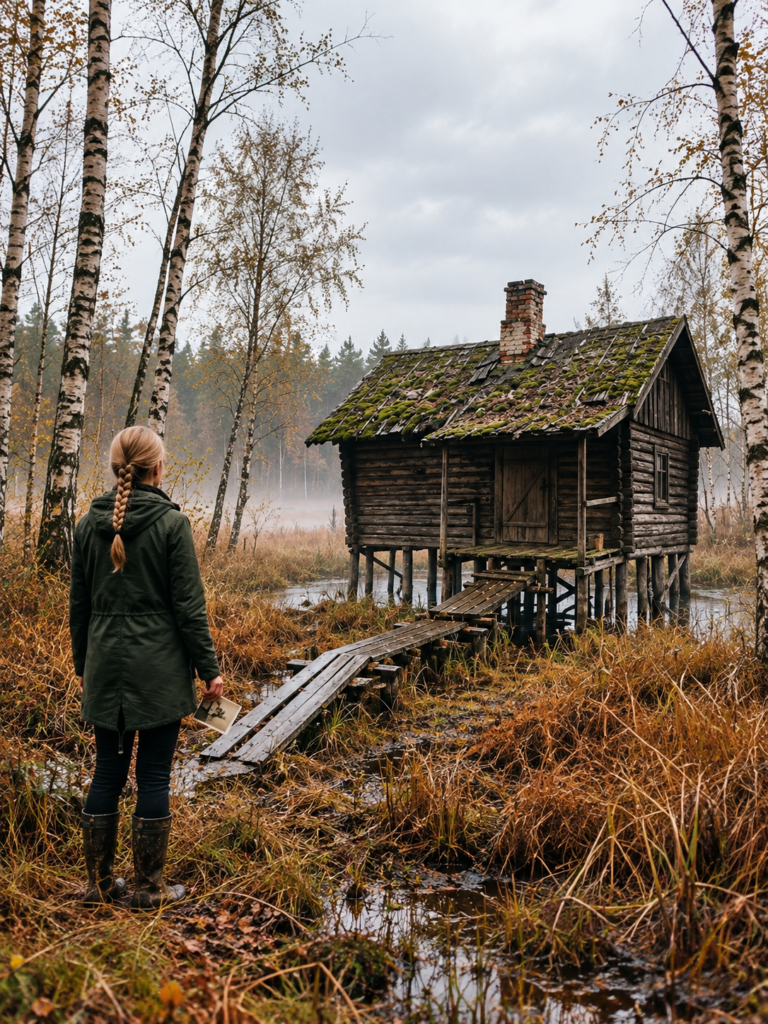
In the picture, a little girl stood beside a narrow wooden walkway that crossed a dark marsh. Behind her, on a small island surrounded by pine trees, stood a weather-beaten cabin.
A wooden owl perched on the roof, one wing raised.
The girl was Ellie’s mother, Claire.
She had been seven years old when the picture was taken.
Ellie knew almost nothing about Claire Bennett. Her mother had died when Ellie was four, and the county caseworker who handled her early placement had been unable to identify any living relatives willing or able to take her.
The photograph and a birth certificate were all she’d received from that part of her life.
But on the back of the picture were four words written in faded blue ink.
Old Causeway, Wisconsin. 1991.
Ellie had looked up the location years earlier.
It was outside a tiny community called Hollow Creek, surrounded by cranberry bogs, pine forests, and miles of wetland in central Wisconsin.
There was almost nothing there.
That had never mattered to her.
What mattered was that her mother had once stood there.
For years, Ellie had imagined visiting the place after she found a good job, bought a reliable car, and built something resembling a normal life.
Now, sitting beside everything she owned, she realized there was no particular reason to wait.
She slipped the photograph into her pocket.
Then she carried her box and mattress into storage, shouldered her backpack, and picked up the kettle.
An hour later, she was on a bus heading north.
By midafternoon, the buildings outside the windows had given way to farms, dark woods, and the occasional gas station with handwritten signs advertising firewood.
At a small transportation stop, Ellie discovered that the connecting bus to Hollow Creek ran only twice a week.
The next one wasn’t until Friday.
It was Wednesday.
She stood under the bus shelter, watching a cold rain begin to fall.
A man in a faded postal-service jacket was loading mailbags into an old pickup truck.
“Excuse me,” Ellie called. “Are you going toward Hollow Creek?”
He turned.
“Depends who’s asking.”
“My name’s Ellie. I’m trying to get there.”
He looked at her backpack, then at the electric kettle hanging awkwardly from one hand.
“You moving?”
“Something like that.”
He studied her another moment.
“I’m Mike Russo. I run the rural mail route. You can ride along if you don’t mind a few stops.”
“How much?”
“Nothing. I’m headed that way anyway.”
Ellie climbed into the passenger seat.
For the next forty minutes, Mike talked about hunting season, cranberry harvests, road construction, and an unusually wet summer that had flooded part of the old causeway.
He asked what brought her to Hollow Creek.
“My mom grew up around here. I think.”
“What’s her name?”
“Claire Bennett.”
Mike frowned.
“Doesn’t ring a bell.”
“She would’ve been a kid in the early nineties.”
“Could’ve been a hundred families living out here back then.”
Ellie nodded.
Then she showed him the photograph.
Mike glanced at it while waiting at a stop sign.
His expression changed.
“Well, I’ll be.”
“You recognize it?”
“That old place out on the marsh.”
“Who lives there?”
He gave a short laugh.
“Nobody, sweetheart. Nobody with any sense.”
Before Ellie could ask what he meant, Mike added, “If you’re looking for information, start with the county office. Denise Harlow knows everybody who ever lived around here.”
He dropped her outside a small brick building across from a diner and the town’s only grocery store.
The county satellite office smelled of old paper, coffee, and lemon-scented cleaner.
Behind the counter sat a woman in her early sixties with silver-framed glasses and a cardigan buttoned all the way to her neck.
A desk plaque identified her as Denise Harlow.
“What can I do for you?”
Ellie explained her situation as simply as she could.
She had just graduated. She had lost her temporary housing. She was looking for somewhere inexpensive to stay, perhaps in exchange for helping an elderly homeowner with cleaning or yard work.
Denise listened without interrupting.
“You don’t have family you can stay with?”
“No, ma’am.”
“Friends?”
“Not anywhere nearby.”
“And you came all the way out here?”
Ellie placed the photograph on the counter.
“My mother was here once.”
Denise put on her glasses.
She studied the image.
For several seconds, she said nothing.
Then she looked at Ellie again.
“You said your mother’s name was Bennett?”
“Claire Bennett.”
“I don’t remember any Bennetts living out on the causeway.”
“Maybe she was visiting someone.”
“Maybe.”
Denise examined the cabin in the background.
“Now, that place I recognize.”
“Is it still there?”
“Unfortunately.”
“Does somebody own it?”
Denise leaned back in her chair.
“Well, that’s a complicated question.”
She explained that the cabin sat on a small parcel of land the county had acquired years earlier after unpaid property taxes and an abandoned estate.
The structure was considered uninhabitable.
There was no functioning electrical service, no reliable water supply, and no safe heating system. The property had failed to attract a buyer at repeated county surplus sales.
Under a special disposal program, the county was offering the parcel for seventy-five dollars, plus recording costs, to someone willing to assume responsibility for cleanup and rehabilitation.
“Seventy-five dollars?” Ellie repeated.
Denise nodded.
“There’s a reason nobody wants it.”
“What reason?”
The woman removed her glasses.
“People around here call it the witch’s cabin.”
Ellie waited.
Denise sighed.
“A woman named Martha Holloway lived there. Years ago, she helped deliver babies and treated people with herbs. Then a little boy died, and folks decided she’d done something terrible.”
“What happened?”
“Depends who you ask.”
“And the house?”
“She died back in the seventies. Nobody’s lived there since.”
Ellie looked down at the photograph.
The little girl in the oversized sweater seemed to be looking straight at that abandoned cabin.
“Can I buy it?”
Denise blinked.
“Excuse me?”
“The property.”
“Sweetheart, you haven’t even seen it.”
“I have nowhere to sleep tonight.”
“That cabin isn’t safe to occupy. Buying it doesn’t mean you can legally move right in.”
“I understand.”
“I’m not sure you do. The access road is half underwater. The roof needs work. There’s no heat.”
Ellie folded the photograph carefully.
“But it has walls?”
“Technically.”
“And a roof?”
“Most of one.”
“Then I’d like the paperwork.”
Denise stared at her for a long moment.
Finally, she opened a filing cabinet.
By the time Ellie left the office, she had signed the necessary forms, paid the purchase and recording charges, and been warned several more times about the property’s condition.
Her available money had fallen to just over two hundred dollars.
But for the first time in her life, she had paperwork showing that a place belonged to her.
The feeling was so unfamiliar she kept checking the envelope to make sure it was real.
Across the street, three men stood outside the grocery store drinking coffee from paper cups.
One of them, a broad-shouldered man around forty wearing a camouflage jacket, noticed the envelope.
“You the girl who bought the Holloway place?”
Ellie stopped.
“Yes.”
The man laughed.
“Did you hear that, boys? Somebody finally bought the witch’s house.”
One of the others shook his head.
“Hope you brought holy water.”
The man in camouflage stepped closer.
“Name’s Gary Caldwell. You know what’s out there?”
“A cabin.”
“A cursed cabin.”
The others laughed.
“Old Martha’s probably still sitting inside, waiting for somebody to come knocking.”
Ellie didn’t answer.
Gary grinned.
“Seventy-five bucks. You could’ve bought yourself a nice motel room instead.”
“For one night,” Ellie said.
His smile weakened.
She walked inside and bought matches, candles, a package of crackers, and two bottles of water.
When she came back outside, a small elderly woman stood near the entrance holding a shopping bag.
The woman glanced at Ellie, then at the photograph protruding from her jacket pocket.
She looked again, more carefully this time.
But she said nothing.
Ellie followed Denise’s directions through the last stretch of town, past shuttered farmhouses and abandoned cranberry equipment.
The paved road ended beside a wooden sign that read:
OLD CAUSEWAY — NO WINTER MAINTENANCE.
Beyond it stretched a narrow raised path across the marsh.
The land was almost unnaturally quiet.
Brown reeds swayed above shallow black water. Small islands of sedge broke the surface. Pine trees stood in uneven clusters beneath a low gray sky.
Ellie walked carefully, testing the loose boards with her feet.
After several hundred yards, the path rose onto a patch of dry ground.
And there it was.
The cabin.
Its logs were blackened with age. Moss covered part of the roof. One window was boarded up, and the other had a broken pane.
Above the front porch, a carved wooden owl rested on the roof ridge.
One wing raised.
Ellie stopped walking.
She took out the photograph.
Same cabin.
Same crooked roofline.
Same boarded window.
Same owl.
Her mother had stood on the opposite bank thirty-three years earlier, looking directly at this place.
Ellie turned toward the narrow path behind her.
For an instant, she could almost imagine a little girl standing there in an oversized sweater.
“Mom,” she whispered.
There was no answer except the wind moving through the reeds.
The front door was swollen and difficult to open.
Ellie pushed with her shoulder until the wood finally gave way.
Inside, the air smelled of dust, old timber, and dried leaves.
A narrow entryway led into a single main room. A wooden table stood beneath the window, and a long bench ran along one wall.
Bundles of dried plants hung from beams overhead.
But what caught Ellie’s attention was the enormous brick stove occupying the left side of the room.
It wasn’t like the freestanding woodstoves she’d seen in hunting cabins.
This one was a heavy, hand-built masonry heater with a cooking chamber and a broad brick surface above it.
And it was sitting on thick wooden beams.
Ellie crouched.
Two oak timbers ran beneath the structure, extending several inches beyond its base.
The floorboards around them had been cut in straight lines.
Behind the stove was a narrow gap.
She reached her hand toward it.
Only cold clay and cobwebs.
Then she noticed the stove’s iron door was slightly crooked.
She pulled it open.
Rust scraped against brick.
Something flaked from the inside of the iron plate.
Letters.
Someone had scratched a message into the metal.
Ellie brushed away the soot and held her phone flashlight closer.
FOR THE ONE WHO ISN’T AFRAID TO LIVE HERE.
LOOK BEHIND THE STOVE.
She read the words three times.
Then she shined her light into the gap again.
Nothing.
No box.
No opening.
Only an old clay-covered wall.
“What exactly am I supposed to find?” she murmured.
Outside, a strange hollow call echoed across the marsh.
Ellie stiffened.
A moment later, she remembered hearing a similar sound in a wildlife documentary.
A bittern.
Just a bird.
Still, she closed the door before darkness.
That night she slept on the wooden bench with her jacket over her shoulders and her backpack beneath her head.
She ate crackers for dinner.
The temperature dropped into the thirties.
Wind rattled the broken window, and something scraped softly across the roof.
She didn’t light the stove. There was no firewood, and she had no idea whether the chimney worked.
Instead, she stared at the photograph of her mother until the phone battery died.
At some point near dawn, she dreamed of a woman standing beside the brick stove, stirring something in a black iron pot.
The woman never turned around.
Ellie woke to three sharp knocks.
She sat upright.
“Hello?”
A man’s voice answered from outside.
“You alive in there, young lady?”
“Yeah!”
“Well, open this door before I freeze to death.”
Standing on the porch was an older man wearing rubber boots and a battered green work coat.
He held a metal bucket in one hand and a thermos in the other.
“Walter Pike,” he announced. “I live on the other side of the marsh.”
Ellie opened the door wider.
“Ellie Bennett.”
“I know. Half the county knows.”
He handed her the thermos.
“Coffee. Cream and sugar. Figured you needed something warm.”
She accepted it with both hands.
Walter stepped inside, looked around, and frowned.
“Lord have mercy. You actually slept here.”
“Yes, sir.”
“Don’t call me sir. Makes me feel like I’m already buried.”
He walked straight to the masonry stove.
“Have you lit this thing?”
“No.”
“Good. Don’t.”
He knelt and pushed a pocketknife into one of the timbers supporting the stove.
The blade sank deep into the rotting wood.
“Supports are shot. Chimney’s cracked too. You light a fire in here, you could fill the cabin with carbon monoxide or set the roof ablaze.”
Ellie looked at the stove.
“Why is it sitting on wooden beams?”
Walter ran one hand across the bricks.
“Because somebody wanted it to move.”
“Move?”
“That’s what my father said when he built it.”
Ellie turned.
“Your father built this?”
“Back in sixty-nine. Martha Holloway insisted on having it set up on oak skids. My dad thought she was crazy.”
“Why?”
“Moving a masonry stove is a miserable job. But she wanted it that way.”
Ellie reached into her backpack.
She showed him the photograph first.
Then she showed him the message scratched inside the stove door.
Walter adjusted his glasses.
He read it slowly.
Afterward, he stood motionless.
“Behind the stove,” he repeated.
Ellie nodded.
“I looked. There’s nothing.”
Walter examined the timbers again.
“Maybe you haven’t looked far enough.”
He glanced at her thin jacket and the unheated room.
“Moving that thing won’t be quick. We need jacks, rollers, new timbers, and a safe way to disconnect the chimney.”
“I can’t afford any of that.”
Walter gave her an irritated look.
“Did I ask you for money?”
“No.”
“Then quit worrying about money for five minutes.”
He studied the old stove once more.
“My father built this thing. I helped mix the mortar. For fifty-five years I’ve wondered why Martha wanted it on skids.”
A small smile appeared beneath his gray mustache.
“Now I might finally find out.”
That afternoon, Walter insisted Ellie move into the heated room above his detached workshop while they worked on the cabin.
Ellie resisted until he pointed out that surviving the winter would be considerably harder if she froze before Thanksgiving.
Over the following days, she cleaned the abandoned property, removed damaged boards, and sorted through decades of dust.
Walter patched the broken window with plastic sheeting and brought over a sleeping bag.
Denise found Ellie an evening custodial job at the little elementary school.
The pay wasn’t much, but it was steady.
One afternoon, while picking up supplies from the grocery store, Ellie met the elderly woman who had stared at her on her first day in town.
Her name was Evelyn Harper.
When Ellie mentioned Martha Holloway, Evelyn’s expression tightened.
“Martha delivered my three children,” she said.
“She was a doctor?”
“No. A trained midwife, mostly. Knew her herbs, too. Helped people who couldn’t afford to travel to the hospital.”
“Then why did everyone call her a witch?”
Evelyn looked away.
“Because a little boy died.”
She told Ellie about eight-year-old Tommy Caldwell, who had fallen desperately ill during the summer of 1968.
His father, Samuel Caldwell, had taken him to Martha.
The boy died three days later.
His mother accused Martha of poisoning him.
In a small town, one terrible accusation had been enough.
“People stopped coming to her house during daylight,” Evelyn said. “Some still went at night when they needed help.”
“Did you?”
Evelyn rubbed her hands together.
“Yes.”
“Did you defend her?”
The old woman looked straight at Ellie.
“No.”
The answer surprised her more than an excuse would have.
“I’m not proud of it,” Evelyn continued. “But that’s the truth.”
Ellie asked whether Martha had any family.
“One daughter. June.”
“What happened to her?”
“Kids tormented that girl after Tommy died. Called her the witch’s daughter. She left at sixteen and never came back.”
“And Martha?”
“Lived alone until she died in seventy-six.”
Ellie looked down at her hands.
Somewhere behind the enormous brick stove was something Martha Holloway had wanted someone to discover.
And Ellie was beginning to suspect that finding it might answer a question much older than the cabin itself.
Part 2
The first hard frost arrived in early November.
By then, Ellie had spent nearly three weeks working between the elementary school and the cabin.
Her hands were rough from scrubbing floors and carrying lumber.
She had learned to identify the loose boards along the causeway, the places where rainwater collected, and the particular creak of the cabin’s front steps.
It still wasn’t a comfortable home.
But every evening, when she crossed the marsh carrying her groceries, she felt something she’d never experienced in foster care.
She was going somewhere that belonged to her.
On Thursday, Walter announced that they would move the stove that weekend.
“We’ve got a cold front coming,” he said. “If we’re going to rebuild this thing before winter, now’s the time.”
He recruited Mike Russo and, to Ellie’s surprise, Gary Caldwell.
Gary arrived wearing the same camouflage jacket he’d worn when he mocked her outside the grocery store.
He stood on the porch, studying the carved owl.
“You couldn’t pay me to sleep here,” he muttered.
“Good,” Walter answered. “I’m not asking you to.”
Gary stepped inside reluctantly.
Walter had already disconnected the upper chimney sections and stacked the old bricks beneath a tarp.
Two hydraulic bottle jacks sat beside the stove.
He explained the plan twice before allowing anyone to touch anything.
The massive heater would have to be lifted carefully, supported on temporary blocks, and rolled outward on short steel pipes beneath its surviving timbers.
Ellie would watch the rollers and keep the work area clear.
Mike and Gary handled the jacks.
Walter directed them.
At first, nothing moved.
The jacks strained beneath the weight.
Old mortar cracked.
Dust drifted down from the stove’s upper edge.
“Easy,” Walter warned. “Nobody rushes.”
They adjusted the supports.
Tried again.
The heater rose a fraction of an inch.
Ellie held her breath.
Walter slid a steel roller beneath one of the runners.
Then another.
“All right,” he said. “Now push.”
The stove groaned.
Nothing happened.
Gary leaned harder against the bar.
Mike grunted.
The enormous brick structure shifted.
Barely.
But it moved.
“Would you look at that!” Mike shouted.
Gary laughed despite himself.
“Come on, you old witch!”
“It’s a stove,” Walter snapped.
“Yeah, yeah. Come on, stove!”
They worked for almost an hour.
Every few inches required another adjustment.
Ellie crawled beside the supports to reposition pipes when Walter signaled that it was safe, emerging with black soot on her hands and knees.
Finally, Walter raised one hand.
“That’s enough.”
The stove now stood far enough from the wall to create a narrow passage.
Ellie picked up her flashlight.
Behind the heater was a section of clay-covered wall.
It appeared ordinary.
Walter stepped into the gap and tapped the surface with his knuckles.
Thud.
Thud.
Thud.
Then a different sound.
Hollow.
He stopped.
“There.”
Ellie squeezed past him.
She knocked on the same spot.
The sound was unmistakable.
Using a small scraper, she carefully removed a layer of brittle clay.
Beneath it lay a wooden panel fitted between two wall logs.
Her pulse quickened.
Walter passed her a narrow pry bar.
“Slowly. Don’t break whatever’s inside.”
Ellie worked around the panel’s edges.
The old wood resisted.
Then it loosened.
She pulled it free.
Behind it was a deep recess.
Inside stood a rectangular metal box wrapped in dark oilcloth and tied with twine.
For several seconds, she could only stare.
Mike leaned into the passage.
“Well, I’ll be damned.”
Gary pushed forward.
“What’s in it? Money?”
Ellie reached inside.
The box was heavier than she expected.
She lifted it carefully and carried it to the old wooden table beneath the window.
The four of them gathered around.
Walter handed her his pocketknife.
Ellie cut the twine.
The oilcloth peeled away, revealing an old blue tea tin decorated with faded flowers.
Its lid was stiff.
She worked her fingers beneath the rim.
When it opened, a faint scent of dried herbs rose from the box.
Inside were four notebooks, a yellowed envelope, several photographs, and a folded document bearing an official seal.
On top lay a letter.
Written across it in careful capital letters were the words:
TO THE PERSON BRAVE ENOUGH TO LIVE HERE.
Ellie opened it.
The handwriting was old-fashioned but remarkably clear.
If you found this, then you moved the stove. That means you came here to live, not simply to search for something valuable.
I had Walter Pike’s father build the stove on wooden runners so that one day someone patient enough to make this house a home could find what I left behind.
Walter took off his cap.
“She planned it.”
Ellie continued reading.
If you are my daughter, June, forgive me for not following when you left.
I stayed because there were mothers and children here who still needed me, even when their families pretended not to know my name.
If you are not June, please find her.
Her name is June Holloway. She was born in 1952.
Ellie stopped.
The name seemed important, though she didn’t yet understand why.
She looked at Walter.
“Evelyn told me Martha had a daughter named June.”
Walter nodded slowly.
“That’s her.”
Ellie returned to the letter.
Everything I learned is in these books. Every baby I delivered. Every illness I treated. Every mistake I made.
Let them know I did not kill that child.
What happened to Tommy Caldwell is written here, too. I have not hidden my own responsibility.
If June has children or grandchildren, these books belong with them. If my family is gone, let them help people who still care about the truth.
Martha Holloway.
October 1975.
Gary had stopped smiling.
“Tommy Caldwell,” he said quietly.
Ellie looked at him.
“Wasn’t he your relative?”
“My grandfather’s son. My dad’s older brother.”
He stared at the black notebook lying beneath the others.
“My grandmother spent her whole life saying that woman killed him.”
Walter pulled out a chair.
“Then perhaps we ought to see what she actually wrote.”
Ellie opened the first brown notebook.
The first page contained Martha’s name, the year 1938, and a series of carefully drawn columns.
Plant names.
Harvesting seasons.
Methods of preparation.
Warnings about poisonous species.
Pressed leaves lay between the pages.
The second and third notebooks contained similar material, along with observations about pregnancies, deliveries, nutrition, and illnesses.
Some of the advice was outdated.
Other entries showed extraordinary attention to detail.
The folded certificate documented Martha’s completion of a rural midwifery training program at a county hospital in 1946.
Walter stared at its signature.
“She had training,” he said.
“She was a midwife,” Ellie replied.
For the first time, Gary looked uncomfortable.
Ellie opened the black notebook.
Inside were hundreds of dated entries covering nearly four decades.
Names.
Births.
Complications.
Injuries.
Treatments.
Outcomes.
Ellie turned several pages.
Then Walter stopped her.
“Wait.”
He pointed to a line dated August 12, 1957.
Walter Pike. Male infant. Difficult delivery. Breathing restored. Mother and child survived.
Walter sat down.
“My mother always said I almost didn’t make it.”
He read the line again.
“She never told me who delivered me.”
Mike leaned over.
“Look for my family.”
Ellie found entries for the Russos, the Harpers, and other families still living in Hollow Creek.
Gary took the notebook next.
He found his father’s name.
Edward Caldwell. Healthy male infant. Delivered 1951. Mother recovered well.
He stared at the page.
“She delivered my dad.”
Nobody answered.
Gary closed the book carefully.
“I need some air.”
He walked outside.
They heard his boots crossing the porch.
Then his truck door slammed.
Walter watched through the window as Gary drove away.
“Let him go,” he said. “That’s a lot to learn about somebody you’ve hated your whole life.”
Later that evening, Ellie carried the books to Walter’s workshop, where they could be kept dry.
They sat at the table beneath a yellow lamp and searched for the summer of 1968.
Ellie found the entry on July nineteenth.
The handwriting was darker than on the surrounding pages.
Thomas Caldwell. Eight years old. Severe pain in right abdomen. Fever. Vomiting.
I told Samuel the boy needed immediate hospital treatment. I suspected appendicitis. He said the truck was needed for the harvest and asked whether I could give him something to settle his stomach.
I told him again that this was beyond what I could treat.
The next entry was dated July twentieth.
Thomas worse. I insisted again that Samuel take him to the hospital. He finally left late in the evening.
July twenty-first.
Thomas died.
He needed surgery sooner. I knew it. I should have called for help myself rather than allowing his father to delay.
Samuel will carry this guilt. So will I.
May God forgive us both.
Ellie lowered the notebook.
Walter stared at the table.
“Appendicitis,” he said.
“Yes.”
“All these years.”
He ran a hand over his face.
“We thought Martha poisoned him.”
“His father delayed getting him to the hospital.”
Walter nodded.
“And Martha blamed herself for not doing more.”
Ellie touched the page.
The woman accused of killing a child had written down her own failure with painful honesty.
She hadn’t tried to make herself look innocent.
She had tried to preserve the truth.
Ellie thought of the people who had mocked Martha’s daughter, the neighbors who stopped speaking to her, and the old woman who continued helping them even after they called her a witch.
She couldn’t understand how a town could forget so much.
Then she looked at the notebook.
Perhaps it hadn’t forgotten.
Perhaps it had simply chosen the easier story.
The next morning, Ellie returned to the tea tin.
At the very bottom was a photograph of a teenage girl with a long dark braid.
On the back, Martha had written:
My June. 1966.
Ellie placed the picture beside the only photograph she owned of her mother.
At first she noticed the dark hair.
Then the eyes.
The straight eyebrows.
The small dimple in the girl’s left cheek.
The resemblance was remarkable.
She carried both photographs to Walter.
“Look at these.”
He adjusted his glasses.
“That’s June Holloway.”
“And that’s my mother.”
Walter glanced from one to the other.
“You’re sure?”
“It’s the picture they gave me when I entered foster care.”
He studied their faces again.
“Good Lord.”
Ellie sat down.
“What if June was my grandmother?”
Walter said nothing for several seconds.
Then he pulled a chair closer.
“Pictures aren’t proof, Ellie.”
“I know.”
“But I can see why you’re asking.”
Ellie stared at her mother’s photograph.
She had spent sixteen years believing she came from nowhere.
Now she was holding a picture of a woman who might be her grandmother.
And the house she had bought almost by accident might have belonged to her family long before she ever found it.
Evelyn Harper recognized June immediately.
When Ellie brought the photographs to her house, the elderly woman placed a hand over her mouth.
“Oh, my goodness.”
She picked up the picture of the braided teenager.
“June.”
Her eyes filled.
“She used to bring me little peppermint candies from the store. She was such a serious child.”
Then Evelyn looked at the picture of Claire.
“I remember this.”
Ellie leaned forward.
“What?”
“A woman brought a little girl out to the causeway one summer. Early nineties, I think.”
“Did you speak to her?”
“No. I saw them from across the road.”
“Was the woman June?”
Evelyn slowly nodded.
“I believe it was.”
Ellie’s fingers tightened around the photographs.
“Did they go to the cabin?”
“No.”
“Why not?”
Evelyn looked toward the window.
“They stood at the beginning of the walkway for a long time. Then the woman took the little girl’s picture.”
“And left?”
“Yes.”
Ellie tried to imagine the scene.
June returning to the place where she’d been humiliated as a teenager.
Bringing her own young daughter.
Standing close enough to see the cabin but unable to cross the last few hundred yards.
Ellie understood something then.
Her mother hadn’t been looking at a strange abandoned house.
She had been looking at a family home.
Denise helped Ellie request the necessary vital records.
They sent copies of Ellie’s birth certificate, Claire’s death certificate, and the identifying information from the old photographs to the appropriate county and state records offices.
The wait felt endless.
Ellie continued cleaning classrooms in the evenings.
During the day, she helped Walter replace rotten floorboards and clear debris from the cabin.
Every night she thought about the sealed envelope at the bottom of the tea tin.
One word was written across its front.
June.
Ellie refused to open it.
Not yet.
It had been written for somebody else.
If June really was her grandmother, Ellie wanted to know that before reading the words Martha had meant for her daughter.
The records arrived nine days later.
Denise called Ellie at the school.
“Come over when you finish,” she said. “We have something.”
Ellie ran across the street still wearing her custodial work shirt.
Denise laid two certified copies on the counter.
The first was Claire Bennett’s birth record.
Born in 1984.
Father: Robert Bennett.
Mother: June Bennett, formerly June Holloway.
Ellie read it.
Then she read it again.
Denise touched the second document.
June Bennett’s death record.
1999.
She had died five years before Ellie was born.
Ellie sank into a chair.
The dates arranged themselves inside her mind.
Martha had died in 1976.
June had never returned.
Claire had been born eight years later, then lost her mother at fifteen.
Claire herself had died at twenty-four.
And Ellie had entered foster care at four.
Four generations of women, connected by one abandoned cabin and separated by one loss after another.
For a long time, Ellie couldn’t speak.
Denise sat beside her.
“Well,” she said gently, “you know where you come from now.”
Ellie shook her head.
“I thought I didn’t have anybody.”
Denise didn’t try to answer that.
She simply stayed with her.
That evening, Ellie crossed the causeway carrying the tea tin beneath her jacket.
She entered the cold cabin, lit a candle, and sat at the table.
Then she opened June’s letter.
It was only one page.
M y dear June,
I had the stove built this way because I wanted there to be something here for you, even if you never wished to live under this roof again.
If you come back, these books are yours.
If you don’t want to stay, take them and go freely.
But if you do wish to stay, this place can still be home.
The marsh is beautiful in spring. The birds come back. The cranberries turn red in autumn. I wish you could remember those things instead of the way people treated you.
Don’t spend your life carrying their fear.
Home isn’t only a building.
Home is where somebody is waiting for you.
I’m waiting, June.
Love, Mama.
Ellie read the letter once.
Then again.
She rested her forehead against her hands.
Martha had written those words nearly fifty years before Ellie was born.
June had never read them.
Neither had Claire.
For half a century, the letter had remained behind a brick stove, waiting for a daughter who would never come home.
Ellie looked around the dark cabin.
At the uneven floorboards.
The cracked window.
The bundles of herbs hanging overhead.
The enormous stove sitting away from the wall.
Then she whispered, “I came.”
The candle flickered.
“I know I’m not June.”
Her voice broke.
“But I came.”
Part 3
The next morning, Ellie asked Walter to take her to the cemetery.
He didn’t ask why.
He simply put a shovel, a small brush, and a clean rag into his truck.
The cemetery sat on a sandy rise beneath tall pine trees.
Most of the graves near the entrance had polished granite markers and fresh flowers.
Martha Holloway’s grave lay near the back fence.
Its wooden marker leaned sideways.
The painted name had nearly disappeared.
Ellie stood looking at it.
“She helped deliver half the people in town,” Walter said quietly. “And this is what she got.”
He knelt and began clearing leaves from the base.
Ellie brushed away dirt from the weathered wood.
They worked without speaking.
Walter straightened the marker and packed fresh soil around it.
When they finished, Ellie took out the two photographs.
She placed June’s picture against the grave.
Then Claire’s.
“Your daughter had a daughter,” she whispered.
“And she had me.”
Walter turned away.
Ellie knelt beside the marker.
“I’m sorry nobody came back.”
A gust of wind moved through the pines.
After a while, Walter touched her shoulder.
“Come on. It’s getting cold.”
As they walked toward the truck, he said, “You know, once your job starts in January, you won’t need that cabin anymore.”
Ellie looked at him.
“I know.”
“You could rent something better. Somewhere warm.”
“I know.”
He stopped walking.
“But you aren’t going to leave, are you?”
Ellie turned toward the marsh beyond the trees.
“No.”
Walter gave a slow nod.
“Didn’t think so.”
News of the notebooks spread quickly.
Mike mentioned them at the grocery store.
Evelyn told several neighbors about June’s photograph.
Denise confirmed that Ellie was Martha Holloway’s great-granddaughter.
Within a week, nearly everyone in Hollow Creek knew.
Unfortunately, the story changed as it traveled.
Someone claimed Ellie had found a trunk of antique coins.
Someone else insisted there were gold bars hidden beneath the floor.
At the grocery store, Gary overheard a man announce that the county had accidentally sold a fortune for seventy-five dollars.
Gary shook his head.
“It’s mostly notebooks.”
The man looked disappointed.
“Then why’s everybody talking about it?”
Gary glanced toward the road leading to the marsh.
“Because maybe we were wrong about something.”
He didn’t explain further.
That Wednesday evening, an older woman appeared outside Ellie’s cabin.
She had silver hair, a straight-backed posture, and the sharp expression of someone accustomed to being listened to.
“My name is Valerie Caldwell,” she announced.
Ellie recognized the surname.
“Gary’s aunt?”
“Yes.”
Valerie looked past her into the room.
“Tommy Caldwell was my younger brother.”
Ellie stepped aside.
“Would you like to come in?”
“No.”
Valerie remained on the porch.
“I haven’t stepped inside this place in more than fifty years.”
She clasped her hands tightly.
“Gary says you found something about Tommy.”
“Yes.”
“He says that woman wrote that my father waited too long to take him to the hospital.”
Ellie nodded.
Valerie’s face hardened.
“My mother said Martha poisoned him.”
“I know.”
“My brother was eight.”
Ellie didn’t interrupt.
“He was a sweet boy,” Valerie continued. “He liked fishing and baseball. He used to sleep with his glove beside his pillow.”
Her voice wavered.
“Don’t come here telling me my family made up what happened.”
“I won’t.”
Valerie looked surprised.
Ellie took a breath.
“I have Martha’s notebook. It contains what she wrote during Tommy’s illness. I can show it to you.”
“Right now?”
“Somewhere private. At your house, if that’s all right.”
Valerie studied her for a long moment.
Finally, she nodded.
“Sunday afternoon.”
Then she turned and walked back down the causeway.
Ellie watched until she disappeared beyond the reeds.
She was still standing on the porch when a dark SUV arrived at the beginning of the path the next afternoon.
A man in a tailored coat climbed out carrying a leather portfolio.
He introduced himself as Charles Sloane, a private collector specializing in historical medical manuscripts and early American folk medicine.
He had heard about Martha’s journals.
Would Ellie be willing to let him examine them?
She was cautious, but she showed him one of the notebooks while keeping it in her hands.
Sloane turned the pages with practiced care.
His interest grew.
“Original handwritten records from the thirties onward,” he murmured. “Pressed specimens. Medical observations. Very unusual.”
He looked up.
“Do you have the complete set?”
“Yes.”
“I’d be interested in acquiring them.”
“They’re not for sale.”
“Everyone says that at first.”
He opened his portfolio and wrote a number on a sheet of paper.
Then he turned it toward her.
Thirty-five thousand dollars.
Ellie stared.
The number was larger than any amount she’d ever had in her bank account.
Thirty-five thousand dollars could buy a used car, pay for training, and cover years of living expenses if she was careful.
It could repair the cabin properly.
It could give her something she’d never had.
Financial breathing room.
Sloane watched her reaction.
“You’re a young woman with an entire life ahead of you,” he said. “These books belong in a controlled environment. I can make sure they’re preserved.”
Ellie looked down at the notebook.
She imagined it sitting in a private collector’s cabinet where nobody from Hollow Creek would ever see it again.
Martha had written hundreds of names.
Hundreds of people.
They weren’t merely objects to be sold.
They were a record of lives.
“No,” Ellie said.
Sloane raised his eyebrows.
“Perhaps you’d like to think about it.”
“I already have.”
“Thirty-five thousand dollars is a serious offer.”
“I know.”
“You’re living in a cabin without electricity.”
“I know that too.”
“Then help me understand.”
Ellie closed the notebook.
“These pages belonged to my great-grandmother. She wanted her family to have them, and she wanted people to know the truth about her work.”
Sloane waited.
“If I sell them to you, who gets to read them?”
He didn’t answer immediately.
“Private collectors do sometimes make materials available to researchers.”
“Sometimes.”
“Yes.”
Ellie shook her head.
“I’m not selling.”
Sloane regarded her for a moment.
Then he put away his pen.
“If you change your mind, my card is there.”
After he left, Ellie placed the card beneath her old electric kettle.
The next morning, Principal Webb called a historian at the regional historical society.
A few days later, Dr. Karen Mitchell arrived at Walter’s workshop carrying a camera, archival sleeves, and a portable scanner.
She spent nearly an entire afternoon examining the books.
“These are extraordinary,” she said.
Ellie watched anxiously.
“Are they real?”
Karen smiled.
“The paper, binding, ink, and certificate are all consistent with the periods indicated. And these don’t read like something written all at once. They’re working records, built up over decades.”
She pointed to several entries.
“Some of the medical information would be obsolete today, of course. But as a historical record of rural health care, this is remarkable.”
“Mr. Sloane offered me thirty-five thousand dollars.”
Karen’s smile vanished.
“I’m familiar with him.”
“Is that what they’re worth?”
“They might interest collectors at that price. But their historical significance isn’t something I can reduce to a number.”
Ellie looked at the notebook.
“Can they stay here?”
“Certainly. They’re yours to care for, though you should protect them from moisture and temperature changes.”
Karen paused.
“We could create digital copies and arrange preservation advice. That way the originals can remain with your family, and the historical information won’t be lost if something happens to the cabin.”
Ellie thought of Evelyn, Walter, Mike, and all the people whose names appeared in the books.
“Could families get copies of their own pages?”
“Where appropriate, yes. We’d want to handle the medical information respectfully and avoid sharing anyone’s private details publicly.”
Ellie nodded.
“That’s what I want.”
Karen studied her.
“You’re thinking about the town?”
“I’m thinking about the people Martha helped.”
A week later, Ellie visited Valerie Caldwell.
Valerie lived in a redbrick house near the center of Hollow Creek.
Inside, the kitchen smelled of coffee and apple pie.
A framed photograph hung above the table.
It showed a laughing boy with sandy hair and slightly crooked front teeth.
“Tommy,” Valerie said.
Ellie set the black notebook on the table.
She opened it to July 1968.
Valerie adjusted her reading glasses.
She read the first entry.
Then the second.
Finally the third.
Her hands began to tremble.
“She told him to go to the hospital,” Valerie whispered.
Ellie said nothing.
Valerie read the words again.
Then she stared at the photograph on the wall.
“My father told me something before he died.”
Her voice had become very quiet.
“He was sick. Sometimes he didn’t know where he was.”
She swallowed.
“One night he grabbed my hand and said, ‘I should’ve taken Tommy sooner.’”
She looked at Ellie.
“I thought he was confused.”
Ellie waited.
“I remember the truck leaving,” Valerie continued. “I remember standing on the porch with my mother. We were all crying.”
She touched the page.
“All these years, I thought Martha did something to him.”
“She tried to get him help.”
Valerie nodded.
“And my father waited.”
Her eyes filled.
“He carried that all his life.”
Ellie pointed to the final lines.
“Martha carried it too.”
Valerie read them again.
Then she began to cry.
Not loudly.
She sat with her hands folded over the notebook, tears sliding down her cheeks.
After a long time, she said, “I called June a witch’s daughter.”
Ellie looked up.
“At school,” Valerie continued. “I used to shout it when she walked by.”
She pressed her fingers against her mouth.
“I was ten. She was sixteen.”
Ellie listened.
“I threw snowballs at her one winter. Other kids did too.”
Valerie shook her head.
“And then I grew up. I became a teacher. Spent forty years telling children not to bully people.”
She closed her eyes.
“I never thought about what I’d done.”
Ellie sat beside her.
“You were a child.”
“Yes.”
Valerie wiped her cheeks.
“But I wasn’t a child forever.”
Neither spoke for a while.
Eventually, Valerie stood and made fresh coffee.
When Ellie prepared to leave, Valerie touched the notebook.
“Would it be possible to have a copy of Tommy’s page?”
“Of course.”
“And perhaps one more thing?”
“What?”
Valerie hesitated.
“Would you tell me about Martha? The things you’ve learned?”
Ellie stayed another hour.
By the time she left, snow had begun falling across the yard.
Valerie walked her to the porch.
“Ellie?”
“Yes?”
“I’m sorry about June.”
Ellie looked at her.
“Thank you.”
It wasn’t enough to undo what had happened fifty years earlier.
But it was the first apology anyone in Martha’s family had ever received.
Over the next several weeks, Karen helped Ellie create carefully organized copies of the historical records for family members.
Ellie visited households throughout Hollow Creek.
Some people accepted their pages quietly.
Others invited her inside and told stories about parents, grandparents, and babies who had survived difficult births.
Evelyn Harper received copies of the entries describing the births of her three children.
She sat at her kitchen table reading the names.
Then she covered her face.
“Martha,” she whispered. “You helped bring all three of them into this world.”
Ellie rested a hand on her shoulder.
Evelyn looked up.
“And I wouldn’t even speak to her in the grocery store.”
In another house, a woman named Susan Miller read an entry describing her mother’s difficult labor.
“My mom said a midwife saved me,” Susan told Ellie.
“She never told me who.”
Her husband appeared in the doorway carrying a sack of potatoes.
Susan looked at him.
“We ought to take these out to that girl.”
And slowly, things began to change.
At first, somebody left firewood on Ellie’s porch.
Then a bag of groceries appeared beside the door.
The Harpers brought an extra quilt.
Mike delivered a used propane heater for Walter’s workshop room, making sure it was properly vented and safe.
A local contractor donated insulation left over from a renovation.
One Saturday morning, Gary Caldwell arrived carrying two replacement windowpanes.
Ellie was sweeping the porch.
He stopped beside her.
“Your windows are still covered with plastic.”
“I know.”
“That won’t make it through January.”
“Probably not.”
He lifted the glass.
“I can put these in.”
Ellie looked at him.
“I can’t pay you.”
Gary frowned.
“Who said anything about paying?”
She moved aside.
He spent the morning repairing the window frames, sealing gaps, and fitting the glass.
Ellie handed him tools and helped hold the frames steady.
When he finished, they stood outside looking at the cabin.
Gary rubbed his hands together.
“That ought to keep the wind out.”
“Thank you.”
He nodded.
Then he looked at her, clearly uncomfortable.
“Listen. About what I said at the grocery store.”
Ellie waited.
“I was acting like an idiot.”
She didn’t disagree.
Gary exhaled.
“My whole life, I heard Martha Holloway was some dangerous old woman.”
He glanced toward the stove inside.
“Turns out she delivered my dad. And my grandfather’s family treated her like dirt.”
He shook his head.
“I can’t fix what happened back then.”
“No,” Ellie said.
“But I can fix a window.”
Ellie smiled.
“That’s a start.”
Gary smiled back.
Before leaving, he pointed to the owl on the roof.
“I can repaint that thing in spring.”
“You don’t have to.”
“I know.”
He climbed into his truck.
“See you around, Ellie.”
Walter spent another week rebuilding the stove’s supports.
He used seasoned oak from his shed, replacing the rotten original skids and stabilizing the heavy masonry heater.
Mike and Gary returned after work to help position it.
They carefully moved the stove back toward its original place, leaving enough clearance for access to the hidden wall compartment.
Walter rebuilt the chimney using sound bricks salvaged from the old structure and additional materials supplied by a local mason.
A qualified chimney professional inspected the completed system before they used it.
Ellie helped mix mortar and clean bricks.
One afternoon, Walter watched her working beside him.
He gave a small laugh.
“What?”
“Nothing.”
“Walter.”
He wiped his forehead.
“Just thinking about my father.”
Ellie stopped.
“When he built this stove, I was the kid mixing mortar and handing him bricks.”
He looked down at the tools.
“Now I’m doing his job, and you’re doing mine.”
Ellie smiled.
“Maybe Martha knew we’d end up here.”
Walter shook his head.
“Don’t start talking like Gary.”
But he was smiling too.
By early December, the cabin was finally ready for its first proper fire in decades.
Walter came that evening with Mike.
Evelyn arrived carrying cornbread wrapped in foil.
Denise brought a casserole.
Gary carried a box of kindling and a bag of dry firewood.
Valerie Caldwell didn’t come.
But she sent a jar of homemade apple butter and a note.
For your first warm evening.
Please tell us if you need anything.
Ellie placed the food on the table.
The repaired window was clear.
The new door seal kept out the wind.
The room smelled of fresh mortar, pinewood, and something baking in Denise’s casserole dish.
Walter nodded toward the stove.
“Go ahead.”
Ellie knelt in front of it.
She arranged kindling beneath several small logs.
Then she struck a match.
The flame caught.
A thin ribbon of smoke rose through the newly repaired flue.
Everyone watched.
Walter checked the draft.
After a moment, he nodded.
“She’s drawing just fine.”
The fire grew steadily.
Warmth began spreading through the masonry.
For a few minutes, nobody said anything.
Then Evelyn crossed the room and placed both palms against the warming brick, keeping a safe distance from the hot opening.
“Fifty years,” she murmured.
Ellie looked at her.
“Fifty years since this stove was warm.”
The old woman glanced around the cabin.
“I used to come here at night when my children were sick.”
Her voice softened.
“I never came through the front door in daylight. I was too ashamed of what the neighbors would say.”
She touched the edge of the brick.
“Well, Martha. Here I am.”
Walter looked away.
Evelyn smiled through her tears.
“Walked right through your front door in broad daylight.”
That evening, they ate together around the old wooden table.
Mike told stories about strange things he’d seen on his mail route.
Denise complained about county paperwork.
Gary promised to repair the loose steps before spring.
Walter argued that nobody should touch the porch until the snow melted.
And for the first time Ellie could remember, she listened to people discussing repairs to her home as though it were perfectly natural that she would still be there next year.
She wasn’t somebody’s temporary guest.
She wasn’t a case number.
She wasn’t waiting for someone to tell her when she had to leave.
She belonged at the table.
Later, after everyone went home, Ellie sat beside the stove with Martha’s notebooks stacked on the table.
The historical society had supplied archival materials and a small protective storage container for the most fragile documents. Ellie kept the originals safely inside the cabin, away from heat and moisture.
She returned the old blue tea tin to the recessed compartment behind the stove.
It held copies of the letters and photographs, along with a note of her own.
I found them.
I know who we are now.
On the shelf above the table, she arranged three things.
The photograph of Claire beside the marsh.
The photograph of June with her long braid.
And Martha’s midwifery certificate.
Three women she had never truly known.
Yet their lives had somehow led her to this room.
She stood looking at them for a long time.
Outside, snow drifted gently across the causeway.
The carved owl creaked in the wind.
In January, Ellie enrolled in a nursing assistant program at a nearby technical college, planning to continue toward nursing while working part-time at the elementary school.
When she told Walter, he grinned.
“Following Martha’s footsteps?”
Ellie shook her head.
“Not exactly.”
“How do you figure?”
“Martha knew when a patient needed a hospital. That’s part of what she tried to teach people.”
Walter nodded.
“And nobody listened.”
“I want to be somebody who listens.”
Walter studied her for a moment.
Then he gave a quiet smile.
“Your great-grandmother would’ve liked that.”
One evening, Ellie sat at the table reviewing her course materials.
Her old electric kettle stood nearby, its faded orange cat sticker still smiling from the side.
She had carried that kettle through foster homes, temporary bedrooms, college dormitories, and one frightening night in an abandoned cabin.
It had survived every move.
Now it finally had a permanent place.
Beside it lay the business card Charles Sloane had left.
Ellie picked it up.
Thirty-five thousand dollars.
For a moment, she remembered how desperately she’d needed money when she first arrived in Hollow Creek.
Then she glanced at the photographs above the table.
She walked to the stove and dropped the card into the fire.
It curled and disappeared among the embers.
She returned to the table and opened one of Martha’s notebooks.
Between two pages lay a dried leaf, carefully pressed decades earlier.
Beside it, in Martha’s handwriting, was a note about the importance of knowing when a home remedy was not enough.
Ellie smiled faintly.
The old woman had understood something the town hadn’t been willing to hear.
Helping people didn’t mean pretending you could save everyone.
Sometimes it meant telling the truth, even when the truth was painful.
Sometimes it meant admitting what you couldn’t do.
And sometimes it meant leaving behind enough evidence that someone, someday, might understand.
Ellie closed the notebook.
The stove gave a low, steady crackle.
She walked to the window.
Across the marsh, the causeway was almost invisible beneath the snow.
Somewhere out there, thirty-three years earlier, her mother had stood as a little girl while June took her photograph.
June had come back to the edge of her childhood.
But she hadn’t crossed.
Perhaps she’d been afraid.
Perhaps she’d been too hurt.
Perhaps she’d simply believed there was nothing waiting for her on the other side.
Ellie would never know for certain.
She thought of Claire, who had died before Ellie was old enough to ask the questions that mattered.
And Martha, who had spent her final years waiting for a daughter who never returned.
None of them had received the ending they deserved.
But Ellie had found something they had all been searching for.
A place where the past could finally be spoken about without shame.
A home that didn’t require her to pretend she came from nowhere.
And a town that was beginning, however imperfectly, to make room for the truth.
She took her mother’s photograph from the shelf.
In it, seven-year-old Claire stood on the far bank, looking toward the old cabin.
Ellie ran one finger along the worn edge.
“I wish you could see it now, Mom.”
The fire snapped softly behind her.
“The roof still needs work. Gary says he’ll fix the owl in spring. Walter keeps telling me I’m using too much firewood.”
She gave a small laugh.
“And Mrs. Harper brings enough food for six people every time she visits.”
Her smile slowly faded.
“I found your mom.”
She looked at June’s photograph.
“And your grandmother.”
Outside, snow continued falling over the marsh.
Ellie placed Claire’s photograph between the others.
Then she turned toward the warm room that was finally hers.
“We’re home, Mom,” she whispered.
“All of us.”
The old stove burned steadily through the night.
And beyond the window, the abandoned cabin that an entire town had feared for fifty years stood quietly among the pines, its windows glowing against the falling snow.

