Part 1
The cold reached Cedar Ridge long before the morning light.
It had settled over the little mountain town during the night, filling the hollows between buildings, tightening around fence posts, and burying the wagon tracks beneath a fresh layer of snow. By the time the eastern sky began showing the faintest suggestion of gray, the roads beyond the ridge had nearly disappeared.
Behind the fuel shed, a man worked in the darkness.
He lifted another rectangular brown block from a wooden crate, brushed a little loose dust from its edge, and fitted it against the others on a heavy delivery sled. His fingers ached inside his gloves. The leather had stiffened overnight, and the cold seemed to have found its way through every seam.
He paid it no attention.
There was a right way to pack a load, especially one that had to cross deep snow. Every block needed to sit squarely against the next. Every bundle needed room for its binding. A poorly balanced sled could cost a horse its footing, and a shifting load could spill into a drift where no man had the strength to recover it.
He had spent most of his life learning such things.
Beside him, Nelly stood with a pencil tucked behind one ear and a length of coarse twine in her hands.
“Forty,” she murmured.
She placed another block in the crate.
“Forty-one.”
Her voice was nearly lost beneath the wind.
She was not counting for the satisfaction of watching the number rise. Each block represented hours of work, carefully measured materials, and the possibility that another family might make it through the night without their stove going cold.
The Hollis place lay beyond the ridge, where the wind swept across the open ground without anything substantial to stop it. Two more cabins stood farther along the same road. Beyond those, scattered ranch families had been trying to survive on firewood that was either buried beneath the snow or too wet to burn properly.
A storm had closed most of the approaches during the night.
No fresh wood was coming in.
And the temperature was still falling.
Nelly tightened the twine around the last bundle until the fibers bit into her gloves.
“That ought to get the Hollises through,” she said.
The man glanced at the sled, measuring its load against the distance and the weather.
“For longer than a day or two, if they keep the north wind out of that shed.”
She nodded.
Neither said anything else for a moment.
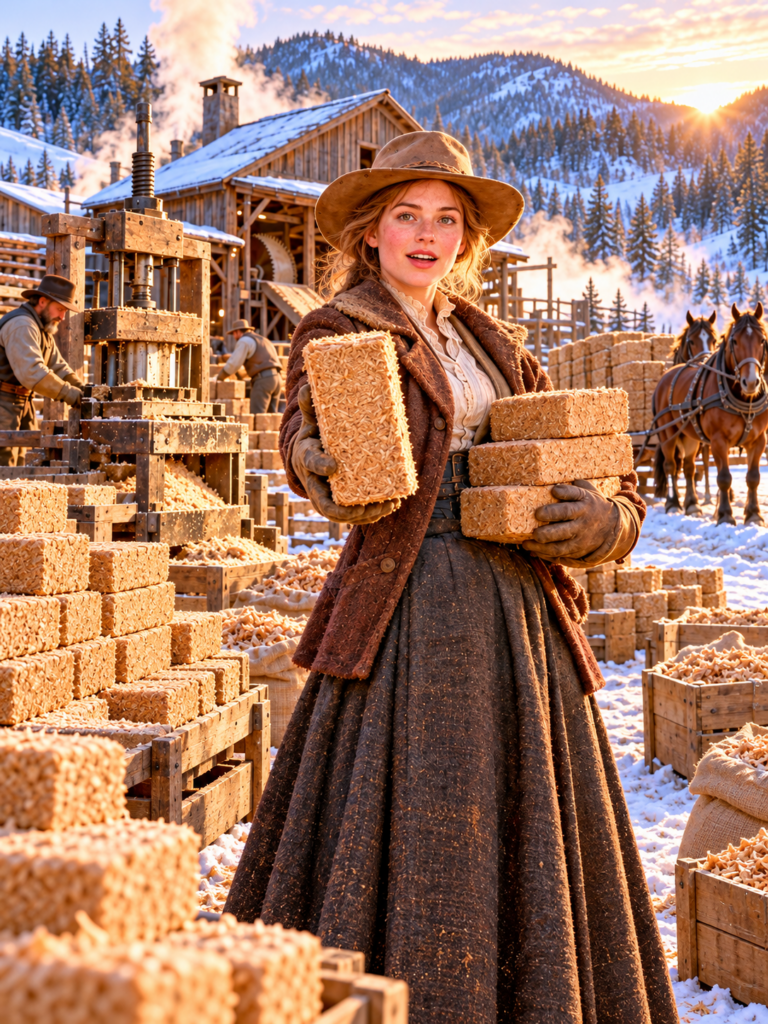
The shed behind them smelled of sawdust, drying wood, and the faint sourness of flour paste. Under its reinforced roof stood row upon row of compact fuel bricks, each carrying a small W impressed into one face.
Only a few months earlier, most people in Cedar Ridge would have laughed at the idea of heating their homes with something made from sawmill waste.
Now those same brown blocks were among the most valuable things in town.
The man pulled the canvas over the loaded crates and reached beneath the sled to check the bindings around the runners. His hands knew exactly where to go, even in the dark.
There had been a time when he would not have imagined himself standing here.
Not with a team of horses waiting patiently at his shoulder.
Not with useful work ahead of him.
And certainly not with a woman like Nelly trusting him to help carry what might be the only reliable fuel some of her neighbors would see that week.
As he tightened the last rope, his thoughts traveled backward to another cold morning.
One in which he had possessed neither a job nor a place where he was welcome.
He remembered the railroad platform at Cedar Ridge and the folded letter inside his coat.
He had arrived in early October, stepping down from the train with little more than the clothes he wore and the knowledge that his old life had ended badly.
The letter had followed him all the way west.
He had read it often enough to remember every accusation without unfolding the paper. It concerned property that had gone missing at his previous railroad post. Silver. Something valuable enough for people to whisper about and ordinary enough that they believed a man with access to it might have been tempted.
He had been accused of stealing it.
He had not.
But the accusation had remained long after the questions stopped.
There had been no proof establishing his guilt. There had been no proof offered that persuaded the people in authority of his innocence, either. In the end, the uncertainty had been enough to take his position away.
A man could lose a livelihood without ever standing before a judge.
He had discovered that much.
The trouble did not end when he left.
A railroad office might be hundreds of miles away, but a story traveled easily between towns where men gathered around station platforms, freight yards, and boardinghouse tables.
Once a stranger acquired the reputation of a thief, every closed door became one more consequence of something he had never done.
At Cedar Ridge, he had stood beside the platform while passengers collected their belongings and walked away into lives that still seemed to have room for them.
He watched a freight wagon rattle down the street.
Then he looked at the letter once more.
He had no wages coming.
No employer waiting.
No person in town who had reason to believe him.
He folded the paper carefully and put it away.
By the time evening came, he had walked far enough beyond the town that the buildings stood behind him like dark shapes against the fading sky.
The cold arrived suddenly.
He had known October nights could turn bitter in that country, but knowing it and having nowhere to sleep were two different things.
Wind slipped beneath his collar. The road hardened under his boots. Somewhere in the distance, a horse made a low, restless sound.
That was how he found the barn.
It stood at the edge of a working ranch, its broad roof rising above a yard crowded with fencing, feed bins, and equipment. A little light showed from the direction of the house, but the barn itself was dark.
He knew better than to enter another person’s property without permission.
He entered anyway.
There was hay inside, and the air smelled of dry grass, leather, and the warm bodies of horses. The building offered the simple mercy of four walls that kept the wind from reaching him.
He climbed into an unused corner of the hay and drew his coat around himself.
He intended to leave before daylight.
He had almost managed to sleep when the barn door opened.
A lantern appeared first.
Then a woman stepped through the doorway.
She wore a work coat and heavy boots, and she carried herself with the manner of someone accustomed to being obeyed by animals, hired men, and stubborn pieces of machinery.
The lantern light moved across the stalls and stopped on him.
He sat upright immediately.
“Ma’am, I’m sorry. I wasn’t fixing to cause trouble.”
She studied him.
For a moment, he expected her to shout for the men or reach for a weapon.
Instead, she said, “That’s my hay you’re sleeping in.”
He scrambled to his feet.
“I know. I’ll be on my way. Just needed somewhere out of the wind.”
“I didn’t tell you to leave.”
He stopped.
The woman raised the lantern slightly, looking him over with a practical expression.
“Question is whether you’re planning to spend all night sleeping on it or whether you know how to earn your supper.”
He did not know what answer she wanted.
“I can work.”
“What kind?”
“Carpentry, mostly. Barn frames, wagon repairs, fences. Whatever needs fixing.”
Her eyes shifted toward a stack of lumber resting against the far wall.
“I’ve got crates need building.”
He followed her gaze.
Beside the lumber stood a peculiar wooden contraption and, beyond it, several shelves holding rows of brown rectangular blocks.
They looked a little like badly made bricks.
Only they were not clay.
Their surfaces were fibrous, and their edges had crumbled into loose piles of dust.
He had never seen anything quite like them.
“What are those?”
“Fuel,” she answered.
He looked again.
She appeared to notice his uncertainty but made no attempt to explain herself.
“Those crates are for carrying them. Build what I need, and there’s supper at the house. Loft’s got a blanket you can use.”
It was an arrangement offered so plainly that he almost failed to recognize it as kindness.
“You don’t even know my name.”
“I know whether somebody can swing a hammer after I’ve seen his work.”
She turned toward the door.
“And I didn’t offer you supper for standing around.”
The lantern disappeared into the yard.
For a while, he remained where she had left him.
Then he took off his coat, rolled up his sleeves, and went to examine the lumber.
He picked out the straightest pieces first.
But before he had cut the first board, the strange wooden machine drew his attention.
He walked around it slowly.
It was a press, or at least an attempt at one.
The frame had been assembled from green timber and bound in places with rawhide. A screw salvaged from an old wagon jack passed through its center and descended toward a roughly shaped mold.
The idea was clever.
The construction was not.
He bent to examine the joints.
The frame had already begun to shift under pressure. The housing around the screw was too loose, allowing the shaft to wander as it turned. The mold sat slightly crooked.
It was no wonder the blocks on the nearby shelves had broken corners.
Whoever had built the press understood what it was supposed to accomplish but had not known how to make it bear the strain.
He stood there considering it.
He could build the crates in the morning.
The press might not survive another dozen uses.
He found a few scraps of leather, sorted through a collection of spare iron, and set to work.
It was not his machine.
He had not been asked to repair it.
But something about watching a useful idea fail because of a few bad joints troubled him more than the possibility of being scolded for interfering.
He loosened the screw housing, packed the space around it with leather, and fitted it again until the shaft turned without wandering.
Then he squared the mold.
A broken harness hook provided enough salvageable iron to reinforce the corners of the frame.
He worked by lantern light, stopping occasionally to test the structure with his weight.
When he finally loaded the mold with the prepared sawdust mixture and turned the screw, the wooden frame creaked but held.
The pressure came down evenly.
He raised the screw and removed the block.
Its edges were clean.
He pressed another.
Then another.
By the time Nelly returned, carrying a plate of cornbread and salt pork, four finished blocks rested beside the earlier failures.
She stopped just inside the doorway.
He straightened, suddenly aware that he had spent the evening doing something other than what she had ordered.
“I was going to start those crates,” he said.
Her attention remained on the shelf.
She put the plate down, lifted one of the new blocks, and turned it slowly in her hands.
She pressed her thumb against an edge.
Nothing flaked away.
She looked at the older blocks, then at the new ones.
“How’d you manage that?”
“Your screw was running crooked. Frame was giving way every time you tightened it.”
“I know it was giving way.”
“The pressure wasn’t reaching the mold evenly. I squared the housing and braced the corners.”
She picked up another block.
It felt noticeably heavier than the ones she had been making.
“You think it’ll hold?”
“Long as the wood stays sound. Eventually you’ll want a stronger frame.”
Nelly said nothing.
She returned the block to the shelf, walked around the press, and inspected the work for herself.
Then she came back to the doorway.
“Crates tomorrow,” she said. “Tonight, show me every change you made.”
For the first time in weeks, the man felt something shift inside him.
He had not been asked where he came from.
He had not been asked to defend himself.
Someone had looked at his work and decided it was worth understanding.
He pulled a stool beside the machine and began explaining leverage, alignment, and compression while Nelly listened closely enough to make him repeat anything she did not fully understand.
The cornbread grew cold on the plate.
Neither noticed.
By the next morning, the arrangement between them had already begun changing.
He built the crates as promised, but Nelly kept returning to the press to test what he had shown her. The improved blocks held their shape better, stacked more securely, and could be moved without leaving half their substance scattered across the floor.
She told him more about what she was trying to do.
The sawmill outside Cedar Ridge produced mountains of shavings, fine dust, and scraps that had little value once the usable lumber was taken away.
Most people considered the material a nuisance.
Nelly saw fuel.
She had been experimenting with mixing sawdust and other small wood fragments with a flour-based paste, pressing the mixture into blocks, and drying them until they could be burned.
Her first attempts had been uneven.
Some broke apart.
Some dried too slowly.
Some smoked more than they heated.
Yet enough had worked to convince her that the idea deserved more than a few shelves in a barn.
The stranger listened without laughing.
That alone seemed to surprise her.
He could see what she was trying to accomplish. He could also see where the work demanded more strength and accuracy than her first equipment could provide.
During the following days, their conversations became less about whether the idea would work and more about how to make it work consistently.
Nelly understood the materials she had been testing.
He understood tools, wood, iron, and the many ways a structure could fail under repeated strain.
Neither had everything the other knew.
That was why the work began improving.
Not everyone at the ranch approved.
The foreman watched the stranger with an expression that made his opinion clear long before he spoke it.
Word about the railroad accusation had reached Cedar Ridge.
The foreman had heard enough to believe he understood the man who now slept in the loft and worked in Nelly’s barn.
One morning, after the stranger had been there nearly two weeks, several hired hands gathered near the corral while he repaired a gate hinge that had been dragging through the dirt since spring.
The foreman planted himself in front of the opening.
“Funny thing,” he said, raising his voice so the men could hear. “A fellow gets turned loose from his last place over missing silver, then turns up here wanting everybody to trust him.”
The stranger continued working.
He had removed the hinge pin and was studying the worn socket.
The foreman waited.
When no answer came, he stepped closer.
“You hear me talking to you?”
“I hear you.”
“Then you might explain what happened.”
The stranger examined the pin again.
“Sounds like you’ve already explained it to everybody standing here.”
A few hands shifted uncomfortably.
The foreman’s jaw tightened.
“You saying the story isn’t true?”
“I’m saying this gate needs fixing.”
He fitted the replacement pin into place and tapped it down with his hammer.
The foreman stood rigid, waiting for an argument.
The stranger gave him none.
He tested the gate.
It swung cleanly.
He opened and closed it again, checking that the hinge carried its weight without scraping.
From the edge of the yard, Nelly watched with a sack of flour balanced against her hip.
“That gate’s been dragging for months,” she said. “Good to have it working.”
Nothing more.
She did not offer a speech about the stranger’s character.
She did not invite the foreman to continue.
She simply recognized the work that had been done.
The foreman looked toward her, then back at the gate.
He had wanted the stranger either to confess something or lose his temper in front of the men.
Instead, there was a repaired hinge and a quiet yard.
He spat into the dirt and walked away.
The hands gradually returned to their tasks.
The stranger gathered his tools.
He did not feel vindicated.
One well-hung gate could not erase a reputation.
But it was one more thing in Cedar Ridge that worked because he had been there.
And for the time being, that would have to be enough.
Part 2
The first time Nelly took him to the sawmill, the air still held a little of autumn’s warmth.
The trees along the road had begun shedding their leaves, and the ground beneath the wagon wheels was dry enough to raise dust. Beyond the ranch fences, Cedar Ridge went about its ordinary business, unaware that the small operation behind Nelly’s barn was beginning to become something more than an experiment.
The sawmill sat outside town, where the land opened enough for wagons to turn and lumber to be stacked in long rows.
He heard the saw before he saw the building.
The steady cutting sound rose and fell beneath the shouts of the workers. Fresh boards lay on trestles, and piles of offcuts crowded the edges of the yard. Behind the main building, sawdust had accumulated in pale heaps that steamed faintly in the cool morning air.
Nelly drew the wagon to a stop.
“That’s what I came for.”
She pointed toward the waste piles.
He climbed down and walked over to them.
The material varied more than he expected. Coarse shavings curled in long, light strips. Fine dust lay underneath, dense enough to hold the shape of a bootprint. Bark fragments had been pushed into a separate heap beside the discarded ends of boards.
The mill owner came out with his thumbs hooked into his belt.
He recognized Nelly.
“Back again?”
“I told you I’d need another load.”
The man glanced at her wagon.
“That’s a fair amount of trouble for something nobody else wants.”
“Doesn’t have to be trouble. I haul it away, you don’t have to bother with it.”
The mill owner looked doubtful.
They had evidently had this conversation before.
Nelly explained again that she wanted clean sawdust and shavings, not material mixed with dirt or rubbish. She would bring her own wagon, load it, and leave the yard clear.
The mill owner listened politely, but his expression suggested that he still could not imagine why anyone would go to such effort.
The stranger said nothing at first.
He walked around the piles, bending now and then to pick up a handful of material.
After several minutes, he returned.
“How much bark do you cut loose in a week?”
The mill owner turned toward him.
“Depends what comes through.”
“Keep it apart from the sanding dust?”
“Mostly.”
“And would it cause trouble if we came twice a week instead of once?”
The owner studied him.
“What exactly are you making with all this?”
“Fuel blocks. Pressed tight, dried properly. Different kinds of wood burn differently, so we need to know what’s going into them.”
The mill owner looked past him toward Nelly.
“That’s the project you’ve been telling me about?”
She folded her arms.
“Same one.”
The stranger continued asking questions. He wanted to know which scraps were easiest for the workers to separate and whether bark could be collected without interfering with the mill’s regular business.
His questions were not particularly clever.
They were specific.
He spoke as someone who understood that discarded material still had to be handled, moved, and sorted before it became useful.
The mill owner began answering with more interest.
Before they finished loading, he offered the bark fragments as well as the sawdust.
“Take those too, if they’ll do you any good.”
“They will,” the stranger said.
The owner looked at Nelly with a small, embarrassed smile.
“Reckon I should’ve offered them when you first came around. Didn’t quite see what you were after.”
Nelly gave him a level look.
“I’ve been after the same thing all along.”
He nodded, having no answer to that.
On the ride back, she was quiet.
The stranger sat beside her, holding the wagon lines while the load shifted softly behind them.
He could tell she was thinking.
After a time, he said, “You’d already worked out most of that arrangement.”
“Most of it.”
“He just needed to hear it differently.”
“He needed to hear it from a man who sounded like he knew his business.”
The stranger looked toward her.
She kept her eyes on the road.
There was no self-pity in the remark, only an observation made by someone who had encountered the same obstacle before.
“You knew what you wanted,” he said.
“Knowing it and getting it aren’t always the same.”
He considered that.
“No, ma’am. They aren’t.”
Nelly glanced at him briefly.
Then she turned her attention back to the horses.
Nothing more was said, but the silence between them no longer felt like the silence of strangers.
It belonged to two people learning how the other saw the world.
Back at the ranch, they unloaded the wagon and began sorting the material.
Nelly kept her own records.
She wrote down the source of each load, its condition, and the mixtures they used. She tracked drying times and noted whether a block held together after handling. In the evenings, she tested samples in the shed stove, watching how quickly they caught and how steadily they burned.
The stranger brought his own kind of knowledge.
Years of building with timber had taught him to recognize differences in wood that another man might overlook. He knew how grain behaved, how moisture changed weight, and why a piece of pine responded differently to heat than a piece of poplar.
Still, he did not pretend to know everything about the fuel Nelly was making.
He had never run a business built around compressed sawdust.
She had never built a press that could survive hundreds of repeated cycles.
They worked out the rest together.
Some mornings, they stood beside the stove before the hired hands appeared, drinking coffee from tin cups while the cold gathered outside.
He would hold up two handfuls of shavings and explain what he expected from them.
Nelly would measure them into separate batches, add the paste, and press the mixtures.
Then they waited.
That was often the hardest part.
A brick that looked solid when it came out of the press might still hold too much moisture to burn well. A block made too loosely could break before it reached a customer’s stove. A mixture that caught fire quickly might be nearly useless for someone hoping to keep a house warm through the night.
They could not simply make the bricks and declare the work finished.
They had to let them dry.
They had to burn them.
And when a batch failed, they had to decide whether the fault lay in the mixture, the press, or the drying conditions.
Nelly filled page after page of her notebook.
The stranger learned to recognize her handwriting on the small labels she placed beside each trial batch.
Sometimes a block would crumble when she lifted it from the rack.
She would examine it, make a brief notation, and return to the mixing table.
Other times, the blocks held together beautifully but burned too quickly.
The stranger would shake his head.
“Fine for starting a fire. Not much use keeping one.”
“Then we make one that lasts longer.”
That became the pattern.
A failure was not a reason to stop.
It was a piece of information they had not possessed the day before.
As the weeks passed, three useful types emerged.
The first was made with a lighter mixture containing more curled shavings. It caught quickly and burned brightly, useful for travelers, cold mornings, and anyone trying to get a reluctant stove started.
The second contained mostly fine sawdust, pressed tightly into a dense block. Once properly dried and lit, it provided a slower, longer burn that made it valuable for household stoves.
The third incorporated more bark fragments and required especially firm pressing and careful drying. Its purpose was different. It was meant for furnaces and forges where a strong, steady fire mattered more than quick ignition.
Each variety had its own mixture and place on the drying racks.
Nelly insisted that they not be confused.
The stranger began improving the crates so they could hold the bricks securely without crushing their corners during transport.
Eventually, every finished block received a small W stamped into its face.
It was not a grand trademark announced with speeches or painted signs.
It was simply a mark that identified their work.
Still, Nelly examined each new batch before allowing it to be stacked for delivery.
She understood that the most important thing they could sell was not a clever idea.
It was a fuel someone could depend upon.
By the time the weather turned, the shed held enough finished bricks for the first serious test of everything they had learned.
The rain began quietly.
For three days, it barely stopped.
Water drummed on roofs, ran along the wagon ruts, and soaked into the uncovered woodpiles behind houses throughout Cedar Ridge.
People who had expected to rely on their usual winter stores discovered that much of their wood would do little more than smoke.
Green logs were troublesome enough.
Rain-soaked logs were worse.
Stoves that ordinarily threw comfortable heat into kitchens struggled to maintain a flame. Men spent their mornings splitting wood only to find that the pieces inside remained damp. Mothers carried additional blankets into rooms where children were already sleeping in their clothes.
Nelly stood beneath the roof of the drying shed one afternoon while rain poured from the eaves.
The stranger was inspecting a finished batch.
He lifted a block from the rack and knocked it lightly against another.
It held firm.
Then he looked toward the muddy yard.
“That wood stacked behind the houses won’t be drying anytime soon.”
“No.”
“They’ll start looking for something else.”
Nelly said nothing, but he noticed how her gaze moved across the shelves.
Every brick there had been protected from the weather.
Every one had been mixed, pressed, and dried before the rain arrived.
Their preparation, which had seemed so slow and fussy during the warmer weeks, suddenly mattered more than either had expected.
The first requests came from a few households.
Then more arrived.
Someone who had bought a small bundle returned for another. A rancher wanted enough to supplement the wood he had stored under a leaky shelter. A family whose stove would not stay hot through the night asked whether the dense blocks could be kept burning longer than their wet logs.
Nelly explained what she knew.
She did not promise miracles.
She told customers which bricks were suited to their stoves, how they should be stored, and why keeping them dry mattered.
The orders increased.
What had once been a few bundles became crate loads.
Then wagon loads.
The small press worked from early morning until evening.
The stranger tightened its bolts, adjusted the screw, and repaired the frame whenever it began showing signs of strain.
Nelly mixed new batches, kept track of orders, and checked the drying racks.
They were both exhausted.
And they were still falling behind.
One evening, after the last wagon had gone, the stranger stood looking at the press.
He could hear Nelly inside the shed, counting the blocks that remained.
He examined the wooden frame one more time.
There was nothing particularly wrong with it now.
That was the problem.
It was doing exactly what they had built it to do, and its capacity was no longer enough.
He found a flat board and a piece of charcoal.
For nearly an hour, he sketched.
The new machine would need a longer, stronger frame and a heavier screw. A lever would allow greater pressure without demanding so much force from the operator’s wrists and shoulders.
Most importantly, it would hold six molds instead of one.
He thought through the strain each part would have to endure.
A machine that looked impressive but failed under daily use was no improvement.
When Nelly came into the barn, he showed her the drawing.
She studied it carefully.
“Six at once?”
“If we build it straight and brace it properly.”
“That much pressure won’t twist the frame?”
“Not if the joints are cut right and we use enough iron where it counts.”
She ran a finger along the charcoal outline.
“How much timber?”
He told her.
“And the screw?”
“We’ll need a stronger one. Some of the iron we can salvage.”
She stood silently for another moment.
He waited.
Then she placed the drawing back on the bench.
“Build it.”
There was no ceremony in her decision.
No speech about their future.
She understood what the machine might cost in materials and effort. She also understood what would happen if the orders continued arriving while they remained dependent on the single mold.
The sawmill owner helped them obtain what they needed.
By then, he had seen enough of their operation to know the stranger’s questions had not been idle.
He vouched for the work when two men from the mill agreed to help construct the larger press.
Those men knew the stories.
They had heard about the accusation involving the railroad silver.
During their first mornings at the ranch, they watched the stranger cautiously.
He did not attempt to persuade them to think differently.
He showed them where to place the supports, how to square the frame, and why each reinforcement mattered.
They worked beside him through cold weather that turned their breath white in the barn.
When a timber refused to seat properly, he made them lift it out and fit it again.
When an iron strap lay crooked, he corrected it before allowing the next piece to be fastened.
He could be particular about work.
He had learned what happened when small mistakes were covered rather than fixed.
At last, the machine stood assembled beneath the shed roof.
The heavy screw rose through the reinforced frame. The lever projected far enough for a man’s full weight to be brought to bear. Beneath it, six molds waited in a straight row.
Nelly prepared the mixture herself for the first test.
The three men watched while the stranger filled the molds and brought the lever down.
The frame groaned.
The screw turned.
For an instant, everyone stood still.
Then he released the pressure and lifted the mold assembly.
Six bricks emerged.
They were almost identical.
Nelly took one and turned it over in her hands.
She tested the corners.
Then she looked at the other five.
“Again,” she said.
He grinned faintly.
The millmen laughed.
They pressed a second batch.
Then a third.
By afternoon, the new machine had proved what the drawings had promised.
Where the earlier press had made production a slow and exhausting task, the larger one allowed them to work in quantities they could scarcely have imagined when Nelly first began pressing sawdust behind the barn.
Dozens became hundreds.
The drying racks filled.
The piles of raw material diminished and were replenished.
New crates appeared beside the loading area, and the shed became the center of a business with customers depending on its output.
The millmen began coming and going without the guarded expressions they had worn at first.
The foreman found fewer reasons to linger near the workbench.
No one made a formal announcement that the stranger had earned their respect.
They simply began treating his instructions as the words of someone who knew what he was doing.
For a man who had arrived in Cedar Ridge carrying a letter that called him a thief, the change mattered.
But it also frightened him a little.
A reputation could be rebuilt slowly and lost in a moment.
He had already lived through that once.
The moment he feared arrived in late autumn.
A railroad agent came to the ranch with a ledger and a wagon large enough to carry a substantial portion of their available stock.
He represented the same world of freight schedules, shipments, and accounts that the stranger had once belonged to.
The order he placed was larger than anything Nelly had received.
She checked the figures twice.
Then she wrote them down carefully, holding the pencil more tightly than usual.
It was the sort of order that separated a promising local experiment from a business people beyond the immediate neighborhood had begun to take seriously.
But the agent had brought another man.
A freight inspector.
The stranger was working beside the large press when the inspector entered the shed.
He glanced around at the stacked fuel bricks.
Then he saw the man at the machine.
Recognition moved across his face.
The stranger noticed immediately.
He knew that look.
The inspector approached with the measured expression of someone trying to place a face and a story together.
“I know you,” he said.
The stranger set down the tool in his hand.
The inspector mentioned the railroad line where he had previously worked.
Then he referred to the missing silver.
The foreman, standing nearby, turned his head.
The old suspicion returned to his expression so quickly that the stranger felt the familiar weight settle in his stomach.
The inspector did not claim that the theft had ever been proven.
He remembered the accusation and the unresolved questions around it.
That was enough.
The stranger could feel the old story beginning again.
He could have explained.
He could have said what he had said before, that he had taken nothing, that he had lost his work over an accusation nobody had established.
He had repeated those words often enough to know how little they sometimes accomplished.
Before he answered, Nelly stepped forward.
She did not raise her voice.
She did not demand that anyone leave.
Instead, she stood where both the inspector and the foreman could see her clearly.
“You see that press?” she asked.
The inspector looked toward the machine.
“He built it,” Nelly said. “The smaller one too, after he’d fixed what was wrong with my first.”
She gestured toward the racks.
“He’s kept this place working through weeks when we had more orders than we knew how to fill. He’s repaired my equipment, helped me collect materials, and worked from morning until after dark.”
The inspector listened.
Nelly continued.
“I don’t know what happened at your railroad office. I wasn’t there. That’s between him and the people who accused him.”
She looked directly at the man.
“But I know what he’s done here. I’ve watched him work every day.”
For a moment, the shed was completely quiet.
The stranger stood beside the press, unable to think of anything to say.
He had grown accustomed to defending himself.
He was not accustomed to anyone doing it for him.
The inspector glanced at the finished bricks, the sturdy machine, and the carefully arranged crates ready for shipment.
Then he opened his ledger.
There was freight to account for.
There were quantities to record and delivery arrangements to make.
Whatever else he might have intended to say, he left it unsaid.
The agent returned to discussing the order.
The foreman looked away.
No document cleared the stranger’s name that afternoon.
No missing silver appeared.
No one discovered the truth behind the accusation.
The past remained unresolved.
But something important had happened nonetheless.
Nelly had been given the opportunity to believe the worst of him.
She had declined.
Later, when the agent’s wagon had gone and the shed was quiet again, the stranger remained near the press, checking a bolt that did not really need checking.
Nelly walked past him with her notebook.
He raised his head.
“About what you said earlier—”
“I said what I knew.”
“I appreciate it.”
She looked at him for a moment.
Then she glanced toward the rows of completed bricks.
“We’ve got another order to fill tomorrow.”
He understood.
She was not dismissing his gratitude.
She was telling him the work they had begun together still stood, whatever anyone chose to whisper.
He returned to the machine.
For the first time since leaving the railroad, the thought of remaining in one place did not seem foolish.
As autumn gave way to winter, the value of their preparations became clearer.
The cold deepened.
The roads grew difficult.
Fuel that had once seemed plentiful was used faster than families expected, and the sawmill’s waste became an important part of Cedar Ridge’s winter supply.
The stranger reinforced the delivery crates with raised edges so they could be stacked without sliding.
He repaired harnesses, replacing weak stitching with doubled leather and refitting worn iron rings.
When the first serious snow came, he turned his attention to the sled.
Its runners were too narrow for the weight they now needed to haul.
He widened them, fitted scrap iron to the undersides, and spent several evenings making adjustments until the sled moved more steadily across packed snow.
Nelly watched him work.
“You think it’ll carry a full load?”
“Better than it did before.”
“That’s not what I asked.”
He glanced up with a small smile.
“Then yes. Provided we don’t ask it to do the impossible.”
She shook her head and went back to her ledger.
Neither knew then how severely winter intended to test that answer.
Now, beneath a sky that had turned almost white with blowing snow, the stranger stood beside that same sled as the horses strained against their traces.
The machine in the shed had given them fuel enough to sell and share across Cedar Ridge.
The reinforced sled had allowed them to carry it farther than an ordinary wagon could have traveled.
But beyond the ridge, families were waiting.
Their supplies were running low.
And the storm was growing worse.
Part 3
The horses were breathing hard by the time the sled reached the upper road.
Snow clung to their manes and gathered along the edges of their harnesses. Every few minutes, the lead horse shook its head, sending a spray of white crystals into the air.
Nelly walked alongside it where the drifts grew deep, searching out the safest ground.
The stranger kept one hand on the reins and the other near the ropes securing the cargo.
Behind him, the crates shifted slightly as the runners crossed a buried rut.
They held.
He had built raised lips along the crate edges for that very reason.
The load was heavier than any he would once have considered sensible, but the families beyond the ridge could not afford another day without fuel.
At the next rise, Nelly stopped and studied the road ahead.
“Wind’s filled the lower track.”
He looked toward the fence line, most of which had disappeared beneath the snow.
“We’ll stay above it.”
“Long way around.”
“Better than digging the horses out.”
She nodded and took the lead again.
They had begun to understand each other’s decisions without needing lengthy explanations. She knew the roads, the ranches, and the people waiting for them. He knew what their equipment could safely endure.
Between them, they found a way forward.
As they approached the sawmill, the stranger thought about the first time he had entered its yard.
Back then, the mill owner had treated Nelly’s plan as a curiosity.
Now the arrangements ran so smoothly that nobody thought to question them.
The owner emerged from the building wrapped in an oversized coat, lifted a hand in greeting, and pointed toward the prepared sacks.
Clean sawdust and bark fragments waited beneath a shelter at the back of the yard.
The mill owner’s boy came out to help.
Together, they secured the sacks they could carry without endangering the fuel already loaded for delivery.
The boy handed another sack up to the stranger.
“That all you need?”
“For this trip.”
“Pa says there’ll be another pile ready by tomorrow.”
“Tell him we’re obliged.”
The boy nodded and hurried back toward the warmth of the mill.
There was no discussion of missing silver.
No question about whether the stranger could be trusted with equipment or materials.
The mill owner had watched him work for months, and practical experience had done what arguments never managed.
As the stranger tightened the canvas over the new sacks, he remembered another winter morning not long before, when the foreman had stood beside the shed watching him inspect the sled.
The foreman had not apologized for his earlier accusations.
He had simply looked at the widened runners and asked whether the iron would hold.
The stranger had explained how he had reinforced them.
The foreman had listened.
Then he had gone to load the next batch of fuel.
It was a small change, but the stranger recognized its meaning.
The man who had once called him a thief in front of the hired hands was now depending on equipment he had built.
Trust rarely announced itself.
Sometimes it appeared in the form of a load placed confidently on a sled.
By late morning, the storm had swallowed most of the surrounding landscape.
The two of them moved slowly along the road toward the outlying ranches.
The snow no longer fell in gentle flakes. It drove sideways in hard, dry clouds that stung their faces and gathered inside their collars.
The horses pressed forward with heads lowered.
Occasionally, Nelly stepped ahead to test a drift before allowing the team through it.
The stranger watched her closely.
She had been willing to walk into the barn and confront an unknown man in the dark. She had taken sawdust nobody valued and spent weeks trying to turn it into something useful.
He had come to understand that her stubbornness was not carelessness.
She simply refused to abandon a sound idea because other people had not yet recognized its worth.
It was a quality he had learned to trust.
At last, a house emerged through the blowing snow.
The Puit place.
The first thing he noticed was the smoke.
There was very little of it.
The chimney produced a thin, uncertain trail that vanished almost as soon as it reached the wind.
Then he saw the woodpile.
It stood beneath a shallow lean-to behind the house, half covered by snow. The logs were dark with moisture, their split surfaces swollen and heavy.
A few blackened pieces lay near the back step where someone had evidently tried to start a fire and failed.
A woman appeared at the door.
She wore a shawl around her shoulders and held it closed beneath her chin.
When she saw the sled, she hurried down the steps despite the cold.
“Oh, thank heaven.”
Nelly climbed down.
“We brought the fuel.”
The woman looked from her to the stranger, then toward the covered crates.
“Our wood won’t burn,” she said. “We’ve been fighting that stove since Tuesday. It smokes, then dies, and the house gets cold again.”
Her voice trembled.
“I’ve got a baby inside. I’ve wrapped that child in every blanket we own.”
Nelly was already pulling back the canvas.
Beneath it, the finished bricks sat stacked in neat bundles.
The W on their surfaces caught the weak daylight.
The woman stared at them.
“These are the ones you told us about?”
“They are,” Nelly said. “Dry, packed tight, and ready for the stove. Keep what you aren’t using under cover.”
The stranger lifted a bundle.
The twine dug into his palm as he carried it toward the house.
Inside, the air was chilly despite the stove standing against the far wall.
He could see that the woman had done what she could. The room was shut against the wind. Blankets had been gathered nearby. A small amount of warmth remained around the stove, but not enough for weather this severe.
He set the bundle safely beside the hearth, clear of the stove’s hot surfaces.
The woman knelt and placed her fingers against one of the bricks.
It was solid.
Dry.
Nothing like the wet logs outside.
“Will they really last?”
“They’ll burn better than what you’ve got stacked out back,” he said. “Nelly can tell you which ones are best for keeping the heat steady.”
Nelly showed her the denser blocks and explained how to use them once the stove was drawing properly.
The woman listened closely.
Then she looked again at the stranger.
For months, people in Cedar Ridge had looked at him with suspicion or avoided looking at him at all.
This woman did neither.
She looked directly into his face with the simple gratitude of someone whose family might finally be warm.
“I’m sorry,” she said. “I don’t believe I got your name.”
The question took him by surprise.
It was an ordinary courtesy.
But he could not remember the last time a stranger had asked his name without already carrying some opinion about it.
For a moment, he stood motionless.
Then he told her.
She repeated it softly, fixing it in her memory.
“Well, I’m grateful to you. Both of you.”
He nodded.
There was nothing grand he could say in return.
The woman went back to the stove, and Nelly gathered the empty wrappings.
Outside, the wind pressed harder against the house.
When they climbed onto the sled again, he looked once more at the small trail of smoke rising from the chimney.
It was beginning to strengthen.
As the horses moved forward, he found himself thinking about how little his name had meant to people when he arrived.
It had been a warning.
A story.
A reason not to offer him work.
Now, in a house at the edge of a snowbound road, it had been spoken with gratitude.
He did not know whether the old accusation would ever be officially put to rest.
But for the first time, he understood that his future did not have to wait for someone else to correct his past.
The road beyond the Puit place was worse.
The snow had hardened beneath the new drifts, creating deceptive patches of smooth ground and sudden buried ridges.
The horses labored uphill.
Nelly kept close to the lead animal.
The stranger shifted his weight when the sled tipped, easing the strain whenever it crossed uneven ground.
For a while, the only sounds were the harness leather creaking, the runners scraping through the snow, and the wind moving across the open fields.
Then something cracked beneath them.
The sound was sharp enough to make Nelly turn immediately.
The sled lurched sideways.
A crate struck the wooden rail with a heavy thud.
The horses stopped, startled.
The stranger caught the reins and brought them under control while Nelly hurried around the load.
“What happened?”
He climbed down.
One runner had split along an old knot in the wood.
The fracture ran farther than he liked, opening where the weight of the cargo pressed hardest.
He crouched beside it and examined the damage.
Nelly came around the sled.
“How bad?”
He did not answer at once.
His fingers traced the split, feeling how deeply it traveled into the timber.
A poorly judged repair could hold for a few yards and fail at the worst possible moment.
The sled could not safely continue as it was.
And they could not abandon the load.
Beyond the ridge, more families were waiting.
Nelly looked down the road.
The snow was already beginning to cover their tracks.
“We can’t leave it here.”
“I know.”
“Can it be fixed?”
He looked toward the canvas roll secured beneath the seat.
“Maybe enough to get us through.”
Before leaving the ranch that morning, he had packed tools.
A hammer.
A chisel.
Two lengths of strap iron.
A coil of wire.
Nelly had noticed the bundle and nearly told him he was carrying unnecessary weight.
She had not said anything.
Now she helped him pull it from beneath the seat.
The stranger laid the tools on the sled where the snow could not swallow them.
“Hold the lantern close.”
Nelly knelt beside him.
He removed his gloves long enough to work with the smaller pieces of iron and wire.
The cold struck his fingers almost immediately.
He pressed one strap against the split runner and checked where it would bear the most strain. Then he positioned the second to help brace the damaged section.
With the chisel, he worked the wire around the reinforcement and drew it tight.
Nelly held the lantern where he needed it.
When he reached for a tool, she handed it to him.
When the runner shifted, she steadied the sled.
He twisted the wire again, securing the iron firmly against the wood.
His fingers had gone painfully numb.
He flexed them once and continued.
The wind pushed snow into the opening between the runner and its reinforcement.
He cleared it away and tightened the final binding.
Then he leaned his full weight against the repaired section.
It held.
He tested it again.
Nelly watched his face.
“Will it carry?”
“To the Hollis place, I think.”
“And after that?”
“We unload what belongs there. It’ll be easier on the runner with less weight.”
She looked at the road, then at the repair.
“All right.”
They returned the tools to the canvas roll and climbed back onto the sled.
The horses started forward.
At first, the stranger listened to every sound beneath them.
The repaired runner scraped unevenly, but the iron braces held.
The load remained steady.
Nelly stayed close to the horses, guiding them through the deepest snow.
She did not tell him how frightened she had been when the runner cracked.
He did not tell her that he had been frightened too.
Both understood what might have happened if the damage had been beyond repair.
A full load of fuel, stranded in a storm, could do nothing for the people waiting on it.
The incident also revealed something neither had spoken about directly.
Nelly no longer thought of the stranger as a temporary helper.
She depended on him.
Not because he had promised never to fail.
Not because she believed he could solve every problem.
She depended on him because she had watched him face difficult work honestly, again and again, until the evidence became impossible to ignore.
He had repaired broken tools, improved her press, strengthened her deliveries, and stood beside her when the business demanded more than either could manage alone.
Now he had knelt in the snow and made a damaged sled capable of reaching the next house.
She knew exactly what his work was worth.
And he, riding beside her through the storm, knew that she had given him something he had almost stopped hoping to find.
A place where that worth could be seen.
The Hollis place finally appeared through the drifting snow.
The house stood low against the weather, its fences nearly buried.
A faint light showed through one window.
As the sled approached, someone came to the door.
Nelly raised her arm.
“We made it!”
The stranger guided the horses to a sheltered spot and climbed down carefully.
He inspected the repaired runner once more.
The wire had held.
The iron was still tight.
He allowed himself a small breath of relief.
Then they began unloading.
Each bundle passed from the sled into the hands of people who had been waiting for fuel they were no longer certain would arrive.
The Hollises helped carry the bricks inside.
Nelly explained which blocks to use for longer heating and reminded them to keep the remaining bundles away from damp ground.
The stranger rearranged what was left in the crates, balancing the lighter load so the damaged runner would bear as little strain as possible.
Before they departed, he looked back toward the house.
The door had closed against the wind.
Beyond it, a stove could be fed with something dry and dependable.
That was enough.
They continued toward the remaining cabins, where the Pierce family and their neighbors had been trying to burn green pine.
The journey took longer than expected.
In places, Nelly walked ahead while the stranger guided the horses around hidden drifts. Whenever they stopped, he checked the damaged runner.
It was not a repair he trusted for a whole winter.
It was a repair made for one necessary journey.
There was a difference.
By the time they reached the last cabin, the afternoon had faded into a colorless gray.
The people there came out to meet them.
They had heard about Nelly’s fuel blocks, but the storm had made them uncertain that any delivery could reach their road.
Together, they carried the remaining bundles into shelter.
The stranger felt the weight leave the sled a little at a time.
His shoulders ached.
His fingers throbbed whenever he tried to straighten them.
Nelly’s face was reddened by the wind, and frost had gathered along the edge of her scarf.
Neither complained.
At the last house, they made sure the bricks had been placed somewhere dry before returning to the horses.
The hardest part of the day’s work was finished.
Yet the road home remained.
They turned the sled toward Cedar Ridge and began the slow journey back.
The empty crates rattled behind them.
The damaged runner held under the reduced weight.
The horses, sensing the familiar direction, found a steadier pace.
By the time the ranch buildings appeared, darkness had begun gathering along the ridge.
A lantern burned near the main shed.
The foreman was there with the hired hands, sorting another load of fuel and preparing the next round of deliveries.
He came over as they approached.
“Road bad?”
“Worse than yesterday,” Nelly answered.
The stranger pointed toward the sled.
“Runner split up beyond the Puit place. We braced it, but it’ll need replacing.”
The foreman examined the repair.
He crouched beside the iron straps and wire.
“That held all the way back?”
“It did.”
The foreman gave a low whistle.
Then he stood.
“Best get the other sled ready for tomorrow.”
The stranger nodded.
There was work to do.
The foreman turned and went to see to it.
No mention was made of theft.
No accusation hung between them.
It was simply a conversation between men responsible for keeping an operation running.
A year earlier, the stranger might not have noticed the importance of such a small exchange.
Now he did.
He helped unhitch the horses and made sure they were attended to before returning the tools to the shed.
Nelly went over the remaining stock, checking that the next deliveries could be supplied without disturbing the bricks still drying.
The racks stretched along the walls.
There were quick-lighting blocks for starting fires.
Dense blocks for household stoves.
Heavier bark mixtures for the demands of workshops and forges.
Each represented hours of careful work and knowledge acquired through repeated testing.
The small press that had nearly broken beneath its first uneven loads stood off to one side.
Nearby, the larger machine waited for the next morning.
Its six molds were clean.
The heavy lever rested in place.
The stranger ran his hand along the frame.
He remembered his first night in the barn, when he had found the little wooden press crooked against the wall.
He had not imagined building anything like this.
He had only wanted a place out of the wind.
Perhaps some food.
Perhaps a day’s work.
He had expected to leave before the people on the ranch had time to ask too many questions.
Instead, he had spent months here.
His hands had repaired what was broken, and in doing so, they had helped restore something in himself that he had feared was gone.
He was no longer merely the man who had been accused.
He was the man who knew how the press worked.
The man who built the crates.
The man who reinforced the sled.
The man whose labor had helped turn unwanted sawdust into a reliable winter fuel.
He had begun to understand that the truth of a person could be larger than the worst story told about him.
At last, Nelly closed her ledger.
“Come inside,” she said.
He followed her toward the ranch house.
Their boots were heavy with snow.
The kitchen was warm, and the smell of bread greeted them as they entered.
For a moment, he stood near the doorway, uncertain whether he ought to go back to the loft after supper.
The habit of keeping his place had never fully left him.
Nelly removed her coat and hung it beside the stove.
Then she went to the cupboard.
She took down one plate.
Set it on the table.
Then she took down another.
She placed it opposite the first.
The stranger watched without speaking.
For months, their work had drawn them together, but the arrangements of the household had changed more slowly.
He had eaten where he was told, slept in the loft, and tried not to assume that his usefulness entitled him to anything beyond what had been offered.
Now Nelly pulled out a chair.
“Sit down.”
He hesitated.
She looked up.
This time, she used his name.
Not the cautious form of address she had used when he first arrived.
Not a distant word suitable for someone whose place in the household remained uncertain.
His own name, spoken as naturally as though it had belonged at that table all along.
He sat.
Nelly brought the bread over and placed it between them.
For a while, neither spoke.
The day’s exhaustion settled over the room.
Outside, the wind moved around the corners of the house, but the stove burned steadily.
Finally, Nelly rested her hands on the table.
“I’ve been thinking about this place.”
He looked toward her.
“Something wrong?”
“No.”
She glanced toward the window.
Beyond the glass, the roof of the fuel shed showed faintly in the snow.
“When I started making those bricks, I figured I’d do everything myself.”
“You did plenty yourself.”
“I had to. There wasn’t anyone else.”
He waited.
Nelly looked back at him.
“But having to do something alone isn’t the same as wanting it that way forever.”
He lowered his eyes to the table.
She continued in the same steady voice she had used when discussing the press or planning a delivery.
“The business is bigger than it was. Bigger than I expected it to get. And there’s more work coming.”
He nodded.
“There is.”
“I can keep the orders straight. I know the materials. I know what the customers need.”
“You do.”
“But those machines don’t build themselves. And when a sled breaks on a mountain road, I can’t always be the one to fix it.”
He looked up.
Nelly held his gaze.
“I don’t want to run this by myself anymore.”
There was no elaborate proposal.
No promise of riches.
No attempt to turn a winter’s work into a sentimental story about rescue.
She was offering him something far more substantial.
A place beside her in the work they had made successful.
Not merely room in the loft.
Not another temporary task.
A partnership.
He looked toward the window again.
In the darkness beyond it stood rows of finished fuel bricks, each marked with the small W that had become familiar throughout Cedar Ridge.
He thought of the mill owner who had once considered the material worthless.
The foreman who had called him a thief.
The railroad inspector who had brought the old accusation into the shed.
The families who now depended on what the two of them produced.
And the woman sitting across from him, who had never required him to become someone else before allowing him to prove who he was.
He took his time answering.
Then he nodded.
“No,” he said quietly. “I don’t suppose you should have to.”
Nelly’s expression softened.
It was not a broad smile.
She was not given to those.
But he recognized the small change in her face.
It was the same expression he had seen on the first night, when she lifted one of the bricks he had pressed and discovered that it held together.
Only now she was not weighing a block of fuel in her hands.
She was acknowledging a future neither of them could have built alone.
They ate their supper.
They spoke a little about the next day’s deliveries and the damaged sled that would need a new runner.
There were accounts to settle, stock to prepare, and more snow likely before morning.
Nothing about the work had suddenly become easy.
The railroad accusation remained unresolved.
The winter was not over.
The ranch still had to survive whatever weather came next.
Yet the uncertainty no longer felt like something the stranger had to face by himself.
When the conversation ended, he remained seated at the table instead of making an immediate excuse to leave.
Nelly did not seem surprised.
Outside, snow lay deep across the yard.
The tracks made by the day’s sleds curved past the fuel shed and disappeared toward the road, where they would slowly fill again before dawn.
Beyond the ridge, the Hollis family had fuel stacked beside their stove.
At the Puit place, a mother could tend her child in a warmer room.
In the Pierce cabins, dry bricks waited where damp pine had failed.
Across Cedar Ridge, families were beginning to understand the value of something they had once dismissed as waste.
And inside the ranch house, two people who had started the autumn as strangers sat across from each other with a loaf of bread between them.
One had seen possibility in discarded sawdust.
The other had recognized what a poorly built press needed in order to make that possibility real.
Neither had saved the other with a grand gesture.
Nelly had offered useful work instead of judgment.
He had answered with patience, skill, and the determination to do that work well.
Together, they had built something that could endure more than one hard season.
The fire settled in the stove, sending a steady warmth through the room.
For the first time since stepping off the train at Cedar Ridge, the stranger did not wonder where he would go next.
There would be another morning.
More bricks to press.
More roads to cross.
More families waiting for fuel.
And when winter came again, as it always would, there would be two sets of hands ready to face it.
Not because the world had suddenly become kinder.
But because, in one small corner of that world, trust had been built carefully enough to hold.