
Part 1
The laughter was what I remembered most.
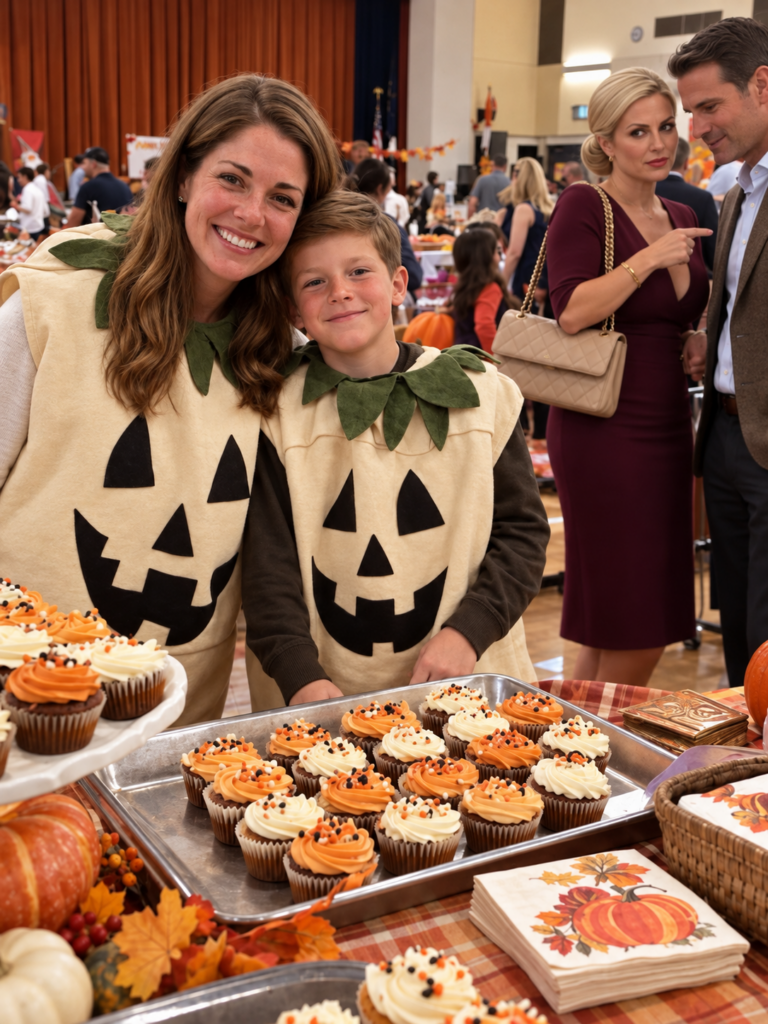
Not the smell of kettle corn drifting across the school courtyard or the children running between the hay bales. Not even the ridiculous orange costume I’d made for myself, with its crooked green stem and uneven stuffing.
It was the sound of my former husband laughing at me.
Loudly. Freely. Without the slightest concern that our son was standing between us.
“Well, Claire,” Vanessa said, lifting one perfectly shaped eyebrow, “I have to admit, that’s the most appropriate outfit I’ve ever seen you wear.”
She glanced at my round pumpkin costume, then deliberately lowered her eyes toward my waist.
“You’ve certainly got the shape for it.”
My ex-husband, Martin, threw his head back.
“Oh, come on,” he said between laughs. “That’s actually pretty funny.”
Vanessa slipped her hand into his.
She looked pleased with herself.
Beside me, my ten-year-old son, Noah, went very still.
He’d been holding a paper plate with one of the pumpkin cupcakes we’d made the night before. Orange frosting had stained two of his fingers. His matching costume was slightly smaller than mine, with the same crooked green stem on top.
Ten minutes earlier, he’d been laughing so hard that he’d nearly dropped his cupcake.
Now he wasn’t laughing at all.
“That’s not funny,” he said.
Martin looked down.
“What was that, buddy?”
“I said it’s not funny. Mom worked really hard on our costumes.”
Vanessa let out a little sigh.
“Oh, Noah. We’re only teasing.”
“You always say that.”
The words landed harder than any insult Vanessa had thrown at me.
Martin’s smile disappeared.
“Watch how you speak to Vanessa.”
Noah’s cheeks turned red.
I stepped closer to him.
“He wasn’t being disrespectful, Martin.”
“He doesn’t need to talk to adults like that.”
“And adults don’t need to make fun of his mother in front of him.”
Vanessa rolled her eyes.
“Good grief, Claire. It was a pumpkin joke, not a personal attack.”
I looked directly at her.
“Then explain why my son looks like he’s about to cry.”
For one brief second, she had no answer.
Around us, the fair continued. A little girl was begging her father for another turn at the ring toss. Someone was calling out raffle numbers over the loudspeaker. The smell of cinnamon floated from the bake-sale table.
It should have been a happy Sunday.
Instead, I was standing in a school courtyard, explaining basic decency to two grown adults.
Martin glanced around, embarrassed that other parents were looking.
“Can we not make a scene?”
That sentence almost made me laugh.
For thirteen years, including nine years of marriage, I’d heard versions of it whenever his behavior embarrassed me.
Don’t make a scene.
Don’t take everything personally.
Just let it go.
I’d become so practiced at keeping the peace that sometimes I couldn’t remember when I’d last been allowed to feel angry.
But this time Noah was watching.
And I wasn’t going to teach him that the proper response to cruelty was silence.
“Come on, sweetheart,” I told him. “We still have cupcakes to sell.”
I gently guided him away.
Behind us, Vanessa muttered something about people being too sensitive.
Martin didn’t correct her.
I could feel my son’s small hand tightening around mine.
“Mom?”
“Yes?”
“Do you wish we hadn’t worn these?”
I stopped beside the folding tables.
He wouldn’t look at me.
It broke my heart more completely than Vanessa’s insult ever could.
“Noah, look at me.”
He raised his eyes.
“I love these costumes.”
“Even yours?”
“Especially mine.”
“But she said—”
“I heard what she said.”
I crouched until our ridiculous pumpkin faces were level.
“Do you remember what you told me when we finished sewing them?”
He nodded.
“That we looked like two pumpkins who got kicked down a hill.”
I smiled.
“Exactly. And we laughed until you spilled your hot chocolate. That’s what I remember when I look at these costumes.”
He gave a small smile, but it didn’t last.
“Why does Dad think she’s funny?”
I didn’t have an answer that wouldn’t hurt him.
So I told him the truth I could safely give.
“Sometimes grown-ups make poor choices because they’re trying to please somebody else.”
“Even dads?”
“Especially when they forget they’re supposed to be setting an example.”
He considered that.
Then he took my hand again.
“Can we go check on our booth?”
“Absolutely.”
We walked toward the gymnasium, where the fifth-grade classes had transformed folding tables into a little autumn marketplace.
Noah’s class was selling baked goods and handmade decorations to raise money for new library furniture.
Paper pumpkins hung from string. Hand-painted wooden signs advertised apple cider and cookies. Children in orange volunteer shirts hurried between tables while their parents tried to keep them organized.
Our table stood near the back wall.
Or what was supposed to be our table.
I stopped when I saw the decorations.
The little paper pumpkins Noah and his classmates had spent two afternoons making were gone.
In their place stood tall gold-painted branches, expensive artificial leaves, and three glass vases filled with miniature lights.
The display looked like something arranged for a department-store window.
Beautiful, in a certain way.
But there was almost nothing left that looked as if children had made it.
“Where are our pumpkins?” Noah asked.
My stomach tightened.
I knew exactly who had rearranged the booth.
And that was when I understood that Vanessa hadn’t come to the fair simply to help.
She’d come to be admired.
Unfortunately, she’d decided the easiest way to get admiration was to erase everybody else’s work.
Three months earlier, I probably would have let it happen.
I had reasons for avoiding conflict.
I was thirty-seven, divorced, and working full-time as the office manager for a small dental practice in a quiet Ohio suburb.
My days began at six.
I made breakfast, packed lunches, located missing homework, and reminded Noah to brush the teeth he’d somehow managed to forget every morning of his life.
After dropping him at school, I spent eight hours dealing with insurance claims, appointment schedules, frustrated patients, and a dentist who believed every administrative problem could be solved by asking me to work a little later.
Evenings were homework, laundry, dinner, and whatever household emergency appeared.
A leaking faucet.
A permission slip buried in a backpack.
A washing machine that made noises suggesting it was preparing to take flight.
I wasn’t unhappy with my life.
I had a small house with peeling paint on the back porch, a son who loved astronomy and terrible jokes, and a collection of mismatched coffee mugs I’d bought at thrift stores.
There was peace in that life.
Or there had been, until Martin started bringing Vanessa into it.
Martin and I had divorced almost two years earlier.
There hadn’t been one spectacular betrayal.
No secret family or dramatic discovery.
Our marriage had simply worn thin under the weight of things that never seemed to matter equally to both of us.
When Noah was sick, I missed work.
When a teacher needed a parent volunteer, I rearranged my schedule.
When something in the house broke, I found the repairman.
Martin earned good money selling commercial insurance, and he believed that should have been enough.
Over time, I stopped asking for help because hearing him sigh before agreeing had become more exhausting than doing the work myself.
Eventually, I stopped expecting much of anything.
The divorce was painful, but we managed to remain civil.
We split holidays carefully. We attended school conferences together. We sat on opposite sides of Noah’s soccer games and applauded the same goals.
I genuinely wanted Martin to find happiness.
I just hadn’t expected his happiness to come packaged with someone who seemed determined to make me feel small.
Vanessa was thirty-two, worked in marketing for a high-end home furnishings company, and had the effortless polish of someone who never left the house without checking every angle of her reflection.
I didn’t resent her looks.
I resented the way she seemed to need someone standing beneath her before she could feel tall.
At first, her comments were subtle.
When we met at a school pickup, she glanced at my faded jeans.
“Oh, Claire, you always look so comfortable. I wish I could stop caring about how I present myself.”
Another time, when I brought Noah’s forgotten math binder to Martin’s house, she noticed my old sedan.
“It’s adorable that you still drive that thing. Martin says you’ve always been sentimental.”
Martin would smile awkwardly.
Sometimes he laughed.
Usually, he told me afterward that Vanessa didn’t mean anything by it.
Then the comments started reaching Noah.
The first real warning came on a Tuesday evening, a little more than a week before the fair.
I was standing at the kitchen counter, cutting orange felt for our costumes, when Noah appeared in the doorway.
“Mom?”
“What’s up?”
“Do you think you’re pretty?”
The scissors stopped moving.
I turned around.
“That’s an unusual question.”
He shrugged.
“I was just wondering.”
I could tell he was choosing his next words carefully.
“Why?”
He picked up a strip of felt.
“Vanessa says you don’t take care of yourself anymore.”
For a moment, all I could hear was the refrigerator humming.
“What exactly did she say?”
“She said you dress like somebody who gave up trying. And then she asked Dad if you always looked like that.”
I laid the scissors down.
“What did Dad say?”
Noah examined the felt in his hands.
“He laughed. Then he said you never liked shopping.”
There it was again.
That laughter.
Small enough for Martin to dismiss. Sharp enough for a child to remember.
I pulled out the chair beside me.
“Come sit down.”
Noah climbed onto it.
“Am I in trouble for telling you?”
“Of course not.”
“Vanessa said I shouldn’t repeat grown-up conversations.”
My chest tightened.
“Did she say that after talking about me?”
He nodded.
I reached for his hand.
“Listen carefully. You never have to keep a secret because an adult is embarrassed about what they said. Especially if it makes you uncomfortable.”
His shoulders relaxed slightly.
“Then why does she keep doing it?”
That was the question I had been avoiding.
Because Vanessa could be charming when she wanted something.
Because Martin liked the attention of a glamorous girlfriend.
Because neither of them was considering what Noah heard when they discussed his mother as if she were an old piece of furniture Martin had finally replaced.
“I don’t know why she does it,” I told him. “But I know it’s wrong.”
“Are you going to tell Dad?”
“Yes.”
“Will he get mad?”
I hated that he had to ask.
“Whatever your dad feels, I’ll handle it. That’s not your responsibility.”
After he went to bed, I called Martin.
He answered on the fourth ring.
“Everything okay with Noah?”
“He’s fine physically. Emotionally, we need to talk.”
Martin sighed.
“That’s a dramatic opening.”
“Vanessa has been making comments about my appearance in front of him.”
“Claire—”
“He asked me tonight if I thought I was pretty. A ten-year-old boy shouldn’t be worrying about whether his mother is good-looking enough to deserve respect.”
There was silence.
Then Martin said, “She has a sarcastic sense of humor.”
“This isn’t about her sense of humor.”
“She doesn’t dislike you.”
“Then she has a strange way of showing it.”
He lowered his voice.
“Look, she’s a little insecure about the fact that we have a child together. You’re always going to be in my life.”
I almost laughed.
“So her insecurity means she gets to insult me?”
“That’s not what I’m saying.”
“Then what are you saying?”
He paused.
“I’ll talk to her.”
“Martin, I’m serious. Noah is starting to dread going over there.”
That finally caught his attention.
“What? He never said that to me.”
“Maybe because when he tells you something bothers him, you laugh.”
He didn’t answer.
I softened my voice.
“I don’t need Vanessa to like me. But she needs to treat me respectfully around our son.”
“Okay,” he said. “I understand.”
I wanted to believe him.
I truly did.
Three days later, Vanessa approached me outside Noah’s school.
She was carrying a pair of blue sneakers he’d left at Martin’s apartment.
“Claire! Perfect timing.”
I stopped beside my car.
“Thanks for bringing those.”
She handed them over.
“No problem. Listen, Martin mentioned you’re helping organize the autumn fundraiser.”
“The fifth-grade pumpkin booth, yes.”
Her face brightened.
“I’ve been thinking I could help with the decorations. I have access to some gorgeous seasonal displays through work.”
I hesitated.
Then Noah came bounding out of the school doors.
“Vanessa! Did you bring my shoes?”
“Sure did, handsome.”
She smiled at him.
Then she turned back to me.
“I thought we could make your booth really special.”
Noah looked delighted.
“Mom, could we? We could have the best booth in the whole gym!”
His enthusiasm caught me off guard.
He wanted the adults in his life to get along.
He wanted one school event where nobody felt uncomfortable.
I’d wanted the same thing for him since the divorce.
So I agreed.
“Extra decorations would be great,” I said. “The class has already made most of what we’ll use, though. Their work needs to be part of the display.”
“Obviously,” Vanessa said.
Her eyes traveled over my cardigan.
“I’ll just give everything a little polish.”
I ignored that last remark.
I told myself it wasn’t worth another argument.
That evening, our class coordinator, Mrs. Ellison, added Vanessa to the volunteer planning group.
Within twenty-four hours, things began changing.
Vanessa sent photographs of elaborate display stands.
She suggested replacing the handwritten signs with printed lettering.
Then she volunteered to handle the booth’s “visual direction,” a phrase that seemed unnecessary for a table selling two-dollar cupcakes.
At the Saturday planning meeting, she placed a folder of design samples in front of the other parents.
“I’ve developed a complete concept,” she announced.
A father named Greg looked impressed.
“Wow. You put this together quickly.”
Vanessa smiled.
“Well, somebody had to take charge.”
I was sitting beside Noah’s teacher, Mrs. Palmer.
“We already have a plan,” I said. “The children are making the signs, and the families have divided up the baking.”
“Oh, certainly.” Vanessa waved her hand. “I’m just elevating it.”
She pointed to a picture of white pumpkins and golden leaves.
“These would look so much better than the construction-paper decorations.”
Mrs. Palmer frowned.
“The students were very proud of those pumpkins.”
“And they should be,” Vanessa said smoothly. “Perhaps we could display them somewhere less prominent.”
I shook my head.
“They’re the heart of the booth.”
Vanessa’s smile tightened.
“Claire, you don’t have to oppose every suggestion.”
“I’m not opposing suggestions. I’m making sure we remember whose fundraiser this is.”
Mrs. Ellison quickly changed the subject.
But when the meeting ended, Vanessa stopped me in the hallway.
“Can I give you a little advice?”
“That depends.”
She folded her arms.
“Not everything has to be homemade to be meaningful.”
“I know.”
“Sometimes a little sophistication is a good thing.”
I looked at her.
“The kids have worked hard, Vanessa.”
“And that’s sweet. But adults are allowed to make things look nice.”
I could feel my patience thinning.
“Making something nice doesn’t mean hiding the children’s work.”
She gave a short laugh.
“Well, I can see why Martin said you were stubborn.”
I held her gaze.
“Martin knows I don’t like people speaking for me.”
For the first time since I’d met her, Vanessa seemed surprised that I hadn’t backed down.
She walked away without saying goodbye.
That night, I found Noah sitting on the living-room floor with my phone.
He was going through the photographs he’d taken of our preparations.
There were pictures of paper pumpkins drying on newspaper.
Pictures of classmates painting signs.
Pictures of the cupcakes we were planning to bake.
And several spectacularly unflattering photographs of me leaning over the sewing machine.
“Why are you taking so many pictures?” I asked.
He smiled.
“Mrs. Palmer said we can do a slideshow at the fair. We have to show how our booth was made.”
“That’s nice.”
“I’m making ours.”
I sat beside him.
“Want some help?”
“No. It’s supposed to be a student project.”
He swiped to a photograph of me holding up his costume.
My hair was in a messy bun. I had a pencil tucked behind one ear and a piece of green thread stuck to my shirt.
I looked tired.
I also looked happy.
Noah studied the photograph for a long moment.
“That’s my favorite one.”
I laughed.
“Of all the pictures you took?”
“Yep.”
“Sweetheart, I look like I haven’t slept in a week.”
He looked genuinely confused.
“But you’re smiling.”
I didn’t know what to say.
He went back to arranging the photographs.
“Mrs. Palmer said the best presentations tell a story, not just show stuff.”
“Smart teacher.”
“She said we should show what happened from the beginning.”
I kissed the top of his head.
“Then show what you’re proud of.”
He looked up.
“Can I put in the picture of us wearing the costumes?”
“Even though we look ridiculous?”
“Especially because we look ridiculous.”
We laughed.
For a while, I forgot about Vanessa.
The following Saturday, we baked sixty pumpkin cupcakes.
Noah insisted on putting exactly six chocolate chips on each one because, according to him, five looked lonely and seven looked crowded.
We made a terrible mess.
Flour covered the counter.
A streak of orange frosting somehow ended up on the dog next door after he wandered into our kitchen through the open back door.
At one point, I dropped an entire piping bag.
Noah laughed so hard he had to sit on the floor.
He photographed everything.
When we finished, we placed the cupcakes into boxes and laid our costumes across the sofa.
Noah pulled his on first.
He turned in a circle, the stuffing wobbling around his middle.
“Do I look like a pumpkin?”
“You look like the mayor of Pumpkin Town.”
He grinned.
“Then you’re the queen.”
I slipped into mine.
The zipper caught twice. One shoulder sat higher than the other, and the green stem leaned sharply to the left.
Noah stared at me.
Then he burst out laughing.
I laughed with him.
We stood together in front of the hallway mirror, two uneven orange pumpkins in a small house filled with the smell of cinnamon.
He wrapped his arms around my waist.
“Promise you’ll wear yours tomorrow.”
“Promise.”
“Even if somebody makes fun of us?”
I looked down at him.
There was a seriousness behind the question that hadn’t belonged there before Vanessa entered our lives.
“Even then.”
He pressed his cheek against my costume.
“Good.”
I hugged him a little tighter.
At seven the next morning, we loaded our boxes into the car.
By eight, we were at school.
And by nine, I discovered the first missing decoration.
The children’s paper pumpkins had been packed inside a cardboard box and shoved beneath the display table.
Their handwritten labels had vanished.
Vanessa stood near the booth in cream-colored trousers, a fitted sweater, and ankle boots that looked expensive enough to require their own insurance policy.
She was adjusting a gold ribbon when I approached.
“Where are the students’ decorations?”
She didn’t look up.
“I put them somewhere safe.”
“Under the table?”
“Claire, the booth looks lovely. Don’t start.”
I bent down and pulled out the box.
Some paper pumpkins had been bent where they’d been stacked.
One had a small tear near its stem.
I recognized it immediately.
Noah had made that one.
He’d painted a tiny telescope on it because he said even pumpkins deserved to see the stars.
I held it carefully.
“These are going back up.”
Vanessa’s expression hardened.
“You’re going to ruin the entire arrangement.”
“Then the arrangement will have to survive.”
I began hanging the pumpkins across the front of the table.
Mrs. Palmer appeared with a box of napkins.
“Oh, there they are!”
She looked relieved.
“I was wondering what happened to them. The children kept asking.”
“They were packed away,” I said.
Mrs. Palmer glanced at Vanessa, then at the elaborate gold display.
“Well, the handmade ones need to be visible. It’s their project.”
Vanessa gave a stiff smile.
“Of course.”
But she wasn’t finished.
Around lunchtime, I overheard her telling two parents how much work she’d put into the booth.
“I practically designed the whole thing,” she said. “The original display was a bit of a mess.”
I was carrying a tray of cupcakes.
I stopped beside them.
“Vanessa provided the purchased decorations,” I said. “The children made the rest, and all the families helped.”
One mother smiled.
“That’s wonderful. It’s such a team effort.”
“Exactly,” I said.
Vanessa’s eyes narrowed.
Later, Martin arrived.
Noah ran to greet him.
For one hopeful moment, I thought the day might improve.
Martin hugged our son, admired his costume, and asked how many cupcakes he’d sold.
Then he looked at me.
Vanessa followed his gaze.
And she made the joke about my body.
The joke that made Martin laugh.
The joke that made Noah go quiet.
Now, standing beside our restored booth, I watched my son straighten one of the paper pumpkins.
“Mom?”
“Yes?”
“Do you think people notice who does the work?”
I thought about Vanessa’s decorations, the other parents’ contributions, and all the children who had proudly spent hours making things that could easily have been thrown away.
“Sometimes they do. Sometimes they don’t.”
“Is that fair?”
“Not always.”
He considered my answer.
Then he asked something that surprised me.
“Is it wrong to tell people?”
“No, sweetheart. It’s not wrong to tell the truth.”
He nodded slowly.
“But you should never feel you have to prove my worth to anyone,” I added.
“I know.”
He looked toward the small stage at the front of the gym.
Mrs. Palmer was connecting a laptop to the projector.
“Mrs. Palmer said my slideshow’s ready.”
“That’s wonderful.”
“Will you watch?”
I smiled.
“Front row.”
He returned the smile.
But there was a strange determination in his expression.
An hour later, as the families began gathering for the student presentations, I noticed Vanessa standing beside the principal.
She was explaining how she’d transformed the fifth-grade display.
Martin stood next to her, nodding along.
I was about to approach them when Mrs. Palmer called Noah’s name.
He stepped onto the stage carrying a small flash drive.
And that was the moment I realized my son had been paying closer attention to everything than any of us understood.
Part 2
The gymnasium had been transformed into a makeshift auditorium.
Parents sat on metal folding chairs while younger children balanced paper cups of cider on their knees. A few grandparents stood along the walls. The principal, Mr. Hargrove, waited near the stage with a clipboard.
Behind him, a white projection screen hung beneath a banner reading Our Community, Our Children.
I remember noticing those words.
They seemed so simple.
And yet, somehow, we’d spent an entire week fighting over who deserved credit for something the children had created.
Noah stood beside Mrs. Palmer, waiting for the projector to warm up.
He looked impossibly small.
His orange costume bulged around his middle, and the green stem on his head tilted whenever he moved.
He held a microphone with both hands.
Martin slipped into a chair near the aisle.
Vanessa sat beside him.
I took a seat two rows behind them.
Mrs. Palmer smiled at the audience.
“Our fifth-grade students have been documenting the work behind today’s fundraiser. A few volunteers prepared short presentations about their class projects.”
She turned to Noah.
“Whenever you’re ready.”
He nodded.
“Hi, everybody. I’m Noah Bennett, and our class made the pumpkin booth.”
His voice shook slightly.
A few parents smiled encouragingly.
Noah clicked the remote.
The first picture appeared.
It showed four students sitting around a classroom table, surrounded by construction paper and markers.
“Our teacher told us we could help buy new shelves and reading chairs for the school library,” Noah said. “So we made decorations, and our families helped make stuff to sell.”
The next photograph showed his classmates holding up their painted signs.
He named each child.
He thanked one boy for bringing extra glue.
He thanked a girl named Sophie for drawing the big pumpkin on their welcome sign.
Then he thanked Mrs. Ellison for organizing the volunteer schedule.
I smiled.
He had listened carefully to the assignment.
He was giving everybody their moment.
Another picture appeared.
This one showed our kitchen.
There was flour on the counter, a mixing bowl in the sink, and Noah standing on a stool beside me.
I heard a woman behind me whisper, “How cute.”
Noah grinned.
“My mom and I made the cupcakes. I counted the chocolate chips, and she did everything that involved the oven.”
Several people laughed.
He clicked again.
There I was, bent over my old sewing machine, concentrating on the orange fabric.
The photograph filled the screen.
It wasn’t flattering.
My hair was falling out of its bun. My reading glasses sat low on my nose, and I was wearing the same faded sweatshirt I’d owned for years.
But I remembered the moment.
Noah had been sitting cross-legged on the floor, asking whether a pumpkin could have pockets.
I’d told him anything could have pockets if its mother was tired enough to sew them on.
And we’d laughed.
“Mom made our costumes,” he announced. “She doesn’t really sew clothes, but she watched videos and figured out how.”
I could feel myself blushing.
On the screen, the next photograph showed us wearing the finished costumes in our hallway.
A few people applauded.
Somebody called out, “Those are fantastic!”
Noah beamed.
“They’re supposed to look funny. We wanted them to match.”
Then he clicked again.
A photograph appeared showing the booth before the purchased decorations had been added.
The handmade pumpkins hung across the table.
The children’s signs stood in front of the cupcake trays.
Every little painted detail was visible.
“This is what we made first,” Noah explained. “We worked on it for a long time.”
He looked briefly toward the audience.
“Then Vanessa helped by bringing extra decorations.”
The next photograph showed the gold branches and white pumpkins she’d purchased.
I saw Vanessa straighten in her chair.
Noah continued.
“She got those from her work, and they made the table look fancy. Thank you, Vanessa.”
People applauded politely.
Vanessa smiled.
For perhaps three seconds, she looked satisfied.
Then the next photograph appeared.
It showed the cardboard box I’d discovered beneath the booth.
Inside were the children’s paper pumpkins.
Some were bent. The little telescope Noah had painted was visible near the top.
There was a quiet murmur from the audience.
Noah glanced toward Mrs. Palmer.
She was standing near the laptop, watching attentively.
“When we got here this morning, we couldn’t find our decorations,” he said. “Somebody had put them in a box. But Mom found them and hung them back up.”
He clicked again.
The screen showed me kneeling beside the table, carefully straightening Noah’s damaged pumpkin.
I hadn’t known he’d taken that picture.
And I certainly hadn’t known he’d included it in the presentation.
Vanessa grabbed Martin’s forearm.
“Make him stop.”
She spoke quietly, but I heard her.
Martin frowned.
“What?”
“Tell them to stop the presentation.”
“Vanessa, he’s showing the booth.”
“You don’t understand.”
She leaned closer to him.
“Look at what he’s showing. Those pictures make it look like I didn’t do anything!”
Martin looked toward the screen.
Then back at her.
“He thanked you.”
“That’s not the point.”
Her voice sharpened.
I watched Martin’s expression change.
For perhaps the first time, he seemed to recognize that Vanessa wasn’t upset because Noah had been unkind.
She was upset because he hadn’t made her the center of the story.
Onstage, my son continued.
“This is my mom putting everything back where it belonged.”
A photograph appeared of the finished booth, with the children’s decorations hanging proudly beneath Vanessa’s expensive display.
“And this is how it looked when everybody’s work was together.”
He paused.
Then he said something I’ll never forget.
“I like this picture best because you can see what everybody did.”
A woman sitting across the aisle nodded.
I noticed Mrs. Ellison wipe one eye.
Noah clicked to the final slide.
It was a photograph of his classmates standing behind the booth, smiling proudly.
There was a little handmade sign at the bottom.
THANK YOU FOR HELPING OUR SCHOOL.
“I wanted to thank everybody who helped,” he said. “But especially my mom, because she did a lot of work when nobody was watching.”
My throat tightened.
He looked directly toward my chair.
“Mom says you don’t have to be the most important person to make something important.”
I pressed my fingers against my mouth.
“And she tells me we shouldn’t make fun of people just because somebody else is laughing.”
The room grew quiet.
Noah shifted his weight.
“I think she’s pretty, and I think our costumes are awesome.”
A few people chuckled softly.
“But mostly, she’s my mom. And I’m glad she made them with me.”
That was all.
No dramatic accusation.
No demand that anybody apologize.
No public speech calling Vanessa a liar.
Just a little boy explaining what he’d seen, what he’d made, and who had been there to help him.
The applause began in the back of the gym.
Then it spread.
Parents stood.
Mrs. Palmer put her hand on Noah’s shoulder.
He looked surprised by the attention.
Then he smiled.
I was crying by the time he stepped down from the stage.
When he reached me, I knelt and wrapped my arms around him.
“Did I do okay?”
“Oh, sweetheart.”
I kissed his cheek.
“You did beautifully.”
His shoulders relaxed.
“I thought you might not like the picture with your messy hair.”
I laughed through my tears.
“That might be my favorite picture now.”
He grinned.
And for a moment, everything felt right.
Then Vanessa appeared.
Her face was pale beneath her carefully applied makeup.
“You knew.”
I looked up.
“What?”
“You knew he was going to do that.”
Martin stood behind her, looking uncomfortable.
“I knew he was preparing a slideshow,” I said. “I didn’t know exactly what he’d included.”
Vanessa crossed her arms.
“That was a deliberate attempt to humiliate me.”
Noah’s smile vanished.
I moved slightly in front of him.
“Vanessa, this is not the place.”
“He made me look like I threw away the children’s work.”
I held her gaze.
“Did you put their decorations in a box?”
“Because they didn’t match!”
She said it loudly enough that two nearby parents turned toward us.
Then she seemed to hear herself.
Her expression changed.
“I mean, I was trying to improve the display.”
Martin rubbed his forehead.
“Can we discuss this privately?”
Vanessa ignored him.
“I spent hundreds of dollars helping this class, and your son makes it seem like I was the problem.”
Noah looked down at his shoes.
“I’m sorry,” he whispered.
I felt something inside me harden.
Not against him.
Against the adults who had made a little boy feel guilty for thanking his mother.
I took his hand.
“Noah, you have nothing to apologize for.”
Vanessa let out an incredulous laugh.
“Seriously?”
I turned toward Martin.
“Take her outside.”
He stared at me.
“Claire—”
“Now.”
Something in my voice stopped him.
Vanessa looked offended.
But Martin touched her elbow and guided her toward the side doors.
I crouched beside Noah.
“Listen to me. You did what your teacher asked. You showed the work everyone did, and you thanked the people who helped. I’m very proud of you.”
“But Vanessa’s mad.”
“Her feelings are not yours to fix.”
He looked toward the doors.
“Is Dad mad too?”
“I don’t know. But whatever he’s feeling, that’s for him to work through.”
He swallowed.
“Did I make things worse?”
I wished I could erase the question from his mind.
“No, honey. The adults made things difficult long before you gave your presentation.”
Mrs. Palmer approached.
“Noah, would you help me put away the projector?”
He looked at her uncertainly.
She smiled.
“Your presentation was thoughtful, and you followed the assignment exactly. You did a good job.”
His face brightened a little.
“Really?”
“Really.”
He followed her toward the stage.
I waited until he was safely across the room.
Then I went outside.
Martin and Vanessa were standing beside the brick wall near the gym entrance.
The October air had turned cool.
Leaves scraped across the pavement.
Vanessa was talking rapidly.
“…and now everybody thinks I’m some horrible woman who steals credit from children.”
Martin saw me approaching.
“Claire, we need to straighten this out.”
“I agree.”
Vanessa spun toward me.
“Then start by admitting you encouraged him.”
“I didn’t.”
“Oh, please.”
“I helped him transfer photographs from my phone. His teacher reviewed the presentation. He chose what to say.”
“That’s convenient.”
Martin raised a hand.
“Both of you, stop.”
I looked at him.
“No, Martin. You’ve spent months asking me to be quiet while your girlfriend insults me. We’re finally going to have a real conversation.”
His jaw tightened.
“We’re not doing this here.”
“Where would you prefer? Because I tried discussing it privately, and nothing changed.”
Vanessa gave a bitter laugh.
“There it is. You’ve been looking for an excuse to turn him against me.”
I shook my head.
“Nobody needed to turn Noah against you. He listened to you.”
She opened her mouth.
I continued.
“He heard you criticize my clothes. He heard you ask his father why he stayed married to me. He heard Martin laugh when you made fun of my body.”
Martin looked away.
“And today, after your comments hurt him, he still thanked you publicly for your contribution.”
Vanessa folded her arms tightly.
“Then why did he show that box?”
“Because that’s where you put his work.”
“It was a design decision!”
“He painted a telescope on his pumpkin, Vanessa. Do you know why?”
She blinked.
“What?”
“Because he loves astronomy. His classmates made decorations that reflected things they loved. That wasn’t clutter. That was the reason for the fundraiser.”
For the first time, she looked genuinely unsettled.
Only briefly.
Then she said, “You’re making me sound like a monster over paper.”
“No. I’m explaining why the paper mattered.”
Martin exhaled.
“Claire, enough.”
I turned to him.
“You’re the one I need to talk to.”
He stiffened.
“Fine.”
“Last week, Noah asked whether I thought I was pretty.”
Martin looked confused.
“What?”
“He asked because Vanessa has been criticizing my appearance at your house. He notices when you laugh. He notices when you don’t defend me.”
Martin glanced at Vanessa.
She said nothing.
“He’s ten,” I continued. “He should be worrying about homework and soccer and whether he gets enough chocolate chips on his cupcakes. Instead, he’s worried about whether his mother is embarrassing.”
Martin’s expression changed.
“I didn’t realize it was affecting him like that.”
“He told you today.”
“He was being rude.”
“He told you something hurt him.”
Martin opened his mouth, then closed it.
Vanessa stared at the pavement.
For a moment, nobody spoke.
Then Martin said, “What do you want from me?”
It was such a familiar question.
As if respecting boundaries were a complicated favor.
“I want you to behave like Noah’s father. Not like Vanessa’s audience.”
His face flushed.
I continued, keeping my voice steady.
“I don’t care who you date. I don’t care what she wears or how beautiful you think she is. I care about what happens when our child is in your home.”
Vanessa looked at Martin.
“Are you seriously going to let her talk to us like this?”
He didn’t answer immediately.
That surprised her.
It surprised me too.
Finally, he said, “Vanessa, maybe we should leave.”
She stared.
“Are you kidding?”
“I think we’ve had enough for today.”
She looked between us.
Then she walked toward the parking lot.
Her heels clicked sharply against the pavement.
Martin remained.
He looked older than he’d looked when he arrived.
“That thing Noah said about laughing at people,” he began.
I waited.
“Do you think he meant me?”
I studied him.
“Martin, I think he meant anybody who does it.”
He lowered his eyes.
Then I said, “But yes. I think he’s been wondering why you find it funny.”
He rubbed the back of his neck.
“I need to talk to him.”
“You need to listen to him.”
He nodded reluctantly.
We stood in silence.
Then he asked, “Can I see the slideshow?”
“You can ask Noah.”
He looked surprised.
“You’re not going to tell him to show me?”
“No. If you want to understand how he feels, start by asking him.”
I turned toward the door.
“Claire.”
I stopped.
“I didn’t know she packed up the decorations.”
“Now you do.”
I went back inside.
For the rest of the afternoon, I tried to give Noah the fair he’d been looking forward to.
We played ring toss.
I missed every single throw.
He won a small stuffed raccoon and named it Captain Pickles.
We ate caramel apples and watched his classmates compete in a sack race.
By the time the fair ended, his laughter had returned.
But that evening, when we were washing frosting from the cupcake trays, he became quiet again.
“Mom?”
“Yes?”
“Did Dad get mad at you?”
I set down the sponge.
“Your dad and I had a serious conversation.”
“About my pictures?”
“Partly.”
He leaned against the counter.
“I didn’t want to make him angry.”
I dried my hands and sat beside him.
“Noah, I need you to hear something important.”
He looked worried.
“Sometimes adults disagree. Sometimes they make mistakes. And sometimes they need to apologize. None of that is your job to manage.”
“But I wanted everybody to know you helped.”
“I know. And that meant a lot to me.”
He stared at his hands.
“I thought if Dad saw the pictures, he might remember you’re nice.”
My heart seemed to stop.
I had expected the slideshow to be about the booth.
Even after watching it, I’d believed Noah simply wanted to give credit where it belonged.
Now I understood something deeper.
He had been trying to remind his father who I was.
Not an embarrassing former wife.
Not a punch line.
Not the woman Vanessa described over dinner.
Just the mother who had spent her evenings sewing crooked pumpkins and helping with homework.
I pulled him into my arms.
“Oh, Noah.”
He leaned against me.
“Dad used to say you could fix anything.”
I closed my eyes.
Martin used to say that.
When we were first married, he told his friends I’d somehow managed to repair a broken kitchen drawer with a spoon and a shoelace.
He’d been proud of my resourcefulness then.
Somewhere along the way, that admiration had become an expectation.
Then an inconvenience.
Then something he barely noticed.
“Your dad knew a different version of us,” I said quietly.
“Was it a bad version?”
“No. Just one that didn’t work the way we needed it to.”
He thought for a moment.
“Do you still like Dad?”
I smiled sadly.
“I want him to be happy. And I want him to be a good father to you.”
“Even with Vanessa?”
“Even then. But being happy doesn’t give anyone permission to hurt somebody else.”
He nodded.
Then he asked, “Can we make popcorn?”
It was such an ordinary question that I nearly cried again.
“Absolutely.”
We watched an old animated movie on the sofa.
He fell asleep halfway through, Captain Pickles tucked beneath his chin.
I carried his blanket upstairs, kissed his forehead, and returned to the kitchen.
My phone was vibrating on the counter.
Martin.
I answered.
“Hello.”
“Vanessa’s been crying all evening.”
I closed my eyes.
“Good evening to you too.”
“Claire, I’m serious.”
“So am I.”
He sighed.
“She thinks everyone at the school is going to judge her.”
“Then perhaps she should consider how she treats people at school.”
“She’s embarrassed.”
“Noah was embarrassed today too.”
“She’s convinced you planned it.”
“I didn’t.”
“Could you at least have Noah apologize?”
The words seemed so unreasonable that for a moment I wondered if I’d misunderstood them.
“For what?”
“For making her feel humiliated.”
I stared at the kitchen wall.
Our pumpkin costumes were hanging over two chairs, still slightly stained from the fair.
“Martin, our son thanked your girlfriend in front of an entire gymnasium. He did not insult her. He did not lie. He did not call her names.”
“She thinks he deliberately showed those pictures to make her look bad.”
“The pictures showed what happened.”
“Maybe he shouldn’t have included the box.”
I felt a familiar exhaustion rising.
The old pressure to smooth things over.
To be reasonable enough for everybody.
To make things comfortable by accepting blame that wasn’t mine.
But then I remembered Noah standing in our kitchen, wondering if his father still thought his mother was nice.
“No,” I said.
Martin went quiet.
“No what?”
“No, I will not ask Noah to apologize for telling the truth. And I will not help you teach him that the person who gets embarrassed is automatically the victim.”
“That’s not fair.”
“Neither is putting a child in the middle of adult cruelty.”
He breathed out heavily.
Then he said something unexpected.
“He asked me something when I dropped him off last weekend.”
I waited.
“He asked whether Vanessa would still like him if he looked more like you when he got older.”
My fingers tightened around the phone.
“What did you say?”
“I told him that was a silly question.”
I closed my eyes.
“Martin.”
“I know.”
“No. I don’t think you do.”
There was a long silence.
Then his voice changed.
“I keep thinking about his face today.”
I said nothing.
“When Vanessa made that joke, he looked at me like he was waiting for me to do something.”
“He was.”
Martin swallowed audibly.
“And I laughed.”
“Yes.”
Another silence followed.
Finally, he said, “I’ll apologize to him.”
“Good.”
“And I’ll talk to Vanessa.”
“You said that last week.”
“I know.”
“Then this time, something needs to change.”
He didn’t argue.
After the call ended, I sat alone at the kitchen table.
I should have felt relieved.
Instead, I felt frightened.
Not because Vanessa might dislike me even more.
That no longer mattered.
I was frightened because I realized how easily Noah had been pulled into a conflict he should never have carried.
He’d spent weeks watching.
Remembering.
Trying to understand.
And eventually trying to fix something the adults refused to fix themselves.
I couldn’t undo that.
But I could change what happened next.
The next morning, I emailed Martin.
It wasn’t angry.
It was carefully written.
I explained that we needed clear expectations about how each parent and any partner would speak about the other around Noah.
I asked him to agree that Noah would not be questioned about private conversations, pressured to apologize for adult embarrassment, or made responsible for disagreements between households.
I also suggested that if Noah continued showing signs of anxiety about visiting either home, we should consider speaking with the school counselor together.
Then I sent it.
Martin didn’t respond until late that afternoon.
His message was short.
I understand. We need to talk in person.
Before I could decide whether that was encouraging, another message arrived.
This one came from Mrs. Palmer.
She asked whether we could meet briefly after school the following day.
She said there was something about the fair she believed I should know.
I stared at the screen.
For one unsettling moment, I wondered whether Noah had done something wrong.
I wrote back immediately.
Is Noah okay?
Her reply came within minutes.
He’s fine. He hasn’t done anything wrong. But I think you should understand how much care he put into his presentation.
That night, I barely slept.
I kept thinking about the slideshow.
The photographs.
The expression on Vanessa’s face.
And the unusual determination in my son’s eyes when he’d told me he was ready to present.
The following afternoon, I sat across from Mrs. Palmer in her classroom.
Children’s artwork covered the walls.
A half-finished multiplication chart hung beside the whiteboard.
Mrs. Palmer folded her hands on her desk.
“Claire, first, I want you to know Noah is a wonderful student.”
“Thank you.”
“He’s kind, thoughtful, and very observant.”
I smiled faintly.
“He’s always been observant.”
She hesitated.
“That’s part of why I wanted to speak to you.”
My stomach tightened.
“Did he say something?”
“Several things. Not all at once.”
She reached into a folder and withdrew a printed worksheet.
At the top, in Noah’s handwriting, were the words:
WHAT I WANT PEOPLE TO KNOW.
Beneath them was a short paragraph.
I recognized his careful, uneven letters.
Mrs. Palmer slid the page toward me.
I began reading.
And by the second sentence, I couldn’t see the words clearly anymore.
Part 3
The worksheet was dated four days before the fair.
Noah had written it as part of his presentation planning.
Most of the children had listed facts about their booths.
What they sold.
How much they hoped to raise.
Which decorations they liked best.
Noah had written something different.
I want people to know that making things takes time. My mom works all day and still helps me at night. Sometimes people laugh at how she looks, but she makes me feel happy and never laughs when someone is sad. I want Dad to see that she’s good at lots of things. I don’t want people to think she’s not important.
I read it twice.
Then I put the paper down.
Mrs. Palmer offered me a tissue.
“I’m sorry,” she said gently. “I didn’t want to upset you.”
I shook my head.
“You didn’t.”
But my voice was breaking.
She waited while I collected myself.
“When Noah first handed me his plan,” she continued, “I thought he was simply proud of the work you’d done together. Then he asked whether he was allowed to show photographs of something that hadn’t gone the way he expected.”
“The decorations?”
She nodded.
“He showed me the picture of the box. I asked why it mattered to him.”
I looked up.
“What did he say?”
“He told me the children had made those pumpkins because they wanted their booth to look like something they’d created. He said somebody thought the decorations weren’t pretty enough.”
I pressed the tissue between my fingers.
Mrs. Palmer’s expression softened.
“He didn’t ask me to embarrass anybody. He wanted to show what his classmates had contributed.”
“Then why didn’t you tell me?”
“I considered it. But Noah wasn’t doing anything inappropriate. His presentation was factual, and he thanked everyone, including Vanessa. I did remind him that the purpose was to celebrate the class’s work, not settle disagreements.”
She paused.
“He understood that.”
I looked at the worksheet again.
There was so much love in those childish sentences.
And so much worry.
“Did he seem upset?” I asked.
“He seemed concerned about making sure everybody was recognized.”
She leaned forward.
“Claire, there’s something else.”
My heart sank.
“Go ahead.”
“After we reviewed his slides, Noah asked whether parents ever stopped being proud of each other after a divorce.”
I stared at her.
“He asked that?”
“Yes.”
“What did you tell him?”
“I told him that sometimes people’s relationships change, but their responsibility to treat each other respectfully does not.”
I looked down.
“He said he hoped his father would like the picture of your costumes.”
That was when I cried.
Not loudly.
I simply sat in my son’s classroom, holding a tissue while tears slipped down my cheeks.
For months, I’d told myself that keeping the peace was protecting Noah.
I had swallowed remarks, ignored insults, and tried to remain pleasant when Vanessa behaved badly.
I’d convinced myself that as long as I didn’t argue, he would be spared the discomfort of conflict.
But he hadn’t been spared anything.
He’d been watching his mother absorb humiliation.
And because the adults around him refused to address it, he’d decided he needed to do something.
Mrs. Palmer gave me a moment.
Then she said, “I want to be careful here. Noah is not responsible for managing adult relationships. You know that. But I also don’t want him to believe that noticing something unfair was wrong.”
I nodded.
“Neither do I.”
“His presentation came from a good place. He just needs the adults in his life to take over now.”
Those words stayed with me.
The adults need to take over now.
Not Noah.
Not his classmates.
Not a ten-year-old boy in a crooked pumpkin costume.
Us.
I thanked Mrs. Palmer and asked whether Noah could speak with the school counselor if he wanted to.
She agreed to help arrange it.
Then I drove home and sat in the car for several minutes before going inside.
I thought about calling Martin immediately.
Instead, I sent him a photograph of the worksheet.
Underneath, I wrote:
This is what our son was carrying around before the fair. We need to make sure he never feels responsible for proving either parent’s worth again.
Martin called less than five minutes later.
His voice sounded strained.
“Did he really write that?”
“Yes.”
“About wanting me to see?”
“Yes.”
There was silence.
Then he said, “I thought he was just being protective of you.”
“He was trying to make sense of what he heard.”
Martin took a long breath.
“I didn’t realize he thought I’d stopped respecting you.”
I looked through the kitchen window.
A few yellow leaves were caught against the fence.
“Martin, respect isn’t something a child should have to guess about.”
He didn’t respond.
“You don’t have to love me,” I continued. “You don’t even have to like everything about me. But Noah needs to know that both his parents are safe people to talk about.”
“I know.”
“And he needs to be allowed to love us both without feeling disloyal.”
Martin’s voice cracked slightly.
“I know.”
I waited.
Finally, he said, “I need to tell you something.”
My stomach tightened.
“All right.”
“Vanessa and I had a fight after the fair.”
I said nothing.
“She kept insisting that Noah had been manipulated. She wanted me to call you and demand an apology. When I told her I wasn’t doing that, she got angry.”
“About the slideshow?”
“About a lot of things.”
He paused.
“She said she was tired of competing with you.”
I frowned.
“Competing with me?”
“She thinks people still see you as my family.”
I closed my eyes.
“Martin, I am your family in one important way. We share a son. That isn’t going to change.”
“I told her that.”
“And?”
“She said she didn’t sign up to spend her weekends celebrating my ex-wife.”
For a moment, neither of us spoke.
Then I said, “That sounds like something you two need to work out.”
“I know.”
He hesitated.
“She admitted something else.”
I waited.
“She said she moved the decorations because she thought the booth looked childish and wanted the principal to notice the display she’d arranged. She was hoping the school would ask her to help with future events.”
I stared at the floor.
There it was.
The reason behind the expensive decorations.
The insistence on being recognized.
The anger when Noah’s photographs showed other people’s contributions.
Vanessa hadn’t simply wanted to help.
She’d wanted a public success she could claim as her own.
And she’d treated a classroom full of children’s work as an obstacle.
“Did you tell her why that was wrong?” I asked.
“Yes.”
“What did she say?”
“That she was only trying to make a good impression.”
I let out a tired breath.
“Then perhaps the impression she made will teach her something.”
Martin was quiet.
“Claire, I’ve been making excuses for her.”
“Yes.”
“Some of the things she says remind me of how I used to talk to you.”
That surprised me.
I sat down.
“What do you mean?”
He sighed.
“I used to make jokes about how you dressed. Or how you did everything yourself. I’d call you stubborn when you disagreed with me.”
I remembered.
Of course I remembered.
“Yes,” I said.
“I thought it was harmless.”
“It wasn’t.”
“I know that now.”
I didn’t rush to comfort him.
I didn’t tell him everything was fine.
Because everything wasn’t fine.
He had spent years making me feel unreasonable for expecting kindness.
And now our son had been hurt by the same behavior.
Martin spoke again.
“I owe you an apology too.”
I closed my eyes.
Those were words I’d once wanted desperately to hear.
Now they were simply words.
Necessary, perhaps.
But not enough.
“Thank you,” I said. “But the most important apology is the one you owe Noah.”
“I know.”
“And after that, he needs to see a real change.”
“I understand.”
I believed Martin meant it.
Whether he could follow through was another matter.
That Friday evening, he arrived at my house without Vanessa.
He had called earlier to ask whether he could speak with Noah before their weekend visit.
I agreed.
But I told him I would remain nearby.
When I opened the door, Martin looked nervous.
He wore jeans and an old navy sweater I’d bought him years before.
For a strange moment, he looked like the man I’d known before everything became complicated.
Noah came down the stairs carrying Captain Pickles.
“Dad!”
Martin smiled.
“Hey, buddy.”
He hugged him.
Then he looked toward me.
“Could we sit in the living room for a minute?”
Noah glanced between us.
“Am I in trouble?”
Martin’s face fell.
“No, son. Not at all.”
They sat on the sofa.
I took the armchair across from them.
Martin rested his elbows on his knees.
“I’ve been thinking about the fair.”
Noah’s shoulders stiffened.
“Okay.”
“And I’ve been thinking about the things Vanessa said about Mom.”
Noah looked at me.
I gave him a small, encouraging nod.
Martin continued.
“When you told me those jokes bothered you, I didn’t listen. I laughed instead. That was wrong.”
Noah stared at the stuffed raccoon in his lap.
“I’m sorry,” Martin said. “I should have stood up for your mom, and I should have listened when you told me you were upset.”
Noah remained quiet.
Martin waited.
Finally, my son asked, “Do you think Mom looks bad?”
The question seemed to strike Martin physically.
He sat back.
“What?”
“Vanessa says Mom doesn’t try to look nice anymore.”
Martin glanced toward me.
Then he looked directly at our son.
“No, Noah. I don’t think that.”
“Then why do you laugh?”
Martin swallowed.
“Because I was being thoughtless. And because sometimes I was trying to keep Vanessa happy instead of doing the right thing.”
Noah frowned.
“Does that mean you like Vanessa more than Mom?”
Martin took a moment before answering.
“It means Vanessa is the person I’m dating. But your mom is someone I shared a big part of my life with, and she’s the mother of my son. Those relationships are different. Neither one gives me permission to disrespect anybody.”
Noah considered that.
“Are you going to laugh next time?”
“No.”
“Even if Vanessa gets mad?”
Martin looked at me.
Then back at Noah.
“Even then.”
My son nodded slowly.
Martin reached for his hand.
“And there’s something else. You never need to convince me that your mom is a good mom. I already know.”
Noah’s lower lip trembled.
“Then why did you act like you forgot?”
Martin’s eyes filled.
He didn’t have a quick answer.
For once, he didn’t try to invent one.
“I was wrong,” he said quietly. “And I’m going to work on being better.”
Noah leaned against him.
Martin put his arms around our son.
I looked away, giving them a little privacy.
It was an apology.
Not a solution.
But it was the first time in a long while that Martin had accepted responsibility without asking somebody else to share the blame.
Before they left, Noah asked about Vanessa.
“Is she coming this weekend?”
Martin shook his head.
“No. It’ll just be us.”
“Is she mad at me?”
Martin’s expression grew serious.
“Vanessa’s feelings about the fair are for her to work through. You haven’t done anything wrong.”
Noah nodded.
“Okay.”
Martin glanced toward me.
I could see that he understood how much those words mattered.
They left for pizza and a movie.
For the first time in weeks, Noah seemed excited about spending time with his father.
I watched their car disappear down the street.
Then I went inside and sat at the kitchen table.
The house was quiet.
I thought I might feel triumphant.
Vanessa had been exposed.
Martin had finally acknowledged his behavior.
My son had spoken from the heart in front of an entire school.
But triumph wasn’t what I felt.
I felt tired.
And grateful.
And sad that it had taken so much for something so simple to be understood.
That night, I took the pumpkin costumes from the laundry basket.
Both needed repairs.
Noah’s stem had nearly fallen off.
Mine still leaned sideways.
I threaded a needle and began stitching.
Halfway through, my phone rang.
It was my older sister, Diane.
She’d heard about the fair from another parent.
“Apparently your boy gave quite a speech,” she said.
I smiled.
“He did.”
“And apparently Martin’s girlfriend wasn’t thrilled.”
“That’s putting it mildly.”
Diane was quiet for a moment.
Then she said, “Are you okay?”
It was such a simple question.
I hadn’t realized how badly I needed somebody to ask it.
“I think so.”
“That doesn’t sound convincing.”
I stared at the orange fabric in my lap.
“I hate that Noah felt he had to defend me.”
“Of course you do.”
“I should’ve stopped it sooner.”
“Maybe,” Diane said. “But you are stopping it now.”
I looked at the little stitches.
“I used to think staying quiet was the mature thing.”
“Sometimes it is. Sometimes it just teaches people you won’t object.”
I let that sink in.
Then I laughed softly.
“You sound like Mom.”
“One of us has to.”
After we hung up, I finished repairing the costumes.
I placed them carefully in the closet.
Not because I wanted to forget the fair.
But because I wanted to remember it for the right reasons.
Over the following weeks, things changed gradually.
Martin began picking Noah up on time without asking me to adjust my schedule around Vanessa’s plans.
He started attending school events without turning them into an opportunity to discuss his personal life.
He asked Noah more questions.
And, according to our son, he actually listened to the answers.
One evening, Noah came home and told me that his father had asked to see the entire slideshow.
“Did you show him?” I asked.
“Yep.”
“What did he think?”
“He said I did a good job.”
I smiled.
“That’s wonderful.”
Noah hesitated.
“Then he asked if I could send him the picture of our costumes.”
I looked up.
“Really?”
“Yeah. He said it reminded him that you always make things special.”
I didn’t know what to say.
There had been a time when Martin’s approval would have meant everything to me.
Now I appreciated the sentiment without needing it.
That was a change I hadn’t expected.
A week later, I received an email from Mrs. Ellison, the parent volunteer coordinator.
She was sending photographs from the fundraiser.
The fifth-grade classes had raised enough money to purchase two new library chairs and contribute toward a new bookshelf.
Included in the email was a photograph of the completed booth.
Vanessa’s golden branches stood behind the handmade pumpkins.
The children’s painted signs rested beside the cupcakes.
Everything was visible.
Nobody’s contribution needed to disappear to make room for someone else’s.
Under the photograph, Mrs. Ellison had written:
Thank you to every family who gave time, materials, creativity, and care. The children were proud of what they accomplished together.
I printed the photograph.
Then I printed one more.
It was the picture Mrs. Palmer had taken of Noah and me before we left the fair.
We stood beneath a tree with brilliant red leaves.
Our costumes were crooked.
My hair had escaped from beneath the green stem.
Noah held Captain Pickles under one arm and gave the camera an enormous grin.
I was smiling too.
Not politely.
Not carefully.
I looked genuinely happy.
I placed both photographs on the kitchen table.
When Noah came home from school, he noticed them immediately.
“Mom! You printed them!”
“I did.”
He picked up the picture of us.
“Can we put this one on the fridge?”
“Of course.”
He grabbed a magnet shaped like a tiny blue whale.
Then he paused.
“Mom?”
“Yes?”
“Did Vanessa ever say sorry?”
I set down the dinner plates.
“No, sweetheart. She hasn’t.”
He looked disappointed.
“Do you think she will?”
“I don’t know.”
“Does Dad still like her?”
I considered my answer.
“That’s something your dad will have to figure out.”
Noah frowned.
“Can he like her if she’s mean?”
“Sometimes we care about people who make bad choices. But caring about someone doesn’t mean we have to excuse their behavior.”
He nodded thoughtfully.
Then he asked, “Will I have to be nice to her?”
“You should be polite to people, Noah. But you never have to pretend something hurtful is okay. And you can always tell your dad or me when you’re uncomfortable.”
He seemed satisfied.
Then he returned to the refrigerator.
“Where should I put our picture?”
“Anywhere you like.”
He chose the center.
Right at eye level.
A few days later, Martin called to tell me that he and Vanessa were taking some time apart.
I hadn’t asked.
He volunteered the information while we were discussing Noah’s winter schedule.
“We’ve been arguing a lot,” he admitted.
“I’m sorry to hear that.”
He sighed.
“She still thinks the school fair was unfair to her.”
I looked toward the photograph on the refrigerator.
“Then I don’t think she’s understood what happened.”
“No,” Martin said. “I don’t think she has.”
He didn’t ask me to feel sorry for her.
He didn’t ask Noah to intervene.
And he didn’t blame me for their problems.
That, in itself, was progress.
I never found out whether they eventually made peace with each other.
I didn’t need to.
My concern was making sure the boundaries around Noah remained clear.
And for the first time, Martin seemed willing to help enforce them.
The first snow arrived in early December.
Not enough to close school, but enough to leave the grass covered in white.
One afternoon, Noah came home carrying a bright green flyer.
He dropped his backpack by the door and hurried into the kitchen.
“Mom! Guess what?”
“What?”
“We’re having a winter market!”
I looked at the flyer.
There would be a craft sale, music, hot chocolate, and a collection for the local food pantry.
Noah was practically bouncing.
“Our class gets to make ornaments. Mrs. Palmer says families can help.”
I smiled.
“Sounds fun.”
“And we can dress up if we want.”
I raised an eyebrow.
“Dress up?”
He nodded eagerly.
“Like snowmen. Or reindeer. Or maybe Christmas trees.”
I laughed.
“Please tell me you’re not asking me to make another giant costume.”
He looked serious.
“Actually, I was thinking we could be two gingerbread cookies.”
I stared at him.
“Two gingerbread cookies?”
“With frosting around the edges.”
“And buttons?”
“Definitely buttons.”
I pretended to consider the proposal.
“That sounds like a lot of sewing.”
“We can start early.”
“And people might laugh.”
He grinned.
“That’s kind of the point.”
For a moment, I simply looked at him.
This was the boy I’d wanted back.
Not the child anxiously watching adults for signs of anger.
Not the child measuring his father’s laughter against his mother’s feelings.
Just Noah.
Creative.
Funny.
Excited about a silly project.
“Well,” I said, “I suppose we could be gingerbread cookies.”
He threw both arms around me.
“Yes!”
Then he ran to the living room to find his sketchbook.
I watched him go.
The sun was setting beyond the kitchen window.
The refrigerator hummed quietly behind me.
I turned toward the photograph from the fall fair.
There we were.
Two ridiculous pumpkins.
A crooked stem.
A stuffed raccoon.
A mother and son smiling without concern for how they appeared to anybody else.
For months, I’d been looking at myself through the eyes of people who seemed determined to find something lacking.
Too tired.
Too ordinary.
Not polished enough.
Not attractive enough.
Not worth admiring.
But in that photograph, I saw something entirely different.
I saw the woman who had learned to keep a household running when her marriage fell apart.
The mother who stayed up late sewing because her son wanted them to match.
The person who had finally stopped confusing silence with peace.
And I saw a little boy who loved his mother openly, even when the adults around him made it difficult.
From the living room, Noah called out.
“Mom! Do you think gingerbread cookies can have pockets?”
I laughed.
“Apparently everything has to have pockets in this family!”
He appeared in the doorway, holding his sketchbook.
“Well, where else am I supposed to keep my candy?”
I walked over and put my arm around him.
“Fair point.”
He leaned against me.
Then he looked toward the refrigerator.
“Mom?”
“Yes?”
“Are you glad we wore our pumpkin costumes?”
I followed his gaze to the photograph.
I thought of the laughter that had hurt us.
The slideshow that had exposed something nobody wanted to acknowledge.
The difficult conversations afterward.
And the courage it had taken to stop accepting behavior I’d once convinced myself was harmless.
“Yes, sweetheart,” I said. “I’m very glad.”
“Even though Vanessa thought they were ugly?”
I shook my head.
“Her opinion was never the important part.”
He smiled.
“I thought they were awesome.”
I kissed the top of his head.
“So did I.”
Then he opened his sketchbook to a page filled with two enormous gingerbread people.
One had a crooked smile.
The other had six colorful buttons and a little blue pocket.
Above them, in Noah’s careful handwriting, were four words:
ME AND MY MOM.
We sat down at the kitchen table and began making plans.
And for the first time in a long time, I wasn’t wondering what anyone else might think.
Because the greatest thing my son had given me that autumn wasn’t a public defense or a room full of applause.
It was the reminder that I had never needed to become someone more impressive to deserve respect.
I only needed to stop allowing other people to convince me otherwise.
On the refrigerator, our two crooked pumpkins smiled back at us.
And on the table, two gingerbread costumes were waiting to be made.
This time, neither of us had to promise we’d wear them.
We already knew we would.


