
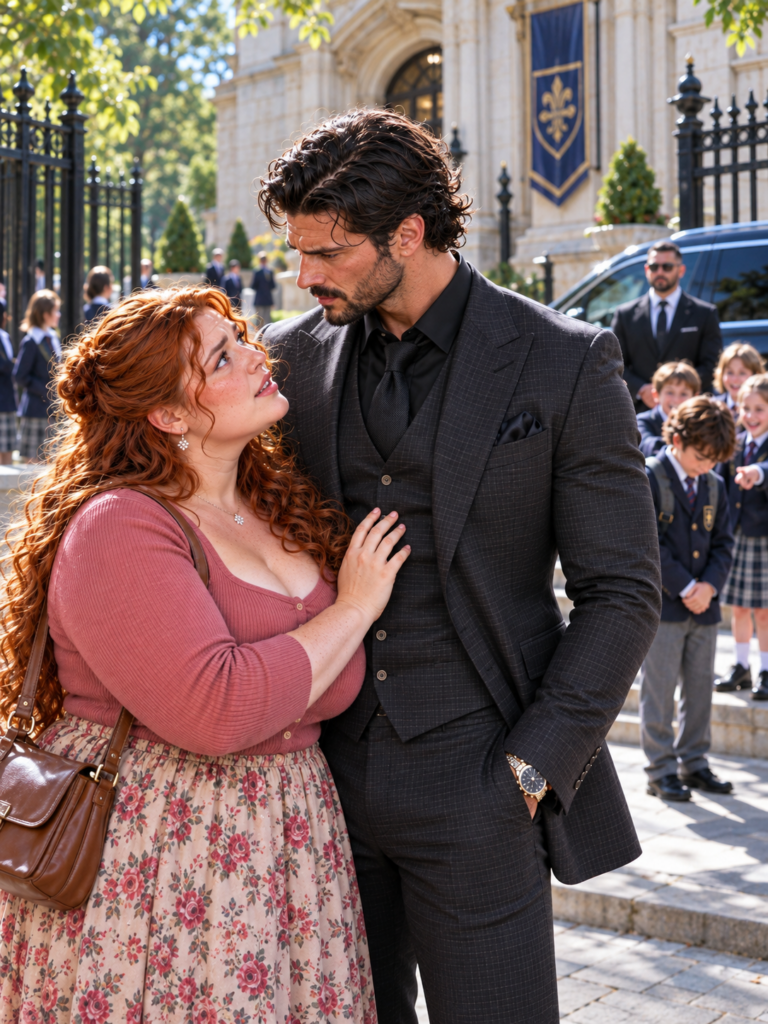
Part 1
At eight o’clock on a Wednesday morning, Rafael Moretti sat across from a man who had just realized that begging would not save him.
The man’s shirt collar was damp. His lawyer stood against the wall with a briefcase held tightly against one leg, looking as though he regretted every decision that had brought him into the room.
Rafael, meanwhile, appeared perfectly comfortable.
His dark gray suit was immaculate. His broad shoulders rested against the chair, and his tattooed hands lay loosely folded on the table.
Forty thousand dollars had disappeared from an account under his control.
The man across from him had taken it.
But the missing money wasn’t what concerned Rafael.
“You told three people I wouldn’t find out,” he said.
The man swallowed. “Mr. Moretti, I can explain—”
“You’ve been explaining for twenty minutes.”
“I’ll return every dollar.”
“I know.”
The man’s eyes flickered with something dangerously close to relief.
Rafael noticed.
He noticed everything.
“What troubles me,” Rafael continued, “is that you believed I could be careless enough not to notice. And then you encouraged other people to believe it.”
The relief disappeared.
Rafael adjusted his cuff.
“You’ll have the money back by Friday. And you’ll speak to those same three people. You’ll tell them you misjudged me.”
The man nodded frantically.
“Not that I frightened you. Not that I threatened you. Simply that you were wrong.”
Rafael stood, fastened his jacket, and walked out without another word.
No one moved until the door closed.
That was how Rafael Moretti handled business.
He was a man whose name made conversations stop when he entered restaurants. A man who owned legitimate businesses, controlled far less legitimate arrangements, and understood that fear was most useful when it required no demonstration.
He had spent most of his adult life constructing a reputation so formidable that strangers crossed streets to avoid his attention.
What happened twenty-eight minutes later would have bewildered every person who feared him.
Because at precisely 8:28 each weekday morning, a six-year-old boy walked past Rafael’s black luxury sedan and pretended it belonged to his father.
The little boy’s name was Theo Cross.
And his father had never been part of his life.
Sadie Flynn had learned that children could break your heart without knowing they were doing it.
Sometimes they accomplished it with an innocent question.
Sometimes with a drawing.
And sometimes with a lie they desperately needed to believe.
“That’s Daddy’s car.”
Theo announced it as they passed the polished black sedan parked outside Alder & Vine, a discreet corner café two blocks from Bellwood Elementary.
Sadie looked down at him.
Her copper-red hair was twisted into a loose bun, and the morning breeze had already pulled strands free around her cheeks. Her soft, curvy figure was wrapped in a comfortable cardigan, one pocket containing a dinosaur-shaped eraser Theo insisted was lucky.
“That one?” she asked.
Theo gave her a patient look.
He had explained this four mornings in a row.
“Yes. The big black one.”
“Right.”
“He’s very important.”
“I’m sure he is.”
“He has important things to do, so he can’t come inside the school.”
Sadie’s smile hurt.
Theo spoke with the solemn certainty of someone defending an established fact.
There was no father arriving late from business trips. No father stationed overseas. No father recovering from illness.
Theo’s biological father had vanished from his life before the child was old enough to remember him.
His mother, Vivian Cross, was a successful executive who ran a logistics company and spent much of her time negotiating contracts in cities far from home.
She loved her son.
Sadie believed that.
But love expressed through expensive birthday presents and brief video calls was difficult for a six-year-old to hold.
Vivian had been in Singapore for nineteen days.
Sadie had been Theo’s nanny for two years.
In that time she had handled scraped knees, stomach bugs, school projects, nightmares, birthday cakes, and the delicate tragedy of a dinosaur toy broken beyond repair.
She knew which cereal Theo liked and which socks he refused to wear.
She knew the exact moment his breathing changed when he finally fell asleep.
And she knew the difference between his real smile and the brave little expression he wore when someone asked about his parents.
“Theo,” she said gently as they approached the school, “you know you don’t have to tell the other children about that car.”
“I’m not telling them about the car.”
He sounded offended by the misunderstanding.
“I’m telling them about my dad.”
Then he squeezed her fingers once, let go, and marched toward the school gates.
Sadie watched him straighten his shoulders.
He was preparing for battle.
She didn’t have to wait long to see why.
Three older boys stood beside the climbing frame.
One leaned toward the others, pointed at Theo, and said something.
Laughter followed.
Theo stopped walking.
His small shoulders rose. His hands went rigid beside his backpack.
He didn’t cry.
He didn’t argue.
He simply stood there, holding himself so still that Sadie felt something twist painfully inside her.
By the time she reached the fence, the boys had wandered away.
Theo continued toward his classroom.
He never looked back.
That evening, Sadie discovered a folded notice inside Theo’s backpack.
BELLWOOD FAMILY NIGHT — THURSDAY, 6:00 P.M.
Families were invited to bring a special adult to celebrate something the child could feel proud of.
Fathers, mothers, grandparents, uncles, and other important people were welcome.
One word had been circled in blue crayon.
Fathers.
Sadie recognized Theo’s handwriting beside it.
A tiny, hopeful question mark.
She called Vivian immediately.
An assistant answered.
“Ms. Cross is in meetings through the weekend. Is this urgent?”
Sadie glanced toward Theo’s bedroom.
Light glowed beneath the door.
He was reading his dinosaur book again, probably whispering the names of prehistoric creatures as though memorizing them could protect him from the world.
“It’s his school,” Sadie said. “There’s an important family event on Thursday.”
“I’ll make sure she receives a message.”
The assistant’s tone was polite.
Professional.
Final.
Sadie ended the call and sat on the kitchen floor.
She imagined Theo standing in a classroom surrounded by children with fathers beside them.
She imagined the three boys at the climbing frame.
And she imagined the long black car outside Alder & Vine.
The idea that formed was ridiculous.
Dangerous, perhaps.
Certainly irresponsible.
But by midnight, she could think of nothing else.
The following morning, Sadie left Theo at school and walked back toward the café.
Alder & Vine was elegant without being flashy. Tall windows admitted the morning light. Dark wood tables stood beneath brass fixtures, and the air smelled of freshly ground coffee.
Behind the counter, a large man polished a glass.
At the window table sat Rafael Moretti.
He wore a charcoal suit, a crisp white shirt, and an expression that suggested he rarely encountered interruptions he hadn’t authorized.
In person, he was even more intimidating than Sadie had expected.
His shoulders were broad, his dark hair swept back neatly, and a short black beard emphasized the severe lines of his face. Ink extended from beneath one sleeve across the back of his hand.
His eyes lifted when the bell above the door rang.
The sensation was startling.
It felt as though a spotlight had found her.
“We’re not receiving visitors until nine,” he said.
His voice was low and controlled.
“Franco can get you coffee at the counter.”
“I don’t want coffee.”
For an instant, one of his eyebrows moved.
Sadie crossed the room and sat directly opposite him.
Behind the counter, the man holding the glass stopped polishing.
Near the entrance, another large man shifted forward.
Rafael raised two fingers slightly.
Both men froze.
He regarded Sadie for several seconds.
“All right,” he said. “You have my attention.”
Sadie clasped her hands beneath the table to stop them shaking.
“There’s a little boy.”
Rafael said nothing.
“He’s six. I take care of him. And he’s been telling people at school that his father owns a beautiful black car.”
Rafael glanced briefly toward the street.
Sadie followed his gaze.
“Your car.”
Silence settled between them.
“He’s been pointing at it every morning,” she continued. “He says you’re an important man who can’t come to school because you have important things to do.”
Rafael’s face remained unreadable.
“He doesn’t really have a father in his life. Some boys have been bullying him, and tomorrow there’s a family night at school.”
Her throat tightened.
“All the other children will have someone. And he thinks—”
She stopped.
The words suddenly sounded even more absurd spoken aloud.
Rafael waited.
“He thinks you’re his father.”
For the first time, the man at the window appeared genuinely surprised.
Sadie forced herself to continue.
“I’m asking you to come to his school tomorrow evening. Just for an hour. Let him stand beside you and introduce you.”
Rafael slowly placed his coffee cup on its saucer.
“You want me to pretend to be a six-year-old’s father.”
“Yes.”
“A child I’ve never met.”
“Yes.”
“And you’ve decided to ask a complete stranger to do this?”
Sadie met his eyes.
“I don’t think either of us believes you’re an ordinary stranger.”
A flicker of interest crossed his face.
“Then you understand why this is a poor idea.”
“I understand it’s crazy.”
“Do you know who I am?”
“I know this café belongs to you. I know that car is yours. And I know your men moved when I walked in, then stopped because you lifted two fingers.”
She glanced toward the doorway.
“I can make a reasonably educated guess.”
Rafael leaned back.
“Then my answer is no.”
Sadie felt her courage leave her all at once.
She nodded and pushed back her chair.
“Of course. I’m sorry I bothered—”
“Sit.”
It wasn’t shouted.
It didn’t need to be.
She sat again.
“You came here with an honest request,” Rafael said. “You deserve an honest explanation.”
He looked out at the street.
“Men like me don’t belong beneath bright lights in rooms full of children. People are afraid of us. Sometimes they’re right to be. If you bring that boy beside me, you may give the people teasing him something worse to use against him.”
Sadie listened.
And then she said, “They’re hurting him already.”
His eyes returned to hers.
“He stands alone in the playground while other children laugh at him. He makes up a father because he can’t bear having none. I know you’re not a safe choice by ordinary standards, Mr. Moretti.”
She drew a careful breath.
“But he chose you.”
Rafael became very still.
“Explain that.”
“He could have pointed to anyone. There are dozens of cars on that street every day.”
She gave a helpless little smile.
“He picked yours.”
Something changed behind Rafael’s eyes.
Not softness, exactly.
Recognition.
“What did he say about me?”
Sadie repeated Theo’s words.
“That you’re important. That you do important things. And that you can’t come inside.”
Rafael lowered his gaze.
For several seconds, he seemed impossibly far away.
He was remembering another child, long before anyone had been frightened of the name Moretti.
A boy standing beside a second-floor window.
A boy inventing stories about a man who sometimes parked across the street.
A boy who had needed a father so badly he had constructed one from a stranger and an automobile.
Finally, Rafael looked up.
“Tomorrow. What time?”
Sadie blinked.
“Six.”
“One hour,” he said. “He introduces me. I stay beside him. Then I leave. There are no obligations after that.”
She stared at him.
“You’re serious?”
“Very.”
“Thank you.”
He waved the gratitude away.
“What’s his name?”
“Theo.”
He repeated it quietly, as though committing it to memory.
“And yours?”
“Sadie Flynn.”
“Rafael.”
“I know.”
The faintest suggestion of amusement touched his mouth.
“I assumed you might.”
Rafael Moretti arrived at Bellwood Family Night dressed like a man preparing to negotiate the purchase of the building.
His three-piece suit was worth more than most of the cars in the parking lot.
His expression suggested he was assessing the security arrangements.
And beside him stood Sadie Flynn, wondering whether she had made the worst or best decision of her life.
Theo wore a blue shirt embroidered with a tiny dinosaur.
He had changed clothes four times before settling on it.
His explanation had been simple.
“This is my interview shirt.”
Now, seeing Rafael in the doorway, he stopped breathing for a moment.
“You’re real,” Theo whispered.
Rafael looked down.
“Last time I checked.”
“You’re the car man.”
“I am.”
Theo’s eyes widened.
“I told people you’re my dad.”
Rafael crouched.
The movement drew several astonished glances from parents nearby.
“I’m sorry,” Theo rushed to say. “I know I made it up. I can tell everyone.”
Rafael extended his tattooed hand.
“You told them I was important.”
Theo nodded miserably.
“And that I had important work.”
Another nod.
“Those things happen to be true.”
Theo looked confused.
“You only made one mistake.”
“What?”
“You said I couldn’t come inside.”
Rafael gave him a small, serious smile.
“Apparently, I can.”
Theo placed both of his small hands around Rafael’s enormous one.
Sadie looked away before either of them could see the tears gathering in her eyes.
Inside the classroom, Miss Paine had arranged small chairs in a circle.
Rafael examined one with visible suspicion.
He sat anyway.
The chair creaked.
Across the room, Sadie pressed her lips together to keep from laughing.
Miss Paine welcomed the families and invited the adults to share something they admired about their children.
A father in a golf shirt delivered an enthusiastic account of his daughter’s swimming times.
Before he had finished, Theo’s hand shot up.
Miss Paine smiled.
“Theo, would you like to go next?”
He sprang to his feet.
“This is my dad!”
He said it with the pride of someone introducing a king.
“And he’s very proud of me because…”
Theo stopped.
His confidence evaporated.
He hadn’t planned beyond the introduction.
Every face turned toward Rafael.
Sadie held her breath.
Rafael rose slowly from the tiny chair.
“I’m proud of Theo,” he said, “because last week, three older boys made fun of him in the playground.”
The classroom grew quiet.
“He didn’t strike them. He didn’t run away. He stood there, even though he was frightened.”
Rafael looked down at Theo.
“I’ve known grown men who couldn’t manage that much courage.”
Theo’s lips parted.
“He went home afterward and continued with his day. And he came back to school. That takes more strength than people realize.”
Rafael rested a hand lightly on the boy’s shoulder.
“This young man is braver than plenty of adults twice my size.”
Nobody laughed.
Nobody moved.
Theo looked as though someone had opened a window inside his chest and let sunlight pour through.
By the window, three boys who had been whispering earlier sat very quietly.
Sadie would remember that moment for the rest of her life.
But it was only the beginning.
Family Night included a parent-child relay race in the gymnasium.
Theo wanted to participate.
Naturally, he wanted Rafael beside him.
Rafael examined the spoon and egg he had been given.
“You’re certain this is necessary?”
Theo nodded.
“All the dads are doing it.”
Rafael glanced toward Sadie.
She was smiling much too broadly.
“Don’t look at me,” she said. “You agreed to Family Night.”
“I agreed to stand beside him.”
“Well, now you’re standing beside an egg.”
Theo tugged his sleeve.
“Come on, Dad.”
The word stopped Rafael more effectively than any threat ever had.
He followed.
They lost the race spectacularly.
Halfway down the gym, their egg rolled off the spoon.
Rafael stopped, crouched, recovered it with extraordinary care, and continued with Theo beside him.
They crossed the finish line last.
Theo laughed so hard he could barely stand.
Later, at the refreshments table, another child accidentally spilled grape juice across Rafael’s expensive jacket.
The boy went pale.
Sadie watched several adults brace for an explosion.
Rafael looked at the spreading purple stain.
Then at the terrified child.
“Interesting,” he said. “I’ve been considering a different color for this jacket. Perhaps you’ve made the decision easier.”
The boy let out a nervous laugh.
The nearby parents relaxed.
Sadie didn’t.
Because at that exact moment, she noticed a man across the gymnasium recognize Rafael.
Mr. Delgado, a loud car salesman she had met at school pickups, stopped walking.
His face drained of color.
He retreated toward a corner and spent the rest of the evening watching the exits.
Sadie understood then that Rafael’s warnings had not been exaggerated.
People truly were frightened of him.
And she had brought him into a school.
Yet when she looked back, she saw him helping Theo clean grape juice from his fingers.
It was difficult to reconcile the two images.
After Family Night, Sadie walked Rafael toward his car.
Theo was nearly asleep, leaning against the man’s leg.
His small hand held two of Rafael’s fingers.
Rafael glanced toward the parking lot.
“You saw Delgado.”
“Yes.”
“You understand now.”
Sadie considered the sleeping child.
“I understand people are afraid of you.”
“And?”
“I also watched you run a relay race with an egg because a little boy didn’t want to run alone.”
Rafael said nothing.
“Tonight,” she added, “that matters more to me.”
He looked at her for a long moment.
Then he carefully untangled his fingers from Theo’s sleepy grip.
“That was our hour, Miss Flynn.”
“I know.”
“Take him home.”
Sadie nodded.
Rafael entered the black sedan.
Its taillights disappeared down the street.
And that should have been the end.
For four days, it was.
Then Tuesday arrived.
At three o’clock, Sadie found Theo sitting on the low wall outside Bellwood Elementary.
His backpack remained strapped to his shoulders.
His eyes were fixed on the street corner.
“Sweetheart, what are you doing?”
“Waiting for Dad.”
Her heart sank.
“Theo, remember what we discussed? Thursday was something special.”
“He’s coming.”
“He has work, honey.”
Theo shook his head.
“He said he can come inside now.”
Sadie crouched before him.
She couldn’t decide whether it would be crueler to explain the truth or let him wait for someone who wasn’t coming.
Then, at 3:03, a black sedan turned the corner.
It pulled up beside the curb.
The window lowered.
Rafael Moretti looked from Theo to Sadie.
“I happened to be nearby.”
It was a lie.
He had rescheduled two meetings and driven across the city.
Sadie knew it.
Rafael knew she knew.
Neither mentioned it.
Theo jumped down from the wall.
“You came!”
Rafael studied the boy’s delighted face.
Then he opened the car door.
“I remembered school finishes at three.”
Theo climbed inside.
Sadie followed, still trying to understand what was happening.
Rafael drove them home.
The next afternoon, the car appeared again.
And the afternoon after that.
Soon Rafael stopped pretending his presence was coincidental.
Every day, the most feared man in the city arrived outside an elementary school at three o’clock.
Every day, a little boy ran toward him.
And somewhere beneath the expensive suits, the polished reputation, and the life he had built around keeping people away, Rafael Moretti began to understand what it felt like to be someone a child expected to see.
More dangerously still, he began to want to deserve that expectation.
Part 2
The first thing Rafael learned about Theo was that the boy took his dinosaurs extremely seriously.
He could identify forty different species from pictures, knew which ones lived during the Jurassic period, and considered anyone who confused a velociraptor with a larger carnivore to be dangerously uninformed.
The second thing Rafael learned was that Theo couldn’t tie his own shoes.
This discovery occurred on an ordinary afternoon outside Bellwood Elementary.
Theo was attempting to secure his sneakers when Rafael noticed the hopeless arrangement of loops hanging from his fingers.
“Who taught you to do that?”
Theo looked up.
“Nobody. That’s the problem.”
Rafael considered the tangled laces.
Then he lowered himself onto one knee.
“All right. Watch.”
He demonstrated the familiar method of making two loops.
Theo copied him.
The knot collapsed.
They tried again.
And again.
By the eleventh attempt, Rafael’s expensive trousers were collecting dust from the sidewalk.
Theo was becoming increasingly frustrated.
“I can’t.”
“You haven’t done it yet,” Rafael corrected. “That isn’t the same thing.”
Theo frowned and tried once more.
This time, the knot held.
His face brightened.
“I did it!”
“Yes.”
“By myself!”
“Yes.”
Theo untied the shoe immediately.
Rafael stared at him.
“What are you doing?”
“Making sure I can do it again.”
Something resembling pride settled beneath Rafael’s ribs.
They practiced a twelfth time.
When Theo succeeded, Rafael offered his hand.
Theo shook it solemnly.
Then he decided ordinary handshakes were boring.
Within a week, they had invented a four-part greeting involving two taps, a turn of their hands, and a finger snap at the end.
Theo insisted on performing it whenever they met.
Even when Rafael was speaking to men who controlled entire businesses.
Especially then.
Sadie watched these developments with a mixture of amusement and disbelief.
The man who could make grown adults sweat with a single look now carried dinosaur books in the back of his car.
He knew which snacks Theo preferred after school.
He had opinions about the boy’s handwriting.
And whenever Theo began talking about a new prehistoric discovery, Rafael listened as though the information might affect a major financial decision.
Sadie began noticing smaller things.
When Theo climbed into the car, Rafael waited until the seat belt was secure before moving.
When the boy talked, he didn’t interrupt.
When Theo made a mistake, Rafael corrected him without making him feel foolish.
These weren’t grand gestures.
Nobody would photograph them.
Nobody would whisper about them in restaurants.
But to Sadie, they revealed more about Rafael than his reputation ever could.
And Rafael was noticing her, too.
He noticed that she always served Theo first.
That she often ate while standing beside the kitchen counter, as though sitting down for a meal was a luxury she hadn’t earned.
That she hummed when she believed nobody was listening, usually repeating the same line of a song before stopping abruptly.
He learned that she had once wanted to become a teacher.
When he asked about it, she said only, “Life took a different direction.”
He didn’t press.
He understood what it meant to keep certain memories behind locked doors.
They developed a peculiar intimacy without ever discussing it.
She could recognize his car by the quiet way its engine approached the curb.
He could tell from the set of her shoulders whether Theo had enjoyed school or endured it.
Sometimes their hands nearly touched when they passed a backpack between them.
Neither acknowledged those moments.
But neither forgot them.
On a rainy Thursday afternoon, they waited inside Rafael’s parked car while water hammered against the windshield.
Theo occupied the back seat, singing a dinosaur song with tremendous enthusiasm and absolutely no concern for musical accuracy.
Rafael handed him a tissue before the boy even realized he needed one.
Sadie smiled.
“You’re remarkably good at this.”
“At handing out tissues?”
“At taking care of him.”
Rafael looked toward the school gates.
“You sound surprised.”
“I am surprised. You act like someone who’s been doing this for years.”
“I haven’t.”
“Then where did you learn?”
He remained quiet long enough for Sadie to regret asking.
Finally, he spoke.
“From having nobody teach me.”
She turned toward him.
Rafael watched rainwater trace crooked paths down the glass.
“When I was around Theo’s age, there was a window in the second-floor room where I lived. I spent a great deal of time standing beside it.”
Sadie didn’t interrupt.
“A man used to park across the street. I never knew his name. I think he was a salesman. He came by on certain afternoons.”
Rafael rested his tattooed hand on the steering wheel.
“I decided he was my father.”
Sadie went completely still.
“I told other boys he was important. That he had responsibilities. That he couldn’t come upstairs because he was too busy with important work.”
The resemblance to Theo’s story struck her so hard that she could barely breathe.
“Was he?” she whispered.
“My father?”
She nodded.
“No.”
Rafael’s expression remained composed, but there was something unguarded in his voice.
“My real father was not a subject people discussed at home. So I invented someone else. I imagined where he worked, what he would say, what he might bring me.”
He gave a humorless little smile.
“I knew the schedule of a man I’d never spoken to better than I knew some people who actually lived near me.”
Sadie glanced toward Theo.
The boy was still singing.
Completely unaware.
“So when I told you what Theo said…”
Rafael nodded.
“Those words were familiar.”
He turned to face her.
“I didn’t agree to that school night because you were persuasive, Sadie. I agreed because I remembered the window. And I remembered how long a boy can wait for someone who will never climb the stairs.”
Sadie’s eyes filled.
Rafael looked toward the back seat.
“Theo chose a stranger’s car the way I once did.”
“But you came.”
“Yes.”
“That makes the difference.”
For several moments, neither spoke.
Then Rafael said something that stayed with her.
“He doesn’t have to invent me anymore.”
Sadie looked at his profile, at the man the city feared, and understood that the greatest danger he faced had nothing to do with rival criminals or business enemies.
He had allowed himself to love someone.
And once he did, he would never again be able to pretend he had nothing to lose.
Theo’s life began changing in ways that had little to do with Rafael’s wealth or reputation.
He made friends.
Real ones.
The first was Priya, a solemn little girl who considered correcting dinosaur facts a public service.
The second was Max, a cheerful boy whose proudest achievement was being able to burp the alphabet through the letter G.
On Saturdays, the two children visited Theo.
They spread dinosaur figures across the living room floor and constructed entire prehistoric landscapes using cushions, blankets, and whatever household objects Sadie permitted them to borrow.
The first time they met Rafael, both went quiet.
Max stared at the enormous man sitting on the carpet.
“Is that your dad?”
Theo considered the question.
Rafael kept his eyes on the dinosaur book in his hands.
Finally, Theo answered.
“He’s the one who comes.”
Sadie felt the words settle inside her.
Not the one with the expensive car.
Not the powerful man.
Not the man who frightened other fathers.
The one who came.
Rafael turned a page slowly.
He didn’t look up.
But Sadie noticed that his hand remained still on the paper for several seconds.
Then Priya announced that he had pronounced Deinonychus incorrectly.
Rafael accepted the correction with grave seriousness.
“Thank you. I prefer accurate information.”
Priya nodded, satisfied.
Most adults, she explained, didn’t appreciate being corrected.
Rafael assured her that most adults were foolish.
From the doorway, Gigi watched the exchange as though his understanding of the universe was collapsing.
Gigi had served as Rafael’s driver and trusted shadow for nine years.
He had seen his boss negotiate dangerous agreements, outmaneuver powerful enemies, and make difficult men surrender without raising his voice.
But watching Rafael lose an argument to a seven-year-old girl about a dinosaur was entirely new territory.
Later, when Sadie found Gigi examining the house’s entrance, he spoke in a lowered voice.
“I still don’t understand the operation.”
Sadie blinked.
“What operation?”
“The school. The child. These afternoon visits.”
“There is no operation.”
Gigi looked unconvinced.
“That’s what an excellent operation would require everyone to believe.”
Sadie laughed.
“He’s just a little boy, Gigi.”
The driver looked toward the living room.
Rafael was holding a plastic dinosaur while Theo explained its diet.
After a long moment, Gigi adjusted his tie.
“Then perhaps,” he said reluctantly, “this is the one thing he’s doing that isn’t a cover.”
He paused.
“Which means it’s probably the most important thing I have to protect.”
And Gigi took that responsibility very seriously.
Far too seriously, in Sadie’s opinion.
He began arriving early at Bellwood Elementary.
He memorized the pickup arrangements and examined the exits.
On one memorable afternoon, a crossing guard reached suddenly into her jacket for a whistle.
Gigi reacted so sharply that Sadie had to step between them before the woman understood why a large man in a dark suit was staring at her hand.
“You cannot treat the crossing guard like a security threat,” Sadie informed him afterward.
“She moved quickly.”
“She was getting a whistle.”
“People conceal things in jackets.”
“Yes. Occasionally, whistles.”
Gigi remained dissatisfied.
But he listened.
Mostly.
The school fair presented an entirely different challenge.
It was a cheerful Saturday event involving lemonade, ring toss, a brightly colored inflatable castle, and a three-legged race.
Theo wanted to attend.
That meant Rafael would attend.
And that meant Gigi arrived an hour early to inspect the grounds.
Sadie found him staring suspiciously at the inflatable castle.
“It’s not going to attack anyone,” she said.
Gigi looked at the enormous structure as it swayed in the breeze.
“It’s unstable.”
“It’s full of air.”
“Exactly.”
She handed him lemonade.
He accepted it with the resignation of a man who had been assigned a deeply unreasonable mission.
Across the playground, Theo had managed to enter himself and Rafael in the three-legged race.
Rafael discovered this when Miss Paine appeared with a yellow ribbon.
“I believe these belong together,” she said brightly, indicating their ankles.
Rafael looked down.
Then at Theo.
“I don’t run.”
“You ran with the egg.”
“That was a regrettable exception.”
Theo thought about it.
“Dads make mistakes.”
Sadie turned away to hide her laughter.
Rafael gave her a warning look.
It had absolutely no effect.
A minute later, the city’s most intimidating businessman stood on a school field with one ankle tied to a six-year-old boy’s.
They moved three steps.
Stumbled.
Recovered.
Then fell together near the finish line.
Theo landed on the grass in a helpless fit of giggles.
Rafael lay beside him, staring at the sky as though reconsidering every decision that had brought him to this point.
They finished last again.
Theo declared it the greatest race of his life.
Later, at the ring-toss booth, the boy’s happiness began to fade.
He missed his first throw.
And his second.
And every throw after that.
As the other children collected small prizes, his shoulders slowly sank.
Rafael crouched beside him.
“What’s wrong?”
“I can’t do it.”
“You’re looking at the wrong thing.”
Theo frowned.
“The ring?”
“Precisely. You keep watching the ring leave your hand. Instead, look at where you want it to land.”
Rafael pointed toward the farthest peg.
“Choose your target. Keep your eyes there.”
Theo stared at it.
“Even if I look silly?”
“Especially then.”
He handed the boy his final ring.
“Where do you want it?”
“That peg.”
“Then keep looking.”
Theo threw.
The ring sailed through the air and settled around the peg.
His shout was so loud that several parents turned.
“I DID IT!”
Rafael smiled.
A real smile this time.
Theo grabbed another ring and hurried back into the game.
“How did you know that would work?”
Rafael considered the question.
“Because most things require you to decide what matters and keep your attention there.”
“Like dinosaurs?”
“Certainly.”
“And tying shoes?”
“Yes.”
“And dads?”
Rafael looked at him.
Theo was already studying the next peg.
“Especially those,” Rafael answered quietly.
Across the field, Mr. Delgado had been observing the scene.
The car salesman still looked nervous whenever Rafael came near.
But now he watched the feared man kneeling in the grass, offering advice to a child struggling with a carnival game.
Whatever frightening image he carried of Rafael Moretti did not fit what he was seeing.
When Theo landed another ring, Delgado hesitantly raised a thumb.
Theo returned the gesture.
He had no idea how extraordinary that small exchange was.
Later, Sadie sat beside Rafael with a paper cup of lemonade.
“You realize you’re ruining your reputation.”
Rafael watched Theo proudly show Priya his prize.
“Good.”
She smiled.
“Good?”
“Maintaining it has been expensive.”
He looked at her.
“And it never made me particularly happy.”
The words were delivered casually.
But Sadie heard the confession beneath them.
She was beginning to care for him in a way that frightened her.
Not because of the things people said about Rafael Moretti.
Because each ordinary afternoon made it harder to imagine him leaving.
Vivian Cross returned from Singapore the following Thursday.
By then, Rafael had been picking Theo up from school for three weeks.
Sadie told Vivian everything.
She believed a parent deserved to know who had become part of her child’s life, even when that parent had been absent long enough to miss the beginning of it.
Vivian listened in her kitchen, dressed in an impeccable business suit, with a cup of coffee cooling between her hands.
“Let me make sure I understand.”
Her voice was controlled.
“A man has been collecting my son from school every afternoon?”
“Not alone. I’ve been with them.”
“For three weeks.”
“Yes.”
“And this began because Theo told classmates that a stranger was his father?”
Sadie nodded.
“Who is the stranger?”
She had rehearsed the answer.
It still felt dangerous.
“Rafael Moretti.”
Vivian set down her cup.
For the first time since entering the room, her professional composure faltered.
“Moretti?”
“Yes.”
“Rafael Moretti?”
Sadie nodded again.
Vivian stood abruptly.
She walked toward the window and stared into the garden.
“I know that name. People in my industry know that name.”
Sadie waited.
“Do you understand what would happen if anyone connected my company with him? Do you know what people would say if they discovered my son was riding around with a man like that?”
“He’s been good to Theo.”
“That’s not an answer.”
“It’s the most important answer.”
Vivian turned.
“You’re not seeing the risk.”
“I am seeing it.”
“No, Sadie. You’re seeing a man who behaves pleasantly around a little boy. I’m seeing the possibility of my son becoming associated with organized crime.”
Sadie’s throat tightened.
She had no easy response.
Vivian wasn’t inventing the danger.
Even Rafael had acknowledged it.
But Sadie had seen the other danger.
The danger of a child believing nobody would ever come for him.
“Theo has changed,” she said. “He has friends now. He smiles when he leaves school. He doesn’t spend every morning trying to convince people he has a father.”
Vivian pressed her fingertips to her temples.
“I’ll enroll him in an appropriate after-school program.”
“Vivian—”
“Somewhere supervised. Somewhere with proper credentials.”
“That’s not what he needs.”
“I’m paying you to keep my son safe, Sadie. Not to find him a criminal and call him Daddy.”
The words struck harder than Vivian intended.
Sadie stood very still.
Then she spoke quietly.
“You pay me to look after him.”
Vivian’s expression hardened.
“And that includes his emotional wellbeing.”
“I know.”
“Do you?”
Sadie had never spoken to her employer this way.
Not in two years.
But she could no longer swallow what needed to be said.
“You pay me to keep him safe. I’ve been making sure he feels loved, too. I’ve done that without asking for another dollar.”
Vivian looked away.
“Someone had to be there when he was frightened,” Sadie continued. “Someone had to know about his school events and his favorite books and the boys who laugh at him.”
“Sadie.”
“And for nineteen days you were in Singapore.”
The silence that followed was terrible.
Neither woman moved.
Sadie immediately regretted the cruelty in her last sentence.
But she didn’t regret the truth beneath it.
Vivian finally spoke.
“Tomorrow, tell Mr. Moretti this arrangement is over.”
Sadie’s stomach tightened.
“He cannot continue.”
“Vivian—”
“I mean it.”
Her employer picked up the untouched coffee.
“And Sadie?”
Sadie looked up.
“Thank you for caring about Theo. I do mean that.”
It made the decision harder to bear.
Because Vivian wasn’t heartless.
She was frightened.
And frightened people often tried to control whatever they could.
Sadie told Rafael the next afternoon beside his car.
Theo was playing with a classmate several yards away.
Rafael listened without interrupting.
When she finished, he looked toward the playground.
“She’s right.”
Sadie stared.
“No, she isn’t.”
“She is.”
“Rafael, after everything you’ve done—”
“I told you from the beginning that I’m a risk.”
His expression was unreadable.
“Every day I come here, more people see what that boy means to me. Eventually someone may decide that’s useful information.”
Sadie felt a chill.
“You think someone would hurt him?”
“I think dangerous men pay attention when other dangerous men begin caring about something.”
He looked at her.
“I can’t pretend that isn’t true simply because I enjoy being here.”
“Then what about Theo?”
Rafael watched the boy laughing.
For a moment his face changed.
Sadie saw the cost of his decision.
“He’ll remember me kindly,” Rafael said. “That’s better than allowing my life to harm him.”
“You’re talking as though leaving won’t hurt him.”
Rafael didn’t answer.
Theo ran toward them.
“Did you see? Max can burp another letter!”
Rafael crouched.
“Impressive progress.”
Theo offered his hand.
They performed their four-part handshake.
Two taps.
A turn.
A snap.
Then Rafael spoke carefully.
“I have some work that will keep me away for a while.”
Theo’s smile faltered.
“How long?”
“I’m not certain.”
“But you’ll come back.”
Rafael swallowed.
It was such a small movement that anyone else might have missed it.
Sadie didn’t.
“You said you can come inside now,” Theo reminded him.
Rafael rested his hand briefly against the boy’s shoulder.
“I remember.”
He stood.
And for the first time since Sadie had known him, Rafael Moretti appeared unsure of what to say.
He entered the car.
Gigi closed the door.
The black sedan pulled away.
Theo stood watching until it disappeared.
Sadie took his hand.
She hated herself a little for introducing him to someone who could leave.
And hated herself more for understanding why Rafael believed he had to.
Three days later, a man named Dean Marsh returned to the city.
He was Theo’s biological father.
He had been absent for six years.
And his sudden interest in becoming a parent had nothing to do with love.
Part 3
Dean Marsh had never shown much interest in the responsibilities of fatherhood.
He had not been there when Theo learned to walk.
He had not helped with school enrollment, doctor visits, sleepless nights, or birthdays.
He had not called to ask whether the boy was healthy.
For six years, he had been a name attached to an absence.
Now he wanted custody.
The timing was no coincidence.
Vivian Cross’s logistics company was in the middle of a potentially lucrative sale. The transaction involved enough money to attract the attention of men who considered human relationships useful negotiating tools.
Dean had discovered that a child could become leverage.
And someone had offered to finance his attempt.
That man was Silas Finn.
Finn had spent two years looking for a vulnerability in Rafael Moretti’s otherwise carefully controlled life.
He had tried to find weaknesses in business arrangements and personal loyalties.
He understood Rafael’s reputation.
He understood the way fear worked around him.
But fear was difficult to use against a man who had spent decades mastering it.
Then photographs began circulating of a black luxury sedan outside Bellwood Elementary.
A small boy climbed inside each afternoon.
And Rafael Moretti was there to welcome him.
Finn finally recognized an opportunity.
Rafael cared about the child.
That made Theo valuable.
“You don’t need to defeat Moretti in one of his own rooms,” Finn told Dean during a private meeting.
Dean sat opposite him, looking uncomfortable in a suit that didn’t quite fit.
“Then what do you want me to do?”
“Ask for custody.”
Dean frowned.
“Vivian won’t agree.”
“She won’t want to fight, either.”
Finn explained the situation with the patience of a man describing a financial calculation.
Vivian’s work required frequent international travel. Dean could argue that she was an absent parent who had delegated her son’s upbringing to a nanny.
There were photographs of Theo waiting outside school.
There were records of Vivian’s travel.
There was also Rafael.
“If Moretti intervenes,” Finn said, “we bring his involvement into a courtroom. A biological father seeking custody looks sympathetic beside an alleged criminal trying to control a child who isn’t his.”
Dean shifted in his chair.
“And if he stays away?”
“Then Vivian faces a damaging custody dispute during the sale of her company. She may decide to settle.”
Dean looked down at the paperwork.
“What’s in it for me?”
Finn smiled.
That question, at least, was easy to answer.
The custody petition reached Vivian’s attorney on Monday.
By Monday evening, Vivian was sitting at Sadie’s kitchen table.
She looked nothing like the woman who had returned from Singapore and announced that everything would be handled properly.
Her hair was still neat.
Her coat was still expensive.
But both hands trembled around her coffee cup.
“He’s requesting supervised temporary custody,” she said. “With a path toward full custody.”
Sadie sat opposite her.
“Dean?”
Vivian nodded.
“He’s using my travel schedule. He says I leave Theo with other people while I fly around the world.”
She looked down.
“And he has photographs.”
“What photographs?”
“Theo waiting outside the school.”
Sadie felt something cold move through her.
Vivian continued.
“The ones taken when he was waiting for Rafael. When you were standing beside him.”
“How did he get them?”
“That’s what I want to know.”
Sadie thought about the black sedan.
Rafael’s warning.
The possibility that someone had discovered what Theo meant to him.
“Someone was watching the school,” she said.
Vivian looked up.
“Why?”
“Because Rafael was there.”
Sadie paused.
“Who is paying Dean’s legal expenses?”
Vivian’s expression changed.
“My attorney found a connection to someone named Silas Finn.”
The name meant little to Sadie.
But the circumstances meant everything.
“This isn’t about Dean wanting to raise Theo.”
“I know.”
Vivian’s voice cracked.
“I know he doesn’t want him.”
For the first time in two years, Sadie saw fear overwhelm the executive’s polished exterior.
“If the case goes to court, they’ll bring up Rafael. They’ll bring up my absences. If I settle, I could be handing my son to a man who only wants money.”
She stared at her hands.
“I don’t know what to do.”
It was the most honest thing Sadie had ever heard her say.
And this time, Sadie knew exactly what to tell her.
“I’ve kept records.”
Vivian blinked.
“What?”
“Of Theo. Everything.”
Sadie stood and brought out a storage box.
Inside were folders arranged by date.
School notices.
Medical appointment records.
Photographs.
Birthday details.
Notes about illnesses and daily routines.
Documents Sadie had signed when Vivian was traveling.
Two years of a little boy’s life, recorded with the care of someone who understood that ordinary days mattered.
Vivian opened the first folder.
“Why did you keep all this?”
“Because someone needed to remember.”
Sadie sat beside her.
“There was a night Theo had a fever while you were in Zurich. I wrote down his temperature, when I checked it, and what the doctor told me.”
She turned another page.
“Here’s his first school report. And the day he lost his first tooth. And every appointment I took him to.”
Vivian’s eyes filled.
Sadie continued carefully.
“I didn’t keep these things to use against you. I kept them because someday Theo might want to know what his childhood was like.”
She placed a hand on the folders.
“Dean has photographs of a boy waiting outside school. We have two years of evidence showing who actually cared for him.”
Vivian looked at her.
“You think that will be enough?”
“I think it gives your lawyer something real to work with.”
Sadie considered the problem.
“And we need one more thing.”
Vivian followed her gaze toward the window.
“The person financing Dean.”
“Silas Finn?”
“Yes.”
Sadie slowly closed the box.
“There’s a man who notices things other people miss.”
Vivian’s eyes widened.
“No.”
“Listen to me.”
“I told you to keep Moretti away.”
“And he stayed away.”
Sadie’s voice remained calm.
“That doesn’t mean we can’t ask him a question.”
Vivian hesitated.
Sadie continued.
“We don’t need Rafael to threaten Dean. We don’t need him in a courtroom. We need to know where the money is coming from.”
Vivian looked down at the box.
For a long moment, neither woman spoke.
Then Vivian nodded.
Not because she trusted Rafael.
Not yet.
Because she trusted Sadie.
And because she had finally understood that controlling a situation and protecting her son were not always the same thing.
The next morning, Sadie walked into Alder & Vine at 8:28.
Rafael sat at his usual table.
The same cup.
The same folded newspaper.
The same expression of quiet concentration.
When Sadie approached, he looked up.
He didn’t seem surprised.
She sat opposite him without asking permission.
Near the door, Gigi didn’t move a muscle.
Rafael noticed that, too.
“What happened?”
Sadie placed her hands on the table.
“Theo’s biological father has come back.”
Rafael’s face changed.
“He wants custody. He’s filed a petition against Vivian.”
Rafael remained motionless.
“Who is paying for it?”
Sadie met his eyes.
“Silas Finn.”
The air between them seemed to tighten.
Rafael leaned back slowly.
“Say that again.”
“Silas Finn.”
For several seconds, he stared at nothing.
Then he looked at Sadie with an expression she had never seen before.
Not fear.
Recognition of a perfectly constructed trap.
“Finn has been trying to get me into a courtroom for years.”
Sadie listened.
“He can’t easily challenge me through my businesses. But if I get involved in a custody dispute involving a child with no legal relationship to me, he’ll have exactly what he wants.”
Rafael tapped one finger against the table.
“A biological father asking for his son. A mother with a demanding international career. And a man with my reputation standing between them.”
He shook his head.
“He’s designed it well.”
“Then don’t give him what he wants.”
Rafael looked up.
Sadie leaned forward.
“I’m not asking you to handle the custody case.”
“Sadie—”
“I’ll help Vivian’s attorney. I have two years of records.”
Rafael stopped speaking.
“I need something different from you.”
“What?”
“Find out where Dean’s money comes from. On paper. Who pays his lawyer? Which accounts are involved? Who arranged it?”
Rafael studied her.
“No threats?”
“No.”
“No visits from Gigi?”
“Absolutely not.”
From the doorway, Gigi looked mildly disappointed.
Sadie continued.
“Just the records. We need proof.”
A quiet smile touched Rafael’s face.
It wasn’t amusement.
It was respect.
“You understand exactly where the trap is.”
“Yes.”
“And you intend to go around it.”
“Yes.”
He looked at the woman who had once entered his café asking for a favor no sensible person would have requested.
She had frightened him that day by reminding him of a little boy standing beside a window.
Now she astonished him for an entirely different reason.
She had recognized that his power was only useful if he controlled it.
“You don’t need me to be dangerous,” Rafael said.
“I need you to be careful.”
He considered her for a long moment.
Then nodded.
“Give me three days.”
Rafael kept his promise.
He didn’t visit Dean Marsh.
He didn’t send anyone to intimidate Vivian’s attorneys.
He didn’t confront Silas Finn in a restaurant or arrange some dramatic encounter in a darkened parking garage.
Instead, he did what he understood better than almost anyone else.
He examined the details.
His people traced the financial connections surrounding Dean’s custody petition.
Within three days, an ordinary folder arrived at Vivian’s lawyer’s office.
There was no dramatic announcement.
No threatening message.
Only documents.
The first showed money moving from a holding company connected to Silas Finn.
Another identified an intermediary company.
A third connected the transfers to the account used to retain Dean Marsh’s attorney.
There were dates.
Amounts.
Corporate connections.
Enough information to give Vivian’s legal team a much clearer picture of the arrangement.
But the most important document was older.
Six years older.
A signed and notarized agreement from 2019.
Dean Marsh had accepted money in exchange for relinquishing his parental rights shortly after Theo’s birth.
He had signed it willingly.
Then he had disappeared from his son’s life.
Now he was attempting to reclaim the same rights while a third party financed the effort.
Vivian’s lawyer studied the document.
Then looked at the financial records.
She didn’t smile.
But something in her posture changed.
The case had turned.
The attorney would still need to address the legal status and effect of the old agreement.
That was her responsibility, not Rafael’s.
But Dean’s signature, his unexplained financial backing, and his sudden interest in custody gave her powerful evidence with which to challenge his motives.
And for the first time since receiving the petition, Vivian could see a way through the situation without surrendering her son.
The custody hearing never took place.
Instead, Dean Marsh sat in a conference room across from Vivian’s attorney.
His own lawyer occupied the chair beside him.
Coffee rested untouched on the table.
Silas Finn was absent.
Men like Finn preferred staying away from rooms where their carefully arranged plans might fall apart.
Vivian’s attorney opened a folder.
“Mr. Marsh, before we proceed, I’d like you to review a document.”
She slid the notarized agreement toward him.
Dean looked at it.
His expression stiffened.
“Do you recognize the signature?”
He didn’t answer.
“According to this document, you voluntarily relinquished parental rights in 2019.”
Dean shifted in his chair.
His attorney reached for the paper.
Vivian’s lawyer continued calmly.
“We also have records relevant to the financing of your current petition. Those records raise questions about the involvement of a third party who appears to have a separate interest in this dispute.”
Dean looked increasingly uncomfortable.
“We are prepared to present these documents for the court’s consideration,” she said. “Along with the evidence concerning Theo’s care and your years of absence.”
She placed another file on the table.
“And, naturally, your client is free to continue if he believes that is in his best interests.”
Dean stared at his old signature.
For years, the child he had abandoned had meant nothing to him.
Now his attempt to use that child had exposed the very transaction he’d hoped everyone would forget.
He turned to his lawyer.
A whispered conversation followed.
Then another.
Before noon, Dean withdrew his custody petition.
No threats were exchanged.
No weapons appeared.
Nobody needed to be dragged from the room.
Silas Finn left the city within a week.
His scheme had depended on forcing Rafael into the open as a frightening, possessive man interfering with a biological father’s rights.
Instead, he had exposed Dean’s own history and the money behind the sudden claim.
The trap had failed because Rafael refused to become the man Finn needed him to be.
And because Sadie had spent two years doing something that required no wealth, no influence, and no reputation.
She had paid attention.
When the legal danger passed, Vivian made a decision.
She went to Bellwood Elementary at three o’clock.
Alone.
She parked her car and walked toward the low wall where Theo had once waited for Rafael.
There were children everywhere.
Parents calling names.
Backpacks bouncing against little shoulders.
The ordinary confusion of a school afternoon.
Vivian stood there, feeling strangely out of place.
Then Theo appeared.
He stopped.
“Mom?”
She knelt on the pavement.
Her elegant coat brushed the ground.
“Hello, sweetheart.”
He ran into her arms.
Vivian held him longer than he expected.
Long enough for him to squirm.
Long enough for her to realize how many ordinary afternoons she had missed.
That evening, when she tucked him into bed, she asked a question.
“Theo, when you first picked Mr. Moretti to be your pretend father, did you know people were afraid of him?”
Theo thought about it.
Then shook his head.
“He’s not scary.”
Vivian smiled faintly.
“Why not?”
“He carried the egg.”
It was such a small answer.
Such a ridiculous answer, coming from a boy who still slept with dinosaur figures arranged beside his pillow.
But Vivian understood.
Theo did not measure Rafael by the number of people who feared him.
He measured him by the afternoon when a large man in a beautiful suit had bent down to pick up a fallen egg rather than leave him to finish a race alone.
Vivian kissed his forehead.
She didn’t transform overnight into a different person.
She still ran her company.
She still had responsibilities.
She still faced difficult choices.
But she began making different ones.
The first was deciding not to enroll Theo in the prestigious after-school program she had researched.
The second was asking Sadie to invite Rafael Moretti to Sunday dinner.
Rafael arrived wearing a clean jacket.
No grape-juice stains.
He carried a dinosaur book Theo had never seen.
And when the boy opened the door, Rafael greeted him with their four-part handshake.
Two taps.
A turn.
A snap.
Theo laughed and threw his arms around him.
Rafael caught him instinctively.
Sadie watched from the hallway.
For a second, their eyes met over Theo’s shoulder.
Neither said anything.
They didn’t need to.
At dinner, Vivian observed what Sadie had been trying to explain for weeks.
Theo leaned naturally toward Rafael when speaking.
Rafael cut the boy’s food into smaller pieces without being asked.
When Theo forgot his water, Rafael reached for the pitcher at almost the same moment Sadie did.
Their movements seemed practiced.
Comfortable.
Like those of people who had spent enough time together to recognize one another’s needs.
Later, after Theo had gone to bed, the three adults remained at the table.
Vivian turned toward Rafael.
“I owe you an apology.”
He waited.
“I believed bringing you into Theo’s life could only make him less safe.”
Rafael said nothing.
“But the man who tried to take my son has withdrawn his claim. And I know you helped make that possible.”
She took a breath.
“I was wrong about some things.”
Rafael looked across the table at Sadie.
“Your nanny kept two years of records.”
Vivian glanced at her.
“Yes.”
“She remembered the details that mattered. Appointments. Birthdays. School days. The time she gave your son.”
He rested his hand beside his glass.
“What I found took an afternoon. What Sadie did took two years.”
Sadie lowered her eyes.
Rafael continued.
“If you’re going to thank someone for protecting Theo, make certain you’re thanking the right person.”
Vivian looked at Sadie for a long moment.
Then she reached across the table and took her hand.
“Thank you.”
Sadie blinked back tears.
Vivian’s voice softened.
“For loving him when I wasn’t there to show him often enough.”
It didn’t erase the missed afternoons.
It didn’t repair everything that had been left unsaid.
But it was a beginning.
And sometimes a beginning was all people needed to make the next better decision.
Rafael did not legally adopt Theo.
The complications of the law, his own life, and the child’s existing family made that a difficult and potentially harmful choice.
He understood that loving a child didn’t automatically entitle a person to claim him.
So he chose something simpler.
He kept coming.
He stopped hiding his involvement with Theo.
He attended school events in full view of anyone who cared to look.
He took the boy to the fair.
He collected him after school.
He allowed the entire city to see that the formerly untouchable Rafael Moretti cared deeply about someone.
And he accepted that this made him vulnerable.
It was a different kind of courage from anything he had practiced before.
Gigi remained vigilant.
Vivian became more involved in Theo’s daily life.
And Sadie watched a peculiar, imperfect little family settle into its own rhythm.
There were still difficult days.
Rafael still had a dangerous reputation.
Vivian still sometimes struggled to balance business and motherhood.
And Theo still occasionally forgot to tie his shoes.
But none of those things meant the arrangement wasn’t real.
The most important change occurred one afternoon when Rafael wasn’t even present.
Carter, the oldest of the boys who had bullied Theo beside the climbing frame, cornered him near the coat hooks.
Carter had a father who shouted loudly at sports games but seemed far less interested in the things that mattered outside them.
Perhaps that was why Carter had always been so quick to attack what Theo lacked.
He pointed toward Theo and began his familiar routine.
A mocking smile.
A cutting remark.
The expectation that other children would laugh.
Miss Paine noticed.
She started across the classroom, ready to intervene.
Then she stopped.
Because Theo wasn’t reacting the way he once had.
He didn’t lower his head.
He didn’t freeze.
He didn’t look around for someone to rescue him.
Instead, he looked directly at Carter.
“Why do you keep doing that?”
Carter seemed surprised.
“Doing what?”
“Trying to make me feel bad.”
Carter scoffed.
“Your dad isn’t even real.”
Theo considered this.
There had been a time when those words would have crushed him.
A time when he would have gone home and invented another story about the important man in the black car.
But now he knew something he hadn’t known before.
He didn’t have to persuade Carter to believe in Rafael.
Rafael would come whether Carter believed or not.
“You can keep saying it,” Theo replied.
Carter frowned.
“What’s that supposed to mean?”
“It won’t change anything.”
Theo adjusted his backpack.
“I know who’s coming for me.”
Carter’s face reddened.
“He’s not your real dad.”
Theo nodded thoughtfully.
“I used to make up a dad.”
Carter blinked.
“For a long time, I imagined someone who couldn’t come because he was busy.”
Theo looked straight at him.
“Then someone really came.”
He lifted his backpack onto both shoulders.
“Maybe somebody will come for you, too.”
Carter stared.
He hadn’t expected sympathy.
He certainly hadn’t expected Theo to offer it.
Theo turned toward the classroom door.
Then paused.
“Sometimes you have to keep looking at the thing you want, even when it feels silly.”
He walked away.
Carter stayed beside the coat hooks, silent.
Across the classroom, Miss Paine stood motionless.
That evening, she wrote down the entire exchange.
She wanted to preserve it exactly as she remembered it.
The next afternoon, she told Sadie.
Sadie listened, her eyes growing brighter with every sentence.
When Rafael arrived, she climbed into the passenger seat and told him what had happened.
He drove nearly two blocks without speaking.
Then he cleared his throat.
“He remembered the ring toss.”
Sadie smiled.
“The ring toss?”
“The peg. Keeping your eyes on where you want something to go.”
“He used it on Carter.”
Rafael nodded slowly.
“On a person.”
Sadie’s voice softened.
“You taught him more than a carnival trick.”
Rafael looked through the windshield.
“I showed him how to throw a ring.”
“You showed him how not to look away.”
Rafael’s fingers tightened slightly around the steering wheel.
“I once told a room full of people that he was braver than adults twice his size.”
“You did.”
“He proved it when nobody was there to applaud.”
Sadie watched him.
Rafael shook his head.
“I’ve spent years making certain people knew I was dangerous. And that boy just stopped someone from hurting him without threatening anyone.”
For a moment, his voice became rough.
“He may be the strongest person I know.”
Sadie reached across the center console.
She rested her hand lightly over his.
This time, neither pulled away.
The following months were filled with ordinary things.
Rafael taught Theo how to ride a bicycle.
He ran behind the little bike, one hand gripping the seat while Theo pedaled with the desperate determination of a child learning that balance required courage.
“Don’t let go!” Theo shouted.
“I’ve got you.”
“Promise?”
“Keep looking ahead.”
Theo pedaled faster.
He reached the end of the block.
Then turned.
Rafael was several yards behind him.
Both his hands were free.
Theo shrieked.
“You let go!”
Rafael smiled.
“You didn’t need me to hold on anymore.”
Theo looked down at the bicycle.
Then back at him.
“I did it!”
“Yes, you did.”
He rode another circle, laughing so loudly that Sadie could hear him from the sidewalk.
Sunday dinners became a tradition.
Then they stopped feeling like a tradition.
They became simply what happened on Sunday.
Vivian was sometimes there, listening to Theo describe his latest dinosaur discovery.
Sadie cooked while humming her unfinished songs.
Rafael arrived with books, or groceries, or nothing at all.
Sometimes he helped clear the table.
Sometimes he sat on the living room floor and let Theo explain complicated prehistoric ecosystems.
And always, when it was time to leave, Theo asked when he would return.
Rafael always answered.
Eventually, Theo began asking less often.
Not because he cared any less.
Because he had started to believe the answer.
Several months later, on an ordinary Tuesday evening, Rafael asked Sadie to take a walk with him after Theo had gone to sleep.
The air was cool.
Streetlights painted soft pools of gold across the pavement.
For a while, they walked without speaking.
Sadie knew something was troubling him.
Rafael, who could negotiate with dangerous men without hesitation, kept adjusting his jacket and looking toward the street as though searching for the right opening.
Finally, he stopped.
“I’ve spent my whole life becoming a man people were afraid to disappoint.”
Sadie waited.
“I thought that was strength.”
His gaze settled on her.
“Then you walked into my café one morning and asked me to become someone a little boy wouldn’t be afraid of.”
Sadie smiled faintly.
“It was a ridiculous request.”
“It was.”
“I knew that even while I was making it.”
Rafael looked down.
“I didn’t know that man existed in me.”
“Which man?”
“The one who could sit on a classroom chair and care what a six-year-old thought.”
Sadie’s expression softened.
“The one who would run a race he knew he was going to lose. The one who would let a little boy tie him to his ankle with a yellow ribbon.”
Rafael let out a quiet laugh.
“Those were difficult afternoons.”
“They were.”
He stepped closer.
“I don’t want to go back to the person I was before.”
Sadie held his gaze.
“Then don’t.”
He seemed startled by the simplicity of her answer.
“That’s it?”
“That’s it.”
“After everything I’ve been, you think I can just choose differently?”
Sadie considered him.
“You once told me that men like you don’t stand beside children in bright rooms.”
“I remember.”
“But you did.”
“Yes.”
“And you held an egg on a spoon.”
Rafael shook his head.
“I suspect you’ll never let me forget that.”
“Absolutely not.”
She smiled.
“Your rule was wrong, Rafael. So make a better one.”
He looked at her for a long time.
Then he reached for her hand.
There was no dramatic declaration.
No sudden kiss beneath the streetlights.
No promise that his dangerous world would become harmless overnight.
He simply took her hand.
Carefully.
As though it were something precious that had been offered to him, not something he had a right to claim.
Sadie curled her fingers around his.
They continued walking.
And for a man who had built his entire life around control, the simple act of holding someone’s hand without knowing exactly what tomorrow would bring felt astonishingly brave.
Two years later, Theo Cross was eight years old.
He still loved dinosaurs more than almost anything.
He still corrected adults who confused prehistoric periods.
And he had long since mastered tying his shoes.
At Bellwood Elementary, the playground looked much the same.
The climbing frame stood where it always had.
Children raced across the grass.
Parents gathered near the gates.
The boys who had once tormented Theo sometimes greeted him now as he passed.
“Hey, Theo!”
He waved.
He no longer needed to invent an important father to protect himself from their laughter.
He had friends.
He had his mother, who was making a greater effort to be present.
He had Sadie.
And he had Rafael.
At three o’clock, Theo emerged from the school building with his backpack over both shoulders.
He crossed the playground.
Passed the climbing frame.
Walked through the gates.
And there, beside the curb, waited a long black sedan.
The afternoon sunlight shone across its polished surface.
Years earlier, Theo had pointed at a car just like that and built an imaginary father around it.
He had told everyone the man inside was important.
That he did important things.
That he couldn’t come into the school because he was too busy.
Now the window lowered.
Rafael Moretti sat behind the wheel.
His dark hair carried a little more silver than it once had.
The tattoos on the back of his hand were visible against the steering wheel.
And beside him sat Sadie Flynn.
Her copper-red hair was pinned up hurriedly.
She was humming softly.
But this time, instead of stopping after the first line of her song, she continued into the next.
Theo ran toward the car.
He smiled when he saw Rafael.
And though he had watched that black sedan arrive hundreds of times, part of him still remembered the little boy sitting alone on the school wall, staring at the corner and hoping.
“You came again!”
Rafael looked at him.
“Of course.”
“Every day,” Theo said, with a wonder he had never entirely outgrown.
Rafael smiled.
He remembered another window.
Another car.
Another little boy who had once believed that loving someone meant waiting for a person who would never arrive.
He remembered Sadie walking into his café and asking for an hour.
He remembered a tiny chair, a fallen egg, a frightened child, and a woman brave enough to ask an impossible favor.
Then he reached across and opened the door.
“Well,” Rafael said, “I know what time school ends.”
Theo climbed into the car.
Sadie turned and smiled at him.
And the man who had once built an empire on being feared looked at the family he had never expected to find.
For the first time in his life, Rafael Moretti understood that being important had nothing to do with how many people obeyed him.
It was about how much his presence mattered to the people waiting for him.
Sadie had asked him for one night.
Theo had hoped for a father.
And Rafael had discovered a reason to become someone better.
He had spent decades watching for betrayal, danger, and weakness.
Now he watched for a little boy leaving school.
And every afternoon, when the clock reached three, he made the same decision.
He came.


