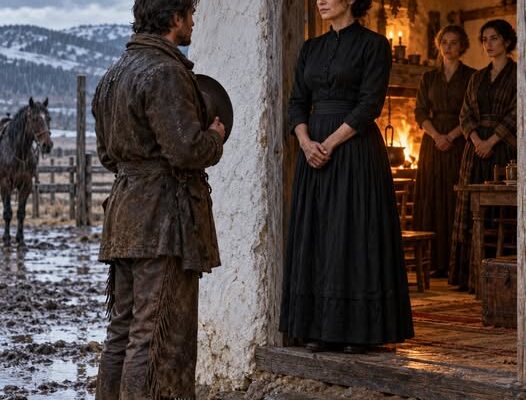
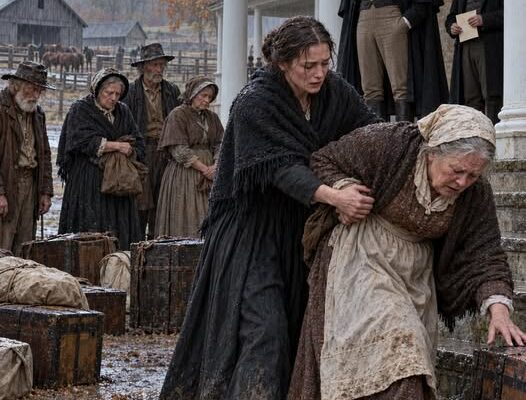
no man answered the lonely rancher’s help notice all autumn—then a widow arrived with her own tools and refused to leave him to lose the land
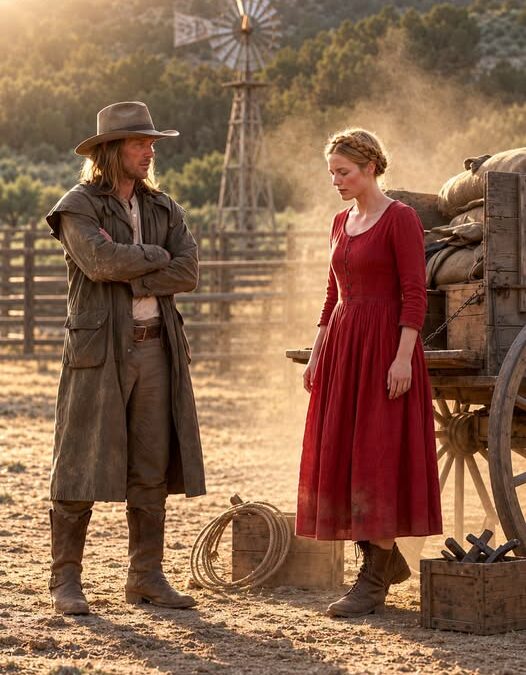
no man answered the lonely rancher’s help notice all autumn—then a widow arrived with her own tools and refused to leave him to lose the land
Part 1
By the third week of October, Abel Voss had stopped looking toward the road.
The help notice had been hanging on the post office door in Montrose since the last week of August.
Experienced ranch hand needed. Voss Mesa Ranch. Twelve miles south of Montrose. Season’s wage, room, and board.
Abel had written it three times before settling on those words.
He had made the letters large.
He had made the terms fair.
He had even added directions because the switchback road climbing toward his mesa was easy to miss if a man did not know the country.
Thirty-seven days passed.
Not one man came.
On the thirty-eighth morning, Abel stood at his kitchen window before daylight and watched frost whiten the sagebrush below the east fence.
The mountains were already carrying snow.
Not enough to close the roads yet.
Enough to warn a sensible man that winter had started counting.
The kitchen behind him smelled of old coffee, iron stove ash, and the faint sweetness of the apples he had dried in September.
There were two chairs at the table.
One had a cracked rung.
The other was pushed against the wall.
For two winters, Abel had needed only one.
His wife, Margaret, had died in that kitchen after a fever that came suddenly and refused to leave.
She had been forty-three.
Abel had been forty-seven.
He was forty-nine now, although some mornings he felt sixty.
Loneliness had not ruined him.
That would have been easier to understand.
It had simply settled over everything.
His meals became simpler.
His evenings became quieter.
A loose hinge could remain loose for three months.
A cracked chair stayed cracked because no one complained about it.
The root cellar door sagged.
The garden went half to weeds.
One corner of the porch leaned slightly lower every spring.
None of those things destroyed a ranch.
Together, they made a man understand the difference between living somewhere and merely continuing there.
That August, Abel had broken two ribs while setting a fence post alone.
The post slipped.
The tamping bar twisted.
He went down hard against a rock.
For several minutes he lay in the grass staring at the blue Colorado sky, unable to pull enough air into his lungs to curse.
He had eventually climbed onto his horse and ridden home.
No one had known he was hurt until four days later when Amos Bell, a neighbor from six miles north, stopped by and found Abel trying to carry a grain sack one-handed.
“You need help,” Amos had said.
“I need these ribs to quit hurting.”
“You need help.”
Abel had looked toward the pasture.
“I’ll hire somebody.”
That had been August.
Now October was nearly gone.
He poured coffee into the same chipped white mug Margaret had bought in Telluride twenty years earlier.
Outside, one of the horses struck the barn wall.
Abel set down his cup.
Work did not care whether a man was lonely.
That was one thing he liked about it.
He pulled on his coat, stepped into the cold, and crossed the yard.
The ranch spread across one hundred sixty acres of bench land above the river canyon, with grama grass across the flats, a stand of aspens along the eastern edge, and an irrigation ditch carrying precious water from higher ground.
Three dozen cattle grazed there.
Two horses.
A barn.
A smokehouse.
A root cellar.
A hands cabin twelve steps from the main house.
And more repairs than Abel cared to count.
The cattle were sound.
The hay supply was adequate.
The roof had been patched before his ribs broke.
He could survive another winter alone.
That was what he told himself.
Survival and good sense, however, were not always the same thing.
Abel had just finished feeding the horses when he heard wheels climbing the switchback road.
He froze with one hand resting on the barn latch.
A wagon.
Not a light buggy.
Something heavier.
He could hear the horses breathing as they pulled the grade.
For thirty-seven days, Abel had imagined every distant sound might be a man coming about the notice.
After the first two weeks, he stopped walking to the fence to look.
After the fourth week, he stopped expecting anyone at all.
So he finished latching the barn.
He carried the empty feed bucket toward the house.
Only when the wagon rolled through the gate did he stop.
It was a work wagon.
Two bay horses.
Mud dried along the wheels.
Burlap sacks filled half the bed.
The other half held a wooden tool chest secured with leather straps, two coils of fencing wire, a bedroll, a lantern, and a shovel.
The driver wore a dark indigo wool coat.
She pulled the team to a stop in the yard with practiced hands.
Abel stared.
The woman wrapped the reins, set the brake, and climbed down without waiting for help.
She was perhaps thirty.
Brown hair was braided beneath a worn felt hat.
Her face was not delicate.
It was handsome in a practical way, with dark eyes that moved immediately from Abel to the barn, the fence line, the root cellar, the chimney, the cattle beyond the yard, and back to Abel.
She studied the ranch as though she had arrived to buy it.
“You Voss?”
“I am.”
She reached inside her coat.
Abel’s shoulders tightened before he realized she was pulling out a folded piece of paper.
She handed it to him.
His own notice.
Rain had stained one corner.
The folds were soft from being opened more than once.
“My name is Sarah Kern.”
Abel looked from the paper to her.
“I’m here about the position.”
For a moment, neither spoke.
The wind moved through the bare branches of the cottonwoods near the well.
Abel cleared his throat.
“The notice said experienced hand.”
“I read it.”
“Most people took that to mean a man.”
Sarah looked toward the empty road behind her.
“Most people didn’t come.”
That answer sat between them.
Abel almost smiled.
Almost.
Instead he said, “What experience?”
She pointed toward the tool chest.
“Four years on my brother’s homestead outside Gunnison. Two seasons in the orchards near Grand Junction. Fencing, irrigation, livestock, harness repair, root cellar work, preserving, basic carpentry. I can shoe a horse badly enough to get it home and well enough if you give me time. I’ve helped with calving. I can shoot if something needs shooting.”
She paused.
“I don’t particularly enjoy that last part.”
Abel walked toward the wagon.
The tool chest was scarred and dark with age.
Not decorative.
Not bought for effect.
The corners had been repaired twice.
The leather handles were worn smooth.
A crack in the wagon sill had been reinforced with a tin plate and four bolts, all fitted cleanly.
He crouched beside it.
“You do this?”
“Yes.”
“Where’d you learn?”
“Needing the wagon.”
Abel stood.
She nodded toward the root cellar.
“Your lower hinge is about gone.”
“I know.”
“West fence is leaning.”
“I know.”
“Garden looks like somebody lost six weeks.”
Abel’s jaw tightened.
“Broken ribs.”
Her eyes shifted to him.
The expression on her face changed only slightly.
Not pity.
Recalculation.
“When?”
“August.”
“Healed?”
“Mostly.”
“You lifting heavy?”
“Yes.”
“You shouldn’t be.”
“I didn’t hire a doctor.”
“No. You’re trying to hire a ranch hand.”
Abel gave her a long look.
She met it without apology.
He said, “Forty dollars for the season. Room and board. Cabin’s yours. Separate stove.”
“Forty-five.”
He nearly laughed.
“You just got here.”
“And I already counted more than forty dollars’ worth of repair work.”
“That’s not how wages work.”
“Then you’ve had thirty-seven days to find somebody who agrees with you.”
This time Abel did smile, though briefly.
“Forty-two.”
“Forty-five.”
“I’ll cut and stack your stove wood.”
Sarah considered.
“Forty-two and the stove wood.”
“Done.”
They shook hands.
Her palm was rough.
Her grip was neither timid nor challenging.
Simply firm.
“One condition,” she said.
Abel waited.
“When spring comes, we settle square. No assumptions. If I leave, I leave with my wage and property. If you want me longer, we make another agreement. Nothing unspoken.”
Abel understood more in that sentence than she had said aloud.
“You’ve had trouble with employers?”
“I’ve had trouble with assumptions.”
“All right.”
“I mean it.”
“So do I.”
Her shoulders eased.
“Then we understand each other.”
He helped her lower the tool chest from the wagon.
It was heavy enough that neither could have managed comfortably alone.
He noticed she did not protest when he took one side.
She noticed he did not try to take the entire weight from her.
They carried it to the hands cabin.
Inside stood a narrow bunk, a little iron stove, one shelf, a washstand, and a table beneath the window.
Sarah checked the flue.
Opened the stove door.
Ran one finger along the table.
Looked beneath the bunk.
“I’ll need straw for the mattress tick.”
“Barn loft.”
“Good.”
She took off her hat and set it on the shelf.
Abel was already turning away when she said, “I’ll fix the cellar door before supper.”
“You don’t have to start today.”
“I know.”
She opened the tool chest.
Everything inside had its place.
Hammer.
Auger.
Files.
Chisels.
Awl.
Small saw.
Oiled cloth wrapped around metal tools.
A coffee tin filled with sorted nails.
Abel watched her for a moment.
She looked up.
“Something wrong?”
“No.”
“You always stand in doorways watching hired hands unpack?”
“Never had one bring better tools than mine.”
That earned the smallest smile.
“Then maybe you hired the right one.”
At noon, Abel brought out two bowls of stew.
Sarah was sitting cross-legged beside the root cellar door.
She had already removed the bad hinge.
He set one bowl beside her.
“Meal’s included in the forty-two.”
“I remember.”
He sat on the chopping block.
She tasted the stew.
“Good.”
“That surprise you?”
“Little.”
“Why?”
“You live alone.”
“So?”
“Men living alone usually believe salt repairs everything.”
Abel looked into his bowl.
“Margaret taught me.”
Sarah did not ask who Margaret was.
That made him grateful.
They ate in silence.
After a while she said, “Cattle look healthy.”
“They are.”
“South flat’s thin.”
“I was supposed to rotate them two weeks ago.”
“Ribs?”
“Ribs.”
“I’ll move them tomorrow.”
Abel nodded.
She returned to work.
By sundown, the cellar door swung straight.
By the third day, Sarah had reset nine fence posts.
By the fourth, Abel returned from the barn and found the cracked kitchen chair upside down on the table.
The broken rung had been glued and wrapped tightly with cloth.
Sarah was nowhere in sight.
He stood looking at it longer than a man should look at a chair.
Margaret had always said broken things spoke louder the longer you ignored them.
That evening Abel made a second pot of coffee.
He carried a cup across the yard and knocked on Sarah’s cabin.
She opened the door with a harness strap across her lap.
“I used your wood glue,” she said before he spoke. “I’ll replace it.”
He held out the coffee.
“Don’t.”
She took the cup.
“I fixed your chair without asking.”
“I noticed.”
“You mind?”
“No.”
She studied him.
“Then thank you for the coffee.”
He nodded.
Walking back across the yard, Abel realized the light in her cabin window made the place look less abandoned.
Three nights later, he moved the good chair from the spare bedroom into the kitchen.
He told himself it was practical.
There were two people working the ranch now.
Two people occasionally ate noon meals inside.
Two people required two chairs.
The explanation was reasonable.
That did not make it entirely true.
Part 2
Sarah Kern did not become part of Voss Mesa Ranch all at once.
She became part of it by inches.
A fence stayed upright because she reset it.
A harness stopped rubbing raw against a mare’s shoulder because she stitched it.
A shelf appeared in the root cellar.
The stove pipe in the hands cabin stopped smoking.
The garden beds were cleared before the ground froze hard.
A missing latch on the chicken shed was replaced.
A cracked axe handle disappeared and returned smooth, fitted, and wedged properly.
None of those things were grand enough to announce change.
Together they changed everything.
The ranch began looking tended again.
So did Abel.
He did not notice that part.
Sarah did.
She noticed his coat was buttoned properly now because he was no longer rushing from one unfinished job to another.
She noticed he started eating noon meals instead of forgetting them.
She noticed his limp disappeared as his ribs stopped pulling his posture sideways.
And she noticed something else.
He never asked questions she had not invited.
That mattered to her more than he knew.
On the following Tuesday, Abel prepared to drive into Montrose for flour, lamp oil, salt, and cattle medicine.
Sarah handed him a list.
“Linseed oil. Ten-penny nails. Two pounds. Cheesecloth. Good cheesecloth, not that thin weave some places sell.”
Abel took the scrap.
Her handwriting was neat.
“Anything else?”
“No.”
“You sure?”
“Yes.”
He glanced at the paper.
It had been torn from an old envelope.
He could see part of an address on the reverse.
Kern.
Gunnison.
He turned it over without reading further.
At the dry goods store, Abel purchased everything on the list.
Then, as the clerk packed the items, Abel noticed a tin of black tea.
Sarah drank tea every evening.
The little tin on her cabin shelf had nearly emptied.
He added it to the order.
“Never knew you for tea,” the clerk said.
“Not mine.”
The clerk raised an eyebrow.
Abel looked at him.
The eyebrow went back down.
When Abel returned to the ranch, he left the tea outside Sarah’s cabin.
He did not knock.
She never mentioned it.
The next day, however, Abel came inside after checking cattle and found a plate on the kitchen table.
Two pieces of warm dried-apple cake.
No note.
No explanation.
He ate one standing up.
Then the other.
The next morning he said nothing.
Neither did she.
That was how they communicated when words would have made a simple kindness feel like a debt.
October hardened.
The aspens lost their gold.
Ice formed along the stock trough before sunrise.
Snow on Cerro Summit deepened from a dusting to six inches.
Freight wagons still crossed, but drivers coming through Montrose complained about slick rock and axle-deep mud.
One evening, Sarah sat on the cabin step repairing a breast collar while Abel worked at the kitchen table with his ranch ledger.
The door stood open between them.
“How long before you’d call the summit closed?” she asked.
Abel stopped writing.
“Depends on weather.”
“Your judgment.”
“Three weeks. Maybe four.”
She pulled the awl through the leather.
“If November turns ugly?”
“Sooner.”
Sarah nodded.
Abel watched her.
“Why?”
“I had planned to go west after the season.”
“The season runs to spring thaw.”
“I know what the agreement says.”
“Then why ask?”
She looked toward him.
“Because there isn’t enough work here for two people all winter.”
Abel leaned back.
“There’s always work.”
“There’s work. Not forty-two dollars plus food and lodging worth of work.”
“That’s my concern.”
“It becomes mine if I sit through January taking wages you don’t need to pay.”
Abel frowned.
“You’re trying to quit?”
“No.”
The answer came quickly.
Sarah set the harness down.
“I’m telling you I know what winter means. I don’t intend to wake up after a heavy snow and discover I stayed because the road made the decision for me.”
Abel looked at her.
There it was again.
Choice.
Everything with Sarah seemed to return to that word.
“When you leave,” he said, “it will be because you decide.”
“Yes.”
“Not because I send you.”
“Yes.”
“Then we understand each other.”
She picked up the harness.
“I thought we did.”
Abel returned to the ledger.
The figures blurred.
He disliked the idea of Sarah leaving.
That realization irritated him.
He had hired her for a season.
He had agreed explicitly that the arrangement would end.
A sensible man should be satisfied when an agreement worked exactly as intended.
Abel had always considered himself sensible.
That evening, he stared at the same hay figure for nearly ten minutes.
Three days later, outside pressure arrived on horseback.
Abel had taken the cattle toward the south pasture when Sarah saw three riders climbing the road.
The man in front wore a charcoal coat too clean for ranch work.
She recognized him from town.
Harlow Trent.
Land agent.
He represented a Denver consortium buying parcels throughout the Uncompahgre country.
Sarah had heard his name twice at the Montrose store.
The first time from a farmer who had sold.
The second time from a farmer who wished he had not.
She kept splitting wood.
Trent dismounted.
The other men remained near their horses.
“You Mrs. Voss?”
Sarah planted the maul in the chopping block.
“No.”
“Where’s Voss?”
“South pasture.”
Trent looked around.
“You work here?”
“Yes.”
“Interesting.”
Sarah waited.
He smiled.
It was not a kind smile or a cruel one.
It was the sort used by men who had learned that pleasantness allowed them to say impolite things without admitting they were being impolite.
“We have business.”
“Then you should wait for Mr. Voss.”
“I intend to.”
He walked toward the porch.
Sarah returned to splitting wood.
She felt his attention on her.
“Voss employ women often?”
Sarah raised the maul.
“No idea.”
The log split.
Trent stopped asking questions.
Twenty minutes later Abel rode into the yard.
His expression hardened the moment he saw the horses.
“Harlow.”
“Abel.”
Trent produced a document roll.
“We need to talk about your east ditch.”
“We’ve talked about it.”
“Circumstances changed.”
“Water doesn’t.”
“The record does.”
Abel dismounted.
Trent opened the papers.
“The consortium filed a senior claim. According to the records supplied to our attorneys, their right predates yours.”
Abel took the documents.
Sarah remained at the woodpile.
She watched him read.
Abel became still when angry.
Not loud.
Not red-faced.
Still.
Sarah had seen the same habit in her late husband, Joseph, though Joseph’s stillness had often come before bad decisions.
Abel’s seemed to come before careful ones.
“These dates are wrong,” he said.
Trent folded his gloves.
“You’ll have to establish that.”
“My claim was filed March 1883.”
“These records say September 1884.”
“My original certificate has the recorder number.”
“Then I suggest you produce it.”
Abel looked up.
“What exactly do you want?”
“A revised water share.”
“How much?”
“Half the east ditch allocation during low-water months.”
Abel laughed once.
There was no humor in it.
“That kills this ranch.”
“It reduces capacity.”
“It kills it.”
“You could sell.”
“No.”
“The consortium’s offer is generous.”
“No.”
“You haven’t heard it.”
“I heard the last two.”
Trent sighed.
“Abel, look around.”
He gestured toward the ranch.
“One man. Thirty-some cattle. Old improvements. Difficult road. Water exposure. You could sell now and live comfortably in town.”
Abel’s eyes moved to the barn.
Then the house.
Then the aspens.
Sarah watched his face.
There are insults that sound like insults.
Others sound like practical advice.
The second kind can cut deeper because they suggest the life a man built is merely an inconvenience no sensible person should continue carrying.
Abel handed back the papers.
“This ranch isn’t for sale.”
“You may feel differently after the county reviews both claims.”
“Then let the county review them.”
Trent glanced toward Sarah.
“Your wife?”
“No.”
“This is Miss Kern. She works this ranch.”
Trent gave Sarah a measuring look.
“A hired hand.”
Sarah picked up another log.
“Correct.”
He turned back to Abel.
“You’ll hear from our attorney.”
“I expect I will.”
Trent mounted.
The riders left.
Abel stood watching until they disappeared down the switchback.
Only then did Sarah approach.
“You have the original?”
“I believe so.”
“Believe?”
“Come on.”
Inside the house, Abel crossed to the rear bedroom.
A wooden box sat on a shelf above an old dresser.
Inside were Margaret’s death certificate, the ranch deed, tax receipts, mortgage releases, cattle bills, and a folded water-right certificate.
Abel carried it to the kitchen table.
March 17, 1883.
Recorder number clearly written.
Sarah leaned over the document.
“They’re a year late.”
“Eighteen months.”
“Then they lose.”
“Not automatically.”
“They should.”
“Should and will are cousins who don’t always speak.”
Sarah considered that.
“When can you take this to the county clerk?”
“Thursday.”
“You should go tomorrow.”
“Tomorrow I need to move hay.”
“I’ll move hay.”
“It’s heavy.”
“So is losing half your water.”
Abel looked at her.
“Thursday,” Sarah said. “Go Thursday at the latest.”
He nodded.
She remained beside the table.
Her hand hovered near the document but did not touch it.
“Keep this inside something waterproof when you ride.”
“I know.”
“Make a copy.”
“Sarah.”
She looked at him.
“I know.”
For the first time, her mouth twitched.
“Good.”
That night Abel lay awake listening to the wind strike the roof.
He imagined the east ditch dry in July.
He imagined selling cattle.
Then land.
Then the house.
He imagined some Denver company cutting channels across Margaret’s garden.
The possibility made his stomach turn.
Around midnight he heard another sound.
Hammering.
Slow.
Measured.
He put on his boots and coat.
Light showed in Sarah’s cabin.
The door was open.
She sat at her worktable repairing a wooden document box.
She looked up.
“Couldn’t sleep?”
“What are you doing?”
“Making sure you stop keeping important papers in a box with a split corner.”
Abel stared.
“You saw that?”
“I see things.”
“You planning to repair the whole ranch one piece at a time?”
“If you keep leaving broken pieces where I can find them.”
He leaned against the doorframe.
“You know, most employees wait until somebody asks.”
“Most employers don’t let a hinge hang sideways for a year.”
“It was six months.”
“Terrible defense.”
He smiled.
Sarah returned to the box.
After a minute she said, “My husband lost land because of paper.”
Abel’s smile faded.
She did not look up.
“Joseph had a brother. Thomas. They inherited one hundred twenty acres outside Gunnison together. Joseph trusted him. Never insisted they separate the title properly.”
The hammer stopped.
“After Joseph died, Thomas produced debts I didn’t know existed. Some were real. Some I still don’t know. But his name was on everything.”
“What happened?”
“I sold my interest to cover what I could prove.”
“And the rest?”
“I walked away.”
Abel was quiet.
“Is that why you carry your own tools?”
She looked at him.
“No.”
“Why, then?”
“Tools don’t disappear when men decide a woman shouldn’t own something.”
Abel had no answer.
Sarah looked back down.
“The papers matter.”
He nodded.
“Yes.”
“Keep yours safe.”
“I will.”
“And don’t sign anything Trent gives you.”
“I’m not stupid.”
“I didn’t say you were.”
“You implied it.”
“I implied you’re stubborn.”
“That’s different?”
“Very.”
He stood there a while longer.
Then returned to the house.
Sarah’s hammer resumed behind him.
The next morning, the repaired document box sat on his kitchen table.
The certificate rested inside.
Dry.
Safe.
Ready for Montrose.
Part 3
The county clerk examined Abel’s water certificate twice.
Then he removed his spectacles, cleaned them, and examined it again.
Abel stood at the counter with his hat in his hands.
Outside, sleet struck the courthouse windows.
Finally the clerk said, “This is valid.”
“I know.”
“And it predates the consortium filing.”
“I know that too.”
The clerk gave him a weary look.
“Then why are you looking at me like I’m the man stealing your water?”
“Because somebody in this building gave their attorney records saying my claim was later.”
That changed the clerk’s expression.
He opened a ledger.
For fifteen minutes they searched.
Abel watched the man’s finger move down handwritten rows.
Then stop.
“There.”
March 17, 1883.
Voss, Abel.
East Bench irrigation right.
The clerk frowned.
“The consortium’s copy must have been taken from a later transfer index.”
“Accident?”
“I’m not saying otherwise without evidence.”
“Convenient accident.”
The clerk looked toward the back office.
“Leave me a copy of your certificate.”
“I’m not leaving the original.”
“I didn’t ask you to.”
“Good.”
The clerk met his eyes.
“That hired hand of yours tell you to make copies?”
Abel paused.
“How’d you know?”
“Because Margaret would have.”
Hearing his wife’s name unexpectedly struck Abel harder than he expected.
The clerk had known her.
Most of Montrose had.
Margaret had possessed the rare ability to make people feel remembered.
Abel looked toward the window.
“She would have.”
The clerk’s voice softened.
“I heard you hired somebody.”
“Sarah Kern.”
“Woman from Gunnison?”
“You know her?”
“Know of her. Widow. Husband died a few years back. Hard situation.”
Abel’s attention sharpened.
“What situation?”
The clerk shook his head.
“Not my story.”
Abel appreciated that answer.
He tucked the certificate into oilcloth.
“Anything else?”
“Your claim stands unless a judge says otherwise. If Trent’s people threaten action, bring them here.”
Abel nodded.
Before leaving town, he stopped at the dry goods store.
He bought salt.
Flour.
Lamp oil.
Coffee.
Tea.
And a new pair of lined work gloves.
He held the gloves for several seconds before placing them on the counter.
Sarah’s were worn through along two fingers.
On the ride home, snow began.
Not heavy.
Fine, dry flakes that vanished when they hit the road.
Abel reached the mesa after dark.
A lantern burned near the barn.
Sarah stood inside with the older bay mare, rubbing the animal’s swollen leg.
“What happened?”
“Slipped near the trough.”
“Bad?”
“No break. Strain, I think.”
“You been here long?”
“Hour.”
Abel crouched beside her.
Together they examined the leg.
The mare leaned into Sarah’s shoulder.
“She trusts you,” Abel said.
“She trusts grain.”
“Same thing with most people.”
Sarah laughed.
It startled him.
He had heard her chuckle before.
Never that.
The sound made the barn feel suddenly warmer.
“County?” she asked.
“Claim’s valid.”
“I told you.”
“Clerk agrees.”
“Then Trent?”
“Can complain.”
“He will.”
“Probably.”
Sarah stood.
Her knees cracked.
She winced.
“You hurt?”
“No.”
“That sounded hurt.”
“That sounded thirty-one.”
“I’m forty-nine. Thirty-one doesn’t make noises.”
“You groan every time you stand after fixing fence.”
“My ribs.”
“Your ribs healed.”
“Mostly.”
“Convenient.”
They walked toward the house.
Abel handed her the package containing the gloves.
“What’s this?”
“Supplies.”
“For me?”
“You need them.”
She opened the paper.
Her expression changed.
“I didn’t put these on the list.”
“I know.”
“I can buy gloves.”
“I know.”
“Then why?”
“Because your fingers are coming through the ones you’ve got.”
Sarah looked down at the gloves.
For a second she seemed uncomfortable.
Abel worried he had crossed whatever invisible line she guarded so carefully.
Then she pulled them on.
Flexed her fingers.
“They’re warm.”
“That’s the purpose.”
She looked at him.
“Thank you.”
“Apple cake acceptable repayment.”
“There’s no repayment.”
“Then two pieces.”
“Abel.”
“One?”
She shook her head.
“You bargain badly.”
“You took forty-two.”
“And stove wood.”
“Exactly.”
The snow thickened overnight.
By morning the mesa was white.
Not deep.
Three inches.
Enough to silence the land.
Sarah came from the cabin before daylight wearing the gloves.
Abel noticed.
He said nothing.
They worked.
Days shortened.
Cold strengthened.
The relationship between them deepened not through declarations, but repetition.
Trust, Abel discovered, was built the same way a fence was built.
Post by post.
Wire by wire.
Tension right.
Nothing dramatic until the day something leaned against it and discovered whether it would hold.
That day came in the first week of November.
A rider appeared shortly after noon.
Not Trent.
A younger man.
Suit coat under a heavy cape.
He introduced himself as Mr. Caleb Morris, attorney representing the Western Bench Water Consortium.
Abel invited him into the kitchen.
Sarah remained outside carrying feed until Abel called her.
“Sarah.”
She entered.
Morris glanced at her.
“This is private business.”
“She knows the ranch.”
“That doesn’t make her a party.”
“She works here.”
Morris hesitated.
Abel pulled out the second kitchen chair.
“Sit, Sarah.”
She did.
Morris placed documents on the table.
“The consortium acknowledges your earlier filing.”
“Good.”
“However, there is an issue concerning beneficial use.”
Abel’s expression hardened.
“What issue?”
“They intend to argue that portions of the east ditch allocation have not been continuously applied to the acreage claimed.”
“That’s nonsense.”
“They have survey records.”
“They have hired men with pencils.”
Morris remained polite.
Sarah studied the document.
“How many acres are they disputing?”
The lawyer looked at her.
“Miss Kern, I’m not sure—”
“Twenty?” she asked. “Forty?”
Morris glanced at Abel.
Abel said nothing.
“Approximately fifty-eight.”
Sarah leaned back.
“That includes the upper garden plots and north pasture.”
Morris blinked.
“Yes.”
She looked at Abel.
“When did you last run water to the north pasture?”
“September.”
“This September?”
“Yes.”
“Witness?”
“Amos Bell helped clear the gate.”
Sarah looked at Morris.
“Then your survey is wrong.”
“I didn’t conduct it.”
“Who did?”
Morris gathered the pages slightly.
“The point is simply that litigation can become expensive.”
There it was.
Not a claim.
A threat shaped like advice.
Morris continued.
“My clients are still willing to purchase the disputed allocation. They may also consider purchasing the ranch.”
“No,” Abel said.
“Mr. Voss—”
“No.”
Sarah watched Morris.
“What are they building?”
The lawyer paused.
“I beg your pardon?”
“Nobody spends attorney money on a water claim unless they need the water for something. What?”
Morris smiled thinly.
“I’m not authorized to discuss their development.”
Sarah nodded.
“Then they need it badly.”
Morris looked at Abel.
“Your employee is unusually involved.”
Abel’s answer came without hesitation.
“She stays.”
Something shifted in Sarah’s chest.
She did not show it.
Morris left ten minutes later.
Abel stood in the yard watching him ride away.
Sarah joined him.
“They’ll come back.”
“Yes.”
“You need Amos Bell’s statement.”
“Yes.”
“And receipts for seed or any record showing that north pasture was used.”
“Yes.”
“Stop saying yes like you’re annoyed.”
“I am annoyed.”
“At me?”
“At them.”
“Good.”
He looked at her.
Snow clouds hung low above the ridge.
“What would you do?”
Sarah did not answer immediately.
“What?”
“If this were yours.”
She looked across the pasture.
The words struck deeper than Abel intended.
If this were yours.
Sarah remembered Joseph’s land outside Gunnison.
She remembered the day Thomas told her the bank notes were not his problem.
She remembered packing dishes into crates while men discussed property in the next room as though she were already gone.
She remembered touching the orchard fence before leaving and knowing she would never own anything there.
“If it were mine,” she said slowly, “I’d make it impossible for them to call me careless.”
“How?”
“Document everything. Water gates. Cattle movement. Repairs. Dates. Witnesses.”
“That sounds like Margaret.”
“Smart woman?”
“Yes.”
Sarah looked toward the east ditch.
“Then listen to both of us.”
For the next week, they recorded everything.
Sarah kept a small ledger.
Temperature.
Snow.
Water flow.
Pasture use.
Fence repairs.
Cattle count.
Hay.
Visitors.
Abel teased her about it.
Then copied every page.
The habit felt excessive until Harlow Trent returned.
This time he came alone.
He stopped near the gate rather than entering.
Abel walked out.
Sarah was repairing tack in the barn and could hear only pieces.
“Final offer.”
“Not selling.”
“Winter’s coming.”
“It comes every year.”
“You’re alone up here.”
A pause.
Then Abel’s voice.
“No. I’m not.”
Sarah stopped working.
She could not see his face from where she sat.
Trent rode away minutes later.
That evening, Sarah made apple cake.
She did not tell Abel why.
Part 4
The first real storm arrived eleven days before Thanksgiving.
It came from the west.
Morning began gray.
By noon the mountains disappeared.
By three, snow traveled sideways across the yard.
Abel and Sarah secured the barn, moved extra feed inside, checked the cattle, drained one exposed line, and stacked wood against both cabins.
At dusk, Abel looked toward Sarah’s cabin.
“You should stay in the house tonight.”
She tightened the scarf around her neck.
“Why?”
“If something happens to that chimney, I won’t hear you.”
“I can manage a chimney.”
“That isn’t what I said.”
Sarah considered the weather.
Wind screamed against the barn roof.
“All right.”
She carried her bedroll and a small bag into the spare room.
Abel lit the second lamp.
Neither mentioned the strangeness.
For nearly six weeks they had lived twelve steps apart.
Now a storm had erased those twelve steps.
Dinner was stew.
Again.
Sarah looked into the pot.
“You eat anything else?”
“Yes.”
“What?”
“Beans.”
She laughed.
After supper they sat near the stove.
The house groaned under the wind.
Abel repaired a bridle.
Sarah darned a sock.
For a long time, neither spoke.
Then Sarah noticed a photograph on the mantel.
A woman beside Abel.
Same porch.
Summer.
Aspens behind them.
Margaret.
“You loved her.”
Abel’s hands stopped.
“Yes.”
Sarah regretted saying it.
“I’m sorry.”
“Don’t be.”
He set down the bridle.
“She was better with people than I am.”
“That’s a low fence.”
Abel smiled.
“She would have liked you.”
“You don’t know that.”
“I do.”
“Why?”
“She liked useful people.”
Sarah raised an eyebrow.
“That romantic description explains why she married you?”
“It might.”
The wind struck the chimney.
Silence returned.
Abel looked at the photograph.
“She wanted children.”
Sarah lowered the sock.
“We never had any.”
“I’m sorry.”
“So was I. She thought it was her fault. Doctor said maybe. Maybe not. Didn’t matter.”
He rubbed his thumb across the leather reins.
“The last year she was alive, she started talking about taking in a boy from a family outside Delta. Parents both gone. Then she got sick.”
Sarah waited.
Abel swallowed.
“I kept thinking we had time.”
There was nothing Sarah could say that would improve that sentence.
So she did not try.
After a while, she said, “Joseph and I had a baby.”
Abel looked up.
“Girl.”
Sarah’s eyes stayed on the sock.
“Clara.”
He said nothing.
“She lived nine days.”
The wind filled the room.
Abel’s voice came quietly.
“I’m sorry.”
“So am I.”
“How long ago?”
“Seven years.”
“That was before Joseph died.”
“Yes.”
Sarah folded the sock.
“He changed afterward. Not cruel. Just… he started borrowing money. Buying things for the farm. Bigger things. Plans. I think he believed if he made the land bigger, the house fuller, the future louder, we wouldn’t hear how empty the nursery was.”
Abel stared into the fire.
“He never told you about the debts?”
“Not all of them.”
“Why?”
“Shame, maybe.”
She looked toward Margaret’s photograph.
“That’s the trouble with grief. Sometimes a person thinks hiding it protects everyone else.”
Abel nodded slowly.
Outside, the storm deepened.
Around midnight a crash woke them.
Abel was out of bed instantly.
Sarah opened her door.
“What?”
“Barn.”
They dressed and ran into the storm.
A section of roof sheeting had torn loose along the south side.
Snow blew into the loft.
The horses panicked.
Abel climbed the ladder.
Sarah caught his coat.
“Your ribs.”
“Roof won’t care.”
“Neither will the ground if you fall.”
“I need to secure it.”
“We need to secure it.”
They worked together.
Abel climbed inside the rafters.
Sarah fed rope upward.
He crossed beams in darkness while the building shuddered.
Once his boot slipped.
Sarah heard him grunt.
“Abel?”
“I’m fine.”
“Don’t lie from a roof.”
“Then stop asking questions while I’m on one.”
They fastened a tarp beneath the gap and anchored it.
It was not a permanent repair.
It kept the snow out.
By the time they returned to the house, both were soaked.
Sarah’s braid had come loose.
Ice clung to Abel’s beard.
She put more wood on the stove.
He began laughing.
She stared at him.
“What?”
“Nothing.”
“You’re laughing.”
“I know.”
“At what?”
“I’m fifty years old next spring, standing in my kitchen at two in the morning looking like I fell in a river because part of my barn tried to leave.”
Sarah started laughing too.
They could not stop.
Perhaps it was exhaustion.
Perhaps fear.
Perhaps six weeks of carefulness finally finding a crack.
They stood dripping snowmelt onto the floor, laughing until Sarah had to put one hand on the table.
Then, as suddenly as it started, the laughter faded.
They looked at each other.
The room became quiet.
Abel was aware of how close she stood.
Sarah was aware of it too.
Neither moved.
Finally she stepped toward the stove.
“I’ll make tea.”
Abel nodded.
“Tea.”
By dawn the storm weakened.
Twenty inches of snow lay across the mesa.
The road vanished.
For three days, no rider could reach them.
They dug paths to the barn.
Fed cattle.
Cleared the roof.
Melted ice.
Carried wood.
At night Sarah remained in the spare room because the path to the cabin drifted waist-deep.
On the fourth day, sunlight returned.
The world shone white and blue.
Abel stood on the porch.
“Road might open tomorrow.”
Sarah joined him.
“Yes.”
He felt disappointment.
That surprised him.
“What happens when the summit clears?” he asked.
“I don’t know.”
“You were thinking Delta.”
“I was.”
“Still are?”
Sarah watched sunlight move across the pasture.
“I don’t know.”
Abel wanted to ask more.
He did not.
That afternoon Amos Bell arrived on snowshoes.
He brought news.
The consortium had been buying water rights from three smaller properties farther south.
“Trent’s planning some kind of reservoir agreement,” Amos said. “He wants control of enough flow to bargain with the county.”
Abel frowned.
“For what?”
“Rail spur rumor.”
Sarah looked up.
“Railroad?”
“Could be.”
If a railroad extension came through the lower valley, land values would rise sharply.
So would water.
Trent was not merely trying to acquire a ranch.
He was positioning the consortium before the public knew why.
Amos signed an affidavit confirming irrigation to the north pasture.
Sarah added it to the document box.
That evening, Abel opened his ledger.
Sarah sat across from him.
Both kitchen chairs.
The storm had turned the temporary arrangement into habit.
Abel finally said, “There’s enough work.”
Sarah looked up.
“What?”
“You said there wasn’t enough work for two people all winter.”
“There isn’t.”
“There could be.”
“That sounds like a man inventing chores.”
“I’m considering improvements.”
“In December?”
“Irrigation gate.”
“Frozen.”
“Barn stalls.”
“Fine.”
“Porch.”
“Snowed under.”
He frowned.
Sarah’s eyes softened.
“Abel.”
He closed the ledger.
“I don’t want you to go.”
There.
The sentence sat between them.
Sarah did not move.
Abel continued before he lost the courage.
“I know what we agreed.”
“Yes.”
“I know you intended to buy land.”
“Yes.”
“I know staying because the road closes isn’t staying.”
Her eyes narrowed slightly.
He remembered.
Choice.
“I’m not asking you to stay because you’re stranded.”
“What are you asking?”
Abel looked at his hands.
He had proposed to Margaret twenty-three years earlier beside a creek.
He had rehearsed the words for two days.
When the moment came, he forgot all of them.
Now he felt the same helplessness.
“I’m asking you to stay because this place is better with you in it.”
Sarah breathed slowly.
“That’s different from needing an employee.”
“I know.”
“And different from needing a woman to cook and mend.”
“I cook.”
“Badly.”
“You ate it.”
“Survival.”
He almost smiled.
Then became serious again.
“You fixed the chair.”
Sarah glanced toward it.
“You remember everything about that chair.”
“It was broken for a year.”
“Six months.”
“Felt like a year.”
“You could have fixed it.”
“I know.”
“Why didn’t you?”
Abel considered.
“Because nobody was sitting in it.”
Sarah looked away.
His voice lowered.
“Then you came.”
Silence.
The stove ticked.
A gust moved snow from the roof.
Sarah folded her hands.
“I had a plan.”
“Delta.”
“A small orchard parcel. Twenty acres. Maybe less.”
“You could buy it?”
“Lease first. Buy later.”
“How long?”
“Two seasons if things went well.”
Abel nodded.
“You want land that’s yours.”
“Yes.”
“Not a room.”
“Yes.”
“Not wages.”
“Yes.”
“Not gratitude.”
Sarah looked at him.
“Yes.”
Abel reached for the document box.
He removed the ranch deed.
Placed it on the table.
“One hundred sixty acres.”
“Abel.”
“If you stayed as my wife—”
Sarah became perfectly still.
He continued.
“—you would not stay as hired help.”
She stared at him.
“I’m not offering shelter.”
“Then what are you offering?”
“A partnership.”
“Marriage is not a business partnership.”
“No.”
“People who pretend it is usually hurt each other.”
“I know.”
“Do you?”
“Yes.”
Abel leaned forward.
“I loved Margaret.”
“I know.”
“I am not looking for another Margaret.”
Sarah’s expression changed.
“I’m asking Sarah Kern whether she wants to build something with Abel Voss.”
Her eyes glistened, though no tears fell.
“You barely know me.”
“I know what you do when a horse is hurt.”
“That isn’t knowing someone.”
“I know you count fence tension by hand. I know you hate weak tea. I know you lie about your knees hurting. I know you put tools away cleaner than you found them. I know you record weather like God’s going to audit you. I know you fixed my chair because broken things bother you. I know you lost a child and a husband and land, and you came here anyway carrying your own tools.”
Sarah looked down.
Abel’s voice roughened.
“And you know me too.”
“Yes.”
“I’m difficult.”
“Yes.”
“Stubborn.”
“Very.”
“Bad cook.”
“Terrible.”
“That stew is respectable.”
“It’s edible.”
He breathed out.
“If you say no, nothing changes. Your wage is yours. Cabin is yours until the season ends. When the road clears, if you choose Delta, I’ll take you as far as Montrose myself.”
Sarah looked at him for a long time.
Then she said, “If I said yes, my name goes on the deed.”
“Before spring.”
“Before I give up the Delta parcel.”
“All right.”
“The cabin remains mine as a workroom.”
“All right.”
“My tools remain mine.”
“I wouldn’t survive trying to take them.”
“I’m serious.”
“So am I.”
“And I don’t become your housekeeper.”
“You’ve seen my housekeeping. I clearly need supervision, not replacement.”
She nearly smiled.
Then her face grew solemn again.
“I won’t marry because I’m afraid to leave.”
“I wouldn’t want you to.”
“I won’t stay because snow decided for me.”
“I know.”
Sarah rose.
For one terrible moment Abel thought she was leaving the room.
Instead she walked to the window.
The ranch lay beneath moonlight.
Barn.
Pastures.
Aspens.
East ditch.
The little cabin where her tool chest sat beneath the window.
She had arrived wanting one season’s wages.
One more step toward buying land no one could take.
But sometime during those weeks, ownership had begun to mean something different.
Not possession.
Participation.
The fence carried her work.
The cellar door carried her work.
The records protecting the water carried her handwriting.
Even the kitchen chair carried the pressure of her clamps and the scrape of her knife.
This ranch was not hers.
Yet parts of her were already embedded in it.
She turned.
“I need until morning.”
Abel nodded.
“Take longer.”
“No.”
“Sarah—”
“Morning.”
She walked to the spare room.
At the doorway she stopped.
“And Abel?”
“Yes?”
“If I say no, you’re still fixing that barn roof properly.”
He looked at her.
“Yes, ma’am.”
She closed the door.
Abel did not sleep.
Part 5
Before dawn, Sarah dressed quietly and stepped outside.
The sky was clear.
Stars burned above the Uncompahgre Plateau.
Her boots broke the crust on the snow as she crossed toward the barn.
She did not know Abel was watching from the kitchen window.
She fed the horses.
Checked the older mare’s leg.
Carried hay.
Then walked to the east fence.
Sarah stood there for nearly twenty minutes.
She thought of Gunnison.
Joseph.
Clara.
The empty nursery.
Thomas Kern discussing debts.
The auction of household goods.
Years spent working other people’s places.
Every room temporary.
Every field belonging to someone else.
Every season ending with her packing the same tool chest into the same wagon.
She had told herself independence meant never needing anyone.
Now she wondered if independence might mean having the freedom to choose someone without surrendering herself.
The sun began turning the eastern sky pale.
Sarah walked back.
Abel stood in the kitchen.
Coffee waited.
Two mugs.
Two chairs.
He did not ask.
She removed her gloves.
Sat.
Abel remained standing.
“Sit down,” she said.
He sat.
Sarah wrapped both hands around the coffee.
“I’m not giving up my name.”
“I didn’t ask you to.”
“I’ll be Sarah Kern Voss on papers if necessary. Sarah Kern everywhere else.”
“All right.”
“My name on the deed before the end of the year.”
“Yes.”
“If the county delays it, we sign a separate agreement.”
“Yes.”
“Half.”
Abel blinked.
“Half what?”
“The ranch.”
“I know. I thought you meant half the coffee.”
She stared.
He cleared his throat.
“Half the ranch.”
“And if the consortium comes after the water, it comes after both of us.”
“Yes.”
“And if you decide three years from now you preferred living alone?”
“You get the east half.”
“Why east?”
“You already fixed the ditch.”
Sarah’s mouth trembled.
Then she laughed softly.
Abel leaned forward.
“Is that a yes?”
She held out her hand.
The same way she had the first day.
Abel stared at it.
Sarah said, “Don’t make me repeat myself.”
He took her hand.
Her grip was firm.
They shook.
Then neither let go.
The difference between that handshake and the first one was only a few seconds.
It was enough.
“When?” Abel asked.
“After you settle the water issue.”
“No.”
Sarah frowned.
“No?”
“I’m not letting Trent decide when I get married.”
She considered.
“Fair.”
“Saturday?”
“This Saturday?”
“Reverend Cole.”
“Road?”
“Passable.”
“Witness?”
“Amos owes me for using my bull last spring.”
Sarah shook her head.
“That may be the least romantic wedding plan in Colorado.”
“You’re marrying the wrong man if you wanted poetry.”
“I noticed.”
Thursday morning, Abel rode into Montrose.
He carried the water documents.
The ranch deed.
And, folded inside his coat, a list Sarah had written.
Lamp oil.
Flour.
Coffee.
Nails.
Tea.
He stopped first at the courthouse.
The clerk confirmed that the consortium’s challenge had weakened considerably after review of the original filing and Amos Bell’s affidavit.
“They could still bring suit,” the clerk said.
“Will they?”
“Maybe.”
Abel looked at him.
“What aren’t you saying?”
The clerk lowered his voice.
“County commissioners heard about the railroad discussions.”
“So?”
“So Trent’s consortium was trying to acquire rights before public announcement.”
Abel’s jaw tightened.
“Legal?”
“Buying land is legal.”
“Using bad records?”
“Different question.”
“What happens now?”
“The commissioners are reviewing every recent transfer involving the consortium.”
Abel slowly nodded.
“Your water stays yours,” the clerk said.
“For now?”
“For as long as the law means anything.”
“I’d prefer stronger reassurance.”
“So would I.”
Abel took out the deed.
“One more thing.”
The clerk read the requested amendment.
Then looked over his spectacles.
“Sarah Kern?”
“Yes.”
“You marrying her?”
“Yes.”
The man leaned back.
“Well.”
“What?”
“Nothing.”
“That wasn’t nothing.”
“I’m remembering Margaret.”
Abel’s expression softened.
“What about her?”
“She used to say this ranch needed two stubborn people because one would eventually get tired.”
Abel looked toward the door.
“Sarah doesn’t get tired.”
The clerk laughed.
“That may be worse.”
They prepared the deed documents.
Sarah would need to sign.
Abel left with instructions and went directly to Reverend Cole.
Saturday arrived cold and clear.
The storm had scrubbed the sky.
Reverend Cole came to the ranch in a wagon with his deacon.
Amos Bell and his wife, June, arrived an hour later.
Sarah wore the indigo coat she had worn the day she came.
Beneath it, a plain dark blue dress.
No flowers.
No veil.
Her hair was braided and pinned.
Abel wore his black Sunday coat.
June Bell looked between them.
“You two certain you understand what weddings usually look like?”
Sarah glanced at Abel.
“He promised there’d be stew.”
June laughed.
“That explains it.”
They stood in the kitchen.
The kitchen where Margaret had cooked.
The kitchen where Abel had eaten alone.
The kitchen where Sarah had spread water-right documents beneath lamplight.
Two chairs rested against the table.
Reverend Cole opened his Bible.
The ceremony was simple.
When he asked Abel whether he took Sarah as his lawful wife, Abel said yes with such certainty that Sarah looked at him.
When he asked Sarah, she paused only long enough to breathe.
“Yes.”
There were no grand speeches.
No music.
No crowd.
After Reverend Cole pronounced them married, Abel hesitated before kissing her.
Sarah noticed.
“You’re allowed,” she whispered.
That made June laugh from behind them.
Abel kissed Sarah gently.
It lasted only a moment.
When they separated, Sarah still held his hand.
The marriage register was signed.
Then the deed paperwork.
Sarah stared at her name beside Abel’s.
Sarah Kern.
Joint owner.
One hundred sixty acres.
Her hand trembled once.
Abel noticed.
“You all right?”
“Yes.”
“You sure?”
She touched the paper.
“This is the first time my name has ever been on land.”
No one spoke.
Even Amos looked away.
Sarah breathed in.
Then she signed.
Later, after the Bells and Reverend Cole left, Sarah changed back into work clothes.
Abel found her carrying a wrench toward the barn.
“You just got married.”
“Yes.”
“Where are you going?”
“Roof.”
“Today?”
“Sun’s out.”
He stared at her.
“You know, Margaret would have rested.”
Sarah looked back.
“Then you should have married Margaret.”
Abel’s face changed.
For half a second, Sarah feared she had hurt him.
Then he smiled.
“I did.”
She softened.
“Yes.”
“And I married you.”
“Yes.”
“So roof?”
“Roof.”
They spent their wedding afternoon repairing the storm damage.
Abel worked above.
Sarah passed tools.
At sunset they stood together in the yard.
The barn roof was secure.
Smoke rose from the chimney.
The aspens were bare.
Snow lay blue in the shadows.
Sarah looked toward the hands cabin.
“My tool chest stays there.”
“I remember.”
“I’ll sleep in the house.”
“I was hoping.”
“Don’t become presumptuous.”
“I wouldn’t dare.”
She looked toward the root cellar.
“We’re short on lamp oil.”
“I bought two gallons.”
“When?”
“Thursday.”
“Good.”
“And tea.”
Sarah glanced at him.
“Did I ask for tea?”
“No.”
“You’re developing bad habits.”
“You made apple cake?”
“Yes.”
“Then I’ll risk it.”
They entered the kitchen.
Abel served stew.
Sarah sliced cake.
They sat in the two chairs.
For the first time, neither chair felt borrowed from another life.
Winter settled over the mesa.
December brought deep cold.
January froze the east ditch solid at night.
February brought two calves during a storm.
Sarah spent six hours in the barn with one frightened heifer while Abel kept hot water coming from the house.
In March, the first warm wind softened the south slope.
The consortium never filed suit.
By April, county investigators had discovered irregularities in several land purchases connected to Harlow Trent’s employers.
Trent left Montrose before spring planting.
Abel heard he went to Denver.
Sarah did not ask.
Revenge interested her less than security.
The water continued flowing.
The ranch remained theirs.
Spring thaw came.
The season specified in Sarah’s original employment agreement officially ended on a Monday morning.
Abel remembered before she did.
She was repairing the garden gate.
He approached carrying a small cloth bag.
“What?”
“Your wages.”
Sarah stared.
“You paid me in December.”
“Through December.”
She wiped her hands.
“We got married.”
“The agreement was through spring thaw.”
“You’re paying your wife?”
“I’m paying the hired hand I contracted last October.”
Sarah stared.
“You kept track?”
“Forty-two dollars.”
“Abel.”
“Take it.”
“You are ridiculous.”
“A deal’s a deal.”
She accepted the bag.
Coins shifted inside.
Then she reached into her pocket.
Pulled out one dollar.
Handed it back.
“What’s this?”
“My half of supper.”
“Sarah.”
“A deal’s a deal.”
He looked at her.
She smiled.
He laughed.
That summer they expanded the garden.
Sarah planted beans, squash, and potatoes.
Abel repaired the porch.
They added two milk cows.
In September they rode to Montrose together.
The old help notice was gone from the post office door, but the nail remained.
Sarah stopped and looked at it.
“What?”
“Nothing.”
Abel followed her gaze.
“That notice changed my life.”
Sarah shook her head.
“No.”
“No?”
“I answered it.”
“That’s what I mean.”
She looked at him.
“You wrote it.”
He considered.
Then nodded.
“Fair.”
Years later, people in Montrose would remember Sarah Kern Voss as the woman who arrived at Voss Mesa Ranch with her own tool chest.
They remembered the story because it sounded romantic when told afterward.
A lonely rancher.
A widow.
An unanswered advertisement.
An early snow.
Marriage before winter.
But that was not how Sarah remembered it.
She remembered the cracked chair.
The sagging hinge.
A box of water papers.
Warm work gloves.
A mare with a swollen leg.
A barn roof tearing loose during a storm.
She remembered Abel telling a man at the gate, “No. I’m not alone.”
She remembered him placing the deed on the kitchen table and understanding, perhaps before he did, that he was offering more than shelter.
He was making room.
There was a difference.
Abel understood it too.
For years he had believed grief had divided his life into before and after.
Before Margaret died.
After Margaret died.
He eventually learned life was not so tidy.
Love did not replace love.
Memory did not disappear because new happiness arrived.
The heart, like good land, could carry more than one season without betraying the season that came before.
Margaret remained part of the ranch.
Her apple trees stood behind the house.
Her white coffee mug remained on the shelf.
Sarah never moved the photograph from the mantel.
She only placed another beside it years later.
In that photograph, Sarah stood near the barn holding a fencing tool.
Abel stood beside her.
Both looked uncomfortable in front of the camera.
Behind them, the west fence ran straight across the pasture.
The root cellar door hung square.
And through the kitchen window, if a person looked closely, two chairs could be seen beside the table.
People sometimes believed staying meant a person had nowhere else to go.
Sarah knew better.
She could have gone to Delta.
The road had reopened.
The orchard parcel had still been available.
She had money.
A wagon.
Tools.
Skills.
Nothing trapped her on Voss Mesa.
That was precisely why staying mattered.
Abel never asked her to surrender the independence she had fought to regain.
He gave it somewhere to belong.
And Sarah never rescued Abel from loneliness by becoming the woman who had died before her.
She simply entered the life that remained and worked beside him until it became a different life altogether.
Year by year, the ranch improved.
Not quickly.
Good things rarely did.
Fence by fence.
Calf by calf.
Garden row by garden row.
Winter by winter.
The repaired chair lasted another seventeen years.
When its rung finally cracked again, Abel carried it toward the workshop.
Sarah stopped him.
“Leave it.”
“You want a broken chair?”
“I want that one.”
“Why?”
She ran her hand over the old repair.
The glue line was still visible.
The cloth marks had long since worn away.
“Because this is where it started.”
Abel looked at her.
“The chair?”
“No.”
She smiled.
“The fixing.”
So they kept it.
And on winter evenings, when snow covered the mesa and the east wind moved against the walls, two older people sat across from each other at the kitchen table.
Sometimes they talked.
Sometimes they did not.
There was coffee for Abel.
Black tea for Sarah.
Often dried-apple cake.
Outside were cattle, fences, mountains, and the long honest cold.
Inside were two chairs.
And neither was empty.
You Might Also Enjoy

She Accidentally Took the Mafia Boss’s Private Seat—Then He Looked at the Curvy Stranger and Said, “Stay Beside Me”