The Cattleman’s Son Sent His Father’s Widow to a Roofless Line Shack With Rusted Keys—By Spring, the Two Sisters She Had Raised Were Sleeping Under the Roof She Built Herself, and Their Brother Had to Ride Out and Ask Permission to Enter
Selena was terrible at first.
Then she improved.
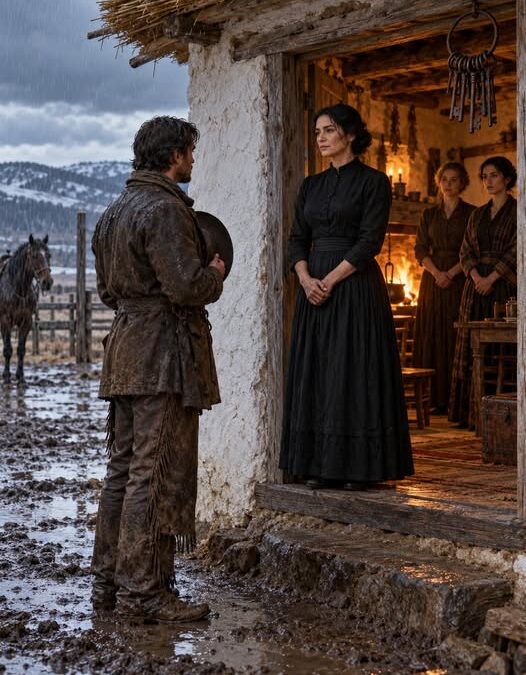
One February evening, with snow lying over the prairie and five wheels humming around the hearth, someone struck the door hard enough to shake it.
Selena rose.
Another knock came.
She opened the door.
Pera stood outside.
Clayton’s elder sister had walked nearly six miles through snow.
Her boots had split.
Her lavender coat was soaked black below the knees.
Her cheeks were raw with cold.
Selena stared at her.
“What happened?”
Pera looked past her.
She saw the white walls.
The women.
The fire.
Then she looked upward at the golden reed roof.
Her proud face folded.
“I came to see whether you were dead.”
Selena stepped aside immediately.
“Come in.”
Pera crossed the threshold and threw both arms around her.
That night she sat wrapped in blankets with broth between her hands and told Selena what Clayton had done after shutting the ranch house for winter.
Most rooms had been closed.
Fires had been extinguished to save coal and wood.
Candles were counted.
The kitchen allowance had been cut twice.
Mirabel still lived there with the housekeeper.
“She cries where no one can hear,” Pera said.
Selena’s mouth tightened.
“Why did you leave her?”
“Because somebody had to find out whether you were alive.”
“And now?”
Pera looked directly at her.
“I am not going back.”
Selena set down her cup.
“Do not decide that because you pity me.”
“I don’t.”
“Do not decide it because you are angry with your brother.”
“I’m furious with my brother.”
“That is not enough either.”
Pera’s eyes filled, but her voice remained firm.
“I am here because the woman who raised me was sent into winter with no roof, and I stayed in that house eating his food because I was afraid of losing it.”
She drew a breath.
“I do not wish to be that woman anymore.”
Selena studied her for a long moment.
Then she pointed toward the loft.
“You may sleep there.”
Pera smiled weakly.
“Thank you.”
“But if you stay, you decide for yourself every morning whether you are still staying.”
Pera’s expression changed.
That was not permission given by a guardian.
It was a boundary offered between two grown women.
Pera nodded.
“In that case, I will decide again tomorrow.”
The next morning she came down with her sleeves rolled.
“What needs doing?”
Selena handed her a broom.
“A great many things.”
Pera laughed for the first time all winter.
In March, when the snow finally softened, a freight wagon stopped on the road below Hebb’s End.
A young woman climbed down beside a small trunk.
Mirabel.
She dragged it herself through the mud until Pera saw her and ran down the lane.
Together the sisters carried the trunk toward the rebuilt house.
Mirabel reached the gate.
She looked at Selena standing beneath the roof.
Then she began crying so hard she had to drop one end of the trunk.
Selena had just started toward her when hoofbeats sounded from the ridge.
Rusby was riding down the lane with a folded order in his hand.
—————————————
If this moment pulled you in, please like the post and comment “Next” so we know you want the rest of their story.
Rusby rode into the yard and removed his hat.
Pera straightened.
Mirabel wiped her face.
“I’ve an order from Mr. Demoka,” Rusby said.
“Read it.”
He unfolded the paper.
While Pera and Mirabel remained at Hebb’s End, their allowances were suspended.
No tenant on Demoka land was to sell Selena roofing reed, flax, grain seed, or other farm supplies without Clayton’s approval.
Pera stepped forward.
“He means to starve us home.”
Rusby looked down.
“I only carry the orders.”
Selena touched Pera’s arm.
Then she looked at Rusby.
“Is that all?”
He hesitated.
“Mr. Demoka says his sisters belong at the main house.”
Mirabel spoke.
“We are not cattle.”
“No, ma’am.”
“Then tell him we are where we choose to be.”
Rusby mounted.
Before leaving, he looked at the whitewashed walls, the smoke from the chimney, and the completed roof.
Something uncomfortable passed across his face.
Then he rode away.
The order hurt immediately.
The back chamber still needed roofing.
The field behind the barn needed seed.
Clayton’s tenants would sell them neither.
So Selena returned to what he did not own.
The common.
The women.
Their own labor.
Two mornings later, the women went back into the marsh.
Pera went with them.
She learned badly at first.
Then better.
Mirabel stayed near the hearth twisting hazel spars until her fingers blistered.
Selena found her wrapping them in strips of cloth.
“You can stop.”
Mirabel shook her head.
“I spent all winter stopping because Clayton wished me to.”
She picked up another strip of hazel.
“I would rather learn what happens if I don’t.”
Within two weeks, the second chamber was covered.
The seed was harder.
Selena tried three neighboring farms.
Every man gave the same apologetic answer.
Clayton had forbidden the sale.
So Selena put on her bonnet, walked beyond the ranch boundary, and carried with her a small linen bundle.
Inside were the pearls Elias had fastened around her throat on their wedding morning.
She stood outside the jeweler’s shop for nearly five minutes before entering.
She did not sell the spectacles.
Those stayed in her pocket.
But she sold the pearls.
For less than they were worth.
She knew it.
The jeweler knew she knew it.
Still, Selena took the money.
She bought flax seed.
Flour.
Lamp oil.
Salt.
Needles.
Nails.
A carrier brought the sacks as far as the lane.
Selena hauled them the rest of the way.
At supper Pera noticed her bare throat.
She said nothing.
She simply rose and placed another piece of wood on the fire.
That quiet understanding hurt more than questions would have.
The gale came on the last night of March.
It struck from the west after dark.
The new roof groaned but held.
Selena lay awake listening to rain beat against something that no longer let it through.
Near midnight someone pounded on the door.
A ranch hand stood outside soaked to the skin.
“The main house,” he gasped.
Pera appeared behind Selena.
“What happened?”
“East roof came off. Rain’s pouring into Mr. Elias’s study. Mrs. Bell’s alone trying to save the books.”
Selena was already reaching for her coat.
Pera stared.
“You’re going?”
“Yes.”
“After what Clayton did?”
Selena tied the coat closed.
“Those books did not do it.”
They took the repaired handcart.
Pera and Mirabel came.
As they crossed the prairie, women came out of neighboring cottages and joined them without being asked.
The wind drove rain sideways.
Mud swallowed their boots.
Lanterns went out and had to be relit.
By the time they reached the main house, dawn was still hours away.
The east wing stood open to the storm.
Rain fell straight through the rafters.
Mrs. Bell met them with wet books piled in her apron.
When she saw Selena, she sat down on the step.
“Oh, ma’am.”
“No time.”
Selena took the lantern.
“Show me the study.”
The room looked almost exactly as Hebb’s End had looked the night Clayton sent her there.
Open sky.
Rain.
Black rafters.
Water streaming down the walls.
Elias’s books swelled on the shelves.
Papers floated under the desk.
His portrait hung above the fireplace, rain running over the canvas.
They worked until dawn.
Books first.
Then ledgers.
Maps.
Correspondence.
Journals.
Four women lowered the portrait from its hooks.
Selena took one corner.
The frame pressed against her ribs as they carried it downstairs.
By morning the kitchen was full of wet paper and dripping books.
Mrs. Bell looked around helplessly.
“There’s nowhere dry enough.”
Selena looked at Elias’s portrait leaning against the cupboard.
Then she said,
“There is.”
Pera understood.
“Hebb’s End.”
Selena nodded.
Mrs. Bell stared.
“You would take all of it there?”
“I have a roof.”
Nothing more needed saying.
They loaded Elias’s portrait onto the same cart that had carried reed.
Packed books around it.
Wrapped the frame in blankets.
The sisters walked beside it.
The women pushed.
They crossed the prairie at first light.
At Hebb’s End they hung Elias’s portrait above Selena’s hearth.
Books were opened near the fire.
Wet pages lifted slowly in the warmth.
For the first time, Elias Demoka looked down from the wall upon his widow and both daughters together beneath the roof his son had assumed she would never manage to build.
That should have been the end of it.
Instead, it became the beginning of Clayton’s humiliation.
The preacher’s wife came to see the portrait.
Then a neighboring rancher’s wife.
Then two merchants.
Within weeks, everyone seemed to know.
The widow Clayton had sent to a roofless shack had saved the books from his own failing house.
His sisters had chosen to live with her.
Their allowances had been stopped.
And the only warm, dry hearth able to save Elias Demoka’s papers belonged to the woman Clayton had meant to drive into submission.
The story reached Denver.
Clayton returned in April.
The road was too muddy for his carriage.
So he walked.
Selena watched him come up the lane with mud to his knees and his hat in his hands.
He stopped at the gate.
The house was white now.
The roof was gold.
Smoke rose from the chimney.
Pera and Mirabel sat inside sorting flax fiber.
Clayton approached the door.
He did not enter.
He knocked.
Selena opened it.
He looked at her.
“May I come in?”
She waited long enough for him to understand the importance of the question.
Then she stepped aside.
Clayton entered.
He saw his sisters.
Then his father.
Elias’s portrait hung whole and dry over the fire.
Clayton went still.
“The carriage is waiting,” he said eventually. “Your rooms are ready.”
Pera did not rise.
“We are home.”
Mirabel pointed toward the bench.
“Sit down. You’re letting in the cold.”
Clayton sat.
For once, no command came.
Finally he looked at Selena.
“What do you want?”
She had been ready for that question since the night of the gale.
“My widow’s settlement paid in full.”
“Yes.”
“Directly to me.”
“Yes.”
“Pera and Mirabel’s allowances restored in their own names.”
He glanced toward his sisters.
“Yes.”
“And Hebb’s End.”
His expression changed.
“The lease?”
“No.”
Selena remained standing.
“The house. The barn. The well. The field behind it. The strip to the common edge.”
“For your lifetime?”
“For mine to own and leave as I choose.”
Clayton rose.
“Selena—”
“I will not return to the main house.”
He stopped.
“I will not live anywhere merely because a Demoka man permits it.”
His face colored.
“There is one condition more.”
“What?”
“Sunday.”
He frowned.
“You will stand in church and tell the truth.”
Pera inhaled.
Clayton stared.
“You want to shame me.”
“No.”
Selena slipped one hand into her pocket around Elias’s spectacles.
“You used your authority publicly. Your tenants obeyed you. Your steward obeyed you. Your sisters lost their money because you disliked where they chose to live.”
She held his gaze.
“If this ends, it ends where everyone can hear how it happened.”
Clayton looked toward Elias’s portrait.
The fire cracked beneath it.
At last he said,
“All right.”
Selena opened the door.
“Then we will see you Sunday.”
The next morning Clayton returned with the estate lawyer, Rusby, witnesses, and a locked strongbox.
This time he knocked.
Again Selena chose whether he entered.
The lawyer spread the deed across her table.
Selena read every line.
Clayton seemed surprised when she questioned the wording of the boundary.
She noticed.
“You thought I could not read it?”
“No.”
“You thought I would not.”
He said nothing.
The deed transferred Hebb’s End to Selena.
House.
Barn.
Well.
Field.
Grazing strip.
Not a temporary arrangement.
Not a widow’s favor.
Ownership.
Then Rusby opened the strongbox.
Selena’s withheld settlement was counted across the table beneath Elias’s portrait.
Coin by coin.
Rusby counted it.
Selena counted it again.
Because it was hers.
Pera and Mirabel’s allowances were restored directly to them.
Before leaving, Rusby hesitated beside the door.
“I should have helped you.”
Selena looked at him.
“That first night,” he continued. “I saw the roof.”
“Yes.”
“I knew it was wrong.”
“Yes.”
“I told myself I was carrying orders.”
“You were.”
His face fell.
Selena did not comfort him.
After a moment she said, “Hezuba needs two fence posts carried from the road.”
Rusby blinked.
“If you want somewhere to begin, begin there.”
He carried both before riding away.
Sunday morning the church filled early.
Ranch hands came.
Tenants.
Merchants.
Women from the north range.
Hezuba wore her old brown coat and looked prepared to fight anyone who objected.
Selena sat between Pera and Mirabel in the same black mourning dress she had worn when Clayton left her at Hebb’s End.
The dress was the same.
Her hands were not.
Small scars marked her knuckles.
One palm still carried the line of a split spar.
The pearls were gone.
Before the final hymn, Clayton stood.
He unfolded a sheet.
His hands shook.
“My father died last autumn.”
Silence settled.
“Four days after his burial, I sent his widow to Hebb’s End.”
He stopped.
Then forced himself onward.
“The house did not have a sound roof. I knew that.”
No one moved.
“I withheld money due to her. I prevented servants from assisting her. And when my sisters chose to live with her, I stopped their allowances and ordered my tenants not to sell her supplies.”
Someone near the back shifted.
Clayton looked directly at Selena.
“I told myself I was exercising authority.”
His voice roughened.
“I was exercising cruelty.”
Pera’s hand found Mirabel’s.
“When the roof of my own house failed in the March gale, Mrs. Demoka and the women I had done nothing to help crossed the prairie to save my father’s books and papers.”
Clayton swallowed.
“She carried them to the house I had meant as punishment because that house was drier than mine.”
He folded the page.
“I apologize to Selena Demoka.”
Then to his sisters.
Then to the women of the north range.
“I cannot make the winter unhappen.”
His voice nearly broke.
“But I can say plainly that what I did was wrong.”
He sat.
The church remained silent.
Selena did not mistake confession for repair.
The apology could not return the pearls.
Could not erase cold nights.
Could not make his first cruelty smaller.
But he had surrendered the lie that authority made it justified.
That mattered.
After the service, Selena found Clayton standing alone beside Elias’s grave.
“I meant it,” he said.
“I know.”
“I do not expect forgiveness.”
“That is wise.”
A startled laugh escaped him.
Then his face settled again.
“I thought you were trying to take Father’s place.”
Selena frowned.
“In the ranch?”
“In everything.”
The truth came slowly after that.
Pera and Mirabel had gone to Selena first.
Elias had trusted Selena with accounts and correspondence.
When illness weakened him, he sometimes asked her judgment before giving his own.
Clayton had inherited the land.
But inheritance had not made him feel like his father.
“So I began removing everything that reminded me of that,” he said.
His eyes met hers.
“You were first.”
Selena let the ugliness of it stand between them.
Then she looked toward Elias’s grave.
“You could not inherit your father by driving away everyone else who loved him.”
Clayton shut his eyes briefly.
“No.”
She turned to leave.
“Selena.”
She stopped.
“May I come to Hebb’s End again?”
“That depends.”
“On what?”
“Whether you knock.”
Spring came.
Selena planted the field behind the barn with flax seed bought from the sale of her pearls.
By summer the whole field turned blue.
Thousands of small flowers moved in the wind.
The women who had cut reed with Selena returned to help harvest it.
Pera worked in town several days each week keeping accounts for a merchant.
Mirabel began teaching neighboring children to read.
Neither asked Clayton’s permission.
Neither needed Selena’s.
Hebb’s End changed slowly.
Shelves appeared.
Then a second table.
Beds in the loft.
A workroom in the back chamber.
An herb garden beside the well.
The rusted keys Clayton had first given Selena remained on a nail beside the door.
Nobody used them.
The rebuilt door had a different latch.
Selena kept the old keys anyway.
Not because they still controlled anything.
Because they no longer did.
Clayton came rarely at first.
Every visit followed the same rule.
Knock.
Wait.
Invitation.
Only then entry.
Sometimes Pera argued with him.
Sometimes Mirabel did.
Clayton learned that disagreement did not mean rebellion.
He reopened rooms in the main ranch house.
Rehired workers.
Restored proper supplies.
Not because Selena ordered him.
She did not manage his ranch.
That was his responsibility.
Hebb’s End was hers.
By December snow lay over the prairie again.
On Christmas Eve the little house filled before dark.
Women came carrying bread, preserved fruit, and jars of vegetables.
Pera returned late from town.
Mirabel had flour on her sleeves.
Hezuba sat closest to the hearth complaining that no one made coffee correctly.
The table was covered with linen woven from flax grown in Selena’s blue field.
Someone began singing badly.
Everyone joined.
Then came a knock.
Selena opened the door.
Clayton stood outside with snow on his shoulders.
He carried no orders.
No papers.
No steward.
“Merry Christmas.”
“Merry Christmas.”
His eyes traveled past her toward Elias’s portrait.
“May I come in?”
Selena stepped aside.
Later, when the room grew loud enough to grant privacy, Clayton approached her.
“May I see him?”
Selena knew what he meant.
She walked with him to the hearth.
Elias looked down from the portrait in his dark coat, stern as ever.
Clayton stood beneath it.
Selena reached into her pocket.
For more than a year she had carried Elias’s spectacles everywhere.
Through rain.
Frost.
Marsh water.
The roof.
The gale.
They had been the one object of his she refused to surrender.
Now she unfolded them.
Placed them on the mantel beneath his portrait.
Clayton stared.
“I remember those.”
“He wore them every evening.”
“He complained about them.”
“He complained about most things he liked.”
Clayton smiled faintly.
“That sounds like him.”
For a time they stood there together.
Not widow and heir.
Not enemies.
Just two people who had loved the same difficult man differently.
Then Selena touched Clayton’s arm once and went back to the table.
She left him there with his father.
Years later, people told the story of the winter Selena Demoka roofed Hebb’s End.
Most versions made it simpler than it had been.
They said Selena built the house alone.
She did not.
Women stood beside her.
They said she was never frightened.
She was.
They said she forgave Clayton the day he apologized.
That was not true either.
Where forgiveness came, it arrived the same way the roof had.
Course by course.
With work between.
Pera eventually married from Selena’s doorway.
So did Mirabel.
Both came back often.
Neither stopped calling Hebb’s End home.
Clayton changed more slowly.
He remained capable of pride.
Sometimes of arrogance.
But he learned to recognize when fear made him controlling.
He learned that helping did not buy obedience.
That land ownership did not make people his possessions.
That an apology did not entitle him to forgiveness.
Most importantly, he learned to knock.
Selena never returned to the main house.
She kept Hebb’s End for the rest of her life.
The well ran clear.
Flax grew behind the barn.
Women came through the door without asking whether they were grand enough to sit beside her fire.
Elias’s portrait remained above the hearth.
And beside the entrance hung the ring of rusted keys Clayton had once dropped into Selena’s palm.
Nobody used them.
The original lock was gone.
The new door opened from inside with a simple latch.
Some winter evenings Selena sat alone after everyone had left.
She could still remember the first night perfectly.
Rain through open rafters.
Wet black wool.
Cold shoulders.
Elias’s spectacles in her hands.
The knowledge that Clayton expected weather and humiliation to make the decision for her.
Then she would look upward.
The roof remained.
Not because she had been rescued.
Not because Clayton had changed his mind.
Not because Elias’s name had protected her.
It remained because Hezuba had brought milk and knowledge.
Because the woman who laughed came back carrying a sickle.
Because Pera walked six miles through snow.
Because Mirabel dragged her own trunk through spring mud.
Because neighbors cut reed they did not owe.
And because Selena had accepted help without surrendering ownership of her own future.
A roof, Hezuba had said, was reed and patience.
Selena learned that a life could be much the same.
Piece by piece.
Choice by choice.
Winter after winter.
It held.
You Might Also Enjoy

She Accidentally Took the Mafia Boss’s Private Seat—Then He Looked at the Curvy Stranger and Said, “Stay Beside Me”