After the Ranch Owner Cast Five Aging Hands Into the Rain, a Newly Widowed Gardener Took Them Into an Abandoned Cabin—By Christmas, His Own Mother Was Sleeping Under Her Roof, and He Came Down the Frozen Lane With His Hat in His Hand
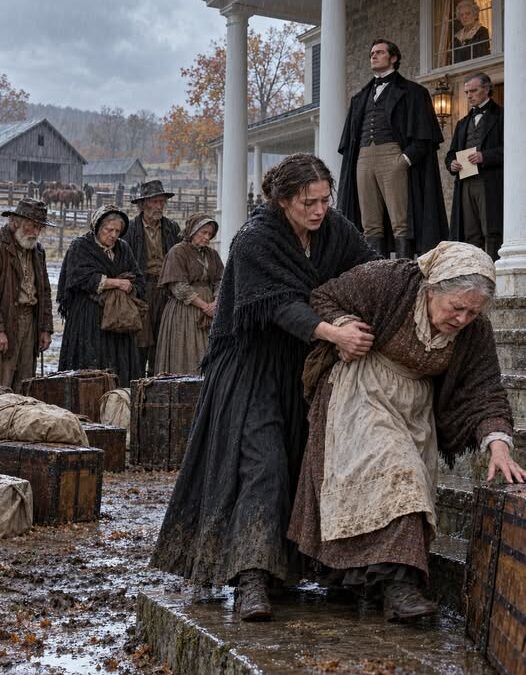
“I have nothing to give you,” Mrs. Stoll said.
Kate looked at the woman’s wet hem, the fine black cloth gone shiny at the elbows, the hands held together as though she feared they might tremble if she separated them.
“My son controls the household money. I could not pay you for the bread if you asked.”
Kate pushed another slice toward her.
“You did not come down here for bread.”
Mrs. Stoll looked at her for a long moment.
“No.”
“Then you owe us nothing for it.”
The older woman lowered her eyes.
“May I come again?”
Kate glanced at Miss Dorr.
Thirty years of loyalty sat naked on the woman’s face.
Then Kate looked at the door.
“It isn’t locked.”
After that, Mrs. Stoll came every Thursday near dusk.
She came without servants.
Without money.
Without the authority her name carried elsewhere.
At first she sat awkwardly near the fire while Miss Dorr mended stockings and Mrs. Twig kneaded dough. Before long she was shelling beans, winding yarn, and laughing at Doggett’s stories about her late husband losing a carriage wheel on a mountain road twenty years earlier.
Once she laughed so hard beans spilled across her lap.
She stared down at them in astonishment.
“Nobody ever let me shell a bean in that house.”
Mrs. Twig snorted.
“Then you have been badly educated.”
For a little while the cabin became warm enough to make everyone forget what waited uphill.
Then the steward came.
He stopped at the gate rather than entering.
“Mr. Stoll knows his mother has been visiting.”
Kate folded her arms.
“He does not approve.”
“That sounds like something he should discuss with her.”
The steward’s mouth tightened.
“The upper garden gate has been locked.”
His gaze shifted to the woodpile stacked neatly beneath the orchard wall.
The five had gathered fallen limbs for weeks, carrying them home one armful at a time.
“That timber belongs to Mr. Stoll.”
“It was deadfall.”
“It remains his property.”
At three that afternoon a wagon arrived.
Two hired men loaded every stick.
Doggett stood beside the gate with both hands on his cane and watched the wood disappear.
Nobody tried to stop them.
Four nights later the frost came.
Hard.
White.
Still.
It killed half Kate’s winter greens.
The water bucket froze beside the door.
Mrs. Twig could barely rise from her chair.
Tess’s hands cracked until blood appeared between her fingers.
Doggett’s cough deepened.
Kate stood before the empty wood rack and understood that pride could be expensive, but cold could kill.
Her eyes moved toward the nail beside her bed.
Samuel’s silver watch hung there.
Every night of their marriage he had wound it before sleeping.
Kate could still hear the tiny turning of the key if she closed her eyes.
Mrs. Twig followed her gaze.
“No.”
Kate reached up.
“We need fuel.”
“That belonged to Samuel.”
Kate wrapped the watch in her handkerchief.
“That is why the choice is mine.”
She pulled on Samuel’s old coat.
Before anyone could argue again, Kate opened the door and stepped into the frozen lane with the watch pressed against her heart.
Kate walked seven miles to the market town with Samuel’s watch hidden beneath her coat.
The road had frozen into hard ridges. By the time she reached the first buildings, her feet had gone numb and the cold had settled beneath her gloves.
The dealer turned Samuel’s watch beneath the window light.
He opened the back.
Examined the works.
Then offered Kate barely half what she knew it was worth.
Samuel had once told her what the silver case alone had cost.
Kate looked at the familiar scratches near the winding stem.
One had come from dropping it against the garden wall the summer they married.
She remembered laughing while he searched through the grass.
For one foolish second she nearly took it back.
Then she thought of Doggett coughing.
Of Tess’s bleeding hands.
Of Mrs. Twig unable to straighten before the fire.
“Give me the money.”
She bought coal.
Flour.
Lamp oil.
Goose grease for Tess’s skin.
She rode home beside the coal driver with her empty hands folded in her lap.
That night the cottage stayed warm from wall to wall.
Kate sat by the hearth listening for a ticking that was no longer there.
Mrs. Twig put a cup beside her.
“You kept six people warm with it.”
“I know.”
“That does not mean you cannot miss it.”
Kate looked into the fire.
“It was the last thing of his I could still hear.”
No one told her she ought to be grateful.
No one told her Samuel would have approved.
They simply let the loss remain a loss.
December brought snow.
It fell softly at first, then steadily for three days until the orchard lane vanished beneath white and the tops of the gate posts barely showed.
A boy from the bakery brought word that Mr. Stoll had gone away with guests and would not return before Christmas Eve.
Miss Dorr began watching the house each evening.
Mrs. Stoll had missed one Thursday.
Then another.
Kate tried to explain it.
“The road is buried.”
Miss Dorr shook her head.
“She always keeps a candle in her west window. She has been afraid of darkness since she was young.”
That night there was no light.
Nor the next.
On the third evening Miss Dorr came from the gate pale with fear.
“Something is wrong.”
Kate took down the lantern.
“I’m going.”
“So am I.”
The snow reached their knees.
The upper garden gate was locked exactly as the steward had promised.
Miss Dorr led Kate along the wall toward an old laundry entrance.
“I kept one key.”
Kate stared at her.
“I served in that house thirty years.”
The lock opened.
Inside, the north wing was colder than the cottage had been when they first entered it.
Their breath smoked in the lantern light.
No fires burned.
They climbed the back stair.
Mrs. Stoll lay in darkness.
The hearth was dead.
Water in the wash pitcher had frozen solid.
The old woman’s face burned with fever while her fingers felt cold.
Miss Dorr caught her hand.
“Ma’am?”
Mrs. Stoll’s eyes opened.
“I rang.”
Kate looked toward the bell pull.
“I rang and rang.”
Miss Dorr’s mouth trembled.
“We cannot leave her.”
“No.”
“We cannot carry her alone.”
Kate stared toward the corridor.
Then she remembered Doggett once mentioning an old covered carrying chair stored behind the carriage house.
“We are not alone.”
She ran back through the snow.
When Kate burst into the cottage and told them, all five rose.
Doggett knew exactly where the chair had been stored.
Thomas—the tall dining-room servant whose Christian name Kate had only recently learned—helped drag it free.
Tess heated bricks and wrapped them in cloth.
Mrs. Twig put broth on the stove.
Doggett followed uphill carrying a second lantern despite his cough.
They wrapped Mrs. Stoll in blankets and Kate’s shawl.
Thomas took the front poles.
Kate took the rear.
The chair seemed to grow heavier with every yard.
Snow caught Kate’s skirts.
At the terrace steps her boot slipped.
She crashed onto one knee.
Pain shot through her hip.
Thomas stopped.
“I can get another man.”
“No.”
“Mrs. Rowley—”
Kate dragged herself upright.
“Do not take my end unless I ask.”
Thomas waited.
Kate planted her feet.
“Now.”
They moved again.
Doggett fell behind them.
Once.
Then again.
Each time he rose without complaint.
Inside the covered chair, Mrs. Stoll moaned.
Thomas spoke toward her quietly.
“Nearly there, ma’am.”
At last the cottage appeared.
One yellow window in the white darkness.
The door opened.
Warmth and the smell of broth poured out.
They put Mrs. Stoll in Kate’s bed.
Hot bricks went along her sides and feet.
Mrs. Twig fed her broth a spoonful at a time.
Miss Dorr remained beside her.
Kate kept the fire burning all night.
Near dawn, the old woman’s breathing eased.
Her fever began to break.
Kate sat against the bedstead and fell asleep where she was.
She woke to a weak voice.
“Mrs. Rowley?”
Kate stood.
Mrs. Stoll looked around the room.
At Miss Dorr.
At Doggett sleeping with his chin on his chest.
At Tess beside the stove.
At Thomas wrapped in a blanket near the wall.
At Mrs. Twig working dough.
Understanding came slowly.
“I shall not go back.”
Miss Dorr began to cry.
Mrs. Stoll looked directly toward Kate’s voice.
“If you will have me, I mean to stay here.”
Kate did not answer immediately.
She wanted the older woman to understand what she was saying.
“Your son may come for you.”
“He may.”
“He may send the steward.”
“He may send every man on this property.”
The faintest spark appeared in Mrs. Stoll’s eyes.
“I am not going back to that cold room to wait for someone to answer a bell.”
Kate pulled the blanket higher.
“This house has one rule.”
Mrs. Stoll waited.
“Nobody remains because they have nowhere else to go.”
Kate looked around at the others.
“They stay because they choose to.”
The old woman’s expression softened.
“Then I choose.”
Three days later, when the road was passable, one trunk arrived from the big house.
It contained Mrs. Stoll’s clothes, a Bible, and a small portrait of her late husband.
Nothing more.
She moved into the little room beside the kitchen where heat from the bread oven traveled through the wall.
“It is warmer than my room has been since summer,” she said.
The cottage changed after that.
Someone from the village replaced the broken window with real glass.
The baker sent a goose for Christmas.
One morning split wood appeared outside the gate.
Nobody admitted bringing it.
The people who once mocked Kate in town stopped laughing.
Rumors about the cold north wing had begun traveling.
Kate refused to feed them.
She did not want Mr. Stoll humiliated.
She wanted him to understand.
On Christmas Eve, as daylight faded blue over the snow, Doggett looked through the repaired window.
“Someone’s coming.”
A lone man was walking down from the house.
No steward.
No hired hands.
No carriage.
Mr. Stoll reached the gate.
Months earlier he had remained mounted there while handing Kate the agreement that removed five people from his accounts.
Now he removed his hat.
He came to the door and knocked.
Kate opened it.
“Mrs. Rowley.”
“Mr. Stoll.”
His eyes moved past her.
His mother sat at the table with color in her cheeks.
Mrs. Twig was tending the goose.
Doggett, Miss Dorr, Tess, and Thomas occupied the benches.
The copper shone beside the fire.
Fresh bread cooled beneath a cloth.
Mr. Stoll tightened his grip on his hat.
“I have come for my mother.”
Kate stepped aside.
“You had better ask her.”
Mr. Stoll entered.
Snow melted from his boots onto the clean stone floor.
No one stood.
The silence grew until Kate could hear the goose fat snapping inside the oven.
Mr. Stoll looked at his mother.
“Mother.”
She folded her hands on the table.
“The carriage can be brought down,” he said. “Your rooms will be made ready.”
“My rooms?”
“At the house.”
Mrs. Stoll studied him.
“I rang for three nights.”
Mr. Stoll’s face changed.
“The household was short-handed while I was away.”
“I rang.”
He looked toward Miss Dorr.
His mother continued.
“My fire went out.”
“What?”
“My water froze.”
He stared at her.
“Nobody told me.”
“No.”
Her voice remained quiet.
“That is precisely the trouble.”
Mr. Stoll lowered his hat.
Mrs. Stoll looked around the table.
“You dismissed the people who knew that house better than anyone you brought into it.”
His gaze moved unwillingly from face to face.
Doggett.
Tess.
Thomas.
Miss Dorr.
Finally Mrs. Twig, whose white cap was crooked from working near the oven.
Mrs. Stoll went on.
“When I became ill, Dorr noticed because my candle was dark. Mrs. Rowley crossed the snow. These people carried me down the hill.”
Mr. Stoll looked at Doggett.
The old man’s cane rested between his knees.
“Doggett fell repeatedly.”
Doggett shrugged.
“Snow was deep.”
“And got up every time,” Mrs. Stoll said.
Mr. Stoll’s eyes moved toward Mrs. Twig.
Something in his expression shifted.
“You made my birthday cakes.”
The old cook looked at him.
“Every year.”
“When I was small.”
“Until you went away to school.”
He lowered his eyes.
For several moments nobody spoke.
Then he turned toward Kate.
“When my father died, I found debts. More than I expected. I thought cutting old arrangements was necessary.”
Kate listened.
“I told myself the promises were informal. That everyone would find family or another place.”
Doggett gave a dry laugh.
“At my age?”
Mr. Stoll looked at him.
“No.”
He swallowed.
“No, Mr. Doggett.”
The old man became still.
Mr. Stoll faced Kate again.
“I did not know what happened after they left.”
“You did not want to know.”
The words landed harder than accusation because Kate did not raise her voice.
Mr. Stoll looked at her.
Then nodded.
“No.”
That answer changed the room.
Not forgiveness.
But truth.
“I am sorry.”
Tess rubbed one thumb across the cracks in her other hand.
Mrs. Twig checked the oven.
Kate said, “Sorry does not warm a house.”
“No.”
“It does not pay what was promised.”
“No.”
“It does not return months to people who spent them wondering whether forty years of work meant anything.”
His jaw tightened.
“No.”
Kate held his gaze.
“But it can be a beginning.”
Mr. Stoll reached inside his coat.
He placed a heavy purse on the table.
Then five smaller packets.
“My father promised twelve dollars each year to every one of you.”
Nobody moved.
“This is everything owed since autumn.”
He placed one packet before each former worker.
“And future payments will be made quarterly. Directly to each of you.”
Doggett picked his up.
“You’ll put that in writing?”
“Yes.”
“Signed?”
“Yes.”
“Witnessed?”
Mr. Stoll almost smiled.
“Yes.”
Doggett tucked the packet inside his coat.
“Then we understand one another.”
Mr. Stoll continued.
“The wood taken from here will be returned tomorrow. More will come with it.”
Kate asked, “Without conditions?”
“Without conditions.”
“And this cottage?”
He looked around.
The sagging ruin he had once considered useful only because it removed five names from a ledger no longer looked worthless.
The roof had been repaired.
The oven worked.
The walls were scrubbed.
Food filled the room.
His mother looked healthier beneath its low ceiling than she had in his house.
“The cottage remains yours without rent.”
Kate’s expression did not change.
“Because we keep your former workers?”
“No.”
“Because your mother is here?”
“No.”
“Then say what you mean.”
Mr. Stoll took a breath.
“Because I used shelter to make you carry an obligation that belonged to me.”
The room became completely quiet.
“I will not do that again.”
Kate nodded once.
Then she looked toward Mrs. Stoll.
“And her?”
Mr. Stoll followed her gaze.
His mother waited.
For a moment Kate saw how much easier it would have been for him to become commanding.
To insist.
To invoke family.
Property.
Duty.
Instead he asked, “Do you want to come back?”
“No.”
Pain crossed his face.
He did not hide it quickly enough.
“Do you mean to remain here?”
“For now.”
He nodded.
“Then you remain.”
His mother watched him carefully.
“And if I decide otherwise later?”
“You decide.”
“And if I decide to see you?”
His expression broke.
“Then I would be grateful.”
Mrs. Stoll looked down.
“You may come here.”
Mr. Stoll glanced at Kate.
“If Mrs. Rowley permits it.”
Every face turned toward her.
Kate remembered the first day.
The rain.
The paper.
The way he would not even look at them.
Now he stood inside a cottage legally connected to his property yet understood that entrance was not the same thing as welcome.
“You knock.”
“Yes.”
“You do not send the steward down with instructions.”
“No.”
“You do not decide who belongs here.”
“No.”
“And nobody under this roof loses safety because you find their presence inconvenient.”
Mr. Stoll’s eyes moved around the table.
“I understand.”
Kate stepped away from the door.
“Then you may visit.”
Mrs. Twig immediately struck the roasting pan with a spoon.
“Good. Someone carve this goose before all this moral improvement ruins supper.”
Thomas looked down because he was smiling.
Mrs. Stoll pointed at her son.
“He can carve.”
Mr. Stoll stared at her.
“I cannot carve a goose.”
“That has never prevented a man from attempting something badly.”
Doggett coughed into his fist.
Kate bit her lip.
Mr. Stoll removed his coat.
Mrs. Twig handed him the knife.
He sat on the only remaining kitchen stool, knees nearly level with the table.
His mother instructed him from the first cut.
“No. Along the joint.”
“I am cutting along the joint.”
“You are sawing through the bone.”
“I see now why Father always had someone else do this.”
“Your father knew his limitations.”
“Mother.”
Kate laughed.
It came out before she could stop it.
A real laugh.
Not the almost-laugh that had hurt in the rain.
Not something dragged out of grief.
The sound startled her.
Then Mrs. Twig began laughing.
Doggett joined.
Even Mr. Stoll smiled.
Christmas morning arrived clear.
Snow lay over the repaired roof.
Smoke rose straight from the chimney.
A wagon came after sunrise carrying the wood that had been taken.
The same two men who had removed it began stacking it beneath the orchard wall.
A second wagon brought coal.
Kate was relieved when there was no third.
She did not want restitution transformed into spectacle.
The pension papers arrived several days later.
Doggett read every line.
Miss Dorr read them again.
Kate checked them herself.
Each payment belonged to the person named.
No service required.
No residence required.
No return to the house required.
Thomas witnessed Doggett’s signature.
Doggett witnessed Thomas’s.
Mrs. Stoll watched beside the stove.
“That is closer to what your father intended,” she told her son the following Sunday.
Mr. Stoll nodded.
“Yes.”
Winter deepened.
The cottage continued.
Mrs. Twig baked more bread than they could eat.
When people offered money for it, Kate suggested they sell regularly.
Tess began washing for three nearby households.
Miss Dorr mended clothes.
Thomas discovered he could repair chairs almost as neatly as he had once arranged silver.
Doggett sharpened tools while sitting near the stove.
Each earned something.
Each contributed something.
But Kate made one thing clear.
Nobody paid for the right to remain.
When Mrs. Twig tried to hand over all her bread money, Kate closed the older woman’s fingers over the coins.
“They are yours.”
“We use your flour.”
“Then we keep accounts.”
“You intend to charge us?”
“I intend to stop any of us from becoming invisible inside gratitude.”
Mrs. Twig stared at her.
Then nodded.
So they kept accounts.
Not rigid ones.
Fair ones.
They argued about coal.
About flour.
About whether Doggett truly needed the milk goat he saw for sale in spring.
He lost the vote.
He bought the goat anyway.
It adored him.
The others never allowed him to forget it.
Mr. Stoll began visiting most Sundays.
He always knocked.
Sometimes his mother went up to the house for supper.
Sometimes she stayed overnight.
Sometimes she returned to the cottage before dark.
The decision remained hers.
The steward disappeared from Stoll Farm before spring.
Kate heard there had been irregularities in several household accounts.
Mr. Stoll never presented his dismissal as proof that everything had been the steward’s fault.
Once Kate asked him directly.
“Did he make every decision?”
“No.”
“Good.”
He looked surprised.
“Why good?”
“Because blaming him for all of it would let you remain exactly the man who hired him.”
Mr. Stoll absorbed that.
“You are remarkably comfortable correcting me.”
“I became comfortable when you stopped being able to throw me out.”
He almost laughed.
“That is useful information.”
“It was expensive information.”
Spring reached the orchard.
Kate returned to Samuel’s garden.
The winter greens had survived in small patches.
She cleared the beds and found herself talking aloud as she worked.
Not because she believed Samuel was listening.
Because she had spent six years telling him what she planned to plant, and silence still felt unnatural.
One afternoon Mr. Stoll found Samuel’s small spade near the wall.
The wooden handle had split.
When Kate returned from the well, she saw him holding it.
“That was Samuel’s.”
He stopped immediately.
“I know.”
“What are you doing?”
“Nothing unless you allow it.”
He showed her the crack.
“Thomas thinks it can be braced.”
Kate took the spade.
Her thumb followed the split.
She had sold Samuel’s watch.
Used his coat.
Planted his seeds.
Loss had forced her to decide repeatedly whether preserving an object mattered more than allowing it to keep serving the living.
“Repair it.”
Mr. Stoll nodded.
He and Thomas fitted a narrow dark brace around the handle.
The break remained visible.
The spade worked.
Kate liked that better than if they had hidden the scar.
That autumn, on the anniversary of Samuel’s death, she walked to the graveyard alone.
She carried the repaired spade.
She cleared weeds beside his stone.
Then sat.
“I sold your watch,” she said.
The grass moved in the wind.
“You would have hated what I got for it.”
Her mouth trembled.
“I bought coal.”
She told him about the cottage.
About Doggett’s impossible goat.
About Mrs. Twig’s bread.
About Tess earning enough from washing to buy gloves she refused to wear because she said they slowed her down.
About Miss Dorr.
Thomas.
Mrs. Stoll moving between two houses according to her own wishes.
Even Mr. Stoll.
“He is learning,” Kate said.
She thought.
“Slowly.”
When she returned home, Mrs. Twig was waiting near the orchard wall.
She rested one warm hand on Kate’s arm.
Exactly as she had in the muddy lane the morning Samuel’s burial clay still covered Kate’s boots.
Kate placed her hand over hers.
Behind them came laughter from the cottage.
Doggett denying he had fed the goat at the table.
Tess accusing him accurately.
Thomas looking for spectacles that were on his head.
Mrs. Stoll telling everyone to be quiet while laughing herself.
Up the hill, Mr. Stoll stood beside a wagon speaking with one of his workers.
He looked down.
This time he raised his hand.
Kate raised hers.
Nothing more was required.
She had not replaced Samuel.
She never wanted to.
Her future did not need another husband to prove it was complete.
What she had built was different.
A garden grown from seeds Samuel saved.
Work she controlled.
A door nobody could open against her wishes.
A table where usefulness did not determine whether a person deserved a chair.
At Christmas, one year after Mrs. Stoll had nearly died alone in the north wing, everyone gathered again.
The cottage barely contained them.
Mr. Stoll arrived carrying a parcel.
He knocked.
Kate opened.
Mrs. Twig shouted from the kitchen, “If that is something decorative, take it back.”
Mr. Stoll looked toward the voice.
“It isn’t.”
Inside the parcel were seven plain wooden cups.
Doggett counted them.
“There are only six of us living here now.”
Mrs. Stoll had begun spending more nights at the main house after insisting on choosing her own rooms and keeping Miss Dorr free to come and go.
Mr. Stoll pointed toward the shelf.
“One extra.”
Kate looked at him.
“For whom?”
He shrugged.
“Whoever needs it next.”
The room became quiet.
A year earlier, five people had stood in the rain while their names were removed from a ledger.
Kate had believed she was the one taking them in.
Now she understood differently.
Mrs. Twig had held her through grief.
Doggett had carried light through snow.
Miss Dorr had remembered the key that reached a forgotten woman.
Tess had turned cleanliness into dignity.
Thomas had carried Mrs. Stoll down a frozen hill.
Mrs. Stoll had forced her son to see what comfort allowed him to ignore.
And Mr. Stoll had learned—late, imperfectly—that an apology became meaningful only when power changed afterward.
Kate placed the seventh cup on the shelf.
Not because she expected another tragedy.
Because leaving room had become part of the house.
Outside, snow settled across the orchard wall.
Inside, the bread oven glowed.
Samuel’s repaired spade rested near the back door waiting for spring.
Mrs. Twig reached across the table and laid one heavy, familiar hand over Kate’s.
Kate looked at the people who had once stood in rain with nowhere to go.
Then she looked at the empty cup.
For the first time since Samuel had been buried, an empty place no longer meant only that someone was gone.
It could also mean there was room for someone to come in.
You Might Also Enjoy

She Accidentally Took the Mafia Boss’s Private Seat—Then He Looked at the Curvy Stranger and Said, “Stay Beside Me”