My sister-in-law slapped my 5-year-old daughter right across the face on Christmas Eve. My husband begged me “not to ruin dinner.” So I slapped Rachel twice right back, right in front of the turkey, the roast beef, and his entire high-society family. That very night, I sent moving trucks and emptied the house they swore was theirs.

To his family, I had always simply been “Jessica from nowhere.”
The small-town girl.
The quiet wife.
The woman who sometimes disappeared for “government work.”
Victoria had once joked that I probably filed forms in a basement.
Margaret said the Army had apparently lowered its standards.
Richard once asked whether I had ever considered getting “a serious career.”
I had smiled.
Every time.
Because rank didn’t belong at the dinner table.
My daughter did.
I stepped around my chair.
Victoria gave a short laugh.
“What now?”
I kept walking.
“The country girl finally found her courage?”
I stopped in front of her.
She smiled.
I struck her once across the face.
The room gasped.
Victoria’s head snapped sideways.
Before she could recover, I slapped her again across the opposite cheek.
Sharp.
Controlled.
Final.
“The first,” I said, staring directly into her eyes, “was for my daughter.”
Victoria touched her face in disbelief.
“The second is so you remember that you will never put your hands on Chloe again.”
Silence.
I lowered my hand.
“If you ever touch my child again, there will be consequences. Legal consequences. Family consequences. Every consequence available to me.”
Victoria looked stunned.
Then furious.
“You psycho!”
She lunged forward.
Richard dropped the carving knife.
Margaret screamed.
David grabbed Victoria’s arm before she reached me.
“What is wrong with you?” Victoria shouted.
I didn’t move.
“Ask yourself that question.”
“You hit me!”
“You hit a five-year-old.”
“She needed discipline!”
“She needed an adult in this room to protect her.”
My eyes moved to David.
He understood exactly who I meant.
His face changed.
“Jessica, that’s enough.”
“No.”
The word surprised him.
Maybe because after seven years, it was the first time I’d said it to him in front of his family.
“No, David. It isn’t.”
Margaret rose so quickly her chair nearly tipped over.
“You come into our home and attack our daughter?”
I laughed once.
It didn’t sound like me.
“Your daughter struck mine.”
“Victoria gave her a tap.”
“A tap?”
I looked at Chloe again.
The handprint was brighter now.
Five distinct marks.
Margaret saw me looking.
Something flickered in her expression.
But pride won.
“Children need boundaries.”
“So do adults.”
Richard finally spoke.
“Everyone calm down.”
His voice had probably controlled boardrooms for forty years.
It didn’t control me.
“This has gotten completely out of hand.”
“It got out of hand,” I replied, “the moment Victoria decided she had the right to put one on my child.”
He pointed at me.
“You will not speak to my wife like that.”
“And you will not tell me how to respond after your daughter hit Chloe while all of you watched.”
David stepped between us.
“Jessica, stop.”
I turned toward him.
There are moments when a marriage changes shape.
Not slowly.
Not over months.
In a second.
A single sentence can reveal the architecture underneath everything you thought you had built.
“Stop?”
“Yes.”
His jaw tightened.
“You slapped my sister twice.”
“And what did you do when she hit Chloe?”
He opened his mouth.
Nothing came out.
I stepped closer.
“What did you do?”
“Jessica—”
“Say it.”
His face flushed.
“I was trying to keep things from escalating.”
“They had already escalated.”
“I didn’t know you were going to lose control.”
That did it.
Not the insult.
The assumption.
That defending Chloe meant I had lost control.
I reached down and lifted my daughter into my arms.
Chloe immediately wrapped herself around me.
Her little face pressed into my shoulder.
Only then did I feel her trembling.
“I’m sorry, Mommy,” she whispered.
My heart cracked.
“For what?”
“For asking about the turkey.”
I closed my eyes.
Every person in that room should have heard those words and felt ashamed.
I held her tighter.
“You did nothing wrong.”
“But Aunt Victoria got mad.”
“That was Aunt Victoria’s mistake.”
“Is Christmas ruined?”
I kissed her hair.
“No, sweetheart.”
Behind me, Margaret muttered, “Unbelievable.”
I turned.
“What is unbelievable is that a five-year-old thinks this is her fault.”
Victoria pointed at me.
“Get out.”
I nodded.
“Gladly.”
David stared.
“Jessica.”
I began gathering Chloe’s coat.
“Where are you going?”
“Home.”
“We came together.”
“Then find another ride.”
His face hardened.
“So you’re just leaving?”
“Yes.”
“Because of one mistake?”
I stopped.
“Do not call what happened to our daughter a mistake.”
Victoria laughed bitterly.
“Oh, spare us the dramatic mother routine.”
I turned so quickly she flinched.
Good.
Before I could answer, the intercom near the penthouse entrance buzzed.
Nobody moved.
It buzzed again.
Richard frowned.
“We aren’t expecting anyone.”
Margaret walked toward the panel.
“Yes?”
The doorman’s voice came through.
“Mr. Bennett, there are two gentlemen downstairs asking for Mrs. Jessica Bennett.”
The room went still.
Richard looked at me.
“Who?”
Margaret pressed the button.
“Who are they?”
A pause.
“One is Colonel James Mercer. The other identified himself as Major Daniel Ruiz.”
David’s eyes shifted toward me.
Victoria frowned.
Margaret slowly turned around.
“Colonel?”
I looked at the clock.
8:17 p.m.
Then I remembered.
My secure phone.
I had left it inside my coat pocket when we arrived.
I pulled the coat from the closet and checked.
Three missed calls.
Two secure messages.
My stomach tightened.
Whatever had brought Mercer here on Christmas evening wasn’t social.
“Send them up,” I said.
Richard stared at me.
“You don’t get to invite strangers into my home.”
“They aren’t strangers.”
“Who are they?”
Before I could answer, the elevator at the end of the private hall chimed.
Seconds later, the doors opened.
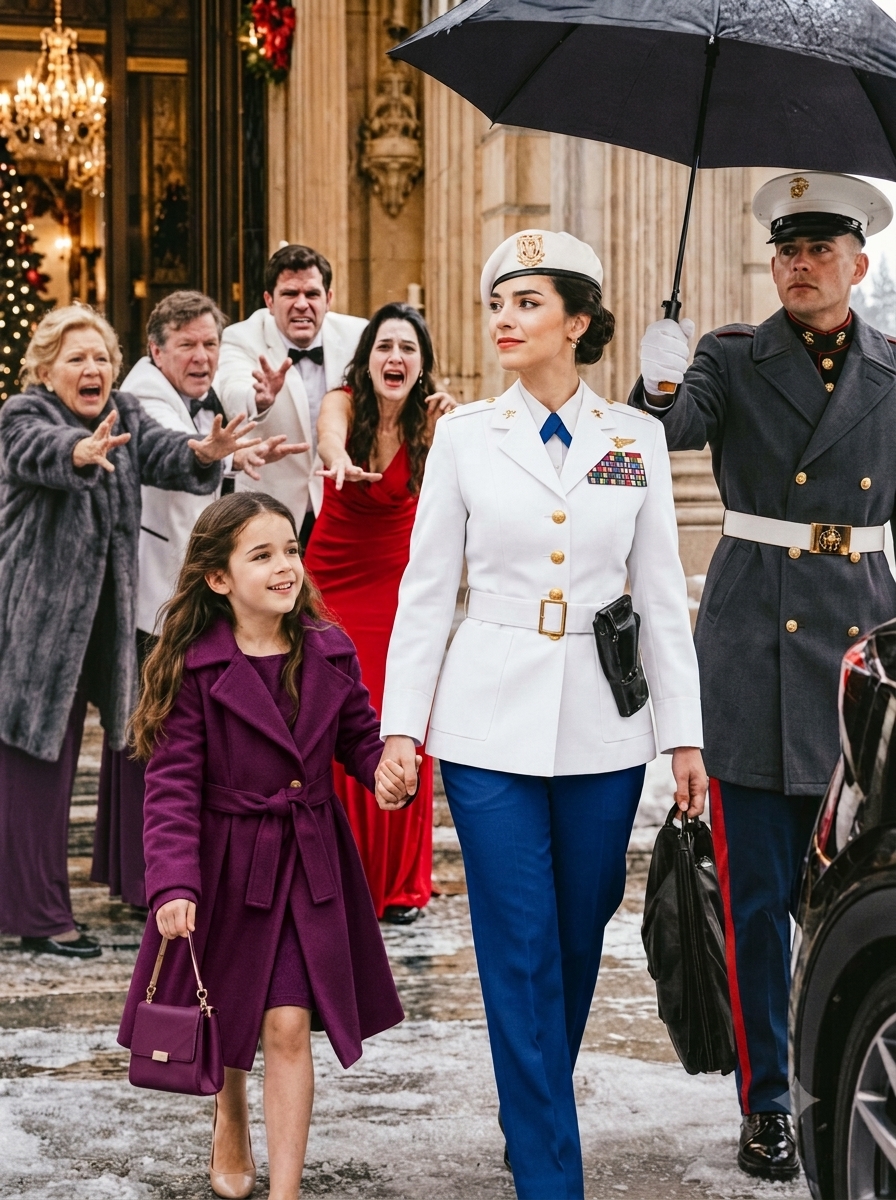
Colonel James Mercer entered first in service uniform, winter coat folded over one arm.
Major Daniel Ruiz followed.
The atmosphere in the room changed immediately.
Not because they were threatening.
They weren’t.
Because both men carried the unmistakable posture of people accustomed to serious places and serious decisions.
Mercer’s eyes found me.
Then Chloe.
Then the red mark on Chloe’s face.
His expression hardened.
“Ma’am.”
Every person at the table heard it.
Ma’am.
Mercer, a full colonel, had just addressed me with formal military respect.
Victoria looked from him to me.
“What the hell?”
I shifted Chloe higher against my shoulder.
“Colonel Mercer. Major Ruiz.”
Ruiz’s gaze landed on Chloe’s cheek.
His jaw tightened.
“Is everything all right, ma’am?”
“Family issue.”
Mercer understood immediately that I didn’t want details discussed.
He nodded.
“We need two minutes.”
David stepped forward.
“Who exactly are you?”
Mercer looked at him.
“Colonel James Mercer.”
“I heard your name. Why are you here for my wife?”
Mercer paused.
He glanced at me.
I gave a slight nod.
Only enough.
He looked back at David.
“Because Brigadier General Jessica Bennett is my commanding officer.”
No one breathed.
The words seemed to hang above the Christmas table.
Brigadier General.
Victoria’s mouth opened.
Margaret gripped the back of a chair.
Richard stared at me as though he had never seen me before.
David didn’t move at all.
Mercer seemed to realize he had just detonated something.
He looked at me.
“Was that not known?”
“No.”
He winced slightly.
“Understood, ma’am.”
Victoria was the first to recover.
“That’s impossible.”
Ruiz’s eyes flicked toward her.
She laughed nervously.
“No. Jessica isn’t a general.”
Nobody answered.
Victoria looked at David.
“Tell them.”
David kept staring at me.
“Jessica?”
I said nothing.
He stepped closer.
“You’re a brigadier general?”
“Yes.”
His voice dropped.
“Since when?”
“Four months.”
“You told me you were being moved into a new command position.”
“I was.”
“You never said general.”
“I told you I couldn’t discuss details until the appropriate release.”
“You couldn’t tell your husband?”
“Not at that time.”
Richard suddenly found his voice.
“What exactly do you command?”
I looked at Mercer.
He understood.
“Sir,” he said, “there are aspects of General Bennett’s work that are not appropriate for family discussion.”
General Bennett.
Margaret sank into her chair.
Seven years of judgment seemed to pass behind her eyes.
Every joke.
Every insult.
Every comment.
Richard looked at my simple black dress.
Then at my shoes.
Then back at Mercer.
“I thought she did administrative work.”
Ruiz almost smiled.
I didn’t.
“That assumption was never mine to correct,” I said.
Victoria touched her swollen cheek.
“So what? You think being some general makes you better than us?”
“No.”
My answer came immediately.
“It means exactly what it meant five minutes ago. Nothing at this dinner table.”
I looked at Chloe.
“This is what matters.”
Mercer followed my gaze.
His expression softened.
“Ma’am, do you need medical assistance for your daughter?”
“No. I’ll have her checked.”
Victoria scoffed.
“Oh my God.”
Mercer turned toward her.
It was the first time he truly looked at Victoria.
“Was the child struck?”
“That’s none of your business.”
“It’s a simple question.”
Richard stepped forward.
“This is a family matter, Colonel.”
Mercer nodded.
“Then I will stay out of it.”
He looked at me again.
“General, we do need a decision regarding tomorrow morning.”
David stared.
“Tomorrow?”
Mercer spoke carefully.
“Operational schedule change.”
I knew better than to ask for details in front of the family.
“Car?”
“Downstairs.”
“Give me ten minutes.”
“Yes, ma’am.”
He and Ruiz stepped back into the hall.
The elevator doors closed.
Nobody spoke for several seconds.
Then Victoria laughed.
It was a strange, desperate sound.
“Of course.”
She shook her head.
“Of course this is some performance.”
David turned on her.
“For once, Victoria, shut up.”
That surprised everyone.
Especially Victoria.
David faced me.
“You’ve been a general for four months?”
“Yes.”
“And before that?”
“Colonel.”
His expression collapsed.
“Colonel?”
“For nearly five years.”
Margaret covered her mouth.
Five years.
Which meant almost every time she’d called my career unimpressive, I’d already been a senior Army officer.
Richard slowly sat down.
“You never corrected us.”
“No.”
“Why?”
“Because I shouldn’t have to show you military rank to earn basic respect.”
Nobody had an answer.
“I didn’t need you to salute me,” I continued. “I didn’t need you to be impressed. I needed you to treat me like a human being.”
I looked at Margaret.
“When you mocked where I grew up, I stayed quiet.”
Then Richard.
“When you asked when I would find a serious career, I stayed quiet.”
Victoria.
“When you called me backward, cheap, boring, and embarrassing, I stayed quiet.”
Finally, David.
“When you told me they were just jokes, I stayed quiet.”
His eyes dropped.
“But tonight you asked me to stay quiet after our daughter was hit.”
“Jessica…”
“No.”
I held Chloe closer.
“You don’t get to fix this with my name or my rank.”
He looked genuinely shaken.
“I didn’t know.”
“Know what?”
“Who you were.”
There it was.
The sentence that told me he still didn’t understand.
“You knew exactly who I was.”
He frowned.
“You knew I was your wife.”
I pointed gently toward Chloe.
“You knew I was her mother.”
My voice broke slightly.
“You knew she was your daughter.”
I swallowed.
“That should have been enough.”
David looked like I’d struck him.
Maybe in a way, I had.
The truth can do that.
Chloe pulled back from my shoulder.
“Mommy?”
“Yes, sweetheart?”
“What’s a general?”
A laugh almost escaped me.
Not because anything was funny.
Because children have a way of cutting through every performance adults build.
I kissed her forehead.
“It’s someone in the Army who has a very big job.”
“Are you one?”
“Yes.”
Her eyes widened.
“Like a boss?”
“A little.”
“Do you boss Daddy?”
Despite everything, Ruiz probably would have laughed if he’d still been in the room.
I smiled for the first time all evening.
“No.”
Chloe considered this.
Then whispered, “Can we go home?”
“Absolutely.”
I put on her coat.
David followed me toward the door.
“Jessica, please.”
I didn’t stop.
“Can we talk?”
“Not tonight.”
“This is our marriage.”
“Then you should have remembered that when Chloe needed you.”
His face tightened with pain.
“You’re right.”
I stopped.
It was the first correct thing he’d said all evening.
He looked at Chloe.
“I failed her.”
I waited.
He crouched slowly.
“Chloe?”
She turned her face away.
That hurt him.
Good.
Not because I wanted David to suffer.
Because sometimes pain is the first honest teacher people listen to.
“I’m sorry,” he said softly. “Daddy should have stood up for you.”
Chloe stayed silent.
“You didn’t do anything wrong.”
She looked at me.
I nodded slightly.
David continued.
“And Aunt Victoria should never have hit you.”
Chloe finally looked at him.
“Why didn’t you tell her?”
He swallowed.
“Because Daddy was scared of making Grandma and Aunt Victoria angry.”
Children understand cowardice better than adults think.
Chloe stared at him.
“You’re bigger than them.”
Nobody in that room moved.
David closed his eyes briefly.
“Yes.”
“Then you should’ve helped me.”
His voice nearly disappeared.
“Yes.”
Chloe turned away.
I opened the front door.
Behind us, Margaret spoke.
“Jessica.”
I looked over my shoulder.
Her face was pale.
“I…”
She couldn’t seem to finish.
Maybe apologizing had never been part of her vocabulary.
Finally she said, “I didn’t know about your career.”
I stared at her.
“This isn’t about my career.”
She flinched.
“You shouldn’t need to know I wear stars on my uniform before deciding my daughter deserves protection.”
I stepped into the hall.
The elevator waited.
David followed us out.
“I’m coming.”
I turned.
“No.”
“Jessica—”
“Your family needs you.”
“My family is you and Chloe.”
I held his eyes.
“Then start acting like it.”
The elevator doors closed between us.
Downstairs, Mercer and Ruiz were waiting beside a black government vehicle.
Mercer immediately opened the rear door.
Then he looked at Chloe’s cheek.
“General, with your permission, there’s an urgent care clinic six minutes away.”
I nodded.
“Do it.”
For the next hour, I stopped being a general.
I was just a mother.
The doctor examined Chloe carefully.
No serious injury.
No damage to the eye.
No fracture.
Just swelling.
A bruise.
And a memory I would have given anything to erase.
Chicago police were contacted because the clinic’s documentation involved an adult striking a child.
I gave my statement.
I did not use my rank.
I did not make a phone call.
I did not ask for a favor.
And when the officer asked whether I had hit Victoria afterward, I told the truth.
“Twice.”
He raised an eyebrow.
“Open hand?”
“Yes.”
“Any injury you’re aware of?”
“No.”
“You understand she may file a complaint.”
“I do.”
Ruiz stared straight ahead.
Mercer said nothing.
I accepted responsibility.
Because accountability cannot mean one thing when other people fail and another thing when I do.
The next morning, Victoria did file a complaint.
And so did I regarding Chloe.
The family exploded.
Margaret called David twelve times.
Richard hired an attorney before lunch.
Victoria posted a vague message online about being “assaulted by an unstable relative.”
She deleted it forty minutes later.
Not because I threatened her.
Because David called her.
For once, he did not ask for peace.
He asked for accountability.
I wasn’t there for the conversation, but he told me later exactly what he said.
“If you ever mention Chloe publicly, if you blame her, or if you come near her without Jessica’s permission, you will no longer have a brother.”
Victoria apparently screamed.
David hung up.
It was not enough to repair what happened.
But it was a beginning.
Three days later, David moved into a hotel.
Not because I ordered him out.
Because when he came home, I told him the truth.
“I don’t know whether I can trust you to protect Chloe when protecting her costs you something.”
He didn’t argue.
That mattered.
For seven years, he had always defended his family.
This time he sat at our kitchen table and listened.
He listened when I described every insult he’d minimized.
Every holiday where I had been expected to smile.
Every time Victoria undermined me in front of Chloe.
Every time Margaret suggested Chloe needed “refinement.”
Every time David said, “That’s just how they are.”
Finally, he whispered, “I trained you to accept things I should’ve stopped.”
I looked at him.
“Yes.”
His eyes filled.
“I’m ashamed.”
“Then do something useful with that shame.”
He nodded.
And he did.
Family therapy.
Individual counseling.
No contact between Chloe and Victoria.
No unsupervised contact with Margaret or Richard.
No more Christmas at the penthouse.
No excuses.
No “that’s just how they are.”
Weeks passed.
Then months.
The criminal complaints were eventually resolved without some dramatic courtroom spectacle.
Victoria entered a diversion agreement related to striking Chloe, attended mandated anger-management sessions, and accepted restrictions on contact.
My own actions were reviewed as well.
I accepted the consequences required of me.
I had retaliated physically.
I would never pretend otherwise.
Protecting Chloe didn’t erase my responsibility for what I had done.
But something else happened during those months.
The Bennett family stopped asking who I really was.
Because the answer had finally become clear.
Not Brigadier General Jessica Bennett.
Not the small-town girl.
Not David’s quiet wife.
Not the woman Victoria enjoyed humiliating.
Those were labels.
Pieces.
Who was I really?
I was the mother who had spent too many years believing silence was strength.
I was the Army officer who could walk into rooms full of powerful people without fear, yet had allowed cruelty at a family table because I wanted my marriage to stay peaceful.
I was the woman who finally understood that peace purchased with humiliation is not peace.
It is surrender.
And I was done surrendering.
The following Christmas looked nothing like the one before.
No penthouse.
No crystal.
No sixteen-person dining table.
No golden decorations chosen by a designer.
Just our house.
A slightly crooked tree.
Too many lights.
Cookies Chloe had decorated with enough frosting to qualify as structural engineering.
David arrived at noon.
He no longer lived at the hotel.
We were trying again.
Slowly.
Carefully.
Not because one apology had fixed anything.
Because for eleven months, he had done the work.
He had stopped defending himself long enough to become someone worth trusting.
There were boundaries now.
Real ones.
Margaret and Richard came for two hours in the afternoon.
Victoria did not.
That was one of the boundaries.
Margaret stood awkwardly in our living room holding a wrapped present for Chloe.
She looked smaller than she had in the penthouse.
Less certain.
Before giving Chloe the present, she crouched down.
“May I give you a hug?”
Chloe looked at me.
I let her choose.
After a moment, she nodded.
Margaret hugged her gently.
Then she whispered something.
I couldn’t hear it.
Later, Chloe told me.
Grandma had said she was sorry she hadn’t protected her.
Not perfect.
But real.
Richard found me in the kitchen.
For several seconds, we stood in silence.
Then he said, “I spent most of my life believing respect followed achievement.”
I waited.
“You proved me wrong.”
I shook my head.
“No. Chloe did.”
He looked toward the living room.
“Yes.”
At three o’clock, they left.
No argument.
No pressure.
No demands.
That evening, snow began falling outside.
Chloe sat on the floor building a plastic military helicopter she’d gotten for Christmas.
David laughed.
“I wonder where she got that interest.”
Chloe looked up.
“Mommy?”
“Yes?”
“When do I get to see you in your general clothes?”
I smiled.
“You mean my uniform?”
“Yeah.”
David looked at me.
I hadn’t taken him to a formal ceremony since everything happened.
Maybe I had been keeping the two worlds separate for too long.
Two weeks later, I brought them both to a ceremony at Fort Sheridan.
Chloe sat in the front row.
David beside her.
Soldiers stood in formation beneath a pale winter sky.
When I stepped onto the platform in uniform, Chloe’s face changed.
She had seen photographs.
But photographs were not the same.
The stars.
The ribbons.
The soldiers standing when I approached.
The salute.
The command presence.
For the first time, my daughter saw the world I had hidden behind ordinary clothes and vague explanations.
Afterward, as families gathered near the building, Chloe ran toward me.
“Mommy!”
I crouched.
She threw her arms around my neck.
“Everyone listened to you!”
I laughed.
“Most days.”
“Are they scared of you?”
“No.”
She looked confused.
“Then why do they listen?”
I thought about the question.
Then about Christmas.
About Victoria.
About David.
About myself.
“Because good leaders don’t make people scared of them.”
Chloe leaned back.
“What do they do?”
“They make people feel safe.”
Her expression softened.
Then she touched the star on my shoulder.
“Like you make me safe?”
The question nearly broke me.
I kissed her forehead.
“I’m going to spend the rest of my life trying.”
Behind her, David stood quietly.
He didn’t interrupt.
He didn’t claim forgiveness.
He simply waited.
When I stood, he looked at me.
“I finally understand something.”
“What?”
“For seven years, my family kept asking what made you think you belonged with us.”
I said nothing.
His eyes moved toward the soldiers behind me.
Then toward our daughter.
“They were asking the wrong question.”
I raised an eyebrow.
He took my hand.
“The question should have been whether we deserved to belong with you.”
I shook my head.
“That’s still the wrong question.”
He frowned.
I looked at Chloe.
Then back at him.
“Families aren’t supposed to deserve each other because of money, rank, background, or status.”
He nodded slowly.
“They’re supposed to protect each other.”
“Yes.”
Chloe squeezed both our hands.
And standing there beneath the cold Chicago sky, I finally understood the truth myself.
My rank hadn’t saved us.
My authority hadn’t saved us.
The uniform hadn’t saved us.
A five-year-old girl with a red handprint on her cheek had forced every adult in her life to reveal who they really were.
Victoria revealed her cruelty.
Margaret and Richard revealed how easily pride could blind them.
David revealed his cowardice.
And I revealed something too.
I had confused endurance with strength.
For years, I believed staying silent proved that their insults couldn’t hurt me.
But strength isn’t measured by how much disrespect you can absorb.
Sometimes strength is speaking.
Sometimes strength is leaving.
Sometimes strength is admitting you were wrong.
And sometimes it is drawing a line so clearly that the people around you finally understand crossing it has a cost.
That Christmas night, my in-laws discovered that the quiet woman they had mocked for seven years was a brigadier general in the United States Army.
But that wasn’t the revelation that mattered.
The real revelation was mine.
I finally remembered that before I was an officer, before I was a wife, before I was anything anyone else expected me to be—
I was Chloe’s mother.
And nobody would ever make my daughter feel small enough to accept cruelty in the name of keeping the peace again.